


ISO 12649:2004
(Main)Graphic technology — Safety requirements for binding and finishing systems and equipment
Graphic technology — Safety requirements for binding and finishing systems and equipment
ISO 12649:2004 provides safety specifications for the design and construction of binding and finishing equipment operated in a system configuration or in stand-alone mode. It provides safety requirements for the design and construction of equipment used to convert printed or blank substrates into cut, folded, collated, assembled, bound, or otherwise finished product. It may also be applied to processes for preparing substrate for the printing process. It addresses recognized hazards specific to binding and finishing equipment and systems, such as mechanical, electrical, slipping, tripping, falling, ergonomics, noise, radiation, fire and explosion, thermal and emissions hazards.
Technologie graphique — Exigences de sécurité pour les systèmes et les équipements de reliure et de finition
Grafična tehnologija – Varnostne zahteve za sisteme in opremo v knjigoveznici in grafični dodelavi
General Information
- Status
- Withdrawn
- Publication Date
- 25-Apr-2004
- Withdrawal Date
- 25-Apr-2004
- Technical Committee
- ISO/TC 130 - Graphic technology
- Drafting Committee
- ISO/TC 130/WG 5 - Ergonomics - Safety
- Current Stage
- 9599 - Withdrawal of International Standard
- Start Date
- 25-Feb-2008
- Completion Date
- 12-Feb-2026
Relations
- Effective Date
- 15-Apr-2008
- Effective Date
- 15-Apr-2008

Frequently Asked Questions
ISO 12649:2004 is a standard published by the International Organization for Standardization (ISO). Its full title is "Graphic technology — Safety requirements for binding and finishing systems and equipment". This standard covers: ISO 12649:2004 provides safety specifications for the design and construction of binding and finishing equipment operated in a system configuration or in stand-alone mode. It provides safety requirements for the design and construction of equipment used to convert printed or blank substrates into cut, folded, collated, assembled, bound, or otherwise finished product. It may also be applied to processes for preparing substrate for the printing process. It addresses recognized hazards specific to binding and finishing equipment and systems, such as mechanical, electrical, slipping, tripping, falling, ergonomics, noise, radiation, fire and explosion, thermal and emissions hazards.
ISO 12649:2004 provides safety specifications for the design and construction of binding and finishing equipment operated in a system configuration or in stand-alone mode. It provides safety requirements for the design and construction of equipment used to convert printed or blank substrates into cut, folded, collated, assembled, bound, or otherwise finished product. It may also be applied to processes for preparing substrate for the printing process. It addresses recognized hazards specific to binding and finishing equipment and systems, such as mechanical, electrical, slipping, tripping, falling, ergonomics, noise, radiation, fire and explosion, thermal and emissions hazards.
ISO 12649:2004 is classified under the following ICS (International Classification for Standards) categories: 37.100.01 - Graphic technology in general. The ICS classification helps identify the subject area and facilitates finding related standards.
ISO 12649:2004 has the following relationships with other standards: It is inter standard links to ISO 12643-1:2007, ISO 12643-3:2008. Understanding these relationships helps ensure you are using the most current and applicable version of the standard.
ISO 12649:2004 is available in PDF format for immediate download after purchase. The document can be added to your cart and obtained through the secure checkout process. Digital delivery ensures instant access to the complete standard document.
Standards Content (Sample)
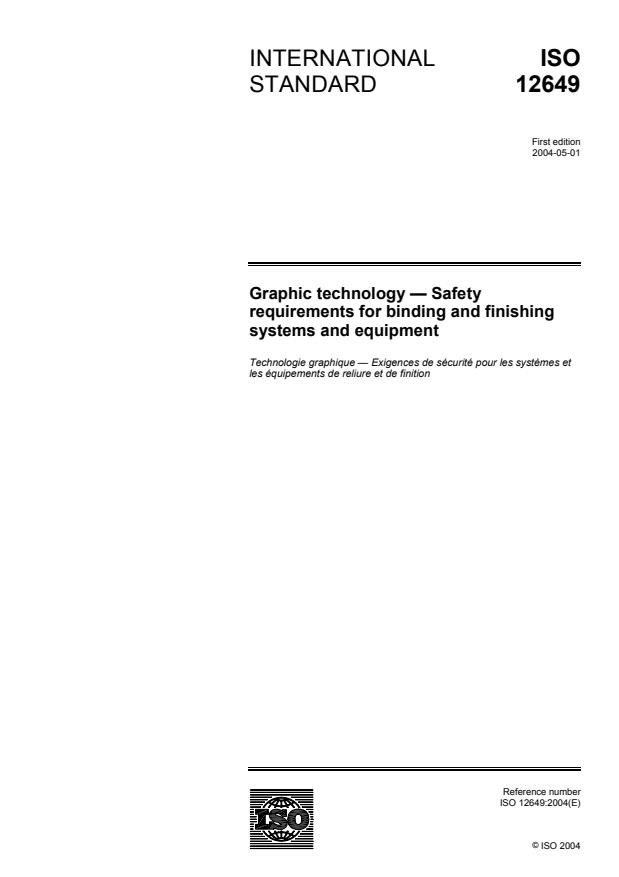
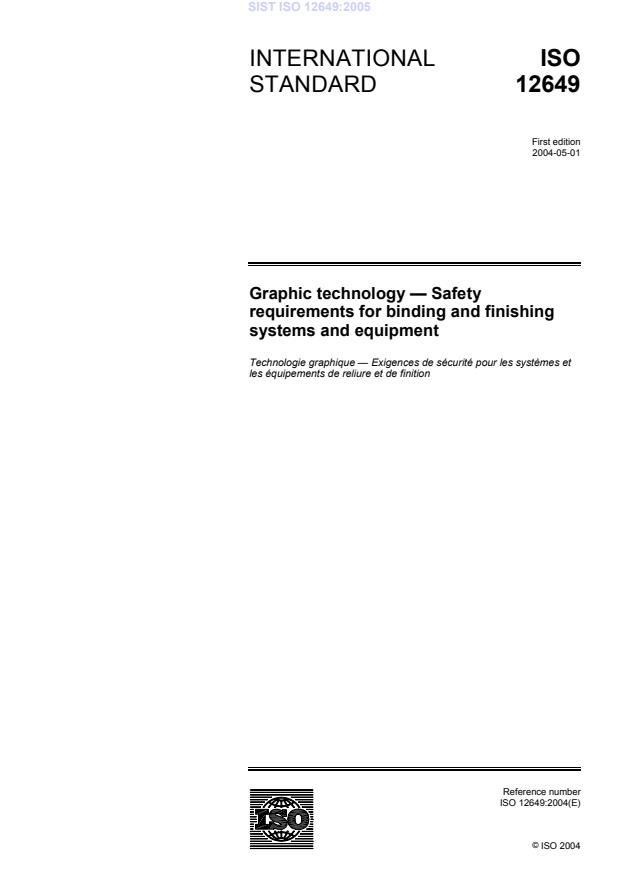
INTERNATIONAL ISO
STANDARD 12649
First edition
2004-05-01
Graphic technology — Safety
requirements for binding and finishing
systems and equipment
Technologie graphique — Exigences de sécurité pour les systèmes et
les équipements de reliure et de finition
Reference number
©
ISO 2004
PDF disclaimer
This PDF file may contain embedded typefaces. In accordance with Adobe's licensing policy, this file may be printed or viewed but
shall not be edited unless the typefaces which are embedded are licensed to and installed on the computer performing the editing. In
downloading this file, parties accept therein the responsibility of not infringing Adobe's licensing policy. The ISO Central Secretariat
accepts no liability in this area.
Adobe is a trademark of Adobe Systems Incorporated.
Details of the software products used to create this PDF file can be found in the General Info relative to the file; the PDF-creation
parameters were optimized for printing. Every care has been taken to ensure that the file is suitable for use by ISO member bodies. In
the unlikely event that a problem relating to it is found, please inform the Central Secretariat at the address given below.
© ISO 2004
All rights reserved. Unless otherwise specified, no part of this publication may be reproduced or utilized in any form or by any means,
electronic or mechanical, including photocopying and microfilm, without permission in writing from either ISO at the address below or
ISO's member body in the country of the requester.
ISO copyright office
Case postale 56 • CH-1211 Geneva 20
Tel. + 41 22 749 01 11
Fax + 41 22 749 09 47
E-mail copyright@iso.org
Web www.iso.org
Published in Switzerland
ii © ISO 2004 – All rights reserved
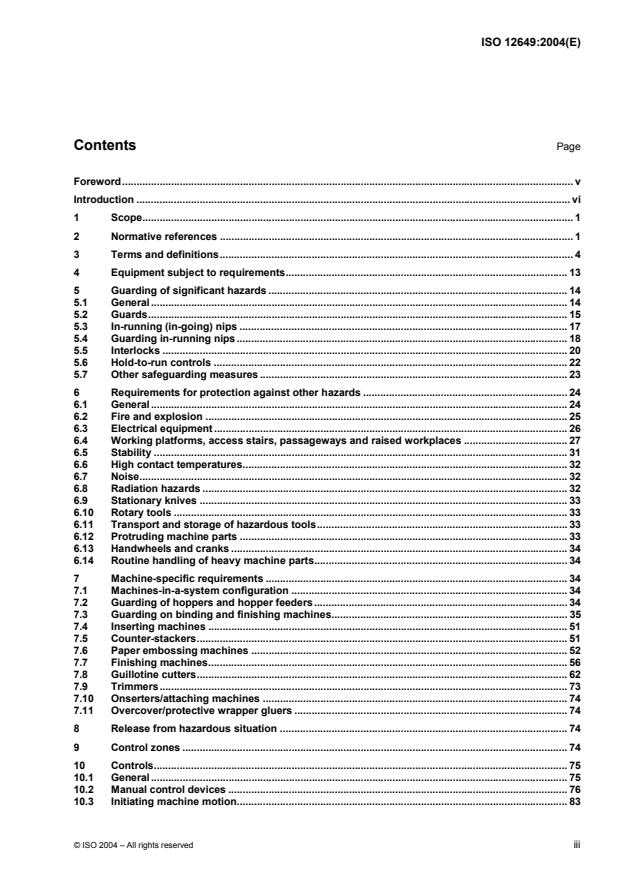
Contents Page
Foreword. v
Introduction . vi
1 Scope. 1
2 Normative references . 1
3 Terms and definitions. 4
4 Equipment subject to requirements. 13
5 Guarding of significant hazards . 14
5.1 General. 14
5.2 Guards. 15
5.3 In-running (in-going) nips . 17
5.4 Guarding in-running nips. 18
5.5 Interlocks . 20
5.6 Hold-to-run controls . 22
5.7 Other safeguarding measures . 23
6 Requirements for protection against other hazards . 24
6.1 General. 24
6.2 Fire and explosion . 25
6.3 Electrical equipment . 26
6.4 Working platforms, access stairs, passageways and raised workplaces . 27
6.5 Stability . 31
6.6 High contact temperatures. 32
6.7 Noise. 32
6.8 Radiation hazards . 32
6.9 Stationary knives . 33
6.10 Rotary tools . 33
6.11 Transport and storage of hazardous tools. 33
6.12 Protruding machine parts . 33
6.13 Handwheels and cranks . 34
6.14 Routine handling of heavy machine parts. 34
7 Machine-specific requirements . 34
7.1 Machines-in-a-system configuration . 34
7.2 Guarding of hoppers and hopper feeders. 34
7.3 Guarding on binding and finishing machines. 35
7.4 Inserting machines . 51
7.5 Counter-stackers. 51
7.6 Paper embossing machines . 52
7.7 Finishing machines. 56
7.8 Guillotine cutters. 62
7.9 Trimmers. 73
7.10 Onserters/attaching machines . 74
7.11 Overcover/protective wrapper gluers . 74
8 Release from hazardous situation . 74
9 Control zones . 74
10 Controls. 75
10.1 General. 75
10.2 Manual control devices . 76
10.3 Initiating machine motion. 83
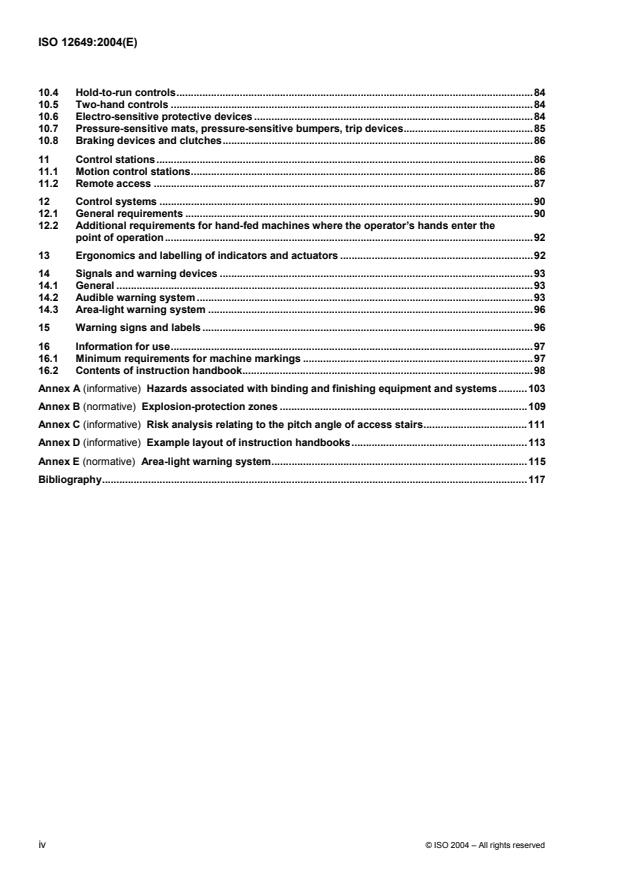
10.4 Hold-to-run controls.84
10.5 Two-hand controls .84
10.6 Electro-sensitive protective devices .84
10.7 Pressure-sensitive mats, pressure-sensitive bumpers, trip devices.85
10.8 Braking devices and clutches.86
11 Control stations.86
11.1 Motion control stations.86
11.2 Remote access .87
12 Control systems .90
12.1 General requirements .90
12.2 Additional requirements for hand-fed machines where the operator’s hands enter the
point of operation.92
13 Ergonomics and labelling of indicators and actuators .92
14 Signals and warning devices .93
14.1 General .93
14.2 Audible warning system .93
14.3 Area-light warning system .96
15 Warning signs and labels .96
16 Information for use.97
16.1 Minimum requirements for machine markings .97
16.2 Contents of instruction handbook.98
Annex A (informative) Hazards associated with binding and finishing equipment and systems.103
Annex B (normative) Explosion-protection zones .109
Annex C (informative) Risk analysis relating to the pitch angle of access stairs.111
Annex D (informative) Example layout of instruction handbooks.113
Annex E (normative) Area-light warning system.115
Bibliography.117
iv © ISO 2004 – All rights reserved
Foreword
ISO (the International Organization for Standardization) is a worldwide federation of national standards bodies
(ISO member bodies). The work of preparing International Standards is normally carried out through ISO
technical committees. Each member body interested in a subject for which a technical committee has been
established has the right to be represented on that committee. International organizations, governmental and
non-governmental, in liaison with ISO, also take part in the work. ISO collaborates closely with the
International Electrotechnical Commission (IEC) on all matters of electrotechnical standardization.
International Standards are drafted in accordance with the rules given in the ISO/IEC Directives, Part 2.
The main task of technical committees is to prepare International Standards. Draft International Standards
adopted by the technical committees are circulated to the member bodies for voting. Publication as an
International Standard requires approval by at least 75 % of the member bodies casting a vote.
Attention is drawn to the possibility that some of the elements of this document may be the subject of patent
rights. ISO shall not be held responsible for identifying any or all such patent rights.
ISO 12649 was prepared by Technical Committee ISO/TC 130, Graphic technology.
Introduction
During the development of this International Standard, existing relevant standards of other countries were
taken into consideration. An effort has been made to harmonize the requirements of all countries, recognizing
that national standards or laws may dictate national requirements. In cases where it was known that there is a
national requirement that differs from this International Standard, that has been noted.
This International Standard was developed to harmonize three U.S. safety standards:
ANSI B65.2, Safety standard — Binding and finishing systems,
ANSI B65.3 Safety standard — Guillotine cutters, mill trimmers, and integral handling equipment,
ANSI B65.4, Safety standard — Three-knife trimmers, including rotary, and single- and multiple-knife
trimmers;
and three European standards:
prEN 1010-1, Safety of machinery — Safety requirements for the design and construction of printing and
paper converting machinery — Part 1: Common requirements,
EN 1010-3, Safety of machinery — Safety requirements for the design and construction of printing and
paper converting machinery — Part 3: Cutting machines,
EN 1010-4, Safety of machinery — Safety requirements for the design and construction of printing and
paper converting machinery — Part 4: Bookbinding, paper converting and paper finishing machines.
vi © ISO 2004 – All rights reserved
INTERNATIONAL STANDARD ISO 12649:2004(E)
Graphic technology — Safety requirements for binding and
finishing systems and equipment
1 Scope
This International Standard provides safety specifications for the design and construction of binding and
finishing equipment operated in a system configuration or in stand-alone mode.
This International Standard provides safety requirements for the design and construction of equipment used to
convert printed or blank substrates into cut, folded, collated, assembled, bound, or otherwise finished product.
It may also be applied to processes for preparing substrate for the printing process.
It addresses recognized hazards specific to binding and finishing equipment and systems in the following
areas:
mechanical;
electrical;
slipping, tripping, falling;
ergonomics;
noise;
radiation;
fire and explosion;
thermal;
emissions.
This International Standard applies to new machines manufactured after December 31 of the year following
the year of issue of this International Standard.
Equipment covered by this International Standard may be used in a stand-alone configuration, or in
combination with other machines affected by an integrated control system. These may include but are not
limited to, the combinations of the machines noted in Clause 4.
2 Normative references
The following referenced documents are indispensable for the application of this document. For dated
references, only the edition cited applies. For undated references, the latest edition of the referenced
document (including any amendments) applies.
ISO 8031, Rubber and plastic hoses and hose assemblies — Determination of electrical resistance
ISO 11553, Safety of machinery — Laser processing machines — Safety requirements
ISO/TR 11688-1, Acoustics — Recommended practice for the design of low-noise machinery and
equipment — Part 1: Planning
ISO 12100-1, Safety of machinery — Basic concepts, general principles for design — Part 1: Basic
terminology, methodology
ISO 12100-2:2003, Safety of machinery — Basic concepts, general principles for design — Part 2: Technical
principles
ISO 12648:2003, Graphic technology — Safety requirements for printing press systems
ISO 13849-1:1999, Safety of machinery — Safety-related parts of control systems — Part 1: General
principles for design
ISO 13850, Safety of machinery — Emergency stop — Principles for design
ISO 13851, Safety of machinery — Two-hand control devices — Functional aspects and design principles
ISO 13852:1996, Safety of machinery — Safety distances to prevent danger zones being reached by the
upper limbs
ISO 13854, Safety of machinery — Minimum gaps to avoid crushing of parts of the human body
ISO 13855, Safety of machinery — Positioning of protective equipment with respect to the approach speeds of
parts of the human body
ISO 13856-1, Safety of machinery — Pressure-sensitive protective devices — Part 1: General principles for
the design and testing of pressure-sensitive mats and pressure-sensitive floors
ISO 14119:1998, Safety of machinery — Interlocking devices associated with guards — Principles for design
and selection
ISO 14120, Safety of machinery — Guards — General requirements for the design and construction of fixed
and movable guards
ISO 14122-1, Safety of machinery — Permanent means of access to machinery — Part 1: Choice of a fixed
means of access between two levels
ISO 14122-2, Safety of machinery — Permanent means of access to machinery — Part 2: Working platforms
and gangways
ISO 14122-3, Safety of machinery — Permanent means of access to machinery — Part 3: Stairs, stepladders
and guard-rails
ISO 14123-1, Safety of machinery — Reduction of risks to health from hazardous substances emitted by
machinery — Part 1: Principles and specifications for machinery manufacturers
ISO 14123-2, Safety of machinery — Reduction of risks to health from hazardous substances emitted by
machinery — Part 2: Methodology leading to verification procedures
1)
ISO 15847:— , Graphic technology — Graphical symbols for printing press systems and finishing systems,
including related auxiliary equipment
1) To be published.
2 © ISO 2004 – All rights reserved
IEC 60079-1, Electrical apparatus for explosive gas atmospheres — Part 1: Flameproof enclosures “d”
IEC 60079-2, Electrical apparatus for explosive gas atmospheres — Part 2: Pressurized enclosures “p”
IEC 60079-5, Electrical apparatus for explosive gas atmospheres — Part 5: Powder filling “q”
IEC 60079-6, Electrical apparatus for explosive gas atmospheres — Part 6: Oil-immersion “o”
IEC 60079-7, Electrical apparatus for explosive gas atmospheres — Part 7: Increased safety “e”
IEC 60079-11, Electrical apparatus for explosive gas atmospheres — Part 11: Intrinsic safety “I”
IEC 60079-14, Electrical apparatus for explosive gas atmospheres — Part 14: Electrical installations in
hazardous areas (other than mines)
IEC 60079-18, Electrical apparatus for explosive gas atmospheres — Part 18: Encapsulation “m”
IEC 60204-1:2000, Safety of machinery — Electrical equipment of machines — Part 1: General requirements
IEC 60825-1, Safety of laser products — Part 1: Equipment classification, requirements and user’s guide
IEC 60947-5-1, Low-voltage switchgear and controlgear — Part 5-1: Control circuit devices and switching
elements — Electromechanical control circuit devices
IEC 61010-1, Safety requirements for electrical equipment for measurement, control, and laboratory use —
Part 1: General requirements
IEC 61310-1, Safety of machinery — Indication, marking and actuation — Part 1: Requirements for visual,
auditory and tactile signals
IEC 61310-2, Safety of machinery — Indication, marking and actuation — Part 2: Requirements for marking
IEC 61496-1, Safety of machinery — Electro-sensitive protective equipment — Part 1: General requirements
and tests
IEC 61496-2, Safety of machinery — Electro-sensitive protective equipment — Part 2: Particular requirements
for equipment using active opto-electronic protective devices (AOPDs)
EN 563, Safety of machinery — Temperatures of touchable surfaces — Ergonomics data to establish
temperature limit values for hot surfaces
EN 1127-1, Explosive atmosphere — Explosion prevention and protection — Part 1: Basic concepts and
methodology
EN 1539, Dryers and ovens, in which flammable substances are released — Safety requirements
EN 1760-2, Safety of machinery — Pressure sensitive protective devices — Part 2: General principles for the
design and testing of pressure sensitive edges and pressure sensitive bars
EN 12198-1:2000, Safety of machinery — Assessment and reduction of risks arising from radiation emitted by
machinery — Part 1: General principles
EN 13023, Noise measurement methods for printing, paper converting, paper making machines and auxiliary
equipment —Accuracy grades 2 and 3
3 Terms and definitions
For the purposes of this International Standard, the terms and definitions given in ISO 13849-1:1999 and the
following apply.
3.1
actuator
part of the actuating system to which an external actuating force is applied
[39]
[IEV 441-15-22]
NOTE 1 The actuator may take the form of a handle, knob, pushbutton, roller, plunger, etc.
NOTE 2 There are some actuating means that do not require an external actuating force, but only an action.
NOTE 3 See also machine actuator (3.48)
3.2
anti-repeat device
mechanical or electromechanical mechanism to ensure that only one cutting cycle occurs for each manual
activation or automatic cut if the primary stopping system or single-cycle device (3.83) fails
3.3
armed condition
machine status in which machine motion can be automatically initiated
NOTE Zero speed (3.92) can be considered to be an armed condition.
3.4
audible alarm
horn, bell or other distinctive audible warning device which sounds to indicate impending machine motion
3.5
authorized person
person identified by plant management as having special training or designated to act in specified situations
NOTE The specified situations can include special tasks to be performed; the function of the adjustments in the work
zone; proper operation of adjustments and controls; all types of hazards in the area where the task is to be performed; the
application of equivalent, alternative protection to perform the task; improper actions that can cause injury; and the
consequences of those improper actions.
3.6
automatic cutting sequence
programmed succession of clamping operations and/or cutting movements that is initiated by the operator and
proceeds to a specified point without further intervention by the operator
3.7
back rounding and pressing machine
apparatus for processing book signatures, i.e. for rounding the spine and the trimmed front edge of book
signatures and compressing the resulting signatures
3.8
backgauge
movable device (automatic or manual) on a guillotine cutter, positioned square to the cutting table, and which
is used to stop the stack of material to be cut when the material is pushed into the opening under the cutting
blade by the operator, and to determine the dimensions of the cut
3.9
backgauge drive
mechanism to position the backgauge (3.8) prior to the initiation of the cut
4 © ISO 2004 – All rights reserved
3.10
backlining and head banding machines
equipment for the automatic production of hard cover books where the binding together of the signatures is
rounded or flat, with glue, gauze, or paper
3.11
barrier guard
distance guard
guard (3.35) that reduces or prevents physical access to a hazard zone by closing off access to an area
containing one or more hazards
EXAMPLE A perimeter fence or tunnel guard.
3.12
binding and finishing system
combination of machines functioning in an integrated configuration to turn an incomplete printed product into a
finished product by means of one or more processes, such as cutting, folding, binding, stitching, gluing,
wrapping, etc.
3.13
book cover crease forming machine
〈hard-cover bookbinding〉 apparatus for creating, under heat and pressure, a permanent bend in the cover of a
hard-cover book, then pressing the entire cover surface
3.14
book press
press used for flattening books after binding
3.15
book signature press
power-operated press used for flattening book signatures, which are fed and aligned manually
3.16
casing-in machine
〈hard-cover bookbinding〉 apparatus for gluing the end papers of the book signatures to the interior surfaces
of the book cover
3.17
category 0 stop
uncontrolled stop
stopping by immediate removal of power to the machine actuators (3.48)
[IEC 60204-1:2000]
3.18
category 1 stop
controlled stop with power available to the machine actuators (3.48) to achieve the stop and then removal of
power when the stop is achieved
[IEC 60204-1:2000]
3.19
category 2 stop
controlled stop with power left available to the machine actuators (3.48)
[IEC 60204-1:2000]
3.20
clamp
device using pressure to secure product so that it does not move during an operation
3.21
clamp drive
mechanism by which the clamp(s) (3.20) of the paper cutter is/are forced against the material to be cut
3.22
coater
finishing machine that applies a predetermined thickness of a liquid substance (for example glue, varnish, ink)
on substrates made of paper or a similar material
3.23
counter-stacker
machine for stacking of piles of leaflets, books, magazines or newspapers such that the successive layers are
at 180°
3.24
cutting cycle
〈for machines with (a) manually driven clamp(s) (3.20)〉 programmed succession of operations that begins
when the knife drive is activated and ends when the knife returns to its retracted position
3.25
cutting cycle
〈for machines with (a) power-driven clamp(s) (3.20)〉 programmed succession of operations that begins when
high-pressure clamping is initiated and ends when the knife(s) and clamp(s) return to their retracted positions
after a single clamp/knife stroke
3.26
cutting zone
three-dimensional space through which any part of the knife(s) and/or clamp(s) (3.20) travel(s) during the
entire cutting cycle (3.24, 3.25)
3.27
drive
mechanism, divided into the following two general categories, which causes a machine or any of its elements
to move:
drives with no stored energy, which include, but are not limited to, direct-motor drives;
drives having stored energy, which include, but are not limited to, motor-flywheel-clutch drives and
hydraulic-pneumatic drives
3.28
electrical hazard
source of potential injury or death from electric shock or burn
[adapted from ISO 12100-1:2003]
3.29
electro-sensitive protective device
ESPD
apparatus that detects the presence of a person or part of a person or object in a defined area, using any
detection means including, but not limited to, photoelectric, light screen, ultrasonic, etc.
3.30
emergency stop device
manually actuated control used to initiate an emergency stop function (3.31)
[adapted from ISO 13850:1996]
6 © ISO 2004 – All rights reserved
3.31
emergency stop function
mechanism activated by a single human motion and intended to halt machine activity in order to avoid injury to
persons, damage to machinery or damage to work in progress
3.32
fixed guard
guard (3.35) that is securely affixed by fasteners that require a tool(s) to remove in order to gain access to an
area with a significant hazard
3.33
gang stitcher
machine for stitching folded sheets of paper, during the operation of which individual folded sheets are
removed by feeding grippers and the open sheets are stacked on top of each other on a transport chain for
subsequent back stitching
3.34
gathering machine
apparatus that assembles sheets or folded sheets in a binding line
3.35
guard
physical barrier that restricts access to a significant hazard
3.36
guillotine cutter
power-driven machine having a single knife which is used primarily to cut paper products, stacks of paper, or
other substrates as specified by the manufacturer
NOTE This definition includes equipment classified as mill trimmers.
3.37
hazard zone
any area within and/or around machinery in which a person is exposed to risk of injury or damage to health
[adapted from ISO 12100-1:2003]
3.38
high-pressure clamping
operation of clamps (3.20) with a dynamic force in excess of 300 N for machines up to and including 1,6 m in
width, or 500 N for machines greater than 1,6 m in width, when measured at 75 % of the clamp opening (e.g.
with the clamp at 25 % of its maximum travel distance measured from the retracted position)
NOTE The 75 % requirement is to ensure the measurement is made at the position that approximates the size of an
operator's hand.
3.39
hold-to-run control
control that starts and maintains machine motion only as long as the control is activated
3.40
inch
jog
〈operation of machinery〉 machine motion requiring maintained activation engagement of a hold-to-run control
and which will continue until the control is released or until a pre-determined displacement (limited inch) has
been reached
3.41
inch speed
how fast the machine is operating while in inch (3.40) mode
3.42
infrequently used workplace
area in which an activity is carried out, such as observation, make-ready, jam clearing, minor servicing,
crossing inserting hoppers or conveyer belts, etc., that is routine, repetitive, integral to (but not necessarily
during) production, and done only on an occasional basis
3.43
in-running nip
area created either by two rotating components that are rotating inward, or by one component rotating toward
an adjacent surface (see Figure 1)
a) Two counter- b) Two rolls c) Two rolls d) One rotating e) Belt, chain or
rotating rolls rotating in the same rotating in the same roll and an adjacent web which is driving,
direction at different direction, but with fixed object or being driven by, a
speeds different surface roll
properties (friction)
Figure 1 — In-running nips
3.44
inserting machine
apparatus that inserts printed matter such as leaflets and magazines at a predetermined position in other
printed products, such as newspapers or magazines
3.45
knife drive
mechanism by which the knife of the guillotine is forced through the material to be cut
3.46
laminator
paper finishing machine that applies a solid material (e.g. foil, paper) on a substrate made of paper or a similar
material
3.47
low-pressure clamping
〈for machines with a power-driven clamp(s)〉 operation of clamps (3.20) at a dynamic force not exceeding
300 N for machines up to and including 1,6 m in width, or 500 N force dynamic for machines greater than
1,6 m in width, when measured at 75 % of the clamp opening (with the clamp at 25 % of its maximum travel
measured from the retracted position)
NOTE The 75 % requirement is to ensure the measurement is made at the position that approximates the size of an
operator's hand.
3.48
machine actuator
power mechanism used to effect motion of a machine
[ISO 13850:1996]
8 © ISO 2004 – All rights reserved
3.49
maintained-contact control
control that remains in an open or closed state after its activation
3.50
maintenance
operation(s) required to assure that the machine remains in acceptable operating condition and that is/are
usually performed when the machine is not available for production
NOTE Maintenance (for example, repairing or replacing broken, worn or damaged parts; performing lubrication;
preventive servicing; etc.) is normally performed by qualified maintenance personnel, or operators, who have been trained
about the types of hazards in the area in which their tasks are to be performed and about how these hazards can be
avoided. Such maintenance is generally performed with energy isolated, when possible.
3.51
manual clamping
operation of clamps (3.20) in which the dynamic and static forces and motion of the clamp are directly
supplied by the operator
3.52
manual control device
mechanism comprising part of the actuating system to which a manual action is applied
[39]
[Adapted from IEV 441-15-22]
3.53
mechanical hazard
source of potential injury to a person created by motion of machinery, components or material (for example,
crushing and shearing points; trapping points; in-running nips; cutting, punching and impact points)
EXAMPLES Gear, chain and worm drives; V-belt, flat belt, cord and rope drives; pulling and supporting elements on
continuous conveyors; spoke wheels and fly wheels; shafts and shaft ends; rollers; slides; push rods and similar parts,
tools and clamping devices.
3.54
mechanical hazard point
location of a mechanical hazard on a machine where a person can be injured by parts of a machine or by
machine movement, such as tools of machines or parts thereof, work pieces or parts thereof, or materials
being processed
3.55
momentary contact control
control that is opened or closed only during its actuation
3.56
motion control
control that initiates machine movement or movement at zero speed (3.92), or places the machine in the
armed condition (3.3)
3.57
motion control station
device station that contains at least an emergency stop control and which may contain a motion-initiation
control
3.58
motion zone
area defined by any machine component, or group of machine components, which is driven directly by the
binding and finishing system drive motor(s) or indirectly by other means
3.59
movable control station
control station that is permanently wired to the equipment, but which can be moved within a range limited by
the length of the attached cable
3.60
movable guard
guard (3.35) that does not require a tool to move or remove it to gain access to a significant hazard
3.61
nip guard
guard (3.35) located at an in-going nip
EXAMPLES Nip bar, finger bar, finger guard.
3.62
non-motion zone
area defined by any machine component, or group of machine components, which, due to system
configuration, is not driven by the drive motor(s) of the binding and/or finishing system, or by the web
NOTE A freestanding (not machine-mounted) console is considered to be a non-motion zone.
3.63
non-operational machine
apparatus configured for functions other than delivering products, such as make-ready or wash-up
3.64
normal operation
usual functioning and conditions that exist during set-up, make-ready, production and minor servicing,
adjusting and cleaning performed by operators, but not including maintenance (3.50) operations
3.65
operating position
location where normal functions (make-ready and other routine, repetitive tasks) requiring control of the main
drive motor(s) are performed
3.66
operational machine
apparatus that is configured to deliver product, is composed of at least one motion zone, and may include
non-motion zones
3.67
paper drill
machine used to drill holes into piles of paper
3.68
paper embossing machine
machine for finishing paper surfaces by using cylinders to press a design, etc., in relief into the paper
3.69
paper finishing machine
apparatus used for applying liquid or solid coating material on a substrate made of paper or a similar material
3.70
perfect binder
machine for the automatic production of brochures (soft-cover) or book signatures (hard-cover) where
gathered folded sheets or single sheets are bound to form book or brochure signatures by applying glue on
the pre-processed book back, and where book or brochure signatures are inserted into covers by gluing the
cover on the back and/or sides
10 © ISO 2004 – All rights reserved
3.71
personnel warning lights
red and green lights used to indicate the ready, running and safe conditions of the machine relative to
personnel safety
NOTE These lights are not the same as machine status lights (3.85).
3.72
portable control station
control station that can be disconnected from one location, moved to another location and be reconnected
3.73
positive mechanical action
linkage of one component with another component such that movement of the former inevitably compels
movement of the latter, either by direct contact or by a rigid connection
NOTE 1 This definition also applies to a component that prevents any movement of another component by virtue of its
presence.
NOTE 2 When the movement of one mechanical component simply allows another component to move freely (e.g. by
gravity, spring force, etc.), there is no positive mechanical action of the former component on the latter.
3.74
positive opening
contact separation as the direct result of a specified movement of the actuator (3.1) through non-resilient
members, e.g. those not dependent on springs
3.75
programmable system
apparatus which a machine operator can use to enter and record various data and functions, including cutting
dimensions, auxiliary operations and, if so equipped, automatic cut sequences, and which, on command, will
step the machine through the functions recorded in a specific programmed sequence
NOTE The system might be capable of storing one or more job sequences in its memory.
3.76
raised workplaces
areas where functions are regularly performed, and are at least 0,5 m above access level
3.77
ready condition
status of a machine in which motion can be initiated by the operator
3.78
remote control
connection to the control station of a machine by use of an external communication link
3.79
routine and regular access
repetitive access to a hazard point that is required for manual feeding of a machine during normal production
activity
3.80
safe condition
machine status in which movement of the main drive motor(s) (prime mover) of the motion zone is prevented,
which may apply to the entire machine or to one or more motion zones, and which exists only when one or
more stop/safe or emergency stop pushbuttons is/are latched in the depressed position
3.81
sheet-folding machine
apparatus to cut, perforate and/or crease single or multiple folds in single sheets of paper
3.82
significant hazard
potential source of severe or disabling injury or death
3.83
single-cycle device
mechanism that ensures that only one cutting cycle occurs for each manual activation or automatic cut
NOTE See anti-repeat device (3.2).
3.84
smooth roller
cylinder
elongated solid body with a circular cross-section having a smooth surface; i.e. with grooves or elevations no
more than 4 mm deep and with circumferential slots no more than 8 mm wide with no sharp or cutting edges
(see Figure 2)
Dimensions in millimetres
Figure 2 — Smooth roller/cylinder
3.85
status lights
lights that indicate machine status or machine process condition
NOTE These are not the same as personnel warning lights (3.71).
3.86
stored energy
potential energy that may be released without actuation of the machine drive or controls
3.87
tool
implement, such as a key or wrench, designed to operate a fastener
NOTE An improvised implement such as a coin or fingernail file is not considered to be a tool.
3.88
trip nip bar
movable protective bar located at an in-running nip which, when pushed, activates the interlocked safety
system of the machine
3.89
two-hand control
safety device that consists of two manual control devices that must be operated simultaneously by a single
operator to initiate potentially hazardous machine motion
12 © ISO 2004 – All rights reserved
3.90
warning period
time interval during which machine motion is prevented and a warning is given to personnel that machine
motion is about to occur
3.91
wireless control
transmission of commands and signals between a machine-control system and the motion-control station(s)
using means other than a physical connection
3.92
zero speed
condition of machine movement in which the drive control system is actively holding the machine at a position
and while machine movement is not discernible, machine movement can be initiated without warning
NOTE Zero speed can be considered to be an armed condition (3.3).
4 Equipment subject to requirements
Equipment covered by this International Standard may be used in a stand-alone configuration, or in
combination with other machines affected by an integrated control system. This International Standard is
intended to apply to a wider range of equipment used in the binding and finishing process. These may include
but are not limited to, the combinations of the machines noted in the following list:
addressing equipment;
attaching machines;
book presses (press for pressing books after binding);
book stackers;
bundle presses (to compress bundles of product);
bundle wrappers;
bundling machines (strappers);
case makers;
casing-in machines;
conveyors;
counter-stackers;
cutters and trimmers;
depalletizers;
die cutters;
drilling and sewing machines;
embossers;
foil stampers;
folders;
gathering machines;
gripper conveyors;
guillotine cutters;
imprinting equipment;
inserters, card feeders;
laminators;
mailing systems;
numbering equipment;
off-line coaters;
onserters, attaching machines;
overcover/protective wrapper gluers;
palletized product wrappers;
perfect binders;
pocket printers;
polywrappers;
robotics (e.g. automatic guided vehicles);
rotary trimmers, slitters;
scoring equipment;
side gluers;
stampers;
stitching/sewing machines (e.g. gang stitchers, saddle stitchers);
stream feeders.
5 Guarding of significant hazards
5.1 General
Guarding, consistent with operation of the machine, shall be provided in tho
...
2003-01.Slovenski inštitut za standardizacijo. Razmnoževanje celote ali delov tega standarda ni dovoljeno.Technologie graphique -- Exigences de sécurité pour les systèmes et les équipements de reliure et de finitionGraphic technology -- Safety requirements for binding and finishing systems and equipment37.100.10Reprodukcijska opremaReproduction equipmentICS:Ta slovenski standard je istoveten z:ISO 12649:2004SIST ISO 12649:2005en01-januar-2005SIST ISO 12649:2005SLOVENSKI
STANDARD
Reference numberISO 12649:2004(E)© ISO 2004
INTERNATIONAL STANDARD ISO12649First edition2004-05-01Graphic technology — Safety requirements for binding and finishing systems and equipment Technologie graphique — Exigences de sécurité pour les systèmes et les équipements de reliure et de finition
©
ISO 2004 All rights reserved. Unless otherwise specified, no part of this publication may be reproduced or utilized in any form or by any means, electronic or mechanical, including photocopying and microfilm, without permission in writing from either ISO at the address below or ISO's member body in the country of the requester. ISO copyright office Case postale 56 • CH-1211 Geneva 20 Tel.
+ 41 22 749 01 11 Fax
+ 41 22 749 09 47 E-mail
copyright@iso.org Web
www.iso.org Published in Switzerland
ii © ISO 2004 – All rights reserved
Hazards associated with binding and finishing equipment and systems.103 Annex B (normative)
Explosion-protection zones.109 Annex C (informative)
Risk analysis relating to the pitch angle of access stairs.111 Annex D (informative)
Example layout of instruction handbooks.113 Annex E (normative)
Area-light warning system.115 Bibliography.117
INTERNATIONAL STANDARD ISO 12649:2004(E) © ISO 2004 – All rights reserved 1 Graphic technology — Safety requirements for binding and finishing systems and equipment 1 Scope This International Standard provides safety specifications for the design and construction of binding and finishing equipment operated in a system configuration or in stand-alone mode. This International Standard provides safety requirements for the design and construction of equipment used to convert printed or blank substrates into cut, folded, collated, assembled, bound, or otherwise finished product. It may also be applied to processes for preparing substrate for the printing process. It addresses recognized hazards specific to binding and finishing equipment and systems in the following areas: mechanical; electrical; slipping, tripping, falling; ergonomics; noise; radiation; fire and explosion; thermal; emissions. This International Standard applies to new machines manufactured after December 31 of the year following the year of issue of this International Standard. Equipment covered by this International Standard may be used in a stand-alone configuration, or in combination with other machines affected by an integrated control system. These may include but are not limited to, the combinations of the machines noted in Clause 4. 2 Normative references The following referenced documents are indispensable for the application of this document. For dated references, only the edition cited applies. For undated references, the latest edition of the referenced document (including any amendments) applies. ISO 8031, Rubber and plastic hoses and hose assemblies — Determination of electrical resistance ISO 11553, Safety of machinery — Laser processing machines — Safety requirements SIST ISO 12649:2005
1) To be published. SIST ISO 12649:2005
combination of machines functioning in an integrated configuration to turn an incomplete printed product into a finished product by means of one or more processes, such as cutting, folding, binding, stitching, gluing, wrapping, etc. 3.13 book cover crease forming machine 〈hard-cover bookbinding〉 apparatus for creating, under heat and pressure, a permanent bend in the cover of a hard-cover book, then pressing the entire cover surface 3.14 book press press used for flattening books after binding 3.15 book signature press power-operated press used for flattening book signatures, which are fed and aligned manually 3.16 casing-in machine 〈hard-cover bookbinding〉
apparatus for gluing the end papers of the book signatures to the interior surfaces of the book cover 3.17 category 0 stop uncontrolled stop stopping by immediate removal of power to the machine actuators (3.48) [IEC 60204-1:2000] 3.18 category 1 stop controlled stop with power available to the machine actuators (3.48) to achieve the stop and then removal of power when the stop is achieved [IEC 60204-1:2000] 3.19 category 2 stop controlled stop with power left available to the machine actuators (3.48) [IEC 60204-1:2000] 3.20 clamp device using pressure to secure product so that it does not move during an operation SIST ISO 12649:2005
a) Two counter- rotating rolls b) Two rolls rotating in the same direction at different speeds c) Two rolls rotating in the same direction, but with different surface properties (friction) d) One rotating roll and an adjacent fixed object e) Belt, chain or web which is driving, or being driven by, a roll Figure 1 — In-running nips 3.44 inserting machine apparatus that inserts printed matter such as leaflets and magazines at a predetermined position in other printed products, such as newspapers or magazines 3.45 knife drive mechanism by which the knife of the guillotine is forced through the material to be cut 3.46 laminator paper finishing machine that applies a solid material (e.g. foil, paper) on a substrate made of paper or a similar material 3.47 low-pressure clamping 〈for machines with a power-driven clamp(s)〉 operation of clamps (3.20) at a dynamic force not exceeding 300 N for machines up to and including 1,6 m in width, or 500 N force dynamic for machines greater than 1,6 m in width, when measured at 75 % of the clamp opening (with the clamp at 25 % of its maximum travel measured from the retracted position) NOTE The 75 % requirement is to ensure the measurement is made at the position that approximates the size of an operator's hand. 3.48 machine actuator power mechanism used to effect motion of a machine [ISO 13850:1996] SIST ISO 12649:2005
Figure 2 — Smooth roller/cylinder 3.85 status lights lights that indicate machine status or machine process condition NOTE These are not the same as personnel warning lights (3.71). 3.86 stored energy potential energy that may be released without actuation of the machine drive or controls 3.87 tool implement, such as a key or wrench, designed to operate a fastener NOTE An improvised implement such as a coin or fingernail file is not considered to be a tool. 3.88 trip nip bar movable protective bar located at an in-running nip which, when pushed, activates the interlocked safety system of the machine 3.89 two-hand control safety device that consists of two manual control devices that must be operated simultaneously by a single operator to initiate potentially hazardous machine motion SIST ISO 12649:2005
...
Questions, Comments and Discussion
Ask us and Technical Secretary will try to provide an answer. You can facilitate discussion about the standard in here.
Loading comments...