

ISO 19085-14:2021
(Main)Woodworking machines — Safety — Part 14: Four-sided moulding machines
General Information
- Abstract
This document gives the safety requirements and measures for four-sided moulding machines, capable of continuous production use, with a maximum working width of 350 mm and a maximum speed of the integrated workpiece feed of 200 m/min, hereinafter referred to as “machines”, designed to cut solid wood and materials with similar physical characteristics to wood (see ISO 19085-1:2021, 3.2). It deals with all significant hazards, hazardous situations and events, listed in Annex A, relevant to the machines, when operated, adjusted and maintained as intended and under the conditions foreseen by the manufacturer; reasonably foreseeable misuse has been considered too. Also, transport, assembly, dismantling, disabling and scrapping phases are taken into account. It is also applicable to machines fitted with one or more of the following devices / additional working units, whose hazards have been dealt with: — universal spindle; — glass bead saw unit; — fixed or movable workpiece support; — quick tool changing system; — laser marking unit; — automatic workpiece returner; — in-feed hopper; — loading magazine; — unloading table. This document does not deal with any hazards related to: a) in-feed devices other than in-feed hopper and loading magazine; NOTE 1 For mechanical in-feed devices which also prevent access to the in-feed opening, see 6.6.4. b) out-feed devices other than unloading table, except for hazards related to ejection from the machine due to climb cutting; c) out-feed of workpieces on machines with feed speed higher than 60 m/min; NOTE 2 Machines with feed speed higher than 60 m/min are usually combined with mechanical unloading and workpiece transfer systems. d) machines being used in combination with any other machine (as part of a line). It is not applicable to machines intended for use in potentially explosive atmosphere and to machines manufactured prior to its publication.
- Status
- Published
- Publication Date
- 14-Oct-2021
- Technical Committee
- ISO/TC 39/SC 4 - Woodworking machines
- Current Stage
- 9092 - International Standard to be revised
- Start Date
- 28-Jun-2025
- Completion Date
- 29-Aug-2026
Buy Documents



ISO 19085-14:2021 - Woodworking machines -- Safety

ISO 19085-14:2021 - Woodworking machines — Safety — Part 14: Four-sided moulding machines/15/2021



ISO 19085-14:2021 - Machines à bois -- Sécurité

ISO 19085-14:2021 - Machines à bois — Sécurité — Partie 14: Machines à moulurer sur quatre faces/15/2021
Overview - ISO 19085-14:2021 (Four-sided moulding machines)
ISO 19085-14:2021 specifies safety requirements and measures for four-sided moulding machines used in continuous production to cut solid wood and materials with similar physical characteristics. It applies to machines with a maximum working width of 350 mm and an integrated workpiece feed speed up to 200 m/min. The standard addresses significant hazards during intended operation, adjustment, maintenance, transport, assembly, dismantling and scrapping, and also considers reasonably foreseeable misuse. It is not applicable to machines for potentially explosive atmospheres or to machines manufactured before publication.
Key technical topics and requirements
The standard covers both control- and machine-specific safety measures, including:
Control systems and safety functions
- Safe and reliable control architectures, control devices, start procedures, safe stops, emergency stop, brake functions and manual reset
- Mode selection (operation modes), tool speed change methods, standstill detection and speed monitoring
- Tele-service and time-delay considerations
Protection against mechanical hazards
- Tool and spindle design, tool fixing, circular saw blade interfaces and spindle rings
- Braking and maximum run-down time tests
- Fixed guards, interlocked movable guards, hold-to-run, two-hand controls, enabling controls, ESPE/PSPE (electro-/pressure-sensitive protective equipment)
- Prevention of access to hazardous moving parts, guard materials and impact tests
- Measures to prevent ejection/kickback, clamping devices, and workpiece support (in-feed hopper, loading magazine, automatic returner, unloading table)
Other hazards
- Fire, noise (design reduction and measurement), chips and dust emissions, electrical safety, ergonomics, lighting, pneumatics, hydraulics, EMC, laser, static electricity and maintenance requirements
Annexes and tests
- Annex A: list of significant hazards
- Annex B: required performance levels
- Normative test annexes: stability, braking, guard impact and noise test code
Practical applications and users
Who uses ISO 19085-14:2021:
- Machine manufacturers - design and verify safety features, choose guards and braking systems
- Safety engineers and compliance teams - perform risk assessments and validate control systems and guarding
- Maintenance and service personnel - follow requirements for safe maintenance, lockout and diagnostics
- Purchasing/specification teams - evaluate machine safety features when procuring four-sided moulders
- Testing bodies and certifiers - apply normative tests and performance-level checks
Practical uses include machine design validation, safety documentation and information for use (marking, instruction handbooks), and implementing protective measures for production lines that employ four-sided moulding machines.
Related standards (context)
- ISO 19085-1:2021 (general terms and definitions for woodworking machines)
- Other parts of ISO 19085 series covering different woodworking equipment and safety topics
Keywords: ISO 19085-14:2021, four-sided moulding machines, woodworking machines safety, machine guarding, tool braking, feed speed, in-feed hopper, loading magazine, safety controls.
Relations
- Effective Date
- 12-Feb-2026
Buy Documents
ISO 19085-14:2021 - Woodworking machines -- Safety
ISO 19085-14:2021 - Woodworking machines — Safety — Part 14: Four-sided moulding machines/15/2021
ISO 19085-14:2021 - Machines à bois -- Sécurité
ISO 19085-14:2021 - Machines à bois — Sécurité — Partie 14: Machines à moulurer sur quatre faces/15/2021
Get Certified
Connect with accredited certification bodies for this standard

CIS Institut d.o.o.
Personal Protective Equipment (PPE) certification body. Notified Body NB-2890 for EU Regulation 2016/425 PPE.
Gozdarski inštitut Slovenije
Slovenian Forestry Institute. Forest management certification support, timber testing.

Kiwa BDA Testing
Building and construction product certification.
Sponsored listings
Frequently Asked Questions
ISO 19085-14:2021 is a standard published by the International Organization for Standardization (ISO). Its full title is "Woodworking machines — Safety — Part 14: Four-sided moulding machines". This standard covers: This document gives the safety requirements and measures for four-sided moulding machines, capable of continuous production use, with a maximum working width of 350 mm and a maximum speed of the integrated workpiece feed of 200 m/min, hereinafter referred to as “machines”, designed to cut solid wood and materials with similar physical characteristics to wood (see ISO 19085-1:2021, 3.2). It deals with all significant hazards, hazardous situations and events, listed in Annex A, relevant to the machines, when operated, adjusted and maintained as intended and under the conditions foreseen by the manufacturer; reasonably foreseeable misuse has been considered too. Also, transport, assembly, dismantling, disabling and scrapping phases are taken into account. It is also applicable to machines fitted with one or more of the following devices / additional working units, whose hazards have been dealt with: — universal spindle; — glass bead saw unit; — fixed or movable workpiece support; — quick tool changing system; — laser marking unit; — automatic workpiece returner; — in-feed hopper; — loading magazine; — unloading table. This document does not deal with any hazards related to: a) in-feed devices other than in-feed hopper and loading magazine; NOTE 1 For mechanical in-feed devices which also prevent access to the in-feed opening, see 6.6.4. b) out-feed devices other than unloading table, except for hazards related to ejection from the machine due to climb cutting; c) out-feed of workpieces on machines with feed speed higher than 60 m/min; NOTE 2 Machines with feed speed higher than 60 m/min are usually combined with mechanical unloading and workpiece transfer systems. d) machines being used in combination with any other machine (as part of a line). It is not applicable to machines intended for use in potentially explosive atmosphere and to machines manufactured prior to its publication.
This document gives the safety requirements and measures for four-sided moulding machines, capable of continuous production use, with a maximum working width of 350 mm and a maximum speed of the integrated workpiece feed of 200 m/min, hereinafter referred to as “machines”, designed to cut solid wood and materials with similar physical characteristics to wood (see ISO 19085-1:2021, 3.2). It deals with all significant hazards, hazardous situations and events, listed in Annex A, relevant to the machines, when operated, adjusted and maintained as intended and under the conditions foreseen by the manufacturer; reasonably foreseeable misuse has been considered too. Also, transport, assembly, dismantling, disabling and scrapping phases are taken into account. It is also applicable to machines fitted with one or more of the following devices / additional working units, whose hazards have been dealt with: — universal spindle; — glass bead saw unit; — fixed or movable workpiece support; — quick tool changing system; — laser marking unit; — automatic workpiece returner; — in-feed hopper; — loading magazine; — unloading table. This document does not deal with any hazards related to: a) in-feed devices other than in-feed hopper and loading magazine; NOTE 1 For mechanical in-feed devices which also prevent access to the in-feed opening, see 6.6.4. b) out-feed devices other than unloading table, except for hazards related to ejection from the machine due to climb cutting; c) out-feed of workpieces on machines with feed speed higher than 60 m/min; NOTE 2 Machines with feed speed higher than 60 m/min are usually combined with mechanical unloading and workpiece transfer systems. d) machines being used in combination with any other machine (as part of a line). It is not applicable to machines intended for use in potentially explosive atmosphere and to machines manufactured prior to its publication.
ISO 19085-14:2021 is classified under the following ICS (International Classification for Standards) categories: 13.110 - Safety of machinery; 79.120.10 - Woodworking machines. The ICS classification helps identify the subject area and facilitates finding related standards.
ISO 19085-14:2021 has the following relationships with other standards: It is inter standard links to EN ISO 19085-14:2021. Understanding these relationships helps ensure you are using the most current and applicable version of the standard.
ISO 19085-14:2021 is available in PDF format for immediate download after purchase. The document can be added to your cart and obtained through the secure checkout process. Digital delivery ensures instant access to the complete standard document.
Standards Content (Sample)
INTERNATIONAL ISO
STANDARD 19085-14
First edition
2021-10
Woodworking machines — Safety —
Part 14:
Four-sided moulding machines
Machines à bois — Sécurité —
Partie 14: Machines à moulurer sur quatre faces
Reference number
© ISO 2021
All rights reserved. Unless otherwise specified, or required in the context of its implementation, no part of this publication may
be reproduced or utilized otherwise in any form or by any means, electronic or mechanical, including photocopying, or posting on
the internet or an intranet, without prior written permission. Permission can be requested from either ISO at the address below
or ISO’s member body in the country of the requester.
ISO copyright office
CP 401 • Ch. de Blandonnet 8
CH-1214 Vernier, Geneva
Phone: +41 22 749 01 11
Email: copyright@iso.org
Website: www.iso.org
Published in Switzerland
ii
Contents Page
Foreword .v
Introduction . vi
1 Scope . 1
2 Normative references . 2
3 Terms and definitions . 2
4 Safety requirements and measures for controls . 6
4.1 Safety and reliability of control systems. 6
4.2 Control devices . 6
4.3 Start . 7
4.3.1 Direct start . 7
4.3.2 Start via control power-on . 7
4.3.3 Integrated feed . . 7
4.3.4 Laser marking unit . 7
4.4 Safe stops . 7
4.4.1 General . 7
4.4.2 Normal stop . 8
4.4.3 Operational stop . 8
4.4.4 Emergency stop . 8
4.5 Braking function of tools . 8
4.6 Mode selection . 8
4.6.1 MODE 2 . 8
4.6.2 MODE 3 . 8
4.7 Tool speed changing . 10
4.7.1 Speed changing by shifting the belts on the pulleys . 10
4.7.2 Speed changing by incremental speed change motor . 10
4.7.3 Infinitely variable speed by frequency inverter . 10
4.7.4 Direction of spindle rotation . 10
4.8 Failure of any power supply . 11
4.9 Manual reset control . 11
4.10 Standstill detection and monitoring . 11
4.11 Machine moving parts speed monitoring. 11
4.12 Time delay. 11
4.13 Tele-service . 11
5 Safety requirements and measures for protection against mechanical hazards .12
5.1 Stability . 12
5.2 Risk of break-up during operation .12
5.3 Tool and tool fixing design .12
5.3.1 General .12
5.3.2 Spindle locking .13
5.3.3 Circular saw blade fixing device . 13
5.3.4 Flange dimensions for circular saw blades . 13
5.3.5 Spindle rings.13
5.4 Braking . 13
5.4.1 Braking of tools . 13
5.4.2 Maximum run-down time . 13
5.4.3 Brake release . 13
5.5 Safeguards . 13
5.5.1 Fixed guards . 13
5.5.2 Interlocking moveable guards . 13
5.5.3 Hold-to-run control . 14
5.5.4 Two hand control . 14
5.5.5 Electro-sensitive protective equipment (ESPE) . 14
iii
5.5.6 Pressure sensitive protective equipment (PSPE) . 14
5.5.7 Enabling control . 14
5.6 Prevention of access to hazardous moving parts . 14
5.6.1 Guarding of tools . 14
5.6.2 Guarding of drives . 16
5.6.3 Safeguarding of feed mechanisms . 17
5.7 Impact hazard . 18
5.8 Clamping devices . 18
5.9 Measures against ejection . 19
5.9.1 General . 19
5.9.2 Guards materials and characteristics . 19
5.9.3 Devices to minimize the possibility or effect of ejection or kickback . 19
5.10 Workpiece support and guides . 24
5.10.1 General . 24
5.10.2 In-feed hopper . 25
5.10.3 Loading magazine . 25
5.10.4 Automatic workpiece returner . 26
6 Safety requirements and measures for protection against other hazards .26
6.1 Fire . 26
6.2 Noise . 27
6.2.1 Noise reduction at the design stage . 27
6.2.2 Noise emission measurement and declaration . 27
6.3 Emission of chips and dust . 27
6.4 Electricity . 27
6.5 Ergonomics and handling . 27
6.6 Lighting . 27
6.7 Pneumatics . 27
6.8 Hydraulics . 27
6.9 Electromagnetic compatibility.28
6.10 Laser .28
6.11 Static electricity.28
6.12 Errors of fitting .28
6.13 Isolation . 28
6.14 Maintenance .28
6.15 Relevant but not significant hazards .28
7 Information for use .28
7.1 Warning devices .28
7.2 Marking .28
7.2.1 General .28
7.2.2 Additional markings .28
7.3 Instruction handbook.29
7.3.1 General .29
7.3.2 Additional information .29
Annex A (informative) List of significant hazards .31
Annex B (informative) Performance levels required .33
Annex C (normative) Stability test .35
Annex D (normative) Tests for braking function .36
Annex E (normative) Impact test for guards .37
Annex F (normative) Noise test code .38
Annex G (normative) Table lip resistance test .42
Bibliography .45
iv
Foreword
ISO (the International Organization for Standardization) is a worldwide federation of national standards
bodies (ISO member bodies). The work of preparing International Standards is normally carried out
through ISO technical committees. Each member body interested in a subject for which a technical
committee has been established has the right to be represented on that committee. International
organizations, governmental and non-governmental, in liaison with ISO, also take part in the work.
ISO collaborates closely with the International Electrotechnical Commission (IEC) on all matters of
electrotechnical standardization.
The procedures used to develop this document and those intended for its further maintenance are
described in the ISO/IEC Directives, Part 1. In particular, the different approval criteria needed for the
different types of ISO documents should be noted. This document was drafted in accordance with the
editorial rules of the ISO/IEC Directives, Part 2 (see www.iso.org/directives).
Attention is drawn to the possibility that some of the elements of this document may be the subject of
patent rights. ISO shall not be held responsible for identifying any or all such patent rights. Details of
any patent rights identified during the development of the document will be in the Introduction and/or
on the ISO list of patent declarations received (see www.iso.org/patents).
Any trade name used in this document is information given for the convenience of users and does not
constitute an endorsement.
For an explanation of the voluntary nature of standards, the meaning of ISO specific terms and
expressions related to conformity assessment, as well as information about ISO's adherence to
the World Trade Organization (WTO) principles in the Technical Barriers to Trade (TBT), see
www.iso.org/iso/foreword.html.
This document was prepared by Technical Committee ISO/TC 39, Machine tools, Subcommittee SC 4,
Woodworking machines, in collaboration with the European Committee for Standardization (CEN)
Technical Committee CEN/TC 142, Woodworking machines – Safety, in accordance with the Agreement
on technical cooperation between ISO and CEN (Vienna Agreement).
Any feedback or questions on this document should be directed to the user’s national standards body. A
complete listing of these bodies can be found at www.iso.org/members.html.
This document is intended to be used in conjunction with ISO 19085-1:2021, which gives requirements
common to different machine types.
A list of all parts in the ISO 19085 series can be found on the ISO website.
v
Introduction
The ISO 19085 series provides technical safety requirements for the design and construction of
woodworking machinery. It concerns designers, manufacturers, suppliers and importers of the
machines specified in the Scope. It also includes a list of informative items to be provided to the user by
the manufacturer.
This document is a type-C standard as stated in ISO 12100.
This document is of relevance, in particular, for the following stakeholder groups representing the
market players with regard to machinery safety:
— machine manufacturers (small, medium and large enterprises);
— health and safety bodies (regulators, accident prevention organisations, market surveillance etc.)
Others can be affected by the level of machinery safety achieved with the means of the document by the
above-mentioned stakeholder groups:
— machine users/employers (small, medium and large enterprises);
— machine users/employees (e.g. trade unions, organizations for people with special needs);
— service providers, e. g. for maintenance (small, medium and large enterprises);
— consumers (in case of machinery intended for use by consumers).
The above-mentioned stakeholder groups have been given the possibility to participate at the drafting
process of this document.
The machinery concerned and the extent to which hazards, hazardous situations or hazardous events
are covered are indicated in the Scope.
When requirements of this type-C standard are different from those which are stated in type-A or
type-B standards, the requirements of this type-C standard take precedence over the requirements of
the other standards for machines that have been designed and built according to the requirements of
this type-C standard.
The full set of requirements for a particular type of woodworking machine are those given in the part
of ISO 19085 applicable to that type, together with the relevant requirements from ISO 19085-1, to the
extent specified in the Scope of the applicable part of ISO 19085 series.
As far as possible, the safety requirements of parts of the ISO 19085 series refer to the relevant
subclauses of ISO 19085-1. Each part contains replacements and additions to the common requirements
given in ISO 19085-1.
Clauses 1 to 3 are specific to each part and, therefore, replace ISO 19085-1:2021, Clauses 1 to 3.
For Clauses 4 to 7 and the annexes, ISO 19085-1:2021, Clauses 4 to 7 and Annexes, each subclause can
be:
— confirmed as a whole;
— confirmed with additions;
— excluded in total; or
— replaced with specific text.
This is indicated by one of the following possible statements:
— “ISO 19085-1:2021, [subclause/Annex], applies”;
vi
— “ISO 19085-1:2021, [subclause/Annex], applies with the following additions.” or “ISO 19085-1:2021,
[subclause/Annex], applies with the following additions, subdivided into further specific subclauses.”;
— “ISO 19085-1:2021, [subclause/Annex], does not apply.”;
— “ISO 19085-1:2021, [subclause/Annex], is replaced by the following text.” or “ISO 19085-1:2021,
[subclause/Annex], is replaced by the following text, subdivided into further specific subclauses.”.
Other subclauses and annexes specific to this document are indicated by the introductory sentence:
“Subclause/Annex specific to this document.”.
vii
INTERNATIONAL STANDARD ISO 19085-14:2021(E)
Woodworking machines — Safety —
Part 14:
Four-sided moulding machines
1 Scope
This document gives the safety requirements and measures for four-sided moulding machines, capable
of continuous production use, with a maximum working width of 350 mm and a maximum speed of the
integrated workpiece feed of 200 m/min, hereinafter referred to as “machines”, designed to cut solid
wood and materials with similar physical characteristics to wood (see ISO 19085-1:2021, 3.2).
It deals with all significant hazards, hazardous situations and events, listed in Annex A, relevant to the
machines, when operated, adjusted and maintained as intended and under the conditions foreseen by
the manufacturer; reasonably foreseeable misuse has been considered too. Also, transport, assembly,
dismantling, disabling and scrapping phases are taken into account.
It is also applicable to machines fitted with one or more of the following devices / additional working
units, whose hazards have been dealt with:
— universal spindle;
— glass bead saw unit;
— fixed or movable workpiece support;
— quick tool changing system;
— laser marking unit;
— automatic workpiece returner;
— in-feed hopper;
— loading magazine;
— unloading table.
This document does not deal with any hazards related to:
a) in-feed devices other than in-feed hopper and loading magazine;
NOTE 1 For mechanical in-feed devices which also prevent access to the in-feed opening, see 6.6.4.
b) out-feed devices other than unloading table, except for hazards related to ejection from the machine
due to climb cutting;
c) out-feed of workpieces on machines with feed speed higher than 60 m/min;
NOTE 2 Machines with feed speed higher than 60 m/min are usually combined with mechanical
unloading and workpiece transfer systems.
d) machines being used in combination with any other machine (as part of a line).
It is not applicable to machines intended for use in potentially explosive atmosphere and to machines
manufactured prior to its publication.
2 Normative references
The following documents are referred to in the text in such a way that some or all of their content
constitutes requirements of this document. For dated references, only the edition cited applies. For
undated references, the latest edition of the referenced document (including any amendments) applies.
ISO 286-2:2010, Geometrical product specifications (GPS) — ISO code system for tolerances on linear
sizes — Part 2: Tables of standard tolerance classes and limit deviations for holes and shafts
ISO 12100:2010, Safety of machinery — General principles for design — Risk assessment and risk reduction
ISO 13849-1:2015, Safety of machinery — Safety-related parts of control systems — Part 1: General
principles for design
ISO 13857:2019, Safety of machinery — Safety distances to prevent hazard zones being reached by upper
and lower limbs
ISO 19085-1:2021, Woodworking machines – Safety – Part-1: common requirements
IEC 60825-1:2014, Safety of laser products – Part 1: Equipment classification and requirements
EN 847-1:2017, Tools for woodworking — Safety requirements — Part 1: Milling tools, circular saw blades
EN 1837:1999+A1: 2009, Safety of machinery — Integral lighting of machines
EN 12198-1:2000+A1: 2008, Safety of machinery — Assessment and reduction of risks arising from
radiation emitted by machinery — Part 1: General principles
3 Terms and definitions
For the purposes of this document, the terms and definitions given in ISO 12100:2010, ISO 13849-
1:2015, ISO 19085-1:2021 and the following apply.
ISO and IEC maintain terminological databases for use in standardization at the following addresses:
— ISO Online browsing platform: available at https:// www .iso .org/ obp
— IEC Electropedia: available at https:// www .electropedia .org/
3.1
four-sided moulding machine
machine for four-sided longitudinal processing with four or more working units with spindles, which
can be equipped with planing and/or moulding tools, at least one unit on each side of the workpiece,
and with integrated feed of the workpiece
Note 1 to entry: machines where the first feed roller is fitted after the first tool and machines where the feed
roller before the first bottom spindle can be raised up for the purpose of straightening are, for the purpose of this
document, also integrated fed machines.
3.2
universal spindle
working unit whose position can be changed manually or under power so as to allow it to work at
different positions around the workpiece
3.3
glass bead saw unit
working unit fitted with a tool, usually a saw blade, with or without coaxially mounted milling tool, to
cut out a glass bead from the machined profile of the workpiece
Note 1 to entry: An example of glass bead saw unit is shown in Figure 1.
Key
1 glass bead saw-blade 2 bed ledge separator 3 anti-kickback finger
4 pressure device 5 guiding channel for glass bead ledge 6 glass bead ledge
7 workpiece 8 fence 9 feed direction
Figure 1 — Example of glass bead saw unit
3.4
in-feed hopper
device to hold a stack of workpieces at the in-feed, so that, after the lowest one is fed, the next one can
be fed to the machine automatically
Note 1 to entry: An example of in-feed hopper is shown in Figure 2.
3.5
loading magazine
system where the workpieces are loaded, independently from the operational sequence of the machine,
with a device to bring them to the machine feed in sequence
Note 1 to entry: An example of loading magazine is shown in Figure 3 (safeguarding not complete).
3.6
automatic workpiece returner
powered system that brings the machined workpiece from the machine end to the loading position
Note 1 to entry: An example of automatic workpiece returner is shown in Figure 4 (safeguarding not complete).
3.7
integral enclosure
guarding designed to fit close to the machine and provide a measure of noise attenuation and where
certain setting adjustments can be available outside the enclosure
Key
1 in-feed-end of the machine 4 workpieces stack vertical guides
2 feed direction 5 workpiece support
3 feed roller
Figure 2 — Example of in-feed hopper
Key
1 fixed guard 4 AOPD
2 lateral fence 5 machine in-feed table
3 loading belts/chains 6 feed direction
Figure 3 — Example of loading magazine
Figure 4 — Example of automatic workpiece returner
3.8
complete enclosure
total machine enclosure primarily designed for noise attenuation and to permit the operator to move
around freely within it and where all machine setting and adjustments are available inside it and access
is normally through a door/opening
Note 1 to entry: The complete enclosure usually contains openings for workpiece loading and unloading. The
openings are usually equipped with measures for noise attenuation.
3.9
initiation control
control that does not directly start any movement, but enables power supply to specific machine
actuators when activated
3.10
MODE 2
condition with safeguards disabled, for setting or adjustment of processing units, feeding and guiding
devices, and/or for cleaning
3.11
MODE 3
condition with safeguards disabled, for test run, fine adjustment of processing units, feeding and
guiding devices
3.12
jog control
control device for momentary activation of a function or a movement
3.13
hydrostatic tool fixing device
device for clamping the tool to the spindle using hydraulic pressure
4 Safety requirements and measures for controls
4.1 Safety and reliability of control systems
ISO 19085-1:2021, 4.1, applies with the following additions.
Table B.1 replaces ISO 19085-1:2021, Table B.1.
4.2 Control devices
ISO 19085-1:2021, 4.2, applies with the following additions.
Emergency stop control devices shall be fitted at the following positions:
a) in close proximity to the in-feed end of the machine;
b) at the loading side of the loading magazine, if provided;
c) in close proximity to the out-feed end of the machine;
d) on each hand-held control set (if provided);
e) not more than 1,5 m from each fixed hold−to−run control device and jog control device;
f) on the main control panel.
If the distance between two required emergency stop control devices is less than 1 m, only one
emergency stop control device may be provided.
Additional control devices for process start and normal stop may be provided on hand-held control sets
with cable connection or wireless.
When a wireless control set loses its connection to the machine an emergency stop shall be automatically
activated. The SRP/CS for interlocking of wireless connection with emergency stop shall achieve PL = c.
r
Reset function control devices, control devices for control power-on and mode selectors shall not be
positioned on hand-held control sets and inside the complete enclosure.
Verification: By checking the relevant drawings and/or circuit diagrams, measurements, inspection of
the machine and relevant functional testing of the machine.
4.3 Start
4.3.1 Direct start
ISO 19085-1:2021, 4.3.1, applies.
4.3.2 Start via control power-on
ISO 19085-1:2021, 4.3.2, applies.
4.3.3 Integrated feed
Subclause specific to this document.
In normal processing mode (MODE 1), start of the feed shall only be possible when the tool spindles
are rotating or the tools of all spindles not involved in the current operation cannot come into contact
with the workpiece, because the tools are removed from the spindles or the not rotating spindles are
retracted to a non-cutting position.
For machines where at least one spindle is adjusted manually, by hand wheel or power operated under
hold to run control, instruction shall be given according to 7.3.2 f).
For machines where at least one spindle is adjusted automatically under NC or CNC-control, one of the
following requirements shall be fulfilled:
a) the PLC shall request a confirmation by the operator at each start of the integrated feed, that the
not rotating tools have been removed or are retracted to a non-cutting position;
b) a limit position device shall detect the not rotating tool at the non-cutting position;
c) the PLC shall ensure that no contact between a not rotating tool and the workpiece is possible,
taking into account the position of the tool, the workpiece dimensions and the spindle position;
d) the feed shall be interlocked with the rotation of all tool spindles.
The SRP/CS for interlocking of feed start with all tool spindle drives (rotation or position) may not
achieve any PL .
r
Verification: By checking the relevant drawings and/or circuit diagrams, inspection of the machine and
relevant functional testing of the machine.
4.3.4 Laser marking unit
Subclause specific to this document.
Laser marking unit activation shall only be possible when feed is active and workpiece is detected to be
under laser marking unit. The SRP/CS for interlocking of laser marking unit activation with feed shall
achieve PL = c and with workpiece detection shall achieve PL = b.
r r
Verification: By checking the relevant drawings and/or circuit diagrams, inspection of the machine and
relevant functional testing of the machine.
4.4 Safe stops
4.4.1 General
ISO 19085-1:2021, 4.4.1, applies with the following additions.
On machines with laser marking unit, activating the safe stop (normal and emergency) shall also disable
the laser marking unit.
The SRP/CS for disabling the laser marking unit with the safe stop shall achieve PL = c.
r
4.4.2 Normal stop
ISO 19085-1:2021, 4.4.2, applies.
4.4.3 Operational stop
ISO 19085-1:2021, 4.4.3, does not apply.
4.4.4 Emergency stop
ISO 19085-1:2021, 4.4.4, applies.
4.5 Braking function of tools
ISO 19085-1:2021, 4.5, applies.
4.6 Mode selection
ISO 19085-1:2021, 4.6, applies with the following additions, subdivided into further specific subclauses.
4.6.1 MODE 2
If MODE 2 is implemented for accessing the machine with the moveable guards described in 5.6.1 in
opened position, the following requirements apply:
a) selecting MODE 2 shall initiate stopping of the feed and tool spindles;
b) during MODE 2, movement of the feed, forward or reverse, and adjustment of powered units shall
only be possible either by:
1) hold-to-run control; or
2) jog control (no PL required) after actuation of an initiation control device. The SRP/CS for the
initiation control shall achieve PL = c. The initiation control shall be disabled if jog control is
r
not activated for more than 30 s (no PL required), and in any case after 10 min. The SRP/CS for
the 10-minute delay of the disabling shall achieve PL = c;
r
c) movement of the feed shall stop within 100 mm after the hold-to-run control device or the jog
control device is released;
d) unexpected start of any tool spindle shall be prevented; The SRP/CS for prevention of unexpected
start of tool spindles shall achieve PL = c.
r
Verification: By checking the relevant drawings and/or circuit diagrams and inspection of the machine.
4.6.2 MODE 3
If MODE 3 is implemented for accessing the machine with the moveable guards described in 5.6.1 in
opened position, the following requirements apply:
a) selecting MODE 3 shall initiate stopping of the feed and tool spindles;
b) during MODE 3, each tool spindle may be started. The SRP/CS for the start of spindle drives shall
achieve PL = c. As an exception, no PL is required for spindle start if an initiation control is used.
r r
The SRP/CS for this initiation control shall achieve PL = c. The initiation control shall be deactivated
r
after 20 s. The SRP/CS for the 20 s time delay for deactivation shall achieve PL = c.
r
c) during MODE 3, movement of the feed, forward or reverse, reverse only with no tools rotating, shall
only be possible either by:
1) hold-to-run control; or
2) jog control (no PL required) after actuation of an initiation control device. The SRP/CS for the
initiation control shall achieve PL = c. The initiation control shall be disabled if jog control is
r
not activated for more than 30 s (no PL required), and in any case after 10 min. The SRP/CS for
the 10-minute delay of the disabling shall achieve PL = c;
r
The SRP/CS for prevention of reverse feed while the tools are rotating shall achieve PL = c;
r
d) during MODE 3, adjustment of powered units with tools running shall only be possible for one unit
at a time either by:
1) hold-to-run control; or
2) jog control (no PL required) after actuation of an initiation control device. The SRP/CS for the
initiation control shall achieve PL = c. The initiation control shall be disabled if jog control is
r
not activated for more than 30 s (no PL required), and in any case after 10 min. The SRP/CS for
the 10-minute delay of the disabling shall achieve PL = c.
r
Activation of another unit adjustment at the same time shall be prevented, and the relevant SRP/CS
shall achieve PL = b. No PL is required for the specific unit selection.
r
As an exception, adjustment of multiple units at a time may be provided if the following two
additional requirements are fulfilled:
— an additional selector shall be provided for this purpose. The SRP/CS for this selection shall
achieve PL = b;
r
— tool running is not allowed during multiple units’ adjustments. The SRP/CS for interlocking of
tool rotation with selection of multiple units shall achieve PL = b;
r
e) movement of the feed shall stop within 100 mm after the hold-to-run control device or the jog
control device is released;
f) access to the tools shall be prevented by fixed guards with the exception of openings necessary
for changing tools and of the maximum cutting area of the tool. This requirement can be met, for
example, by using the extraction hood and chip breaker system;
g) the openings necessary for changing tools shall be closed by movable guards, which do not require
interlocking, e.g. hinged covers, and which shall be positively locked in the closed position or held
in place by means of a positive connection during normal operation and may be opened without aid
of a tool for tool changing;
h) access to the cutting area of the first right vertical and first bottom horizontal tools, when they are
rotating, shall be prevented, e.g. by one or a combination of the following measures:
1) automatically adjustable guards; opening and closing of the automatically adjustable guards
can be either power operated, e.g. triggered by the hold-to-run control for the feed or the
presence of a workpiece, or achieved by the workpiece itself;
2) interlocked moveable guards; in the case of an integral enclosure, the interlocked movable
guard may be obtained by dividing the movable guard required in 5.6.1, the division being such
that access to any point of the first right vertical and first bottom horizontal tools being in the
closest possible position to the operator is prevented up to a horizontal distance of at least
850 mm;
3) pressure-sensitive mats extending at least 850 mm from any point of the first right vertical
and first bottom horizontal tools being in the closest possible position to the operator; when a
person is detected, a safe stop of the first right vertical and first bottom horizontal tools shall
be initiated; the SRP/CS for initiation of the safe stop
...
INTERNATIONAL ISO
STANDARD 19085-14
First edition
2021-10
Woodworking machines — Safety —
Part 14:
Four-sided moulding machines
Machines à bois — Sécurité —
Partie 14: Machines à moulurer sur quatre faces
Reference number
© ISO 2021
All rights reserved. Unless otherwise specified, or required in the context of its implementation, no part of this publication may
be reproduced or utilized otherwise in any form or by any means, electronic or mechanical, including photocopying, or posting on
the internet or an intranet, without prior written permission. Permission can be requested from either ISO at the address below
or ISO’s member body in the country of the requester.
ISO copyright office
CP 401 • Ch. de Blandonnet 8
CH-1214 Vernier, Geneva
Phone: +41 22 749 01 11
Email: copyright@iso.org
Website: www.iso.org
Published in Switzerland
ii
Contents Page
Foreword .v
Introduction . vi
1 Scope . 1
2 Normative references . 2
3 Terms and definitions . 2
4 Safety requirements and measures for controls . 6
4.1 Safety and reliability of control systems. 6
4.2 Control devices . 6
4.3 Start . 7
4.3.1 Direct start . 7
4.3.2 Start via control power-on . 7
4.3.3 Integrated feed . . 7
4.3.4 Laser marking unit . 7
4.4 Safe stops . 7
4.4.1 General . 7
4.4.2 Normal stop . 8
4.4.3 Operational stop . 8
4.4.4 Emergency stop . 8
4.5 Braking function of tools . 8
4.6 Mode selection . 8
4.6.1 MODE 2 . 8
4.6.2 MODE 3 . 8
4.7 Tool speed changing . 10
4.7.1 Speed changing by shifting the belts on the pulleys . 10
4.7.2 Speed changing by incremental speed change motor . 10
4.7.3 Infinitely variable speed by frequency inverter . 10
4.7.4 Direction of spindle rotation . 10
4.8 Failure of any power supply . 11
4.9 Manual reset control . 11
4.10 Standstill detection and monitoring . 11
4.11 Machine moving parts speed monitoring. 11
4.12 Time delay. 11
4.13 Tele-service . 11
5 Safety requirements and measures for protection against mechanical hazards .12
5.1 Stability . 12
5.2 Risk of break-up during operation .12
5.3 Tool and tool fixing design .12
5.3.1 General .12
5.3.2 Spindle locking .13
5.3.3 Circular saw blade fixing device . 13
5.3.4 Flange dimensions for circular saw blades . 13
5.3.5 Spindle rings.13
5.4 Braking . 13
5.4.1 Braking of tools . 13
5.4.2 Maximum run-down time . 13
5.4.3 Brake release . 13
5.5 Safeguards . 13
5.5.1 Fixed guards . 13
5.5.2 Interlocking moveable guards . 13
5.5.3 Hold-to-run control . 14
5.5.4 Two hand control . 14
5.5.5 Electro-sensitive protective equipment (ESPE) . 14
iii
5.5.6 Pressure sensitive protective equipment (PSPE) . 14
5.5.7 Enabling control . 14
5.6 Prevention of access to hazardous moving parts . 14
5.6.1 Guarding of tools . 14
5.6.2 Guarding of drives . 16
5.6.3 Safeguarding of feed mechanisms . 17
5.7 Impact hazard . 18
5.8 Clamping devices . 18
5.9 Measures against ejection . 19
5.9.1 General . 19
5.9.2 Guards materials and characteristics . 19
5.9.3 Devices to minimize the possibility or effect of ejection or kickback . 19
5.10 Workpiece support and guides . 24
5.10.1 General . 24
5.10.2 In-feed hopper . 25
5.10.3 Loading magazine . 25
5.10.4 Automatic workpiece returner . 26
6 Safety requirements and measures for protection against other hazards .26
6.1 Fire . 26
6.2 Noise . 27
6.2.1 Noise reduction at the design stage . 27
6.2.2 Noise emission measurement and declaration . 27
6.3 Emission of chips and dust . 27
6.4 Electricity . 27
6.5 Ergonomics and handling . 27
6.6 Lighting . 27
6.7 Pneumatics . 27
6.8 Hydraulics . 27
6.9 Electromagnetic compatibility.28
6.10 Laser .28
6.11 Static electricity.28
6.12 Errors of fitting .28
6.13 Isolation . 28
6.14 Maintenance .28
6.15 Relevant but not significant hazards .28
7 Information for use .28
7.1 Warning devices .28
7.2 Marking .28
7.2.1 General .28
7.2.2 Additional markings .28
7.3 Instruction handbook.29
7.3.1 General .29
7.3.2 Additional information .29
Annex A (informative) List of significant hazards .31
Annex B (informative) Performance levels required .33
Annex C (normative) Stability test .35
Annex D (normative) Tests for braking function .36
Annex E (normative) Impact test for guards .37
Annex F (normative) Noise test code .38
Annex G (normative) Table lip resistance test .42
Bibliography .45
iv
Foreword
ISO (the International Organization for Standardization) is a worldwide federation of national standards
bodies (ISO member bodies). The work of preparing International Standards is normally carried out
through ISO technical committees. Each member body interested in a subject for which a technical
committee has been established has the right to be represented on that committee. International
organizations, governmental and non-governmental, in liaison with ISO, also take part in the work.
ISO collaborates closely with the International Electrotechnical Commission (IEC) on all matters of
electrotechnical standardization.
The procedures used to develop this document and those intended for its further maintenance are
described in the ISO/IEC Directives, Part 1. In particular, the different approval criteria needed for the
different types of ISO documents should be noted. This document was drafted in accordance with the
editorial rules of the ISO/IEC Directives, Part 2 (see www.iso.org/directives).
Attention is drawn to the possibility that some of the elements of this document may be the subject of
patent rights. ISO shall not be held responsible for identifying any or all such patent rights. Details of
any patent rights identified during the development of the document will be in the Introduction and/or
on the ISO list of patent declarations received (see www.iso.org/patents).
Any trade name used in this document is information given for the convenience of users and does not
constitute an endorsement.
For an explanation of the voluntary nature of standards, the meaning of ISO specific terms and
expressions related to conformity assessment, as well as information about ISO's adherence to
the World Trade Organization (WTO) principles in the Technical Barriers to Trade (TBT), see
www.iso.org/iso/foreword.html.
This document was prepared by Technical Committee ISO/TC 39, Machine tools, Subcommittee SC 4,
Woodworking machines, in collaboration with the European Committee for Standardization (CEN)
Technical Committee CEN/TC 142, Woodworking machines – Safety, in accordance with the Agreement
on technical cooperation between ISO and CEN (Vienna Agreement).
Any feedback or questions on this document should be directed to the user’s national standards body. A
complete listing of these bodies can be found at www.iso.org/members.html.
This document is intended to be used in conjunction with ISO 19085-1:2021, which gives requirements
common to different machine types.
A list of all parts in the ISO 19085 series can be found on the ISO website.
v
Introduction
The ISO 19085 series provides technical safety requirements for the design and construction of
woodworking machinery. It concerns designers, manufacturers, suppliers and importers of the
machines specified in the Scope. It also includes a list of informative items to be provided to the user by
the manufacturer.
This document is a type-C standard as stated in ISO 12100.
This document is of relevance, in particular, for the following stakeholder groups representing the
market players with regard to machinery safety:
— machine manufacturers (small, medium and large enterprises);
— health and safety bodies (regulators, accident prevention organisations, market surveillance etc.)
Others can be affected by the level of machinery safety achieved with the means of the document by the
above-mentioned stakeholder groups:
— machine users/employers (small, medium and large enterprises);
— machine users/employees (e.g. trade unions, organizations for people with special needs);
— service providers, e. g. for maintenance (small, medium and large enterprises);
— consumers (in case of machinery intended for use by consumers).
The above-mentioned stakeholder groups have been given the possibility to participate at the drafting
process of this document.
The machinery concerned and the extent to which hazards, hazardous situations or hazardous events
are covered are indicated in the Scope.
When requirements of this type-C standard are different from those which are stated in type-A or
type-B standards, the requirements of this type-C standard take precedence over the requirements of
the other standards for machines that have been designed and built according to the requirements of
this type-C standard.
The full set of requirements for a particular type of woodworking machine are those given in the part
of ISO 19085 applicable to that type, together with the relevant requirements from ISO 19085-1, to the
extent specified in the Scope of the applicable part of ISO 19085 series.
As far as possible, the safety requirements of parts of the ISO 19085 series refer to the relevant
subclauses of ISO 19085-1. Each part contains replacements and additions to the common requirements
given in ISO 19085-1.
Clauses 1 to 3 are specific to each part and, therefore, replace ISO 19085-1:2021, Clauses 1 to 3.
For Clauses 4 to 7 and the annexes, ISO 19085-1:2021, Clauses 4 to 7 and Annexes, each subclause can
be:
— confirmed as a whole;
— confirmed with additions;
— excluded in total; or
— replaced with specific text.
This is indicated by one of the following possible statements:
— “ISO 19085-1:2021, [subclause/Annex], applies”;
vi
— “ISO 19085-1:2021, [subclause/Annex], applies with the following additions.” or “ISO 19085-1:2021,
[subclause/Annex], applies with the following additions, subdivided into further specific subclauses.”;
— “ISO 19085-1:2021, [subclause/Annex], does not apply.”;
— “ISO 19085-1:2021, [subclause/Annex], is replaced by the following text.” or “ISO 19085-1:2021,
[subclause/Annex], is replaced by the following text, subdivided into further specific subclauses.”.
Other subclauses and annexes specific to this document are indicated by the introductory sentence:
“Subclause/Annex specific to this document.”.
vii
INTERNATIONAL STANDARD ISO 19085-14:2021(E)
Woodworking machines — Safety —
Part 14:
Four-sided moulding machines
1 Scope
This document gives the safety requirements and measures for four-sided moulding machines, capable
of continuous production use, with a maximum working width of 350 mm and a maximum speed of the
integrated workpiece feed of 200 m/min, hereinafter referred to as “machines”, designed to cut solid
wood and materials with similar physical characteristics to wood (see ISO 19085-1:2021, 3.2).
It deals with all significant hazards, hazardous situations and events, listed in Annex A, relevant to the
machines, when operated, adjusted and maintained as intended and under the conditions foreseen by
the manufacturer; reasonably foreseeable misuse has been considered too. Also, transport, assembly,
dismantling, disabling and scrapping phases are taken into account.
It is also applicable to machines fitted with one or more of the following devices / additional working
units, whose hazards have been dealt with:
— universal spindle;
— glass bead saw unit;
— fixed or movable workpiece support;
— quick tool changing system;
— laser marking unit;
— automatic workpiece returner;
— in-feed hopper;
— loading magazine;
— unloading table.
This document does not deal with any hazards related to:
a) in-feed devices other than in-feed hopper and loading magazine;
NOTE 1 For mechanical in-feed devices which also prevent access to the in-feed opening, see 6.6.4.
b) out-feed devices other than unloading table, except for hazards related to ejection from the machine
due to climb cutting;
c) out-feed of workpieces on machines with feed speed higher than 60 m/min;
NOTE 2 Machines with feed speed higher than 60 m/min are usually combined with mechanical
unloading and workpiece transfer systems.
d) machines being used in combination with any other machine (as part of a line).
It is not applicable to machines intended for use in potentially explosive atmosphere and to machines
manufactured prior to its publication.
2 Normative references
The following documents are referred to in the text in such a way that some or all of their content
constitutes requirements of this document. For dated references, only the edition cited applies. For
undated references, the latest edition of the referenced document (including any amendments) applies.
ISO 286-2:2010, Geometrical product specifications (GPS) — ISO code system for tolerances on linear
sizes — Part 2: Tables of standard tolerance classes and limit deviations for holes and shafts
ISO 12100:2010, Safety of machinery — General principles for design — Risk assessment and risk reduction
ISO 13849-1:2015, Safety of machinery — Safety-related parts of control systems — Part 1: General
principles for design
ISO 13857:2019, Safety of machinery — Safety distances to prevent hazard zones being reached by upper
and lower limbs
ISO 19085-1:2021, Woodworking machines – Safety – Part-1: common requirements
IEC 60825-1:2014, Safety of laser products – Part 1: Equipment classification and requirements
EN 847-1:2017, Tools for woodworking — Safety requirements — Part 1: Milling tools, circular saw blades
EN 1837:1999+A1: 2009, Safety of machinery — Integral lighting of machines
EN 12198-1:2000+A1: 2008, Safety of machinery — Assessment and reduction of risks arising from
radiation emitted by machinery — Part 1: General principles
3 Terms and definitions
For the purposes of this document, the terms and definitions given in ISO 12100:2010, ISO 13849-
1:2015, ISO 19085-1:2021 and the following apply.
ISO and IEC maintain terminological databases for use in standardization at the following addresses:
— ISO Online browsing platform: available at https:// www .iso .org/ obp
— IEC Electropedia: available at https:// www .electropedia .org/
3.1
four-sided moulding machine
machine for four-sided longitudinal processing with four or more working units with spindles, which
can be equipped with planing and/or moulding tools, at least one unit on each side of the workpiece,
and with integrated feed of the workpiece
Note 1 to entry: machines where the first feed roller is fitted after the first tool and machines where the feed
roller before the first bottom spindle can be raised up for the purpose of straightening are, for the purpose of this
document, also integrated fed machines.
3.2
universal spindle
working unit whose position can be changed manually or under power so as to allow it to work at
different positions around the workpiece
3.3
glass bead saw unit
working unit fitted with a tool, usually a saw blade, with or without coaxially mounted milling tool, to
cut out a glass bead from the machined profile of the workpiece
Note 1 to entry: An example of glass bead saw unit is shown in Figure 1.
Key
1 glass bead saw-blade 2 bed ledge separator 3 anti-kickback finger
4 pressure device 5 guiding channel for glass bead ledge 6 glass bead ledge
7 workpiece 8 fence 9 feed direction
Figure 1 — Example of glass bead saw unit
3.4
in-feed hopper
device to hold a stack of workpieces at the in-feed, so that, after the lowest one is fed, the next one can
be fed to the machine automatically
Note 1 to entry: An example of in-feed hopper is shown in Figure 2.
3.5
loading magazine
system where the workpieces are loaded, independently from the operational sequence of the machine,
with a device to bring them to the machine feed in sequence
Note 1 to entry: An example of loading magazine is shown in Figure 3 (safeguarding not complete).
3.6
automatic workpiece returner
powered system that brings the machined workpiece from the machine end to the loading position
Note 1 to entry: An example of automatic workpiece returner is shown in Figure 4 (safeguarding not complete).
3.7
integral enclosure
guarding designed to fit close to the machine and provide a measure of noise attenuation and where
certain setting adjustments can be available outside the enclosure
Key
1 in-feed-end of the machine 4 workpieces stack vertical guides
2 feed direction 5 workpiece support
3 feed roller
Figure 2 — Example of in-feed hopper
Key
1 fixed guard 4 AOPD
2 lateral fence 5 machine in-feed table
3 loading belts/chains 6 feed direction
Figure 3 — Example of loading magazine
Figure 4 — Example of automatic workpiece returner
3.8
complete enclosure
total machine enclosure primarily designed for noise attenuation and to permit the operator to move
around freely within it and where all machine setting and adjustments are available inside it and access
is normally through a door/opening
Note 1 to entry: The complete enclosure usually contains openings for workpiece loading and unloading. The
openings are usually equipped with measures for noise attenuation.
3.9
initiation control
control that does not directly start any movement, but enables power supply to specific machine
actuators when activated
3.10
MODE 2
condition with safeguards disabled, for setting or adjustment of processing units, feeding and guiding
devices, and/or for cleaning
3.11
MODE 3
condition with safeguards disabled, for test run, fine adjustment of processing units, feeding and
guiding devices
3.12
jog control
control device for momentary activation of a function or a movement
3.13
hydrostatic tool fixing device
device for clamping the tool to the spindle using hydraulic pressure
4 Safety requirements and measures for controls
4.1 Safety and reliability of control systems
ISO 19085-1:2021, 4.1, applies with the following additions.
Table B.1 replaces ISO 19085-1:2021, Table B.1.
4.2 Control devices
ISO 19085-1:2021, 4.2, applies with the following additions.
Emergency stop control devices shall be fitted at the following positions:
a) in close proximity to the in-feed end of the machine;
b) at the loading side of the loading magazine, if provided;
c) in close proximity to the out-feed end of the machine;
d) on each hand-held control set (if provided);
e) not more than 1,5 m from each fixed hold−to−run control device and jog control device;
f) on the main control panel.
If the distance between two required emergency stop control devices is less than 1 m, only one
emergency stop control device may be provided.
Additional control devices for process start and normal stop may be provided on hand-held control sets
with cable connection or wireless.
When a wireless control set loses its connection to the machine an emergency stop shall be automatically
activated. The SRP/CS for interlocking of wireless connection with emergency stop shall achieve PL = c.
r
Reset function control devices, control devices for control power-on and mode selectors shall not be
positioned on hand-held control sets and inside the complete enclosure.
Verification: By checking the relevant drawings and/or circuit diagrams, measurements, inspection of
the machine and relevant functional testing of the machine.
4.3 Start
4.3.1 Direct start
ISO 19085-1:2021, 4.3.1, applies.
4.3.2 Start via control power-on
ISO 19085-1:2021, 4.3.2, applies.
4.3.3 Integrated feed
Subclause specific to this document.
In normal processing mode (MODE 1), start of the feed shall only be possible when the tool spindles
are rotating or the tools of all spindles not involved in the current operation cannot come into contact
with the workpiece, because the tools are removed from the spindles or the not rotating spindles are
retracted to a non-cutting position.
For machines where at least one spindle is adjusted manually, by hand wheel or power operated under
hold to run control, instruction shall be given according to 7.3.2 f).
For machines where at least one spindle is adjusted automatically under NC or CNC-control, one of the
following requirements shall be fulfilled:
a) the PLC shall request a confirmation by the operator at each start of the integrated feed, that the
not rotating tools have been removed or are retracted to a non-cutting position;
b) a limit position device shall detect the not rotating tool at the non-cutting position;
c) the PLC shall ensure that no contact between a not rotating tool and the workpiece is possible,
taking into account the position of the tool, the workpiece dimensions and the spindle position;
d) the feed shall be interlocked with the rotation of all tool spindles.
The SRP/CS for interlocking of feed start with all tool spindle drives (rotation or position) may not
achieve any PL .
r
Verification: By checking the relevant drawings and/or circuit diagrams, inspection of the machine and
relevant functional testing of the machine.
4.3.4 Laser marking unit
Subclause specific to this document.
Laser marking unit activation shall only be possible when feed is active and workpiece is detected to be
under laser marking unit. The SRP/CS for interlocking of laser marking unit activation with feed shall
achieve PL = c and with workpiece detection shall achieve PL = b.
r r
Verification: By checking the relevant drawings and/or circuit diagrams, inspection of the machine and
relevant functional testing of the machine.
4.4 Safe stops
4.4.1 General
ISO 19085-1:2021, 4.4.1, applies with the following additions.
On machines with laser marking unit, activating the safe stop (normal and emergency) shall also disable
the laser marking unit.
The SRP/CS for disabling the laser marking unit with the safe stop shall achieve PL = c.
r
4.4.2 Normal stop
ISO 19085-1:2021, 4.4.2, applies.
4.4.3 Operational stop
ISO 19085-1:2021, 4.4.3, does not apply.
4.4.4 Emergency stop
ISO 19085-1:2021, 4.4.4, applies.
4.5 Braking function of tools
ISO 19085-1:2021, 4.5, applies.
4.6 Mode selection
ISO 19085-1:2021, 4.6, applies with the following additions, subdivided into further specific subclauses.
4.6.1 MODE 2
If MODE 2 is implemented for accessing the machine with the moveable guards described in 5.6.1 in
opened position, the following requirements apply:
a) selecting MODE 2 shall initiate stopping of the feed and tool spindles;
b) during MODE 2, movement of the feed, forward or reverse, and adjustment of powered units shall
only be possible either by:
1) hold-to-run control; or
2) jog control (no PL required) after actuation of an initiation control device. The SRP/CS for the
initiation control shall achieve PL = c. The initiation control shall be disabled if jog control is
r
not activated for more than 30 s (no PL required), and in any case after 10 min. The SRP/CS for
the 10-minute delay of the disabling shall achieve PL = c;
r
c) movement of the feed shall stop within 100 mm after the hold-to-run control device or the jog
control device is released;
d) unexpected start of any tool spindle shall be prevented; The SRP/CS for prevention of unexpected
start of tool spindles shall achieve PL = c.
r
Verification: By checking the relevant drawings and/or circuit diagrams and inspection of the machine.
4.6.2 MODE 3
If MODE 3 is implemented for accessing the machine with the moveable guards described in 5.6.1 in
opened position, the following requirements apply:
a) selecting MODE 3 shall initiate stopping of the feed and tool spindles;
b) during MODE 3, each tool spindle may be started. The SRP/CS for the start of spindle drives shall
achieve PL = c. As an exception, no PL is required for spindle start if an initiation control is used.
r r
The SRP/CS for this initiation control shall achieve PL = c. The initiation control shall be deactivated
r
after 20 s. The SRP/CS for the 20 s time delay for deactivation shall achieve PL = c.
r
c) during MODE 3, movement of the feed, forward or reverse, reverse only with no tools rotating, shall
only be possible either by:
1) hold-to-run control; or
2) jog control (no PL required) after actuation of an initiation control device. The SRP/CS for the
initiation control shall achieve PL = c. The initiation control shall be disabled if jog control is
r
not activated for more than 30 s (no PL required), and in any case after 10 min. The SRP/CS for
the 10-minute delay of the disabling shall achieve PL = c;
r
The SRP/CS for prevention of reverse feed while the tools are rotating shall achieve PL = c;
r
d) during MODE 3, adjustment of powered units with tools running shall only be possible for one unit
at a time either by:
1) hold-to-run control; or
2) jog control (no PL required) after actuation of an initiation control device. The SRP/CS for the
initiation control shall achieve PL = c. The initiation control shall be disabled if jog control is
r
not activated for more than 30 s (no PL required), and in any case after 10 min. The SRP/CS for
the 10-minute delay of the disabling shall achieve PL = c.
r
Activation of another unit adjustment at the same time shall be prevented, and the relevant SRP/CS
shall achieve PL = b. No PL is required for the specific unit selection.
r
As an exception, adjustment of multiple units at a time may be provided if the following two
additional requirements are fulfilled:
— an additional selector shall be provided for this purpose. The SRP/CS for this selection shall
achieve PL = b;
r
— tool running is not allowed during multiple units’ adjustments. The SRP/CS for interlocking of
tool rotation with selection of multiple units shall achieve PL = b;
r
e) movement of the feed shall stop within 100 mm after the hold-to-run control device or the jog
control device is released;
f) access to the tools shall be prevented by fixed guards with the exception of openings necessary
for changing tools and of the maximum cutting area of the tool. This requirement can be met, for
example, by using the extraction hood and chip breaker system;
g) the openings necessary for changing tools shall be closed by movable guards, which do not require
interlocking, e.g. hinged covers, and which shall be positively locked in the closed position or held
in place by means of a positive connection during normal operation and may be opened without aid
of a tool for tool changing;
h) access to the cutting area of the first right vertical and first bottom horizontal tools, when they are
rotating, shall be prevented, e.g. by one or a combination of the following measures:
1) automatically adjustable guards; opening and closing of the automatically adjustable guards
can be either power operated, e.g. triggered by the hold-to-run control for the feed or the
presence of a workpiece, or achieved by the workpiece itself;
2) interlocked moveable guards; in the case of an integral enclosure, the interlocked movable
guard may be obtained by dividing the movable guard required in 5.6.1, the division being such
that access to any point of the first right vertical and first bottom horizontal tools being in the
closest possible position to the operator is prevented up to a horizontal distance of at least
850 mm;
3) pressure-sensitive mats extending at least 850 mm from any point of the first right vertical
and first bottom horizontal tools being in the closest possible position to the operator; when a
person is detected, a safe stop of the first right vertical and first bottom horizontal tools shall
be initiated; the SRP/CS for initiation of the safe stop
...
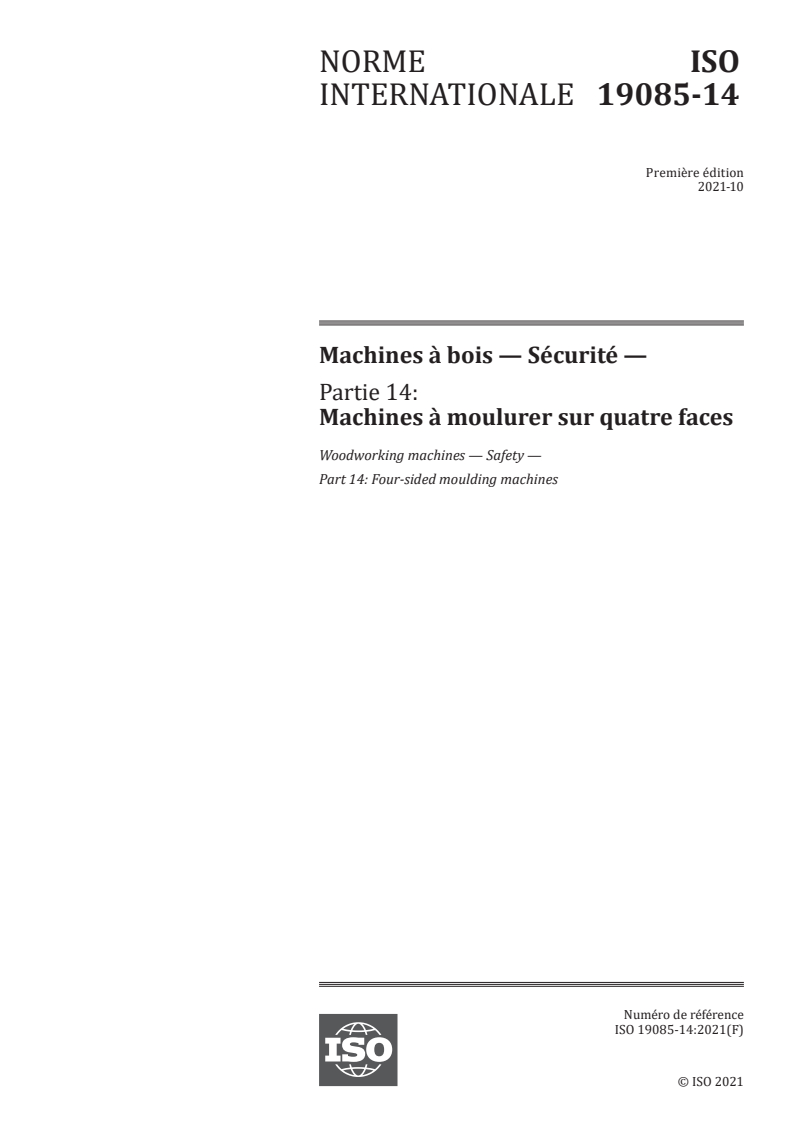
NORME ISO
INTERNATIONALE 19085-14
Première édition
2021-10
Machines à bois — Sécurité —
Partie 14:
Machines à moulurer sur quatre faces
Woodworking machines — Safety —
Part 14: Four-sided moulding machines
Numéro de référence
DOCUMENT PROTÉGÉ PAR COPYRIGHT
© ISO 2021
Tous droits réservés. Sauf prescription différente ou nécessité dans le contexte de sa mise en œuvre, aucune partie de cette
publication ne peut être reproduite ni utilisée sous quelque forme que ce soit et par aucun procédé, électronique ou mécanique,
y compris la photocopie, ou la diffusion sur l’internet ou sur un intranet, sans autorisation écrite préalable. Une autorisation peut
être demandée à l’ISO à l’adresse ci-après ou au comité membre de l’ISO dans le pays du demandeur.
ISO copyright office
Case postale 401 • Ch. de Blandonnet 8
CH-1214 Vernier, Genève
Tél.: +41 22 749 01 11
E-mail: copyright@iso.org
Web: www.iso.org
Publié en Suisse
ii
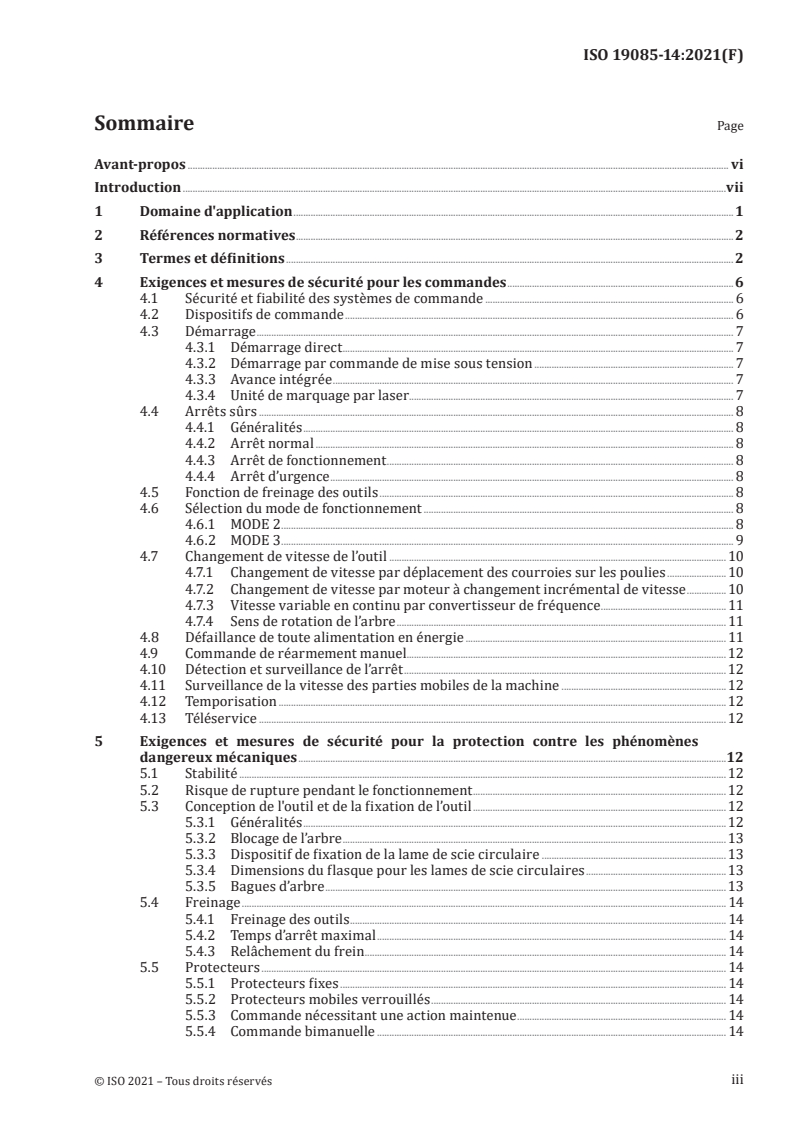
Sommaire Page
Avant-propos . vi
Introduction .vii
1 Domaine d'application .1
2 Références normatives .2
3 Termes et définitions . 2
4 Exigences et mesures de sécurité pour les commandes . 6
4.1 Sécurité et fiabilité des systèmes de commande . 6
4.2 Dispositifs de commande . 6
4.3 Démarrage . 7
4.3.1 Démarrage direct . 7
4.3.2 Démarrage par commande de mise sous tension . 7
4.3.3 Avance intégrée . 7
4.3.4 Unité de marquage par laser . 7
4.4 Arrêts sûrs . 8
4.4.1 Généralités . 8
4.4.2 Arrêt normal . 8
4.4.3 Arrêt de fonctionnement . 8
4.4.4 Arrêt d’urgence . 8
4.5 Fonction de freinage des outils . 8
4.6 Sélection du mode de fonctionnement . 8
4.6.1 MODE 2 . 8
4.6.2 MODE 3 . 9
4.7 Changement de vitesse de l’outil . 10
4.7.1 Changement de vitesse par déplacement des courroies sur les poulies . 10
4.7.2 Changement de vitesse par moteur à changement incrémental de vitesse . 10
4.7.3 Vitesse variable en continu par convertisseur de fréquence . 11
4.7.4 Sens de rotation de l’arbre . 11
4.8 Défaillance de toute alimentation en énergie . 11
4.9 Commande de réarmement manuel.12
4.10 Détection et surveillance de l’arrêt .12
4.11 Surveillance de la vitesse des parties mobiles de la machine .12
4.12 Temporisation .12
4.13 Téléservice .12
5 Exigences et mesures de sécurité pour la protection contre les phénomènes
dangereux mécaniques .12
5.1 Stabilité . 12
5.2 Risque de rupture pendant le fonctionnement .12
5.3 Conception de l'outil et de la fixation de l’outil .12
5.3.1 Généralités .12
5.3.2 Blocage de l’arbre . 13
5.3.3 Dispositif de fixation de la lame de scie circulaire .13
5.3.4 Dimensions du flasque pour les lames de scie circulaires .13
5.3.5 Bagues d’arbre . 13
5.4 Freinage . 14
5.4.1 Freinage des outils . 14
5.4.2 Temps d’arrêt maximal . 14
5.4.3 Relâchement du frein . . 14
5.5 Protecteurs . 14
5.5.1 Protecteurs fixes . 14
5.5.2 Protecteurs mobiles verrouillés . 14
5.5.3 Commande nécessitant une action maintenue . 14
5.5.4 Commande bimanuelle . 14
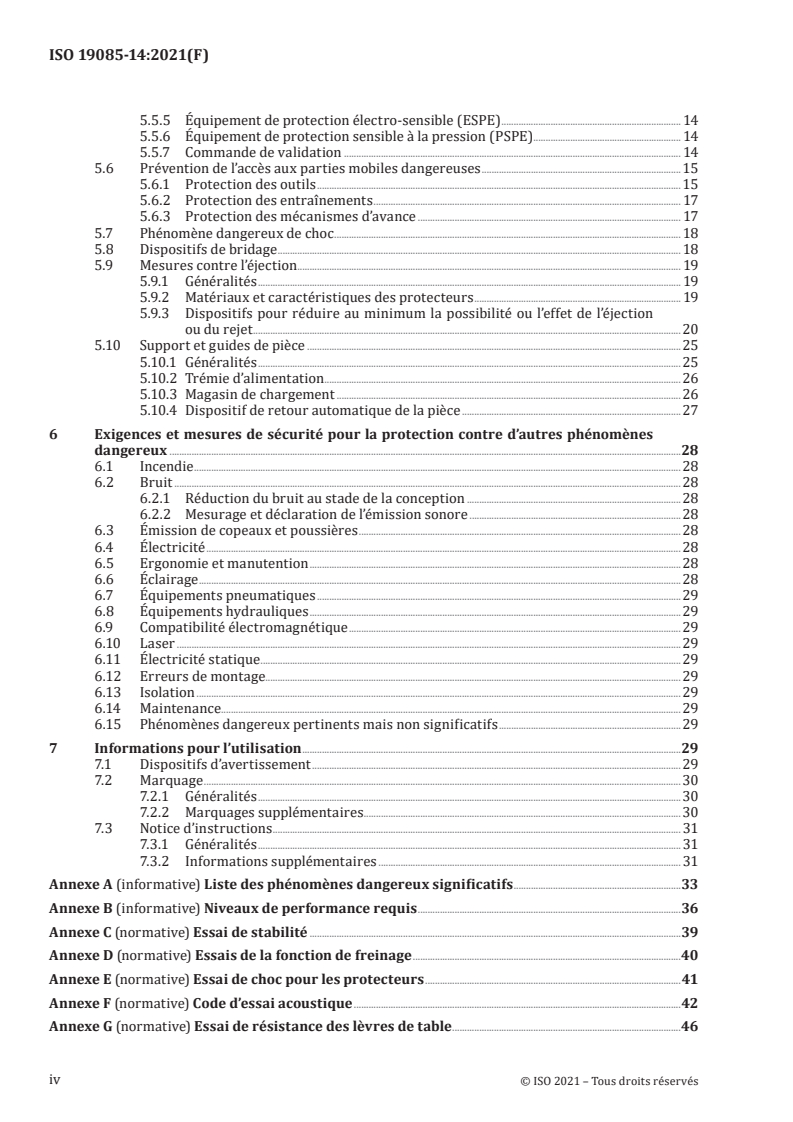
iii
5.5.5 Équipement de protection électro-sensible (ESPE) . 14
5.5.6 Équipement de protection sensible à la pression (PSPE). 14
5.5.7 Commande de validation . 14
5.6 Prévention de l’accès aux parties mobiles dangereuses . 15
5.6.1 Protection des outils . 15
5.6.2 Protection des entraînements . 17
5.6.3 Protection des mécanismes d’avance . 17
5.7 Phénomène dangereux de choc . 18
5.8 Dispositifs de bridage . 18
5.9 Mesures contre l’éjection. 19
5.9.1 Généralités . 19
5.9.2 Matériaux et caractéristiques des protecteurs . 19
5.9.3 Dispositifs pour réduire au minimum la possibilité ou l’effet de l’éjection
ou du rejet . 20
5.10 Support et guides de pièce .25
5.10.1 Généralités . 25
5.10.2 Trémie d’alimentation . 26
5.10.3 Magasin de chargement . 26
5.10.4 Dispositif de retour automatique de la pièce . 27
6 Exigences et mesures de sécurité pour la protection contre d’autres phénomènes
dangereux .28
6.1 Incendie .28
6.2 Bruit .28
6.2.1 Réduction du bruit au stade de la conception .28
6.2.2 Mesurage et déclaration de l’émission sonore .28
6.3 Émission de copeaux et poussières .28
6.4 Électricité . 28
6.5 Ergonomie et manutention .28
6.6 Éclairage .28
6.7 Équipements pneumatiques .29
6.8 Équipements hydrauliques .29
6.9 Compatibilité électromagnétique .29
6.10 Laser .29
6.11 Électricité statique . .29
6.12 Erreurs de montage. 29
6.13 Isolation . 29
6.14 Maintenance . 29
6.15 Phénomènes dangereux pertinents mais non significatifs .29
7 Informations pour l’utilisation .29
7.1 Dispositifs d’avertissement .29
7.2 Marquage . 30
7.2.1 Généralités .30
7.2.2 Marquages supplémentaires .30
7.3 Notice d’instructions . 31
7.3.1 Généralités . 31
7.3.2 Informations supplémentaires . 31
Annexe A (informative) Liste des phénomènes dangereux significatifs .33
Annexe B (informative) Niveaux de performance requis .36
Annexe C (normative) Essai de stabilité .39
Annexe D (normative) Essais de la fonction de freinage .40
Annexe E (normative) Essai de choc pour les protecteurs .41
Annexe F (normative) Code d’essai acoustique .42
Annexe G (normative) Essai de résistance des lèvres de table .46
iv
Bibliographie .50
v
Avant-propos
L'ISO (Organisation internationale de normalisation) est une fédération mondiale d'organismes
nationaux de normalisation (comités membres de l'ISO). L'élaboration des Normes internationales est
en général confiée aux comités techniques de l'ISO. Chaque comité membre intéressé par une étude
a le droit de faire partie du comité technique créé à cet effet. Les organisations internationales,
gouvernementales et non gouvernementales, en liaison avec l'ISO participent également aux travaux.
L'ISO collabore étroitement avec la Commission électrotechnique internationale (IEC) en ce qui
concerne la normalisation électrotechnique.
Les procédures utilisées pour élaborer le présent document et celles destinées à sa mise à jour sont
décrites dans les Directives ISO/IEC, Partie 1. Il convient, en particulier, de prendre note des différents
critères d'approbation requis pour les différents types de documents ISO. Le présent document a
été rédigé conformément aux règles de rédaction données dans les Directives ISO/IEC, Partie 2 (voir
www.iso.org/directives).
L'attention est attirée sur le fait que certains des éléments du présent document peuvent faire l'objet de
droits de propriété intellectuelle ou de droits analogues. L'ISO ne saurait être tenue pour responsable
de ne pas avoir identifié de tels droits de propriété et averti de leur existence. Les détails concernant
les références aux droits de propriété intellectuelle ou autres droits analogues identifiés lors de
l'élaboration du document sont indiqués dans l'Introduction et/ou dans la liste des déclarations de
brevets reçues par l'ISO (voir www.iso.org/brevets).
Les appellations commerciales éventuellement mentionnées dans le présent document sont données
pour information, par souci de commodité, à l’intention des utilisateurs et ne sauraient constituer un
engagement.
Pour une explication de la nature volontaire des normes, la signification des termes et expressions
spécifiques de l'ISO liés à l'évaluation de la conformité, ou pour toute information au sujet de l'adhésion
de l'ISO aux principes de l’Organisation mondiale du commerce (OMC) concernant les obstacles
techniques au commerce (OTC), voir www.iso.org/avant-propos.
Le présent document a été élaboré par le Comité Technique ISO/TC 39, Machines-outils, sous-comité
SC 4, Machines à bois en collaboration avec le Comité Technique CEN/TC 142, Machines à bois - Sécurité,
du Comité Européen de Normalisation (CEN) conformément à l'accord de coopération technique entre
l'ISO et le CEN (Accord de Vienne).
Il convient que l’utilisateur adresse tout retour d’information ou toute question concernant le présent
document à l’organisme national de normalisation de son pays. Une liste exhaustive desdits organismes
se trouve à l’adresse www.iso.org/fr/members.html.
Le présent document est destiné à être utilisé conjointement avec l’ISO 19085-1:2021, qui donne les
exigences communes aux différents types de machines.
Une liste de toutes les parties de la série ISO 19085 se trouve sur le site Web de l’ISO.
vi
Introduction
La série ISO 19085 fournit les exigences techniques de sécurité pour la conception et la fabrication
des machines à bois. Elle concerne les concepteurs, les fabricants, les fournisseurs et les importateurs
des machines spécifiées dans le Domaine d’application. Elle comprend également une liste de points
informatifs à fournir à l’utilisateur par le fabricant.
Le présent document une norme de type C tel que mentionné dans l’ISO 12100.
Le présent document concerne, en particulier, les groupes de parties prenantes suivants représentant
les acteurs du marché dans le domaine de la sécurité des machines:
— fabricants de machines (petites, moyennes et grandes entreprises);
— organismes de santé et de sécurité (autorités réglementaires, organismes de prévention des risques
professionnels, surveillance du marché, etc.).
D’autres partenaires peuvent être concernés par le niveau de sécurité des machines atteint à l’aide du
document par les groupes de parties prenantes mentionnées ci-dessus:
— utilisateurs de machines/employeurs (petites, moyennes et grandes entreprises);
— utilisateurs de machines/salariés (par exemple syndicats de salariés, organisations représentant
des personnes ayant des besoins particuliers);
— prestataires de services, par exemple sociétés de maintenance (petites, moyennes et grandes
entreprises);
— consommateurs (dans le cas de machines destinées à être utilisées par des consommateurs).
Les groupes de parties prenantes mentionnés ci-dessus ont eu la possibilité de participer à l'élaboration
du présent document.
Les machines concernées et l’étendue des phénomènes dangereux, situations dangereuses ou
événements dangereux couverts sont indiquées dans le Domaine d’application.
Lorsque des exigences de la présente norme de type C sont différentes de celles énoncées dans les
normes de type A ou de type B, les exigences de la présente norme de type C ont priorité sur les exigences
des autres normes pour les machines ayant été conçues et fabriquées conformément aux exigences de la
présente norme de type C.
L’ensemble des exigences pour un type particulier de machine à bois sont celles données dans la partie
de l’ISO 19085 applicable à ce type, conjointement avec les exigences pertinentes de l’ISO 19085-1, dans
l’étendue spécifiée dans le Domaine d’application de la partie applicable de la série ISO 19085.
Dans la mesure du possible, les exigences de sécurité des parties de la série ISO 19085 font référence
aux paragraphes pertinents de l’ISO 19085-1. Chaque partie contient des remplacements et des ajouts
aux exigences communes données dans l’ISO 19085-1.
Les Articles 1 à 3 sont spécifiques à chaque partie et, par conséquent, remplacent l'ISO 19085-1:2021,
Articles 1 à 3.
Pour les Articles 4 à 7 et les annexes, l'ISO 19085-1:2021, Articles 4 à 7 et les annexes, chaque paragraphe
peut être:
— confirmé dans son intégralité;
— confirmé avec des ajouts;
— exclu en totalité; ou
— remplacé par un texte spécifique.
vii
Cela est indiqué par l’un des énoncés possibles suivants:
— «L’ISO 19085-1:2021, [paragraphe/Annexe], s’applique »;
— «L’ISO 19085-1:2021, [paragraphe/Annexe], s’applique avec les ajouts suivants.» ou
«L’ISO 19085-1:2021, [paragraphe/Annexe], s’applique avec les ajouts suivants, divisés en de
nouveaux paragraphes spécifiques.»;
— «L’ISO 19085-1:2021, [paragraphe/Annexe], ne s’applique pas. »;
— «L’ISO 19085-1:2021, [paragraphe/Annexe], est remplacé par le texte suivant» ou «L’ISO 19085-1:2021,
[paragraphe/Annexe], est remplacé par le texte suivant, divisé en de nouveaux paragraphes
spécifiques.».
Les autres paragraphes et annexes spécifiques au présent document sont indiqués par la phrase
introductive: « Paragraphe/Annexe spécifique au présent document. ».
viii
NORME INTERNATIONALE ISO 19085-14:2021(F)
Machines à bois — Sécurité —
Partie 14:
Machines à moulurer sur quatre faces
1 Domaine d'application
Le présent document donne les exigences et mesures de sécurité pour les machines à moulurer sur
quatre faces, capable d’une utilisation en production continue, ayant une largeur maximale de travail
de 350 mm et une vitesse maximale de l’avance mécanisée de la pièce de 200 m/min, ci-après désignées
« machines », conçues pour la coupe de bois massif et de matériau ayant des caractéristiques physiques
similaires à celles du bois (voir l’ISO 19085-1:2021, 3.2).
Il traite de tous les phénomènes dangereux, situations et événements dangereux significatifs, énumérés
à l’Annexe A, applicables aux machines lorsqu’elles sont utilisées, réglées et entretenues comme prévu
et dans les conditions prévues par le fabricant; une mauvaise utilisation raisonnablement prévisible
a également été prise en compte. Les phases de transport, d’assemblage, de démontage, de mise hors
service et de mise au rebut sont également prises en compte.
Il est également applicable aux machines équipées d’un(e) ou plusieurs des dispositifs/unités de travail
supplémentaires suivant(e)s, dont les phénomènes dangereux ont été traités:
— arbre universel;
— unité de sciage de parclose;
— support de pièce fixe ou mobile;
— système de changement rapide d’outil;
— unité de marquage par laser;
— dispositif de retour automatique de la pièce;
— trémie d’alimentation;
— magasin de chargement;
— table de déchargement.
Le présent document ne traite d'aucun des phénomènes dangereux relatifs aux:
a) dispositifs d’avance autres que la trémie d’alimentation et le magasin de chargement;
NOTE 1 Pour les dispositifs d’avance mécaniques qui empêchent également l’accès à l’ouverture
d’alimentation, voir 6.6.4
b) les dispositifs de sortie autres que la table de déchargement, sauf pour les phénomènes dangereux
liés à l’éjection de la machine due à la coupe en avalant;
c) sortie des pièces sur des machines ayant une vitesse d’avance supérieures à 60 m/min;
NOTE 2 Les machines ayant une vitesse d'avance supérieure à 60 m/min sont généralement combinées
avec des systèmes mécaniques de déchargement et de transfert de pièces.
d) machines utilisées en combinaison avec toute autre machine (comme partie d’une ligne).
Il n’est pas applicable aux machines prévues pour une utilisation en atmosphère explosible et aux
machines fabriquées avant sa publication.
2 Références normatives
Les documents suivants sont cités dans le texte de sorte qu'ils constituent, pour tout ou partie de leur
contenu, des exigences du présent document. Pour les références datées, seule l'édition citée s'applique.
Pour les références non datées, la dernière édition du document de référence s'applique (y compris les
éventuels amendements).
ISO 286-2:2010, Spécification géométrique des produits (GPS) — Système de codification ISO pour les
tolérances sur les tailles linéaires — Partie 2: Tableaux des classes de tolérance normalisées et des écarts
limites des alésages et des arbres
ISO 12100:2010, Sécurité des machines — Principes généraux de conception — Appréciation du risque et
réduction du risque
ISO 13849-1:2015, Sécurité des machines — Parties des systèmes de commande relatives à la sécurité —
Partie 1: Principes généraux de conception
ISO 13857:2019, Sécurité des machines — Distances de sécurité empêchant les membres supérieurs et
inférieurs d'atteindre les zones dangereuses
ISO 19085-1:2021, Machines à bois — Sécurité — Partie 1: Exigences communes
IEC 60825-1:2014, Sécurité des appareils à laser — Partie 1: Classification des matériels et exigences
EN 847-1:2017, Outils pour le travail du bois — Prescriptions de sécurité — Partie 1: Outils de fraisage,
lames de scies circulaires
E N 1837:1999+A 1: 200 9, Sécurité des machines — Éclairage intégré aux machines
E N 12198 -1:2000 +A 1: 2008 , Sécurité des machines — Estimation et réduction des risques engendrés par
les rayonnements émis par les machines — Partie 1: Principes généraux
3 Termes et définitions
Pour les besoins du présent du document, les termes et définitions donnés dans l’ISO 12100:2010, dans
l’ISO 13849-1:2015 et dans l’ISO 19085-1:2021 ainsi que les suivants s’appliquent.
L’ISO et l'IEC tiennent à jour des bases de données terminologiques pour l'utilisation en normalisation,
consultables aux adresses suivantes:
— ISO Online browsing platform: disponible à l’adresse https:// www .iso .org/ obp
— IEC Electropedia: disponible à l’adresse https:// www .electropedia .org/
3.1
machine à moulurer sur quatre faces
machine pour l’usinage longitudinal sur quatre faces ayant quatre unités de travail ou plus pourvues
d’arbres, qui peuvent être équipées d’outils de dégauchissage et/ou de toupillage, avec au moins une
unité sur chaque côté de la pièce et ayant une avance mécanisée de la pièce
Note 1 à l'article: Les machines dans lesquelles le premier rouleau d’avance est placé après le premier outil et les
machines où le rouleau d’avance avant le premier arbre inférieur peut être soulevé à des fins de redressement
sont, pour les besoins du présent document, également des machines à avance mécanisée.
3.2
arbre universel
unité de travail dont la position peut être modifiée manuellement ou de manière mécanisée pour lui
permettre de travailler en différentes positions autour de la pièce
3.3
unité de sciage de parclose
unité d’usinage munie d’un outil, généralement une lame de scie, avec ou sans outil de fraisage monté de
manière coaxiale, pour couper une parclose sur un profil usiné de la pièce
Note 1 à l'article: Un exemple d’unité de sciage de parclose est illustré à la Figure 1.
Légende
1 lame de scie pour coupe de parclose 2 séparateur de parclose 3 linguet anti-rejet
4 dispositif de pression 5 chenal de guidage pour parclose 6 parclose
7 pièce 8 guide 9 sens de l’avance
Figure 1 — Exemple d’unité de sciage de parclose
3.4
trémie d’alimentation
dispositif pour contenir une pile de pièces à l’alimentation, de sorte que, une fois que la pièce la plus
basse a avancé, la suivante puisse être avancée vers la machine automatiquement
Note 1 à l'article: Un exemple de trémie d’alimentation est illustré à la Figure 2.
3.5
magasin de chargement
système où les pièces sont chargées, indépendamment de la séquence opérationnelle de la machine,
avec un dispositif pour les amener à l’avance de la machine en séquence
Note 1 à l'article: Un exemple de magasin de chargement est illustré à la Figure 3 (protection non complète).
3.6
dispositif de retour automatique de la pièce
système mécanisé qui ramène la pièce usinée de l’extrémité de la machine à la position de chargement
Note 1 à l'article: Un exemple de dispositif de retour automatique de la pièce est illustré à la Figure 4 (protection
non complète).
3.7
enceinte intégrée
protection conçue pour s’adapter au plus près de la machine et fournir une mesure d'atténuation du
bruit et où certains ajustages de réglage peuvent être possibles de l’extérieur de l’enceinte
Légende
1 extrémité d’alimentation de la machine 4 guides verticaux de la pile de pièces
2 sens de l’avance 5 support de pièce
3 rouleau d’avance
Figure 2 — Exemple de trémie d’alimentation
Légende
1 protecteur fixe 4 AOPD
2 guide latéral 5 table d’alimentation de la machine
3 courroies/chaînes d’alimentation 6 sens de l’avance
Figure 3 — Exemple de magasin de chargement
Figure 4 — Exemple de dispositif de retour automatique de la pièce
3.8
enceinte complète
enceinte totale de la machine principalement conçue pour l’atténuation du bruit et pour permettre à
l’opérateur de se déplacer autour librement à l’intérieur et où tous les réglages et ajustages de la machine
sont disponibles à l’intérieur et où l’accès se fait normalement par une porte/ouverture
Note 1 à l'article: L’enceinte complète contient généralement des ouvertures pour le chargement et le
déchargement de la pièce. Les ouvertures sont généralement équipées de mesures pour l’atténuation du bruit.
3.9
commande de déclenchement
commande qui ne déclenche directement aucun mouvement, mais qui permet d'alimenter des
actionneurs spécifiques de la machine lorsqu'elle est activée
3.10
MODE 2
condition avec protecteurs désactivés, pour le réglage ou l’ajustement des unités de traitement, des
dispositifs d'alimentation et de guidage, et/ou pour le nettoyage
3.11
MODE 3
condition avec protecteurs désactivés, pour essai de fonctionnement, réglage fin des unités de
traitement, des dispositifs d'alimentation et de guidage
3.12
commande pas à pas
dispositif de commande pour l’activation momentanée d’une fonction ou d’un mouvement
3.13
dispositif de fixation hydrostatique de l’outil
dispositif pour le bridage de l’outil sur l’arbre utilisant la pression hydraulique
4 Exigences et mesures de sécurité pour les commandes
4.1 Sécurité et fiabilité des systèmes de commande
L’ISO 19085-1:2021, 4.1, s’applique avec les ajouts suivants.
Le Tableau B.1 remplace l'ISO 19085-1:2021, Tableau B.1.
4.2 Dispositifs de commande
L’ISO 19085-1:2021, 4.2, s’applique avec les ajouts suivants.
Les dispositifs de commande d’arrêt d’urgence doivent être installés aux emplacements suivants:
a) à proximité immédiate de l’extrémité d’alimentation de la machine;
b) au côté chargement du magasin de chargement, s’il est fourni;
c) à proximité immédiate de l’extrémité de sortie de la machine;
d) sur chaque bloc de commande portatif (si fourni);
e) à une distance maximale de 1,5 m de chaque dispositif de commande nécessitant une action
maintenue et chaque dispositif de commande pas à pas fixes;
f) sur le panneau de commande principal.
Si la distance entre deux dispositifs de commande d’arrêt d’urgence requises est inférieure à 1 m, un
seul dispositif de commande d’arrêt d’urgence peut être fourni.
Des dispositifs de commande supplémentaires pour le démarrage du processus et l’arrêt normal
peuvent être fournis sur les blocs de commande portatifs avec liaison par câble ou sans fil.
Lorsqu’un bloc de commande sans fil perd sa connexion à la machine, un arrêt d’urgence doit être
automatiquement activé. Les SRP/CS pour le verrouillage de la liaison sans fil avec l’arrêt d’urgence
doivent atteindre PL = c.
r
Les dispositifs de commande de la fonction de réarmement, les dispositifs de commande de mise sous
tension et les sélecteurs de mode de fonctionnement ne doivent pas être positionnés sur des blocs de
commande portatifs et à l’intérieur de l’enceinte complète.
Vérification: Par contrôle des plans et/ou schémas de circuit correspondants, mesurages, inspection de
la machine et essais de fonctionnement appropriés de la machine.
4.3 Démarrage
4.3.1 Démarrage direct
L’ISO 19085-1:2021, 4.3.1, s’applique.
4.3.2 Démarrage par commande de mise sous tension
L’ISO 19085-1:2021, 4.3.2, s’applique.
4.3.3 Avance intégrée
Paragraphe spécifique au présent document.
En mode de fonctionnement normal (MODE 1), le démarrage de l'avance doit être uniquement possible
lorsque les arbres porte-outils tournent ou que les outils de tous les arbres non impliqués dans
l'opération en cours ne peuvent pas entrer en contact avec la pièce, parce que les outils sont retirés des
arbres ou que les arbres qui ne tournent pas sont rétractés dans une position non travaillante .
Pour les machines où au moins un arbre est réglé manuellement, par un volant ou commandé
mécaniquement sous une commande nécessitant une action maintenue, des instructions doivent être
données conformément à 7.3.2 f).
Pour les machines où au moins un arbre est réglé automatiquement sous commande CN ou CNC, l'une
des exigences suivantes doit être satisfaite:
a) le PLC doit exiger une confirmation par l'opérateur à chaque démarrage de l'avance intégrée,
indiquant que les outils qui ne tournent pas ont été retirés ou sont rétractés dans une position non
travaillante;
b) un dispositif limiteur de position doit détecter l'outil qui ne tourne pas dans la position non
travaillante;
c) le PLC doit garantir qu'aucun contact entre un outil qui ne tourne pas et la pièce à usiner n'est
possible, compte tenu de la position de l'outil, des dimensions de la pièce et de la position de l’arbre;
d) l'avance doit être verrouillée avec la rotation de tous les arbres porte-outils.
Les SRP/CS pour le verrouillage du démarrage de l'avance avec tous les entraînements d’arbre porte -
outil (rotation ou position) peuvent n’atteindre aucun PL .
r
Vérification: Par contrôle des plans et/ou schémas de circuit correspondants, inspection de la machine
et essais de fonctionnement appropriés de la machine.
4.3.4 Unité de marquage par laser
Paragraphe spécifique au présent document.
L’activation de l’unité de marquage par laser doit uniquement être possible lorsque l’avance est active
et qu'une pièce est détectée sous l’unité de marquage par laser. Les SRP/CS pour le verrouillage de
l’activation de l’unité de marquage par laser avec l’avance doivent atteindre PL = c, et avec la détection
r
de la pièce doivent atteindre PL = b.
r
Vérification: Par contrôle des plans et/ou schémas de circuit correspondants, inspection de la machine
et essais de fonctionnement appropriés de la machine.
4.4 Arrêts sûrs
4.4.1 Généralités
L’ISO 19085-1:2021, 4.4.1, s’applique avec les ajouts suivants.
Sur les machines équipées d’une unité de marquage par laser, l’activation de l’arrêt sûr (normal et
d’urgence) doit également désactiver l’unité de marquage par laser.
Les SRP/CS pour la désactivation de l’unité de marquage par laser avec l’arrêt sûr doivent
atteindre PL = c.
r
4.4.2 Arrêt normal
L’ISO 19085-1:2021, 4.4.2, s’applique.
4.4.3 Arrêt de fonctionnement
L’ISO 19085-1:2021, 4.4.3, ne s’applique pas.
4.4.4 Arrêt d’urgence
L’ISO 19085-1:2021, 4.4.4, s’applique.
4.5 Fonction de freinage des outils
L’ISO 19085-1:2021, 4.5, s’applique.
4.6 Sélection du mode de fonctionnement
L’ISO 19085-1:2021, 4.6, s’applique avec les ajouts suivants, divisés en de nouveaux paragraphes
spécifiques.
4.6.1 MODE 2
Si le MODE 2 est implémenté pour accéder à la machine avec les protecteurs mobiles décrits en 5.6.1 en
position ouverte, les exigences suivantes s'appliquent:
a) la sélection du MODE 2 doit déclencher l’arrêt de l’avance et des arbres porte-outils;
b) pendant le MODE 2, le mouvement de l'avance, avant ou arrière, et le réglage des unités mécanisées
doivent uniquement être possibles par soit:
1) une commande nécessitant une action maintenue; soit
2) une commande pas à pas (aucun PL n’est requis) après actionnement d’un dispositif de
commande de déclenchement. Les SRP/CS pour la commande de déclenchement doivent
atteindre PL = c. La commande de déclenchement doit être désactivée si la commande pas à
r
pas n’est pas activée pendant plus de 30 s (aucun PL n’est requis), et dans tous les cas après
10 min. Les SRP/CS pour la temporisation de 10 minutes de la désactivation doivent atteindre
PL = c;
r
c) le mouvement de l’avance doit s’arrêter dans les 100 mm après que le dispositif de commande
nécessitant une action maintenue ou le dispositif de commande pas à pas aient été relâchés;
d) le démarrage intempestif de tout arbre porte-outil doit être empêché; Les SRP/CS pour la prévention
d'un démarrage intempestif des arbres porte-outils doivent atteindre PL = c.
r
Vérification: Par contrôle des plans et/ou schémas de circuit correspondants et inspection de la machine.
4.6.2 MODE 3
Si le MODE 3 est implémenté pour accéder à la machine avec les protecteurs mobiles décrits en 5.6.1 en
position ouverte, les exigences suivantes s'appliquent:
a) la sélection du MODE 3 doit déclencher l’arrêt de l’avance et des arbres porte-outils;
b) pendant le MODE 3, chaque arbre porte-outil peut être démarré. Les SRP/CS pour le démarrage
des entraînements d’arbre doivent atteindre PL = c. À titre d’exception, aucun PL n'est requis
r r
pour le démarrage de l’arbre si une commande de déclenchement est utilisée. Les SRP/CS pour
cette commande de déclenchement doivent atteindre PL = c. La commande de déclenchement doit
r
être désactivée après 20 s. Les SRP/CS pour la temporisation de 20 s pour la désactivation doivent
atteindre PL = c;
r
c) pendant le MODE 3, le mouvement de l’avance, avant ou arrière, arrière seulement avec aucun outil
en rotation, doit uniquement être possible par soit:
1) une commande nécessitant une action maintenue; soit
2) une commande pas à pas (aucun PL n’est requis) après actionnement d’un dispositif de
commande de déclenchement. Les SRP/CS pour la commande de déclenchement doivent
atteindre PL = c. La commande de déclenchement doit être désactivée si la commande pas à
r
pas n’est pas activée pendant plus de
...
NORME ISO
INTERNATIONALE 19085-14
Première édition
2021-10
Machines à bois — Sécurité —
Partie 14:
Machines à moulurer sur quatre faces
Woodworking machines — Safety —
Part 14: Four-sided moulding machines
Numéro de référence
DOCUMENT PROTÉGÉ PAR COPYRIGHT
© ISO 2021
Tous droits réservés. Sauf prescription différente ou nécessité dans le contexte de sa mise en œuvre, aucune partie de cette
publication ne peut être reproduite ni utilisée sous quelque forme que ce soit et par aucun procédé, électronique ou mécanique,
y compris la photocopie, ou la diffusion sur l’internet ou sur un intranet, sans autorisation écrite préalable. Une autorisation peut
être demandée à l’ISO à l’adresse ci-après ou au comité membre de l’ISO dans le pays du demandeur.
ISO copyright office
Case postale 401 • Ch. de Blandonnet 8
CH-1214 Vernier, Genève
Tél.: +41 22 749 01 11
E-mail: copyright@iso.org
Web: www.iso.org
Publié en Suisse
ii
Sommaire Page
Avant-propos . vi
Introduction .vii
1 Domaine d'application .1
2 Références normatives .2
3 Termes et définitions . 2
4 Exigences et mesures de sécurité pour les commandes . 6
4.1 Sécurité et fiabilité des systèmes de commande . 6
4.2 Dispositifs de commande . 6
4.3 Démarrage . 7
4.3.1 Démarrage direct . 7
4.3.2 Démarrage par commande de mise sous tension . 7
4.3.3 Avance intégrée . 7
4.3.4 Unité de marquage par laser . 7
4.4 Arrêts sûrs . 8
4.4.1 Généralités . 8
4.4.2 Arrêt normal . 8
4.4.3 Arrêt de fonctionnement . 8
4.4.4 Arrêt d’urgence . 8
4.5 Fonction de freinage des outils . 8
4.6 Sélection du mode de fonctionnement . 8
4.6.1 MODE 2 . 8
4.6.2 MODE 3 . 9
4.7 Changement de vitesse de l’outil . 10
4.7.1 Changement de vitesse par déplacement des courroies sur les poulies . 10
4.7.2 Changement de vitesse par moteur à changement incrémental de vitesse . 10
4.7.3 Vitesse variable en continu par convertisseur de fréquence . 11
4.7.4 Sens de rotation de l’arbre . 11
4.8 Défaillance de toute alimentation en énergie . 11
4.9 Commande de réarmement manuel.12
4.10 Détection et surveillance de l’arrêt .12
4.11 Surveillance de la vitesse des parties mobiles de la machine .12
4.12 Temporisation .12
4.13 Téléservice .12
5 Exigences et mesures de sécurité pour la protection contre les phénomènes
dangereux mécaniques .12
5.1 Stabilité . 12
5.2 Risque de rupture pendant le fonctionnement .12
5.3 Conception de l'outil et de la fixation de l’outil .12
5.3.1 Généralités .12
5.3.2 Blocage de l’arbre . 13
5.3.3 Dispositif de fixation de la lame de scie circulaire .13
5.3.4 Dimensions du flasque pour les lames de scie circulaires .13
5.3.5 Bagues d’arbre . 13
5.4 Freinage . 14
5.4.1 Freinage des outils . 14
5.4.2 Temps d’arrêt maximal . 14
5.4.3 Relâchement du frein . . 14
5.5 Protecteurs . 14
5.5.1 Protecteurs fixes . 14
5.5.2 Protecteurs mobiles verrouillés . 14
5.5.3 Commande nécessitant une action maintenue . 14
5.5.4 Commande bimanuelle . 14
iii
5.5.5 Équipement de protection électro-sensible (ESPE) . 14
5.5.6 Équipement de protection sensible à la pression (PSPE). 14
5.5.7 Commande de validation . 14
5.6 Prévention de l’accès aux parties mobiles dangereuses . 15
5.6.1 Protection des outils . 15
5.6.2 Protection des entraînements . 17
5.6.3 Protection des mécanismes d’avance . 17
5.7 Phénomène dangereux de choc . 18
5.8 Dispositifs de bridage . 18
5.9 Mesures contre l’éjection. 19
5.9.1 Généralités . 19
5.9.2 Matériaux et caractéristiques des protecteurs . 19
5.9.3 Dispositifs pour réduire au minimum la possibilité ou l’effet de l’éjection
ou du rejet . 20
5.10 Support et guides de pièce .25
5.10.1 Généralités . 25
5.10.2 Trémie d’alimentation . 26
5.10.3 Magasin de chargement . 26
5.10.4 Dispositif de retour automatique de la pièce . 27
6 Exigences et mesures de sécurité pour la protection contre d’autres phénomènes
dangereux .28
6.1 Incendie .28
6.2 Bruit .28
6.2.1 Réduction du bruit au stade de la conception .28
6.2.2 Mesurage et déclaration de l’émission sonore .28
6.3 Émission de copeaux et poussières .28
6.4 Électricité . 28
6.5 Ergonomie et manutention .28
6.6 Éclairage .28
6.7 Équipements pneumatiques .29
6.8 Équipements hydrauliques .29
6.9 Compatibilité électromagnétique .29
6.10 Laser .29
6.11 Électricité statique . .29
6.12 Erreurs de montage. 29
6.13 Isolation . 29
6.14 Maintenance . 29
6.15 Phénomènes dangereux pertinents mais non significatifs .29
7 Informations pour l’utilisation .29
7.1 Dispositifs d’avertissement .29
7.2 Marquage . 30
7.2.1 Généralités .30
7.2.2 Marquages supplémentaires .30
7.3 Notice d’instructions . 31
7.3.1 Généralités . 31
7.3.2 Informations supplémentaires . 31
Annexe A (informative) Liste des phénomènes dangereux significatifs .33
Annexe B (informative) Niveaux de performance requis .36
Annexe C (normative) Essai de stabilité .39
Annexe D (normative) Essais de la fonction de freinage .40
Annexe E (normative) Essai de choc pour les protecteurs .41
Annexe F (normative) Code d’essai acoustique .42
Annexe G (normative) Essai de résistance des lèvres de table .46
iv
Bibliographie .50
v
Avant-propos
L'ISO (Organisation internationale de normalisation) est une fédération mondiale d'organismes
nationaux de normalisation (comités membres de l'ISO). L'élaboration des Normes internationales est
en général confiée aux comités techniques de l'ISO. Chaque comité membre intéressé par une étude
a le droit de faire partie du comité technique créé à cet effet. Les organisations internationales,
gouvernementales et non gouvernementales, en liaison avec l'ISO participent également aux travaux.
L'ISO collabore étroitement avec la Commission électrotechnique internationale (IEC) en ce qui
concerne la normalisation électrotechnique.
Les procédures utilisées pour élaborer le présent document et celles destinées à sa mise à jour sont
décrites dans les Directives ISO/IEC, Partie 1. Il convient, en particulier, de prendre note des différents
critères d'approbation requis pour les différents types de documents ISO. Le présent document a
été rédigé conformément aux règles de rédaction données dans les Directives ISO/IEC, Partie 2 (voir
www.iso.org/directives).
L'attention est attirée sur le fait que certains des éléments du présent document peuvent faire l'objet de
droits de propriété intellectuelle ou de droits analogues. L'ISO ne saurait être tenue pour responsable
de ne pas avoir identifié de tels droits de propriété et averti de leur existence. Les détails concernant
les références aux droits de propriété intellectuelle ou autres droits analogues identifiés lors de
l'élaboration du document sont indiqués dans l'Introduction et/ou dans la liste des déclarations de
brevets reçues par l'ISO (voir www.iso.org/brevets).
Les appellations commerciales éventuellement mentionnées dans le présent document sont données
pour information, par souci de commodité, à l’intention des utilisateurs et ne sauraient constituer un
engagement.
Pour une explication de la nature volontaire des normes, la signification des termes et expressions
spécifiques de l'ISO liés à l'évaluation de la conformité, ou pour toute information au sujet de l'adhésion
de l'ISO aux principes de l’Organisation mondiale du commerce (OMC) concernant les obstacles
techniques au commerce (OTC), voir www.iso.org/avant-propos.
Le présent document a été élaboré par le Comité Technique ISO/TC 39, Machines-outils, sous-comité
SC 4, Machines à bois en collaboration avec le Comité Technique CEN/TC 142, Machines à bois - Sécurité,
du Comité Européen de Normalisation (CEN) conformément à l'accord de coopération technique entre
l'ISO et le CEN (Accord de Vienne).
Il convient que l’utilisateur adresse tout retour d’information ou toute question concernant le présent
document à l’organisme national de normalisation de son pays. Une liste exhaustive desdits organismes
se trouve à l’adresse www.iso.org/fr/members.html.
Le présent document est destiné à être utilisé conjointement avec l’ISO 19085-1:2021, qui donne les
exigences communes aux différents types de machines.
Une liste de toutes les parties de la série ISO 19085 se trouve sur le site Web de l’ISO.
vi
Introduction
La série ISO 19085 fournit les exigences techniques de sécurité pour la conception et la fabrication
des machines à bois. Elle concerne les concepteurs, les fabricants, les fournisseurs et les importateurs
des machines spécifiées dans le Domaine d’application. Elle comprend également une liste de points
informatifs à fournir à l’utilisateur par le fabricant.
Le présent document une norme de type C tel que mentionné dans l’ISO 12100.
Le présent document concerne, en particulier, les groupes de parties prenantes suivants représentant
les acteurs du marché dans le domaine de la sécurité des machines:
— fabricants de machines (petites, moyennes et grandes entreprises);
— organismes de santé et de sécurité (autorités réglementaires, organismes de prévention des risques
professionnels, surveillance du marché, etc.).
D’autres partenaires peuvent être concernés par le niveau de sécurité des machines atteint à l’aide du
document par les groupes de parties prenantes mentionnées ci-dessus:
— utilisateurs de machines/employeurs (petites, moyennes et grandes entreprises);
— utilisateurs de machines/salariés (par exemple syndicats de salariés, organisations représentant
des personnes ayant des besoins particuliers);
— prestataires de services, par exemple sociétés de maintenance (petites, moyennes et grandes
entreprises);
— consommateurs (dans le cas de machines destinées à être utilisées par des consommateurs).
Les groupes de parties prenantes mentionnés ci-dessus ont eu la possibilité de participer à l'élaboration
du présent document.
Les machines concernées et l’étendue des phénomènes dangereux, situations dangereuses ou
événements dangereux couverts sont indiquées dans le Domaine d’application.
Lorsque des exigences de la présente norme de type C sont différentes de celles énoncées dans les
normes de type A ou de type B, les exigences de la présente norme de type C ont priorité sur les exigences
des autres normes pour les machines ayant été conçues et fabriquées conformément aux exigences de la
présente norme de type C.
L’ensemble des exigences pour un type particulier de machine à bois sont celles données dans la partie
de l’ISO 19085 applicable à ce type, conjointement avec les exigences pertinentes de l’ISO 19085-1, dans
l’étendue spécifiée dans le Domaine d’application de la partie applicable de la série ISO 19085.
Dans la mesure du possible, les exigences de sécurité des parties de la série ISO 19085 font référence
aux paragraphes pertinents de l’ISO 19085-1. Chaque partie contient des remplacements et des ajouts
aux exigences communes données dans l’ISO 19085-1.
Les Articles 1 à 3 sont spécifiques à chaque partie et, par conséquent, remplacent l'ISO 19085-1:2021,
Articles 1 à 3.
Pour les Articles 4 à 7 et les annexes, l'ISO 19085-1:2021, Articles 4 à 7 et les annexes, chaque paragraphe
peut être:
— confirmé dans son intégralité;
— confirmé avec des ajouts;
— exclu en totalité; ou
— remplacé par un texte spécifique.
vii
Cela est indiqué par l’un des énoncés possibles suivants:
— «L’ISO 19085-1:2021, [paragraphe/Annexe], s’applique »;
— «L’ISO 19085-1:2021, [paragraphe/Annexe], s’applique avec les ajouts suivants.» ou
«L’ISO 19085-1:2021, [paragraphe/Annexe], s’applique avec les ajouts suivants, divisés en de
nouveaux paragraphes spécifiques.»;
— «L’ISO 19085-1:2021, [paragraphe/Annexe], ne s’applique pas. »;
— «L’ISO 19085-1:2021, [paragraphe/Annexe], est remplacé par le texte suivant» ou «L’ISO 19085-1:2021,
[paragraphe/Annexe], est remplacé par le texte suivant, divisé en de nouveaux paragraphes
spécifiques.».
Les autres paragraphes et annexes spécifiques au présent document sont indiqués par la phrase
introductive: « Paragraphe/Annexe spécifique au présent document. ».
viii
NORME INTERNATIONALE ISO 19085-14:2021(F)
Machines à bois — Sécurité —
Partie 14:
Machines à moulurer sur quatre faces
1 Domaine d'application
Le présent document donne les exigences et mesures de sécurité pour les machines à moulurer sur
quatre faces, capable d’une utilisation en production continue, ayant une largeur maximale de travail
de 350 mm et une vitesse maximale de l’avance mécanisée de la pièce de 200 m/min, ci-après désignées
« machines », conçues pour la coupe de bois massif et de matériau ayant des caractéristiques physiques
similaires à celles du bois (voir l’ISO 19085-1:2021, 3.2).
Il traite de tous les phénomènes dangereux, situations et événements dangereux significatifs, énumérés
à l’Annexe A, applicables aux machines lorsqu’elles sont utilisées, réglées et entretenues comme prévu
et dans les conditions prévues par le fabricant; une mauvaise utilisation raisonnablement prévisible
a également été prise en compte. Les phases de transport, d’assemblage, de démontage, de mise hors
service et de mise au rebut sont également prises en compte.
Il est également applicable aux machines équipées d’un(e) ou plusieurs des dispositifs/unités de travail
supplémentaires suivant(e)s, dont les phénomènes dangereux ont été traités:
— arbre universel;
— unité de sciage de parclose;
— support de pièce fixe ou mobile;
— système de changement rapide d’outil;
— unité de marquage par laser;
— dispositif de retour automatique de la pièce;
— trémie d’alimentation;
— magasin de chargement;
— table de déchargement.
Le présent document ne traite d'aucun des phénomènes dangereux relatifs aux:
a) dispositifs d’avance autres que la trémie d’alimentation et le magasin de chargement;
NOTE 1 Pour les dispositifs d’avance mécaniques qui empêchent également l’accès à l’ouverture
d’alimentation, voir 6.6.4
b) les dispositifs de sortie autres que la table de déchargement, sauf pour les phénomènes dangereux
liés à l’éjection de la machine due à la coupe en avalant;
c) sortie des pièces sur des machines ayant une vitesse d’avance supérieures à 60 m/min;
NOTE 2 Les machines ayant une vitesse d'avance supérieure à 60 m/min sont généralement combinées
avec des systèmes mécaniques de déchargement et de transfert de pièces.
d) machines utilisées en combinaison avec toute autre machine (comme partie d’une ligne).
Il n’est pas applicable aux machines prévues pour une utilisation en atmosphère explosible et aux
machines fabriquées avant sa publication.
2 Références normatives
Les documents suivants sont cités dans le texte de sorte qu'ils constituent, pour tout ou partie de leur
contenu, des exigences du présent document. Pour les références datées, seule l'édition citée s'applique.
Pour les références non datées, la dernière édition du document de référence s'applique (y compris les
éventuels amendements).
ISO 286-2:2010, Spécification géométrique des produits (GPS) — Système de codification ISO pour les
tolérances sur les tailles linéaires — Partie 2: Tableaux des classes de tolérance normalisées et des écarts
limites des alésages et des arbres
ISO 12100:2010, Sécurité des machines — Principes généraux de conception — Appréciation du risque et
réduction du risque
ISO 13849-1:2015, Sécurité des machines — Parties des systèmes de commande relatives à la sécurité —
Partie 1: Principes généraux de conception
ISO 13857:2019, Sécurité des machines — Distances de sécurité empêchant les membres supérieurs et
inférieurs d'atteindre les zones dangereuses
ISO 19085-1:2021, Machines à bois — Sécurité — Partie 1: Exigences communes
IEC 60825-1:2014, Sécurité des appareils à laser — Partie 1: Classification des matériels et exigences
EN 847-1:2017, Outils pour le travail du bois — Prescriptions de sécurité — Partie 1: Outils de fraisage,
lames de scies circulaires
E N 1837:1999+A 1: 200 9, Sécurité des machines — Éclairage intégré aux machines
E N 12198 -1:2000 +A 1: 2008 , Sécurité des machines — Estimation et réduction des risques engendrés par
les rayonnements émis par les machines — Partie 1: Principes généraux
3 Termes et définitions
Pour les besoins du présent du document, les termes et définitions donnés dans l’ISO 12100:2010, dans
l’ISO 13849-1:2015 et dans l’ISO 19085-1:2021 ainsi que les suivants s’appliquent.
L’ISO et l'IEC tiennent à jour des bases de données terminologiques pour l'utilisation en normalisation,
consultables aux adresses suivantes:
— ISO Online browsing platform: disponible à l’adresse https:// www .iso .org/ obp
— IEC Electropedia: disponible à l’adresse https:// www .electropedia .org/
3.1
machine à moulurer sur quatre faces
machine pour l’usinage longitudinal sur quatre faces ayant quatre unités de travail ou plus pourvues
d’arbres, qui peuvent être équipées d’outils de dégauchissage et/ou de toupillage, avec au moins une
unité sur chaque côté de la pièce et ayant une avance mécanisée de la pièce
Note 1 à l'article: Les machines dans lesquelles le premier rouleau d’avance est placé après le premier outil et les
machines où le rouleau d’avance avant le premier arbre inférieur peut être soulevé à des fins de redressement
sont, pour les besoins du présent document, également des machines à avance mécanisée.
3.2
arbre universel
unité de travail dont la position peut être modifiée manuellement ou de manière mécanisée pour lui
permettre de travailler en différentes positions autour de la pièce
3.3
unité de sciage de parclose
unité d’usinage munie d’un outil, généralement une lame de scie, avec ou sans outil de fraisage monté de
manière coaxiale, pour couper une parclose sur un profil usiné de la pièce
Note 1 à l'article: Un exemple d’unité de sciage de parclose est illustré à la Figure 1.
Légende
1 lame de scie pour coupe de parclose 2 séparateur de parclose 3 linguet anti-rejet
4 dispositif de pression 5 chenal de guidage pour parclose 6 parclose
7 pièce 8 guide 9 sens de l’avance
Figure 1 — Exemple d’unité de sciage de parclose
3.4
trémie d’alimentation
dispositif pour contenir une pile de pièces à l’alimentation, de sorte que, une fois que la pièce la plus
basse a avancé, la suivante puisse être avancée vers la machine automatiquement
Note 1 à l'article: Un exemple de trémie d’alimentation est illustré à la Figure 2.
3.5
magasin de chargement
système où les pièces sont chargées, indépendamment de la séquence opérationnelle de la machine,
avec un dispositif pour les amener à l’avance de la machine en séquence
Note 1 à l'article: Un exemple de magasin de chargement est illustré à la Figure 3 (protection non complète).
3.6
dispositif de retour automatique de la pièce
système mécanisé qui ramène la pièce usinée de l’extrémité de la machine à la position de chargement
Note 1 à l'article: Un exemple de dispositif de retour automatique de la pièce est illustré à la Figure 4 (protection
non complète).
3.7
enceinte intégrée
protection conçue pour s’adapter au plus près de la machine et fournir une mesure d'atténuation du
bruit et où certains ajustages de réglage peuvent être possibles de l’extérieur de l’enceinte
Légende
1 extrémité d’alimentation de la machine 4 guides verticaux de la pile de pièces
2 sens de l’avance 5 support de pièce
3 rouleau d’avance
Figure 2 — Exemple de trémie d’alimentation
Légende
1 protecteur fixe 4 AOPD
2 guide latéral 5 table d’alimentation de la machine
3 courroies/chaînes d’alimentation 6 sens de l’avance
Figure 3 — Exemple de magasin de chargement
Figure 4 — Exemple de dispositif de retour automatique de la pièce
3.8
enceinte complète
enceinte totale de la machine principalement conçue pour l’atténuation du bruit et pour permettre à
l’opérateur de se déplacer autour librement à l’intérieur et où tous les réglages et ajustages de la machine
sont disponibles à l’intérieur et où l’accès se fait normalement par une porte/ouverture
Note 1 à l'article: L’enceinte complète contient généralement des ouvertures pour le chargement et le
déchargement de la pièce. Les ouvertures sont généralement équipées de mesures pour l’atténuation du bruit.
3.9
commande de déclenchement
commande qui ne déclenche directement aucun mouvement, mais qui permet d'alimenter des
actionneurs spécifiques de la machine lorsqu'elle est activée
3.10
MODE 2
condition avec protecteurs désactivés, pour le réglage ou l’ajustement des unités de traitement, des
dispositifs d'alimentation et de guidage, et/ou pour le nettoyage
3.11
MODE 3
condition avec protecteurs désactivés, pour essai de fonctionnement, réglage fin des unités de
traitement, des dispositifs d'alimentation et de guidage
3.12
commande pas à pas
dispositif de commande pour l’activation momentanée d’une fonction ou d’un mouvement
3.13
dispositif de fixation hydrostatique de l’outil
dispositif pour le bridage de l’outil sur l’arbre utilisant la pression hydraulique
4 Exigences et mesures de sécurité pour les commandes
4.1 Sécurité et fiabilité des systèmes de commande
L’ISO 19085-1:2021, 4.1, s’applique avec les ajouts suivants.
Le Tableau B.1 remplace l'ISO 19085-1:2021, Tableau B.1.
4.2 Dispositifs de commande
L’ISO 19085-1:2021, 4.2, s’applique avec les ajouts suivants.
Les dispositifs de commande d’arrêt d’urgence doivent être installés aux emplacements suivants:
a) à proximité immédiate de l’extrémité d’alimentation de la machine;
b) au côté chargement du magasin de chargement, s’il est fourni;
c) à proximité immédiate de l’extrémité de sortie de la machine;
d) sur chaque bloc de commande portatif (si fourni);
e) à une distance maximale de 1,5 m de chaque dispositif de commande nécessitant une action
maintenue et chaque dispositif de commande pas à pas fixes;
f) sur le panneau de commande principal.
Si la distance entre deux dispositifs de commande d’arrêt d’urgence requises est inférieure à 1 m, un
seul dispositif de commande d’arrêt d’urgence peut être fourni.
Des dispositifs de commande supplémentaires pour le démarrage du processus et l’arrêt normal
peuvent être fournis sur les blocs de commande portatifs avec liaison par câble ou sans fil.
Lorsqu’un bloc de commande sans fil perd sa connexion à la machine, un arrêt d’urgence doit être
automatiquement activé. Les SRP/CS pour le verrouillage de la liaison sans fil avec l’arrêt d’urgence
doivent atteindre PL = c.
r
Les dispositifs de commande de la fonction de réarmement, les dispositifs de commande de mise sous
tension et les sélecteurs de mode de fonctionnement ne doivent pas être positionnés sur des blocs de
commande portatifs et à l’intérieur de l’enceinte complète.
Vérification: Par contrôle des plans et/ou schémas de circuit correspondants, mesurages, inspection de
la machine et essais de fonctionnement appropriés de la machine.
4.3 Démarrage
4.3.1 Démarrage direct
L’ISO 19085-1:2021, 4.3.1, s’applique.
4.3.2 Démarrage par commande de mise sous tension
L’ISO 19085-1:2021, 4.3.2, s’applique.
4.3.3 Avance intégrée
Paragraphe spécifique au présent document.
En mode de fonctionnement normal (MODE 1), le démarrage de l'avance doit être uniquement possible
lorsque les arbres porte-outils tournent ou que les outils de tous les arbres non impliqués dans
l'opération en cours ne peuvent pas entrer en contact avec la pièce, parce que les outils sont retirés des
arbres ou que les arbres qui ne tournent pas sont rétractés dans une position non travaillante .
Pour les machines où au moins un arbre est réglé manuellement, par un volant ou commandé
mécaniquement sous une commande nécessitant une action maintenue, des instructions doivent être
données conformément à 7.3.2 f).
Pour les machines où au moins un arbre est réglé automatiquement sous commande CN ou CNC, l'une
des exigences suivantes doit être satisfaite:
a) le PLC doit exiger une confirmation par l'opérateur à chaque démarrage de l'avance intégrée,
indiquant que les outils qui ne tournent pas ont été retirés ou sont rétractés dans une position non
travaillante;
b) un dispositif limiteur de position doit détecter l'outil qui ne tourne pas dans la position non
travaillante;
c) le PLC doit garantir qu'aucun contact entre un outil qui ne tourne pas et la pièce à usiner n'est
possible, compte tenu de la position de l'outil, des dimensions de la pièce et de la position de l’arbre;
d) l'avance doit être verrouillée avec la rotation de tous les arbres porte-outils.
Les SRP/CS pour le verrouillage du démarrage de l'avance avec tous les entraînements d’arbre porte -
outil (rotation ou position) peuvent n’atteindre aucun PL .
r
Vérification: Par contrôle des plans et/ou schémas de circuit correspondants, inspection de la machine
et essais de fonctionnement appropriés de la machine.
4.3.4 Unité de marquage par laser
Paragraphe spécifique au présent document.
L’activation de l’unité de marquage par laser doit uniquement être possible lorsque l’avance est active
et qu'une pièce est détectée sous l’unité de marquage par laser. Les SRP/CS pour le verrouillage de
l’activation de l’unité de marquage par laser avec l’avance doivent atteindre PL = c, et avec la détection
r
de la pièce doivent atteindre PL = b.
r
Vérification: Par contrôle des plans et/ou schémas de circuit correspondants, inspection de la machine
et essais de fonctionnement appropriés de la machine.
4.4 Arrêts sûrs
4.4.1 Généralités
L’ISO 19085-1:2021, 4.4.1, s’applique avec les ajouts suivants.
Sur les machines équipées d’une unité de marquage par laser, l’activation de l’arrêt sûr (normal et
d’urgence) doit également désactiver l’unité de marquage par laser.
Les SRP/CS pour la désactivation de l’unité de marquage par laser avec l’arrêt sûr doivent
atteindre PL = c.
r
4.4.2 Arrêt normal
L’ISO 19085-1:2021, 4.4.2, s’applique.
4.4.3 Arrêt de fonctionnement
L’ISO 19085-1:2021, 4.4.3, ne s’applique pas.
4.4.4 Arrêt d’urgence
L’ISO 19085-1:2021, 4.4.4, s’applique.
4.5 Fonction de freinage des outils
L’ISO 19085-1:2021, 4.5, s’applique.
4.6 Sélection du mode de fonctionnement
L’ISO 19085-1:2021, 4.6, s’applique avec les ajouts suivants, divisés en de nouveaux paragraphes
spécifiques.
4.6.1 MODE 2
Si le MODE 2 est implémenté pour accéder à la machine avec les protecteurs mobiles décrits en 5.6.1 en
position ouverte, les exigences suivantes s'appliquent:
a) la sélection du MODE 2 doit déclencher l’arrêt de l’avance et des arbres porte-outils;
b) pendant le MODE 2, le mouvement de l'avance, avant ou arrière, et le réglage des unités mécanisées
doivent uniquement être possibles par soit:
1) une commande nécessitant une action maintenue; soit
2) une commande pas à pas (aucun PL n’est requis) après actionnement d’un dispositif de
commande de déclenchement. Les SRP/CS pour la commande de déclenchement doivent
atteindre PL = c. La commande de déclenchement doit être désactivée si la commande pas à
r
pas n’est pas activée pendant plus de 30 s (aucun PL n’est requis), et dans tous les cas après
10 min. Les SRP/CS pour la temporisation de 10 minutes de la désactivation doivent atteindre
PL = c;
r
c) le mouvement de l’avance doit s’arrêter dans les 100 mm après que le dispositif de commande
nécessitant une action maintenue ou le dispositif de commande pas à pas aient été relâchés;
d) le démarrage intempestif de tout arbre porte-outil doit être empêché; Les SRP/CS pour la prévention
d'un démarrage intempestif des arbres porte-outils doivent atteindre PL = c.
r
Vérification: Par contrôle des plans et/ou schémas de circuit correspondants et inspection de la machine.
4.6.2 MODE 3
Si le MODE 3 est implémenté pour accéder à la machine avec les protecteurs mobiles décrits en 5.6.1 en
position ouverte, les exigences suivantes s'appliquent:
a) la sélection du MODE 3 doit déclencher l’arrêt de l’avance et des arbres porte-outils;
b) pendant le MODE 3, chaque arbre porte-outil peut être démarré. Les SRP/CS pour le démarrage
des entraînements d’arbre doivent atteindre PL = c. À titre d’exception, aucun PL n'est requis
r r
pour le démarrage de l’arbre si une commande de déclenchement est utilisée. Les SRP/CS pour
cette commande de déclenchement doivent atteindre PL = c. La commande de déclenchement doit
r
être désactivée après 20 s. Les SRP/CS pour la temporisation de 20 s pour la désactivation doivent
atteindre PL = c;
r
c) pendant le MODE 3, le mouvement de l’avance, avant ou arrière, arrière seulement avec aucun outil
en rotation, doit uniquement être possible par soit:
1) une commande nécessitant une action maintenue; soit
2) une commande pas à pas (aucun PL n’est requis) après actionnement d’un dispositif de
commande de déclenchement. Les SRP/CS pour la commande de déclenchement doivent
atteindre PL = c. La commande de déclenchement doit être désactivée si la commande pas à
r
pas n’est pas activée pendant plus de
...