


ISO 5252:1991
(Main)Steel tubes - Tolerance systems
Steel tubes - Tolerance systems
Specifies the majority of tolerances on dimensions used by ISO/TC 5/SC 1 in drawing up International Standards concerning steel tubes. Is intended for use as a basic document by all ISO technical committees concerned with the standardization of steel tubes. It cannot, therefore, be used as a standard for the definiton of a product. This second edition cancels and replaces the first edition (1977), the standardized tolerances on thickness of which have been technically revised.
Tubes en acier — Systèmes de tolérances
General Information
- Status
- Published
- Publication Date
- 06-Feb-1991
- Technical Committee
- ISO/TC 5/SC 1 - Steel tubes
- Drafting Committee
- ISO/TC 5/SC 1 - Steel tubes
- Current Stage
- 9060 - Close of review
- Completion Date
- 04-Mar-2029
Relations
- Effective Date
- 15-Apr-2008
Overview
ISO 5252:1991 is an international standard developed by the International Organization for Standardization (ISO) that specifies the tolerance systems used for steel tubes. This standard consolidates the majority of dimensional tolerances adopted by ISO/TC 5/SC 1 for drafting international standards related to steel tubes. It serves as a foundational reference for ISO technical committees involved in the standardization of steel tubes but is not intended to define finished products directly.
The 1991 edition is the second revision of the original 1977 standard, featuring technically updated tolerances on tube thicknesses. The document underlines how tolerances must be applied in standardizing steel tubes, emphasizing clear, precise, and practical definitions of dimensional and shape tolerances.
Key Topics
Tolerance Types
ISO 5252:1991 introduces and defines several types of tolerances applied to steel tubes:
- Absolute Tolerance: Deviations expressed as fixed millimeter values related to nominal dimensions (e.g., +0.5 mm on a 30 mm diameter).
- Proportional Tolerance: Deviations expressed as percentages of the nominal dimension (e.g., ±1% on diameter).
- Mixed Tolerance: Combines one absolute deviation with one proportional deviation.
- Unilateral Tolerance: Deviations allowed in one direction only, either positive or negative.
- Bilateral Tolerance: Deviations allowed in both directions with opposite signs.
- Symmetrical & Asymmetrical Tolerances: Symmetrical tolerances have equal positive and negative deviations, while asymmetrical tolerances have unequal deviations.
Dimensional Tolerances for Steel Tubes
The standard specifies tolerance classes for key dimensions including:
- Outer Diameter: Five classes of proportional tolerances standardized, ensuring diameter variations remain within industry-accepted limits.
- Wall Thickness: Ten classes of proportional thickness tolerances based on the thickness-to-diameter ratio, allowing precise control suited to various manufacturing and application needs.
- Length: Four types of length tolerances are defined such as standard lengths, approximate lengths, precise lengths, and multiple lengths, supporting a wide variety of production and delivery requirements.
Additional Parameters
- Ovality Tolerance: Ovalization is generally incorporated within the outer diameter tolerance.
- Excentration Tolerance: Inclusion of eccentricity of the tube wall within thickness tolerances.
- Straightness (Rectitude): The standard defines measurement classes for total and local straightness deviations using vertical deflection (fleche) criteria.
- Mass Tolerances: Separate tolerance classes for mass per tube and mass per lot, with tighter controls for bulk shipments over individual tubes.
Applications
ISO 5252:1991 is essential for manufacturers, designers, and quality assurance professionals who deal with steel tubes used in numerous industries, such as:
- Construction and Infrastructure: Ensuring structural steel tubes meet precise dimensional tolerances for safety and compatibility.
- Mechanical Engineering: Standardized tube dimensions critical for fittings, machinery components, and pipelines.
- Heat Exchangers and Process Equipment: Application-specific tolerance systems for precise dimensions, wall thickness, and tolerances to optimize performance and durability.
- Automotive and Transportation: Compliance with tolerance standards that assure fitting accuracy and operational reliability of steel tubes in vehicles.
- Oil and Gas Industry: High-standard tubing requirements for pipelines and drilling, where dimensional precision impacts safety and efficiency.
By applying ISO 5252:1991, stakeholders can reduce variability in steel tube production, ensure interchangeability, and maintain compliance with internationally recognized quality standards, driving cost efficiency and reliability.
Related Standards
ISO 5252:1991 references and uses terminology consistent with other key international standards including:
- ISO 286-1: Geometrical product specifications – ISO system of limits and fits – Part 1: Basis of tolerances, deviations, and fits. It provides fundamental definitions and guidelines on tolerance expressions mentioned throughout ISO 5252.
- Other ISO/TC 5 Standards: ISO technical committee 5 deals extensively with ferrous metal pipes and tubes, thus complementary standards cover materials, testing methods, and product specifications directly related to those covered by ISO 5252.
Adhering to ISO 5252 in combination with related ISO standards enables comprehensive, harmonized standardization for steel tubes, facilitating global trade, production consistency, and quality assurance.
Keywords: ISO 5252, steel tubes, tolerance systems, dimensional tolerance, tube thickness tolerance, ovality, proportional tolerance, absolute tolerance, steel tube standardization, pipe tolerances, steel pipe dimensions, length tolerance, tube straightness, mass tolerance, ISO steel tube standards.



Frequently Asked Questions
ISO 5252:1991 is a standard published by the International Organization for Standardization (ISO). Its full title is "Steel tubes - Tolerance systems". This standard covers: Specifies the majority of tolerances on dimensions used by ISO/TC 5/SC 1 in drawing up International Standards concerning steel tubes. Is intended for use as a basic document by all ISO technical committees concerned with the standardization of steel tubes. It cannot, therefore, be used as a standard for the definiton of a product. This second edition cancels and replaces the first edition (1977), the standardized tolerances on thickness of which have been technically revised.
Specifies the majority of tolerances on dimensions used by ISO/TC 5/SC 1 in drawing up International Standards concerning steel tubes. Is intended for use as a basic document by all ISO technical committees concerned with the standardization of steel tubes. It cannot, therefore, be used as a standard for the definiton of a product. This second edition cancels and replaces the first edition (1977), the standardized tolerances on thickness of which have been technically revised.
ISO 5252:1991 is classified under the following ICS (International Classification for Standards) categories: 23.040.10 - Iron and steel pipes. The ICS classification helps identify the subject area and facilitates finding related standards.
ISO 5252:1991 has the following relationships with other standards: It is inter standard links to ISO 5252:1977. Understanding these relationships helps ensure you are using the most current and applicable version of the standard.
You can purchase ISO 5252:1991 directly from iTeh Standards. The document is available in PDF format and is delivered instantly after payment. Add the standard to your cart and complete the secure checkout process. iTeh Standards is an authorized distributor of ISO standards.
Standards Content (Sample)
Is0
INTERNATIONAL
STANDARD
Second edition
1991-02-15
Steel tubes - Tolerance systems
Tubes en acier - Syst&mes de tokrances
----
Reference number
IS0 5252:1991(E)
IS0 5252:1991(E)
Foreword
IS0 (the International Organization for Standardization) is a worldwide
federation of national standards bodies (IS0 member bodies). The work
of preparing International Standards is normally carried out through IS0
technical committees. Each member body interested in a subject for
which a technical committee has been established has the right to be
represented on that committee. International organizations, govern-
mental and non-governmental, in liaison with ISO, also take part in the
work. IS0 collaborates closely with the International Electrotechnical
Commission (IEC) on all matters of electrotechnical standardization.
Draft International Standards adopted by the technical committees are
circulated to the member bodies for voting. Publication as an Inter-
national Standard requires approval by at least 75 % of the member
bodies casting a vote.
International Standard IS0 5252 was prepared by Technical Committee
ISO/TC 5, Ferrous metal pipes and metallic fittings.
This second edition cancels and replaces the first edition
(IS0 5252:1977), the standardized tolerances on thickness of which have
been technically revised.
0 IS0 1991
All rights reserved. No part of this publication may be reproduced or utilized in any form
or by any means, electronic or mechanical, including photocopying and microfilm, without
permission in writing from the publisher.
International Organization for Standardization
Case Postale 56 l CH-1211 Geneve 20 l Switzerland
Printed in Switzerland
ii
IS0 5252:1991 (E)
Introduction
This International Standard groups together the majority of the toler-
ances on dimensions used by ISO/TC 5/SC 1 in the drawing up of its
International Standards concerning steel tubes.
It is intended for use as a basic document by all IS0 technical com-
mittees concerned with the standardization of steel tubes.
It cannot, therefore, be used as a standard for the definition of a product.
. . .
III
This page intentionally left blank
IS0 5252:1991(E)
INTERNATIONAL STANDARD
Steel tubes - Tolerance systems
EXAMPLE
1 Scope
Absolute tolerance applied to a diameter
This International Standard establishes the toler-
ance systems to be used for the standardization of
30 mm + 0,5 mm
-
steel tubes (product standards).
joint tolerance: Tolerance where one of the de-
3.3
viations is given in the proportional system and the
2 Normative reference other in the absolute system.
EXAMPLE
The following standard contains provisions which,
through reference in this text, constitute provisions
Joint tolerance applied to a thickness
of this International Standard. At the time of publi-
cation, the edition indicated was valid. All standards
2,9 mm $$?m
are subject to revision, and parties to agreements
based on this International Standard are encour-
aged to investigate the possibility of applying the 3.4 unilateral tolerance: Tolerance where the devi-
ation is wholly positive or wholly negative.
most recent edition of the standard indicated below.
Members of IEC and IS0 maintain registers of cur-
EXAMPLE
rently valid International Standards.
Unilateral tolerance applied to a length
IS0 28641988, IS0 system of limits and fits -
Part I: Bases of tolerances, deviations and fits.
6 000 mm +A0 mm
3.5 bilateral tolerance: Tolerance where the devi-
ations are of opposite signs.
3 Definitions
For the purposes of this International Standard, the
3.6 symmetrical tolerance: Bilateral tolerance
definitions of the terms “size tolerance ”,
where the deviations, expressed in the same unit,
“deviation” and “nominal size” given in IS0 286-l
are equal.
and the following definitions apply.
EXAMPLE
3.1 proportional tolerance: Tolerance where the
Symmetrical tolerance applied to a diameter
deviations with respect to the nominal size are
I
specified as a percentage of the size.
168,3 mm + 1 %
EXAMPLE
3.7 asymmetrical tolerance: Bilateral tolerance
Proportional tolerance applied to a thickness
where the deviations, expressed in the same unit,
are unequal.
6,3 mm k 12,5 “/o
EXAMPLE
3.2 absolute tolerance: Tolerance where the devi-
Asymmetrical tolerance applied to a thickness
ations with respect to the nominal size are specified
in the form of a value expressed in the units of the
size. 12,5 mm ~~~~~ F
I
IS0 5252:1991(E)
doubt about the tolerance on an intermediate diam-
4 Use of tolerances
eter, the tolerance on the next larger size applies.
4.1 The tolerances used in product standards
EXAMPLE
should be selected from this International Standard
If in a product standard a table similar to table 2 ap-
although the use of a tolerance specific to a par-
ticular product is not excluded. pears, the tolerance for a diameter of 32 mm, be-
tween diameters 30 mm and 35 mm, is + - 0,25 mm.
4.2 The choice and the combination of the different
proposed tolerances should be the subject of a
Table 2
careful examination. Among other factors, consider-
ation should be given to the tube manufacturing
Outside diameter Tolerance
p
...
Iso
NORME
INTERNATIONALE
Deuxi6me édition
1991-02-15
Tubes en acier - Systèmes de tolérances
Steel tubes - Tolerance systems
Numéro de référence
ISO 5252: 1991 (F)
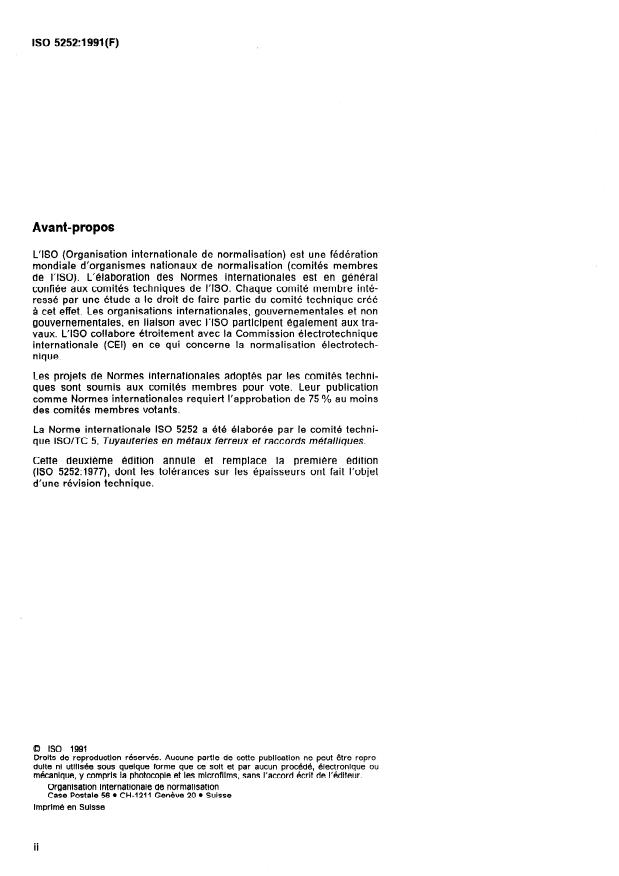
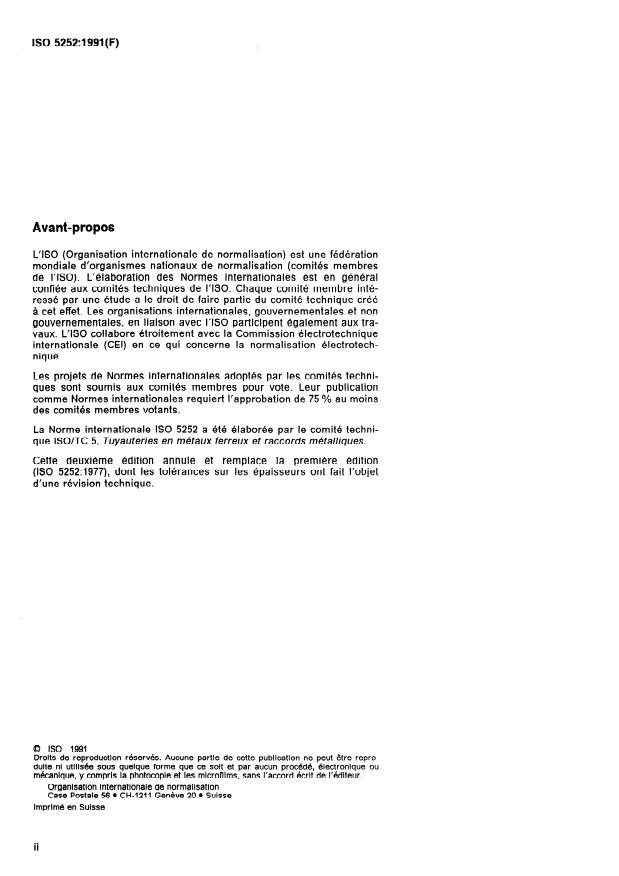
Avant-propos
L’ISO (Organisation internationale de normalisation) est une fédération’
mondiale d’organismes nationaux de normalisation (comités membres
de I’ISO). L’élaboration des Normes internationales est en général
confiée aux comités techniques de I’ISO. Chaque comité membre inté-
ressé par une étude a le droit de faire partie du comité technique créé
à cet effet. Les organisations internationales, gouvernementales et non
gouvernementales, en liaison avec I’ISO participent également aux tra-
vaux. L’ISO collabore étroitement avec la Commission électrotechnique
internationale (CEI) en ce qui concerne la normalisation électrotech-
nique.
Les projets de Normes internationales adoptes par les comités techni-
ques sont soumis aux comités membres pour vote. Leur publication
comme Normes internationales requiert l’approbation de 75 % au moins
des comités membres votants.
La Norme internationale ISO 5252 a été élaborée par le comité techni-
que ISO/TC 5, Tuyauteries en métaux ferreux et raccords métalliques.
Cette deuxiéme édition annule et remplace la première édition
(ISO 5252:1977), dont les tolérances sur les épaisseurs ont fait l’objet
d’une révision technique.
0 ISO 1991
Droits de reproduction réservés. Aucune partie de cette publication ne peut être repro-
duite ni utilisée sous quelque forme que ce soit et par aucun procédé, électronique ou
mécanique, y compris la photocopie et les microfilms, sans l’accord écrit de l’éditeur.
Organisation internationale de normalisation
Case Postale 56 l CH-121 1 Genève 20 l Suisse
tmprimé en Suisse
ii
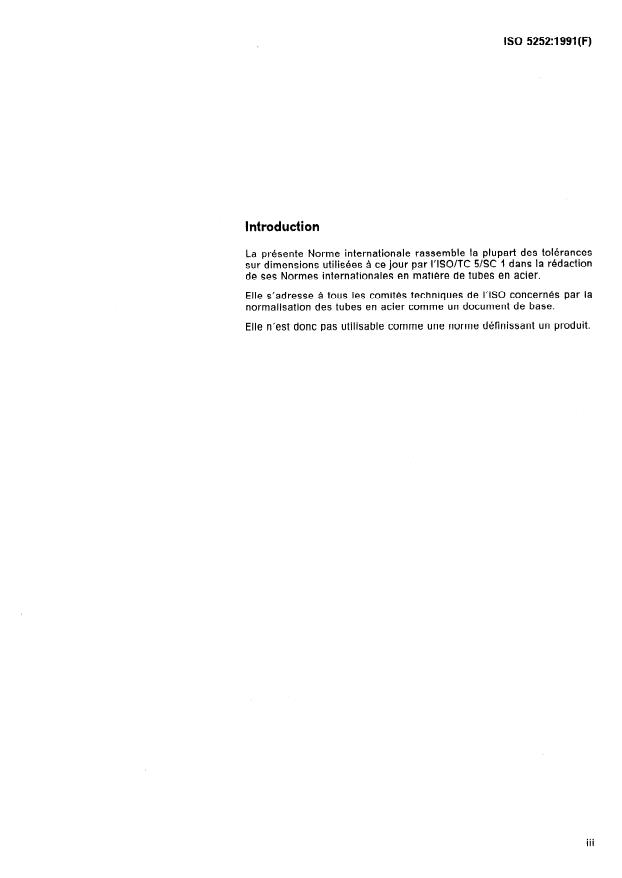
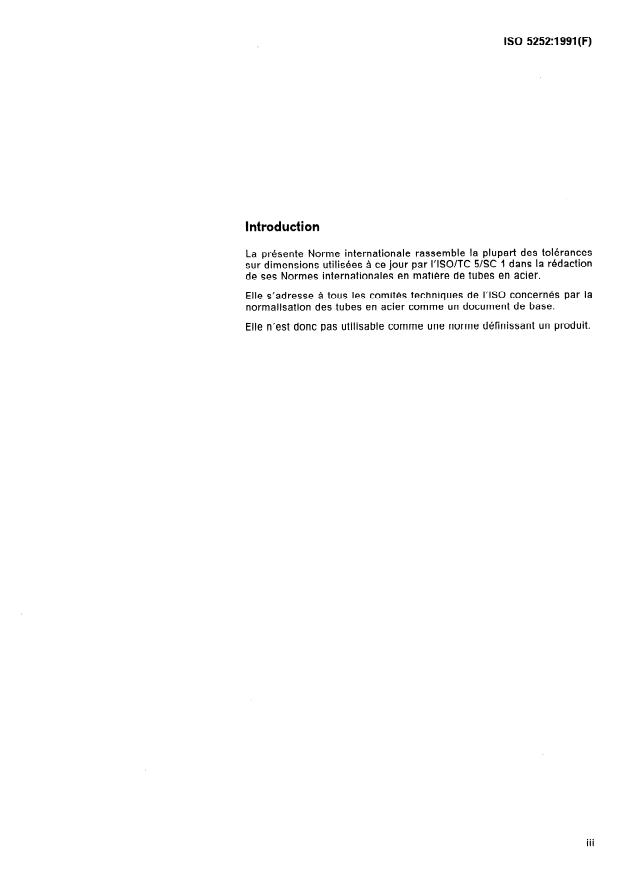
Introduction
La présente Norme internationale rassemble la plupart des tolérances
sur dimensions utilisées à ce jour par I’ISO/TC 5/SC 1 dans la redaction
de ses Normes internationales en matière de tubes en acier.
Elle s’adresse à tous les comités techniques de I’ISO concernés par la
normalisation des tubes en acier comme un document de base.
Elle n’est donc pas utilisable comme une norme définissant un produit.
. . .
III
Page blanche
~ ~~
NORME INTERNATIONALE
Tubes en acier - Systèmes de tolérances
3.2 tolérance absolue: Tolérance ou les écarts par
1 DomaIne d’application
rapport à la dimension nominale sont exprimes sous
la forme d’une valeur donnée dans l’unité de la di-
La présente Norme internationale établit les systè-
mension.
mes de tolérances sur dimensions à utiliser dans la
normalisation des tubes en acier (normes de pro-
EXEMPLE
duit).
Tolérance absolue appliquée à un diamétre
2 Référence normative
30 mm + 0,5 mm
-
La norme suivante contient des dispositions qui, par
suite de la référence qui en est faite, constituent des
3.3 tolérance mixte: Tolérance où l’un des écarts
dispositions valables pour la présente Norme inter-
est donné dans le système proportionnel et l’autre
nationale. Au moment de la publication, l’édition in-
dans le système absolu.
diquée était en vigueur. Toute norme est sujette à
révision et les parties prenantes des accords fondés
EXEMPLE
sur la présente Norme internationale sont invitées
Tolérance mixte appliquée à une épaisseur
à rechercher la possibilité d’appliquer l’édition la
plus récente de la norme indiquée ci-après. Les
membres de la CEI et de I’ISO possèdent le registre
des Normes internationales en vigueur à un moment
donné.
3.4 tolérance unilatérale: Tolérance où l’écart est
entièrement positif ou entièrement négatif.
ISO 28641988, Système /SO de tolérances et
d’ajustements - Partie 1: Base des tolérances,
EXEMPLE
écarts et ajustements.
Tolérance unilatérale appliquée à une longueur
3 Définitions
6000mm +Aomm
Pour les besoins de la présente Norme internatio-
nale, les définitions des termes 4olérance dimen-
3.5 tolérance bilatérale: Tolérance où les écarts
4car-t)) et ((dimension nominale))
sionnelle~~, sont de signes opposés.
données dans I’ISO 286-l et les définitions suivantes
s’appliquent.
3.6 tolérance symétrique: Tolérance bilatérale où
les écarts exprimes dans la même unité sont égaux.
3.1 tolérance proportionnelle: Tolérance où les
écarts par rapport à la dimension nominale sont
EXEMPLE
exprimés sous la forme d’un pourcentage de la di-
mension. Tolérance symétrique appliquée à un diamètre
EXEMPLE
168,3 mm &- 1 %
Tolérance proportionnelle appliquée à une épais-
3.7 tolérance asymétrique: Tolérance bilatérale où
seur
les écarts exprimes dans la même unité sont iné-
gaux.
6,3 mm &- 12,5 %
EXEMPLE
5.2 Sauf mention particulière dans la norme de
produit, la tolérance sur I’ovalisation est comprise
Tolérance asymétrique appliquée à une épaisseur
dans la tolérance sur le diamètre extérieur.
5.3 Pour les usages particuliers, par exemple pour
4 Utilisation des tolérances
le diamètre des tubes de précision, l’utilisation
d’une tolérance absolue est nécessaire. Cette tolé-
4.1
II convient que les tolérances utilisées dans les
rance doit être fixée de facon claire et précise pour
normes de produit soient choisies par sélection
chaque diamétre dans la norme de produit. Si, mal-
dans la présente Norme internationale, bien que
gré tout, un doute subsiste pour les dimensions in-
l’utilisation d’une tolérance spécifique à ce produit
termédiaires, la tolérance voisine la plus large
ne soit pas exclue.
s’applique.
4.2 II est recommandé que le choix et la combi-
EXEMPLE
naison des différentes tolérances proposées fasse
...
Iso
NORME
INTERNATIONALE
Deuxi6me édition
1991-02-15
Tubes en acier - Systèmes de tolérances
Steel tubes - Tolerance systems
Numéro de référence
ISO 5252: 1991 (F)
Avant-propos
L’ISO (Organisation internationale de normalisation) est une fédération’
mondiale d’organismes nationaux de normalisation (comités membres
de I’ISO). L’élaboration des Normes internationales est en général
confiée aux comités techniques de I’ISO. Chaque comité membre inté-
ressé par une étude a le droit de faire partie du comité technique créé
à cet effet. Les organisations internationales, gouvernementales et non
gouvernementales, en liaison avec I’ISO participent également aux tra-
vaux. L’ISO collabore étroitement avec la Commission électrotechnique
internationale (CEI) en ce qui concerne la normalisation électrotech-
nique.
Les projets de Normes internationales adoptes par les comités techni-
ques sont soumis aux comités membres pour vote. Leur publication
comme Normes internationales requiert l’approbation de 75 % au moins
des comités membres votants.
La Norme internationale ISO 5252 a été élaborée par le comité techni-
que ISO/TC 5, Tuyauteries en métaux ferreux et raccords métalliques.
Cette deuxiéme édition annule et remplace la première édition
(ISO 5252:1977), dont les tolérances sur les épaisseurs ont fait l’objet
d’une révision technique.
0 ISO 1991
Droits de reproduction réservés. Aucune partie de cette publication ne peut être repro-
duite ni utilisée sous quelque forme que ce soit et par aucun procédé, électronique ou
mécanique, y compris la photocopie et les microfilms, sans l’accord écrit de l’éditeur.
Organisation internationale de normalisation
Case Postale 56 l CH-121 1 Genève 20 l Suisse
tmprimé en Suisse
ii
Introduction
La présente Norme internationale rassemble la plupart des tolérances
sur dimensions utilisées à ce jour par I’ISO/TC 5/SC 1 dans la redaction
de ses Normes internationales en matière de tubes en acier.
Elle s’adresse à tous les comités techniques de I’ISO concernés par la
normalisation des tubes en acier comme un document de base.
Elle n’est donc pas utilisable comme une norme définissant un produit.
. . .
III
Page blanche
~ ~~
NORME INTERNATIONALE
Tubes en acier - Systèmes de tolérances
3.2 tolérance absolue: Tolérance ou les écarts par
1 DomaIne d’application
rapport à la dimension nominale sont exprimes sous
la forme d’une valeur donnée dans l’unité de la di-
La présente Norme internationale établit les systè-
mension.
mes de tolérances sur dimensions à utiliser dans la
normalisation des tubes en acier (normes de pro-
EXEMPLE
duit).
Tolérance absolue appliquée à un diamétre
2 Référence normative
30 mm + 0,5 mm
-
La norme suivante contient des dispositions qui, par
suite de la référence qui en est faite, constituent des
3.3 tolérance mixte: Tolérance où l’un des écarts
dispositions valables pour la présente Norme inter-
est donné dans le système proportionnel et l’autre
nationale. Au moment de la publication, l’édition in-
dans le système absolu.
diquée était en vigueur. Toute norme est sujette à
révision et les parties prenantes des accords fondés
EXEMPLE
sur la présente Norme internationale sont invitées
Tolérance mixte appliquée à une épaisseur
à rechercher la possibilité d’appliquer l’édition la
plus récente de la norme indiquée ci-après. Les
membres de la CEI et de I’ISO possèdent le registre
des Normes internationales en vigueur à un moment
donné.
3.4 tolérance unilatérale: Tolérance où l’écart est
entièrement positif ou entièrement négatif.
ISO 28641988, Système /SO de tolérances et
d’ajustements - Partie 1: Base des tolérances,
EXEMPLE
écarts et ajustements.
Tolérance unilatérale appliquée à une longueur
3 Définitions
6000mm +Aomm
Pour les besoins de la présente Norme internatio-
nale, les définitions des termes 4olérance dimen-
3.5 tolérance bilatérale: Tolérance où les écarts
4car-t)) et ((dimension nominale))
sionnelle~~, sont de signes opposés.
données dans I’ISO 286-l et les définitions suivantes
s’appliquent.
3.6 tolérance symétrique: Tolérance bilatérale où
les écarts exprimes dans la même unité sont égaux.
3.1 tolérance proportionnelle: Tolérance où les
écarts par rapport à la dimension nominale sont
EXEMPLE
exprimés sous la forme d’un pourcentage de la di-
mension. Tolérance symétrique appliquée à un diamètre
EXEMPLE
168,3 mm &- 1 %
Tolérance proportionnelle appliquée à une épais-
3.7 tolérance asymétrique: Tolérance bilatérale où
seur
les écarts exprimes dans la même unité sont iné-
gaux.
6,3 mm &- 12,5 %
EXEMPLE
5.2 Sauf mention particulière dans la norme de
produit, la tolérance sur I’ovalisation est comprise
Tolérance asymétrique appliquée à une épaisseur
dans la tolérance sur le diamètre extérieur.
5.3 Pour les usages particuliers, par exemple pour
4 Utilisation des tolérances
le diamètre des tubes de précision, l’utilisation
d’une tolérance absolue est nécessaire. Cette tolé-
4.1
II convient que les tolérances utilisées dans les
rance doit être fixée de facon claire et précise pour
normes de produit soient choisies par sélection
chaque diamétre dans la norme de produit. Si, mal-
dans la présente Norme internationale, bien que
gré tout, un doute subsiste pour les dimensions in-
l’utilisation d’une tolérance spécifique à ce produit
termédiaires, la tolérance voisine la plus large
ne soit pas exclue.
s’applique.
4.2 II est recommandé que le choix et la combi-
EXEMPLE
naison des différentes tolérances proposées fasse
...
Questions, Comments and Discussion
Ask us and Technical Secretary will try to provide an answer. You can facilitate discussion about the standard in here.
Loading comments...