

ISO 16290:2013
(Main)Space systems — Definition of the Technology Readiness Levels (TRLs) and their criteria of assessment
General Information
- Abstract
ISO 16290:2013 defines Technology Readiness Levels (TRLs). It is applicable primarily to space system hardware, although the definitions could be used in a wider domain in many cases. The definition of the TRLs provides the conditions to be met at each level, enabling accurate TRL assessment.
- Status
- Published
- Publication Date
- 13-Oct-2013
- Technical Committee
- ISO/TC 20/SC 14 - Space systems and operations
- Drafting Committee
- ISO/TC 20/SC 14/WG 5 - Space System Program Management and Quality
- Current Stage
- 9093 - International Standard confirmed
- Start Date
- 04-Jun-2024
- Completion Date
- 29-Aug-2026
Buy Documents

ISO 16290:2013 - Space systems — Definition of the Technology Readiness Levels (TRLs) and their criteria of assessment Released:10/14/2013

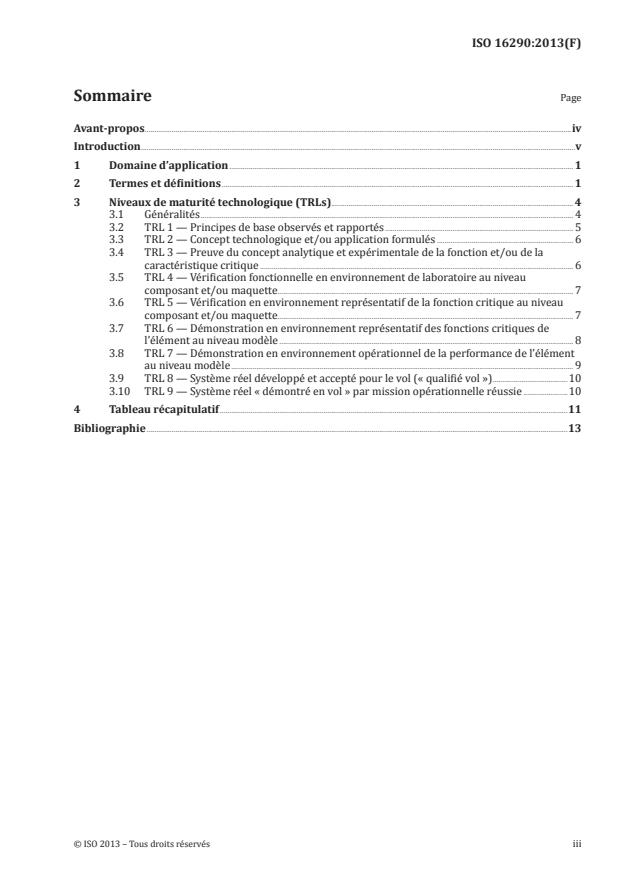

ISO 16290:2013 - Systemes spatiaux — Definition des Niveaux de Maturité de la Technologie (NMT) et de leurs criteres d'évaluation Released:1/13/2014
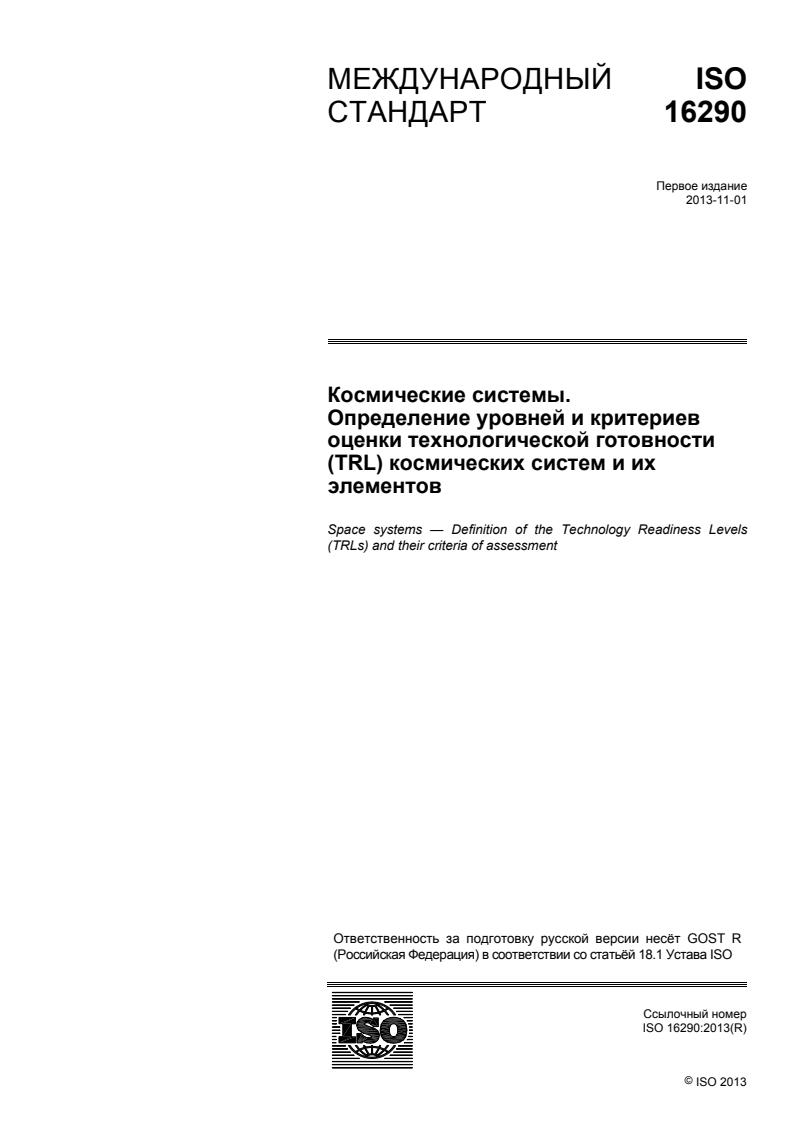

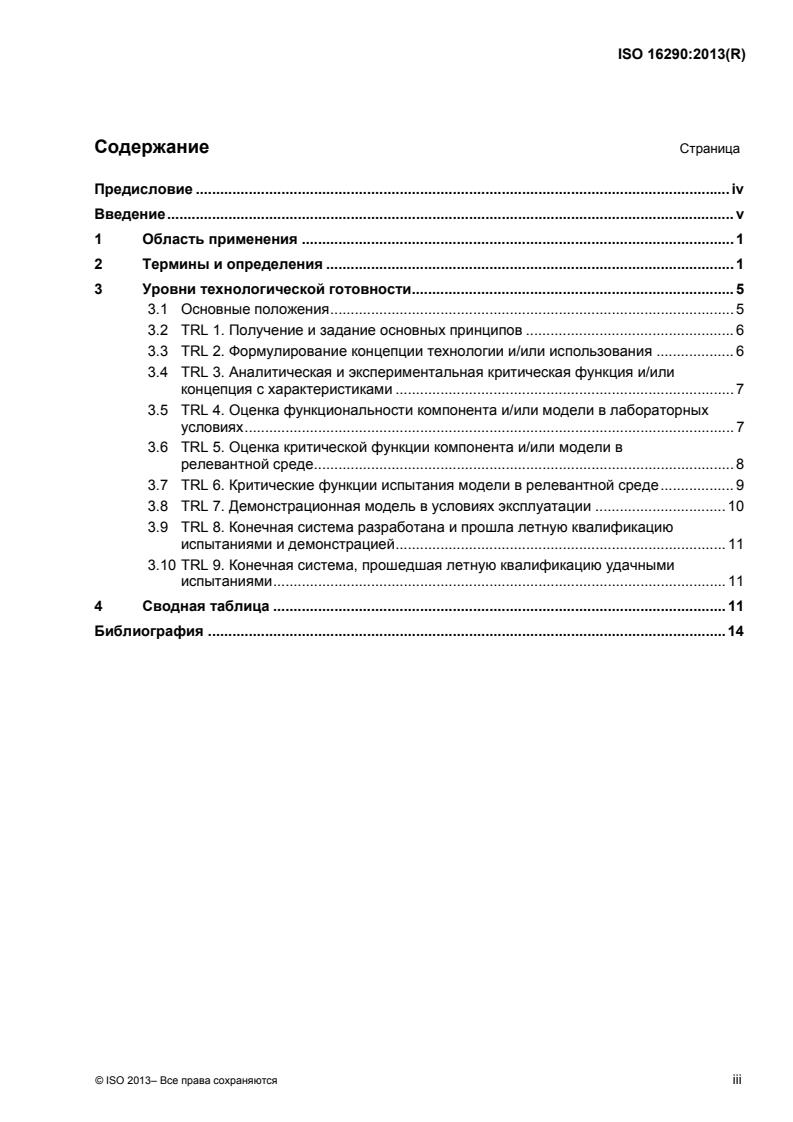
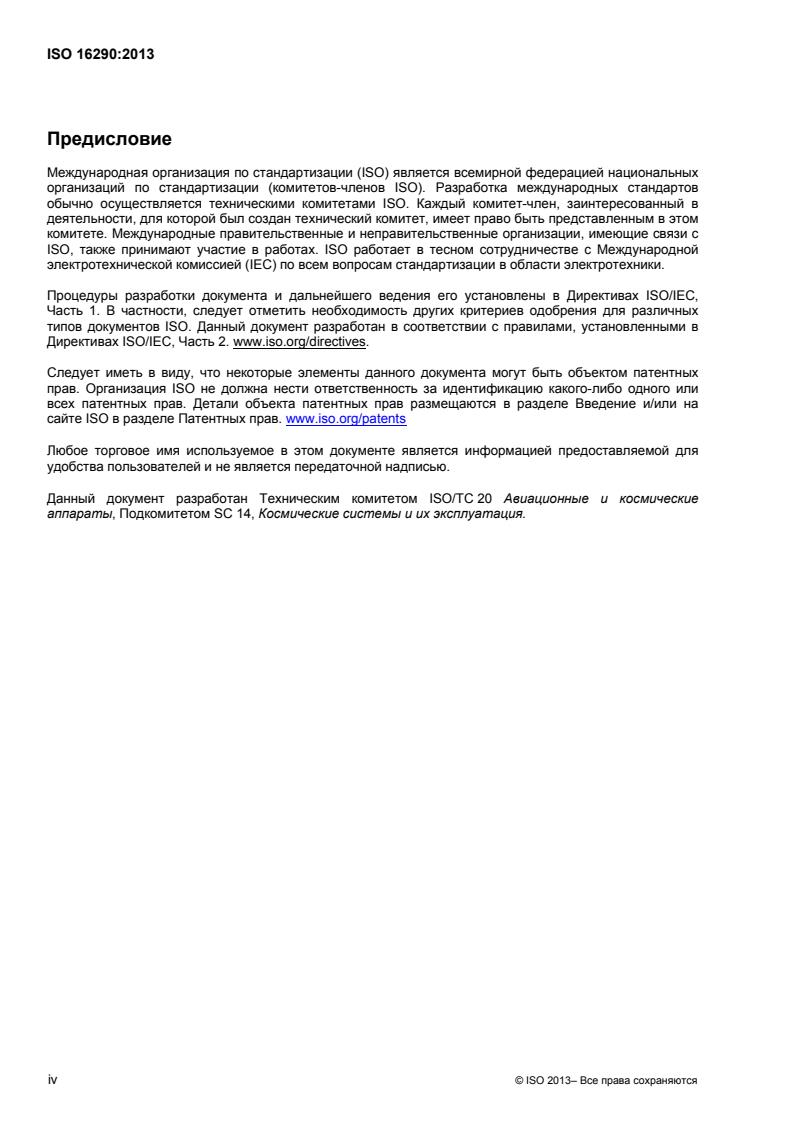
ISO 16290:2013 - Space systems — Definition of the Technology Readiness Levels (TRLs) and their criteria of assessment Released:1/19/2015
Overview
ISO 16290:2013 - "Space systems - Definition of the Technology Readiness Levels (TRLs) and their criteria of assessment" defines a standardized scale of Technology Readiness Levels (TRLs 1–9) for assessing the maturity of technology elements intended for space missions. Primarily focused on space system hardware, the standard provides definitions, required conditions at each TRL, and a summary table to enable consistent and accurate TRL assessment. The detailed assessment process itself is left to the adopting organization.
Key topics
- TRL scale (1 to 9): Descriptions and criteria for each level (see Clause 3), from basic principles observed (TRL 1) to flight-proven systems (TRL 9).
- Terms & definitions: Clear definitions for element, model, breadboard, critical function/part, laboratory vs relevant vs operational environment, reproducible process, verification and validation.
- Assessment conditions: Conditions required at each TRL to demonstrate maturity - including functional verification, performance verification in laboratory and relevant environments, and actual operational validation.
- Scope and applicability: Intended mainly for space hardware but adaptable to other domains where technology maturity assessment is needed.
- Traceability and time-sensitivity: TRL is assessed for a specific element at a given time; maturity can be downgraded if context or reproducibility changes (e.g., obsolescence, new operational environment).
- Limitations: TRL indicates maturity status but does not quantify the cost, schedule, or effort required to advance levels.
Applications
ISO 16290 is useful for:
- Technology monitoring and maturation planning for space missions
- Input to project implementation and go/no-go decision processes
- Risk assessment and mitigation tied to technology maturity
- Procurement and contracting (defining supplier readiness expectations)
- Research & development roadmaps and milestone definitions
- Cross-organizational communication of technology status using a common TRL language
Who uses this standard
- Systems and spacecraft engineers
- Program and project managers in space agencies and industry
- Technology managers, R&D leads, and principal investigators
- Procurement officers, reviewers, and independent assessors
- Organizations adapting TRL frameworks for non-space applications
Related standards and references
- ISO 16290 references and aligns terminology with other ISO work (e.g., definitions from ISO 10795) and takes into account existing TRL guidance from major space organizations (NASA, DoD, ESA, CNES, DLR). The ISO/IEC Directives govern the development and maintenance of the standard.
Keywords: ISO 16290, Technology Readiness Levels, TRL assessment, space systems, technology maturity, TRL 1–9, verification, validation, space hardware.
Buy Documents
ISO 16290:2013 - Space systems — Definition of the Technology Readiness Levels (TRLs) and their criteria of assessment Released:10/14/2013
ISO 16290:2013 - Systemes spatiaux — Definition des Niveaux de Maturité de la Technologie (NMT) et de leurs criteres d'évaluation Released:1/13/2014
ISO 16290:2013 - Space systems — Definition of the Technology Readiness Levels (TRLs) and their criteria of assessment Released:1/19/2015
Get Certified
Connect with accredited certification bodies for this standard

BUREAU VERITAS Certification Germany
Bureau Veritas certification in Germany.

Element Materials Technology
Materials testing and product certification.

AQMS Ltd.
AQMS provides ISO certification to SMEs across the UK.
Sponsored listings
Frequently Asked Questions
ISO 16290:2013 is a standard published by the International Organization for Standardization (ISO). Its full title is "Space systems — Definition of the Technology Readiness Levels (TRLs) and their criteria of assessment". This standard covers: ISO 16290:2013 defines Technology Readiness Levels (TRLs). It is applicable primarily to space system hardware, although the definitions could be used in a wider domain in many cases. The definition of the TRLs provides the conditions to be met at each level, enabling accurate TRL assessment.
ISO 16290:2013 defines Technology Readiness Levels (TRLs). It is applicable primarily to space system hardware, although the definitions could be used in a wider domain in many cases. The definition of the TRLs provides the conditions to be met at each level, enabling accurate TRL assessment.
ISO 16290:2013 is classified under the following ICS (International Classification for Standards) categories: 49.140 - Space systems and operations. The ICS classification helps identify the subject area and facilitates finding related standards.
ISO 16290:2013 is available in PDF format for immediate download after purchase. The document can be added to your cart and obtained through the secure checkout process. Digital delivery ensures instant access to the complete standard document.
Standards Content (Sample)
INTERNATIONAL ISO
STANDARD 16290
First edition
2013-11-01
Space systems — Definition of the
Technology Readiness Levels (TRLs)
and their criteria of assessment
Systèmes spatiaux — Definition des Niveaux de Maturité de la
Technologie (NMT) et de leurs critères d’évaluation
Reference number
©
ISO 2013
© ISO 2013
All rights reserved. Unless otherwise specified, no part of this publication may be reproduced or utilized otherwise in any form
or by any means, electronic or mechanical, including photocopying, or posting on the internet or an intranet, without prior
written permission. Permission can be requested from either ISO at the address below or ISO’s member body in the country of
the requester.
ISO copyright office
Case postale 56 • CH-1211 Geneva 20
Tel. + 41 22 749 01 11
Fax + 41 22 749 09 47
E-mail copyright@iso.org
Web www.iso.org
Published in Switzerland
ii © ISO 2013 – All rights reserved
Contents Page
Foreword .iv
Introduction .v
1 Scope . 1
2 Terms and definitions . 1
3 Technology Readiness Levels (TRLs) . 4
3.1 General . 4
3.2 TRL 1 — Basic principles observed and reported . 5
3.3 TRL 2 — Technology concept and/or application formulated . 5
3.4 TRL 3 — Analytical and experimental critical function and/or
characteristic proof-of-concept . 6
3.5 TRL 4 — Component and/or breadboard functional verification in
laboratory environment . 6
3.6 TRL 5 — Component and/or breadboard critical function verification in a
relevant environment . 7
3.7 TRL 6 — Model demonstrating the critical functions of the element in a
relevant environment . 8
3.8 TRL 7 — Model demonstrating the element performance for the
operational environment . 9
3.9 TRL 8 — Actual system completed and accepted for flight (“flight qualified”) . 9
3.10 TRL 9 — Actual system “flight proven” through successful mission operations .10
4 Summary table .10
Bibliography .12
Foreword
ISO (the International Organization for Standardization) is a worldwide federation of national standards
bodies (ISO member bodies). The work of preparing International Standards is normally carried out
through ISO technical committees. Each member body interested in a subject for which a technical
committee has been established has the right to be represented on that committee. International
organizations, governmental and non-governmental, in liaison with ISO, also take part in the work.
ISO collaborates closely with the International Electrotechnical Commission (IEC) on all matters of
electrotechnical standardization.
The procedures used to develop this document and those intended for its further maintenance are
described in the ISO/IEC Directives, Part 1. In particular the different approval criteria needed for the
different types of ISO documents should be noted. This document was drafted in accordance with the
editorial rules of the ISO/IEC Directives, Part 2. www.iso.org/directives
Attention is drawn to the possibility that some of the elements of this document may be the subject of
patent rights. ISO shall not be held responsible for identifying any or all such patent rights. Details of
any patent rights identified during the development of the document will be in the Introduction and/or
on the ISO list of patent declarations received. www.iso.org/patents
Any trade name used in this document is information given for the convenience of users and does not
constitute an endorsement.
The committee responsible for this document is ISO/TC 20, Aircraft and space vehicles, Subcommittee
SC 14, Space systems and operations.
iv © ISO 2013 – All rights reserved
Introduction
Technology Readiness Levels (TRLs) are used to quantify the technology maturity status of an element
intended to be used in a mission. Mature technology corresponds to the highest TRL, namely TRL 9, or
flight proven elements.
The TRL scale can be useful in many areas including, but not limited to the following examples:
a) For early monitoring of basic or specific technology developments serving a given future mission or
a family of future missions;
b) For providing a status on the technical readiness of a future project, as input to the project
implementation decision process;
c) In some cases, for monitoring the technology progress throughout development.
The TRL descriptions are provided in Clause 3 of this International Standard. The achievements that are
requested for enabling the TRL assessment at each level are identified in the summary table in Clause 4.
The detailed procedure for the TRL assessment is to be defined by the relevant organization or institute
in charge of the activity.
This International Standard was produced by taking due consideration of previous available documents
on the subject, in particular including those from the National Aeronautics Space Administration (NASA),
the US Department of Defence (DoD) and European space institutions (DLR, CNES and ESA).
INTERNATIONAL STANDARD ISO 16290:2013(E)
Space systems — Definition of the Technology Readiness
Levels (TRLs) and their criteria of assessment
1 Scope
This International Standard defines Technology Readiness Levels (TRLs). It is applicable primarily to
space system hardware, although the definitions could be used in a wider domain in many cases.
The definition of the TRLs provides the conditions to be met at each level, enabling accurate TRL assessment.
2 Terms and definitions
For the purposes of this document, the following terms and definitions apply.
2.1
breadboard
physical model (2.10) designed to test functionality and tailored to the demonstration need
2.2
critical function of an element
mandatory function which requires specific technology (2.19) verification
Note 1 to entry: This situation occurs when either the element or components of the element are new and cannot
be assessed by relying on previous realizations, or when the element is used in a new domain, such as new
environmental conditions or a new specific use not previously demonstrated.
Note 2 to entry: Wherever used in this International Standard, “critical function” always refers to “technology
critical function” and should not be confused with “safety critical function”.
Note 3 to entry: Wherever used in this International Standard, “critical function” always refers to “critical function
of an element”.
2.3
critical part of an element
element (2.4) part associated to a critical function
Note 1 to entry: The critical part of an element can represent a subset of the element and the technology verification
for the critical function may be achievable through dedicated tests achieved on the critical part only.
Note 2 to entry: Wherever used in this International Standard, “critical part” always refers to “technology
critical part”.
Note 3 to entry: Wherever used in this International Standard, “critical part” always refers to “critical part
of an element”.
2.4
element
item or object under consideration for the technology readiness assessment
Note 1 to entry: The element can be a component, a piece of equipment, a subsystem or a system.
2.5
element function
intended effect of the element (2.4)
2.6
functional performance requirements
subset of the performance requirements (2.14) of an element (2.4) specifying the element functions (2.5)
Note 1 to entry: The functional performance requirements do not necessarily include requirements resulting
from the operational environment (2.11).
2.7
laboratory environment
controlled environment needed for demonstrating the underlying principles and functional performance
Note 1 to entry: The laboratory environment does not necessarily address the operational environment (2.11).
2.8
mature technology
technology defined by a set of reproducible processes (2.17) for the design, manufacture, test and
operation of an element (2.4) for meeting a set of performance requirements (2.14) in the actual operational
environment (2.11)
2.9
mission operations
sequence of events that are defined for accomplishing the mission
2.10
model
physical or abstract representation of relevant aspects of an element (2.4) that is put forward as a basis
for calculations, predictions, tests or further assessment
Note 1 to entry: The term “model” can also be used to identify particular instances of the element, e.g. flight model.
Note 2 to entry: Adapted from ISO 10795, definition 1.141.
2.11
operational environment
set of natural and induced conditions that constrain the element (2.4) from its design definition to its operation
EXAMPLE 1 Natural conditions: weather, climate, ocean conditions, terrain, vegetation, dust, light, radiation, etc.
EXAMPLE 2 Induced conditions: electromagnetic interference, heat, vibration, pollution, contamination, etc.
2.12
operational performance requirements
subset of the performance requirements (2.14) of an element (2.4) specifying the element functions (2.5)
in its operational environment (2.11)
Note 1 to entry: The operational performance requirements are expressed through technical specifications
covering all engineering domains. They are validated through successful in orbit operation and can be verified
through a collection of element verifications on the ground which comprehensively cover the operational case.
Note 2 to entry: The full set of performance requirements of an element consists of the operational performance
requirements and the performance requirements for the use of the element on ground.
2.13
performance
aspects of an element (2.4) observed or measured from its operation or function
Note 1 to entry: These aspects are generally quantified.
Note 2 to entry: Adapted from ISO 10795, definition 1.155.
2 © ISO 2013 – All rights reserved
2.14
performance requirements
set of parameters that are intended to be satisfied by the element (2.4)
Note 1 to entry: The complete set of performance requirements inevitably include the environment conditions in
which the element is used and operated and are therefore linked to the mission(s) under consideration and also to
the environment of the system in which it is incorporated.
2.15
process
set of interrelated or interacting activities which transform inputs into outputs
Note 1 to entry: Inputs to a process are generally outputs of other processes.
Note 2 to entry: Processes in an organization are generally planned and carried out under controlled conditions
to add value.
Note 3 to entry: A process where the conformity of the resulting product cannot be readily economically verified
is frequently referred to as a “special process”.
[SOURCE: ISO 10795, definition 1.160]
2.16
relevant environment
minimum subset of the operational environment (2.11) that is required to demonstrate critical functions
of the element (2.2) performance in its operational environment (2.11)
2.17
reproducible process
process (2.15) that can be repeated in time
Note 1 to entry: It is fundamental in the definition of “mature technology” and is intimately linked to realization
capability and to verifiability.
Note 2 to entry: An element developed “by chance”, even if meeting the requirements, can obviously not be declared
as relying on a mature technology if there is little possibility of reproducing the element on a reliable schedule.
Conversely, reproducibility implicitly introduces the notion of time in the mature technology definition. A technology
can be declared mature at a given time, and degraded later at a lower readiness level because of the obsolescence of
its components or because the processes involve a specific organization with unique skills that has closed.
2.18
requirement
need or expectation that is stated and to be complied with
Note 1 to entry: Adapted from ISO 10795, definition 1.190.
2.19
technology
application of scientific knowledge, tools, techniques, crafts, systems or methods of organization in
order to solve a problem or achieve an objective
2.20
validation
confirmation, through objective evidence, that the requirements (2.18) for a specific intended use or
application have been fulfilled
Note 1 to entry: The term “validated” is used to designate the corresponding status.
Note 2 to entry: The use conditions for validation can be real or simulated.
Note 3 to entry: May be determined by a combination of test, analysis, demonstration, and inspection.
Note 4 to entry: When the element is validated it is confirmed that it is able to accomplish its intended use in the
intended operational environment (2.11).
Note 5 to entry: Adapted from ISO 10795, definition 1.228.
2.21
verification
confirmation through the provision of objective evidence that specified requirements (2.18) have
been fulfilled
Note 1 to entry: The term “verified” is used to designate the corresponding status.
Note 2 to entry: Confirmation can be comprised of activities such as: performing alternative calculations, comparing
a new design specification with a similar proven design specification, undertaking tests and demonstrations, and
reviewing documents prior to issue.
Note 3 to entry: Verification may be determined by a combination of test, analysis, demonstration, and inspection.
Note 4 to entry: When an element is verified, it is confirmed that it meets the design specifications.
Note 5 to entry: Adapted from ISO 10795, definition 1.229
3 Technology Readiness Levels (TRLs)
3.1 General
A technology for an element intended for an application reaches the maturity level, corresponding to
TRL 9, when it is well-defined by a set of reproducible processes for the design, manufacture, test and
operation of the element and when, in addition, the element meets a set of performance requirements in
the actual operational environment.
The element under consideration is assumed to be a physical part of a system. Systems are generally
subdivided into sub-systems with potentially several sub-levels. The element can be any part of the
system and is not necessarily a specific sub-system or at a specific sub-level.
A prerequisite for TRL assessment is the identification of the element that is subject to the assessment.
Higher TRLs further require the definition of the performance requirements, and therefore require the
knowledge of the mission and the system where the element is intended to be used and its operational
environment. Performance requirements can be preliminary and targeting several missions at low
TRLs, then progressively refined and verified at higher levels.
The entire TRL scale applies for a given element. Therefore, there is no gradation in the element
complexity when moving from low to high TRLs.
Higher TRLs also imply that the element is in its final form and is being integrated into a system for
validation or use. Therefore, the TRL of a given element may be downgraded if this same element is used
in a different system, unless all environment and interface requirements for the element in the new
system can be demonstrated to be equally or less demanding than for the original system.
A TRL assessment is valid for a given element and at a given point in time. It may evolve if the conditions
that prevailed at the time of the assessment are no longer valid. Such a situation may lead to TRL
reassessment and degradation, which can occur in particular when the re-build/re-use of an element is
envisioned. Examples are when the obsolescence of the electronics requires modifications or when the
production involves a specific knowledge that has been lost.
The time or effort to move from one TRL to another are technology dependent and are not linearly
connected to the TRL scale. Experience shows that they can vary widely depending on the element and
mission under consideration. Therefore, while the TRL scale is an appropriate tool for assessing the
technology maturity status at a given point in time, it gives no indication of the effort and cost to be
spent for reaching the next level.
4 © ISO 2013 – All rights reserved
While TRL 9 refers to mature technology, lower TRLs reflect the fact that one or more conditions for
reaching a mature technology have not been met, such as:
a) The processes involved for the element manufacturing have not been fully defined,
b) The operational performance requirements have not yet been fully defined,
c) The element has not yet been fully defined,
d) The element has not yet been built,
e) The element performance requirements have not yet been demonstrated in its operational environment.
When the element is an integrated system or subsystem, it can consist of sub-elements, each involving
some specific technology. In that case, the TRL of the element cannot be greater than that of the individual
sub-elements.
For each TRL, the expected status of the element performance requirements is stated in the description.
3.2 TRL 1 — Basic principles observed and reported
3.2.1 Description
Scientific research exists related to the technology to be assessed and begins to be translated into
applied research and development. Basic principles are observed and reported through academic-like
research. Potential applications are identified but performance requirements are not yet specified.
At TRL1, no specific mission can be associated with the technology as concepts and/or applications are
only formulated at TRL 2. Therefore, the performance requirements may not be defined at this stage.
3.2.2 Examples
The following are examples of TRL 1:
a) In 1895 German physicist William Conrad Roentgen discovered X-rays.
b) Superconductivity is discovered by H. Kamerlingh Onnes in 1911, showing abrupt disappearance of
electrical resistance for certain materials below a characteristic temperature.
c) In October 2010 researchers announced the discovery of the world’s second giant virus, dubbed
CroV. This virus, which infects single-cell marine creatures, is considered enormous due to the size
of its genome – approximately 730 000 base pairs, or genetic building blocks, more than double the
size of the largest known “normal” virus.
3.3 TRL 2 — Technology concept and/or application formulated
3.3.1 Description
Once basic princ
...
NORME ISO
INTERNATIONALE 16290
Première édition
2013-11-01
Systèmes spatiaux — Definition des
Niveaux de Maturité de la Technologie
(NMT) et de leurs critères d’évaluation
Space systems — Definition of the Technology Readiness Levels (TRLs)
and their criteria of assessment
Numéro de référence
©
ISO 2013
DOCUMENT PROTÉGÉ PAR COPYRIGHT
© ISO 2013
Droits de reproduction réservés. Sauf indication contraire, aucune partie de cette publication ne peut être reproduite ni utilisée
sous quelque forme que ce soit et par aucun procédé, électronique ou mécanique, y compris la photocopie, l’affichage sur
l’internet ou sur un Intranet, sans autorisation écrite préalable. Les demandes d’autorisation peuvent être adressées à l’ISO à
l’adresse ci-après ou au comité membre de l’ISO dans le pays du demandeur.
ISO copyright office
Case postale 56 • CH-1211 Geneva 20
Tel. + 41 22 749 01 11
Fax + 41 22 749 09 47
E-mail copyright@iso.org
Web www.iso.org
Version française parue en 2014
Publié en Suisse
ii © ISO 2013 – Tous droits réservés
Sommaire Page
Avant-propos .iv
Introduction .v
1 Domaine d’application . 1
2 Termes et définitions . 1
3 Niveaux de maturité technologique (TRLs) . 4
3.1 Généralités . 4
3.2 TRL 1 — Principes de base observés et rapportés . 5
3.3 TRL 2 — Concept technologique et/ou application formulés . 6
3.4 TRL 3 — Preuve du concept analytique et expérimentale de la fonction et/ou de la
caractéristique critique . 6
3.5 TRL 4 — Vérification fonctionnelle en environnement de laboratoire au niveau
composant et/ou maquette. 7
3.6 TRL 5 — Vérification en environnement représentatif de la fonction critique au niveau
composant et/ou maquette. 7
3.7 TRL 6 — Démonstration en environnement représentatif des fonctions critiques de
l’élément au niveau modèle . 8
3.8 TRL 7 — Démonstration en environnement opérationnel de la performance de l’élément
au niveau modèle . 9
3.9 TRL 8 — Système réel développé et accepté pour le vol (« qualifié vol ») .10
3.10 TRL 9 — Système réel « démontré en vol » par mission opérationnelle réussie .10
4 Tableau récapitulatif .11
Bibliographie .13
Avant-propos
L’ISO (Organisation internationale de normalisation) est une fédération mondiale d’organismes
nationaux de normalisation (comités membres de l’ISO). L’élaboration des Normes internationales est
en général confiée aux comités techniques de l’ISO. Chaque comité membre intéressé par une étude
a le droit de faire partie du comité technique créé à cet effet. Les organisations internationales,
gouvernementales et non gouvernementales, en liaison avec l’ISO participent également aux travaux.
L’ISO collabore étroitement avec la Commission électrotechnique internationale (CEI) en ce qui concerne
la normalisation électrotechnique.
Les procédures utilisées pour élaborer le présent document et celles destinées à sa mise à jour sont
décrites dans les Directives ISO/CEI, Partie 1. Il convient, en particulier de prendre note des différents
critères d’approbation requis pour les différents types de documents ISO. Le présent document a été
rédigé conformément aux règles de rédaction données dans les Directives ISO/CEI, Partie 2, www.iso.
org/directives.
L’attention est appelée sur le fait que certains des éléments du présent document peuvent faire l’objet de
droits de propriété intellectuelle ou de droits analogues. L’ISO ne saurait être tenue pour responsable
de ne pas avoir identifié de tels droits de propriété et averti de leur existence. Les détails concernant les
références aux droits de propriété intellectuelle ou autres droits analogues identifiés lors de l’élaboration
du document sont indiqués dans l’Introduction et/ou sur la liste ISO des déclarations de brevets reçues,
www.iso.org/patents.
Les éventuelles appellations commerciales utilisées dans le présent document sont données pour
information à l’intention des utilisateurs et ne constituent pas une approbation ou une recommandation.
Le comité chargé de l’élaboration du présent document est l’ISO/TC 20, Aéronautique et espace, sous-
comité SC 14, Systèmes spatiaux, développement et mise en oeuvre.
iv © ISO 2013 – Tous droits réservés
Introduction
Les Niveaux de Maturité Technologique (TRLs) sont utilisés pour quantifier l’état de maturité
technologique d’un élément destiné à être utilisé pour une mission. La technologie mature correspond
au TRL le plus élevé, à savoir TRL 9 ou à des éléments éprouvés en vol.
L’échelle des TRLs peut être utile dans de nombreux domaines incluant, mais sans s’y limiter, les exemples
suivants:
a) Pour le contrôle en amont des développements technologiques génériques ou spécifiques de la
technologie au service d’une mission future donnée ou d’une famille de missions futures,
b) Pour faire un état de la maturité technique d’un futur projet, en tant que contribution au processus
décisionnel d‘exécution du projet,
c) Dans certains cas, pour suivre la progression d’une technologie tout au long de son développement.
Ce document fournit la description des TRLs dans l’Article 3. Les réalisations qui sont exigées de façon
à permettre l’évaluation des TRLs à chaque niveau sont identifiées dans le tableau récapitulatif dans
l’Article 4. La procédure détaillée concernant l’évaluation des TRLs doit être définie par l’organisme ou
l’institut compétent responsable de l’activité.
La présente Norme internationale a été produite en prenant dûment en considération les documents
antérieurs existants sur le sujet, y compris en particulier ceux de la National Aeronautics Space
Administration (NASA), le Department of Defence (DoD) des États-Unis et des Agences Spatiales
européennes (DLR, CNES et ESA).
NORME INTERNATIONALE ISO 16290:2013(F)
Systèmes spatiaux — Definition des Niveaux de Maturité de
la Technologie (NMT) et de leurs critères d’évaluation
1 Domaine d’application
La présente Norme internationale définit les Niveaux de Maturité Technologique. Elle est applicable
principalement aux matériels relatifs aux systèmes spatiaux bien que, dans de nombreux cas, les
définitions puissent être utilisées dans un domaine plus large.
La définition des TRLs fournit les conditions à remplir à chaque niveau, permettant une évaluation de
TRL précise.
2 Termes et définitions
Pour les besoins du présent document, les termes et définitions suivants s’appliquent.
2.1
maquette
modèle physique (2.10) conçu pour soumettre à essai la fonctionnalité et adapté au besoin de la
démonstration
2.2
fonction critique d’un élément
fonction obligatoire exigeant une vérification spécifique de la technologie (2.19)
Note 1 à l’article: Cette situation se produit lorsque l’élément ou les composants de l’élément sont nouveaux et
ne peuvent être évalués en se basant sur des réalisations antérieures ou lorsqu’un élément est utilisé dans un
nouveau domaine, telles que des nouvelles conditions en environnement ou une utilisation spécifique nouvelle
non encore démontrée.
Note 2 à l’article: Chaque fois que «fonction critique» est utilisée dans le présent document, elle renvoie toujours
à «fonction critique de la technologie» et il convient de ne pas la confondre avec «fonction critique de sécurité».
Note 3 à l’article: Chaque fois que «fonction critique» est utilisée dans le présent document, elle renvoie toujours
à «fonction critique d’un élément».
2.3
partie critique d’un élément
partie d’un élément (2.4) associée à une fonction critique
Note 1 à l’article: La partie critique d’un élément peut représenter un sous-ensemble de l’élément et la vérification
de la technologie de la fonction critique peut être réalisée au moyen de tests dédiés menés uniquement sur la
partie critique.
Note 2 à l’article: Chaque fois que «partie critique» est utilisée dans le présent document, elle renvoie toujours à
la «partie critique de la technologie».
Note 3 à l’article: Chaque fois que «partie critique» est utilisée dans le présent document, elle renvoie toujours à
la «partie critique d’un élément».
2.4
élément
article ou objet examiné pour l’évaluation de la maturité technologique
Note 1 à l’article: L’élément peut être un composant, une partie d’équipement, un sous-système ou un système.
2.5
fonction de l’élément
effet prévu de l’élément (2.4)
2.6
exigences de performance fonctionnelle
sous-ensemble des exigences de performance (2.14) d’un élément (2.4) spécifiant les fonctions de l’élément
(2.5)
Note 1 à l’article: Les exigences de performance fonctionnelle n’incluent pas nécessairement les exigences
résultant de l’environnement opérationnel.
2.7
environnement de laboratoire
environnement contrôlé nécessaire pour démontrer les principes sous-jacents et la performance
fonctionnelle
Note 1 à l’article: NOTE L’environnement de laboratoire ne traite pas nécessairement l’environnement opérationnel
(2.11)
2.8
technologie mature
technologie définie par un ensemble de procédés reproductibles (2.17) pour la conception, la fabrication,
les tests et l’exploitation d’un élément (2.4) de façon à satisfaire un ensemble d’exigences de performance
dans l’environnement opérationnel réel (2.11)
2.9
opérations relatives à la mission
séquence des évènements qui sont définis pour accomplir la mission
2.10
modèle
représentation physique ou abstraite des aspects pertinents d’un élément (2.4) qui sert de base pour les
calculs, les prévisions, les tests ou une évaluation ultérieure
Note 1 à l’article: Le terme «modèle» peut aussi être utilisé pour identifier des cas particuliers de l’élément, par
exemple, modèle de vol.
Note 2 à l’article: Adapté de l’ISO 10795, définition 1.141.
2.11
environnement opérationnel
ensemble de conditions naturelles et induites qui constitue une contrainte pour l’élément (2.4) à partir
de la définition de la conception jusqu’à son exploitation
EXEMPLE 1 Conditions naturelles: temps, climat, conditions océaniques, terrain, végétation, poussière,
lumière, radiation, etc.
EXEMPLE 2 Conditions induites: interférence électromagnétique, chaleur, vibration, pollution, contamination,
etc.
2.12
exigences de performance opérationnelle
sous-ensemble des exigences de performance (2.14) d’un élément (2.4) spécifiant les fonctions de l’élément
(2.5) dans son environnement opérationnel (2.11)
Note 1 à l’article: Les exigences de performance opérationnelle sont exprimées à travers des spécifications
techniques couvrant tous les domaines d’ingénierie. Elles sont validées par des opérations en orbite réussies et
elles peuvent être vérifiées grâce à un ensemble de vérifications d’éléments au sol couvrant intégralement le cas
opérationnel.
Note 2 à l’article: L’ensemble complet des exigences de performance d’un élément est constitué des exigences de
performance opérationnelle et des exigences de performance pour l’utilisation des éléments au sol.
2 © ISO 2013 – Tous droits réservés
2.13
performance
aspects d’un élément (2.4) constatés ou mesurés à partir de son fonctionnement ou de sa fonction
Note 1 à l’article: Ces aspects sont généralement mesurés.
Note 2 à l’article: Adapté de l’ISO 10795, définition 1.155.
2.14
exigences de performance
ensemble de paramètres qui sont destinés à être satisfaits par l’élément (2.4)
Note 1 à l’article: L’ensemble complet des exigences de performance comprend inévitablement les conditions
d’environnement dans lesquelles l’élément est utilisé et exploité et qui sont donc liées à la/les missions concernées
et aussi à l’environnement du système dans lequel il est intégré.
2.15
procédé
ensemble d’activités corrélées ou interactives qui transforment des éléments d’entrée en éléments de
sortie
Note 1 à l’article: Les éléments d’entrée dans un procédé sont généralement des éléments de sortie pour d’autres
procédés.
Note 2 à l’article: Les procédés dans une organisation sont généralement planifiés et réalisés dans des conditions
maîtrisées pour ajouter de la valeur.
Note 3 à l’article: Un procédé dans lequel la conformité du produit résultant ne peut pas être facilement vérifiée
du point de vue économique est fréquemment appelé “procédé spécial”.
[SOURCE: l’ISO 10795, définition 1.160]
2.16
environnement représentatif
sous-ensemble minimal de l’environnement opérationnel (2.11) qui est requis pour démontrer la
performance des fonctions critiques de l’élément (2.2) dans son environnement opérationnel (2.11)
2.17
procédé reproductible
procédé (2.15) qui peut être répété dans le temps
Note 1 à l’article: Il est fondamental dans la définition de la “technologie mature” et il est intimement lié à la
capacité de réalisation et à la vérifiabilité.
Note 2 à l’article: Un élément élaboré “par hasard”, même s’il satisfait aux exigences, ne peut évidemment pas se
prévaloir de s’appuyer sur une technologie mature s’il y a peu de chance de reproduire l’élément dans des délais
fiables. Inversement, la reproductibilité introduit de manière implicite la notion de temps dans la définition de la
technologie mature. Une technologie peut être déclarée mature à un moment donné, et dégradée plus tard à un
niveau de maturité inférieur à cause de l’obsolescence de ses composants ou parce que les procédés impliquent
une organisation spécifique doté de compétences uniques qui a fermé.
2.18
exigence
besoin ou attente qui est déclaré et qui doit être satisfait
Note 1 à l’article: Adapté de l’ISO 10795, définition 1.190]
2.19
technologie
application de connaissances, outils, techniques, métiers, systèmes ou méthodes d’organisation afin de
résoudre un problème ou atteindre un objectif
2.20
validation
confirmation, à travers une preuve objective, que les exigences (2.18) pour une utilisation ou une
application spécifique prévue ont été satisfaites
Note 1 à l’article: Le terme «validé» est utilisé pour désigner le statut correspondant.
Note 2 à l’article: Les conditions d’utilisation pour la validation peuvent être réelles ou simulées.
Note 3 à l’article: Elle peut être déterminée par une combinaison de test, d’analyse, de démonstration et d’examens.
Note 4 à l’article: Lorsque l’élément est validé, il est confirmé que celui-ci est capable de répondre à son utilisation
prévue dans un environnement opérationnel prévu (2.21).
Note 5 à l’article: Adapté de l’ISO 10795, définition 1.228]
2.21
vérification
confirmation au moyen de la fourniture de la preuve objective que les exigences spécifiées (2.18) ont
été remplies
Note 1 à l’article: Le terme «vérifié» est utilisé pour désigner le statut correspondant.
Note 2 à l’article: La confirmation peut être constituée d’activités telles que: la réalisation de calculs alternatifs, la
comparaison d’une nouvelle spécification de conception avec une spécification de conception éprouvée similaire,
la mise en œuvre de tests et de démonstrations, la revue des documents avant l’émission.
Note 3 à l’article: Elle peut être déterminée par une combinaison de test, d’analyse, de démonstration et d’examens.
Note 4 à l’article: Lorsqu’un élément est vérifié, il est confirmé qu’il satisfait les spécifications de conception
Note 5 à l’article: Adapté de l’ISO 10795, définition 1.229.
3 Niveaux de maturité technologique (TRLs)
3.1 Généralités
La technologie d’un élément prévu pour une application atteint le niveau de maturité – correspondant au
TRL 9 – lorsqu’il est bien défini par un ensemble de procédés reproductibles concernant la conception,
la fabrication, les tests et l’exploitation de l’élément et lorsque, de surcroît, il satisfait un ensemble
d’exigences de performance dans l’environnement opérationnel réel.
L’élément examiné est supposé constituer une partie physique d’un système. Les systèmes sont
généralement subdivisés en sous-systèmes susceptibles d’avoir plusieurs sous-niveaux. L’élément peut
correspondre à toutes les parties d’un système et n’est pas nécessairement un sous-système spécifique
ou un sous-niveau spécifique.
Une condition préalable à l’évaluation du TRL est l’identification de l’élément soumis à l’évaluation. Les
TRLs plus élevés nécessitent en outre un approfondissement des exigences de performance et donc
une connaissance de la mission et du système pour lesquels il est prévu d’utiliser l’élément ainsi que
son environnement opérationnel. Pour les TRLs faibles, les exigences de performance peuvent être
préliminaires et cibler plusieurs missions, puis ils sont progressivement affinées et vérifiées pour des
niveaux plus élevés.
L’échelle complète des TRLs s’applique à un élément donné. Par conséquent, il n’y pas de gradation de la
complexité de l’élément lorsqu’il passe de TRLs faibles à des TRLs élevés.
Les TRLs plus élevés impliquent aussi que l’élément est dans sa forme finale et qu’il est intégré dans
un système pour validation ou utilisation. Par conséquent, le TRL d’un élément donné peut aussi être
rétrogradé si ce même élément est utilisé dans un système différent, sauf s’il peut être démontré que
4 © ISO 2013 – Tous droits réservés
toutes les exigences d’environnement et d’interface relatives à l’élément dans le nouveau système sont
au moins aussi élévées que pour le système initial.
Une évaluation de TRL est valable pour un élément donné et à un point donné dans le temps. Elle peut
évoluer si les conditions qui ont prévalu au moment de l’évaluation ne sont plus valables. Une telle
situation peut entraîner la réévaluation et la rétrogradation du TRL qui peut survenir en particulier dans
le cas où il est envisagé la reconstruction/réutilisation d’un élément. Par exemple, lorsque l’obsolescence
de l’électronique nécessite des modifications ou lorsque la production implique une connaissance
spécifique qui a disparu.
Le temps ou l’effort nécessaire pour passer d’un TRL à un autre dépend de la technologie et n’est pas
linéairement corrélé à l’échelle des TRLs. L’expérience montre que ceux-ci peuvent amplement varier
en fonction de l’élément et de la mission envisagée. Par conséquent, alors que l’échelle des TRLs est un
outil approprié pour évaluer l’état de maturité technologique à un moment donné, elle ne fournit pas
d’indication quant à l’effort et au coût à mettre en œuvre pour atteindre le niveau suivant.
Alors que le TRL 9 fait référence à la technologie mature, les TRLs inférieurs servent à indiquer qu’une
ou plusieurs conditions pour atteindre une technologie mature n’ont pas été satisfaites, telles que:
a) Les procédés concernés par la fabrication des éléments n’ont pas été entièrement définis,
b) Les exigences de performance opérationnelle n’ont pas encore été complètement définies,
c) L’élément n’a pas encore été entièrement défini,
d) L’élément n’a pas encore été construit,
e) Les exigences de performance de l’élément n’ont pas encore été démontrées dans son environnement
opérationnel.
Lorsqu’un élément est un système ou un sous-système intégré, il peut consister en sous-éléments, chacun
impliquant une technologie spécifique. Dans ce cas, le TRL de l’élément ne peut pas être supérieur à celui
des sous-éléments pris individuellement.
Pour chaque TRL, le statut attendu des exigences de performance de l’élément est indiqué dans sa
description.
3.2 TRL 1 — Principes de base observés et rapportés
3.2.1 Description
La recherche scientifique sur la technologie à évaluer existe et commence à être traduite en recherche
appliquée et développement. Les principes de base sont observés et rapportés dans le cadre de la
recherche académique. Des applications potentielles sont identifiées mais les exigences de performance
ne sont pas encore spécifiées.
Au TRL 1, aucune mission spécifique ne peut être associée à la technologie car les concepts et/ou leurs
applications ne sont formulés qu’au TRL 2. Par conséquent, les exigences de performance ne peuvent pas
être définies à ce stade.
3.2.2 Exemples
Des exemples de TRL 1 sont donnés ci-après:
a) En 1895, le physicien allemand William Conrad Roentgen a découvert les rayons X.
b) La supraconductivité a été découverte par H. Kamerlingh Onnes en 1911, montrant la disparition
soudaine de la résistance électrique de certains matériaux en dessous d’une température
caractéristique.
c) En octobre 2010, les chercheurs ont annoncé la découverte du deuxième plus grand virus du monde,
surnommé CroV. Ce virus qui infecte les créatures marines unicellulaires est qualifié d’énorme de
par la taille de son génome – approximativement 730 000 paires de base ou éléments génétiques,
dont la taille est plus du double de celle du plus grand virus “normal” connu.
3.3 TRL 2 — Concept technologique et/ou application formulés
3.3.1 Description
Une fois les principes de base observés, des applications pratiques peuvent être inventées. Les
applications sont spéculatives et il peut
...
МЕЖДУНАРОДНЫЙ ISO
СТАНДАРТ 16290
Первое издание
2013-11-01
Космические системы.
Определение уровней и критериев
оценки технологической готовности
(TRL) космических систем и их
элементов
Space systems — Definition of the Technology Readiness Levels
(TRLs) and their criteria of assessment
Ответственность за подготовку русской версии несёт GOST R
(Российская Федерация) в соответствии со статьёй 18.1 Устава ISO
Ссылочный номер
©
ISO 2013
ДОКУМЕНТ ЗАЩИЩЕН АВТОРСКИМ ПРАВОМ
Все права сохраняются. Если не указано иное, никакую часть настоящей публикации нельзя копировать или использовать в
какой-либо форме или каким-либо электронным или механическим способом, включая фотокопии и микрофильмы, без
предварительного письменного согласия ISO по адресу ниже или членов ISO в стране регистрации пребывания.
ISO copyright office
Case postale 56 • CH-1211 Geneva 20
Tel. + 41 22 749 01 11
Fax + 41 22 749 09 47
E-mail copyright@iso.org
Web www.iso.org
Опубликовано в Швейцарии
ii © ISO 2013– Все права сохраняются
Содержание Страница
Предисловие . iv
Введение. v
1 Область применения . 1
2 Термины и определения . 1
3 Уровни технологической готовности. 5
3.1 Основные положения. 5
3.2 TRL 1. Получение и задание основных принципов . 6
3.3 TRL 2. Формулирование концепции технологии и/или использования . 6
3.4 TRL 3. Аналитическая и экспериментальная критическая функция и/или
концепция с характеристиками . 7
3.5 TRL 4. Оценка функциональности компонента и/или модели в лабораторных
условиях. 7
3.6 TRL 5. Оценка критической функции компонента и/или модели в
релевантной среде. 8
3.7 TRL 6. Критические функции испытания модели в релевантной среде. 9
3.8 TRL 7. Демонстрационная модель в условиях эксплуатации . 10
3.9 TRL 8. Конечная система разработана и прошла летную квалификацию
испытаниями и демонстрацией. 11
3.10 TRL 9. Конечная система, прошедшая летную квалификацию удачными
испытаниями. 11
4 Сводная таблица . 11
Библиография .14
Предисловие
Международная организация по стандартизации (ISO) является всемирной федерацией национальных
организаций по стандартизации (комитетов-членов ISO). Разработка международных стандартов
обычно осуществляется техническими комитетами ISO. Каждый комитет-член, заинтересованный в
деятельности, для которой был создан технический комитет, имеет право быть представленным в этом
комитете. Международные правительственные и неправительственные организации, имеющие связи с
ISO, также принимают участие в работах. ISO работает в тесном сотрудничестве с Международной
электротехнической комиссией (IEC) по всем вопросам стандартизации в области электротехники.
Процедуры разработки документа и дальнейшего ведения его установлены в Директивах ISO/IEC,
Часть 1. В частности, следует отметить необходимость других критериев одобрения для различных
типов документов ISO. Данный документ разработан в соответствии с правилами, установленными в
Директивах ISO/IEC, Часть 2. www.iso.org/directives.
Следует иметь в виду, что некоторые элементы данного документа могут быть объектом патентных
прав. Организация ISO не должна нести ответственность за идентификацию какого-либо одного или
всех патентных прав. Детали объекта патентных прав размещаются в разделе Введение и/или на
сайте ISO в разделе Патентных прав. www.iso.org/patents
Любое торговое имя используемое в этом документе является информацией предоставляемой для
удобства пользователей и не является передаточной надписью.
Данный документ разработан Техническим комитетом ISO/TC 20 Авиационные и космические
аппараты, Подкомитетом SC 14, Космические системы и их эксплуатация.
iv © ISO 2013– Все права сохраняются
Введение
Уровни технологической готовности (TRL) используются для определения статуса отработанности
космических технологий. Отработанные технологии соответствуют высшему уровню технологической
готовности (TRL 9) или допуску к летным испытаниям космической системы или ее элемента.
Шкала оценки TRL может применяться во многих областях, включая:
a) контроль готовности технологий, специфичных для данной конкретной космической программы
или будущих программ на ранних этапах их подготовки
b) оценку уровня завершенности проекта по созданию космической системы для принятия решения
по его реализации
c) мониторинг развития космических технологий.
В Разделе 3 данного стандарта описаны определения уровней TRL. В Разделе 4 данного стандарта
имеется сводная результирующая таблица, дающая возможность оценить уровни TRL. Детальные
процедуры оценки уровней TRL устанавливаются соответствующими организациями или институтами в
рамках их совместной деятельности.
Стандарт разработан с учетом существующих документов по данной тематике, в частности, документы
National Aeronautics Space Administration (NASA), the US Department of Defence (DoD – США) и
Европейских космических предприятий (DLR – Германия, CNES – Франция и ESA Европейское
космическое агентство).
МЕЖДУНАРОДНЫЙ СТАНДАРТ ISO 16290:2013(R)
Космические системы. Определение уровней и критериев
оценки технологической готовности космических систем и
их элементов (TRL)
1 Область применения
Данный стандарт устанавливает уровни технологической готовности (TRL ). Область распространения
s
стандарта относится в основном к аппаратной части космических систем, хотя в ряде случаев
некоторые определения уровней можно использовать и в более широкой области применения.
Определение уровней технологической готовности позволяет получить те условия, которым должен
отвечать каждый из уровней, допускающий их точную оценку.
2 Термины и определения
В рамках данного документа применимы следующие термины и определения.
2.1
макет
breadboard
физическая модель (2.10) необходимая для демонстрации функциональных возможностей и
специальных (натурных) испытаний космической системы и ее элементов
2.2
критическая функция элемента
critical function of an element
основная функция элемента космической системы, требующая специальных мероприятий по
технологической (2.19) проверке и испытаниям
ПРИМЕЧАНИЕ 1 к статье: Например, когда либо элемент, либо его компонент применяются впервые и поэтому
их возможности нельзя оценить, исходя из ранее полученных результатов, или при использовании элемента в
новой области применения, например, при новых условиях окружающей среды или по новому назначению, в
котором он ранее не проверялся.
ПРИМЕЧАНИЕ 2 к статье: Независимо от назначения в данном международном стандарте, “критическая
функция” всегда связана с “технологической критической функцией”, но не “критическая функция безопасности”.
ПРИМЕЧАНИЕ 3 к статье: Независимо от назначения в данном международном стандарте, “критическая
функция” всегда связана с “критической функцией элемента”.
2.3
критическая часть элемента
critical part of an element
часть элемента (2.4), которая связана с критической функцией
ПРИМЕЧАНИЕ 1 к статье: Критическая часть элемента может представлять собой подмножество элементов, при
этом технологическая проверка этой функции может осуществляться при специализированных испытаниях только
критической части элемента.
ПРИМЕЧАНИЕ 2 к статье: Независимо от назначения в данном международном стандарте, “критическая часть”
всегда связана с “технологической критической частью”.
ПРИМЕЧАНИЕ 3 к статье: Независимо от назначения в данном международном стандарте, “критическая часть”
всегда связана с “критической частью элемента”.
2.4
элемент
element
составная часть космической системы, рассматриваемая с точки зрения оценки ее технологической готовности
ПРИМЕЧАНИЕ 1 к статье: Элементом может быть компонент, часть оборудования, подсистема или система в целом.
2.5
функция (назначение) элемента
element function
действия, выполняемые элементом (2.4)
2.6
требования к характеристикам функционирования
functional performance requirements
составная часть требований к рабочим (эксплуатационным) характеристикам (2.14) элемента (2.4),
определяемая назначением элемента (2.5)
ПРИМЕЧАНИЕ 1 к статье: Требования к характеристикам функционирования элемента не обязательноlaboratory
включают в себя требования условий эксплуатации (2.11).
2.7
лабораторные условия
laboratory environment
условия, моделируемые на Земле, с целью демонстрации основных принципов и характеристик
функционирования космической системы и ее элементов
ПРИМЕЧАНИЕ 1 к статье: лабораторные условия не обязательно учитывают требования условий эксплуатации (2.11).
2.8
отработанная технология
mature technology
технология, описанная рядом воспроизводимых процессов (2.17) конструирования, изготовления,
испытаний и эксплуатации элемента (2.4) в соответствии с рядом требований, предъявляемых к их
рабочим характеристикам (2.14) при реальных условиях эксплуатации (2.11).
2.9
целевые операции
mission operations
последовательность событий, которые задаются для выполнения конкретного задания
2.10
модель
model
физическое или абстрактное представление соответствующих аспектов элемента (2.4), как основы для
расчетов, прогнозных оценок, испытаний или последующей оценки
ПРИМЕЧАНИЕ 1 к статье: Термин "модель" также может быть использован для идентификации конкретных
образцов космической системы или ее элемента, например летный образец (модель).
ПРИМЕЧАНИЕ 2 к статье: Термин взят из ISO 10795, определение 1.141.
2 © ISO 2013– Все права сохраняются
2.11
условия эксплуатации
operational environment
набор естественных и искусственно созданных условий, которые ограничивают применение элемента
(2.4), начиная от технических требований к нему и заканчивая его использование
ПРИМЕР 1 Естественные условия эксплуатации – погода, климат, физические особенности местности,
растительность, пыль, свет, радиация и т.п.
ПРИМЕР 2 Искусственные условия эксплуатации – электромагнитные помехи, нагрев, вибрации, загрязняющие
выбросы и т.п.
2.12
требования к эксплуатационным характеристикам
operational performance requirements
часть требований к характеристикам (2.14) космической системы или ее элемента (2.4), определяющих
функции элементов системы (2.5) в заданных условиях эксплуатации (2.11)
ПРИМЕЧАНИЕ 1 к статье: Требования к эксплуатационным характеристикам задаются в техническом задании,
охватывающем все этапы создания космической системы. Выполнение этих требований может быть
подтверждено при наземных комплексных испытаниях системы, а также в процессе летных испытаний.
ПРИМЕЧАНИЕ 2 к статье: Полный набор требований к элементу состоит из требований к эксплуатационным
характеристикам и требований к техническим характеристикам.
2.13
технические характеристики
performance
показатели элемента (2.4), наблюдаемые или измеряемые в процессе его эксплуатации или
функционирования
ПРИМЕЧАНИЕ 1 к статье: Показатели элемента, как правило, количественные.
ПРИМЕЧАНИЕ 2 к статье: Термин взят из ISO 10795, определение 1.155.
2.14
требования к характеристикам
performance requirements
набор параметров, характеризующих данный элемент (2.4)
ПРИМЕЧАНИЕ 1 к статье: В требованиях к характеристикам элемента обязательно должны оговариваться
условия, в которых будет эксплуатироваться данный элемент. По этой причине характеристики элемента должны
быть тесно связаны с поставленной задачей (задачами), а также с условиями эксплуатации космической системы,
составной частью которой является данный элемент.
2.15
процесс
process
совокупность взаимосвязанных и взаимодействующих видов деятельности, преобразующая входы в
выходы
ПРИМЕЧАНИЕ 1 к статье: Входы одного процесса обычно являются выходами других процессов.
ПРИМЕЧАНИЕ 2 к статье: Процессы в организации, как правило, планируются и осуществляются в
контролируемых условиях с целью улучшения (критерия эффективности функционирования системы).
ПРИМЕЧАНИЕ 3 к статье: Процесс, в котором соответствие выходов заданным требованиям не может быть
легко проверено часто называют “специальным процессом".
[ИСТОЧНИК: ISO 10795, определение 1.160]
2.16
релевантные условия эксплуатации
relevant environment
минимальный набор условий эксплуатации (2.11), который необходим для проверки наиболее важных
(критических) функций в условиях эксплуатации (2.11)] элемента (2.2)
2.17
повторяющийся процесс
reproducible process
процесс (2.15), который может неоднократно повторяться.
ПРИМЕЧАНИЕ 1 к статье: Это понятие является основополагающим для определения “проверенная технология”
и внутренне связанным с возможностью реализации этого процесса и его контроля.
ПРИМЕЧАНИЕ 2 к статье: Элемент, являющийся уникальным (опытный образец элемента), даже если он
отвечает всем предъявляемым требованиям, не может считаться основанным на отработанной технологии,
если существует недостаточно высокая вероятность воспроизводства этого элемента в приемлемые сроки. И
наоборот, отработанность, безусловно, вводит в определение термина “отработанная технология” понятие сроков.
Технология, заявленная на сегодняшний день как «отработанная», в дальнейшем может ухудшаться до более
низкого уровня готовности из-за устаревания компонентной базы или из-за прекращения существования
специализированных организаций с уникальным практическим опытом, владевших данной технологией.
2.18
требование
requirement
заданные потребность или ожидание, которые должны быть реализованы
ПРИМЕЧАНИЕ 1 к статье: Термин взят из ISO 10795, определение 1.190.
2.19
технология
technology
применение научных знаний, теоретических и практических методов, технических средств,
профессионального мастерства для решения поставленной проблемы
2.20
валидация
validation
подтверждение, через объективные доказательства, что требования (2.18) для конкретного
предполагаемого использования или применения, выполнены
ПРИМЕЧАНИЕ 1 к статье: Термин “валидация” используется для обозначения соответствующего статуса.
ПРИМЕЧАНИЕ 2 к статье: Условия использования для проверки могут быть реальные или смоделированные.
ПРИМЕЧАНИЕ 3 к статье: валидация может определяться сочетанием испытания, анализа, демонстрации и инспекции.
ПРИМЕЧАНИЕ 4 к статье: Валидация элемента подтверждает, что он способен выполнить свое предназначение
с учетом условий эксплуатации (2.11).
ПРИМЕЧАНИЕ 5 к статье: Термин адаптирован с термином из ISO 10795, определение 1.228.
2.21
верификация
verification
подтверждение посредством предоставления объективных доказательств, что установленные
требования (2.18) были выполнены
4 © ISO 2013– Все права сохраняются
ПРИМЕЧАНИЕ 1 к статье: Термин "верификация" используется для определения соответствующего статуса.
ПРИМЕЧАНИЕ 2 к статье: Верификация может состоять из таких мероприятий, как: осуществление
альтернативных расчетов, сравнивая новую спецификацию проекта с аналогичной спецификацией, проведения
испытаний и демонстрации, и рассмотрения документов до их выпуска.
ПРИМЕЧАНИЕ 3 к статье: Верификация может быть определена путем сочетания испытания, анализа,
демонстрации и инспекции.
ПРИМЕЧАНИЕ 4 к статье: Верификация элемента подтверждает, что он соответствует проектной спецификации.
ПРИМЕЧАНИЕ 5 к статье: Термин адаптирован с термином из ISO 10795, определения 1.229.
3 Уровни технологической готовности (TRLs)
3.1 Основные положения
Технология для применяемого элемента достигает уровня отработанности, соответствующего уровню
TRL 9 тогда, когда она становится четко заданной с помощью ряда воспроизводимых процессов
конструирования, изготовления и испытания элемента, а также, когда элемент будет отвечать ряду
требований к его техническим характеристикам в условиях эксплуатации.
Предполагается, что рассматриваемый элемент является физической частью системы, которая в
общем случае может быть разбита на подсистемы (возможно, с несколькими подуровнями готовности).
Элемент может быть любой частью этой системы, а не обязательно только ее специфической
подсистемой или работающей при специфическом подуровне готовности.
Предварительным условием TRL-оценки является идентификация элемента, который является
субъектом оценки. Более высокие TRL-уровни требуют задания требований к рабочим
характеристикам элемента и поэтому требуют установления цели (задачи) для системы, в которой
предполагается использовать данный элемент при заданных условиях эксплуатации.
К заданному элементу применима полная шкала TRL-уровней, поэтому у него не существует градаций
по сложности при перемещении от низкого к более высокому TRL-уровню.
На более высоких TRL-уровнях предполагается, что элемент отработан и встроен в систему, в которой он
будет проверяться и использоваться, поэтому TRL-уровень данного элемента может быть понижен, если он
будет применяться в другой системе, если нельзя будет доказать, что все требования к условиям
эксплуатации и сопряжению в новой системе эквивалентны или ниже требований в исходной системе.
Оценка TRL-уровня действительна для данного элемента в данный момент времени, но может
изменяться в том случае, когда действовавшие на момент оценки условия перестали существовать.
Подобная ситуация может приводить к повторной оценке TRL-уровня и его снижению, и возникать, в
частности, в случае планируемой модернизации/изменения назначения этого элемента. Примеры тому
– моральное устаревание элементов электронной техники, требующее их модификации, или
производство элементов, требующее уже утраченных специальных знаний.
Время или усилия, необходимые для перехода с одного TRL-уровня на другой, зависят от
рассматриваемой технологии и нелинейно связан с TRL-шкалой. Опыт показывает, что уровни могут
сильно изменяться в зависимости от рассматриваемого элемента и поставленной задачи, поэтому,
хотя TRL-шкала и является в данный момент адекватным средством оценки состояния
технологической отработанности, она не может отражать усилия и затраты, необходимые для
достижения следующего уровня.
Если уровень TRL 9 относится к полностью отработанной технологии, то более низкие TRL-уровни
будут отражать тот факт, что не выполняется одно или несколько условий, необходимых для
достижения самого высокого уровня, т.е.:
a) Процессы производства элемента определены не полностью,
b) Требования к условиям эксплуатации еще не полностью определены,
c) Сам элемент еще не полностью определен,
d) Элемент еще не до конца создан,
e) Требования к условиям эксплуатации элемента еще не полностью обоснованы в рабочей среде.
Если элементом является тщательно разработанная система или подсистема, то ее удобно разделять на
подэлементы, каждый из которых будет соответствовать некоторой специфической технологии. В этом
случае технологическая отработанность элемента не может быть лучше, чем у отдельных элементов.
Для каждого уровня TRL будущий уровень требований к рабочим характеристикам элемента
устанавливается в описании.
3.2 TRL 1 ― Получение и задание основных принципов
3.2.1 Описание
Научное исследование существует относительно оцениваемой технологии и переходит в прикладное
исследование и разработку. Основные принципы выводятся из академического исследования.
Потенциальное использование определено, но еще не сформулировано.
На уровне TRL 1 технологию нельзя ассоциировать с какой-либо научной программой, т.к. концепция и
использование формируется только на уровне TRL 2. Поэтому требования к рабочим характеристикам
могут быть не установлены на этом уровне.
3.2.2 Примеры
Ниже приведены примеры TRL 1:
a) В 1895 году немецкий физик Уильям Кон
...