


ISO/IEC 23001-4:2011/FDAmd 1
(Amendment)Information technology — MPEG systems technologies — Part 4: Codec configuration representation — Amendment 1: RVC-CAL extensions
Information technology — MPEG systems technologies — Part 4: Codec configuration representation — Amendment 1: RVC-CAL extensions
Technologies de l'information — Technologies des systèmes MPEG — Partie 4: Représentation de configuration codec — Amendement 1: Extensions RVC-CAL
General Information
- Status
- Withdrawn
- Current Stage
- 5098 - Project deleted
- Start Date
- 08-Apr-2013
- Completion Date
- 12-Feb-2026
Relations
- Effective Date
- 01-Jan-2022


Get Certified
Connect with accredited certification bodies for this standard

BSI Group
BSI (British Standards Institution) is the business standards company that helps organizations make excellence a habit.

NYCE
Mexican standards and certification body.
Sponsored listings
Frequently Asked Questions
ISO/IEC 23001-4:2011/FDAmd 1 is a draft published by the International Organization for Standardization (ISO). Its full title is "Information technology — MPEG systems technologies — Part 4: Codec configuration representation — Amendment 1: RVC-CAL extensions". This standard covers: Information technology — MPEG systems technologies — Part 4: Codec configuration representation — Amendment 1: RVC-CAL extensions
Information technology — MPEG systems technologies — Part 4: Codec configuration representation — Amendment 1: RVC-CAL extensions
ISO/IEC 23001-4:2011/FDAmd 1 is classified under the following ICS (International Classification for Standards) categories: 35.040 - Information coding; 35.040.40 - Coding of audio, video, multimedia and hypermedia information. The ICS classification helps identify the subject area and facilitates finding related standards.
ISO/IEC 23001-4:2011/FDAmd 1 has the following relationships with other standards: It is inter standard links to ISO/IEC 23001-4:2011. Understanding these relationships helps ensure you are using the most current and applicable version of the standard.
ISO/IEC 23001-4:2011/FDAmd 1 is available in PDF format for immediate download after purchase. The document can be added to your cart and obtained through the secure checkout process. Digital delivery ensures instant access to the complete standard document.
Standards Content (Sample)
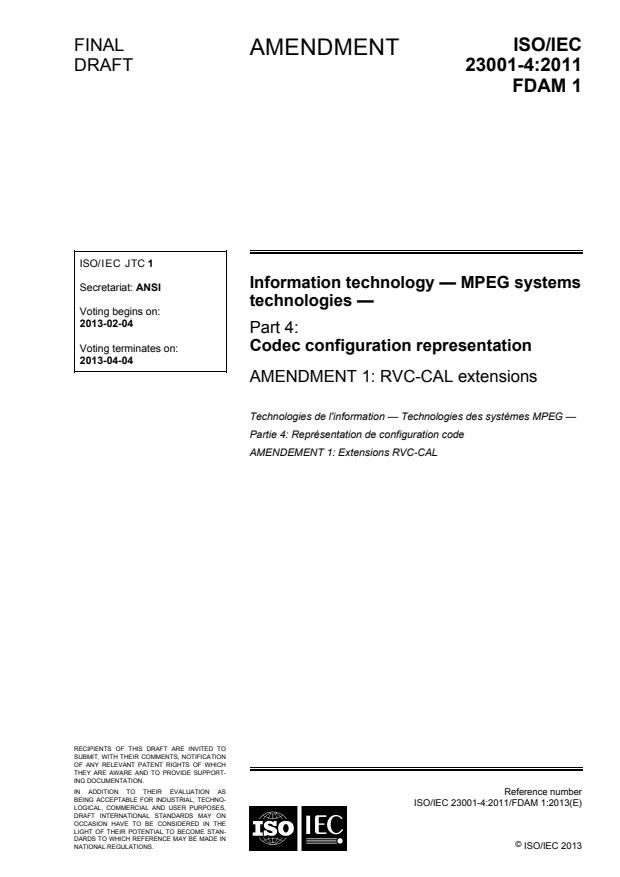
FINAL ISO/IEC
AMENDMENT
DRAFT 23001-4:2011
FDAM 1
ISO/IEC JTC 1
Information technology — MPEG systems
Secretariat: ANSI
technologies —
Voting begins on:
2013-02-04
Part 4:
Codec configuration representation
Voting terminates on:
2013-04-04
AMENDMENT 1: RVC-CAL extensions
Technologies de l'information — Technologies des systèmes MPEG —
Partie 4: Représentation de configuration code
AMENDEMENT 1: Extensions RVC-CAL
RECIPIENTS OF THIS DRAFT ARE INVITED TO
SUBMIT, WITH THEIR COMMENTS, NOTIFICATION
OF ANY RELEVANT PATENT RIGHTS OF WHICH
THEY ARE AWARE AND TO PROVIDE SUPPORT-
ING DOCUMENTATION.
IN ADDITION TO THEIR EVALUATION AS
Reference number
BEING ACCEPTABLE FOR INDUSTRIAL, TECHNO-
ISO/IEC 23001-4:2011/FDAM 1:2013(E)
LOGICAL, COMMERCIAL AND USER PURPOSES,
DRAFT INTERNATIONAL STANDARDS MAY ON
OCCASION HAVE TO BE CONSIDERED IN THE
LIGHT OF THEIR POTENTIAL TO BECOME STAN-
DARDS TO WHICH REFERENCE MAY BE MADE IN
©
ISO/IEC 2013
NATIONAL REGULATIONS.
ISO/IEC 23001-4:2011/FDAM 1:2013(E)
© ISO/IEC 2013
All rights reserved. Unless otherwise specified, no part of this publication may be reproduced or utilized otherwise in any form or by any
means, electronic or mechanical, including photocopying, or posting on the internet or an intranet, without prior written permission.
Permission can be requested from either ISO at the address below or ISO’s member body in the country of the requester.
ISO copyright office
Case postale 56 CH-1211 Geneva 20
Tel. + 41 22 749 01 11
Fax + 41 22 749 09 47
E-mail copyright@iso.org
Web www.iso.org
Published in Switzerland
ii © ISO/IEC 2013 – All rights reserved
ISO/IEC 23001-4:2011/FDAM 1:2013(E)
Foreword
ISO (the International Organization for Standardization) and IEC (the International Electrotechnical
Commission) form the specialized system for worldwide standardization. National bodies that are members of
ISO or IEC participate in the development of International Standards through technical committees
established by the respective organization to deal with particular fields of technical activity. ISO and IEC
technical committees collaborate in fields of mutual interest. Other international organizations, governmental
and non-governmental, in liaison with ISO and IEC, also take part in the work. In the field of information
technology, ISO and IEC have established a joint technical committee, ISO/IEC JTC 1.
International Standards are drafted in accordance with the rules given in the ISO/IEC Directives, Part 2.
The main task of the joint technical committee is to prepare International Standards. Draft International
Standards adopted by the joint technical committee are circulated to national bodies for voting. Publication as
an International Standard requires approval by at least 75 % of the national bodies casting a vote.
Attention is drawn to the possibility that some of the elements of this document may be the subject of patent
rights. ISO and IEC shall not be held responsible for identifying any or all such patent rights.
Amendment 1 to ISO/IEC 23001-4:2011 was prepared by Joint Technical Committee ISO/IEC JTC 1,
Information technology, Subcommittee SC 29, Coding of audio, picture, multimedia and hypermedia
information.
© ISO/IEC 2013 – All rights reserved iii
ISO/IEC 23001-4:2011/FDAM 1:2013(E)
Information technology — MPEG systems technologies —
Part 4:
Codec configuration representation
AMENDMENT 1: RVC-CAL extensions
At the end of Clause 2, add the following paragraph:
DEFLATE Compressed Data Format Specification version 1.3. P. Deutsch, The Internet Society, May 1996.
IETF RFC 1889, RTP A Transport Protocol for Real-Time Applications, H. Schulzrinne, et. al., January 1996.
IETF RFC 2327, SDP: Session Description Protocol, M. Handley, April 1998.
ISO/IEC 14496-12: Information technology– Coding of audio-visual objects – Part 12: ISO Base Media File
Format (technically identical to ISO/IEC 15444-12).
At the end of D.2, add the following paragraph:
Units. Unlike an actor, a unit does not compute anything. A unit is used to declare ‘constants’, ‘functions’, and
procedures that can be referenced or imported into an actor. It cannot contain mutable variables, which would
violate the design constraint that actors do not share state. Units help in factorizing the code in order not to
duplicate function declarations or FU constants.
Replace the title of D.4:
D.4 Structure of actor descriptions
with:
D.4 Structure of actor/unit descriptions
After the title of D.4, add the title D.4.1:
D.4.1 Actor description
In D.4, replace the following paragraph:
Actors are the largest lexical units of specification and translation. The basic structure of an actor is this:
© ISO/IEC 2013 – All rights reserved 1
ISO/IEC 23001-4:2011/FDAM 1:2013(E)
with:
Actors are the largest lexical units of specification and translation. The basic structure of an actor is this:
Add D.4.2:
D.4.2 Unit description
A unit can declare functions, procedures, and constants (D.6). A unit can import units. However a unit cannot
import units that lead to a cyclic dependency.
Renumber D.5 – D.11 to D.6 – D.12 respectively.
2 © ISO/IEC 2013 – All rights reserved
ISO/IEC 23001-4:2011/FDAM 1:2013(E)
Insert D.5:
D.5 Qualified names and Imports
D.5.1 Qualified names
A qualified name is represented with the following rule:
QualifiedName : ID('.' ID) *
A qualified name with a possible wildcard is allowed only in imports and is defined by:
QualifiedNameWithWildCard : QualifiedName '.*'?
D.5.2 Declaration of an entity
An entity (actor or unit) may begin with a package directive that declares the package the unit or actor resides
in (a la Java). In the absence of the package declaration, the unit or actor is considered part of the “default”
package, but as in Java this practice is discouraged. The qualified name of an entity is its package followed by
a dot and then its identifier. In case the package is not specified, the qualified name is simply the identifier of
the entity.
D.5.3 Imports
Qualified names can be imported by imports.
Import : 'import' QualifiedNameWithWildCard ';'
D.5.4 Reference to unit elements
An actor or unit may reference a variable or function declared in a unit by its qualified name. The qualified
name of a variable or function is the name of the variable or function prefixed by the name of the unit it is
declared in and a dot, e.g. MyUnit.myVar.
An actor or a unit may also import any or all of the variables or functions declared in a unit by using an import
statement. Explicit import of one or more variables or functions is done by referencing them by their qualified
name, as in:
import MyUnit.myVar;
Importing all variables or functions declared by a unit is done by using a wildcard:
import MyUnit.*;
Inside an entity, you can use either the qualified name or the simple name of the variable. If you use the
simple name of a variable, this variable can be shadowed by another declaration of a variable
© ISO/IEC 2013 – All rights reserved 3
ISO/IEC 23001-4:2011/FDAM 1:2013(E)
Add D.5.5 (D.6.5):
D.5.5 Least Upper Bound (lub)
This subclause lists the typing rules for RVC-CAL expressions.
Expression Type of result
boolean bool
floating-point number float
integer with value v type of int(v)
“xyz” String
variable var declared with type T T
unary expression: op e type of unary(op, e)
binary expression: e1 op e2 type of binary(e1, op, e2)
if cond then e1 else e2 end lub(e1, e2)
with cond of type bool
list[i][j] type of index(list, i, j)
[ e1, e2, …, en : for int i1 in L1 . H1, for int i2 in List(type: lub(e1, e2, …, en),
L2 . H2, …, for int in in LN . HN ] size=n * (H1 – L1 + 1) *
(H2 – L2 + 1) * … * (HN – LN + 1))
D.5.5.1 Least Upper Bound (lub)
The Least Upper Bound (lub) of n types is the smallest type that is compatible with the biggest of the given n
types. Lub(t1, t2, …, tn) is defined as lub(…lub(lub(t1, t2), t3), …, tn).
bool, bool bool
float, float float
String, String String
int(size=S1), int(size=S2) int(size=max(S1, S2))
uint(size=S1), uint(size=S2) uint(size=max(S1, S2))
int(size=SI), uint(size=SU) with SI > SU int(size=SI)
int(size=SI), uint(size=SU) with SU >= SI int(size=SU + 1)
List(type : T1, size=S1), List(type :T2, size=S2) List(type:lub(T1, T2), size=max(S1, S2))
any other combinations invalid
The lub is commutative: lub(t1, t2) is the same as lub(t2, t1).
D.5.5.2 Greatest Lower Bound (glb)
The Greatest Lower Bound (glb) of n types is the greatest type that is compatible with the smallest of the
given n types.
bool, bool bool
float, float float
String, String String
int(size=S1), int(size=S2) int(size=min(S1, S2))
uint(size=S1), uint(size=S2) uint(size=min(S1, S2))
int(size=SI), uint(size=SU) with SI > SU int(size=SU + 1)
int(size=SI), uint(size=SU) with SU >= SI int(size=SI)
any other combinations Invalid
NOTE – glb has not been defined for List because it is not needed as typing rule.
4 © ISO/IEC 2013 – All rights reserved
ISO/IEC 23001-4:2011/FDAM 1:2013(E)
D.5.5.3 Type of an integer
The size of an integer whose value is v is defined by the following formula:
v 0v
sizeof(v) = log 2( )
v 0 v1
where x is ceil(x), which returns the smallest integer that is not less than x.
The type of an integer whose value is v, and size is s = sizeof(v), is defined as:
If v < 0, int(size=s + 1)
If v = 0, uint(size=1)
If v > 0, uint(size=s)
D.5.5.4 Type of unary expressions
Expression Type of result
bitnot e (or ~e) with e of type T (int or uint) T
not e with e of type bool bool
- e with e of type T (int or float) T
- e with e of type uint(size=s) int(size=s + 1)
#e with e of type List(type:T, size=S) S
float_of_int(e) with e of type T (int or uint) float
int_of_float(e, sz) with e of type float and sz of type int(size=sz)
int or uint
uint_of_float(e,sz) with e of type float and sz of uint(size=sz)
type int or uint
Where float_of_int, int_of_float and uint_of_float are built-ins functions for float to int/uint conversion and vice
versa. The conversion to int/uint from float is the truncation conversion towards zero as used in C99 (i.e.
int_of_float(5.3, 32) returns 5, and int_of_float(-5.3, 32) returns -5).
D.5.5.5 Type of binary expressions
Expression Type of result
e1 + e2 with e1 of type String or e2 of type String String
e1 + e2 with e1 of type List(type:T1, size=S1) List(type:lub(T1, T2), size=S1+S2)
e2 of type List(type:T2, size=S2)
e1 + e2 with e1 of type T1 (int or uint) lub(T1, T2) + 1
e2 of type T2 (int or uint)
e1 - e2 with e1 of type T1 (int or uint) lub(T1, T2) + 1
e2 of type T2 (int or uint)
e1 * e2 with e1 of type int(size=S1) or lub(T1, T2) with size=S1 + S2
uint(size=S1)
e2 of type int(size=S2) or uint(size=S2)
e1 << e2 with e1 of type int(size=S1) or S1 + (1 << S2) – 1
uint(size=S1)
e2 of type int(size=S2) or uint(size=S2)
e1 & e2, with e1 of type T1 (int or uint) and e2 of glb(T1, T2)
type T2 (int or uint)
e1 | e2, with e1 of type T1 (int or uint) and e2 of lub(T1, T2)
type T2 (int or uint)
© ISO/IEC 2013 – All rights reserved 5
ISO/IEC 23001-4:2011/FDAM 1:2013(E)
Expression Type of result
e1 ^ e2 (xor), with e1 of type T1 (int or uint) and e2 lub(T1, T2)
of type T2 (int or uint)
e1 / e2, e1 >> e2, with e1 of type T1 (int or uint) T1
and e2 of type T2 (int or uint)
e1 mod e2, with e1 of type T1 (int or uint) and e2 T2
of type T2 (int or uint)
e1 = e2, e1 != e2 with e1 of type T1 and e2 of type bool
T2, if lub(T1, T2) exists
e1 > e2, e1 >= e2, e1 < e2, e1 <= e2, with e1 of bool
type T1 (int or uint or float) and e2 of type T2 (int or
uint or float), and if lub(T1, T2) exists
e1 && e2, e1 || e2, with e1 of type bool and e2 of bool
type bool
e1 + e2 with e1 of type float and e2 of type float float
e1 - e2 with e1 of type float and e2 of type float float
e1 * e2 with e1 of type float and e2 of type float float
e1 / e2 with e1 of type float and e2 of type float float
The type of binary expressions whose operator is +, -, *, /, and where one operand has type float, and the
other has type int, uint, or float, is float. In other words, operands with type int or uint are automatically
promoted to float.
D.5.5.6 Type of an indexing expression
The type of an indexing expression list[i1][i2]…[in] with a list of type List(type:List(type:.type:List(type:T,
size=SN), size=SN_1), …, size=S1) is T if the type of i1 is not larger than the type of S1 (as obtained with
sizeof(S1)), i2 is not larger than sizeof(S2), etc.
th
If only a subset of indexes is given, say i, then the type of the expression is the type of the i inner type.
Replace the title of D.6 (D.7):
D.6 Variables
with:
D.6 Variables, functions, and procedures
In D.6.2 (D.7.2): Explicit variable declarations, replace the following formula:
VarDecl [Type] ID [('=' | ':=') Expression]';'
| FunDecl | ProcDecl
with:
An actor may contain state variable declarations:
6 © ISO/IEC 2013 – All rights reserved
ISO/IEC 23001-4:2011/FDAM 1:2013(E)
A unit may contain constant variable declarations:
For List declaration, a more compact representation is available with an array style.
T myVar[N1][N2].[Nn] – is equivalent to List(type: List(type: . List(type: T,
size=Nn), ., size=N2), size=N1) myVar where the type is T.
In D.6.3 (D.7.3) Function and procedure declaration, replace the following formulas:
with:
Renumber Annexes E and F to H and I respectively.
Insert Annexes E-G:
Annex E
(informative)
FU Classification according to their dataflow model of computation of
RVC-CAL
E.1 Introduction
This Annex describes those conditions used to classify FUs, so that programmers and RVC codec
implementers can make sure that an FU is classified correctly by analysis and translation tools.
© ISO/IEC 2013 – All rights reserved 7
ISO/IEC 23001-4:2011/FDAM 1:2013(E)
E.2 Basic terms
E.2.1 Token rates
An FU consists of any number of actions of the form
action A:[a1, a2], B:[b]
==> X:[s + a1, s + a2, s], Y:[a1 + b]
guard P(b) do
s := s + b;
end
The constructs preceding the ==> are called input patterns, and establish how many tokens the action
requires in order to be enabled on each port, which is also the number of tokens it will consume when it fires.
For instance, the construct A: [a1, a2] specifies that the action requires two tokens on port A in order to fire.
The constructs following the ==> are called output expressions, and they specify how many tokens are being
produced on each output port when the action fires (as well as their values, of course). For instance, the
expression X: [s + a1, s + a2, s] implies that three tokens will be produced on output X, since that is the
number of comma-separated expressions between the square brackets.
Together, input patterns and output expressions define the token rates of an action, which is the number of
tokens produced and consumed whenever that action fires. In the example above, the action will consume two
tokens on input port A, one on input port B, and it will produce three tokens on output port X and one on
output port Y. If the FU has no any other ports besides these four, the rate of token consumption or production
on those ports for this action is zero.
E.2.2 Priorities
Actions within an FU may be related to each other through a priority statement such as the following.
priority
A1 > A2;
A2 > A3;
A2 > A4;
end
The names A1, A2, A3, and A4 must then be action tags, identifying one or more actions. The order among
actions is partial: note that in the example, A3 and A4 are of lower priority then A2 (and, by implication, A1),
but they are related to each other. Also, if the FU in the example above contains another action tagged, e.g.,
A5, that action will not be related to any of the actions tagged A1, A2, A3, and A4.
A special case of priority orders is the total order, in which for any pair of two actions one of them has a higher
priority than the other. For instance, if the example above is modified as follows, the tags are totally ordered:
priority
A1 > A2;
A2 > A3;
A3 > A4;
end
For all actions to be totally ordered within an FU, each tag must uniquely identify one action, i.e. no two
actions may be tagged by the same name.
8 © ISO/IEC 2013 – All rights reserved
ISO/IEC 23001-4:2011/FDAM 1:2013(E)
E.2.3 Cyclic scheduler
A scheduling finite state machine is considered to be a cyclic scheduler if there is a sequence of states s , …,
s such that
n
s is the initial state of the scheduler,
there are exactly n transitions, viz. s to s for all i from 1 to n–1, and s to s .
i i+1 n 1
The length of the cycle is n. If there is no scheduler, the absent scheduler is considered to be (trivially) cyclic
with cycle length 1. For instance, the following scheduler is cyclic, with cycle length 2:
schedule fsm s0 :
s0 (A) ---> s1;
s1 (B) ---> s0;
end
By contrast, the next scheduler is not cyclic:
schedule fsm s0 :
s0 (A) ---> s1;
s0 (B) ---> s2;
s1 (C) ---> s0;
s2 (C) ---> s0;
end
E.3 FU classes and taxonomy
In the following four specialized classes of FUs can be distinguished, in order of specialization: non-
deterministic FUs
...
Questions, Comments and Discussion
Ask us and Technical Secretary will try to provide an answer. You can facilitate discussion about the standard in here.
Loading comments...