

ISO/TR 21865:2017
(Main)Fireworks — Third party testing — Voluntary scheme
General Information
- Abstract
ISO/TR 21865:2017 describes the relevant responsibilities of the involved manufacturers of fireworks articles and corresponding laboratories for the application of the ISO 25947 series and the ISO 26261 series. By applying this approach, a clear separation of the responsibilities of the manufacturers and the third party laboratories is achieved in order to demonstrate the conformity to the relevant safety specifications defined in these standards.
- Status
- Published
- Publication Date
- 26-Oct-2017
- Technical Committee
- ISO/TC 264 - Fireworks
- Drafting Committee
- ISO/TC 264 - Fireworks
- Current Stage
- 6060 - International Standard published
- Start Date
- 27-Oct-2017
- Due Date
- 16-Aug-2018
- Completion Date
- 16-Aug-2018
Buy Documents
ISO/TR 21865:2017 - Fireworks — Third party testing — Voluntary scheme Released:10/27/2017
ISO/TR 21865:2017 - Fireworks — Third party testing — Voluntary scheme/27/2017
Overview
ISO/TR 21865:2017, titled Fireworks - Third party testing - Voluntary scheme, provides guidance on the roles and responsibilities of fireworks manufacturers and independent laboratories. It specifically supports the application of the ISO 25947 and ISO 26261 series standards, which address safety and conformity requirements for fireworks articles. This standard establishes a clear division of responsibilities between manufacturers and third-party testing laboratories to help demonstrate compliance with relevant safety regulations. By following this voluntary scheme, stakeholders enhance product safety, quality assurance, and regulatory alignment within the fireworks industry.
Key Topics
- Third Party Testing Framework: ISO/TR 21865 outlines a voluntary framework for manufacturers to engage accredited laboratories for type and batch testing of fireworks articles.
- Type and Batch Tests:
- Type tests verify that a representative sample of production meets the technical design requirements according to the ISO 25947 and ISO 26261 standards.
- Batch tests involve sampling actual production batches to ensure ongoing conformity and homogeneity across manufactured fireworks.
- Responsibilities of Manufacturers:
- Selecting appropriate laboratories for testing.
- Maintaining internal production control to ensure ongoing product compliance.
- Preparing and retaining technical documentation for at least 10 years.
- Labeling products correctly and providing safe usage instructions in clear language.
- Taking corrective actions like product recall or withdrawal if non-conformity is detected.
- Laboratory Obligations:
- Conduct type and batch tests objectively upon request.
- Ensure testing aligns with the specifications set in ISO 25947 and ISO 26261.
- Clear Separation of Duties: The standard reinforces the independence of laboratories from manufacturers to avoid conflicts of interest and enhance trust in conformity assessments.
Applications
- Manufacturer Quality Control: Enables fireworks producers to implement rigorous quality assurance by integrating third-party test results with internal checks.
- Safety Compliance Demonstration: Supports manufacturers in proving that their fireworks articles comply with internationally recognized safety standards before market placement.
- Regulatory and Market Access Support: Facilitates meeting regulatory requirements and gaining market acceptance through documented conformity and voluntary testing schemes.
- Risk Mitigation: Reduces the risk of unsafe fireworks entering the market, protecting consumers and public safety.
- Documentation and Traceability: Encourages thorough record-keeping and traceability of pyrotechnic article designs and testing outcomes over extended periods.
Related Standards
- ISO 25947 Series: Fireworks-Categories 1, 2, and 3 - Provides detailed requirements on safety and testing for commonly used fireworks meant for consumer and professional use.
- ISO 26261 Series: Fireworks-Category 4 - Targets the highest hazard category of fireworks, establishing stringent testing and safety provisions.
- Directive 2013/29/EU: European legislation harmonizing the market access of pyrotechnic articles, emphasizing conformity assessment and safety regulations.
By integrating ISO/TR 21865:2017 with these related standards, fireworks manufacturers and testing bodies can establish a comprehensive approach to product safety, regulatory adherence, and consumer protection. This voluntary scheme promotes confidence among stakeholders, minimizes risks associated with fireworks articles, and supports international trade through harmonized quality assurance and testing processes.
Buy Documents
ISO/TR 21865:2017 - Fireworks — Third party testing — Voluntary scheme Released:10/27/2017
ISO/TR 21865:2017 - Fireworks — Third party testing — Voluntary scheme/27/2017
Get Certified
Connect with accredited certification bodies for this standard

ECOCERT
Organic and sustainability certification.

Eurofins Food Testing Global
Global leader in food, environment, and pharmaceutical product testing.

Intertek Bangladesh
Intertek certification and testing services in Bangladesh.
Sponsored listings
Frequently Asked Questions
ISO/TR 21865:2017 is a technical report published by the International Organization for Standardization (ISO). Its full title is "Fireworks — Third party testing — Voluntary scheme". This standard covers: ISO/TR 21865:2017 describes the relevant responsibilities of the involved manufacturers of fireworks articles and corresponding laboratories for the application of the ISO 25947 series and the ISO 26261 series. By applying this approach, a clear separation of the responsibilities of the manufacturers and the third party laboratories is achieved in order to demonstrate the conformity to the relevant safety specifications defined in these standards.
ISO/TR 21865:2017 describes the relevant responsibilities of the involved manufacturers of fireworks articles and corresponding laboratories for the application of the ISO 25947 series and the ISO 26261 series. By applying this approach, a clear separation of the responsibilities of the manufacturers and the third party laboratories is achieved in order to demonstrate the conformity to the relevant safety specifications defined in these standards.
ISO/TR 21865:2017 is classified under the following ICS (International Classification for Standards) categories: 71.100.30 - Explosives. Pyrotechnics and fireworks. The ICS classification helps identify the subject area and facilitates finding related standards.
ISO/TR 21865:2017 is available in PDF format for immediate download after purchase. The document can be added to your cart and obtained through the secure checkout process. Digital delivery ensures instant access to the complete standard document.
Standards Content (Sample)
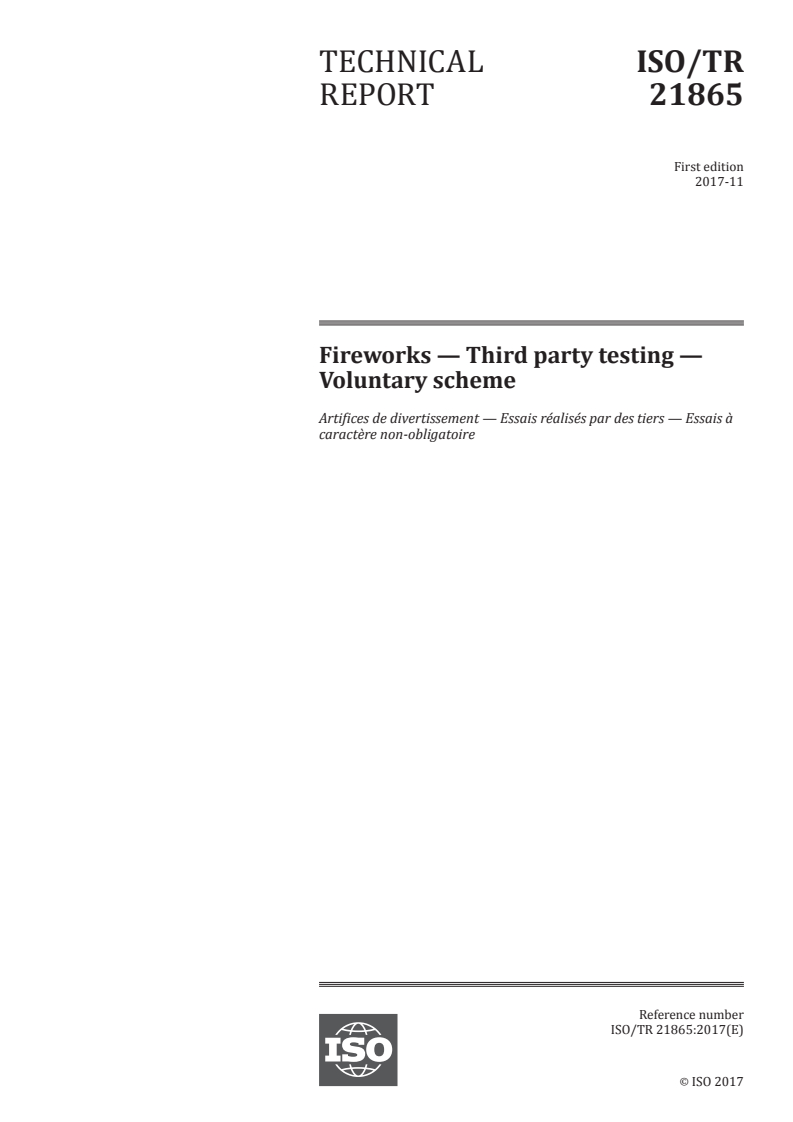
TECHNICAL ISO/TR
REPORT 21865
First edition
2017-11
Fireworks — Third party testing —
Voluntary scheme
Artifices de divertissement — Essais réalisés par des tiers — Essais à
caractère non-obligatoire
Reference number
©
ISO 2017
© ISO 2017, Published in Switzerland
All rights reserved. Unless otherwise specified, no part of this publication may be reproduced or utilized otherwise in any form
or by any means, electronic or mechanical, including photocopying, or posting on the internet or an intranet, without prior
written permission. Permission can be requested from either ISO at the address below or ISO’s member body in the country of
the requester.
ISO copyright office
Ch. de Blandonnet 8 • CP 401
CH-1214 Vernier, Geneva, Switzerland
Tel. +41 22 749 01 11
Fax +41 22 749 09 47
copyright@iso.org
www.iso.org
ii © ISO 2017 – All rights reserved
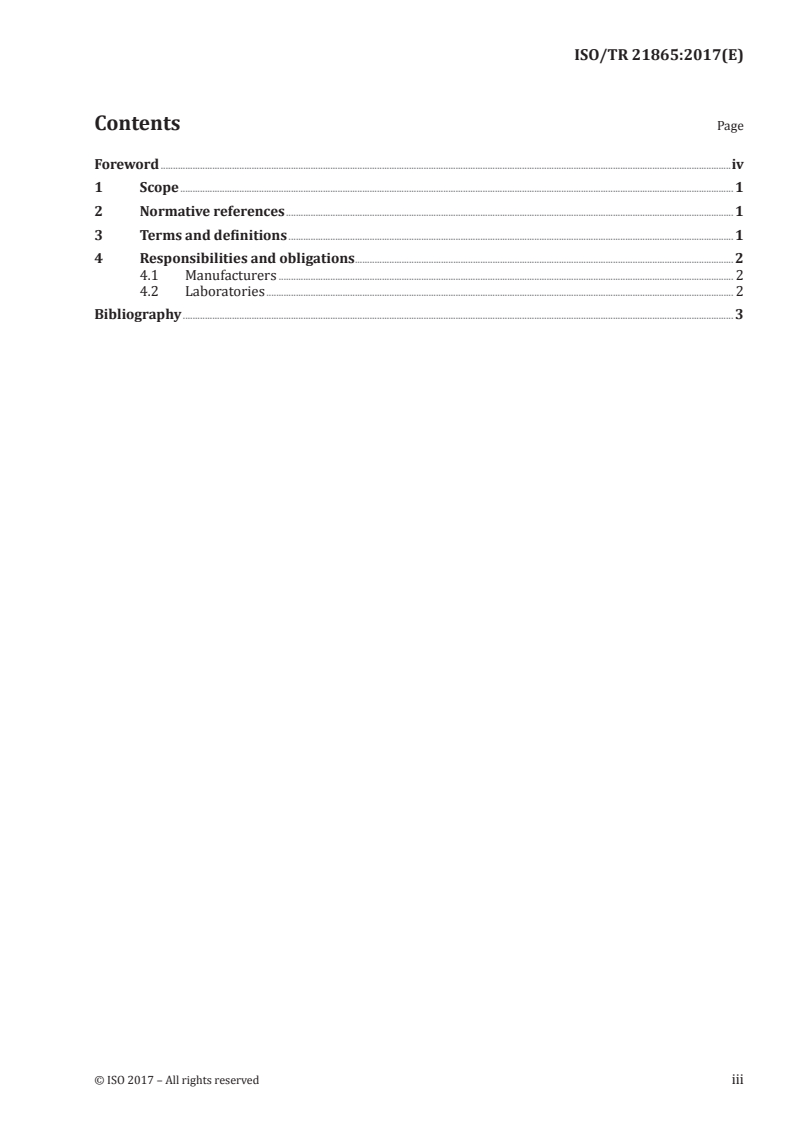
Contents Page
Foreword .iv
1 Scope . 1
2 Normative references . 1
3 Terms and definitions . 1
4 Responsibilities and obligations . 2
4.1 Manufacturers . 2
4.2 Laboratories . 2
Bibliography . 3
Foreword
ISO (the International Organization for Standardization) is a worldwide federation of national standards
bodies (ISO member bodies). The work of preparing International Standards is normally carried out
through ISO technical committees. Each member body interested in a subject for which a technical
committee has been established has the right to be represented on that committee. International
organizations, governmental and non-governmental, in liaison with ISO, also take part in the work.
ISO collaborates closely with the International Electrotechnical Commission (IEC) on all matters of
electrotechnical standardization.
The procedures used to develop this document and those intended for its further maintenance are
described in the ISO/IEC Directives, Part 1. In particular the different approval criteria needed for the
different types of ISO documents should be noted. This document was drafted in accordance with the
editorial rules of the ISO/IEC Directives, Part 2 (see www.iso.org/directives).
Attention is drawn to the possibility that some of the elements of this document may be the subject of
patent rights. ISO shall not be held responsible for identifying any or all such patent rights. Details of
any patent rights identified during the development of the document will be in the Introduction and/or
on the ISO list of patent declarations received (see www.iso.org/patents).
Any trade name used in this document is information given for the convenience of users and does not
constitute an endorsement.
For an explanation on the voluntary nature of standards, the meaning of ISO specific terms and
expressions related to conformity assessment, as well as information about ISO's adherence to the
World Trade Organization (WTO) principles in the Technical Barriers to Trade (TBT) see the following
URL: www.iso.org/iso/foreword.html.
This document was prepared by Technical Committee ISO/TC 264, Fireworks.
iv © ISO 2017 – All rights reserved
TECHNICAL REPORT ISO/TR 21865:2017(E)
Fireworks — Third party testing — Voluntary scheme
1 Scope
This document describes the relevant responsibilities of the involved manufacturers of fireworks articles
and corresponding laboratories for the application of the ISO 25947 series and the ISO 26261 series.
By applying this approach, a clear separation of the responsibilities of the manufacturers and the
third party laboratories is achieved in order to demonstrate the conformity to the relevant safety
specifications defined in these standards.
2 Normative references
There are no normative references in this document.
3 Terms and definitions
For the purposes of this document, the following terms and definitions apply.
ISO and IEC maintain terminological databases for
...
TECHNICAL ISO/TR
REPORT 21865
First edition
2017-11
Fireworks — Third party testing —
Voluntary scheme
Artifices de divertissement — Essais réalisés par des tiers — Essais à
caractère non-obligatoire
Reference number
©
ISO 2017
© ISO 2017, Published in Switzerland
All rights reserved. Unless otherwise specified, no part of this publication may be reproduced or utilized otherwise in any form
or by any means, electronic or mechanical, including photocopying, or posting on the internet or an intranet, without prior
written permission. Permission can be requested from either ISO at the address below or ISO’s member body in the country of
the requester.
ISO copyright office
Ch. de Blandonnet 8 • CP 401
CH-1214 Vernier, Geneva, Switzerland
Tel. +41 22 749 01 11
Fax +41 22 749 09 47
copyright@iso.org
www.iso.org
ii © ISO 2017 – All rights reserved
Contents Page
Foreword .iv
1 Scope . 1
2 Normative references . 1
3 Terms and definitions . 1
4 Responsibilities and obligations . 2
4.1 Manufacturers . 2
4.2 Laboratories . 2
Bibliography . 3
Foreword
ISO (the International Organization for Standardization) is a worldwide federation of national standards
bodies (ISO member bodies). The work of preparing International Standards is normally carried out
through ISO technical committees. Each member body interested in a subject for which a technical
committee has been established has the right to be represented on that committee. International
organizations, governmental and non-governmental, in liaison with ISO, also take part in the work.
ISO collaborates closely with the International Electrotechnical Commission (IEC) on all matters of
electrotechnical standardization.
The procedures used to develop this document and those intended for its further maintenance are
described in the ISO/IEC Directives, Part 1. In particular the different approval criteria needed for the
different types of ISO documents should be noted. This document was drafted in accordance with the
editorial rules of the ISO/IEC Directives, Part 2 (see www.iso.org/directives).
Attention is drawn to the possibility that some of the elements of this document may be the subject of
patent rights. ISO shall not be held responsible for identifying any or all such patent rights. Details of
any patent rights identified during the development of the document will be in the Introduction and/or
on the ISO list of patent declarations received (see www.iso.org/patents).
Any trade name used in this document is information given for the convenience of users and does not
constitute an endorsement.
For an explanation on the voluntary nature of standards, the meaning of ISO specific terms and
expressions related to conformity assessment, as well as information about ISO's adherence to the
World Trade Organization (WTO) principles in the Technical Barriers to Trade (TBT) see the following
URL: www.iso.org/iso/foreword.html.
This document was prepared by Technical Committee ISO/TC 264, Fireworks.
iv © ISO 2017 – All rights reserved
TECHNICAL REPORT ISO/TR 21865:2017(E)
Fireworks — Third party testing — Voluntary scheme
1 Scope
This document describes the relevant responsibilities of the involved manufacturers of fireworks articles
and corresponding laboratories for the application of the ISO 25947 series and the ISO 26261 series.
By applying this approach, a clear separation of the responsibilities of the manufacturers and the
third party laboratories is achieved in order to demonstrate the conformity to the relevant safety
specifications defined in these standards.
2 Normative references
There are no normative references in this document.
3 Terms and definitions
For the purposes of this document, the following terms and definitions apply.
ISO and IEC maintain terminological databases for
...