


ISO 18127
(Main)Water quality — Determination of adsorbable organically bound fluorine, chlorine, bromine and iodine (AOF, AOCl, AOBr, AOI) — Method using combustion and subsequent ion chromatographic measurement
Water quality — Determination of adsorbable organically bound fluorine, chlorine, bromine and iodine (AOF, AOCl, AOBr, AOI) — Method using combustion and subsequent ion chromatographic measurement
Qualité de l’eau — Dosage des composés organiques adsorbables contenant du fluor, du chlore, du brome et de l’iode (AOF, AOCl, AOBr, AOI) — Méthode de combustion suivie d’un mesurage par chromatographie ionique
General Information
- Status
- Not Published
- Technical Committee
- ISO/TC 147/SC 2 - Physical, chemical and biochemical methods
- Drafting Committee
- ISO/TC 147/SC 2 - Physical, chemical and biochemical methods
- Current Stage
- 6000 - International Standard under publication
- Start Date
- 31-Oct-2025
- Completion Date
- 12-Feb-2026
Relations
- Effective Date
- 12-Feb-2026
- Effective Date
- 06-May-2023
Overview
ISO 18127:2025 is an internationally recognized standard developed by the International Organization for Standardization (ISO) under Technical Committee ISO/TC 147/SC 2. This standard specifies a precise analytical method for determining adsorbable organically bound halogens in water quality assessment. It covers the measurement of adsorbable organically bound fluorine (AOF), chlorine (AOCl), bromine (AOBr), and iodine (AOI) using a method that combines combustion and ion chromatographic measurement.
The ISO 18127 method enables the separate quantification of organic halogens bound in water samples-critical substances for environmental monitoring and water treatment validation. Notably, this technique extends the traditional adsorbable organically bound halogen (AOX) determination by including organofluorine compounds, providing a broader scope of water contaminants analysis.
Key Topics
Scope and Parameters
Determination of organically bound halogens-fluorine, chlorine, bromine, iodine-adsorbable on activated carbon from water samples. Both dissolved and suspended organic halogens are considered.Method Principle
Combustion ion chromatography (CIC) is employed. Water samples undergo adsorption on activated carbon, followed by combustion to convert halogens into measurable ions, which are then quantified by ion chromatography.Sample Preparation
Procedures include homogenization, adsorption on activated carbon, washing steps to eliminate interferences, and combustion with subsequent ion detection. The method accommodates samples with suspended solids or high halide content via alternative procedures.Interferences and Validation
The standard identifies potential interferences during adsorption, combustion, and ion chromatography stages, along with validation steps such as blanks, calibration, and completeness tests to ensure data accuracy.Annexed Detailed Procedures
Normative annexes provide procedures for individual halogen determination (AOF, AOCl, AOBr, AOI) and variations such as the shaking method and solid phase extraction to analyze complex water matrices.
Applications
ISO 18127 serves multiple practical applications in water quality monitoring, environmental protection, and industrial compliance:
Environmental Monitoring
Enables tracking of organofluorine and other halogenated organic compounds in surface waters, wastewater, and groundwater to assess pollution levels.Wastewater Treatment Evaluation
Assists operators in evaluating treatment processes’ efficiency in removing halogenated organic contaminants.Regulatory Compliance
Facilitates conformance with environmental regulations by providing standardized quantification of hazardous organohalogens.Research and Development
Supports scientific studies on the occurrence, distribution, and fate of organohalogen compounds in aquatic environments.Analytical Laboratories
Provides a robust, reproducible method for water quality testing labs performing routine and advanced contaminant analysis.
Related Standards
ISO 9562: Water Quality - Determination of Adsorbable Organohalogen Compounds (AOX)
While ISO 9562 details AOX measurement, ISO 18127 extends the methodology to include organofluorine specifically and provides separated halogen analyses.ISO/IEC Directives, Part 1 and Part 2
Outlines procedures for developing and maintaining ISO standards, ensuring consistency and quality.ISO 5667 Series: Water Quality Sampling
Relevant for standard sampling methods compatible with ISO 18127 sample preparation.CEN/TC 230 Standards on Water Analysis
European Committee for Standardization's technical committee provides complementary standards aligned with ISO water quality measurement practices.
Keywords: ISO 18127, water quality, adsorbable organically bound halogen, AOF, AOCl, AOBr, AOI, combustion ion chromatography, CIC, organofluorine, water pollutants, environmental monitoring, water analysis, water treatment compliance, activated carbon adsorption, ion chromatography, water contaminants analysis.

ISO/FDIS 18127 - Water quality — Determination of adsorbable organically bound fluorine, chlorine, bromine and iodine (AOF, AOCl, AOBr, AOI) — Method using combustion and subsequent ion chromatographic measurement Released:21. 08. 2025
REDLINE ISO/FDIS 18127 - Water quality — Determination of adsorbable organically bound fluorine, chlorine, bromine and iodine (AOF, AOCl, AOBr, AOI) — Method using combustion and subsequent ion chromatographic measurement Released:21. 08. 2025
ISO/FDIS 18127 - Qualité de l’eau — Dosage des composés organiques adsorbables contenant du fluor, du chlore, du brome et de l’iode (AOF, AOCl, AOBr, AOI) — Méthode de combustion suivie d’un mesurage par chromatographie ionique Released:17. 09. 2025
Get Certified
Connect with accredited certification bodies for this standard

NSF International
Global independent organization facilitating standards development and certification.

CIS Institut d.o.o.
Personal Protective Equipment (PPE) certification body. Notified Body NB-2890 for EU Regulation 2016/425 PPE.

Kiwa BDA Testing
Building and construction product certification.
Sponsored listings
Frequently Asked Questions
ISO 18127 is a draft published by the International Organization for Standardization (ISO). Its full title is "Water quality — Determination of adsorbable organically bound fluorine, chlorine, bromine and iodine (AOF, AOCl, AOBr, AOI) — Method using combustion and subsequent ion chromatographic measurement". This standard covers: Water quality — Determination of adsorbable organically bound fluorine, chlorine, bromine and iodine (AOF, AOCl, AOBr, AOI) — Method using combustion and subsequent ion chromatographic measurement
Water quality — Determination of adsorbable organically bound fluorine, chlorine, bromine and iodine (AOF, AOCl, AOBr, AOI) — Method using combustion and subsequent ion chromatographic measurement
ISO 18127 is classified under the following ICS (International Classification for Standards) categories: 13.060.50 - Examination of water for chemical substances. The ICS classification helps identify the subject area and facilitates finding related standards.
ISO 18127 has the following relationships with other standards: It is inter standard links to FprEN ISO 18127, ISO 12925-2:2020. Understanding these relationships helps ensure you are using the most current and applicable version of the standard.
ISO 18127 is available in PDF format for immediate download after purchase. The document can be added to your cart and obtained through the secure checkout process. Digital delivery ensures instant access to the complete standard document.
Standards Content (Sample)
FINAL DRAFT
International
Standard
ISO/FDIS 18127
ISO/TC 147/SC 2
Water quality — Determination
Secretariat: DIN
of adsorbable organically bound
Voting begins on:
fluorine, chlorine, bromine and
2025-09-04
iodine (AOF, AOCl, AOBr, AOI) —
Voting terminates on:
Method using combustion and
2025-10-30
subsequent ion chromatographic
measurement
Qualité de l’eau — Dosage des composés organiques adsorbables
contenant du fluor, du chlore, du brome et de l’iode (AOF, AOCl,
AOBr, AOI) — Méthode de combustion suivie d’un mesurage par
chromatographie ionique
RECIPIENTS OF THIS DRAFT ARE INVITED TO SUBMIT,
WITH THEIR COMMENTS, NOTIFICATION OF ANY
RELEVANT PATENT RIGHTS OF WHICH THEY ARE AWARE
AND TO PROVIDE SUPPOR TING DOCUMENTATION.
IN ADDITION TO THEIR EVALUATION AS
BEING ACCEPTABLE FOR INDUSTRIAL, TECHNO
ISO/CEN PARALLEL PROCESSING LOGICAL, COMMERCIAL AND USER PURPOSES, DRAFT
INTERNATIONAL STANDARDS MAY ON OCCASION HAVE
TO BE CONSIDERED IN THE LIGHT OF THEIR POTENTIAL
TO BECOME STAN DARDS TO WHICH REFERENCE MAY BE
MADE IN NATIONAL REGULATIONS.
Reference number
ISO/FDIS 18127:2025(en) © ISO 2025
FINAL DRAFT
ISO/FDIS 18127:2025(en)
International
Standard
ISO/FDIS 18127
ISO/TC 147/SC 2
Water quality — Determination
Secretariat: DIN
of adsorbable organically bound
Voting begins on:
fluorine, chlorine, bromine and
iodine (AOF, AOCl, AOBr, AOI) —
Voting terminates on:
Method using combustion and
subsequent ion chromatographic
measurement
Qualité de l’eau — Dosage des composés organiques adsorbables
contenant du fluor, du chlore, du brome et de l’iode (AOF, AOCl,
AOBr, AOI) — Méthode de combustion suivie d’un mesurage par
chromatographie ionique
RECIPIENTS OF THIS DRAFT ARE INVITED TO SUBMIT,
WITH THEIR COMMENTS, NOTIFICATION OF ANY
RELEVANT PATENT RIGHTS OF WHICH THEY ARE AWARE
AND TO PROVIDE SUPPOR TING DOCUMENTATION.
© ISO 2025
IN ADDITION TO THEIR EVALUATION AS
All rights reserved. Unless otherwise specified, or required in the context of its implementation, no part of this publication may
BEING ACCEPTABLE FOR INDUSTRIAL, TECHNO
ISO/CEN PARALLEL PROCESSING
LOGICAL, COMMERCIAL AND USER PURPOSES, DRAFT
be reproduced or utilized otherwise in any form or by any means, electronic or mechanical, including photocopying, or posting on
INTERNATIONAL STANDARDS MAY ON OCCASION HAVE
the internet or an intranet, without prior written permission. Permission can be requested from either ISO at the address below
TO BE CONSIDERED IN THE LIGHT OF THEIR POTENTIAL
or ISO’s member body in the country of the requester.
TO BECOME STAN DARDS TO WHICH REFERENCE MAY BE
MADE IN NATIONAL REGULATIONS.
ISO copyright office
CP 401 • Ch. de Blandonnet 8
CH-1214 Vernier, Geneva
Phone: +41 22 749 01 11
Email: copyright@iso.org
Website: www.iso.org
Published in Switzerland Reference number
ISO/FDIS 18127:2025(en) © ISO 2025
ii
ISO/FDIS 18127:2025(en)
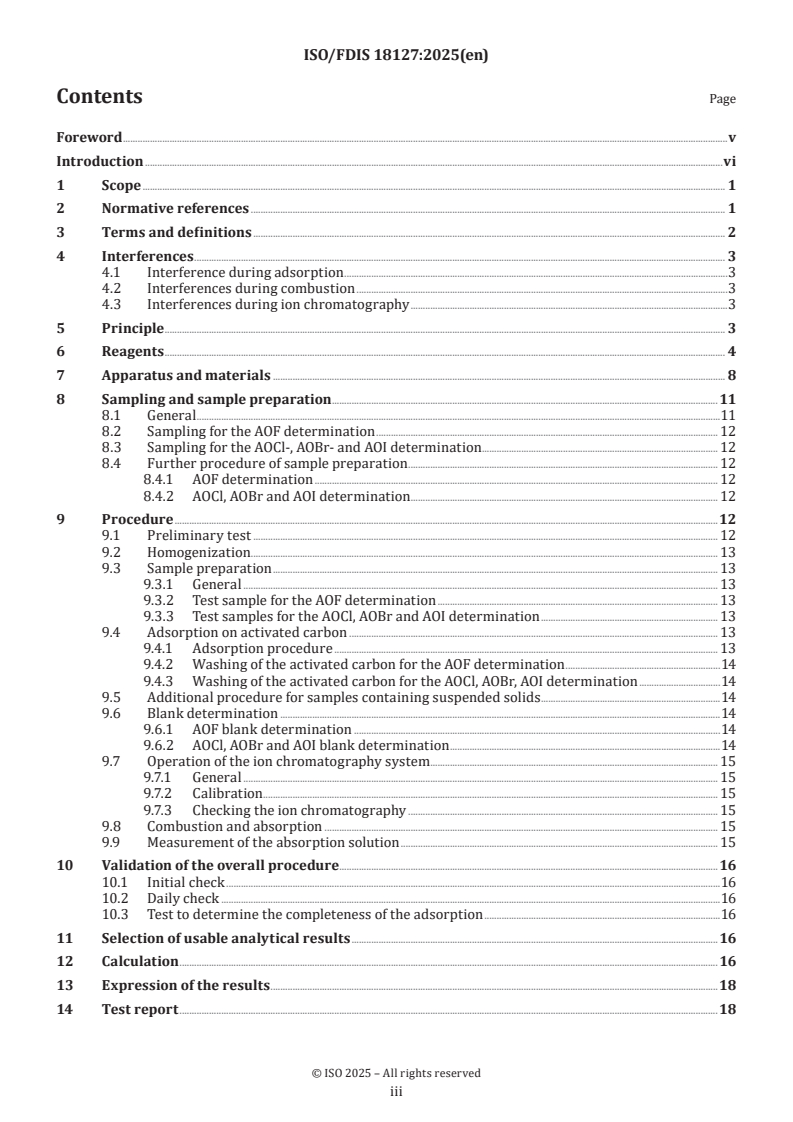
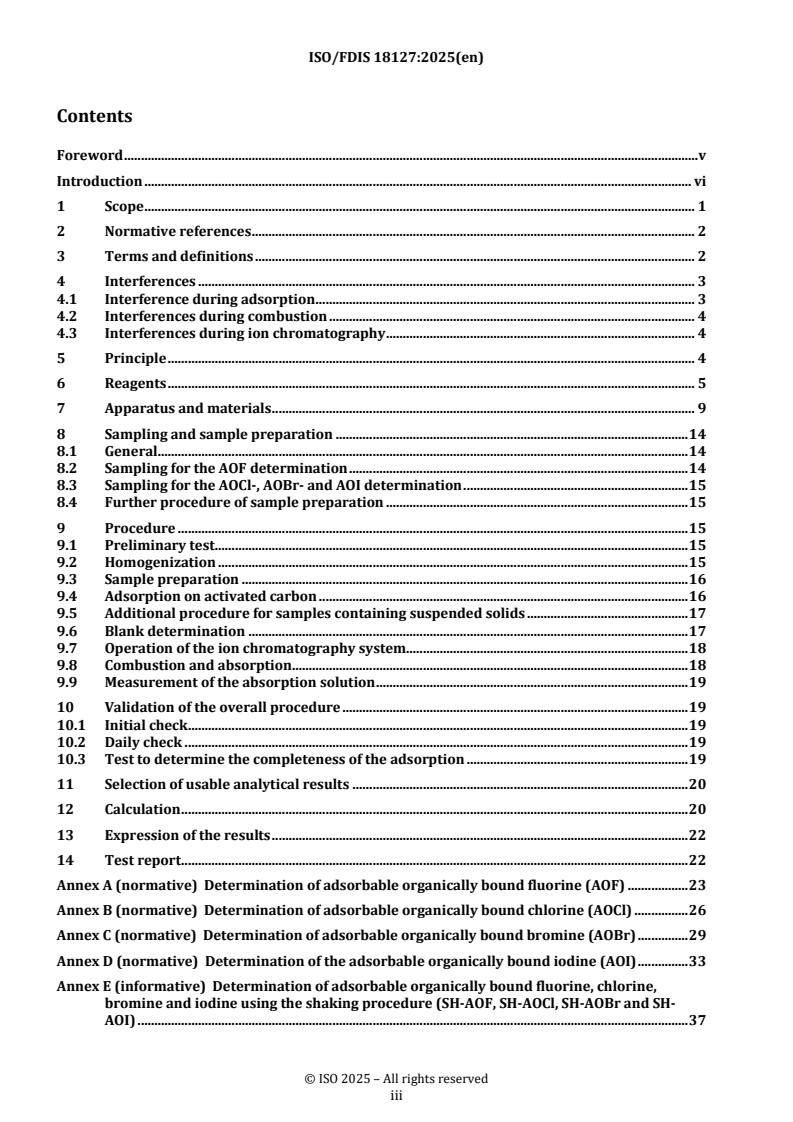
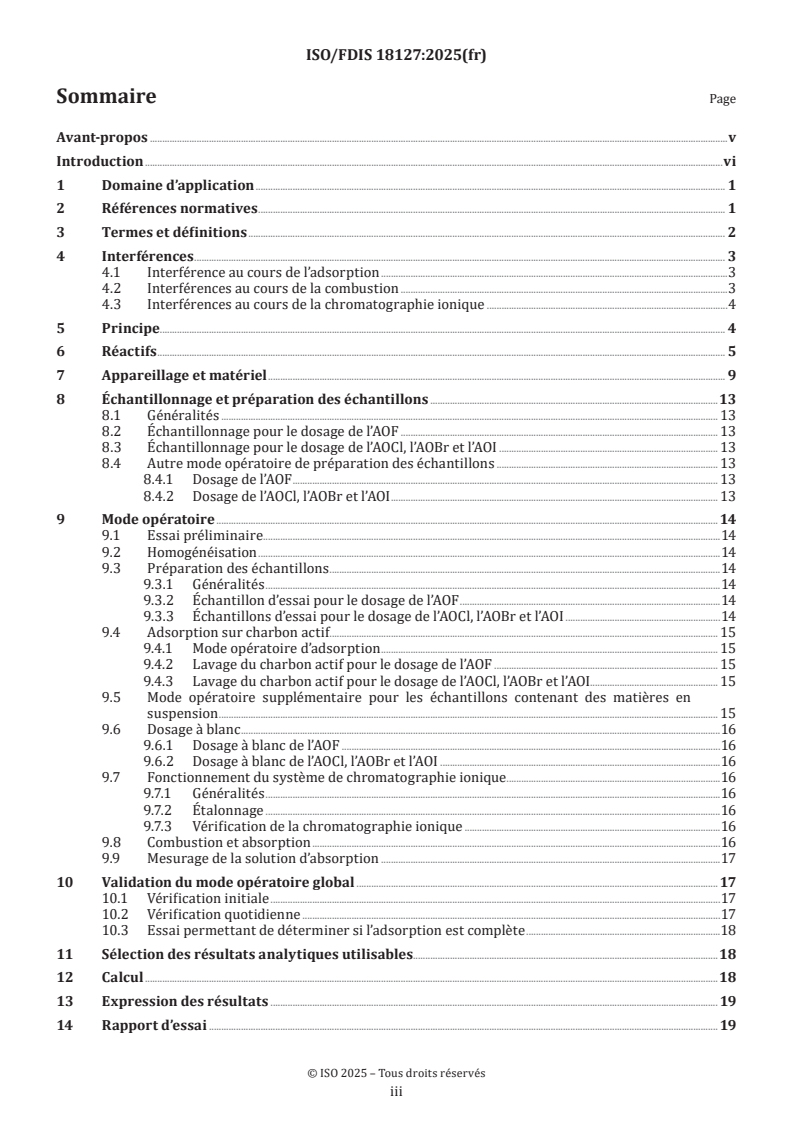
Contents Page
Foreword .v
Introduction .vi
1 Scope . 1
2 Normative references . 1
3 Terms and definitions . 2
4 Interferences . 3
4.1 Interference during adsorption .3
4.2 Interferences during combustion .3
4.3 Interferences during ion chromatography .3
5 Principle . 3
6 Reagents . 4
7 Apparatus and materials . 8
8 Sampling and sample preparation .11
8.1 General .11
8.2 Sampling for the AOF determination . 12
8.3 Sampling for the AOCl-, AOBr- and AOI determination . 12
8.4 Further procedure of sample preparation . 12
8.4.1 AOF determination . 12
8.4.2 AOCl, AOBr and AOI determination. 12
9 Procedure .12
9.1 Preliminary test . 12
9.2 Homogenization. 13
9.3 Sample preparation . 13
9.3.1 General . 13
9.3.2 Test sample for the AOF determination . 13
9.3.3 Test samples for the AOCl, AOBr and AOI determination . 13
9.4 Adsorption on activated carbon . 13
9.4.1 Adsorption procedure . 13
9.4.2 Washing of the activated carbon for the AOF determination .14
9.4.3 Washing of the activated carbon for the AOCl, AOBr, AOI determination .14
9.5 Additional procedure for samples containing suspended solids .14
9.6 Blank determination .14
9.6.1 AOF blank determination .14
9.6.2 AOCl, AOBr and AOI blank determination .14
9.7 Operation of the ion chromatography system . 15
9.7.1 General . 15
9.7.2 Calibration . . . 15
9.7.3 Checking the ion chromatography . 15
9.8 Combustion and absorption . 15
9.9 Measurement of the absorption solution . 15
10 Validation of the overall procedure . .16
10.1 Initial check .16
10.2 Daily check .16
10.3 Test to determine the completeness of the adsorption .16
11 Selection of usable analytical results .16
12 Calculation .16
13 Expression of the results .18
14 Test report .18
iii
ISO/FDIS 18127:2025(en)
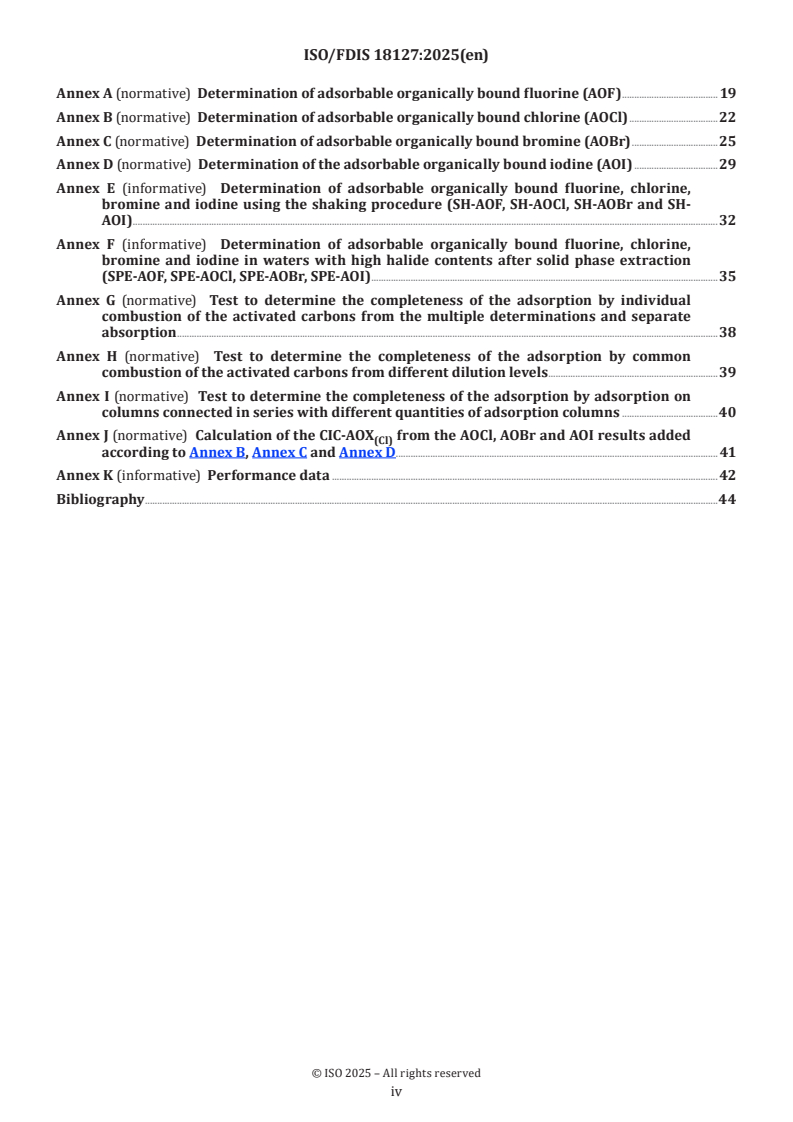
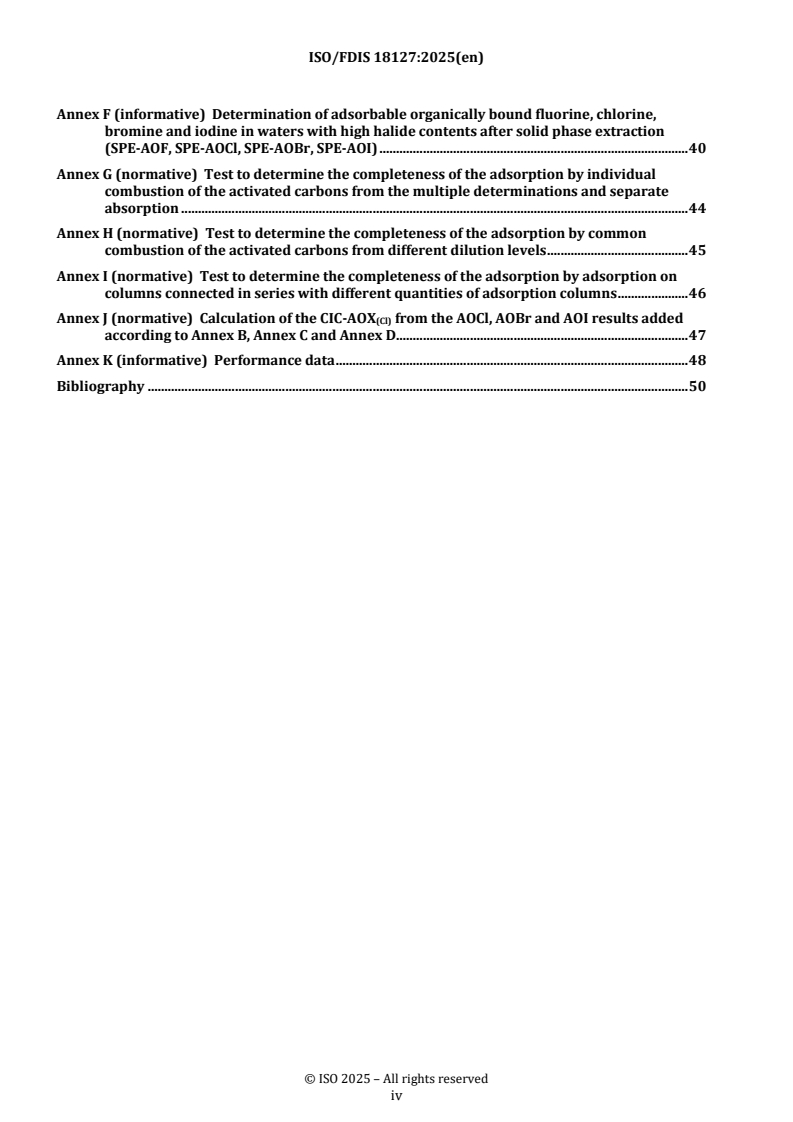
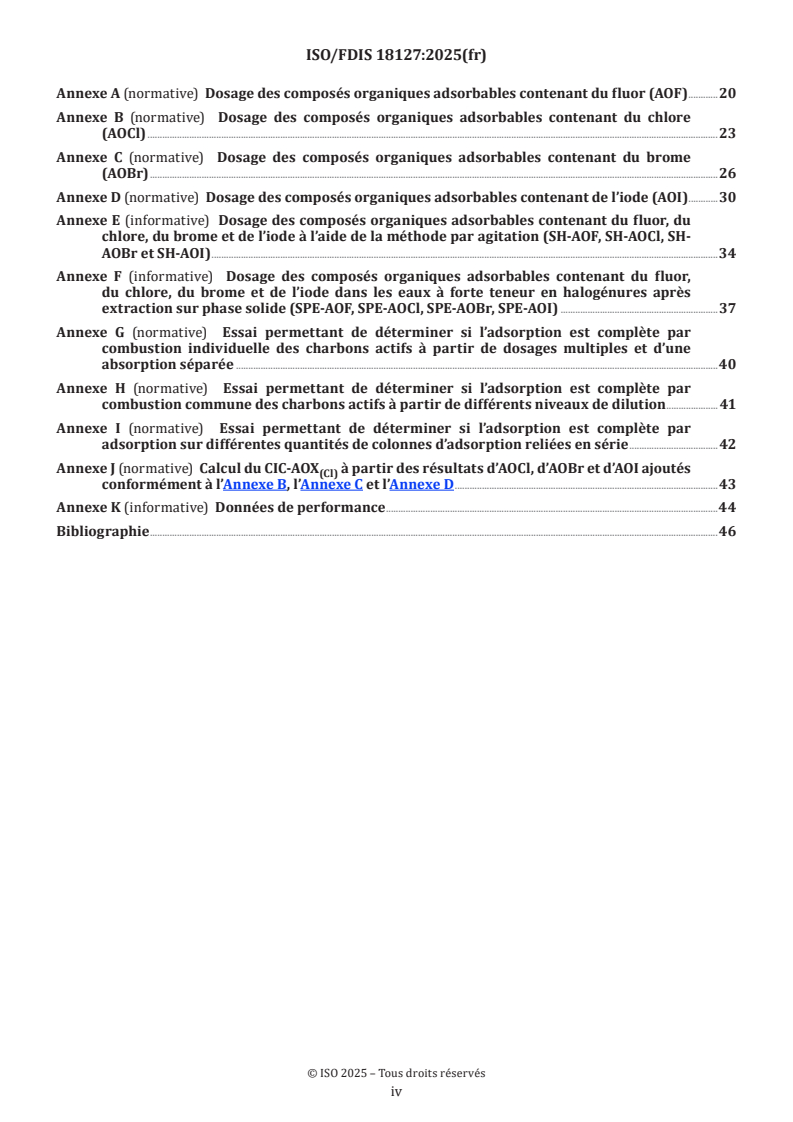
Annex A (normative) Determination of adsorbable organically bound fluorine (AOF) . 19
Annex B (normative) Determination of adsorbable organically bound chlorine (AOCl) .22
Annex C (normative) Determination of adsorbable organically bound bromine (AOBr) .25
Annex D (normative) Determination of the adsorbable organically bound iodine (AOI) .29
Annex E (informative) Determination of adsorbable organically bound fluorine, chlorine,
bromine and iodine using the shaking procedure (SH-AOF, SH-AOCl, SH-AOBr and SH-
AOI) .32
Annex F (informative) Determination of adsorbable organically bound fluorine, chlorine,
bromine and iodine in waters with high halide contents after solid phase extraction
(SPE-AOF, SPE-AOCl, SPE-AOBr, SPE-AOI) .35
Annex G (normative) Test to determine the completeness of the adsorption by individual
combustion of the activated carbons from the multiple determinations and separate
absorption .38
Annex H (normative) Test to determine the completeness of the adsorption by common
combustion of the activated carbons from different dilution levels .39
Annex I (normative) Test to determine the completeness of the adsorption by adsorption on
columns connected in series with different quantities of adsorption columns .40
Annex J (normative) Calculation of the CIC-AOX from the AOCl, AOBr and AOI results added
(Cl)
according to Annex B, Annex C and Annex D. 41
Annex K (informative) Performance data .42
Bibliography .44
iv
ISO/FDIS 18127:2025(en)
Foreword
ISO (the International Organization for Standardization) is a worldwide federation of national standards
bodies (ISO member bodies). The work of preparing International Standards is normally carried out through
ISO technical committees. Each member body interested in a subject for which a technical committee
has been established has the right to be represented on that committee. International organizations,
governmental and non-governmental, in liaison with ISO, also take part in the work. ISO collaborates closely
with the International Electrotechnical Commission (IEC) on all matters of electrotechnical standardization.
The procedures used to develop this document and those intended for its further maintenance are described
in the ISO/IEC Directives, Part 1. In particular, the different approval criteria needed for the different types
of ISO document should be noted. This document was drafted in accordance with the editorial rules of the
ISO/IEC Directives, Part 2 (see www.iso.org/directives).
ISO draws attention to the possibility that the implementation of this document may involve the use of (a)
patent(s). ISO takes no position concerning the evidence, validity or applicability of any claimed patent
rights in respect thereof. As of the date of publication of this document, ISO had not received notice of (a)
patent(s) which may be required to implement this document. However, implementers are cautioned that
this may not represent the latest information, which may be obtained from the patent database available at
www.iso.org/patents. ISO shall not be held responsible for identifying any or all such patent rights.
Any trade name used in this document is information given for the convenience of users and does not
constitute an endorsement.
For an explanation of the voluntary nature of standards, the meaning of ISO specific terms and expressions
related to conformity assessment, as well as information about ISO's adherence to the World Trade
Organization (WTO) principles in the Technical Barriers to Trade (TBT), see www.iso.org/iso/foreword.html.
This document was prepared by Technical Committee ISO/TC 147, Water quality, Subcommittee SC 2, Physical,
chemical and biochemical methods, in collaboration with the European Committee for Standardization
(CEN) Technical Committee CEN/TC 230, Water analysis, in accordance with the Agreement on technical
cooperation between ISO and CEN (Vienna Agreement).
Any feedback or questions on this document should be directed to the user’s national standards body. A
complete listing of these bodies can be found at www.iso.org/members.html.
v
ISO/FDIS 18127:2025(en)
Introduction
Adsorbable organically bound fluorine, chlorine, bromine or iodine are analytical convention parameters
used to monitor water quality. They represent the sum of organically bound fluorine, chlorine, bromine and
iodine that can be adsorbed on activated carbon under specified conditions and, if the sample has not been
filtered, can also be attached to or contained in suspended substances.
In contrast to the adsorbable organically bound halogen (AOX) method according to ISO 9562, this method
can be applied to determine the sum of organofluorine compounds in addition to the determination of
organically bound chlorine, bromine and iodine and detected halogen-specific separately.
The method is carried out by combustion ion chromatography (CIC).
Procedures for each separate parameter are described in Annex A, Annex B, Annex C and Annex D.
Alternatively, the adsorption of the organic substances contained in the water sample on activated carbon
can also be carried out by the shaking method (see Annex E).
Samples with a high content of suspended solids can be analysed using the shaking method (see Annex E).
Samples with a high content of inorganic halides can be analysed using the solid phase extraction (SPE)
method (see Annex F).
Results for samples analysed according to Annex E (shaking procedure) or Annex F (SPE procedure) can
differ significantly from those of the method specified in the main part.
With some waters, interference can occur that cannot be eliminated. These waters cannot be measured with
the method.
The AOCl, AOBr and AOI results according to Annex B, Annex C and Annex D can also be reported as
adsorbable organically bound halogen determined by combustion ion chromatography (CIC-AOX) (see
Annex J).
vi
FINAL DRAFT International Standard ISO/FDIS 18127:2025(en)
Water quality — Determination of adsorbable organically
bound fluorine, chlorine, bromine and iodine (AOF, AOCl,
AOBr, AOI) — Method using combustion and subsequent ion
chromatographic measurement
WARNING — Persons using this document should be familiar with normal laboratory practice. This
document does not purport to address all of the safety problems, if any, associated with its use. It is
the responsibility of the user to establish appropriate safety and health practices.
IMPORTANT — It is absolutely essential that tests conducted in accordance with this document be
carried out by suitably qualified staff.
1 Scope
This document specifies a method for the determination of organically bound halogens fluorine, chlorine,
bromine and iodine which are adsorbable on activated carbon. Adsorption takes place on activated carbon
packed in columns.
The method is applicable for the determination of:
— ≥ 2 µg/l AOF, expressed as F;
— ≥ 10 µg/l AOCl, expressed as Cl;
— ≥ 1 µg/l AOBr, expressed as Br;
— ≥ 1 µg/l AOI, expressed as I.
The method is applicable for the determination of adsorbable organically bound fluorine, chlorine, bromine
or iodine in water, e.g. in groundwater, surface water, bank filtrate, drinking water, aqueous eluates, cooling
water and wastewater.
The working range is limited by the capacity of the activated carbon, the process blank and the capacity of
the chromatographic separation column. Sample dilution into the working range can be required.
The range of application can be extended to lower concentrations with lower process blanks e.g. using low
blank active carbons.
The method can also be applied for samples containing suspended solids. Halogens adsorbed on the
suspended solids (e.g. undissolved halides) are also determined. Filtration of the sample prior to analyses
using a membrane filter (0,45 µm) allows the separate determination of dissolved adsorbable and particulate
bound fractions of organically bound fluorine, chlorine, bromine or iodine.
Results from an international interlaboratory trial are presented in Annex K.
2 Normative references
The following documents are referred to in the text in such a way that some or all of their content constitutes
requirements of this document. For dated references, only the edition cited applies. For undated references,
the latest edition of the referenced document (including any amendments) applies.
ISO 8466-1, Water quality — Calibration and evaluation of analytical methods — Part 1: Linear calibration
function
ISO/FDIS 18127:2025(en)
ISO 8466-2, Water quality — Calibration and evaluation of analytical methods and estimation of performance
characteristics — Part 2: Calibration strategy for non-linear second-order calibration functions
3 Terms and definitions
For the purposes of this document, the following terms and definitions apply.
ISO and IEC maintain terminology databases for use in standardization at the following addresses:
— ISO Online browsing platform: available at https:// www .iso .org/ obp
— IEC Electropedia: available at https:// www .electropedia .org/
3.1
adsorbable organically bound fluorine
AOF
equivalent mass of fluorine in organic halogen compounds, expressed as fluorine, measured under the
conditions of this procedure
3.2
adsorbable organically bound chlorine
AOCl
equivalent mass of chlorine in organic halogen compounds, expressed as chlorine, measured under the
conditions of this procedure
3.3
adsorbable organically bound bromine
AOBr
equivalent mass of bromine in organic halogen compounds, expressed as bromine, measured under the
conditions of this procedure
3.4
adsorbable organically bound iodine
AOI
equivalent mass of iodine in organic halogen compounds, expressed as iodine, measured under the
conditions of this procedure
3.5
adsorbable organically bound halogens
AOX
equivalent mass of the halogens chlorine, bromine and iodine in organic compounds, determined according
to ISO 9562 and expressed as chloride
3.6
test sample
sample obtained from the original sample after preparation and dilution, if necessary, and fed into the
adsorption process
3.7
combustion ion chromatography
CIC
technique comprising oxidative high-temperature combustion followed by absorption of formed hydrogen
halides and subsequent ion chromatographic detection of the halide ions
3.8
adsorbable organically bound halogens, determined by combustion ion chromatography
CIC-AOX
equivalent mass of the halogens chlorine, bromine and iodine in organic compounds, measured under the
conditions of this procedure and expressed as chlorine
ISO/FDIS 18127:2025(en)
4 Interferences
4.1 Interference during adsorption
AOF, AOCl, AOBr or AOI values can arise from the presence of inorganic halides in the sample. If the test
sample contains as well as organohalogens in low concentration and inorganic halides in high concentration,
the halides can add significant contribution to the result. These contributions can be dependent on the
matrix and halogenide concentration. It is not possible to specify any information on the concentrations
of inorganic halides at which significant contributions to the result for the AOF, AOCl, AOBr or AOI can be
expected. These can depend on various factors, such as the properties e.g. characteristics of the activated
carbon or contaminated laboratory air. Annex A, Annex B, Annex C and Annex D give examples of halide
concentrations that give significant contributions to the result for the AOF, AOCl or AOI.
Sample matrix characteristics [e.g. high concentrations of dissolved organic carbon (DOC)] can cause
interference with the adsorption of the organically bound halogens and result in negative bias. These effects
can be solved by sample dilution or spiking experiments, if necessary. Information on the influence of DOC
on the adsorption reaction of the sample can be provided by current measurements or previous testing of
the sampling point. For samples not filtered, the total organic carbon (TOC) can also be used as information.
Samples containing living cells (e.g. microorganisms or algae) can cause a positive bias due to their halide
content on AOCl, AOBr and AOI (chloride, bromide and iodide). In this case, the acidified sample is analysed
at least the earliest 8 h after sampling.
Particulate inorganic halogen compounds with a melting point < 1 000 °C can cause a positive bias. This can
be avoided filtering the sample.
High contents of undissolved substances can cause interference with the column method. In these cases, the
use of activated carbon according to 9.4 or the shaking procedure (see Annex E) should be considered.
The recovery of some polar and hydrophilic compounds (e.g. trifluoroacetate or monochloroacetate) or
volatile compounds is incomplete.
Contamination of the laboratory air due to chemicals or other sources can cause positive bias.
4.2 Interferences during combustion
Alkali metals present can cause premature devitrification of a quartz glass combustion tube.
NOTE The use of a ceramic inner tube can increase the lifetime of the combustion tube significantly.
A deficiency or insufficient quantity of water added for hydropyrolysis during AOF determination can lead
to a negative bias.
4.3 Interferences during ion chromatography
Any substance that generates a detector signal similar to that of the analyte ion can cause interference.
Additionally, a high concentration of ions can influence the peak resolution and the retention time of the
analyte. Gradient elution can minimize many of these interferences.
5 Principle
To determine the organically bound halogens, the substances contained in the water sample are adsorbed
onto activated carbon. Enriched halides are displaced from the activated carbon by washing with a nitrate
wash solution. The loaded activated carbon is combusted in an oxygen stream. The resulting hydrogen
halides are sorbed in an absorption solution. The halide ions are then determined by ion chromatography.
The basic requirements for the procedure are:
— Samples for the determination of AOF are treated differently from samples for the determination of AOCl,
AOBr and AOI.
ISO/FDIS 18127:2025(en)
— Samples for the determination of AOF are not acidified. The adsorption takes place under unchanged pH
conditions. Washing is performed with a neutral washing solution.
— Samples for the determination of AOCl, AOBr and AOI are adjusted to a pH < 2 with nitric acid. The
adsorption and washing step are carried out in a nitric acid environment.
— The aqueous sample is passed through columns of activated carbon which adsorbs the organically bound
halogens.
— The inorganic halides are removed by washing with a nitrate solution.
— The activated carbon is combusted in an oxygen stream at 950 °C or higher. For the determination of AOF,
the loaded activated carbon is combusted with addition of water (hydropyrolysis).
— The resulting change in the volume in the absorption solution is taken into account when calculating of
the concentration (e.g. by determining the recovery of an internal standard).
— The hydropyrolytic combustion does not interfere with the determination of AOCl, AOBr and AOI.
— The resulting hydrogen halide ions from the organically bound halogens are collected in an absorbing
solution.
The absorbing solution is injected into an ion chromatograph with a suppressed conductivity detector
where anions are separated and quantitated. The ion chromatographic separation is carried out on an anion
exchange resin as stationary phase. Aqueous solutions of salts of weak monobasic and dibasic acids are used
as eluents for isocratic or gradient elution. Determination is carried out by means of conductivity detection
(CD). The conductivity of the eluents is reduced by a suppressor device (cation exchanger). UV or tandem UV
detection may be used.
NOTE A UV detector is not required to perform this analysis, but it can be used for bromide and iodide if higher
sensitivity is required or in the case of matrix interference with the CD. UV detection (UVD) can be used in combination
with the CD. The UV detector measures the absorption of the irradiated UV radiation. The measuring wavelength is at
λ = (215 ± 10) nm for bromide and at λ = (226 ± 10) nm for iodide.
The AOCl, AOBr and AOI results according to Annex B, Annex C and Annex D can also be reported as
adsorbable organically bound halogens, determined by combustion ion chromatography CIC-AOX (CIC-
AOX(Cl)).
The calculation shall be as described in Annex J.
6 Reagents
6.1 General
Use only reagents with the purity grade “for analyses”, if available. Unless otherwise stated, reagents shall
be weighed to an accuracy of ±1 % of nominal mass. Commercially available solutions of equivalent quality
may be used. If necessary, alternative volumes and concentrations to the solutions described in this clause
may be prepared and used.
All reagents shall be checked for their contribution to the blank, if applicable.
6.2 Water, with a specific electrical resistance of ≥18 MΩ·cm (at 25 °C).
6.3 Reagents for sample stabilization and pre-treatment.
6.3.1 Nitric acid,w(HNO ) = 65 %.
ISO/FDIS 18127:2025(en)
6.3.2 Sodium sulfite, Na SO .
2 3
6.3.2.1 Sodium sulfite solution,c(Na SO ) = 1 mol/l.
2 3
Dissolve 126 g Na SO (6.3.2) in water (6.2) in a 1 000 ml volumetric flask and dilute to volume with
2 3
water (6.2).
The solution is stable for four weeks if stored at (5 ± 3) °C.
6.3.3 Iodine starch paper.
6.3.4 Potassium iodide.
6.3.5 Starch solution, mass fraction of 1 %.
6.4 Reagents and gases for adsorption, combustion and absorption.
6.4.1 Activated carbon with an iodine number >1 050 mg/g.
Suitable natural coal-derived activated carbons have particle sizes in the range of about 50 µm to 150 µm.
Synthetic materials with larger specific surfaces may also be used.
Various methods can be used to determine the adsorption capacity. One of these methods is described in
[8]
EN 12902 . The iodine number gives an indication of the adsorption capacity of the activated carbon.
NOTE 1 Activated carbon qualities with grain sizes <50 µm can lead to blockage of the adsorption column.
To prevent the activated carbon from being contaminated by adsorption of halogen-containing compounds
from the laboratory air during storage, the activated carbon should be stored in an airtight container (e.g.
aluminium screw bottle, halogen polymer-free plastic bottle or similar). Only the daily required amount for
the intended series or samples should be taken from a separate container. The remainder of the activated
carbon taken from the container each day should be discarded. Any additional activated carbon not used
within the same day shall be discarded.
NOTE 2 The halogen blank values of the activated carbon can be determined by analysing, for example, 100 mg
of the activated carbon analyses moistened with 100 µl water (6.2). The result serves as an indication of relevant
impurities. Ultimately, the analytically decisive factor is the method blank.
The applicability of an activated carbon batch shall be checked on the recoveries of fluorine, chlorine,
bromine or iodine from model substances via the overall procedure given in Annex A, Annex B, Annex C and
Annex D. The compounds listed in Annex A, Annex B, Annex C and Annex D shall be used as test reagents.
6.4.2 Sodium nitrate, NaNO .
6.4.2.1 Neutral nitrate stock solution I, c(NaNO ) = 2 mol/l for the AOF determination.
Dissolve 170 g sodium nitrate (6.4.2) in water (6.2) in a 1 000 ml volumetric flask and dilute to volume with
water (6.2).
The solution is stable for six months if stored in an amber glass bottle at ambient temperature.
6.4.2.2 Neutral nitrate wash solution II,c(NaNO ) = 0,01 mol/l for the AOF determination.
Pipette 5 ml of neutral nitrate stock solution (6.4.2.1) in a 1 000 ml volumetric flask and dilute to volume
with water (6.2).
The solution is stable for four weeks if stored in an amber glass bottle at ambient temperature.
ISO/FDIS 18127:2025(en)
6.4.2.3 Nitric acid nitrate stock solution I,c(NaNO ) = 2 mol/l for the AOCl, AOBr and AOI determination.
Dissolve 170 g sodium nitrate (6.4.2) in water (6.2) in a 1 000 ml volumetric flask, add 25 ml nitric acid
(6.3.1) and dilute to volume with water (6.2).
The solution is stable for six months if stored in an amber glass bottle at ambient temperature.
6.4.2.4 Nitric acid nitrate wash solution II,c(NaNO ) = 0,01 mol/l, pH ≈ 1,7 for the AOCl, AOBr and AOI
determination.
Pipette 5 ml of nitric acid stock solution (6.4.2.3) in a 1 000 ml volumetric flask and dilute to volume with
nitric acid dilution water (6.4.6).
The solution is stable for four weeks if stored in an amber glass bottle at ambient temperature.
6.4.3 Ethanol, C H OH, absolute.
2 5
6.4.4 Standard solutions for the test of the overall procedure.
Organic halogen single and multi-component stock solutions with appropriate and required specification
may be used if commercially available. These solutions are stable for six months. The manufacturer
specifications shall be observed. Alternatively, stock solutions may be prepared by weighing. See Annex A,
Annex B, Annex C and Annex D.
6.4.5 Dilution water and blank solution for the determination of the total AOF blank value, 100 ml
water (6.2).
6.4.6 Nitric acid dilution water and blank solution for the determination of the total AOCl, AOBr and
AOI blanks, 100 ml water (6.2), acidified with 0,2 ml nitric acid (6.3.1).
6.4.7 Oxygen, or a mixture of oxygen and inert gas (e.g. argon).
The use of argon is recommended when using adsorption columns packed with cellulose wool. Adsorption
columns packed with ceramic wool or quartz wool can possibly be combusted without the use of an inert
gas. For a residue-free conversion of e.g. cellulose wool packed adsorption columns, an inert gas (e.g. argon)
should be used. Otherwise, incomplete combustion, resulting in incorrect results, can occur.
NOTE Gas purities for oxygen ≥ 99,995 % and argon ≥ 99,998 % have proven to be sufficient.
6.4.8 Absorption solution for combustion gases.
Water (6.2). Alternatively, solutions according to C.4.5 and D.4.5 may be prepared for absorption.
The use of an internal standard in the absorption solution is necessary if the volume of the absorption solution
cannot be determined prior to sample injection into the ion chromatography. For example, methanesulfonic
acid or phosphate solutions can be used as internal standards (6.5.5).
NOTE The addition of reducing agents, e.g. hydrogen peroxide in an alkaline medium, can be necessary for the
determination of bromine and iodine (see C.4.5 and D.4.5).
6.5 Reagents for the ion chromatography
6.5.1 Eluents
Carbonate, hydrogen carbonate, hydroxide salts, e.g. manually, automatically or electrochemically generated
in situ, may be used as eluents. The choice of eluent depends on the selected separation column and detector;
follow the column manufacturer's instructions. The selected combination of separation column and eluent
shall fulfil the requirement for the peak resolution in accordance with 7.8. The eluents may be used as long
as the requirements in 7.8 are fulfilled. An example of a suitable eluent is described in 6.5.2.2.
ISO/FDIS 18127:2025(en)
Degas the eluents, if necessary. A renewed gas uptake shall be prevented during operation (e.g. by helium
overlay or inline degasser).
6.5.2 Sodium carbonate, Na CO .
2 3
6.5.2.1 Sodium carbonate concentrate,c(Na CO ) = 0,09 mol/l.
2 3
Dissolve 9,54 g sodium carbonate (6.5.2) in water (6.2) in a 1 000 ml volumetric flask and dilute to volume
with water (6.2).
The solution is stable for six months if stored at (5 ± 3) °C.
6.5.2.2 Sodium carbonate eluent,c(Na CO ) = 0,009 mol/l.
2 3
The following eluent is suitable for the determination of the ions mentioned in 6.5.3: pipette 100 ml of the
sodium carbonate concentrate (6.5.2.1) into a 1 000 ml volumetric flask and dilute to volume with water (6.2).
6.5.3 Fluoride, chloride, bromide and iodide stock solutions, each ρ = 1 000 mg/l.
Single anion and mixed anion stock solutions with adequate and required specifications are commercially
available. These solutions are considered to be stable for several months. Alternatively, prepare stock
solutions manually in accordance with Table 1. The salts are dissolved accordingly in water (6.2) after
adequate drying. Use mixed standard solutions in suitable concentrations with at least five different
concentrations for the calibrations.
Table 1 — Weighing and pre-treatment for the stock solutions
a
Anion Salt Weighing in 1 000 ml Drying salt at (105 ± 5) °C for at least
g
Fluoride NaF 2,210 1 h
Chloride NaCl 1,648 2 h
Bromide NaBr 1,288 6 h
Iodide NaI 1,181 3 h
a
Other salts that meet the required specifications may be used.
6.5.4 Fluoride, chloride, bromide and iodide calibration solution.
6.5.4.1 General
Depending on the expected concentrations, single or mixed standard solutions with fluoride, chloride,
bromide and iodide contents are to be prepared from the stock solutions (6.5.3). The example in 6.5.4.2
describes the preparation of mixed standard solutions.
The standard solutions shall be stored in polyethene or glass containers.
6.5.4.2 Example of a fluoride, chloride, bromide and iodide mixed standard solution, each
ρ = 10 mg/l.
Pipette 1,0 ml of each of the stock solutions (6.5.3) into a 100 ml volumetric flask and dilute to volume with
water (6.2).
The solution is stable for one week if stored in glass or polyethene containers at (5 ± 3) °C.
ISO/FDIS 18127:2025(en)
6.5.4.3 Fluoride, chloride, bromide and iodide calibration solution.
Depending on the expected concentrations in the sample, prepare, for example, 5 to 10 calibration solutions
distributed as evenly as possible over the expected working range, from the mixed standard solution
(6.5.4.2).
For the range of e.g. 0,05 mg/l to 0,5 mg/l proceed as follows:
— Place the following volumes in a series of 20 ml volumetric flasks.
— Pipette 100 μl, 200 μl, 300 μl, 400 μl, 500 μl, 600 μl, 700 μl, 800 μl, 900 μl and 1 000 μl of the mixed
standard solution (6.5.4.2) and dilute to volume with water (6.2).
— The anion concentrations in these calibration solutions are: 0,05 mg/l; 0,1 mg/l; 0,15 mg/l; 0,2 mg/l;
0,25 mg/l; 0,3 mg/l; 0,35 mg/l; 0,4 mg/l; 0,45 mg/l and 0,5 mg/l.
The solutions shall be prepared on the day of use.
NOTE For assessment of any possible chromatographic interference by coeluting ions, the addition of more anions
(e.g. nitrate, sulfate or phosphate) to the calibration solution is helpful. It can also be helpful to check also possible
coelution of other ions, e.g. iodate, bromate, nitrite, sulfite, chlorite and chlorate.
6.5.5 Internal standard
Sodium methane sulphonate or phosphate solutions, for example, can be used as an internal standard.
Subclause 6.5.5.3 describes the preparation of a sodium methanesulfonate solution as an example of a
suitable internal standard.
6.5.5.1 Sodium methanesulfonate, CH SO Na.
3 3
6.5.5.2 Sodium methanesulfonate solution,ρ(CH SO Na) = 500 mg/l.
3 3
Dissolve 500 mg sodium methanesulfonate (6.5.5.1) in the absorption solution (6.4.8) in 1 000 ml volumetric
flask and dilute to volume with absorption solution (6.4.8).
6.5.5.3 Absorption solution with internal standard sodium methanesulfonate,ρ(CH SO Na) = 1 mg/l.
3 3
Pipette 2 ml of the sodium methanesulfonate solution (6.5.5.2) in 1 000 ml volumetric flask and dilute to
volume with absorption solution (6.4.8).
The solution is stable for three months if stored at (5 ± 3) °C.
6.5.6 Blank solution for the ion chromatography.
Fill a volumetric flask with water (6.2), e.g. 100 ml.
7 Apparatus and materials
7.1 General
In accordance with the analysis objectives, it shall be ensured that only materials which do not significantly
affect the blank value are used (e.g. halogen-free materials for valves, tubes).
Usual laboratory equipment and in particular the following.
7.2 Filtration device, e.g. with a filter funnel, capacity V = 0,15 l, filter diameter 25 mm, filtration unit for
positive or negative pressure filtration.
ISO/FDIS 18127:2025(en)
7.3 Polycarbonate membrane filter, e.g. of diameter 25 mm and pore size 0,45 µm, or equivalent filter
material.
7.4 Device for adsorption on activated carbon applying the column procedure
Suitable pump, e.g. piston pump with polypropylene transfer tubing and a device (e.g. automatic sample
changer) for homogeneous sample transfer, which is equipped with a stirring device, e.g. magnetic stirrer,
adsorption columns, inner diameter e.g. about 3 mm, length 40 mm to 50 mm, packed with activated carbon
and arranged vertically in series. Other column dimensions are possible. Apply the sample to the top of the
columns and pass it through the column with excess pressure.
7.5 Ceramic wool or cellulose wool or other suitable material, for fixing the activated carbon in the
columns.
7.6 Device for combustion and absorption
7.6.1 Combustion device, consisting of a furnace, heatable to 950 °C or higher, with a quartz glass or
ceramic combustion tube. Both tubes, vertically and horizontally arranged combustion, are suitable. To
determine AOF, a combustion device with a device for hydropyrolysis is required (e.g. see Figure 1).
Key
1 inlet for water, combustion and inert gas
2 sample inlet
3 combustion gas inlet
4 furnace
5 outer combustion tube
6 inner combustion tube
7 sample boat
8 absorption vessel
9 ion chromatograph
Figure 1 — Schematic representation of a device for the combustion with hydropyrolysis and
coupled ion chromatograph
For trace analyses and to reduce contamination risks, e.g. by decanting the absorption solution or by
contact of the absorption solution with laboratory air, it is recommended to fill the absorption tube (7.6.3)
and the injection loop (7.7.3) and to flush the gas
...
ISO/FDIS 18127:2025(en)
ISO/TC 147/SC 2
Secretariat: DIN
Date: 2025-04-2508-20
Water quality — Determination of adsorbable organically bound
fluorine, chlorine, bromine and iodine (AOF, AOCl, AOBr, AOI) —
Method using combustion and subsequent ion chromatographic
measurement
Qualité de l'eaul’eau — Dosage des composés organiques adsorbables contenant du fluor, du chlore, du brome
et de l'iode adsorbables liés organiquementl’iode (AOF, AOCl, AOBr, AOI) — Méthode en utilisant lade
combustion et la mesure ultérieuresuivie d’un mesurage par chromatographie ionique
FDIS stage
ISO/FDIS 18127:2025(en)
All rights reserved. Unless otherwise specified, or required in the context of its implementation, no part of this publication
may be reproduced or utilized otherwise in any form or by any means, electronic or mechanical, including photocopying,
or posting on the internet or an intranet, without prior written permission. Permission can be requested from either ISO
at the address below or ISO’s member body in the country of the requester.
ISO copyright office
CP 401 • Ch. de Blandonnet 8
CH-1214 Vernier, Geneva
Phone: + 41 22 749 01 11
EmailE-mail: copyright@iso.org
Website: www.iso.org
Published in Switzerland
ii
ISO/FDIS 18127:2025(en)
Contents
Foreword . v
Introduction . vi
1 Scope . 1
2 Normative references . 2
3 Terms and definitions . 2
4 Interferences . 3
4.1 Interference during adsorption . 3
4.2 Interferences during combustion . 4
4.3 Interferences during ion chromatography . 4
5 Principle . 4
6 Reagents . 5
7 Apparatus and materials . 9
8 Sampling and sample preparation . 14
8.1 General. 14
8.2 Sampling for the AOF determination . 14
8.3 Sampling for the AOCl-, AOBr- and AOI determination . 15
8.4 Further procedure of sample preparation . 15
9 Procedure . 15
9.1 Preliminary test . 15
9.2 Homogenization . 15
9.3 Sample preparation . 16
9.4 Adsorption on activated carbon . 16
9.5 Additional procedure for samples containing suspended solids . 17
9.6 Blank determination . 17
9.7 Operation of the ion chromatography system. 18
9.8 Combustion and absorption . 18
9.9 Measurement of the absorption solution . 19
10 Validation of the overall procedure . 19
10.1 Initial check . 19
10.2 Daily check . 19
10.3 Test to determine the completeness of the adsorption . 19
11 Selection of usable analytical results . 20
12 Calculation . 20
13 Expression of the results . 22
14 Test report . 22
Annex A (normative) Determination of adsorbable organically bound fluorine (AOF) . 23
Annex B (normative) Determination of adsorbable organically bound chlorine (AOCl) . 26
Annex C (normative) Determination of adsorbable organically bound bromine (AOBr) . 29
Annex D (normative) Determination of the adsorbable organically bound iodine (AOI) . 33
Annex E (informative) Determination of adsorbable organically bound fluorine, chlorine,
bromine and iodine using the shaking procedure (SH-AOF, SH-AOCl, SH-AOBr and SH-
AOI) . 37
iii
ISO/FDIS 18127:2025(en)
Annex F (informative) Determination of adsorbable organically bound fluorine, chlorine,
bromine and iodine in waters with high halide contents after solid phase extraction
(SPE-AOF, SPE-AOCl, SPE-AOBr, SPE-AOI) . 40
Annex G (normative) Test to determine the completeness of the adsorption by individual
combustion of the activated carbons from the multiple determinations and separate
absorption . 44
Annex H (normative) Test to determine the completeness of the adsorption by common
combustion of the activated carbons from different dilution levels . 45
Annex I (normative) Test to determine the completeness of the adsorption by adsorption on
columns connected in series with different quantities of adsorption columns . 46
Annex J (normative) Calculation of the CIC-AOX from the AOCl, AOBr and AOI results added
(Cl)
according to Annex B, Annex C and Annex D . 47
Annex K (informative) Performance data . 48
Bibliography . 50
iv
ISO/FDIS 18127:2025(en)
Foreword
ISO (the International Organization for Standardization) is a worldwide federation of national standards
bodies (ISO member bodies). The work of preparing International Standards is normally carried out through
ISO technical committees. Each member body interested in a subject for which a technical committee has been
established has the right to be represented on that committee. International organizations, governmental and
non-governmental, in liaison with ISO, also take part in the work. ISO collaborates closely with the
International Electrotechnical Commission (IEC) on all matters of electrotechnical standardization.
The procedures used to develop this document and those intended for its further maintenance are described
in the ISO/IEC Directives, Part 1. In particular, the different approval criteria needed for the different types of
ISO documentsdocument should be noted. This document was drafted in accordance with the editorial rules
of the ISO/IEC Directives, Part 2 (see www.iso.org/directives).
Attention is drawnISO draws attention to the possibility that some of the elementsimplementation of this
document may beinvolve the subjectuse of (a) patent(s). ISO takes no position concerning the evidence,
validity or applicability of any claimed patent rights in respect thereof. As of the date of publication of this
document, ISO had not received notice of (a) patent(s) which may be required to implement this document.
However, implementers are cautioned that this may not represent the latest information, which may be
obtained from the patent database available at www.iso.org/patents. ISO shall not be held responsible for
identifying any or all such patent rights. Details of any patent rights identified during the development of the
document will be in the Introduction and/or on the ISO list of patent declarations received (see ).
Any trade name used in this document is information given for the convenience of users and does not
constitute an endorsement.
For an explanation of the voluntary nature of standards, the meaning of ISO specific terms and expressions
related to conformity assessment, as well as information about ISO's adherence to the World Trade
Organization (WTO) principles in the Technical Barriers to Trade (TBT), see www.iso.org/iso/foreword.html.
This document was prepared by Technical Committee ISO/TC 147, Water quality, Subcommittee SC 2,
Physical, chemical and biochemical methods., in collaboration with the European Committee for
Standardization (CEN) Technical Committee CEN/TC 230, Water analysis, in accordance with the Agreement
on technical cooperation between ISO and CEN (Vienna Agreement).
Any feedback or questions on this document should be directed to the user’s national standards body. A
complete listing of these bodies can be found at www.iso.org/members.html.
v
ISO/FDIS 18127:2025(en)
Introduction
Adsorbable organically bound fluorine, chlorine, bromine or iodine are analytical convention parameters used
to monitor water quality. They represent the sum of organically bound fluorine, chlorine, bromine and iodine
that can be adsorbed on activated carbon under specified conditions and, if the sample has not been filtered,
can also be attached to or contained in suspended substances.
In contrast to the AOXadsorbable organically bound halogen (AOX) method according to ISO 9562, this
method can be applied to determine the sum of organofluorine compounds in addition to the determination
of organically bound chlorine, bromine and iodine and detected halogen-specific separately.
The method is carried out by combustion ion chromatography (CIC).
Procedures for each separate parameter are described in Annex A, Annex B, Annex C and Annex D.
Alternatively, the adsorption of the organic substances contained in the water sample on activated carbon can
also be carried out by the shaking method (see Annex E).
Samples with a high content of suspended solids can be analysed using the shaking method (see Annex E).
Samples with a high content of inorganic halides can be analysed using the solid phase extraction (SPE)
method (see Annex F).
Results for samples analysed according to Annex E (shaking procedure) or Annex F (SPE procedure) can differ
significantly from those of the method specified in the main part.
With some waters, interference can occur that cannot be eliminated. These waters cannot be measured with
the method.
The AOCl, AOBr and AOI results according to Annex B, Annex C and Annex D can also be reported as
adsorbable organically bound halogen determined by combustion ion chromatography (CIC-AOX) (see
Annex J).
vi
ISO/FDIS 18127:2025(en)
Water quality — Determination of adsorbable organically bound
fluorine, chlorine, bromine and iodine (AOF, AOCl, AOBr, AOI) —
Method using combustion and subsequent ion chromatographic
measurement
WARNING — Persons using this document should be familiar with normal laboratory practice. This
document does not purport to address all of the safety problems, if any, associated with its use. It is
the responsibility of the user to establish appropriate safety and health practices.
IMPORTANT — It is absolutely essential that tests conducted in accordance with this document be
carried out by suitably qualified staff.
1 Scope
This document specifies a method for the determination of organically bound halogens fluorine, chlorine,
bromine and iodine which are adsorbable on activated carbon. Adsorption takes place on activated carbon
packed in columns.
The method is applicable for the determination of:
— — ≥ 2 µg/l AOF, expressed as F;
— — ≥ 10 µg/l AOCl, expressed as Cl;
— — ≥ 1 µg/l AOBr, expressed as Br;
— — ≥ 1 µg/l AOI, expressed as I.
The method is applicable for the determination of adsorbable organically bound fluorine, chlorine, bromine
or iodine in water, e.g. in groundwater, surface water, bank filtrate, drinking water, aqueous eluates, cooling
water and wastewater.
The working range is limited by the capacity of the activated carbon, the process blank and the capacity of the
chromatographic separation column. Sample dilution into the working range can be required.
The range of application can be extended to lower concentrations with lower process blanks e.g. using low
blank active carbons.
The method can also be applied for samples containing suspended solids. Halogens adsorbed on the
suspended solids (e.g. undissolved halides) are also determined, too. Filtration of the sample prior to analyses
using a membrane filter (0,45 µm) allows the separate determination of dissolved adsorbable and particulate
bound fractions of organically bound fluorine, chlorine, bromine or iodine.
Results from an international interlaboratory trial are presented in Annex KThe recovery of some polar and
hydrophilic compounds, e.g. trifluoroacetate or monochloroacetate or volatile compounds is incomplete.
Procedures for each separate parameter are described in normative Annex A, Annex B, Annex C and Annex D.
Alternatively, the adsorption of the organic substances contained in the water sample on activated carbon can
also be carried out by the shaking method (see Annex E).
Samples with a high content of suspended solids can be analysed using the shaking method (see Annex E).
ISO/FDIS 18127:2025(en)
Samples with a high content of inorganic halides can be analysed using the solid phase extraction (SPE)
method (see Annex F).
Results for samples analysed according to Annex E (shaking procedure) or Annex F (SPE procedure) can differ
significantly from those of the method specified in the main part.
With some waters, interference can occur that cannot be eliminated. These waters cannot be measured with
the method.
The AOCl, AOBr and AOI results according to Annex B, Annex C and Annex D can also be reported as CIC-AOX
(Cl)
(Annex J).
.
2 Normative references
The following documents are referred to in the text in such a way that some or all of their content constitutes
requirements of this document. For dated references, only the edition cited applies. For undated references,
the latest edition of the referenced document (including any amendments) applies.
ISO 8466--1, Water quality — Calibration and evaluation of analytical methods — Part 1: Linear calibration
function
ISO 8466--2, Water quality — Calibration and evaluation of analytical methods and estimation of performance
characteristics — Part 2: Calibration strategy for non-linear second-order calibration functions
3 Terms and definitions
For the purposes of this document, the following terms and definitions apply.
ISO and IEC maintain terminology databases for use in standardization at the following addresses:
— — ISO Online browsing platform: available at https://www.iso.org/obp
— — IEC Electropedia: available at https://www.electropedia.org/
3.1
adsorbable organically bound fluorine
AOF
equivalent mass of fluorine in organic halogen compounds, expressed as fluorine, measured under the
conditions of this procedure
3.2
adsorbable organically bound chlorine
AOCl
equivalent mass of chlorine in organic halogen compounds, expressed as chlorine, measured under the
conditions of this procedure
3.3
adsorbable organically bound bromine
AOBr
equivalent mass of bromine in organic halogen compounds, expressed as bromine, measured under the
conditions of this procedure
ISO/FDIS 18127:2025(en)
3.4
adsorbable organically bound iodine
AOI
equivalent mass of iodine in organic halogen compounds, expressed as iodine, measured under the conditions
of this procedure
3.5
adsorbable organically bound halogens
AOX
equivalent mass of the halogens chlorine, bromine and iodine in organic compounds, determined according to
ISO 9562 and expressed as chloride
3.6
test sample
sample obtained from the original sample after preparation and dilution, if necessary, and fed into the
adsorption process
3.7
combustion ion chromatography
CIC
technique comprising oxidative high-temperature combustion followed by absorption of formed hydrogen
halides and subsequent ion chromatographic detection of the halide ions
3.8
adsorbable organically bound halogens, determined by combustion ion chromatography
CIC-AOX
equivalent mass of the halogens chlorine, bromine and iodine representing the sum of organically bound
chlorine, bromine and iodine.in organic compounds, measured under the conditions of this method;
expression of resultsprocedure and expressed as mass concentration of chlorine
4 Interferences
4.1 Interference during adsorption
AOF, AOCl, AOBr or AOI values can arise from the presence of inorganic halides in the sample. If the test sample
contains as well as organohalogens in low concentration and inorganic halides in high concentration, the
halides can add significant contribution to the result. These contributions can be dependent on the matrix and
halogenide concentration. It is not possible to specify any information on the concentrations of inorganic
halides at which significant contributions to the result for the AOF, AOCl, AOBr or AOI can be expected. These
can depend on various factors, such as the properties e.g. characteristics of the activated carbon or
contaminated laboratory air. Annex A, Annex BAnnex A, Annex B, Annex C, Annex C and Annex DAnnex D give
examples of halide concentrations that give significant contributions to the result for the AOF, AOCl or AOI.
Sample matrix characteristics ([e.g. high concentrations of dissolved organic carbon (DOC)))] can cause
interference with the adsorption of the organically bound halogens and result in negative bias. These effects
can be solved by sample dilution or spiking experiments, if necessary. Information on the influence of DOC on
the adsorption reaction of the sample can be provided by current measurements or previous testing of the
sampling point. For samples not filtered, the total organic carbon (TOC) can also be used as information.
Samples containing living cells (e.g. microorganisms or algae) can cause a positive bias due to their halide
content on AOCl, AOBr and AOI (chloride, bromide, and iodide). In this case, the acidified sample is analysed
at least the earliest 8 h after sampling.
Particulate inorganic halogen compounds with a melting point < 1 000 °C can cause a positive bias. This can
be avoided filtering the sample.
ISO/FDIS 18127:2025(en)
High contents of undissolved substances can cause interference with the column method. In these cases, the
use of activated carbon according to 9.49.4 or the shaking procedure (see Annex EAnnex E)) should be
considered.
The recovery of some polar and hydrophilic compounds (e.g. trifluoroacetate or monochloroacetate) or
volatile compounds is incomplete.
Contamination of the laboratory air due to chemicals or other sources can cause positive bias.
4.2 Interferences onduring combustion
Alkali metals present can cause premature devitrification of a quartz glass combustion tube.
NOTE The use of a ceramic inner tube can increase the lifetime of the combustion tube significantly.
A deficiency or insufficient quantity of water added for hydropyrolysis during AOF determination can lead to
a negative bias.
4.3 Interferences onduring ion chromatography
Any substance that generates a detector signal similar to that of the analyte ion can cause interference.
Additionally, a high concentration of ions can influence the peak resolution and the retention time of the
analyte. Gradient elution can minimize many of these interferences.
5 Principle
Adsorption ofTo determine the organic organically bound halogens, the substances contained in the water
sample onare adsorbed onto activated carbon. Displacement of the inorganicEnriched halides by washing are
displaced from the activated carbon by washing with a nitrate wash solution. Combustion of theThe loaded
activated carbon is combusted in an oxygen stream. Absorption of theThe resulting hydrogen halides and
subsequent ion chromatographic determination of theare sorbed in an absorption solution. The halide ions.
Basic are then determined by ion chromatography. The basic requirements for the procedure are:
— — Samples for the determination of AOF are treated differently from samples for the determination of
AOCl, AOBr and AOI.
— — Samples for the determination of AOF are not acidified. The adsorption takes place under unchanged
pH conditions. Washing is performed with a neutral washing solution.
— — Samples for the determination of AOCl, AOBr and AOI are adjusted to a pH < 2 with nitric acid. The
adsorption and washing step are carried out in a nitric acid environment.
— — The aqueous sample is passed through columns of activated carbon which adsorbs the organically
bound halogens.
— — The inorganic halides are removed by washing with a nitrate solution.
— — The activated carbon is combusted in an oxygen stream at 950 °C or higher. For the determination of
AOF, the loaded activated carbon is combusted with addition of water (hydropyrolysis).
— — The resulting change in the volume in the absorption solution is taken into account when calculating
of the concentration (e.g. by determining the recovery of an internal standard).
— — The hydropyrolytic combustion does not interfere with the determination of AOCl, AOBr and AOI.
ISO/FDIS 18127:2025(en)
— — The resulting hydrogen halide ions from the organically bound halogens are collected in an absorbing
solution.
The absorbing solution is injected into an ion chromatograph with a suppressed conductivity detector where
anions are separated and quantitated. The ion chromatographic separation is carried out on an anion
exchange resin as stationary phase. Aqueous solutions of salts of weak monobasic and dibasic acids are used
as eluents for isocratic or gradient elution. Determination is carried out by means of conductivity detection
(CD). The conductivity of the eluents is reduced by a suppressor device (cation exchanger). UV or
Tandemtandem UV detection may be used.
NOTE A UV detector is not required to perform this analysis, but it can be used for bromide and iodide if higher
sensitivity is required or in the case of matrix interference with the CD. UV detection (UVD) can be used in combination
with the CD. The UV detector measures the absorption of the irradiated UV radiation. The measuring wavelength is at λ
= = (215 ± 10) nm for bromide and at λ = = (226 ± 10) nm for iodide.
The AOCl, AOBr and AOI results according to Annex B, Annex C and Annex D can also be reported as
adsorbable organically bound halogens, determined by combustion ion chromatography CIC-AOX (CIC-
AOX ).
(Cl)
The calculation shall be as described in Annex J.
6 Reagents
6.1 6.1 General
Use only reagents with the purity grade "“for analyses",”, if available. Unless otherwise stated, reagents shall
be weighed to an accuracy of ±1 % of nominal mass. Commercially available solutions of equivalent quality
may be used. If necessary, alternative volumes and concentrations to the solutions described in this clause
may be prepared and used.
All reagents shall be checked for their contribution to the blank, if applicable.
6.2 6.2 Water, with a specific electrical resistance of ≥ ≥18 MΩ·cm (at 25 °C).
6.3 6.3 Reagents for sample stabilization and pre-treatment.
6.3.1 6.3.1 Nitric acid,w(HNO ) = 65 %.
6.3.2 6.3.2 Sodium sulfite, Na SO .
2 3
6.3.2.1 6.3.2.1 Sodium sulfite solution,c(Na SO ) = 1 mol/l.
2 3
Dissolve 126 g Na SO (6.3.2(6.3.2)) in water (6.2(6.2)) in a 1 000 ml volumetric flask and dilute to volume
2 3
with water (6.2(6.2).).
The solution is stable for four weeks if stored at (5 ± 3) °C.
6.3.3 6.3.3 Iodine starch paper.
6.3.4 6.3.4 Potassium iodide.
6.3.5 6.3.5 Starch solution, mass fraction of 1 %.
6.4 6.4 Reagents and gases for adsorption, combustion and absorption.
6.4.1 6.4.1 Activated carbon with an iodine number > >1 050 mg/g.
ISO/FDIS 18127:2025(en)
Suitable natural coal-derived activated carbons have particle sizes in the range of about 50 µm to 150 µm.
Synthetic materials with larger specific surfaces may also be used.
Various methods can be used to determine the adsorption capacity. One of these methods is described, e.g. in
[ ]
EN 12902 0. . The iodine number gives an indication of the adsorption capacity of the activated carbon.
NOTE 1 Activated carbon qualities with grain sizes < <50 µm can lead to blockage of the adsorption column.
To prevent the activated carbon from being contaminated by adsorption of halogen-containing compounds
from the laboratory air during storage, the activated carbon should be stored in an airtight container (e.g.
aluminium screw bottle, halogen polymer-free plastic bottle, or similar). Only the daily required amount for
the intended series or samples should be taken from a separate container. The remainder of the activated
carbon taken from the container each day should be discarded. Any additional activated carbon not used
within the same day shall be discarded.
NOTE 2 The halogen blank values of the activated carbon can be determined by analysing e.g., for example, 100 mg of
the activated carbon analyses moistened with 100 µl water (6.2(6.2).). The result serves as an indication of relevant
impurities. Ultimately, the analytically decisive factor is the method blank.
The applicability of an activated carbon batch shall be checked on the recoveries of fluorine, chlorine, bromine
or iodine from model substances via the overall procedure given in Annex A, Annex BAnnex A, Annex B,
Annex C, Annex C and Annex DAnnex D. The compounds listed in Annex A, Annex BAnnex A, Annex B,
Annex C, Annex C and Annex DAnnex D shall be used as test reagents.
6.4.2 6.4.2 Sodium nitrate, NaNO .
6.4.2.1 6.4.2.1 Neutral nitrate stock solution I, c(NaNO ) = 2 mol/l for the AOF
determination.
Dissolve 170 g sodium nitrate (6.4.2(6.4.2)) in water (6.2(6.2)) in a 1 000 ml volumetric flask and dilute to
volume with water (6.2(6.2).).
The solution is stable for six months if stored in an amber glass bottle at ambient temperature.
6.4.2.2 6.4.2.2 Neutral nitrate wash solution II, c(NaNO ) = 0,01 mol/l for the AOF determination.
Pipette 5 ml of neutral nitrate stock solution (6.4.2.1) in a 1 000 ml volumetric flask and dilute to volume with
water (6.2).
The solution is stable for four weeks if stored in an amber glass bottle at ambient temperature.
6.4.2.3 6.4.2.3 Nitric acid nitrate stock solution I, c(NaNO ) = 2 mol/l for the AOCl, AOBr and AOI
determination
Dissolve 170 g sodium nitrate (6.4.2) in water (6.2) in a 1 000 ml volumetric flask, add 25 ml nitric acid (6.3.1)
and dilute to volume with water (6.2).
The solution is stable for six months if stored in an amber glass bottle at ambient temperature.
6.4.2.2 Neutral nitrate wash solution II,c(NaNO ) = 0,01 mol/l for the AOF determination.
Pipette 5 ml of neutral nitrate stock solution (6.4.2.1) in a 1 000 ml volumetric flask and dilute to volume with
water (6.26.4.2.4 ).
The solution is stable for four weeks if stored in an amber glass bottle at ambient temperature.
6.4.2.3 Nitric acid nitrate stock solution I,c(NaNO ) = 2 mol/l for the AOCl, AOBr and AOI determination.
ISO/FDIS 18127:2025(en)
Dissolve 170 g sodium nitrate (6.4.2) in water (6.2) in a 1 000 ml volumetric flask, add 25 ml nitric acid (6.3.1)
and dilute to volume with water (6.2).
The solution is stable for six months if stored in an amber glass bottle at ambient temperature.
6.4.2.4 Nitric acid nitrate wash solution II,c(NaNO ) = 0,01 mol/l, pH ≈ 1,7 for the AOCl, AOBr and AOI
determination.
Pipette 5 ml of nitric acid stock solution (6.4.2.3(6.4.2.3)) in a 1 000 ml volumetric flask and dilute to volume
with nitric acid dilution water (6.4.6(6.4.6).).
The solution is stable for four weeks if stored in an amber glass bottle at ambient temperature.
6.4.3 6.4.3 Ethanol, C H OH, absolute.
2 5
6.4.4 6.4.4 Standard solutions for the test of the overall procedure.
Organic halogen single and multi-component stock solutions with appropriate and required specification may
be used if commercially available. These solutions are stable for six months. The manufacturer specifications
shall be observed. Alternatively, stock solutions may be prepared by weighing. See Annex A, Annex BAnnex A,
Annex B, Annex C, Annex C and Annex DAnnex D.
6.4.5 6.4.5 Dilution water and blank solution for the determination of the total AOF blank value,
100 ml water (6.2(6.2).).
6.4.6 6.4.6 Nitric acid dilution water and blank solution for the determination of the total AOCl,
AOBr and AOI blanks, 100 ml water (6.2(6.2),), acidified with 0,2 ml nitric acid (6.3.1(6.3.1).).
6.4.7 6.4.7 Oxygen, or a mixture of oxygen and inert gas (e.g. argon)).
NOTE 1 Gas purities for oxygen ≥ 99,995 % and argon ≥ 99,998 % have proven to be sufficient.
NOTE 2 The use of argon is recommended when using adsorption columns packed with cellulose wool.
Adsorption columns packed with ceramic wool or quartz wool can possibly be combusted without the use of
an inert gas. For a residue-free conversion of e.g. cellulose wool packed adsorption columns, an inert gas (e.g.
argon) should be used. Otherwise, incomplete combustion, resulting in incorrect results, can occur.
6.4.8 NOTE Gas purities for oxygen ≥ 99,995 % and argon ≥ 99,998 % have proven to be sufficient.
6.4.8 Absorption solution for combustion gases.
Water (6.2(6.2).). Alternatively, solutions according to C.54.5 and D.4.5D.5.5 may be prepared for absorption.
The use of an internal standard in the absorption solution is necessary if the volume of the absorption solution
cannot be determined prior to sample injection into the ion chromatography. For example, methanesulfonic
acid or phosphate solutions can be used as internal standards (6.5.5(6.5.5).).
NOTE The addition of reducing agents, e.g. hydrogen peroxide in an alkaline medium, maycan be necessary for the
determination of bromine and iodine (see C.54.5 and D.4.5D.5.5).).
6.5 6.5 Reagents for the ion chromatography
6.5.1 6.5.1 Eluents
Carbonate, hydrogen carbonate, hydroxide salts, e.g. manually, automatically or electrochemically generated
in situ, may be used as eluents. The choice of eluent depends on the selected separation column and detector;
follow the column manufacturer's instructions. The selected combination of separation column and eluent
ISO/FDIS 18127:2025(en)
shall fulfil the requirement for the peak resolution in accordance with 7.8according to 7.8. The eluents may
be used as long as the requirements according to 7.8in 7.8 are fulfilled. An example of a suitable eluent is
described in 6.5.2.26.5.2.2.
Degas the eluents, if necessary. A renewed gas uptake shall be prevented during operation (e.g. by helium
overlay or inline degasser).
6.5.2 6.5.2 Sodium carbonate, Na CO .
2 3
6.5.2.1 6.5.2.1 Sodium carbonate concentrate,c(Na CO ) = 0,09 mol/l.
2 3
Dissolve 9,54 g sodium carbonate (6.5.2(6.5.2)) in water (6.2(6.2)) in a 1 000 ml volumetric flask and dilute
to volume with water (6.2(6.2).).
The solution is stable for six months if stored at (5 ± 3) °C.
6.5.2.2 6.5.2.2 Sodium carbonate eluent,c(Na CO ) = 0,009 mol/l.
2 3
The following eluent is suitable for the determination of the ions mentioned in 6.5.36.5.3: Pipette: pipette
100 ml of the sodium carbonate concentrate (6.5.2.1(6.5.2.1)) into a 1 000 ml volumetric flask and dilute to
volume with water (6.2(6.2).).
6.5.3 6.5.3 Fluoride, chloride, bromide and iodide stock solutions, each ρ = 1 000 mg/l.
Single anion and mixed anion stock solutions with adequate and required specifications are commercially
available. These solutions are considered to be stable for several months. Alternatively, prepare stock
solutions manually in accordance with Table 1according to Table 1. The salts are dissolved accordingly in
water (6.2(6.2)) after adequate drying. Use mixed standard solutions in suitable concentrations with at least
five different concentrations for the calibrations.
Table 1 — Weighing and pre-treatment for the stock solutions
a
Anion Salt
Weighing (g)in 1 000 ml DryDrying salt at (105 ± 5) °C for at
least
in 1 000 mlg
Fluoride NaF 2,210 1 h
Chloride NaCl 1,648 2 h
Bromide NaBr 1,288 6 h
Iodide NaI 1,181 3 h
a
Other salts that meet the required specifications may be used.
6.5.4 6.5.4 Fluoride, chloride, bromide and iodide calibration solution.
6.5.4.1 6.5.4.1 General
Depending on the expected concentrations, single or mixed standard solutions with fluoride, chloride,
bromide and iodide contents are to be prepared from the stock solutions (6.5.3(6.5.3).). The following example
in 6.5.4.2 describes the preparation of mixed standard solutions.
The standard solutions shall be stored in polyethene or glass containers.
6.5.4.2 6.5.4.2 Example of a fluoride, chloride, bromide and iodide mixed standard
solution, each ρ = 10 mg/l.
ISO/FDIS 18127:2025(en)
Pipette 1,0 ml of each of the stock solutions (6.5.3(6.5.3)) into a 100 ml volumetric flask and dilute to volume
with water (6.2(6.2).).
The solution is stable for one week if stored in glass or polyethene containers at (5 ± 3) °C.
6.5.4.3 6.5.4.3 Fluoride, chloride, bromide and iodide calibration solution.
Depending on the expected concentrations in the sample, prepare e.g. five, for example, 5 to ten10 calibration
solutions distributed as evenly as possible over the expected working range, from the mixed standard solution
(6.5.4.2(6.5.4.2).).
For the range of e.g. 0,05 mg/l to 0,5 mg/l proceed as follows:
— Place the following volumes in a series of 20 ml volumetric flasks:.
— Pipette 100 μl, 200 μl, 300 μl, 400 μl, 500 μl, 600 μl, 700 μl, 800 μl, 900 μl and 1 000 μl of the mixed
standard solution (6.5.4.2(6.5.4. 2)) and dilute to volume with water (6.2(6.2).).
— The anion concentrations in these calibration solutions are: 0,05 mg/l; 0,1 mg/l; 0,15 mg/l; 0,2 mg/l;
0,25 mg/l; 0,3 mg/l; 0,35 mg/l; 0,4 mg/l; 0,45 mg/l and 0,5 mg/l.
The solutions shall be prepared on the day of use.
NOTE For assessment of any possible chromatographic interference by coeluting ions, the addition of furthermore
anions, (e.g. nitrate, sulfate or phosphate) to the calibration solution is helpful. It couldcan also be helpful to check also
possible coelution of other ions, e.g. iodate, bromate, nitrite, sulfite, chlorite and chlorate.
6.5.5 6.5.5 Internal standard
Sodium methane sulphonate or phosphate solutions, e.g.for example, can be used as an internal standard.
6.5.5.3Clause 6.5.5.3 describes the preparation of a sodium methanesulfonate solution as an example of a
suitable internal standard.
6.5.5.1 6.5.5.1 Sodium methanesulfonate, CH SO Na.
3 3
6.5.5.2 6.5.5.2 Sodium methanesulfonate solution,ρ(CH SO Na) = 500 mg/l.
3 3
Dissolve 500 mg sodium methanesulfonate (6.5.5.1(6.5.5.1)) in the absorption solution (6.4.8(6.4.8)) in
1 000 ml volumetric flask and dilute to volume with absorption solution (6.4.8(6.4.8).).
6.5.5.3 6.5.5.3 Absorption solution with internal standard sodium
methanesulfonate,ρ(CH SO Na) = 1 mg/l.
3 3
Pipette 2 ml of the sodium methanesulfonate solution (6.5.5.2(6.5.5.2)) in 1 000 ml volumetric flask and dilute
to volume with absorption solution (6.4.8(6.4.8).).
The solution is stable for three months if stored at (5 ± 3) °C.
6.5.6 6.5.6 Blank solution for the ion chromatography.
Fill a volumetric flask with water (6.2(6.2),), e.g. 100 ml.
7 Apparatus and materials
7.1 7.1 General
ISO/FDIS 18127:2025(en)
In accordance with the analysis objectives, it is important to ensureshall be ensured that only materials which
do not significantly affect the blank value are used (e.g.,. halogen-free materials for valves, tubes, etc.).).
Usual laboratory equipment and in particular the following.
7.2 7.2 Filtration device, e.g. with a filter funnel, capacity V = 0,15 l, filter diameter 25 mm, filtration
unit for positive or negative pressure filtration.
7.3 7.3 Polycarbonate membrane filter, e.g. of diameter 25 mm and pore size 0,45 µm, or
equivalent filter material.
7.4 7.4 Device for adsorption on activated carbon applying the column procedure
Suitable pump, e.g. piston pump with polypropylene transfer tubing and a device (e.g. automatic sample
changer) for homogeneous sample transfer, which is equipped with a stirring device, e.g. magnetic stirrer,
adsorption columns, inner diameter e.g. about 3 mm, length 40 mm to 50 mm, packed with activated carbon
and arranged vertically in series. Other column dimensions are possible. Apply the sample to the top of the
columns and pass it through the column with excess pressure.
7.5 7.5 Ceramic wool, or cellulose wool or other suitable material, for fixing the activated carbon
in the columns.
7.6 7.6 Device for combustion and absorption
7.6.1 7.6.1 Combustion device, consisting of a furnace, heatable to 950 °C or higher, with a quartz glass
or ceramic combustion tube. Both tubes, vertically and horizontally arranged combustion, are suitable. To
determine AOF, a combustion device with a device for hydropyrolysis is required (examplee.g. see
Figure 1Figure 1).).
Key
1 inlet for water, combustion and inert gas 6 inner combustion tube
2 sample inlet 7 sample boat
3 combustion gas inlet 8 absorption vessel
4 furnace 9 ion chromatograph
ISO/FDIS 18127:2025(en)
5 outer combustion tube
1 inlet for water, combustion and inert gas
2 sample inlet
3 combustion gas inlet
4 furnace
5 outer combustion tube
6 inner combustion tube
7 sample boat
8 absorption vessel
9 ion chromatograph
Figure 1 — Schematic representation of a device for the combustion with hydropyrolysis and
coupled ion chromatograph
For trace analyses and to reduce contamination risks, e.g. by decanting the absorption solution or by contact
of the absorption solution with laboratory air, it is recommended to fill the absorption tube (7.6.3(7.6.3)) and
the injection loop (7.7.3(7.7.3)) and to flush the gas-transfer lines between the combustion tube (7.6.1(7.6.1))
and the absorption tube (7.6.3(7.6.3)) in a closed system and to couple the combustion apparatus and the ion
chromatograph via an injection valve.
7.6.2 7.6.2 Sample boat, e.g. ceramic or quartz container, suitable to be inserted into the combustion tube.
7.6.3 7.6.3 Absorption tube, with a suitable volume of the absorption solution (6.4.8(6.4.8).).
The solution shall not flow back to the combustion tube.
Possible volume changes from washing processes or the addition of water when using hydropyrolysis shall be
taken into account (e.g. automated or manual filling to a known volume, volume correction by means of a
device which takes the volume change into account, calculation of the volume change, use of an absorption
solution with an internal standard (e.g. 6.5.56.5.5),), gravimetric assessment of the amount of absorption
solution).
7.7 7.7 Ion chromatograph (IC) system, complyingconforming with the quality requirements
specified in 7.87.8,, e.g. peak resolution. It generally consists of the following components (see example in
Figure 2Figure 2).).
NOTE The IC system can be used either for online coupling with the absorption device of a CIC system or for offline
operation.
7.7.1 7.7.1 Eluent reservoir, if necessary, with degassing device.
7.7.2 7.7.2 IC pump, suitable for isocratic elution or gradient technique.
7.7.3 7.7.3 Sample delivery device, e.g. sample pump, including a sample injection system with sample
loop for a suitable volume (e.g. 0,1 ml to 1 ml) or automatic sampler if the ion chromatograph is to be used in
off-line operation.
7.7.4 7.7.4 Separator column, with required separation performance (7.8(7.8).).
7.7.5 7.7.5 Precolumn, if necessary (see NOTE in 9.9note to 9.9).).
NOTE In general, two different types of precolumns can be used: those containing the same material as the
separation column and those packed with a non-functionalised resin.
7.7.6 7.7.6 Conductivity detector, with suppressor device.
ISO/FDIS 18127:2025(en)
...
PROJET FINAL
Norme
internationale
ISO/FDIS 18127
ISO/TC 147/SC 2
Qualité de l’eau — Dosage des
Secrétariat: DIN
composés organiques adsorbables
Début de vote:
contenant du fluor, du chlore, du
2025-09-04
brome et de l’iode (AOF, AOCl, AOBr,
Vote clos le:
AOI) — Méthode de combustion
2025-10-30
suivie d’un mesurage par
chromatographie ionique
Water quality — Determination of adsorbable organically bound
fluorine, chlorine, bromine and iodine (AOF, AOCl, AOBr, AOI) —
Method using combustion and subsequent ion chromatographic
measurement
LES DESTINATAIRES DU PRÉSENT PROJET SONT
INVITÉS À PRÉSENTER, AVEC LEURS OBSERVATIONS,
NOTIFICATION DES DROITS DE PROPRIÉTÉ DONT ILS
AURAIENT ÉVENTUELLEMENT CONNAISSANCE ET À
FOURNIR UNE DOCUMENTATION EXPLICATIVE.
OUTRE LE FAIT D’ÊTRE EXAMINÉS POUR
ÉTABLIR S’ILS SONT ACCEPTABLES À DES FINS
INDUSTRIELLES, TECHNOLOGIQUES ET COM-MERCIALES,
AINSI QUE DU POINT DE VUE DES UTILISATEURS, LES
PROJETS DE NORMES
TRAITEMENT PARALLÈLE ISO/CEN
INTERNATIONALES DOIVENT PARFOIS ÊTRE CONSIDÉRÉS
DU POINT DE VUE DE LEUR POSSI BILITÉ DE DEVENIR DES
NORMES POUVANT
SERVIR DE RÉFÉRENCE DANS LA RÉGLEMENTATION
NATIONALE.
Numéro de référence
ISO/FDIS 18127:2025(fr) © ISO 2025
PROJET FINAL
ISO/FDIS 18127:2025(fr)
Norme
internationale
ISO/FDIS 18127
ISO/TC 147/SC 2
Qualité de l’eau — Dosage des
Secrétariat: DIN
composés organiques adsorbables
Début de vote:
contenant du fluor, du chlore, du
2025-09-04
brome et de l’iode (AOF, AOCl, AOBr,
Vote clos le:
AOI) — Méthode de combustion
2025-10-30
suivie d’un mesurage par
chromatographie ionique
Water quality — Determination of adsorbable organically bound
fluorine, chlorine, bromine and iodine (AOF, AOCl, AOBr, AOI) —
Method using combustion and subsequent ion chromatographic
measurement
LES DESTINATAIRES DU PRÉSENT PROJET SONT
INVITÉS À PRÉSENTER, AVEC LEURS OBSERVATIONS,
NOTIFICATION DES DROITS DE PROPRIÉTÉ DONT ILS
AURAIENT ÉVENTUELLEMENT CONNAISSANCE ET À
FOURNIR UNE DOCUMENTATION EXPLICATIVE.
DOCUMENT PROTÉGÉ PAR COPYRIGHT
OUTRE LE FAIT D’ÊTRE EXAMINÉS POUR
ÉTABLIR S’ILS SONT ACCEPTABLES À DES FINS
© ISO 2025 INDUSTRIELLES, TECHNOLOGIQUES ET COM-MERCIALES,
AINSI QUE DU POINT DE VUE DES UTILISATEURS, LES
Tous droits réservés. Sauf prescription différente ou nécessité dans le contexte de sa mise en œuvre, aucune partie de cette
PROJETS DE NORMES
TRAITEMENT PARALLÈLE ISO/CEN
INTERNATIONALES DOIVENT PARFOIS ÊTRE CONSIDÉRÉS
publication ne peut être reproduite ni utilisée sous quelque forme que ce soit et par aucun procédé, électronique ou mécanique,
DU POINT DE VUE DE LEUR POSSI BILITÉ DE DEVENIR DES
y compris la photocopie, ou la diffusion sur l’internet ou sur un intranet, sans autorisation écrite préalable. Une autorisation peut
NORMES POUVANT
être demandée à l’ISO à l’adresse ci-après ou au comité membre de l’ISO dans le pays du demandeur.
SERVIR DE RÉFÉRENCE DANS LA RÉGLEMENTATION
NATIONALE.
ISO copyright office
Case postale 401 • Ch. de Blandonnet 8
CH-1214 Vernier, Genève
Tél.: +41 22 749 01 11
E-mail: copyright@iso.org
Web: www.iso.org
Publié en Suisse Numéro de référence
ISO/FDIS 18127:2025(fr) © ISO 2025
ii
ISO/FDIS 18127:2025(fr)
Sommaire Page
Avant-propos .v
Introduction .vi
1 Domaine d’application . 1
2 Références normatives . 1
3 Termes et définitions . 2
4 Interférences . 3
4.1 Interférence au cours de l’adsorption .3
4.2 Interférences au cours de la combustion .3
4.3 Interférences au cours de la chromatographie ionique .4
5 Principe. 4
6 Réactifs . 5
7 Appareillage et matériel . 9
8 Échantillonnage et préparation des échantillons .13
8.1 Généralités . 13
8.2 Échantillonnage pour le dosage de l’AOF . 13
8.3 Échantillonnage pour le dosage de l’AOCl, l’AOBr et l’AOI . 13
8.4 Autre mode opératoire de préparation des échantillons . 13
8.4.1 Dosage de l’AOF . 13
8.4.2 Dosage de l’AOCl, l’AOBr et l’AOI . 13
9 Mode opératoire . 14
9.1 Essai préliminaire.14
9.2 Homogénéisation .14
9.3 Préparation des échantillons .14
9.3.1 Généralités .14
9.3.2 Échantillon d’essai pour le dosage de l’AOF .14
9.3.3 Échantillons d’essai pour le dosage de l’AOCl, l’AOBr et l’AOI .14
9.4 Adsorption sur charbon actif . 15
9.4.1 Mode opératoire d’adsorption . 15
9.4.2 Lavage du charbon actif pour le dosage de l’AOF . 15
9.4.3 Lavage du charbon actif pour le dosage de l’AOCl, l’AOBr et l’AOI. 15
9.5 Mode opératoire supplémentaire pour les échantillons contenant des matières en
suspension . 15
9.6 Dosage à blanc .16
9.6.1 Dosage à blanc de l’AOF .16
9.6.2 Dosage à blanc de l’AOCl, l’AOBr et l’AOI .16
9.7 Fonctionnement du système de chromatographie ionique .16
9.7.1 Généralités .16
9.7.2 Étalonnage .16
9.7.3 Vérification de la chromatographie ionique .16
9.8 Combustion et absorption .16
9.9 Mesurage de la solution d’absorption .17
10 Validation du mode opératoire global . 17
10.1 Vérification initiale .17
10.2 Vérification quotidienne .17
10.3 Essai permettant de déterminer si l’adsorption est complète .18
11 Sélection des résultats analytiques utilisables .18
12 Calcul .18
13 Expression des résultats . 19
14 Rapport d’essai . 19
iii
ISO/FDIS 18127:2025(fr)
Annexe A (normative) Dosage des composés organiques adsorbables contenant du fluor (AOF) .20
Annexe B (normative) Dosage des composés organiques adsorbables contenant du chlore
(AOCl) .23
Annexe C (normative) Dosage des composés organiques adsorbables contenant du brome
(AOBr) .26
Annexe D (normative) Dosage des composés organiques adsorbables contenant de l’iode (AOI) .30
Annexe E (informative) Dosage des composés organiques adsorbables contenant du fluor, du
chlore, du brome et de l’iode à l’aide de la méthode par agitation (SH-AOF, SH-AOCl, SH-
AOBr et SH-AOI) .34
Annexe F (informative) Dosage des composés organiques adsorbables contenant du fluor,
du chlore, du brome et de l’iode dans les eaux à forte teneur en halogénures après
extraction sur phase solide (SPE-AOF, SPE-AOCl, SPE-AOBr, SPE-AOI) .37
Annexe G (normative) Essai permettant de déterminer si l’adsorption est complète par
combustion individuelle des charbons actifs à partir de dosages multiples et d’une
absorption séparée .40
Annexe H (normative) Essai permettant de déterminer si l’adsorption est complète par
combustion commune des charbons actifs à partir de différents niveaux de dilution . 41
Annexe I (normative) Essai permettant de déterminer si l’adsorption est complète par
adsorption sur différentes quantités de colonnes d’adsorption reliées en série .42
Annexe J (normative) Calcul du CIC-AOX à partir des résultats d’AOCl, d’AOBr et d’AOI ajoutés
(Cl)
conformément à l’Annexe B, l’Annexe C et l’Annexe D .43
Annexe K (informative) Données de performance .44
Bibliographie .46
iv
ISO/FDIS 18127:2025(fr)
Avant-propos
L’ISO (Organisation internationale de normalisation) est une fédération mondiale d’organismes nationaux
de normalisation (comités membres de l’ISO). L’élaboration des Normes internationales est en général
confiée aux comités techniques de l’ISO. Chaque comité membre intéressé par une étude a le droit de faire
partie du comité technique créé à cet effet. Les organisations internationales, gouvernementales et non
gouvernementales, en liaison avec l’ISO participent également aux travaux. L’ISO collabore étroitement avec
la Commission électrotechnique internationale (IEC) en ce qui concerne la normalisation électrotechnique.
Les procédures utilisées pour élaborer le présent document et celles destinées à sa mise à jour sont
décrites dans les Directives ISO/IEC, Partie 1. Il convient, en particulier, de prendre note des différents
critères d’approbation requis pour les différents types de documents ISO. Le présent document
a été rédigé conformément aux règles de rédaction données dans les Directives ISO/IEC, Partie 2
(voir www.iso.org/directives).
L’ISO attire l’attention sur le fait que la mise en application du présent document peut entraîner l’utilisation
d’un ou de plusieurs brevets. L’ISO ne prend pas position quant à la preuve, à la validité et à l’applicabilité
de tout droit de brevet revendiqué à cet égard. À la date de publication du présent document, l’ISO n’avait
pas reçu notification qu’un ou plusieurs brevets pouvaient être nécessaires à sa mise en application.
Toutefois, il y a lieu d’avertir les responsables de la mise en application du présent document que des
informations plus récentes sont susceptibles de figurer dans la base de données de brevets, disponible à
l’adresse www.iso.org/brevets. L’ISO ne saurait être tenue pour responsable de ne pas avoir identifié de tels
droits de brevet.
Les appellations commerciales éventuellement mentionnées dans le présent document sont données pour
information, par souci de commodité, à l’intention des utilisateurs et ne sauraient constituer un engagement.
Pour une explication de la nature volontaire des normes, la signification des termes et expressions
spécifiques de l’ISO liés à l’évaluation de la conformité, ou pour toute information au sujet de l’adhésion de
l’ISO aux principes de l’Organisation mondiale du commerce (OMC) concernant les obstacles techniques au
commerce (OTC), voir www.iso.org/avant-propos.
Le présent document a été élaboré par le comité ISO/TC 147, Qualité de l’eau, sous-comité SC 2,
Méthodes physiques, chimiques et biochimiques, en collaboration avec le comité technique CEN/TC 230, Analyse
de l’eau, du Comité européen de normalisation (CEN), conformément à l’Accord de coopération technique
entre l’ISO et le CEN (Accord de Vienne).
Il convient que l’utilisateur adresse tout retour d’information ou toute question concernant le présent
document à l’organisme national de normalisation de son pays. Une liste exhaustive desdits organismes se
trouve à l’adresse www.iso.org/fr/members.html.
v
ISO/FDIS 18127:2025(fr)
Introduction
Les composés organiques adsorbables contenant du fluor, du chlore, du brome ou de l’iode sont des
paramètres d’analyse conventionnels utilisés pour surveiller la qualité de l’eau. Ils représentent la somme
des composés organiques contenant du fluor, du chlore, du brome et de l’iode qui peuvent être adsorbés sur
du charbon actif dans des conditions spécifiques et, si l’échantillon n’a pas été filtré, qui peuvent également
être attachés à des substances en suspension ou contenus dans celles-ci.
Contrairement à la méthode des composés organiques halogénés adsorbables (AOX) conformément à
l’ISO 9562, la présente méthode peut être appliquée pour déterminer la somme des composés organofluorés
en plus du dosage des composés organiques contenant du chlore, du brome et de l’iode et de la détection
séparée des composés halogénés.
La méthode est réalisée par chromatographie ionique de combustion (CIC).
Les modes opératoires pour chaque paramètre séparé sont décrits à l’Annexe A, l’Annexe B, l’Annexe C
et l’Annexe D.
En variante, l’adsorption des substances organiques contenues dans l’échantillon d’eau sur le charbon actif
peut également être réalisée par la méthode par agitation (voir l’Annexe E).
Les échantillons à forte teneur en matières en suspension peuvent être analysés par la méthode par agitation
(voir l’Annexe E).
Les échantillons à forte teneur en halogénures inorganiques peuvent être analysés par la méthode
d’extraction sur phase solide (SPE) (voir l’Annexe F).
Les résultats obtenus pour les échantillons analysés conformément à l’Annexe E (méthode par agitation)
ou à l’Annexe F (méthode d’extraction sur phase solide) peuvent différer sensiblement de ceux obtenus par la
méthode décrite dans la partie principale.
Certaines eaux peuvent provoquer des interférences qui ne peuvent être éliminées. Ces eaux ne peuvent pas
être mesurées avec cette méthode.
Les résultats d’AOCl, d’AOBr et d’AOI obtenus conformément à l’Annexe B, l’Annexe C et l’Annexe D
peuvent également être exprimés sous forme de composés organiques halogénés adsorbables dosés par
chromatographie ionique de combustion (CIC-AOX) (voir l’Annexe J).
vi
PROJET FINAL Norme internationale ISO/FDIS 18127:2025(fr)
Qualité de l’eau — Dosage des composés organiques
adsorbables contenant du fluor, du chlore, du brome et de
l’iode (AOF, AOCl, AOBr, AOI) — Méthode de combustion suivie
d’un mesurage par chromatographie ionique
AVERTISSEMENT — Il convient que les utilisateurs du présent document maîtrisent les pratiques
courantes de laboratoire. Le présent document ne prétend pas couvrir tous les problèmes de sécurité
potentiels associés à son utilisation. Il incombe à l’utilisateur de mettre en place des pratiques de
santé et de sécurité appropriées.
IMPORTANT — Il est indispensable que les essais menés selon le présent document soient effectués
par un personnel adéquatement qualifié.
1 Domaine d’application
Le présent document spécifie une méthode de dosage des composés organiques halogénés contenant du
fluor, du chlore, du brome et de l’iode adsorbables sur charbon actif. L’adsorption s’effectue sur du charbon
actif conditionné en colonnes.
La méthode s’applique également au dosage de:
— ≥ 2 µg/l d’AOF, exprimé en F;
— ≥ 10 µg/l d’AOCl, exprimé en Cl;
— ≥ 1 µg/l d’AOBr, exprimé en Br;
— ≥ 1 µg/l d’AOI, exprimé en I.
La méthode s’applique au dosage des composés organiques adsorbables contenant du fluor, du chlore,
du brome ou de l’iode dans l’eau, par exemple dans les eaux souterraines, les eaux de surface, le filtrat de
rive, l’eau potable, les éluats aqueux, l’eau de refroidissement et les eaux usées.
Le domaine de travail est limité par la capacité du charbon actif, le blanc de protocole et la capacité de la
colonne de séparation chromatographique. Il peut être nécessaire de diluer l’échantillon dans le domaine de
travail.
Le domaine d’application peut être étendu à des concentrations plus faibles avec des valeurs de blanc de
protocole plus faibles, par exemple en utilisant des charbons actifs présentant une valeur de blanc faible.
La méthode peut également être appliquée aux échantillons contenant des matières en suspension.
Les halogènes adsorbés sur les matières en suspension (par exemple, les halogénures non dissous)
sont également dosés. La filtration de l’échantillon avant les analyses à l’aide d’un filtre à membrane
(0,45 µm) permet de doser séparément les fractions adsorbables dissoutes et les fractions particulaires dans
les composés organiques contenant du fluor, du chlore, du brome ou de l’iode.
Les résultats d’un essai interlaboratoires international sont présenté à l’Annexe K.
2 Références normatives
Les documents suivants sont cités dans le texte de sorte qu’ils constituent, pour tout ou partie de leur
contenu, des exigences du présent document. Pour les références datées, seule l’édition citée s’applique. Pour
ISO/FDIS 18127:2025(fr)
les références non datées, la dernière édition du document de référence s’applique (y compris les éventuels
amendements).
ISO 8466-1, Qualité de l'eau — Étalonnage et évaluation des méthodes d'analyse — Partie 1: Fonction linéaire
d'étalonnage
ISO 8466-2, Qualité de l'eau — Étalonnage et évaluation des méthodes d'analyse et estimation des caractères de
performance — Partie 2: Stratégie d'étalonnage pour fonctions d'étalonnage non linéaires du second degré
3 Termes et définitions
Pour les besoins du présent document, les termes et définitions suivants s’appliquent.
L’ISO et l’IEC tiennent à jour des bases de données terminologiques destinées à être utilisées en normalisation,
consultables aux adresses suivantes:
— ISO Online browsing platform: disponible à l’adresse https:// www .iso .org/ obp
— IEC Electropedia: disponible à l’adresse https:// www .electropedia .org/
3.1
composé organique adsorbable contenant du fluor
AOF
masse équivalente de fluor dans les composés organiques halogénés, exprimée en fluor, mesurée dans les
conditions du présent mode opératoire
3.2
composé organique adsorbable contenant du chlore
AOCl
masse équivalente de chlore dans les composés organiques halogénés, exprimée en chlore, mesurée dans les
conditions du présent mode opératoire
3.3
composé organique adsorbable contenant du brome
AOBr
masse équivalente de brome dans les composés organiques halogénés, exprimée en brome, mesurée dans les
conditions du présent mode opératoire
3.4
composé organique adsorbable contenant de l’iode
AOI
masse équivalente d’iode dans les composés organiques halogénés, exprimée en iode, mesurée dans les
conditions du présent mode opératoire
3.5
composés organiques halogénés adsorbables
AOX
masse équivalente des composés organiques halogénés contenant du chlore, du brome et de l’iode,
déterminée conformément à l’ISO 9562 et exprimée en chlorure
3.6
échantillon d’essai
échantillon obtenu à partir de l’échantillon initial après préparation et dilution, si nécessaire, et introduit
dans le processus d’adsorption
3.7
chromatographie ionique de combustion
CIC
technique comprenant une combustion oxydante à haute température, suivie d’une absorption des
halogénures d’hydrogène formés, puis d’un dosage par chromatographie ionique des ions halogénures
ISO/FDIS 18127:2025(fr)
3.8
composés organiques halogénés adsorbables dosés par chromatographie ionique de combustion
CIC-AOX
masse équivalente des composés organiques halogénés contenant du chlore, du brome et de l’iode,
exprimée en chlore, mesurée dans les conditions du présent mode opératoire
4 Interférences
4.1 Interférence au cours de l’adsorption
Les valeurs d’AOF, d’AOCl, d’AOBr ou d’AOI peuvent provenir de la présence d’halogénures inorganiques
dans l’échantillon. Si l’échantillon d’essai contient aussi bien des organohalogénés en faible concentration
que des halogénures inorganiques en forte concentration, les halogénures peuvent contribuer de manière
significative au résultat. Ces contributions peuvent dépendre de la matrice et de la concentration en
halogénures. Il n’est pas possible de préciser les concentrations d’halogénures inorganiques pour lesquelles
il est possible de s’attendre à des contributions significatives au résultat de dosage de l’AOF, l’AOCl, l’AOBr ou
l’AOI. Cela peut dépendre de divers facteurs, tels que les propriétés (par exemple, les caractéristiques) du
charbon actif ou l’air contaminé du laboratoire. L’Annexe A, l’Annexe B, l’Annexe C et l’Annexe D fournissent
des exemples de concentrations en halogénures qui contribuent largement au résultat de dosage de l’AOF,
l’AOCl ou l’AOI.
Les caractéristiques de la matrice de l’échantillon [par exemple, de fortes concentrations de carbone
organique dissous (COD)] peuvent perturber l’adsorption des composés organiques halogénés et entraîner
un biais négatif. Ces effets peuvent être résolus par des expériences de dilution de l’échantillon ou de
dopage, si nécessaire. Des informations sur l’influence du COD sur la réaction d’adsorption de l’échantillon
peuvent être fournies par des mesurages effectués à l’instant T ou par des essais antérieurs sur ce point
d’échantillonnage. Pour les échantillons non filtrés, le carbone organique total (COT) peut également être
utilisé comme information.
Les échantillons contenant des cellules vivantes (par exemple, des micro-organismes ou des algues) peuvent
provoquer un biais positif sur l’AOCl, l’AOBr et l’AOI (chlorure, bromure et iodure) en raison de leur teneur en
halogénures. Dans ce cas, l’échantillon acidifié est analysé au moins 8 h après l’échantillonnage.
Les composés halogénés inorganiques particulaires dont le point de fusion est < 1 000 °C peuvent provoquer
un biais positif. Cela peut être évité de filtrer l’échantillon.
Des teneurs élevées en substances non dissoutes peuvent perturber la méthode sur colonne. Il convient alors
d’envisager le recours au charbon actif conformément à 9.4 ou à la méthode par agitation (voir l’Annexe E).
La récupération de certains composés polaires et hydrophiles (par exemple, le trifluoroacétate ou le
monochloroacétate) ou de certains composés volatils est incomplète.
La contamination de l’air du laboratoire par des produits chimiques ou d’autres sources peut provoquer un
biais positif.
4.2 Interférences au cours de la combustion
La présence de métaux alcalins peut entraîner une dévitrification prématurée d’un tube de combustion
en quartz.
NOTE L’utilisation d’un tube amovible en céramique peut augmenter considérablement la durée de vie du tube de
combustion.
Une insuffisance ou une quantité insuffisante d’eau ajoutée pour l’hydropyrolyse lors du dosage de l’AOF
peut entraîner un biais négatif.
ISO/FDIS 18127:2025(fr)
4.3 Interférences au cours de la chromatographie ionique
Toute substance qui génère un signal détecteur similaire à celui de l’ion analyte peut provoquer des
interférences. De plus, une concentration élevée d’ions peut influencer la résolution de pic et le temps de
rétention de l’analyte. L’élution par gradient peut réduire la plupart de ces interférences.
5 Principe
Pour déterminer les composés organiques halogénés, les substances contenues dans l’échantillon d’eau
sont adsorbées sur du charbon actif. Les halogénures enrichis sont éliminés du charbon actif par lavage
avec une solution de lavage à base de nitrate. Le charbon actif chargé est brûlé dans un courant d’oxygène.
Les halogénures d’hydrogène ainsi obtenus sont sorbés dans une solution d’absorption. Les ions halogénures
sont ensuite dosés par chromatographie ionique. Les exigences de base du mode opératoire sont les
suivantes:
— les échantillons destinés au dosage de l’AOF sont traités différemment des échantillons pour le dosage de
l’AOCl, l’AOBr et l’AOI;
— les échantillons destinés au dosage de l’AOF ne sont pas acidifiés. L’adsorption a lieu dans des conditions
de pH inchangées. Le lavage est effectué avec une solution de lavage neutre;
— les échantillons destinés au dosage de l’AOCl, l’AOBr et l’AOI sont ajustés à un pH < 2 avec de l’acide
nitrique. L’étape d’adsorption et de lavage s’effectue dans un environnement d’acide nitrique;
— l’échantillon aqueux traverse des colonnes de charbon actif qui adsorbe les composés organiques
halogénés;
— les halogénures inorganiques sont éliminés par lavage avec une solution de nitrate;
— le charbon actif est brûlé dans un courant d’oxygène à 950 °C ou plus. Pour le dosage de l’AOF, le charbon
actif chargé est brûlé avec ajout d’eau (hydropyrolyse);
— la variation du volume de la solution d’absorption qui en résulte est prise en compte lors du calcul de la
concentration (par exemple, en déterminant la récupération d’un étalon interne);
— la combustion hydropyrolytique n’interfère pas avec le dosage de l’AOCl, l’AOBr et l’AOI;
— les ions halogénures d’hydrogène issus de composés organiques halogénés sont recueillis dans une
solution absorbante.
La solution absorbante est injectée dans un chromatographe ionique équipé d’un détecteur de conductivité
avec suppression dans lequel les anions sont séparés et quantifiés. La séparation par chromatographie
ionique est réalisée sur une phase stationnaire constituée de résine anionique. Des solutions aqueuses de
sels d’acides faibles, monobasiques et dibasiques, sont utilisées comme éluants pour l’élution isocratique
ou par gradient. Le dosage est effectué au moyen d’une détection de conductivité (CD). La conductivité des
éluants est réduite par un dispositif suppresseur (échangeur de cations). Une détection UV ou UV en tandem
peut être utilisée.
NOTE Aucun détecteur UV n’est requis pour effectuer la présente analyse, mais il est possible d’en utiliser un pour
le bromure et l’iodure si une sensibilité plus élevée est requise ou en cas d’interférence matricielle avec le détecteur
CD. La détection UV (UVD) peut être utilisée en combinaison avec la CD. Le détecteur UV mesure l’absorption du
rayonnement UV irradié. La longueur d’onde de mesure est à λ = (215 ± 10) nm pour le bromure et à λ = (226 ± 10) nm
pour l’iodure.
Les résultats d’AOCl, d’AOBr et d’AOI obtenus conformément à l’Annexe B, l’Annexe C et l’Annexe D
peuvent également être exprimés sous forme de composés organiques halogénés adsorbables dosés par
chromatographie ionique de combustion CIC-AOX (CIC-AOX ).
(Cl)
Le calcul doit être tel que décrit à l’Annexe J.
ISO/FDIS 18127:2025(fr)
6 Réactifs
6.1 Généralités
N’utiliser que des réactifs ayant le degré de pureté «pour analyses», le cas échéant. Sauf indication
contraire, les réactifs doivent être pesés avec une exactitude de ±1 % de la masse nominale. Des solutions
de qualité équivalente, disponibles sur le marché, peuvent être utilisées. Si nécessaire, d’autres volumes et
concentrations que les solutions décrites dans le présent article peuvent être préparés et utilisés.
La contribution de tous les réactifs à la valeur du blanc doit être vérifiée, le cas échéant.
6.2 Eau, avec une résistance électrique spécifique ≥ 18 MΩ cm (à 25 °C).
6.3 Réactifs pour la stabilisation et le prétraitement des échantillons.
6.3.1 Acide nitrique, w(HNO ) = 65 %.
6.3.2 Sulfite de sodium, Na SO .
2 3
6.3.2.1 Solution de sulfite de sodium, c(Na SO ) = 1 mol/l.
2 3
Dissoudre 126 g de Na SO (6.3.2) dans de l’eau (6.2) dans une fiole jaugée de 1 000 ml et diluer au volume
2 3
requis avec de l’eau (6.2).
La solution est stable pendant quatre semaines si elle est conservée à (5 ± 3) °C.
6.3.3 Papier d’amidon iodé.
6.3.4 Iodure de potassium.
6.3.5 Empois d’amidon, fraction massique de 1 %.
6.4 Réactifs et gaz pour adsorption, combustion et absorption.
6.4.1 Charbon actif ayant un indice d’iode > 1 050 mg/g.
Les charbons actifs naturels dérivés du charbon ont des tailles de particules comprises entre 50 µm et
150 µm environ. Des matériaux synthétiques présentant des surfaces spécifiques plus grandes peuvent
également être utilisés.
Différentes méthodes peuvent être utilisées pour déterminer la capacité d’adsorption. L’une de ces méthodes
[8]
est décrite dans l’EN 12902 . L’indice d’iode donne une indication de la capacité d’adsorption du charbon actif.
NOTE 1 Les qualités de charbon actif avec une granulométrie < 50 µm peuvent entraîner l’obstruction de la colonne
d’adsorption.
Pour éviter que le charbon actif ne soit contaminé par adsorption de composés halogénés dans l’air du
laboratoire pendant la période de conservation, il convient de le conserver dans un récipient étanche à l’air
(par exemple, flacon à vis en aluminium, flacon en plastique exempt de polymère halogène ou similaire).
Il convient de prélever d’un récipient séparé uniquement la quantité journalière requise pour la série ou
les échantillons prévus. Il convient de jeter le reste du charbon actif prélevé chaque jour dans le récipient.
Tout charbon actif supplémentaire non utilisé dans la même journée doit être jeté.
NOTE 2 Les valeurs du blanc d’halogène du charbon actif peuvent être déterminées en analysant par exemple
100 mg de charbon actif humidifié avec 100 µl d’eau (6.2). Le résultat sert d’indication des impuretés pertinentes.
Enfin, le facteur décisif sur le plan analytique est la valeur du blanc de la méthode.
ISO/FDIS 18127:2025(fr)
L’applicabilité d’un lot de charbon actif doit être vérifiée sur la base des récupérations de fluor, de chlore,
de brome ou d’iode à partir de substances modèles, en appliquant le mode opératoire global indiqué à
l’Annexe A, l’Annexe B, l’Annexe C et l’Annexe D. Les composés énumérés à l’Annexe A, l’Annexe B, l’Annexe C
et l’Annexe D doivent être utilisés comme réactifs d’essai.
6.4.2 Nitrate de sodium, NaNO .
6.4.2.1 Solution mère de nitrate neutre I, c(NaNO ) = 2 mol/l pour le dosage de l’AOF.
Dissoudre 170 g de nitrate de sodium (6.4.2) dans de l’eau (6.2) dans une fiole jaugée de 1 000 ml et diluer au
volume requis avec de l’eau (6.2).
La solution est stable pendant six mois si elle est conservée dans un flacon en verre ambré à température
ambiante.
6.4.2.2 Solution de lavage de nitrate neutre II, c(NaNO ) = 0,01 mol/l pour le dosage de l’AOF.
Pipeter 5 ml de solution mère de nitrate neutre (6.4.2.1) dans une fiole jaugée de 1 000 ml et diluer au volume
requis avec de l’eau (6.2).
La solution est stable pendant quatre semaines si elle est conservée dans un flacon en verre ambré à
température ambiante.
6.4.2.3 Solution mère de nitrate et d’acide nitrique I, c(NaNO ) = 2 mol/l pour le dosage de l’AOCl,
de l’AOBr et de l’AOI.
Dissoudre 170 g de nitrate de sodium (6.4.2) dans de l’eau (6.2) dans une fiole jaugée de 1 000 ml,
ajouter 25 ml d’acide nitrique (6.3.1) et diluer au volume requis avec de l’eau (6.2).
La solution est stable pendant six mois si elle est conservée dans un flacon en verre ambré à température
ambiante.
6.4.2.4 Solution de lavage à base de nitrate et d’acide nitrique II, c(NaNO ) = 0,01 mol/l, pH ≈ 1,7 pour
le dosage de l’AOCl, de l’AOBr et de l’AOI.
Pipeter 5 ml de solution mère d’acide nitrique (6.4.2.3) dans une fiole jaugée de 1 000 ml et diluer au volume
requis avec de l’eau de dilution d’acide nitrique (6.4.6).
La solution est stable pendant quatre semaines si elle est conservée dans un flacon en verre ambré à
température ambiante.
6.4.3 Éthanol, C H OH, absolu.
2 5
6.4.4 Solutions étalons pour l’essai du mode opératoire global.
Des solutions mères contenant un ou plusieurs composés organiques halogénés avec les spécifications
appropriées et requises peuvent être utilisées si elles sont disponibles sur le marché. Ces solutions sont
stables pendant six mois. Les spécifications du fabricant doivent être respectées. En variante, les solutions
mères peuvent être préparées par pesée. Voir l’Annexe A, l’Annexe B, l’Annexe C et l’Annexe D.
6.4.5 Eau de dilution et solution de blanc pour la détermination de la valeur totale du blanc d’AOF,
100 ml d’eau (6.2).
6.4.6 Eau de dilution d’acide nitrique et solution de blanc pour la détermination des blancs totaux
d’AOCl, d’AOBr et d’AOI, 100 ml d’eau 6.2), acidifiée avec 0,2 ml d’acide nitrique (6.3.1).
ISO/FDIS 18127:2025(fr)
6.4.7 Oxygène, ou un mélange d’oxygène et de gaz inerte (par exemple, argon).
L’utilisation d’argon est recommandée lors du recours à des colonnes d’adsorption remplies de laine
de cellulose. Les colonnes d’adsorption remplies de laine céramique ou de laine de quartz peuvent
éventuellement faire l’objet d’une combustion sans utiliser de gaz inerte. Pour une conversion sans résidu de
colonnes d’adsorption remplies de laine de cellulose, par exemple, il convient d’utiliser un gaz inerte (l’argon,
par exemple). Sinon, il peut en résulter une combustion incomplète, entraînant des résultats incorrects.
NOTE Des puretés de gaz pour l’oxygène ≥ 99,995 % et pour l’argon ≥ 99,998 % se sont avérées suffisantes.
6.4.8 Solution d’absorption des gaz de combustion.
Eau (6.2). En variante, des solutions conformes à C.4.5 et D.4.5 peuvent être préparées pour l’absorption.
L’utilisation d’un étalon interne dans la solution d’absorption est nécessaire si le volume de la solution
d’absorption ne peut pas être déterminé avant l’injection de l’échantillon dans la chromatographie ionique.
Par exemple, des solutions d’acide méthanesulfonique ou de phosphate peuvent être utilisées comme étalons
internes (6.5.5).
NOTE L’ajout d’agents réducteurs, par exemple du peroxyde d’hydrogène en milieu alcalin, peut être nécessaire
pour le dosage du brome et de l’iode (voir en C.4.5 et D.4.5).
6.5 Réactifs pour la chromatographie ionique
6.5.1 Éluants
Le carbonate, l’hydrogénocarbonate, les sels d’hydroxyde, générés par exemple manuellement,
automatiquement ou électrochimiquement in situ, peuvent être utilisés comme éluants. Le choix de
l’éluant dépend de la colonne de séparation et du détecteur choisis. Suivre les instructions du fabricant de
la colonne. La combinaison colonne de séparation/éluant choisie doit satisfaire à l’exigence de résolution
de pic conformément à 7.8. Les éluants peuvent être utilisés tant que les exigences en 7.8 sont satisfaites.
Un exemple d’éluant adapté est décrit en 6.5.2.2.
Dégazer les éluants, si nécessaire. Toute réabsorption de gaz doit être évitée pendant le fonctionnement
(par exemple, par surcouche d’hélium ou un dégazeur en ligne).
6.5.2 Carbonate de sodium, Na CO
2 3.
6.5.2.1 Concentré de carbonate de sodium, c(Na CO ) = 0,09 mol/l.
2 3
Dissoudre 9,54 g de carbonate de sodium (6.5.2) dans de l’eau (6.2) dans une fiole jaugée de 1 000 ml et
diluer au volume requis avec de l’eau (6.2).
La solution est stable pendant six mois si elle est conservée à (5 ± 3) °C.
6.5.2.2 Éluant de carbonate de sodium, c(Na CO ) = 0,009 mol/l.
2 3
L’éluant suivant convient pour le dosage des ions mentionnés en 6.5.3: pipeter 100 ml du concentré de
carbonate de sodium (6.5.2.1) dans une fiole jaugée de 1 000 ml et diluer au volume requis avec de l’eau (6.2).
6.5.3 Solutions mères de fluorure, chlorure, bromure et iodure, ρ = 1 000 mg/l chacune.
Des solutions mères constituées d’une seule espèce d’anion et d’un mélange d’anions ayant les spécifications
appropriées requises sont disponibles sur le marché. Ces solutions sont considérées comme étant stables
durant plusieurs mois. En variante, préparer manuellement les solutions mères conformément au Tableau 1.
Les sels sont dissous en conséquence dans de l’eau (6.2) après un séchage adéquat. Utiliser des solutions
étalons mixtes à des concentrations appropriées, avec au moins cinq concentrations différentes pour les
étalonnages.
ISO/FDIS 18127:2025(fr)
Tableau 1 — Pesée et prétraitement des solutions mères
a
Anion Sel Pesée dans 1 000 ml Sécher le sel à (105 ± 5) °C pen-
dant au moins
g
Fluorures NaF 2,210 1 h
Chlorure NaCl 1,648 2 h
Bromures NaBr 1,288 6 h
Iodure NaI 1,181 3 h
a
D’autres sels satisfaisant aux spécifications requises peuvent être utilisés.
6.5.4 Solution d’étalonnage de fluorure, chlorure, bromure et iodure
6.5.4.1 Généralités
En fonction des concentrations attendues, des solutions étalons simples ou mixtes contenant du fluorure,
du chlorure, du bromure et de l’iodure doivent être préparées à partir des solutions mères (6.5.3).
L’exemple en 6.5.4.2 décrit la préparation de solutions étalons mixtes.
Les solutions étalons doivent être conservées dans des récipients en polyéthylène ou en verre.
6.5.4.2 Exemple de solution étalon mixte de fluorure, chlorure, bromure et iodure, ρ = 10 mg/l
chacune.
Pipeter 1,0 ml de chacune des solutions mères (6.5.3) dans une fiole jaugée de 100 ml et diluer au volume
requis avec de l’eau (6.2).
La solution est stable pendant une semaine si elle est conservée dans un récipient en verre ou en polyéthylène
à (5 ± 3) °C.
6.5.4.3 Solution d’étalonnage de fluorure, chlorure, bromure et iodure
En fonction des concentrations attendues dans l’échantillon, préparer par exemple 5 à 10 solutions
d’étalonnage réparties aussi uniformément que possible sur le domaine de travail attendu, à partir de la
soluti
...
Questions, Comments and Discussion
Ask us and Technical Secretary will try to provide an answer. You can facilitate discussion about the standard in here.
Loading comments...