


ISO/IEC 14496-15:2010
(Main)Information technology — Coding of audio-visual objects — Part 15: Advanced Video Coding (AVC) file format
Information technology — Coding of audio-visual objects — Part 15: Advanced Video Coding (AVC) file format
ISO/IEC 14496-15:2010 defines a storage format for video streams compressed using any of the coding standards defined in ISO/IEC 14496-10 (Advanced Video Coding), including not only the AVC video format, but also Scalable Video Coding (SVC) and Multiview Video Coding (MVC), in order to enable the best visibility of, and access to, the advanced features of the video coding standard, and to enhance the opportunities for the interchange and interoperability of media. ISO/IEC 14496-15:2010 specifies how these video streams are stored in file formats derived from ISO/IEC 14496-12 & 15444-12 (The ISO base media file format). As a consequence, it therefore defines how AVC streams are stored in ISO/IEC 14496-14 (the MP4 file format). ISO/IEC 14496-15:2010 can be used as a stand-alone specification, but it is normally expected that it will be used in the context of other standards using both the ISO Base Media File Format and AVC. ISO/IEC 14496-15:2010 enables but does not require the use of MPEG-4 systems structures. Substantial support for the scalability and multiview coding in the file format enables identification, selection, and extraction of scalable layers or views, without scanning the entire video stream. AVC compatibility may be maintained, and streams with expected subsets of the scalable layers, or views, can be pre-computed and stored efficiently. ISO/IEC 14496-15:2010 enables AVC, SVC and MVC video streams to: be used in conjunction with other media streams, such as audio, be formatted for delivery by a streaming server, using hint tracks, and inherit all the use cases and features of the ISO base media file.
Technologies de l'information — Codage des objets audiovisuels — Partie 15: Format de fichier de codage vidéo avancé (AVC)
General Information
- Status
- Withdrawn
- Publication Date
- 30-May-2010
- Withdrawal Date
- 30-May-2010
- Current Stage
- 9599 - Withdrawal of International Standard
- Start Date
- 24-Jun-2014
- Completion Date
- 12-Feb-2026
Relations
- Effective Date
- 09-Feb-2026
- Effective Date
- 23-Apr-2020
- Effective Date
- 14-Jul-2018
- Effective Date
- 09-Nov-2013
- Effective Date
- 06-Feb-2010
- Effective Date
- 06-Feb-2010
- Effective Date
- 06-Feb-2010
- Effective Date
- 06-Feb-2010

Get Certified
Connect with accredited certification bodies for this standard

BSI Group
BSI (British Standards Institution) is the business standards company that helps organizations make excellence a habit.

NYCE
Mexican standards and certification body.
Sponsored listings
Frequently Asked Questions
ISO/IEC 14496-15:2010 is a standard published by the International Organization for Standardization (ISO). Its full title is "Information technology — Coding of audio-visual objects — Part 15: Advanced Video Coding (AVC) file format". This standard covers: ISO/IEC 14496-15:2010 defines a storage format for video streams compressed using any of the coding standards defined in ISO/IEC 14496-10 (Advanced Video Coding), including not only the AVC video format, but also Scalable Video Coding (SVC) and Multiview Video Coding (MVC), in order to enable the best visibility of, and access to, the advanced features of the video coding standard, and to enhance the opportunities for the interchange and interoperability of media. ISO/IEC 14496-15:2010 specifies how these video streams are stored in file formats derived from ISO/IEC 14496-12 & 15444-12 (The ISO base media file format). As a consequence, it therefore defines how AVC streams are stored in ISO/IEC 14496-14 (the MP4 file format). ISO/IEC 14496-15:2010 can be used as a stand-alone specification, but it is normally expected that it will be used in the context of other standards using both the ISO Base Media File Format and AVC. ISO/IEC 14496-15:2010 enables but does not require the use of MPEG-4 systems structures. Substantial support for the scalability and multiview coding in the file format enables identification, selection, and extraction of scalable layers or views, without scanning the entire video stream. AVC compatibility may be maintained, and streams with expected subsets of the scalable layers, or views, can be pre-computed and stored efficiently. ISO/IEC 14496-15:2010 enables AVC, SVC and MVC video streams to: be used in conjunction with other media streams, such as audio, be formatted for delivery by a streaming server, using hint tracks, and inherit all the use cases and features of the ISO base media file.
ISO/IEC 14496-15:2010 defines a storage format for video streams compressed using any of the coding standards defined in ISO/IEC 14496-10 (Advanced Video Coding), including not only the AVC video format, but also Scalable Video Coding (SVC) and Multiview Video Coding (MVC), in order to enable the best visibility of, and access to, the advanced features of the video coding standard, and to enhance the opportunities for the interchange and interoperability of media. ISO/IEC 14496-15:2010 specifies how these video streams are stored in file formats derived from ISO/IEC 14496-12 & 15444-12 (The ISO base media file format). As a consequence, it therefore defines how AVC streams are stored in ISO/IEC 14496-14 (the MP4 file format). ISO/IEC 14496-15:2010 can be used as a stand-alone specification, but it is normally expected that it will be used in the context of other standards using both the ISO Base Media File Format and AVC. ISO/IEC 14496-15:2010 enables but does not require the use of MPEG-4 systems structures. Substantial support for the scalability and multiview coding in the file format enables identification, selection, and extraction of scalable layers or views, without scanning the entire video stream. AVC compatibility may be maintained, and streams with expected subsets of the scalable layers, or views, can be pre-computed and stored efficiently. ISO/IEC 14496-15:2010 enables AVC, SVC and MVC video streams to: be used in conjunction with other media streams, such as audio, be formatted for delivery by a streaming server, using hint tracks, and inherit all the use cases and features of the ISO base media file.
ISO/IEC 14496-15:2010 is classified under the following ICS (International Classification for Standards) categories: 35.040 - Information coding; 35.040.40 - Coding of audio, video, multimedia and hypermedia information. The ICS classification helps identify the subject area and facilitates finding related standards.
ISO/IEC 14496-15:2010 has the following relationships with other standards: It is inter standard links to EN ISO 22311:2014, ISO/IEC 14496-15:2010/Amd 1:2011, ISO/IEC 14496-15:2010/Cor 2:2012, ISO/IEC 14496-15:2014, ISO/IEC 14496-15:2004/FDAM 3, ISO/IEC 14496-15:2004, ISO/IEC 14496-15:2004/Amd 1:2006, ISO/IEC 14496-15:2004/Amd 2:2008. Understanding these relationships helps ensure you are using the most current and applicable version of the standard.
ISO/IEC 14496-15:2010 is available in PDF format for immediate download after purchase. The document can be added to your cart and obtained through the secure checkout process. Digital delivery ensures instant access to the complete standard document.
Standards Content (Sample)
INTERNATIONAL ISO/IEC
STANDARD 14496-15
Second edition
2010-06-01
Information technology — Coding of
audio-visual objects —
Part 15:
Advanced Video Coding (AVC) file format
Technologies de l'information — Codage des objets audiovisuels —
Partie 15: Format de fichier de codage vidéo avancé (AVC)
Reference number
©
ISO/IEC 2010
PDF disclaimer
This PDF file may contain embedded typefaces. In accordance with Adobe's licensing policy, this file may be printed or viewed but
shall not be edited unless the typefaces which are embedded are licensed to and installed on the computer performing the editing. In
downloading this file, parties accept therein the responsibility of not infringing Adobe's licensing policy. The ISO Central Secretariat
accepts no liability in this area.
Adobe is a trademark of Adobe Systems Incorporated.
Details of the software products used to create this PDF file can be found in the General Info relative to the file; the PDF-creation
parameters were optimized for printing. Every care has been taken to ensure that the file is suitable for use by ISO member bodies. In
the unlikely event that a problem relating to it is found, please inform the Central Secretariat at the address given below.
© ISO/IEC 2010
All rights reserved. Unless otherwise specified, no part of this publication may be reproduced or utilized in any form or by any means,
electronic or mechanical, including photocopying and microfilm, without permission in writing from either ISO at the address below or
ISO's member body in the country of the requester.
ISO copyright office
Case postale 56 • CH-1211 Geneva 20
Tel. + 41 22 749 01 11
Fax + 41 22 749 09 47
E-mail copyright@iso.org
Web www.iso.org
Published in Switzerland
ii © ISO/IEC 2010 – All rights reserved
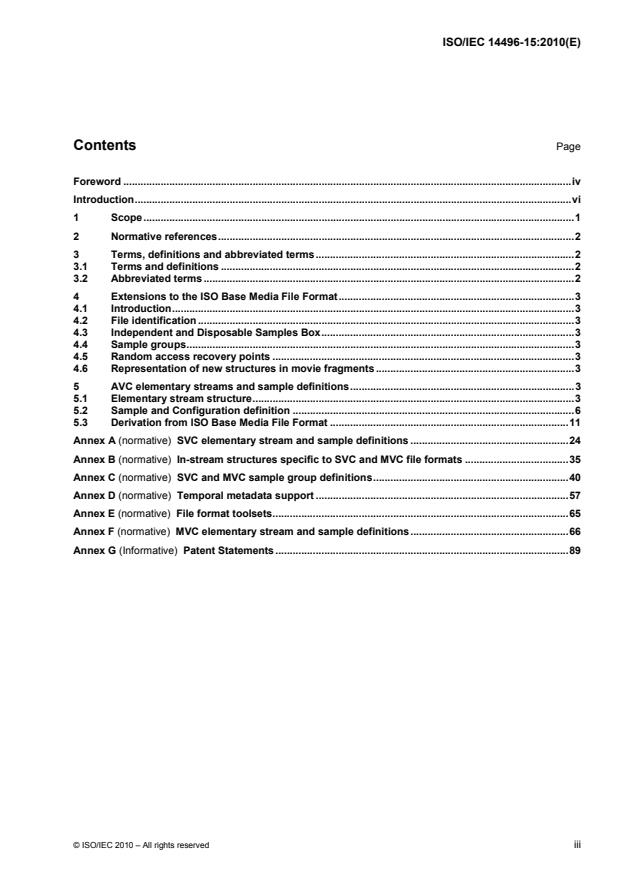
Contents Page
Foreword .iv
Introduction.vi
1 Scope.1
2 Normative references.2
3 Terms, definitions and abbreviated terms.2
3.1 Terms and definitions .2
3.2 Abbreviated terms .2
4 Extensions to the ISO Base Media File Format.3
4.1 Introduction.3
4.2 File identification .3
4.3 Independent and Disposable Samples Box.3
4.4 Sample groups.3
4.5 Random access recovery points .3
4.6 Representation of new structures in movie fragments .3
5 AVC elementary streams and sample definitions.3
5.1 Elementary stream structure.3
5.2 Sample and Configuration definition .6
5.3 Derivation from ISO Base Media File Format .11
Annex A (normative) SVC elementary stream and sample definitions .24
Annex B (normative) In-stream structures specific to SVC and MVC file formats .35
Annex C (normative) SVC and MVC sample group definitions.40
Annex D (normative) Temporal metadata support .57
Annex E (normative) File format toolsets.65
Annex F (normative) MVC elementary stream and sample definitions.66
Annex G (Informative) Patent Statements .89
© ISO/IEC 2010 – All rights reserved iii
Foreword
ISO (the International Organization for Standardization) and IEC (the International Electrotechnical
Commission) form the specialized system for worldwide standardization. National bodies that are members of
ISO or IEC participate in the development of International Standards through technical committees
established by the respective organization to deal with particular fields of technical activity. ISO and IEC
technical committees collaborate in fields of mutual interest. Other international organizations, governmental
and non-governmental, in liaison with ISO and IEC, also take part in the work. In the field of information
technology, ISO and IEC have established a joint technical committee, ISO/IEC JTC 1.
International Standards are drafted in accordance with the rules given in the ISO/IEC Directives, Part 2.
The main task of the joint technical committee is to prepare International Standards. Draft International
Standards adopted by the joint technical committee are circulated to national bodies for voting. Publication as
an International Standard requires approval by at least 75 % of the national bodies casting a vote.
ISO/IEC 14496-15 was prepared by Joint Technical Committee ISO/IEC JTC 1, Information technology,
Subcommittee SC 29, Coding of audio, picture, multimedia and hypermedia information.
This second edition cancels and replaces the first edition (ISO/IEC 14496-15:2004) which has been
technically revised. It also incorporates the Amendments ISO/IEC 14496-15:2004/Amd.1:2006,
ISO/IEC 14496-15:2004/Amd.2:2008, and the Technical Corrigenda ISO/IEC 14496-15:2004/Cor.1:2006,
ISO/IEC 14496-15;2004/Cor.2:2006 and ISO/IEC 14496-15:2004/Cor.3:2009.
ISO/IEC 14496 consists of the following parts, under the general title Information technology — Coding of
audio-visual objects:
⎯ Part 1: Systems
⎯ Part 2: Visual
⎯ Part 3: Audio
⎯ Part 4: Conformance testing
⎯ Part 5: Reference software
⎯ Part 6: Delivery Multimedia Integration Framework (DMIF)
⎯ Part 7: Optimized reference software for coding of audio-visual objects [Technical Report]
⎯ Part 8: Carriage of ISO/IEC 14496 contents over IP networks
⎯ Part 9: Reference hardware description [Technical Report]
⎯ Part 10: Advanced Video Coding
⎯ Part 11: Scene description and application engine
⎯ Part 12: ISO base media file format
⎯ Part 13: Intellectual Property Management and Protection (IPMP) extensions
iv © ISO/IEC 2010 – All rights reserved
⎯ Part 14: MP4 file format
⎯ Part 15: Advanced Video Coding (AVC) file format
⎯ Part 16: Animation Framework eXtension (AFX)
⎯ Part 17: Streaming text format
⎯ Part 18: Font compression and streaming
⎯ Part 19: Synthesized texture stream
⎯ Part 20: Lightweight Application Scene Representation (LASeR) and Simple Aggregation Format (SAF)
⎯ Part 21: MPEG-J Graphics Framework eXtension (GFX)
⎯ Part 22: Open Font Format
⎯ Part 23: Symbolic Music Representation
⎯ Part 24: Audio and systems interaction
⎯ Part 25: 3D Graphics Compression Model
⎯ Part 26: Audio conformance
⎯ Part 27: 3D Graphics conformance
© ISO/IEC 2010 – All rights reserved v
Introduction
The Advanced Video Coding (AVC) standard, jointly developed by the ITU-T and
ISO/IEC JTC 1/SC 29/WG 11 (MPEG), offers not only increased coding efficiency and enhanced robustness,
but also many features for the systems that use it. To enable the best visibility of, and access to, those
features, and to enhance the opportunities for the interchange and interoperability of media, this part of
ISO/IEC 14496 defines a storage format for video streams compressed using AVC.
This part of ISO/IEC 14496 defines a storage format based on, and compatible with, the ISO Base Media File
Format (ISO/IEC 14496-12 and ISO/IEC 15444-12), which is used by the MP4 file format (ISO/IEC 14496-14)
and the Motion JPEG 2000 file format (ISO/IEC 15444-3) among others. This part of ISO/IEC 14496 enables
AVC video streams to
⎯ be used in conjunction with other media streams, such as audio,
⎯ be used in an MPEG-4 systems environment, if desired,
⎯ be formatted for delivery by a streaming server, using hint tracks, and
⎯ inherit all the use cases and features of the ISO Base Media File Format on which MP4 and MJ2 are
based.
This part of ISO/IEC 14496 may be used as a standalone specification; it specifies how AVC content shall be
stored in an ISO Base Media File Format compliant format. However, it is normally used in the context of a
specification, such as the MP4 file format, derived from the ISO Base Media File Format, that permits the use
of AVC video.
The ISO Base Media File Format is becoming increasingly common as a general-purpose media container
format for the exchange of digital media, and its use in this context should accelerate both adoption and
interoperability.
Extensions to the ISO Base Media File Format are defined here to support the new systems aspects of the
AVC codec.
This International Standard defines the storage for plain AVC, SVC, and MVC video streams, where ‘plain
AVC’ refers to the main part of ISO/IEC 14496-10, excluding Annex G (Scalable Video Coding) and Annex H
(Multiview Video Coding); SVC refers to ISO/IEC 14496-10 when the techniques in Annex G (Scalable Video
Coding) are in use, and MVC refers to ISO/IEC 14496-10 when the techniques in Annex H (Multiview Video
Coding) are in use. Specific techniques are introduced for handling of scalable and multiview streams,
enabling their use, and assisting the extraction of subsets of scalable and multiview streams.
The International Organization for Standardization (ISO) and International Electrotechnical Commission (IEC)
draw attention to the fact that it is claimed that compliance with this document may involve the use of a patent.
The ISO and IEC take no position concerning the evidence, validity and scope of this patent right.
The holder of this patent right has assured the ISO and IEC that he is willing to negotiate licences under
reasonable and non-discriminatory terms and conditions with applicants throughout the world. In this respect,
the statement of the holder of this patent right is registered with the ISO and IEC. Information may be obtained
from the companies listed in Annex G.
Attention is drawn to the possibility that some of the elements of this document may be the subject of patent
rights other than those identified in Annex G. ISO and IEC shall not be held responsible for identifying any or
all such patent rights.
vi © ISO/IEC 2010 – All rights reserved
INTERNATIONAL STANDARD ISO/IEC 14496-15:2010(E)
Information technology — Coding of audio-visual objects —
Part 15:
Advanced Video Coding (AVC) file format
1 Scope
This part of ISO/IEC 14496 specifies the storage format for AVC (ISO/IEC 14496-10) video streams.
The storage of AVC content uses the existing capabilities of the ISO base media file format but also defines
extensions to support the following features of the AVC codec.
⎯ Switching pictures:
to enable switching between different coded streams and substitution of pictures within the same stream.
⎯ Sub-sequences and layers:
provides a structuring of the dependencies of a group of pictures to provide for a flexible stream structure
(e.g. in terms of temporal scalability and layering).
⎯ Parameter sets:
the sequence and picture parameter set mechanism decouples the transmission of infrequently changing
information from the transmission of coded macroblock data. Each slice containing the coded macroblock
data references the picture parameter set containing its decoding parameters. In turn, the picture
parameter set references a sequence parameter set that contains sequence level decoding parameter
information.
The file format for storage of SVC content, as defined in Annexes A to E, and the file format for storage of
MVC content, as defined in Annexes B to F, use the existing capabilities of the ISO base media file format and
the plain AVC file format (i.e. the file format specified in Clauses 2 to 5 not including SVC and MVC supports
specified in Annexes A to F). In addition, the following new extensions, among others, to support SVC- and/or
MVC-specific features are specified.
⎯ Scalable or multiview grouping:
a structuring and grouping mechanism to indicate the association of NAL units with different types and
hierarchy levels of scalability.
⎯ Aggregator:
a structure to enable efficient scalable grouping of NAL units by changing irregular patterns of NAL units
into regular patterns of aggregated data units.
⎯ Extractor:
a structure to enable efficient extraction of NAL units from other tracks than the one containing the media
data.
⎯ Temporal metadata statements:
structures for storing time-aligned information of media samples.
⎯ AVC compatibility:
a provision for storing an SVC or MVC bitstream in an AVC compatible manner, such that the AVC
compatible base layer can be used by any plain AVC file format compliant reader.
© ISO/IEC 2010 – All rights reserved 1
2 Normative references
The following referenced documents are indispensable for the application of this document. For dated
references, only the edition cited applies. For undated references, the latest edition of the referenced
document (including any amendments) applies.
ISO/IEC 14496-1:2001, Information technology — Coding of audio-visual objects — Part 1: Systems
ISO/IEC 14496-10, Information technology — Coding of audio-visual objects — Part 10: Advanced Video
Coding
ISO/IEC 14496-12, Information technology — Coding of audio-visual objects — Part 12: ISO base media file
1)
format
3 Terms, definitions and abbreviated terms
3.1 Terms and definitions
For the purposes of this document, the terms and definitions given in ISO/IEC 14496-10, this part of
ISO/IEC 14496, A.2, F.2 and the following apply.
3.1.1
parameter set
sequence parameter set or a picture parameter set, as defined in ISO/IEC 14496-10
NOTE This term is used to refer to both types of parameter sets.
3.1.2
parameter set elementary stream
elementary stream containing samples made up of only sequence and picture parameter set NAL units
synchronized with the video elementary stream
3.1.3
video elementary stream
elementary stream containing access units made up of NAL units for coded picture data
3.2 Abbreviated terms
AVC Advanced Video Coding. Where contrasted with SVC or MVC in this International Standard, this
term refers to the main part of ISO/IEC 14496-10, including neither Annex G (Scalable Video
Coding) nor Annex H (Multiview Video Coding)
FF File Format
HRD Hypothetical Reference Decoder
IDR Instantaneous Decoding Refresh
MVC MultiviewVideo Coding [refers to ISO/IEC 14496-10 when the techniques in Annex H (Multiview
Video Coding) are in use]
NAL Network Abstraction Layer
PPS Picture Parameter Set
1) ISO/IEC 14496-12 is technically identical to ISO/IEC 15444-12.
2 © ISO/IEC 2010 – All rights reserved
ROI Region-Of-Interest
SEI Supplementary Enhancement Information
SPS Sequence Parameter Set
SVC Scalable Video Coding [refers to ISO/IEC 14496-10 when the techniques in Annex G (Scalable
Video Coding) are in use]
VCL Video Coding Layer
4 Extensions to the ISO Base Media File Format
4.1 Introduction
The technologies originally documented in clause 4 are now defined in ISO/IEC 14496-12:2008 (technically
identical to ISO/IEC 15444-12:2008).
4.2 File identification
See subclause 6.3 in ISO/IEC 14496-12.
4.3 Independent and Disposable Samples Box
See subclause 8.6.4 in ISO/IEC 14496-12 for the definition of this box.
4.4 Sample groups
See subclause 8.9 in ISO/IEC 14496-12.
4.5 Random access recovery points
See subclause 10.1 in ISO/IEC 14496-12.
4.6 Representation of new structures in movie fragments
See subclause 8.9.4 in ISO/IEC 14496-12.
5 AVC elementary streams and sample definitions
This clause specifies the elementary stream and sample structure used to store AVC visual content.
5.1 Elementary stream structure
AVC specifies a set of Network Abstraction Layer (NAL) units, which contain different types of data. This
subclause specifies the format of the elementary streams for storing such AVC content. Two types of
elementary streams are defined for this purpose (see also Figure 1):
• Video Elementary Streams shall contain all video coding related NAL units (i.e. those NAL units
containing video data or signaling video structure) and may contain non-video coding related NAL units
such as SEI messages and access unit delimiter NAL units. Other NAL units that are not expressly
prohibited may be present, and if they are unrecognized should be ignored (e.g. not placed in the
output buffer while accessing the file).
© ISO/IEC 2010 – All rights reserved 3
• Parameter set elementary streams shall not contain video coding related NAL units (i.e. those NAL
units containing video data or signalling video structure), and would normally contain only sequence
parameter sets, picture parameter sets and sequence parameter set extension NAL units.
Using these stream types, AVC content shall be stored in either one or two elementary streams:
• Video elementary stream only: In this case, sequence and picture parameter set NAL units shall be
stored in the sample descriptions of this track. Sequence and picture parameter set NAL units shall not
be part of AVC samples within the stream itself.
• Video elementary stream and parameter set elementary stream: In this case, sequence and
picture parameter set NAL units shall be transmitted only in the parameter set elementary stream and
shall neither be present in the sample descriptions nor the AVC samples of the video elementary
stream.
The types of NAL units that are allowed in each of the video and parameter set elementary streams are
specified in Table 1.
4 © ISO/IEC 2010 – All rights reserved
Table 1 — NAL unit types in elementary streams
Value of Description Video elementary Parameter set
nal_unit_type stream elementary
stream
Unspecified Not specified by this part Not specified by
of ISO/IEC 14496 this part of
ISO/IEC 14496
1 Coded slice of a non-IDR picture Yes No
slice_layer_without_partitioning_rbsp( )
2 Coded slice data partition A Yes No
slice_data_partition_a_layer_rbsp( )
3 Coded slice data partition B Yes No
slice_data_partition_b_layer_rbsp( )
4 Coded slice data partition C Yes No
slice_data_partition_c_layer_rbsp( )
5 Coded slice of an IDR picture Yes No
slice_layer_without_partitioning_rbsp( )
6 Supplemental enhancement Yes. Only ‘declarative’
information(SEI) Except for the Sub- SEIs should be
sei_rbsp( ) sequence, layering or present
Filler SEI messages
7 Sequence parameter set (SPS) No. Yes
seq_parameter_set_rbsp( ) If parameter set
elementary stream is not
used, SPS shall be
stored in the Decoder
Specific Information.
8 Picture parameter set (PPS) No. Yes
pic_parameter_set_rbsp( ) If parameter set
elementary stream is not
used, PPS shall be
stored in the Decoder
Specific Information.
9 Access unit delimiter (AU Delimiter) Yes No
access_unit_delimiter_rbsp( )
10 End of sequence Yes No
end_of_seq_rbsp()
11 End of stream Yes No
end_of_stream_rbsp()
12 Filler data (FD) No No
filler_data_rbsp( )
13 Sequence parameter set extension No. Yes
seq_parameter_set_extension_rbsp( )
If parameter set
elementary stream is not
used, Sequence
Parameter Set Extension
shall be stored in the
Decoder Specific
Information.
14…18 Reserved Not specified by this part Not specified by
of ISO/IEC 14496 this part of
ISO/IEC 14496
19 Coded slice of an auxiliary coded picture Yes No
without partitioning
slice_layer_without_partitioning_rbsp( )
© ISO/IEC 2010 – All rights reserved 5
20…23 Reserved Not specified by this part Not specified by
of ISO/IEC 14496 this part of
ISO/IEC 14496
24 – 31 Unspecified Not specified by this part Not specified by
of ISO/IEC 14496 this part of
ISO/IEC 14496
AU Delimiter SEI Messages VCL
NAL unit NAL units NAL units.
(if present) (if present) e.g. Slice
Access Unit
(a) Single video elementary stream containing NAL units
Video
Slice Slice
NALU NALU
ES
Parameter
Param
NALU
Set ES
(b) Synchronized video and parameter sets with arrows denoting synchronization between streams
Figure 1 — AVC elementary stream structure
5.2 Sample and Configuration definition
5.2.1 Introduction
AVC sample: An AVC sample is an access unit as defined in ISO/IEC 14496-10, 7.4.1.2.
AVC parameter set sample: An AVC parameter set sample is a sample in a parameter set stream which shall
consist of those parameter set NAL units that are to be considered as if present in the video elementary
stream at the same instant in time.
5.2.2 Canonical order and restrictions
The AVC elementary stream is stored in the ISO Base Media File Format in a canonical format. The canonical
format is as neutral as possible so that systems that need to customize the stream for delivery over different
transport protocols — MPEG-2 Systems, RTP, and so on — should not have to remove information from the
stream while being free to add to the stream. Furthermore, a canonical format allows such operations to be
performed against a known initial state.
The canonical stream format is an AVC elementary stream that satisfies the following conditions:
• Video data NAL units (Coded Slice, Coded Slice Data Partition A, Coded Slice Data Partition B,
Coded Slice Data Partition C, Coded Slice IDR Pictures): All slice and data partition NAL units for a
single picture shall be contained with the sample whose decoding time and composition time are those
of the picture. Each AVC sample shall contain at least one video data NAL unit of the primary picture.
6 © ISO/IEC 2010 – All rights reserved
• SEI message NAL units: All SEI message NAL units shall be contained in the sample whose
decoding time is that before which the SEI messages come into effect instantaneously, or in the
parameter set arrays. The order of SEI messages within a sample is as defined in ISO/IEC 14496-10,
7.4.1.2. This means that the SEI messages for a picture shall be included in the sample containing that
picture and that SEI messages pertaining to a sequence of pictures shall be included in the sample
containing the first picture of the sequence to which the SEI message pertains.
• Access unit delimiter NAL units: The constraints obeyed by access unit delimiter NAL units are
defined in ISO/IEC 14496-10, 7.4.1.2.3.
• Parameter sets: If a parameter set elementary stream is used, then the sample in the parameter
stream shall have a decoding time equal or prior to when the parameter set(s) comes into effect
instantaneously. This means that for a parameter set to be used in a picture it must be sent prior to the
sample containing that picture or in the sample for that picture.
NOTE Parameter sets are stored either in the sample descriptions of the video stream or in the parameter set
stream, but never in both. This ensures that it is not necessary to examine every part of the video elementary
stream to find relevant parameter sets. It also avoids dependencies of indefinite duration between the sample that
contains the parameter set definition and the samples that use it. Storing parameter sets in the sample
descriptions of a video stream provides a simple and static way to supply parameter sets. Parameter set
elementary streams on the other hand are more complex but allow for more dynamism in the case of updates.
Parameter sets may be inserted into the video elementary stream when the file is streamed over a transport that
permits such parameter set updates.
• The sequence of NAL units in an elementary stream and within a single sample must be in a valid
decoding order for those NAL units as specified in ISO/IEC 14496-10.
• Parameter set track: A sync sample in a parameter set track indicates that all parameter sets needed
from that time forward in the video elementary stream are in that or succeeding parameter stream
samples. Also there shall be a parameter set sample at each point a parameter set is updated. Each
parameter set sample shall contain exactly the sequence and picture parameter sets needed to
decode the relevant section of the video elementary stream.
NOTE The use of a parameter set track in the file format does not require that a system delivering AVC content
use a separate elementary stream for parameter sets. Instead, implementations may choose to map parameter
sets to in-band parameter set NAL units in the video elementary stream or use some out-of-band delivery
mechanism defined by the transport layer.
• All timing information is external to stream. Picture Timing SEI messages that define presentation
or composition timestamps may be included in the AVC video elementary stream, as this message
contains other information than timing, and may be required for conformance checking. However, all
timing information is provided by the information stored in the various sample metadata tables, and this
information over-rides any timing provided in the AVC layer. Timing provided within the AVC stream in
this file format should be ignored as it may contradict the timing provided by the file format and may not
be correct or consistent within itself.
NOTE This constraint is imposed due to the fact that post-compression editing, combination, or re-timing of a
stream at the file format level may invalidate or make inconsistent any embedded timing information present within
the AVC stream.
• Sub-sequence and layering SEI messages. Sub-sequence or layering SEI messages shall not occur
in the AVC elementary stream. Specifically, the sub-sequence information, sub-sequence layer
characteristics, and sub-sequence characteristics SEI messages shall not occur in the stored AVC
video elementary stream. Instead, all such information is stored as external metadata as described in
5.3.12.
• Redundant picture: NAL units within a single access unit shall be ordered in non-decreasing order of
redundant picture count (redundant_pic_cnt).
© ISO/IEC 2010 – All rights reserved 7
• Slice groups: NAL units within a primary coded picture or a redundant coded picture shall be ordered
in non-decreasing order of slice group identifier. Within the same slice group, slices shall be ordered by
their first Macroblock location (first_mb_in_slice in the slice header).
NOTE Slice groups are stored in a canonical order to ease hinting, and to make it easier to find a primary
picture within a sample.
• No start codes. The elementary streams shall not include start codes. As stored, each NAL unit is
preceded by a length field as specified in 5.2.3; this enables easy scanning of the sample’s NAL units.
Systems that wish to deliver, from this file format, a stream using start codes will need to reformat the
stream to insert those start codes.
• No filler data. Video data is naturally represented as variable bit rate in the file format and should be
filled for transmission if needed. Filler Data NAL units and Filler Data SEI messages shall not be
present in the file format stored stream.
NOTE The removal of Filler Data NAL units, start codes, zero_byte syntax elements, SEI messages or Filler
Data SEI messages may change the bit-stream characteristics with respect to conformance with the HRD when
operating the HRD in CBR mode as specified in ISO/IEC 14496-10, Annex C.
5.2.3 AVC sample structure definition
This subclause defines structure for the samples of AVC streams. Samples are externally framed and have a
size supplied by that external framing. An example of the structure of an AVC sample is depicted in Figure 2.
Access Slice Slice
Unit SEI NAL Unit NAL Unit
Delimiter NAL Unit (Primary (Redundant
NAL Unit Coded Coded Picture)
(if present)
(if present) Picture) (if present)
Figure 2 — The structure of an AVC sample
An AVC access unit is made up of a set of NAL units. Each NAL unit is represented with a:
• Length: Indicates the length in bytes of the following NAL unit. The length field can be configured to be
of 1, 2, or 4 bytes.
• NAL Unit: Contains the NAL unit data as specified in ISO/IEC 14496-10.
5.2.4 Decoder configuration information
This subclause specifies the decoder configuration information for ISO/IEC 14496-10 video content.
5.2.4.1 AVC decoder configuration record
This record contains the size of the length field used in each sample to indicate the length of its contained
NAL units as well as the initial parameter sets. This record is externally framed (its size must be supplied by
the structure which contains it).
This record contains a version field. This version of the specification defines version 1 of this record.
Incompatible changes to the record will be indicated by a change of version number. Readers must not
attempt to decode this record or the streams to which it applies if the version number is unrecognised.
Compatible extensions to this record will extend it and will not change the configuration version code. Readers
should be prepared to ignore unrecognised data beyond the definition of the data they understand (e.g. after
the parameter sets in this specification).
8 © ISO/IEC 2010 – All rights reserved
Length
Length
Length
Length
When used to provide the configuration of
• a parameter set elementary stream,
• a video elementary stream used in conjunction with a parameter set elementary stream,
the configuration record shall contain no sequence or picture parameter sets
(numOfSequenceParameterSets and numOfPictureParameterSets shall both have the value 0).
The values for AVCProfileIndication, AVCLevelIndication, and the flags which indicate profile compatibility
must be valid for all parameter sets of the stream described by this record. The level indication must indicate a
level of capability equal to or greater than the highest level indicated in the included parameter sets; each
profile compatibility flag may only be set if all the included parameter sets set that flag. The profile indication
must indicate a profile to which the entire stream conforms. If the sequence parameter sets are marked with
different profiles, and the relevant profile compatibility flags are all zero, then the stream may need
examination to determine which profile, if any, the stream conforms to. If the stream is not examined, or the
examination reveals that there is no profile to which the stream conforms, then the stream must be split into
two or more sub-streams with separate configuration records in which these rules can be met.
Explicit indication can be provided in the AVC Decoder Configuration Record about the chroma format and bit
depth used by the avc video elementary stream. The parameter ‘chroma_format_idc’ present in the
sequence parameter set in AVC specifies the chroma sampling relative to the luma sampling. Similarly the
parameters ‘bit_depth_luma_minus8’ and ‘bit_depth_chroma_minus8’ in the sequence parameter set
specify the bit depth of the samples of the luma and chroma arrays. The values of chroma_format_idc,
bit_depth_luma_minus8’ and ‘bit_depth_chroma_minus8’ must be identical in all sequence
parameter sets in a single AVC configuration record. If two sequences differ in any of these values, two
different AVC configuration records will be needed. If the two sequences differ in color space indications in
their VUI information, then two different configuration records are also required.
The array of sequence parameter sets, and the array of picture parameter sets, may contain SEI messages of
a ‘declarative’ nature, that is, those that provide information about the stream as a whole. An example of such
an SEI is a user-data SEI. Such SEIs may also be placed in a parameter set elementary stream. NAL unit
types that are reserved in ISO/IEC 14496-10 and in this specification may acquire a definition in future, and
readers should ignore NAL units with reserved values of NAL unit type when they are present in these arrays.
NOTE - this ‘tolerant’ behaviour is designed so that errors are not raised, allowing the possibility of backwards-compatible
extensions to these arrays in future specifications.
When Sequence Parameter Set Extension NAL units occur in this record in profiles other than those indicated
for the array specific to such NAL units (profile_idc not equal to any of 100, 110, 122, 144), they should be
placed in the Sequence Parameter Set Array.
© ISO/IEC 2010 – All rights reserved 9
5.2.4.1.1 Syntax
aligned(8) class AVCDecoderConfigurationRecord {
unsigned int(8) configurationVersion = 1;
unsigned int(8) AVCProfileIndication;
unsigned int(8) profile_compatibility;
unsigned int(8) AVCLevelIndication;
bit(6) reserved = ‘111111’b;
unsigned int(2) lengthSizeMinusOne;
bit(3) reserved = ‘111’b;
unsigned int(5) numOfSequenceParameterSets;
for (i=0; i< numOfSequenceParameterSets; i++) {
unsigned int(16) sequenceParameterSetLength ;
bit(8*sequenceParameterSetLength) sequenceParameterSetNALUnit;
}
unsigned int(8) numOfPictureParameterSets;
for (i=0; i< numOfPictureParameterSets; i++) {
unsigned int(16) pictureParameterSetLength;
bit(8*pictureParameterSetLength) pictureParameterSetNALUnit;
}
if( profile_idc == 100 || profile_idc == 110 ||
profile_idc == 122 || profile_idc == 144 )
{
bit(6) reserved = ‘111111’b;
unsigned int(2) chroma_format;
bit(5) reserved = ‘11111’b;
unsigned int(3) bit_depth_luma_minus8;
bit(5) reserved = ‘11111’b;
unsigned int(3) bit_depth_chroma_minus8;
unsigned int(8) numOfSequenceParameterSetExt;
for (i=0; i< numOfSequenceParameterSetExt; i++) {
unsigned int(16) sequenceParameterSetExtLength;
bit(8*sequenceParameterSetExtLength) sequenceParameterSetExtNALUnit;
}
}
}
5.2.4.1.2 Semantics
AVCProfileIndication contains the profile code as defined in ISO/IEC 14496-10.
profile_compatibility is a byte defined exactly the same as the byte which occurs between the
profile_IDC and level_IDC in a sequence parameter set (SPS), as defined in ISO/IEC 14496-10.
AVCLevelIndication contains the level code as defined in ISO/IEC 14496-10.
lengthSizeMinusOne indicates the length in bytes of the NALUnitLength field in an AVC video
sample or AVC parameter set sample of the associated stream minus one. For example, a size of one
byte is indicated with a value of 0. The value of this field shall be one of 0, 1, or 3 corresponding to a
length encoded with 1, 2, or 4 bytes, respectively.
numOfSequenceParameterSets indicates the number of SPSs that are used as the initial set of SPSs
for decoding the AVC elementary stream.
sequenceParameterSetLength indicates the length in bytes of the SPS NAL unit as defined in
ISO/IEC 14496-10.
sequenceParameterSetNALUnit contains a SPS NAL unit, as specified in ISO/IEC 14496-10. SPSs
shall occur in order of ascending parameter set identifier with gaps being allowed.
numOfPictureParameterSets indicates the number of picture parameter sets (PPSs) that are used
as the initial set of PPSs for decoding the AVC elementary stream.
pictureParameterSetLength indicates the length in bytes of the PPS NAL unit as defined in
ISO/IEC 14496-10.
10 © ISO/IEC 2010 – All rights reserved
pictureParameterSetNALUnit contains a PPS NAL unit, as specified in ISO/IEC 14496-10. PPSs
shall occur in order of ascending parameter set identifier with gaps being allowed.
chroma_format contains the chroma_format indicator as defined by the chroma_format_idc parameter
in ISO/IEC 14496-10.
bit_depth_luma_minus8 indicates the bit depth of the samples in the Luma arrays. For example, a bit
depth of 8 is indicated with a value of zero (BitDepth = 8 + bit_depth_luma_minus8). The value of this
field shall be in the range of 0 to 4, inclusive.
bit_depth_chroma_minus8 indicates the bit depth of the samples in the Chroma arrays. For example,
a bit depth of 8 is indicated with a value of zero (BitDepth = 8 + bit_depth_luma_minus8). The value of
this field shall be in the range of 0 to 4, inclusive.
numOfSequenceParameterSetExt indicates the number of Sequence Parameter Set Extensions that
are used for decoding the AVC elementary stream.
sequenceParameterSetExtLength indicates the length in bytes of the SPS Extension NAL unit as
defined in ISO/IEC 14496-10.
sequenceParameterSetExtNALUnit contains a SPS Extension NAL unit, as specified in
ISO/IEC 14496-10.
5.3 Derivation from ISO Base Media File Format
5.3.1 Introduction
This subclause defines how the plain AVC file format is derived from the ISO Base Media File Format
[ISO/IEC 14496-12].
Table 2 summarizes the correspondences between the sets of terminology used in AVC Video and the ISO
Base Media File Format.
Table 2 — Correspondence of terms in AVC and ISO Base Media File Format
AVC ISO Base Media File Format
- Movie
Stream Track
Access Unit Sample
5.3.2 AVC File type and identification
Conformance with this part of ISO/IEC 14496 is indicated by the presence of the brand of a specification that
permits the inclusion of AVC content, in the compatible brands list of the FileTypeBox as defined in
ISO/IEC 14496-12. The file extension normally matches the major brand.
AVC content may be used in an MPEG-4 context. If the extensions documented in Clause 4 are not used or
their support is not required in the decoder, then the brands ‘mp41’ or ‘mp42’ may be used. If the extensions
are required, then the brand ‘avc1’ should be used. In this case, in a file with extension “.mp4”, the major
brand may be ‘avc1’.
Readers conformant to this part of ISO/IEC 14496 should read the file if a suitable brand occurs in the
compatible-brands list. Other structures and/or track types, defined in specifications other than that identified
by the brand, may be present, and these may be ignored by a reader conformant with the specification
identified by the brand.
© ISO/IEC 2010 – All rights reserved 11
5.3.3 AVC Track Structure
In the terminology of ISO/IEC 14496-12, AVC tracks (both video and parameter set tracks) are video or visual
tracks. They therefore use:
a) a handler_type of ‘vide’ in the HandlerBox;
b) a video media header ‘vmhd’;
c) and, as defined below, a derivative of the VisualSampleEntry.
A video stream is represented by one or more video tracks in a file.
If there is more than one track representing scalable aspects of a single stream, then they form alternatives to
each other, and the field ‘alternate_group’ should be used, or the composition system used should select
one of them, as appropriate. See 8.10.3 “Track Selection Box” of ISO/IEC 14496-12 for informative labelling of
why tracks are members of alternate groups.
5.3.4 AVC Video Stream Definition
This subclause defines the sample entry and sample format for AVC video elementary streams.
5.3.4.1 Sample description name and format
5.3.4.1.1 Definition
Box Types: ‘avc1’, ‘avc2’, ‘avcC’, ‘m4ds’,’btrt’
Container: Sample Table Box (‘stbl’)
Mandatory: An ‘avc1’ or ‘avc2’ sample entry is mandatory
Quantity: One or more sample entries may be present
An AVC visual sample entry shall contain an AVC Configuration Box, as defined below. This includes an
AVCDecoderConfigurationRecord, as defined in 5.2.4.1.
An optional MPEG4BitRateBox may be present in the AVC visual sample entry to signal the bit rate
information of the AVC video stream. Extension descriptors that should be inserted into the Elementary
Stream Descriptor, when used in MPEG-4, may also be present.
Multiple sample descriptions may be used, as permitted by the ISO Base Media File Format specification, to
indicate sections of video that use different configurations or parameter sets.
The sample entry name ‘avc1’ may only be used when the entire stream is a compliant and usable AVC
stream as viewed by an AVC decoder operating under the configuration (including profile and level) given in
the AVCConfigurationBox. The file format specific structures that resemble NAL units (see Annex B) may be
present but must not be used to access the AVC base data; that is, the AVC data must not be contained in
Aggregators (though they may be included within the bytes referenced by the additional_bytes field) nor
referenced by Extractors.
The sample entry name ‘avc2’ may only be used when Extractors or Aggregators (Annex B) are required to be
supported, and an appropriate Toolset is required (for example, as indicated by the file-type brands). This
sample entry type indicates that, in order to form the intended AVC stream, Extractors must be replaced with
the data they are referencing, and Aggregators must be examined for contained NAL Units. Tier grouping may
be present.
12 © ISO/IEC 2010 – All rights reserved
5.3.4.1.2 Syntax
// Visual Sequences
class AVCConfigurationBox extends Box(‘avcC’) {
AVCDecoderConfigurationRecord() AVCConfig;
}
class MPEG4BitRateBox extends Box(‘btrt’){
unsigned int(32) bufferSizeDB;
unsigned int(32) maxBitrate;
unsigned int(32) avgBitrate;
}
class MPEG4ExtensionDescriptorsBox extends Box(‘m4ds’) {
Descriptor Descr[0 . 255];
}
class AVCSampleEntry() extends VisualSampleEntry (‘avc1’){
AVCConfigurationBox config;
MPEG4BitRateBox (); // optional
MPEG4ExtensionDescriptorsBox (); // optional
}
class AVC2SampleEntry() extends VisualSampleEntry (‘avc2’){
AVCConfigurationBox avcconfig;
MPEG4BitRateBox bitrate; // optional
MPEG4ExtensionDescriptorsBox descr; // optional
extra_boxes boxes; // optional
}
5.3.4.1.3 Semantics
Compressorname in the base class VisualSampleEntry indicates the name of the compressor used
with the value "\012AVC Coding" being recommended (\012 is 10, the length of the string as a
b
...
Questions, Comments and Discussion
Ask us and Technical Secretary will try to provide an answer. You can facilitate discussion about the standard in here.
Loading comments...