

ISO/FDIS 24881
(Main)Textiles — Synthetic monofilament yarns — Test method for bending resistance properties
- Abstract
This document specifies a test method for bending resistance properties of monofilament yarns. This document is applicable to monofilament yarns with equivalent diameter from 0,030 mm to 0,200 mm. Other types of synthetic monofilament yarns may refer to this document as well.
- Status
- Not Published
- Technical Committee
- ISO/TC 38/SC 23 - Fibres and yarns
- Drafting Committee
- ISO/TC 38/SC 23/WG 6 - Fibres - Man-made
- Current Stage
- 5000 - Final text received or FDIS registered for formal approval - 50 Approval
- Start Date
- 16-Oct-2026
- Due Date
- 19-Feb-2028
- Completion Date
- 19-Feb-2028
Buy Documents
ISO/FDIS 24881 - Textiles — Synthetic monofilament yarns — Test method for bending resistance properties
REDLINE ISO/FDIS 24881 - Textiles — Synthetic monofilament yarns — Test method for bending resistance properties
ISO/FDIS 24881 is an ISO standard for synthetic monofilament yarns, published by ISO. It specifies a test method for bending resistance properties of monofilament yarns with equivalent diameters from 0.030 mm to 0.200 mm, and it can also be used for other synthetic monofilament yarns. In practice, it gives laboratories, manufacturers, and buyers a common way to measure and compare how a monofilament bends under controlled conditions.
What does ISO/FDIS 24881 specify?
ISO/FDIS 24881 specifies a full test method for bending resistance properties, from specimen preparation through calculation and reporting. The document is organized into clauses 1 to 11, with one informative annex.
| Annex | What it covers |
|---|---|
| Annex A | Typical bending force/bending deformation curves, with example statistical analysis for 40D, 63D, and 80D polyester (PET) monofilaments |
The scope is limited to monofilament yarns in the stated equivalent diameter range, and the document also notes that other synthetic monofilament yarns may refer to it. That matters because the method is intended for controlled comparison of bending behavior, not for general tensile testing or unrelated textile properties.
What are the key requirements of ISO/FDIS 24881?
Principle and measured outputs
ISO/FDIS 24881 measures the force response when a monofilament yarn is pressed to bend under specified conditions. Clause 4 says the force sensor records the bending force and the bending force/bending deformation curve is then used to determine the main indicators.
In practice, the test does not stop at a single force value. It produces bending-resistance force, bending-resistance deformation, and bending work, so users can compare both the peak response and the deformation at that peak.
Apparatus and measurement quality
Clause 5 requires a bending force tester with force and deformation display or recording, an autographic recorder, and flat-faced clamps that prevent slipping or cutting. It also gives performance limits for force and displacement accuracy, and it allows a suitable universal testing machine (UTM) with a micro-force sensor if equivalent results are obtained.
The clause also specifies supporting items such as a skein winding reel, skein hanging stand, pre-tensioning weights, tweezers, and a flannelette board. In practice, this means the setup must hold fine monofilaments securely and measure very small forces without damaging the specimen.
Specimen preparation and atmosphere
Clause 6 requires conditioning and testing in the standard atmosphere of ISO 139. Clause 7.1 says linear density is determined in accordance with ISO 2060 if it is not already known, and it provides conversion between linear density and equivalent diameter.
Clause 7.2 to 7.4 describes how to reel the yarn into skeins, condition them, straighten them, and cut them into 50 mm sections. At least 50 filament sections are selected as test specimens unless the parties agree otherwise, which matters because the final result is based on a group of specimens rather than one sample.
Test conditions and procedure
Clause 8 sets the pretension, the constant rate of pressing, and the gauge length. The moving clamp presses at 5 mm/min, and the recommended gauge length is 5 mm, with 10 mm or other values allowed by agreement if the force range is exceeded.
Clause 9 says the specimen is mounted along the axis and centered in the clamps, then tested until the curve passes the peak and the bending force drops by 5%. This gives a repeatable stopping point tied to the behavior of the curve, not to a fixed time.
Calculation and reporting
Clause 10 defines how bending deformation is calculated and how bending-resistance force, bending-resistance deformation, and bending work are taken from the curve. It also requires arithmetic mean value, standard deviation, coefficient of variation (CV), and confidence interval half-width in accordance with ISO 3534-1.
Clause 11 lists the report items, including the document reference, sample identification, linear density and equivalent diameter, tester information, test conditions, results, deviations from the method, unusual features, and the test date. That makes the results traceable for quality records, supplier comparisons, and disputes.
What terms does ISO/FDIS 24881 define?
- Bending-resistance force - the maximum bending force reached when the test specimen is pressed to bend under the specified conditions.
- Bending deformation - the change in relative distance between the two clamping points during bending, expressed as a percentage of the initial length.
- Bending-resistance deformation - the bending deformation at the point where the bending-resistance force occurs.
- Bending work - the work needed to bend the specimen up to the bending-resistance deformation.
- Coefficient of variation (CV) - the relative spread statistic used in the final results to show how consistent the specimen set is.
- Universal testing machine (UTM) - a suitable alternative tester mentioned in the apparatus note, provided it gives equivalent results with a micro-force sensor.
Who uses ISO/FDIS 24881?
ISO/FDIS 24881 is used by textile laboratories, yarn and filament manufacturers, and quality control teams that need to measure bending resistance in a repeatable way. It is also relevant to buyers, specifiers, and test houses that compare supplier lots, verify product consistency, or document product performance for synthetic monofilament yarns.
Which standards are used with ISO/FDIS 24881?
- ISO 139 - provides the standard atmosphere for conditioning and testing.
- ISO 2060 - gives the skein method for determining linear density when the value is unknown.
- ISO 2076 - supplies generic names for man-made fibres used in the terminology.
- ISO 3534-1 - provides the statistical terms and symbols used for mean, standard deviation, CV, and confidence interval half-width.
- ISO 5079 - contributes the defined terms and definitions for individual fibres used in Clause 3.
What does the ISO/FDIS 24881 document contain?
The document contains the test principle, apparatus requirements, atmosphere requirements, specimen preparation steps, test conditions, procedure, calculation formulas, and test report content. It also includes formulas for converting linear density and equivalent diameter, calculating bending deformation, and calculating bending work.
Annex A provides a typical bending force/bending deformation curve and example statistical analyses for 40D, 63D, and 80D polyester (PET) monofilaments. Those examples show how the method presents results and how the curve is interpreted in practice.
Buy Documents
ISO/FDIS 24881 - Textiles — Synthetic monofilament yarns — Test method for bending resistance properties
REDLINE ISO/FDIS 24881 - Textiles — Synthetic monofilament yarns — Test method for bending resistance properties
Get Certified
Connect with accredited certification bodies for this standard

Control Union Certifications
Global certification for agriculture and sustainability.

Hohenstein Institut
Textile testing and certification.

Bureau Veritas Bangladesh
Bureau Veritas certification services in Bangladesh.
Sponsored listings
Frequently Asked Questions
ISO/FDIS 24881 is a draft published by the International Organization for Standardization (ISO). Its full title is "Textiles — Synthetic monofilament yarns — Test method for bending resistance properties". This standard covers: This document specifies a test method for bending resistance properties of monofilament yarns. This document is applicable to monofilament yarns with equivalent diameter from 0,030 mm to 0,200 mm. Other types of synthetic monofilament yarns may refer to this document as well.
This document specifies a test method for bending resistance properties of monofilament yarns. This document is applicable to monofilament yarns with equivalent diameter from 0,030 mm to 0,200 mm. Other types of synthetic monofilament yarns may refer to this document as well.
ISO/FDIS 24881 is classified under the following ICS (International Classification for Standards) categories: 59.080.20 - Yarns. The ICS classification helps identify the subject area and facilitates finding related standards.
ISO/FDIS 24881 is available in PDF format for immediate download after purchase. The document can be added to your cart and obtained through the secure checkout process. Digital delivery ensures instant access to the complete standard document.
Standards Content (Sample)
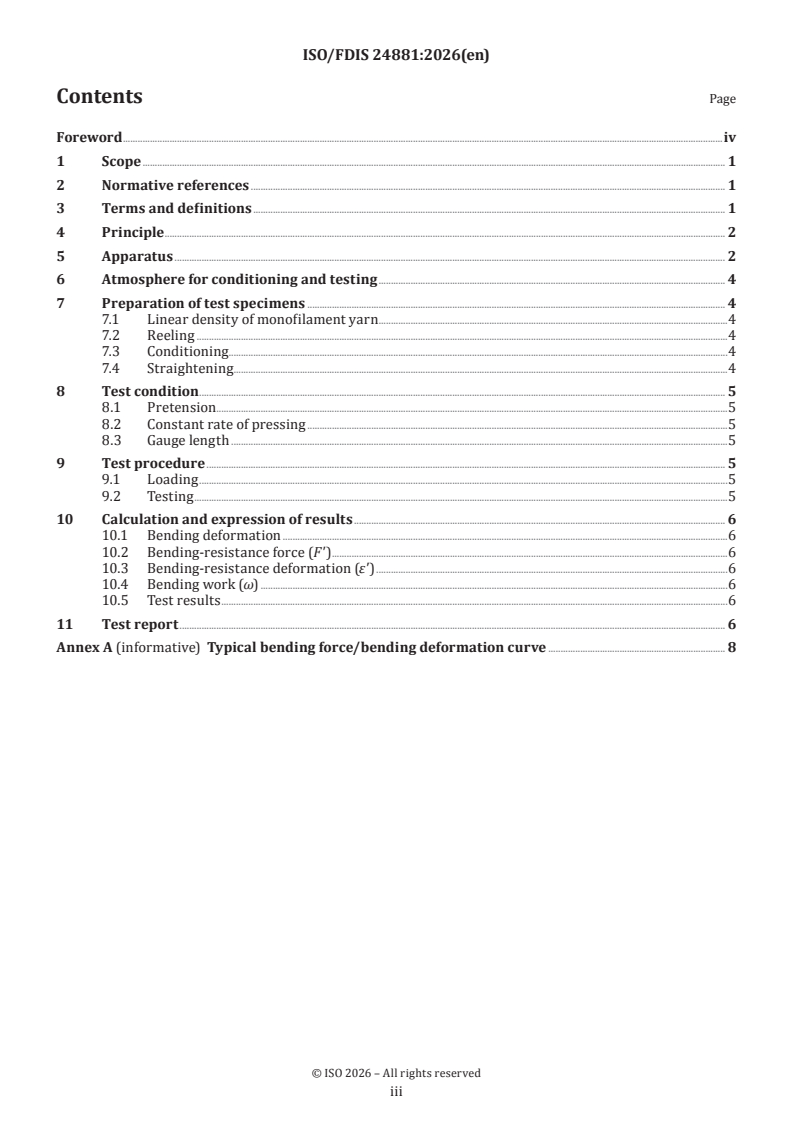
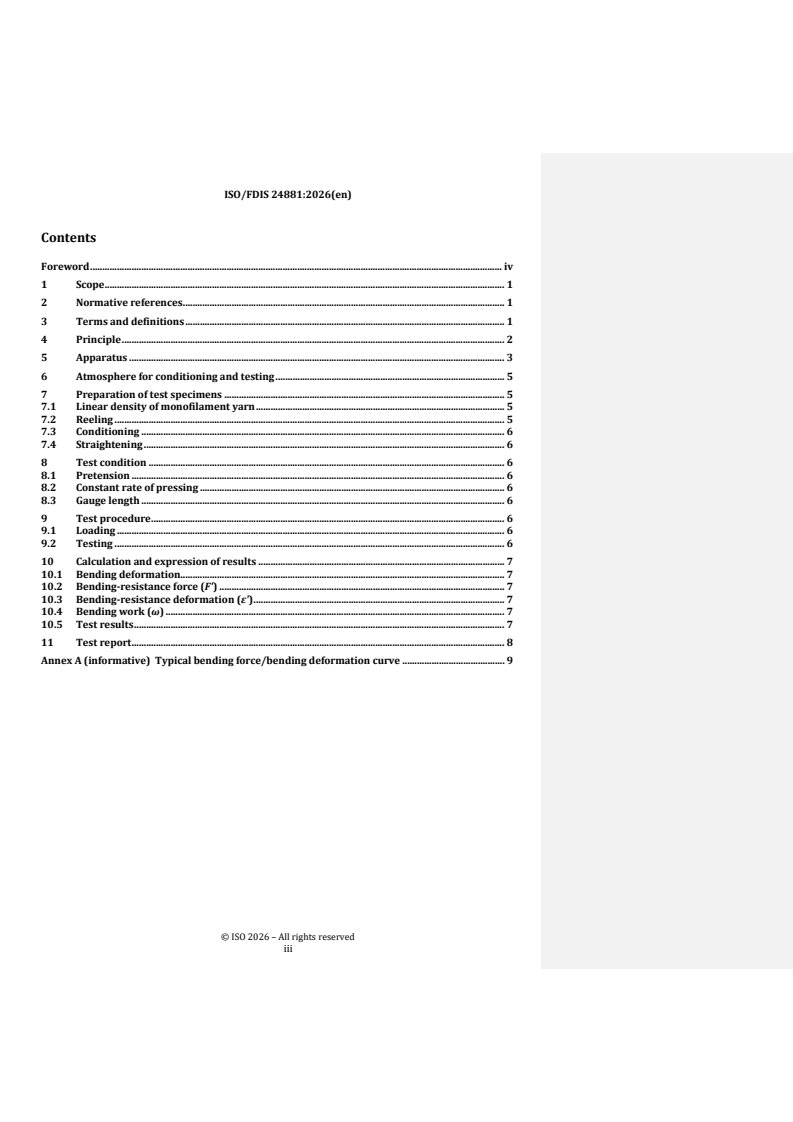
Contents
- 1 Scope
- 2 Normative references
- 3 Terms and definitions
- 3.1 bending-resistance force
- 3.2 bending deformation
- 3.3 bending-resistance deformation
- 3.4 bending work
- 4 Principle
- 5 Apparatus
- 6 Atmosphere for conditioning and testing
- 7 Preparation of test specimens
- 7.1 Linear density of monofilament yarn
- 7.2 Reeling
- 7.3 Conditioning
- 7.4 Straightening
- 8 Test condition
- 8.1 Pretension
- 8.2 Constant rate of pressing
- 8.3 Gauge length
- 9 Test procedure
- 9.1 Loading
- 9.2 Testing
- 10 Calculation and expression of results
- 10.1 Bending deformation
- 10.2 Bending-resistance force (F')
- 10.3 Bending-resistance deformation (ε')
- 10.4 Bending work (ω)
- 10.5 Test results
- 11 Test report
- Annex A
1 Scope
This document specifies a test method for bending resistance properties of monofilament yarns. This document is applicable to monofilament yarns with equivalent diameters from 0,030 mm to 0,200 mm. NOTE See 7.1 for the conversion of the equivalent diameter of monofilament yarn into the corresponding linear density.
2 Normative references
The following documents are referred to in the text in such a way that some or all of their content constitutes requirements of this document. For dated references, only the edition cited applies. For undated references, the latest edition of the referenced document (including any amendments) applies. ISO 139, Textiles — Standard atmospheres for conditioning and testing ISO 2060, Textiles — Yarn from packages — Determination of linear density (mass per unit length) by the skein method ISO 2076, Textiles — Man-made fibres — Generic names ISO 3534-1, Statistics — Vocabulary and symbols — Part 1: General statistical terms and terms used in probability ISO 5079, Textile fibres — Determination of breaking force and elongation at break of individual fibres
3 Terms and definitions
For the purposes of this document, the terms and definitions given in ISO 2076, ISO 5079 and the following apply.
ISO and IEC maintain terminology databases for use in standardization at the following addresses:
- ISO Online browsing platform: available at http:// www .iso .org/ obp/ ui
- IEC Electropedia: available at http:// www .electropedia .org/
3.1 bending-resistance force
maximum bending force occurs when the test specimen is pressed to bend under specified conditions
3.2 bending deformation
change of the relative distance between two clamping points of test specimen when it is pressed to bend Note 1 to entry: It is expressed as a percentage of the initial length.
3.3 bending-resistance deformation
bending deformation (3.2) corresponding to the bending-resistance force (3.1)
ISO/FDIS 24881:2026(en)
3.4 bending work
work required to bend test specimen up to bending-resistance deformation (3.3)
4 Principle
Under specified conditions, a monofilament yarn is pressed in axial direction to bend. During the bending of the monofilament yarn, the bending force occurring is collected by a force sensor. The bending-resistance force and other indicators are obtained from bending force/bending deformation curve to characterize bending resistance properties.
The schematic diagram of bending force/bending deformation curve is shown in Figure 1. Key Y bending force, expressed in mN X bending deformation, expressed as a percentage F' bending-resistance force, expressed in mN F dropped bending force by 5%, expressed in mN
ε' bending-resistance deformation, expressed as a percentage Figure 1 — Schematic diagram of bending force/bending deformation curve
5 Apparatus
5.1 Bending force tester, which shall be equipped with the following devices. a) A mechanism to display or record bending force occurring and corresponding bending deformation. b) An autographic recorder giving bending force/bending deformation curve. c) Suitable clamps for gripping test specimen at the required gauge length, a means for pressing the test specimen to bend by moving one of the clamps at constant rate. The clamps for gripping the specimens shall be flat-faced jaws and prevent slipping or cutting of the test specimens. The schematic diagram of the test specimen deformed by being pressed to bend is shown in Figure 2. Other suitable testing machine [e.g. universal testing machine (UTM)] equipped with a micro-force sensor may be used for the test provided that equivalent results are obtained. To achieve a proper gripping effect, the clamping jaws may be unlined, lined or silicone-coated.
ISO/FDIS 24881:2026(en) Key 1 upper clamp, connected to a force sensor 2 lower clamp, moveable 3 test specimen Figure 2 — Schematic diagram of the test specimen deformed by being pressed to bend The bending force tester shall meet the following requirements of accuracy:
d) minimum resolution of force measurement below 50 mN is 0,01 mN, respectively 0,1 mN for force of 50 mN and above; e) maximum error of recorded force value is ±1 %; f) maximum error of recorded displacement is ±0,02 mm; g) accuracy of gauge length is ±0,02 mm.
...
Contents
- 1 Scope
- 2 Normative references
- 3 Terms and definitions
- 3.1 bending-resistance force
- 3.2 bending deformation
- 3.3 bending-resistance deformation
- 3.4 bending work
- 4 Principle
- 5 Apparatus
- 5.1 Bending force tester
- 5.3 Skein winding reel
- 5.5 Skein hanging stand
- 6 Atmosphere for conditioning and testing
- 7 Preparation of test specimens
- 7.1 Linear density of monofilament yarn
- 7.2 Reeling
- 7.3 Conditioning
- 7.4 Straightening
- 8 Test condition
- 8.1 Pretension
- 8.2 Constant rate of pressing
- 8.3 Gauge length
- 9 Test procedure
- 9.1 Loading
- 9.2 Testing
- 10 Calculation and expression of results
- 10.1 Bending deformation
- 10.2 Bending-resistance force (F')
- 10.3 Bending-resistance deformation (ε')
- 10.4 Bending work (ω)
- 10.5 Test results
- 11 Test report
- Annex A
1 Scope
This document specifies a test method for bending resistance properties of monofilament yarns. This document is applicable to monofilament yarns with equivalent diameters from 0,030 mm to 0,200 mm. NOTE See 7.1 for the conversion of the equivalent diameter of monofilament yarn into the corresponding linear density.
2 Normative references
The following documents are referred to in the text in such a way that some or all of their content constitutes requirements of this document. For dated references, only the edition cited applies. For undated references, the latest edition of the referenced document (including any amendments) applies. ISO 139, Textiles — Standard atmospheres for conditioning and testing ISO 2060, Textiles — Yarn from packages — Determination of linear density (mass per unit length) by the skein method ISO 2076, Textiles — Man-made fibres — Generic names ISO 3534-1, Statistics — Vocabulary and symbols — Part 1: General statistical terms and terms used in probability ISO 5079, Textile fibres — Determination of breaking force and elongation at break of individual fibres
3 Terms and definitions
For the purposes of this document, the terms and definitions given in ISO 2076, ISO 5079 as well asand the following apply.
ISO and IEC maintain terminologicalterminology databases for use in standardization at the following addresses:
- IEC Electropedia: available at http://www.electropedia.org/ Field Code Changed
- ISO Online browsing platform: available at http://www.iso.org/obp/ui
- IEC Electropedia: available at http://www.electropedia.org/ Field Code Changed
3.1 bending-resistance force
maximum bending force occurs when the test specimen is pressed to bend under specified conditions
3.2 bending deformation
change of the relative distance between two clamping points of test specimen when it is pressed to bend Note 1 to entry: It is expressed as a percentage of the initial length.
ISO/FDIS 24881:2026(en)
3.3 bending-resistance deformation
bending deformation (3.2) corresponding to the bending-resistance force (3.1)
3.4 bending work
work required to bend test specimen up to bending-resistance deformation (3.3)
4 Principle
Under specified conditions, a monofilament yarn is pressed in axial direction to bend. During the bending of the monofilament yarn, the bending force occurring is collected by a force sensor. The bending-resistance force and other indicators are obtained from bending force/bending deformation curve to characterize bending resistance properties.
The schematic diagram of bending force/bending deformation curve is shown in Figure 1.
Key Y bending force, expressed in mN
ISO/FDIS 24881:2026(en) X bending deformation, expressed as a percentage F' bending-resistance force, expressed in mN F0 dropped bending force by 5% ,%, expressed in mN ε' bending-resistance deformation, expressed as a percentage Figure 1 — Schematic diagram of bending force/bending deformation curve
5 Apparatus
5.1 Bending force tester
5.25.1 It, which shall be equipped with the following devices. a) A mechanism to display or record bending force occurring and corresponding bending deformation. b) An autographic recorder giving bending force/bending deformation curve. c) Suitable clamps for gripping test specimen at the required gauge length, a means for pressing the test specimen to bend by moving one of the clamps at constant rate. The clamps for gripping the specimens shall be flat-faced jaws and prevent slipping or cutting of the test specimens. The schematic diagram of the test specimen deformed by being pressed to bend is shown in Figure 2. NOTE 1 Other suitable testing machine ([e.g. universal testing machine) (UTM)] equipped with a microforce sensor may be used for the test provided that equivalent results are obtained. NOTE 2 To achieve a proper gripping effect, the clamping jaws may be unlined, lined, or silicone-coated.
ISO/FDIS 24881:2026(en)
Key 1 upper clamp, connected to a force sensor 2 lower clamp, moveable 3 test specimen Figure 2 — Schematic diagram of the test specimen deformed by being pressed to bend ItThe bending force tester shall meet the following requirements of accuracy.:
d) minimum resolution of force measurement below 50 mN is 0,01 mN, respectively 0,1 mN for force of 50 mN and above.; e) maximum error of recorded force value is ±1 %.%; f) maximum error of recorded displacement is ±0,02 mm.; g) accuracy of gauge length is ±0,02 mm.
...