

ISO 18067:2015
(Main)Textiles — Synthetic filament yarns — Determination of shrinkage in dry-hot air (after treatment)
General Information
- Abstract
ISO 18067:2015 specifies methods for the determination of dry-hot air shrinkage (after treatment) of synthetic filament yarns, skein method and single-end method. The skein method provides two forms of measurement which are of manual and automatic types. The single-end method gives the result by manual measurement. In case of dispute, manual measurement procedure is to be used. If these methods are not applicable, the corresponding test methods may be agreed between interested parties. ISO 18067:2015 is applicable to synthetic filament yarns of linear density less than 3 000 dtex. ISO 18067:2015 is not applicable to partially oriented yarns.
- Status
- Published
- Publication Date
- 20-May-2015
- Technical Committee
- ISO/TC 38/SC 23 - Fibres and yarns
- Drafting Committee
- ISO/TC 38/SC 23/WG 6 - Fibres - Man-made
- Current Stage
- 9092 - International Standard to be revised
- Start Date
- 31-Oct-2024
- Completion Date
- 29-Aug-2026
Buy Documents


ISO 18067:2015 - Textiles -- Synthetic filament yarns -- Determination of shrinkage in dry-hot air (after treatment)
ISO 18067:2015 - Textiles — Synthetic filament yarns — Determination of shrinkage in dry-hot air (after treatment)/21/2015
Overview
ISO 18067:2015 - Textiles - Synthetic filament yarns - Determination of shrinkage in dry‑hot air (after treatment) specifies standardized methods to measure dry‑hot air shrinkage of synthetic filament yarns. It covers two principal test approaches: the skein method (manual and automatic measurement variants) and the single‑end method (manual measurement). The standard applies to synthetic filament yarns with nominal linear density less than 3 000 dtex and excludes partially oriented yarns. In disputes, the manual procedure is the reference method.
Key topics and requirements
- Test methods: Skein method A (manual), Skein method B (automatic), and Single‑end method (manual).
- Apparatus: specifications for skein winding reels, length‑measuring stands, automatic shrinkage testers (0.05 mm resolution), and a ventilated oven with controlled temperature (±3 °C) and internal height ≥ 600 mm.
- Specimen preparation: reeling procedure, knotting, and conditioning in a standard atmosphere (referenced ISO 139). Set skein linear densities (example table): ≤ 400 dtex → 2 500 dtex skein; > 400 to ~ 3 000 dtex → 10 000 dtex skein.
- Tension control: tension calculated from yarn linear density; typical tension per unit linear density: non‑textured yarns (0.05 ± 0.01 cN/dtex), textured yarns (0.20 ± 0.04 cN/dtex).
- Dry‑hot air treatment: temperature and time depend on fiber type (examples from the standard: polyester/polyamide 66 - 190 ± 3 °C, 15 ± 1 min; multifilament polyamide 6 - 170 ± 3 °C, 15 ± 1 min; polypropylene - 110 ± 3 °C, 15 ± 1 min).
- Sampling and number of specimens: requirements for lot and laboratory samples (minimums range from 10 to 20 specimens depending on lot size; arbitration procedures specify up to 60 specimens).
- Results: shrinkage expressed as percentage decrease in length before and after thermal treatment; procedures for measurement, equilibrium times, and reporting are specified.
Applications
- Quality control and acceptance testing for manufacturers and suppliers of synthetic filament yarns (polyester, polyamide, polypropylene).
- Textile testing laboratories verifying dimensional stability after heat treatment.
- Product development and R&D where yarn shrinkage affects downstream processes (texturizing, weaving, knitting, finishing).
- Procurement, compliance, and arbitration where standardized shrinkage data are required.
Related standards
- ISO 139 - Standard atmospheres for conditioning and testing (referenced for conditioning and moisture equilibrium).
Keywords: ISO 18067:2015, dry‑hot air shrinkage, synthetic filament yarns, skein method, single‑end method, textile testing, shrinkage test.
Relations
- Consolidated By
ISO 19496-1:2017 - Vitreous and porcelain enamels — Terminology — Part 1: Terms and definitions - Effective Date
- 06-Jun-2022
Buy Documents
ISO 18067:2015 - Textiles -- Synthetic filament yarns -- Determination of shrinkage in dry-hot air (after treatment)
ISO 18067:2015 - Textiles — Synthetic filament yarns — Determination of shrinkage in dry-hot air (after treatment)/21/2015
Get Certified
Connect with accredited certification bodies for this standard

Control Union Certifications
Global certification for agriculture and sustainability.

Hohenstein Institut
Textile testing and certification.

Bureau Veritas Bangladesh
Bureau Veritas certification services in Bangladesh.
Sponsored listings
Frequently Asked Questions
ISO 18067:2015 is a standard published by the International Organization for Standardization (ISO). Its full title is "Textiles — Synthetic filament yarns — Determination of shrinkage in dry-hot air (after treatment)". This standard covers: ISO 18067:2015 specifies methods for the determination of dry-hot air shrinkage (after treatment) of synthetic filament yarns, skein method and single-end method. The skein method provides two forms of measurement which are of manual and automatic types. The single-end method gives the result by manual measurement. In case of dispute, manual measurement procedure is to be used. If these methods are not applicable, the corresponding test methods may be agreed between interested parties. ISO 18067:2015 is applicable to synthetic filament yarns of linear density less than 3 000 dtex. ISO 18067:2015 is not applicable to partially oriented yarns.
ISO 18067:2015 specifies methods for the determination of dry-hot air shrinkage (after treatment) of synthetic filament yarns, skein method and single-end method. The skein method provides two forms of measurement which are of manual and automatic types. The single-end method gives the result by manual measurement. In case of dispute, manual measurement procedure is to be used. If these methods are not applicable, the corresponding test methods may be agreed between interested parties. ISO 18067:2015 is applicable to synthetic filament yarns of linear density less than 3 000 dtex. ISO 18067:2015 is not applicable to partially oriented yarns.
ISO 18067:2015 is classified under the following ICS (International Classification for Standards) categories: 59.080.20 - Yarns. The ICS classification helps identify the subject area and facilitates finding related standards.
ISO 18067:2015 has the following relationships with other standards: It is inter standard links to ISO 19496-1:2017. Understanding these relationships helps ensure you are using the most current and applicable version of the standard.
ISO 18067:2015 is available in PDF format for immediate download after purchase. The document can be added to your cart and obtained through the secure checkout process. Digital delivery ensures instant access to the complete standard document.
Standards Content (Sample)
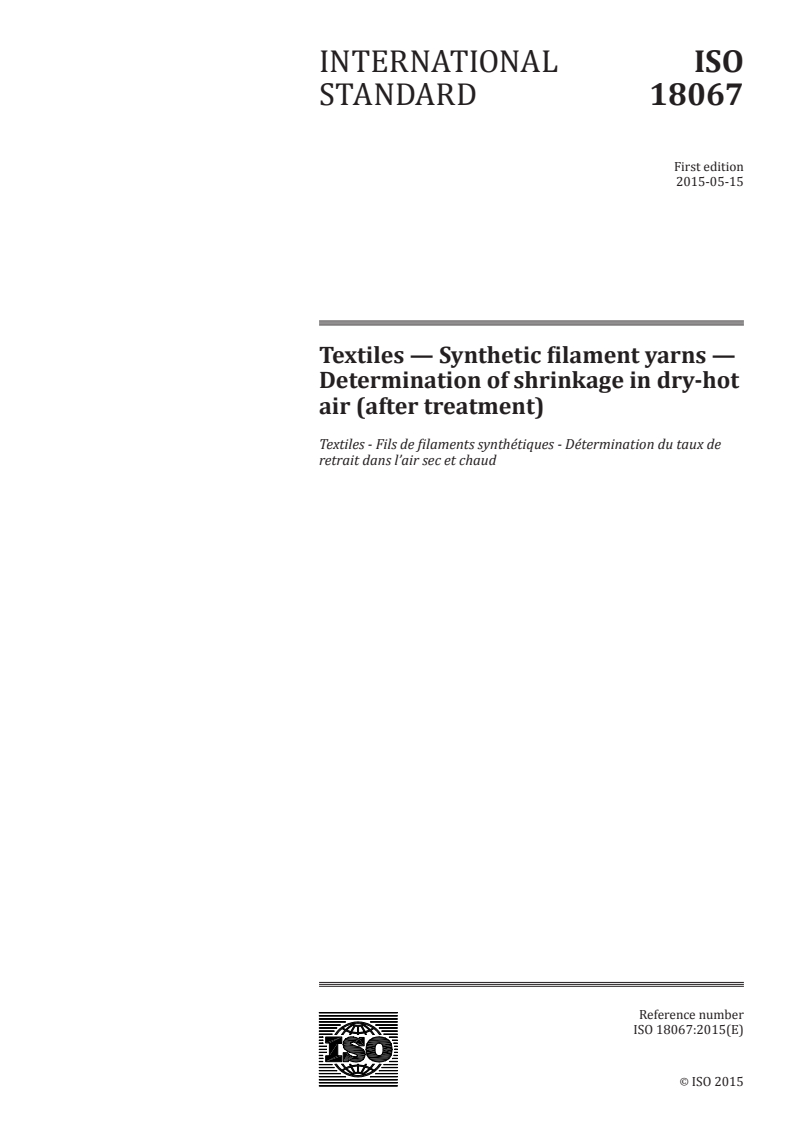
INTERNATIONAL ISO
STANDARD 18067
First edition
2015-05-15
Textiles — Synthetic filament yarns —
Determination of shrinkage in dry-hot
air (after treatment)
Textiles - Fils de filaments synthétiques - Détermination du taux de
retrait dans l’air sec et chaud
Reference number
©
ISO 2015
ISO 18067:2015(E)
COPYRIGHT PROTECTED DOCUMENT
© ISO 2015, Published in Switzerland
All rights reserved. Unless otherwise specified, no part of this publication may be reproduced or utilized otherwise in any form
or by any means, electronic or mechanical, including photocopying, or posting on the internet or an intranet, without prior
written permission. Permission can be requested from either ISO at the address below or ISO’s member body in the country of
the requester.
ISO copyright office
Ch. de Blandonnet 8 • CP 401
CH-1214 Vernier, Geneva, Switzerland
Tel. +41 22 749 01 11
Fax +41 22 749 09 47
copyright@iso.org
www.iso.org
ii © ISO 2015 – All rights reserved
ISO 18067:2015(E)
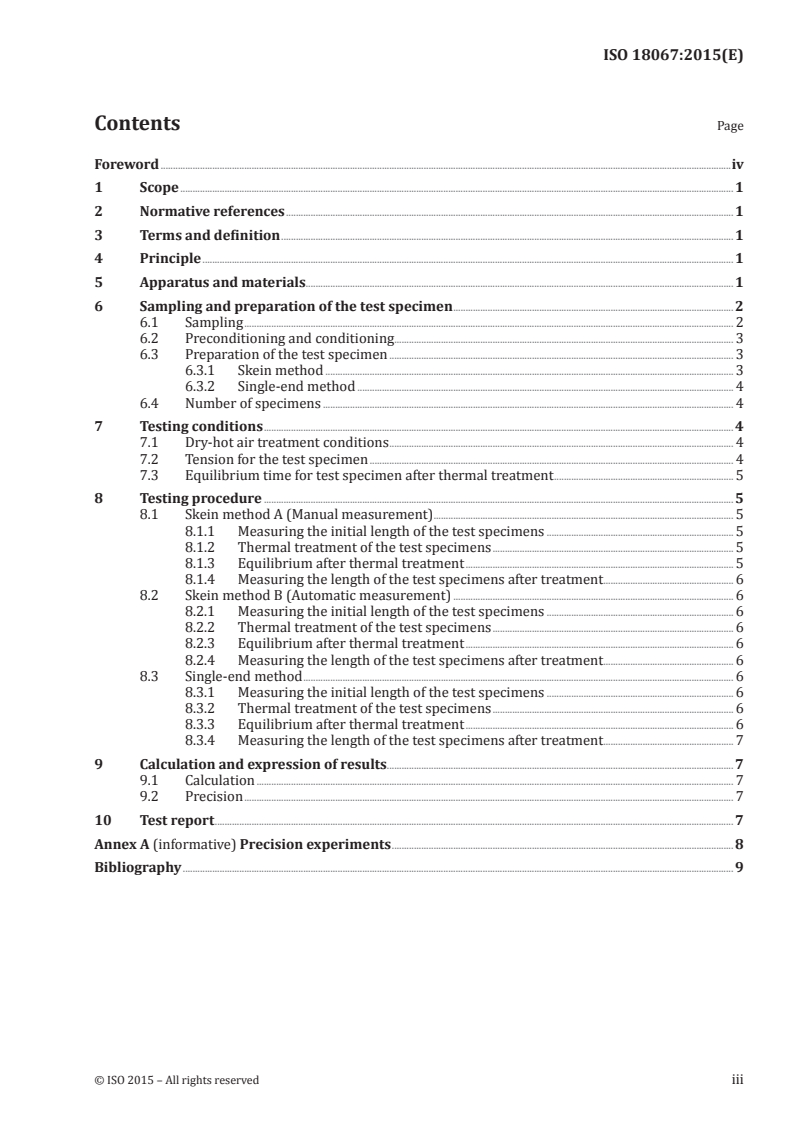
Contents Page
Foreword .iv
1 Scope . 1
2 Normative references . 1
3 Terms and definition . 1
4 Principle . 1
5 Apparatus and materials. 1
6 Sampling and preparation of the test specimen . 2
6.1 Sampling . 2
6.2 Preconditioning and conditioning. 3
6.3 Preparation of the test specimen . 3
6.3.1 Skein method . 3
6.3.2 Single-end method . 4
6.4 Number of specimens . 4
7 Testing conditions . 4
7.1 Dry-hot air treatment conditions . 4
7.2 Tension for the test specimen . 4
7.3 Equilibrium time for test specimen after thermal treatment . 5
8 Testing procedure . 5
8.1 Skein method A (Manual measurement) . 5
8.1.1 Measuring the initial length of the test specimens . 5
8.1.2 Thermal treatment of the test specimens . 5
8.1.3 Equilibrium after thermal treatment . 5
8.1.4 Measuring the length of the test specimens after treatment. 6
8.2 Skein method B (Automatic measurement) . 6
8.2.1 Measuring the initial length of the test specimens . 6
8.2.2 Thermal treatment of the test specimens . 6
8.2.3 Equilibrium after thermal treatment . 6
8.2.4 Measuring the length of the test specimens after treatment. 6
8.3 Single-end method . 6
8.3.1 Measuring the initial length of the test specimens . 6
8.3.2 Thermal treatment of the test specimens . 6
8.3.3 Equilibrium after thermal treatment . 6
8.3.4 Measuring the length of the test specimens after treatment. 7
9 Calculation and expression of results . 7
9.1 Calculation . 7
9.2 Precision . 7
10 Test report . 7
Annex A (informative) Precision experiments . 8
Bibliography . 9
ISO 18067:2015(E)
Foreword
ISO (the International Organization for Standardization) is a worldwide federation of national standards
bodies (ISO member bodies). The work of preparing International Standards is normally carried out
through ISO technical committees. Each member body interested in a subject for which a technical
committee has been established has the right to be represented on that committee. International
organizations, governmental and non-governmental, in liaison with ISO, also take part in the work.
ISO collaborates closely with the International Electrotechnical Commission (IEC) on all matters of
electrotechnical standardization.
The procedures used to develop this document and those intended for its further maintenance are
described in the ISO/IEC Directives, Part 1. In particular the different approval criteria needed for the
different types of ISO documents should be noted. This document was drafted in accordance with the
editorial rules of the ISO/IEC Directives, Part 2 (see www.iso.org/directives).
Attention is drawn to the possibility that some of the elements of this document may be the subject of
patent rights. ISO shall not be held responsible for identifying any or all such patent rights. Details of any
patent rights identified during the development of the document will be in the Introduction and/or on
the ISO list of patent declarations received (see www.iso.org/patents).
Any trade name used in this document is information given for the convenience of users and does not
constitute an endorsement.
For an explanation on the meaning of ISO specific terms and expressions related to conformity
assessment, as well as information about ISO’s adherence to the WTO principles in the Technical Barriers
to Trade (TBT), see the following URL: Foreword — Supplementary information.
The committee responsible for this document is ISO/TC 38, Textiles, Subcommittee SC 23, Fibres and yarns.
iv © ISO 2015 – All rights reserved
INTERNATIONAL STANDARD ISO 18067:2015(E)
Textiles — Synthetic filament yarns — Determination of
shrinkage in dry-hot air (after treatment)
1 Scope
This International Standard specifies methods for the determination of dry-hot air shrinkage (after
treatment) of synthetic filament yarns, skein method and single-end method. The skein method provides
two forms of measurement which are of manual and automatic types. The single-end method gives the
result by manual measurement.
In case of dispute, manual measurement procedure is to be used.
If these methods are not applicable, the corresponding test methods may be agreed between
interested parties.
This International Standard is applicable to synthetic filament yarns of linear density less than 3 000 dtex.
This International Standard is not applicable to partially oriented yarns.
2 Normative references
The following documents, in whole or in part, are normatively referenced in this document and are
indispensable for its application. For dated references, only the edition cited applies. For undated
references, the latest edition of the referenced document (including any amendments) applies.
ISO 139, Textiles — Standard atmospheres for conditioning and testing
3 Terms and definition
For the purposes of this document, the following terms and definitions apply.
3.1
shrinkage in dry-hot air (after treatment)
decrease in length of a specimen as a result of thermal treatment in dry-hot air, expressed as a percentage
of its original length, which measured under tension before and after treatment
4 Principle
Under specific condition, a test specimen is treated in dry-hot air. Shrinkage is calculated as variation in
length, measured before and after treatment.
5 Apparatus and materials
5.1 Skein winding reel, which meets the following requirements:
a) 1 000 ± 2,5 mm reel circumference, driven either automatically or manually;
b) a traversing mechanism to avert overlapping when several skeins are wound at the same time;
c) a tensioning device to maintain tension within the recommended limits, accurate to within ± 10 %;
d) a device to count reel revolutions, preferably capable to stop winding automatically and warn when
nearing the specified number of reel revolutions;
ISO 18067:2015(E)
e) a mechanism to reduce the reel circumference for easy removal of the skein.
5.2 Length-measuring stand, which meets the following requirements:
a) a stand for measuring specimen length of least 1 mm gauge length;
b) a millimetre scale to determine specimen length, accurate to within ±1 mm;
c) a steel hook or a clamp, where the top of the hook or the lower side of the clamp (where the specimen
hung from) is positioned in line with the zero index of the scale;
d) tensioning weights with hooks or clamps for applying tensile force to specimens, accurate to
within ±10 %.
5.3 Automatic shrinkage tester, which meets the following requirements:
a) automatically applies specified tension, measures specimen length, and calculates the shrinkage
based on length values;
b) 0,05 mm resolution of length measurement;.
c) a specimen holder for suspending specimens more than 600 mm high, which can consistently hold
2,5 cN load per skein for the duration of the testing procedure with several skeins arranged and
tested in succession.
NOTE Other mechanical devices may be used for the test provided that equivalent results are obtained.
5.4 Ventilated oven, which meets the following requirements:
a) a holder for suspending spec
...
INTERNATIONAL ISO
STANDARD 18067
First edition
2015-05-15
Textiles — Synthetic filament yarns —
Determination of shrinkage in dry-hot
air (after treatment)
Textiles - Fils de filaments synthétiques - Détermination du taux de
retrait dans l’air sec et chaud
Reference number
©
ISO 2015
ISO 18067:2015(E)
COPYRIGHT PROTECTED DOCUMENT
© ISO 2015, Published in Switzerland
All rights reserved. Unless otherwise specified, no part of this publication may be reproduced or utilized otherwise in any form
or by any means, electronic or mechanical, including photocopying, or posting on the internet or an intranet, without prior
written permission. Permission can be requested from either ISO at the address below or ISO’s member body in the country of
the requester.
ISO copyright office
Ch. de Blandonnet 8 • CP 401
CH-1214 Vernier, Geneva, Switzerland
Tel. +41 22 749 01 11
Fax +41 22 749 09 47
copyright@iso.org
www.iso.org
ii © ISO 2015 – All rights reserved
ISO 18067:2015(E)
Contents Page
Foreword .iv
1 Scope . 1
2 Normative references . 1
3 Terms and definition . 1
4 Principle . 1
5 Apparatus and materials. 1
6 Sampling and preparation of the test specimen . 2
6.1 Sampling . 2
6.2 Preconditioning and conditioning. 3
6.3 Preparation of the test specimen . 3
6.3.1 Skein method . 3
6.3.2 Single-end method . 4
6.4 Number of specimens . 4
7 Testing conditions . 4
7.1 Dry-hot air treatment conditions . 4
7.2 Tension for the test specimen . 4
7.3 Equilibrium time for test specimen after thermal treatment . 5
8 Testing procedure . 5
8.1 Skein method A (Manual measurement) . 5
8.1.1 Measuring the initial length of the test specimens . 5
8.1.2 Thermal treatment of the test specimens . 5
8.1.3 Equilibrium after thermal treatment . 5
8.1.4 Measuring the length of the test specimens after treatment. 6
8.2 Skein method B (Automatic measurement) . 6
8.2.1 Measuring the initial length of the test specimens . 6
8.2.2 Thermal treatment of the test specimens . 6
8.2.3 Equilibrium after thermal treatment . 6
8.2.4 Measuring the length of the test specimens after treatment. 6
8.3 Single-end method . 6
8.3.1 Measuring the initial length of the test specimens . 6
8.3.2 Thermal treatment of the test specimens . 6
8.3.3 Equilibrium after thermal treatment . 6
8.3.4 Measuring the length of the test specimens after treatment. 7
9 Calculation and expression of results . 7
9.1 Calculation . 7
9.2 Precision . 7
10 Test report . 7
Annex A (informative) Precision experiments . 8
Bibliography . 9
ISO 18067:2015(E)
Foreword
ISO (the International Organization for Standardization) is a worldwide federation of national standards
bodies (ISO member bodies). The work of preparing International Standards is normally carried out
through ISO technical committees. Each member body interested in a subject for which a technical
committee has been established has the right to be represented on that committee. International
organizations, governmental and non-governmental, in liaison with ISO, also take part in the work.
ISO collaborates closely with the International Electrotechnical Commission (IEC) on all matters of
electrotechnical standardization.
The procedures used to develop this document and those intended for its further maintenance are
described in the ISO/IEC Directives, Part 1. In particular the different approval criteria needed for the
different types of ISO documents should be noted. This document was drafted in accordance with the
editorial rules of the ISO/IEC Directives, Part 2 (see www.iso.org/directives).
Attention is drawn to the possibility that some of the elements of this document may be the subject of
patent rights. ISO shall not be held responsible for identifying any or all such patent rights. Details of any
patent rights identified during the development of the document will be in the Introduction and/or on
the ISO list of patent declarations received (see www.iso.org/patents).
Any trade name used in this document is information given for the convenience of users and does not
constitute an endorsement.
For an explanation on the meaning of ISO specific terms and expressions related to conformity
assessment, as well as information about ISO’s adherence to the WTO principles in the Technical Barriers
to Trade (TBT), see the following URL: Foreword — Supplementary information.
The committee responsible for this document is ISO/TC 38, Textiles, Subcommittee SC 23, Fibres and yarns.
iv © ISO 2015 – All rights reserved
INTERNATIONAL STANDARD ISO 18067:2015(E)
Textiles — Synthetic filament yarns — Determination of
shrinkage in dry-hot air (after treatment)
1 Scope
This International Standard specifies methods for the determination of dry-hot air shrinkage (after
treatment) of synthetic filament yarns, skein method and single-end method. The skein method provides
two forms of measurement which are of manual and automatic types. The single-end method gives the
result by manual measurement.
In case of dispute, manual measurement procedure is to be used.
If these methods are not applicable, the corresponding test methods may be agreed between
interested parties.
This International Standard is applicable to synthetic filament yarns of linear density less than 3 000 dtex.
This International Standard is not applicable to partially oriented yarns.
2 Normative references
The following documents, in whole or in part, are normatively referenced in this document and are
indispensable for its application. For dated references, only the edition cited applies. For undated
references, the latest edition of the referenced document (including any amendments) applies.
ISO 139, Textiles — Standard atmospheres for conditioning and testing
3 Terms and definition
For the purposes of this document, the following terms and definitions apply.
3.1
shrinkage in dry-hot air (after treatment)
decrease in length of a specimen as a result of thermal treatment in dry-hot air, expressed as a percentage
of its original length, which measured under tension before and after treatment
4 Principle
Under specific condition, a test specimen is treated in dry-hot air. Shrinkage is calculated as variation in
length, measured before and after treatment.
5 Apparatus and materials
5.1 Skein winding reel, which meets the following requirements:
a) 1 000 ± 2,5 mm reel circumference, driven either automatically or manually;
b) a traversing mechanism to avert overlapping when several skeins are wound at the same time;
c) a tensioning device to maintain tension within the recommended limits, accurate to within ± 10 %;
d) a device to count reel revolutions, preferably capable to stop winding automatically and warn when
nearing the specified number of reel revolutions;
ISO 18067:2015(E)
e) a mechanism to reduce the reel circumference for easy removal of the skein.
5.2 Length-measuring stand, which meets the following requirements:
a) a stand for measuring specimen length of least 1 mm gauge length;
b) a millimetre scale to determine specimen length, accurate to within ±1 mm;
c) a steel hook or a clamp, where the top of the hook or the lower side of the clamp (where the specimen
hung from) is positioned in line with the zero index of the scale;
d) tensioning weights with hooks or clamps for applying tensile force to specimens, accurate to
within ±10 %.
5.3 Automatic shrinkage tester, which meets the following requirements:
a) automatically applies specified tension, measures specimen length, and calculates the shrinkage
based on length values;
b) 0,05 mm resolution of length measurement;.
c) a specimen holder for suspending specimens more than 600 mm high, which can consistently hold
2,5 cN load per skein for the duration of the testing procedure with several skeins arranged and
tested in succession.
NOTE Other mechanical devices may be used for the test provided that equivalent results are obtained.
5.4 Ventilated oven, which meets the following requirements:
a) a holder for suspending spec
...