


ISO 6344-3:2013
(Main)Coated abrasives — Grain size analysis — Part 3: Determination of grain size distribution of microgrits P240 to P2500
Coated abrasives — Grain size analysis — Part 3: Determination of grain size distribution of microgrits P240 to P2500
ISO 6344:2013 specifies a method for determining or testing the grain size distribution of electro-fused aluminium oxide and silicon carbide microgrits P240 to P2500 for coated abrasives as defined in ISO 6344-1. It applies both to those grits used in the manufacture of coated abrasive products and to those grits taken from products for testing purposes.
Abrasifs appliqués — Granulométrie — Partie 3: Détermination de la distribution granulométrique des micrograins P240 à P2500
L'ISO 6344-3:2013 spécifie une méthode de détermination ou de contrôle de la distribution granulométrique des micrograins P240 à P2500 en oxyde d'aluminium fondu et en carbure de silicium pour abrasifs appliqués comme défini dans l'ISO 6344-1. Elle est applicable tant aux grains utilisés pour la fabrication des produits abrasifs appliqués qu'aux grains extraits de ces produits pour les contrôler.
General Information
- Status
- Withdrawn
- Publication Date
- 07-May-2013
- Withdrawal Date
- 07-May-2013
- Technical Committee
- ISO/TC 29/SC 5 - Grinding wheels and abrasives
- Drafting Committee
- ISO/TC 29/SC 5/WG 7 - Grain characteristics
- Current Stage
- 9599 - Withdrawal of International Standard
- Start Date
- 30-Nov-2021
- Completion Date
- 12-Feb-2026
Relations
- Referred By
EN 15947-4:2015 - Pyrotechnic articles - Fireworks, Categories F1, F2 and F3 - Part 4: Test methods - Effective Date
- 09-Feb-2026
- Referred By
EN 15947-4:2022 - Pyrotechnic articles - Fireworks, Categories F1, F2 and F3 - Part 4: Test methods - Effective Date
- 09-Feb-2026
- Referred By
EN 16263-4:2015 - Pyrotechnic articles - Other pyrotechnic articles - Part 4: Test methods - Effective Date
- 09-Feb-2026
- Effective Date
- 23-Apr-2020
- Effective Date
- 18-Feb-2010
- Effective Date
- 18-Feb-2010
Get Certified
Connect with accredited certification bodies for this standard

National Aerospace and Defense Contractors Accreditation Program (NADCAP)
Global cooperative program for special process quality in aerospace.
CARES (UK Certification Authority for Reinforcing Steels)
UK certification for reinforcing steels and construction.
DVS-ZERT GmbH
German welding certification society.
Sponsored listings
Frequently Asked Questions
ISO 6344-3:2013 is a standard published by the International Organization for Standardization (ISO). Its full title is "Coated abrasives — Grain size analysis — Part 3: Determination of grain size distribution of microgrits P240 to P2500". This standard covers: ISO 6344:2013 specifies a method for determining or testing the grain size distribution of electro-fused aluminium oxide and silicon carbide microgrits P240 to P2500 for coated abrasives as defined in ISO 6344-1. It applies both to those grits used in the manufacture of coated abrasive products and to those grits taken from products for testing purposes.
ISO 6344:2013 specifies a method for determining or testing the grain size distribution of electro-fused aluminium oxide and silicon carbide microgrits P240 to P2500 for coated abrasives as defined in ISO 6344-1. It applies both to those grits used in the manufacture of coated abrasive products and to those grits taken from products for testing purposes.
ISO 6344-3:2013 is classified under the following ICS (International Classification for Standards) categories: 25.100.70 - Abrasives. The ICS classification helps identify the subject area and facilitates finding related standards.
ISO 6344-3:2013 has the following relationships with other standards: It is inter standard links to EN 15947-4:2015, EN 15947-4:2022, EN 16263-4:2015, ISO 6344-3:2021, ISO 6344-3:1998/Cor 1:1999, ISO 6344-3:1998. Understanding these relationships helps ensure you are using the most current and applicable version of the standard.
ISO 6344-3:2013 is available in PDF format for immediate download after purchase. The document can be added to your cart and obtained through the secure checkout process. Digital delivery ensures instant access to the complete standard document.
Standards Content (Sample)
INTERNATIONAL ISO
STANDARD 6344-3
Second edition
2013-05-01
Coated abrasives — Grain size
analysis —
Part 3:
Determination of grain size distribution
of microgrits P240 to P2500
Abrasifs appliqués — Granulométrie —
Partie 3: Détermination de la distribution granulométrique des
micrograins P240 à P2500
Reference number
©
ISO 2013
© ISO 2013
All rights reserved. Unless otherwise specified, no part of this publication may be reproduced or utilized otherwise in any form
or by any means, electronic or mechanical, including photocopying, or posting on the internet or an intranet, without prior
written permission. Permission can be requested from either ISO at the address below or ISO’s member body in the country of
the requester.
ISO copyright office
Case postale 56 • CH-1211 Geneva 20
Tel. + 41 22 749 01 11
Fax + 41 22 749 09 47
E-mail copyright@iso.org
Web www.iso.org
Published in Switzerland
ii © ISO 2013 – All rights reserved
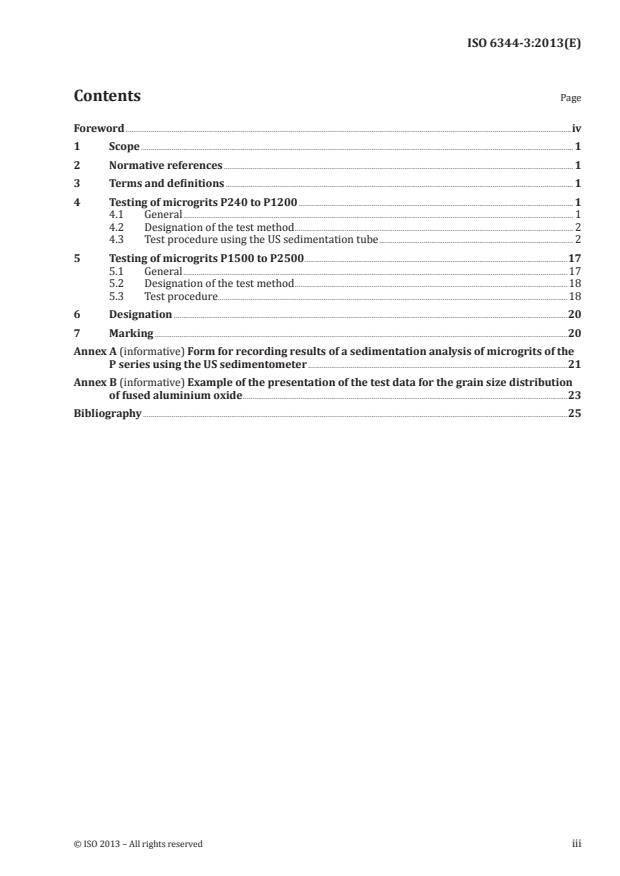
Contents Page
Foreword .iv
1 Scope . 1
2 Normative references . 1
3 Terms and definitions . 1
4 Testing of microgrits P240 to P1200 . 1
4.1 General . 1
4.2 Designation of the test method . 2
4.3 Test procedure using the US sedimentation tube . 2
5 Testing of microgrits P1500 to P2500 .17
5.1 General .17
5.2 Designation of the test method .18
5.3 Test procedure .18
6 Designation .20
7 Marking .20
Annex A (informative) Form for recording results of a sedimentation analysis of microgrits of the
P series using the US sedimentometer .21
Annex B (informative) Example of the presentation of the test data for the grain size distribution
of fused aluminium oxide .23
Bibliography .25
Foreword
ISO (the International Organization for Standardization) is a worldwide federation of national standards
bodies (ISO member bodies). The work of preparing International Standards is normally carried out
through ISO technical committees. Each member body interested in a subject for which a technical
committee has been established has the right to be represented on that committee. International
organizations, governmental and non-governmental, in liaison with ISO, also take part in the work.
ISO collaborates closely with the International Electrotechnical Commission (IEC) on all matters of
electrotechnical standardization.
International Standards are drafted in accordance with the rules given in the ISO/IEC Directives, Part 2.
The main task of technical committees is to prepare International Standards. Draft International
Standards adopted by the technical committees are circulated to the member bodies for voting.
Publication as an International Standard requires approval by at least 75 % of the member bodies
casting a vote.
Attention is drawn to the possibility that some of the elements of this document may be the subject of
patent rights. ISO shall not be held responsible for identifying any or all such patent rights.
ISO 6344-3 was prepared by Technical Committee ISO/TC 29, Small tools, Subcommittee SC 5, Grinding
wheels and abrasives.
This second edition cancels and replaces the first edition (ISO 6344-3:1998). It also incorporates the
Technical Corrigendum ISO 6344-3:1998/Corr.1:1999. The significant changes against ISO 6344-3:1998
are the following:
a) new definitions have been included in Clause 3;
b) the test procedure in 4.3 has been completely updated; requirements for the use of the US
sedimentation tube have replaced the reference to ISO 8486-2, in order to facilitate the use of this
part of ISO 6344;
c) Bibliography has been added.
ISO 6344 consists of the following parts, under the general title Coated abrasives — Grain size analysis:
— Part 1: Grain size distribution test
— Part 2: Determination of grain size distribution of macrogrits P12 to P220
— Part 3: Determination of grain size distribution of microgrits P240 to P2500
iv © ISO 2013 – All rights reserved
INTERNATIONAL STANDARD ISO 6344-3:2013(E)
Coated abrasives — Grain size analysis —
Part 3:
Determination of grain size distribution of microgrits
P240 to P2500
1 Scope
This part of ISO 6344 specifies a method for determining or testing the grain size distribution of electro-fused
aluminium oxide and silicon carbide microgrits P240 to P2500 for coated abrasives as defined in ISO 6344-1.
It applies both to those grits used in the manufacture of coated abrasive products and to those grits
taken from products for testing purposes.
2 Normative references
The following documents, in whole or in part, are normatively referenced in this document and are
indispensable for its application. For dated references, only the edition cited applies. For undated
references, the latest edition of the referenced document (including any amendments) applies.
ISO 6344-1:1998, Coated abrasives — Grain size analysis — Part 1: Grain size distribution test
3 Terms and definitions
For the purposes of this document, the following terms and definitions apply.
3.1
microgrit
abrasive grit having a median equivalent diameter of 58,5 μm to 8,4 μm, whose grain size distribution
is determined by sedimentation
3.2
grain size distribution
percentage of grains of different sizes composing the macrogrit or microgrit
4 Testing of microgrits P240 to P1200
4.1 General
The testing of microgrits P240 to P1200 by sedimentation shall be carried out using the US sedimentometer
whereby the grain size distribution is determined; see 4.3.1.
The limits are specified in ISO 6344-1:1998, Table 2, which is reproduced as (the following) Table 1.
Table 1 — Grain size distribution of microgrits P240 to P1200 d -values for testing with the US
s
sedimentometer
d value d value Median grain size d value
s0 s3 s95
Grit designation max. max. d values min.
s50
μm μm μm μm
P240 110 81,7 58,5 ±2,0 44,5
P280 101 74,0 52,2 ±2,0 39,2
P320 94 66,8 46,2 ±1,5 34,2
P360 87 60,3 40,5 ±1,5 29,6
P400 81 53,9 35,0 ±1,5 25,2
P500 77 48,3 30,2 ±1,5 21,5
P600 72 43,0 25,8 ±1,0 18,0
P800 67 38,1 21,8 ±1,0 15,1
P1000 63 33,7 18,3 ±1,0 12,4
P1200 58 29,7 15,3 ±1,0 10,2
The permissible deviations are given in Table 2.
Table 2 — Permissible deviations resulting from the variations due to the measuring technique
(US sedimentometer)
Permissible deviation for
Grit designation
d d d
s3 s50 s95
μm μm μm
P240
P280 +1,5 ±1,5 –1,5
P320
P360
P400 +1,5 ±1,0 –1,5
P500
P600
P800
+1,5 ±0,8 –1,5
P1000
P1200
4.2 Designation of the test method
The designation of the test method by means of the US sedimentometer for microgrits P240 to P1200 is
as follows: Test method – Micro P
4.3 Test procedure using the US sedimentation tube
4.3.1 Testing by sedimentation
The testing of microgrits P240 to P1200 by sedimentation shall be carried out using the US sedimentation
tube whereby the grain size distribution is determined.
The principle of measurement is to determine the volumes of a suspension of the grit sample settled in
the collecting tube as a function of time, and to calculate the equivalent grain diameter using Stokes’ law.
2 © ISO 2013 – All rights reserved
The grain size distribution of microgrits P240 to P1200 is determined using the following criteria:
a) the maximum grains diameter (theoretical grain diameter) of the first sedimented grain (d value)
s0
shall not exceed the maximum permissible d value;
s0
b) the grain diameter (theoretical grain diameter) shall not exceed the maximum permissible d value
s3
at the 3 % point of the grain size distribution curve;
c) the median grain diameter (theoretical grain diameter) shall be within the specified tolerances of
the d value at the 50 % point of the grain size distribution curve;
s50
d) the grain diameter (theoretical grain diameter) shall at least attain the d value at the 95 % point
s95
of the grain size distribution curve.
The four criteria shall be met at the same time. The values are specified in Table 1.
The permissible deviations are given in Table 2.
4.3.2 Test apparatus
The US sedimentation tube consists of a vertical sedimentation tube of 940 mm in length and of 20 mm
inside diameter. It is surrounded by a water jacket in which the water temperature is maintained at a
constant level.
A graduated collecting tube is fixed at the bottom of the sedimentation tube. The whole assembly is
mounted on a frame, the base plate of which is fitted with level adjusting screws for keeping the tube
vertical (see Figure 1).
For the design and dimensions of the collecting tube, see Figure 2.
To improve the accuracy of sedimentation volume readings, it is recommended that a horizontal beam
light source and a magnifying glass be used. A time printer renders the recording of the sedimentation
times easier.
Dimensions in millimetres
Key
1 methyl alcohol level (initial)
2 sedimentation tube
3 water jacket
4 thermometer
5 collecting tube (see Figure 5)
6 rubber centring spacer
7 scale for height of sedimentation
8 rubber gasket
9 vertical adjusting screws
a
Water inlet.
b
Water outlet.
Figure 1 — US sedimentation tube
4 © ISO 2013 – All rights reserved
Dimensions in millimetres
Key
Dial graduation and figures shall be in white.
50 division marks at equal intervals (graduation about 1 mm).
Length of division mark: 3 mm
Every fifth division mark: 4 mm
Thickness of division mark: 0,25 mm
Figure 2 — Collecting tube
4.3.3 Test equipment
4.3.3.1 Sedimentation medium
Use methyl alcohol of 95 % up to 99 % purity as the sedimentation medium.
Adjust the sedimentation medium using the checking minerals specified in 4.3.4.1.3.
4.3.3.2 Dispersing agent
In order to avoid grain agglomeration, a dispersing agent, such as EDTA (tetrasodium salt of
ethylendiamine tetra-acetic acid), shall be added to the methyl alcohol, i.e. 4 ml of a 1 % aqueous EDTA-
solution per litre of methyl alcohol.
4.3.3.3 Checking minerals
The adjustment of the whole measuring procedure should be controlled by means of checking minerals
280 and 320. Each supply of checking minerals is accompanied by a cumulative volume grain size
distribution curve (see Figure 3). The 10 %, 20 %, 30 %, 40 % and 50 % points shall not deviate by more
than ± 0,5 micrometres (µm) from the sizes indicated in Table 3.
NOTE The grain size distributions of the checking minerals do not correspond to identical grain sizes of this
part of ISO 6344.
Table 3 — Grain diameter of checking minerals
Grain diameter
Volume fraction
d
of the settled
µm
checking minerals
Checking mineral
%
280 320
0 74,7 75,1
3 62,1 58,7
10 52,9 ± 1,06 49,8 ± 1
20 47,9 ± 0,96 44,2 ± 0,88
30 44,7 ± 0,89 40,5 ± 0,81
40 42 ± 0,84 37,5 ± 0,75
50 39,7 ± 0,79 34,9 ± 0,7
60 37,4 32,5
70 35 30,1
80 32,3 27,5
90 28,8 24,4
100 20 16,5
6 © ISO 2013 – All rights reserved
Key
Y volume fraction, %
X grain diameter, d, µm
Figure 3 — Cumulative volume grain size distribution curve of checking minerals 280 and 320
4.3.4 Testing
4.3.4.1 Preparation for testing
4.3.4.1.1 Setting up test device
When setting up the US sedimentometer for use as the test device, check that the collecting tube is
positioned centrally in the sedimentation tube. It is held in the vertical position by a rubber spacer
located about 30 mm from the top of the collecting tube. Check this using a plumb line suspended from
the top of the sedimentation tube and the collecting tube. The plumb line shall pass centrally through
both the sedimentation tube and the collecting tube. The device is adjusted by means of the adjusting
screws on the base plate.
After adjustment, fill the water jacket and connect it to a thermostat.
4.3.4.1.2 Test temperature
The testing of the grain size shall be carried out under constant temperature with a permissible
deviation of ±0,1 °C.
It is convenient to use a test temperature of 25 °C. The grain diameters indicated in Tables 4 and 5 for the
respective times of sedimentation apply to this temperature only.
For the determination of the grain diameters for other test temperatures, see 4.3.5.1.
4.3.4.1.3 Adjustment of the sedimentation medium
The methyl alcohol used for the test shall be adjusted by means of one of the two checking minerals, 280
or 320.
The grain sizes corresponding to 10 %, 20 %, 30 %, 40 % and 50 % points shall not deviate by more than
±0,5 µm from the values specified on the curves supplied with the checking minerals. The average of the
algebraic sum of the deviations shall not exceed ±0,3 µm.
If agreement with the accompanying curves is not reached within the permissible tolerances, then the density
and viscosity of the sedimentation medium shall be changed in such a way so that agreement is obtained.
4.3.4.2 Test procedure
4.3.4.2.1 Filling of sedimentation tube
Fill the sedimentation tube with the previously adjusted sedimentation liquid to a height of
1 000 mm ± 2 mm (measured from the bottom of the collecting tube). Then, allow it to stand until
equilibrium is reached between the water jacket connected to the thermostat and the sedimentation
tube temperatures.
4.3.4.2.2 Preparation of the sample
Prior to the test, the sample shall be heated to a temperature of 600 °C ± 20 °C for at least 10 min.
4.3.4.2.3 Dispersion of the sample
Place a sufficient amount of the sample in a test tube such that a height of 20 to 25 divisions in the
collecting tube after sedimentation is obtained. For silicon carbide, this will be about 1,6 g; while for
fused aluminium oxide it will be about 2,2 g.
It is recommended that the dispersed sample be submitted to ultrasonic treatment to remove
agglomerates.
Transfer 15 ml of sedimentation medium containing the specified quantity of dispersing agent and the
sample to be settled to a test tube and shake the test tube to achieve complete dispersion. Allow the grit
to stand in the sedimentation medium for at least 30 min and then again shake the test tube vigorously
several times during this period. The temperature of the medium shall be the same as the temperature
of the medium in the sedimentation tube.
4.3.4.2.4 Transfer to sedimentation tube
Place a suitable funnel in the sedimentation tube. Shake the test-tube containing the sample and the
sedimentation liquid vigorously for at least 30 s. Then, pour its contents onto the sedimentation liquid,
down the slope of the funnel.
Subsequently, quickly remove the funnel from the sedimentation tube in order to prevent any residue
from dropping into the tube as this would distort the results.
4.3.4.2.5 Start of measurement
Measurement shall begin at the time of transfer.
8 © ISO 2013 – All rights reserved
Table 4 — Theoretical grain diameter, d, for grits of fused aluminium oxide as a function of time of
sedimentation, t, when using methyl alcohol as sedimentation medium at test temperature 25 °C
t d t d T d t d t d
min µm min µm min µm min µm min µm
0,50 112,7 2,50 50,4 4,50 37,6 8,00 28,2 23,00 16,6
0,55 107,5 2,55 49,9 4,55 37,4 8,20 27,8 24,00 16,3
0,60 102,9 2,60 49,4 4,60 37,2 8,40 27,5 25,00 15,9
0,65 98,9 2,65 49 4,65 37 8,60 27,2 26,00 15,6
0,70 95,3 2,70 48,5 4,70 36,8 8,80 26,9 27,00 15,3
0,75 92 2,75 48,1 4,75 36,6 9,00 26,6 28,00 15,1
0,80 89,1 2,80 47,6 4,80 36,4 9,20 26,3 29,00 14,8
0,85 86,4 2,85 47,2 4,85 36,2 9,40 26 30,00 14,6
0,90 84 2,90 46,8 4,90 36 9,60 25,7 32,00 14,1
0,95 81,8 2,95 46,4 4,95 35,8 9,80 25,5 34,00 13,7
1,00 79,7 3,00 46 5,00 35,6 10,00 25,2 36,00 13,3
1,05 77,8 3,05 45,6 5,10 35,3 10,20 25 38,00 12,9
1,10 76 3,10 45,3 5,20 35 10,40 24,7 40,00 12,6
1,15 74,3 3,15 44,9 5,30 34,6 10,60 24,5 42,00 12,3
1,20 72,8 3,20 44,6 5,40 34,3 10,80 24,2 44,00 12
1,25 71,3 3,25 44,2 5,50 34 11,00 24 46,00 11,8
1,30 69,9 3,30 43,9 5,60 33,7 11,20 23,8 48,00 11,5
1,35 68,6 3,35 43,5 5,70 33,4 11,40 23,6 50,00 11,3
1,40 67,4 3,40 43,2 5,80 33,1 11,60 23,4 55,00 10,8
1,45 66,2 3,45 42,9 5,90 32,8 11,80 23,2 60,00 10,3
1,50 65,1 3,50 42,6 6,00 32,5 12,00 23 65,00 9,9
1,55 64 3,55 42,3 6,10 32,3 12,50 22,5 70,00 9,5
1,60 63 3,60 42 6,20 32 13,00 22,1 75,00 9,2
1,65 62,9 3,65 41,7 6,30 31,8 13,50 21,7 80,00 8,9
1,70 61,1 3,70 41,4 6,40 31,5 14,00 21,3 85,00 8,6
1,75 60,2 3,75 41,2 6,50 31,3 14,50 20,9 90,00 8,4
1,80 59,4 3,80 40,9 6,60 31 15,00 20,6 95,00 8,2
1,85 58,6 3,85 40,6 6,70 30,8 15,50 20,2 100,00 8
1,90 57,8 3,90 40,4 6,80 30,6 16,00 19,9 105,00 7,8
1,95 57,1 3,95 40,1 6,90 30,3 16,50 19,6 110,00 7,6
2,00 56,4 4,00 39,9 7,00 30,1 17,00 19,3 115,00 7,4
2,05 55,7 4,05 39,6 7,10 29,9 17,50 19,1 120,00 7,3
2,10 55 4,10 39,4 7,20 29,7 18,00 18,8 130,00 7
2,15 54,4 4,15 39,1 7,30 29,5 18,50 18,5 140,00 6,7
2,20 53,7 4,20 38,9 7,40 29,3 19,00 18,3 150,00 6,5
2,25 60,1 4,25 38,7 7,50 29,1 19,50 18 160,00 6,3
2,30 52,6 4,30 38,4 7,60 28,9 20,00 17,8 170,00 6,1
2,35 52 4,35 38,2 7,70 28,7 20,50 17,6 180,00 5,9
2,40 51,4 4,40 38 7,80 28,5 21,00 17,4 190,00 5,8
2,45 50,9 4,45 37,8 7,90 28,4 22,00 17 200,00 5,6
Table 5 — Theoretical grain diameter, d, for grits of silicon carbide as a function of time of
sedimentation, t, when using methyl alcohol as sedimentation medium at test temperature 25 °C
t d t d t d t d t d
min µm min µm min µm min µm min µm
0,50 128,8 2,50 57,6 4,50 42,9 8,00 32,2 23,00 19
0,55 122,8 2,55 57 4,55 42,7 8,20 31,8 24,00 18,6
0,60 117,6 2,60 56,5 4,60 42,5 8,40 31,4 25,00 18,2
0,65 112,9 2,65 56 4,65 42,2 8,60 31,1 26,00 17,9
0,70 108,8 2,70 55,4 4,70 42 8,80 30,7 27,00 17,5
0,75 105,1 2,75 54,9 4,75 41,8 9,00 30,4 28,00 17,2
0,80 101,8 2,80 54,4 4,80 41,6 9,20 30 29,00 16,9
0,85 98,8 2,85 54 4,85 41,4 9,40
...
NORME ISO
INTERNATIONALE 6344-3
Deuxième édition
2013-05-01
Abrasifs appliqués —
Granulométrie —
Partie 3:
Détermination de la distribution
granulométrique des micrograins
P240 à P2500
Coated abrasives — Grain size analysis —
Part 3: Determination of grain size distribution of microgrits P240 to
P2500
Numéro de référence
©
ISO 2013
DOCUMENT PROTÉGÉ PAR COPYRIGHT
© ISO 2013
Droits de reproduction réservés. Sauf indication contraire, aucune partie de cette publication ne peut être reproduite ni utilisée
sous quelque forme que ce soit et par aucun procédé, électronique ou mécanique, y compris la photocopie, l’affichage sur
l’internet ou sur un Intranet, sans autorisation écrite préalable. Les demandes d’autorisation peuvent être adressées à l’ISO à
l’adresse ci-après ou au comité membre de l’ISO dans le pays du demandeur.
ISO copyright office
Case postale 56 • CH-1211 Geneva 20
Tel. + 41 22 749 01 11
Fax + 41 22 749 09 47
E-mail copyright@iso.org
Web www.iso.org
Publié en Suisse
ii © ISO 2013 – Tous droits réservés
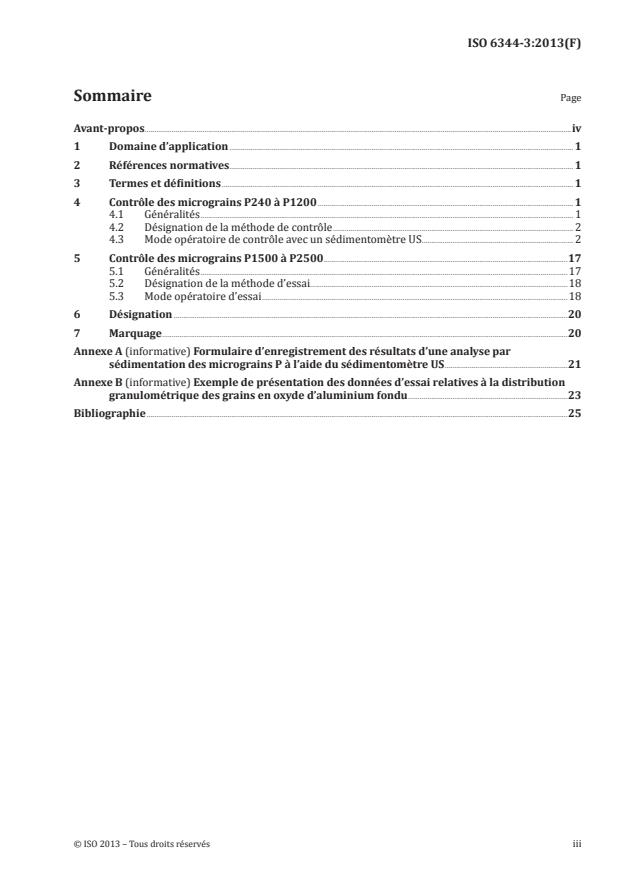
Sommaire Page
Avant-propos .iv
1 Domaine d’application . 1
2 Références normatives . 1
3 Termes et définitions . 1
4 Contrôle des micrograins P240 à P1200 . 1
4.1 Généralités . 1
4.2 Désignation de la méthode de contrôle . 2
4.3 Mode opératoire de contrôle avec un sédimentomètre US . 2
5 Contrôle des micrograins P1500 à P2500 .17
5.1 Généralités .17
5.2 Désignation de la méthode d’essai.18
5.3 Mode opératoire d’essai .18
6 Désignation .20
7 Marquage .20
Annexe A (informative) Formulaire d’enregistrement des résultats d’une analyse par
sédimentation des micrograins P à l’aide du sédimentomètre US .21
Annexe B (informative) Exemple de présentation des données d’essai relatives à la distribution
granulométrique des grains en oxyde d’aluminium fondu .23
Bibliographie .25
Avant-propos
L’ISO (Organisation internationale de normalisation) est une fédération mondiale d’organismes
nationaux de normalisation (comités membres de l’ISO). L’élaboration des Normes internationales est
en général confiée aux comités techniques de l’ISO. Chaque comité membre intéressé par une étude
a le droit de faire partie du comité technique créé à cet effet. Les organisations internationales,
gouvernementales et non gouvernementales, en liaison avec l’ISO participent également aux travaux.
L’ISO collabore étroitement avec la Commission électrotechnique internationale (CEI) en ce qui concerne
la normalisation électrotechnique.
Les Normes internationales sont rédigées conformément aux règles données dans les Directives
ISO/CEI, Partie 2.
La tâche principale des comités techniques est d’élaborer les Normes internationales. Les projets de
Normes internationales adoptés par les comités techniques sont soumis aux comités membres pour vote.
Leur publication comme Normes internationales requiert l’approbation de 75 % au moins des comités
membres votants.
L’attention est appelée sur le fait que certains des éléments du présent document peuvent faire l’objet de
droits de propriété intellectuelle ou de droits analogues. L’ISO ne saurait être tenue pour responsable de
ne pas avoir identifié de tels droits de propriété et averti de leur existence.
L’ISO 6344-3 a été élaborée par le comité technique ISO/TC 29, Petit outillage, sous-comité SC 5,
Meules et abrasifs.
Cette deuxième édition annule et remplace la première édition (ISO 6344-3:1998). Elle incorpore
également le Correctif technique ISO 6344-3:1998/Cor.1:1999. Les principales modifications par rapport
à l’ISO 6344-3:1998 sont les suivantes:
a) ajout de nouvelles définitions à l’Article 3;
b) mise à jour complète du mode opératoire d’essai en 4.3 et ajout des exigences relatives à l’utilisation
du sédimentomètre US au lieu de renvoyer à l’ISO 8486-2 pour faciliter l’utilisation de la présente
partie de l’ISO 6344;
c) ajout d’une bibliographie.
L’ISO 6344 comprend les parties suivantes, présentées sous le titre général Abrasifs appliqués —
Granulométrie:
— Partie 1: Contrôle de la distribution granulométrique
— Partie 2: Détermination de la distribution granulométrique des macrograins P12 à P220
— Partie 3: Détermination de la distribution granulométrique des micrograins P240 à P2500
iv © ISO 2013 – Tous droits réservés
NORME INTERNATIONALE ISO 6344-3:2013(F)
Abrasifs appliqués — Granulométrie —
Partie 3:
Détermination de la distribution granulométrique des
micrograins P240 à P2500
1 Domaine d’application
La présente partie de l’ISO 6344 spécifie une méthode de détermination ou de contrôle de la distribution
granulométrique des micrograins P240 à P2500 en oxyde d’aluminium fondu et en carbure de silicium
pour abrasifs appliqués comme défini dans l’ISO 6344-1.
Elle est applicable tant aux grains utilisés pour la fabrication des produits abrasifs appliqués qu’aux
grains extraits de ces produits pour les contrôler.
2 Références normatives
Les documents suivants, en totalité ou en partie, sont référencés de manière normative dans le présent
document et sont indispensables pour son application. Pour les références datées, seule l’édition citée
s’applique. Pour les références non datées, la dernière édition du document de référence s’applique (y
compris les éventuels amendements).
ISO 6344-1:1998, Abrasifs appliqués — Granulométrie — Partie 1: Contrôle de la distribution granulométrique
3 Termes et définitions
Pour les besoins du présent document, les définitions suivantes s’appliquent.
3.1
micrograin
grain abrasif de diamètre équivalent médian compris entre 58,5 µm et 8,4 µm, dont la distribution
granulométrique est déterminée par sédimentation
3.2
distribution granulométrique
pourcentage de grains de différentes tailles composant une distribution de macrograins ou de
micrograins donnée
4 Contrôle des micrograins P240 à P1200
4.1 Généralités
Le contrôle des micrograins P240 à P1200 par sédimentation doit être effectué à l’aide d’un
sédimentomètre US, grâce auquel la distribution granulométrique est déterminée (voir 4.3.1).
Les limites sont spécifiées dans l’ISO 6344-1:1998, Tableau 2, qui est reproduit sous la forme du
Tableau 1 ci-après.
Tableau 1 — Distribution granulométrique des micrograins P240 à P1200, valeurs d pour le
s
contrôle avec un sédimentomètre US
Valeur d Valeur d Diamètre médian des grains Valeur d
s0 s3 s95
Désignation des
max. max. Valeur d min.
s50
grains
µm µm µm µm
P240 110 81,7 58,5 ±2,0 44,5
P280 101 74,0 52,2 ±2,0 39,2
P320 94 66,8 46,2 ±1,5 34,2
P360 87 60,3 40,5 ±1,5 29,6
P400 81 53,9 35,0 ±1,5 25,2
P500 77 48,3 30,2 ±1,5 21,5
P600 72 43,0 25,8 ±1,0 18,0
P800 67 38,1 21,8 ±1,0 15,1
P1000 63 33,7 18,3 ±1,0 12,4
P1200 58 29,7 15,3 ±1,0 10,2
Les écarts admissibles sont donnés dans le Tableau 2.
Tableau 2 — Écarts admissibles résultant des variations dues à la technique de mesure
(sédimentomètre US)
Écart admissible pour
Désignation des
d d d
s3 s50 s95
grains
µm µm µm
P240
P280 +1,5 ±1,5 −1,5
P320
P360
P400 +1,5 ±1,0 −1,5
P500
P600
P800
+1,5 ±0,8 −1,5
P1000
P1200
4.2 Désignation de la méthode de contrôle
La désignation de la méthode de contrôle au moyen d’un sédimentomètre US pour les micrograins P240
à P1200 est la suivante:
Méthode de contrôle – Micro P
4.3 Mode opératoire de contrôle avec un sédimentomètre US
4.3.1 Contrôle par sédimentation
Le contrôle des micrograins P240 à P1200 par sédimentation doit être effectué à l’aide du sédimentomètre
US, grâce auquel la distribution granulométrique est déterminée.
2 © ISO 2013 – Tous droits réservés
Le principe de mesurage consiste à déterminer les volumes d’une suspension de l’échantillon de grains
qui ont sédimenté dans le tube collecteur en fonction du temps et à calculer le diamètre équivalent des
grains à l’aide de la loi de Stokes.
La distribution granulométrique des micrograins P240 à P1200 est déterminée en utilisant les
critères suivants:
a) le diamètre maximal (diamètre théorique) du premier grain sédimenté (valeur d ) ne doit pas
s0
dépasser la valeur d maximale admissible;
s0
b) le diamètre du grain (diamètre théorique) ne doit pas dépasser la valeur d maximale admissible au
s3
point situé à 3 % de la courbe de distribution granulométrique;
c) le diamètre médian du grain (diamètre théorique) doit se situer dans les tolérances spécifiées pour
la valeur d au point situé à 50 % de la courbe de distribution granulométrique;
s50
d) le diamètre du grain (diamètre théorique) doit au moins atteindre la valeur d au point situé à
s95
95 % de la courbe de distribution granulométrique.
Les quatre critères doivent être remplis en même temps. Les valeurs sont spécifiées dans le Tableau 1.
Les valeurs admissibles sont données dans le Tableau 2.
4.3.2 Appareillage d’essai
Le sédimentomètre US est constitué d’un tube de sédimentation vertical de 940 mm de long et de 20 mm
de diamètre intérieur. Il est entouré d’une chemise à circulation d’eau dans laquelle la température de
l’eau est maintenue à un niveau constant.
Un tube collecteur gradué est fixé à la base du tube de sédimentation. L’ensemble est monté sur un
support dont le socle est équipé de vis permettant le réglage de la verticalité du tube de sédimentation
(voir la Figure 1).
Pour la conception et les dimensions du tube collecteur, voir la Figure 2.
Afin d’améliorer l’exactitude des lectures de volume de sédimentation, il est recommandé d’utiliser
une source lumineuse donnant un rayon horizontal et une loupe grossissante. Un chronographe rend
l’enregistrement des temps de sédimentation plus aisé.
Dimensions en millimètres
Légende
1 niveau de méthanol (initial)
2 tube de sédimentation
3 chemise à circulation d’eau
4 thermomètre
5 tube collecteur (voir Figure 5)
6 bague de centrage en caoutchouc
7 échelle de mesure de la hauteur de sédimentation
8 joint en caoutchouc
9 vis de réglage de la verticalité
a
entrée d’eau
b
sortie d’eau
Figure 1 — Sédimentomètre US
4 © ISO 2013 – Tous droits réservés
Dimensions en millimètres
Légende
L’échelle et les chiffres doivent être en blanc
50 traits équidistants (graduation tous les 1 mm environ)
Longueur des traits: 3 mm
De 5 en 5, traits de graduation: 4 mm
Épaisseur des traits: 0,25 mm
Figure 2 — Tube collecteur
4.3.3 Équipement d’essai
4.3.3.1 Liquide de sédimentation
Utiliser du méthanol de pureté 95 % à 99 % comme liquide de sédimentation.
Ajuster le liquide de sédimentation à l’aide de grains étalons spécifiés en 4.3.4.1.3.
4.3.3.2 Agent dispersant
Afin d’éviter la floculation des grains, un agent dispersant tel que l’EDTA (sel tétrasodique de l’acide
éthylène diamine tétracétique) doit être ajouté au méthanol, au dosage de 4 ml d’une solution aqueuse
d’EDTA à 1 % par litre de méthanol.
4.3.3.3 Grains étalons
Il convient que l’ajustement de l’ensemble du mode opératoire de mesure soit contrôlé par des grains
étalons 280 et 320. Chaque livraison de grains étalons est accompagnée d’une courbe de distribution
granulométrique cumulée en volume (voir la Figure 3). Les points situés à 10 %, 20 %, 30 %, 40 % et 50 %
ne doivent pas dévier de plus de ± 0,5 micromètres (µm) des dimensions indiquées dans le Tableau 3.
NOTE Les distributions granulométriques des grains étalons ne correspondent pas aux diamètres des mêmes
grains de la présente partie de l’ISO 6344.
Tableau 3 — Diamètre des grains étalons
Diamètre des grains
Fraction volumique de
d
grains étalons sédimen-
µm
tés
Grains étalons
%
280 320
0 74,7 75,1
3 62,1 58,7
10 52,9 ± 1,06 49,8 ± 1
20 47,9 ± 0,96 44,2 ± 0,88
30 44,7 ± 0,89 40,5 ± 0,81
40 42 ± 0,84 37,5 ± 0,75
50 39,7 ± 0,79 34,9 ± 0,7
60 37,4 32,5
70 35 30,1
80 32,3 27,5
90 28,8 24,4
100 20 16,5
6 © ISO 2013 – Tous droits réservés
Légende
X diamètre du grain, d, µm
Y fraction volumique, %
Figure 3 — Courbe de distribution granulométrique cumulée en volume des grains étalons 280
et 320
4.3.4 Essai
4.3.4.1 Préparation de l’essai
4.3.4.1.1 Montage du dispositif d’essai
Lors du montage du sédimentomètre US utilisé comme dispositif d’essai, vérifier le centrage du tube
collecteur dans le tube de sédimentation. Il est maintenu verticalement grâce à une bague cannelée en
caoutchouc placée à environ 30 mm de l’extrémité supérieure du tube collecteur. Vérifier ceci à l’aide
d’un fil à plomb suspendu du sommet du tube de sédimentation et du tube collecteur. Le fil à plomb doit
passer à la fois au centre du tube de sédimentation et au centre du tube collecteur. Le dispositif est ajusté
au moyen des vis de réglage sur le socle.
Après ajustement, remplir la chemise à circulation d’eau et la raccorder à un thermostat.
4.3.4.1.2 Température d’essai
L’essai granulométrique doit être réalisé à température constante, avec un écart admissible de ± 0,1 °C.
Il est pratique d’utiliser une température d’essai de 25 °C. Les diamètres de grains indiqués dans les
Tableaux 4 et 5 pour les temps de sédimentation respectifs s’appliquent à cette température uniquement.
Pour la détermination des diamètres de grains à d’autres températures d’essai, voir 4.3.5.1.
4.3.4.1.3 Ajustement du liquide de sédimentation
Le méthanol utilisé pour l’essai doit être ajusté grâce à l’un des deux grains étalons, 280 ou 320.
Les tailles de grains correspondant aux points à 10 %, 20 %, 30 %, 40 % et 50 % ne doivent pas différer
de plus de ± 0,5 µm de ceux spécifiés sur les courbes accompagnant la livraison des grains étalons. La
moyenne de la somme algébrique des écarts ne doit pas dépasser ± 0,3 µm.
Si les résultats s’écartent des tolérances admissibles accompagnant les courbes, alors la densité et la
viscosité du liquide de sédimentation doivent être corrigées de manière à respecter les tolérances.
4.3.4.2 Mode opératoire d’essai
4.3.4.2.1 Remplissage du tube de sédimentation
Remplir le tube de sédimentation de liquide de sédimentation préalablement vérifié, jusqu’à une hauteur
de 1 000 mm ± 2 mm (mesurée à partir de la base du tube collecteur). Puis, attendre l’équilibrage de la
température du tube de sédimentation avec celle de la chemise à circulation d’eau raccordée au thermostat.
4.3.4.2.2 Préparation de l’échantillon
Avant l’essai, l’échantillon doit être chauffé à une température de 600 °C ± 20 °C pendant au moins 10 min.
4.3.4.2.3 Dispersion de l’échantillon
Placer une quantité suffisante de l’échantillon dans un tube à essai de façon à atteindre une hauteur
comprise entre 20 à 25 graduations dans le tube collecteur après sédimentation. Cela correspond à
environ 1,6 g de carbure de silicium ou à 2,2 g d’oxyde d’aluminium fondu.
Il est recommandé de soumettre l’échantillon dispersé aux ultrasons pour supprimer les agglomérats.
Transférer dans un tube à essai 15 ml de liquide de sédimentation contenant la quantité spécifiée
d’agent dispersant et l’échantillon à sédimenter et agiter le tube à essai jusqu’à dispersion complète.
Laisser les grains au moins 30 min dans le liquide de sédimentation, en agitant vigoureusement le tube
à essai à plusieurs reprises pendant cette période. La température du mélange doit être la même que la
température du liquide dans le tube de sédimentation.
4.3.4.2.4 Transfert dans le tube de sédimentation
Placer un entonnoir adapté dans le tube de sédimentation. Agiter vigoureusement le tube à essai
contenant l’échantillon et le liquide de sédimentation pendant au moins 30 s. Puis verser son contenu
sur le liquide de sédimentation, le long de l’entonnoir.
Ensuite, retirer rapidement l’entonnoir du tube de sédimentation pour éviter que des résidus ne tombent
dans le tube ce qui fausserait les résultats.
4.3.4.2.5 Début du mesurage
Le mesurage doit commencer au temps de transfert.
8 © ISO 2013 – Tous droits réservés
Tableau 4 — Diamètre théorique, d, des grains en oxyde d’aluminium fondu en fonction du
temps de sédimentation, t, en cas d’utilisation de méthanol comme liquide de sédimentation à
la température d’essai de 25 °C
t d t d t d t d t d
min µm min µm min µm min µm min µm
0,50 112,7 2,50 50,4 4,50 37,6 8,00 28,2 23,00 16,6
0,55 107,5 2,55 49,9 4,55 37,4 8,20 27,8 24,00 16,3
0,60 102,9 2,60 49,4 4,60 37,2 8,40 27,5 25,00 15,9
0,65 98,9 2,65 49 4,65 37 8,60 27,2 26,00 15,6
0,70 95,3 2,70 48,5 4,70 36,8 8,80 26,9 27,00 15,3
0,75 92 2,75 48,1 4,75 36,6 9,00 26,6 28,00 15,1
0,80 89,1 2,80 47,6 4,80 36,4 9,20 26,3 29,00 14,8
0,85 86,4 2,85 47,2 4,85 36,2 9,40 26 30,00 14,6
0,90 84 2,90 46,8 4,90 36 9,60 25,7 32,00 14,1
0,95 81,8 2,95 46,4 4,95 35,8 9,80 25,5 34,00 13,7
1,00 79,7 3,00 46 5,00 35,6 10,00 25,2 36,00 13,3
1,05 77,8 3,05 45,6 5,10 35,3 10,20 25 38,00 12,9
1,10 76 3,10 45,3 5,20 35 10,40 24,7 40,00 12,6
1,15 74,3 3,15 44,9 5,30 34,6 10,60 24,5 42,00 12,3
1,20 72,8 3,20 44,6 5,40 34,3 10,80 24,2 44,00 12
1,25 71,3 3,25 44,2 5,50 34 11,00 24 46,00 11,8
1,30 69,9 3,30 43,9 5,60 33,7 11,20 23,8 48,00 11,5
1,35 68,6 3,35 43,5 5,70 33,4 11,40 23,6 50,00 11,3
1,40 67,4 3,40 43,2 5,80 33,1 11,60 23,4 55,00 10,8
1,45 66,2 3,45 42,9 5,90 32,8 11,80 23,2 60,00 10,3
1,50 65,1 3,50 42,6 6,00 32,5 12,00 23 65,00 9,9
1,55 64 3,55 42,3 6,10 32,3 12,50 22,5 70,00 9,5
1,60 63 3,60 42 6,20 32 13,00 22,1 75,00 9,2
1,65 62,9 3,65 41,7 6,30 31,8 13,50 21,7 80,00 8,9
1,70 61,1 3,70 41,4 6,40 31,5 14,00 21,3 85,00 8,6
1,75 60,2 3,75 41,2 6,50 31,3 14,50 20,9 90,00 8,4
1,80 59,4 3,80 40,9 6,60 31 15,00 20,6 95,00 8,2
1,85 58,6 3,85 40,6 6,70 30,8 15,50 20,2 100,00 8
1,90 57,8 3,90 40,4 6,80 30,6 16,00 19,9 105,00 7,8
1,95 57,1 3,95 40,1 6,90 30,3 16,50 19,6 110,00 7,6
2,00 56,4 4,00 39,9 7,00 30,1 17,00 19,3 115,00 7,4
2,05 55,7 4,05 39,6 7,10 29,9 17,50 19,1 120,00 7,3
2,10 55 4,10 39,4 7,20 29,7 18,00 18,8 130,00 7
2,15 54,4 4,15 39,1 7,30 29,5 18,50 18,5 140,00 6,7
2,20 53,7 4,20 38,9 7,40 29,3 19,00 18,3 150,00 6,5
2,25 60,1 4,25 38,7 7,50 29,1 19,50 18 160,00 6,3
2,30 52,6 4,30 38,4 7,60 28,9 20,00 17,8 170,00 6,1
2,35 52 4,35 38,2 7,70 28,7 20,50 17,6 180,00 5,9
2,40 51,4 4,40 38 7,80 28,5 21,00 17,4 190,00 5,8
2,45 50,9 4,45 37,8 7,90 28,4 22,00 17 200,00 5,6
Tableau 5 — Diamètre théorique, d, des grains en carbure de silicium en fonction du temps
de sédimentation, t, en cas d’utilisation de méthanol comme liquide de sédimentation à la
température d’essai de 25 °C
t d t d t d t d t d
min µm min µm min µm min µm min µm
0,50 128,8 2,50 57,6 4,50 42,9 8,00 32,2 23,00 19
0,55 122,8 2,55 57 4,55 42,7 8,20 31,8 24,00 18,6
0,60 117,6 2,60 56,5 4,60 42,5 8,40 31,4 25,00 18,2
0,65 112,9 2,65 56 4,65 42,2 8,60 31,1 26,00 17,9
0,70 108,8 2,70 55,4 4,70 42 8,80 30,7 27,00 17,5
0,75 105,1 2,75 54,9 4,75 41,8 9,00 30,4 28,00 17,2
0,80 101,8 2,80 54,4 4,80 41,6 9,20 30 29,00 16,9
0,85 98,8 2,85 54 4,85 41,4 9,40 29,7 30,00 16,6
0,90 96 2,90 53,5 4,90 41,2 9,60 29,4 32,00 16,1
0,95 93,4 2,95 53 4,95 40,9 9,80 29,1 34,00 15,6
1,00 91,1 3,00 52,6 5,00 40,7 10,00 28,8 36,00 15,2
1,05 88,
...
Questions, Comments and Discussion
Ask us and Technical Secretary will try to provide an answer. You can facilitate discussion about the standard in here.
Loading comments...