

ISO 603-15:2022
(Main)Bonded abrasive products — Dimensions — Part 15: Cutting-off wheels on stationary or mobile cutting-off machines
General Information
- Abstract
This document specifies the most common nominal dimensions, in millimetres, of: — shape type 41: flat cutting-off wheel; — shape type 42: depressed centre cutting-off wheel. These bonded abrasive products are intended to be used for cutting‑off of any workpiece using stationary or mobile cutting-off machines, both manually and mechanically guided. In the application that is manually guided, the workpiece is firmly clamped or stabilized by its own weight. The cutting‑off wheel is guided by the operator and the workpiece is fixed, or vice versa. This document does not specify limit deviations and run‑out tolerances, which are given in ISO 13942.
- Status
- Published
- Publication Date
- 19-Sep-2022
- Technical Committee
- ISO/TC 29/SC 5 - Grinding wheels and abrasives
- Drafting Committee
- ISO/TC 29/SC 5/WG 5 - Bonded abrasives
- Current Stage
- 6060 - International Standard published
- Start Date
- 20-Sep-2022
- Due Date
- 05-Jun-2022
- Completion Date
- 20-Sep-2022
Buy Documents
ISO 603-15:2022 - Bonded abrasive products — Dimensions — Part 15: Cutting-off wheels on stationary or mobile cutting-off machines Released:20. 09. 2022
ISO 603-15:2022 - Bonded abrasive products — Dimensions — Part 15: Cutting-off wheels on stationary or mobile cutting-off machines Released:20. 09. 2022
Overview
ISO 603-15:2022 specifies the most common nominal dimensions, in millimetres, for bonded abrasive cutting-off wheels used on stationary or mobile cutting-off machines. This standard outlines dimensional requirements for two major shape types:
- Type 41: Flat cutting-off wheels
- Type 42: Depressed centre cutting-off wheels
These cutting-off wheels are key abrasive products intended for use in the cutting of a wide range of workpieces. The standard is relevant for both manually guided and mechanically guided applications, ensuring products fit appropriately and operate safely in compatible equipment. It replaces the earlier edition (ISO 603-15:1999), reflecting updated industry needs and broader global use.
Key Topics
- Scope of Application: Covers dimensions for cutting-off wheels used in both stationary and mobile cutting-off machines.
- Shape Types:
- Type 41: Flat profile designed for general cutting tasks
- Type 42: Depressed centre profile for applications requiring deeper cuts or access to hard-to-reach areas
- Nominal Dimensions: Standardized in millimetres, with conversions to imperial units where applicable to support global industries.
- Guidance for Use:
- Supports usage for both operator-guided (manual) and mechanically-guided (automated) cutting methods
- Intended for applications where the workpiece is securely clamped or stabilized by its weight
- Exclusions: Limit deviations and run-out tolerances for these products are governed by ISO 13942 and are not included in this standard.
- Designation: Refers users to ISO 525 for detailed information on marking, shape types, and designation of bonded abrasive products.
Applications
Businesses and professionals in the metalworking, construction, automotive, and manufacturing sectors depend on standardized bonded abrasive cutting-off wheels for:
- Precision Cutting: Ensuring accurate and consistent cuts on metals, composites, and other workpiece materials.
- Interchangeability: Guaranteeing cutting-off wheels from different manufacturers are compatible with a range of stationary and mobile machines.
- Safety and Compliance: Meeting international safety standards by using abrasive products with standardized dimensions reduces operational risks.
- Global Trade: Facilitating procurement and specification of cutting-off wheels across international supply chains by referencing global standards in technical documents and contracts.
Typical environments where ISO 603-15:2022 is critical include workshops, fabrication plants, construction sites, and automated manufacturing systems, where requirements for reliability, interoperability, and performance are paramount.
Related Standards
Organizations implementing or referencing ISO 603-15:2022 may also need to consult these associated international standards:
- ISO 525: Bonded abrasive products - Shape types, designation, and marking (provides full shape classification and identification rules)
- ISO 13942: Bonded abrasive products - Limit deviations and run-out tolerances (necessary for comprehensive quality control)
- ISO 6103: Bonded abrasive products - Permissible unbalances of grinding wheels as delivered - Static testing (addresses the balance and safe operation of abrasive wheels)
- ISO 8486: Bonded abrasives - Determination and designation of grain size distribution (for understanding and specifying abrasive performance)
ISO 603-15:2022 helps manufacturers, suppliers, and end users align with best practices in abrasive product specification and application, supporting safe, efficient, and standardized cutting operations worldwide. For the complete list in the ISO 603 series and updates, visit the ISO website.
Relations
- Effective Date
- 24-Jul-2021
- Effective Date
- 17-Jul-2021
Buy Documents
ISO 603-15:2022 - Bonded abrasive products — Dimensions — Part 15: Cutting-off wheels on stationary or mobile cutting-off machines Released:20. 09. 2022
ISO 603-15:2022 - Bonded abrasive products — Dimensions — Part 15: Cutting-off wheels on stationary or mobile cutting-off machines Released:20. 09. 2022
Get Certified
Connect with accredited certification bodies for this standard

DVS-ZERT GmbH
German welding certification society.
CARES (UK Certification Authority for Reinforcing Steels)
UK certification for reinforcing steels and construction.
EWF/IIW (European/International Welding Federation)
International welding personnel certification.
Sponsored listings
Frequently Asked Questions
ISO 603-15:2022 is a standard published by the International Organization for Standardization (ISO). Its full title is "Bonded abrasive products — Dimensions — Part 15: Cutting-off wheels on stationary or mobile cutting-off machines". This standard covers: This document specifies the most common nominal dimensions, in millimetres, of: — shape type 41: flat cutting-off wheel; — shape type 42: depressed centre cutting-off wheel. These bonded abrasive products are intended to be used for cutting‑off of any workpiece using stationary or mobile cutting-off machines, both manually and mechanically guided. In the application that is manually guided, the workpiece is firmly clamped or stabilized by its own weight. The cutting‑off wheel is guided by the operator and the workpiece is fixed, or vice versa. This document does not specify limit deviations and run‑out tolerances, which are given in ISO 13942.
This document specifies the most common nominal dimensions, in millimetres, of: — shape type 41: flat cutting-off wheel; — shape type 42: depressed centre cutting-off wheel. These bonded abrasive products are intended to be used for cutting‑off of any workpiece using stationary or mobile cutting-off machines, both manually and mechanically guided. In the application that is manually guided, the workpiece is firmly clamped or stabilized by its own weight. The cutting‑off wheel is guided by the operator and the workpiece is fixed, or vice versa. This document does not specify limit deviations and run‑out tolerances, which are given in ISO 13942.
ISO 603-15:2022 is classified under the following ICS (International Classification for Standards) categories: 25.100.70 - Abrasives. The ICS classification helps identify the subject area and facilitates finding related standards.
ISO 603-15:2022 has the following relationships with other standards: It is inter standard links to ISO 603-15:1999/Cor 1:1999, ISO 603-15:1999. Understanding these relationships helps ensure you are using the most current and applicable version of the standard.
ISO 603-15:2022 is available in PDF format for immediate download after purchase. The document can be added to your cart and obtained through the secure checkout process. Digital delivery ensures instant access to the complete standard document.
Standards Content (Sample)
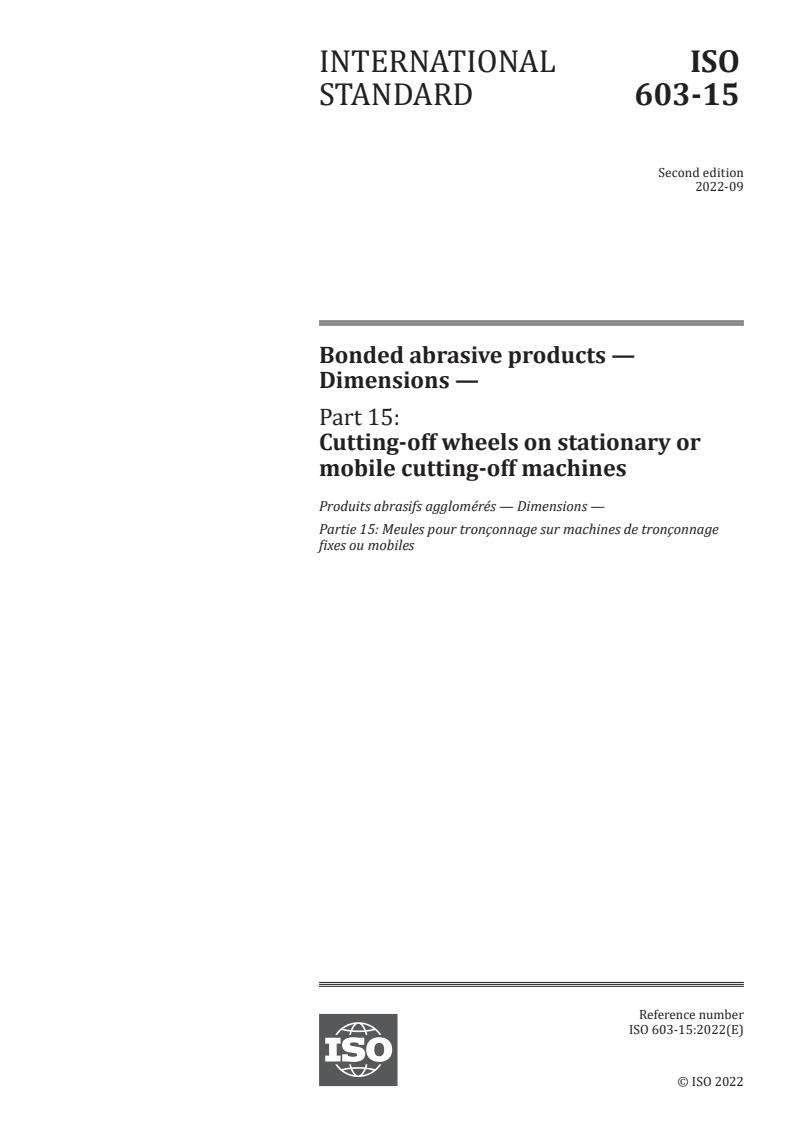
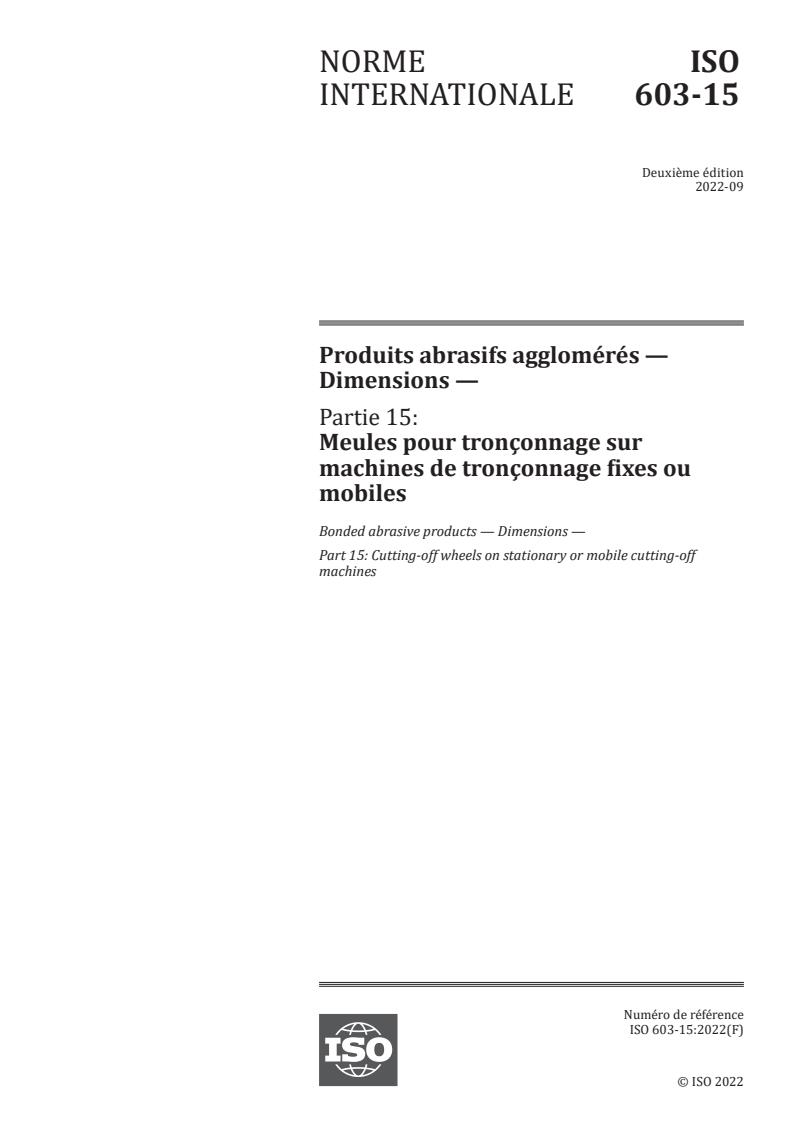
INTERNATIONAL ISO
STANDARD 603-15
Second edition
2022-09
Bonded abrasive products —
Dimensions —
Part 15:
Cutting-off wheels on stationary or
mobile cutting-off machines
Produits abrasifs agglomérés — Dimensions —
Partie 15: Meules pour tronçonnage sur machines de tronçonnage
fixes ou mobiles
Reference number
© ISO 2022
All rights reserved. Unless otherwise specified, or required in the context of its implementation, no part of this publication may
be reproduced or utilized otherwise in any form or by any means, electronic or mechanical, including photocopying, or posting on
the internet or an intranet, without prior written permission. Permission can be requested from either ISO at the address below
or ISO’s member body in the country of the requester.
ISO copyright office
CP 401 • Ch. de Blandonnet 8
CH-1214 Vernier, Geneva
Phone: +41 22 749 01 11
Email: copyright@iso.org
Website: www.iso.org
Published in Switzerland
ii
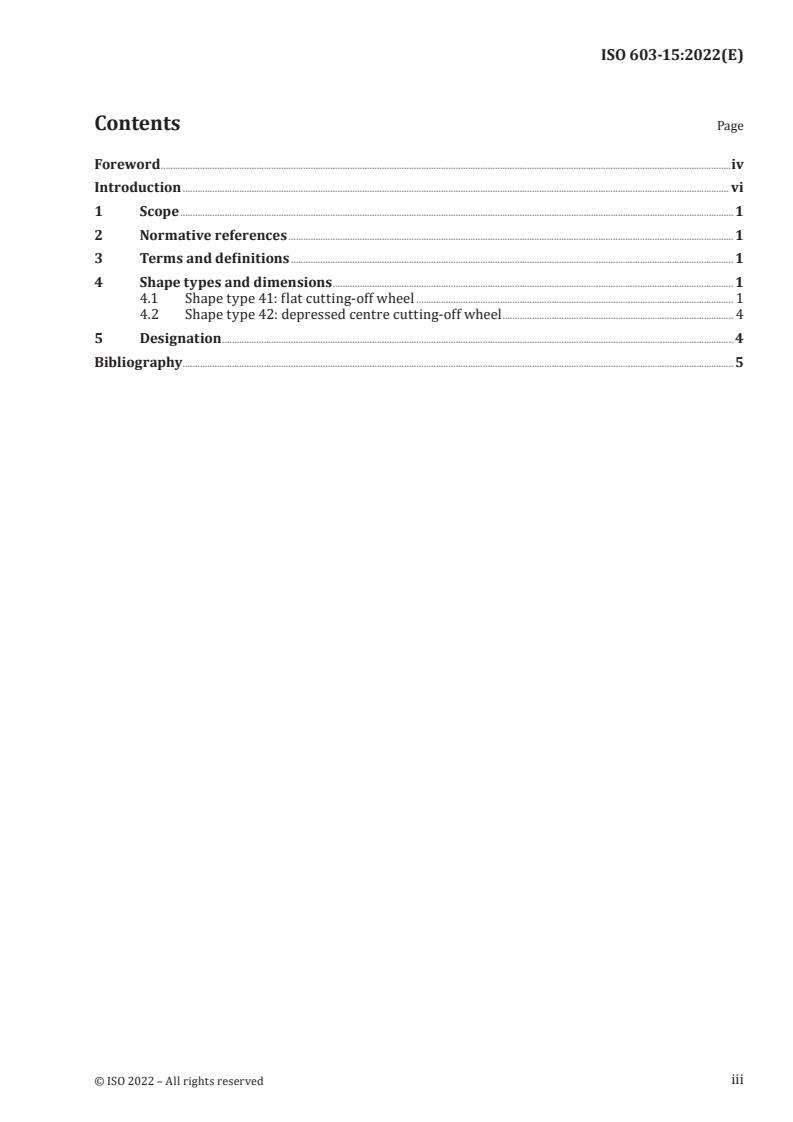
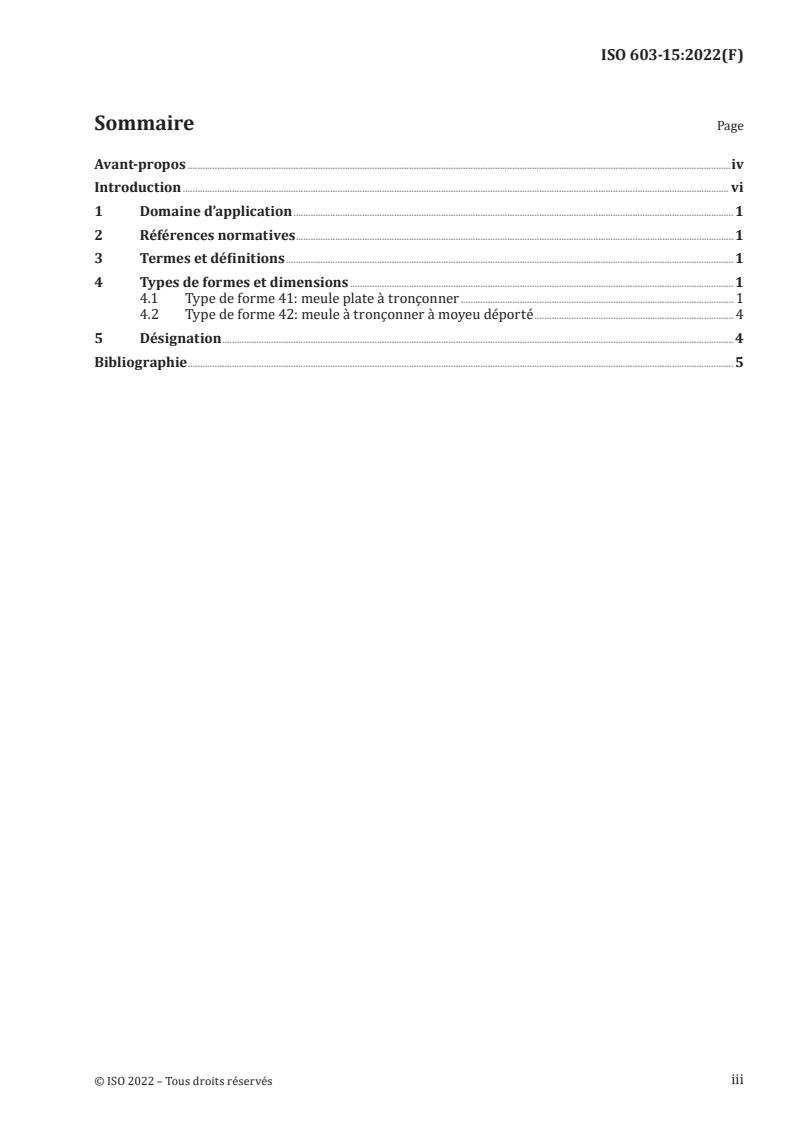
Contents Page
Foreword .iv
Introduction . vi
1 Scope . 1
2 Normative references . 1
3 Terms and definitions . 1
4 Shape types and dimensions . 1
4.1 Shape type 41: flat cutting-off wheel . 1
4.2 Shape type 42: depressed centre cutting-off wheel . 4
5 Designation . 4
Bibliography . 5
iii
Foreword
ISO (the International Organization for Standardization) is a worldwide federation of national standards
bodies (ISO member bodies). The work of preparing International Standards is normally carried out
through ISO technical committees. Each member body interested in a subject for which a technical
committee has been established has the right to be represented on that committee. International
organizations, governmental and non-governmental, in liaison with ISO, also take part in the work.
ISO collaborates closely with the International Electrotechnical Commission (IEC) on all matters of
electrotechnical standardization.
The procedures used to develop this document and those intended for its further maintenance are
described in the ISO/IEC Directives, Part 1. In particular, the different approval criteria needed for the
different types of ISO documents should be noted. This document was drafted in accordance with the
editorial rules of the ISO/IEC Directives, Part 2 (see www.iso.org/directives).
Attention is drawn to the possibility that some of the elements of this document may be the subject of
patent rights. ISO shall not be held responsible for identifying any or all such patent rights. Details of
any patent rights identified during the development of the document will be in the Introduction and/or
on the ISO list of patent declarations received (see www.iso.org/patents).
Any trade name used in this document is information given for the convenience of users and does not
constitute an endorsement.
For an explanation of the voluntary nature of standards, the meaning of ISO specific terms and
expressions related to conformity assessment, as well as information about ISO's adherence to
the World Trade Organization (WTO) principles in the Technical Barriers to Trade (TBT), see
www.iso.org/iso/foreword.html.
This document was prepared by Technical Committee ISO/TC 29, Small tools, Subcommittee SC 5,
Grinding wheels and abrasives.
This second edition cancels and replaces the first edition (ISO 603-15:1999), which has been technically
revised.
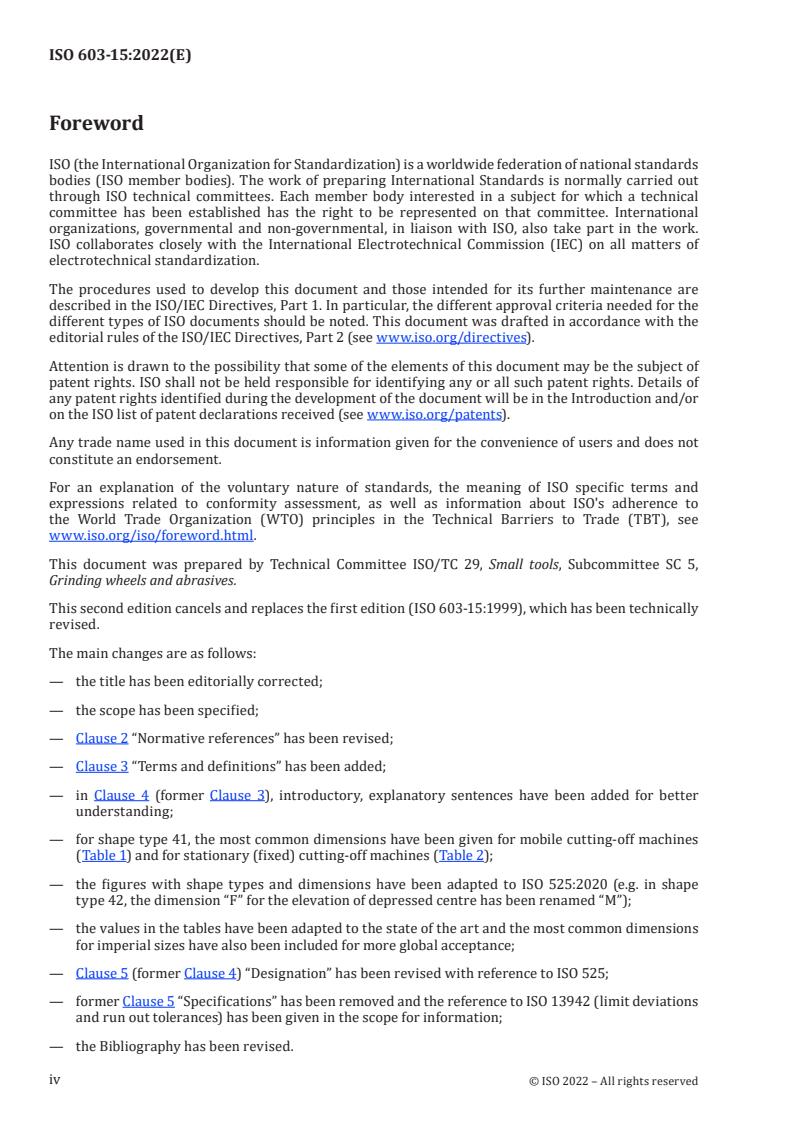
The main changes are as follows:
— the title has been editorially corrected;
— the scope has been specified;
— Clause 2 “Normative references” has been revised;
— Clause 3 “Terms and definitions” has been added;
— in Clause 4 (former Clause 3), introductory, explanatory sentences have been added for better
understanding;
— for shape type 41, the most common dimensions have been given for mobile cutting-off machines
(Table 1) and for stationary (fixed) cutting-off machines (Table 2);
— the figures with shape types and dimensions have been adapted to ISO 525:2020 (e.g. in shape
type 42, the dimension “F” for the elevation of depressed centre has been renamed “M”);
— the values in the tables have been adapted to the state of the art and the most common dimensions
for imperial sizes have also been included for more global acceptance;
— Clause 5 (former Clause 4) “Designation” has been revised with reference to ISO 525;
— former Clause 5 “Specifications” ha
...
NORME ISO
INTERNATIONALE 603-15
Deuxième édition
2022-09
Produits abrasifs agglomérés —
Dimensions —
Partie 15:
Meules pour tronçonnage sur
machines de tronçonnage fixes ou
mobiles
Bonded abrasive products — Dimensions —
Part 15: Cutting-off wheels on stationary or mobile cutting-off
machines
Numéro de référence
DOCUMENT PROTÉGÉ PAR COPYRIGHT
© ISO 2022
Tous droits réservés. Sauf prescription différente ou nécessité dans le contexte de sa mise en œuvre, aucune partie de cette
publication ne peut être reproduite ni utilisée sous quelque forme que ce soit et par aucun procédé, électronique ou mécanique,
y compris la photocopie, ou la diffusion sur l’internet ou sur un intranet, sans autorisation écrite préalable. Une autorisation peut
être demandée à l’ISO à l’adresse ci-après ou au comité membre de l’ISO dans le pays du demandeur.
ISO copyright office
Case postale 401 • Ch. de Blandonnet 8
CH-1214 Vernier, Genève
Tél.: +41 22 749 01 11
E-mail: copyright@iso.org
Web: www.iso.org
Publié en Suisse
ii
Sommaire Page
Avant-propos .iv
Introduction . vi
1 Domaine d’application . 1
2 Références normatives .1
3 Termes et définitions . 1
4 Types de formes et dimensions . 1
4.1 Type de forme 41: meule plate à tronçonner . 1
4.2 Type de forme 42: meule à tronçonner à moyeu déporté . 4
5 Désignation . 4
Bibliographie . 5
iii
Avant-propos
L'ISO (Organisation internationale de normalisation) est une fédération mondiale d'organismes
nationaux de normalisation (comités membres de l'ISO). L'élaboration des Normes internationales est
en général confiée aux comités techniques de l'ISO. Chaque comité membre intéressé par une étude
a le droit de faire partie du comité technique créé à cet effet. Les organisations internationales,
gouvernementales et non gouvernementales, en liaison avec l'ISO participent également aux travaux.
L'ISO collabore étroitement avec la Commission électrotechnique internationale (IEC) en ce qui
concerne la normalisation électrotechnique.
Les procédures utilisées pour élaborer le présent document et celles destinées à sa mise à jour sont
décrites dans les Directives ISO/IEC, Partie 1. Il convient, en particulier, de prendre note des différents
critères d'approbation requis pour les différents types de documents ISO. Le présent document a
été rédigé conformément aux règles de rédaction données dans les Directives ISO/IEC, Partie 2 (voir
www.iso.org/directives).
L'attention est attirée sur le fait que certains des éléments du présent document peuvent faire l'objet de
droits de propriété intellectuelle ou de droits analogues. L'ISO ne saurait être tenue pour responsable
de ne pas avoir identifié de tels droits de propriété et averti de leur existence. Les détails concernant
les références aux droits de propriété intellectuelle ou autres droits analogues identifiés lors de
l'élaboration du document sont indiqués dans l'Introduction et/ou dans la liste des déclarations de
brevets reçues par l'ISO (voir www.iso.org/brevets).
Les appellations commerciales éventuellement mentionnées dans le présent document sont données
pour information, par souci de commodité, à l’intention des utilisateurs et ne sauraient constituer un
engagement.
Pour une explication de la nature volontaire des normes, la signification des termes et expressions
spécifiques de l'ISO liés à l'évaluation de la conformité, ou pour toute information au sujet de l'adhésion
de l'ISO aux principes de l’Organisation mondiale du commerce (OMC) concernant les obstacles
techniques au commerce (OTC), voir www.iso.org/avant-propos.
Le présent document a été élaboré par le comité technique ISO/TC 29, Petit outillage, sous-comité SC 5,
Meules et abrasifs.
Cette deuxième édition annule et remplace la première édition (ISO 603-15:1999), qui a fait l’objet d’une
révision technique.
Les principales modifications sont les suivantes:
— le titre a été corrigé sur le plan rédactionnel;
— le domaine d’application a été spécifié;
— l’Article 2 «Références normatives» a été révisé;
— l’Article 3 «Termes et définitions» a été ajouté;
— dans l’Article 4 (ancien Article 3), des phrases introductives et explicatives ont été ajoutées pour
une meilleure compréhension;
— pour le type de forme 41, les dimensions les plus courantes ont été données pour les machines
de tronçonnage mobiles (Tableau 1) et pour les machines de tronçonnage stationnaires (fixes)
(Tableau 2);
— les figures avec les types de forme et les dimensions ont été adaptées à l’ISO 525:2020 (par exemple,
dans le type de forme 42, la dimension «F» pour l’élévation du moyeu déporté a été renommée «M»);
— les valeurs dans les tableaux ont été adaptées à l’état de l’Art et les dimensions les plus courantes
pour les tailles impériales ont également été incluses pour une acceptation plus globale;
iv
— l’Article 5 (ancien Article 4) «Désignation» a été rév
...