

ISO/IEC 14417:1999
(Main)Information technology — Data recording format DD-1 for magnetic tape cassette conforming to IEC 1016
General Information
- Abstract
This International Standard specifies the media characteristics, the recorded tape format and file structure requirements to enable information interchange between information processing systems using 19,0 mm wide magnetic tape and cassette conforming to IEC 61016 Section 2.
- Status
- Published
- Publication Date
- 31-Mar-1999
- Current Stage
- 9093 - International Standard confirmed
- Start Date
- 21-Aug-2020
- Completion Date
- 29-Aug-2026


Overview
ISO/IEC 14417:1999 defines the DD-1 data recording format for magnetic tape cassettes using 19.0 mm (3/4 inch) wide tape. The standard specifies the media characteristics, recorded tape format and file structure requirements needed to enable reliable information interchange between information processing systems that use compatible cassettes (see referenced cassette standard in the document). ISO/IEC 14417 covers physical, electrical and logical recording aspects to ensure interoperability, data integrity and predictable behaviour in generation, transmission and reception of recorded data.
Key topics and requirements
The standard addresses technical areas required for a complete tape recording specification, including:
- Conformance classes for magnetic tape cassettes, generating systems and receiving systems to ensure interoperability.
- Definitions and terminology (blocks, sectors, tracks, azimuth, sync patterns, preamble/postamble, annotation records) to standardize file format semantics.
- Environmental and safety conditions: testing, operating and storage environments and cassette conditioning.
- Cassette and tape mechanical properties: cassette dimensions, identification features, leaders, splices, tape wind and dimensional tolerances.
- Tape electrical and magnetic properties: coating, average signal amplitude (ASA), resolution, magnetic coating characteristics, erasure/erase fields and signal quality metrics (e.g., digital sum, DSV/CDS concepts).
- Track and recording format: helical track layout, track sets, sector and file structure, sync patterns and reference fields for reliable read/write alignment.
- Reference and test methods: master/secondary reference tapes, standard reference amplitude/current, and conformance test requirements.
- File structure and logical volume management to support interchange and indexing of recorded data.
Applications and who uses it
ISO/IEC 14417 is practical for organizations working with legacy or specialized magnetic tape media where compatibility and long-term interchange are required:
- Tape drive and cassette manufacturers implementing compliant hardware and firmware.
- Data migration and archival professionals standardizing media for long-term preservation and transfer.
- Test laboratories and QA teams validating tape media and recording systems against conformance criteria.
- Systems integrators and OEMs building devices or workflows that read/write 19.0 mm tape cassettes.
- Enterprise IT operations maintaining heterogeneous environments that require predictable tape interchange.
By following ISO/IEC 14417, stakeholders can reduce data loss risk, ensure consistent signal and track layouts, and enable smooth interchange among information processing systems.
Related standards
- IEC/ISO cassette physical standards referenced in the document (e.g., IEC 61016 / ISO/IEC 1016 as applicable)
- Other ISO/IEC magnetic recording and media standards governing tape formats and testing methods
Get Certified
Connect with accredited certification bodies for this standard

BSI Group
BSI (British Standards Institution) is the business standards company that helps organizations make excellence a habit.

NYCE
Mexican standards and certification body.
Sponsored listings
Frequently Asked Questions
ISO/IEC 14417:1999 is a standard published by the International Organization for Standardization (ISO). Its full title is "Information technology — Data recording format DD-1 for magnetic tape cassette conforming to IEC 1016". This standard covers: This International Standard specifies the media characteristics, the recorded tape format and file structure requirements to enable information interchange between information processing systems using 19,0 mm wide magnetic tape and cassette conforming to IEC 61016 Section 2.
This International Standard specifies the media characteristics, the recorded tape format and file structure requirements to enable information interchange between information processing systems using 19,0 mm wide magnetic tape and cassette conforming to IEC 61016 Section 2.
ISO/IEC 14417:1999 is classified under the following ICS (International Classification for Standards) categories: 35.220.23 - Cassettes and cartridges for magnetic tapes. The ICS classification helps identify the subject area and facilitates finding related standards.
ISO/IEC 14417:1999 is available in PDF format for immediate download after purchase. The document can be added to your cart and obtained through the secure checkout process. Digital delivery ensures instant access to the complete standard document.
Standards Content (Sample)
INTERNATIONAL ISO/IEC
STANDARD 14417
First edition
1999-03-15
Information technology — Data recording
format DD-1 for magnetic tape cassette
conforming to ISO/IEC 1016
Technologies de l'information — Format d'enregistrement des données
DD-1 pour cassette à bande magnétique conforme à l'ISO/CEI 1016
Reference number
B C
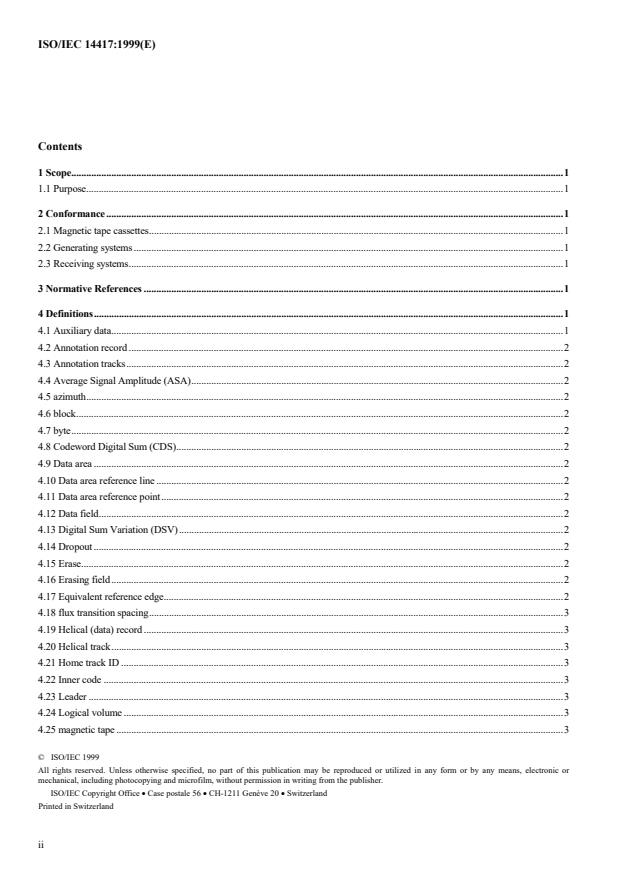
Contents
1 Scope.1
1.1 Purpose.1
2 Conformance .1
2.1 Magnetic tape cassettes.1
2.2 Generating systems .1
2.3 Receiving systems.1
3 Normative References .1
4 Definitions.1
4.1 Auxiliary data.1
4.2 Annotation record .2
4.3 Annotation tracks.2
4.4 Average Signal Amplitude (ASA).2
4.5 azimuth.2
4.6 block.2
4.7 byte.2
4.8 Codeword Digital Sum (CDS).2
4.9 Data area .2
4.10 Data area reference line .2
4.11 Data area reference point.2
4.12 Data field.2
4.13 Digital Sum Variation (DSV).2
4.14 Dropout.2
4.15 Erase.2
4.16 Erasing field.2
4.17 Equivalent reference edge.2
4.18 flux transition spacing.3
4.19 Helical (data) record .3
4.20 Helical track.3
4.21 Home track ID .3
4.22 Inner code .3
4.23 Leader .3
4.24 Logical volume .3
4.25 magnetic tape .3
© ISO/IEC 1999
All rights reserved. Unless otherwise specified, no part of this publication may be reproduced or utilized in any form or by any means, electronic or
mechanical, including photocopying and microfilm, without permission in writing from the publisher.
ISO/IEC Copyright Office • Case postale 56 • CH-1211 Genève 20 • Switzerland
Printed in Switzerland
ii
©
ISO/IEC
4.26 Master Standard Reference Tape.3
4.27 Outer code.3
4.28 physical recording density .3
4.29 Postamble.3
4.30 Preamble.3
4.31 reference edge .3
4.32 reference field.3
4.33 Resolution .3
4.34 Secondary Standard Reference Tape.4
4.35 Sector.4
4.36 Sector recording tolerance .4
4.37 Standard Reference Amplitude.4
4.38 Standard Reference Current.4
4.39 Sync pattern.4
4.40 Tape mark .4
4.41 Tolerance zones .4
4.42 track.4
4.43 track angle .4
4.44 Track Set .4
4.45 Track Set ID (TSID) .4
4.46 Volume set .4
5 Conventions and notations.5
5.1 Representation of numbers.5
5.2 Names.5
5.3 Acronyms .5
6 Environmental and safety .6
6.1 Testing environment.6
6.2 Operating environment .6
6.3 Cassette conditioning .6
6.4 Storage environment .6
6.5 Safety.6
7 Cassette.7
7.1 General description .7
7.2 Dimensions.7
7.3 Identification holes.7
8 Tape mechanical and electrical properties.8
8.1 Materials.8
8.2 Tape width and tolerance.8
8.3 Delta width.8
8.4 Reference edge straightness.8
8.5 Tape thickness.8
iii
©
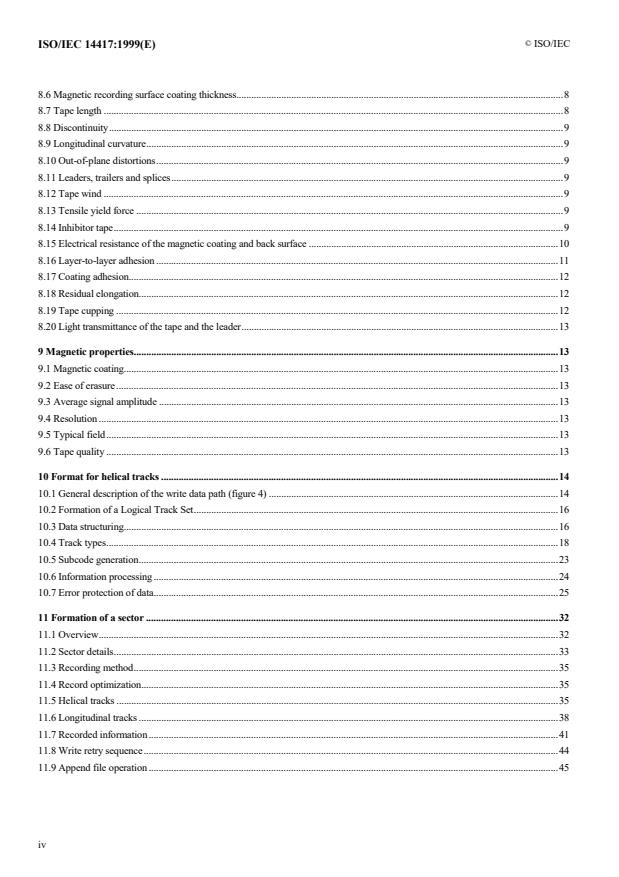
ISO/IEC
8.6 Magnetic recording surface coating thickness.8
8.7 Tape length .8
8.8 Discontinuity.9
8.9 Longitudinal curvature.9
8.10 Out-of-plane distortions.9
8.11 Leaders, trailers and splices.9
8.12 Tape wind .9
8.13 Tensile yield force .9
8.14 Inhibitor tape.9
8.15 Electrical resistance of the magnetic coating and back surface .10
8.16 Layer-to-layer adhesion .11
8.17 Coating adhesion.12
8.18 Residual elongation.12
8.19 Tape cupping .12
8.20 Light transmittance of the tape and the leader.13
9 Magnetic properties.13
9.1 Magnetic coating.13
9.2 Ease of erasure.13
9.3 Average signal amplitude .13
9.4 Resolution .13
9.5 Typical field.13
9.6 Tape quality .13
10 Format for helical tracks .14
10.1 General description of the write data path (figure 4) .14
10.2 Formation of a Logical Track Set.16
10.3 Data structuring.16
10.4 Track types.18
10.5 Subcode generation.23
10.6 Information processing .24
10.7 Error protection of data.25
11 Formation of a sector .32
11.1 Overview.32
11.2 Sector details.33
11.3 Recording method.35
11.4 Record optimization.35
11.5 Helical tracks .35
11.6 Longitudinal tracks .38
11.7 Recorded information.41
11.8 Write retry sequence.44
11.9 Append file operation .45
iv
©
ISO/IEC
Annexes
A Measurement of light transmittance .46
B Tables.49
C Append file and file termination.57
D Examples of subcode data fields in sequences of track type.63
E Recommendations for transportation.65
F Error management systems.66
G Secondary reference tape user procedure .74
H Example of data record termination.76
I Physical to logical data structure mapping .77
Bibliography .78
v
©
ISO/IEC
Foreword
ISO (the International Organization for Standardization) and IEC (the International Electrotechnical Commission) form the
specialized system for worldwide standardization. National bodies that are members of ISO or IEC participate in the
development of International Standards through technical committees established by the respective organization to deal with
particular fields of technical activity. ISO and IEC technical committees collaborate in fields of mutual interest. Other
international organizations, governmental and non-governmental, in liaison with ISO and IEC, also take part in the work.
In the field of information technology, ISO and IEC have established a joint technical committee, ISO/IEC JTC 1. Draft
International Standards adopted by the joint technical committee are circulated to national bodies for voting. Publication as an
International Standard requires approval by at least 75 % of the national bodies casting a vote.
International Standard ISO/IEC 14417 was prepared by Joint Technical Committee ISO/IEC JTC 1, Information technology,
Subcommittee SC 11, Flexible magnetic media for digital data interchange.
Annexes A to C form an integral part of this International Standard. Annexes D to I are for information only.
vi
©
INTERNATIONAL STANDARD ISO/IEC ISO/IEC 14417:1999(E)
Information technology - Data recording format DD-1 for magnetic tape
cassette conforming to IEC 61016
1 Scope
This International Standard specifies the media characteristics, the recorded tape format and file structure requirements to
enable information interchange between information processing systems using 19,0 mm wide magnetic tape and cassette
conforming to IEC 61016 Section 2.
1.1 Purpose
The purpose of this International Standard is to define the format necessary to ensure information interchange at acceptable
performance levels.
The interchange parties complying with the applicable standards should be able to achieve compatibility without the need for
additional exchange of technical information.
2 Conformance
2.1 Magnetic tape cassettes
Each size / capacity of magnetic tape cassette shall be in conformance with this International Standard if it satisfies all mandatory
requirements of this International Standard and IEC 61016 Section Two. If both Standards specify the same subjects differently,
then this International Standard shall prevail. The tape requirements shall be satisfied throughout the extent of the tape.
2.2 Generating systems
A system generating a magnetic tape cassette for interchange shall be entitled to claim conformance with this International
Standard if all the recordings that it makes on a tape according to 2.1 meet the mandatory requirements of this International
Standard. If there is a choice, e.g. cassette size, at least one shall meet the mandatory requirements of this International
Standard.
2.3 Receiving systems
A system receiving a magnetic tape cassette for interchange shall be entitled to claim conformance with this International
Standard if it is able to handle any recording made on the tape according to 2.1. If there is a choice, e.g. tape thickness, at least
one shall meet the mandatory requirements of this International Standard.
3 Normative References
The following normative documents contain provisions which, through reference in this text, constitute provisions of this
International Standard. For dated references, subsequent amendments to, or revisions of, any of these publications do not apply.
However, parties to agreements based on this International Standard are encouraged to investigate the possibility of applying the
most recent editions of the normative documents indicated below. For undated references, the latest edition of the normative
document referred to applies. Members of ISO and IEC maintain registers of currently valid International Standards.
ISO/IEC 646:1991, Information technology — ISO 7-bit coded character set for information interchange.
ISO 1001:1986, Information processing — File structure and labelling of magnetic tapes for information interchange.
IEC 61016, Helical-scan digital component video cassette recording system using 19 mm magnetic tape (format D-1),
Section 2 — Videotape cassette.
4 Definitions
4.1 Auxiliary data
Optional information of secondary importance.
©
ISO/IEC
4.2 Annotation record
The magnetization pattern or associated information recorded in the annotation track.
4.3 Annotation tracks
Two longitudinal tracks one each at each tape edge.
4.4 Average Signal Amplitude (ASA)
The average peak-to-peak value of the signal output of the read head measured over a minimum of 280 000 flux transitions,
exclusive of dropouts.
4.5 azimuth
The angular deviation, in degrees and minutes of arc, of the recorded flux transitions on a track from the line perpendicular to
the track centerline.
4.6 block
A group of bytes transported between host and controller as a unit and considered a minimum locatable unit; containing one or
more logical records or portions of logical records.
4.7 byte
An ordered set of 8 bits acted on as a unit.
4.8 Codeword Digital Sum (CDS)
The digital sum variation from the beginning to the end of a NRZI(1) symbol’s waveform. The CDS is calculated assuming that
the NRZI(1) waveform starts at a negative level, the binary -1 and +1, and the waveform transitions are centred relative to the
corresponding bit cells.
4.9 Data area
An area on tape that is defined by the end points of all possible helical track center lines.
4.10 Data area reference line
A basic dimension which shall be exactly 1,8075 mm from the tape reference edge (no tolerence).
4.11 Data area reference point
The point on the centreline of a helical track at the boundry between preamble run-up and preamble sync pattern.
4.12 Data field
A continuous string of bits that is error protected.
4.13 Digital Sum Variation (DSV)
The accumulated sum of the CDS values of the NRZI(1) symbols.
4.14 Dropout
The point of read signal amplitude below a given threshold.
4.15 Erase
The removal of all magnetically recorded information from the tape.
4.16 Erasing field
An a. c. magnetic field of sufficient strength to remove the recorded signals from the tape.
4.17 Equivalent reference edge
For measurement of the recorded track format, the average location of the reference edge over a given length.
©
ISO/IEC
4.18 flux transition spacing
The distance along a track between successive flux transitions. The spacing is derived from the inverse of flux transitions per
millimeter (ftpmm) (See physical record density.)
4.19 Helical (data) record
The magnetization pattern or associated information recorded in all possible helical tracks.
4.20 Helical track
An area on tape, inclined at a small angle to the reference edge of the tape.
4.21 Home track ID
A recorder manufacturer defined field used to identify the scanner head recording the first track of a track set.
4.22 Inner code
Of the sequential error detection and correction codes, the first encountered on playback from tape (C1).
4.23 Leader
A nonmagnetic length of transparent tape joined to each end of the magnetic tape to provide strength and convenience. At the
beginning of the tape, it identifies the storage position of the tape. At the end of the tape, it indicates that the permissible
recording area has been exceeded.
4.24 Logical volume
A collection of related files, without regard to physical container size.
4.25 magnetic tape
A tape which will accept and retain the magnetic signals intended for input, output, and storage purposes on computers and
associated equipment.
4.26 Master Standard Reference Tape
The tape selected to establish the standard for tape properties essential to data interchange.
Note - A master standard reference tape has been established. It has been agreed that Sony Corporation will maintain the master standard
reference tape. (See secondary standard reference tape.)
4.27 Outer code
Of the sequential error detection and correction codes, the second encountered on playback from tape (C2).
4.28 physical recording density
The number of recorded flux transitions per unit length of track, e.g., flux transitions per millimeter (ftpmm).
4.29 Postamble
A sequence of bits recorded at the end of each helical track on a magnetic tape to provide flux transitions and special padding
area to clear the decoding circuitry and provide tolerance area.
4.30 Preamble
A sequence of bits recorded at the beginning of each helical track on a magnetic tape to provide electronic synchronization.
4.31 reference edge
The lower edge of the tape when viewing the recording surface with the supply reel to the observer’s right.
4.32 reference field
The typical field of the master standard reference tape.
4.33 Resolution
The ratio of the average signal amplitude at the physical recording density of 2252 ftpmm to that at the physical recording
density of 280 ftpmm.
©
ISO/IEC
4.34 Secondary Standard Reference Tape
A tape, the performance of which is known and stated in relation to that of the master standard reference tape.
Note - A master standard reference tape has been established. The Sony Corporation will make available for purchase, secondary standard
reference tapes that can be ordered (P/N C2B-D1) until the year 2007. For information contact:
Sony Corporation, Magnetic Products Group, Major Customer Sales Division,
6-7-35 Kitashinagawa, Shinagawa-ku, Tokyo 141, Japan,
Tel: 81-3-5448-3560, Fax: 81-3-5448-7701, Tlx: SONYCORPJ22262
4.35 Sector
The helical record pertaining to a single helical track.
4.36 Sector recording tolerance
The maximum allowable distance of the data area reference point from the intersection of track center line and data area
reference line.
4.37 Standard Reference Amplitude
The average peak-to-peak signal amplitude output from the master standard reference tape when it is recorded with the standard
reference current. The signal amplitude shall be averaged over at least 280 000 flux transitions. Traceability to the standard
reference is provided by the secondary standard reference tape.
4.38 Standard Reference Current
The current required to produce the reference field.
4.39 Sync pattern
A magnetization pattern defining the start of each sync block and the postamble or, following the preamble run-up.
4.40 Tape mark
A special block recorded on magnetic tape to serve as a separator between files and file labels, or to define the end of recorded
data.
4.41 Tolerance zones
Narrow zones established to contain completely the track center lines of six consecutive helical tracks.
4.42 track
A narrow, defined area on tape along which a series of magnetic signals may be recorded.
4.43 track angle
The angular deviation, expressed in degrees and minutes of arc calculated from arcsine of (16/170), of the centerline of the
recorded helical track from the equivalent reference edge of the tape.
4.44 Track Set
Four consecutive helical tracks uniquely identified by a track set ID.
4.45 Track Set ID (TSID)
A 23 bit binary field which is a common identifier for a set of four consecutive helical tracks. Each track set ID is recorded at
the start of the helical tracks as part of the control record, and also recorded on the control track.
4.46 Volume set
A collection of logical volumes.
©
ISO/IEC
5 Conventions and notations
5.1 Representation of numbers
− A measured value is rounded off to the least significant digit of the corresponding specified value. It implies that a
specified value of 1,26 with a positive tolerance of 0,01, and a negative tolerance of 0,02 allows a range of measured
values from 1,235 (inclusive) to 1,275 (exclusive).
− Letters and digits in parentheses represent numbers in hexadecimal notation.
− The setting of a bit is denoted by ZERO or ONE.
− Numbers in binary notation and bit combinations are represented by strings of 0s and 1s. Within such strings, X may be
used to indicate that the setting of a bit is not specified within the string.
− Numbers in binary notation and bit combinations are shown as Words with the MSB to the left, and with the msb in
each byte to the left.
− Negative values of numbers in binary notion are given in TWOs complement.
5.2 Names
Proper names and basic elements are written with a capital initial letter.
5.3 Acronyms
ASA Average Signal Amplitude
CRC Cyclic Redundancy Check
DIT Directory Information Table
DM Dummy
DSV Digital Sum Variation
ECC Error Correction Code
EOD End of Data
FIT File Information Table
LBOT Logical Beginning of Tape
LEOT Logical End of Tape
ELD End of Label Data
LSB Least Significant Byte
lsb least significant bit
MSB Most Significant Byte
msb most significant bit
NEOT Near End of Tape
PBOT Physical Beginning of Tape
PEOT Physical End of Tape
TM Tape Mark
TSID Track Set Identification
UD User Data
UHL User Header Label
UIT User Information Table
UT Update Table
©
ISO/IEC
VEOV Virtual End of Volume
VIT Volume Information Table
VSIT Volume Set Information Table
6 Environmental and safety
6.1 Testing environment
Tests and measurements made on the tape to check the requirements of this standard shall be made under the following
conditions unless otherwise specified:
temperature: 20 °C ± 1 °C (Ref. ISO/IEC 1016);
relative humidity: 48% to 52%;
barometric pressure: 96 kPa ± 10 kPa;
tape tension: 0,80N ± 0,05N;
conditioning before testing: cassette shall be exposed to the test
environment for 24 h min.
6.2 Operating environment
Cassettes used for data interchange shall be operated under the following conditions:
temperature: 5 °C to 45 °C;
relative humidity: 20% to 80% non-condensing;
wet bulb temperature: 26 °C max.
6.3 Cassette conditioning
For interchange, the cassette shall be conditioned by exposure to the operating environment for a time equal to or greater than
the time away from the operating environment (up to maximum of 24 hours).
Conditioning of the tape stock before recording and testing for compliance to this standard shall be as follows:
storage conditioning: not less than 24 hours;
environmental: stabilized to the conditions specified in 6.1;
tape tension: wound on a reel at a tension of 0,6 N to 1,5 N.
6.4 Storage environment
Cassettes shall be stored under the following conditions:
temperature: 5°C to 32°C;
relative humidity: 40% to 60%.
6.5 Safety
6.5.1 Safeness
The components of the tape and cassette assembly shall not constitute any safety or health hazard when used in the intended
manner, or through any foreseeable misuse in an information processing system.
6.5.2 Flammability
Tape or cassette components that will ignite from a match flame, and when so ignited will continue to burn in a still carbon
dioxide atmosphere, shall not be used.
6.5.3 Toxicity
Tape or cassette components that may cause bodily harm by contact, inhalation, or ingestion during normal use of the cassette shall
not be used.
©
ISO/IEC
7 Cassette
7.1 General description
The cassette is a coplanar design in three sizes with the tape and hubs completely enclosed by the case, except for the hinged
door opening. The drive is via hub couplings which are mechanically connected to external reeling motors. Tape velocity is
stabilized by an external capstan. A clear plastic window allows visual monitoring of the tape from the top of the cassette.
7.2 Dimensions
Dimensions of the three sizes of cassettes are defined in normative reference IEC 1016. section 2.
7.3 Identification holes
There shall be two sets of identification holes, one for the use of the manufacturer and the other for the user. Manufacturers’
coding holes, detailed in normative reference IEC 1016 are further defined in the following clauses.
7.3.1 Manufacturer coding holes
7.3.1.1 Media thickness
Manufacturer holes 1 and 2 shall be used in combination to indicate tape thickness according to the following logic table:
Hole #1 Hole #2 Meaning
0 0 16 μm tape
0 1 13 μm tape
1 0 Undefined/reserved
1 1 Reserved, cleaning cassette only
Note - A 0 in the above tables indicates that the indicator tab is removed or open, denoting an undetected status (0 state) by the recorder/player
sensor mechanism.
7.3.1.2 Media coercivity
Manufacturer holes 3 and 4 shall be used to indicate the coercivity of the magnetic recording tape according to the following
table:
Hole #3 Hole #4 Meaning
0 0 Class 68kA/m
0 1 Reserved
1 0 Undefined/reserved
1 1 Reserved, cleaning cassette only
Note - A 0 in the above tables indicates that the indicator tab is removed or open, denoting an undetected status (0 state) by the recorder/player
sensor mechanism
7.3.2 User coding holes
The user plug mechanism shall withstand a minimum axial force of 0,5 N
The dimensions and location of the users’ holes specified in normative reference IEC 1016 are defined as follows:
When a 0 state exists, the user holes shall identify the following conditions:
Hole Condition
1 Total record lock out (data/auxiliary/time code/control track)
2 Reserved and undefined
3 Reserved and undefined
4 Reserved and undefined
©
ISO/IEC
8 Tape mechanical and electrical properties
8.1 Materials
The tape shall consist of a base film material (oriented polyethylene terephthalate film or its equivalent) coated on one surface
with a strong yet flexible layer of ferromagnetic material dispersed in a suitable binder. A backcoating material may be used.
8.2 Tape width and tolerance
8.2.1 Requirement
The tape width shall be 19,010 mm ± 0,015 mm.
8.2.2 Procedure
The tape, covered with a glass plate, shall be measured without tension at a minimum of five different positions along the tape
using a calibrated microscope or profile projector having an accuracy of at least 2,5 mm. Tape width is defined as the average
of the five readings.
8.3 Delta width
8.3.1 Requirement
Delta width (width fluctuation) shall not exceed 6 mm peak to peak.
8.3.2 Procedure
Measurement of delta width shall be over a minimum tape length of 230 mm with a tension of 1,39 N ± 0,28 N.
8.4 Reference edge straightness
Reference edge straightness is the departure of the reference edge of the tape from a straight line along the longitudinal dimension
of the tape in the plane of the tape surface.
8.4.1 Requirement
The reference edge straightness maximum deviation is 6 mm peak to peak.
8.4.2 Procedure
Edge straightness fluctuation is measured at the edge of a moving tape guided by two guides having contact to the same edge
and separated at a distance of 115 mm. Edge measurements are averaged over 10 mm lengths and are made at the mid-point
between the first and second guide at a tension of 1,00 N ± 0,28 N.
8.5 Tape thickness
Use of tapes with various thicknesses is permitted with the total tape thickness being within the following values:
− nominal 16 μm tape shall have a thickness between 13,5 μm - 16,0 μm;
− nominal 13 μm tape shall have a thickness between 11,0 μm - 13,0 μm.
8.6 Magnetic recording surface coating thickness
The magnetic recording surface coating thickness shall be 2,0 μm - 3,6 μm
Backcoating surface thickness is not sp
...