

ISO 24638:2021
(Main)Space systems — Pressure components and pressure system integration
General Information
- Abstract
This document establishes the baseline requirements for the design, fabrication and testing of space flight pressure components. It also establishes the requirements for the assembly, installation, test, inspection, operation and maintenance of the pressure systems in spacecraft and launch vehicles. These requirements, when implemented on a particular space system, ensure a high level of confidence in achieving safe and reliable operation. This document applies to all pressure components other than pressure vessels and pressurized structures in a pressure system. It covers lines, fittings, valves, bellows, hoses and other appropriate components that are integrated to form a pressure system. The requirements for pressure vessels and pressurized structures are set forth in ISO 14623. This document does not apply to engine components.
- Status
- Published
- Publication Date
- 12-May-2021
- Technical Committee
- ISO/TC 20/SC 14 - Space systems and operations
- Drafting Committee
- ISO/TC 20/SC 14 - Space systems and operations
- Current Stage
- 9060 - Close of review
- Completion Date
- 02-Dec-2031
Buy Documents
ISO 24638:2021 - Space systems -- Pressure components and pressure system integration
ISO 24638:2021 - Space systems — Pressure components and pressure system integration/13/2021
Overview
ISO 24638:2021 - Space systems: Pressure components and pressure system integration defines baseline requirements for the design, fabrication, testing, assembly, installation, inspection, operation and maintenance of pressure components and integrated pressure systems used in spacecraft and launch vehicles. It applies to components such as lines, fittings, valves, bellows, hoses and other non‑vessel pressure parts. The standard supports safe, reliable spaceflight pressure system performance and explicitly excludes pressure vessels/pressurized structures (see ISO 14623) and engine components.
Key topics and technical requirements
ISO 24638 covers a broad range of technical subjects relevant to space systems pressure components and pressure system integration, including:
- Design requirements: loads, pressure and environmental definition, strength, stiffness, thermal effects, stress and fatigue (safe‑life) analyses, and survivability against debris/meteoroid impacts.
- Materials and fabrication: metallic and non‑metallic material selection, processing, contamination control and cleanliness to meet spaceflight requirements.
- Quality & qualification: quality assurance programmes, inspection planning, QA techniques, acceptance testing and qualification test requirements for spaceflight hardware.
- Operation & maintenance: operating procedures, safe operating limits, inspection, repair/refurbishment, storage, reactivation and recertification of pressure components and systems.
- System‑level analysis and design: system pressure and functional analysis, system hazard analysis, routing, assembly, separation, shielding and grounding considerations for integrated pressure systems.
- Component selection & controls: criteria for connections, valves, regulators, pumps, fracture/leakage mitigation, oxygen‑system specifics, interlocks and safety critical control logic.
- Protection & pressure relief: relief device sizing, venting, automatic relief, isolation and negative‑pressure protection for spacecraft and launch vehicle pressure systems.
- Mechanical & electrical environments: acceleration, shock, vibration, torque loads, RF and hazardous-atmosphere considerations for electrically actuated components.
Applications and users
ISO 24638 is essential for organizations involved in the design, manufacture, integration and certification of spaceflight pressure systems, including:
- Aerospace system and mechanical engineers designing spacecraft and launch vehicle fluid systems
- Pressure component manufacturers and suppliers (hoses, fittings, valves, bellows)
- Systems integrators and avionics teams responsible for routing and assembly
- Quality assurance, test laboratories and certification authorities performing qualification and acceptance testing
- Operations, maintenance and ground‑support teams managing safe handling, storage and recertification
Use of ISO 24638 helps ensure consistent pressure system safety, minimizes leakage and failure risk, and supports regulatory compliance and mission reliability.
Related standards
- ISO 14623 - Requirements for pressure vessels and pressurized structures in space systems (complements ISO 24638)
- Other ISO and aerospace standards referenced in ISO 24638 provide normative testing and material specifications (see the standard’s normative references for details).
Relations
- Consolidated By
ISO 18134-3:2023 - Solid biofuels — Determination of moisture content — Part 3: Moisture in general analysis sample - Effective Date
- 06-Jun-2022
- Effective Date
- 15-Jul-2017
Buy Documents
ISO 24638:2021 - Space systems -- Pressure components and pressure system integration
ISO 24638:2021 - Space systems — Pressure components and pressure system integration/13/2021
Get Certified
Connect with accredited certification bodies for this standard

BUREAU VERITAS Certification Germany
Bureau Veritas certification in Germany.

Element Materials Technology
Materials testing and product certification.

AQMS Ltd.
AQMS provides ISO certification to SMEs across the UK.
Sponsored listings
Frequently Asked Questions
ISO 24638:2021 is a standard published by the International Organization for Standardization (ISO). Its full title is "Space systems — Pressure components and pressure system integration". This standard covers: This document establishes the baseline requirements for the design, fabrication and testing of space flight pressure components. It also establishes the requirements for the assembly, installation, test, inspection, operation and maintenance of the pressure systems in spacecraft and launch vehicles. These requirements, when implemented on a particular space system, ensure a high level of confidence in achieving safe and reliable operation. This document applies to all pressure components other than pressure vessels and pressurized structures in a pressure system. It covers lines, fittings, valves, bellows, hoses and other appropriate components that are integrated to form a pressure system. The requirements for pressure vessels and pressurized structures are set forth in ISO 14623. This document does not apply to engine components.
This document establishes the baseline requirements for the design, fabrication and testing of space flight pressure components. It also establishes the requirements for the assembly, installation, test, inspection, operation and maintenance of the pressure systems in spacecraft and launch vehicles. These requirements, when implemented on a particular space system, ensure a high level of confidence in achieving safe and reliable operation. This document applies to all pressure components other than pressure vessels and pressurized structures in a pressure system. It covers lines, fittings, valves, bellows, hoses and other appropriate components that are integrated to form a pressure system. The requirements for pressure vessels and pressurized structures are set forth in ISO 14623. This document does not apply to engine components.
ISO 24638:2021 is classified under the following ICS (International Classification for Standards) categories: 49.140 - Space systems and operations. The ICS classification helps identify the subject area and facilitates finding related standards.
ISO 24638:2021 has the following relationships with other standards: It is inter standard links to ISO 18134-3:2023, ISO 24638:2008. Understanding these relationships helps ensure you are using the most current and applicable version of the standard.
ISO 24638:2021 is available in PDF format for immediate download after purchase. The document can be added to your cart and obtained through the secure checkout process. Digital delivery ensures instant access to the complete standard document.
Standards Content (Sample)
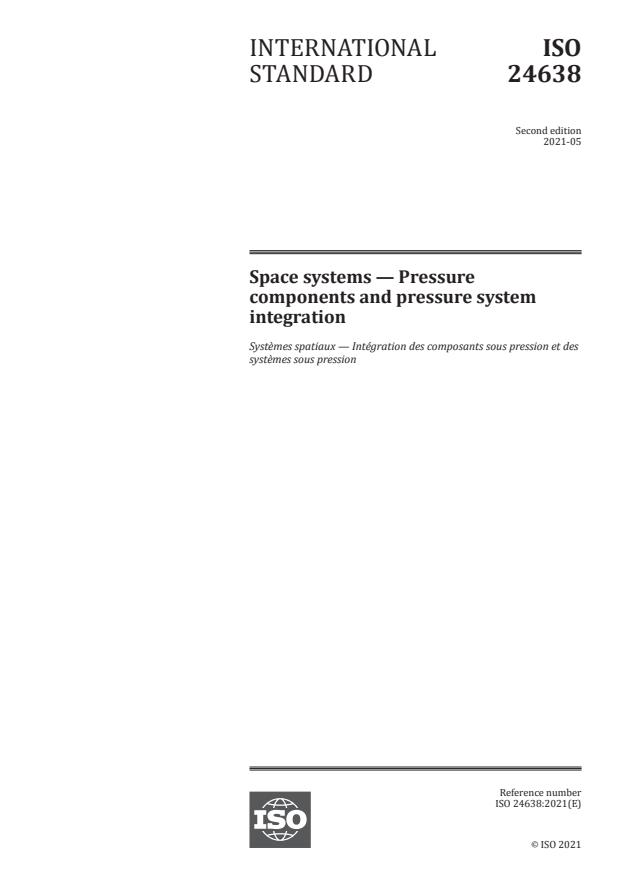
INTERNATIONAL ISO
STANDARD 24638
Second edition
2021-05
Space systems — Pressure
components and pressure system
integration
Systèmes spatiaux — Intégration des composants sous pression et des
systèmes sous pression
Reference number
©
ISO 2021
© ISO 2021
All rights reserved. Unless otherwise specified, or required in the context of its implementation, no part of this publication may
be reproduced or utilized otherwise in any form or by any means, electronic or mechanical, including photocopying, or posting
on the internet or an intranet, without prior written permission. Permission can be requested from either ISO at the address
below or ISO’s member body in the country of the requester.
ISO copyright office
CP 401 • Ch. de Blandonnet 8
CH-1214 Vernier, Geneva
Phone: +41 22 749 01 11
Email: copyright@iso.org
Website: www.iso.org
Published in Switzerland
ii © ISO 2021 – All rights reserved
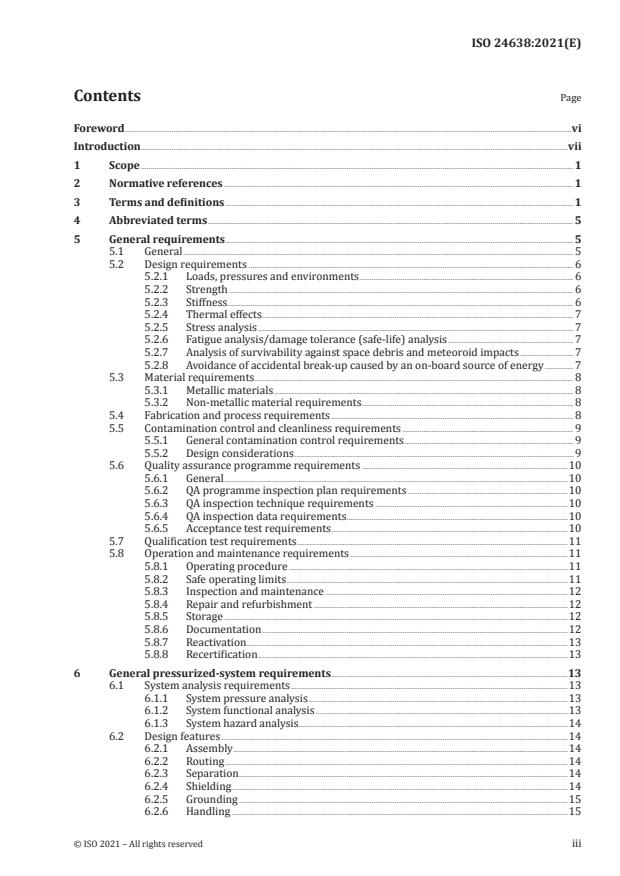
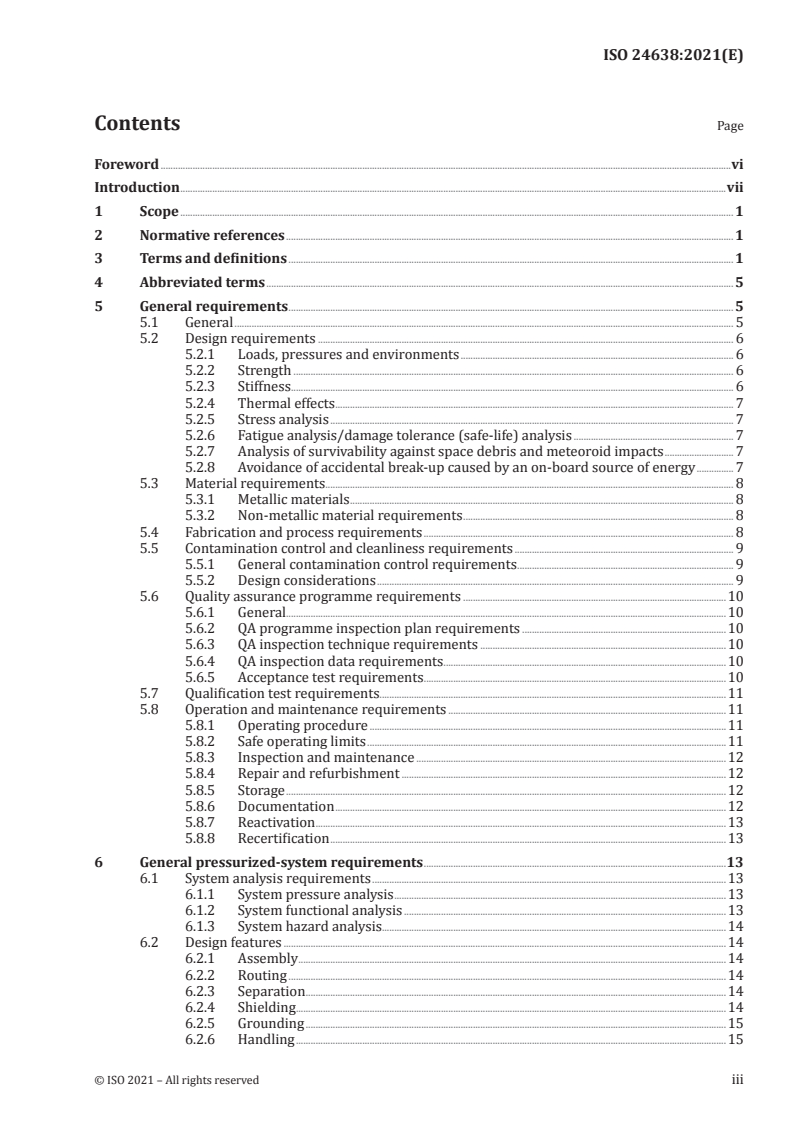
Contents Page
Foreword .vi
Introduction .vii
1 Scope . 1
2 Normative references . 1
3 Terms and definitions . 1
4 Abbreviated terms . 5
5 General requirements . 5
5.1 General . 5
5.2 Design requirements . 6
5.2.1 Loads, pressures and environments . 6
5.2.2 Strength . 6
5.2.3 Stiffness . 6
5.2.4 Thermal effects . 7
5.2.5 Stress analysis . 7
5.2.6 Fatigue analysis/damage tolerance (safe-life) analysis . 7
5.2.7 Analysis of survivability against space debris and meteoroid impacts . 7
5.2.8 Avoidance of accidental break-up caused by an on-board source of energy . 7
5.3 Material requirements. 8
5.3.1 Metallic materials . 8
5.3.2 Non-metallic material requirements . 8
5.4 Fabrication and process requirements . 8
5.5 Contamination control and cleanliness requirements . 9
5.5.1 General contamination control requirements . 9
5.5.2 Design considerations . 9
5.6 Quality assurance programme requirements .10
5.6.1 General.10
5.6.2 QA programme inspection plan requirements .10
5.6.3 QA inspection technique requirements .10
5.6.4 QA inspection data requirements .10
5.6.5 Acceptance test requirements .10
5.7 Qualification test requirements.11
5.8 Operation and maintenance requirements .11
5.8.1 Operating procedure .11
5.8.2 Safe operating limits .11
5.8.3 Inspection and maintenance .12
5.8.4 Repair and refurbishment .12
5.8.5 Storage .12
5.8.6 Documentation .12
5.8.7 Reactivation .13
5.8.8 Recertification .13
6 General pressurized-system requirements .13
6.1 System analysis requirements .13
6.1.1 System pressure analysis .13
6.1.2 System functional analysis .13
6.1.3 System hazard analysis.14
6.2 Design features .14
6.2.1 Assembly .14
6.2.2 Routing .14
6.2.3 Separation .14
6.2.4 Shielding.14
6.2.5 Grounding .15
6.2.6 Handling .15
6.2.7 Special tools .15
6.2.8 Test points .15
6.2.9 Common-plug test connectors .15
6.2.10 Individual test connectors .15
6.2.11 Threaded parts .15
6.2.12 Friction-type locking devices .15
6.2.13 Internally threaded bosses .15
6.2.14 Retainer or snap rings .15
6.2.15 Snubbers .15
6.3 Component selection .16
6.3.1 Connections .16
6.3.2 Fluid temperature .16
6.3.3 Actuator pressure rating .16
6.3.4 Pressure rating .16
6.3.5 Pump selection .16
6.3.6 Fracture and leakage .16
6.3.7 Oxygen system components.16
6.3.8 Pressure regulators .16
6.3.9 Manual valves and regulators .16
6.4 Design pressures .17
6.4.1 Overpressure or underpressure .17
6.4.2 Back-pressure .17
6.4.3 Pressure isolation .17
6.4.4 Gas/fluid separation .17
6.4.5 Compressed-gas bleeding .17
6.5 Mechanical-environment design .17
6.5.1 Acceleration and shock loads .17
6.5.2 Torque loads .17
6.5.3 Vibration loads .17
6.6 Controls .17
6.6.1 Interlocks . .17
6.6.2 Multiple safety-critical functions .18
6.6.3 Critical flows and pressures .18
6.7 Protection .18
6.8 Electrical .18
6.8.1 Hazardous atmospheres .18
6.8.2 Radio frequency energy .18
6.8.3 Grounding .18
6.8.4 Solenoids.18
6.8.5 Electric motor-driven pumps .18
6.9 Pressure relief .18
6.9.1 General requirements .18
6.9.2 Flow capacity .19
6.9.3 Sizing .19
6.9.4 Unmanned flight vehicle servicing .19
6.9.5 Automatic relief .19
6.9.6 Venting .19
6.9.7 Relief valve isolation .19
6.9.8 Negative-pressure protection .19
6.9.9 Reservoir pressure relief .20
6.9.10 Air pressure control .20
6.10 Control devices .20
6.10.1 Directional control valves .20
6.10.2 Overtravel .20
6.10.3 Pressure and volume control stops .20
6.10.4 Manually operated levers .20
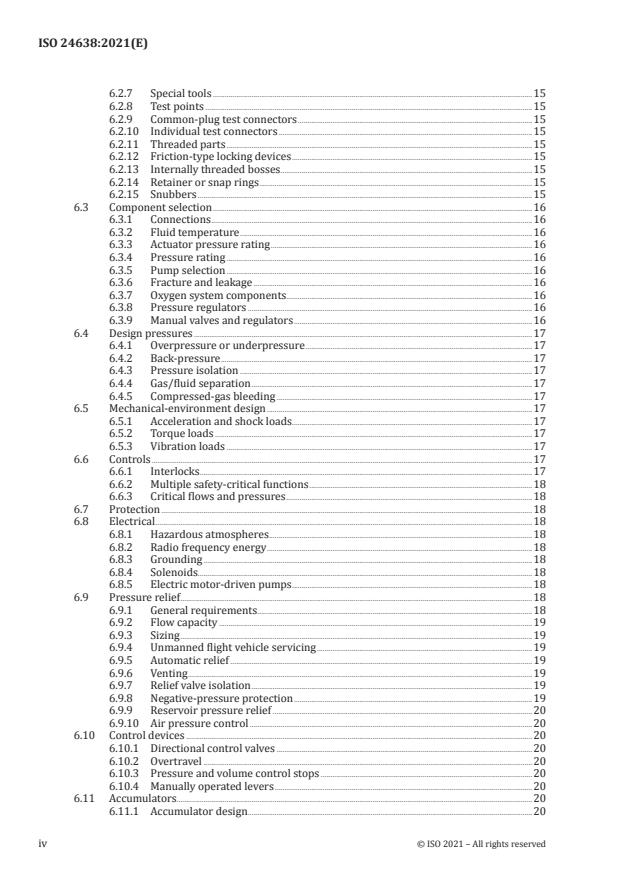
6.11 Accumulators.20
6.11.1 Accumulator design . .20
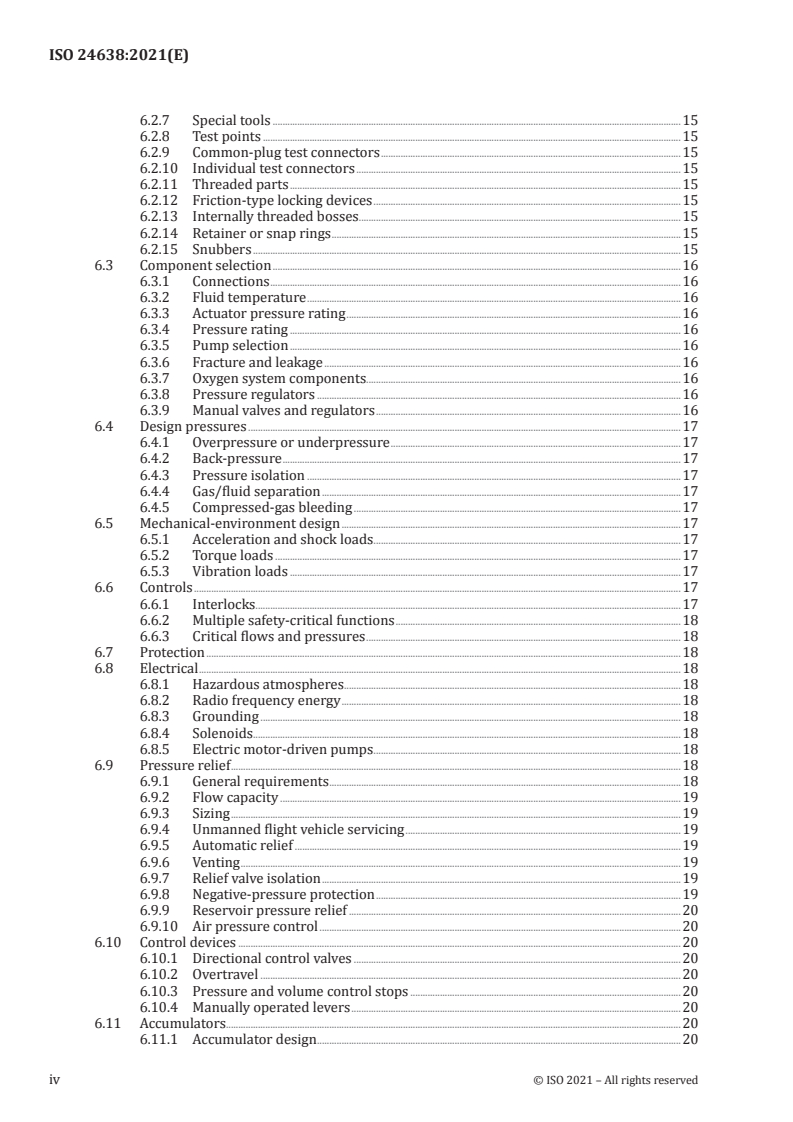
iv © ISO 2021 – All rights reserved
6.11.2 Accumulator gas pressure gauges .21
6.11.3 Accumulator identification .21
6.12 Flexible hose .21
6.12.1 Installation .21
6.12.2 Restraining devices .21
6.12.3 Flexible hose stress .21
6.12.4 Temporary installations .21
7 Specific pressure system requirements .21
7.1 General .21
7.2 Hydraulic systems .22
7.2.1 Hydraulic system components .22
7.2.2 Pressure limit .23
7.2.3 Cavitations .23
7.2.4 Hydraulic lockup .23
7.2.5 Pressure relief .23
7.3 Pneumatic-system requirements .24
7.3.1 Pneumatic-system components .24
7.3.2 Controls .24
Annex A (informative) Recommended minimum safety factors.25
Annex B (informative) Open line force calculation factors .26
Bibliography .27
Foreword
ISO (the International Organization for Standardization) is a worldwide federation of national standards
bodies (ISO member bodies). The work of preparing International Standards is normally carried out
through ISO technical committees. Each member body interested in a subject for which a technical
committee has been established has the right to be represented on that committee. International
organizations, governmental and non-governmental, in liaison with ISO, also take part in the work.
ISO collaborates closely with the International Electrotechnical Commission (IEC) on all matters of
electrotechnical standardization.
The procedures used to develop this document and those intended for its further maintenance are
described in the ISO/IEC Directives, Part 1. In particular, the different approval criteria needed for the
different types of ISO documents should be noted. This document was drafted in accordance with the
editorial rules of the ISO/IEC Directives, Part 2 (see www .iso .org/ directives).
Attention is drawn to the possibility that some of the elements of this document may be the subject of
patent rights. ISO shall not be held responsible for identifying any or all such patent rights. Details of
any patent rights identified during the development of the document will be in the Introduction and/or
on the ISO list of patent declarations received (see www .iso .org/ patents).
Any trade name used in this document is information given for the convenience of users and does not
constitute an endorsement.
For an explanation of the voluntary nature of standards, the meaning of ISO specific terms and
expressions related to conformity assessment, as well as information about ISO's adherence to the
World Trade Organization (WTO) principles in the Technical Barriers to Trade (TBT), see www .iso .org/
iso/ foreword .html.
This document was prepared by Technical Committee ISO/TC 20, Aircraft and space vehicles,
Subcommittee SC 14, Space systems and operations.
This second edition cancels and replaces the first edition (ISO 24638:2008), which has been technically
revised.
The main changes compared to the previous edition are as follows:
— 6.8.4 was revised to make the requirement a more general statement;
— corrections were made to Tables 1 and A.1.
Any feedback or questions on this document should be directed to the user’s national standards body. A
complete listing of these bodies can be found at www .iso .org/ members .html.
vi © ISO 2021 – All rights reserved
Introduction
Space vehicles and their launch systems usually have a series of engines to use for both primary
propulsion and secondary propulsion functions, such as attitude control and spin control.
Different engines have different propellant feed systems. For example, the gas-pressure feed system
is typically used for liquid propellant engines; it consists of a high-pressure gas tank, a fuel tank and
an oxidizer tank, valves and a pressure regulator. All these components are referred to as pressurized
hardware.
Due to their specific usage, the liquid propellant tanks and the high-pressure gas bottles are often
referred to as pressure vessels, while valves, regulators and feed lines are usually called pressure
components.
ISO 14623 sets forth the standard requirements for pressure vessels in order to achieve safe operation
and mission success. However, the requirements for pressure components are not covered in ISO 14623.
Furthermore, the standard requirements for pressure system integration are lacking.
Significant work has been done in the area of design, analysis and testing of pressure components for
use in space systems. This document establishes the preferred methods for these techniques and sets
forth the requirements for the assembly, installation, test, inspection, operation and maintenance of the
pressure systems in spacecraft and launch vehicles.
INTERNATIONAL STANDARD ISO 24638:2021(E)
Space systems — Pressure components and pressure
system integration
1 Scope
This document establishes the baseline requirements for the design, fabrication and testing of space
flight pressure components. It also establishes the requirements for the assembly, installation, test,
inspection, operation and maintenance of the pressure systems in spacecraft and launch vehicles.
These requirements, when implemented on a particular space system, ensure a high level of confidence
in achieving safe and reliable operation.
This document applies to all pressure components other than pressure vessels and pressurized
structures in a pressure system. It covers lines, fittings, valves, bellows, hoses and other appropriate
components that are integrated to form a pressure system.
The requirements for pressure vessels and pressurized structures are set forth in ISO 14623.
This document does not apply to engine components.
2 Normative references
The following documents are referred to in the text in such a way that some or all of their content
constitutes requirements of this document. For dated references, only the edition cited applies. For
undated references, the latest edition of the referenced document (including any amendments) applies.
ISO 14623, Space systems - Pressure vessels and pressurized structures — Design and operation
ISO 21347, Space systems — Fracture and damage control
ISO 24113, Space systems — Space debris mitigation requirements
3 Terms and definitions
For the purposes of this document, the following terms and definitions apply.
ISO and IEC maintain terminological databases for use in standardization at the following addresses:
— ISO Online browsing platform: available at https:// www .iso .org/ obp
— IEC Electropedia: available at http:// www .electropedia .org/
3.1
A-basis allowable
mechanical strength value above which at least 99 % of the population of values is expected to fall, with
a confidence level of 95 %
Note 1 to entry: See also B-basis allowable (3.3).
[SOURCE: ISO 14623:2003, 2.1, modified — Note 1 to entry has been added.]
3.2
applied load
applied stress
actual load (stress) imposed on the hardware in the service environment
[SOURCE: ISO 14623:2003, 2.4, modified — “the structure” has been changed to “the hardware”.]
3.3
B-basis allowable
mechanical strength value above which at least 90 % of the population of values is expected to fall, with
a confidence level of 95 %
Note 1 to entry: See also A-basis allowable (3.1).
[SOURCE: ISO 14623:2003, 2.6, modified — Note 1 to entry has been added.]
3.4
component
set of materials, assembled according to defined and controlled processes, which cannot be disassembled
without destroying its capability and which performs a simple function that can be evaluated against
expected performance requirements
[SOURCE: ISO 10795:2019, 3.48, modified — The preferred term "part" has been removed.]
3.5
damage tolerance
ability of a material/structure to resist failure due to the presence of flaws for a specified period of
unrepaired usage
[SOURCE: ISO 21347:2005, 3.7]
3.6
damage tolerance analysis
safe-life analysis
fracture mechanics-based analysis that predicts the flaw growth behaviour of a flawed hardware item
which is under service loading spectrum (3.15) with a pre-specified scatter factor (3.24)
3.7
design burst pressure
burst pressure
ultimate pressure
differential pressure that pressurized hardware must withstand without burst in the applicable
operational environment
Note 1 to entry: Design burst pressure is equal to the product of the maximum expected operating pressure (MEOP)
(3.17) or maximum design pressure (MDP) (3.16) and a design burst factor.
[SOURCE: ISO 14623:2003, 2.16, modified — In Note 1 to entry, “the MEOP or MDP” has been changed to
“the maximum expected operating pressure (MEOP) or maximum design pressure (MDP)”.]
3.8
design safety factor
safety factor
design factor of safety
factor of safety
multiplying factor to be applied to limit loads (3.13) and/or maximum expected operating pressure
(MEOP) (3.17) or maximum design pressure (MDP) (3.16)
[SOURCE: ISO 14623:2003, 2.17, modified — The preferred term “safety factor” has been added; “MEOP
(or MDP)” has been changed to “maximum expected operating pressure (MEOP) or maximum design
pressure (MDP)“.]
3.9
detrimental deformation
structural deformation, deflection or displacement that prevents any portion of the structure or some
other system from performing its intended function or that jeopardizes mission success
[SOURCE: ISO 10786:2011, 3.16]
2 © ISO 2021 – All rights reserved
3.10
fitting
pressure component (3.18) of a pressurized system used to connect lines (3.14), other pressure
components and/or pressure vessels (3.19) within the system
3.11
hazard
existing or potential condition of an item that can result in an accident
Note 1 to entry: This condition can be associated with the design, fabrication, operation or environment of the
item, and has the potential for introducing an accident.
Note 2 to entry: “Item” can include human beings.
[SOURCE: ISO 10795:2019, 3.120, modified — In note 1 to entry, “the potential for accidents” has been
changed to “the potential for introducing an accident”.]
3.12
hydrogen embrittlement
mechanical-environmental process that results from the initial presence or absorption of excessive
amounts of hydrogen in metals, usually in combination with residual or applied tensile stresses
[SOURCE: ISO 14623:2003, 2.31]
3.13
limit load
design limit load
maximum expected load, or combination of loads, which a structure or a component (3.4) in a structural
assembly is expected to experience during its service life (3.25), in association with the applicable
operating environments
Note 1 to entry: Load is a generic term for thermal load, pressure, external mechanical load (force, moment, or
enforced displacement) or internal mechanical load (residual stress, pretension, or inertial load).
Note 2 to entry: The corresponding stress or strain is called limit stress or limit strain.
[SOURCE: ISO 10786:2011, 3.30, modified — “design limit load” has been added as an admitted term;
Note 3 to the entry describing “design limit load” has been deleted.]
3.14
line
tubular pressure component (3.18) of a pressure system (3.21) provided as a means for transferring
fluids between components (3.4) of the system
Note 1 to entry: Flexible hoses are included.
3.15
loading spectrum
representation of the cumulative loading levels and associated cycles anticipated for the structure or
component (3.4) of a structural assembly according to its service life (3.25) under all expected operating
environments
Note 1 to entry: Significant transportation, test, and handling loads are included in this definition.
[SOURCE: ISO 10786:2011, 3.32]
3.16
maximum design pressure
MDP
highest pressure, as defined by maximum relief pressure, maximum regulator pressure and/or
maximum temperature, including transient pressures, at which a pressurized hardware item retains
two-fault tolerance without failure
[SOURCE: ISO 21347:2005, 3.20, modified — “pressure vessel” has been changed to “pressurized
hardware item”.]
3.17
maximum expected operating pressure
MEOP
maximum allowed working pressure
MAWP
maximum operating pressure
MOP
highest differential pressure which a pressurized hardware item is expected to experience during its
service life (3.25) and retain its functionality, in association with its applicable operating environments
Note 1 to entry: MEOP includes the effects of temperature, transient peaks, relief pressures, regulator pressure,
vehicle acceleration, phase changes, transient pressure excursions, and relief valve tolerance.
Note 2 to entry: Some projects may replace MEOP with maximum design pressure (MDP) (3.16), which takes into
account more conservative conditions.
Note 3 to entry: The terms MAWP and MOP are used when required to replace the term MEOP in a specific
application.
[SOURCE: ISO 14623: 2003, 2.41, Modified — "maximum allowed working pressure", "MAWP",
"maximum operating pressure", "MOP" have been added as admitted terms; notes 1, 2 and 3 to entry
have been added.]
3.18
pressure component
component (3.4) in a pressure system (3.21), other than a pressure vessel (3.19), or pressurized structure
(3.20) that is designed largely by the internal pressure
EXAMPLE Lines (3.14), fittings (3.10), pressure gauges, valves, bellows and hoses.
3.19
pressure vessel
container designed primarily for the storage of pressurized fluids, which either contains gas/liquid
with high energy level, or contains gas/liquid that will create a mishap (accident) if released, or contains
gas/liquid with high pressure level
Note 1 to entry: This definition excludes pressurized structures (3.20) and pressure components (3.18).
Note 2 to entry: Energy and pressure levels are defined by each project and approved by the procuring authority
(customer). If appropriate values are not defined by the project, the following levels are used:
— stored energy is at least 19 310 J, based on adiabatic expansion of perfect gas;
— MEOP (3.17) is at least 0,69 MPa.
3.20
pressurized structure
structure designed to carry both internal pressure and vehicle structural loads
EXAMPLE Launch vehicle main propellant tank, crew cabins, manned modules.
4 © ISO 2021 – All rights reserved
3.21
pressure system
system that consists of pressure vessels (3.19) or pressurized structures (3.20), or both, and other
pressure components (3.18) such as lines (3.14), fittings (3.10), valves and bellows, which are exposed to,
and structurally designed largely by, the acting pressure
Note 1 to entry: The term “pressure system” does not include electrical or other control devices required for
system operations.
3.22
proof factor
multiplying factor applied to the limit load (3.13) or MEOP (3.17) (or MDP (3.16)) to obtain proof load or
proof pressure (3.23) for use in the acceptance testing
3.23
proof pressure
product of MEOP (3.17) (or MDP (3.16)) and a proof factor (3.22)
Note 1 to entry: The proof pressure is used to provide evidence of satisfactory workmanship and material quality
and/or to establish maximum initial flaw sizes for damage tolerance (3.5) life (safe-life) demonstration.
3.24
scatter factor
multiplying factor to be applied to the number of load/pressure cycles, for the purpose of covering the
scatters that potentially exist in the material’s fatigue or crack growth data
3.25
service life
period of time (or cycles) that starts with item inspection after manufacturing and continues through
all testing, handling, storage, transportation, launch operations, orbital operations, refurbishment, re-
testing, re-entry or recovery from orbit, and reuse that can be required or specified for the item
[SOURCE: ISO 10786:2011, 3.56]
3.26
safety-critical
any condition, event, operation, process, equipment or system with a potential for personnel injury,
fatality or damage to, or loss of, equipment or property
[SOURCE: ISO 14625:2007, 3.1.6, modified — The term has been changed from "safety critical" to
"safety-critical".]
4 Abbreviated terms
For the purposes of this document, the following abbreviated terms apply.
NDI non-destructive inspection
QA quality assurance
5 General requirements
5.1 General
This clause presents the general requirements for a pressure system and pressure components in a
pressure system regarding
— design and analysis,
— material selection and characterization,
— fabrication and process control,
— quality assurance (QA),
— operation and maintenance (including repair and refurbishment), and
— storage.
The general requirements for a pressure system are presented in Clause 6. The integration requirements
for specific pressure systems are presented in Clause 7.
5.2 Design requirements
5.2.1 Loads, pressures and environments
The anticipated load-pressure-temperature history and other associated environments throughout
the service life of the pressure system shall be determined in accordance with specified mission
requirements. As a minimum, the following factors and their statistical variations shall be considered
appropriately:
a) environmentally induced loads and pressures;
b) environments acting simultaneously with these loads and pressures with their proper relationships;
c) frequency of application of these loads, pressures and environments, and their levels and durations.
These data shall be used to define the design load/loading spectrum, which shall be used for both
design analysis and testing. The design loading spectrum shall be revised as the structural design
develops and the loads analysis matures.
5.2.2 Strength
Pressure components and their interconnections in a pressure system shall possess sufficient strength
to withstand limit loads and MEOP in the expected operating environments throughout the service life
without incurring detrimental deformation. The pressure components shall sustain proof pressure
without leaking or incurring detrimental deformation. They shall also withstand ultimate loads and
design burst pressure in the expected operating environments without rupturing or collapsing.
The minimum proof factor for pressure components shall be 1,5. The minimum design burst factor
varies depending on the type of pressure component. Table A.1 presents recommended minimum proof
factors and design burst factors for various pressure components.
A pressure system shall possess sufficient strength at the component interfaces, attachments, tie-
downs and other critical points. The pressure system shall sustain proof pressure without experiencing
leakage and incurring detrimental deformation.
5.2.3 Stiffness
The mounting and arrangement of all components in a pressure system shall provide adequate stiffness
not to generate destructive vibration, shock and acceleration, and to prevent excess stresses at the
interfaces between components and at mounting brackets when subjected to limit loads, MEOP and
deflections of the supporting structures in the expected operating environments. Connections between
adjacent components shall be designed to prevent excessive stresses at their interfaces from combined
effects of limit loads, MEOP and deflections of the supporting structures in the expected operating
environments.
6 © ISO 2021 – All rights reserved
5.2.4 Thermal effects
Thermal effects, including heating and cooling rates, temperatures, thermal gradients, thermal stresses
and deformations, and changes with temperature of the physical and mechanical properties of the
material of construction, shall be factored into the design of the flight pressure system. Thermal effects
shall be based on temperature extremes that simulate those predicted for the operating environment,
plus a predefined design margin. The design margin shall be based on national industry heritage,
including experience in thermal effects that are important to a specific pressure component.
5.2.5 Stress analysis
A detailed stress analysis shall be performed on the pressure components and assembled and installed
pressure system to demonstrate acceptable stress levels and deflections at the interfaces be
...
INTERNATIONAL ISO
STANDARD 24638
Second edition
2021-05
Space systems — Pressure
components and pressure system
integration
Systèmes spatiaux — Intégration des composants sous pression et des
systèmes sous pression
Reference number
©
ISO 2021
© ISO 2021
All rights reserved. Unless otherwise specified, or required in the context of its implementation, no part of this publication may
be reproduced or utilized otherwise in any form or by any means, electronic or mechanical, including photocopying, or posting
on the internet or an intranet, without prior written permission. Permission can be requested from either ISO at the address
below or ISO’s member body in the country of the requester.
ISO copyright office
CP 401 • Ch. de Blandonnet 8
CH-1214 Vernier, Geneva
Phone: +41 22 749 01 11
Email: copyright@iso.org
Website: www.iso.org
Published in Switzerland
ii © ISO 2021 – All rights reserved
Contents Page
Foreword .vi
Introduction .vii
1 Scope . 1
2 Normative references . 1
3 Terms and definitions . 1
4 Abbreviated terms . 5
5 General requirements . 5
5.1 General . 5
5.2 Design requirements . 6
5.2.1 Loads, pressures and environments . 6
5.2.2 Strength . 6
5.2.3 Stiffness . 6
5.2.4 Thermal effects . 7
5.2.5 Stress analysis . 7
5.2.6 Fatigue analysis/damage tolerance (safe-life) analysis . 7
5.2.7 Analysis of survivability against space debris and meteoroid impacts . 7
5.2.8 Avoidance of accidental break-up caused by an on-board source of energy . 7
5.3 Material requirements. 8
5.3.1 Metallic materials . 8
5.3.2 Non-metallic material requirements . 8
5.4 Fabrication and process requirements . 8
5.5 Contamination control and cleanliness requirements . 9
5.5.1 General contamination control requirements . 9
5.5.2 Design considerations . 9
5.6 Quality assurance programme requirements .10
5.6.1 General.10
5.6.2 QA programme inspection plan requirements .10
5.6.3 QA inspection technique requirements .10
5.6.4 QA inspection data requirements .10
5.6.5 Acceptance test requirements .10
5.7 Qualification test requirements.11
5.8 Operation and maintenance requirements .11
5.8.1 Operating procedure .11
5.8.2 Safe operating limits .11
5.8.3 Inspection and maintenance .12
5.8.4 Repair and refurbishment .12
5.8.5 Storage .12
5.8.6 Documentation .12
5.8.7 Reactivation .13
5.8.8 Recertification .13
6 General pressurized-system requirements .13
6.1 System analysis requirements .13
6.1.1 System pressure analysis .13
6.1.2 System functional analysis .13
6.1.3 System hazard analysis.14
6.2 Design features .14
6.2.1 Assembly .14
6.2.2 Routing .14
6.2.3 Separation .14
6.2.4 Shielding.14
6.2.5 Grounding .15
6.2.6 Handling .15
6.2.7 Special tools .15
6.2.8 Test points .15
6.2.9 Common-plug test connectors .15
6.2.10 Individual test connectors .15
6.2.11 Threaded parts .15
6.2.12 Friction-type locking devices .15
6.2.13 Internally threaded bosses .15
6.2.14 Retainer or snap rings .15
6.2.15 Snubbers .15
6.3 Component selection .16
6.3.1 Connections .16
6.3.2 Fluid temperature .16
6.3.3 Actuator pressure rating .16
6.3.4 Pressure rating .16
6.3.5 Pump selection .16
6.3.6 Fracture and leakage .16
6.3.7 Oxygen system components.16
6.3.8 Pressure regulators .16
6.3.9 Manual valves and regulators .16
6.4 Design pressures .17
6.4.1 Overpressure or underpressure .17
6.4.2 Back-pressure .17
6.4.3 Pressure isolation .17
6.4.4 Gas/fluid separation .17
6.4.5 Compressed-gas bleeding .17
6.5 Mechanical-environment design .17
6.5.1 Acceleration and shock loads .17
6.5.2 Torque loads .17
6.5.3 Vibration loads .17
6.6 Controls .17
6.6.1 Interlocks . .17
6.6.2 Multiple safety-critical functions .18
6.6.3 Critical flows and pressures .18
6.7 Protection .18
6.8 Electrical .18
6.8.1 Hazardous atmospheres .18
6.8.2 Radio frequency energy .18
6.8.3 Grounding .18
6.8.4 Solenoids.18
6.8.5 Electric motor-driven pumps .18
6.9 Pressure relief .18
6.9.1 General requirements .18
6.9.2 Flow capacity .19
6.9.3 Sizing .19
6.9.4 Unmanned flight vehicle servicing .19
6.9.5 Automatic relief .19
6.9.6 Venting .19
6.9.7 Relief valve isolation .19
6.9.8 Negative-pressure protection .19
6.9.9 Reservoir pressure relief .20
6.9.10 Air pressure control .20
6.10 Control devices .20
6.10.1 Directional control valves .20
6.10.2 Overtravel .20
6.10.3 Pressure and volume control stops .20
6.10.4 Manually operated levers .20
6.11 Accumulators.20
6.11.1 Accumulator design . .20
iv © ISO 2021 – All rights reserved
6.11.2 Accumulator gas pressure gauges .21
6.11.3 Accumulator identification .21
6.12 Flexible hose .21
6.12.1 Installation .21
6.12.2 Restraining devices .21
6.12.3 Flexible hose stress .21
6.12.4 Temporary installations .21
7 Specific pressure system requirements .21
7.1 General .21
7.2 Hydraulic systems .22
7.2.1 Hydraulic system components .22
7.2.2 Pressure limit .23
7.2.3 Cavitations .23
7.2.4 Hydraulic lockup .23
7.2.5 Pressure relief .23
7.3 Pneumatic-system requirements .24
7.3.1 Pneumatic-system components .24
7.3.2 Controls .24
Annex A (informative) Recommended minimum safety factors.25
Annex B (informative) Open line force calculation factors .26
Bibliography .27
Foreword
ISO (the International Organization for Standardization) is a worldwide federation of national standards
bodies (ISO member bodies). The work of preparing International Standards is normally carried out
through ISO technical committees. Each member body interested in a subject for which a technical
committee has been established has the right to be represented on that committee. International
organizations, governmental and non-governmental, in liaison with ISO, also take part in the work.
ISO collaborates closely with the International Electrotechnical Commission (IEC) on all matters of
electrotechnical standardization.
The procedures used to develop this document and those intended for its further maintenance are
described in the ISO/IEC Directives, Part 1. In particular, the different approval criteria needed for the
different types of ISO documents should be noted. This document was drafted in accordance with the
editorial rules of the ISO/IEC Directives, Part 2 (see www .iso .org/ directives).
Attention is drawn to the possibility that some of the elements of this document may be the subject of
patent rights. ISO shall not be held responsible for identifying any or all such patent rights. Details of
any patent rights identified during the development of the document will be in the Introduction and/or
on the ISO list of patent declarations received (see www .iso .org/ patents).
Any trade name used in this document is information given for the convenience of users and does not
constitute an endorsement.
For an explanation of the voluntary nature of standards, the meaning of ISO specific terms and
expressions related to conformity assessment, as well as information about ISO's adherence to the
World Trade Organization (WTO) principles in the Technical Barriers to Trade (TBT), see www .iso .org/
iso/ foreword .html.
This document was prepared by Technical Committee ISO/TC 20, Aircraft and space vehicles,
Subcommittee SC 14, Space systems and operations.
This second edition cancels and replaces the first edition (ISO 24638:2008), which has been technically
revised.
The main changes compared to the previous edition are as follows:
— 6.8.4 was revised to make the requirement a more general statement;
— corrections were made to Tables 1 and A.1.
Any feedback or questions on this document should be directed to the user’s national standards body. A
complete listing of these bodies can be found at www .iso .org/ members .html.
vi © ISO 2021 – All rights reserved
Introduction
Space vehicles and their launch systems usually have a series of engines to use for both primary
propulsion and secondary propulsion functions, such as attitude control and spin control.
Different engines have different propellant feed systems. For example, the gas-pressure feed system
is typically used for liquid propellant engines; it consists of a high-pressure gas tank, a fuel tank and
an oxidizer tank, valves and a pressure regulator. All these components are referred to as pressurized
hardware.
Due to their specific usage, the liquid propellant tanks and the high-pressure gas bottles are often
referred to as pressure vessels, while valves, regulators and feed lines are usually called pressure
components.
ISO 14623 sets forth the standard requirements for pressure vessels in order to achieve safe operation
and mission success. However, the requirements for pressure components are not covered in ISO 14623.
Furthermore, the standard requirements for pressure system integration are lacking.
Significant work has been done in the area of design, analysis and testing of pressure components for
use in space systems. This document establishes the preferred methods for these techniques and sets
forth the requirements for the assembly, installation, test, inspection, operation and maintenance of the
pressure systems in spacecraft and launch vehicles.
INTERNATIONAL STANDARD ISO 24638:2021(E)
Space systems — Pressure components and pressure
system integration
1 Scope
This document establishes the baseline requirements for the design, fabrication and testing of space
flight pressure components. It also establishes the requirements for the assembly, installation, test,
inspection, operation and maintenance of the pressure systems in spacecraft and launch vehicles.
These requirements, when implemented on a particular space system, ensure a high level of confidence
in achieving safe and reliable operation.
This document applies to all pressure components other than pressure vessels and pressurized
structures in a pressure system. It covers lines, fittings, valves, bellows, hoses and other appropriate
components that are integrated to form a pressure system.
The requirements for pressure vessels and pressurized structures are set forth in ISO 14623.
This document does not apply to engine components.
2 Normative references
The following documents are referred to in the text in such a way that some or all of their content
constitutes requirements of this document. For dated references, only the edition cited applies. For
undated references, the latest edition of the referenced document (including any amendments) applies.
ISO 14623, Space systems - Pressure vessels and pressurized structures — Design and operation
ISO 21347, Space systems — Fracture and damage control
ISO 24113, Space systems — Space debris mitigation requirements
3 Terms and definitions
For the purposes of this document, the following terms and definitions apply.
ISO and IEC maintain terminological databases for use in standardization at the following addresses:
— ISO Online browsing platform: available at https:// www .iso .org/ obp
— IEC Electropedia: available at http:// www .electropedia .org/
3.1
A-basis allowable
mechanical strength value above which at least 99 % of the population of values is expected to fall, with
a confidence level of 95 %
Note 1 to entry: See also B-basis allowable (3.3).
[SOURCE: ISO 14623:2003, 2.1, modified — Note 1 to entry has been added.]
3.2
applied load
applied stress
actual load (stress) imposed on the hardware in the service environment
[SOURCE: ISO 14623:2003, 2.4, modified — “the structure” has been changed to “the hardware”.]
3.3
B-basis allowable
mechanical strength value above which at least 90 % of the population of values is expected to fall, with
a confidence level of 95 %
Note 1 to entry: See also A-basis allowable (3.1).
[SOURCE: ISO 14623:2003, 2.6, modified — Note 1 to entry has been added.]
3.4
component
set of materials, assembled according to defined and controlled processes, which cannot be disassembled
without destroying its capability and which performs a simple function that can be evaluated against
expected performance requirements
[SOURCE: ISO 10795:2019, 3.48, modified — The preferred term "part" has been removed.]
3.5
damage tolerance
ability of a material/structure to resist failure due to the presence of flaws for a specified period of
unrepaired usage
[SOURCE: ISO 21347:2005, 3.7]
3.6
damage tolerance analysis
safe-life analysis
fracture mechanics-based analysis that predicts the flaw growth behaviour of a flawed hardware item
which is under service loading spectrum (3.15) with a pre-specified scatter factor (3.24)
3.7
design burst pressure
burst pressure
ultimate pressure
differential pressure that pressurized hardware must withstand without burst in the applicable
operational environment
Note 1 to entry: Design burst pressure is equal to the product of the maximum expected operating pressure (MEOP)
(3.17) or maximum design pressure (MDP) (3.16) and a design burst factor.
[SOURCE: ISO 14623:2003, 2.16, modified — In Note 1 to entry, “the MEOP or MDP” has been changed to
“the maximum expected operating pressure (MEOP) or maximum design pressure (MDP)”.]
3.8
design safety factor
safety factor
design factor of safety
factor of safety
multiplying factor to be applied to limit loads (3.13) and/or maximum expected operating pressure
(MEOP) (3.17) or maximum design pressure (MDP) (3.16)
[SOURCE: ISO 14623:2003, 2.17, modified — The preferred term “safety factor” has been added; “MEOP
(or MDP)” has been changed to “maximum expected operating pressure (MEOP) or maximum design
pressure (MDP)“.]
3.9
detrimental deformation
structural deformation, deflection or displacement that prevents any portion of the structure or some
other system from performing its intended function or that jeopardizes mission success
[SOURCE: ISO 10786:2011, 3.16]
2 © ISO 2021 – All rights reserved
3.10
fitting
pressure component (3.18) of a pressurized system used to connect lines (3.14), other pressure
components and/or pressure vessels (3.19) within the system
3.11
hazard
existing or potential condition of an item that can result in an accident
Note 1 to entry: This condition can be associated with the design, fabrication, operation or environment of the
item, and has the potential for introducing an accident.
Note 2 to entry: “Item” can include human beings.
[SOURCE: ISO 10795:2019, 3.120, modified — In note 1 to entry, “the potential for accidents” has been
changed to “the potential for introducing an accident”.]
3.12
hydrogen embrittlement
mechanical-environmental process that results from the initial presence or absorption of excessive
amounts of hydrogen in metals, usually in combination with residual or applied tensile stresses
[SOURCE: ISO 14623:2003, 2.31]
3.13
limit load
design limit load
maximum expected load, or combination of loads, which a structure or a component (3.4) in a structural
assembly is expected to experience during its service life (3.25), in association with the applicable
operating environments
Note 1 to entry: Load is a generic term for thermal load, pressure, external mechanical load (force, moment, or
enforced displacement) or internal mechanical load (residual stress, pretension, or inertial load).
Note 2 to entry: The corresponding stress or strain is called limit stress or limit strain.
[SOURCE: ISO 10786:2011, 3.30, modified — “design limit load” has been added as an admitted term;
Note 3 to the entry describing “design limit load” has been deleted.]
3.14
line
tubular pressure component (3.18) of a pressure system (3.21) provided as a means for transferring
fluids between components (3.4) of the system
Note 1 to entry: Flexible hoses are included.
3.15
loading spectrum
representation of the cumulative loading levels and associated cycles anticipated for the structure or
component (3.4) of a structural assembly according to its service life (3.25) under all expected operating
environments
Note 1 to entry: Significant transportation, test, and handling loads are included in this definition.
[SOURCE: ISO 10786:2011, 3.32]
3.16
maximum design pressure
MDP
highest pressure, as defined by maximum relief pressure, maximum regulator pressure and/or
maximum temperature, including transient pressures, at which a pressurized hardware item retains
two-fault tolerance without failure
[SOURCE: ISO 21347:2005, 3.20, modified — “pressure vessel” has been changed to “pressurized
hardware item”.]
3.17
maximum expected operating pressure
MEOP
maximum allowed working pressure
MAWP
maximum operating pressure
MOP
highest differential pressure which a pressurized hardware item is expected to experience during its
service life (3.25) and retain its functionality, in association with its applicable operating environments
Note 1 to entry: MEOP includes the effects of temperature, transient peaks, relief pressures, regulator pressure,
vehicle acceleration, phase changes, transient pressure excursions, and relief valve tolerance.
Note 2 to entry: Some projects may replace MEOP with maximum design pressure (MDP) (3.16), which takes into
account more conservative conditions.
Note 3 to entry: The terms MAWP and MOP are used when required to replace the term MEOP in a specific
application.
[SOURCE: ISO 14623: 2003, 2.41, Modified — "maximum allowed working pressure", "MAWP",
"maximum operating pressure", "MOP" have been added as admitted terms; notes 1, 2 and 3 to entry
have been added.]
3.18
pressure component
component (3.4) in a pressure system (3.21), other than a pressure vessel (3.19), or pressurized structure
(3.20) that is designed largely by the internal pressure
EXAMPLE Lines (3.14), fittings (3.10), pressure gauges, valves, bellows and hoses.
3.19
pressure vessel
container designed primarily for the storage of pressurized fluids, which either contains gas/liquid
with high energy level, or contains gas/liquid that will create a mishap (accident) if released, or contains
gas/liquid with high pressure level
Note 1 to entry: This definition excludes pressurized structures (3.20) and pressure components (3.18).
Note 2 to entry: Energy and pressure levels are defined by each project and approved by the procuring authority
(customer). If appropriate values are not defined by the project, the following levels are used:
— stored energy is at least 19 310 J, based on adiabatic expansion of perfect gas;
— MEOP (3.17) is at least 0,69 MPa.
3.20
pressurized structure
structure designed to carry both internal pressure and vehicle structural loads
EXAMPLE Launch vehicle main propellant tank, crew cabins, manned modules.
4 © ISO 2021 – All rights reserved
3.21
pressure system
system that consists of pressure vessels (3.19) or pressurized structures (3.20), or both, and other
pressure components (3.18) such as lines (3.14), fittings (3.10), valves and bellows, which are exposed to,
and structurally designed largely by, the acting pressure
Note 1 to entry: The term “pressure system” does not include electrical or other control devices required for
system operations.
3.22
proof factor
multiplying factor applied to the limit load (3.13) or MEOP (3.17) (or MDP (3.16)) to obtain proof load or
proof pressure (3.23) for use in the acceptance testing
3.23
proof pressure
product of MEOP (3.17) (or MDP (3.16)) and a proof factor (3.22)
Note 1 to entry: The proof pressure is used to provide evidence of satisfactory workmanship and material quality
and/or to establish maximum initial flaw sizes for damage tolerance (3.5) life (safe-life) demonstration.
3.24
scatter factor
multiplying factor to be applied to the number of load/pressure cycles, for the purpose of covering the
scatters that potentially exist in the material’s fatigue or crack growth data
3.25
service life
period of time (or cycles) that starts with item inspection after manufacturing and continues through
all testing, handling, storage, transportation, launch operations, orbital operations, refurbishment, re-
testing, re-entry or recovery from orbit, and reuse that can be required or specified for the item
[SOURCE: ISO 10786:2011, 3.56]
3.26
safety-critical
any condition, event, operation, process, equipment or system with a potential for personnel injury,
fatality or damage to, or loss of, equipment or property
[SOURCE: ISO 14625:2007, 3.1.6, modified — The term has been changed from "safety critical" to
"safety-critical".]
4 Abbreviated terms
For the purposes of this document, the following abbreviated terms apply.
NDI non-destructive inspection
QA quality assurance
5 General requirements
5.1 General
This clause presents the general requirements for a pressure system and pressure components in a
pressure system regarding
— design and analysis,
— material selection and characterization,
— fabrication and process control,
— quality assurance (QA),
— operation and maintenance (including repair and refurbishment), and
— storage.
The general requirements for a pressure system are presented in Clause 6. The integration requirements
for specific pressure systems are presented in Clause 7.
5.2 Design requirements
5.2.1 Loads, pressures and environments
The anticipated load-pressure-temperature history and other associated environments throughout
the service life of the pressure system shall be determined in accordance with specified mission
requirements. As a minimum, the following factors and their statistical variations shall be considered
appropriately:
a) environmentally induced loads and pressures;
b) environments acting simultaneously with these loads and pressures with their proper relationships;
c) frequency of application of these loads, pressures and environments, and their levels and durations.
These data shall be used to define the design load/loading spectrum, which shall be used for both
design analysis and testing. The design loading spectrum shall be revised as the structural design
develops and the loads analysis matures.
5.2.2 Strength
Pressure components and their interconnections in a pressure system shall possess sufficient strength
to withstand limit loads and MEOP in the expected operating environments throughout the service life
without incurring detrimental deformation. The pressure components shall sustain proof pressure
without leaking or incurring detrimental deformation. They shall also withstand ultimate loads and
design burst pressure in the expected operating environments without rupturing or collapsing.
The minimum proof factor for pressure components shall be 1,5. The minimum design burst factor
varies depending on the type of pressure component. Table A.1 presents recommended minimum proof
factors and design burst factors for various pressure components.
A pressure system shall possess sufficient strength at the component interfaces, attachments, tie-
downs and other critical points. The pressure system shall sustain proof pressure without experiencing
leakage and incurring detrimental deformation.
5.2.3 Stiffness
The mounting and arrangement of all components in a pressure system shall provide adequate stiffness
not to generate destructive vibration, shock and acceleration, and to prevent excess stresses at the
interfaces between components and at mounting brackets when subjected to limit loads, MEOP and
deflections of the supporting structures in the expected operating environments. Connections between
adjacent components shall be designed to prevent excessive stresses at their interfaces from combined
effects of limit loads, MEOP and deflections of the supporting structures in the expected operating
environments.
6 © ISO 2021 – All rights reserved
5.2.4 Thermal effects
Thermal effects, including heating and cooling rates, temperatures, thermal gradients, thermal stresses
and deformations, and changes with temperature of the physical and mechanical properties of the
material of construction, shall be factored into the design of the flight pressure system. Thermal effects
shall be based on temperature extremes that simulate those predicted for the operating environment,
plus a predefined design margin. The design margin shall be based on national industry heritage,
including experience in thermal effects that are important to a specific pressure component.
5.2.5 Stress analysis
A detailed stress analysis shall be performed on the pressure components and assembled and installed
pressure system to demonstrate acceptable stress levels and deflections at the interfaces be
...