

ISO/IEC 19794-1:2011
(Main)Information technology — Biometric data interchange formats — Part 1: Framework
General Information
- Abstract
ISO/IEC 19794-1:2011 describes the general aspects and requirements for defining biometric data interchange formats. The notation and transfer formats provide platform independence and separation of transfer syntax from content definition. ISO/IEC 19794-1:2011 defines what is commonly applied for biometric data formats, i.e. the standardization of the common content, meaning, and representation of biometric data formats of biometric types considered in the specific parts of ISO/IEC 19794.
- Status
- Published
- Publication Date
- 30-Jun-2011
- Technical Committee
- ISO/IEC JTC 1/SC 37 - Biometrics
- Drafting Committee
- ISO/IEC JTC 1/SC 37/WG 3 - Biometric data interchange formats
- Current Stage
- 9093 - International Standard confirmed
- Start Date
- 06-Sep-2024
- Completion Date
- 29-Aug-2026

Overview
ISO/IEC 19794-1:2011 - "Information technology - Biometric data interchange formats - Part 1: Framework" defines the general framework for creating interoperable biometric data interchange formats. It specifies high-level aspects and requirements used across the ISO/IEC 19794 family so different biometric modalities (fingerprint, face, iris, voice, etc.) can share a common approach to content, meaning, representation and transfer. The standard promotes platform independence by separating transfer syntax from content definition and harmonizing headers and naming conventions used in biometric records.
Key Topics
- General aspects for biometric data usage: guidance on how biometric records should be structured and used for interchange and interoperability.
- Processing levels and data types: classification of biometric data from captured samples through image/behavioural data to extracted feature data and templates.
- Naming conventions: standardized naming for biometric data structures to reduce ambiguity when exchanging data between systems.
- Coding scheme for format types: mechanisms to identify format types and structure of biometric data records, including common header elements and representation headers.
- Biometric data records and blocks: definitions for BDIR (biometric data interchange record) and BDB (biometric data block) consistent with CBEFF concepts.
- Multibiometrics and capture device requirements: considerations for records containing multiple modalities and minimum expectations from capture devices.
- Format ownership and types: roles of format owners and types of formats referenced across the ISO/IEC 19794 parts.
- Supporting material: informative annexes (e.g., examples of comparison scenarios) and normative references like ISO/IEC 19785 and ISO/IEC 29794-1.
Applications
ISO/IEC 19794-1 is intended for organizations that design, implement or evaluate biometric systems and data interchange protocols:
- Biometric system developers and integrators - to ensure records they produce/consume are interoperable.
- Government agencies and border control - for standardizing biometric data in travel documents, national ID, and immigration systems.
- Security architects and vendors - to align biometric templates, capture devices, and data exchange workflows with accepted formats.
- Forensics, law enforcement and healthcare - to exchange biometric evidence or identity data between agencies and suppliers.
- Standards bodies and test labs - as the framework that other parts of ISO/IEC 19794 build on (finger, face, iris, voice, etc.).
Keywords: ISO/IEC 19794-1, biometric data interchange formats, biometric interoperability, biometric templates, feature extraction, CBEFF.
Related Standards
- ISO/IEC 19794 (other parts: fingerprints, face, iris, voice, etc.)
- ISO/IEC 19785 (CBEFF - Common Biometric Exchange Formats Framework)
- ISO/IEC 19784 (BioAPI)
- ISO/IEC 29794-1 (Biometric sample quality - Framework)
Relations
- Effective Date
- 08-Jan-2022
- Effective Date
- 24-Jul-2021
- Effective Date
- 15-Apr-2008
Get Certified
Connect with accredited certification bodies for this standard

BSI Group
BSI (British Standards Institution) is the business standards company that helps organizations make excellence a habit.

NYCE
Mexican standards and certification body.
Sponsored listings
Frequently Asked Questions
ISO/IEC 19794-1:2011 is a standard published by the International Organization for Standardization (ISO). Its full title is "Information technology — Biometric data interchange formats — Part 1: Framework". This standard covers: ISO/IEC 19794-1:2011 describes the general aspects and requirements for defining biometric data interchange formats. The notation and transfer formats provide platform independence and separation of transfer syntax from content definition. ISO/IEC 19794-1:2011 defines what is commonly applied for biometric data formats, i.e. the standardization of the common content, meaning, and representation of biometric data formats of biometric types considered in the specific parts of ISO/IEC 19794.
ISO/IEC 19794-1:2011 describes the general aspects and requirements for defining biometric data interchange formats. The notation and transfer formats provide platform independence and separation of transfer syntax from content definition. ISO/IEC 19794-1:2011 defines what is commonly applied for biometric data formats, i.e. the standardization of the common content, meaning, and representation of biometric data formats of biometric types considered in the specific parts of ISO/IEC 19794.
ISO/IEC 19794-1:2011 is classified under the following ICS (International Classification for Standards) categories: 35.040 - Information coding; 35.240.15 - Identification cards. Chip cards. Biometrics. The ICS classification helps identify the subject area and facilitates finding related standards.
ISO/IEC 19794-1:2011 has the following relationships with other standards: It is inter standard links to ISO/IEC 19794-1:2011/Amd 1:2013, ISO/IEC 19794-1:2011/Amd 2:2015, ISO/IEC 19794-1:2006. Understanding these relationships helps ensure you are using the most current and applicable version of the standard.
ISO/IEC 19794-1:2011 is available in PDF format for immediate download after purchase. The document can be added to your cart and obtained through the secure checkout process. Digital delivery ensures instant access to the complete standard document.
Standards Content (Sample)
INTERNATIONAL ISO/IEC
STANDARD 19794-1
Second edition
2011-07-15
Information technology — Biometric data
interchange formats —
Part 1:
Framework
Technologies de l'information — Formats d'échange de données
biométriques —
Partie 1: Cadre
Reference number
©
ISO/IEC 2011
© ISO/IEC 2011
All rights reserved. Unless otherwise specified, no part of this publication may be reproduced or utilized in any form or by any means,
electronic or mechanical, including photocopying and microfilm, without permission in writing from either ISO at the address below or
ISO's member body in the country of the requester.
ISO copyright office
Case postale 56 • CH-1211 Geneva 20
Tel. + 41 22 749 01 11
Fax + 41 22 749 09 47
E-mail copyright@iso.org
Web www.iso.org
Published in Switzerland
ii © ISO/IEC 2011 – All rights reserved
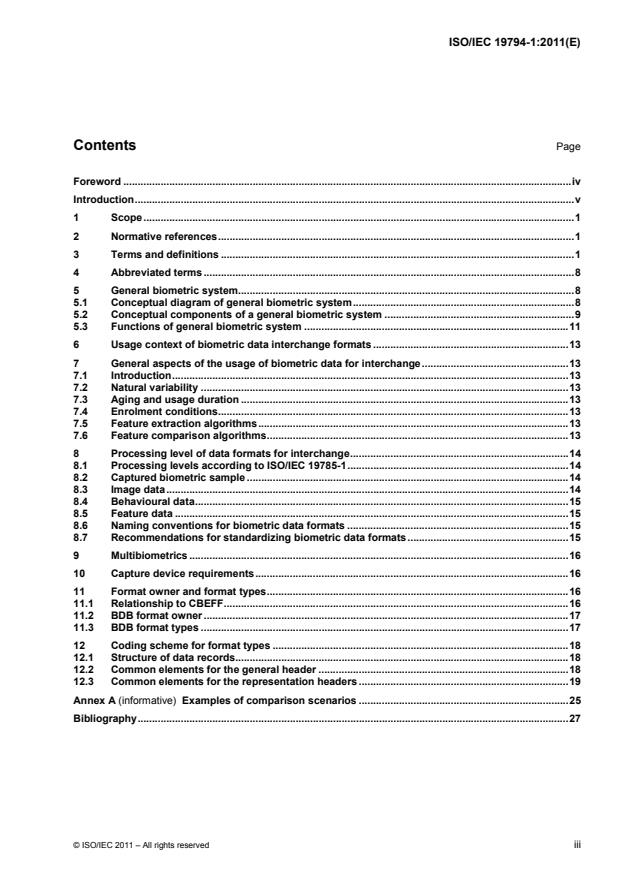
Contents Page
Foreword .iv
Introduction.v
1 Scope.1
2 Normative references.1
3 Terms and definitions .1
4 Abbreviated terms .8
5 General biometric system.8
5.1 Conceptual diagram of general biometric system.8
5.2 Conceptual components of a general biometric system .9
5.3 Functions of general biometric system .11
6 Usage context of biometric data interchange formats .13
7 General aspects of the usage of biometric data for interchange.13
7.1 Introduction.13
7.2 Natural variability .13
7.3 Aging and usage duration .13
7.4 Enrolment conditions.13
7.5 Feature extraction algorithms.13
7.6 Feature comparison algorithms.13
8 Processing level of data formats for interchange.14
8.1 Processing levels according to ISO/IEC 19785-1.14
8.2 Captured biometric sample .14
8.3 Image data.14
8.4 Behavioural data.15
8.5 Feature data .15
8.6 Naming conventions for biometric data formats .15
8.7 Recommendations for standardizing biometric data formats.15
9 Multibiometrics .16
10 Capture device requirements.16
11 Format owner and format types.16
11.1 Relationship to CBEFF.16
11.2 BDB format owner .17
11.3 BDB format types .17
12 Coding scheme for format types .18
12.1 Structure of data records.18
12.2 Common elements for the general header .18
12.3 Common elements for the representation headers .19
Annex A (informative) Examples of comparison scenarios .25
Bibliography.27
© ISO/IEC 2011 – All rights reserved iii
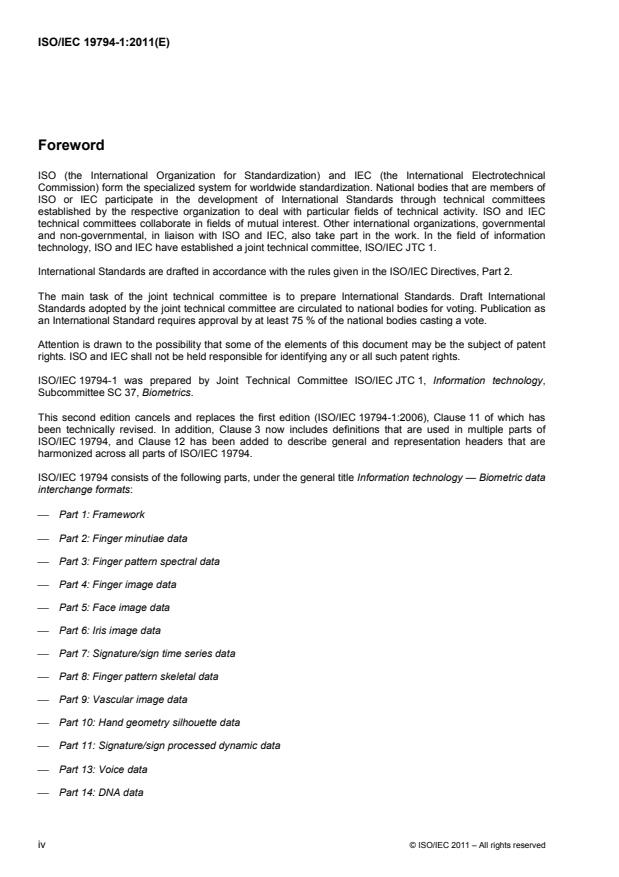
Foreword
ISO (the International Organization for Standardization) and IEC (the International Electrotechnical
Commission) form the specialized system for worldwide standardization. National bodies that are members of
ISO or IEC participate in the development of International Standards through technical committees
established by the respective organization to deal with particular fields of technical activity. ISO and IEC
technical committees collaborate in fields of mutual interest. Other international organizations, governmental
and non-governmental, in liaison with ISO and IEC, also take part in the work. In the field of information
technology, ISO and IEC have established a joint technical committee, ISO/IEC JTC 1.
International Standards are drafted in accordance with the rules given in the ISO/IEC Directives, Part 2.
The main task of the joint technical committee is to prepare International Standards. Draft International
Standards adopted by the joint technical committee are circulated to national bodies for voting. Publication as
an International Standard requires approval by at least 75 % of the national bodies casting a vote.
Attention is drawn to the possibility that some of the elements of this document may be the subject of patent
rights. ISO and IEC shall not be held responsible for identifying any or all such patent rights.
ISO/IEC 19794-1 was prepared by Joint Technical Committee ISO/IEC JTC 1, Information technology,
Subcommittee SC 37, Biometrics.
This second edition cancels and replaces the first edition (ISO/IEC 19794-1:2006), Clause 11 of which has
been technically revised. In addition, Clause 3 now includes definitions that are used in multiple parts of
ISO/IEC 19794, and Clause 12 has been added to describe general and representation headers that are
harmonized across all parts of ISO/IEC 19794.
ISO/IEC 19794 consists of the following parts, under the general title Information technology — Biometric data
interchange formats:
⎯ Part 1: Framework
⎯ Part 2: Finger minutiae data
⎯ Part 3: Finger pattern spectral data
⎯ Part 4: Finger image data
⎯ Part 5: Face image data
⎯ Part 6: Iris image data
⎯ Part 7: Signature/sign time series data
⎯ Part 8: Finger pattern skeletal data
⎯ Part 9: Vascular image data
⎯ Part 10: Hand geometry silhouette data
⎯ Part 11: Signature/sign processed dynamic data
⎯ Part 13: Voice data
⎯ Part 14: DNA data
iv © ISO/IEC 2011 – All rights reserved
Introduction
This part of ISO/IEC 19794 defines what is commonly applied for biometric data formats, i.e. the
standardization of the common content, meaning, and representation of biometric data formats of biometric
modalities considered in the specific parts of ISO/IEC 19794.
Each part of ISO/IEC 19794 can reference text and concepts from documents published by national,
international, or industry organizations. Documents from approved reference specification originator (ARO)
organizations as defined by JTC 1 will be referenced by citation. Documents from non-ARO organizations can
be copied to an annex.
ISO/IEC 19794 is one of a family of International Standards being developed by ISO/IEC JTC 1/SC 37 that
support interoperability and data interchange among biometric applications and systems. This family of
standards specifies requirements that solve the complexities of applying biometrics to a wide variety of
person-recognition applications, whether such applications operate in an open systems environment or
consist of a single, closed system. Open systems are built on standards-based, publicly defined data formats,
interfaces, and protocols to facilitate data interchange and interoperability with other systems, which can
include components of different design or manufacture. A closed system can also be built on publicly defined
standards, and can include components of different design or manufacture, but inherently has no requirement
for data interchange and interoperability with any other system.
Biometric data interchange format standards and biometric interface standards are both necessary to achieve
full data interchange and interoperability for biometric recognition in an open systems environment. The
ISO/IEC JTC 1/SC 37 biometric standards family includes a layered set of standards consisting of biometric
data interchange formats and biometric interfaces, as well as biometric profiles that describe the use of these
standards in specific application areas.
Figure 1 shows the interrelation of biometric-related areas of standardization. Biometric data complying with a
biometric data interchange format of ISO/IEC 19794 represents the core component of biometric
interoperability. Biometric formats frameworks such as ISO/IEC 19785 (CBEFF) can be used and serve as a
wrapper around biometric data. Since biometric data are sensitive data and subject to attack, cryptographic
protection is required in interchange environments. Biometric properties with respect to profiles, security
evaluation and performance evaluation also play an important role. Biometric interfaces are essential to
facilitate easy integration and usage of biometric components. The emerging harmonized vocabulary is
recommended for use in describing biometric technology. The deployment of applications using biometric
verification or identification takes place within the context of societal and cross-jurisdictional requirements.
The biometric data interchange format standards specify biometric data interchange formats for different
biometric modalities. Parties that agree on a biometric data interchange format specified in ISO/IEC 19794
should be able to decode each other’s biometric data.
The biometric interface standards include ISO/IEC 19785, Information technology — Common Biometric
Exchange Formats Framework and ISO/IEC 19784, Information technology — Biometric application
programming interface (BioAPI). These standards support exchange of biometric data within a system or
among systems. ISO/IEC 19785 specifies the basic structure of a standardized Biometric Information Record
(BIR), which includes the biometric data interchange record with added metadata such as when it was
captured, its expiry date, whether it is encrypted, etc. ISO/IEC 19784 specifies an open system API that
supports communications between software applications and underlying biometric technology services.
The biometric profile standards facilitate implementations of the base standards (e.g. the ISO/IEC JTC 1/
SC 37 biometric data interchange format and biometric interface standards, and possibly non-biometric
standards) for defined applications. These profile standards define the functions of an application
(e.g. physical access control for employees at airports) and then specify use of options in the base standards
to ensure biometric interoperability.
© ISO/IEC 2011 – All rights reserved v
SoSocciietetalal aanndd JJururiissdidiccttiioonnaall I Issssuueses
HHaarrmmoonniizzeedd Bi Biomometetrriicc Vo Voccaabubullaarryy
BiBiomometetrriicc IIntntererffaacecess
(B(BiiooAAPPI,I, BioBioAAMIMI, Ca, Card rd IntInteerfarfaccee,, . .).)
BioBiommetricetric SSyysstteemm PPropropeertrtiieess
(B(Biioomemetric Ptric Prrooffileiles,s, SSeeccuurityrity EvEvaalluauatiotionn,,
PPeerformarformancence E Evvalualuaattiionon))
BiBioommetetrriicc
DaData Seta Secucurriittyy AtAttributributteess
((CCoonnffiidedentntiiaalliity,ty, IInnttegregriitty)y)
BiBioommetetrriicc FForormmaattss
FraFrammewewoorrk (CBk (CBEEFF,FF, LDS LDS))
BiBiomometetrriicc D Daattaa
InIntteerrcchahangngee FForormmaattss
Figure 1 — General interrelation model of biometric issues
vi © ISO/IEC 2011 – All rights reserved
INTERNATIONAL STANDARD ISO/IEC 19794-1:2011(E)
Information technology — Biometric data interchange
formats —
Part 1:
Framework
1 Scope
This part of ISO/IEC 19794 specifies
⎯ general aspects for the usage of biometric data records,
⎯ the processing levels and types of biometric data structures,
⎯ a naming convention for biometric data structures, and
⎯ a coding scheme for format types.
2 Normative references
The following referenced documents are indispensable for the application of this document. For dated
references, only the edition cited applies. For undated references, the latest edition of the referenced
document (including any amendments) applies.
ISO/IEC 19785-2, Information technology — Common Biometric Exchange Formats Framework — Part 2:
Procedures for the operation of the Biometric Registration Authority
ISO/IEC 29794-1:2009, Information technology — Biometric sample quality — Part 1: Framework
3 Terms and definitions
For the purposes of this document, the following terms and definitions apply.
NOTE Definitions from ISO/IEC 2382-37 and ISO/IEC 2382-29 have been used when available.
3.1
biometric
of or having to do with biometrics (3.2)
NOTE The use of biometric as a noun, to mean biometric characteristic or biometric modality, is deprecated.
EXAMPLE 1 Incorrect usage #1: ICAO resolved that face is the biometric most suited to the practicalities of travel
documents.
EXAMPLE 2 Correct usage #1: ICAO resolved that face recognition is the biometric modality most suited to the
practicalities of travel documents.
© ISO/IEC 2011 – All rights reserved 1
EXAMPLE 3 Incorrect usage #2: My face biometric was encoded in my passport.
EXAMPLE 4 Correct usage #2: My facial biometric characteristics were encoded in my passport.
3.2
biometrics
automated recognition of individuals based on their behavioural and biological characteristics
NOTE “Individual” is restricted in scope by ISO/IEC JTC 1/SC 37 to humans.
3.3
biometric algorithm
sequence of instructions that tell a biometric system (3.20) how to solve a particular problem
NOTE A biometric algorithm will have a finite number of steps and is typically used by the biometric system
software to decide whether biometric probe data and a biometric reference match.
3.4
biometric behavioural data
biometric data (3.7) representing behavioural biometric characteristics of an individual
EXAMPLE Data resulting from writing, speaking, or typing.
3.5
biometric capture device
device that collects a signal from a biometric characteristic (3.6) and converts it to a captured biometric
sample (3.28)
3.6
biometric characteristic
biological and behavioural characteristic of an individual that can be detected and from which distinguishing,
repeatable biometric features (3.11) can be extracted for the purpose of automated recognition of individuals
3.7
biometric data
biometric sample (3.19) at any stage of processing, biometric reference (3.17), biometric feature (3.11) or
biometric property
EXAMPLE Sensor data, image data, behavioural data, feature data.
3.8
biometric data block
BDB
block of data with a defined format that contains one or more biometric samples (3.19) or biometric
templates (3.21)
NOTE Definition according to CBEFF.
3.9
biometric data interchange record
BDIR
data package containing biometric data (3.7) that claims to be in the form prescribed by a base standard
NOTE If the BDIR is encapsulated in a CBEFF record, then the BDIR is also a biometric data block (BDB) as defined
in ISO/IEC 19785, but this will not always be the case for BDIRs defined in ISO/IEC 19794.
3.10
biometric data record
data record containing biometric data (3.7)
2 © ISO/IEC 2011 – All rights reserved
3.11
biometric feature
numbers or labels extracted from biometric samples (3.19) and used for comparison (3.30)
NOTE 1 Biometric features are the output of a completed biometric feature extraction.
NOTE 2 The use of this term needs to be consistent with its use by the pattern recognition and mathematics
communities.
NOTE 3 A biometric feature set can also be considered a processed biometric sample.
3.12
biometric feature data unit
smallest individual unit of extracted feature data
EXAMPLE Minutia of a fingerprint.
3.13
biometric feature extraction
process applied to a biometric sample (3.19) with the intent of isolating and outputting repeatable and
distinctive numbers or labels which can be compared to those extracted from other biometric samples (3.19)
NOTE 1 Filters applied to biometric samples (3.19) are not themselves biometric features (3.11), however the
output of the filter applied to these samples can be. Therefore, for example, eigenfaces are not biometric features (3.11).
NOTE 2 Repeatable implies low variation between outputs generated from samples of the same individual.
NOTE 3 Distinctive implies high variation between outputs generated from samples of different individuals.
3.14
biometric image data
pre-processed biometric data (3.7) that results from the presentation of an anatomical (i.e. static) biometric
feature (3.11) of a user and is represented by pixels in a spatial coordinate system
EXAMPLE Fingerprint image data.
3.15
biometric information template
constructed data object in a card containing information needed by the outside world for a verification process
NOTE See ISO/IEC 7816-11.
3.16
biometric model
stored function (dependent on the biometric data subject) generated from one or more biometric features
(3.11)
3.17
biometric reference
one or more stored biometric samples (3.19), biometric templates (3.21) or biometric models (3.16)
attributed to a biometric data subject and used for comparison (3.30)
EXAMPLE Face image on a passport; fingerprint minutiae template on a national ID card; Gaussian mixture model,
for speaker recognition, in a database.
NOTE A biometric reference can be created with implicit or explicit use of auxiliary data, such as Universal
Background Models.
© ISO/IEC 2011 – All rights reserved 3
3.18
biometric representation
biometric sample (3.19) or biometric feature set
NOTE This term is used in ISO/IEC 19794 for labelling a sub-record in a biometric data interchange record.
3.19
biometric sample
information obtained from a biometric capture device (3.5), either directly or after processing
3.20
biometric system
system for the purpose of the automated recognition of individuals based on their behavioural and biological
characteristics
3.21
biometric template
reference biometric feature set
set of stored biometric features (3.11) comparable directly to biometric features (3.11) of a probe
biometric sample (3.19)
NOTE 1 A biometric reference (3.17) consisting of an image, or other captured biometric sample (3.28), in its
original, enhanced or compressed form, is not a biometric template (3.21).
NOTE 2 The biometric features (3.11) are not considered to be a biometric template (3.21) unless they are stored
for reference.
3.22
biometric modality
type of biometric technology
EXAMPLE Fingerprint.
3.23
bit-depth
number of bits used to represent a data element
3.24
byte
contiguous sequence of 8 bits processed as a single unit of information
3.25
candidate
biometric reference identifier of a biometric reference (3.17) in the enrolment database determined to be
similar to the biometric probe
NOTE Determination can be on the basis of comparison score (3.31) and/or rank.
3.26
candidate list
set of zero, one or more candidates (3.25) that can be intermediate or final
NOTE Intermediate candidate lists can be produced by systems that use multi-pass biometric identification.
3.27
capture
record or express accurately in words or pictures causing data to be stored in a computer
4 © ISO/IEC 2011 – All rights reserved
3.28
captured biometric sample
raw biometric sample (deprecated)
biometric sample (3.19) that is output of biometric capture process
3.29
cell
rectangular region defined by a uniform and non-overlapping division of the image
3.30
comparison
match, noun (deprecated)
matching, noun (deprecated)
estimation, calculation or measurement of similarity or dissimilarity between biometric probe(s) and biometric
reference(s) (3.17)
NOTE 1 Compare (verb) – “estimate, measure or note the similarity or dissimilarity between”.
NOTE 2 Match (verb) is deprecated as a synonym to compare (verb).
3.31
comparison score
numerical value (or set of values) resulting from a comparison (3.30)
3.32
continuous tone image
image whose components have more than one bit per pixel (3.45)
3.33
core
topmost point on the innermost recurving ridgeline of a fingerprint
NOTE Generally, the core is placed upon or within the innermost recurve of a loop.
3.34
delta
point on a ridge at or nearest to the point of divergence of two typelines (3.56) and located at or directly in
front of the point of divergence
3.35
dimension
number of pixels in a captured biometric sample (3.28) either in x- or y-direction
3.36
enrolment
registration (deprecated)
process of creating and storing, for an individual, a data record associated with an individual and including
biometric reference(s) (3.17) and, typically, non-biometric data
3.37
friction ridge
ridge present on the skin of the fingers and toes, the palms and soles of the feet, which makes contact with an
incident surface under normal touch
NOTE On the fingers, the unique patterns formed by the friction ridges make up fingerprints.
© ISO/IEC 2011 – All rights reserved 5
3.38
identification
〈biometric system function〉 biometric system function that performs a one-to-many search to obtain a
candidate list
EXAMPLE BioAPI_IdentifyMatch.
NOTE An identification function can be used to verify a claim of enrolment (3.36) in an enrolment database without a
specified biometric reference identifier.
3.39
intermediate biometric sample
biometric sample (3.19) following intermediate biometric sample processing
EXAMPLE Intermediate biometric samples might have been enhanced for biometric feature (3.11) extraction,
compressed for compact storage purposes, etc.
3.40
latent fingerprint
impression of a fingerprint image collected from an intermediate surface, rather than directly via a live scan
capture device or a traditional inked fingerprint card
3.41
live capture
process of capturing a biometric sample (3.19) through an interaction between an end user and a biometric
system
3.42
minutia
friction ridge characteristic that is used to individualize a fingerprint
NOTE 1 The plural is “minutiae”.
NOTE 2 Minutiae occur at points where a single friction ridge deviates from an uninterrupted flow. Deviation may take
the form of ending, bifurcation, or a more complicated “composite” type.
3.43
multipresentation
using either multiple presentation samples of one instance of a biometric characteristic or a single
presentation that results in the capture of multiple samples
EXAMPLE Several frames from video camera capture of a face image (possibly but not necessarily consecutive).
NOTE Multipresentation biometrics is considered a form of multibiometrics, if fusion techniques are employed.
3.44
multisensorial
using multiple sensors for capturing samples of one biometric instance
3.45
pixel
picture element
point in an image that is represented by an n-by-m matrix of points, where n is the number of horizontal rows
and m is the number of vertical columns,
3.46
pixel depth
number of bits used to represent the luminance and/or chrominance value of a pixel
6 © ISO/IEC 2011 – All rights reserved
3.47
raw
image file in which the image is stored in the same format in which it is stored in video memory, typically one
byte (for monochrome images) per pixel (3.45) or three bytes (for colour images) per pixel (3.45)
3.48
ridge bifurcation
minutia assigned to the location at which a friction ridge splits into two ridges or, alternatively, where two
separate friction ridges combine into one
3.49
ridge ending
minutia assigned to the location at which a friction ridge terminates or, alternatively, begins
NOTE A ridge ending corresponds to the bifurcation of the adjacent valley: the location at which a valley splits into
two valleys or, alternatively, at which two separate valleys combine into one.
3.50
signature/sign
handwritten signature or handwritten personal sign
3.51
skeleton
one-pixel-wide representation of the topology of an object
NOTE The skeleton is also known as the medial axis.
3.52
spatial sampling rate
resolution (deprecated)
number of pixels (3.45) per unit distance in the object space, specified as the number of pixels per millimetre
in the object space along the applicable coordinate axes
3.53
swipe fingerprint image
method of fingerprint collection where the finger is manually slid across a one-dimensional sensor resulting in
multiple readings or partial impressions from the same fingerprint
NOTE These readings are then combined to produce an accurate two-dimensional image of the fingerprint.
3.54
time series
sequence of values sampled at successive points in time
3.55
transaction
sequence of attempts on the part of a user for the purposes of an enrolment, verification or identification
3.56
typeline
one of the two innermost friction ridges (3.37) that start parallel, diverge, and surround or tend to surround
the pattern area
3.57
user
〈biometric system〉 person or organization interacting in any way with a biometric system
© ISO/IEC 2011 – All rights reserved 7
3.58
valley
area between two friction ridges (3.37) that does not make contact with an incident surface under normal
touch
3.59
verification
authentication (deprecated)
positive identification (deprecated)
〈biometric system function〉 biometric system function that performs a one-to-one comparison (3.30)
EXAMPLE BioAPI_VerifyMatch.
NOTE An identification application can use an exhaustive series of verification function calls.
4 Abbreviated terms
For the purposes of this document, the following abbreviated terms apply.
API Application Programming Interface
BDB Biometric Data Block
BDIR Biometric Data Interchange Record
BIR Biometric Information Record
CBEFF Common Biometric Exchange Formats Framework
IBIA International Biometric Industry Association
LDS Logical Data Structure
SB Security Block
SBH Standard Biometric Header
5 General biometric system
5.1 Conceptual diagram of general biometric system
Given the variety of applications and technologies, it might seem difficult to draw any generalizations about
biometric systems. All such systems, however, have many elements in common. Captured biometric samples
are acquired from a subject by a biometric capture device. The biometric capture device output may be sent to
a processor that extracts the distinctive but repeatable measures of the sample (the “features”), discarding all
other components. The resulting features can be stored in the database as a “reference”, sometimes called a
“biometric reference” or a biometric “template”. In other cases the sample (without feature extraction) may be
stored as the biometric reference. A new sample can be compared to a specific reference, to many references
or all references already in the database to determine if there is a match. A decision regarding the identity
claim is made based upon the similarities or dissimilarities between the sample features and those of the
reference or references compared.
Figure 2 illustrates the information flow within a general biometric system, showing a general biometric system
consisting of data capture, signal processing, storage, comparison and decision subsystems. This diagram
illustrates both enrolment, and the operation of verification and identification systems. The following sub-
clauses describe each of these subsystems in more detail.
NOTE In any implemented system, some of these conceptual components may be absent or may not have a direct
correspondence with a physical or software entity.
8 © ISO/IEC 2011 – All rights reserved
Data Capture Data Storage Comparison Decision
Subsystem Subsystem Subsystem Subsystem
Comparison
Biometric
Reference
Score(s)
Enrolment
Claim
Comparison
Database
Signal
Match?
Processing
Candidate?
Presentation
Subsystem
Reference Match/
Reference Candidate
Threshold
Non-match
List
Creation
Biometric
Characteristics
Verified?
Features
Identified?
Re-capture
Quality Control
Decision
Sensor
Feature Extraction
Policy
Segmentation
Verification Identification
Outcome Outcome
Captured
Biometric
Sample
Enrolment
Verification
Identification
Figure 2 — Components of a general biometric system
5.2 Conceptual components of a general biometric system
5.2.1 Data capture subsystem
The data capture subsystem collects an image or signal of a subject’s biometric characteristics that they have
presented to the biometric capture device, and outputs this image/signal as a captured biometric sample.
NOTE In Clause 5, italics are used for components shown in Figure 2.
5.2.2 Transmission subsystem
The transmission subsystem (not portrayed in diagram; not always present or visibly present in a biometric
system) will transmit samples, features, and/or references between different subsystems. Samples, features
or references may be transmitted using standard biometric data interchange formats. The captured biometric
sample may be compressed and/or encrypted before transmission, and expanded and/or decrypted before
use. A captured biometric sample may be altered in transmission due to noise in the transmission channel as
well as losses in the compression/expansion process. It is advisable that cryptographic techniques be used to
protect the authenticity, integrity, and confidentiality of stored and transmitted biometric data.
5.2.3 Signal processing subsystem
Signal processing may include processes such as
⎯ segmentation, i.e. locating the signal of the subject’s biometric characteristics within the captured
biometric sample,
⎯ feature extraction, i.e. deriving the subject’s repeatable and distinctive measures from the captured
biometric sample,
© ISO/IEC 2011 – All rights reserved 9
⎯ quality control, i.e., assessing the suitability of samples, features, references, etc. and possibly affecting
other processes, such as returning control to the data capture subsystem to collect further samples; or
modifying parameters for segmentation, feature extraction, or comparison,
⎯ image enhancement, i.e. improving the quality and clarity of the captured biometric sample.
In the case of enrolment, the signal processing subsystem creates a reference. Sometimes the enrolment
process requires features from several presentations of the individual’s biometric characteristics. Sometimes
the reference comprises just the features, in which case the reference may be called a “template”. Sometimes
the reference comprises just the sample, in which case feature extraction from the reference may occur
immediately before comparison.
Sequencing and iteration of the above-mentioned processes are determined by the specifics of each system.
5.2.4 Data storage subsystem
References are stored within an enrolment database held in the data storage subsystem. Each reference
might be associated with some details of the enrolled subject or the enrolment process. It should be noted that
prior to being stored in the enrolment database, references may be re-formatted into a biometric data
interchange format. References may be stored within a biometric capture device, on a portable medium such
as a smart card, locally such as on a personal computer or local server, or remotely in a central database.
5.2.5 Comparison subsystem
In the comparison subsystem, the features are compared against one or more references and comparison
scores are passed to the decision subsystem. The comparison scores indicate the similarities or dissimilarities
between the features and reference/s compared. In some cases, the features may take the same form as the
stored reference. For verification, a single specific claim of subject enrolment would lead to a single
comparison score. For identification, many or all references may be compared with the features, and a
comparison score may be produced for each comparison.
5.2.6 Decision subsystem
The decision subsystem uses the comparison scores generated from one or more attempts to provide the
decision outcome for a verification or identification transaction.
In the case of verification, the features are considered to match a compared reference when (assuming that
higher scores correspond to greater similarity) the comparison score exceeds a specified threshold. A claim
about the subject’s enrolment can then be verified on the basis of the decision policy, which may allow or
require multiple attempts.
In the case of identification, an enrolee reference is a potential candidate for the subject when (assuming that
higher scores correspond to greater similarity) the comparison score exceeds a specified threshold, and/or
when the comparison score is among the highest ranked values generated during comparisons across the
entire database. The decision policy may allow or require multiple attempts before making an identification
decision.
NOTE Conceptually, it is possible to treat multibiometric systems in the same manner as unibiometric systems, by
treating the combined captured biometric samples/references/scores as if they were a single sample/reference/score and
allowing the decision subsystem to operate score fusion or decision fusion as and if appropriate. (See also ISO/IEC TR
24722:2007 Multimodal and other multibiometric fusion).
5.2.7 Administration subsystem
The administration subsystem (not portrayed in diagram) governs the overall policy, implementation and
usage of the biometric system, in accordance with the relevant legal, jurisdictional and societal constraints and
requirements. Illustrative examples include:
10 © ISO/IEC 2011 – All rights reserved
⎯ requesting additional information from the subject,
⎯ providing final arbitration on output from decision and/or scores,
⎯ setting threshold values for decision,
⎯ setting biometric system acquisition settings,
⎯ controlling the operational environment and non-biometric data storage,
⎯ providing appropriate safeguards for subject privacy,
⎯ interacting with the application that utilizes the biometric system,
⎯ defining decision criteria for verification or identification.
5.2.8 Interface
The biometric system may or may not interface to an external application or system via an Application
Programming Interface, Hardware Interface or Protocol Interface (not portrayed in diagram).
5.3 Functions of general biometric system
5.3.1 Enrolment
In enrolment, a transaction by a subject is processed by the system in order to generate and store an
enrolment reference for that individual.
Enrolment typically involves:
⎯ sample acquisition,
⎯ segmentation,
⎯ feature extraction,
⎯ quality checks (which may reject the sample/features as being unsuitable for creating a reference, and
require acquisition of further samples),
⎯ biometric reference creation (which may require features from multiple samples), possible conversion into
a biometric data interchange format and storage,
⎯ test verification or identification attempts to ensure that the resulting enrolment is usable, and
⎯ allowing repeat enrolment attempts, should the initial enrolment be deemed unsatisfactory (dependent on
the enrolment policy).
5.3.2 Verification
In verification, a transaction by a subject is processed by the system in order to verify a positive specific claim
about the subject’s enrolment (e.g. “I am enrolled as subject X”). The verification function will either accept or
reject the claim. The verification decision outcome is considered to be erroneous if either a false claim is
accepted (false accept) or a true claim is rejected (false reject).
NOTE Some biometric systems will allow a single subject to enrol more than one instance of a biometric
characteristic (for example, an iris system may allow subjects to enrol both iris images, while a fingerprint system may
require enrolment of additional fingers for fallback in case a primary finger is damaged).
© ISO/IEC 2011 – All rights reserved 11
Verification typically involves:
⎯ signal processing,
⎯ sample acquisition,
⎯ segmentation,
⎯ feature extraction,
⎯ quality checks (which may reject the sample/features as being unsuitable for comparison, and require
acquisition of further samples),
⎯ comparison of the sample features against the reference for the claimed identity producing a comparison
score,
⎯ determination of whether the sample features match the reference based on whether the comparison
score exceeds a threshold (assuming that higher scores correspond to greater similarity), and
⎯ decision to verify based on the comparison result of one or more attempts as dictated by the decision
policy.
EXAMPLE In a verification system allowing up to three attempts to be matched to an enrolled reference, a false
rejection will result with any combination of failures-to-acquire and false non-matches over three attempts. A false
acceptance will result if a sample is acquired and falsely matched to the enrolled reference for the claimed identity on any
of three attempts.
5.3.3 Identification
In identification, a transaction by a subject is processed by the system and the enrolment database is
searched to find matching references. Identification provides a candidate list of identifiers that will contain zero,
one, or more identifiers. Identification is considered correct when the subject is enrolled, and an identifier for
their enrolment is in the candidate list. The identification is considered to be erroneous if either an enrolled
subject’s identifier is not in the resulting candidate list (false-negative identification error), or if a transaction by
a non-enrolled subject produces a non-empty candidate list (false-positive identification error).
Identification typically involves:
⎯ signal processing,
⎯ sample acquisition,
⎯ segmentation,
⎯ feature extraction,
⎯ quality checks (which may reject the sample/features as being unsuitable for comparison, and require
acquisition of further samples),
⎯ comparison against some or all references in the enrolment database, producing a comparison score for
each comparison,
⎯ determination of whether each compared reference is a potential candidate identifier for the user, based
on whether the comparison score exceeds a threshold and/or is among the highest ranked scores
returned, producing a candidate list (assuming that higher scores correspond to greater similarity), and
⎯ an identification decision based on the candidate lists from one or more attempts, as dictated by the
decision policy.
12 © ISO/IEC 2011 – All rights reserved
6 Usage context of biometric data interchange formats
The structure and content of biometric data records for interchange depend on the intended usage context.
There may be
⎯ self-contained data structures providing all necessary information,
⎯ data structures designed for the biometric data block of CBEFF not duplicating information which is
present in the CBEFF standard biometric header,
⎯ data structures for usage in a Biometric Information Template as defined in ISO/IEC 7816-11 and
ISO/IEC 19785-3,
⎯ data structures designed for on-card biometric comparison as defined in ISO/IEC 24787.
7 General aspects of the usage of biometric data for interchange
7.1 Introduction
When using biometric data, the general aspects specified in the following clauses should be taken into
consideration.
7.2 Natural variability
Biometric samples and reference data from the same person do not generally result in a perfect match when
performing a comparison. A person may never be able to present exactly the same data again since they
depend on a lot of factors where smallest changes (e.g. translation, rotation and distortion of fingers) already
result in different data. Therefore it may be necessary to specify, together with the biometric data structure,
specific parameters such as tolerances for the range of presentation parameters that may be acceptable.
7.3 Aging and usage duration
Some biometric characteristics (e.g. facial image or signature dynamics) may undergo changes with
increasing age of the person. If appropriate it is important to specify a recommended usage period of
biometric reference data.
7.4 Enrolment conditions
In order to achieve good comparison results, it is important to specify enrolment conditions with respect to the
minimum quality of the biometric reference data, e.g. minimum number of minutiae or, in the case of image
data, minimum focus quality, contrast, spatial sampling rate, etc.
7.5 Feature extraction algorithms
If biometric data formats for interchange are specified at the feature level (e.g. finger minutiae), then the way
for deriving these features shall be specified to the extent nece
...