

ISO/TR 22019:2019
(Main)Nanotechnologies — Considerations for performing toxicokinetic studies with nanomaterials
General Information
- Abstract
This document describes the background and principles for toxicokinetic studies relevant for nanomaterials. Annex A shows the definitions for terminology with respect to toxicokinetics as used in OECD TG 417:2010.
- Status
- Published
- Publication Date
- 21-May-2019
- Technical Committee
- ISO/TC 229 - Nanotechnologies
- Current Stage
- 6060 - International Standard published
- Start Date
- 22-May-2019
- Completion Date
- 29-Aug-2026
Buy Documents
ISO/TR 22019:2019 - Nanotechnologies — Considerations for performing toxicokinetic studies with nanomaterials Released:5/22/2019
ISO/TR 22019:2019 - Nanotechnologies — Considerations for performing toxicokinetic studies with nanomaterials/22/2019
Overview
ISO/TR 22019:2019 - Nanotechnologies - Considerations for performing toxicokinetic studies with nanomaterials is a technical report from ISO/TC 229 (2019) that reviews the background, principles and practical issues for performing toxicokinetic (ADME) studies on nanomaterials. The document clarifies why nanomaterials (NMs) require specific toxicokinetic consideration - their particulate nature, size-dependent behavior and surface chemistry mean absorption, distribution, metabolism and excretion (ADME) can differ substantially from dissolved chemicals or bulk particles. Annex A reproduces terminology used in OECD TG 417:2010 and Annex B summarizes quantitation methods.
Key topics and technical requirements
The report focuses on practical guidance rather than prescriptive test procedures. Major topics include:
- Importance for risk assessment: how toxicokinetic data link external exposure to internal dose and support target-organ identification, grouping/read-across and persistence assessment.
- Factors influencing toxicokinetics: dissolution rate, particle size, shape, surface chemistry, agglomeration/agglomeration and protein corona formation.
- Analytical challenges: detection and quantitation of elemental, radiolabelled or fluorescent labels, particle versus dissolved fraction measurement, and limits of detection.
- Dosing considerations: relevant exposure routes, dose metrics (mass, particle number, surface area) and realistic exposure conditions.
- Absorption by route: skin, gastrointestinal and respiratory uptake considerations specific to NMs.
- Distribution and transport: organ distribution, macrophage-mediated transport, potential translocation across placenta and blood–brain barrier (BBB).
- Metabolism/degradation and excretion: issues around persistence, bioaccumulation and pathways for elimination.
- Modeling implications: the need to adapt physiologically based pharmacokinetic (PBPK) approaches for particulate behaviors.
Practical applications and users
ISO/TR 22019:2019 is intended for professionals involved with:
- Regulatory risk assessment and safety dossiers for nanomaterials
- Toxicologists and study designers planning ADME/toxicokinetic studies for NMs
- Nanomaterials manufacturers and formulators seeking read-across or grouping justification
- Academic researchers and laboratories developing analytical and PBPK methods for nanoparticles
- Nanomedicine developers needing guidance on systemic distribution and persistence
The report helps users design meaningful toxicokinetic studies, select appropriate dose metrics and analytical approaches, and interpret internal exposure data for safety decision-making.
Related standards and guidance
- OECD Test Guideline 417 (Toxicokinetics) - terminology and context (not intended for NMs)
- ISO 10993-16:2017 - toxicokinetic study design for medical-device leachables
- ICH S3A / S3B, EMA and FDA PBPK guidance - referenced for modeling approaches but not fully applicable to NMs
Keywords: ISO/TR 22019:2019, nanotechnologies, toxicokinetic studies, nanomaterials, ADME, PBPK, OECD TG 417, nanoparticle toxicokinetics.
Buy Documents
ISO/TR 22019:2019 - Nanotechnologies — Considerations for performing toxicokinetic studies with nanomaterials Released:5/22/2019
ISO/TR 22019:2019 - Nanotechnologies — Considerations for performing toxicokinetic studies with nanomaterials/22/2019
Frequently Asked Questions
ISO/TR 22019:2019 is a technical report published by the International Organization for Standardization (ISO). Its full title is "Nanotechnologies — Considerations for performing toxicokinetic studies with nanomaterials". This standard covers: This document describes the background and principles for toxicokinetic studies relevant for nanomaterials. Annex A shows the definitions for terminology with respect to toxicokinetics as used in OECD TG 417:2010.
This document describes the background and principles for toxicokinetic studies relevant for nanomaterials. Annex A shows the definitions for terminology with respect to toxicokinetics as used in OECD TG 417:2010.
ISO/TR 22019:2019 is classified under the following ICS (International Classification for Standards) categories: 07.120 - Nanotechnologies. The ICS classification helps identify the subject area and facilitates finding related standards.
ISO/TR 22019:2019 is available in PDF format for immediate download after purchase. The document can be added to your cart and obtained through the secure checkout process. Digital delivery ensures instant access to the complete standard document.
Standards Content (Sample)
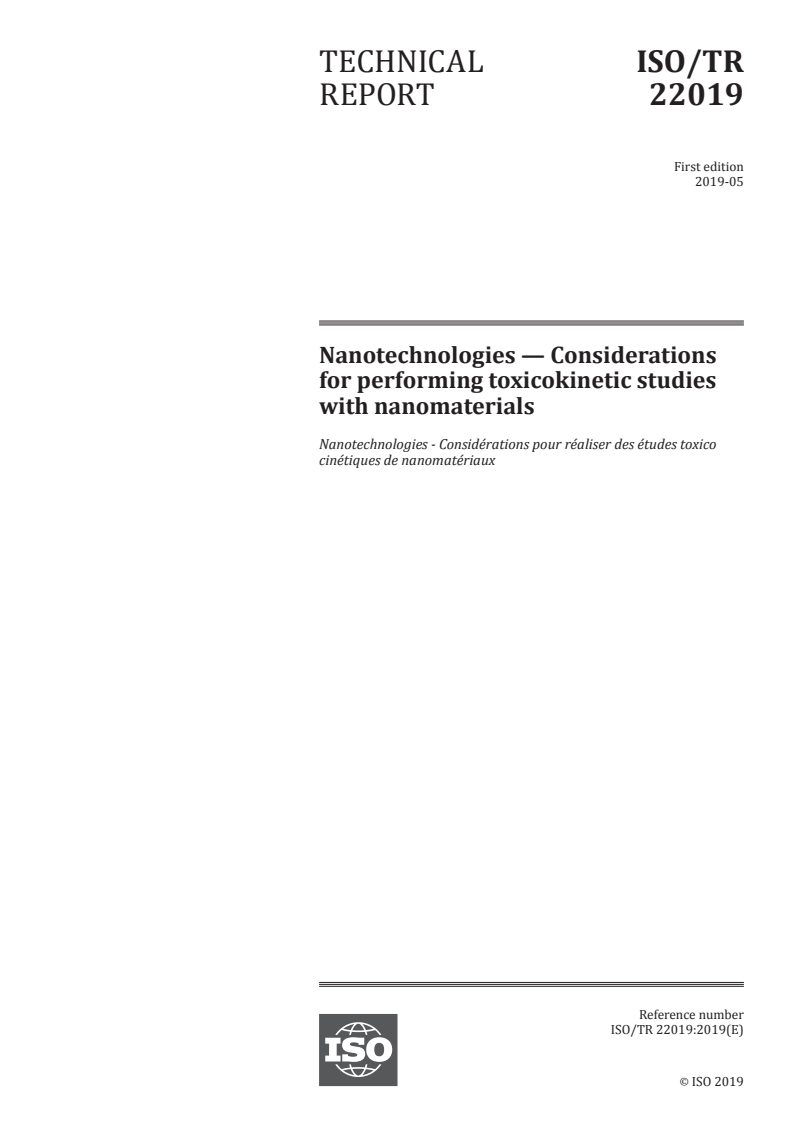
TECHNICAL ISO/TR
REPORT 22019
First edition
2019-05
Nanotechnologies — Considerations
for performing toxicokinetic studies
with nanomaterials
Nanotechnologies - Considérations pour réaliser des études toxico
cinétiques de nanomatériaux
Reference number
©
ISO 2019
© ISO 2019
All rights reserved. Unless otherwise specified, or required in the context of its implementation, no part of this publication may
be reproduced or utilized otherwise in any form or by any means, electronic or mechanical, including photocopying, or posting
on the internet or an intranet, without prior written permission. Permission can be requested from either ISO at the address
below or ISO’s member body in the country of the requester.
ISO copyright office
CP 401 • Ch. de Blandonnet 8
CH-1214 Vernier, Geneva
Phone: +41 22 749 01 11
Fax: +41 22 749 09 47
Email: copyright@iso.org
Website: www.iso.org
Published in Switzerland
ii © ISO 2019 – All rights reserved
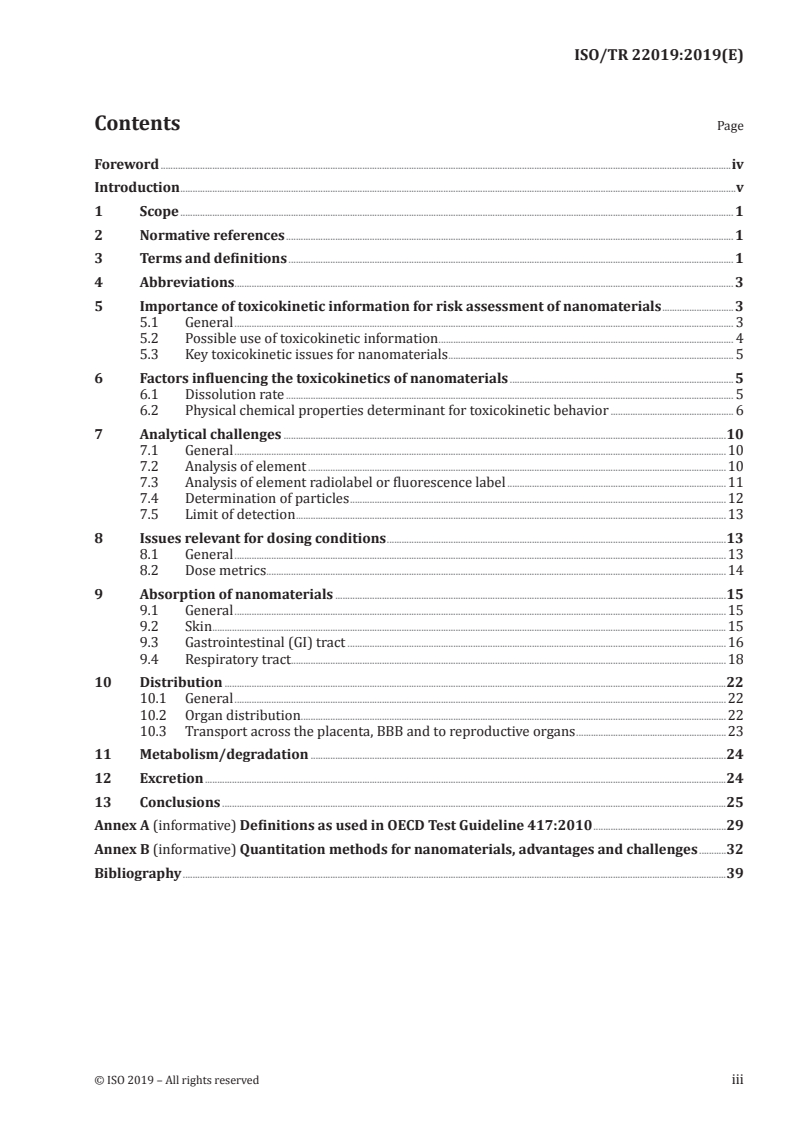
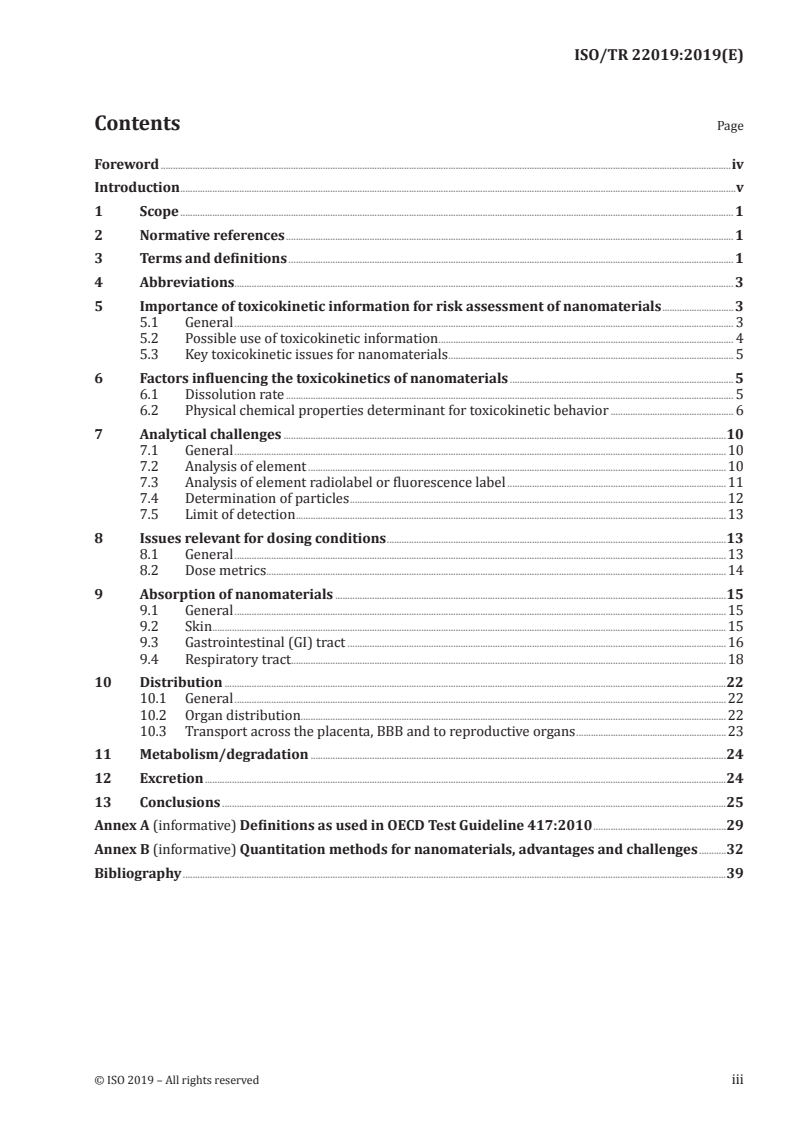
Contents Page
Foreword .iv
Introduction .v
1 Scope . 1
2 Normative references . 1
3 Terms and definitions . 1
4 Abbreviations. 3
5 Importance of toxicokinetic information for risk assessment of nanomaterials .3
5.1 General . 3
5.2 Possible use of toxicokinetic information . 4
5.3 Key toxicokinetic issues for nanomaterials . 5
6 Factors influencing the toxicokinetics of nanomaterials . 5
6.1 Dissolution rate . 5
6.2 Physical chemical properties determinant for toxicokinetic behavior . 6
7 Analytical challenges .10
7.1 General .10
7.2 Analysis of element .10
7.3 Analysis of element radiolabel or fluorescence label .11
7.4 Determination of particles .12
7.5 Limit of detection .13
8 Issues relevant for dosing conditions .13
8.1 General .13
8.2 Dose metrics .14
9 Absorption of nanomaterials .15
9.1 General .15
9.2 Skin .15
9.3 Gastrointestinal (GI) tract .16
9.4 Respiratory tract.18
10 Distribution .22
10.1 General .22
10.2 Organ distribution . .22
10.3 Transport across the placenta, BBB and to reproductive organs .23
11 Metabolism/degradation .24
12 Excretion .24
13 Conclusions .25
Annex A (informative) Definitions as used in OECD Test Guideline 417:2010 .29
Annex B (informative) Quantitation methods for nanomaterials, advantages and challenges .32
Bibliography .39
Foreword
ISO (the International Organization for Standardization) is a worldwide federation of national standards
bodies (ISO member bodies). The work of preparing International Standards is normally carried out
through ISO technical committees. Each member body interested in a subject for which a technical
committee has been established has the right to be represented on that committee. International
organizations, governmental and non-governmental, in liaison with ISO, also take part in the work.
ISO collaborates closely with the International Electrotechnical Commission (IEC) on all matters of
electrotechnical standardization.
The procedures used to develop this document and those intended for its further maintenance are
described in the ISO/IEC Directives, Part 1. In particular, the different approval criteria needed for the
different types of ISO documents should be noted. This document was drafted in accordance with the
editorial rules of the ISO/IEC Directives, Part 2 (see www .iso .org/directives).
Attention is drawn to the possibility that some of the elements of this document may be the subject of
patent rights. ISO shall not be held responsible for identifying any or all such patent rights. Details of
any patent rights identified during the development of the document will be in the Introduction and/or
on the ISO list of patent declarations received (see www .iso .org/patents).
Any trade name used in this document is information given for the convenience of users and does not
constitute an endorsement.
For an explanation of the voluntary nature of standards, the meaning of ISO specific terms and
expressions related to conformity assessment, as well as information about ISO's adherence to the
World Trade Organization (WTO) principles in the Technical Barriers to Trade (TBT) see www .iso
.org/iso/foreword .html.
This document was prepared by Technical Committee ISO/TC 229, Nanotechnologies.
Any feedback or questions on this document should be directed to the user’s national standards body. A
complete listing of these bodies can be found at www .iso .org/members .html.
iv © ISO 2019 – All rights reserved
Introduction
Nanomaterials (NMs) are a family of chemicals that, like any other chemicals, can exert a range of
toxicities. Toxicokinetics can support the safety evaluation of compounds including NMs by identifying
potential target organs, and especially for NMs, the potential for persistence in organs (including
cellular uptake and compartmentalization). Also, toxicokinetic information can be used to evaluate if
a NM behaves differently from a similar NM or bulk material with the same chemical composition, e.g.
with regard to barrier penetration. As for all studies with NMs, a proper characterization of the NM
dispersions or aerosols used in the toxicokinetic studies is essential.
Importance of toxicokinetic information for risk assessment (of nanomaterials)
Toxicokinetics describes the absorption, distribution, metabolism and excretion (ADME) of foreign
compounds in the body with time. It links the external exposure with the internal dose and is thus a
key aspect for toxicity. If a NM is absorbed by the body through any of the potential exposure routes
(oral, respiratory, dermal) it can enter into the blood or lymph circulation. Subsequent distribution
to internal organs determines potential target tissues and potential toxicity. Alternatively, NMs can
be intravenously administered (e.g. as nanomedicine) thus directly entering the blood circulation,
potentially resulting in wide spread tissue distribution. Toxicokinetics therefore aids in the design of
targeted toxicity studies and in identifying potential target organs and can thus also provide relevant
information for justification or waiving of toxicity studies. In addition, toxicokinetic information can be
useful as basis for grouping and read-across of NMs. Risk assessments based on internal concentrations,
determined using toxicokinetic information, can be more realistic than risk assessments based
on external doses, as nanoparticles (NPs) can show specific tissue distribution and accumulation.
Toxicokinetic studies can be used to build toxicokinetic models, especially physiologically based
pharmacokinetic (PBPK) models, which then can be used to extrapolate experimental toxicity data to
other species, tissues, exposure routes, exposure durations and doses. Due to the accumulation of some
NPs, the ability to extrapolate to longer exposure durations is of special importance for NMs.
Why a technical report specifically for nanomaterials?
A considerable body of published literature, including many national and international guidelines,
exists on the use of toxicokinetic methods to study the fate of chemicals in the body. In addition, OECD
Test Guideline (TG) 417 on Toxicokinetics (latest update dated 2010) gives an extensive description for
evaluation of the toxicokinetic profile of chemicals but excludes NMs specifically. ISO 10993-16:2017
Biological evaluation of medical devices — Part 16: Toxicokinetic study design for degradation products
and leachables, provides an overview for toxicokinetic studies for leachables of medical devices.
Furthermore, the European Medicines Agency’s ICH S3A (Toxicokinetics: A Guidance for Assessing
Systemic Exposure in Toxicology Studies) and ICH S3B (Pharmacokinetics: Repeated Dose Tissue
Distribution Studies) give guidance on the design and conduct of toxicokinetic studies to assist in the
development of new drugs.
Guidelines also exist on toxicokinetic modelling, especially the development and application of
physiologically-based pharmacokinetic (PBPK) models. For example, the United States Food and
Drug Administration’s Draft Physiologically Based Pharmacokinetic Analyses — Format and Content
Guidance for Industry, provides the standard content and format of PBPK study reports while the United
States Environmental Protection Agency’s Approaches for the Application of Physiologically Based
Pharmacokinetic (PBPK) Models and Supporting Data in Risk Assessment, addresses the application
and evaluation of PBPK models for risk assessment purposes. The European Medicines Agency (EMA)
has published a “Guideline on the qualification and reporting of physiologically based pharmacokinetic
[1]
(PBPK) modelling and simulation” in 2016 . WHO has published the “Characterization and application
[2]
of physiologically based pharmacokinetic models in risk assessment” .
As stated, the current OECD toxicokinetics TG 417 explicitly states that the guideline is not intended
[3]
for the testing of NMs , as the toxicokinetics of NMs are different from dissolved ions/molecules and
large particles. This was confirmed in a report on preliminary review of OECD Test Guidelines for their
[4]
applicability to NMs . Additionally, the PBPK models described in the current and mentioned guidance
documents are not suitable for NMs, as the processes governing the distribution of NPs is different from
those of the dissolved (molecular/ionic) substances addressed by the current guidance documents (e.g.
Reference [5]).
New guidelines or specific additions to existing guidelines about the case of NMs are thus necessary.
A review of the current knowledge on the specific toxicokinetic characteristics of NMs and the issues
around toxicokinetic testing is a practical preparative step to ensure the best possible understanding of
testing needed to obtain relevant information on toxicokinetics of NMs.
How are nanomaterials different from dissolved ions/molecules and large particles?
Nanomaterials (NMs) present a unique family of chemicals that, by their particulate nature and
reduction in size, acquire specific physical chemical properties not present for their bulk or soluble
counterparts, that might or might not be accompanied by specific toxicity as discussed previously in
many reports (e.g. References [6], [7], [8], [9], [10]).
Toxicokinetics of NPs is of special interest because, in comparison to larger sized particles, the small
size of NPs could enable an increased rate of translocation beyond the portal of entry, to the lymphatic
[11]
fluid and blood circulation, from where they can reach potentially all internal organs . In addition,
[12]
smaller sized NPs can show a more widespread organ distribution than larger sized particles . For
the same reason, transport across barriers such as the blood-brain barrier and placenta can occur (e.g.
References [13] and [14]).
Other notable differences between the toxicokinetic behaviour of dissolved molecular/ionic substances
and NMs can be understood within the context of the principles that govern the absorption, distribution,
metabolism and excretion (ADME) of a substance. For dissolved molecular/ionic substances,
toxicokinetics is driven by 1) passive transport, which includes simple diffusion and filtration or 2)
special transport, which includes active transport, carrier-mediated transporter systems and facilitated
diffusion through cellular membranes, enzymatic metabolism and passive or active excretion. For NMs,
toxicokinetics involves aggregation, agglomeration, protein corona formation, active cellular uptake,
[15]
distribution through macrophages, and for certain NMs degradation, and excretion . In addition, the
surface chemistry/composition affects the toxicokinetics of NPs by its potential of binding a variety
of biomolecules on the surface (also designated the “protein” corona). As excretion is often limited,
bioaccumulation can occur similar to other poorly metabolized molecules. Thus, the requirements for
the testing and modelling of the toxicokinetics of NMs can differ significantly from those identified
for dissolved substances. In this respect, especially the potential for accumulation and persistence in
organs needs to be evaluated, for example in repeated dose and prolonged toxicokinetic studies.
vi © ISO 2019 – All rights reserved
TECHNICAL REPORT ISO/TR 22019:2019(E)
Nanotechnologies — Considerations for performing
toxicokinetic studies with nanomaterials
1 Scope
This document describes the background and principles for toxicokinetic studies relevant for
nanomaterials.
Annex A shows the definitions for terminology with respect to toxicokinetics as used in OECD TG
417:2010.
2 Normative references
There are no normative references in this document.
3 Terms and definitions
For the purposes of this document, the terms and definitions given in the ISO 80004 series
Nanotechnologies Vocabulary and the following apply.
ISO and IEC maintain terminological databases for use in standardization at the following addresses:
— ISO Online browsing platform: available at http: //www .iso .org/obp
— IEC Electropedia: available at http: //www .electropedia .org/
3.1
agglomerate
collection of weakly or medium strongly bound particles (3.12) where the resulting external surface
area is similar to the sum of the surface areas of the individual components
Note 1 to entry: The forces holding an agglomerate together are weak forces, for example van der Waals forces or
simple physical entanglement.
Note 2 to entry: Agglomerates are also termed secondary particles and the original source particles are termed
primary particles.
[SOURCE: ISO 26824:2013, 1.2]
3.2
aggregate
particle (3.12) comprising strongly bonded or fused particles where the resulting external surface area
is significantly smaller than the sum of surface areas of the individual components
Note 1 to entry: The forces holding an aggregate together are strong forces, for example covalent or ionic bonds,
or those resulting from sintering or complex physical entanglement, or otherwise combined former primary
particles.
Note 2 to entry: Aggregates are also termed secondary particles and the original source particles are termed
primary particles.
[SOURCE: ISO 26824:2013, 1.3, modified — Note 1 adapted.]
3.3
nanoscale
length range approximately from 1 nm to 100 nm
Note 1 to entry: Properties that are not extrapolations from larger sizes are predominantly exhibited in this
length range.
[SOURCE: ISO/TS 80004-1: 2015, 2.1]
3.4
nanotechnology
application of scientific knowledge to manipulate and control matter predominantly in the nanoscale
(3.3) to make use of size- and structure-dependent properties and phenomena distinct from those
associated with individual atoms or molecules, or extrapolation from larger sizes of the same material
Note 1 to entry: Manipulation and control includes material synthesis.
[SOURCE: ISO/TS 80004-1: 2015, 2.3]
3.5
nanomaterial
material with any external dimension in the nanoscale (3.3) or having internal structure or surface
structure in the nanoscale
Note 1 to entry: This generic term is inclusive of nano-object (3.6) and nanostructured material (3.8).
Note 2 to entry: See also 3.6 to 3.11.
[SOURCE: ISO/TS 80004-1: 2015, 2.4]
3.6
nano-object
discrete piece of material with one, two or three external dimensions in the nanoscale (3.3)
Note 1 to entry: The second and third external dimensions are orthogonal to the first dimension and to each other.
[SOURCE: ISO/TS 80004-1: 2015, 2.5]
3.7
nanostructure
composition of inter-related constituent parts in which one or more of those parts is a nanoscale
(3.3) region
Note 1 to entry: A region is defined by a boundary representing a discontinuity in properties.
[SOURCE: ISO/TS 80004-1: 2015, 2.6]
3.8
nanostructured material
material having internal nanostructure (3.7) or surface nanostructure
Note 1 to entry: This definition does not exclude the possibility for a nano-object (3.6) to have internal structure
or surface structure. If external dimension(s) are in the nanoscale (3.3), the term nano-object is recommended.
[SOURCE: ISO/TS 80004-1: 2015, 2.7]
3.9
nanoparticle
nano-object (3.6) with all external dimensions in the nanoscale (3.3) where the lengths of the longest
and the shortest axes of the nano-object do not differ significantly
Note 1 to entry: If the dimensions differ significantly (typically by more than 3 times), terms such as nanofibre
(ISO/TS 80004-2:2017, 4.5) or nanoplate (ISO/TS 80004-2:2017 4.6) may be preferred to the term nanoparticle.
2 © ISO 2019 – All rights reserved
[SOURCE: ISO/TS 80004-2:2017, 4.4, modified — Note 1 to entry has been changed for clarification. ]
3.12
particle
minute piece of matter with defined physical boundaries
Note 1 to entry: A physical boundary can also be described as an interface.
Note 2 to entry: A particle can move as a unit.
Note 3 to entry: This general particle definition applies to nano-objects (3.6).
[SOURCE: ISO 26824:2013, 1.1]
3.13
substance
single chemical element or compound, or a complex structure of compounds
[SOURCE: ISO 10993-9:2009, 3.6]
4 Abbreviations
AAS Atomic Absorption Spectrometry
ADME Absorption, Distribution, Metabolism, Excretion
AUC Area under the Curve
BALF Bronchoalveolar lavage fluid
ICP-MS Inductively Coupled Plasma – Mass Spectrometry
IV Intravenous
IVIVE in vitro in vivo extrapolation
MPS mononuclear phagocytic system
MWCNT Multi Walled Carbon Nanotubes
NM(s) Nanomaterial(s)
NP(s) Nanoparticle(s)
PBPK Physiologically Based Pharmacokinetic (model)
SSA Specific Surface Area
TG Test Guideline
5 Importance of toxicokinetic information for risk assessment of nanomaterials
5.1 General
Toxicokinetic studies are important to obtain insight in the toxicologically relevant target organs
that can be considered more closely in the safety evaluation and risk assessment of NMs and/or NPs.
Furthermore, information might be obtained on relevant exposure durations (e.g. acute, chronic) to be
applied in toxicity studies based on the persistence of the NP over time. Finally, such information is
essential to enable more reliable extrapolations over species, time and exposure routes and can be used
for grouping, read-across and waiving.
5.2 Possible use of toxicokinetic information
For dissolved substances, legislation differs in the requirement for providing kinetic information,
[16]
also between countries, but most often this information is not required by legislation . However,
toxicokinetic knowledge is essential for various purposes in the current risk assessment approach
based on animal tests:
— to predict systemic exposure and internal tissue dose (correlate given dose with target dose);
— to know whether a test, such as a genotoxicity test in bone marrow or sperm, is relevant (does the
substance reach these tissues?);
— to perform route-to-route extrapolation (see e.g. Reference [17]);
— to perform high-to-low-dose extrapolation or to select appropriate doses (see e.g. Reference [18]
and [19]);
— to verify human relevance of test results from animals (i.e. perform interspecies extrapolation; e.g.
Reference [20]);
— to enable extrapolation in time for accumulating substances, as animal tests do not cover an entire
human lifetime, while accumulation can lead to increases in concentration in a tissue that continues
lifelong (e.g. Reference [21]).
When avoiding animal tests as much as possible and performing a risk assessment based mostly on
[22]
in vitro test results, as envisioned by the 3Rs principle , kinetic information becomes even more
essential. In vitro tests do not provide for the totality of the toxicokinetics of a whole body, as animals
do: the absorption in the intestines, for example, is not included in an in vitro test with liver cells. Thus,
in vitro test results need to be supplemented with kinetic information using kinetic models, in a process
named in vitro in vivo extrapolation (IVIVE).
In addition, toxicokinetic information provides insight into potential target organs and organ burden
that might ultimately result in toxicity. This allows for improved selection and design of hazard studies,
e.g. waiving a certain systemic study if absorption and accumulation of the substances are known not
to occur, or adding additional analyses to a study that are relevant to identified target organs.
These considerations are valid for both NMs and soluble substances. Specific for non-degradable NMs
is that there is a higher potential for accumulation. In the case of accumulation, determination of the
kinetics is of greater importance for the correct estimation of a health risk, as an extrapolation in time
needs to be made. This is valid for accumulating NMs just as much as it is for accumulating substances.
Internal (or target tissue) concentrations are therefore better dose metrics for risk assessment purposes
than external doses.
Specific for NMs is also that they have a distinct distribution pattern, with high proportions in organs
of the mononuclear phagocytic system (MPS) notably in the liver and spleen. Such information can, for
[21][23]
example, warrant special attention for potential effects on liver and spleen cell populations .
Due to the many forms in which NMs can occur or be produced, of which testing all would require a large
amount of resources, grouping is of high interest for NMs. Recent papers on possibilities for grouping of
NMs describe kinetic parameters as essential pieces of information on which to base group formation
and justification: degradation (including dissolution), distribution and potential bioaccumulation or
[24][25][26]
persistence and distribution . Dissolution is actually a physico-chemical parameter that also
is dependent of the local environment (e.g. water, buffer or (simulated) body fluids), but can also be
seen as a kinetic parameter. The rate of dissolution/degradation provides insight in the toxicokinetic
behaviour of a NM. Until dissolution occurs, the kinetics of NMs are governed by the particulate nature
of the NMs, whereas after dissolution the (dissolved) ions or molecules determine the toxicokinetics.
Distribution studies are needed to assess if and to which extent the different NMs show distribution
to the same target organs, as part of a scientific justification for grouping, and to assess if the same
hazards can be considered. Accumulation is a kinetic parameter, which is not measured directly, but is
determined by all other (more basic) kinetic parameters, i.e. absorption, distribution, and elimination.
4 © ISO 2019 – All rights reserved
5.3 Key toxicokinetic issues for nanomaterials
The kinetic properties of a compound include the biodistribution, biodegradation and biopersistence
and can be described by the time course for absorption, distribution, metabolism and excretion (ADME)
of a compound in the body with time. Absorption, distribution, (metabolism), and excretion can be
[3]
described as potentially sequential processes. The basic principles that are described in OECD 417
and ISO 10993-16:2017 provide a framework how to perform toxicokinetic studies. An OECD Expert
meeting, Toxicokinetics of Manufactured Nanomaterials, identified issues for toxicokinetics for NMs
[27]
and discussed how to address them .
The absorption of current NMs/nano-objects after oral exposure is commonly very low, in the order of
[17][28]
1 % and less .
Another major difference between the toxicokinetics of dissolved substances and NMs is that the tissue
distribution for dissolved substances is concentration dependent (i.e. the difference in concentration in
the circulation/blood and the organ determines the organ uptake), and that an equilibrium is generally
obtained between blood and organ concentration. In contrast, NMs/NPs are rapidly removed from
the systemic circulation by cells of the mononuclear phagocytic system (MPS) as indicated by the
[12][17][29]
observed distribution of a major fraction of an injected dose into spleen and liver . However,
[30]
also granulocytes are able to take up NPs . This implies that plasma is usually not a suitable media
to monitor NP exposure and plasma kinetic parameters such as plasma area under the curve (AUC) are
generally not relevant. In addition, PBPK-models for NPs need to be based on blood flow and the uptake
of the NPs by macrophages (e.g. References [5], [31] and [32]), or need to consider specific targeting by
[33][34]
ligands as components of an NM for drug targeting , instead of equilibrium partitioning.
Regarding the metabolism, biotransformation or degradation might be a more appropriate term
given the uncertainty associated with the occurrence of enzymatic metabolism for many NMs (e.g. for
inorganic NMs such as the metal and metal oxides). However, organic NMs can be metabolized. The
dissolution of a NM can also be seen as a more general process that transforms NMs, and is thereby
similar to metabolism.
[35] [13]
Excretion of systemically available NMs is possible through breast milk , urine and bile , but
seemingly not for all types of NPs. For some NPs (e.g. TiO ), the only elimination route (besides breast
milk) seems to be dissolution, which renders insoluble NMs very persistent and accumulative.
Thus, even though kinetic information in general is just as important for molecular substances as for
NMs (see 5.1), the type of kinetic information that is necessary differs and other issues arise when
testing for toxicokinetic properties. Key kinetic parameters for NMs are:
— degradation, which is determined mostly by the dissolution rate in the various physiologically
relevant surroundings (incl. in macrophages) (elaborated on in 6.1);
— absorption (i.e. translocation over the external barriers, dependent on the exposure route)
(elaborated on in chapter 9);
— uptake by macrophages/granulocytes or by monocytes in tissues (as a very new parameter,
feasibility yet unknown);
— elimination rate from the tissues (elaborated on in chapter 12).
The latter can, together with physiological information on macrophage content of tissues, help
determine the potential uptake rate into tissues. Ultimately these key parameters determine the tissue
distribution of the NM and indicate the target organs potentially at risk for toxic effects.
6 Factors influencing the toxicokinetics of nanomaterials
6.1 Dissolution rate
A major factor for the induction of an adverse (toxic) effect by NMs is considered to be related to the
presence or release of free nano-objects, ions, molecules or components from the individual NM. In
this respect, the dissolution, or rather the dissolution rate, of the NM can be considered crucial for risk
assessment. If a NM has been completely dissolved before absorption, the classical risk assessment of the
[36][37]
dissolved chemical/molecules can be applied (i.e. no special NM considerations are applicable ).
NM dissolution rates have been found to be extremely sensitive to variables of the experimental
testing protocol, e.g. NM dispersion procedure, primary and agglomerate/aggregate size distributions,
temperature, pH, composition of the test medium, hydrodynamic conditions (stirring, etc.). This
sensitivity is significantly larger than with dissolved substances. Furthermore, there is still no
consensus on which is the most suitable combination of solid-liquid separation step (ultrafiltration,
ultracentrifugation, etc.) and elemental analysis technique (atomic spectrometry, voltammetry, etc.),
nor which dissolved fraction (free ions, low MW dissolved complexes, metal bound to macromolecules,
etc.) is the most relevant for toxicology purposes. Therefore, NM dissolution rate in physiologically
relevant media seems to still be an ill-defined endpoint from a regulatory point of view. Further
development and standardization of test methods for dissolution rate is therefore highly necessary
[38]
(ISO/TR 19057) .
The dissolution rate of a given NM in humans varies with type of body fluid e.g. through differences
in pH of these fluids. It is therefore relevant to determine the dissolution rate in a representative set
of media, which mimic the relevant body fluids. Relevant body fluids are not only saliva, lung mucus,
gastric juice, intestinal fluid and plasma, but also lysosomal fluid, as NMs are known to end up in
[37]
lysosomes of macrophages . As an example, NiO nanowire-like particles were 100 % dissolved within
24 h when mixed with artificial lysosomal fluid, while they dissolved only minimally (3,5 % to 6,5 %)
in water, saline and artificial interstitial lung fluid (Gamble’s solution) at 216 h. Spherical NiO NPs were
only 12 % and 35 % dissolved after 216 h when mixed with artificial lysosomal fluid, and the largest,
[39]
irregular-shaped NiO NPs hardly dissolved in any solution indicating an effect of shape . In this case,
the nanowire like particles are eliminated within 24 h. Both in the case of the nanowirelike particles
and the nanospheres, NPs and ions can be present during the first 24 h, but at a different ratio (that is
changing in time), impacting the risk assessment.
6.2 Physical chemical properties determinant for toxicokinetic behavior
Several distinct factors influence the kinetics of ENM (apart from those that also influence the kinetics
[13][40][41][42][43]
of molecular substances) :
— the size (primary particle and agglomeration/aggregation) of NM;
— the surface charge of NM;
— the morphology/shape (e.g. the aspect ratio in case of fibres);
— protein binding to NM;
— surface chemistry (e.g. coatings, hydrophobicity).
Both the size and surface charge have shown to affect the composition and density of proteins attached
[44]
to NPs .
As for the dissolution rate, these physical-chemical properties might change in different environments,
e.g. as pristine material, in dosing medium, body fluids, and in tissues. Therefore, physical-chemical
characterization may need to be determined at various stages of the toxicokinetic testing.
It is still difficult to analyse the relationship between phys-chem properties of NMs and their
toxicokinetic behaviour, as there are few studies systematically studying these relationships by varying
one property at a time. In addition, the quality of the studies is not always sufficient, especially those
from the beginning of the research on NMs, when there was still too little knowledge to ensure certain
quality.
For every study performed with NMs, including toxicokinetic studies, knowledge on the physicochemical
parameters (e.g. size, agglomeration/aggregation, morphology, degradation/dissolution, surface charge,
surface chemistry) of the NM dispersion or aerosol evaluated needs to be available. For information on
6 © ISO 2019 – All rights reserved
the determination of various physicochemical parameters a number of ISO documents are available (for
overview see ISO TR 18196:2016).
Size
In many studies, it was observed that the smaller sized NM resulted in a more widespread
biodistribution, i.e. to other tissues, compared with larger-sized NM. For example, when comparing the
size of Au-NPs, it was reported that the smallest NPs (i.e. 10 nm) showed the most widespread organ
[12]
distribution after intravenous administration . Poly(amidoamine) PAMAM dendrimers of 5 nm
sized particles showed a more favourable distribution to tumors in mice compared to the 11 nm and
22 nm particles, which was suggested to be due to less immune recognition and less organ-specific
[45]
binding . Conflicting results have been obtained on the effect of size on the pattern of distribution:
For Ag-NPs, the 20 nm particles distributed mainly to liver after IV injection, followed by kidneys and
spleen, whereas the larger particles (80 nm and 110 nm) distributed mainly to spleen followed by liver
[29]
and lung. In the other organs evaluated, no major differences between the sizes were observed . In
another study, however, also for Ag-NPs after intravenous administration, all particle sizes investigated
(10 nm, 40 nm, and 100 nm), regardless of their coating, showed the highest silver concentrations in the
[46]
spleen and liver, followed by lung, kidney, and brain .
There are also reports that smaller NM lead to higher organ concentrations, indicating higher tissue
specific absorption. For example, silver concentrations were significantly higher in the spleen, lung,
kidney, brain, and blood of mice treated with 10 nm Ag NPs than those treated with larger particles.
This finding correlated with relevant adverse effects (midzonal hepatocellular necrosis, gall bladder
haemorrhage) observed in the mice treated with 10 nm Ag NPs, while lesions observed in mice treated
[46]
with 40 nm and 100 nm Ag NPs, lesions were milder or negligible, respectively . Following inhalation
exposure, there was no size dependent retention observed in the lung. All sizes of NPs investigated
[47]
(10 nm, 15 nm, 35 nm and 75 nm of iridium-192 NPs) showed similar retention times . There was
a slow long-term clearance of iridium from the rat lung (i.e. retention half-times of several hundred
days). There was a low translocation in the body (maximum 0,4 % of the lung burden). However, organ
distribution to the liver and spleen did show a marked difference between the 10 nm and 15 nm size
on the one hand and 35 nm and 75 nm on the other hand with high levels for the smaller NPs. Kreyling
[48]
et al also demonstrated that smaller iridium and carbon NPs showed a higher translocation into the
[48]
body following inhalation .
A complicating factor in systematic evaluation of the influence of the NP size on toxicokinetics, is that
the other properties (e.g. shape, surface composition etc.) need to be kept similar among the tested
particles.
There seem to be optimal size ranges for tissue uptake, which differ with the organ and the cell type in
vitro, respectively. For agglomerated NPs (>0,5 µm), uptake by macrophages is expected to be the major
[13]
internalization pathway while smaller particles are primarily processed by endocytotic pathways .
For gold NPs, it has been found that the optimum size for uptake in human breast cancer SK-BR-3 cells
[49]
is 25 nm to 50 nm .
Another aspect of size is the fact that NPs can form superstructures based on the primary particles as
potential building blocks in the formation of agglomerates (i.e. structures that are formed by weak Van
Der Waals forces) and aggregates (i.e. structures formed by strong molecular binding forces). For Au
NPs with a primary particle size of 5 nm to 8 nm, these structures can have sizes ranging from 40 nm up
[50]
to 2 000 nm . A confounding effect was noted with the intravenous dosing of the Au nanostructures
with a considerable amount of aggregates remaining in the administration syringes. Although such
losses to labware have been reported more often and might not be specific for aggregates, it is possible
that aggregate losses occur more readily due to their faster sedimentation. Aggregation can change
the potential to accumulate, leading to size-dependent differences in distribution. The difference in
distribution is seen most dramatically in the lung with the aggregates showing significantly higher
accumulation compared with the primary particles. Aggregates also accumulated significantly more in
[50]
the heart .
Surface properties, including charge
The surface and especially the coating of the NPs can also have an effect on NP distribution, partly
through the modification of the surface charge. As different cells can have a different membrane
charge, which is dependent on their redox state, NPs with a certain surface charge will not be taken
[51]
up by all cells with equal efficiency . For dendrimer-coated NPs, in addition to the effect of their
size as described above, the organ distribution pattern was also affected by the surface charge, as
positively charged dendrimers showed higher distribution to the kidney, whereas neutral non-charged
[45]
and negatively charged 5 nm dendrimers tended to be preferentially distributed to liver and spleen .
[52]
Similar observations were made for gold/dendrimer composite nanodevices . For quantum dots
(QDs) biodistribution studies demonstrated that negative and neutral CdSe/ZnS QDs preferentially
distributed in the liver and the spleen, whereas positive QDs mainly deposited in the kidney and in
[53]
the brain . From these studies it might be concluded that a positive surface charge would favour
migration to the kidneys.
It is also well known that coating NPs or nanorods with polyethyleneglycol (PEG) affects the half-
[31][54][55]
life in the blood . This is probably more a steric effect than a charge effect. This has been
[55][56]
demonstrated for example for the PEGylation of Au nanorods, Au NPs and organic nanotubes
[57][58]
. Higher PEG grafting levels were advantageous for MPS avoidance, for enhancing permeability
and retention (EPR) in tumor sites, and for suppression of aggregation of the gold nanorods in the
[56]
circulation . For the PEG-Au-NPs, intravenous injection of 4 nm and 13 nm NPs showed a prolonged
[57]
circulation time up to 7 d . These kinetic trends were well correlated with tissue distribution
patterns, particularly in liver, spleen, and mesenteric lymph node. PEGylated particles bind very few
[59][60]
proteins, avoid uptake by the MPS, and therefore circulate longer in the blood . Also for citrate-
ligand-capped 10 nm Au NPs and PEGylated 10 nm Au NPs a difference was observed for distribution
to breast milk after intravenous administration to lactating mice with the PEGylated Au NPs showing a
[61]
higher and more prolonged presence in breast milk .
For three different Ag NP sizes (10 nm, 40 nm, 100 nm)
...
TECHNICAL ISO/TR
REPORT 22019
First edition
2019-05
Nanotechnologies — Considerations
for performing toxicokinetic studies
with nanomaterials
Nanotechnologies - Considérations pour réaliser des études toxico
cinétiques de nanomatériaux
Reference number
©
ISO 2019
© ISO 2019
All rights reserved. Unless otherwise specified, or required in the context of its implementation, no part of this publication may
be reproduced or utilized otherwise in any form or by any means, electronic or mechanical, including photocopying, or posting
on the internet or an intranet, without prior written permission. Permission can be requested from either ISO at the address
below or ISO’s member body in the country of the requester.
ISO copyright office
CP 401 • Ch. de Blandonnet 8
CH-1214 Vernier, Geneva
Phone: +41 22 749 01 11
Fax: +41 22 749 09 47
Email: copyright@iso.org
Website: www.iso.org
Published in Switzerland
ii © ISO 2019 – All rights reserved
Contents Page
Foreword .iv
Introduction .v
1 Scope . 1
2 Normative references . 1
3 Terms and definitions . 1
4 Abbreviations. 3
5 Importance of toxicokinetic information for risk assessment of nanomaterials .3
5.1 General . 3
5.2 Possible use of toxicokinetic information . 4
5.3 Key toxicokinetic issues for nanomaterials . 5
6 Factors influencing the toxicokinetics of nanomaterials . 5
6.1 Dissolution rate . 5
6.2 Physical chemical properties determinant for toxicokinetic behavior . 6
7 Analytical challenges .10
7.1 General .10
7.2 Analysis of element .10
7.3 Analysis of element radiolabel or fluorescence label .11
7.4 Determination of particles .12
7.5 Limit of detection .13
8 Issues relevant for dosing conditions .13
8.1 General .13
8.2 Dose metrics .14
9 Absorption of nanomaterials .15
9.1 General .15
9.2 Skin .15
9.3 Gastrointestinal (GI) tract .16
9.4 Respiratory tract.18
10 Distribution .22
10.1 General .22
10.2 Organ distribution . .22
10.3 Transport across the placenta, BBB and to reproductive organs .23
11 Metabolism/degradation .24
12 Excretion .24
13 Conclusions .25
Annex A (informative) Definitions as used in OECD Test Guideline 417:2010 .29
Annex B (informative) Quantitation methods for nanomaterials, advantages and challenges .32
Bibliography .39
Foreword
ISO (the International Organization for Standardization) is a worldwide federation of national standards
bodies (ISO member bodies). The work of preparing International Standards is normally carried out
through ISO technical committees. Each member body interested in a subject for which a technical
committee has been established has the right to be represented on that committee. International
organizations, governmental and non-governmental, in liaison with ISO, also take part in the work.
ISO collaborates closely with the International Electrotechnical Commission (IEC) on all matters of
electrotechnical standardization.
The procedures used to develop this document and those intended for its further maintenance are
described in the ISO/IEC Directives, Part 1. In particular, the different approval criteria needed for the
different types of ISO documents should be noted. This document was drafted in accordance with the
editorial rules of the ISO/IEC Directives, Part 2 (see www .iso .org/directives).
Attention is drawn to the possibility that some of the elements of this document may be the subject of
patent rights. ISO shall not be held responsible for identifying any or all such patent rights. Details of
any patent rights identified during the development of the document will be in the Introduction and/or
on the ISO list of patent declarations received (see www .iso .org/patents).
Any trade name used in this document is information given for the convenience of users and does not
constitute an endorsement.
For an explanation of the voluntary nature of standards, the meaning of ISO specific terms and
expressions related to conformity assessment, as well as information about ISO's adherence to the
World Trade Organization (WTO) principles in the Technical Barriers to Trade (TBT) see www .iso
.org/iso/foreword .html.
This document was prepared by Technical Committee ISO/TC 229, Nanotechnologies.
Any feedback or questions on this document should be directed to the user’s national standards body. A
complete listing of these bodies can be found at www .iso .org/members .html.
iv © ISO 2019 – All rights reserved
Introduction
Nanomaterials (NMs) are a family of chemicals that, like any other chemicals, can exert a range of
toxicities. Toxicokinetics can support the safety evaluation of compounds including NMs by identifying
potential target organs, and especially for NMs, the potential for persistence in organs (including
cellular uptake and compartmentalization). Also, toxicokinetic information can be used to evaluate if
a NM behaves differently from a similar NM or bulk material with the same chemical composition, e.g.
with regard to barrier penetration. As for all studies with NMs, a proper characterization of the NM
dispersions or aerosols used in the toxicokinetic studies is essential.
Importance of toxicokinetic information for risk assessment (of nanomaterials)
Toxicokinetics describes the absorption, distribution, metabolism and excretion (ADME) of foreign
compounds in the body with time. It links the external exposure with the internal dose and is thus a
key aspect for toxicity. If a NM is absorbed by the body through any of the potential exposure routes
(oral, respiratory, dermal) it can enter into the blood or lymph circulation. Subsequent distribution
to internal organs determines potential target tissues and potential toxicity. Alternatively, NMs can
be intravenously administered (e.g. as nanomedicine) thus directly entering the blood circulation,
potentially resulting in wide spread tissue distribution. Toxicokinetics therefore aids in the design of
targeted toxicity studies and in identifying potential target organs and can thus also provide relevant
information for justification or waiving of toxicity studies. In addition, toxicokinetic information can be
useful as basis for grouping and read-across of NMs. Risk assessments based on internal concentrations,
determined using toxicokinetic information, can be more realistic than risk assessments based
on external doses, as nanoparticles (NPs) can show specific tissue distribution and accumulation.
Toxicokinetic studies can be used to build toxicokinetic models, especially physiologically based
pharmacokinetic (PBPK) models, which then can be used to extrapolate experimental toxicity data to
other species, tissues, exposure routes, exposure durations and doses. Due to the accumulation of some
NPs, the ability to extrapolate to longer exposure durations is of special importance for NMs.
Why a technical report specifically for nanomaterials?
A considerable body of published literature, including many national and international guidelines,
exists on the use of toxicokinetic methods to study the fate of chemicals in the body. In addition, OECD
Test Guideline (TG) 417 on Toxicokinetics (latest update dated 2010) gives an extensive description for
evaluation of the toxicokinetic profile of chemicals but excludes NMs specifically. ISO 10993-16:2017
Biological evaluation of medical devices — Part 16: Toxicokinetic study design for degradation products
and leachables, provides an overview for toxicokinetic studies for leachables of medical devices.
Furthermore, the European Medicines Agency’s ICH S3A (Toxicokinetics: A Guidance for Assessing
Systemic Exposure in Toxicology Studies) and ICH S3B (Pharmacokinetics: Repeated Dose Tissue
Distribution Studies) give guidance on the design and conduct of toxicokinetic studies to assist in the
development of new drugs.
Guidelines also exist on toxicokinetic modelling, especially the development and application of
physiologically-based pharmacokinetic (PBPK) models. For example, the United States Food and
Drug Administration’s Draft Physiologically Based Pharmacokinetic Analyses — Format and Content
Guidance for Industry, provides the standard content and format of PBPK study reports while the United
States Environmental Protection Agency’s Approaches for the Application of Physiologically Based
Pharmacokinetic (PBPK) Models and Supporting Data in Risk Assessment, addresses the application
and evaluation of PBPK models for risk assessment purposes. The European Medicines Agency (EMA)
has published a “Guideline on the qualification and reporting of physiologically based pharmacokinetic
[1]
(PBPK) modelling and simulation” in 2016 . WHO has published the “Characterization and application
[2]
of physiologically based pharmacokinetic models in risk assessment” .
As stated, the current OECD toxicokinetics TG 417 explicitly states that the guideline is not intended
[3]
for the testing of NMs , as the toxicokinetics of NMs are different from dissolved ions/molecules and
large particles. This was confirmed in a report on preliminary review of OECD Test Guidelines for their
[4]
applicability to NMs . Additionally, the PBPK models described in the current and mentioned guidance
documents are not suitable for NMs, as the processes governing the distribution of NPs is different from
those of the dissolved (molecular/ionic) substances addressed by the current guidance documents (e.g.
Reference [5]).
New guidelines or specific additions to existing guidelines about the case of NMs are thus necessary.
A review of the current knowledge on the specific toxicokinetic characteristics of NMs and the issues
around toxicokinetic testing is a practical preparative step to ensure the best possible understanding of
testing needed to obtain relevant information on toxicokinetics of NMs.
How are nanomaterials different from dissolved ions/molecules and large particles?
Nanomaterials (NMs) present a unique family of chemicals that, by their particulate nature and
reduction in size, acquire specific physical chemical properties not present for their bulk or soluble
counterparts, that might or might not be accompanied by specific toxicity as discussed previously in
many reports (e.g. References [6], [7], [8], [9], [10]).
Toxicokinetics of NPs is of special interest because, in comparison to larger sized particles, the small
size of NPs could enable an increased rate of translocation beyond the portal of entry, to the lymphatic
[11]
fluid and blood circulation, from where they can reach potentially all internal organs . In addition,
[12]
smaller sized NPs can show a more widespread organ distribution than larger sized particles . For
the same reason, transport across barriers such as the blood-brain barrier and placenta can occur (e.g.
References [13] and [14]).
Other notable differences between the toxicokinetic behaviour of dissolved molecular/ionic substances
and NMs can be understood within the context of the principles that govern the absorption, distribution,
metabolism and excretion (ADME) of a substance. For dissolved molecular/ionic substances,
toxicokinetics is driven by 1) passive transport, which includes simple diffusion and filtration or 2)
special transport, which includes active transport, carrier-mediated transporter systems and facilitated
diffusion through cellular membranes, enzymatic metabolism and passive or active excretion. For NMs,
toxicokinetics involves aggregation, agglomeration, protein corona formation, active cellular uptake,
[15]
distribution through macrophages, and for certain NMs degradation, and excretion . In addition, the
surface chemistry/composition affects the toxicokinetics of NPs by its potential of binding a variety
of biomolecules on the surface (also designated the “protein” corona). As excretion is often limited,
bioaccumulation can occur similar to other poorly metabolized molecules. Thus, the requirements for
the testing and modelling of the toxicokinetics of NMs can differ significantly from those identified
for dissolved substances. In this respect, especially the potential for accumulation and persistence in
organs needs to be evaluated, for example in repeated dose and prolonged toxicokinetic studies.
vi © ISO 2019 – All rights reserved
TECHNICAL REPORT ISO/TR 22019:2019(E)
Nanotechnologies — Considerations for performing
toxicokinetic studies with nanomaterials
1 Scope
This document describes the background and principles for toxicokinetic studies relevant for
nanomaterials.
Annex A shows the definitions for terminology with respect to toxicokinetics as used in OECD TG
417:2010.
2 Normative references
There are no normative references in this document.
3 Terms and definitions
For the purposes of this document, the terms and definitions given in the ISO 80004 series
Nanotechnologies Vocabulary and the following apply.
ISO and IEC maintain terminological databases for use in standardization at the following addresses:
— ISO Online browsing platform: available at http: //www .iso .org/obp
— IEC Electropedia: available at http: //www .electropedia .org/
3.1
agglomerate
collection of weakly or medium strongly bound particles (3.12) where the resulting external surface
area is similar to the sum of the surface areas of the individual components
Note 1 to entry: The forces holding an agglomerate together are weak forces, for example van der Waals forces or
simple physical entanglement.
Note 2 to entry: Agglomerates are also termed secondary particles and the original source particles are termed
primary particles.
[SOURCE: ISO 26824:2013, 1.2]
3.2
aggregate
particle (3.12) comprising strongly bonded or fused particles where the resulting external surface area
is significantly smaller than the sum of surface areas of the individual components
Note 1 to entry: The forces holding an aggregate together are strong forces, for example covalent or ionic bonds,
or those resulting from sintering or complex physical entanglement, or otherwise combined former primary
particles.
Note 2 to entry: Aggregates are also termed secondary particles and the original source particles are termed
primary particles.
[SOURCE: ISO 26824:2013, 1.3, modified — Note 1 adapted.]
3.3
nanoscale
length range approximately from 1 nm to 100 nm
Note 1 to entry: Properties that are not extrapolations from larger sizes are predominantly exhibited in this
length range.
[SOURCE: ISO/TS 80004-1: 2015, 2.1]
3.4
nanotechnology
application of scientific knowledge to manipulate and control matter predominantly in the nanoscale
(3.3) to make use of size- and structure-dependent properties and phenomena distinct from those
associated with individual atoms or molecules, or extrapolation from larger sizes of the same material
Note 1 to entry: Manipulation and control includes material synthesis.
[SOURCE: ISO/TS 80004-1: 2015, 2.3]
3.5
nanomaterial
material with any external dimension in the nanoscale (3.3) or having internal structure or surface
structure in the nanoscale
Note 1 to entry: This generic term is inclusive of nano-object (3.6) and nanostructured material (3.8).
Note 2 to entry: See also 3.6 to 3.11.
[SOURCE: ISO/TS 80004-1: 2015, 2.4]
3.6
nano-object
discrete piece of material with one, two or three external dimensions in the nanoscale (3.3)
Note 1 to entry: The second and third external dimensions are orthogonal to the first dimension and to each other.
[SOURCE: ISO/TS 80004-1: 2015, 2.5]
3.7
nanostructure
composition of inter-related constituent parts in which one or more of those parts is a nanoscale
(3.3) region
Note 1 to entry: A region is defined by a boundary representing a discontinuity in properties.
[SOURCE: ISO/TS 80004-1: 2015, 2.6]
3.8
nanostructured material
material having internal nanostructure (3.7) or surface nanostructure
Note 1 to entry: This definition does not exclude the possibility for a nano-object (3.6) to have internal structure
or surface structure. If external dimension(s) are in the nanoscale (3.3), the term nano-object is recommended.
[SOURCE: ISO/TS 80004-1: 2015, 2.7]
3.9
nanoparticle
nano-object (3.6) with all external dimensions in the nanoscale (3.3) where the lengths of the longest
and the shortest axes of the nano-object do not differ significantly
Note 1 to entry: If the dimensions differ significantly (typically by more than 3 times), terms such as nanofibre
(ISO/TS 80004-2:2017, 4.5) or nanoplate (ISO/TS 80004-2:2017 4.6) may be preferred to the term nanoparticle.
2 © ISO 2019 – All rights reserved
[SOURCE: ISO/TS 80004-2:2017, 4.4, modified — Note 1 to entry has been changed for clarification. ]
3.12
particle
minute piece of matter with defined physical boundaries
Note 1 to entry: A physical boundary can also be described as an interface.
Note 2 to entry: A particle can move as a unit.
Note 3 to entry: This general particle definition applies to nano-objects (3.6).
[SOURCE: ISO 26824:2013, 1.1]
3.13
substance
single chemical element or compound, or a complex structure of compounds
[SOURCE: ISO 10993-9:2009, 3.6]
4 Abbreviations
AAS Atomic Absorption Spectrometry
ADME Absorption, Distribution, Metabolism, Excretion
AUC Area under the Curve
BALF Bronchoalveolar lavage fluid
ICP-MS Inductively Coupled Plasma – Mass Spectrometry
IV Intravenous
IVIVE in vitro in vivo extrapolation
MPS mononuclear phagocytic system
MWCNT Multi Walled Carbon Nanotubes
NM(s) Nanomaterial(s)
NP(s) Nanoparticle(s)
PBPK Physiologically Based Pharmacokinetic (model)
SSA Specific Surface Area
TG Test Guideline
5 Importance of toxicokinetic information for risk assessment of nanomaterials
5.1 General
Toxicokinetic studies are important to obtain insight in the toxicologically relevant target organs
that can be considered more closely in the safety evaluation and risk assessment of NMs and/or NPs.
Furthermore, information might be obtained on relevant exposure durations (e.g. acute, chronic) to be
applied in toxicity studies based on the persistence of the NP over time. Finally, such information is
essential to enable more reliable extrapolations over species, time and exposure routes and can be used
for grouping, read-across and waiving.
5.2 Possible use of toxicokinetic information
For dissolved substances, legislation differs in the requirement for providing kinetic information,
[16]
also between countries, but most often this information is not required by legislation . However,
toxicokinetic knowledge is essential for various purposes in the current risk assessment approach
based on animal tests:
— to predict systemic exposure and internal tissue dose (correlate given dose with target dose);
— to know whether a test, such as a genotoxicity test in bone marrow or sperm, is relevant (does the
substance reach these tissues?);
— to perform route-to-route extrapolation (see e.g. Reference [17]);
— to perform high-to-low-dose extrapolation or to select appropriate doses (see e.g. Reference [18]
and [19]);
— to verify human relevance of test results from animals (i.e. perform interspecies extrapolation; e.g.
Reference [20]);
— to enable extrapolation in time for accumulating substances, as animal tests do not cover an entire
human lifetime, while accumulation can lead to increases in concentration in a tissue that continues
lifelong (e.g. Reference [21]).
When avoiding animal tests as much as possible and performing a risk assessment based mostly on
[22]
in vitro test results, as envisioned by the 3Rs principle , kinetic information becomes even more
essential. In vitro tests do not provide for the totality of the toxicokinetics of a whole body, as animals
do: the absorption in the intestines, for example, is not included in an in vitro test with liver cells. Thus,
in vitro test results need to be supplemented with kinetic information using kinetic models, in a process
named in vitro in vivo extrapolation (IVIVE).
In addition, toxicokinetic information provides insight into potential target organs and organ burden
that might ultimately result in toxicity. This allows for improved selection and design of hazard studies,
e.g. waiving a certain systemic study if absorption and accumulation of the substances are known not
to occur, or adding additional analyses to a study that are relevant to identified target organs.
These considerations are valid for both NMs and soluble substances. Specific for non-degradable NMs
is that there is a higher potential for accumulation. In the case of accumulation, determination of the
kinetics is of greater importance for the correct estimation of a health risk, as an extrapolation in time
needs to be made. This is valid for accumulating NMs just as much as it is for accumulating substances.
Internal (or target tissue) concentrations are therefore better dose metrics for risk assessment purposes
than external doses.
Specific for NMs is also that they have a distinct distribution pattern, with high proportions in organs
of the mononuclear phagocytic system (MPS) notably in the liver and spleen. Such information can, for
[21][23]
example, warrant special attention for potential effects on liver and spleen cell populations .
Due to the many forms in which NMs can occur or be produced, of which testing all would require a large
amount of resources, grouping is of high interest for NMs. Recent papers on possibilities for grouping of
NMs describe kinetic parameters as essential pieces of information on which to base group formation
and justification: degradation (including dissolution), distribution and potential bioaccumulation or
[24][25][26]
persistence and distribution . Dissolution is actually a physico-chemical parameter that also
is dependent of the local environment (e.g. water, buffer or (simulated) body fluids), but can also be
seen as a kinetic parameter. The rate of dissolution/degradation provides insight in the toxicokinetic
behaviour of a NM. Until dissolution occurs, the kinetics of NMs are governed by the particulate nature
of the NMs, whereas after dissolution the (dissolved) ions or molecules determine the toxicokinetics.
Distribution studies are needed to assess if and to which extent the different NMs show distribution
to the same target organs, as part of a scientific justification for grouping, and to assess if the same
hazards can be considered. Accumulation is a kinetic parameter, which is not measured directly, but is
determined by all other (more basic) kinetic parameters, i.e. absorption, distribution, and elimination.
4 © ISO 2019 – All rights reserved
5.3 Key toxicokinetic issues for nanomaterials
The kinetic properties of a compound include the biodistribution, biodegradation and biopersistence
and can be described by the time course for absorption, distribution, metabolism and excretion (ADME)
of a compound in the body with time. Absorption, distribution, (metabolism), and excretion can be
[3]
described as potentially sequential processes. The basic principles that are described in OECD 417
and ISO 10993-16:2017 provide a framework how to perform toxicokinetic studies. An OECD Expert
meeting, Toxicokinetics of Manufactured Nanomaterials, identified issues for toxicokinetics for NMs
[27]
and discussed how to address them .
The absorption of current NMs/nano-objects after oral exposure is commonly very low, in the order of
[17][28]
1 % and less .
Another major difference between the toxicokinetics of dissolved substances and NMs is that the tissue
distribution for dissolved substances is concentration dependent (i.e. the difference in concentration in
the circulation/blood and the organ determines the organ uptake), and that an equilibrium is generally
obtained between blood and organ concentration. In contrast, NMs/NPs are rapidly removed from
the systemic circulation by cells of the mononuclear phagocytic system (MPS) as indicated by the
[12][17][29]
observed distribution of a major fraction of an injected dose into spleen and liver . However,
[30]
also granulocytes are able to take up NPs . This implies that plasma is usually not a suitable media
to monitor NP exposure and plasma kinetic parameters such as plasma area under the curve (AUC) are
generally not relevant. In addition, PBPK-models for NPs need to be based on blood flow and the uptake
of the NPs by macrophages (e.g. References [5], [31] and [32]), or need to consider specific targeting by
[33][34]
ligands as components of an NM for drug targeting , instead of equilibrium partitioning.
Regarding the metabolism, biotransformation or degradation might be a more appropriate term
given the uncertainty associated with the occurrence of enzymatic metabolism for many NMs (e.g. for
inorganic NMs such as the metal and metal oxides). However, organic NMs can be metabolized. The
dissolution of a NM can also be seen as a more general process that transforms NMs, and is thereby
similar to metabolism.
[35] [13]
Excretion of systemically available NMs is possible through breast milk , urine and bile , but
seemingly not for all types of NPs. For some NPs (e.g. TiO ), the only elimination route (besides breast
milk) seems to be dissolution, which renders insoluble NMs very persistent and accumulative.
Thus, even though kinetic information in general is just as important for molecular substances as for
NMs (see 5.1), the type of kinetic information that is necessary differs and other issues arise when
testing for toxicokinetic properties. Key kinetic parameters for NMs are:
— degradation, which is determined mostly by the dissolution rate in the various physiologically
relevant surroundings (incl. in macrophages) (elaborated on in 6.1);
— absorption (i.e. translocation over the external barriers, dependent on the exposure route)
(elaborated on in chapter 9);
— uptake by macrophages/granulocytes or by monocytes in tissues (as a very new parameter,
feasibility yet unknown);
— elimination rate from the tissues (elaborated on in chapter 12).
The latter can, together with physiological information on macrophage content of tissues, help
determine the potential uptake rate into tissues. Ultimately these key parameters determine the tissue
distribution of the NM and indicate the target organs potentially at risk for toxic effects.
6 Factors influencing the toxicokinetics of nanomaterials
6.1 Dissolution rate
A major factor for the induction of an adverse (toxic) effect by NMs is considered to be related to the
presence or release of free nano-objects, ions, molecules or components from the individual NM. In
this respect, the dissolution, or rather the dissolution rate, of the NM can be considered crucial for risk
assessment. If a NM has been completely dissolved before absorption, the classical risk assessment of the
[36][37]
dissolved chemical/molecules can be applied (i.e. no special NM considerations are applicable ).
NM dissolution rates have been found to be extremely sensitive to variables of the experimental
testing protocol, e.g. NM dispersion procedure, primary and agglomerate/aggregate size distributions,
temperature, pH, composition of the test medium, hydrodynamic conditions (stirring, etc.). This
sensitivity is significantly larger than with dissolved substances. Furthermore, there is still no
consensus on which is the most suitable combination of solid-liquid separation step (ultrafiltration,
ultracentrifugation, etc.) and elemental analysis technique (atomic spectrometry, voltammetry, etc.),
nor which dissolved fraction (free ions, low MW dissolved complexes, metal bound to macromolecules,
etc.) is the most relevant for toxicology purposes. Therefore, NM dissolution rate in physiologically
relevant media seems to still be an ill-defined endpoint from a regulatory point of view. Further
development and standardization of test methods for dissolution rate is therefore highly necessary
[38]
(ISO/TR 19057) .
The dissolution rate of a given NM in humans varies with type of body fluid e.g. through differences
in pH of these fluids. It is therefore relevant to determine the dissolution rate in a representative set
of media, which mimic the relevant body fluids. Relevant body fluids are not only saliva, lung mucus,
gastric juice, intestinal fluid and plasma, but also lysosomal fluid, as NMs are known to end up in
[37]
lysosomes of macrophages . As an example, NiO nanowire-like particles were 100 % dissolved within
24 h when mixed with artificial lysosomal fluid, while they dissolved only minimally (3,5 % to 6,5 %)
in water, saline and artificial interstitial lung fluid (Gamble’s solution) at 216 h. Spherical NiO NPs were
only 12 % and 35 % dissolved after 216 h when mixed with artificial lysosomal fluid, and the largest,
[39]
irregular-shaped NiO NPs hardly dissolved in any solution indicating an effect of shape . In this case,
the nanowire like particles are eliminated within 24 h. Both in the case of the nanowirelike particles
and the nanospheres, NPs and ions can be present during the first 24 h, but at a different ratio (that is
changing in time), impacting the risk assessment.
6.2 Physical chemical properties determinant for toxicokinetic behavior
Several distinct factors influence the kinetics of ENM (apart from those that also influence the kinetics
[13][40][41][42][43]
of molecular substances) :
— the size (primary particle and agglomeration/aggregation) of NM;
— the surface charge of NM;
— the morphology/shape (e.g. the aspect ratio in case of fibres);
— protein binding to NM;
— surface chemistry (e.g. coatings, hydrophobicity).
Both the size and surface charge have shown to affect the composition and density of proteins attached
[44]
to NPs .
As for the dissolution rate, these physical-chemical properties might change in different environments,
e.g. as pristine material, in dosing medium, body fluids, and in tissues. Therefore, physical-chemical
characterization may need to be determined at various stages of the toxicokinetic testing.
It is still difficult to analyse the relationship between phys-chem properties of NMs and their
toxicokinetic behaviour, as there are few studies systematically studying these relationships by varying
one property at a time. In addition, the quality of the studies is not always sufficient, especially those
from the beginning of the research on NMs, when there was still too little knowledge to ensure certain
quality.
For every study performed with NMs, including toxicokinetic studies, knowledge on the physicochemical
parameters (e.g. size, agglomeration/aggregation, morphology, degradation/dissolution, surface charge,
surface chemistry) of the NM dispersion or aerosol evaluated needs to be available. For information on
6 © ISO 2019 – All rights reserved
the determination of various physicochemical parameters a number of ISO documents are available (for
overview see ISO TR 18196:2016).
Size
In many studies, it was observed that the smaller sized NM resulted in a more widespread
biodistribution, i.e. to other tissues, compared with larger-sized NM. For example, when comparing the
size of Au-NPs, it was reported that the smallest NPs (i.e. 10 nm) showed the most widespread organ
[12]
distribution after intravenous administration . Poly(amidoamine) PAMAM dendrimers of 5 nm
sized particles showed a more favourable distribution to tumors in mice compared to the 11 nm and
22 nm particles, which was suggested to be due to less immune recognition and less organ-specific
[45]
binding . Conflicting results have been obtained on the effect of size on the pattern of distribution:
For Ag-NPs, the 20 nm particles distributed mainly to liver after IV injection, followed by kidneys and
spleen, whereas the larger particles (80 nm and 110 nm) distributed mainly to spleen followed by liver
[29]
and lung. In the other organs evaluated, no major differences between the sizes were observed . In
another study, however, also for Ag-NPs after intravenous administration, all particle sizes investigated
(10 nm, 40 nm, and 100 nm), regardless of their coating, showed the highest silver concentrations in the
[46]
spleen and liver, followed by lung, kidney, and brain .
There are also reports that smaller NM lead to higher organ concentrations, indicating higher tissue
specific absorption. For example, silver concentrations were significantly higher in the spleen, lung,
kidney, brain, and blood of mice treated with 10 nm Ag NPs than those treated with larger particles.
This finding correlated with relevant adverse effects (midzonal hepatocellular necrosis, gall bladder
haemorrhage) observed in the mice treated with 10 nm Ag NPs, while lesions observed in mice treated
[46]
with 40 nm and 100 nm Ag NPs, lesions were milder or negligible, respectively . Following inhalation
exposure, there was no size dependent retention observed in the lung. All sizes of NPs investigated
[47]
(10 nm, 15 nm, 35 nm and 75 nm of iridium-192 NPs) showed similar retention times . There was
a slow long-term clearance of iridium from the rat lung (i.e. retention half-times of several hundred
days). There was a low translocation in the body (maximum 0,4 % of the lung burden). However, organ
distribution to the liver and spleen did show a marked difference between the 10 nm and 15 nm size
on the one hand and 35 nm and 75 nm on the other hand with high levels for the smaller NPs. Kreyling
[48]
et al also demonstrated that smaller iridium and carbon NPs showed a higher translocation into the
[48]
body following inhalation .
A complicating factor in systematic evaluation of the influence of the NP size on toxicokinetics, is that
the other properties (e.g. shape, surface composition etc.) need to be kept similar among the tested
particles.
There seem to be optimal size ranges for tissue uptake, which differ with the organ and the cell type in
vitro, respectively. For agglomerated NPs (>0,5 µm), uptake by macrophages is expected to be the major
[13]
internalization pathway while smaller particles are primarily processed by endocytotic pathways .
For gold NPs, it has been found that the optimum size for uptake in human breast cancer SK-BR-3 cells
[49]
is 25 nm to 50 nm .
Another aspect of size is the fact that NPs can form superstructures based on the primary particles as
potential building blocks in the formation of agglomerates (i.e. structures that are formed by weak Van
Der Waals forces) and aggregates (i.e. structures formed by strong molecular binding forces). For Au
NPs with a primary particle size of 5 nm to 8 nm, these structures can have sizes ranging from 40 nm up
[50]
to 2 000 nm . A confounding effect was noted with the intravenous dosing of the Au nanostructures
with a considerable amount of aggregates remaining in the administration syringes. Although such
losses to labware have been reported more often and might not be specific for aggregates, it is possible
that aggregate losses occur more readily due to their faster sedimentation. Aggregation can change
the potential to accumulate, leading to size-dependent differences in distribution. The difference in
distribution is seen most dramatically in the lung with the aggregates showing significantly higher
accumulation compared with the primary particles. Aggregates also accumulated significantly more in
[50]
the heart .
Surface properties, including charge
The surface and especially the coating of the NPs can also have an effect on NP distribution, partly
through the modification of the surface charge. As different cells can have a different membrane
charge, which is dependent on their redox state, NPs with a certain surface charge will not be taken
[51]
up by all cells with equal efficiency . For dendrimer-coated NPs, in addition to the effect of their
size as described above, the organ distribution pattern was also affected by the surface charge, as
positively charged dendrimers showed higher distribution to the kidney, whereas neutral non-charged
[45]
and negatively charged 5 nm dendrimers tended to be preferentially distributed to liver and spleen .
[52]
Similar observations were made for gold/dendrimer composite nanodevices . For quantum dots
(QDs) biodistribution studies demonstrated that negative and neutral CdSe/ZnS QDs preferentially
distributed in the liver and the spleen, whereas positive QDs mainly deposited in the kidney and in
[53]
the brain . From these studies it might be concluded that a positive surface charge would favour
migration to the kidneys.
It is also well known that coating NPs or nanorods with polyethyleneglycol (PEG) affects the half-
[31][54][55]
life in the blood . This is probably more a steric effect than a charge effect. This has been
[55][56]
demonstrated for example for the PEGylation of Au nanorods, Au NPs and organic nanotubes
[57][58]
. Higher PEG grafting levels were advantageous for MPS avoidance, for enhancing permeability
and retention (EPR) in tumor sites, and for suppression of aggregation of the gold nanorods in the
[56]
circulation . For the PEG-Au-NPs, intravenous injection of 4 nm and 13 nm NPs showed a prolonged
[57]
circulation time up to 7 d . These kinetic trends were well correlated with tissue distribution
patterns, particularly in liver, spleen, and mesenteric lymph node. PEGylated particles bind very few
[59][60]
proteins, avoid uptake by the MPS, and therefore circulate longer in the blood . Also for citrate-
ligand-capped 10 nm Au NPs and PEGylated 10 nm Au NPs a difference was observed for distribution
to breast milk after intravenous administration to lactating mice with the PEGylated Au NPs showing a
[61]
higher and more prolonged presence in breast milk .
For three different Ag NP sizes (10 nm, 40 nm, 100 nm)
...