


ISO 17491-1:2012
(Main)Protective clothing — Test methods for clothing providing protection against chemicals — Part 1: Determination of resistance to outward leakage of gases (internal pressure test)
Protective clothing — Test methods for clothing providing protection against chemicals — Part 1: Determination of resistance to outward leakage of gases (internal pressure test)
This part of ISO 17491 specifies a method to be performed either at minimum test settings (Method 1) or at more rigorous test settings (Method 2), for assessing the resistance of a gas-tight suit to outward leakage of air through, for example, essential openings, fastenings, seams, interface areas between items, pores and any imperfections in the construction materials. This test does not simulate penetration by gases in an inward direction. Although the danger to the wearer arises from leakage in an inward direction, this test method assesses the outward leakage of air after the gastight suit has been inflated so as to stretch the construction material, thereby enabling the test method to detect very small imperfections, such as holes, splits or tears.
Vêtements de protection — Méthodes d'essai pour les vêtements fournissant une protection contre les produits chimiques — Partie 1: Détermination de la résistance aux fuites des gaz vers l'extérieur (essai de pression interne)
La présente partie de l'ISO 17491 spécifie une méthode à appliquer soit avec des paramètres d'essai minimaux (Méthode 1), soit avec des paramètres d'essai plus stricts (Méthode 2), pour évaluer la résistance d'une tenue étanche aux gaz aux fuites d'air vers l'extérieur, par exemple par les principales ouvertures, les fermetures, les coutures, les zones de jonction entre les vêtements, les pores et tout défaut éventuel des matériaux utilisés. Le présent essai ne simule pas la pénétration de gaz vers l'intérieur. Bien que le danger pour le porteur des vêtements réside dans les fuites vers l'intérieur, la présente méthode d'essai évalue les fuites d'air vers l'extérieur après gonflage de la tenue étanche aux gaz dans le but d'étirer le matériau qui la constitue et donc de permettre à la présente méthode d'essai de détecter d'infimes défauts, tels que des trous, des fentes ou des déchirures.
General Information
- Status
- Published
- Publication Date
- 18-Mar-2012
- Technical Committee
- ISO/TC 94/SC 13 - Protective clothing
- Drafting Committee
- ISO/TC 94/SC 13/WG 3 - Protective clothing against chemicals agents
- Current Stage
- 9093 - International Standard confirmed
- Start Date
- 06-Sep-2023
- Completion Date
- 12-Feb-2026
Relations
- Effective Date
- 09-Feb-2026
- Effective Date
- 09-Feb-2026
- Effective Date
- 09-Feb-2026
Overview
ISO 17491-1:2012 is an international standard developed by the International Organization for Standardization (ISO) that defines test methods for protective clothing designed to guard against chemical hazards. This part, titled "Determination of resistance to outward leakage of gases (internal pressure test)," provides a precise methodology to evaluate the gas-tight integrity of chemical protective suits by assessing their resistance to air leakage outward through potential weak points like seams, fastenings, and material flaws.
This standard is essential for manufacturers, testers, and safety professionals involved in ensuring the reliability and safety of gas-tight protective suits used in hazardous environments. The outward leakage test described is a critical measure to detect small imperfections-such as holes, splits, or tears-that could compromise user safety.
Key Topics
Purpose and Scope
ISO 17491-1 assesses outward air leakage from gas-tight chemical protective suits, indicating potential defects that may result in inward leakage during actual use. The test inflates suits to specific pressures to stretch materials and reveal leaks.Testing Methods
- Method 1 (Minimum Test Settings): Inflates the suit to 1,250 Pa, maintains pressure for at least 1 minute, then reduces to 1,000 Pa for a 4-minute test period.
- Method 2 (Rigorous Test Settings): Inflates the suit to 1,750 Pa, maintains for 10 minutes, then reduces to 1,650 Pa for a 6-minute test period.
Both methods assess the degree of leakage by measuring pressure drops, with a 20% or greater drop indicating failure.
Suit Components and Integrity Points
The test examines air leakage through essential openings, fastenings, seams, interface areas, and any flaws in construction materials. It includes inspection of valves, gloves, and face seals.Leak Detection
If leakage is detected, soap bubble testing is used to locate leaks visibly, facilitating repair and retesting.Test Equipment
Use of compressed air, pressure gauges with sensitivity of 50 Pa, stop clocks, and manufacturer-supplied closure devices for valves and openings.Reporting
Test reports must detail the method used, manufacturer details, pressure data, temperature conditions, observations, and retest results if applicable.
Applications
ISO 17491-1:2012 serves multiple practical roles in industries and environments where chemical protective clothing is critical for safety:
Chemical Manufacturing and Handling
Ensures that gas-tight suits used by workers provide reliable protection against hazardous chemical vapors and gases.Hazardous Materials (HAZMAT) Response
Used by emergency responders to verify the integrity of their chemical protective suits before deployment in gas or vapor-contaminated environments.Pharmaceutical and Laboratory Settings
Assists in assuring chemical protective garments prevent exposure during processing or handling of toxic substances.Quality Control & Maintenance
Facilitates routine inspection and maintenance of protective suits in occupational health and safety programs by detecting early signs of damage to materials and suit construction.Regulatory Compliance Testing
Supports manufacturers and testing laboratories in certifying chemical protective suits in accordance with international safety requirements to meet client and regulatory demands.
Related Standards
ISO 17491-1:2012 is part of a comprehensive series on chemical protective clothing testing:
- ISO 17491-2 - Tests inward leakage of aerosols and gases to evaluate protective clothing integrity under dynamic conditions.
- ISO 17491-3 - Measures resistance to penetration by jets of liquid chemicals, relevant for protection against forceful liquid exposures.
- ISO 17491-4 - Assesses resistance to penetration by liquid sprays at low or high-level intensity.
- ISO 17491-5 - Alternative spray penetration test using a static manikin, offering a different testing approach.
- ISO 6529 - Covers permeation resistance of clothing materials to liquids and gases.
- ISO 6530 - Test method for resistance to liquid penetration.
- ISO 13994 - Penetration resistance under liquid pressure.
- ISO 13688 - General requirements for protective clothing.
Together, these standards provide a robust framework for evaluating all important aspects of chemical protective clothing performance.
Keywords: ISO 17491-1, chemical protective clothing, gas-tight suit, outward leakage test, internal pressure test, chemical protection standards, safety testing, protective suit integrity, chemical hazard protection, clothing leakage resistance.

ISO 17491-1:2012 - Protective clothing -- Test methods for clothing providing protection against chemicals
ISO 17491-1:2012 - Vetements de protection -- Méthodes d'essai pour les vetements fournissant une protection contre les produits chimiques
Get Certified
Connect with accredited certification bodies for this standard

NSF International
Global independent organization facilitating standards development and certification.

CIS Institut d.o.o.
Personal Protective Equipment (PPE) certification body. Notified Body NB-2890 for EU Regulation 2016/425 PPE.

Kiwa BDA Testing
Building and construction product certification.
Sponsored listings
Frequently Asked Questions
ISO 17491-1:2012 is a standard published by the International Organization for Standardization (ISO). Its full title is "Protective clothing — Test methods for clothing providing protection against chemicals — Part 1: Determination of resistance to outward leakage of gases (internal pressure test)". This standard covers: This part of ISO 17491 specifies a method to be performed either at minimum test settings (Method 1) or at more rigorous test settings (Method 2), for assessing the resistance of a gas-tight suit to outward leakage of air through, for example, essential openings, fastenings, seams, interface areas between items, pores and any imperfections in the construction materials. This test does not simulate penetration by gases in an inward direction. Although the danger to the wearer arises from leakage in an inward direction, this test method assesses the outward leakage of air after the gastight suit has been inflated so as to stretch the construction material, thereby enabling the test method to detect very small imperfections, such as holes, splits or tears.
This part of ISO 17491 specifies a method to be performed either at minimum test settings (Method 1) or at more rigorous test settings (Method 2), for assessing the resistance of a gas-tight suit to outward leakage of air through, for example, essential openings, fastenings, seams, interface areas between items, pores and any imperfections in the construction materials. This test does not simulate penetration by gases in an inward direction. Although the danger to the wearer arises from leakage in an inward direction, this test method assesses the outward leakage of air after the gastight suit has been inflated so as to stretch the construction material, thereby enabling the test method to detect very small imperfections, such as holes, splits or tears.
ISO 17491-1:2012 is classified under the following ICS (International Classification for Standards) categories: 13.340.10 - Protective clothing. The ICS classification helps identify the subject area and facilitates finding related standards.
ISO 17491-1:2012 has the following relationships with other standards: It is inter standard links to EN 943-1:2015, EN 943-1:2015+A1:2019, EN 943-2:2019. Understanding these relationships helps ensure you are using the most current and applicable version of the standard.
ISO 17491-1:2012 is available in PDF format for immediate download after purchase. The document can be added to your cart and obtained through the secure checkout process. Digital delivery ensures instant access to the complete standard document.
Standards Content (Sample)
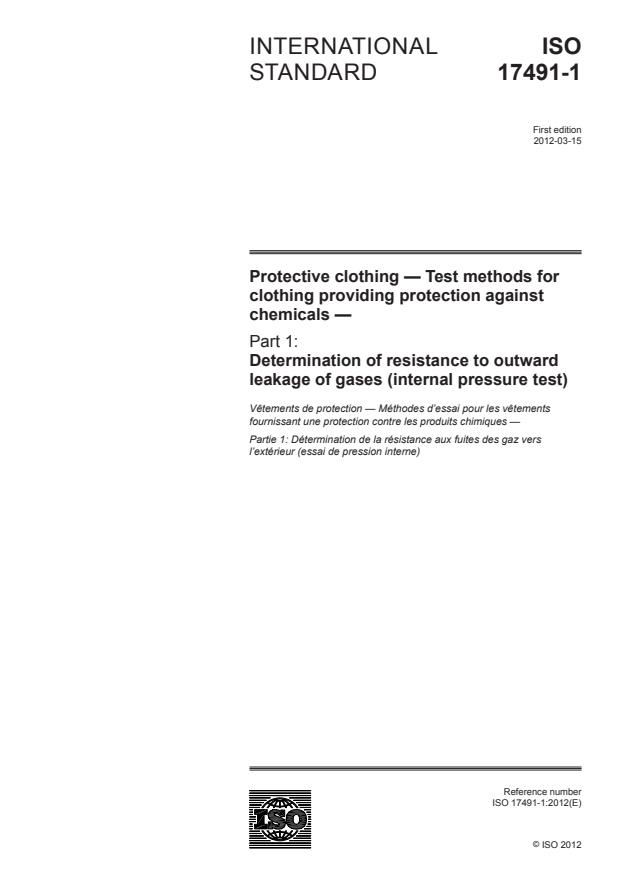
INTERNATIONAL ISO
STANDARD 17491-1
First edition
2012-03-15
Protective clothing — Test methods for
clothing providing protection against
chemicals —
Part 1:
Determination of resistance to outward
leakage of gases (internal pressure test)
Vêtements de protection — Méthodes d’essai pour les vêtements
fournissant une protection contre les produits chimiques —
Partie 1: Détermination de la résistance aux fuites des gaz vers
l’extérieur (essai de pression interne)
Reference number
©
ISO 2012
All rights reserved. Unless otherwise specified, no part of this publication may be reproduced or utilized in any form or by any means,
electronic or mechanical, including photocopying and microfilm, without permission in writing from either ISO at the address below or ISO’s
member body in the country of the requester.
ISO copyright office
Case postale 56 • CH-1211 Geneva 20
Tel. + 41 22 749 01 11
Fax + 41 22 749 09 47
E-mail copyright@iso.org
Web www.iso.org
Published in Switzerland
ii © ISO 2012 – All rights reserved
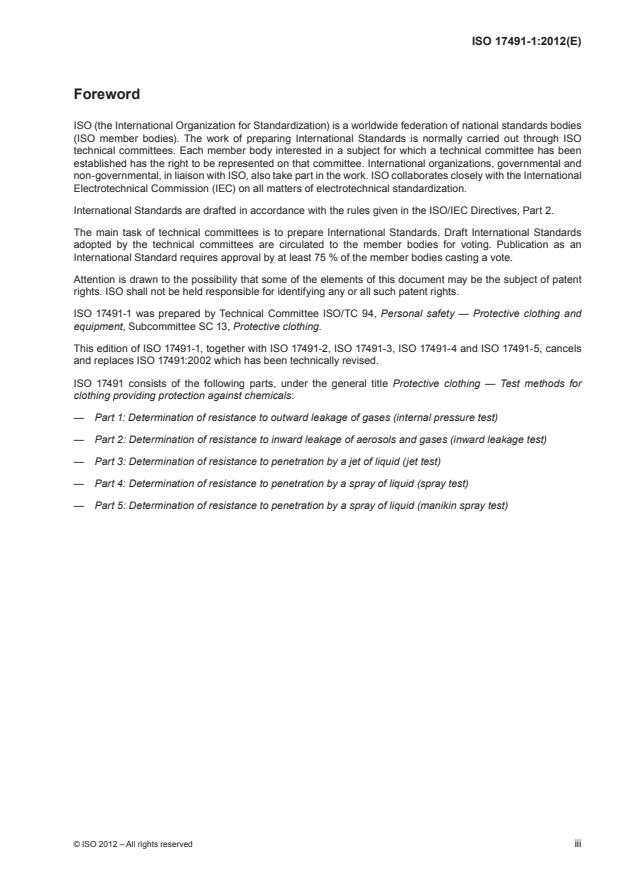
Foreword
ISO (the International Organization for Standardization) is a worldwide federation of national standards bodies
(ISO member bodies). The work of preparing International Standards is normally carried out through ISO
technical committees. Each member body interested in a subject for which a technical committee has been
established has the right to be represented on that committee. International organizations, governmental and
non-governmental, in liaison with ISO, also take part in the work. ISO collaborates closely with the International
Electrotechnical Commission (IEC) on all matters of electrotechnical standardization.
International Standards are drafted in accordance with the rules given in the ISO/IEC Directives, Part 2.
The main task of technical committees is to prepare International Standards. Draft International Standards
adopted by the technical committees are circulated to the member bodies for voting. Publication as an
International Standard requires approval by at least 75 % of the member bodies casting a vote.
Attention is drawn to the possibility that some of the elements of this document may be the subject of patent
rights. ISO shall not be held responsible for identifying any or all such patent rights.
ISO 17491-1 was prepared by Technical Committee ISO/TC 94, Personal safety — Protective clothing and
equipment, Subcommittee SC 13, Protective clothing.
This edition of ISO 17491-1, together with ISO 17491-2, ISO 17491-3, ISO 17491-4 and ISO 17491-5, cancels
and replaces ISO 17491:2002 which has been technically revised.
ISO 17491 consists of the following parts, under the general title Protective clothing — Test methods for
clothing providing protection against chemicals:
— Part 1: Determination of resistance to outward leakage of gases (internal pressure test)
— Part 2: Determination of resistance to inward leakage of aerosols and gases (inward leakage test)
— Part 3: Determination of resistance to penetration by a jet of liquid (jet test)
— Part 4: Determination of resistance to penetration by a spray of liquid (spray test)
— Part 5: Determination of resistance to penetration by a spray of liquid (manikin spray test)
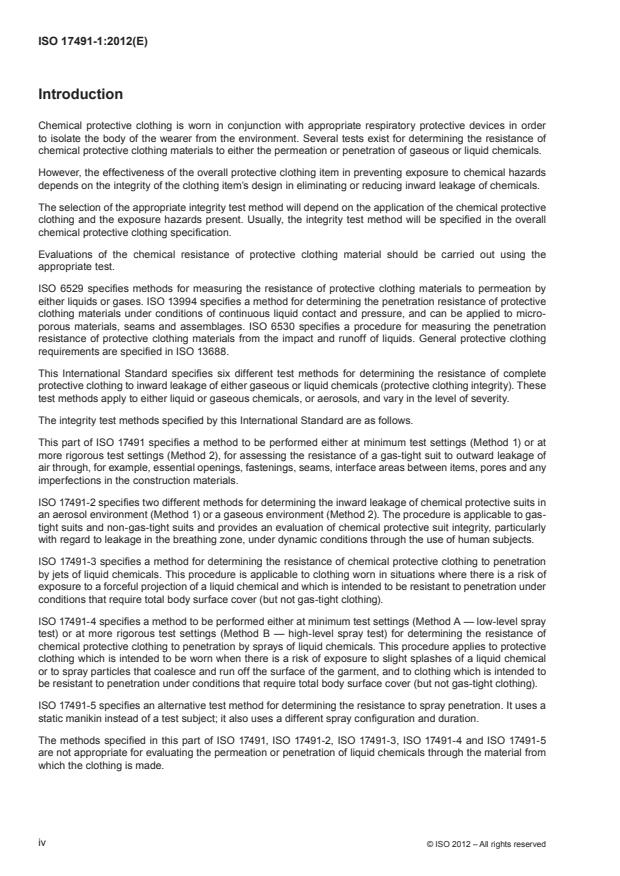
Introduction
Chemical protective clothing is worn in conjunction with appropriate respiratory protective devices in order
to isolate the body of the wearer from the environment. Several tests exist for determining the resistance of
chemical protective clothing materials to either the permeation or penetration of gaseous or liquid chemicals.
However, the effectiveness of the overall protective clothing item in preventing exposure to chemical hazards
depends on the integrity of the clothing item’s design in eliminating or reducing inward leakage of chemicals.
The selection of the appropriate integrity test method will depend on the application of the chemical protective
clothing and the exposure hazards present. Usually, the integrity test method will be specified in the overall
chemical protective clothing specification.
Evaluations of the chemical resistance of protective clothing material should be carried out using the
appropriate test.
ISO 6529 specifies methods for measuring the resistance of protective clothing materials to permeation by
either liquids or gases. ISO 13994 specifies a method for determining the penetration resistance of protective
clothing materials under conditions of continuous liquid contact and pressure, and can be applied to micro-
porous materials, seams and assemblages. ISO 6530 specifies a procedure for measuring the penetration
resistance of protective clothing materials from the impact and runoff of liquids. General protective clothing
requirements are specified in ISO 13688.
This International Standard specifies six different test methods for determining the resistance of complete
protective clothing to inward leakage of either gaseous or liquid chemicals (protective clothing integrity). These
test methods apply to either liquid or gaseous chemicals, or aerosols, and vary in the level of severity.
The integrity test methods specified by this International Standard are as follows.
This part of ISO 17491 specifies a method to be performed either at minimum test settings (Method 1) or at
more rigorous test settings (Method 2), for assessing the resistance of a gas-tight suit to outward leakage of
air through, for example, essential openings, fastenings, seams, interface areas between items, pores and any
imperfections in the construction materials.
ISO 17491-2 specifies two different methods for determining the inward leakage of chemical protective suits in
an aerosol environment (Method 1) or a gaseous environment (Method 2). The procedure is applicable to gas-
tight suits and non-gas-tight suits and provides an evaluation of chemical protective suit integrity, particularly
with regard to leakage in the breathing zone, under dynamic conditions through the use of human subjects.
ISO 17491-3 specifies a method for determining the resistance of chemical protective clothing to penetration
by jets of liquid chemicals. This procedure is applicable to clothing worn in situations where there is a risk of
exposure to a forceful projection of a liquid chemical and which is intended to be resistant to penetration under
conditions that require total body surface cover (but not gas-tight clothing).
ISO 17491-4 specifies a method to be performed either at minimum test settings (Method A — low-level spray
test) or at more rigorous test settings (Method B — high-level spray test) for determining the resistance of
chemical protective clothing to penetration by sprays of liquid chemicals. This procedure applies to protective
clothing which is intended to be worn when there is a risk of exposure to slight splashes of a liquid chemical
or to spray particles that coalesce and run off the surface of the garment, and to clothing which is intended to
be resistant to penetration under conditions that require total body surface cover (but not gas-tight clothing).
ISO 17491-5 specifies an alternative test method for determining the resistance to spray penetration. It uses a
static manikin instead of a test subject; it also uses a different spray configuration and duration.
The methods specified in this part of ISO 17491, ISO 17491-2, ISO 17491-3, ISO 17491-4 and ISO 17491-5
are not appropriate for evaluating the permeation or penetration of liquid chemicals through the material from
which the clothing is made.
iv © ISO 2012 – All rights reserved
INTERNATIONAL STANDARD ISO 17491-1:2012(E)
Protective clothing — Test methods for clothing providing
protection against chemicals —
Part 1:
Determination of resistance to outward leakage of gases
(internal pressure test)
1 Scope
This part of ISO 17491 specifies a method to be performed either at minimum test settings (Method 1) or at
more rigorous test settings (Method 2), for assessing the resistance of a gas-tight suit to outward leakage of
air through, for example, essential openings, fastenings, seams, interface areas between items, pores and any
imperfections in the construction materials.
This test does not simulate penetration by gases in an inward direction. Although the danger to the wearer
arises from leakage in an inward direction, this test method assesses the outward leakage of air after the gas-
tight suit has been inflated so as to stretch the construction material, thereby enabling the test method to detect
very small imperfections, such as holes, splits or tears.
2 Terms and definitions
For the purposes of this document, the following terms and definitions apply.
2.1
assemblage
permanent fastening between two or more different garments, or between chemical protective clothing and
accessories, obtained, for example, by sewing, welding, vulcanizing or gluing
2.2
chemical protective clothing
combined assembly of garments worn to provide protection against exposure to, or contact with, chemicals
2.3
chemical protective suit
clothing worn to protect against chemi
...
NORME ISO
INTERNATIONALE 17491-1
Première édition
2012-03-15
Vêtements de protection — Méthodes
d’essai pour les vêtements fournissant une
protection contre les produits chimiques —
Partie 1:
Détermination de la résistance aux
fuites des gaz vers l’extérieur (essai de
pression interne)
Protective clothing — Test methods for clothing providing protection
against chemicals —
Part 1: Determination of resistance to outward leakage of gases
(internal pressure test)
Numéro de référence
©
ISO 2012
DOCUMENT PROTÉGÉ PAR COPYRIGHT
Droits de reproduction réservés. Sauf prescription différente, aucune partie de cette publication ne peut être reproduite ni utilisée sous
quelque forme que ce soit et par aucun procédé, électronique ou mécanique, y compris la photocopie et les microfilms, sans l’accord écrit
de l’ISO à l’adresse ci-après ou du comité membre de l’ISO dans le pays du demandeur.
ISO copyright office
Case postale 56 • CH-1211 Geneva 20
Tel. + 41 22 749 01 11
Fax + 41 22 749 09 47
E-mail copyright@iso.org
Web www.iso.org
Publié en Suisse
ii © ISO 2012 – Tous droits réservés
Avant-propos
L’ISO (Organisation internationale de normalisation) est une fédération mondiale d’organismes nationaux de
normalisation (comités membres de l’ISO). L’élaboration des Normes internationales est en général confiée aux
comités techniques de l’ISO. Chaque comité membre intéressé par une étude a le droit de faire partie du comité
technique créé à cet effet. Les organisations internationales, gouvernementales et non gouvernementales,
en liaison avec l’ISO participent également aux travaux. L’ISO collabore étroitement avec la Commission
électrotechnique internationale (CEI) en ce qui concerne la normalisation électrotechnique.
Les Normes internationales sont rédigées conformément aux règles données dans les Directives ISO/CEI, Partie 2.
La tâche principale des comités techniques est d’élaborer les Normes internationales. Les projets de Normes
internationales adoptés par les comités techniques sont soumis aux comités membres pour vote. Leur publication
comme Normes internationales requiert l’approbation de 75 % au moins des comités membres votants.
L’attention est appelée sur le fait que certains des éléments du présent document peuvent faire l’objet de droits
de propriété intellectuelle ou de droits analogues. L’ISO ne saurait être tenue pour responsable de ne pas avoir
identifié de tels droits de propriété et averti de leur existence.
L’ISO 17491-1 a été élaborée par le comité technique ISO/TC 94, Sécurité individuelle — Vêtements et
équipements de protection, sous-comité SC 13, Vêtements de protection.
La présente édition de l’ISO 17491-1, conjointement avec l’ISO 17491-2, l’ISO 17491-3, l’ISO 17491-4 et
l’ISO 17491-5, annule et remplace l’ISO 17491:2002, qui a fait l’objet d’une révision technique.
L’ISO 17491 comprend les parties suivantes, présentées sous le titre général Vêtements de protection —
Méthodes d’essai pour les vêtements fournissant une protection contre les produits chimiques:
— Partie 1: Détermination de la résistance aux fuites des gaz vers l’extérieur (essai de pression interne)
— Partie 2: Détermination de la résistance aux fuites des aérosols et des gaz vers l’intérieur (essai de pénétration)
— Partie 3: Détermination de la résistance à la pénétration par un jet de liquide (essai au jet)
— Partie 4: Détermination de la résistance à la pénétration par une vaporisation de liquide (essai au brouillard)
— Partie 5: Détermination de la résistance à la pénétration par une vaporisation de liquide (essai au brouillard
avec un mannequin)
Introduction
Les vêtements de protection chimique se portent avec des appareils de protection respiratoire appropriés, afin
d’isoler le corps de la personne qui les portent de l’environnement. Il existe plusieurs essais visant à déterminer
la résistance des matériaux des vêtements de protection chimique à la perméation ou à la pénétration de
produits chimiques à l’état gazeux ou liquide.
Cependant, l’efficacité de l’ensemble des vêtements de protection contre l’exposition à des dangers chimiques
dépend de la capacité des différents éléments qui les composent à éliminer ou à diminuer les fuites de produits
chimiques vers l’intérieur.
Le choix de la méthode d’essai d’intégrité appropriée dépend de l’utilisation qui est faite des vêtements de
protection chimique et des risques d’exposition existants. La méthode d’essai d’intégrité est habituellement
mentionnée dans la spécification relative aux vêtements de protection chimique.
Il convient d’effectuer l’évaluation de la résistance chimique du matériau des vêtements de protection au moyen
de l’essai approprié.
L’ISO 6529 spécifie des méthodes permettant de mesurer la résistance des matériaux des vêtements de
protection à la perméation de liquides ou de gaz. L’ISO 13994 spécifie une méthode visant à déterminer la
résistance à la pénétration des matériaux des vêtements de protection face à des conditions de pression
et de contact continus d’un liquide, et peut être appliquée aux matériaux microporeux, aux coutures et aux
assemblages. L’ISO 6530 spécifie un mode opératoire permettant de mesurer la résistance des matériaux des
vêtements de protection à la pénétration de liquides projetés ou ruisselants. Les exigences générales relatives
aux vêtements de protection sont spécifiées dans l’ISO 13688.
La présente Norme internationale spécifie six méthodes d’essai différentes pour déterminer la résistance des
vêtements de protection complets aux fuites de produits chimiques liquides ou gazeux vers l’intérieur (intégrité
des vêtements de protection). Ces méthodes d’essai s’appliquent aux produits chimiques liquides ou gazeux et
aux aérosols, et varient selon le niveau de gravité.
Les méthodes d’essai d’intégrité spécifiées dans la présente Norme internationale se présentent comme suit.
La présente partie de l’ISO 17491 spécifie une méthode qui doit être appliquée soit avec des paramètres d’essai
minimaux (Méthode 1), soit avec des paramètres d’essai plus stricts (Méthode 2), pour évaluer la résistance
d’une tenue étanche aux gaz aux fuites d’air vers l’extérieur, par exemple par les principales ouvertures, les
fermetures, les coutures, les zones de jonction entre les vêtements, les pores et tout défaut éventuel des
matériaux utilisés.
L’ISO 17491-2 spécifie deux méthodes différentes permettant de déterminer les fuites vers l’intérieur des
tenues de protection chimique dans un environnement aérosol (Méthode 1) ou gazeux (Méthode 2). Ce mode
opératoire est applicable aux tenues étanches ou non étanches aux gaz et fournit une évaluation de l’intégrité
de la tenue de protection chimique, en particulier pour les fuites dans la zone respiratoire, dans des conditions
dynamiques en faisant appel à des sujets humains.
L’ISO 17491-3 spécifie une méthode permettant de déterminer la résistance des vêtements de protection
chimique à la pénétration d’un jet de produits chimiques liquides. Ce mode opératoire est applicable aux
vêtements portés dans une zone où il existe un risque d’exposition à une projection puissante d’un produit
chimique liquide et prévus pour résister à la pénétration dans des conditions requérant une couverture intégrale
du corps mais pas des vêtements étanches aux gaz.
L’ISO 17491-4 spécifie une méthode à appliquer soit avec des paramètres d’essai minimaux (Méthode A —
essai au brouillard de faible niveau), soit avec des paramètres d’essai plus stricts (Méthode B — essai au
brouillard de niveau élevé), pour déterminer la résistance des vêtements de protection chimique à la pénétration
par vaporisation de produits chimiques liquides. Ce mode opératoire s’applique aux vêtements de protection
prévus pour être portés en cas de risque d’exposition à de légères éclaboussures de produits chimiques
liquides ou à des particules vaporisées qui se rassemblent et s’écoulent le long de la surface de l’article
d’habillement, et aux vêtements prévus pour être résistants à la pénétration dans des conditions requérant une
couverture intégrale du corps mais pas des vêtements étanches aux gaz.
iv © ISO 2012 – Tous droits réservés
L’ISO 17491-5 spécifie une méthode d’essai alternative permettant de déterminer la résistance à la pénétration
par vaporisation. Elle fait appel à un mannequin statique à la place du sujet d’essai; elle utilise également une
configuration et une durée de vaporisation différentes.
Les méthodes spécifiées dans la présente partie de l’ISO 17491, l’ISO 17491-2, l’ISO 17491-3, l’ISO 17491-4
et l’ISO 17491-5 ne permettent pas d’évaluer la perméation ou la pénétration de produits chimiques liquides à
travers le matériau utilisé pour la confection des vêtements.
NORME INTERNATIONALE ISO 17491-1:2012(F)
Vêtements de protection — Méthodes d’essai pour les vêtements
fournissant une protection contre les produits chimiques —
Partie 1:
Détermination de la résistance aux fuites des gaz vers
l’extérieur (essai de pression interne)
1 Domaine d’application
La présente partie de l’ISO 17491 spécifie une méthode à appliquer soit avec des paramètres d’essai minimaux
(Méthode 1), soit avec des paramètres d’essai plus stricts (Méthode 2), pour évaluer la résistance d’une tenue
étanche aux gaz aux fuites d’air vers l’extérieur, par exemple par les principales ouvertures, les fermetures, les
coutures, les zones de jonction entre les vêtements, les pores et tout défaut éventuel des matériaux utilisés.
Le présent essai ne simule pas la pénétration de gaz vers l’intérieur. Bien que le danger pour le porteur
des vêtements réside dans les fuites vers l’intérieur, la présente méthode d’essai évalue les fuites d’air vers
l’extérieur après gonflage de la tenue étanche aux gaz dans le but d’étirer le matériau qui la constitue et donc
de permettre à la présente méthode d’essai de détecter d’infimes défauts, tels que des trous, des fentes ou
des déchirures.
2 Termes et définitions
Pour les besoins du présent document, les termes et définitions suivants s’appliquent.
2.1
assemblage
fixation permanente entre au moins deux articles d’habillement différents ou entre des vêtements de protection
chimique et des accessoires, résultant par exemple d’une couture, d’un soudage, d’une vulcanisation ou d’un collage
2.2
vêtements de protection chimique
ensemble d’articles d’habillement portés en vue de fournir une protection contre l’exposition ou le contact avec
des produits chimiques
2.3
tenue de protection chimique
vêtements couvrant l’intégralité ou une grande partie du corps, destinés à la protection contre les produits chimiques
NOTE 1 Une tenue de protection chimique peut comprendre des articles d’habillement qui, combinés ensemble,
protègent l
...
Questions, Comments and Discussion
Ask us and Technical Secretary will try to provide an answer. You can facilitate discussion about the standard in here.
Loading comments...