

ISO 18616-1:2016
(Main)Transport packaging — Reusable, rigid plastic distribution boxes — Part 1: General purpose application
General Information
- Abstract
ISO 18616-1:2016 specifies the four main types of reusable, rigid plastic distribution boxes for general purpose application in the fields of handling, transport, storage and display of products in distribution systems from the point of manufacture to the point of retail services: a) rigid parallelepipedic and rectangular boxes (stackable boxes); b) foldable boxes; c) nestable boxes; d) nestable and stackable boxes. These boxes are based on the modular area 600 mm × 400 mm, 600 mm × 500 mm, 550 mm × 366 mm and subdivisions of them. This document defines the main types of rigid plastic distribution boxes, dimensions, safety, designation, marking and labeling. ISO 18616-1:2016 is designed for general purpose applications in a returnable transport system. For automotive industry application, ISO 19709‑1, ISO/TS 19709‑2 and ISO/TS 19709-3 can be referenced.
- Status
- Published
- Publication Date
- 07-Nov-2016
- Technical Committee
- ISO/TC 122 - Packaging
- Drafting Committee
- ISO/TC 122 - Packaging
- Current Stage
- 9093 - International Standard confirmed
- Start Date
- 23-May-2022
- Completion Date
- 29-Aug-2026
Buy Documents
ISO 18616-1:2016 - Transport packaging -- Reusable, rigid plastic distribution boxes
ISO 18616-1:2016 - Transport packaging — Reusable, rigid plastic distribution boxes — Part 1: General purpose application/8/2016
Overview
ISO 18616-1:2016 - Transport packaging - Reusable, rigid plastic distribution boxes - Part 1: General purpose application - defines standardized types, dimensions and identification, marking and safety requirements for reusable rigid plastic distribution boxes used in handling, transport, storage and display throughout distribution systems. It is intended for general-purpose returnable transport systems (RTIs) from manufacture to retail.
Key topics and technical requirements
- Box types defined
- Rigid parallelepipedic / rectangular (stackable) boxes
- Foldable boxes (two variants: preserving plan dimensions or changing them when folded)
- Nestable boxes
- Nestable-and-stackable boxes
- Modular plan dimensions
- Boxes are based on modular areas: 600 × 400 mm, 600 × 500 mm, 550 × 366 mm and subdivisions of these modules. Plan dimensions must not exceed the module and deviations shall be ≤ 0.5%.
- Dimensional and mass tolerances
- Plan view subdivisions, inner/outer dimensions, usable inner height and stacking heights are specified.
- Box tare mass tolerance: ±3%.
- Stacking and load
- Nominal stacking load is declared by the manufacturer; stacking safety requirements (static & dynamic) reference ISO 18616‑2 for testing.
- Slippage prevention: design features (e.g., flanges). ISO gives an example where an 8 mm flange is effective to reduce slippage.
- Safety and handling
- Boxes must be free from flash and burrs to avoid injury.
- Requirements for safe stacking and handling are specified and tested per the series.
- Identification, marking & labelling
- Identification number should include manufacturer unique ID, serial number and box designation.
- The standard addresses symbology, data requirements and labelling formats to support traceability and automated identification.
- RFID and automated ID
- Guidance on RFID and automatic identification (Data Matrix, GS1/ADC identifiers) is included to support RTI tracking.
Practical applications and users
ISO 18616-1 is applied where reusable rigid plastic boxes improve supply chain efficiency and sustainability:
- Packaging and container manufacturers - design and certify products to standardized sizes and markings.
- Logistics, warehousing and distribution operators - ensure interoperability, stacking safety and automated handling.
- Retailers and manufacturers - standardize returnable packaging to reduce handling costs and facilitate automation.
- Packaging engineers, procurement, quality and sustainability teams - select compliant RTIs for reuse programs.
- System integrators deploying RFID/traceability in RTI management.
Related standards
- ISO 18616-2 - general specifications for testing (referenced for stacking and safety tests)
- ISO 3394, ISO 3676 - modular plan dimensions and unit load dimensions
- ISO/IEC 15418, 15434, 15459‑5, 16022 - automatic identification and data capture references
- ISO 17364, ISO/IEC 18000‑63 - RFID and RTI identification
- Automotive-specific: ISO 19709‑1, ISO/TS 19709‑2, ISO/TS 19709‑3
Keywords: ISO 18616-1, reusable rigid plastic distribution boxes, returnable transport items (RTI), transport packaging, modular dimensions, stackable boxes, nestable boxes, RFID, identification, supply chain.
Buy Documents
ISO 18616-1:2016 - Transport packaging -- Reusable, rigid plastic distribution boxes
ISO 18616-1:2016 - Transport packaging — Reusable, rigid plastic distribution boxes — Part 1: General purpose application/8/2016
Get Certified
Connect with accredited certification bodies for this standard

BRCGS (Brand Reputation Compliance Global Standards)
Global food safety and quality standards owner.
Sponsored listings
Frequently Asked Questions
ISO 18616-1:2016 is a standard published by the International Organization for Standardization (ISO). Its full title is "Transport packaging — Reusable, rigid plastic distribution boxes — Part 1: General purpose application". This standard covers: ISO 18616-1:2016 specifies the four main types of reusable, rigid plastic distribution boxes for general purpose application in the fields of handling, transport, storage and display of products in distribution systems from the point of manufacture to the point of retail services: a) rigid parallelepipedic and rectangular boxes (stackable boxes); b) foldable boxes; c) nestable boxes; d) nestable and stackable boxes. These boxes are based on the modular area 600 mm × 400 mm, 600 mm × 500 mm, 550 mm × 366 mm and subdivisions of them. This document defines the main types of rigid plastic distribution boxes, dimensions, safety, designation, marking and labeling. ISO 18616-1:2016 is designed for general purpose applications in a returnable transport system. For automotive industry application, ISO 19709‑1, ISO/TS 19709‑2 and ISO/TS 19709-3 can be referenced.
ISO 18616-1:2016 specifies the four main types of reusable, rigid plastic distribution boxes for general purpose application in the fields of handling, transport, storage and display of products in distribution systems from the point of manufacture to the point of retail services: a) rigid parallelepipedic and rectangular boxes (stackable boxes); b) foldable boxes; c) nestable boxes; d) nestable and stackable boxes. These boxes are based on the modular area 600 mm × 400 mm, 600 mm × 500 mm, 550 mm × 366 mm and subdivisions of them. This document defines the main types of rigid plastic distribution boxes, dimensions, safety, designation, marking and labeling. ISO 18616-1:2016 is designed for general purpose applications in a returnable transport system. For automotive industry application, ISO 19709‑1, ISO/TS 19709‑2 and ISO/TS 19709-3 can be referenced.
ISO 18616-1:2016 is classified under the following ICS (International Classification for Standards) categories: 55.180.40 - Complete, filled transport packages. The ICS classification helps identify the subject area and facilitates finding related standards.
ISO 18616-1:2016 is available in PDF format for immediate download after purchase. The document can be added to your cart and obtained through the secure checkout process. Digital delivery ensures instant access to the complete standard document.
Standards Content (Sample)
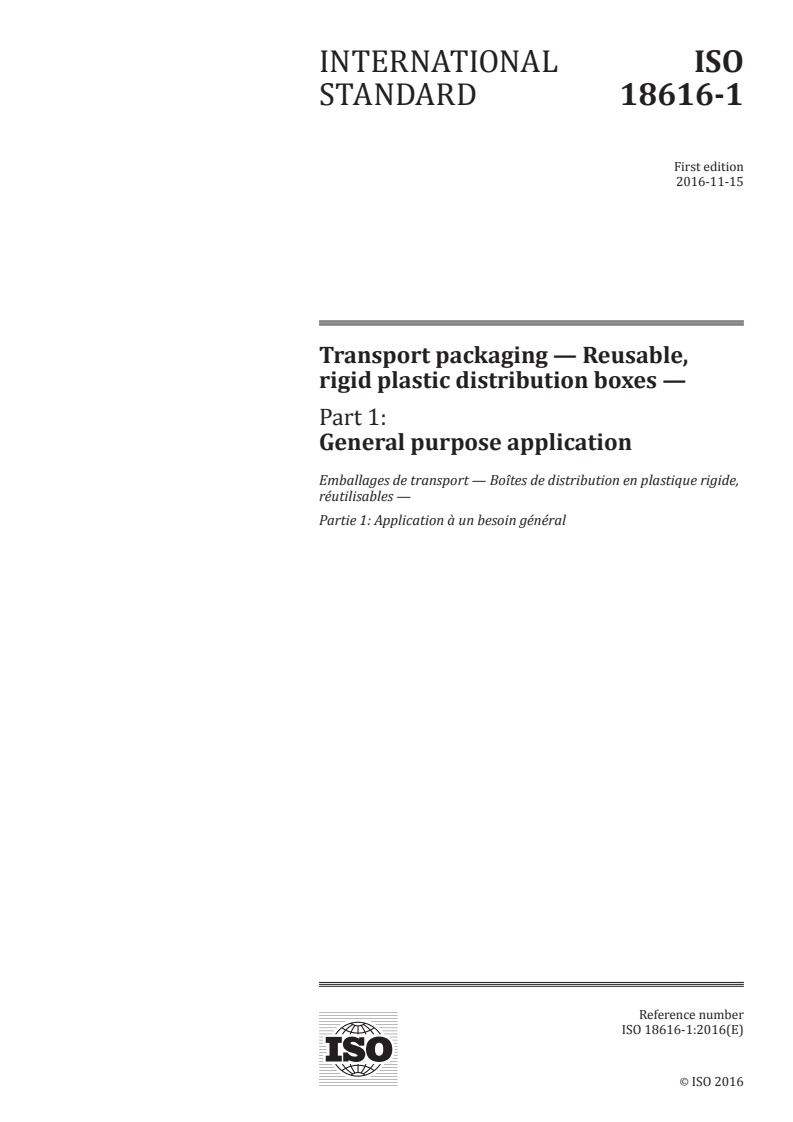
INTERNATIONAL ISO
STANDARD 18616-1
First edition
2016-11-15
Transport packaging — Reusable,
rigid plastic distribution boxes —
Part 1:
General purpose application
Emballages de transport — Boîtes de distribution en plastique rigide,
réutilisables —
Partie 1: Application à un besoin général
Reference number
©
ISO 2016
© ISO 2016, Published in Switzerland
All rights reserved. Unless otherwise specified, no part of this publication may be reproduced or utilized otherwise in any form
or by any means, electronic or mechanical, including photocopying, or posting on the internet or an intranet, without prior
written permission. Permission can be requested from either ISO at the address below or ISO’s member body in the country of
the requester.
ISO copyright office
Ch. de Blandonnet 8 • CP 401
CH-1214 Vernier, Geneva, Switzerland
Tel. +41 22 749 01 11
Fax +41 22 749 09 47
copyright@iso.org
www.iso.org
ii © ISO 2016 – All rights reserved
Contents Page
Foreword .iv
Introduction .v
1 Scope . 1
2 Normative references . 1
3 Terms and definitions . 2
4 Types of reusable rigid plastic distribution boxes . 4
5 Dimensions .10
5.1 Plan view dimensions .10
5.2 Slippage prevention .10
5.3 Box tare mass .10
5.4 Nominal stacking load .10
6 Safety .11
6.1 Safety in stacking .11
6.2 Safety in handling .11
7 Identification .11
7.1 Unique identification of the returnable transport box .11
7.2 Designation of the box .11
8 Marking and labelling .13
8.1 Marking .13
8.1.1 Symbology requirements .13
8.1.2 Data requirements . . .13
8.2 Labelling .15
8.2.1 General.15
8.2.2 Labelling for parallelepipedic type of box .15
9 Radio frequency identification (RFID) .15
Bibliography .16
Foreword
ISO (the International Organization for Standardization) is a worldwide federation of national standards
bodies (ISO member bodies). The work of preparing International Standards is normally carried out
through ISO technical committees. Each member body interested in a subject for which a technical
committee has been established has the right to be represented on that committee. International
organizations, governmental and non-governmental, in liaison with ISO, also take part in the work.
ISO collaborates closely with the International Electrotechnical Commission (IEC) on all matters of
electrotechnical standardization.
The procedures used to develop this document and those intended for its further maintenance are
described in the ISO/IEC Directives, Part 1. In particular the different approval criteria needed for the
different types of ISO documents should be noted. This document was drafted in accordance with the
editorial rules of the ISO/IEC Directives, Part 2 (see www.iso.org/directives).
Attention is drawn to the possibility that some of the elements of this document may be the subject of
patent rights. ISO shall not be held responsible for identifying any or all such patent rights. Details of
any patent rights identified during the development of the document will be in the Introduction and/or
on the ISO list of patent declarations received (see www.iso.org/patents).
Any trade name used in this document is information given for the convenience of users and does not
constitute an endorsement.
For an explanation on the meaning of ISO specific terms and expressions related to conformity assessment,
as well as information about ISO’s adherence to the World Trade Organization (WTO) principles in the
Technical Barriers to Trade (TBT) see the following URL: www.iso.org/iso/foreword.html.
The committee responsible for this document is ISO/TC 122, Packaging.
A list of all parts in the ISO 18616 series can be found on the ISO website.
iv © ISO 2016 – All rights reserved
Introduction
Standardization is a crucial element to improve the efficiency of a returnable packaging system in a
supply chain and can help to integrate a supply chain. Standardization of returnable transport items
(RTI) and its operation system (returnable transport system) is the first step for an efficient and
seamless supply chain. RTI standards such as container sizes, materials and weights enable a company’s
supply chain integration. A standardized returnable packaging operation system facilitates the supply
chain automation, increases efficiency of inventory control and reduces total logistics costs. Global
standardization of returnable transport systems can help a company make it easy to invest in their
packaging system while facilitating smooth and integrated supply chain interfaces from suppliers to
customers.
INTERNATIONAL STANDARD ISO 18616-1:2016(E)
Transport packaging — Reusable, rigid plastic
distribution boxes —
Part 1:
General purpose application
1 Scope
This document specifies the four main types of reusable, rigid plastic distribution boxes for general
purpose application in the fields of handling, transport, storage and display of products in distribution
systems from the point of manufacture to the point of retail services:
a) rigid parallelepipedic and rectangular boxes (stackable boxes);
b) foldable boxes;
c) nestable boxes;
d) nestable and stackable boxes.
These boxes are based on the modular area 600 mm × 400 mm, 600 mm × 500 mm, 550 mm × 366 mm
and subdivisions of them. This document defines the main types of rigid plastic distribution boxes,
dimensions, safety, designation, marking and labeling.
This document is designed for general purpose applications in a returnable transport system. For
automotive industry application, ISO 19709-1, ISO/TS 19709-2 and ISO/TS 19709-3 can be referenced.
2 Normative references
The following documents are referred to in the text in such a way that some or all of their content
constitutes requirements of this document. For dated references, only the edition cited applies. For
undated references, the latest edition of the referenced document (including any amendments) applies.
ISO 3394, Packaging — Complete, filled transport packages and unit loads — Dimensions of rigid
rectangular packages
ISO 3676, Packaging — Complete, filled transport packages and unit loads — Unit load dimensions
ISO/IEC 15418, Information technology — Automatic identification and data capture techniques — GS1
Application Identifiers and ASC MH10 Data Identifiers and maintenance
ISO/IEC 15434, Information technology — Automatic identification and data capture techniques — Syntax
for high-capacity ADC media
ISO/IEC 15459-5, Information technology — Automatic identification and data capture techniques —
Unique identification — Part 5: Individual returnable transport items (RTIs)
ISO/IEC 16022, Information technology — Automatic identification and data capture techniques — Data
Matrix bar code symbology specification
ISO 17364, Supply chain applications of RFID — Returnable transport items (RTIs) and returnable
packaging items (RPIs)
ISO/IEC 18000-63, Information technology — Radio frequency identification for item management — Part
63: Parameters for air interface communications at 860 MHz to 960 MHz Type C
ISO 18616-2, Transport packaging — Reusable, rigid plastics distribution boxes — Part 2: General
specifications for testing
3 Terms and definitions
For the purposes of this document, the terms and definitions given in ISO 21067 and ISO/IEC 19762 and
the following apply.
ISO and IEC maintain terminological databases for use in standardization at the following addresses:
— IEC Electropedia: available at http://www.electropedia.org/
— ISO Online browsing platform: available at http://www.iso.org/obp
3.1
box
rigid packaging with rectangular or polygonal sides, usually completely enclosing the contents
[SOURCE: ISO 21067:2007, 2.3.7]
3.2
bottom
normal standing surface of packaging
[SOURCE: ISO 11683:1997, 3.4]
3.3
burr
raised sharp edge, frequently with a wane on the opposite side
[SOURCE: ISO 8785:1998, 4.2.6]
3.4
capacity
inner parallelepipedic rectangular volume calculated by multiplying
the usable inner length by the usable inner width (both measured at the half way height) and the usable
inner height
3.5
ends
vertical face of the box which corresponds to the width
[SOURCE: ISO 6780:2003, 3.7]
3.6
flash
ridge of workpiece material either expelled from the gap between mould parts or die parts when
forming (die casting, forging, etc.) or formed perpendicular to the direction of pressure when resistance
welding two surfaces (upset welding, flash welding, etc.)
[SOURCE: ISO 8785:1998, 4.2.7]
3.7
foldable box
box with a mechanism to reduce its volume when empty
Note 1 to entry: See examples in Figures 1 and 2.
2 © ISO 2016 – All rights reserved
Figure 1 — Folded without plan view dimensions changed
Key
A Ends for interlocking.
Figure 2 — Folded with plan view dimensions changed
3.8
lid
top fitting cover to enclose a working volume and to prevent the escape of material accessory which fits
inside or over the top rim of the box
3.9
maximum capacity
liquid equivalent volume up to the usable inner height
3.10
nestable box
box which can be placed upright partly inside another when empty, to reduce volume
Note 1 to entry: See Figure 6.
3.11
nestable and stackable box
nestable box incorporating a method of stacking
Note 1 to entry: See Figure 7.
3.12
nominal load
lowest load value, for the purposes of comparison, for the specified support conditions, independent of
the type of load (excluding concentrated loads)
[SOURCE: ISO 445:2013, 2.2]
3.13
nominal stacking load
recommended maximum weight applied to the top of a box when stacked
3.14
reusable packaging
packaging or packaging component which has been designed to accomplish or proves its ability to
accomplish a minimum number of trips or rotations in a system for reuse
[SOURCE: ISO 21067-2:2015, 2.3.2]
3.15
sides
vertical face of the box which corresponds to the length
[SOURCE: ISO 6780:2003, 3.8]
3.16
test load
maximum load required to be contained inside the box, multiplied by the safety factor, or the maximum
stacking load required on top of the box, multiplied by the safety factor
3.17
intrusive marking
subtractive marking
marking method designed to alter a surface to form a human- or machine-readable symbol
[SOURCE: ISO/IEC 19762:2016, 04.02.24, modified]
Note 1 to entry: This marking category includes, but is not limited to, methods that abrade, burn, corrode, cut,
deform, dissolve, etch, melt, oxidize or vaporize a surface. Intrusive marking methods include stamping, laser
etching, chemical etching, dot peen and micro-sandblast.
3.18
non-intrusive m
...
INTERNATIONAL ISO
STANDARD 18616-1
First edition
2016-11-15
Transport packaging — Reusable,
rigid plastic distribution boxes —
Part 1:
General purpose application
Emballages de transport — Boîtes de distribution en plastique rigide,
réutilisables —
Partie 1: Application à un besoin général
Reference number
©
ISO 2016
© ISO 2016, Published in Switzerland
All rights reserved. Unless otherwise specified, no part of this publication may be reproduced or utilized otherwise in any form
or by any means, electronic or mechanical, including photocopying, or posting on the internet or an intranet, without prior
written permission. Permission can be requested from either ISO at the address below or ISO’s member body in the country of
the requester.
ISO copyright office
Ch. de Blandonnet 8 • CP 401
CH-1214 Vernier, Geneva, Switzerland
Tel. +41 22 749 01 11
Fax +41 22 749 09 47
copyright@iso.org
www.iso.org
ii © ISO 2016 – All rights reserved
Contents Page
Foreword .iv
Introduction .v
1 Scope . 1
2 Normative references . 1
3 Terms and definitions . 2
4 Types of reusable rigid plastic distribution boxes . 4
5 Dimensions .10
5.1 Plan view dimensions .10
5.2 Slippage prevention .10
5.3 Box tare mass .10
5.4 Nominal stacking load .10
6 Safety .11
6.1 Safety in stacking .11
6.2 Safety in handling .11
7 Identification .11
7.1 Unique identification of the returnable transport box .11
7.2 Designation of the box .11
8 Marking and labelling .13
8.1 Marking .13
8.1.1 Symbology requirements .13
8.1.2 Data requirements . . .13
8.2 Labelling .15
8.2.1 General.15
8.2.2 Labelling for parallelepipedic type of box .15
9 Radio frequency identification (RFID) .15
Bibliography .16
Foreword
ISO (the International Organization for Standardization) is a worldwide federation of national standards
bodies (ISO member bodies). The work of preparing International Standards is normally carried out
through ISO technical committees. Each member body interested in a subject for which a technical
committee has been established has the right to be represented on that committee. International
organizations, governmental and non-governmental, in liaison with ISO, also take part in the work.
ISO collaborates closely with the International Electrotechnical Commission (IEC) on all matters of
electrotechnical standardization.
The procedures used to develop this document and those intended for its further maintenance are
described in the ISO/IEC Directives, Part 1. In particular the different approval criteria needed for the
different types of ISO documents should be noted. This document was drafted in accordance with the
editorial rules of the ISO/IEC Directives, Part 2 (see www.iso.org/directives).
Attention is drawn to the possibility that some of the elements of this document may be the subject of
patent rights. ISO shall not be held responsible for identifying any or all such patent rights. Details of
any patent rights identified during the development of the document will be in the Introduction and/or
on the ISO list of patent declarations received (see www.iso.org/patents).
Any trade name used in this document is information given for the convenience of users and does not
constitute an endorsement.
For an explanation on the meaning of ISO specific terms and expressions related to conformity assessment,
as well as information about ISO’s adherence to the World Trade Organization (WTO) principles in the
Technical Barriers to Trade (TBT) see the following URL: www.iso.org/iso/foreword.html.
The committee responsible for this document is ISO/TC 122, Packaging.
A list of all parts in the ISO 18616 series can be found on the ISO website.
iv © ISO 2016 – All rights reserved
Introduction
Standardization is a crucial element to improve the efficiency of a returnable packaging system in a
supply chain and can help to integrate a supply chain. Standardization of returnable transport items
(RTI) and its operation system (returnable transport system) is the first step for an efficient and
seamless supply chain. RTI standards such as container sizes, materials and weights enable a company’s
supply chain integration. A standardized returnable packaging operation system facilitates the supply
chain automation, increases efficiency of inventory control and reduces total logistics costs. Global
standardization of returnable transport systems can help a company make it easy to invest in their
packaging system while facilitating smooth and integrated supply chain interfaces from suppliers to
customers.
INTERNATIONAL STANDARD ISO 18616-1:2016(E)
Transport packaging — Reusable, rigid plastic
distribution boxes —
Part 1:
General purpose application
1 Scope
This document specifies the four main types of reusable, rigid plastic distribution boxes for general
purpose application in the fields of handling, transport, storage and display of products in distribution
systems from the point of manufacture to the point of retail services:
a) rigid parallelepipedic and rectangular boxes (stackable boxes);
b) foldable boxes;
c) nestable boxes;
d) nestable and stackable boxes.
These boxes are based on the modular area 600 mm × 400 mm, 600 mm × 500 mm, 550 mm × 366 mm
and subdivisions of them. This document defines the main types of rigid plastic distribution boxes,
dimensions, safety, designation, marking and labeling.
This document is designed for general purpose applications in a returnable transport system. For
automotive industry application, ISO 19709-1, ISO/TS 19709-2 and ISO/TS 19709-3 can be referenced.
2 Normative references
The following documents are referred to in the text in such a way that some or all of their content
constitutes requirements of this document. For dated references, only the edition cited applies. For
undated references, the latest edition of the referenced document (including any amendments) applies.
ISO 3394, Packaging — Complete, filled transport packages and unit loads — Dimensions of rigid
rectangular packages
ISO 3676, Packaging — Complete, filled transport packages and unit loads — Unit load dimensions
ISO/IEC 15418, Information technology — Automatic identification and data capture techniques — GS1
Application Identifiers and ASC MH10 Data Identifiers and maintenance
ISO/IEC 15434, Information technology — Automatic identification and data capture techniques — Syntax
for high-capacity ADC media
ISO/IEC 15459-5, Information technology — Automatic identification and data capture techniques —
Unique identification — Part 5: Individual returnable transport items (RTIs)
ISO/IEC 16022, Information technology — Automatic identification and data capture techniques — Data
Matrix bar code symbology specification
ISO 17364, Supply chain applications of RFID — Returnable transport items (RTIs) and returnable
packaging items (RPIs)
ISO/IEC 18000-63, Information technology — Radio frequency identification for item management — Part
63: Parameters for air interface communications at 860 MHz to 960 MHz Type C
ISO 18616-2, Transport packaging — Reusable, rigid plastics distribution boxes — Part 2: General
specifications for testing
3 Terms and definitions
For the purposes of this document, the terms and definitions given in ISO 21067 and ISO/IEC 19762 and
the following apply.
ISO and IEC maintain terminological databases for use in standardization at the following addresses:
— IEC Electropedia: available at http://www.electropedia.org/
— ISO Online browsing platform: available at http://www.iso.org/obp
3.1
box
rigid packaging with rectangular or polygonal sides, usually completely enclosing the contents
[SOURCE: ISO 21067:2007, 2.3.7]
3.2
bottom
normal standing surface of packaging
[SOURCE: ISO 11683:1997, 3.4]
3.3
burr
raised sharp edge, frequently with a wane on the opposite side
[SOURCE: ISO 8785:1998, 4.2.6]
3.4
capacity
inner parallelepipedic rectangular volume calculated by multiplying
the usable inner length by the usable inner width (both measured at the half way height) and the usable
inner height
3.5
ends
vertical face of the box which corresponds to the width
[SOURCE: ISO 6780:2003, 3.7]
3.6
flash
ridge of workpiece material either expelled from the gap between mould parts or die parts when
forming (die casting, forging, etc.) or formed perpendicular to the direction of pressure when resistance
welding two surfaces (upset welding, flash welding, etc.)
[SOURCE: ISO 8785:1998, 4.2.7]
3.7
foldable box
box with a mechanism to reduce its volume when empty
Note 1 to entry: See examples in Figures 1 and 2.
2 © ISO 2016 – All rights reserved
Figure 1 — Folded without plan view dimensions changed
Key
A Ends for interlocking.
Figure 2 — Folded with plan view dimensions changed
3.8
lid
top fitting cover to enclose a working volume and to prevent the escape of material accessory which fits
inside or over the top rim of the box
3.9
maximum capacity
liquid equivalent volume up to the usable inner height
3.10
nestable box
box which can be placed upright partly inside another when empty, to reduce volume
Note 1 to entry: See Figure 6.
3.11
nestable and stackable box
nestable box incorporating a method of stacking
Note 1 to entry: See Figure 7.
3.12
nominal load
lowest load value, for the purposes of comparison, for the specified support conditions, independent of
the type of load (excluding concentrated loads)
[SOURCE: ISO 445:2013, 2.2]
3.13
nominal stacking load
recommended maximum weight applied to the top of a box when stacked
3.14
reusable packaging
packaging or packaging component which has been designed to accomplish or proves its ability to
accomplish a minimum number of trips or rotations in a system for reuse
[SOURCE: ISO 21067-2:2015, 2.3.2]
3.15
sides
vertical face of the box which corresponds to the length
[SOURCE: ISO 6780:2003, 3.8]
3.16
test load
maximum load required to be contained inside the box, multiplied by the safety factor, or the maximum
stacking load required on top of the box, multiplied by the safety factor
3.17
intrusive marking
subtractive marking
marking method designed to alter a surface to form a human- or machine-readable symbol
[SOURCE: ISO/IEC 19762:2016, 04.02.24, modified]
Note 1 to entry: This marking category includes, but is not limited to, methods that abrade, burn, corrode, cut,
deform, dissolve, etch, melt, oxidize or vaporize a surface. Intrusive marking methods include stamping, laser
etching, chemical etching, dot peen and micro-sandblast.
3.18
non-intrusive m
...