

ISO 18616-2:2016
(Main)Transport packaging — Reusable, rigid plastic distribution boxes — Part 2: General specifications for testing
General Information
- Abstract
ISO 18616-2:2016 specifies the test methods for handling and managing reusable, rigid plastic distribution boxes. These boxes are based on the modular area 600 mm × 400 mm, 600 mm × 500 mm, 550 mm × 366 mm and subdivisions of them. ISO 18616-2:2016 is designed for general purpose applications in a returnable transport system. For automotive industry application, ISO 19709‑1, ISO/TS 19709-2 and ISO/TS 19709-3 can be referenced.
- Status
- Published
- Publication Date
- 07-Nov-2016
- Technical Committee
- ISO/TC 122 - Packaging
- Drafting Committee
- ISO/TC 122 - Packaging
- Current Stage
- 9093 - International Standard confirmed
- Start Date
- 23-May-2022
- Completion Date
- 29-Aug-2026
Buy Documents
ISO 18616-2:2016 - Transport packaging -- Reusable, rigid plastic distribution boxes
ISO 18616-2:2016 - Transport packaging — Reusable, rigid plastic distribution boxes — Part 2: General specifications for testing/8/2016
Overview
ISO 18616-2:2016 specifies test methods for handling and managing reusable, rigid plastic distribution boxes used in returnable transport systems. The standard covers boxes based on the modular areas 600 × 400 mm, 600 × 500 mm, 550 × 366 mm and their subdivisions. It is intended for general-purpose applications and supports supply‑chain integration, quality control and design verification for reusable transport items (RTIs).
Key topics and technical requirements
- Scope & applicability: General-purpose reusable rigid plastic distribution boxes in returnable transport systems; automotive users can reference ISO 19709‑1/2/3.
- Performance requirements:
- Surfaces: Free from foreign bodies, cracks, blowholes and unacceptable burrs; minor processing unevenness allowed if fitness for use is unaffected.
- Dimensions & mass: Tolerances on nominal sizes ≤ ±0.5%; plan view sizes must not exceed modular sizes (ISO 3394); tare mass tolerance ≤ ±3%.
- Shape stability: No visible damage or deformation that reduces function after tests.
- Stacking stability: Three-box stacks must remain in equilibrium; height reduction under load < 2% and residual reduction < 1%.
- Base deflection: Deflection under load < 3% of base diagonal; residual deflection < 1%.
- Test preparations:
- Use new, unused boxes; condition samples (typically 24 h at 23 °C ± 2 °C) per ISO 2233.
- Test load = maximum expected load × safety factor (≥ 1.5).
- Internal test load typically uses fabric/plastic bags with 500 g of plastic granules (type A) or steel balls (type B) occupying > 80% of capacity.
- Test methods:
- Stacking test (static load): Stack three empty boxes, apply 10% then 100% test load (measurements at 0%, after 96 h, and after 24 h relaxation) - per ISO 2234 procedure.
- Drop tests: Two sequences - cold-conditioned drop (−18 °C then drop 0.75 m) and ambient drop (23 °C drop 2.0 m), multiple impact orientations - per ISO 2248.
- Base deflection test: Measure maximum base deflection with 10%/100%/10% load sequence.
Applications and users
ISO 18616-2 is used by:
- Packaging designers and manufacturers for design validation and compliance testing
- QA/verification labs for acceptance testing of reusable plastic boxes
- Logistics and supply‑chain engineers and RTI pool operators to ensure compatibility with automated handling and stacking systems
- Procurement teams specifying RTIs for standardized, returnable transport systems
- Automotive supply chains (with cross-reference to ISO 19709 series)
Practical benefits include improved RTI durability, predictable stacking behaviour, validated drop resistance, and reduced lifecycle logistics cost.
Related standards
- ISO 18616-1 (terms/definitions) and ISO 21067
- ISO 2206 (identification for testing)
- ISO 2233 (conditioning)
- ISO 2234 (stacking tests)
- ISO 2248 (vertical impact/drop test)
- ISO 3394 (dimensions of rigid rectangular packages)
- ISO 19709‑1/2/3 (automotive RTI guidance)
Buy Documents
ISO 18616-2:2016 - Transport packaging -- Reusable, rigid plastic distribution boxes
ISO 18616-2:2016 - Transport packaging — Reusable, rigid plastic distribution boxes — Part 2: General specifications for testing/8/2016
Get Certified
Connect with accredited certification bodies for this standard

BRCGS (Brand Reputation Compliance Global Standards)
Global food safety and quality standards owner.
Sponsored listings
Frequently Asked Questions
ISO 18616-2:2016 is a standard published by the International Organization for Standardization (ISO). Its full title is "Transport packaging — Reusable, rigid plastic distribution boxes — Part 2: General specifications for testing". This standard covers: ISO 18616-2:2016 specifies the test methods for handling and managing reusable, rigid plastic distribution boxes. These boxes are based on the modular area 600 mm × 400 mm, 600 mm × 500 mm, 550 mm × 366 mm and subdivisions of them. ISO 18616-2:2016 is designed for general purpose applications in a returnable transport system. For automotive industry application, ISO 19709‑1, ISO/TS 19709-2 and ISO/TS 19709-3 can be referenced.
ISO 18616-2:2016 specifies the test methods for handling and managing reusable, rigid plastic distribution boxes. These boxes are based on the modular area 600 mm × 400 mm, 600 mm × 500 mm, 550 mm × 366 mm and subdivisions of them. ISO 18616-2:2016 is designed for general purpose applications in a returnable transport system. For automotive industry application, ISO 19709‑1, ISO/TS 19709-2 and ISO/TS 19709-3 can be referenced.
ISO 18616-2:2016 is classified under the following ICS (International Classification for Standards) categories: 55.180.40 - Complete, filled transport packages. The ICS classification helps identify the subject area and facilitates finding related standards.
ISO 18616-2:2016 is available in PDF format for immediate download after purchase. The document can be added to your cart and obtained through the secure checkout process. Digital delivery ensures instant access to the complete standard document.
Standards Content (Sample)
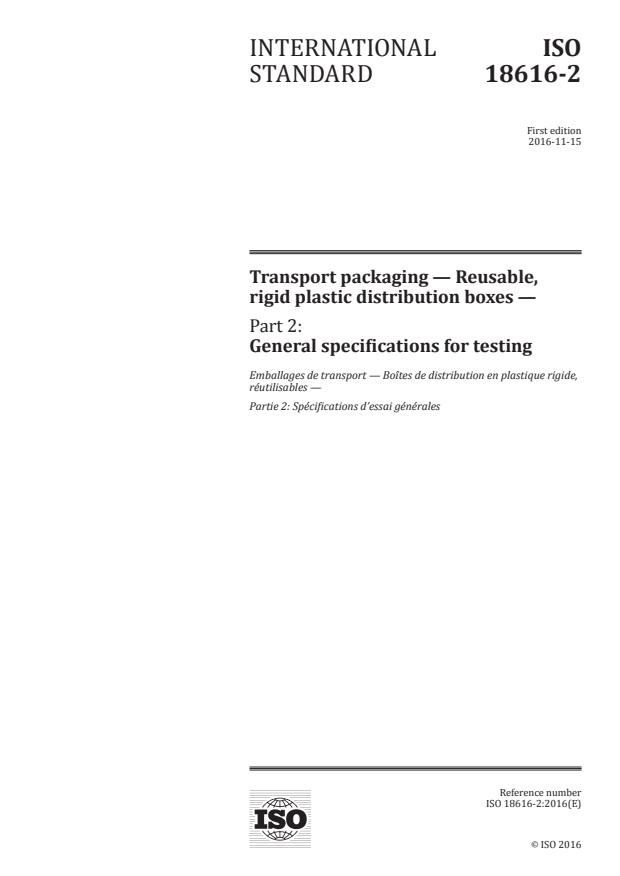
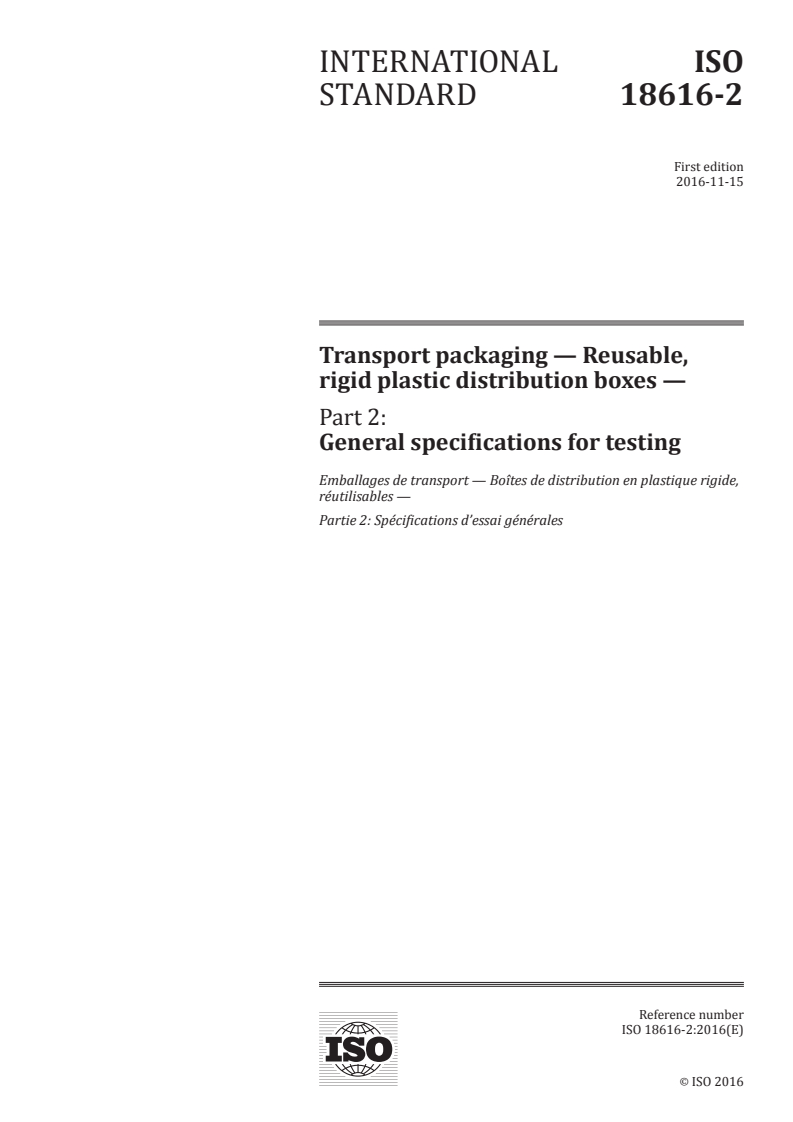
INTERNATIONAL ISO
STANDARD 18616-2
First edition
2016-11-15
Transport packaging — Reusable,
rigid plastic distribution boxes —
Part 2:
General specifications for testing
Emballages de transport — Boîtes de distribution en plastique rigide,
réutilisables —
Partie 2: Spécifications d’essai générales
Reference number
©
ISO 2016
© ISO 2016, Published in Switzerland
All rights reserved. Unless otherwise specified, no part of this publication may be reproduced or utilized otherwise in any form
or by any means, electronic or mechanical, including photocopying, or posting on the internet or an intranet, without prior
written permission. Permission can be requested from either ISO at the address below or ISO’s member body in the country of
the requester.
ISO copyright office
Ch. de Blandonnet 8 • CP 401
CH-1214 Vernier, Geneva, Switzerland
Tel. +41 22 749 01 11
Fax +41 22 749 09 47
copyright@iso.org
www.iso.org
ii © ISO 2016 – All rights reserved
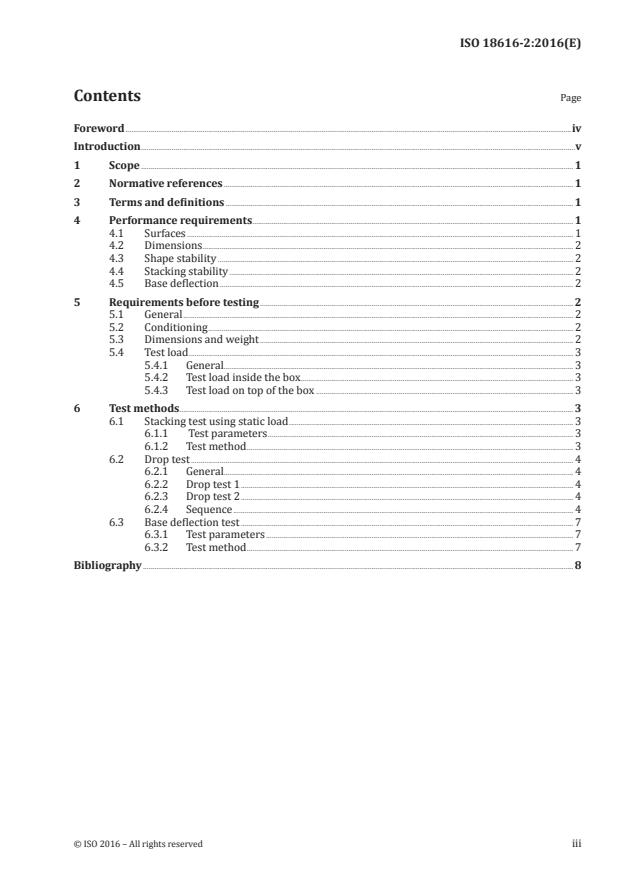
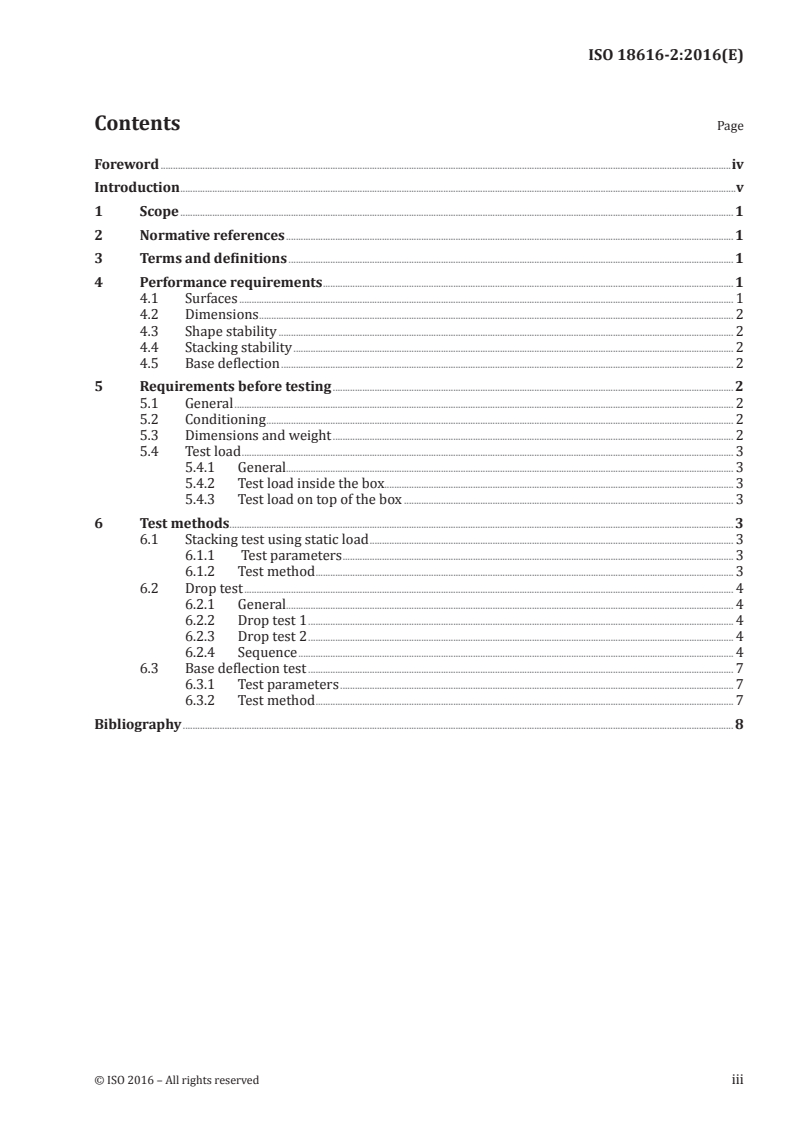
Contents Page
Foreword .iv
Introduction .v
1 Scope . 1
2 Normative references . 1
3 Terms and definitions . 1
4 Performance requirements . 1
4.1 Surfaces . 1
4.2 Dimensions . 2
4.3 Shape stability . 2
4.4 Stacking stability . 2
4.5 Base deflection . 2
5 Requirements before testing . 2
5.1 General . 2
5.2 Conditioning . 2
5.3 Dimensions and weight . 2
5.4 Test load . 3
5.4.1 General. 3
5.4.2 Test load inside the box . . 3
5.4.3 Test load on top of the box . 3
6 Test methods . 3
6.1 Stacking test using static load . 3
6.1.1 Test parameters . 3
6.1.2 Test method . 3
6.2 Drop test . 4
6.2.1 General. 4
6.2.2 Drop test 1 . 4
6.2.3 Drop test 2 . 4
6.2.4 Sequence . 4
6.3 Base deflection test . 7
6.3.1 Test parameters . 7
6.3.2 Test method . 7
Bibliography . 8
Foreword
ISO (the International Organization for Standardization) is a worldwide federation of national standards
bodies (ISO member bodies). The work of preparing International Standards is normally carried out
through ISO technical committees. Each member body interested in a subject for which a technical
committee has been established has the right to be represented on that committee. International
organizations, governmental and non-governmental, in liaison with ISO, also take part in the work.
ISO collaborates closely with the International Electrotechnical Commission (IEC) on all matters of
electrotechnical standardization.
The procedures used to develop this document and those intended for its further maintenance are
described in the ISO/IEC Directives, Part 1. In particular the different approval criteria needed for the
different types of ISO documents should be noted. This document was drafted in accordance with the
editorial rules of the ISO/IEC Directives, Part 2 (see www.iso.org/directives).
Attention is drawn to the possibility that some of the elements of this document may be the subject of
patent rights. ISO shall not be held responsible for identifying any or all such patent rights. Details of
any patent rights identified during the development of the document will be in the Introduction and/or
on the ISO list of patent declarations received (see www.iso.org/patents).
Any trade name used in this document is information given for the convenience of users and does not
constitute an endorsement.
For an explanation on the meaning of ISO specific terms and expressions related to conformity assessment,
as well as information about ISO’s adherence to the World Trade Organization (WTO) principles in the
Technical Barriers to Trade (TBT) see the following URL: www.iso.org/iso/foreword.html.
The committee responsible for this document is ISO/TC 122, Packaging.
A list of all parts in the ISO 18616 series can be found on the ISO website.
iv © ISO 2016 – All rights reserved
Introduction
Standardization is a crucial element to improve the efficiency of a returnable packaging system in a
supply chain and can help to integrate a supply chain. Standardization of returnable transport items
(RTI) and its operation system (returnable transport system) is the first step for an efficient and
seamless supply cha
...
INTERNATIONAL ISO
STANDARD 18616-2
First edition
2016-11-15
Transport packaging — Reusable,
rigid plastic distribution boxes —
Part 2:
General specifications for testing
Emballages de transport — Boîtes de distribution en plastique rigide,
réutilisables —
Partie 2: Spécifications d’essai générales
Reference number
©
ISO 2016
© ISO 2016, Published in Switzerland
All rights reserved. Unless otherwise specified, no part of this publication may be reproduced or utilized otherwise in any form
or by any means, electronic or mechanical, including photocopying, or posting on the internet or an intranet, without prior
written permission. Permission can be requested from either ISO at the address below or ISO’s member body in the country of
the requester.
ISO copyright office
Ch. de Blandonnet 8 • CP 401
CH-1214 Vernier, Geneva, Switzerland
Tel. +41 22 749 01 11
Fax +41 22 749 09 47
copyright@iso.org
www.iso.org
ii © ISO 2016 – All rights reserved
Contents Page
Foreword .iv
Introduction .v
1 Scope . 1
2 Normative references . 1
3 Terms and definitions . 1
4 Performance requirements . 1
4.1 Surfaces . 1
4.2 Dimensions . 2
4.3 Shape stability . 2
4.4 Stacking stability . 2
4.5 Base deflection . 2
5 Requirements before testing . 2
5.1 General . 2
5.2 Conditioning . 2
5.3 Dimensions and weight . 2
5.4 Test load . 3
5.4.1 General. 3
5.4.2 Test load inside the box . . 3
5.4.3 Test load on top of the box . 3
6 Test methods . 3
6.1 Stacking test using static load . 3
6.1.1 Test parameters . 3
6.1.2 Test method . 3
6.2 Drop test . 4
6.2.1 General. 4
6.2.2 Drop test 1 . 4
6.2.3 Drop test 2 . 4
6.2.4 Sequence . 4
6.3 Base deflection test . 7
6.3.1 Test parameters . 7
6.3.2 Test method . 7
Bibliography . 8
Foreword
ISO (the International Organization for Standardization) is a worldwide federation of national standards
bodies (ISO member bodies). The work of preparing International Standards is normally carried out
through ISO technical committees. Each member body interested in a subject for which a technical
committee has been established has the right to be represented on that committee. International
organizations, governmental and non-governmental, in liaison with ISO, also take part in the work.
ISO collaborates closely with the International Electrotechnical Commission (IEC) on all matters of
electrotechnical standardization.
The procedures used to develop this document and those intended for its further maintenance are
described in the ISO/IEC Directives, Part 1. In particular the different approval criteria needed for the
different types of ISO documents should be noted. This document was drafted in accordance with the
editorial rules of the ISO/IEC Directives, Part 2 (see www.iso.org/directives).
Attention is drawn to the possibility that some of the elements of this document may be the subject of
patent rights. ISO shall not be held responsible for identifying any or all such patent rights. Details of
any patent rights identified during the development of the document will be in the Introduction and/or
on the ISO list of patent declarations received (see www.iso.org/patents).
Any trade name used in this document is information given for the convenience of users and does not
constitute an endorsement.
For an explanation on the meaning of ISO specific terms and expressions related to conformity assessment,
as well as information about ISO’s adherence to the World Trade Organization (WTO) principles in the
Technical Barriers to Trade (TBT) see the following URL: www.iso.org/iso/foreword.html.
The committee responsible for this document is ISO/TC 122, Packaging.
A list of all parts in the ISO 18616 series can be found on the ISO website.
iv © ISO 2016 – All rights reserved
Introduction
Standardization is a crucial element to improve the efficiency of a returnable packaging system in a
supply chain and can help to integrate a supply chain. Standardization of returnable transport items
(RTI) and its operation system (returnable transport system) is the first step for an efficient and
seamless supply cha
...