


ISO/FDIS 15194
(Main)In vitro diagnostic medical devices — Requirements for certified reference materials and the content of supporting documentation
In vitro diagnostic medical devices — Requirements for certified reference materials and the content of supporting documentation
Dispositifs médicaux de diagnostic in vitro — Exigences relatives aux matériaux de référence certifiés et au contenu de la documentation associée
General Information
- Status
- Not Published
- Current Stage
- 5020 - FDIS ballot initiated: 2 months. Proof sent to secretariat
- Start Date
- 25-Mar-2026
- Completion Date
- 25-Mar-2026
Relations
- Effective Date
- 12-Feb-2026
- Effective Date
- 06-Jun-2022
Overview
ISO/FDIS 15194 establishes requirements for certified reference materials (CRMs) used with in vitro diagnostic (IVD) medical devices, as well as the necessary contents of their supporting documentation. Developed by ISO Technical Committee 212, this standard is essential for laboratories, manufacturers, and reference material producers to ensure accuracy and metrological traceability in clinical measurements. It aligns with ISO 17511 for calibration hierarchies and supports the consistent use of higher-order CRMs, fostering reliability in laboratory medicine.
Key Topics
- Certified Reference Materials (CRMs): Definition and requirements for CRMs, which are reference materials with certified property values and documented uncertainty and traceability.
- Supporting Documentation: Specifies what information must be included, such as the reference material certificate and certification report. Contents cover production processes, intended use, commutability, stability, measurement uncertainties, and safety precautions.
- Commutability: Emphasizes the importance of establishing and documenting commutability of CRMs, which is their comparability with patient samples across different measurement methods.
- Calibration Hierarchies: Clarifies the roles of primary reference materials, secondary calibrators, and international conventional calibrators within measurement traceability frameworks.
- Intended Use and Labeling: Requires clear description of the CRM’s intended application and proper labeling to facilitate safe and effective use.
- Measurement Uncertainty and Trueness: Details the evaluation and reporting of uncertainty associated with certified values, supporting assessment of measurement trueness and ongoing laboratory performance.
Applications
The requirements outlined in ISO/FDIS 15194 have significant practical value for:
- Clinical Laboratories: Ensuring traceability and comparability of diagnostic results by using CRMs produced in accordance with recognized international standards.
- IVD Device Manufacturers: Meeting regulatory and quality requirements when developing calibrators or trueness controls for diagnostic systems.
- Reference Material Producers: Providing clear guidance for the production, certification, and documentation of CRMs, underpinning the calibration of measurement systems.
- Regulatory Compliance: Facilitating conformity with EU regulations (e.g., Regulation (EU) 2017/746) and national medical device requirements.
- Quality Assurance: Strengthening the integrity of laboratory quality management by documenting metrological traceability and uncertainty, reducing the risk of inconsistent patient results.
Related Standards
To support a holistic approach to quality and measurement traceability in laboratory medicine, ISO/FDIS 15194 refers to other key international standards:
- ISO 17511: Requirements for establishing metrological traceability of values assigned to calibrators, trueness control materials, and human samples.
- ISO 17034: General requirements for the competence of reference material producers, essential for organizations preparing CRMs.
- ISO 80000 (all parts): Standardization of quantities and units.
- ISO/IEC Guide 99: International vocabulary of metrology-Basic and general concepts and associated terms (VIM).
- ISO 15193: Requirements for higher-order reference measurement procedures applicable in laboratory medicine.
ISO/FDIS 15194 is vital for standardizing the production and documentation of certified reference materials in the field of in vitro diagnostics. Adoption of this standard ensures metrological traceability, fosters global harmonization, and advances the reliability and quality of laboratory testing and diagnostic device calibration.
Buy Documents

ISO/FDIS 15194 - In vitro diagnostic medical devices — Requirements for certified reference materials and the content of supporting documentation/31/2023

ISO/FDIS 15194 - In vitro diagnostic medical devices — Requirements for certified reference materials and the content of supporting documentation
REDLINE ISO/FDIS 15194 - In vitro diagnostic medical devices — Requirements for certified reference materials and the content of supporting documentation

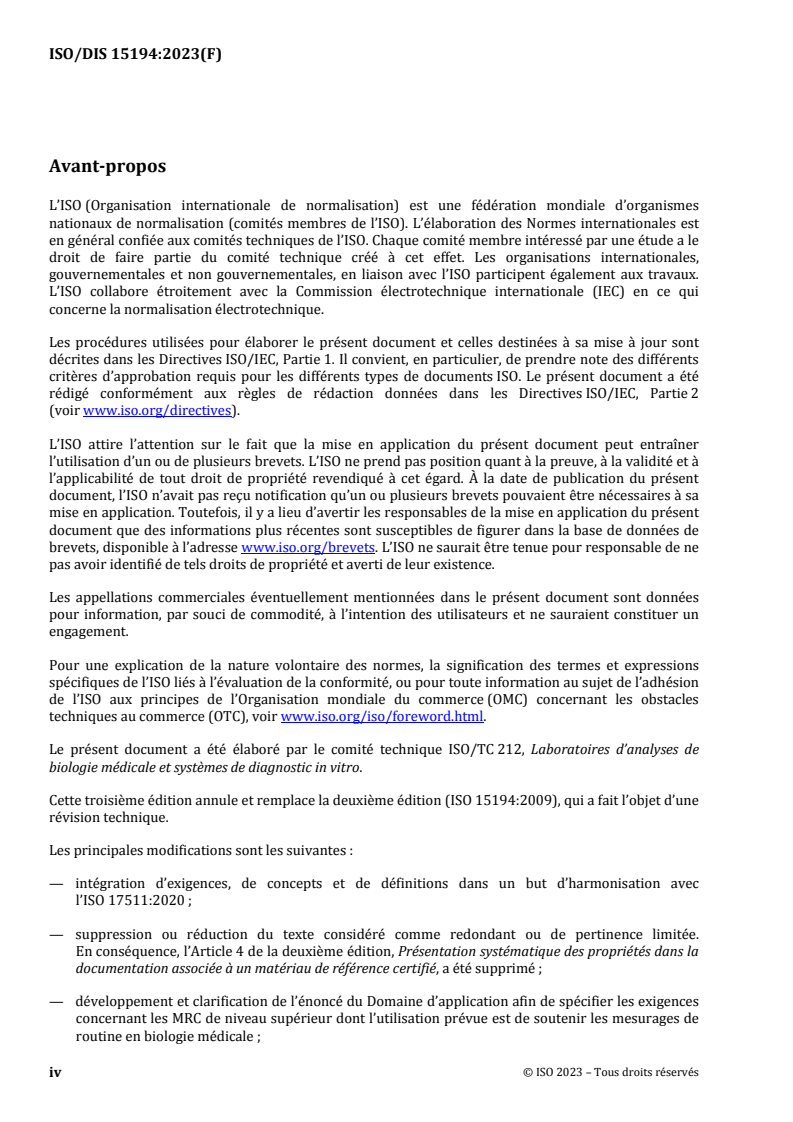
ISO/FDIS 15194 - Dispositifs médicaux de diagnostic in vitro — Exigences relatives aux matériaux de référence certifiés et au contenu de la documentation associée/5/2024

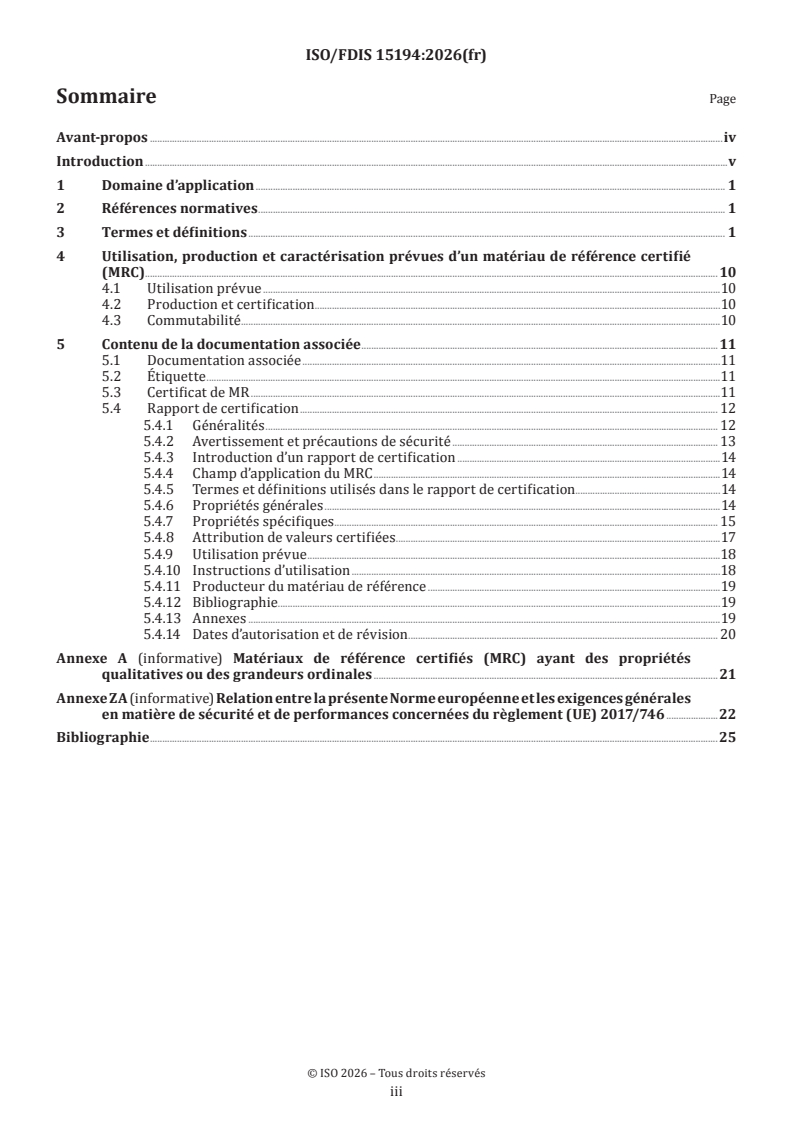
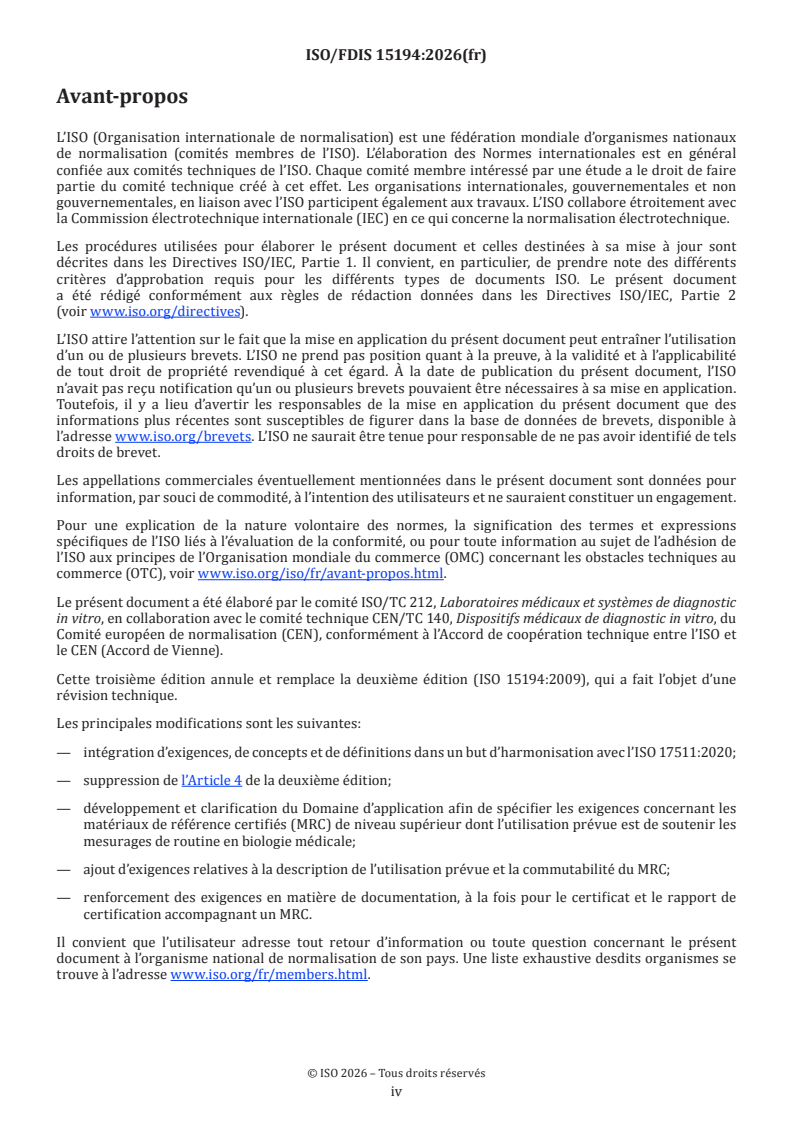
ISO/FDIS 15194 - Dispositifs médicaux de diagnostic in vitro — Exigences relatives aux matériaux de référence certifiés et au contenu de la documentation associée
Get Certified
Connect with accredited certification bodies for this standard

BSI Group
BSI (British Standards Institution) is the business standards company that helps organizations make excellence a habit.

TÜV Rheinland
TÜV Rheinland is a leading international provider of technical services.

TÜV SÜD
TÜV SÜD is a trusted partner of choice for safety, security and sustainability solutions.
Sponsored listings
Frequently Asked Questions
ISO/FDIS 15194 is a draft published by the International Organization for Standardization (ISO). Its full title is "In vitro diagnostic medical devices — Requirements for certified reference materials and the content of supporting documentation". This standard covers: In vitro diagnostic medical devices — Requirements for certified reference materials and the content of supporting documentation
In vitro diagnostic medical devices — Requirements for certified reference materials and the content of supporting documentation
ISO/FDIS 15194 is classified under the following ICS (International Classification for Standards) categories: 11.100.10 - In vitro diagnostic test systems. The ICS classification helps identify the subject area and facilitates finding related standards.
ISO/FDIS 15194 has the following relationships with other standards: It is inter standard links to FprEN ISO 15194, ISO 15194:2009. Understanding these relationships helps ensure you are using the most current and applicable version of the standard.
ISO/FDIS 15194 is available in PDF format for immediate download after purchase. The document can be added to your cart and obtained through the secure checkout process. Digital delivery ensures instant access to the complete standard document.
Standards Content (Sample)
DRAFT INTERNATIONAL STANDARD
ISO/DIS 15194
ISO/TC 212 Secretariat: ANSI
Voting begins on: Voting terminates on:
2023-12-26 2024-03-19
In vitro diagnostic medical devices — Requirements for
certified reference materials and the content of supporting
documentation
ICS: 11.100.10
This document is circulated as received from the committee secretariat.
THIS DOCUMENT IS A DRAFT CIRCULATED
FOR COMMENT AND APPROVAL. IT IS
ISO/CEN PARALLEL PROCESSING
THEREFORE SUBJECT TO CHANGE AND MAY
NOT BE REFERRED TO AS AN INTERNATIONAL
STANDARD UNTIL PUBLISHED AS SUCH.
IN ADDITION TO THEIR EVALUATION AS
BEING ACCEPTABLE FOR INDUSTRIAL,
TECHNOLOGICAL, COMMERCIAL AND
USER PURPOSES, DRAFT INTERNATIONAL
STANDARDS MAY ON OCCASION HAVE TO
BE CONSIDERED IN THE LIGHT OF THEIR
POTENTIAL TO BECOME STANDARDS TO
WHICH REFERENCE MAY BE MADE IN
Reference number
NATIONAL REGULATIONS.
ISO/DIS 15194:2023(E)
RECIPIENTS OF THIS DRAFT ARE INVITED
TO SUBMIT, WITH THEIR COMMENTS,
NOTIFICATION OF ANY RELEVANT PATENT
RIGHTS OF WHICH THEY ARE AWARE AND TO
PROVIDE SUPPORTING DOCUMENTATION. © ISO 2023
ISO/DIS 15194:2023(E)
DRAFT INTERNATIONAL STANDARD
ISO/DIS 15194
ISO/TC 212 Secretariat: ANSI
Voting begins on: Voting terminates on:
In vitro diagnostic medical devices — Requirements for
certified reference materials and the content of supporting
documentation
ICS: 11.100.10
This document is circulated as received from the committee secretariat.
THIS DOCUMENT IS A DRAFT CIRCULATED
FOR COMMENT AND APPROVAL. IT IS
© ISO 2023
ISO/CEN PARALLEL PROCESSING
THEREFORE SUBJECT TO CHANGE AND MAY
All rights reserved. Unless otherwise specified, or required in the context of its implementation, no part of this publication may
NOT BE REFERRED TO AS AN INTERNATIONAL
be reproduced or utilized otherwise in any form or by any means, electronic or mechanical, including photocopying, or posting on STANDARD UNTIL PUBLISHED AS SUCH.
the internet or an intranet, without prior written permission. Permission can be requested from either ISO at the address below
IN ADDITION TO THEIR EVALUATION AS
or ISO’s member body in the country of the requester. BEING ACCEPTABLE FOR INDUSTRIAL,
TECHNOLOGICAL, COMMERCIAL AND
ISO copyright office
USER PURPOSES, DRAFT INTERNATIONAL
CP 401 • Ch. de Blandonnet 8
STANDARDS MAY ON OCCASION HAVE TO
BE CONSIDERED IN THE LIGHT OF THEIR
CH-1214 Vernier, Geneva
POTENTIAL TO BECOME STANDARDS TO
Phone: +41 22 749 01 11
WHICH REFERENCE MAY BE MADE IN
Reference number
Email: copyright@iso.org
NATIONAL REGULATIONS.
Website: www.iso.org ISO/DIS 15194:2023(E)
RECIPIENTS OF THIS DRAFT ARE INVITED
Published in Switzerland
TO SUBMIT, WITH THEIR COMMENTS,
NOTIFICATION OF ANY RELEVANT PATENT
RIGHTS OF WHICH THEY ARE AWARE AND TO
ii
PROVIDE SUPPORTING DOCUMENTATION. © ISO 2023
ISO/DIS 15194:2023(E)
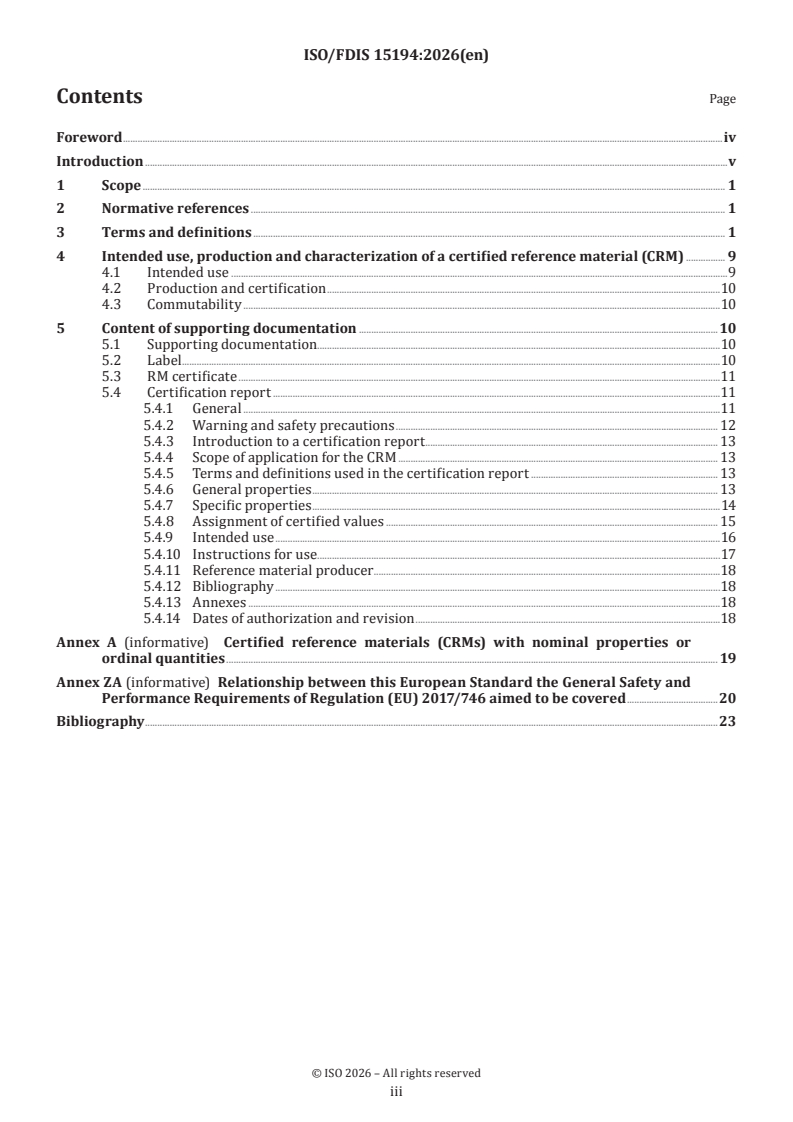
Contents Page
Foreword .iv
Introduction .v
1 Scope . 1
2 Normative references . 1
3 Terms and definitions . 1
4 Intended use, production and characterization of a Certified Reference Material
(CRM) . 9
4.1 Intended Use . 9
4.2 Production and certification . 9
4.3 Commutability . 9
5 Content of supporting documentation . 9
5.1 Supporting documentation. 9
5.2 Label . 10
5.3 Reference Material Certificate. 10
5.4 Certification Report . 11
5.4.1 General . 11
5.4.2 Warning and safety precautions .12
5.4.3 Introduction . 12
5.4.4 Scope of application for the CRM .12
5.4.5 Terms and Definitions .12
5.4.6 General properties .13
5.4.7 Specific properties . 13
5.4.8 Assignment of certified values . 15
5.4.9 Intended use . 16
5.4.10 Instructions for use. 16
5.4.11 Reference material Producer . 17
5.4.12 Bibliography . 17
5.4.13 Annexes . 18
5.4.14 Dates of authorization and revision . 18
Annex A (informative) Certified reference materials with nominal properties or ordinal
quantities .19
Annex ZA (informative) Relationship between this European Standard the General Safety
and Performance Requirements of Regulation (EU) 2017/746 aimed to be covered .20
Bibliography .23
iii
ISO/DIS 15194:2023(E)
Foreword
ISO (the International Organization for Standardization) is a worldwide federation of national standards
bodies (ISO member bodies). The work of preparing International Standards is normally carried out
through ISO technical committees. Each member body interested in a subject for which a technical
committee has been established has the right to be represented on that committee. International
organizations, governmental and non-governmental, in liaison with ISO, also take part in the work.
ISO collaborates closely with the International Electrotechnical Commission (IEC) on all matters of
electrotechnical standardization.
The procedures used to develop this document and those intended for its further maintenance are
described in the ISO/IEC Directives, Part 1. In particular, the different approval criteria needed for the
different types of ISO documents should be noted. This document was drafted in accordance with the
editorial rules of the ISO/IEC Directives, Part 2 (see www.iso.org/directives).
ISO draws attention to the possibility that the implementation of this document may involve the use
of (a) patent(s). ISO takes no position concerning the evidence, validity or applicability of any claimed
patent rights in respect thereof. As of the date of publication of this document, ISO had not received
notice of (a) patent(s) which may be required to implement this document. However, implementers are
cautioned that this may not represent the latest information, which may be obtained from the patent
database available at www.iso.org/patents. ISO shall not be held responsible for identifying any or all
such patent rights.
Any trade name used in this document is information given for the convenience of users and does not
constitute an endorsement.
For an explanation of the voluntary nature of standards, the meaning of ISO specific terms and
expressions related to conformity assessment, as well as information about ISO's adherence to
the World Trade Organization (WTO) principles in the Technical Barriers to Trade (TBT), see
www.iso.org/iso/foreword.html.
This document was prepared by Technical Committee ISO/TC 212, Clinical laboratory testing and in
vitro diagnostic test systems.
This third edition cancels and replaces the second edition (ISO 15194:2009), which has been technically
revised.
The main changes are as follows:
— incorporated requirements, concepts and definitions for consistency with ISO 17511:2020;
— removed or reduced text regarded as redundant or of limited relevance. As a result Section 4 in the
second edition - Systematic designation of CRM properties - has been deleted;
— expanded and clarified the Scope statement to specify requirements for higher-order CRMs whose
intended for use is to underpin routine measurements in laboratory medicine;
— added requirements regarding description of the intended use and commutability of the CRM; and
— strengthened the documentation requirements for both the certificate and the certification report
accompanying a CRM.
Any feedback or questions on this document should be directed to the user’s national standards body. A
complete listing of these bodies can be found at www.iso.org/members.html.
iv
ISO/DIS 15194:2023(E)
Introduction
Reference measurement systems are needed to enable the results produced by end user measurement
procedures to be metrologically traceable to measurement standards and/or measurement procedures
of the highest metrological level. Such systems exist within a traceability chain/calibration hierarchy as
described in ISO 17511:2020. In the context of in vitro diagnostic (IVD) medical devices, they mitigate
the risk of harm to patients by avoiding inconsistent results from different measurement systems.
Substances that are used to establish and maintain this metrological traceability of measurement
results - over time within one location, between different physical locations or with the application
of different measurement procedures - are Reference Materials (RMs). Certified Reference Materials
(CRMs) are a category of RMs required at the higher metrological levels of a calibration hierarchy or
that underpin the metrological traceability of measurement results.
A given CRM is supported by documentation describing the sources of the material, its processing and
production, measurement results, metrological traceability, instructions for use, homogeneity and
stability data, commutability data when applicable, and storage conditions, as well as health and safety
warnings. When the intended application of the CRM is as a secondary calibrator in the calibration
hierarchy of IVD devices, the commutability of the CRM is a critical property to be reported.
This Standard specifies the quality requirements for such materials and the recommended content of
their supporting documentation.
CRMs are used for one of three main purposes:
a) calibration of quantity values indicated by a measurement system or assigned to another RM;
b) assessment of measurement trueness of quantity values obtained in a given laboratory, or in a
group of laboratories;
c) assessment of measurement trueness of quantity values obtained using a new measurement
procedure.
NOTE “Measurement trueness” (ISO 17511:2020 3.47) is the closeness of agreement between the average of
an infinite number of replicate measured quantity values and a reference quantity value. It is inversely related to
systematic measurement error but is not related to random measurement error.
“Measurement precision” (ISO 17511:202 3.34) is the closeness of agreement between measured
quantity values obtained by replicate measurements on the same or similar objects under specified
conditions. It is usually expressed numerically by measures of imprecision, such as standard deviation,
variance, or coefficient of variation under the conditions of measurement. “Measurement precision” is a
measure of random measurement error.
The combined uncertainty of the assigned value of a CRM is determined by the combined uncertainty
of the steps above the CRM in the calibration hierarchy and the CRM uncertainties associated with its
homogeneity and stability. Suitability of its measurement uncertainty is determined by its intended use
in the calibration hierarchy.
Since the proper use of a CRM depends on the provision of detailed information, it is important to apply
rules for the documentation of CRMs.
In this Standard, defined concepts are indicated by italicized text.
v
DRAFT INTERNATIONAL STANDARD ISO/DIS 15194:2023(E)
In vitro diagnostic medical devices — Requirements for
certified reference materials and the content of supporting
documentation
1 Scope
This standard specifies requirements for producers of CRMs of higher metrological order and the
content of their supporting documentation that comply with the requirements of ISO 17511 and the
calibration hierarchies described therein. It is applicable to CRMs intended for use as either primary
reference materials, secondary calibrators or international conventional calibrators within calibration
hierarchies appropriate for measurands used in laboratory medicine, or for applications as trueness
controls. Requirements for determining the certified value of a CRM, including evaluation and reporting
of the assigned uncertainty, are specified.
This standard applies primarily to CRMs with assigned property values where the property has a
magnitude that can be expressed as a quantitative scalar number or ratio to a reference or refers to a
counting scale as also described in the scope of ISO 17511:2020. Annex A provides information on CRMs
for qualitative nominal properties and ordinal quantities, to provide guidance on important quality
attributes for such CRMs, whilst recognizing that they are not within the metrological traceability
schemes described in ISO 17511:2020.
When a CRM includes multiple measurands, this Standard is applied to each of the certified quantity
values present in the CRM.
Although intended to be applicable to producers of CRMs, this Standard will also be useful for RMs
that do not comply with the full metrological requirements of CRMs. For example, this International
Standard does not apply to a RM created by IVD MD manufacturers for use as working calibrator or
end-user calibrator within a calibration hierarchy traceable to a CRM, although some content may be
useful in assessing its performance.
2 Normative references
The following documents are referred to in the text in such a way that some or all of their content
constitutes requirements of this document. For dated references, only the edition cited applies. For
undated references, the latest edition of the referenced document (including any amendments) applies.
ISO 80000 (all parts), Quantities and units
ISO 17511, In vitro diagnostic medical devices — Requirements for establishing metrological traceability of
values assigned to calibrators, trueness control materials and human samples
ISO 17034, General requirements for the competence of reference material producers
ISO/IEC Guide 99:2007, International vocabulary of metrology — Basic and general concepts and
associated terms (VIM)
3 Terms and definitions
For the purposes of this document, the terms and definitions given in ISO/IEC Guide 99 and ISO 17511
and the following apply.
ISO and IEC maintain terminology databases for use in standardization at the following addresses:
— ISO Online browsing platform: available at https:// www .iso .org/ obp
ISO/DIS 15194:2023(E)
— IEC Electropedia: available at https:// www .electropedia .org/
3.1
analyte
component represented in the name of a quantity (3.22)
EXAMPLE In the type of quantity (3.22) "mass of protein in 24-hour urine", "protein" is the analyte. In
"amount of substance of glucose in plasma", "glucose" is the analyte. In both cases the full phrase describes the
measurand (3.13).
[SOURCE: ISO 17511:2020, 3.1]
3.2
calibrator
CRM (3.3) or a RM (3.23) with a traceable assigned quantity (3.22) value used in calibration of a
measurement system (3.16) according to a specified measurement procedure (3.15)
[SOURCE: ISO 17511:2020, 3.6, modified – “CRM or a RM with a traceable assigned quantity value”
replaced “measurement standard”]
3.3
certified reference material (CRM)
reference material (3.23), accompanied by documentation issued by an authoritative body and providing
one or more specified property values with associated uncertainty (3.29) and traceability (3.17) using
valid procedures
Note 1 to entry: “Documentation” is given in the form of a reference material certificate (3.24) and a certification
report (3.4).
Note 2 to entry: Requirements for the production of a CRM are given in ISO 17034. ISO Guide 35 provides technical
guidance on the characterization and the assessment of the homogeneity and stability of a CRM.
Note 3 to entry: In this definition, “uncertainty” covers both ‘measurement uncertainty’ (3.29) and ‘uncertainty
associated with the value of a nominal property’, such as for identity or sequence. “Traceability” covers both
‘metrological traceability (3.17) of a quantity (3.22) value’ and ‘traceability of a nominal property value’.
Note 4 to entry: Specified quantity (3.22) values of CRMs require metrological traceability (3.17) with associated
measurement uncertainty (3.29).
Note 5 to entry: ISO 17034 has an analogous definition.
Note 6 to entry: Specific additional requirements for CRMs and the content of supporting documentation required
in the field of IVD medical devices (3.11) are given in this Standard.
Note 7 to entry: For a specified material, a calibration certificate provided by an accredited calibration laboratory
is not by itself sufficient to confer the status of CRM on these types of materials.
EXAMPLE Human serum with an assigned quantity (3.22) value and associated measurement uncertainty
(3.29) for concentration (amount of substance per unit volume) of cholesterol inherently present in the serum
and used as a calibrator (3.2) or as a trueness control material (3.28) is an example of a CRM.
See also primary calibrator (3.18) and secondary calibrator (3.27).
[SOURCE: ISO 17511: 2020, 3.9 – modified. Note 1 to entry includes a certification report in addition
to a reference material certificate as “documentation” required for a CRM to meet the Scope of this
Standard]
3.4
certification report
additional information on a CRM (3.3), supplementary to that contained in a reference material
certificate (3.24) that describes the production, characterization and certification of a CRM (3.3)
intended for use in laboratory medicine and with IVD devices (3.11)
ISO/DIS 15194:2023(E)
3.5
commutability of a reference material
commutability
property of a reference material (3.23), demonstrated by the closeness of agreement between the relation
among the measurement results for a stated quantity (3.22) in this material, obtained according to at
least two measurement procedures (3.15), and the relation obtained among the measurement results for
other specified materials
Note 1 to entry: The RM (3.23) is usually a secondary calibrator (3.27) and the other materials are usually clinical
samples (3.26).
Note 2 to entry: For the commutability assessment of a CRM (3.3) it is desirable to measure the clinical samples
(3.26) with as many measurement procedures (3.15) as feasible.
Note 3 to entry: Closeness of agreement is defined in terms of fitness for purpose as appropriate for the intended
use of the RM (3.23).
Note 4 to entry: The validity of a commutability statement is restricted to the measurement procedures (3.15)
specified in a particular comparison.
[SOURCE: ISO 17511:2020 3.10]
Note 5 to entry: The IFCC Working Group Recommendations for Assessing Commutability and CLSI Document
EP30-A provide guidance on how to undertake a commutability study.
[SOURCE: Bibliography - Refs. 15, 16, 17, and 18]
3.6
control material
substance, material or artefact intended by its producer to be used to verify the performance of an IVD
medical device (3.11)
[SOURCE: ISO 17511: 2020, 3.11]
3.7
examination
set of operations having the objective of determining the numerical value, text value or characteristics
of a property
[SOURCE: ISO 15189: 2022, 3.8]
3.8
higher-order reference material
higher-order RM
CRM (3.3) that meets internationally accepted quality requirements and provides a common
metrological reference within a calibration hierarchy by which a manufacturer can establish
metrological traceability (3.17)
[SOURCE: ISO 17511: 2020, 3.14]
3.9
higher-order reference measurement procedure
higher-order RMP
RMP (3.25) meeting internationally accepted quality requirements and providing a common
metrological reference within a calibration hierarchy by which a producer can establish metrological
traceability (3.17) and accepted as providing measurement results fit for their intended use in assessing
measurement trueness
Note 1 to entry: Quality requirements for higher-order RMPs are defined in ISO 15193.
[SOURCE: ISO 17511:2020, 3.15 - modified]
ISO/DIS 15194:2023(E)
3.10
international conventional calibrator
international conventional calibrator material
calibrator (3.2) whose quantity (3.22) value is assigned by international agreement but does not have
metrological traceability (3.17) to the SI
Note 1 to entry: The quantity (3.22) is defined with respect to the intended clinical application.
[SOURCE: ISO 17511:2020, 3.17]
3.11
in vitro diagnostic medical device
IVD medical device
IVD MD
device, whether used alone or in combination, intended by the manufacturer for the in vitro examination
(3.7) of specimens derived from the human body solely or principally to provide information for
diagnostic, monitoring or compatibility purposes and including reagents, calibrators (3.2), control
materials (3.6), specimen receptacles, software, and related instruments or apparatus or other articles
[SOURCE: ISO 17511:2020, 3.21]
3.12
matrix
system matrix
components of a material, except the analyte (3.1)
Note 1 to entry: The biological system excluding the analyte (3.1) is the matrix of the material.
EXAMPLE In the measurand (3.13) "mass of protein in 24-hour urine", "24-hour urine" is the matrix. In the
measurand (3.13) "amount of substance of glucose in plasma", "plasma" is the matrix.
[SOURCE: ISO 17511:2020, 3.24]
3.13
measurand
quantity (3.22) intended to be measured
Note 1 to entry: Specification of a measurand requires knowledge of the kind of quantity (3.22), description of the
state of the phenomenon, body, or substance carrying the quantity (3.22), including any relevant component, and
the chemical entities involved.
Note 2 to entry: analyte (3.1) or the name of a substance or entity are terms sometimes erroneously used as
synonyms for measurand. This usage is erroneous because these terms do not refer to a quantity (3.22).
Note 3 to entry: In laboratory medicine description of the measurand includes the name of the quantity (3.22)
(e.g. amount of substance concentration), the analyte (3.1) (e.g. D-glucose), and the matrix (3.12) in which it is
found (e.g. plasma).
[SOURCE: ISO 17511:2020, 3.26]
3.14
measurement method
method of measurement
generic description of a logical organization of operations used in a measurement
[SOURCE: ISO 17511:2020, 3.30]
ISO/DIS 15194:2023(E)
3.15
measurement procedure (MP)
description of a measurement according to one or more measurement principles and to a given
measurement method (3.14), based on a measurement model and including any calculation to obtain a
measurement result. A measurement procedure refers to a written specification for how a measurement
is performed, including a technical description of reagents, calibrators (3.2), equipment, instrument,
and other details necessary to create and operate a measuring system (3.16) that implements those
specifications
Note 1 to entry: A MP is usually documented in sufficient detail to enable an operator to perform a measurement.
Note 2 to entry: A MP can include a statement concerning a target measurement uncertainty (3.29).
Note 3 to entry: A MP is sometimes called a standard operating procedure, abbreviated SOP.
Note 4 to entry: In medical laboratory measurements, a specific instance of a measurement procedure, an IVD
medical device (3.11), is used to make a measurement on a clinical sample (3.26) to produce a measurement result
which is used to inform medical decisions for a patient.
[SOURCE: ISO 17511:2020, 3.27, modified - Note 4 to entry has been added.]
3.16
measuring system
measurement system
set of one or more measuring instruments and often other devices, including any reagent and supply,
assembled and adapted to give information used to generate measured quantity values within specified
intervals for quantities of specified kinds
Note 1 to entry: A measuring system may consist of only one measuring instrument.
[SOURCE: ISO/IEC Guide 99:2007, 3.2]
3.17
metrological traceability
property of a measurement result whereby the result can be related to a reference through a
documented unbroken chain of calibrations, each contributing to the measurement uncertainty (3.29)
Note 1 to entry: For this definition, a ‘reference’ can be a definition of a measurement unit through its practical
realization, or a measurement procedure (3.15) including the measurement unit for a quantity (3.22) value, or a
calibrator (3.2).
Note 2 to entry: Metrological traceability requires an established calibration hierarchy.
Note 3 to entry: The abbreviated term “traceability” is commonly used to refer to other concepts, such as ‘sample
traceability’ or ‘document traceability’ or ‘instrument traceability’ or ‘material traceability’, where the history
(“trace”) of an item is meant. Therefore, the full term of “metrological traceability” is preferred if there is any risk
of confusion.
[SOURCE: ISO 17511:2020, 3.30 –Notes 1,2 and 9 (here note 3 to entry) are retained from the source]
3.18
primary calibrator
primary calibration material
calibrator (3.2) established using a primary reference measurement procedure (3.20), or created as
an artefact, chosen by convention. A primary calibrator serves as the anchor point for a calibration
hierarchy
EXAMPLE 1 Primary calibrator of amount-of-substance concentration prepared by dissolving a known
amount of substance of a primary reference material (3.19) for a chemical component into a known volume of
solution.
EXAMPLE 2 Primary calibrator for isotope amount-of-substance ratio measurements, prepared by mixing
known amounts-of-substance of specified isotopes.
ISO/DIS 15194:2023(E)
Note 1 to entry: ISO 17511:2020 further explains the role of a primary calibrator, defined as position m.2 within
a calibration hierarchy.
[SOURCE: ISO 17511:2020 3.37 – with “measurement standard” replaced by “calibrator”, “Note 1 to
entry” added and Examples 1 to 5 in the source text replaced by two Examples relevant to laboratory
medicine.]
3.19
primary reference material (PRM)
high purity CRM (3.3) of an analyte (3.1), certified for the mass fraction or mole fraction of the analyte
(3.1) and which constitutes the realization of the SI for the analyte (3.1)
Note 1 to entry: A PRM has its quantity (3.22) value assigned either directly by a primary RMP (3.20) or by
quantifying the impurities in the material by appropriate analytical methods (e.g. mass balance method).
Note 2 to entry: ISO 17511:2020 further explains the role of a primary reference material, defined as position m.1
within a calibration hierarchy.
[SOURCE: SOURCE: ISO 17511: 2020, 3.35]
3.20
primary reference measurement procedure
primary RMP
RMP (3.25) used to obtain a measurement result without relation to a calibrator (3.2) for a quantity
(3.22) of the same kind
[SOURCE: ISO 17511:2020, 3.36]
3.21
primary sample
specimen
discrete portion of a body fluid or tissue or other sample (3.26) associated with the human body taken
for examination (3.7), study or analysis of one or more quantities (3.22) or other properties to determine
the character of the whole
[SOURCE: ISO 15189:2022, 3.25]
3.22
quantity
property of a phenomenon, body, or substance, where the property has a magnitude that can be
expressed as a number and a reference
+
EXAMPLE 1 “Plasma (Blood) — Na ion; amount-of-substance concentration of 143 mmol/L in a given person
at a given time”.
EXAMPLE 2 Number concentration of erythrocytes in blood sample (Whole Blood) of 5 × 10 /μL in a given
person at a given time.
Note 1 to entry: quantity is not to be confused with analyte (3.1).
Note 2 to entry: A measurement procedure (3.15) for which the result is expressed in a qualitative manner (e.g.
nucleotide sequence for a DNA sample or “present” or “not present” against a ratio or counting scale with a pre-
determined decision threshold), is consistent with this definition of the term quantity.
[SOURCE: ISO 17511:2020 3.38]
3.23
reference material (RM)
material sufficiently homogeneous and stable with reference to specified properties, which has been
established to be fit for its intended use in measurement or in examination (3.7) of nominal properties
EXAMPLE 1 Examples of RMs embodying a quantity (3.22):
ISO/DIS 15194:2023(E)
a) water of stated purity, the dynamic viscosity of which is used to calibrate viscometers;
b) pooled human serum with an assigned quantity (3.22) value for the amount-of-substance
+
concentration of Na and used as a calibrator (3.2).
EXAMPLE 2 Example of an RM embodying nominal properties:
DNA compound containing a specified nucleotide sequence.
EXAMPLE 3 Spheres of uniform size mounted on a microscope slide.
Note 1 to entry: RMs with or without assigned quantity (3.22) values can be used as control materials (3.6)
whereas only CRMs (3.3) with metrological traceability (3.17) of quantity (3.22) values can be used as calibrators
(3.2) or as trueness control materials (3.28).
Note 2 to entry: RMs normally embody quantity (3.22) values but can also embody nominal properties.
Note 3 to entry: RMs can have assigned quantity (3.22) values that are traceable to a measurement unit outside
the International System of units (SI).
Note 4 to entry: An RM accompanied by documentation issued by an authoritative body and referring to valid
measurement procedures (3.15) used to assign a quantity (3.22) value with associated measurement uncertainty
(3.29) and metrological traceability (3.17) is referred to as a CRM (3.3).
[SOURCE: ISO 17511: 2020, 3.39 with modifications]
3.24
reference material certificate
document containing the essential information required for the use of a CRM (3.3), confirming that the
necessary procedures have been carried out to ensure the validity and metrological traceability (3.17)
of the stated quantity (3.22) or nominal property values
[SOURCE: ISO Guide 31:2015, 3.4 – modified]
3.25
reference measurement procedure (RMP)
measurement procedure (3.15) accepted as providing measurement results fit for their intended use in
assessing measurement trueness of measured quantity (3.22) values obtained from other measurement
procedures (3.15) for a quantity (3.22) of the same kind, in calibration, or in assigning a quantity (3.22)
value to a CRM (3.3)
Note 1 to entry: Requirements of RMPs (3.25) used in a calibration hierarchy supporting IVD devices (3.11) are
described in ISO 15193.
Note 2 to entry: Explanation of the role of a primary RMP (3.20) within a calibration hierarchy can be found in
ISO 17511.
[SOURCE: ISO 17511:2020, 3.40 - modified]
3.26
sample
one or more parts taken from a primary sample (3.21)
[SOURCE: ISO 15189:2012, 3.24]
3.27
secondary calibrator
secondary calibration material
calibrator (3.3) established through calibration with respect to a primary calibrator (3.18) or by a RMP
(3.25) that defines the measurand (3.13) or by a consensus of results obtained using measurement
procedures (3.15)
Note 1 to entry: Also called commutable reference material or secondary reference material.
ISO/DIS 15194:2023(E)
Note 2 to entry: Calibration may be obtained directly between a primary calibrator (3.18) and a secondary
calibrator or involve an intermediate measurement system (3.16) calibrated by the primary calibrator (3.18) and
used to assign a measurement result to the secondary calibrator.
Note 3 to entry: ISO 17511 further explains the role of a secondary calibrator, defined as position m.3 within a
calibration hierarchy.
[SOURCE: ISO 17511:2020 3.42. – modified with “measurement standard” replaced by “calibrator”]
3.28
trueness control material
trueness control
CRM (3.3) used to assess the bias of a measurement procedure (3.15) for a specified quantity (3.22) in a
specified measuring system (3.16)
Note 1 to entry: Trueness controls are often prepared in a matrix (3.12) that emulates clinical samples (3.26).
Note 2 to entry: Trueness control materials shall be evaluated for commutability (3.5) with clinical samples (3.26).
[SOURCE: ISO 17511: 2020, 3.46 – modified as follows: “CRM” replaced “RM”, text was revised for
consistency with definitions in this Standard, “clinical” replaced “human” in Notes 1 and 2 to entry and
“shall” replaced “should” in Note 2 to entry]
3.29
uncertainty of measurement
measurement uncertainty
non-negative parameter characterizing the dispersion of the quantity (3.22) values being attributed to
a measurand (3.13), based on the information used
Note 1 to entry: Measurement uncertainty includes components arising from systematic effects, as in the case of
corrections to the assigned quantity (3.22) values of measurement standards. Sometimes estimated systematic
effects are not corrected for, but instead, the associated measurement uncertainty components are incorporated.
Note 2 to entry: The parameter may be, for example, a standard deviation called standard measurement
uncertainty (or a specified multiple of it), or the half-width of an interval, having a stated coverage probability.
Note 3 to entry: Measurement uncertainty comprises, in general, many components. Some of these may be
evaluated by Type A evaluation of measurement uncertainty from the statistical distribution of the quantity (3.22)
values from a series of measurements and can be characterized by standard deviations. The other components,
which may be evaluated by Type B evaluation of measurement uncertainty, can also be characterized by standard
deviations, evaluated from probability density functions based on experience or other information.
Note 4 to entry: In general, for a given set of information, it is understood that the measurement uncertainty is
associated with a stated quantity (3.22) value attributed to the measurand (3.13). A modification of this value
results in a modification of the associated uncertainty.
Note 5 to entry: Type A evaluation of measurement uncertainty is defined as evaluation of a component of
measurement uncertainty by a statistical analysis of measured quantity (3.22) values obtained under defined
measurement conditions.
Note 6 to entry: Type B evaluation of measurement uncertainty is defined as evaluation of a component of
measurement uncertainty determined by means other than a Type A evaluation. This may include standard
deviations:
a) obtained from information associated with authoritative published quantity (3.22) values,
b) associated with quantity (3.22) values of CRMs (3.3),
c) obtained from a calibration certificate,
d) obtained from experience or other means.
[SOURCE: ISO/IEC Guide 99:2007, 2.26, modified – Notes to entry 5 and 6 have been added]
ISO/DIS 15194:2023(E)
4 Intended use, production and characterization of a Certified Reference
Material (CRM)
4.1 Intended Use
When used within a calibration hierarchy a CRM shall be classified in accordance with its position and
role in the reference measurement system for a specified quantity. As described in ISO 17511, a CRM
can be classified as a:
a) primary reference material;
b) primary calibrator;
c) secondary calibrator;
d) international conventional calibrator.
NOTE ISO 17511 further explains the roles of a primary reference material, primary calibrator and
secondary calibrator, designated respectively in Figure 3 of ISO 17511 as positions m.1, m.2 and m.3, within a
calibration hierarchy where the results obtained for the measurand in clinical samples are traceable to the SI
through a particular primary calibrator.
4.2 Production and certification
A CRM shall be produced and certified in accordance with the quality system requirements set out in
ISO 17034. Certification includes the assessment of the homogeneity and stability of the material, the
assignment of the quantity value for the CRM and the measurement uncertainty of this assignment.
4.3 Commutability
A primary reference material (PRM) does not require a commutability assessment because it consists
predominantly of a defined high-purity analyte.
A secondary calibrator is a commutable CRM typically used at position m.3 in a calibration hierarchy as
described in ISO 17511:2020.
Producing a large batch of commutable CRM can involve pooling single donations of clinical samples or
developing another matrix that provides equivalent measurement responses to those of clinical samples.
Also, modifications of the matrix such as adding exogenous substances, freezing or lyophilization can
affect commutability of the CRM and compromise its suitability. If a non-commutable CRM is used as
a calibrator for one or more measurement procedures, results obtained for a clinical sample may not
agree among the measurement procedures. Similarly, use of a non-commutable CRM as a trueness
control material will not make it possible to evaluate and validate results produced by the assessed
measurement procedures. Consequently, a CRM intended for use as a calibrator or as a trueness control
material shall include evaluation of its commutability, such that its performance is consistent with its
intended use. Clause 5.4.7.4 of this Standard provides information on the technical requirements for
performing a commutability assessment. Additional technical guidance for performing commutability
assessments is provided in Bibliography References 15 through 18.
5 Content of supporting documentation
5.1 Supporting documentation
A CRM shall have an identifying label securely attached and shall be accompanied by a reference
material certificate.
In addition, information on the production and processing and the studies performed as well as the
assessment data for the CRM, shall be made available to the end-user by the producer. When this
ISO/DIS 15194:2023(E)
information is provided as a certification report end-users can evaluate the fitness of a CRM for its
intended application.
5.2 Label
The information provided on a label shall serve to identify the CRM. It should contain at least the name
of the producer, the name of the material, the producer’s identification code for the material, the batch
number if the producer’s code is not unique for a certain batch and health and safety warnings relevant
for the label.
NOTE 1 It is advisable that the certified quantity value not be displayed on the label, to reduce the potential
for use of the CRM without consultation of the information in the reference material certificate.
NOTE 2 The label can make use of graphical symbols for example as given in ISO 15223-1:2021 [Ref. 13].
5.3 Reference Material Certificate
A reference material certificate shall include as a minimum the mandatory items listed in Table 1 below.
These requirements are consistent with the recommendations in ISO Guide31: 2015.
Table 1 — Components of a CRM reference material certificate
Reference Material
Component
Certificate
Title Mandatory
Unique Identifier of the Production
Mandatory
Batch
Name Mandatory
Document version Mandatory
Identification of producer’s authorizing
Mandatory
officer
Intended Use Mandatory
Mandatory
Minimum sample size
(where applicable)
Period of Validity Mandatory
Commutability information listing
the measurement procedures assessed Mandatory
and which were found to be (where applicable)
commutable or non-commutable
Recommended storage Mandatory
Description of the Material Mandatory
Quantity value and associated
Mandatory
uncertainty
Statement of metrological traceability
Mandatory
of the quantity value
Description of the measurement
procedure(s) used for assigning Mandatory
the quantity val
...
FINAL DRAFT
International
Standard
ISO/TC 212
In vitro diagnostic medical
Secretariat: ANSI
devices — Requirements for
Voting begins on:
certified reference materials
2026-03-25
and the content of supporting
Voting terminates on:
documentation
2026-05-20
Dispositifs médicaux de diagnostic in vitro — Exigences
relatives aux matériaux de référence certifiés et au contenu de la
documentation associée
RECIPIENTS OF THIS DRAFT ARE INVITED TO SUBMIT,
WITH THEIR COMMENTS, NOTIFICATION OF ANY
RELEVANT PATENT RIGHTS OF WHICH THEY ARE AWARE
AND TO PROVIDE SUPPOR TING DOCUMENTATION.
IN ADDITION TO THEIR EVALUATION AS
BEING ACCEPTABLE FOR INDUSTRIAL, TECHNO
ISO/CEN PARALLEL PROCESSING LOGICAL, COMMERCIAL AND USER PURPOSES, DRAFT
INTERNATIONAL STANDARDS MAY ON OCCASION HAVE
TO BE CONSIDERED IN THE LIGHT OF THEIR POTENTIAL
TO BECOME STAN DARDS TO WHICH REFERENCE MAY BE
MADE IN NATIONAL REGULATIONS.
Reference number
FINAL DRAFT
International
Standard
ISO/TC 212
In vitro diagnostic medical
Secretariat: ANSI
devices — Requirements for
Voting begins on:
certified reference materials
and the content of supporting
Voting terminates on:
documentation
Dispositifs médicaux de diagnostic in vitro — Exigences
relatives aux matériaux de référence certifiés et au contenu de la
documentation associée
RECIPIENTS OF THIS DRAFT ARE INVITED TO SUBMIT,
WITH THEIR COMMENTS, NOTIFICATION OF ANY
RELEVANT PATENT RIGHTS OF WHICH THEY ARE AWARE
AND TO PROVIDE SUPPOR TING DOCUMENTATION.
© ISO 2026
IN ADDITION TO THEIR EVALUATION AS
All rights reserved. Unless otherwise specified, or required in the context of its implementation, no part of this publication may
BEING ACCEPTABLE FOR INDUSTRIAL, TECHNO
ISO/CEN PARALLEL PROCESSING
LOGICAL, COMMERCIAL AND USER PURPOSES, DRAFT
be reproduced or utilized otherwise in any form or by any means, electronic or mechanical, including photocopying, or posting on
INTERNATIONAL STANDARDS MAY ON OCCASION HAVE
the internet or an intranet, without prior written permission. Permission can be requested from either ISO at the address below
TO BE CONSIDERED IN THE LIGHT OF THEIR POTENTIAL
or ISO’s member body in the country of the requester.
TO BECOME STAN DARDS TO WHICH REFERENCE MAY BE
MADE IN NATIONAL REGULATIONS.
ISO copyright office
CP 401 • Ch. de Blandonnet 8
CH-1214 Vernier, Geneva
Phone: +41 22 749 01 11
Email: copyright@iso.org
Website: www.iso.org
Published in Switzerland Reference number
ii
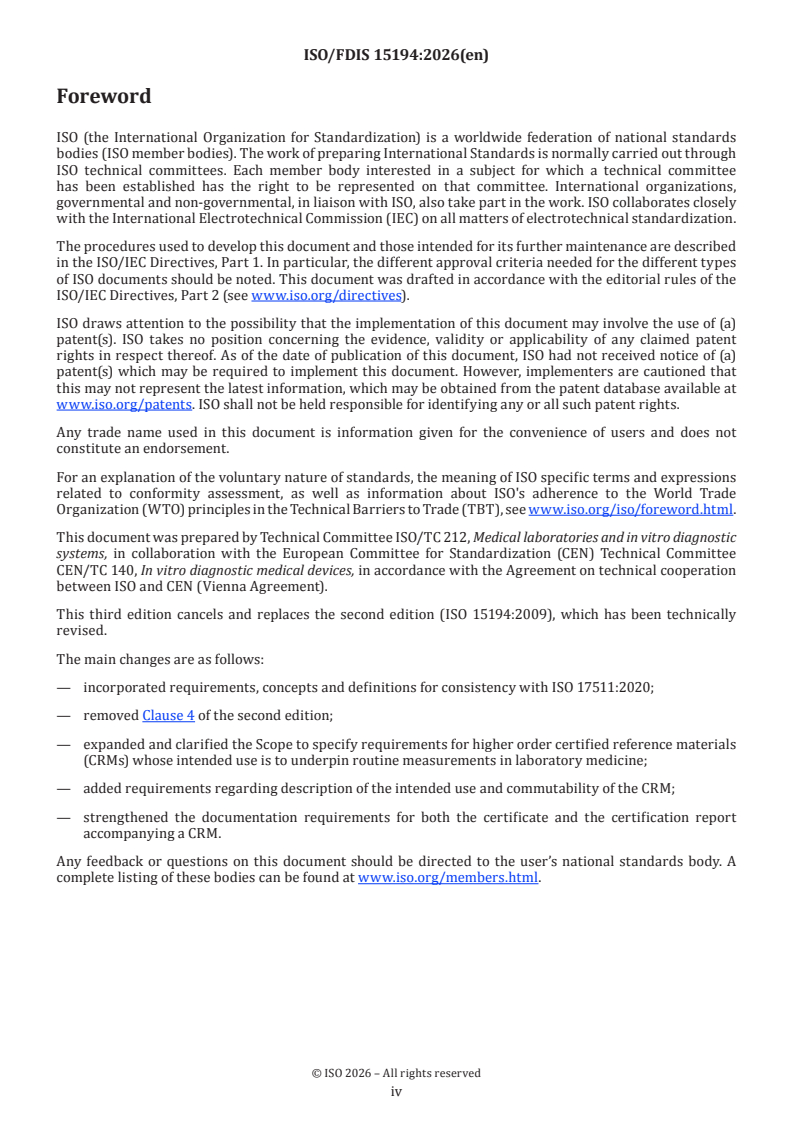
Contents Page
Foreword .iv
Introduction .v
1 Scope . 1
2 Normative references . 1
3 Terms and definitions . 1
4 Intended use, production and characterization of a certified reference material (CRM) . 9
4.1 Intended use .9
4.2 Production and certification .10
4.3 Commutability .10
5 Content of supporting documentation .10
5.1 Supporting documentation.10
5.2 Label .10
5.3 RM certificate .11
5.4 Certification report .11
5.4.1 General .11
5.4.2 Warning and safety precautions . 12
5.4.3 Introduction to a certification report . 13
5.4.4 Scope of application for the CRM . 13
5.4.5 Terms and definitions used in the certification report . 13
5.4.6 General properties . 13
5.4.7 Specific properties .14
5.4.8 Assignment of certified values . 15
5.4.9 Intended use .16
5.4.10 Instructions for use.17
5.4.11 Reference material producer .18
5.4.12 Bibliography .18
5.4.13 Annexes .18
5.4.14 Dates of authorization and revision .18
Annex A (informative) Certified reference materials (CRMs) with nominal properties or
ordinal quantities . 19
Annex ZA (informative) Relationship between this European Standard the General Safety and
Performance Requirements of Regulation (EU) 2017/746 aimed to be covered .20
Bibliography .23
iii
Foreword
ISO (the International Organization for Standardization) is a worldwide federation of national standards
bodies (ISO member bodies). The work of preparing International Standards is normally carried out through
ISO technical committees. Each member body interested in a subject for which a technical committee
has been established has the right to be represented on that committee. International organizations,
governmental and non-governmental, in liaison with ISO, also take part in the work. ISO collaborates closely
with the International Electrotechnical Commission (IEC) on all matters of electrotechnical standardization.
The procedures used to develop this document and those intended for its further maintenance are described
in the ISO/IEC Directives, Part 1. In particular, the different approval criteria needed for the different types
of ISO documents should be noted. This document was drafted in accordance with the editorial rules of the
ISO/IEC Directives, Part 2 (see www.iso.org/directives).
ISO draws attention to the possibility that the implementation of this document may involve the use of (a)
patent(s). ISO takes no position concerning the evidence, validity or applicability of any claimed patent
rights in respect thereof. As of the date of publication of this document, ISO had not received notice of (a)
patent(s) which may be required to implement this document. However, implementers are cautioned that
this may not represent the latest information, which may be obtained from the patent database available at
www.iso.org/patents. ISO shall not be held responsible for identifying any or all such patent rights.
Any trade name used in this document is information given for the convenience of users and does not
constitute an endorsement.
For an explanation of the voluntary nature of standards, the meaning of ISO specific terms and expressions
related to conformity assessment, as well as information about ISO's adherence to the World Trade
Organization (WTO) principles in the Technical Barriers to Trade (TBT), see www.iso.org/iso/foreword.html.
This document was prepared by Technical Committee ISO/TC 212, Medical laboratories and in vitro diagnostic
systems, in collaboration with the European Committee for Standardization (CEN) Technical Committee
CEN/TC 140, In vitro diagnostic medical devices, in accordance with the Agreement on technical cooperation
between ISO and CEN (Vienna Agreement).
This third edition cancels and replaces the second edition (ISO 15194:2009), which has been technically
revised.
The main changes are as follows:
— incorporated requirements, concepts and definitions for consistency with ISO 17511:2020;
— removed Clause 4 of the second edition;
— expanded and clarified the Scope to specify requirements for higher order certified reference materials
(CRMs) whose intended use is to underpin routine measurements in laboratory medicine;
— added requirements regarding description of the intended use and commutability of the CRM;
— strengthened the documentation requirements for both the certificate and the certification report
accompanying a CRM.
Any feedback or questions on this document should be directed to the user’s national standards body. A
complete listing of these bodies can be found at www.iso.org/members.html.
iv
Introduction
Reference measuring systems are needed to enable the results produced by end user measurement
procedures (MPs) to be metrologically traceable to either measurement standards or MPs of the highest
metrological level. Such systems exist within a metrological traceability chain/calibration hierarchy as
described in ISO 17511. In the context of in vitro diagnostic (IVD) medical devices, metrological traceability
to the highest metrological level mitigates the risk of harm to patients by avoiding inconsistent results from
different measuring systems.
Reference materials (RMs) are used to establish and maintain metrological traceability of measurement
results over time within one location, between different physical locations or with the application of
different measurement procedures. Certified reference materials (CRMs) are a category of RMs required
at the higher metrological levels of a calibration hierarchy or that underpin the metrological traceability of
measurement results.
A given CRM is supported by documentation describing the sources of the material, its processing and
production, measurement results, metrological traceability, instructions for use, homogeneity and stability
data, commutability data when applicable, and storage conditions, as well as health and safety warnings.
When the intended application of the CRM is as a secondary calibrator in the calibration hierarchy of IVD
devices, the commutability of the CRM is a critical property to be reported.
This document specifies the quality requirements for such materials and the recommended content of their
supporting documentation.
CRMs are used for one of three main purposes:
a) calibration of quantity values indicated by a measuring system or assigned to another RM;
b) assessment of measurement trueness of quantity values obtained in a given laboratory, or in a group of
laboratories;
c) assessment of measurement trueness of quantity values obtained using a new MP.
NOTE 1 “Measurement trueness” (ISO 17511:2020, 3.47) is the closeness of agreement between the average of
an infinite number of replicate measured quantity values and a reference quantity value. It is inversely related to
systematic measurement error but is not related to random measurement error.
NOTE 2 “Measurement precision” (ISO 17511:2020, 3.34) is the closeness of agreement between measured quantity
values obtained by replicate measurements on the same or similar objects under specified conditions. It is usually
expressed numerically by measures of imprecision, such as standard deviation, variance, or coefficient of variation
under the conditions of measurement. “Measurement precision” is a measure of random measurement error.
The combined measurement uncertainty of the assigned value of a CRM is the combined measurement
uncertainty of the steps above the CRM in the calibration hierarchy and the CRM uncertainties associated
with its homogeneity and stability. Suitability of its measurement uncertainty is determined by its intended
use in the calibration hierarchy.
Since the proper use of a CRM depends on the provision of detailed information on its production,
characterization and intended use, it is important to apply rules for the documentation of CRMs.
Annex A provides information on CRMs for qualitative nominal properties and ordinal quantities, to provide
guidance on important quality attributes for such CRMs, whilst recognizing that they are not within the
metrological traceability schemes described in ISO 17511:2020.
v
FINAL DRAFT International Standard ISO/FDIS 15194:2026(en)
In vitro diagnostic medical devices — Requirements for
certified reference materials and the content of supporting
documentation
1 Scope
This document specifies requirements for certified reference materials (CRMs) of higher metrological
order and the content of the supporting documentation and the calibration hierarchies as described
in ISO 17511:2020, 5.2.1, 5.3.1, 5.4.1, 5.5.1, 5.6.1, 5.7.1. It is applicable to CRMs intended for use as either
primary reference materials (PRMs), secondary calibrators or international conventional calibrators
within calibration hierarchies appropriate for measurands used in laboratory medicine, or for applications
as trueness controls. It also specifies requirements for determining the certified value of a CRM, including
evaluation, and reporting of the assigned uncertainty.
This document is applicable primarily to CRMs with assigned property values where the property has
a magnitude that can be expressed as a quantitative scalar number or ratio to a reference or refers to a
counting scale as also described in ISO 17511:2020, Clause 1.
When a CRM includes multiple measurands, this document is applied to each of the certified quantity values
present in the CRM.
Although intended to be applicable to producers of CRMs, this document is also useful for reference materials
(RMs) that are not in conformity with the full metrological requirements of CRMs. For example, this
document does not apply to an RM created by an in vitro diagnostic medical device (IVD MD) manufacturer
for use as working calibrator or end-user calibrator within a calibration hierarchy traceable to a CRM,
although some content can be useful in assessing its performance.
2 Normative references
The following documents are referred to in the text in such a way that some or all of their content constitutes
requirements of this document. For dated references, only the edition cited applies. For undated references,
the latest edition of the referenced document (including any amendments) applies.
ISO 17034, General requirements for the competence of reference material producers
ISO 17511, In vitro diagnostic medical devices — Requirements for establishing metrological traceability of
values assigned to calibrators, trueness control materials and human samples
ISO/IEC Guide 99, International vocabulary of metrology — Basic and general concepts and associated terms
(VIM)
3 Terms and definitions
For the purposes of this document, the terms and definitions given in ISO 17511 and ISO/IEC Guide 99 and
the following apply.
ISO and IEC maintain terminology databases for use in standardization at the following addresses:
— ISO Online browsing platform: available at https://www.iso.org/obp
— IEC Electropedia: available at https://www.electropedia.org/
3.1
analyte
component represented in the name of a measurable quantity (3.22)
EXAMPLE In the type of quantity “mass of protein in 24-hour urine”, “protein” is the analyte. In “amount of
substance of glucose in plasma”, “glucose” is the analyte. In both cases the full phrase describes the measurand (3.13).
[SOURCE: ISO 17511:2020, 3.1]
3.2
calibrator
certified reference material (CRM) (3.3) or reference material (RM) (3.23) with a traceable assigned quantity
(3.22) value used in calibration of a measuring system (3.16) according to a specified measurement procedure
(MP) (3.15)
[SOURCE: ISO 17511:2020, 3.6, modified — in the definition, “measurement standard” was changed to “CRM
or RM with a traceable assigned quantity value”.]
3.3
certified reference material
CRM
reference material (RM) (3.23) accompanied by documentation issued by an authoritative body and providing
one or more specified property values with associated uncertainty and traceability, using valid procedures
EXAMPLE Human serum with an assigned quantity (3.22) value and associated measurement uncertainty (3.18)
for concentration (amount of substance per unit volume) of cholesterol inherently present in the serum and used as a
calibrator (3.2) or as a trueness control material (3.28).
Note 1 to entry: “Documentation” is given in the form of a RM certificate (3.24) and a certification report (3.4).
1)
Note 2 to entry: Requirements for the production of a CRM are given in ISO 17034. ISO 33405 provides technical
guidance on the characterization and the assessment of the homogeneity and stability of a CRM.
Note 3 to entry: In this definition, “uncertainty” covers both ‘measurement uncertainty’ and ‘uncertainty associated
with the value of a nominal property’, such as for identity or sequence. “Traceability” covers both ‘metrological
traceability (3.17) of a quantity value’ and ‘traceability of a nominal property value’.
Note 4 to entry: Specified quantity values of CRMs require metrological traceability with associated measurement
uncertainty.
Note 5 to entry: ISO 17034 has an analogous definition that uses the modifiers “metrological” and “metrologically”
to refer to both quantities and nominal properties. The text of the ISO 17511:2020, 3.9 definition, based on the text in
ISO/IEC Guide 99, is preferred as the basis for this term.
Note 6 to entry: Specific requirements for CRMs and the content of supporting documentation [in the field of in vitro
diagnostic (IVD) medical devices (3.11)] are given in this document.
Note 7 to entry: For a specified material, a calibration certificate provided by an accredited calibration laboratory is
not by itself sufficient to confer the status of CRM on these types of materials.
[SOURCE: ISO 17511:2020, 3.9, modified — in Note 1 to entry, “certification report” was added; Notes 2 and 5
to entry were changed; in Note 6 to entry, “ISO 15194” was changed to “this document”; in Note 7 to entry,
“does not confer” was changed to “is not by itself sufficient to confer”.]
3.4
certification report
additional information on a certified reference material (CRM) (3.3), supplementary to that contained in a RM
certificate (3.24) that describes the production, characterization and certification of a CRM intended for use
in laboratory medicine and with in vitro diagnostic (IVD) medical devices (3.11)
1) Updated reference: ISO 33405 replaced ISO Guide 35, which has been withdrawn.
3.5
commutability
property of a reference material (RM) (3.23), demonstrated by the closeness of agreement between the
relation among the measurement results for a stated quantity (3.22) in this material, obtained according
to at least two measurement procedures (MPs) (3.15), and the relation obtained among the measurement
results for other specified materials
Note 1 to entry: The reference material (RM) in question is usually a secondary calibrator (3.27) and the other specified
materials are usually clinical samples (3.26).
Note 2 to entry: For the commutability assessment of a certified reference material (CRM) (3.3) it is recommended to
measure the clinical samples with as many measurement procedures as feasible.
Note 3 to entry: Closeness of agreement of measurement results is defined in terms of fitness for purpose as
appropriate for the intended use of the RM.
Note 4 to entry: A commutability statement is restricted to the measurement procedures as specified in a particular
comparison.
Note 5 to entry: The recommendations of the IFCC Working Groups for Assessing Commutability and on Commutability
in Metrological Traceability, as well as a CLSI Document provide guidance on how to undertake a commutability
[16-20]
study .
[SOURCE: ISO 17511:2020, 3.10, modified — the preferred term “commutability of a reference material” was
removed; in Note 1 to entry, “calibrator” was replaced by “secondary calibrator” and “routine samples” was
replaced by “clinical samples”; Note 2 to entry was changed; Note 5 to entry was added.]
3.6
control material
substance, material or artefact intended by its producer to be used to verify the performance of a
measurement procedure (MP) (3.15)
Note 1 to entry: Reference materials (RMs) (3.23) with or without assigned quantity (3.22) values can be used as
control materials whereas only certified reference materials (CRMs) (3.3) with traceable quantity values can be used as
calibrators (3.2) or as trueness control materials (3.28)
[SOURCE: ISO 17511:2020, 3.11, modified — Note 1 to entry was added.]
3.7
examination
set of operations having the objective of determining the numerical value, text value or characteristics of a
property
[SOURCE: ISO 15189:2022, 3.8, modified — Notes 1 to 3 of entry were deleted.]
3.8
higher order reference material
higher order RM
certified reference material (CRM) (3.3) that meets internationally accepted quality requirements and
provides a common metrological reference within the calibration hierarchy to which a producer can
establish metrological traceability (3.17)
Note 1 to entry: Quality requirements for higher order RMs (3.23) are laid out in this document.
Note 2 to entry: Higher order RMs include primary reference materials (PRMs) (3.20), primary calibrators (3.19),
secondary calibrators (3.27) and international conventional calibrators (3.10).
Note 3 to entry: Pure substances constitute the PRM and ultimate source of higher order metrological traceability for
most traceability chains in chemistry, thermometry and calorimetry in general and for the certification of solution
and matrix (3.12) RMs in particular (see ISO 33405:2017).
[21]
Note 4 to entry: According to the Joint Committee for Traceability in Laboratory Medicine (JCTLM), a higher order
RM is a CRM, meeting internationally accepted quality requirements, to which other measurement results can be
referenced, and its measurement uncertainty (3.18) is completely established. Metrologically, a higher order RM is
a RM deployed at a higher level in the calibration hierarchy. Certified, higher order RMs, where available, are used
by in vitro diagnostic medical device (IVD MD) (3.11) manufacturers to assign values to working calibrators. These
working calibrators are subsequently used by the manufacturer to assign values to measurands (3.13) in end-user
IVD MD calibrators and control materials (3.6) for use with IVD MDs in medical laboratories and other IVD testing
environments. Higher order RMs are most commonly produced and distributed by national metrology institutes
[21]
(NMIs). Some commercial sources also provide RMs listed by JCTLM .
[SOURCE: ISO 17511:2020, 3.14, modified — in the definition, “manufacturers ” was changed to “a producer”;
in Note 1 to entry, “ISO 15194” was changed to “this document”; in Note 4 to entry, the list of national
metrology institutes was removed.]
3.9
higher order reference measurement procedure
higher order RMP
reference measurement procedure (RMP) (3.25) meeting internationally accepted quality requirements
and providing a common metrological reference within the calibration hierarchy to which a producer
can establish metrological traceability (3.17) and accepted as providing measurement results fit for their
intended use in assessing measurement trueness
Note 1 to entry: Quality requirements for higher order RMPs are defined in ISO 15193.
Note 2 to entry: For reasons of higher cost, equipment complexity and operator training requirements, higher order
RMPs are typically performed in either national metrology institutes or accredited calibration (3.4) laboratories, or
both.
Note 3 to entry: In laboratory medicine, RMPs that meet the requirements of ISO 15193 are considered to be higher
order RMPs.
[21]
Note 4 to entry: According to JCTLM recommendations, higher order RMPs are well documented, high accuracy MPs
(3.15) used for assigning values to calibrator (3.2) materials. At the highest level these RMPs are frequently expensive
to develop, too complicated for routine use and not suitable for high throughput analysis.
[SOURCE: ISO 17511:2020, 3.15, modified — in the definition, “manufacturers ” was changed to “a producer”.]
3.10
international conventional calibrator
international conventional calibrator material
calibrator (3.2) whose quantity (3.22) value is assigned by international agreement but does not have
metrological traceability (3.17) to the International System of units (SI)
Note 1 to entry: The quantity is specified with respect to the intended clinical application.
[SOURCE: ISO 17511:2020, 3.17, modified — the preferred term “international measurement standard” was
removed.]
3.11
in vitro diagnostic medical device
IVD medical device
IVD MD
device, whether used alone or in combination, intended by the manufacturer for the in vitro examination
(3.7) of samples (3.26) derived from the human body solely or principally to provide information for
diagnostic, monitoring or compatibility purposes and including reagents, calibrators (3.2), control materials
(3.6), sample receptacles, software, and related instruments or apparatus or other articles
[SOURCE: ISO 17511:2020, 3.21, modified — in the definition, “specimen” was changed to “samples”.]
3.12
matrix
system matrix
components of a material, except the analyte (3.1)
Note 1 to entry: The biological system excluding the analyte is the matrix of the material.
EXAMPLE In the measurand (3.13) “mass of protein in 24-hour urine”, “24-hour urine” is the matrix. In the
measurand “amount of substance of glucose in plasma”, “plasma” is the matrix.
[SOURCE: ISO 17511:2020, 3.24, modified — the Example was added.]
3.13
measurand
quantity (3.22) intended to be measured
Note 1 to entry: Specification of a measurand requires knowledge of the kind of quantity, description of the state of the
phenomenon, body, or substance carrying the quantity, including any relevant component, and the chemical entities
involved.
Note 2 to entry: Analyte (3.1) or the name of a substance or entity are terms sometimes erroneously used as synonyms
for measurand. This usage is erroneous because these terms do not refer to a quantity.
Note 3 to entry: In laboratory medicine, description of the measurand includes the name of the quantity (e.g. amount
of substance concentration), the analyte (e.g. D-glucose), and the matrix (3.12) in which it is found (e.g. plasma).
[SOURCE: ISO 17511:2020, 3.26, modified — the original Notes 2 and 3 to entry and the Example were
removed, and Notes 4 and 5 to entry were renumbered.]
3.14
measurement method
method of measurement
generic description of a logical organization of operations used in a measurement
[SOURCE: ISO 17511:2020, 3.30, modified — Note 1 to entry was removed.]
3.15
measurement procedure
MP
detailed written specification for how a measurement is performed, including a technical description
of reagents, calibrators (3.2), equipment, instrument, and other details necessary to create and operate
a measuring system (3.16) that implements those specifications according to one or more measurement
principles and to a given measurement method (3.14), based on a measurement model and including any
calculation to obtain a measurement result
Note 1 to entry: An MP is usually documented in sufficient detail to enable an operator to perform a measurement.
Note 2 to entry: An MP can include a statement concerning a target measurement uncertainty (3.18).
Note 3 to entry: In medical laboratory measurements, a specific instance of a MP, an in vitro diagnostic (IVD) medical
device (3.11), is used to make a measurement on a clinical sample (3.26) to produce a measurement result which is
used to inform medical decisions for a patient.
[SOURCE: ISO 17511:2020, 3.27, modified — in the definition, “including a technical description of reagents,
calibrators, equipment, instrument, and other details necessary to create and operate a measuring system”
was added; the original Note 3 to entry was removed and a new Note 3 to entry was added.]
3.16
measuring system
set of one or more measuring instruments and often other devices, including any reagent and supply,
assembled and adapted to give information used to generate measured quantity (3.22) values within
specified intervals for quantities of specified kinds
Note 1 to entry: A measuring system can consist of only one measuring instrument.
[SOURCE: ISO/IEC Guide 99:2007, 3.2]
3.17
metrological traceability
property of a measurement result whereby the result can be related to a reference through a documented
unbroken chain of calibrations, each contributing to the measurement uncertainty (3.18)
Note 1 to entry: For this definition, a ‘reference’ can be a definition of a measurement unit through its practical
realization, or a measurement procedure (MP) (3.15) including the measurement unit for a quantity (3.22) value, or a
calibrator (3.2).
Note 2 to entry: Metrological traceability requires an established calibration hierarchy.
Note 3 to entry: The abbreviated term “traceability” is commonly used to refer to other concepts, such as ‘sample
traceability’ or ‘document traceability’ or ‘instrument traceability’ or ‘material traceability’, where the history
(“trace”) of an item is meant. Therefore, the full term of “metrological traceability” is preferred as the official term.
[SOURCE: ISO 17511:2020, 3.31, modified — Notes 1, 2 and 8 were retained as Notes 1, 2 and 3 to entry.]
3.18
measurement uncertainty
uncertainty of measurement
non-negative parameter characterizing the dispersion of the quantity (3.22) values being attributed to a
measurand (3.13), based on the information used
Note 1 to entry: Measurement uncertainty includes components arising from systematic effects, as in the case of
corrections to the assigned quantity values of measurement standards. Sometimes estimated systematic effects are
not corrected for, but instead, the associated measurement uncertainty components are incorporated.
Note 2 to entry: The parameter may be, for example, a standard deviation called standard measurement uncertainty
(or a specified multiple of it), or the half-width of an interval, having a stated coverage probability.
Note 3 to entry: Measurement uncertainty comprises, in general, many components. Some of these may be evaluated
by Type A evaluation of measurement uncertainty from the statistical distribution of the quantity values from a series
of measurements and can be characterized by standard deviations. The other components, which may be evaluated
by Type B evaluation of measurement uncertainty, can also be characterized by standard deviations, evaluated from
probability density functions based on experience or other information.
Note 4 to entry: In general, for a given set of information, it is understood that the measurement uncertainty is
associated with a stated quantity value attributed to the measurand. A modification of this value results in a
modification of the associated uncertainty.
Note 5 to entry: Type A evaluation of measurement uncertainty is defined as evaluation of a component of measurement
uncertainty by a statistical analysis of measured quantity values obtained under defined measurement conditions.
Note 6 to entry: Type B evaluation of measurement uncertainty is defined as evaluation of a component of measurement
uncertainty determined by means other than a Type A evaluation. This may include standard deviations:
a) obtained from information associated with authoritative published quantity values,
b) associated with quantity values of CRMs (3.3),
c) obtained from a calibration certificate,
d) obtained from experience or other means.
[SOURCE: ISO/IEC Guide 99:2007, 2.26, modified — Notes 5 and 6 to entry were added.]
3.19
primary calibrator
primary calibration material
calibrator (3.2) established using a primary reference measurement procedure (RMP) (3.21), or created as an
artefact, chosen by convention
Note 1 to entry: A primary calibrator serves as the anchor point for a calibration hierarchy.
Note 2 to entry: ISO 17511:2020, 5.2.5 and 5.4.4 further explains the role of a primary calibrator, defined as position
m.2 within a calibration hierarchy.
Note 3 to entry: A primary calibrator is prepared from a primary reference material (PRM) (3.20), defined as position
m.1 within a calibration hierarchy and value-assigned using a primary RMP.
Note 4 to entry: Adapted from ISO 17511:2020, 3.37.
EXAMPLE 1 Primary calibrator of amount of substance concentration prepared by dissolving a known amount of
substance of a primary reference material for a chemical component into a known volume of solution.
EXAMPLE 2 Primary calibrator for isotope amount of substance ratio measurements, prepared by mixing known
amounts-of-substance of specified isotopes.
3.20
primary reference material
PRM
high purity certified reference material CRM (3.3) of the analyte (3.1), certified for the mass fraction or mole
fraction of the analyte in the material and which constitutes the realization of the International System of
Units (SI) for the analyte of interest
Note 1 to entry: A PRM has its quantity (3.22) value assigned either directly by a primary reference measurement
procedure (RMP) (3.21) or by quantifying the impurities in the material by appropriate analytical methods (e.g. mass
balance method).
Note 2 to entry: ISO 17511:2020, 5.2.4 and 5.4.3 further explains the role of a PRM, defined as position m.1 within a
calibration hierarchy.
[SOURCE: SOURCE: ISO 17511:2020, 3.35, modified — in the definition, “high purity material” was changed
to “high purity certified reference material”; Note 2 to entry was added.]
3.21
primary reference measurement procedure
primary RMP
reference measurement procedure (RMP) (3.25) used to obtain a measurement result without relation to a
calibrator (3.2) for a quantity (3.22) of the same kind
[SOURCE: ISO 17511:2020, 3.36, modified — “measurement standard” was changed to “calibrator”; the
Example and Note 1 to entry were removed.]
3.22
quantity
property of a phenomenon, body, or substance, where the property has a magnitude that can be expressed
as a number and a reference
+
EXAMPLE 1 Plasma (Blood) — Na ion; amount of substance concentration of 143 mmol/l in a given person at a
given time.
EXAMPLE 2 Number concentration of erythrocytes in blood sample (Whole Blood) of 5 × 10 /l in a given person at
a given time.
Note 1 to entry: Quantity is not to be confused with analyte (3.1).
Note 2 to entry: A measurement procedure (3.15) for which the result is expressed in a qualitative manner (e.g.
nucleotide sequence for a DNA sample or “present” or “not present”) against a ratio or counting scale with a pre-
determined decision threshold, is consistent with this definition of the term quantity.
[SOURCE: ISO 17511:2020, 3.38 modified — the original Note 1 to entry was removed, and Notes 2 and 3 to
entry were renumbered.]
3.23
reference material
RM
material sufficiently homogeneous and stable with reference to specified properties, which has been
established to be fit for its intended use in measurement or in examination (3.7) of nominal properties
EXAMPLE 1 Examples of RMs embodying a quantity (3.22):
a) water of stated purity, the dynamic viscosity of which is used to calibrate viscometers;
b) pooled human serum with an assigned quantity value for the amount of substance concentration of
+
sodium (Na ) and used as a calibrator (3.2).
EXAMPLE 2 Example of an RM embodying nominal properties:
DNA compound containing a specified nucleotide sequence.
EXAMPLE 3 Spheres of uniform size mounted on a microscope slide.
Note 1 to entry: RMs with or without assigned quantity values can be used as control materials (3.6) whereas only
certified reference materials (CRMs) (3.3) with metrological traceability (3.17) of quantity values can be used as
calibrators or as trueness control materials (3.28).
Note 2 to entry: RMs normally embody quantity values but can also embody nominal properties.
Note 3 to entry: RMs can have assigned quantity values that are traceable to a measurement unit outside the
International System of units (SI).
Note 4 to entry: An RM accompanied by documentation issued by an authoritative body and referring to valid
measurement procedures (3.15) used to assign a quantity value with associated measurement uncertainty (3.18) and
metrological traceability is referred to as a CRM.
Note 5 to entry: Adapted from ISO 17511:2020, 3.39.
3.24
reference material certificate
RM certificate
document containing the essential information required for the use of a certified reference material (CRM)
(3.3), confirming that the necessary procedures have been carried out to ensure the validity and metrological
traceability (3.17) of the stated quantity (3.22) or nominal property values
[SOURCE: ISO 33401:2024, 3.4, modified — “stated property values” was changed to “stated quantity or
nominal property values”.]
3.25
reference measurement procedure
RMP
measurement procedure (MP) (3.15) accepted as providing measurement results fit for their intended use in
assessing measurement trueness of measured quantity (3.22) values obtained from other MPs for a quantity
of the same kind, in calibration, or in assigning a quantity value to a certified reference material (CRM) (3.3)
Note 1 to entry: Requirements of RMPs used in a calibration hierarchy supporting in vitro diagnostic (IVD) medical
devices (3.11) are described in ISO 15193.
Note 2 to entry: Explanation of the role of a primary RMP (3.21) within a calibration hierarchy can be found in
ISO 17511:2020, 5.2.3, 5.3.4.
[SOURCE: ISO 17511:2020 3.40, modified — in the definition, “characterizing RMs” was changed to “assigning
a quantity value to a CRM”; Note 2 to entry was added.]
3.26
sample
one or more parts taken from a primary sample
[SOURCE: ISO 15189:2022, 3.28]
3.27
secondary calibrator
secondary calibration material
calibrator (3.2) established through calibration with respect to a primary calibrator (3.19) or by a reference
measurement procedure (RMP) (3.25) that defines the measurand (3.13) or by a consensus of results obtained
using measurement procedures (3.15)
Note 1 to entry: Other terms used for secondary calibrator are commutable reference material or secondary reference
material.
Note 2 to entry: Calibration may be obtained directly between a primary calibrator and a secondary calibrator
or involve an intermediate measuring system (3.16) calibrated by the primary calibrator and used to assign a
measurement result to the secondary calibrator.
Note 3 to entry: ISO 17511:2020, 5.2.1, 5.3.1, 5.4.1 further explains the role of a secondary calibrator, defined as
position m.3 within a calibration hierarchy.
Note 4 to entry: Adapted from ISO 17511:2020, 3.42.
3.28
trueness control material
trueness control
certified reference material (CRM) (3.3) used to assess the bias of a measurement procedure (MP) (3.15) for a
specified quantity (3.22) in a specified measuring system (3.16)
Note 1 to entry: Trueness control materials are often prepared in a matrix (3.12) that emulates clinical samples (3.26).
Note 2 to entry: Trueness control materials intended for use with end-user MPs shall be evaluated for commutability
(3.5) with clinical samples.
Note 3 to entry: Adapted from ISO 17511:2020, 3.42.
4 Intended use, production and characterization of a certified reference material
(CRM)
4.1 Intended use
When used within a calibration hierarchy a CRM shall be classified in accordance with its position and role
in the reference measuring system for a specified quantity. As described in ISO 17511:2020, 5.2.1, 5.3.1, 5.4.1,
5.5.1, a CRM can be classified as a:
a) primary reference material (PRM);
b) primary calibrator;
c) secondary c
...
2024-08-20
ISO/TC 212/WG 2
Secretariat: ANSI
Date: 2026-02-04
In vitro diagnostic medical devices — Requirements for certified
reference materials and the content of supporting documentation
Dispositifs médicaux de diagnostic in vitro — Exigences relatives aux matériaux de référence certifiés et au
contenu de la documentation associée
FDIS stage
TThhiis drs draafftt i is s susubbmmiitttteed d ttoo aa ppaarraallellell vvoottee i inn IISSOO,, CCEEN.N.
All rights reserved. Unless otherwise specified, or required in the context of its implementation, no part of this publication
may be reproduced or utilized otherwise in any form or by any means, electronic or mechanical, including photocopying,
or posting on the internet or an intranet, without prior written permission. Permission can be requested from either ISO
at the address below or ISO'sISO’s member body in the country of the requester.
ISO Copyright Office copyright office
CP 401 • Ch. de Blandonnet 8
CH-1214 Vernier, Geneva
Phone: + 41 22 749 01 11
Email: E-mail: copyright@iso.org
Website: www.iso.org
Published in Switzerland.
ii
Contents
Foreword . iv
Introduction . v
1 Scope . 1
2 Normative references . 1
3 Terms and definitions . 1
4 Intended use, production and characterization of a certified reference material (CRM) . 10
4.1 Intended use . 10
4.2 Production and certification . 11
4.3 Commutability . 11
5 Content of supporting documentation . 11
5.1 Supporting documentation . 11
5.2 Label . 11
5.3 RM certificate . 12
5.4 Certification report . 13
Annex A (informative) Certified reference materials (CRMs) with nominal properties or ordinal
quantities . 21
Annex ZA (informative) Relationship between this European Standard the General Safety and
Performance Requirements of Regulation (EU) 2017/746 aimed to be covered . 22
Bibliography . 25
iii
Foreword
ISO (the International Organization for Standardization) is a worldwide federation of national standards
bodies (ISO member bodies). The work of preparing International Standards is normally carried out through
ISO technical committees. Each member body interested in a subject for which a technical committee has been
established has the right to be represented on that committee. International organizations, governmental and
non-governmental, in liaison with ISO, also take part in the work. ISO collaborates closely with the
International Electrotechnical Commission (IEC) on all matters of electrotechnical standardization.
The procedures used to develop this document and those intended for its further maintenance are described
in the ISO/IEC Directives, Part 1. In particular, the different approval criteria needed for the different types of
ISO documents should be noted. This document was drafted in accordance with the editorial rules of the
ISO/IEC Directives, Part 2 (see www.iso.org/directives).
ISO draws attention to the possibility that the implementation of this document may involve the use of (a)
patent(s). ISO takes no position concerning the evidence, validity or applicability of any claimed patent rights
in respect thereof. As of the date of publication of this document, ISO had not received notice of (a) patent(s)
which may be required to implement this document. However, implementers are cautioned that this may not
represent the latest information, which may be obtained from the patent database available at
www.iso.org/patents. ISO shall not be held responsible for identifying any or all such patent rights.
Any trade name used in this document is information given for the convenience of users and does not
constitute an endorsement.
For an explanation of the voluntary nature of standards, the meaning of ISO specific terms and expressions
related to conformity assessment, as well as information about ISO's adherence to the World Trade
Organization (WTO) principles in the Technical Barriers to Trade (TBT), see www.iso.org/iso/foreword.html.
This document was prepared by Technical Committee ISO/TC 212, Medical laboratories and in vitro diagnostic
systems, in collaboration with the European Committee for Standardization (CEN) Technical Committee
CEN/TC 140, In vitro diagnostic medical devices, in accordance with the Agreement on technical cooperation
between ISO and CEN (Vienna Agreement).
This third edition cancels and replaces the second edition (ISO 15194:2009), which has been technically
revised.
The main changes are as follows:
— — incorporated requirements, concepts and definitions for consistency with ISO 17511:2020;
— — removed Clause 4Clause 4 of the second edition;
— — expanded and clarified the Scope to specify requirements for higher order certified reference
materials (CRMs) whose intended use is to underpin routine measurements in laboratory medicine;
— — added requirements regarding description of the intended use and commutability of the CRM;
— — strengthened the documentation requirements for both the certificate and the certification report
accompanying a CRM.
Any feedback or questions on this document should be directed to the user’s national standards body. A
complete listing of these bodies can be found at www.iso.org/members.html.
iv
Introduction
Reference measuring systems are needed to enable the results produced by end user measurement
procedures (MPs) to be metrologically traceable to either measurement standards or MPs of the highest
metrological level. Such systems exist within a metrological traceability chain/calibration hierarchy as
described in ISO 17511. In the context of in vitro diagnostic (IVD) medical devices, metrological traceability
to the highest metrological level mitigates the risk of harm to patients by avoiding inconsistent results from
different measuring systems.
Reference materials (RMs) are used to establish and maintain metrological traceability of measurement
results over time within one location, between different physical locations or with the application of different
measurement procedures. Certified reference materials (CRMs) are a category of RMs required at the higher
metrological levels of a calibration hierarchy or that underpin the metrological traceability of measurement
results.
A given CRM is supported by documentation describing the sources of the material, its processing and
production, measurement results, metrological traceability, instructions for use, homogeneity and stability
data, commutability data when applicable, and storage conditions, as well as health and safety warnings. When
the intended application of the CRM is as a secondary calibrator in the calibration hierarchy of IVD devices,
the commutability of the CRM is a critical property to be reported.
This document specifies the quality requirements for such materials and the recommended content of their
supporting documentation.
CRMs are used for one of three main purposes:
a) a) calibration of quantity values indicated by a measuring system or assigned to another RM;
b) b) assessment of measurement trueness of quantity values obtained in a given laboratory, or in a
group of laboratories;
c) c) assessment of measurement trueness of quantity values obtained using a new MP.
NOTE 1 “Measurement trueness” (ISO 17511:2020, 3.47) is the closeness of agreement between the average of an
infinite number of replicate measured quantity values and a reference quantity value. It is inversely related to systematic
measurement error but is not related to random measurement error.
NOTE 2 “Measurement precision” (ISO 17511:2020, 3.34) is the closeness of agreement between measured quantity
values obtained by replicate measurements on the same or similar objects under specified conditions. It is usually
expressed numerically by measures of imprecision, such as standard deviation, variance, or coefficient of variation under
the conditions of measurement. “Measurement precision” is a measure of random measurement error.
The combined measurement uncertainty of the assigned value of a CRM is the combined measurement
uncertainty of the steps above the CRM in the calibration hierarchy and the CRM uncertainties associated with
its homogeneity and stability. Suitability of its measurement uncertainty is determined by its intended use in
the calibration hierarchy.
Since the proper use of a CRM depends on the provision of detailed information on its production,
characterization and intended use, it is important to apply rules for the documentation of CRMs.
Annex AAnnex A provides information on CRMs for qualitative nominal properties and ordinal quantities, to
provide guidance on important quality attributes for such CRMs, whilst recognizing that they are not within
the metrological traceability schemes described in ISO 17511:2020.
v
FINAL DRAFT International Standard ISO/FDIS 15194:2024(en)
In vitro diagnostic medical devices — Requirements for certified
reference materials and the content of supporting documentation
1 Scope
This document specifies requirements for certified reference materials (CRMs) of higher metrological order
and the content of the supporting documentation and the calibration hierarchies as described in
ISO 17511:2020, 5.2.1, 5.3.1, 5.4.1, 5.5.1, 5.6.1, 5.7.1. It is applicable to CRMs intended for use as either primary
reference materials (PRMs), secondary calibrators or international conventional calibrators within calibration
hierarchies appropriate for measurands used in laboratory medicine, or for applications as trueness controls.
It also specifies requirements for determining the certified value of a CRM, including evaluation, and reporting
of the assigned uncertainty.
This document is applicable primarily to CRMs with assigned property values where the property has a
magnitude that can be expressed as a quantitative scalar number or ratio to a reference or refers to a counting
scale as also described in ISO 17511:2020, Clause 1.
When a CRM includes multiple measurands, this document is applied to each of the certified quantity values
present in the CRM.
Although intended to be applicable to producers of CRMs, this document is also useful for reference materials
(RMs) that are not in conformity with the full metrological requirements of CRMs. For example, this document
does not apply to an RM created by an in vitro diagnostic medical device (IVD MD) manufacturer for use as
working calibrator or end-user calibrator within a calibration hierarchy traceable to a CRM, although some
content can be useful in assessing its performance.
2 Normative references
The following documents are referred to in the text in such a way that some or all of their content constitutes
requirements of this document. For dated references, only the edition cited applies. For undated references,
the latest edition of the referenced document (including any amendments) applies.
ISO 17034, General requirements for the competence of reference material producers
ISO 17511, In vitro diagnostic medical devices — Requirements for establishing metrological traceability of
values assigned to calibrators, trueness control materials and human samples
ISO/IEC Guide 99, International vocabulary of metrology — Basic and general concepts and associated terms
(VIM)
3 Terms and definitions
For the purposes of this document, the terms and definitions given in ISO 17511 and ISO/IEC Guide 99 and
the following apply.
ISO and IEC maintain terminology databases for use in standardization at the following addresses:
— — ISO Online browsing platform: available at https://www.iso.org/obp
— — IEC Electropedia: available at https://www.electropedia.org/
3.1 3.1
analyte
component represented in the name of a measurable quantity (3.22(3.22))
EXAMPLE In the type of quantity “mass of protein in 24-hour urine”, “protein” is the analyte. In “amount of
substance of glucose in plasma”, “glucose” is the analyte. In both cases the full phrase describes the measurand
(3.13(3.13).).
[SOURCE: ISO 17511:2020, 3.1]
3.2 3.2
calibrator
certified reference material (CRM) (3.3(3.3)) or reference material (RM) (3.23(3.23)) with a traceable assigned
quantity (3.22(3.22)) value used in calibration of a measuring system (3.16(3.16)) according to a specified
measurement procedure (MP) (3.15(3.15))
[SOURCE: ISO 17511:2020, 3.6, modified — in the definition, “measurement standard” was changed to “CRM
or RM with a traceable assigned quantity value”.]
3.3 3.3
certified reference material
CRM
reference material (RM) (3.23(3.23)) accompanied by documentation issued by an authoritative body and
providing one or more specified property values with associated uncertainty and traceability, using valid
procedures
EXAMPLE Human serum with an assigned quantity (3.22(3.22)) value and associated measurement uncertainty
(3.18(3.18)) for concentration (amount of substance per unit volume) of cholesterol inherently present in the serum and
used as a calibrator (3.2(3.2)) or as a trueness control material (3.28(3.28).).
Note 1 to entry: “Documentation” is given in the form of a RM certificate (3.24(3.24)) and a certification report (3.4(3.4).).
11)
Note 2 to entry: Requirements for the production of a CRM are given in ISO 17034. ISO 33405 provides technical
guidance on the characterization and the assessment of the homogeneity and stability of a CRM.
Note 3 to entry: In this definition, “uncertainty” covers both ‘measurement uncertainty’ and ‘uncertainty associated with
the value of a nominal property’, such as for identity or sequence. “Traceability” covers both ‘metrological traceability
(3.17(3.17)) of a quantity value’ and ‘traceability of a nominal property value’.
Note 4 to entry: Specified quantity values of CRMs require metrological traceability with associated measurement
uncertainty.
Note 5 to entry: ISO 17034 has an analogous definition that uses the modifiers “metrological” and “metrologically” to
refer to both quantities and nominal properties. The text of the ISO 17511:2020, 3.9 definition, based on the text in
ISO/IEC Guide 99, is preferred as the basis for this term.
Note 6 to entry: Specific requirements for CRMs and the content of supporting documentation [in the field of in vitro
diagnostic (IVD) medical devices (3.11(3.11)])] are given in this document.
Note 7 to entry: For a specified material, a calibration certificate provided by an accredited calibration laboratory is not
by itself sufficient to confer the status of CRM on these types of materials.
Updated reference: ISO 33405 replaced ISO Guide 35, which has been withdrawn.
1)
Updated reference: ISO 33405 replaced ISO Guide 35, which has been withdrawn.
[SOURCE: ISO 17511:2020, 3.9, modified — in Note 1 to entry, “certification report” was added; Notes 2 and 5
to entry were changed; in Note 6 to entry, “ISO 15194” was changed to “this document”; in Note 7 to entry,
“does not confer” was changed to “is not by itself sufficient to confer”.]
3.4 3.4
certification report
additional information on a certified reference material (CRM) (3.3(3.3),), supplementary to that contained in
a RM certificate (3.24(3.24)) that describes the production, characterization and certification of a CRM
intended for use in laboratory medicine and with in vitro diagnostic (IVD) medical devices (3.11(3.11))
3.5 3.5
commutability
property of a reference material (RM) (3.23(3.23),), demonstrated by the closeness of agreement between the
relation among the measurement results for a stated quantity (3.22(3.22)) in this material, obtained according
to at least two measurement procedures (MPs) (3.15(3.15),), and the relation obtained among the
measurement results for other specified materials
Note 1 to entry: The reference material (RM) in question is usually a secondary calibrator (3.27(3.27)) and the other
specified materials are usually clinical samples (3.26(3.26).).
Note 2 to entry: For the commutability assessment of a certified reference material (CRM) (3.3(3.3)) it is recommended
to measure the clinical samples with as many measurement procedures as feasible.
Note 3 to entry: Closeness of agreement of measurement results is defined in terms of fitness for purpose as appropriate
for the intended use of the RM.
Note 4 to entry: A commutability statement is restricted to the measurement procedures as specified in a particular
comparison.
Note 5 to entry: The recommendations of the IFCC Working Groups for Assessing Commutability and on Commutability
[ -
in Metrological Traceability, as well as a CLSI Document provide guidance on how to undertake a commutability study 16
[16-20] ]
20 . .
[SOURCE: ISO 17511:2020, 3.10, modified — the preferred term “commutability of a reference material” was
removed; in Note 1 to entry, “calibrator” was replaced by “secondary calibrator” and “routine samples” was
replaced by “clinical samples”; Note 2 to entry was changed; Note 5 to entry was added.]
3.6 3.6
control material
substance, material or artefact intended by its producer to be used to verify the performance of a measurement
procedure (MP) (3.15(3.15))
Note 1 to entry: Reference materials (RMs) (3.23(3.23)) with or without assigned quantity (3.22(3.22)) values can be used
as control materials whereas only certified reference materials (CRMs) (3.3(3.3)) with traceable quantity values can be
used as calibrators (3.2(3.2)) or as trueness control materials (3.28(3.28))
[SOURCE: ISO 17511:2020, 3.11, modified — Note 1 to entry was added.]
3.7 3.7
examination
set of operations having the objective of determining the numerical value, text value or characteristics of a
property
[SOURCE: ISO 15189:2022, 3.8, modified — Notes 1 to 3 of entry were deleted.]
3.8 3.8
higher order reference material
higher order RM
certified reference material (CRM) (3.3(3.3)) that meets internationally accepted quality requirements and
provides a common metrological reference within the calibration hierarchy to which a producer can establish
metrological traceability (3.17(3.17))
Note 1 to entry: Quality requirements for higher order RMs (3.23(3.23)) are laid out in this document.
Note 2 to entry: Higher order RMs include primary reference materials (PRMs) (3.20(3.20),), primary calibrators
(3.19(3.19),), secondary calibrators (3.27(3.27)) and international conventional calibrators (3.10(3.10).).
Note 3 to entry: Pure substances constitute the PRM and ultimate source of higher order metrological traceability for
most traceability chains in chemistry, thermometry and calorimetry in general and for the certification of solution and
matrix (3.12(3.12)) RMs in particular (see ISO 33405:2017).
[ [21]]
Note 4 to entry: According to the Joint Committee for Traceability in Laboratory Medicine (JCTLM), 21), a higher order
RM is a CRM, meeting internationally accepted quality requirements, to which other measurement results can be
referenced, and its measurement uncertainty (3.18(3.18)) is completely established. Metrologically, a higher order RM is
a RM deployed at a higher level in the calibration hierarchy. Certified, higher order RMs, where available, are used by in
vitro diagnostic medical device (IVD MD) (3.11(3.11)) manufacturers to assign values to working calibrators. These
working calibrators are subsequently used by the manufacturer to assign values to measurands (3.13(3.13)) in end-user
IVD MD calibrators and control materials (3.6(3.6)) for use with IVD MDs in medical laboratories and other IVD testing
environments. Higher order RMs are most commonly produced and distributed by national metrology institutes (NMIs).
[ [21] ]
Some commercial sources also provide RMs listed by JCTLM 21 . .
[SOURCE: ISO 17511:2020, 3.14, modified — in the definition, “manufacturers”manufacturers-” was changed
to “a producer”; in Note 1 to entry, “ISO 15194” was changed to “this document”; in Note 4 to entry, the list of
national metrology institutes was removed.]
3.9 3.9
higher order reference measurement procedure
higher order RMP
reference measurement procedure (RMP) (3.25(3.25)) meeting internationally accepted quality requirements
and providing a common metrological reference within the calibration hierarchy to which a producer can
establish metrological traceability (3.17(3.17)) and accepted as providing measurement results fit for their
intended use in assessing measurement trueness
Note 1 to entry: Quality requirements for higher order RMPs are defined in ISO 15193.
Note 2 to entry: For reasons of higher cost, equipment complexity and operator training requirements, higher order
RMPs are typically performed in either national metrology institutes or accredited calibration (3.4(3.4)) laboratories, or
both.
Note 3 to entry: In laboratory medicine, RMPs that meet the requirements of ISO 15193 are considered to be higher order
RMPs.
[ [21]]
Note 4 to entry: According to JCTLM recommendations, 21, higher order RMPs are well documented, high accuracy
MPs (3.15(3.15)) used for assigning values to calibrator (3.2(3.2)) materials. At the highest level these RMPs are
frequently expensive to develop, too complicated for routine use and not suitable for high throughput analysis.
[SOURCE: ISO 17511:2020, 3.15, modified — in the definition, “manufacturers”manufacturers-” was changed
to “a producer”.]
3.10 3.10
international conventional calibrator
international conventional calibrator material
calibrator (3.2(3.2)) whose quantity (3.22(3.22)) value is assigned by international agreement but does not
have metrological traceability (3.17(3.17)) to the International System of units (SI)
Note 1 to entry: The quantity is specified with respect to the intended clinical application.
[SOURCE: ISO 17511:2020, 3.17, modified — the preferred term “international measurement standard” was
removed.]
3.11 3.11
in vitro diagnostic medical device
IVD medical device
IVD MD
device, whether used alone or in combination, intended by the manufacturer for the in vitro examination
(3.7(3.7)) of samples (3.26(3.26)) derived from the human body solely or principally to provide information
for diagnostic, monitoring or compatibility purposes and including reagents, calibrators (3.2(3.2),), control
materials (3.6(3.6),), sample receptacles, software, and related instruments or apparatus or other articles
[SOURCE: ISO 17511:2020, 3.21, modified — in the definition, “specimen” was changed to “samples”.]
3.12 3.12
matrix
system matrix
components of a material, except the analyte (3.1(3.1))
Note 1 to entry: The biological system excluding the analyte is the matrix of the material.
EXAMPLE In the measurand (3.13(3.13)) “mass of protein in 24-hour urine”, “24-hour urine” is the matrix. In the
measurand “amount of substance of glucose in plasma”, “plasma” is the matrix.
[SOURCE: ISO 17511:2020, 3.24, modified — the Example was added.]
3.13 3.13
measurand
quantity (3.22(3.22)) intended to be measured
Note 1 to entry: Specification of a measurand requires knowledge of the kind of quantity, description of the state of the
phenomenon, body, or substance carrying the quantity, including any relevant component, and the chemical entities
involved.
Note 2 to entry: Analyte (3.1(3.1)) or the name of a substance or entity are terms sometimes erroneously used as
synonyms for measurand. This usage is erroneous because these terms do not refer to a quantity.
Note 3 to entry: In laboratory medicine, description of the measurand includes the name of the quantity (e.g. amount of
substance concentration), the analyte (e.g. D-glucose), and the matrix (3.12(3.12)) in which it is found (e.g. plasma).
[SOURCE: ISO 17511:2020, 3.26, modified — the original Notes 2 and 3 to entry and the Example were
removed, and Notes 4 and 5 to entry were renumbered.]
3.14 3.14
measurement method
method of measurement
generic description of a logical organization of operations used in a measurement
[SOURCE: ISO 17511:2020, 3.30, modified — Note 1 to entry was removed.]
3.15 3.15
measurement procedure
MP
detailed written specification for how a measurement is performed, including a technical description of
reagents, calibrators (3.2(3.2),), equipment, instrument, and other details necessary to create and operate a
measuring system (3.16(3.16)) that implements those specifications according to one or more measurement
principles and to a given measurement method (3.14(3.14),), based on a measurement model and including
any calculation to obtain a measurement result
Note 1 to entry: An MP is usually documented in sufficient detail to enable an operator to perform a measurement.
Note 2 to entry: An MP can include a statement concerning a target measurement uncertainty (3.18(3.18).).
Note 3 to entry: In medical laboratory measurements, a specific instance of a MP, an in vitro diagnostic (IVD) medical
device (3.11(3.11),), is used to make a measurement on a clinical sample (3.26(3.26)) to produce a measurement result
which is used to inform medical decisions for a patient.
[SOURCE: ISO 17511:2020, 3.27, modified — in the definition, “including a technical description of reagents,
calibrators, equipment, instrument, and other details necessary to create and operate a measuring system”
was added; the original Note 3 to entry was removed and a new Note 3 to entry was added.]
3.16 3.16
measuring system
set of one or more measuring instruments and often other devices, including any reagent and supply,
assembled and adapted to give information used to generate measured quantity (3.22(3.22)) values within
specified intervals for quantities of specified kinds
Note 1 to entry: A measuring system can consist of only one measuring instrument.
[SOURCE: ISO/IEC Guide 99:2007, 3.2]
3.17 3.17
metrological traceability
property of a measurement result whereby the result can be related to a reference through a documented
unbroken chain of calibrations, each contributing to the measurement uncertainty (3.18(3.18))
Note 1 to entry: For this definition, a ‘reference’ can be a definition of a measurement unit through its practical
realization, or a measurement procedure (MP) (3.15(3.15)) including the measurement unit for a quantity (3.22(3.22))
value, or a calibrator (3.2(3.2).).
Note 2 to entry: Metrological traceability requires an established calibration hierarchy.
Note 3 to entry: The abbreviated term “traceability” is commonly used to refer to other concepts, such as ‘sample
traceability’ or ‘document traceability’ or ‘instrument traceability’ or ‘material traceability’, where the history (“trace”)
of an item is meant. Therefore, the full term of “metrological traceability” is preferred as the official term.
[SOURCE: ISO 17511:2020, 3.31, modified — Notes 1, 2 and 8 were retained as Notes 1, 2 and 3 to entry.]
3.18 3.18
measurement uncertainty
uncertainty of measurement
non-negative parameter characterizing the dispersion of the quantity (3.22(3.22)) values being attributed to
a measurand (3.13(3.13),), based on the information used
Note 1 to entry: Measurement uncertainty includes components arising from systematic effects, as in the case of
corrections to the assigned quantity values of measurement standards. Sometimes estimated systematic effects are not
corrected for, but instead, the associated measurement uncertainty components are incorporated.
Note 2 to entry: The parameter may be, for example, a standard deviation called standard measurement uncertainty (or
a specified multiple of it), or the half-width of an interval, having a stated coverage probability.
Note 3 to entry: Measurement uncertainty comprises, in general, many components. Some of these may be evaluated by
Type A evaluation of measurement uncertainty from the statistical distribution of the quantity values from a series of
measurements and can be characterized by standard deviations. The other components, which may be evaluated by Type
B evaluation of measurement uncertainty, can also be characterized by standard deviations, evaluated from probability
density functions based on experience or other information.
Note 4 to entry: In general, for a given set of information, it is understood that the measurement uncertainty is associated
with a stated quantity value attributed to the measurand. A modification of this value results in a modification of the
associated uncertainty.
Note 5 to entry: Type A evaluation of measurement uncertainty is defined as evaluation of a component of measurement
uncertainty by a statistical analysis of measured quantity values obtained under defined measurement conditions.
Note 6 to entry: Type B evaluation of measurement uncertainty is defined as evaluation of a component of measurement
uncertainty determined by means other than a Type A evaluation. This may include standard deviations:
a) a) obtained from information associated with authoritative published quantity values,
b) b) associated with quantity values of CRMs (3.3(3.3),),
c) c) obtained from a calibration certificate,
d) d) obtained from experience or other means.
[SOURCE: ISO/IEC Guide 99:2007, 2.26, modified — Notes 5 and 6 to entry were added.]
3.19 3.19
primary calibrator
primary calibration material
calibrator (3.2(3.2)) established using a primary reference measurement procedure (RMP) (3.21(3.21),), or
created as an artefact, chosen by convention
Note 1 to entry: A primary calibrator serves as the anchor point for a calibration hierarchy.
Note 2 to entry: ISO 17511:2020, 5.2.5, and 5.4.4 . further explains the role of a primary calibrator, defined as position
m.2 within a calibration hierarchy.
Note 3 to entry: A primary calibrator is prepared from a primary reference material (PRM) (3.20(3.20),), defined as
position m.1 within a calibration hierarchy and value-assigned using a primary RMP.
Note 4 to entry: Adapted from ISO 17511:2020, 3.37.
EXAMPLE 1 Primary calibrator of amount of substance concentration prepared by dissolving a known amount of
substance of a primary reference material for a chemical component into a known volume of solution.
EXAMPLE 2 Primary calibrator for isotope amount of substance ratio measurements, prepared by mixing known
amounts-of-substance of specified isotopes.
3.20 3.20
primary reference material
PRM
high purity certified reference material CRM (3.3(3.3)) of the analyte (3.1(3.1),), certified for the mass fraction
or mole fraction of the analyte in the material and which constitutes the realization of the International System
of Units (SI) for the analyte of interest
Note 1 to entry: A PRM has its quantity (3.22(3.22)) value assigned either directly by a primary reference measurement
procedure (RMP) (3.21(3.21)) or by quantifying the impurities in the material by appropriate analytical methods (e.g.
mass balance method).
Note 2 to entry: ISO 17511:2020, 5.2.4, and 5.4.3 . further explains the role of a PRM, defined as position m.1 within a
calibration hierarchy.
[SOURCE: SOURCE: ISO 17511:2020, 3.35, modified — in the definition, “high purity material” was changed to
“high purity certified reference material”; Note 2 to entry was added.]
3.21 3.21
primary reference measurement procedure
primary RMP
reference measurement procedure (RMP) (3.25(3.25)) used to obtain a measurement result without relation
to a calibrator (3.2(3.2)) for a quantity (3.22(3.22)) of the same kind
[SOURCE: ISO 17511:2020, 3.36, modified — “measurement standard” was changed to “calibrator”; the
Example and Note 1 to entry were removed.]
3.22 3.22
quantity
property of a phenomenon, body, or substance, where the property has a magnitude that can be expressed as
a number and a reference
+
EXAMPLE 1 Plasma (Blood) — Na ion; amount of substance concentration of 143 mmol/l in a given person at a given
time.
EXAMPLE 2 Number concentration of erythrocytes in blood sample (Whole Blood) of 5 × 10 /l in a given person at
a given time.
Note 1 to entry: Quantity is not to be confused with analyte (3.1(3.1).).
Note 2 to entry: A measurement procedure (3.15(3.15)) for which the result is expressed in a qualitative manner (e.g.
nucleotide sequence for a DNA sample or “present” or “not present”) against a ratio or counting scale with a pre-
determined decision threshold, is consistent with this definition of the term quantity.
[SOURCE: ISO 17511:2020, 3.38 modified — the original Note 1 to entry was removed, and Notes 2 and 3 to
entry were renumbered.]
3.23 3.23
reference material
RM
material sufficiently homogeneous and stable with reference to specified properties, which has been
established to be fit for its intended use in measurement or in examination (3.7(3.7)) of nominal properties
EXAMPLE 1 Examples of RMs embodying a quantity (3.22(3.22):):
a) a) water of stated purity, the dynamic viscosity of which is used to calibrate viscometers;
b) b) pooled human serum with an assigned quantity value for the amount of substance concentration of
+
sodium (Na ) and used as a calibrator (3.2(3.2).).
EXAMPLE 2 Example of an RM embodying nominal properties:
DNA compound containing a specified nucleotide sequence.
EXAMPLE 3 Spheres of uniform size mounted on a microscope slide.
Note 1 to entry: RMs with or without assigned quantity values can be used as control materials (3.6(3.6)) whereas only
certified reference materials (CRMs) (3.3(3.3)) with metrological traceability (3.17(3.17)) of quantity values can be used
as calibrators or as trueness control materials (3.28(3.28).).
Note 2 to entry: RMs normally embody quantity values but can also embody nominal properties.
Note 3 to entry: RMs can have assigned quantity values that are traceable to a measurement unit outside the International
System of units (SI).
Note 4 to entry: An RM accompanied by documentation issued by an authoritative body and referring to valid
measurement procedures (3.15(3.15)) used to assign a quantity value with associated measurement uncertainty
(3.18(3.18)) and metrological traceability is referred to as a CRM.
Note 5 to entry: Adapted from ISO 17511:2020, 3.39.
3.24 3.24
reference material certificate
RM certificate
document containing the essential information required for the use of a certified reference material (CRM)
(3.3(3.3),), confirming that the necessary procedures have been carried out to ensure the validity and
metrological traceability (3.17(3.17)) of the stated quantity (3.22(3.22)) or nominal property values
[SOURCE: ISO 33401:2024, 3.4, modified — “stated property values” was changed to “stated quantity or
nominal property values”.]
3.25 3.25
reference measurement procedure
RMP
measurement procedure (MP) (3.15(3.15)) accepted as providing measurement results fit for their intended
use in assessing measurement trueness of measured quantity (3.22(3.22)) values obtained from other MPs for
a quantity of the same kind, in calibration, or in assigning a quantity value to a certified reference material
(CRM) (3.3(3.3))
Note 1 to entry: Requirements of RMPs used in a calibration hierarchy supporting in vitro diagnostic (IVD) medical devices
(3.11(3.11)) are described in ISO 15193.
Note 2 to entry: Explanation of the role of a primary RMP (3.21(3.21)) within a calibration hierarchy can be found in
ISO 17511:2020, 5.2.3;, 5.3.4, .
[SOURCE: ISO 17511:2020 3.40, modified — in the definition, “characterizing RMs” was changed to “assigning
a quantity value to a CRM”; Note 2 to entry was added.]
3.26 3.26
sample
one or more parts taken from a primary sample
[SOURCE: ISO 15189:2022, 3.28]
3.27 3.27
secondary calibrator
secondary calibration material
calibrator (3.2(3.2)) established through calibration with respect to a primary calibrator (3.19(3.19)) or by a
reference measurement procedure (RMP) (3.25(3.25)) that defines the measurand (3.13(3.13)) or by a
consensus of results obtained using measurement procedures (3.15(3.15))
Note 1 to entry: Other terms used for secondary calibrator are commutable reference material or secondary reference
material.
Note 2 to entry: Calibration may be obtained directly between a primary calibrator and a secondary calibrator or involve
an intermediate measuring system (3.16(3.16)) calibrated by the primary calibrator and used to assign a measurement
result to the secondary calibrator.
Note 3 to entry: ISO 17511:2020, 5.2.1, 5.3.1, 5.4.1 further explains the role of a secondary calibrator, defined as position
m.3 within a calibration hierarchy.
Note 4 to entry: Adapted from ISO 17511:2020, 3.42.
3.28 3.28
trueness control material
trueness control
certified reference material (CRM) (3.3(3.3)) used to assess the bias of a measurement procedure (MP)
(3.15(3.15)) for a specified quantity (3.22(3.22)) in a specified measuring system (3.16(3.16))
Note 1 to entry: Trueness control materials are often prepared in a matrix (3.12(3.12)) that emulates clinical samples
(3.26(3.26).).
Note 2 to entry: Trueness control materials intended for use with end-user MPs shall be evaluated for commutability
(3.5(3.5)) with clinical samples.
Note 3 to entry: Adapted from ISO 17511:2020, 3.42.
4 Intended use, production and characterization of a certified reference material
(CRM)
4.1 Intended use
When used within a calibration hierarchy a CRM shall be classified in accordance with its position and role in
the reference measuring system for a specified quantity. As described in ISO 17511:2020, 5.2.1, 5.3.1, 5.4.1,
5.5.1, a CRM can be classified as a:
a) a) primary reference material (PRM);
b) b) primary calibrator;
c) c) secondary calibrator;
d) d) international conventional calibrator.
The combined uncertainty of the quantity value assigned to the CRM shall be suitable for use in the calibration
hierarchies of end-user IVD measuring systems in relation to the maximum allowable uncertainty for the
quantity value of the measurand in clinical samples.
NOTE 1 ISO 17511:2020, Figure 3 further explains the roles of a PRM, primary calibrator and secondary calibrator,
designated respectively in ISO 17511:2020, 5.2.1.,, 5.3.1.,, 5.4.1, 5.5.1. Figure 3, as positions m.1, m.2 and m.3, within a
calibration hierarchy where the results obtained for the measurand in clinical samples are traceable to the International
System of units (SI) through a particular primary calibrator.
NOTE 2 A commutability assessment is typically required for a secondary calibrator CRM.
4.2 Production and certification
A CRM shall be produced and certified in accordance with the quality system requirements set out in
ISO 17034. Certification includes the assessment of the homogeneity and stability of the material, the
assignment of the quantity value for the CRM and the measurement uncertainty of this assignment.
4.3 Commutability
A CRM intended for use as a secondary calibrator or as a trueness control material for an end-user MP shall
include evaluation of its commutability, such that its performance is consistent with its intended use.
A secondary calibrator for use in establishing the measurement traceability of results as described in
ISO 17511:2020, 4.5.5.,, 5.2.6, 5.2.7, 5.3.6 is a commutable CRM typically used at position m.3 in a calibration
hierarchy.
NOTE 1 A PRM does not require a commutability assessment because it consists of a high-purity analyte of defined
mass fraction or mole fraction composition.
NOTE 2 Producing a large batch of commutable CRM can involve pooling single donations of clinical samples or
developing another matrix that provides equivalent measurement responses to those of clinical samples. Also,
modifications of the matrix such as adding exogenous substances, freezing or lyophilization can affect commutability of
the CRM and compromise its suitability.
NOTE 3 If a non-commutable CRM is used as a calibrator for one or more MPs, it is possible that results obtained for
a clinical sample will not agree among the MPs. Similarly, use of a non-commutable CRM as a trueness control material
will not make it possible to evaluate and validate results produced by the assessed MPs. 5.4.7.45.4.7.4 in this document
provides information on the technical requirements for performing a commutability assessment.
NOTE 4 5.4.7.45.4.7.4 in this document provides information on the technical requirements for performing a
commutability assessment. Guidance for performing commutability assessments is provided in References [16[16]]
to [20[20].].
5 Content of supporting documentation
5.1 Supporting documentation
A CRM shall have an identifying label securely attached and shall be accompanied by an RM certificate and by
a certification report.
When information on the production and processing of a CRM and the studies performed as well as th
...
PROJET
Norme
internationale
ISO/DIS 15194
ISO/TC 212
Dispositifs médicaux de diagnostic
Secrétariat: ANSI
in vitro — Exigences relatives aux
Début de vote:
matériaux de référence certifiés et
2023-12-26
au contenu de la documentation
Vote clos le:
associée
2024-03-19
In vitro diagnostic medical devices — Requirements for certified
reference materials and the content of supporting documentation
ICS: 11.100.10
CE DOCUMENT EST UN PROJET DIFFUSÉ
POUR OBSERVATIONS ET APPROBATION. IL
EST DONC SUSCEPTIBLE DE MODIFICATION
ET NE PEUT ÊTRE CITÉ COMME NORME
INTERNATIONALE AVANT SA PUBLICATION EN
TANT QUE TELLE.
Le présent document est distribué tel qu’il est parvenu du secrétariat
du comité. OUTRE LE FAIT D’ÊTRE EXAMINÉS POUR
ÉTABLIR S’ILS SONT ACCEPTABLES À DES
FINS INDUSTRIELLES, TECHNOLOGIQUES ET
COMMERCIALES, AINSI QUE DU POINT DE VUE
DES UTILISATEURS, LES PROJETS DE NORMES
INTERNATIONALES DOIVENT PARFOIS ÊTRE
TRAITEMENT PARALLÈLE ISO/CEN
CONSIDÉRÉS DU POINT DE VUE DE LEUR
POSSIBILITÉ DE DEVENIR DES NORMES
POUVANT SERVIR DE RÉFÉRENCE DANS LA
RÉGLEMENTATION NATIONALE.
LES DESTINATAIRES DU PRÉSENT PROJET
SONT INVITÉS À PRÉSENTER, AVEC LEURS
OBSERVATIONS, NOTIFICATION DES DROITS
DE PROPRIÉTÉ DONT ILS AURAIENT
ÉVENTUELLEMENT CONNAISSANCE
ET À FOURNIR UNE DOCUMENTATION
EXPLICATIVE.
Numéro de référence
ISO/DIS 15194:2023(fr)
ISO/DIS 15194:2023(fr)
ISO/TC 212
Date : 2024-03-19
ISO/DIS 15194:2023(F)
ISO/TC 212/GT 2
Secrétariat : ANSI
Dispositifs médicaux de diagnostic in vitro — Exigences relatives
aux matériaux de référence certifiés et au contenu de la
documentation associée
In vitro diagnostic medical devices — Requirements for certified reference materials and the content of
supporting documentation
Avertissement
Ce document n’est pas une Norme internationale de l’ISO. Il est distribué pour examen et observations.
Il est susceptible de modification sans préavis et ne peut être cité comme Norme internationale.
Les destinataires du présent projet sont invités à présenter, avec leurs observations, notification des
droits de propriété dont ils auraient éventuellement connaissance et à fournir une documentation
explicative.
ICS : 11.100.10
DOCUMENT PROTÉGÉ PAR COPYRIGHT
© ISO 2023
Tous droits réservés. Sauf prescription différente ou nécessité dans le contexte de sa mise en œuvre, aucune partie de cette
publication ne peut être reproduite ni utilisée sous quelque forme que ce soit et par aucun procédé, électronique ou mécanique,
y compris la photocopie, ou la diffusion sur l’internet ou sur un intranet, sans autorisation écrite préalable. Une autorisation peut
être demandée à l’ISO à l’adresse ci-après ou au comité membre de l’ISO dans le pays du demandeur.
ISO copyright office
Case postale 401 • Ch. de Blandonnet 8
CH-1214 Vernier, Genève
Tél.: +41 22 749 01 11
E-mail: copyright@iso.org Type du document : Norme internationale
Web: www.iso.org
Sous-type du document :
Publié en Suisse Stade du document : (40) Enquête
Langue du document : F
ii
ISO/DIS 15194:2023(F)
Sommaire Page
Avant-propos . iv
Introduction . vi
1 Domaine d’application .1
2 Références normatives .1
3 Termes et définitions .2
4 Utilisation, production et caractérisation prévues d’un matériau de référence
certifié (MRC) . 10
4.1 Utilisation prévue . 10
4.2 Production et certification . 10
4.3 Commutabilité . 10
5 Contenu de la documentation associée . 10
5.1 Documentation associée . 10
5.2 Étiquette . 11
5.3 Certificat de matériau de référence . 11
5.4 Rapport de certification . 12
5.4.1 Généralités . 12
5.4.2 Avertissement et précautions de sécurité . 12
5.4.3 Introduction. 13
5.4.4 Champ d’application du MRC . 13
5.4.5 Termes et définitions . 13
5.4.6 Propriétés générales . 14
5.4.7 Propriétés spécifiques . 15
5.4.8 Assignation de valeurs certifiées . 16
5.4.9 Utilisation prévue . 17
5.4.10 Instructions d’utilisation . 18
5.4.11 Producteur du matériau de référence . 19
5.4.12 Bibliographie . 19
5.4.13 Annexes . 19
5.4.14 Dates d’autorisation et de révision . 19
Annexe A (informative) Matériaux de référence certifiés ayant des propriétés nominales
ou des grandeurs ordinales . 20
Annexe ZA (informative) Relation entre la présente Norme européenne et les exigences
générales en matière de sécurité et de performances concernées du Règlement (UE)
2017/746 . 21
Bibliographie . 24
iii
ISO/DIS 15194:2023(F)
Avant-propos
L’ISO (Organisation internationale de normalisation) est une fédération mondiale d’organismes
nationaux de normalisation (comités membres de l’ISO). L’élaboration des Normes internationales est
en général confiée aux comités techniques de l’ISO. Chaque comité membre intéressé par une étude a le
droit de faire partie du comité technique créé à cet effet. Les organisations internationales,
gouvernementales et non gouvernementales, en liaison avec l’ISO participent également aux travaux.
L’ISO collabore étroitement avec la Commission électrotechnique internationale (IEC) en ce qui
concerne la normalisation électrotechnique.
Les procédures utilisées pour élaborer le présent document et celles destinées à sa mise à jour sont
décrites dans les Directives ISO/IEC, Partie 1. Il convient, en particulier, de prendre note des différents
critères d’approbation requis pour les différents types de documents ISO. Le présent document a été
rédigé conformément aux règles de rédaction données dans les Directives ISO/IEC, Partie 2
(voir www.iso.org/directives).
L’ISO attire l’attention sur le fait que la mise en application du présent document peut entraîner
l’utilisation d’un ou de plusieurs brevets. L’ISO ne prend pas position quant à la preuve, à la validité et à
l’applicabilité de tout droit de propriété revendiqué à cet égard. À la date de publication du présent
document, l’ISO n’avait pas reçu notification qu’un ou plusieurs brevets pouvaient être nécessaires à sa
mise en application. Toutefois, il y a lieu d’avertir les responsables de la mise en application du présent
document que des informations plus récentes sont susceptibles de figurer dans la base de données de
brevets, disponible à l’adresse www.iso.org/brevets. L’ISO ne saurait être tenue pour responsable de ne
pas avoir identifié de tels droits de propriété et averti de leur existence.
Les appellations commerciales éventuellement mentionnées dans le présent document sont données
pour information, par souci de commodité, à l’intention des utilisateurs et ne sauraient constituer un
engagement.
Pour une explication de la nature volontaire des normes, la signification des termes et expressions
spécifiques de l’ISO liés à l’évaluation de la conformité, ou pour toute information au sujet de l’adhésion
de l’ISO aux principes de l’Organisation mondiale du commerce (OMC) concernant les obstacles
techniques au commerce (OTC), voir www.iso.org/iso/foreword.html.
Le présent document a été élaboré par le comité technique ISO/TC 212, Laboratoires d’analyses de
biologie médicale et systèmes de diagnostic in vitro.
Cette troisième édition annule et remplace la deuxième édition (ISO 15194:2009), qui a fait l’objet d’une
révision technique.
Les principales modifications sont les suivantes :
— intégration d’exigences, de concepts et de définitions dans un but d’harmonisation avec
l’ISO 17511:2020 ;
— suppression ou réduction du texte considéré comme redondant ou de pertinence limitée.
En conséquence, l’Article 4 de la deuxième édition, Présentation systématique des propriétés dans la
documentation associée à un matériau de référence certifié, a été supprimé ;
— développement et clarification de l’énoncé du Domaine d’application afin de spécifier les exigences
concernant les MRC de niveau supérieur dont l’utilisation prévue est de soutenir les mesurages de
routine en biologie médicale ;
iv
ISO/DIS 15194:2023(F)
— ajout d’exigences relatives à la description de l’utilisation prévue et la commutabilité du MRC ;
— renforcement des exigences en matière de documentation, à la fois pour le certificat et le rapport de
certification accompagnant un MRC.
Il convient que l’utilisateur adresse tout retour d’information ou toute question concernant le présent
document à l’organisme national de normalisation de son pays. Une liste exhaustive desdits organismes
est disponible à l’adresse www.iso.org/members.html.
v
ISO/DIS 15194:2023(F)
Introduction
Les systèmes de mesure de référence doivent permettre la traçabilité métrologique des résultats
produits par les procédures de mesure de l’utilisateur final à des étalons et/ou des procédures de
mesure du plus haut niveau métrologique. De tels systèmes existent au sein d’une chaîne de
traçabilité/hiérarchie d’étalonnage comme décrit dans l’ISO 17511:2020. Dans le contexte des
dispositifs médicaux de diagnostic in vitro (DIV), ils atténuent le risque de préjudice pour les patients
en évitant les résultats incohérents obtenus avec des systèmes de mesure différents.
Les substances utilisées pour établir et maintenir cette traçabilité métrologique des résultats de
mesure ‒ dans le temps sur un même lieu, entre différents lieux physiques ou en appliquant différentes
procédures de mesure ‒ sont les matériaux de référence (MR). Les matériaux de référence certifiés
(MRC) sont une catégorie de MR requis aux niveaux métrologiques supérieurs d’une hiérarchie
d’étalonnage ou qui étayent la traçabilité métrologique des résultats de mesure.
Un MRC donné est défini par une documentation décrivant la provenance du matériau, son traitement
et sa production, des résultats de mesure, la traçabilité métrologique, des instructions d’utilisation,
des données d’homogénéité et de stabilité, des données de commutabilité s’il y a lieu et les conditions
de stockage, ainsi que des avertissements en matière d’hygiène et de sécurité. Lorsque le MRC est
destiné à être utilisé en tant qu’étalon secondaire dans la hiérarchie d’étalonnage des dispositifs de DIV,
la commutabilité du MRC constitue une propriété critique devant être fournie.
La présente Norme spécifie les exigences de qualité relatives à ces matériaux et le contenu recommandé
de la documentation associée.
Les MRC sont utilisés pour l’un des trois principaux objectifs suivants :
a) étalonnage des valeurs de grandeur indiquées par un système de mesure ou assignées à un autre
MR ;
b) évaluation de la justesse de mesure des valeurs de grandeur obtenues dans un laboratoire donné
ou dans un groupement de laboratoires ;
c) évaluation de la justesse de mesure des valeurs de grandeur obtenues en utilisant une nouvelle
procédure de mesure.
NOTE La « justesse de mesure » (ISO 17511:2020 3.47) est l’étroitesse de l’accord entre la moyenne d’un
nombre infini de valeurs de grandeur mesurées répétées et une valeur de grandeur de référence. Elle varie en
sens inverse de l’erreur de mesure systématique, mais n’est pas liée à l’erreur aléatoire.
La « fidélité de mesure » (ISO 17511:202 3.34) est l’étroitesse de l’accord entre les valeurs de grandeur
mesurées obtenues par des mesurages répétés du même objet ou d’objets similaires dans des
conditions spécifiées. Elle est en général exprimée numériquement par des mesures d’imprécision,
telles que l’écart-type, la variance ou le coefficient de variation dans les conditions de mesure.
La « fidélité de mesure » est une mesure de l’erreur de mesure aléatoire.
L’incertitude composée de la valeur assignée d’un MRC est déterminée par l’incertitude combinée des
étapes situées au-dessus du MRC dans la hiérarchie d’étalonnage et les incertitudes du MRC associées à
son homogénéité et sa stabilité. L’adéquation de son incertitude de mesure est déterminée par son
utilisation prévue dans la hiérarchie d’étalonnage.
L’utilisation correcte d’un MRC dépendant de la fourniture d’informations détaillées, il est important
d’appliquer des règles pour la documentation des MRC.
Dans la présente Norme, les concepts définis sont indiqués par du texte en italique.
vi
PROJET DE NORME INTERNATIONALE ISO/DIS 15194:2023(F)
Dispositifs médicaux de diagnostic in vitro — Exigences
relatives aux matériaux de référence certifiés et au contenu
de la documentation associée
1 Domaine d’application
La présente norme spécifie des exigences pour les producteurs de MRC de niveau métrologique
supérieur et le contenu de la documentation associée, qui sont conformes aux exigences de l’ISO 17511
et aux hiérarchies d’étalonnages décrites ici. Elle s’applique aux MRC destinés à être utilisés comme
matériaux de référence primaires, étalons secondaires ou étalons internationaux conventionnels au
sein des hiérarchies d’étalonnage appropriées pour les mesurandes utilisés en biologie médicale,
ou pour les applications en tant que contrôles de justesse. Les exigences pour la détermination de la
valeur certifiée d’un MRC, incluant l’évaluation et la déclaration de l’incertitude assignée, sont spécifiées.
La présente norme s’applique essentiellement aux MRC avec des valeurs de propriété assignées lorsque
l’amplitude de la propriété peut être exprimée sous la forme d’un nombre scalaire quantitatif ou d’un
rapport à une référence ou se réfère à une échelle de dénombrement comme également décrit dans le
domaine d’application de l’ISO 17511:2020. L’Annexe A présente des informations sur les MRC pour les
propriétés nominales qualitatives et les grandeurs ordinales, afin de fournir des recommandations sur
les attributs de qualité importants pour ces MRC, tout en reconnaissant qu’ils ne font pas partie des
chaînes de traçabilité métrologique décrites dans l’ISO 17511:2020.
Lorsqu’un MRC inclut plusieurs mesurandes, la présente Norme est appliquée à chacune des valeurs de
grandeur certifiées présentes dans le MRC.
Bien qu’elle soit destinée à être applicable aux producteurs de MRC, la présente Norme sera également
utile pour les MR qui ne sont pas conformes à toutes les exigences métrologiques des MRC. Par exemple,
la présente Norme internationale ne s’applique pas à un MR créé par des fabricants de DM DIV destiné à
être utilisé comme étalon de travail ou étalon d’utilisateur final au sein d’une hiérarchie d’étalonnage
traçable à un MRC, bien qu’une partie du contenu puisse être utile pour évaluer ses performances.
2 Références normatives
Les documents suivants sont cités dans le texte de sorte qu’ils constituent, pour tout ou partie de leur
contenu, des exigences du présent document. Pour les références datées, seule l’édition citée s’applique.
Pour les références non datées, la dernière édition du document de référence s’applique (y compris les
éventuels amendements).
ISO 80000 (toutes les parties), Grandeurs et unités.
ISO 17511, Dispositifs médicaux de diagnostic in vitro — Exigences pour l’établissement d’une traçabilité
métrologique des valeurs attribuées aux étalons, aux matériaux de contrôle de la justesse et aux
échantillons humains.
ISO 17034, Exigences générales pour la compétence des producteurs de matériaux de références.
ISO/IEC Guide 99:2007, Vocabulaire international de métrologie — Concepts fondamentaux et généraux
et termes associés (VIM).
ISO/DIS 15194:2023(F)
3 Termes et définitions
Pour les besoins du présent document, les termes et définitions du Guide ISO/IEC 99 et de l’ISO 17511
et les suivants s’appliquent.
L’ISO et l’IEC tiennent à jour des bases de données terminologiques destinées à être utilisées en
normalisation, consultables aux adresses suivantes :
— ISO Online browsing platform : disponible à l’adresse https://www.iso.org/obp
— IEC Electropedia : disponible à l’adresse https://www.electropedia.org/
3.1
analyte
composant représenté au nom d’une grandeur (3.22) mesurable
EXEMPLE Dans le type de grandeur (3.22) « masse de protéines dans l’urine de 24 h », « protéine » est
l’analyte. Dans l’expression « quantité de matière du glucose dans le plasma », « glucose » est l’analyte. Dans les
deux cas, l’expression complète représente le mesurande (3.13).
[SOURCE : ISO 17511:2020, 3.1]
3.2
étalon
MRC (3.3) ou MR (3.23) avec une valeur de grandeur (3.22) assignée traçable utilisé pour des
étalonnages d’un système de mesure (3.16) conformément à une procédure de mesure (3.15) spécifiée
[SOURCE : ISO 17511:2020, 3.6, modifié — « MRC ou MR avec une valeur de grandeur assignée
traçable » a remplacé « étalon ».]
3.3
matériau de référence certifié
MRC
matériau de référence (3.23) accompagné d’une documentation délivrée par un organisme faisant
autorité et fournissant une ou plusieurs valeurs de propriétés spécifiées avec les incertitudes (3.29) et
les traçabilités (3.17) associées, en utilisant des procédures valables
Note 1 à l’article : La « documentation » est délivrée sous la forme d’un certificat de matériau de référence (3.24) et
d’un rapport de certification (3.4).
Note 2 à l’article : Des exigences pour la production d’un MRC sont données dans l’ISO 17034. Le Guide ISO 35
fournit des recommandations techniques sur la caractérisation et l’évaluation de l’homogénéité et de la stabilité
d’un MRC.
Note 3 à l’article : Dans la définition, le terme « incertitude » peut désigner soit une « incertitude de
mesure » (3.29), soit « l’incertitude associée à la valeur d’une propriété nominale », telle que l’identité ou la
séquence. Le terme « traçabilité » peut désigner soit la « traçabilité métrologique (3.17) de la valeur d’une
grandeur (3.22) », soit la « traçabilité de la valeur d’une propriété nominale ».
Note 4 à l’article : Les valeurs de grandeur (3.22) spécifiées des MRC exigent une traçabilité métrologique (3.17)
avec une incertitude de mesure (3.29) associée.
Note 5 à l’article : L’ISO 17034 possède une définition analogue.
Note 6 à l’article : Des exigences spécifiques supplémentaires relatives aux MRC et au contenu de la documentation
associée dans le domaine des dispositifs médicaux de DIV (3.11) sont spécifiées dans la présente Norme.
Note 7 à l’article : Tout certificat d’étalonnage fourni par un laboratoire d’étalonnage agréé pour un matériau
précis ne saurait conférer le statut de MRC à ce type de matériaux.
ISO/DIS 15194:2023(F)
EXEMPLE Un sérum humain avec une valeur de grandeur (3.22) assignée et une incertitude de mesure (3.29)
associée pour la concentration (quantité de matière par unité de volume) de cholestérol présent de manière
inhérente et qui sert d’étalon (3.2) ou de matériau de contrôle de la justesse (3.28) est un exemple de MRC.
Voir également étalon primaire (3.18) et étalon secondaire (3.27).
[SOURCE : ISO 17511:2020, 3.9 — modifié. La Note 1 à l’article inclut un rapport de certification en plus
d’un certificat de matériau de référence en tant que « documentation » requise pour qu’un MRC entre
dans le Domaine d’application de la présente Norme.]
3.4
rapport de certification
informations additionnelles concernant un MRC (3.3), en plus de celles contenues dans un certificat de
matériau de référence (3.24), qui décrivent la production, la caractérisation et la certification d’un
MRC (3.3) destiné à être utilisé en biologie médicale et avec des dispositifs de DIV (3.11)
3.5
commutabilité d’un matériau de référence
commutabilité
propriété d’un matériau de référence (3.23), exprimée par l’étroitesse de l’accord entre, d’une part,
la relation entre les résultats de mesure obtenus pour une grandeur (3.22) déterminée de ce matériau
en utilisant au moins deux procédures de mesure (3.15) et, d’autre part, la relation entre les résultats de
mesure pour d’autres matériaux spécifiés
Note 1 à l’article : Le MR (3.23) en question est généralement un étalon secondaire (3.27) et les autres matériaux
spécifiés sont généralement des échantillons (3.26) cliniques.
Note 2 à l’article : Lors de l’évaluation de la commutabilité d’un MRC (3.3), il est souhaitable de mesurer les
échantillons (3.26) cliniques avec autant de procédures de mesure (3.15) que possible.
Note 3 à l’article : L’étroitesse de l’accord est définie en termes d’adéquation à l’utilisation prévue selon
l’utilisation envisagée du MR (3.23).
Note 4 à l’article : Une assertion de commutabilité se limite aux procédures de mesure (3.15) spécifiées dans une
comparaison donnée.
[SOURCE : ISO 17511:2020, 3.10]
Note 5 à l’article : Les recommandations du groupe de travail IFCC sur l’évaluation de la commutabilité et le
document CLSI EP30-A fournissent des recommandations pour la réalisation d’une étude de commutabilité.
[SOURCE : Bibliographie — Références 15, 16, 17 et 18]
3.6
matériau de contrôle
substance, matériau ou objet conçu par son producteur pour vérifier les caractéristiques de
performance d’un dispositif médical de DIV (3.11)
[SOURCE : ISO 17511:2020, 3.11]
3.7
analyse
examen
ensemble des opérations destinées à déterminer la valeur numérique, la valeur textuelle ou les
caractéristiques d’une propriété
[SOURCE : ISO 15189:2022, 3.8]
ISO/DIS 15194:2023(F)
3.8
matériau de référence de niveau supérieur
MR de niveau supérieur
MRC (3.3) qui satisfait à des exigences de qualité reconnues à l’échelle internationale et fournit une
référence métrologique commune au sein d’une hiérarchie d’étalonnage permettant aux fabricants
d’établir une traçabilité métrologique (3.17)
[SOURCE : ISO 17511:2020, 3.14]
3.9
procédure de mesure de référence de niveau supérieur
PMR de niveau supérieur
PMR (3.25) qui satisfait aux exigences de qualité reconnues à l’échelle internationale et fournit une
référence métrologique commune au sein de la hiérarchie d’étalonnage permettant aux producteurs
d’établir une traçabilité métrologique (3.17) et qui est réputée offrir des résultats de mesure adaptés à
leur utilisation prévue dans le cadre de l’évaluation de la justesse de mesure
Note 1 à l’article : Des exigences de qualité relatives aux PMR de niveau supérieur sont définies dans l’ISO 15193.
[SOURCE : ISO 17511:2020, 3.15 — modifié]
3.10
étalon international conventionnel
matériau d’étalonnage international conventionnel
étalon (3.2) dont la traçabilité métrologique (3.17) de la grandeur (3.22) au SI n’est pas établie, mais est
assignée par accord international
Note 1 à l’article : La grandeur (3.22) est définie par rapport à l’application clinique prévue.
[SOURCE : ISO 17511:2020, 3.17]
3.11
dispositif médical de diagnostic in vitro
dispositif médical de DIV
DM DIV
dispositif, utilisé seul ou en combinaison, désigné par le fabricant pour l’examen (3.7) in vitro
d’échantillons prélevés sur le corps humain uniquement ou principalement dans le but de fournir des
informations à des fins de diagnostic, de surveillance ou de compatibilité incluant les réactifs,
les étalons (3.2), les matériaux de contrôle (3.6), les réceptacles de prélèvements, les logiciels et les
instruments ou appareillages associés ou autres articles
[SOURCE : ISO 17511:2020, 3.21]
3.12
matrice
matrice d’un système
composants d’un système de matériau à l’exception de l’analyte (3.1)
Note 1 à l’article : Le système biologique à l’exclusion de l’analyte (3.1) est la matrice du matériau.
EXEMPLE Dans le mesurande (3.13) « masse de protéines dans les urines de 24 h », « urines de 24 h » est la
matrice. Dans le mesurande (3.13) « quantité de matière du glucose dans le plasma », « plasma » est la matrice.
[SOURCE : ISO 17511:2020, 3.24]
ISO/DIS 15194:2023(F)
3.13
mesurande
grandeur (3.22) que l’on veut mesurer
Note 1 à l’article : La spécification d’un mesurande nécessite la connaissance de la nature de la grandeur (3.22) et
la description de l’état du phénomène, du corps ou de la substance dont la grandeur (3.22) est une propriété,
incluant tout constituant pertinent, et les entités chimiques en jeu.
Note 2 à l’article : le terme analyte (3.1) ou le nom d’une substance ou d’une entité sont quelquefois utilisés
comme synonymes de mesurande. Cet usage est erroné puisque ces termes ne désignent pas une grandeur (3.22).
Note 3 à l’article : En biologie médicale, la description du mesurande comprend le nom de la grandeur (3.22)
(par exemple la concentration en quantité de matière), l’analyte (3.1) (par exemple D-glucose) et la matrice (3.12)
dans laquelle il se trouve (par exemple le plasma).
[SOURCE : ISO 17511:2020, 3.26]
3.14
méthode de mesure
description générique de l’organisation logique des opérations mises en œuvre dans un mesurage
[SOURCE : ISO 17511:2020, 3.30]
3.15
procédure de mesure
PM
description d’un mesurage conformément à un ou plusieurs principes de mesure et à une méthode de
mesure (3.14) donnée, fondée sur un modèle de mesure et incluant tout calcul destiné à obtenir un
résultat de mesure. Une procédure de mesure fait référence à une spécification écrite de la manière
dont une mesure est réalisée, incluant une description technique des réactifs, des étalons (3.2),
de l’équipement, de l’instrument et d’autres détails nécessaires pour créer et utiliser un système de
mesure (3.16) intégrant ces spécifications
Note 1 à l’article : Une PM est habituellement documentée avec assez de détails pour permettre à un opérateur
d’effectuer un mesurage.
Note 2 à l’article : Une PM peut inclure une assertion concernant une incertitude de mesure (3.29) cible.
Note 3 à l’article : Une PM est quelquefois appelée en anglais standard operating procedure, abrégé en SOP.
Note 4 à l’article : En biologie médicale, un type spécifique de procédure de mesure, un dispositif médical de DIV
(3.11), est utilisé pour effectuer une mesure sur un échantillon (3.26) clinique pour produire un résultat de
mesure qui est utilisé pour éclairer des décisions médicales pour un patient.
[SOURCE : ISO 17511:2020, 3.27, modifié — la Note 4 à l’article a été ajoutée.]
3.16
système de mesure
ensemble d’un ou plusieurs instruments de mesure et souvent d’autres dispositifs, comprenant
si nécessaire réactifs et alimentations, assemblés et adaptés pour fournir des informations destinées à
obtenir des valeurs mesurées dans des intervalles spécifiés pour des grandeurs de natures spécifiées
Note 1 à l’article : Un système de mesure peut consister en un seul instrument de mesure.
[SOURCE : Guide ISO/IEC 99:2007, 3.2]
ISO/DIS 15194:2023(F)
3.17
traçabilité métrologique
propriété d’un résultat de mesure selon laquelle ce résultat peut être relié à une référence par
l’intermédiaire d’une chaîne ininterrompue et documentée d’étalonnages, dont chacun contribue à
l’incertitude de mesure (3.29)
Note 1 à l’article : La « référence » mentionnée dans la définition peut être une définition d’une unité de mesure
sous la forme de sa réalisation pratique, une procédure de mesure (3.15), qui indique l’unité de mesure dans le cas
d’une grandeur (3.22), ou un étalon (3.2).
Note 2 à l’article : La traçabilité métrologique nécessite l’existence d’une hiérarchie d’étalonnage.
Note 3 à l’article : Le terme abrégé « traçabilité » est fréquemment employé pour désigner d’autres concepts,
tels que la « traçabilité d’un échantillon », la « traçabilité d’un document » ou la « traçabilité d’un matériau »,
où intervient l’historique (la « trace ») d’une entité. Il est donc préférable d’utiliser le terme complet « traçabilité
métrologique » s’il y a risque de confusion.
[SOURCE : ISO 17511:2020, 3.30 – Les Notes 1, 2 et 9 (ici note 3 à l’article) sont conservées de la source.]
3.18
étalon primaire
étalon de mesure primaire
étalon (3.2) établi à l’aide d’une procédure de mesure de référence primaire (3.20) ou créé comme objet
choisi par convention. Un étalon primaire sert de point d’ancrage pour une hiérarchie d’étalonnage
EXEMPLE 1 Étalon primaire de concentration en quantité de matière préparé en dissolvant une quantité de
matière connue d’un matériau de référence primaire (3.19) pour une substance chimique dans un volume connu
de solution.
EXEMPLE 2 Étalon primaire pour les mesurages du rapport molaire d’isotopes, préparé en mélangeant des
quantités de matière connues d’isotopes spécifiés.
Note 1 à l’article : L’ISO 17511:2020 explique de manière plus approfondie le rôle d’un étalon primaire,
défini comme la position m.2 au sein d’une hiérarchie d’étalonnage.
[SOURCE : ISO 17511:2020 3.37 – avec ajout de la « Note 1 à l’article » et remplacement des Exemples 1
à 5 dans le texte source par deux exemples pertinents pour la biologie médicale.]
3.19
matériau de référence primaire
MRP
MRC (3.3) d’une grande pureté de l’analyte (3.1), certifié pour la fraction massique ou fraction molaire
de l’analyte (3.1) et qui constitue la réalisation du Système international d’unités (SI) pour
l’analyte (3.1) en question
Note 1 à l’article : La valeur de grandeur (3.22) d’un MRP est assignée soit directement par une PMR
primaire (3.20), soit en quantifiant les impuretés dans le matériau à l’aide de méthodes d’analyse appropriées
(méthode du bilan massique par exemple).
Note 2 à l’article : L’ISO 17511:2020 explique de manière plus approfondie le rôle d’un matériau de référence
primaire, défini comme la position m.1 au sein d’une hiérarchie d’étalonnage.
[SOURCE : ISO 17511:2020, 3.35]
3.20
procédure de mesure de référence primaire
PMR primaire
PMR (3.25) utilisée pour obtenir un résultat de mesure sans relation avec un étalon (3.2) d’une
grandeur (3.22) de même nature
[SOURCE : ISO 17511:2020, 3.36]
ISO/DIS 15194:2023(F)
3.21
échantillon primaire
prélèvement
partie discrète d’un liquide ou d’un tissu corporel ou d’un autre échantillon (3.26) en lien avec le corps
humain, prélevée en vue de l’examen (3.7), l’étude ou l’analyse d’une ou plusieurs grandeurs (3.22) ou
caractéristiques afin de déterminer le caractère de l’ensemble
[SOURCE : ISO 15189:2022, 3.25]
3.22
grandeur
propriété d’un phénomène, d’un corps ou d’une substance, que l’on peut exprimer quantitativement
sous forme d’un nombre et d’une référence
+
EXEMPLE 1 « Plasma (sang) — ion Na ; concentration en quantité de matière égale à 143 mmol/l chez une
personne donnée à un instant donné ».
EXEMPLE 2 Concentration numérique d’érythrocytes dans l’échantillon sanguin (sang total) égale à 5 × 10 /ul
chez une personne donnée à un instant donné.
Note 1 à l’article : le terme « grandeur » ne doit pas être confondu avec analyte (3.1).
Note 2 à l’article : Une procédure de mesure (3.15) pour laquelle le résultat est exprimé de manière qualitative
(par exemple, séquence nucléotidique dans un échantillon d’ADN « présente » ou « absente » par rapport à un
rapport ou à une échelle de dénombrement avec un seuil de décision prédéterminé) est conforme à la présente
définition du terme grandeur.
[SOURCE : ISO 17511:2020 3.38]
3.23
matériau de référence
MR
matériau suffisamment homogène et stable en ce qui concerne des propriétés spécifiées, qui a été
préparé pour être adapté à son utilisation prévue pour un mesurage ou pour l’examen (3.7) de
propriétés nominales
EXEMPLE 1 Exemples de MR supports de grandeurs (3.22) :
a) eau de pureté déterminée, dont la viscosité dynamique est utilisée pour l’étalonnage de viscosimètres ;
b) sérum humain regroupé avec une valeur de grandeur (3.22) assignée à la concentration en quantité de
+
matière de Na et utilisé comme étalon (3.2).
EXEMPLE 2 Exemple de MR support de propriétés nominales :
ADN contenant une séquence spécifiée de nucléotides.
EXEMPLE 3 Sphères à granulométrie uniforme montées sur une lame de microscope.
Note 1 à l’article : Des MR avec ou sans valeurs de grandeur (3.22) assignées peuvent servir de matériaux de
contrôle (3.6), tandis que seuls des MRC (3.3) avec des valeurs de traçabilité métrologique (3.17) de la
grandeur (3.22) peuvent servir d’étalons (3.2) ou de matériaux de contrôle de la justesse (3.28).
Note 2 à l’article : Les MR comprennent normalement des valeurs de grandeur (3.22), mais ils peuvent également
inclure des propriétés nominales.
Note 3 à l’article : Les MR peuvent avoir des valeurs de grandeur (3.22) assignées qui sont traçables à une unité de
mesure en dehors du Système international d’unités (SI).
Note 4 à l’article : Un MR accompagné d’une documentation délivrée par un organisme faisant autorité et faisant
référence à des procédures de mesure (3.15) valides utilisées pour assigner une valeur de grandeur (3.22) avec
l’incertitude de mesure (3.29) et la traçabilité métrologique (3.17) associées est désigné par MRC (3.3).
[SOURCE : ISO 17511:2020, 3.39 avec modifications]
ISO/DIS 15194:2023(F)
3.24
certificat de matériau de référence
document contenant les informations essentielles pour utiliser un MRC (3.3), confirmant que les
procédures nécessaires ont été suivies pour assurer la validité et la traçabilité métrologique (3.17) des
valeurs indiquées pour la grandeur (3.22) ou la propriété nominale
[SOURCE : Guide ISO 31:2015, 3.4 — modifié]
3.25
procédure de mesure de référence
PMR
procédure de mesure (3.15) considérée comme fournissant des résultats de mesure adaptés à leur
utilisation prévue pour l’évaluation de la justesse de mesure de valeurs de grandeur (3.22) mesurées
obtenues à partir d’autres procédures de mesure (3.15) pour une grandeur (3.22) de la même nature,
pour un étalonnage ou pour l’affectation d’une valeur de grandeur (3.22) à un MRC (3.3)
Note 1 à l’article : Les exigences relatives aux PMR (3.25) utilisées dans une hiérarchie d’étalonnage destinée aux
dispositifs de DIV (3.11) sont décrites dans l’ISO 15193.
Note 2 à l’article : Une explication du rôle d’un PMR primaire (3.20) au sein d’une hiérarchie d’étalonnage peut
être trouvée dans l’ISO 17511.
[SOURCE : ISO 17511:2020, 3.40 — modifié]
3.26
échantillon
une ou plusieurs parties prélevées à partir d’un échantillon primaire (3.21)
[SOURCE : ISO 15189:2012, 3.24]
3.27
étalon secondaire
étalon de mesure secondaire
étalon (3.3) établi par l’intermédiaire d’un étalonnage par rapport à un étalon primaire (3.18) ou par
une PMR (3.25) qui définit le mesurande (3.13) ou par un consensus de résultats obtenus en utilisant
des procédures de mesure (3.15)
Note 1 à l’article : Également désigné par matériau de référence commutable ou matériau de référence secondaire.
Note 2 à l’article : L’étalonnage peut être obtenu directement entre un étalon primaire (3.18) et un étalon
secondaire ou en mettant en œuvre un système de mesure (3.16) intermédiaire étalonné par l’étalon primaire
(3.18) et utilisé pour assigner un résultat de mesure à l’étalon secondaire.
Note 3 à l’article : L’ISO 17511 explique de manière plus approfondie le rôle d’un étalon secondaire, défini comme
la position m.3 au sein d’une hiérarchie d’étalonnage.
[SOURCE : ISO 17511:2020, 3.42]
ISO/DIS 15194:2023(F)
3.28
matériau de contrôle de la justesse
contrôle de la justesse
MRC (3.3) utilisé pour évaluer le biais d’une procédure de mesure (3.15) d’une grandeur (3.22) spécifiée
dans un système de mesure (3.16) déterminé
Note 1 à l’article : Les matériaux de contrôle de la justesse sont souvent préparés dans une matrice (3.12) conçue
pour simuler des échantillons (3.26) cliniques.
Note 2 à l’article : Les matériaux de contrôle de la justesse doivent être évalués pour établir leur
commutabilité (3.5) avec les échantillons (3.26) cliniques.
[SOURCE : ISO 17511:2020, 3.46 — modifié comme suit : « MR » remplacé par « MRC », texte révisé
dans un but d’harmonisation avec les définitions de la présente Norme, « humains » remplacé par
« cliniques » dans les Notes 1 et 2 à l’article et « il convient que » remplacé par « doivent » dans la Note 2
à l’article.]
3.29
incertitude de mesure
paramètre non négatif qui caractérise la dispersion des valeurs de grandeur (3.22) assignées à un
mesurande (3.13), à partir des informations utilisées
Note 1 à l’article : L’incertitude de mesure comprend des composantes provenant d’effets systématiques, comme
dans le cas des corrections des valeurs de grandeur (3.22) assignées des étalons de mesure. Parfois, on ne corrige
pas des effets systématiques estimés, mais on insère plutôt des composantes associées de l’incertitude de mesure.
Note 2 à l’article : Le paramètre peut être, par exemple, un écart-type appelé « incertitude-type » (ou un de ses
multiples) ou la demi-étendue d’un intervalle ayant une probabilité de couverture déterminée.
Note 3 à l’article : L’incertitude de mesure comprend en général de nombreuses composantes. Certaines peuvent
être évaluées par une évaluation de type A de l’incertitude à partir de la distribution statistique des valeurs de
grandeur (3.22) provenant de séries de mesurages et peuvent être caractérisées par des écarts-types. Les autres
composantes, qui peuvent être évaluées par une évaluation de type B de l’incertitude de mesure, peuvent aussi
être caractérisées par des écarts-types, évalués à partir de fonctions de densité de probabilité fondées sur
l’expérience ou d’autres informations.
Note 4 à l’article : En général, pour des informations données, on sous-entend que l’incertitude de mesure est
associée à une valeur de grandeur (3.22) déterminée assignée au mesurande (3.13). Une modification de cette
valeur entraîne une modification de l’incertitude associée.
Note 5 à l’article : Une évaluation de type A de l’incertitude de mesure est définie comme une évaluation d’une
composante de l’incertitude de mesure par une analyse statistique des valeurs de grandeur (3.22) mesurées
obtenues dans des conditions de mesure définies.
Note 6 à l’article : Une évaluation de type B de l’incertitude de mesure est définie comme l’évaluation d’une
composante de l’incertitude de mesure déterminée par des moyens autres qu’une évaluation de type A. Cela peut
inclure les écarts-types :
a) obtenus à partir d’informations associées aux valeurs de grandeur (3.22) publiées faisant autorité ;
b) associés aux valeurs de grandeur (3.22) des MRC (3.3) ;
c) obtenus à partir d’un certificat d’étalonnage ;
d) obtenus par expérience ou par d’autres moyens.
[SOURCE : Guide ISO/IEC 99:2007, 2.26, modifié — Les Notes 5 et 6 à l’article ont été ajoutées.]
ISO/DIS 15194:2023(F)
4 Utilisation, production et caractérisation prévues d’un matériau de référence
certifié (MRC)
4.1 Utilisation prévue
Lorsqu’il est utilisé dans une hiérarchie d’étalonnage, un MRC doit être classé conformément à sa
position et à son rôle dans le système de mesure de référence pour une grandeur spécifiée.
Comme décrit dans l’ISO 17511, un MRC peut être classé comme :
a) matériau de référence primaire ;
b) étalon primaire ;
c) étalon secondaire ;
d) étalon international conventionnel.
NOTE L’ISO 17511 explique de manière plus approfondie les rôles d’un matériau de référence primaire,
d’un étalon primaire et d’un étalon secondaire, respectivement désignés sur la Figure 3 de l’ISO 17511 comme
positions m.1, m.2 et m.3, au sein d’une hiérarchie d’étalonnage où les résultats obtenus pour le mesurande dans
des échantillons cliniques sont traçables au SI par l’intermédiaire d’un étalon primaire particulier.
4.2 Production et certification
Un MRC doit être produit et certifié conformément aux exigences du système qualité définies dans
l’ISO 17034. La certification comprend l’évaluation de l’homogénéité et de la stabilité du matériau,
l’assignation de la valeur de grandeur pour le MRC et l’incertitude de mesure de cette assignation.
4.3 Commutabilité
Un matériau de référence primaire (MRP) ne nécessite pas d’évaluation de commutabilité, car il est
principalement constitué d’un analyte d
...
PROJET FINAL
Norme
internationale
ISO/TC 212
Dispositifs médicaux de diagnostic
Secrétariat: ANSI
in vitro — Exigences relatives aux
Début de vote:
matériaux de référence certifiés et
2026-03-25
au contenu de la documentation
Vote clos le:
associée
2026-05-20
In vitro diagnostic medical devices — Requirements for certified
reference materials and the content of supporting documentation
LES DESTINATAIRES DU PRÉSENT PROJET SONT
INVITÉS À PRÉSENTER, AVEC LEURS OBSERVATIONS,
NOTIFICATION DES DROITS DE PROPRIÉTÉ DONT ILS
AURAIENT ÉVENTUELLEMENT CONNAISSANCE ET À
FOURNIR UNE DOCUMENTATION EXPLICATIVE.
OUTRE LE FAIT D’ÊTRE EXAMINÉS POUR
ÉTABLIR S’ILS SONT ACCEPTABLES À DES FINS
INDUSTRIELLES, TECHNOLOGIQUES ET COM-MERCIALES,
AINSI QUE DU POINT DE VUE DES UTILISATEURS, LES
PROJETS DE NORMES
TRAITEMENT PARALLÈLE ISO/CEN
INTERNATIONALES DOIVENT PARFOIS ÊTRE CONSIDÉRÉS
DU POINT DE VUE DE LEUR POSSI BILITÉ DE DEVENIR DES
NORMES POUVANT
SERVIR DE RÉFÉRENCE DANS LA RÉGLEMENTATION
NATIONALE.
Numéro de référence
PROJET FINAL
Norme
internationale
ISO/TC 212
Dispositifs médicaux de diagnostic
Secrétariat: ANSI
in vitro — Exigences relatives aux
Début de vote:
matériaux de référence certifiés et
2026-03-25
au contenu de la documentation
Vote clos le:
associée
2026-05-20
In vitro diagnostic medical devices — Requirements for certified
reference materials and the content of supporting documentation
LES DESTINATAIRES DU PRÉSENT PROJET SONT
INVITÉS À PRÉSENTER, AVEC LEURS OBSERVATIONS,
NOTIFICATION DES DROITS DE PROPRIÉTÉ DONT ILS
AURAIENT ÉVENTUELLEMENT CONNAISSANCE ET À
FOURNIR UNE DOCUMENTATION EXPLICATIVE.
DOCUMENT PROTÉGÉ PAR COPYRIGHT
OUTRE LE FAIT D’ÊTRE EXAMINÉS POUR
ÉTABLIR S’ILS SONT ACCEPTABLES À DES FINS
© ISO 2026 INDUSTRIELLES, TECHNOLOGIQUES ET COM-MERCIALES,
AINSI QUE DU POINT DE VUE DES UTILISATEURS, LES
Tous droits réservés. Sauf prescription différente ou nécessité dans le contexte de sa mise en œuvre, aucune partie de cette
PROJETS DE NORMES
TRAITEMENT PARALLÈLE ISO/CEN
INTERNATIONALES DOIVENT PARFOIS ÊTRE CONSIDÉRÉS
publication ne peut être reproduite ni utilisée sous quelque forme que ce soit et par aucun procédé, électronique ou mécanique,
DU POINT DE VUE DE LEUR POSSI BILITÉ DE DEVENIR DES
y compris la photocopie, ou la diffusion sur l’internet ou sur un intranet, sans autorisation écrite préalable. Une autorisation peut
NORMES POUVANT
être demandée à l’ISO à l’adresse ci-après ou au comité membre de l’ISO dans le pays du demandeur.
SERVIR DE RÉFÉRENCE DANS LA RÉGLEMENTATION
NATIONALE.
ISO copyright office
Case postale 401 • Ch. de Blandonnet 8
CH-1214 Vernier, Genève
Tél.: +41 22 749 01 11
E-mail: copyright@iso.org
Web: www.iso.org
Publié en Suisse Numéro de référence
ii
Sommaire Page
Avant-propos .iv
Introduction .v
1 Domaine d’application . 1
2 Références normatives . 1
3 Termes et définitions . 1
4 Utilisation, production et caractérisation prévues d’un matériau de référence certifié
(MRC) . . 10
4.1 Utilisation prévue .10
4.2 Production et certification.10
4.3 Commutabilité.10
5 Contenu de la documentation associée .11
5.1 Documentation associée .11
5.2 Étiquette .11
5.3 Certificat de MR .11
5.4 Rapport de certification . 12
5.4.1 Généralités . 12
5.4.2 Avertissement et précautions de sécurité . 13
5.4.3 Introduction d’un rapport de certification .14
5.4.4 Champ d’application du MRC .14
5.4.5 Termes et définitions utilisés dans le rapport de certification.14
5.4.6 Propriétés générales .14
5.4.7 Propriétés spécifiques . 15
5.4.8 Attribution de valeurs certifiées .17
5.4.9 Utilisation prévue .18
5.4.10 Instructions d’utilisation .18
5.4.11 Producteur du matériau de référence .19
5.4.12 Bibliographie . .19
5.4.13 Annexes .19
5.4.14 Dates d’autorisation et de révision . 20
Annexe A (informative) Matériaux de référence certifiés (MRC) ayant des propriétés
qualitatives ou des grandeurs ordinales .21
Annexe ZA (informative) Relation entre la présente Norme européenne et les exigences générales
en matière de sécurité et de performances concernées du règlement (UE) 2017/746 .22
Bibliographie .25
iii
Avant-propos
L’ISO (Organisation internationale de normalisation) est une fédération mondiale d’organismes nationaux
de normalisation (comités membres de l’ISO). L’élaboration des Normes internationales est en général
confiée aux comités techniques de l’ISO. Chaque comité membre intéressé par une étude a le droit de faire
partie du comité technique créé à cet effet. Les organisations internationales, gouvernementales et non
gouvernementales, en liaison avec l’ISO participent également aux travaux. L’ISO collabore étroitement avec
la Commission électrotechnique internationale (IEC) en ce qui concerne la normalisation électrotechnique.
Les procédures utilisées pour élaborer le présent document et celles destinées à sa mise à jour sont
décrites dans les Directives ISO/IEC, Partie 1. Il convient, en particulier, de prendre note des différents
critères d’approbation requis pour les différents types de documents ISO. Le présent document
a été rédigé conformément aux règles de rédaction données dans les Directives ISO/IEC, Partie 2
(voir www.iso.org/directives).
L’ISO attire l’attention sur le fait que la mise en application du présent document peut entraîner l’utilisation
d’un ou de plusieurs brevets. L’ISO ne prend pas position quant à la preuve, à la validité et à l’applicabilité
de tout droit de propriété revendiqué à cet égard. À la date de publication du présent document, l’ISO
n’avait pas reçu notification qu’un ou plusieurs brevets pouvaient être nécessaires à sa mise en application.
Toutefois, il y a lieu d’avertir les responsables de la mise en application du présent document que des
informations plus récentes sont susceptibles de figurer dans la base de données de brevets, disponible à
l’adresse www.iso.org/brevets. L’ISO ne saurait être tenue pour responsable de ne pas avoir identifié de tels
droits de brevet.
Les appellations commerciales éventuellement mentionnées dans le présent document sont données pour
information, par souci de commodité, à l’intention des utilisateurs et ne sauraient constituer un engagement.
Pour une explication de la nature volontaire des normes, la signification des termes et expressions
spécifiques de l’ISO liés à l’évaluation de la conformité, ou pour toute information au sujet de l’adhésion de
l’ISO aux principes de l’Organisation mondiale du commerce (OMC) concernant les obstacles techniques au
commerce (OTC), voir www.iso.org/iso/fr/avant-propos.html.
Le présent document a été élaboré par le comité ISO/TC 212, Laboratoires médicaux et systèmes de diagnostic
in vitro, en collaboration avec le comité technique CEN/TC 140, Dispositifs médicaux de diagnostic in vitro, du
Comité européen de normalisation (CEN), conformément à l’Accord de coopération technique entre l’ISO et
le CEN (Accord de Vienne).
Cette troisième édition annule et remplace la deuxième édition (ISO 15194:2009), qui a fait l’objet d’une
révision technique.
Les principales modifications sont les suivantes:
— intégration d’exigences, de concepts et de définitions dans un but d’harmonisation avec l’ISO 17511:2020;
— suppression de l’Article 4 de la deuxième édition;
— développement et clarification du Domaine d’application afin de spécifier les exigences concernant les
matériaux de référence certifiés (MRC) de niveau supérieur dont l’utilisation prévue est de soutenir les
mesurages de routine en biologie médicale;
— ajout d’exigences relatives à la description de l’utilisation prévue et la commutabilité du MRC;
— renforcement des exigences en matière de documentation, à la fois pour le certificat et le rapport de
certification accompagnant un MRC.
Il convient que l’utilisateur adresse tout retour d’information ou toute question concernant le présent
document à l’organisme national de normalisation de son pays. Une liste exhaustive desdits organismes se
trouve à l’adresse www.iso.org/fr/members.html.
iv
Introduction
Les systèmes de mesure de référence sont nécessaires pour permettre la traçabilité métrologique des
résultats produits par les procédures de mesure (PM) de l’utilisateur final à des étalons ou à des PM du
niveau métrologique le plus élevé. De tels systèmes existent au sein d’une chaîne de traçabilité métrologique/
hiérarchie d’étalonnage, comme décrit dans l’ISO 17511. Dans le contexte des dispositifs médicaux de
diagnostic in vitro (DIV), la traçabilité métrologique au niveau métrologique le plus élevé atténue le risque
de préjudice pour les patients en évitant les résultats incohérents obtenus avec des systèmes de mesure
différents.
Des matériaux de référence (MR) sont utilisés pour établir et maintenir la traçabilité métrologique des
résultats de mesure dans le temps sur un même lieu, entre différents lieux physiques ou en appliquant
différentes procédures de mesure. Les matériaux de référence certifiés (MRC) sont une catégorie de MR
requis aux niveaux métrologiques supérieurs d’une hiérarchie d’étalonnage ou qui étayent la traçabilité
métrologique des résultats de mesure.
Un MRC donné est défini par une documentation décrivant la provenance du matériau, son traitement et sa
production, des résultats de mesure, la traçabilité métrologique, des instructions d’utilisation, des données
d’homogénéité et de stabilité, des données de commutabilité s’il y a lieu et les conditions de stockage, ainsi
que des avertissements en matière de santé et de sécurité. Lorsque le MRC est destiné à être utilisé en
tant qu’étalon secondaire dans la hiérarchie d’étalonnage des dispositifs de DIV, la commutabilité du MRC
constitue une propriété critique devant être fournie.
Le présent document spécifie les exigences de qualité relatives à ces matériaux et le contenu recommandé de
la documentation associée.
Les MRC sont utilisés pour l’un des trois principaux objectifs suivants:
a) étalonnage des valeurs de grandeur indiquées par un système de mesure ou attribuées à un autre MR;
b) évaluation de la justesse de mesure des valeurs de grandeur obtenues dans un laboratoire donné ou
dans un groupement de laboratoires;
c) évaluation de la justesse de mesure des valeurs de grandeur obtenues en utilisant une nouvelle PM.
NOTE 1 La “justesse de mesure” (ISO 17511:2020, 3.47) est l’étroitesse de l’accord entre la moyenne d’un nombre
infini de valeurs de grandeur mesurées répétées et une valeur de grandeur de référence. Elle varie en sens inverse de
l’erreur de mesure systématique, mais n’est pas liée à l’erreur aléatoire.
NOTE 2 La “fidélité de mesure” (ISO 17511:2020, 3.34) est l’étroitesse de l’accord entre les valeurs de grandeur
mesurées obtenues par des mesurages répétés du même objet ou d’objets similaires dans des conditions spécifiées.
Elle est en général exprimée numériquement par des mesures d’imprécision, telles que l’écart-type, la variance ou le
coefficient de variation dans les conditions de mesure. La “fidélité de mesure” est une mesure de l’erreur de mesure
aléatoire.
L’incertitude de mesure composée de la valeur attribuée d’un MRC est l’incertitude de mesure composée des
étapes situées au-dessus du MRC dans la hiérarchie d’étalonnage et les incertitudes du MRC associées à son
homogénéité et sa stabilité. L’adéquation de son incertitude de mesure est déterminée par son utilisation
prévue dans la hiérarchie d’étalonnage.
L’utilisation correcte d’un MRC dépendant de la fourniture d’informations détaillées sur sa production,
sa caractérisation et son utilisation prévue, il est important d’appliquer des règles pour la documentation
des MRC.
L’Annexe A présente des informations sur les MRC pour les propriétés qualitatives et les grandeurs
ordinales, afin de fournir des recommandations sur les attributs de qualité importants pour ces MRC, tout en
reconnaissant qu’ils ne font pas partie des chaînes de traçabilité métrologique décrites dans l’ISO 17511:2020.
v
PROJET FINAL Norme internationale ISO/FDIS 15194:2026(fr)
Dispositifs médicaux de diagnostic in vitro — Exigences
relatives aux matériaux de référence certifiés et au contenu
de la documentation associée
1 Domaine d’application
Le présent document spécifie les exigences relatives aux matériaux de référence certifiés (MRC) de niveau
métrologique supérieur, ainsi que le contenu de la documentation associée et les hiérarchies d’étalonnage
telles que décrites dans l’ISO 17511:2020, 5.2.1, 5.3.1, 5.4.1, 5.5.1, 5.6.1, 5.7.1. Il est applicable aux MRC
destinés à être utilisés comme matériaux de référence primaires (MRP), étalons secondaires ou étalons
internationaux conventionnels au sein des hiérarchies d’étalonnage appropriées pour les mesurandes
utilisés en biologie médicale, ou pour les applications en tant que contrôles de justesse. Il spécifie également
les exigences pour la détermination de la valeur certifiée d’un MRC, incluant l’évaluation et la déclaration de
l’incertitude attribuée.
Le présent document est essentiellement applicable aux MRC avec des valeurs de propriété attribuées lorsque
l’amplitude de la propriété peut être exprimée sous la forme d’un nombre scalaire quantitatif ou d’un rapport
à une référence ou se réfère à une échelle de dénombrement comme également décrit dans l’ISO 17511:2020,
Article 1.
Lorsqu’un MRC inclut plusieurs mesurandes, le présent document est appliqué à chacune des valeurs de
grandeur certifiées présentes dans le MRC.
Bien qu’il soit destiné à être applicable aux producteurs de MRC, le présent document est également utile pour
les matériaux de référence (MR) qui ne sont pas conformes à toutes les exigences métrologiques des MRC.
Par exemple, le présent document ne s’applique pas à un MR créé par un fabricant de dispositifs médicaux de
diagnostic in vitro (DM DIV) et destiné à être utilisé comme étalon de travail ou étalon d’utilisateur final au
sein d’une hiérarchie d’étalonnage traçable à un MRC, bien qu’une partie du contenu puisse être utile pour
évaluer ses performances.
2 Références normatives
Les documents suivants sont cités dans le texte de sorte qu’ils constituent, pour tout ou partie de leur
contenu, des exigences du présent document. Pour les références datées, seule l’édition citée s’applique. Pour
les références non datées, la dernière édition du document de référence s'applique (y compris les éventuels
amendements).
ISO 17034, Exigences générales pour la compétence des producteurs de matériaux de référence
ISO 17511, Dispositifs médicaux de diagnostic in vitro — Exigences pour l'établissement d'une traçabilité
métrologique des valeurs attribuées aux étalons, aux matériaux de contrôle de la justesse et aux échantillons
humains
Guide ISO/IEC 99, Vocabulaire international de métrologie — Concepts fondamentaux et généraux et termes
associés (VIM)
3 Termes et définitions
Pour les besoins du présent document, les termes et définitions de l’ISO 17511 et de le Guide ISO/IEC 99 ainsi
que les suivants s’appliquent.
L’ISO et l’IEC tiennent à jour des bases de données terminologiques destinées à être utilisées en normalisation,
consultables aux adresses suivantes:
— ISO Online browsing platform: disponible à l’adresse https:// www .iso .org/ obp
— IEC Electropedia: disponible à l’adresse https:// www .electropedia .org/
3.1
analyte
composant représenté au nom d’une grandeur (3.22) mesurable
EXEMPLE Dans le type de grandeur “masse de protéines dans l’urine de 24 h”, “protéine” est l’analyte. Dans
l’expression “quantité de matière du glucose dans le plasma”, “glucose” est l’analyte. Dans les deux cas, l’expression
complète représente le mesurande (3.13).
[SOURCE: ISO 17511:2020, 3.1]
3.2
étalon
matériau d’étalonnage
matériau de référence certifié (MRC) (3.3) ou matériaux de référence (MR) (3.23) avec une valeur de grandeur
(3.22) attribuée traçable utilisé pour des étalonnages d’un système de mesure (3.16) conformément à une
procédure de mesure (PM) (3.15) spécifiée
[SOURCE: ISO 17511:2020, 3.6, modifié — dans la définition, “étalon” a été remplacé par “matériau de
référence certifié (MRC) ou matériaux de référence (MR) avec une valeur de grandeur attribuée traçable”.]
3.3
matériau de référence certifié
MRC
matériau de référence (MR) (3.23) accompagné d’une documentation délivrée par un organisme faisant
autorité et fournissant une ou plusieurs valeurs de propriétés spécifiées avec les incertitudes et les
traçabilités associées, en utilisant des procédures valables
EXEMPLE Sérum humain avec une valeur de grandeur (3.22) attribuée et une incertitude de mesure (3.18) associée
pour la concentration (quantité de matière par unité de volume) de cholestérol présent de manière inhérente et qui
sert d’étalon (3.2) ou de matériau de contrôle de la justesse (3.28).
Note 1 à l'article: La “documentation” est délivrée sous la forme d’un certificat de MR (3.24) et d’un rapport de
certification (3.4).
1)
Note 2 à l'article: Des exigences pour la production d’un MRC sont données dans l’ISO 17034. L’ISO 33405 fournit des
recommandations techniques sur la caractérisation et l’évaluation de l’homogénéité et de la stabilité d’un MRC.
Note 3 à l'article: Dans la définition, le terme “incertitude” peut désigner soit une “incertitude de mesure”, soit
“l’incertitude associée à la valeur d’une propriété qualitative”, telle que l’identité ou la séquence. Le terme “traçabilité”
peut désigner soit la “traçabilité métrologique (3.17) de la valeur d’une grandeur”, soit la “traçabilité de la valeur d’une
propriété qualitative”.
Note 4 à l'article: Les valeurs de grandeur spécifiées des MRC exigent une traçabilité métrologique avec une incertitude
de mesure associée.
Note 5 à l'article: La définition de l’ISO 17034 est analogue, mais utilise “métrologique” à la fois pour une grandeur
et pour une propriété qualitative. Le texte de la définition 3.9 de l’ISO 17511:2020, qui s’appuie sur le texte de le
Guide ISO/IEC 99, est recommandé pour définir ce terme.
Note 6 à l'article: Des exigences spécifiques relatives aux MRC et au contenu de la documentation associée (dans le
domaine des dispositifs médicaux de DIV (3.11)) sont spécifiées dans le présent document.
Note 7 à l'article: Tout certificat d’étalonnage fourni par un laboratoire d’étalonnage agréé pour un matériau spécifié
n’est pas suffisant en soi pour conférer le statut de MRC à ce type de matériaux.
1) Référence mise à jour: l'ISO 33405 a remplacé l'ISO Guide 35, qui a été annulé.
[SOURCE: ISO 17511:2020, 3.9, modifié — dans la Note 1 à l’article, “et d’un rapport de certification” a été
ajouté; les Notes 2 et 5 à l’article ont été modifiées; dans la Note 6 à l’article, “ISO 15194” a été remplacé par
“le présent document”; dans la Note 7 à l’article, “ne saurait conférer” a été remplacé par “n’est pas suffisant
en soi pour conférer”.]
3.4
rapport de certification
informations supplémentaires concernant un matériau de référence certifié (MRC) (3.3), en plus de celles
contenues dans un certificat de MR (3.24), qui décrivent la production, la caractérisation et la certification
d’un MRC destiné à être utilisé en biologie médicale et avec des dispositifs médicaux de diagnostic in vitro (DIV)
(3.11)
3.5
commutabilité
propriété d’un matériau de référence (MR) (3.23), exprimée par l’étroitesse de l’accord entre, d’une part,
la relation entre les résultats de mesure obtenus pour une grandeur (3.22) déterminée de ce matériau en
utilisant au moins deux procédures de mesure (PM) (3.15) données et, d’autre part, la relation entre les
résultats de mesure pour d’autres matériaux spécifiés
Note 1 à l'article: Le matériau de référence (MR) en question est généralement un étalon secondaire (3.27) et les autres
matériaux spécifiés sont généralement des échantillons (3.26) cliniques.
Note 2 à l'article: Lors de l’évaluation de la commutabilité d’un matériau de référence certifié (MRC) (3.3), il est
souhaitable de mesurer les échantillons cliniques avec autant de procédures de mesure que possible.
Note 3 à l'article: L’étroitesse de l’accord entre les résultats de mesure est définie en termes d’adéquation à l’utilisation
prévue selon l’utilisation envisagée du MR.
Note 4 à l'article: Une assertion de commutabilité se limite aux procédures de mesure spécifiées dans une comparaison
donnée.
Note 5 à l'article: Les recommandations des groupes de travail de l’IFCC sur l’évaluation de la commutabilité et sur la
commutabilité dans la traçabilité métrologique (IFCC Working Group Recommendations for Assessing Commutability)
ainsi qu’un document du CLSI fournissent des recommandations relatives à la manière de mener une étude de
[16-20]
commutabilité .
[SOURCE: ISO 17511:2020, 3.10, modifié — le terme recommandé “commutabilité d’un matériau de référence”
a été supprimé; dans la Note 1 à l’article, “étalon” a été remplacé par “étalon secondaire” et “spécimens
courants” a été remplacé par “échantillons cliniques”; la Note 2 à l’article a été modifiée; la Note 5 à l’article
a été ajoutée.]
3.6
matériau de contrôle
substance, matériau ou objet conçu par son producteur pour vérifier les caractéristiques de performance
d’une procédure de mesure (PM) (3.15)
Note 1 à l'article: Les matériaux de référence (MR) (3.23) avec ou sans valeurs de grandeur (3.22) attribuées peuvent
être utilisés comme matériaux de contrôle tandis que seuls les matériaux de référence certifiés (MRC) (3.3) avec des
valeurs de grandeur traçables peuvent être utilisés comme étalons (3.2) ou comme matériaux de contrôle de la justesse
(3.28).
[SOURCE: ISO 17511:2020, 3.11, modifié — la Note 1 à l’article a été ajoutée.]
3.7
analyse
examen
ensemble des opérations destinées à déterminer la valeur numérique, la valeur textuelle ou les
caractéristiques d’une propriété
[SOURCE: ISO 15189:2022, 3.8, modifié — les Notes 1 à 3 à l’article ont été supprimées.]
3.8
matériau de référence de niveau supérieur
MR de niveau supérieur
matériau de référence certifié (MRC) (3.3) qui satisfait à des exigences de qualité reconnues à l’échelle
internationale et fournit une référence métrologique commune au sein d’une hiérarchie d’étalonnage
permettant aux producteurs d’établir une traçabilité métrologique (3.17)
Note 1 à l'article: Des exigences de qualité relatives aux MR (3.23) de niveau supérieur sont définies dans le présent
document.
Note 2 à l'article: Les MR de niveau supérieur comprennent les matériaux de référence primaires (MRP) (3.20), les
étalons primaires (3.19), les étalons secondaires (3.27) et les étalons internationaux conventionnels (3.10).
Note 3 à l'article: Les substances pures constituent le MRP et la source ultime de traçabilité métrologique de niveau
supérieur pour la plupart des chaînes de traçabilité en chimie, en thermométrie et en calorimétrie en général, et pour
la certification de MR de solution et de matrice (3.12) en particulier (voir l’ISO 33405:2017) .
Note 4 à l'article: Selon le Comité commun pour la traçabilité en médecine de laboratoire (JCTLM, de l’anglais Joint
[21]
Committee for Traceability in Laboratory Medicine), un MR de niveau supérieur est un MRC qui satisfait à des
exigences de qualité reconnues à l’échelle internationale, servant de référence à d’autres résultats de mesure et
permettant d’établir complètement leur incertitude de mesure (3.18). D’un point de vue métrologique, un MR de niveau
supérieur est un MR utilisé à un niveau supérieur de la hiérarchie d’étalonnage. Des MR certifiés du niveau le plus
élevé, si disponibles, sont utilisés par les fabricants de dispositifs médicaux de diagnostic in vitro (DM DIV) (3.11) pour
attribuer des valeurs aux étalons de travail. Ces étalons de travail sont ensuite utilisés par les fabricants pour attribuer
des valeurs à des mesurandes (3.13) dans les matériaux de contrôle (3.6) et les étalons des DM DIV des utilisateurs
finaux, destinés à être utilisés avec des DM DIV dans les laboratoires de biologie médicale et d’autres environnements
d’essai de DIV. Les MR de niveau supérieur sont le plus souvent produits et distribués par des instituts nationaux de
[21]
métrologie (INM). Certaines organisations commerciales fournissent également des MR répertoriés par le JCTLM .
[SOURCE: ISO 17511:2020, 3.14, modifié — dans la définition, “fabricants” a été remplacé par “producteurs”;
dans la Note 1 à l’article, “ISO 15194” a été remplacé par “le présent document”; dans la Note 4 à l’article, la
liste des instituts nationaux de métrologie a été supprimée.]
3.9
procédure de mesure de référence de niveau supérieur
PMR de niveau supérieur
procédure de mesure de référence (PMR) (3.25) qui satisfait aux exigences de qualité reconnues à l’échelle
internationale et fournit une référence métrologique commune au sein de la hiérarchie d’étalonnage
permettant aux producteurs d’établir une traçabilité métrologique (3.17) et qui est réputée offrir des
résultats de mesure adaptés à leur utilisation prévue dans le cadre de l’évaluation de la justesse de mesure
Note 1 à l'article: Des exigences de qualité relatives aux PMR de niveau supérieur sont définies dans l’ISO 15193.
Note 2 à l'article: Pour des raisons de coûts élevés, de complexité de l’équipement et d’exigences relatives à la formation
des opérateurs, les PMR de niveau supérieur sont généralement mises en œuvre dans des instituts nationaux de
métrologie ou des laboratoires d’étalonnage agréés, ou dans les deux.
Note 3 à l'article: En biologie médicale, les PMR conformes aux exigences de l’ISO 15193 sont considérées comme des
PMR de niveau supérieur.
[21]
Note 4 à l'article: Conformément aux recommandations du JCTLM, les PMR de niveau supérieur sont des PM (3.15)
d’une grande exactitude, bien documentées, destinées à l’attribution de valeurs aux matériaux d’étalonnage (3.2). Au
niveau le plus élevé, ces PMR sont souvent coûteuses à élaborer, trop compliquées pour un usage de routine et non
adaptées aux analyses à haut rendement.
[SOURCE: ISO 17511:2020, 3.15, modifié — dans la définition, “fabricants” a été remplacé par “producteurs”.]
3.10
étalon international conventionnel
matériau d’étalonnage international conventionnel
matériau d’étalonnage international conventionnel
étalon (3.2) dont la traçabilité métrologique (3.17) de la grandeur (3.22) au système international d’unités (SI)
n’est pas établie, mais est attribuée par accord international
Note 1 à l'article: La grandeur est spécifiée par rapport à l’application clinique prévue.
[SOURCE: ISO 17511:2020, 3.17, modifié — le terme recommandé “étalon international” a été supprimé.]
3.11
dispositif médical de diagnostic in vitro
dispositif médical de DIV
DM DIV
dispositif, utilisé seul ou en combinaison, désigné par le fabricant pour l’examen (3.7)in vitro d’échantillons
(3.26) prélevés sur le corps humain uniquement ou principalement dans le but de fournir des informations à
des fins de diagnostic, de surveillance ou de compatibilité incluant les réactifs, les étalons (3.2), les matériaux
de contrôle (3.6), les réceptacles d’échantillons, les logiciels et les instruments ou appareillages associés ou
autres articles
[SOURCE: ISO 17511:2020, 3.21, modifié — dans la définition anglaise, “specimen” a été remplacé par
“sample”.]
3.12
matrice
matrice d’un système
composants d’un système de matériau à l’exception de l’analyte (3.1)
Note 1 à l'article: Le système biologique à l’exclusion de l’analyte est la matrice du matériau.
EXEMPLE Dans le mesurande (3.13) “masse de protéines dans les urines de 24 h”, “urines de 24 h” est la matrice.
Dans le mesurande “quantité de matière du glucose dans le plasma”, “plasma” est la matrice.
[SOURCE: ISO 17511:2020, 3.24, modifié — l’Exemple a été ajouté.]
3.13
mesurande
grandeur (3.22) que l’on veut mesurer
Note 1 à l'article: La spécification d’un mesurande nécessite la connaissance de la nature de la grandeur et la description
de l’état du phénomène, du corps ou de la substance dont la grandeur est une propriété, incluant tout constituant
pertinent, et les entités chimiques en jeu.
Note 2 à l'article: Le terme analyte (3.1) ou le nom d’une substance ou d’une entité sont quelquefois utilisés comme
synonymes de mesurande. Cet usage est erroné puisque ces termes ne désignent pas des grandeurs.
Note 3 à l'article: En biologie médicale, la description du mesurande comprend le nom de la grandeur (par exemple, la
concentration en quantité de matière), l’analyte (par exemple, D-glucose) et la matrice (3.12) dans laquelle il se trouve
(par exemple, le plasma sanguin).
[SOURCE: ISO 17511:2020, 3.26, modifié — les Notes 2 et 3 à l’article d’origine et l’Exemple ont été supprimés
et les Notes 4 et 5 à l’article ont été renumérotées.]
3.14
méthode de mesure
description générique de l’organisation logique des opérations mises en œuvre dans un mesurage
[SOURCE: ISO 17511:2020, 3.30, modifié — la Note 1 à l’article a été supprimée.]
3.15
procédure de mesure
PM
spécification écrite détaillée d’un mesurage, incluant une description technique des réactifs, des étalons
(3.2), de l’équipement, de l’instrument et d’autres détails nécessaires pour créer et exploiter un système de
mesure (3.16) qui met en œuvre ces spécifications conformément à un ou plusieurs principes de mesure et
à une méthode de mesure (3.14) donnée, fondée sur un modèle de mesure et incluant tout calcul destiné à
obtenir un résultat de mesure
Note 1 à l'article: Une PM est habituellement documentée avec assez de détails pour permettre à un opérateur
d’effectuer un mesurage.
Note 2 à l'article: Une PM peut inclure une assertion concernant une incertitude de mesure (3.18) cible.
Note 3 à l'article: En biologie médicale, un type spécifique de PM, un dispositif médical de diagnostic in vitro (DIV) (3.11),
est utilisé pour effectuer un mesurage sur un échantillon (3.26) clinique pour produire un résultat de mesure qui est
utilisé pour éclairer des décisions médicales pour un patient.
[SOURCE: ISO 17511:2020, 3.27, modifié — “incluant une description technique des réactifs, des étalons, de
l’équipement, de l’instrument et d’autres détails nécessaires pour créer et exploiter un système de mesure
qui met en œuvre ces spécifications” a été ajouté, la Note 3 à l’article d’origine a été supprimée et une nouvelle
Note 3 à l’article a été ajoutée.]
3.16
système de mesure
ensemble d’un ou plusieurs instruments de mesure et souvent d’autres dispositifs, comprenant si nécessaire
réactifs et alimentations, assemblés et adaptés pour fournir des informations destinées à obtenir des valeurs
de grandeur (3.22) mesurées dans des intervalles spécifiés pour des grandeurs de natures spécifiées
Note 1 à l'article: Un système de mesure peut consister en un seul instrument de mesure.
[SOURCE: Guide ISO/IEC 99:2007, 3.2]
3.17
traçabilité métrologique
propriété d’un résultat de mesure selon laquelle ce résultat peut être relié à une référence par l’intermédiaire
d’une chaîne ininterrompue et documentée d’étalonnages, dont chacun contribue à l’incertitude de mesure
(3.18)
Note 1 à l'article: La référence mentionnée dans la définition peut être une définition d’une unité de mesure sous la
forme de sa réalisation pratique, une procédure de mesure (PM) (3.15), qui indique l’unité de mesure dans le cas d’une
valeur de grandeur (3.22), ou un étalon (3.2).
Note 2 à l'article: La traçabilité métrologique nécessite l’existence d’une hiérarchie d’étalonnage.
Note 3 à l'article: Le terme abrégé “traçabilité” est fréquemment employé pour désigner d’autres concepts, tels que la
“traçabilité d’un échantillon”, la “traçabilité d’un document” ou la “traçabilité d’un matériau”, où intervient l’historique
(la “trace”) d’une entité. Il est donc préférable d’utiliser le terme complet “traçabilité métrologique” comme terme
officiel.
[SOURCE: ISO 17511:2020, 3.31, modifié — les Notes 1, 2 et 8 à l’article ont été conservées comme Notes 1, 2
et 3 à l’article.]
3.18
incertitude de mesure
incertitude
paramètre non négatif qui caractérise la dispersion des valeurs de grandeur (3.22) attribuées à un mesurande
(3.13), à partir des informations utilisées
Note 1 à l'article: L’incertitude de mesure comprend des composantes provenant d’effets systématiques, telles que les
composantes associées aux corrections et aux valeurs de grandeur attribuées des étalons. Parfois, on ne corrige pas
des effets systématiques estimés, mais on insère plutôt des composantes associées de l’incertitude de mesure.
Note 2 à l'article: Le paramètre peut être, par exemple, un écart-type appelé “incertitude-type” (ou un de ses multiples
spécifié) ou la demi-étendue d’un intervalle ayant une probabilité de couverture déterminée.
Note 3 à l'article: L’incertitude de mesure comprend en général de nombreuses composantes. Certaines peuvent être
évaluées par une évaluation de type A de l’incertitude à partir de la distribution statistique des valeurs de grandeur
provenant de séries de mesurages et peuvent être caractérisées par des écarts-types. Les autres composantes, qui
peuvent être évaluées par une évaluation de type B de l’incertitude, peuvent aussi être caractérisées par des écarts-
types, évalués à partir de fonctions de densité de probabilité fondées sur l’expérience ou d’autres informations.
Note 4 à l'article: En général, pour des informations données, on sous-entend que l’incertitude de mesure est associée
à une valeur de grandeur déterminée attribuée au mesurande. Une modification de cette valeur entraîne une
modification de l’incertitude associée.
Note 5 à l'article: Une évaluation de type A de l’incertitude de mesure est définie comme une évaluation d’une
composante de l’incertitude de mesure par une analyse statistique des valeurs de grandeur mesurées obtenues dans
des conditions de mesure définies.
Note 6 à l'article: Une évaluation de type B de l’incertitude de mesure est définie comme l’évaluation d’une composante
de l’incertitude de mesure déterminée par des moyens autres qu’une évaluation de type A. Cela peut inclure les écarts-
types:
a) obtenus à partir d’informations associées aux valeurs de grandeur publiées faisant autorité;
b) associés aux valeurs de grandeur des MRC (3.3);
c) obtenus à partir d’un certificat d’étalonnage;
d) obtenus par expérience ou par d’autres moyens.
[SOURCE: Guide ISO/IEC 99:2007, 2.26, modifié — Les Notes 5 et 6 à l’article ont été ajoutées.]
3.19
étalon primaire
matériau d’étalonnage primaire
étalon (3.2) établi à l’aide d’une procédure de mesure de référence (PMR) primaire (3.21) ou créé comme objet
choisi par convention
Note 1 à l'article: Un étalon primaire sert de point d’ancrage pour une hiérarchie d’étalonnage.
Note 2 à l'article: L’ISO 17511:2020, 5.2.5 et 5.4.4, explique de manière plus approfondie le rôle d’un étalon primaire,
défini comme la position m.2 au sein d’une hiérarchie d’étalonnage.
Note 3 à l'article: Un étalon primaire est préparé à partir d’un matériau de référence primaire (MRP) (3.20), défini
comme la position m.1 au sein d’une hiérarchie d’étalonnage et dont la valeur est attribuée sur la base d’une PMR
primaire.
Note 4 à l'article: Adapté de l’ISO 17511:2020, 3.37.
EXEMPLE 1 Étalon primaire de concentration en quantité de matière préparé en dissolvant une quantité de matière
connue d’un matériau de référence primaire pour une substance chimique dans un volume connu de solution.
EXEMPLE 2 Étalon primaire pour les mesurages du rapport molaire d’isotopes, préparé en mélangeant des
quantités de matière connues d’isotopes spécifiés.
3.20
matériau de référence primaire
MRP
matériau de référence certifié (MRC) (3.3) d’une grande pureté de l’analyte (3.1), certifié pour la fraction
massique/molaire de l’analyte dans le matériau et qui constitue la réalisation du Système international
d’unités (SI) pour l’analyte en question
Note 1 à l'article: Un MRP a une valeur de grandeur (3.22) attribuée soit directement par une procédure de mesure
de référence (PMR) primaire (3.21), soit en quantifiant les impuretés dans le matériau à l’aide de méthodes d’analyse
appropriées (méthode du bilan massique, par exemple).
Note 2 à l'article: L’ISO 17511:2020, 5.2.4 et 5.4.3 explique de manière plus approfondie le rôle d’un MRP, défini comme
la position m.1 au sein d’une hiérarchie d’étalonnage.
[SOURCE: ISO 17511:2020, 3.35, modifié — dans la définition, “matériau d’une grande pureté” a été remplacé
par “matériau de référence certifié d’une grande pureté”; la Note 2 à l’article a été ajoutée.]
3.21
procédure de mesure de référence primaire
PMR primaire
procédure de mesure de référence (PMR) (3.25) utilisée pour obtenir un résultat de mesure sans relation avec
un étalon (3.2) d’une grandeur (3.22) de même nature
[SOURCE: ISO 17511:2020, 3.36, modifié — dans la définition anglaise, “measurement standard” a été
remplacé par “étalon”; l’Exemple et la Note 1 à l’article ont été supprimés.]
3.22
grandeur
propriété d’un phénomène, d’un corps ou d’une substance, que l’on peut exprimer quantitativement sous
forme d’un nombre et d’une référence
+
EXEMPLE 1 “Plasma (sang) — Ion Na ; concentration en quantité de matière égale à 143 mmol/l chez une personne
donnée à un instant donné”.
EXEMPLE 2 Concentration numérique d’érythrocytes dans l’échantillon sanguin (sang total) égale à 5 × 10 /l chez
une personne donnée à un instant donné.
Note 1 à l'article: Le terme “grandeur” ne doit pas être confondu avec analyte (3.1).
Note 2 à l'article: Les procédures de mesure (3.15) pour lesquelles le résultat est exprimé de manière qualitative (par
exemple, séquence nucléotidique dans un échantillon d’ADN “présente” ou “absente”) par rapport à un rapport ou
à une échelle de dénombrement avec un seuil de décision prédéterminé, sont conformes à la présente définition du
terme “grandeur”.
[SOURCE: ISO 17511:2020, 3.38 modifié — la Note 1 à l’article d’origine a été supprimée et les Notes 2 et 3 à
l’article ont été renumérotées.]
3.23
matériau de référence
MR
matériau suffisamment homogène et stable en ce qui concerne des propriétés spécifiées, qui a été préparé
pour être adapté à son utilisation prévue pour un mesurage ou pour l’examen (3.7) de propriétés qualitatives
EXEMPLE 1 Exemples de MR supports de grandeurs (3.22):
a) eau de pureté déterminée, dont la viscosité dynamique est utilisée pour l’étalonnage de viscosimètres;
b) sérum humain regroupé avec une valeur de grandeur attribuée à la concentration en quantité de matière
+
de sodium (Na ) et uti
...
Questions, Comments and Discussion
Ask us and Technical Secretary will try to provide an answer. You can facilitate discussion about the standard in here.
Loading comments...