


ISO 15830-4:2013
(Main)Road vehicles — Design and performance specifications for the WorldSID 50th percentile male side impact dummy — Part 4: User's manual
Road vehicles — Design and performance specifications for the WorldSID 50th percentile male side impact dummy — Part 4: User's manual
ISO 15830-4:2013 specifies requirements for assembling and disassembling of the WorldSID 50th percentile side impact dummy, a standardized anthropomorphic dummy for side impact testing of road vehicles. It is applicable to impact tests involving -passenger vehicles of categories M1 and goods vehicles of categories N1, -impacts to the side of the vehicle structure, -impact tests involving the use of an anthropometric dummy as a human surrogate for the purpose of evaluating compliance with vehicle safety standards.
Véhicules routiers — Conception et spécifications de performance pour le mannequin mondial (WorldSID), 50e percentile homme, de choc latéral — Partie 4: Manuel de l'utilisateur
General Information
- Status
- Withdrawn
- Publication Date
- 09-May-2013
- Technical Committee
- ISO/TC 22/SC 36 - Safety and impact testing
- Drafting Committee
- ISO/TC 22/SC 36/WG 5 - Anthropomorphic test devices
- Current Stage
- 9599 - Withdrawal of International Standard
- Start Date
- 06-Oct-2022
- Completion Date
- 12-Feb-2026
Relations
- Effective Date
- 06-Aug-2011



Get Certified
Connect with accredited certification bodies for this standard

TÜV Rheinland
TÜV Rheinland is a leading international provider of technical services.

TÜV SÜD
TÜV SÜD is a trusted partner of choice for safety, security and sustainability solutions.

BSI Group
BSI (British Standards Institution) is the business standards company that helps organizations make excellence a habit.
Sponsored listings
Frequently Asked Questions
ISO 15830-4:2013 is a standard published by the International Organization for Standardization (ISO). Its full title is "Road vehicles — Design and performance specifications for the WorldSID 50th percentile male side impact dummy — Part 4: User's manual". This standard covers: ISO 15830-4:2013 specifies requirements for assembling and disassembling of the WorldSID 50th percentile side impact dummy, a standardized anthropomorphic dummy for side impact testing of road vehicles. It is applicable to impact tests involving -passenger vehicles of categories M1 and goods vehicles of categories N1, -impacts to the side of the vehicle structure, -impact tests involving the use of an anthropometric dummy as a human surrogate for the purpose of evaluating compliance with vehicle safety standards.
ISO 15830-4:2013 specifies requirements for assembling and disassembling of the WorldSID 50th percentile side impact dummy, a standardized anthropomorphic dummy for side impact testing of road vehicles. It is applicable to impact tests involving -passenger vehicles of categories M1 and goods vehicles of categories N1, -impacts to the side of the vehicle structure, -impact tests involving the use of an anthropometric dummy as a human surrogate for the purpose of evaluating compliance with vehicle safety standards.
ISO 15830-4:2013 is classified under the following ICS (International Classification for Standards) categories: 43.020 - Road vehicles in general. The ICS classification helps identify the subject area and facilitates finding related standards.
ISO 15830-4:2013 has the following relationships with other standards: It is inter standard links to ISO 15830-4:2005. Understanding these relationships helps ensure you are using the most current and applicable version of the standard.
ISO 15830-4:2013 is available in PDF format for immediate download after purchase. The document can be added to your cart and obtained through the secure checkout process. Digital delivery ensures instant access to the complete standard document.
Standards Content (Sample)
INTERNATIONAL ISO
STANDARD 15830-4
Second edition
2013-05-15
Road vehicles — Design and
performance specifications for the
WorldSID 50th percentile male side
impact dummy —
Part 4:
User’s manual
Véhicules routiers — Conception et spécifications de performance
pour le mannequin mondial (WorldSID), 50e percentile homme, de
choc latéral —
Partie 4: Manuel de l’utilisateur
Reference number
©
ISO 2013
© ISO 2013
All rights reserved. Unless otherwise specified, no part of this publication may be reproduced or utilized otherwise in any form
or by any means, electronic or mechanical, including photocopying, or posting on the internet or an intranet, without prior
written permission. Permission can be requested from either ISO at the address below or ISO’s member body in the country of
the requester.
ISO copyright office
Case postale 56 • CH-1211 Geneva 20
Tel. + 41 22 749 01 11
Fax + 41 22 749 09 47
E-mail copyright@iso.org
Web www.iso.org
Published in Switzerland
ii © ISO 2013 – All rights reserved
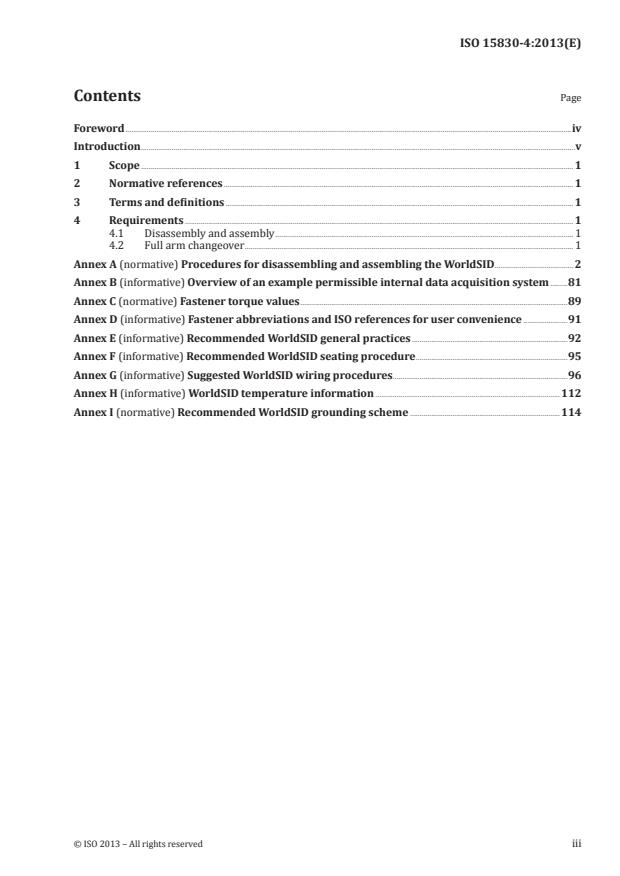
Contents Page
Foreword .iv
Introduction .v
1 Scope . 1
2 Normative references . 1
3 Terms and definitions . 1
4 Requirements . 1
4.1 Disassembly and assembly . 1
4.2 Full arm changeover . 1
Annex A (normative) Procedures for disassembling and assembling the WorldSID .2
Annex B (informative) Overview of an example permissible internal data acquisition system .81
Annex C (normative) Fastener torque values .89
Annex D (informative) Fastener abbreviations and ISO references for user convenience .91
Annex E (informative) Recommended WorldSID general practices .92
Annex F (informative) Recommended WorldSID seating procedure .95
Annex G (informative) Suggested WorldSID wiring procedures .96
Annex H (informative) WorldSID temperature information .112
Annex I (normative) Recommended WorldSID grounding scheme .114
Foreword
ISO (the International Organization for Standardization) is a worldwide federation of national standards
bodies (ISO member bodies). The work of preparing International Standards is normally carried out
through ISO technical committees. Each member body interested in a subject for which a technical
committee has been established has the right to be represented on that committee. International
organizations, governmental and non-governmental, in liaison with ISO, also take part in the work.
ISO collaborates closely with the International Electrotechnical Commission (IEC) on all matters of
electrotechnical standardization.
The procedures used to develop this document and those intended for its further maintenance are
described in the ISO/IEC Directives, Part 1. In particular the different approval criteria needed for the
different types of ISO documents should be noted. This document was drafted in accordance with the
editorial rules of the ISO/IEC Directives, Part 2. www.iso.org/directives
Attention is drawn to the possibility that some of the elements of this document may be the subject of
patent rights. ISO shall not be held responsible for identifying any or all such patent rights. Details of any
patent rights identified during the development of the document will be in the Introduction and/or on
the ISO list of patent declarations received. www.iso.org/patents
Any trade name used in this document is information given for the convenience of users and does not
constitute an endorsement.
The committee responsible for this document is ISO/TC 22, Road vehicles, Subcommittee SC 12, Passive
safety crash protection systems.
This second edition cancels and replaces the first edition (ISO 15830-4:2005) which has been technically
revised. Technical amendments have been incorporated throughout all four parts, resulting from
extensive experience with the standard and design changes.
ISO 15830 consists of the following parts, under the general title Road vehicles — Design and performance
specifications for the WorldSID 50th percentile male side impact dummy:
— Part 1: Terminology and rationale
— Part 2: Mechanical subsystems
— Part 3: Electronic subsystems
— Part 4: User’s manual
iv © ISO 2013 – All rights reserved
Introduction
This second edition of ISO 15830 has been prepared on the basis of the existing design, specifications,
and performance of the WorldSID 50th percentile adult male side impact dummy. The purpose of the
ISO 15830 series is to document the design and specifications of this side impact dummy in a form
suitable and intended for worldwide regulatory use.
In 1997, ISO/TC22/SC12 initiated the WorldSID 50th percentile adult male dummy development,
with the aims of defining a global-consensus side impact dummy, having a wider range of human-like
anthropometry, biofidelity, and injury monitoring capabilities, suitable for regulatory use. Participating
in the development were research institutes, dummy and instrumentation manufacturers, governments,
and vehicle manufacturers from around the world.
With regard to potential regulatory, consumer information, or research and development use of
ISO 15830, users will need to identify which of the permissive (i.e. optional) sensors and other elements
defined in ISO 15830-3 are to be used in a given application.
WorldSID drawings in electronic format are being made available. Details are given in
ISO 15830-2:2013, Annex B.
In order to apply ISO 15830 properly, it is important that all four parts be used together.
INTERNATIONAL STANDARD ISO 15830-4:2013(E)
Road vehicles — Design and performance specifications for
the WorldSID 50th percentile male side impact dummy —
Part 4:
User’s manual
1 Scope
This part of ISO 15830 specifies requirements for assembling and disassembling of the WorldSID 50th
percentile side impact dummy, a standardized anthropomorphic dummy for side impact testing of
road vehicles.
It is applicable to impact tests involving
— passenger vehicles of categories M1 and goods vehicles of categories N1,
— impacts to the side of the vehicle structure,
— impact tests involving the use of an anthropometric dummy as a human surrogate for the purpose
of evaluating compliance with vehicle safety standards.
2 Normative references
The following documents, in whole or in part, are normatively referenced in this document and are
indispensable for its application. For dated references, only the edition cited applies. For undated
references, the latest edition of the referenced document (including any amendments) applies.
ISO 15830-1, Design and performance specifications for the WorldSID 50th percentile adult male side impact
dummy — Part 1: Terminology and rationale
ISO 15830-3:2013, Design and performance specifications for the WorldSID 50th percentile adult male side
impact dummy — Part 3: Electronic subsystems
3 Terms and definitions
For the purposes of this document, the terms and definitions given in ISO 15830-1 apply.
4 Requirements
4.1 Disassembly and assembly
The WorldSID shall be disassembled and assembled according to the procedures in Annex A.
Unless noted otherwise, all fasteners shall be installed using the torques in Annex C.
4.2 Full arm changeover
If a full arm is to be relocated from the left side of the dummy to the right side or from the right side of
the dummy to the left side, then this shall be done using the procedures given in A.4.5.
Annex A
(normative)
Procedures for disassembling and assembling the WorldSID
A.1 Head
A.1.1 Parts list for head
Note that Table A.1 lists the parts required for assembling the WorldSID head, which are illustrated in
Figure A.1. Note that part numbers correspond to those on electronic drawing W50-10000.
Table A.1 — Parts list for WorldSID head
Item number Description Quantity Part number
1 Head core 1 W50-10007
2 Moulded head 1 W50-14014
a
3 Rotational accelerometer, Endevco 7302BM4 3 ISO 15830-3:2013, 4.1.3.3
4 Dual-axis tilt sensor 1 ISO 15830-3:2013, 4.1.3.4.1
5 Linear triaxial accelerometer 1 ISO 15830-3:2013, 4.1.3.2
6 Neck load cell structural replacement 1 W50-71003
7 SHCS M3 x 0,5 x 6 6 5000393
8 Cheese screw, M2 x 16 1 5000254
9 SHCS M4 x 0,7 x 10 1 5000151
10 SHCS M6 x 1 x 16 4 5000081
11 Flat washer M8 (8,9 ID x 18,8 OD x 2,3 thick) 1 5000123
12 BHCS M8 x 1,25 x 25 1 5000255
13 Neck shroud assembly 1 W50-24103
14 SHCS M6 x 12 4 5000281
15 BHCS M4 x 0,7 x 10 5 5000010
Not shown Rotational accelerometer mass replacement 3 W50-10010
Linear triaxial accelerometer mass replace-
Not shown 1 W50-61063
ment
Not shown Dual-axis tilt sensor mass replacement 1 W50-10011
Not shown Universal neck load cell 1 W50-71000
2 © ISO 2013 – All rights reserved
Figure A.1 — WorldSID head components
A.1.2 Disassembling
As shown in Figure A.2, remove the BHCS M8 × 25 fastener (Figure A.1, Item 12) and M8 flat washer
(Figure A.1, Item 11) from the top of the head. Lift the moulded head (Figure A.1, Item 2) off the head core
assembly. If the head sticks to the core, tap the bottom edge of the head lightly with a plastic hammer. Detach
the neck shroud assembly (Figure A.1, Item 13) from the head by removing five screws, BHCS M4 × 10.
Figure A.2 — Removal of moulded head
Remove the four SHCS M6 × 12 (Figure A.1, Item 14) that connect the head core assembly to the neck
assembly (see Figure A.3).
Figure A.3 — Separating the head core from the neck
Remove the four SHCS M6 × 16 (Figure A.1, Item 10) from the bottom of the upper neck load cell structural
replacement (Figure A.1, Item 6) that attach it to the bottom of the head core (see Figure A.4).
4 © ISO 2013 – All rights reserved
Figure A.4 — Removing upper neck load cell from instrumented head core
A.1.3 Assembling
Install the head instrumentation as described in A.1.4. Use four SHCS M6 × 16 (Figure A.1, Item 10) to
attach the upper neck load cell to the bottom of the head core (Figure A.1, Item 1). Make sure the slot
at the top front of the head core is lined up with the connector for the upper neck load cell. Torque the
screws to 6 Nm. Attach the head core assembly to the neck assembly using four SHCS M6 × 12 (Figure A.1,
Item 14). Torque the screws to 6 Nm.
Mount the neck shroud assembly (Table A.1, Item 13) to the moulded head (Figure A.1, Item 2) using five
BHCS M4 × 10. Place the head/neck shroud assembly over the instrumented core, making sure that all
wires are free. Place the M8 flat washer into the recess at the top of the head and connect the head to the
instrumented core using the BHCS M8 × 25 (Figure A.1, Item 12). Tighten the screw 1/4 - 1/2 turn after
engagement of the screw head and the skull.
As shown in Figure A.5, bundle the wires from the head instrumentation together at the rear with cable
ties and route down the back of the neck over to the non-struck side of the dummy. Pass the cables
between the shoulder rib and first thoracic rib. As shown in Figure A.5, make sure that the cable has
some slack. See Annex G for more detailed wiring information.
Figure A.5 — Wire routing for head instrumentation
A.1.4 Instrumentation mounting
Note that, as shown in Figure A.6, the head core can be instrumented with three rotational accelerometers
(Figure A.6, Item 3), one linear triaxial accelerometer (Figure A.6, Item 5), and one dual-axis tilt sensor
(Figure A.6, Item 4). Note that each rotational accelerometer is secured with two SHCS M3 × 6 (Figure A.6,
Item 7) and that the y-axis rotational accelerometer is mounted in the right-front chamber with screws
accessed from the left-front chamber. Mount the z-axis rotational accelerometer in the left-rear chamber
with screws accessed from the top. Mount the x-axis rotational accelerometer in the right-rear chamber
with screws accessed from the right-front chamber. Note that the linear triaxial accelerometer is
mounted in the right-front chamber with one cheese screw M2 × 16 (Figure A.6, Item 8) that is accessed
from the right. Mount the tilt sensor in the right-rear chamber with one SHCS M4 × 10 (Figure A.6, Item
9) accessed from the right-front chamber. Note that the instrumentation in the right-rear chamber shall
be installed before the instrumentation in the right-front chamber. Note that the upper neck load cell is
also considered part of the head assembly instrumentation.
Figure A.6 — WorldSID head instrumentation
6 © ISO 2013 – All rights reserved
A.2 Neck
A.2.1 Parts lists for neck
Note that Table A.2 lists the parts required for assembling the WorldSID neck, which are shown in
Figure A.7. Note that part numbers correspond to those found on drawing W50-20000.
Table A.2 — Parts list for WorldSID neck
Item number Description Quantity Part number
1 Lower neck bracket 1 W50-20101
2 Upper neck bracket 1 W50-20102
3 Neck assembly, tested and certified 1 W50-21001
4 SHCS M6 x 12 8 5000281
5 Neck spacer 2 W50-20103
6 Screw, SHCS M6 x 1 x 30 2 5000008
7 Cable tie mount, #4 screw 1 6002036
8 Screw, BHCS M3 x 0,5 x 6 1 5000399
9 Neck load cell replacement 1 W50-71003
Figure A.7 — WorldSID neck components
A.2.2 Disassembling
Separate the upper (Figure A.7, Item 2) and lower (Figure A.7, Item 1) neck brackets by removing two
SHCS M6 x 30 (Figure A.7, Item 6) accessed from the rear of the dummy (see Figure A.8). Two spacers
(Figure A.7, Item 5), accessed from either side, will be free to be removed.
8 © ISO 2013 – All rights reserved
Figure A.8 — Removing lower neck bracket
Remove the upper part of the neck bracket and lower neck load cell structural replacement from
the neck assembly by removing four SHCS M6 x 12 (Figure A.7, Item 4) accessed from the bottom
(Figure A.9). The lower neck load cell is removed from the upper neck bracket by removing four SHCS
M6 x 12 (Figure A.7, Item 4).
Figure A.9 — Removing upper neck bracket
To take apart the neck assembly, use the neck compression wrench to remove the half-spherical screw
from the neck (Figure A.10). The interface plates will come off, and the four dampers can be removed by
pulling them out (see Figure A.11).
Figure A.10 — Using clamp to remove neck interface plate
Figure A.11 — Neck dampers are free to be removed when interface plates are removed
A.2.3 Assembling
When assembling the neck, mount the neck buffers with the circular cross-sections on the lateral sides
of the neck, and mount the neck buffers with the square cross-sections on the front and rear of the neck.
As shown in Figure A.12, note that the lateral locations for the buffers in the interface plates are farthest
from the holes for mounting the neck to the head and torso.
10 © ISO 2013 – All rights reserved
Figure A.12 — Lateral positions for neck buffers
Note that the circular cross-section buffers have a cylindrical end and a mushroom-shaped end. Press
the mushroom ends firmly into the top and bottom interface plates so that the mushroom cap protrudes
into the counterbore on the flat face of the interface plate. Note that a turning action during assembly
helps to get the circular buffers positioned correctly. Tune the correct response of the neck in lateral
bending by using three different hardnesses of lateral circular cross-section buffers. When installing
the flexion/extension buffers in the interface plates, position them as shown in Figure A.13 so the end
that sticks out farther is facing the moulded neck.
Figure A.13 — Assembling of neck buffers
Position the interface plate with the installed buffers over one end of the neck. Lubricate the surface of
1)
the half-spherical screw with “Never Seez” high-pressure grease. Attach the interface plate to the neck
by tightening the half-spherical screws to 10 Nm using the neck compression tool. Repeat for the other
end of the neck.
Place the upper neck bracket (Figure A.7, Item 2) over the lower neck bracket (Figure A.7, Item 1) and
engage the teeth in the desired orientation. Insert the neck spacer (Figure A.7, Item 5) into the slot on
one side and orient it so the hole in the nut lines up with the hole accessed from the back of the lower
neck bracket. Insert the SHCS M6 x 30 (Figure A.7, Item 6) to secure the brackets together. Repeat with
the second neck bracket nut and SHCS on the other side.
Mount the neck load cell or its structural replacement (Figure A.7, Item 9) to the neck bracket with four
SHCS M6 x 12 (Figure A.7, Item 4). Tighten the screws to 6 Nm. Attach the neck assembly (Figure A.7,
Item 3) to the neck bracket/load cell assembly with four SHCS M6 × 12 (Figure A.7, Item 4) accessed from
the bottom. Tighten the screws to 6 Nm.
A.2.4 Instrumentation mounting
Note that the neck assembly includes a lower neck load cell (the upper neck load cell is considered part
of the head assembly). Note that a triaxial accelerometer can be mounted in a recess in the back of the
1) “Never Seez” is a commercial product. This information is given for the convenience of users of this
International Standard and does not constitute an endorsement by ISO of the product named. Alternative products
may be used if they can be shown to lead to the same results.
12 © ISO 2013 – All rights reserved
lower neck bracket. Attach the triaxial accelerometer or its mass replacement to the upper neck bracket
using a cheese screw M2 × 16 (see Figure A.14).
Figure A.14 — Neck triaxial accelerometer installation
A.3 Thorax, abdomen, and shoulder
A.3.1 Parts list
A.3.1.1 Parts list for thorax, abdomen, and shoulder assembly
Note that Table A.3 lists the parts required for assembling the WorldSID thorax, abdomen, and shoulder,
which are illustrated in Figure A.15. Note that part numbers correspond to those on drawing W50-30000.
Table A.3 — Parts list for the WorldSID thorax, abdomen, and shoulder
Item Description Quantity Part number
number
1 Spine box assembly 1 W50-31000
2 IRTRACC displacement sensor assembly, ribs 1-6 (ref) 6 IF-363
3 Thorax rib assembly 1, WorldSID 2 W50-32111
4 Thorax rib assembly 2 & 3, WorldSID 8 W50-32131
5 Sternum, thorax rib 1 W50-35022
6 Rib coupler, abdominal, WorldSID 1 W50-35021
7 Shoulder rib sternum mounting strip 2 W50-32177
8 Thorax and abdominal rib sternum mounting strip 10 W50-32178
9 Thorax and abdominal rib mounting strip, threaded 10 W50-32176
10 Screw, BHCS M5 X 0,8 X 10 24 5000003
Table A.3 (continued)
Item Description Quantity Part number
number
11 Shoulder rib assembly, inner band, WorldSID 2 W50-32160-2
12 Thorax rib assembly, inner band, WorldSID 6 W50-32150-2
13 Abdomen rib assembly, inner band, WorldSID 4 W50-32155-2
14 Shoulder rib mounting bracket, WorldSID 2 W50-32171
15 Thorax and abdominal rib accelerometer mounting bracket,
10 W50-32172
WorldSID
16 Accelerometer, linear triaxial, Endevco 7268C-M1 (ref) 6 7268C-M1
17 Rib assembly, shoulder 2 W50-32001
not
Shoulder rib sternum mounting strip, threaded 2 W50-32175
shown
19 Thorax and abdominal rib clamping bracket, WorldSID 10 W50-32173
20 Screw, FHCS M5 X 0,8 X 16 8 5000467
21 Screw, rib IRTRACC mount 6 W50-32179
22 Rib doubler, shoulder 2 W50-32010
23 Shoulder assembly, l.c. structural replacement 2 W50-61053
24 Clamp, damping 24 W50-32180
25 Screw, FHCS M5 X 0,8 X 10 48 5000084
26 Screw, BHCS M5 X 0,8 X 6 24 5000214
27 Shoulder pad, left, WorldSID 1 W50-35023-1
28 Shoulder pad, right, WorldSID 1 W50-35023-2
29 Screw, BHCS M2,5 X 0,45 X 10 10 5000208
30 Nut, locknut M12 X 1,75 2 5000462
31 Thorax pad 2 W50-35024
32 Screw, SHCS M6 X 1 X 16 4 5000081
33 Screw, cheese M2 X 16 6 5000254
34 Cable tie mount, ,50 x ,50, nylon, adhesive backed 10 6002035
35 Cable tie mount, #4 screw, nylon 1 6002036
36 Screw, BHCS M3 X 0,5 X 6 1 5000399
37 Cable tie, hook & loop, 11 inch (not shown) 8 6002055
38 Temperature logger assy (ref) 1 734-0808
39 Battery mounting bracket 1 W50-37013
40 Spine ballast stand offs 2 W50-37014
41 G5 mounting bracket, WorldSID thorax 1 W50-37015
42 G5 structural replacement 1 W50-74307
43 Screw, SHCS M5 X 0,8 X 30 2 5000471
44 Screw, BHCS M5 X 0,8 X 12 40 5000654
45 Screw, BHCS #6-32 X 1-1/4 4 9003044
46 Screw, SHCS M3 X 0,5 X 12 6 5000568
47 Structural replacement cover 1 556-5125-2
14 © ISO 2013 – All rights reserved
Figure A.15 — Components of WorldSID thorax and abdomen
A.3.1.2 Parts list for shoulder
Note that Table A.4 lists the parts required for assembling the WorldSID shoulder (electronic drawing
W50-61053), which is illustrated in Figure A.16.
Table A.4 — Parts list for shoulder assembly
Item number Description Quantity Part number
1 Shoulder load cell structural replacement 1 W50-71092
2 Shoulder pivot shaft 1 W50-61049
3 Shoulder pivot washer 2 W50-61050
4 Shoulder clevis assembly 1 W50-61117
5 M6 hex locknut 1 5000143
6 SSNT M4 x 0,7 x 4 mm 2 5000201
Not shown Shoulder load cell 1 W50-71090
Not shown SSFP M4 x 0,7 x 4 mm 2 5000618
Not shown SSFT M6 x 10 1 5000226
Figure A.16 — Shoulder
A.3.1.3 Parts list for spine box assembly
Note that Table A.5 list the parts required for assembling the WorldSID spine box. Note that part numbers
correspond to those on drawing W50-31000 and shown in Figure A.17.
Table A.5 — Parts list for WorldSID spine box
Item number Description Quantity Part number
1 Mounting bracket #1 2 W50-31042
2 Upper bracket weldment, spine box, WorldSID 1 W50-31010
3 Interposer replacement 2 W50-75001
4 Side plate, left WorldSID 1 W50-31020
5 SHCS M3 x 0,5 x 10 7 5000119
6 Spacer, WorldSID 6 W50-31041
16 © ISO 2013 – All rights reserved
Table A.5 (continued)
Item number Description Quantity Part number
7 T12 accelerometer mount, WorldSID 1 W60-37024
8 Side plate, right WorldSID 1 W50-31030
9 SHCS M3 x 0,5 x 8 8 5000388
10 Connector housing mass replacement 2 W50-75002
11 Backup plate mounting bracket 2 W50-37022
12 SHCS M4 x 0,7 x 10 4 5000151
13 FHCS M2,5 x 0,45 x 6 24 5000202
14 Ball joint assembly, IRTRACC 6 W50-31050
15 FHCS M6 x 1 x 10 18 5000204
16 Accelerometer, linear triaxial 2 ISO 15830-3:2013, 4.1.3.2
17 SHCS M2 x 0,4 x 12,0 12,9 alloy steel 8 5000382
18 Cheese screw M2 x 16 2 5000254
19 BHCS M6 x 1 x 18 4 5000465
20 Rotational accelerometer/tilt sensor mount 1 W50-37023
bracket
21 Mounting bracket #2 2 W50-31043
22 G5 mass replacement 3 W50-74307
23 Cover plate spine box 2 W50-31045
24 Accelerometer, rotational 2 ISO 15830-3:2013, 4.1.3.3
25 SHCS M4 x 0,7 x 25 8 5000461
26 Bracket, rotational accelerometer mount 1 W50-37029
27 Tilt sensor, dual axis (ref) 1 ISO 15830-3:2013, 4.1.2.4.3
28 FHCS M3 x 0,5 x 10 2 5000203
29 SHCS M4 x 0,7 x 8 1 5000024
30 Pin, dowel M4 x 14 2 5000053
Not shown Linear accelerometer mass replacement 2 W50-61063
Not shown Rotational accelerometer mass replacement 2 W50-10010
Not shown Dual axis tilt sensor mass replacement 1 W50-10011
Figure A.17 — WorldSID spine box assembly
A.3.2 Disassembling
A.3.2.1 Separation of upper and lower torso
To separate the upper and lower torso, first make sure all cables running between the upper and lower
torso are detached. These would normally include sensor cables that were routed to the DAS in the
thorax, and a ground cable. This step may require disassembly of the sternum to access the sensor
collector. Thereafter, remove the four SHCS M8, two on each side of the bottom of the spine box, to
separate the upper and lower torsos.
A.3.2.2 Shoulder
As shown in Figure A.18, remove the shoulder assembly (Figure A.15, Item 23) by removing the four
FHCS M5 x 16 (Figure A.15, Item 20) that hold each in place.
18 © ISO 2013 – All rights reserved
Figure A.18 — Removing shoulder load cell assembly
To remove the clevis assembly (Figure A.16, Item 4), take off the M6 hex nut (Figure A.16, Item 5) with
the nylon washer (Figure A.16, Item 3) at the threaded end. Next, loosen the two SSNT M4 × 0,7 × 4
(Figure A.16, Item 6) in the clevis assembly that hold the pivot shaft (Figure A.16, Item 2) and the SSFT
M6 × 10 mm (in the load cell behind the clevis securing the pivot shaft) from the load cell structural
replacement then pull the shaft out of the assembly.
NOTE The shoulder load cell has two SSFP M4 × 4 mm securing the pivot shaft instead of the one SSFT M6 × 10
in the load cell structural replacement.
A.3.2.3 Thorax and abdomen
Remove the thorax pad (Figure A.15, Item 31) by removing it from the Velcro® that holds it in place.
Remove the shoulder pads (Figure A.15, Items 27 and 28) by lifting them off of the dummy. Remove the
lower neck bracket from the spine box by removing four SHCS M6 × 16 (Figure A.15, Item 32).
Remove the shoulder rib mounting brackets (Figure A.15, Item 14). Detach the shoulder rib IR-TRACC
(Figure A.15, Item 2) from the shoulder rib mounting bracket by removing the IR-TRACC rib mount
screw (Figure A.15, Item 21), accessed from the bottom of the shoulder rib mounting bracket.
Remove the linear triaxial accelerometer (Figure A.15, Item 16) from the shoulder rib mounting bracket
by removing the cheese screw M2 × 16 (Figure A.15, Item 33). Detach the shoulder IR-TRACC assembly
from the spine box by removing the BHCS M2,5 × 10 (Figure A.15, Item 29).
As shown in Figure A.19, disconnect the shoulder rib (Figure A.19, Item 17) at the front by removing the
two BHCS M5 × 10 (Figure A.15, Item 10) that attach the left and right shoulder ribs to the sternum thorax
rib (Figure A.15, Item 5). Remove a shoulder rib sternum mounting strip (Figure A.15, Item 7) and a
threaded shoulder rib sternum mounting strip (Figure A.15, Item 18) which are removed from each side.
Figure A.19 — Detaching shoulder rib at front from sternum
Detach the left and right shoulder ribs from the spine box at the rear by removing two BHCS M5 × 6
(Figure A.15, Item 26) that hold each in place (see Figure A.20). On the non-struck side, remove the two
damping clamps (Figure A.15, Item 24).
Figure A.20 — Detaching the rib from the spine box at the rear
20 © ISO 2013 – All rights reserved
Note that the procedures for disassembling the remaining ribs are similar to those for the shoulder rib,
but details for the first thoracic rib are included here in order to include references to the correct item
numbers. Detach the rib clamping bracket (Figure A.15, Item 19) and the rib accelerometer mounting
bracket (Figure A.15, Item 15) by removing the four BHCS M5 × 10 (Figure A.15, Item 10). Remove the
triaxial accelerometer (Figure A.15, Item 16) from the rib accelerometer mounting bracket (Figure A.15,
Item 15) by removing the cheese screw M2 × 16 (Figure A.15, Item 33).
Remove the IR-TRACC (Figure A.15, Item 2) by removing the BHCS M2,5 × 10 (Figure A.15, Item 29)
that secures it to the spine box. Detach it from the rib accelerometer bracket by removing the IR-TRACC
mount screw (Figure A.15, Item 21), which is accessed from the bottom of the rib accelerometer bracket.
Detach the thorax rib at the front by removing the four BHCS M5 × 10 (Figure A.15, Item 10) that connect
it to the sternum (Figure A.15, Item 5). Remove the two sternum rib mounting strips (Figure A.15, Item
8) and the two threaded rib mounting strips (Figure A.15, Item 9). Detach the inner band of the thorax
rib (Figure A.15, Item 12) by removing the four BHCS M5 × 10 (Figure A.15, Item 10) that hold them in
place. Remove the two damping clamps (Figure A.15, Item 24). Detach the rib from the spine box at the
rear by removing two BHCS M5 × 6 (Figure A.15, Item 26) that hold them in place.
Repeat this procedure for the second and third thorax ribs and the two abdominal ribs with the few
differences in parts described here. Note that the two abdominal ribs are attached at the front to the
abdominal rib coupler (Figure A.15, Item 6), and that the inner rib bands of the two abdomen ribs
(Figure A.15, Item 13) are different than the inner bands of the three thorax ribs (Figure A.15, Item
12). Note that the damping material on the abdominal ribs is thicker than that on the thoracic ribs. Note
that the first thorax outer rib (Figure A.15, Item 3) is different from the thorax ribs 2 and 3 and the
abdominal ribs (Figure A.15, Item 4), which are the same.
After the ribs are removed, detach the G5 mounting bracket (Figure A.21) from the non-struck side
by removing two SHCS M3 x 12. Then, detach the G5 structural replacement by removing the four #6-
32 × 1-1/4 BHCS. Detach the cover by removing the four BHCS M2.5 x 10. Next, remove the battery
mounting bracket by detaching the two M5 x 30 SHCS that secure it to the spine box. Detach the spine
ballast stand offs from the battery mounting bracket by removing the SHCS M3 x 12.
Figure A.21 — Non-impact side G5 assembly
A.3.2.4 Spine box disassembling
Detach the right side plate (Figure A.17, Item 8) from the spine box by removing 10 FHCS M6 × 10
(Figure A.17, Item 15). Note that the internal components of the spine box will now be visible (see
Figure A.23).
22 © ISO 2013 – All rights reserved
Figure A.22 — Internal spine box assembly
Note the rotational and linear accelerometer assembly shown in Figure A.23. To detach the rotational
accelerometer assembly from the spine box, remove the three SHCS M3 × 10 (Figure A.17, Item 5) that
secure it to the spine box. Remove the dual-axis tilt sensor (Figure A.17, Item 27) from the rotational
accelerometer bracket by removing the SHCS from the back of the bracket. Detach the two rotational
accelerometers by removing the two FHCS that secure each to the bracket.
Figure A.23 — Angular accelerometer assembling
Begin removal of the upper or middle G5 module mass replacements (Figure A.17, Item 22) by removing
two SHCS M4 × 25 (Figure A.17, Item 25) that secure the Number 2 mounting brackets (Figure A.17, Item
21) to the upper bracket weldment, spine box (Figure A.17, Item 2). Remove two more SHCS M4 × 25
(Figure A.17, Item 25) that secure the Number 1 mounting brackets (Figure A.17, Item 1) to the spine
box. Remove the middle or upper G5 module mass replacement assembly (Figure A.17, Item 22). Detach
the spine box cover plate (Figure A.17, Item 23) from the back of each G5 module mass replacement
(Figure A.17, Item 22) by removing two BHCS M6 × 18 (Figure A.17, Item 19). Slide the G5 module mass
replacement (Figure A.17, Item 22) from between the two mounting brackets (Figure A.17, Item 1 and
21). Detach each interposer mass replacement (Figure A.17, Item 3) from the mounting brackets by
removing the four SHCS M2 × 12 (Figure A.17, Item 17). Remove the two backup plate mounting brackets
(Figure A.17, Item 11) from the spine box by removing the two SHCS M4 × 10 (Figure A.17, Item 12)
that hold each in place. Remove each connector housing mass replacement (Figure A.17, Item 10) from
its backup plate mounting bracket (Figure A.17, Item 11) by removing three SHCS M3 × 8 (Figure A.17,
Item 9). Remove the lower G5 module mass replacement (Figure A.17, Item 22) from the spine box by
detaching two pin dowel M4 × 14 (Figure A.17, Item 30).
Turn the spine box over and remove seven FHCS M6 × 10 (Figure A.17, Item 15) to remove the seven
spacers (Figure A.17, Item 6) from the left side plate (Figure A.17, Item 4). Remove three more of the
FHCS M6 × 10 (Figure A.17, Item 15) to separate the upper spine box bracket weldment from the left-side
plate (Figure A.17, Item 4).
24 © ISO 2013 – All rights reserved
As shown in Figure A.24, note that six IR-TRACC ball joint assemblies (Figure A.17, Item 14) are secured
to the struck-side plate, each with four FHCS M2,5 × 6 (Figure A.17, Item 13).
Figure A.24 — IR-TRACC ball joint assemblies are mounted to the struck-side plate of the spine box
A.3.3 Assembling
A.3.3.1 Assembling thorax and abdomen
Note that Figure A.25 shows the colour coding scheme for the WorldSID ribs and that the shoulder rib is grey,
the first thoracic rib is red, and the remaining ribs (thorax number two and three, both abdominal) are white.
Note that the inner bands of the two abdominal ribs (Figure A.15, Item 13) have a thicker layer of damping
material than the inner bands of the thoracic ribs (Figure A.15, Item 12), and that the inner band of the
shoulder rib (Figure A.15, Item 11) is different from the other inner bands.
Figure A.25 — Shoulder rib is grey, the first thoracic rib is red, and the second and third
thoracic ribs and abdominal ribs are white
Begin assembly of the thorax by attaching the two spine ballast stand offs (Figure A.15, Item 40) to the
battery mounting bracket (Figure A.15, Item 39) with SHCS M3 × 12 (Figure A.15, Item 46). Then attach
the battery mounting bracket (Figure A.15, Item 39) with two SHCS M5x30 (Figure A.15, Item 43) that
secure it to the spine box on the non-struck side. Attach the G5 structural replacement (Figure A.15, Item
42) with four BHCS #6-32 × 1-1/4 to the G5 mounting bracket (Figure A.15, Item 41). Attach the G5 cover
(Figure A.15, Item 47) to the G5 replacement with BHCS M2.5 × 10 (Figure A.15, Item 29). Then attach
the G5 mounting bracket (Figure A.15, Item 41) to the battery mounting bracket (Figure A.15, Item 39).
Begin assembly of the ribs from the bottom. Attach the lower abdominal rib (Figure A.15, Item 13)
to the spine box at the rear using two BHCS M5 × 6 (Figure A.15, Item 26). Secure the inner band of
the abdomen (Figure A.15, Item 13) with two damping clamps (Figure A.15, Item 24) and four BHCS
M5 × 10 (Figure A.15, Item 10). To permit easier access to the connector boxes in the spine box, install
the instrumentation before attaching the ribs to the rib and abdominal couplers.
Attach the IR-TRACC to the spine box with a BHCS M2,5 × 10 (Figure A.15, Item 29). Connect it to the
rib accelerometer bracket (Figure A.15, Item 15) with the IR-TRACC mount screw (Figure A.15, Item
21), accessed from the bottom of the rib accelerometer bracket (Figure A.15, Item 15). Connect the
rib clamping bracket (Figure A.15, Item 19) and the rib accelerometer mounting bracket (Figure A.15,
Item 15) to the inner band and rib with four BHCS M5 × 10 (Figure A.15, Item 10). Secure the triaxial
accelerometer (Figure A.15, Item 16) to the rib accelerometer mounting bracket (Figure A.15, Item 15)
with a cheese screw M2 × 16 (Figure A.15, Item 33).
As each IR-TRACC assembly and accelerometer is installed, route the cables toward the centre front
(Figure A.28 and Figure A.29) of the dummy and plug them into the G5 module connectors. See Annex G
for more detailed wiring information.
26 © ISO 2013 – All rights reserved
Note that Figure A.26 shows the arrangement of the components in the first thoracic WorldSID rib and
that all of the ribs have a similar general assembly. Note that the inner band of the rib (Figure A.26,
Item 33) is attached to the spine box with damping clamps (Figure A.26, Item 10) and FHCS. Note that
the rib (Figure A.26, Item 28) is attached to the spine box (Figure A.26, Item 13) at the rear with BHCS,
and to the thorax rib sternum (Figure A.26, Item 3) at the front using BHCS and the sternum mounting
strip (Figure A.26, Item 4) and threaded sternum mounting strip (Figure A.26, Item 7). Attach the IR-
TRACC assembly (Figure A.26, Item 14) with a BHCS to the ball joint components which are attached
to the spine box. Secure the IR-TRACC to the rib accelerometer mounting bracket (Figure A.26, Item
32) with a special mounting screw accessed from the bottom. Note that a linear triaxial accelerometer
(Figure A.26, Item 15) is attached to the rib accelerometer mounting bracket (Figure A.26, Item 32),
which is then secured to the inner rib, rib, and rib clamping bracket (Figure A.26, Item 31) with a BHCS.
Figure A.26 — Components of thorax rib
Figure A.27 — Wire routing for rib instrumentation
Figure A.28 — Plugging rib instrumentation cables into the front of the G5 modules mounted in
the spine box
28 © ISO 2013 – All rights reserved
Continue installing the ribs with the preceding procedure. Attach the shoulder rib mounting bracket
(Figure A.15, Item 14) to the shoulder rib and shoulder load cell structural replacement (Table A.3, Item
23) with four FHCS M5 × 0,8 × 16 (Figure A.15, Item 20).
After the instrumentation is plugged into the connectors, position a threaded rib mounting strip
(Figure A.15, Item 9) behind the front holes on each abdominal rib, and place the abdominal rib coupler
(Figure A.15, Item 6) over it. Put the rib mounting strip (Figure A.26, Item 4) over the rib coupler and
secure the rib at the front with two BHCS M5 × 10 (Figure A.15, Item 10). Note that the installed rib
couplers are shown in Figure A.29.
Attach the lower neck bracket to the spine box with four SHCS M6 × 16 (Table A.3, Item 32). Attach the thorax
pad (Figure A.15, Item 31) with Velcro®. Place the shoulder pads (Figure A.15, Items 27 and 28) in position.
To install the thorax pads, check the fit of the pad against the dummy to make sure the pad covers the
ribs and press into place, engaging the Velcro® with light pressure.
Figure A.29 — The rib and abdominal couplers are attached to the ribs after instrumentation
is plugged in
A.3.3.2 Assembling spine box
Begin assembly of the spine box by mounting the ball joints for the IR-TRACC assemblies to the side
plate so they face the struck-side of the dummy. Secure each ball joint (Figure A.17, Item 14) with four
FHCS M2,5 × 6 (Figure A.17, Item 13). Attach the seven spacers (Figure A.17, Item 6) to the struck-side
plate (Figure A.17, Item 4 or Item 8) using seven FHCS M6 × 10 (Figure A.17, Item 19). Attach the upper
spine box bracket weldment (Figure A.17, Item 2) to the struck-side plate with three more FHCS M6 × 10
(Figure A.17, Item 19).
As shown in Figure A.30, attach the lower G5 module or its mass replacement (Table A.5, Item 22) to the
spine box. Attach each backup plate mounting bracket (Figure A.17, Item 11) to the spine box with two
M4 × 14 pin dowels (Figure A.17, Item 30). Connect each interposer or its mass replacement (Figure A.17,
Item 3) to the mounting brackets Number 1 (Figure A.17, Item 1) and Number 2 (Figure A.17, Item 21) with
four SHCS M2 × 12 (Figure A.17, Item 17). Secure the mounting brackets/interposers to the spine box with
four SHCS M4 × 25 (Figure A.17, Item 25). Slide the G5 modules or their mass replacements (Figure A.17,
Item 22) into the mounting brackets and connect them to the interposers. Attach the spine box cover
plate (Figure A.17, Item 23) to the back of each G5 module or its mass replacement with two BHCS M6 × 18
(Figure A.17, Item 19). Attach each connector housing or its mass replacement (Figure A.17, Item 10) to its
backup plate mounting bracket (Figure A.17, Item 11) with three SHCS M3 × 8 (Figure A.17, Item 9).
Next, assemble the angular accelerometer assembly. Attach the z-axis angular accelerometer to the
bottom of the bracket with two FHCS. Attach the x-axis rotational accelerometer to the back of the
bracket with two FHCS so it is parallel to the bottom of the bracket. Attach the dual-axis tilt sensor
(Figure A.17, Item 27) to the back of the bracket with a SHCS. Position the rotational accelerometer
assembly on the spine box and secure it with three SHCS M3 × 10 (Figure A.17, Item 5). Plug the cables
for the rotational accelerometers sensors into a G5 module, but leave the connectors for the dual-axis tilt
sensor free to be plugged into the off-board readout during dummy setup.
Attach the T12 accelerometer mount (Figure A.17, Item 7) to the spine box with two SHCS M3 × 10
(Figure A.17, Item 5). Attach the accelerometer (Figure A.17, Item 16) to the mount with a cheese screw
M2 × 16 (Figure A.17, Item 18). Orient the accelerometer so that the cable points upward and can be
routed between the middle G5 module and angular accelerometer assembly t
...
Questions, Comments and Discussion
Ask us and Technical Secretary will try to provide an answer. You can facilitate discussion about the standard in here.
Loading comments...