

ISO 15830-2:2022
(Main)Road vehicles — Design and performance specifications for the WorldSID 50th percentile male side-impact dummy — Part 2: Mechanical subsystems
General Information
- Abstract
This document specifies requirements for mechanical components, specifications and validation tests for the WorldSID 50th percentile side-impact dummy, a standardized anthropomorphic dummy for near-side-impact tests of road vehicles.
- Status
- Published
- Publication Date
- 15-Dec-2022
- Technical Committee
- ISO/TC 22/SC 36 - Safety and impact testing
- Drafting Committee
- ISO/TC 22/SC 36/WG 5 - Anthropomorphic test devices
- Current Stage
- 6060 - International Standard published
- Start Date
- 16-Dec-2022
- Due Date
- 10-Jul-2022
- Completion Date
- 16-Dec-2022



Overview
ISO 15830-2:2022 specifies the mechanical subsystems requirements, component specifications, and validation tests for the WorldSID 50th percentile male side‑impact dummy. As Part 2 of the ISO 15830 series (third edition, 2022), this standard documents the mechanical design and test procedures needed to ensure reproducible, biofidelic performance of the WorldSID anthropomorphic test device used in near‑side vehicle impact testing.
Key topics and technical requirements
This part focuses on mechanical hardware and validation methods rather than electronic instrumentation. Major topics include:
- Segment‑level mechanical specifications
- Head: geometry, reference marks and drop/impact validation procedures
- Neck: lateral flexion and torsion description, specifications and validation
- Thorax / abdomen / shoulder: rib‑chest assembly characteristics and pendulum tests
- Lumbar spine, pelvis: mechanical design, pelvis acceleration and pendulum‑force targets (includes pubic force specification)
- Upper and lower legs, knees, ankles and feet: mass and mechanical behaviour
- Arms and clothing: general descriptions and mass/spec limits
- Whole‑dummy requirements
- Assembly mass targets, whole‑body dimensions and CMM (coordinate measuring machine) procedures
- Validation protocols for integrated responses
- Validation test procedures
- Detailed apparatus, sensor, preparation and procedural steps for head, neck (lateral flexion and torsion), thorax, abdomen, pelvis and full‑body tests
- Calculation procedures and reporting requirements
- Informative annexes
- Optional whole body measurement method using mechanical tools
- Optional single rib test procedure
Notable updates in this 2022 edition include revisions to assembly and clothing mass specifications, added neck torsion validation, updated thorax and pelvis specifications (including pubic force), changes to head reference location and whole‑body dimension procedures.
Practical applications and typical users
ISO 15830-2 is essential for consistent, global use of the WorldSID dummy in applications such as:
- Vehicle side‑impact certification and regulatory compliance testing
- OEM crash‑test and occupant‑protection design validation
- Biomechanics research and injury risk assessment
- Anthropomorphic dummy manufacturers and calibration laboratories
- Independent test laboratories and accreditation bodies performing dummy validations
Using this standard helps ensure reproducible mechanical behaviour of the dummy across manufacturers and test sites, improving comparability of side‑impact test results and injury metrics.
Related standards
- ISO 15830-1: Vocabulary and rationale
- ISO 15830-3: Electronic subsystems requirements
- ISO 15830-4: User’s manual
- ISO 6487: Instrumentation for impact tests
- SAE J211‑1, SAE J2570, SAE J1733 and related instrumentation/ATD transducer standards
For implementation and procurement, refer to the full ISO 15830-2:2022 document and use it together with the other parts of the ISO 15830 series.
Relations
- Effective Date
- 05-Aug-2023
- Effective Date
- 23-Apr-2020
Get Certified
Connect with accredited certification bodies for this standard

TÜV Rheinland
TÜV Rheinland is a leading international provider of technical services.

TÜV SÜD
TÜV SÜD is a trusted partner of choice for safety, security and sustainability solutions.

BSI Group
BSI (British Standards Institution) is the business standards company that helps organizations make excellence a habit.
Sponsored listings
Frequently Asked Questions
ISO 15830-2:2022 is a standard published by the International Organization for Standardization (ISO). Its full title is "Road vehicles — Design and performance specifications for the WorldSID 50th percentile male side-impact dummy — Part 2: Mechanical subsystems". This standard covers: This document specifies requirements for mechanical components, specifications and validation tests for the WorldSID 50th percentile side-impact dummy, a standardized anthropomorphic dummy for near-side-impact tests of road vehicles.
This document specifies requirements for mechanical components, specifications and validation tests for the WorldSID 50th percentile side-impact dummy, a standardized anthropomorphic dummy for near-side-impact tests of road vehicles.
ISO 15830-2:2022 is classified under the following ICS (International Classification for Standards) categories: 43.020 - Road vehicles in general. The ICS classification helps identify the subject area and facilitates finding related standards.
ISO 15830-2:2022 has the following relationships with other standards: It is inter standard links to ISO 15830-2:2022/Amd 1:2026, ISO 15830-2:2013. Understanding these relationships helps ensure you are using the most current and applicable version of the standard.
ISO 15830-2:2022 is available in PDF format for immediate download after purchase. The document can be added to your cart and obtained through the secure checkout process. Digital delivery ensures instant access to the complete standard document.
Standards Content (Sample)
INTERNATIONAL ISO
STANDARD 15830-2
Third edition
2022-12
Road vehicles — Design and
performance specifications for the
WorldSID 50th percentile male side-
impact dummy —
Part 2:
Mechanical subsystems
Véhicules routiers — Conception et spécifications de performance
pour le mannequin mondial (WorldSID), 50e percentile homme, de
choc latéral —
Partie 2: Sous-systèmes mécaniques
Reference number
© ISO 2022
All rights reserved. Unless otherwise specified, or required in the context of its implementation, no part of this publication may
be reproduced or utilized otherwise in any form or by any means, electronic or mechanical, including photocopying, or posting on
the internet or an intranet, without prior written permission. Permission can be requested from either ISO at the address below
or ISO’s member body in the country of the requester.
ISO copyright office
CP 401 • Ch. de Blandonnet 8
CH-1214 Vernier, Geneva
Phone: +41 22 749 01 11
Email: copyright@iso.org
Website: www.iso.org
Published in Switzerland
ii
Contents Page
Foreword .v
Introduction .vii
1 Scope . 1
2 Normative references . 1
3 Terms and definitions . 1
4 Mechanical requirements for WorldSID . 2
4.1 Head . 2
4.1.1 General description . . 2
4.1.2 Specifications . 2
4.1.3 Validation . 3
4.2 Neck . 3
4.2.1 General description . 3
4.2.2 Specifications . 3
4.2.3 Validation . 3
4.3 Thorax/abdomen/shoulder . 4
4.3.1 General description . 4
4.3.2 Specifications . 4
4.3.3 Validation . 4
4.4 Arms . . 5
4.4.1 General description . 5
4.4.2 Specifications . 5
4.5 Lumbar spine and pelvis . 6
4.5.1 General description . . 6
4.5.2 Specifications . 6
4.5.3 Validation . 6
4.6 Upper legs and knees . 6
4.6.1 General description . . 6
4.6.2 Specifications . 6
4.7 Lower legs, ankles, and feet . 6
4.7.1 General description . . 6
4.7.2 Specifications . 7
4.8 Clothing . 7
4.8.1 General description . 7
4.8.2 Specifications . 7
4.9 Whole dummy . 7
4.9.1 General description . 7
4.9.2 Specifications . 7
4.9.3 Validation . 8
5 Validation test procedures .10
5.1 Head . 10
5.1.1 Principle . 10
5.1.2 Apparatus . 10
5.1.3 Sensors . 10
5.1.4 Preparation . 10
5.1.5 Procedure . 12
5.1.6 Calculation procedures and expression of results .13
5.1.7 Test reports .13
5.2 Neck .13
5.2.1 Lateral flexion . 13
5.2.2 Torsion . 17
5.3 Thorax/abdomen/shoulder/pelvis full body tests . 20
5.3.1 Full body test setup . 20
iii
5.3.2 Shoulder test . 24
5.3.3 Thorax test . 26
5.3.4 Abdomen test .28
5.3.5 Pelvis test . 31
5.4 Whole body dimensions . 33
5.4.1 Principle . 33
5.4.2 Apparatus . 33
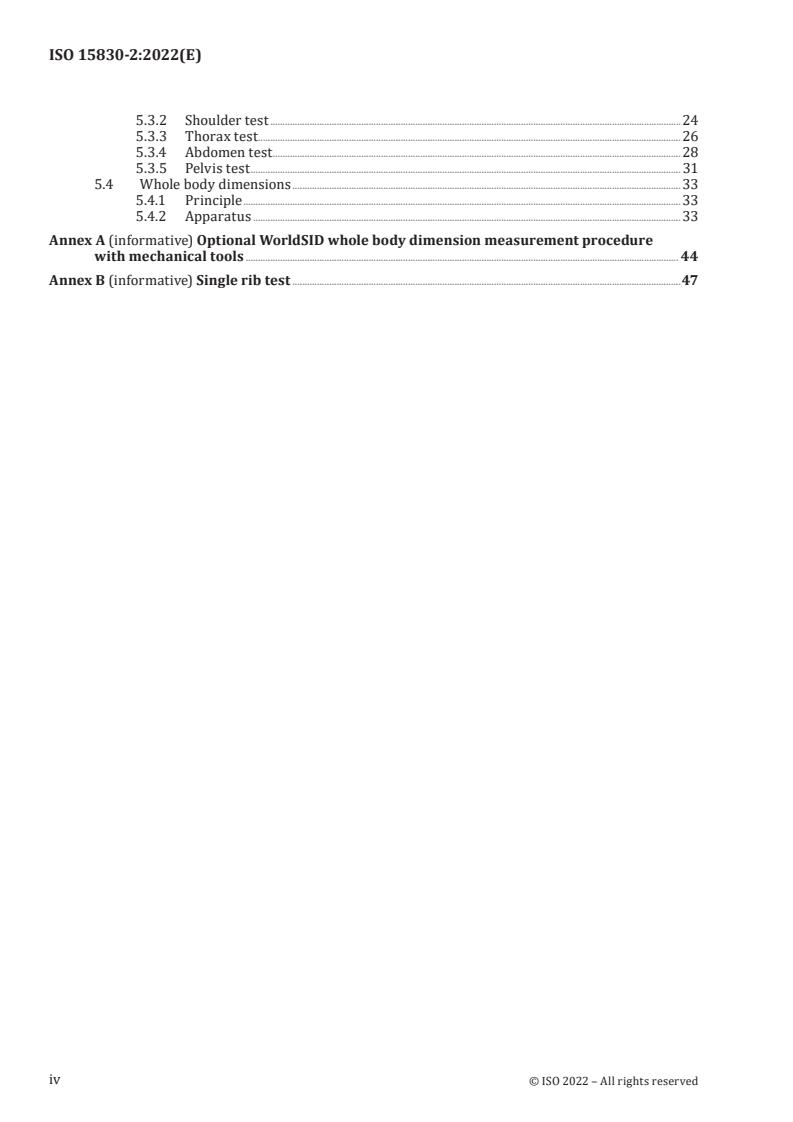
Annex A (informative) Optional WorldSID whole body dimension measurement procedure
with mechanical tools . 44
Annex B (informative) Single rib test .47
iv
Foreword
ISO (the International Organization for Standardization) is a worldwide federation of national standards
bodies (ISO member bodies). The work of preparing International Standards is normally carried out
through ISO technical committees. Each member body interested in a subject for which a technical
committee has been established has the right to be represented on that committee. International
organizations, governmental and non-governmental, in liaison with ISO, also take part in the work.
ISO collaborates closely with the International Electrotechnical Commission (IEC) on all matters of
electrotechnical standardization.
The procedures used to develop this document and those intended for its further maintenance are
described in the ISO/IEC Directives, Part 1. In particular, the different approval criteria needed for the
different types of ISO documents should be noted. This document was drafted in accordance with the
editorial rules of the ISO/IEC Directives, Part 2 (see www.iso.org/directives).
Attention is drawn to the possibility that some of the elements of this document may be the subject of
patent rights. ISO shall not be held responsible for identifying any or all such patent rights. Details of
any patent rights identified during the development of the document will be in the Introduction and/or
on the ISO list of patent declarations received (see www.iso.org/patents).
Any trade name used in this document is information given for the convenience of users and does not
constitute an endorsement.
For an explanation of the voluntary nature of standards, the meaning of ISO specific terms and
expressions related to conformity assessment, as well as information about ISO's adherence to
the World Trade Organization (WTO) principles in the Technical Barriers to Trade (TBT), see
www.iso.org/iso/foreword.html.
This document was prepared by Technical Committee ISO/TC 22, Road vehicles, Subcommittee SC 36,
Safety and impact testing.
This third edition cancels and replaces the second edition (ISO 15830-2:2013), which has been
technically revised.
The main changes are as follows:
— in Figure 1 head CG location has been changed to head reference mark location;
— body segment assembly mass specifications have been changed;
— clothing mass specification has been changed;
— in Table 1 specifications of head resultant acceleration have been changed for frontal and lateral
drops;
— in Table 3 new neck torsion specifications were added for new neck torsion validation test procedure;
— in Table 4 new specification for decay time in shoulder validation test has been added;
— calculation procedure for neck validation has been changed;
— in Table 5 thorax specifications have been changed and validation test procedure specifies a new
pendulum face;
— thorax with arm specifications and validation test procedure have been removed;
— full arm description and specifications have been removed;
— in Table 7 specifications for pelvis acceleration and pendulum force have been changed and a new
specification for pubic force has been added;
— in Table 9 specifications and CMM procedure for whole body dimensions have been added;
v
— drawing list has been removed;
— in Annex B new procedure for optional single rib test has been added.
A list of all parts in the ISO 15830 series can be found on the ISO website.
Any feedback or questions on this document should be directed to the user’s national standards body. A
complete listing of these bodies can be found at www.iso.org/members.html.
vi
Introduction
The purpose of the ISO 15830 series is to document the design and specifications of this side-impact
dummy in a form suitable and intended for worldwide use.
In 1997, the WorldSID 50th percentile adult male dummy development was initiated, with the aims
of defining a global-consensus side-impact dummy, with more humanlike anthropometry, improved
biofidelity, and increased injury monitoring capabilities, suitable, for example, for regulatory use.
Participating in the development were research institutes, dummy and instrumentation manufacturers,
governments and vehicle manufacturers from around the world.
This document is intended to document information and design changes which have become available
since the publication of the second edition of the ISO 15830 series (2013-05-15).
In order to apply the ISO 15830 series properly, it is important that all four parts be used together.
vii
INTERNATIONAL STANDARD ISO 15830-2:2022(E)
Road vehicles — Design and performance specifications for
the WorldSID 50th percentile male side-impact dummy —
Part 2:
Mechanical subsystems
1 Scope
This document specifies requirements for mechanical components, specifications and validation tests
for the WorldSID 50th percentile side-impact dummy, a standardized anthropomorphic dummy for
near-side-impact tests of road vehicles.
2 Normative references
The following documents are referred to in the text in such a way that some or all of their content
constitutes requirements of this document. For dated references, only the edition cited applies. For
undated references, the latest edition of the referenced document (including any amendments) applies.
ISO 6487, Road vehicles — Measurement techniques in impact tests — Instrumentation
ISO 15830-1, Road vehicles — Design and performance specifications for the WorldSID 50th percentile
male side-impact dummy — Part 1: Vocabulary and rationale
ISO 15830-3:2022Road vehicles — Design and performance specifications for the WorldSID 50th percentile
male side-impact dummy — Part 3: Mechanical requirements for electronic subsystems
ISO 15830-4:2022Road vehicles — Design and performance specifications for the WorldSID 50th percentile
male side impact dummy — Part 4: User's manual
ISO/TS 21002, Road vehicles — Multidimensional measurement and coordinate systems definition
SAE J211-1, Instrumentation for impact test — Part 1: Electronic instrumentation
SAE J1733, Sign convention for vehicle crash testing
SAE J2570, Performance specifications for anthropomorphic test device transducers
SAE J2856, User’s manual for 50th percentile male Hybrid III dummy
3 Terms and definitions
For the purposes of this document, the terms and definitions given in ISO 15830-1 apply.
ISO and IEC maintain terminology databases for use in standardization at the following addresses:
— ISO Online browsing platform: available at https:// www .iso .org/ obp
— IEC Electropedia: available at https:// www .electropedia .org/
4 Mechanical requirements for WorldSID
4.1 Head
4.1.1 General description
The head assembly shall consist of the components and assemblies shown in ISO 15830-4:2022,
Clause A.1 excluding the neck shroud and five BHCS M4 × 0,7 × 10 LG.
4.1.2 Specifications
— The total assembly shall have a mass of 4,29 kg ± 0,05 kg.
— The head reference marks shall be located as indicated in Figure 1.
— The materials used in the construction of the head assembly shall not contain lead or lead alloys.
— The flesh material and/or external surface characteristics shall enable positive attachment of
adhesive targets.
— If present, cables exiting the head assembly shall exit at the rear and include a secure strain relief
mechanism.
l (15,5 ± 2,5) mm
l (50,5 ± 2,5) mm
a
Head reference mark.
b
Occipital condyle.
Figure 1 — Head reference mark location
4.1.3 Validation
When assembled in accordance with ISO 15830-4 and tested using the procedure specified in 5.1, the
head assembly shall meet the specifications given in Table 1.
Table 1 — WorldSID head validation specifications
Frontal drop
Variable Absolute value
Peak resultant acceleration (g) 205 to 255
Peak lateral acceleration, a (g) < 15
y
Maximum percentage, subsequent-to-main peak (%) < 10
Lateral drop
Variable Absolute value
Peak resultant acceleration at CG (g) 104 to 123
Peak longitudinal acceleration, a (g) < 15
x
Maximum percentage, subsequent-to-main peak (%) < 10
4.2 Neck
4.2.1 General description
The neck assembly shall consist of the components shown in ISO 15830-4:2022, Clause A.2.
4.2.2 Specifications
— The total assembly shall have a mass of 2,86 kg ± 0,02 kg.
— The materials used in the construction of the neck assembly shall not contain lead or lead alloys.
— The flesh material and/or external surface characteristics shall enable positive attachment of
adhesive targets.
— If present, cables exiting the neck assembly shall include a secure strain relief mechanism.
4.2.3 Validation
4.2.3.1 Lateral flexion
When assembled in accordance with ISO 15830-4 and tested using the procedure specified in 5.2.1, the
neck assembly shall meet the specifications given in Table 2.
Table 2 — WorldSID neck lateral flexion validation specifications
Variable Absolute value
Maximum angular displacement of the head form relative to the pendulum, β (degrees) 50 to 61
a
Decay time of β to 0 degrees (ms) 58 to 72
Peak moment at occipital condyle, M (N⋅m) 55 to 68
OCx
a
Peak moment decay time to 0 N⋅m (ms) 71 to 87
Peak forward potentiometer angular displacement (degrees) 32 to 39
a
Time of peak forward potentiometer angular displacement, θ (ms) 56 to 68
F
a
T = 0 ms is established following the procedure defined in 5.2.1.7.
TTaabblle 2 e 2 ((ccoonnttiinnueuedd))
Variable Absolute value
Peak rearward potentiometer angular displacement, θ (degrees) 30 to 37
R
a
Time of peak rearward potentiometer angular displacement, (ms) 56 to 68
a
T = 0 ms is established following the procedure defined in 5.2.1.7.
4.2.3.2 Torsion
When assembled in accordance with ISO 15830-4 and tested using the procedure specified in 5.2.2, the
neck assembly shall meet the specifications given in Table 3.
Table 3 — WorldSID neck torsion validation specifications
Variable Absolute value
Peak torsion fixture rotation, z-axis (degrees) 41,9 to 51,2
a
Torsion fixture rotation decay time to 0 degrees (ms) 37,3 to 45,6
b
First peak torsion fixture angular rate, ω (degrees/s) 1 440 to 1 760
z
Peak lower neck moment, M (N⋅m) 34,6 to 42,9
z
a
T = 0 ms is established following the procedure defined in 5.2.2.7.
b
The angular rate is relative to the laboratory frame of reference, not the neck
pendulum.
4.3 Thorax/abdomen/shoulder
4.3.1 General description
The thorax/abdomen/shoulder assembly shall consist of the components and assemblies shown in
ISO 15830-4:2022, Clause A.3.
4.3.2 Specifications
— The total assembly shall have a mass of 20,56 kg ± 0,35 kg.
— The materials used in the construction of the thorax/abdomen/shoulder assembly shall not contain
lead or lead alloys.
— The flesh material and/or external surface characteristics shall enable positive attachment of
adhesive targets.
— If present, cables exiting the thorax/abdomen/shoulder assembly shall include a secure strain relief
mechanism.
4.3.3 Validation
4.3.3.1 Shoulders
When assembled in accordance with ISO 15830-4 and tested using the procedure specified in 5.3.2, the
shoulder assembly shall meet the specifications given in Table 4.
Table 4 — WorldSID shoulder validation specifications
Variable Absolute value
Peak pendulum force (kN) 2,6 to 3,3
Peak shoulder rib deflection (mm) 35 to 45
TTaabblle 4 e 4 ((ccoonnttiinnueuedd))
Variable Absolute value
Delay time between peak pendulum force and peak > 15
shoulder rib deflection (ms)
4.3.3.2 Thorax
When assembled in accordance with ISO 15830-4 and tested using the procedure specified in 5.3.3, the
thorax assembly shall meet the specifications given in Table 5.
Table 5 — WorldSID thorax validation specifications
Variable Absolute value
Peak pendulum force (kN) 3,1 to 3,7
Peak T4 acceleration along y-axis (g) 14 to 20
Peak T12 acceleration along y-axis (g) 12 to 20
Peak thorax rib 1 deflection (mm) 35 to 45
Peak thorax rib 2 deflection (mm) 37 to 45
Peak thorax rib 3 deflection (mm) 33 to 41
4.3.3.3 Abdomen
When assembled in accordance with ISO 15830-4 and tested using the procedure specified in 5.3.4, the
abdomen assembly shall meet the specifications given in Table 6.
Table 6 — WorldSID abdomen validation specifications
Variable Absolute value
Peak pendulum force (kN) 2,7 to 3,1
Peak T12 acceleration along y-axis (g) 15 to 20
Peak abdomen rib 1 deflection (mm) 33 to 40
Peak abdomen rib 2 deflection (mm) 30 to 36
4.4 Arms
4.4.1 General description
The arm assembly shall consist of the components and assemblies shown in ISO 15830-4:2022,
Clause A.4.
4.4.2 Specifications
— The total assembly shall have a mass of 1,76 kg ± 0,04 kg.
— The materials used in the construction of the arm assembly shall not contain lead or lead alloys.
— The flesh material and/or external surface characteristics shall enable positive attachment of
adhesive targets.
4.5 Lumbar spine and pelvis
4.5.1 General description
The lumbar spine and pelvis assembly shall consist of the components and assemblies shown in
ISO 15830-4: 2022, Clause A.5.
4.5.2 Specifications
— The total assembly shall have a mass of 19,30 kg ± 0,20 kg.
— The materials used in the construction of the pelvis assembly shall not contain lead or lead alloys.
— The flesh material and/or external surface characteristics shall enable positive attachment of
adhesive targets.
— If present, cables exiting the pelvis assembly shall include a secure strain relief mechanism.
4.5.3 Validation
When assembled in accordance with ISO 15830-4 and tested using the procedure specified in 5.3.5, the
pelvis assembly shall meet the specifications given in Table 7.
Table 7 — WorldSID pelvis validation specifications
Variable Absolute value
Peak pendulum force (kN) 6,8 to 8,2
Peak T12 acceleration along y-axis (g) 10 to 14
Peak pelvis acceleration along y-axis (g) 37 to 47
Peak pubic force (kN) 1,25 to 1,55
4.6 Upper legs and knees
4.6.1 General description
The upper leg assembly shall consist of the components and assemblies shown in ISO 15830-4:2022,
Clause A.6 and Clause A.7.
4.6.2 Specifications
— The total assembly shall have a mass of 5,86 kg ± 0,04 kg.
— The materials used in the construction of the upper leg assembly shall not contain lead or lead
alloys.
— The flesh material and/or external surface characteristics shall enable positive attachment of
adhesive targets.
— If present, cables exiting the upper leg assembly shall include a secure strain relief mechanism.
4.7 Lower legs, ankles, and feet
4.7.1 General description
The lower leg, ankle, and foot assembly shall consist of the components and assemblies shown in
ISO 15830-4:2022, Clause A.8.
4.7.2 Specifications
— The total assembly shall have a mass of 5,06 kg ± 0,07 kg.
— The materials used in the construction of the lower leg assembly shall not contain lead or lead alloys.
— The flesh material and/or external surface characteristics shall enable positive attachment of
adhesive targets.
— If present, cables exiting the lower leg assembly shall include a secure strain relief mechanism.
4.8 Clothing
4.8.1 General description
The clothing shall consist of a form fitting polychloroprene suit covering from neck to ankle and
stopping at the shoulder (sleeveless) as specified in ISO 15830-4:2022, Clause A.9.
4.8.2 Specifications
— The total assembly shall have a mass of 1,62 kg ± 0,16 kg.
— The materials used in the construction of the clothing shall not contain lead or lead alloys.
— The external surface characteristics shall enable positive attachment of adhesive targets.
4.9 Whole dummy
4.9.1 General description
The whole dummy assembly shall consist of the components and assemblies shown in ISO 15830-4:2022,
Annex A.
4.9.2 Specifications
— The total dummy assembly with two half arms including clothing shall have a mass of
73,99 kg ± 1,08 kg.
— The body segment masses shall meet the specifications given in Table 8.
Table 8 — WorldSID body segment mass specifications
Body segment Mass
[kg]
Head 4,29 ± 0,05
Neck 2,86 ± 0,02
Thorax/abdomen/shoulders 20,56 ± 0,35
Two half arms 3,52 ± 0,08
Lumbar spine and pelvis 19,30 ± 0,20
Two upper legs/knees 11,72 ± 0,08
Two lower legs/ankles/feet 10,12 ± 0,14
Clothing 1,62 ± 0,16
Total with clothing and half arms 73,99 ± 1,08
4.9.3 Validation
When assembled in accordance with ISO 15830-4:2022, Annex A, excluding the suit and moulded
lower leg flesh, and measured using the procedure given in 5.4, the dummy shall meet the whole-body
measurements shown in Figure 2 and Figure 3, and specified in Table 9.
Key
1 H-point tool
2 neck bracket
a
Horizontal.
b
Seat pan line.
c
Seat back line.
d
Occipital condyle.
e
Head reference mark.
Figure 2 — External dimensions, side view
Figure 3 — External dimensions, front view
Table 9 — WorldSID linear dimension specifications
Dimensions in millimetres
Value
Variable Symbol
Centre Left Right
Hip pivot height l 85 ± 10 85 ± 10
Hip pivot to back line l 175 ± 10 175 ± 10
Seated height l 865 ± 20
Head reference mark to l 250 ± 20 250 ± 20
seat back
Arm length l 330 ± 10 330 ± 10
Width across shoulder l 435 ± 10
attachment studs
Waist width l 340 ± 10
Thigh clearance l 170 ± 10 170 ± 10
Knee to shoe height l 580 ± 35 588 ± 35
Knee to back line l 665 ± 15 665 ± 15
Thorax rib number 1 l 205 ± 10 205 ± 10
front to back
TTaabblle 9 e 9 ((ccoonnttiinnueuedd))
Value
Variable Symbol
Centre Left Right
Abdomen rib number 2 l 225 ± 10 225 ± 10
front to back
5 Validation test procedures
5.1 Head
5.1.1 Principle
Certify the dynamic response of a head assembly by performing a 200 mm lateral drop on each side of
the head and a 376 mm drop on the forehead.
5.1.2 Apparatus
The usual laboratory apparatus and, in particular, the following shall be used.
— horizontal head impact surface:
— horizontal chrome-plated steel plate rigidly supported;
— 50,8 mm × 610 mm × 610 mm minimum;
— surface finish rms value of 8 µm/mm to 80 µm/mm.
— head drop tool assembly;
— 120 g maximum.
— instrumented head assembly as described in ISO 15830-4:2022, Clause A.1, including the
instrumentation insert and upper neck load cell or structural replacement, but excluding the neck
shroud and five BHCS M4 × 0,7 × 10 LG.
5.1.3 Sensors
Use a triaxial linear accelerometer or three single-axis linear accelerometers as specified in
ISO 15830-3:2022, 4.1.3.2.
5.1.4 Preparation
— Expose the head assembly to an environment with a temperature of 20,6 °C to 22,2 °C and a relative
humidity between 10 % and 70 % for a period of at least four hours prior to a test.
— Clean the head skin surface and the surface of the impact plate with isopropyl alcohol or equivalent.
— Install the triaxial accelerometer or three single-axis linear accelerometers in the head assembly.
— Install the upper neck load cell, angular accelerometers, and dual-axis tilt sensor, or their structural
or mass replacements.
— Suspend the head above the head impact surface using a quick release mechanism.
— For lateral tests, attach the head drop tool to the bottom of the upper neck load cell or its structural
replacement with two SHCS M6 × 12 as shown in Figure 4. The tool orients the midsagittal plane
at an angle of 35,0° ± 1,0° with the impact surface and its anterior-posterior axis is horizontal to
within 1° as shown in Figure 5. Position the head so its lowest point is 200 mm ± 0,25 mm above the
impact surface.
— For a frontal test, attach the head drop tool to the bottom of the upper neck load cell or its structural
replacement with two SHCS M6 × 12 as shown in Figure 6. The tool orients the frontal plane at an
angle of 35,0° ± 1,0° with the impact surface and its anterior-posterior axis is horizontal to within
1° as shown in Figure 7. Position the head so the lowest point on the forehead is 376 mm ± 0,25 mm
above the impact surface.
Dimensions in millimetres
Figure 4 — Head drop tool installation for lateral drops
Dimensions in millimetres
Figure 5 — Lateral head drop angle
Figure 6 — Head drop tool installation for frontal drops
Dimensions in millimetres
Figure 7 — Frontal head drop angle
5.1.5 Procedure
— Drop the head onto the rigid plate from the specified height by means that ensure quick release.
— Visually inspect the head for damage to the skin or skull and note any such damage in the test
report.
— Allow at least 2 h between successive tests at the same location on the same head.
5.1.6 Calculation procedures and expression of results
— Define T as time of contact of head to rigid plate.
— Zero all channels at T .
— Filter all channels at CFC 1000 in accordance with ISO 6487 or SAE J211-1, whichever reference is
the most up to date.
— Calculate resultant acceleration.
5.1.7 Test reports
Document the results of the lateral and the frontal drop tests.
5.2 Neck
5.2.1 Lateral flexion
5.2.1.1 Principle
Certify the dynamic response of the neck assembly by performing lateral pendulum tests.
5.2.1.2 Materials
3 3
For the pendulum stop, use aluminium honeycomb, of density 28,8 kg/m ± 4,9 kg/m and dimensions
102 mm minimum × 102 mm minimum with a thickness along the cells of 76 mm ± 4 mm or alternative
products which can be shown to lead to the same results.
5.2.1.3 Apparatus
The usual laboratory apparatus and, in particular, the following shall be used:
— neck assembly as described in ISO 15830-4: 2022, Clause A.2;
— WorldSID head form as specified in Figure 8:
— 4,11 kg ± 0,02 kg mass;
2 2
— 16 800 kg·mm ± 840 kg·mm mass moment of inertia about the x-axis;
— NOTE CAD design tolerance for mass moment of inertia cannot be applied to the physical part;
— neck pendulum apparatus as specified in SAE J2856;
— pendulum mount rotary potentiometer assembly:
— 1,41 kg ± 0,02 kg mass.
Dimensions in millimetres
Key
1 neck pendulum
2 pendulum mount and rotary potentiometer assembly
3 neck assembly
4 upper neck load cell
5 head form assembly
a
Head form centre of gravity.
Figure 8 — Setup for neck lateral flexion validation test
5.2.1.4 Sensors
Perform the test using the sensors given in Table 10.
Table 10 — Sensor specifications for neck lateral flexion test
Variable Sensor Performance
Pendulum acceleration Single axis accelerometer SAE J2570
Pendulum velocity Not specified Accuracy 0,02 m/s or better
Angular displacement of forward pendu- Angular potentiometer SAE J2570
lum-to-head form sliding rod, positive when
doing a right-side impact (θ )
F
Angular displacement of rearward pendu- Angular potentiometer SAE J2570
lum-to-head form sliding rod, positive when
doing a right-side impact (θ )
R
Angular displacement of head form about Angular potentiometer SAE J2570
forward pendulum-to-head form sliding rod,
positive when doing a right-side impact (θ )
H
Neck moment, M Upper neck load cell SAE J2570
x
ISO 15830-3:2022, 4.1.3.7
Neck force, F Upper neck load cell SAE J2570
y
ISO 15830-3:2022, 4.1.3.7
5.2.1.5 Preparation
— Expose the neck assembly to an environment with a temperature of 20,6 °C to 22,2 °C and a relative
humidity between 10 % and 70 % for a period of at least four hours prior to a test.
— Attach the top of the neck to the head form.
— Attach the bottom of the neck to the pendulum interface. Ensure that the screws do not protrude into
the neck rubber as this may influence the response. If the screws are too long, insert washers under
the head of the screw to prevent rubber contact. Mount the pendulum interface to the pendulum
such that the head form’s midsagittal plane is vertical and is perpendicular to the plane of motion of
the pendulum’s longitudinal centreline.
— Slide the carbon fibre rods through the potentiometer housings on the pendulum. First, slide the
pivot of the potentiometer closest to the pendulum over the central steel rod in the head form, then
install the small spacer ring and the second pivot. Carefully tighten the second pivot.
5.2.1.6 Procedure
— After mounting the neck and head form to the pendulum, wait 15 min without manipulating the
neck.
— Raise the pendulum arm to achieve a 3,4 m/s ± 0,1 m/s impact velocity measured at the centre of the
pendulum-mounted accelerometer.
— Release the pendulum and allow it to fall freely.
— Decelerate the pendulum arm using the 28,8 kg/m aluminium honeycomb or alternative products
which can be shown to lead to the same results, to achieve the pendulum pulse given in Table 11.
— Allow the neck to flex without impact of the head form or neck with any object other than the
pendulum arm.
— Conduct the test such that the time between raising the pendulum and releasing it does not exceed
5 min.
— Conduct the test such that the time between any tests on the same WorldSID neck is not less than
30 min.
Table 11 — Pendulum arm deceleration pulse
Variable Value
a
Velocity change at 4 ms 0,77 m/s to 1,04 m/s
a
Velocity change at 8 ms 1,60 m/s to 1,90 m/s
a
Velocity change at 12 ms 2,43 m/s to 3,29 m/s
a
T = 0 ms is established following the procedure defined in 5.2.1.7.
5.2.1.7 Calculation procedures and expression of results
— Filter the pendulum acceleration data at CFC 1000 in accordance with ISO 6487 or SAE J211-1,
whichever reference is most up to date.
— To calculate the bias, average the filtered pendulum acceleration data over the period between
−50 ms and −10 ms prior to contacting the aluminium honeycomb or alternative product.
— Subtract the bias from the pendulum acceleration data.
— After removing the bias, set T to the first data point where the pendulum acceleration is greater
than 5g.
— Integrate the filtered and adjusted pendulum acceleration time history from T to the end of the
sample period to obtain pendulum velocity.
— Calculate the flexion angle of the head form using the following formula:
βθ=+θ (1)
FH
where
β is the angular displacement of head form relative to the pendulum;
θ is the angular displacement of forward pendulum-to-head form sliding rod, positive when
F
doing a right side impact;
θ is the lateral angular displacement of head form about forward pendulum-to-head form sliding
H
rod, positive when doing a right side impact.
— After performing this calculation, digitally filter all angular displacements and load cell data as
specified in Table 12, in accordance with ISO 6487 or SAE J211-1, whichever reference is the most
up to date.
— Calculate the moment about the occipital condyle as M = M + (F ) × (0,019 5 m), where the M and
OCx X y X
F polarities shall be in accordance with the SAE J1733 sign convention.
y
Table 12 — Filter specifications for neck flexion test
a
Variable Filter
Pendulum acceleration CFC 1000
Pendulum velocity No digital filtering
Angular displacement of forward rod (θ ) CFC 180
F
Angular displacement rear rod (θ ) CFC 180
R
Angular displacement of head form (θ ) CFC 180
H
Neck moment, M CFC 600
x
a
ISO 6487 or SAE J211, whichever reference is the most up to date.
b
To calculate M correctly, M and F shall be filtered at CFC 600.
OCx x y
TTaabblle 1e 12 2 ((ccoonnttiinnueuedd))
a
Variable Filter
b
Neck force, F CFC 1000
y
a
ISO 6487 or SAE J211, whichever reference is the most up to date.
b
To calculate M correctly, M and F shall be filtered at CFC 600.
OCx x y
5.2.1.8 Test reports
Document the results of the test.
5.2.2 Torsion
5.2.2.1 Principle
Certify the dynamic response of the neck assembly by performing torsion tests.
5.2.2.2 Materials
3 3
For the pendulum stop, use aluminium honeycomb, of density 28,8 kg/m ± 4,9 kg/m and dimensions
102 mm minimum × 102 mm minimum with a thickness along the cells of 152 mm ± 4 mm or alternative
products which can be shown to lead to the same results.
5.2.2.3 Apparatus
The usual laboratory apparatus and, in particular, the following shall be used:
— neck assembly as described in ISO 15830-4:2022, Clause A.2 and validated according to 5.2.1;
— neck pendulum apparatus as specified in SAE J2856;
— neck torsion fixture as specified in Figure 9:
— 2,2 kg ± 0,02 kg mass:
— mass specification includes all parts that rotate with the primary pendulum but not the
secondary pendulum;
— does not include load cell, neck assembly or zeroing pins;
— neck torsion secondary pendulum as specified in Figure 9:
— 1,7 kg ± 0,02 kg mass:
— mass specification includes all parts that rotate with the secondary pendulum;
— does not include load cell, neck assembly or zeroing pins;
2 2
— 21 800 kg⋅mm ± 1 090 kg⋅mm mass moment of inertia about the rotational axis of the
secondary pendulum;
— NOTE CAD design tolerance for mass moment of inertia cannot be applied to the physical part.
Dimensions in millimetres
Key
1 stationary fixture
2 neck load cell
3 WorldSID 50th neck assembly
4 angular rate sensor
5 secondary pendulum
6 zeroing pins
7 potentiometer
8 neck pendulum adapter
a
Origin point for CG of stationary components.
b
Origin point for CG and moment of inertia and pivot for rotating components.
c
Centre rod is supported on bearings.
NOTE The angular rate sensor rotates with the secondary pendulum.
Figure 9 — Setup for neck torsion validation test
5.2.2.4 Sensors
Perform the test using the sensors given in Table 13.
Table 13 — Sensor specifications for neck torsion test
Variable Sensor Performance
Pendulum acceleration Single axis accelerometer SAE J2570
Pendulum velocity Not specified Accuracy 0,02 m/s or better
Torsion fixture angular rate, z-axis Angular rate sensor SAE J2570
...