

ISO/IEC 16500-4:1999
(Main)Information technology — Generic digital audio-visual systems — Part 4: Lower-layer protocols and physical interfaces
General Information
- Abstract
This part of ISO/IEC 16500 provides a toolbox consisting of lower layer protocols and physical interfaces. Each tool is applicable at one or more of the reference points within the delivery system. The physical delivery media that have been identified for this version of ISO/IEC 16500-4 are copper pairs, coaxial cable, microwave, fiber and satellite. Removable information carrying physical media (e.g. optical discs and tapes) are not covered. The tools listed address the three parts of the delivery system, namely, the core network, the access network and the access-network-independent interface to the Set Top Unit (STU). Tools are also identified for the STU dataport interface and for a service provider system (SPS) internal network and an SPS/SPS core network. Clause 6 specifies in detail the tools provided to digitize the physical media in the core network. In the case of a broadband core network, all these tools support high speed ATM transport. Clause 7 specifies in detail the tools provided to digitize the physical media in the access network (copper pairs, coax, satellite, microwave, fiber). All these tools support high speed MPEG-2-TS transport and/or high speed ATM transport. Clause 8 concerns the access-network-independent interface to the STU and provides a detailed specification of the physical interfaces between the network interface unit (NIU) and the STU. This physical interface can be internal or external to the Set Top Box (STB) and is independent from the physical interface used in the access network. It supports the transport of MPEG-2-TS and ATM between NIU and STU. Clause 9 concerns the STU dataport interface and specifies the physical interfaces used to connect an STB to various peripheral devices. It defines normative STU multimedia dataport tools and interfaces and also includes informative specifications for both PC and parallel dataports. These interfaces support the transport of MPEG-2-TS or IP. Clause 10 defines the physical interfaces for interconnections between cascaded SPS entities with or without an intervening core network and the physical interfaces for networks used to connect various hosts within an SPS.
- Status
- Published
- Publication Date
- 15-Dec-1999
- Current Stage
- 9060 - Close of review
- Completion Date
- 02-Dec-2031
Overview
ISO/IEC 16500-4:1999 specifies lower-layer protocols and physical interfaces for generic digital audio-visual systems. Developed by the International Organization for Standardization (ISO) and International Electrotechnical Commission (IEC), this standard contributes to reliable, interoperable delivery of digital audio and video content across a variety of networks. It addresses core and access network connections, as well as interfaces for set-top units and service provider systems, ensuring that data transmission is robust, flexible, and scalable.
The standard identifies various delivery media, including copper pairs, coaxial cable, fiber optic cable, microwave links, and satellite connections. Notably, it excludes removable media such as optical discs and tapes. By defining specific reference points and providing a comprehensive set of tools for physical and protocol layers, ISO/IEC 16500-4 enhances end-to-end interoperability in digital audio-visual technologies.
Key Topics
- Lower-layer Protocol Toolbox: Collection of protocols and interfaces to digitize and transport audio-visual signals over diverse physical networks.
- Physical Delivery Media: Support for copper pairs, coaxial cable, microwave, fiber, and satellite as transmission channels.
- Core Network Tools: Specifications focus on high-speed Asynchronous Transfer Mode (ATM) transport for broadband delivery networks.
- Access Network Tools: Detailed support for transporting MPEG-2 Transport Stream (MPEG-2-TS) and ATM over multiple media, optimized for high-speed, reliable delivery.
- Network Interface to Set Top Unit (STU): Provides digital and, optionally, analog physical interface standards between network interface units (NIU) and STUs, enabling device compatibility regardless of access medium.
- STU Dataport Interface: Normative and informative specifications for connecting set-top boxes to peripherals such as PCs or multimedia devices, supporting MPEG-2-TS and IP transport.
- Service Provider System Interfaces: Describes physical interfaces for connecting multiple service provider systems, both internally and across core networks.
Applications
ISO/IEC 16500-4:1999 is highly relevant in the design and deployment of digital broadcast, interactive TV, and multimedia streaming systems. Key applications include:
- Digital Broadcast Networks: Ensures seamless, high-quality transmission of video and audio content across copper, coaxial, fiber, satellite, and microwave networks.
- Interactive TV Systems: Supports fast, bidirectional data transmission for features such as video on demand, interactive guides, and online services.
- Set Top Box Integration: Guarantees that set-top units from different manufacturers are interoperable with various network infrastructures, accelerating device ecosystems and service offerings.
- Service Provider Infrastructure: Standardizes interconnections within and between service provider systems, essential for scalability and multi-vendor environments.
By providing clear specifications for lower-layer protocols and interfaces, this standard underpins the reliable, scalable delivery of digital audio-visual content worldwide.
Related Standards
For robust system architecture and maximum interoperability, ISO/IEC 16500-4:1999 should be considered alongside the following standards:
- ISO/IEC 16500-1: System reference models and scenarios
- ISO/IEC 16500-2: System dynamics and protocol requirements
- ISO/IEC 16500-3: Technology contours for applications and functionalities
- ISO/IEC 16500-5: High and mid-layer protocols for audio-visual systems
- ISO/IEC 13818-1: MPEG-2 Systems coding standard
- ISO/IEC 8802-3: Ethernet (CSMA/CD) and Local Area Networks
- ITU-T G.652, G.704, G.707: Optical and synchronous transmission system standards
Working within the ISO/IEC 16500 family, digital audio-visual system designers and service providers can achieve widespread compatibility and future-proof performance across global network infrastructures.
Relations
- Effective Date
- 06-Jun-2022
Get Certified
Connect with accredited certification bodies for this standard

BSI Group
BSI (British Standards Institution) is the business standards company that helps organizations make excellence a habit.

NYCE
Mexican standards and certification body.
Sponsored listings
Frequently Asked Questions
ISO/IEC 16500-4:1999 is a standard published by the International Organization for Standardization (ISO). Its full title is "Information technology — Generic digital audio-visual systems — Part 4: Lower-layer protocols and physical interfaces". This standard covers: This part of ISO/IEC 16500 provides a toolbox consisting of lower layer protocols and physical interfaces. Each tool is applicable at one or more of the reference points within the delivery system. The physical delivery media that have been identified for this version of ISO/IEC 16500-4 are copper pairs, coaxial cable, microwave, fiber and satellite. Removable information carrying physical media (e.g. optical discs and tapes) are not covered. The tools listed address the three parts of the delivery system, namely, the core network, the access network and the access-network-independent interface to the Set Top Unit (STU). Tools are also identified for the STU dataport interface and for a service provider system (SPS) internal network and an SPS/SPS core network. Clause 6 specifies in detail the tools provided to digitize the physical media in the core network. In the case of a broadband core network, all these tools support high speed ATM transport. Clause 7 specifies in detail the tools provided to digitize the physical media in the access network (copper pairs, coax, satellite, microwave, fiber). All these tools support high speed MPEG-2-TS transport and/or high speed ATM transport. Clause 8 concerns the access-network-independent interface to the STU and provides a detailed specification of the physical interfaces between the network interface unit (NIU) and the STU. This physical interface can be internal or external to the Set Top Box (STB) and is independent from the physical interface used in the access network. It supports the transport of MPEG-2-TS and ATM between NIU and STU. Clause 9 concerns the STU dataport interface and specifies the physical interfaces used to connect an STB to various peripheral devices. It defines normative STU multimedia dataport tools and interfaces and also includes informative specifications for both PC and parallel dataports. These interfaces support the transport of MPEG-2-TS or IP. Clause 10 defines the physical interfaces for interconnections between cascaded SPS entities with or without an intervening core network and the physical interfaces for networks used to connect various hosts within an SPS.
This part of ISO/IEC 16500 provides a toolbox consisting of lower layer protocols and physical interfaces. Each tool is applicable at one or more of the reference points within the delivery system. The physical delivery media that have been identified for this version of ISO/IEC 16500-4 are copper pairs, coaxial cable, microwave, fiber and satellite. Removable information carrying physical media (e.g. optical discs and tapes) are not covered. The tools listed address the three parts of the delivery system, namely, the core network, the access network and the access-network-independent interface to the Set Top Unit (STU). Tools are also identified for the STU dataport interface and for a service provider system (SPS) internal network and an SPS/SPS core network. Clause 6 specifies in detail the tools provided to digitize the physical media in the core network. In the case of a broadband core network, all these tools support high speed ATM transport. Clause 7 specifies in detail the tools provided to digitize the physical media in the access network (copper pairs, coax, satellite, microwave, fiber). All these tools support high speed MPEG-2-TS transport and/or high speed ATM transport. Clause 8 concerns the access-network-independent interface to the STU and provides a detailed specification of the physical interfaces between the network interface unit (NIU) and the STU. This physical interface can be internal or external to the Set Top Box (STB) and is independent from the physical interface used in the access network. It supports the transport of MPEG-2-TS and ATM between NIU and STU. Clause 9 concerns the STU dataport interface and specifies the physical interfaces used to connect an STB to various peripheral devices. It defines normative STU multimedia dataport tools and interfaces and also includes informative specifications for both PC and parallel dataports. These interfaces support the transport of MPEG-2-TS or IP. Clause 10 defines the physical interfaces for interconnections between cascaded SPS entities with or without an intervening core network and the physical interfaces for networks used to connect various hosts within an SPS.
ISO/IEC 16500-4:1999 is classified under the following ICS (International Classification for Standards) categories: 35.040 - Information coding; 35.040.40 - Coding of audio, video, multimedia and hypermedia information. The ICS classification helps identify the subject area and facilitates finding related standards.
ISO/IEC 16500-4:1999 has the following relationships with other standards: It is inter standard links to ISO 9493:2010. Understanding these relationships helps ensure you are using the most current and applicable version of the standard.
ISO/IEC 16500-4:1999 is available in PDF format for immediate download after purchase. The document can be added to your cart and obtained through the secure checkout process. Digital delivery ensures instant access to the complete standard document.
Standards Content (Sample)
INTERNATIONAL ISO/IEC
STANDARD 16500-4
First edition
1999-12-15
Information technology — Generic digital
audio-visual systems —
Part 4:
Lower-layer protocols and physical
interfaces
Technologies de l'information — Systèmes audiovisuels numériques
génériques —
Partie 4: Protocoles et interfaces physiques de la couche inférieure
Reference number
©
ISO/IEC 1999
PDF disclaimer
This PDF file may contain embedded typefaces. In accordance with Adobe's licensing policy, this file may be printed or viewed but shall not
be edited unless the typefaces which are embedded are licensed to and installed on the computer performing the editing. In downloading this
file, parties accept therein the responsibility of not infringing Adobe's licensing policy. The ISO Central Secretariat accepts no liability in this
area.
Adobe is a trademark of Adobe Systems Incorporated.
Details of the software products used to create this PDF file can be found in the General Info relative to the file; the PDF-creation parameters
were optimized for printing. Every care has been taken to ensure that the file is suitable for use by ISO member bodies. In the unlikely event
that a problem relating to it is found, please inform the Central Secretariat at the address given below.
© ISO/IEC 1999
All rights reserved. Unless otherwise specified, no part of this publication may be reproduced or utilized in any form or by any means, electronic
or mechanical, including photocopying and microfilm, without permission in writing from either ISO at the address below or ISO's member body
in the country of the requester.
ISO copyright office
Case postale 56 � CH-1211 Geneva 20
Tel. + 41 22 749 01 11
Fax + 41 22 734 10 79
E-mail copyright@iso.ch
Web www.iso.ch
Printed in Switzerland
ii © ISO/IEC 1999 – All rights reserved
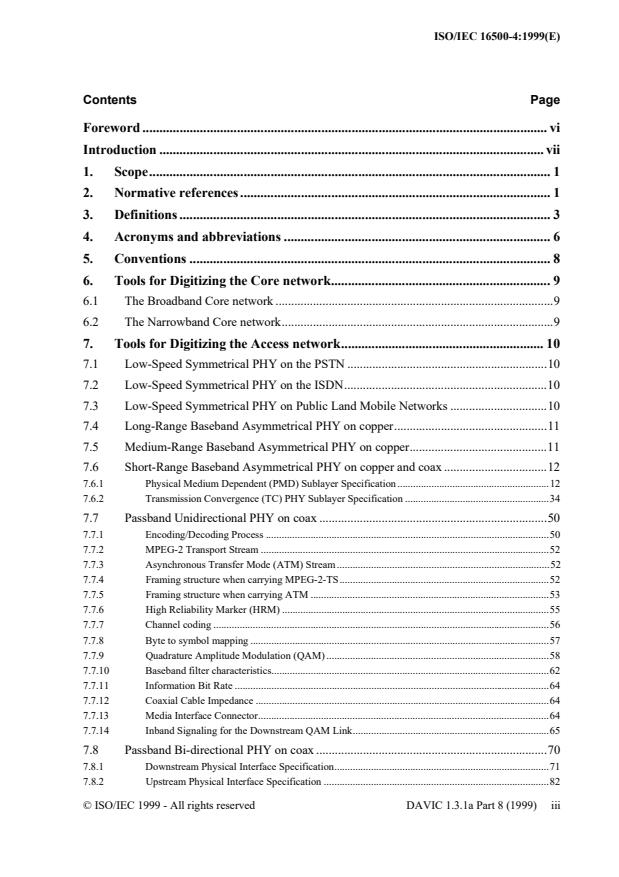
Contents Page
Foreword .vi
Introduction . vii
1. Scope. 1
2. Normative references . 1
3. Definitions . 3
4. Acronyms and abbreviations . 6
5. Conventions . 8
6. Tools for Digitizing the Core network. 9
6.1 The Broadband Core network .9
6.2 The Narrowband Core network.9
7. Tools for Digitizing the Access network. 10
7.1 Low-Speed Symmetrical PHY on the PSTN .10
7.2 Low-Speed Symmetrical PHY on the ISDN.10
7.3 Low-Speed Symmetrical PHY on Public Land Mobile Networks .10
7.4 Long-Range Baseband Asymmetrical PHY on copper.11
7.5 Medium-Range Baseband Asymmetrical PHY on copper.11
7.6 Short-Range Baseband Asymmetrical PHY on copper and coax .12
7.6.1 Physical Medium Dependent (PMD) Sublayer Specification .12
7.6.2 Transmission Convergence (TC) PHY Sublayer Specification .34
7.7 Passband Unidirectional PHY on coax .50
7.7.1 Encoding/Decoding Process .50
7.7.2 MPEG-2 Transport Stream .52
7.7.3 Asynchronous Transfer Mode (ATM) Stream .52
7.7.4 Framing structure when carrying MPEG-2-TS.52
7.7.5 Framing structure when carrying ATM .53
7.7.6 High Reliability Marker (HRM) .55
7.7.7 Channel coding .56
7.7.8 Byte to symbol mapping .57
7.7.9 Quadrature Amplitude Modulation (QAM) .58
7.7.10 Baseband filter characteristics.62
7.7.11 Information Bit Rate .64
7.7.12 Coaxial Cable Impedance .64
7.7.13 Media Interface Connector.64
7.7.14 Inband Signaling for the Downstream QAM Link.65
7.8 Passband Bi-directional PHY on coax .70
7.8.1 Downstream Physical Interface Specification.71
7.8.2 Upstream Physical Interface Specification .82
© ISO/IEC 1999 - All rights reserved DAVIC 1.3.1a Part 8 (1999) iii
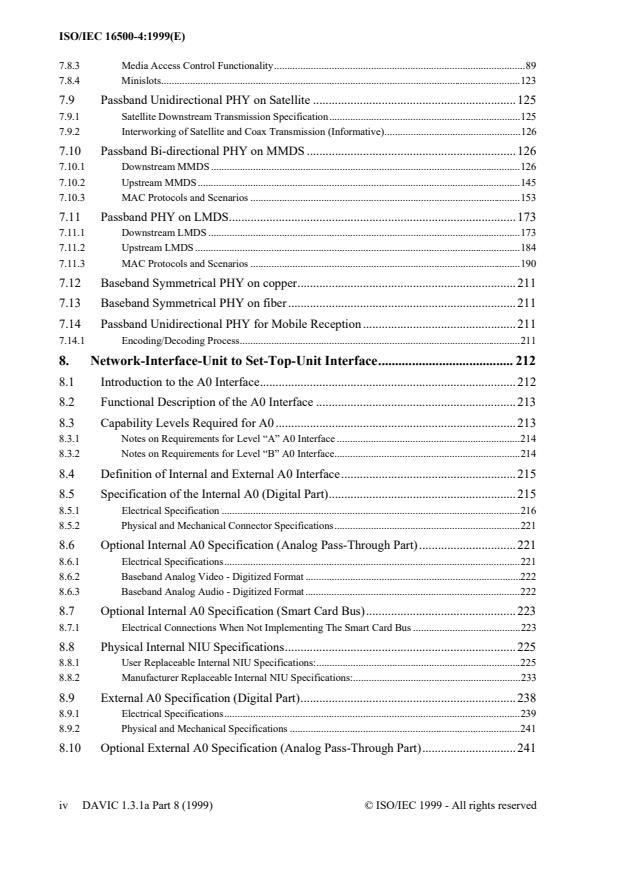
7.8.3 Media Access Control Functionality.89
7.8.4 Minislots.123
7.9 Passband Unidirectional PHY on Satellite .125
7.9.1 Satellite Downstream Transmission Specification.125
7.9.2 Interworking of Satellite and Coax Transmission (Informative).126
7.10 Passband Bi-directional PHY on MMDS .126
7.10.1 Downstream MMDS .126
7.10.2 Upstream MMDS.145
7.10.3 MAC Protocols and Scenarios .153
7.11 Passband PHY on LMDS.173
7.11.1 Downstream LMDS .173
7.11.2 Upstream LMDS .184
7.11.3 MAC Protocols and Scenarios .190
7.12 Baseband Symmetrical PHY on copper.211
7.13 Baseband Symmetrical PHY on fiber.211
7.14 Passband Unidirectional PHY for Mobile Reception .211
7.14.1 Encoding/Decoding Process.211
8. Network-Interface-Unit to Set-Top-Unit Interface. 212
8.1 Introduction to the A0 Interface. 212
8.2 Functional Description of the A0 Interface . 213
8.3 Capability Levels Required for A0.213
8.3.1 Notes on Requirements for Level “A” A0 Interface .214
8.3.2 Notes on Requirements for Level “B” A0 Interface.214
8.4 Definition of Internal and External A0 Interface.215
8.5 Specification of the Internal A0 (Digital Part).215
8.5.1 Electrical Specification .216
8.5.2 Physical and Mechanical Connector Specifications.221
8.6 Optional Internal A0 Specification (Analog Pass-Through Part).221
8.6.1 Electrical Specifications.221
8.6.2 Baseband Analog Video - Digitized Format .222
8.6.3 Baseband Analog Audio - Digitized Format.222
8.7 Optional Internal A0 Specification (Smart Card Bus).223
8.7.1 Electrical Connections When Not Implementing The Smart Card Bus .223
8.8 Physical Internal NIU Specifications. 225
8.8.1 User Replaceable Internal NIU Specifications:.225
8.8.2 Manufacturer Replaceable Internal NIU Specifications:.233
8.9 External A0 Specification (Digital Part).238
8.9.1 Electrical Specifications.239
8.9.2 Physical and Mechanical Specifications .241
8.10 Optional External A0 Specification (Analog Pass-Through Part).241
iv DAVIC 1.3.1a Part 8 (1999) © ISO/IEC 1999 - All rights reserved
9. STU Dataport Interface. 241
9.1 Overview of the STU Dataport .241
9.2 STU Multimedia Dataport.241
9.2.1 Physical Specification (PMD).242
9.2.2 Electrical Specification (PHY).242
9.2.3 Transmission Convergence Layer Specification (TC) .242
9.3 STU PC Dataport - INFORMATIVE Specification. .242
9.3.1 Physical Specification (PMD).242
9.3.2 Electrical Specification (PHY).242
9.3.3 Transmission Convergence Layer Specification (TC) .242
9.4 STU Parallel Dataport - INFORMATIVE Specification .242
10. Tools for digitizing the SPS/SPS core network and SPS internal networks 242
© ISO/IEC 1999 - All rights reserved DAVIC 1.3.1a Part 8 (1999) v
Foreword
ISO (the International Organization for Standardization) and IEC (the International Electrotechnical Commission)
form the specialized system for worldwide standardization. National bodies that are members of ISO or IEC
participate in the development of International Standards through technical committees established by the
respective organization to deal with particular fields of technical activity. ISO and IEC technical committees
collaborate in fields of mutual interest. Other international organizations, governmental and non-governmental, in
liaison with ISO and IEC, also take part in the work.
International Standards are drafted in accordance with the rules given in the ISO/IEC Directives, Part 3.
In the field of information technology, ISO and IEC have established a joint technical committee, ISO/IEC JTC 1.
Draft International Standards adopted by the joint technical committee are circulated to national bodies for voting.
Publication as an International Standard requires approval by at least 75 % of the national bodies casting a vote.
Attention is drawn to the possibility that some of the elements of this part of ISO/IEC 16500 may be the subject of
patent rights. ISO and IEC shall not be held responsible for identifying any or all such patent rights.
International Standard ISO/IEC 16500-4 was prepared by DAVIC (Digital Audio-Visual Council) and was adopted,
under the PAS procedure, by Joint Technical Committee ISO/IEC JTC 1, Information technology, in parallel with its
approval by national bodies of ISO and IEC.
ISO/IEC 16500 consists of the following parts, under the general title Information technology — Generic digital
audio-visual systems:
� Part 1: System reference models and scenarios
� Part 2: System dynamics, scenarios and protocol requirements
� Part 3: Contours: Technology domain
� Part 4: Lower-layer protocols and physical interfaces
� Part 5: High and mid-layer protocols
� Part 6: Information representation
� Part 7: Basic security tools
� Part 8: Management architecture and protocols
� Part 9: Usage information protocols
vi DAVIC 1.3.1a Part 8 (1999) © ISO/IEC 1999 - All rights reserved
Introduction
ISO/IEC 16500 defines the minimum tools and dynamic behavior required by digital audio-visual systems for
end-to-end interoperability across countries, applications and services. To achieve this interoperability, it defines
the technologies and information flows to be used within and between the major components of generic digital
audio-visual systems. Interoperability between these components and between individual sub-systems is assured
through specification of tools and specification of dynamic systems behavior at defined reference points. A
reference point can comprise one or more logical (non-physical) information-transfer interfaces, and one or more
physical signal-transfer interfaces. A logical interface is defined by a set of information flows and associated
protocol stacks. A physical interface is an external interface and is fully defined by its physical and electrical
characteristics. Accessible reference points are used to determine and demonstrate compliance of a digital audio-
visual subsystem with this international standard.
A summary of each part follows.
ISO/IEC 16500-1 (DAVIC 1.3.1a Part 2) defines the normative digital audio-visual systems technical framework.
It provides a vocabulary and a Systems Reference Model, which identifies specific functional blocks and
information flows, interfaces and reference points.
ISO/IEC 16500-2 (DAVIC 1.3.1a Part 12) defines system dynamic behavior and physical scenarios. It details the
locations of the control functional entities along with the normative protocols needed to support the systems
behavior. It is structured as a set of protocol walk-throughs, or “Application Notes”, that rehearse both the steady
state and dynamic operation of the system at relevant reference points using specified protocols. Detailed
dynamics are given for the following scenarios: video on demand, switched video broadcast, interactive broadcast,
and internet access.
ISO/IEC 16500-3 (DAVIC 1.3.1a Part 14) provides the normative definition of DAVIC Technology Contours.
These are strict sets of Applications, Functionalities and Technologies which allow compliance and conformance
criteria to be easily specified and assessed. This part of ISO/IEC 16500 contains the full details of two contours.
These are the Enhanced Digital Broadcast (EDB) and Interactive Digital Broadcast (IDB). ISO/IEC 16500-3
specifies required technologies and is a mandatory compliance document for contour implementations.
ISO/IEC 16500-4 (DAVIC 1.3.1a Part 8) defines the toolbox of technologies used for lower layer protocols and
physical interfaces. The tools specified are those required to digitize signals and information in the Core Network
and in the Access Network. Each tool is applicable at one or more of the reference points specified within the
Delivery System. In addition a detailed specification is provided of the physical interfaces between the Network
Interface Unit and the Set Top Unit and of the physical interfaces used to connect Set Top Boxes to various
peripheral devices (digital video recorder, PC, printer). The physical Delivery System mechanisms included are
copper pairs, coaxial cable, fiber, HFC, MMDS, LMDS, satellite and terrestrial broadcasting.
ISO/IEC 16500-5 (DAVIC 1.3.1a Part 7) defines the technologies used for high and mid-layer protocols for
ISO/IEC 16500 digital audio-visual systems. In particular, this part defines the specific protocol stacks and
requirements on protocols at specific interfaces for the content, control and management information flows.
ISO/IEC 16500-6 (DAVIC 1.3.1a Part 9) defines what the user will eventually see and hear and with what quality.
It specifies the way in which monomedia and multimedia information types are coded and exchanged. This
includes the definition of a virtual machine and a set of APIs to support interoperable exchange of program code.
Interoperability of applications is achieved, without specifying the internal design of a set top unit, by a normative
Reference Decoder Model which defines specific memory and behavior constraints for content decoding. Separate
profiles are defined for different sets of multimedia components.
ISO/IEC 16500-7 (DAVIC 1.3.1a Part 10) defines the interfaces and the security tools required for an
ISO/IEC 16500 system implementing security profiles. These tools include security protocols which operate
across one or both of the defined conditional access interfaces CA0 and CA1. The interface CA0 is to all security
and conditional access functions, including the high speed descrambling functions. The interface CA1 is to a
tamper resistant device used for low speed cryptographic processing. This cryptographic processing function is
implemented in a smart card.
ISO/IEC 16500-8 (DAVIC 1.3.1a Part 6) specifies the information model used for managing ISO/IEC 16500
systems. In particular, this part defines the managed object classes and their associated characteristics for
managing the access network and service-related data in the Delivery System. Where these definitions are taken
from existing standards, full reference to the required standards is provided. Otherwise a full description is
integrated in the text of this part. Usage-related information model is defined in ISO/IEC 16500-9.
© ISO/IEC 1999 - All rights reserved DAVIC 1.3.1a Part 8 (1999) vii
ISO/IEC 16500-9 (DAVIC 1.3.1a Part 11) specifies the interface requirements and defines the formats for the
collection of usage data used for billing, and other business-related operations such as customer profile
maintenance. It also specifies the protocols for the transfer of Usage Information into and out of the
ISO/IEC 16500 digital audio-visual system. In summary, flows of audio, video and audio-visual works are
monitored at defined usage data collection elements (e.g. servers, elements of the Delivery System, set-top boxes).
Information concerning these flows is then collected, processed and passed to external systems such as billing or a
rights administration society via a standardised usage data transfer interface.
Additional Information
ISO/IEC TR 16501 is an accompanying Technical Report. Further architectural and conformance information is
provided in other non-normative parts of DAVIC 1.3.1a (1999). A summary of these documents is included here
for information.
ISO/IEC TR 16501 (DAVIC 1.3.1a Part 1) provides a detailed listing of the functionalities required by users and
providers of digital audio-visual applications and systems. It introduces the concept of a contour and defines the
IDB (Interactive Digital Broadcast) and EDB (Enhanced Digital Broadcast) functionality requirements which are
used to define the normative contour technology toolsets provided in ISO/IEC 16500-3.
DAVIC 1.3.1a Parts 3, 4 and 5 are DAVIC technical reports. They provide additional architectural and other
information for the server, the delivery-system, and the Service Consumer systems respectively. Part 3 defines
how to load an application, once created, onto a server and gives information and guidance on the protocols
transmitted from the set-top user to the server, and those used to control the set-up and execution of a selected
application. Part 4 provides an overview of Delivery Systems and describes instances of specific DAVIC
networked service architectures. These include physical and wireless networks. Non-networked delivery (e.g.
local storage physical media like discs, tapes and CD-ROMs) are not specified. Part 5 provides a Service
Consumer systems architecture and a description of the DAVIC Set Top reference points defined elsewhere in the
normative parts of the specification.
DAVIC 1.3.1a Part 13 is a DAVIC technical report, which provides guidelines on how to validate the systems,
technology tools and protocols through conformance and / or interoperability testing.
viii DAVIC 1.3.1a Part 8 (1999) © ISO/IEC 1999 - All rights reserved
INTERNATIONAL STANDARD ©ISO/IEC ISO/IEC 16500-4:1999(E)
Information technology — Generic digital audio-visual systems —
Part 4: Lower layer protocols and physical interfaces
1. Scope
This part of ISO/IEC 16500 provides a toolbox consisting of lower layer protocols and physical interfaces. Each
tool is applicable at one or more of the reference points within the delivery system. The physical delivery media
that have been identified for this version of ISO/IEC 16500-4 are copper pairs, coaxial cable, microwave, fiber
and satellite. Removable information carrying physical media (e.g. optical discs and tapes) are not covered. The
tools listed address the three parts of the delivery system, namely, the core network, the access network and the
access-network-independent interface to the Set Top Unit (STU). Tools are also identified for the STU dataport
interface and for a service provider system (SPS) internal network and an SPS/SPS core network.
Clause 6 specifies in detail the tools provided to digitize the physical media in the core network. In the case of a
broadband core network, all these tools support high speed ATM transport. Clause 7 specifies in detail the tools
provided to digitize the physical media in the access network (copper pairs, coax, satellite, microwave, fiber). All
these tools support high speed MPEG-2-TS transport and/or high speed ATM transport. Clause 8 concerns the
access-network-independent interface to the STU and provides a detailed specification of the physical interfaces
between the network interface unit (NIU) and the STU. This physical interface can be internal or external to the
Set Top Box (STB) and is independent from the physical interface used in the access network. It supports the
transport of MPEG-2-TS and ATM between NIU and STU. Clause 9 concerns the STU dataport interface and
specifies the physical interfaces used to connect an STB to various peripheral devices. It defines normative STU
multimedia dataport tools and interfaces and also includes informative specifications for both PC and parallel
dataports. These interfaces support the transport of MPEG-2-TS or IP. Clause 10 defines the physical interfaces
for interconnections between cascaded SPS entities with or without an intervening core network and the physical
interfaces for networks used to connect various hosts within an SPS.
2. Normative references
The following normative documents contain provisions which, through reference in this text, constitute provisions
of this part of ISO/IEC 16500. For dated references, subsequent amendments to, or revisions of, any of these
publications do not apply. However, parties to agreements based on this part of ISO/IEC 16500 are encouraged to
investigate the possibility of applying the most recent editions of the standards indicated below. For undated
references, the latest edition of the normative document referred to applies. Members of ISO and IEC maintain
registers of currently valid International Standards. The Telecommunication Standardization Bureau (TSB)
maintains a list of currently valid ITU-T Recommendations.
2.1 IEC, ISO, ISO/IEC and ITU-T normative references
IEC 60801–4:1988 Electromagnetic compatibility for industrial process measurement and control equipment.
Part 4: Electrical fast transient/burst requirements
IEC 61883-1:1998, Consumer audio/video equipment – Digital interface – Part 1: General.
IEC 61883-4:1998, Consumer audio/video equipment – Digital interface – Part 4: MPEG-2 TS data transmission.
ISO/IEC 7816-3:1989, Identification cards – Integrated circuit(s) cards with contacts – Part 3: Electronic signals
and transmission protocols.
ISO/IEC 8802-3:1996, Information technology - Telecommunications and information exchange between systems –
Local and metropolitan area networks – Specific requirements – Part3: Carrier sense multiple access with
collision detection (CSMA/CD) access method and physical layer specifications.
ISO/IEC 8877: 1987, Information technology – Telecommunications and information exchange between systems –
Interface connector and contact assignments for ISDN Basic Access Interface located at reference points S
and T.
ISO/IEC 11801:1995, Generic cabling for customer premises, standards for generic cabling for information
technology.
ISO/IEC 13818-1:1996, Information technology – Generic coding of moving pictures and associated audio
information: Systems
© ISO/IEC 1999 - All rights reserved DAVIC 1.3.1a Part 8 (1999) 1
ISO/IEC 13818-9:1996, Extension for real-time interface for systems decoders.
ITU General Secretariat, Radio Regulations (1990), Volume 1, Article 8, Frequency Allocations Chapter RR8.
ITU-R Recommendation 656. Recommendations of the ITU-R (formerly CCIR), 1990 -- CCIR 656, Part I.
ITU-T Recommendation G.117 [Blue Book], Transmission aspects of unbalance about earth (definitions and
methods), version CCITT PA 1988, published March 1990.
ITU-T Recommendation G.652 [Rev. 1], Characteristics of a single-mode optical fiber cable, version WTSC
1993, published February 1994.
ITU-T Recommendation G.704 [Rev. 2], Synchronous frame structures used at levels of 1544, 6312, 2048, 8448
and 44736 kbit/s, July 95.
ITU-T Recommendation G.707 [Rev. 2], Synchronous digital hierarchy bit rates, version WTSC 1993, published
August 1993.
ITU-T Recommendation G.708, [Rev. 2], Network node interface for synchronous digital hierarchy, version
WTSC 1993, published November 1993.
ITU-T Recommendation G.709 [Rev. 2], Digital transmission systems - Terminal Equipment - General, version
WTSC 1993, published December 1993.
ITU-T Recommendation G.804 [New], ATM cell mapping into plesiochronous digital hierarchy (PDH), version
November 1993, published October 1994.
ITU-T Recommendation G.832 (11/1995), Transport of SDH elements on PDH networks: Frame and
multiplexing structures.
ITU-T Recommendation G.957 (07/1995), Optical interfaces for equipment and systems relating to the
synchronous digital hierarchy.
ITU-T Recommendation G.981 [New], PDH optical line systems for the local network, version January 1994,
published November 1994.
ITU-T Recommendation I.361 (11/1995), B-ISDN ATM layer specification.
ITU-T Recommendation I.363.5 (08/1996), B-ISDN ATM adaptation layer (AAL) specification: Type 5 AAL.
ITU-T Recommendation I.413 [Rev. 1], B-ISDN user-network interface, version WTSC 1993, published
December 1993.
ITU-T Recommendation I.430 [Rev. 1], Basic user-network interface - Layer 1 specification, version WTSC
1993, published March 1994.
ITU-T Recommendation I.432 [Rev. 1], B-ISDN user-network interface - Physical layer specification, version
WTSC 1993, published January 1994.
ITU-T Recommendation O.9 [Blue Book], Measuring arrangements to assess the degree of unbalance about
earth, version CCITT PA 1988, published July 1990.
ITU-T Recommendation V.22 [Blue Book], 1200 bits per second duplex modem standardized for use on the
general switched telephone network and on point-to-point 2-wire leased telephone-type circuits, version
CCITT PA 1988, published November 1989.
ITU-T Recommendation V.22 bis [Blue Book], 2400 bits per second duplex modem using the frequency division
technique standardized for use on the general switched telephone network and on point-to-point 2-wire leased
telephone-type circuits, version CCITT PA 1988, published November 1989.
ITU-T Recommendation V.32 [Rev.1], A family of 2-wire, duplex modems operating at data signaling rates of up
to 9600 bit/s for use on the general switched telephone network and on leased telephone-type circuits, version
WTSC 1993, published January 1994.
ITU-T Recommendation V.32 bis [New], A duplex modem operating at data signaling rates of up to 14400 bit/s
for use on a general switched telephone network and on leased point-to-point 2-wire telephone-type circuits,
version February 1991, published May 1991.
ITU-T Recommendation V.34 [New], A modem operating at data signaling rates of up to 28800 bit/s for use on
the general switched telephone network and on leased point-to-point 2-wire telephone-type circuits, version
September 1994, published December 1994.
2.2 Other normative references
1394 Trade Association, Specification for AV/C Digital Interface Command Set, September 13, 1996. Figure 5-1.
ADSL Forum TR-002, ATM over ADSL Recommendations, March 1997 http://www.adsl.com/adsl_atm.html.
Scope Note: Sections B.2, 3 (except only a single latency path shall be implemented, see 3.2), 4, 6.2, and 7.
ANSI Standard T1.105, SONET Basic Description including Multiplex Structure, Rate and Formats.
ANSI Standard T1.105.01, SONET Automatic Protection Switching.
ANSI Standard T1.105.02, SONET Payload Mappings.
ANSI Standard T1.105.03, SONET Jitter and Network Interfaces.
ANSI Standard T1.105.04, SONET Data Communication Channel Protocols and Architectures.
ANSI Standard T1.105.05, SONET Tandem Connection Maintenance.
2 DAVIC 1.3.1a Part 8 (1999) © ISO/IEC 1999 - All rights reserved
ANSI Standard T1.105.06, SONET Physical Layer Specification.
ANSI Standard T1.105.07, SONET Sub STS-1 Interface Rates and Formats Specifications.
ANSI Standard T1.105.08, SONET Directory Service for TMN and SONET.
ANSI Standard T1.105.09, SONET Timing and Synchronization.
ANSI Standard T1.413, Network and customer installation interfaces - Asymmetrical Digital Subscriber Line
(ADSL) Metallic Interface, version March 95.
ATM Forum, Physical Interface Specification for 25.6 Mbit/s over Twisted Pair Cable, November 1995.
ATM Forum, UTOPIA: an ATM-PHY Interface Specification, Level 1, Version 2.01 March 21,1994.
Bellcore document GR-253 [Issue 02], Set: Synchronous Optical Network (SONET) Transport; Systems: Common
Generic Criteria. December 1995.
CENELEC EN 50083-9, Cabled distribution systems for television, sound and interactive multimedia signals.
Part 9: Interfaces for CATV/SMATV headends and similar professional equipment for DVB/MPEG-2
transport streams. March 1997.
DIN Specification 41612-5, Test Specification, October 1987.
ETSI specification ETS 300 421, Digital broadcasting systems for television, sound and data services; Framing
structure, channel coding and modulation for 11/12 GHz satellite services, version December 1994.
ETSI Technical Report 328 on ADSL, edition 1, December 1996.
IEEE Standard 1284-1994, Signaling Method for a Bidirectional Parallel Peripheral Interface for Personal
Computers (ISBN 1-55937-427-6) [SH17335-NXG] (Note: optional in ISO/IEC 16500- see Subclause 9.4
below)
IEEE Standard 1394-1995, IEEE Standard for a High Performance Serial Bus.
Philips Semiconductor Specification, The I C-bus and how to use it (including specifications), 1995 Update,
released April 1995, by Philips Semiconductor. Document number 9398-393-40011.
3. Definitions
This clause defines new terms, and the intended meaning of certain common terms, used in this part of
ISO/IEC 16500. Annex A of ISO/IEC 16500-1 defines additional terms and, in some cases, alternative
interpretations that are appropriate in other contexts. For convenience, the normative definitions below are
included in the annex.
3.1. Access network (AN): a part of the Delivery system consisting of a collection of equipment and
infrastructures, that link a number of Service Consumer Systems to the rest of the Delivery system through a
single (or a limited number of) common port(s).
3.2. Access node: The element of the Access network containing centralized functions responsible for
processing information flows in preparation for transport through the selected distribution network.
3.3. block: a part of a system or parent block that is the container for one or more processes of one block
substructure. A block is a scope unit and provides a static interface. When used by itself, block is a synonym for
block instance.
3.4. cable modem: a device that interfaces between an A4 reference point and an Hybrid Fiber Coax plant, or
between an A0 reference point and that plant, such that the whole comprises a physical layer tool.
3.5. channel: a connection conveying signals between two blocks (the conveyed signals represent
information). Channels also convey signals between a block and the environment. Channels may be unidirectional
or bi-directional.
3.6. client: a service consuming object or system (block); ( a synonym for user).
3.7. connect: indicates the connection of a channel to one or more signal routes or the interconnection of
signal routes.
3.8. connection: an association of transmission channels or circuits, switching and other functional units set
up to provide a means for a transfer of user, control and management information between two or more end points
(blocks) in a telecommunications network.
3.9. connection service: provides basic functions to create, maintain, and tear down connections.
3.10. Control Plane (CP): a classification for objects that interact to establish, maintain, and release resources
and provide session, transport, and connection control functions that facilitate transparent information transfers
between ISP clients.
© ISO/IEC 1999 - All rights reserved DAVIC 1.3.1a Part 8 (1999) 3
3.11. Core network: a portion of the Delivery system composed of networks, systems, equipment and
infrastructures, connecting the Service providers to the Access networks.
NOTE: The term Core network, in the DAVIC use, is wide sense as it includes the notion of the access networks
that are needed to link the Service providers Systems to the core network in strict sense (i.e., exclusive of any
access network). This kind of access networks are not under consideration within DAVIC.
3.12. Delivery system (DS): The portion of the DAVIC System that enables the transfer of information
between DS-users.
3.13. Distribution network: a collection of equipment and infrastructures that delivers information flows
from the Access node to the Network termination elements of the Access network.
3.14. downstream: information flow direction is from an End Service provider System to an End Service
Consumer System.
3.15. End-Service Consumer (ESC): a user, either human or machine, whose primary interaction with the
system is through the STU.
3.16. End-Service Consumer System (ESCS): A system that (predominantly) consumes information. ESCSs
are ISPS and ESPS clients. The ESCS includes the STU and the ESC.
3.17. End-Service provider (ESP): an entity with jurisdiction over a domain that contains a system that
(predominantly) provides information to clients.
3.18. End-Service provider System (ESPS): a system that (predominantly) provides information to clients.
ESPSs are ISP clients and may also be clients of other ESPSs. ESPSs consists of hardware and software sub-
systems that use ISP services to provide video and multimedia services to ESCSs.
3.19. error: An error occurs during the interpretation of a valid specification of a system when one of the
dynamic conditions of SDL is violated. Once an error has occurred, the subsequent behavior of the system is not
defined.
3.20. interface: a point of demarcation between two blocks through which information flows from one block
to the other. See logical and Physical Interface definitions for further details. A DAVIC interface may be physical-
interface or a logical-interface.
3.21. interface definition: Interface definitions are the detailed physical definitions used to define the method
of interaction between system entities. These definitions are provided for the various reference points. A finite set
of interfaces may exist at each particular reference point.
3.22. Intermediate-Service provider (ISP): ISPs provide adjunct services and convey information among
ESPs and ESCs.
3.23. layer: a collection of objects of the same hierarchical rank
3.24. logical information flow path: a sequence of information transfers from an initial information source
object to a terminal information destination object either directly or through intermediate objects; different
physical information may be associated with a logical information flow path segment or with the entire path in
different implementations.
3.25. logical interface: an interface where the semantic, syntactic, and symbolic attributes of information
flows is defined. Logical interfaces do not define the physical properties of signals used to represent the
information. A logical interface can be an internal or external interface. It is defined by a set of information flows
and associated protocol stacks.
3.26. Management Plane (MP): a plane that contains those interfaces and functions which support
interactions which may be typified as being temporally disjoint from an off-hook interaction. Interactions among
Management Plane objects may also occur concurrently with an off-hook interaction.
3.27. management-information: information exchanged by Management Plane objects; may be content-
information or control-information.
3.28. network: a collection of interconnected elements that provides connection services to users
3.29. network control function: The Network Control Function is responsible for the error-free receipt and
transmission of content flow information to and from the Server.
4 DAVIC 1.3.1a Part 8 (1999) © ISO/IEC 1999 - All rights reserved
3.30. Network Interface Unit (NIU): The NIU accepts network specific content-information flows from the
Delivery system and provides a non-network specific interface to the Connectivity Entity in the STU. (additional
definitions of the NIU may exist).
3.31. Network Related Control: The Network Related Control entity provides control functions for network
configuration, connection establishment and termination and information routing in a network instance of a
Delivery system.
3.32. Network termination (NT): the element of the Access network performing the connection between the
infrastructure owned by the Access network operator and the Service Consumer System (ownership decoupling).
The NT can be passive or active, transparent or not.
3.33. physical information flow path: a channel or a sequence of channels that constitutes a real or virtual
connection between an information source object and an information destination object.
3.34. Physical Interface: An interface where the physical characteristics of signals used to represent
information and the physical characteristics of channels used to carry the signals are defined. A Physical Interface
is an external interface. It is fully defined by its physical and electrical characteristics. Logical information flows
map to signal flows that pass through Physical Interfaces.
3.35. plane: a category that identifies a collection of related objects, e.g., objects that execute similar or
complementary functions; or peer objects that interact to use or to provide services in a class that reflects
authority, capability, or time period. Management-plane service objects, for example, may authorize ISP-clients'
access to certain control-plane service objects that in turn may allow the clients to use services provided by certain
user-plane objects.
3.36. process: a communicating extended finite state machine. Communication can take place via signals or
shared variables. The behavior of a process depends on the order of arrival of signals in its input port
3.37. process instance: an instance of a process created at system creation time or dynamically as a result of a
create [request].
3.38. protocol: set of message formats (semantic, syntactic, and symbolic rules) and the rules for message
exchange between peer layer entities (which messages are valid when)
3.39. randomization: the process of removing auto-correlation from a signal, i.e. white noise spectrum
shaping at the transmitter side to ease symbol or bit timing recovery at the receiver side.
3.40. reference point: a set of interfaces between any two related blocks through which information flows
from one block to the other. A reference point comprises one or more logical (non-physical) information-transfer
interfaces, and one or more physical signal-transfer interfaces.
3.41. S1: content-information flow, from a source to a destination object on the User plane of any service
layer.
3.42. S2: control-information flow from a source to a destination object on the Control Plane of the
Application Service Layer (SL1).
3.43. S3: control-information flow from a source to a destination object on the Control Plane of the Session
and Transport Service Layer (SL2).
3.44. S4: control-information flow from a source to a destination object on the Control Plane of the Network
Service Layer (SL3).
3.45. S5: management-information flow from a source to a destination object on the Management Plane of the
container obje
...