


ISO 19847:2018
(Main)Ships and marine technology — Shipboard data servers to share field data at sea
Ships and marine technology — Shipboard data servers to share field data at sea
This document specifies requirements for the shipboard data server that is used to collect data from other shipboard machinery and systems and to further share the collected data in a safe and efficient manner. This document specifies communication protocols with reference to the data structure of ISO 19848.
Navires et technologie maritime — Serveurs de données embarqués pour partager les données de terrain en mer
General Information
- Status
- Withdrawn
- Publication Date
- 04-Oct-2018
- Technical Committee
- ISO/TC 8/SC 6 - Navigation and ship operations
- Drafting Committee
- ISO/TC 8/SC 6/WG 16 - Ship Communication Network Systems
- Current Stage
- 9599 - Withdrawal of International Standard
- Start Date
- 01-Feb-2024
- Completion Date
- 12-Feb-2026
Relations
- Revised
ISO 19847:2024 - Ships and marine technology — Shipboard data servers for sharing field data at sea - Effective Date
- 23-Apr-2020


Get Certified
Connect with accredited certification bodies for this standard

DNV
DNV is an independent assurance and risk management provider.

Lloyd's Register
Lloyd's Register is a global professional services organisation specialising in engineering and technology.

ABS Quality Evaluations Inc.
American Bureau of Shipping quality certification.
Sponsored listings
Frequently Asked Questions
ISO 19847:2018 is a standard published by the International Organization for Standardization (ISO). Its full title is "Ships and marine technology — Shipboard data servers to share field data at sea". This standard covers: This document specifies requirements for the shipboard data server that is used to collect data from other shipboard machinery and systems and to further share the collected data in a safe and efficient manner. This document specifies communication protocols with reference to the data structure of ISO 19848.
This document specifies requirements for the shipboard data server that is used to collect data from other shipboard machinery and systems and to further share the collected data in a safe and efficient manner. This document specifies communication protocols with reference to the data structure of ISO 19848.
ISO 19847:2018 is classified under the following ICS (International Classification for Standards) categories: 47.020.70 - Navigation and control equipment. The ICS classification helps identify the subject area and facilitates finding related standards.
ISO 19847:2018 has the following relationships with other standards: It is inter standard links to ISO 19847:2024. Understanding these relationships helps ensure you are using the most current and applicable version of the standard.
ISO 19847:2018 is available in PDF format for immediate download after purchase. The document can be added to your cart and obtained through the secure checkout process. Digital delivery ensures instant access to the complete standard document.
Standards Content (Sample)
INTERNATIONAL ISO
STANDARD 19847
First edition
2018-10
Ships and marine technology —
Shipboard data servers to share field
data at sea
Navires et technologie maritime — Serveurs de données embarqués
pour partager les données de terrain en mer
Reference number
©
ISO 2018
© ISO 2018
All rights reserved. Unless otherwise specified, or required in the context of its implementation, no part of this publication may
be reproduced or utilized otherwise in any form or by any means, electronic or mechanical, including photocopying, or posting
on the internet or an intranet, without prior written permission. Permission can be requested from either ISO at the address
below or ISO’s member body in the country of the requester.
ISO copyright office
CP 401 • Ch. de Blandonnet 8
CH-1214 Vernier, Geneva
Phone: +41 22 749 01 11
Fax: +41 22 749 09 47
Email: copyright@iso.org
Website: www.iso.org
Published in Switzerland
ii © ISO 2018 – All rights reserved
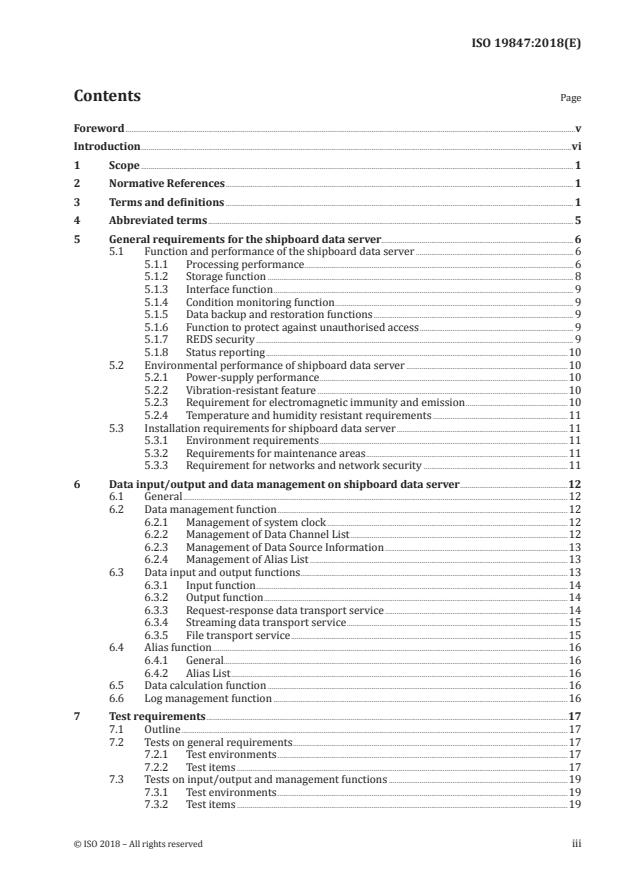
Contents Page
Foreword .v
Introduction .vi
1 Scope . 1
2 Normative References . 1
3 Terms and definitions . 1
4 Abbreviated terms . 5
5 General requirements for the shipboard data server. 6
5.1 Function and performance of the shipboard data server . 6
5.1.1 Processing performance . . 6
5.1.2 Storage function . 8
5.1.3 Interface function . 9
5.1.4 Condition monitoring function . 9
5.1.5 Data backup and restoration functions . 9
5.1.6 Function to protect against unauthorised access . 9
5.1.7 REDS security . 9
5.1.8 Status reporting .10
5.2 Environmental performance of shipboard data server .10
5.2.1 Power-supply performance .10
5.2.2 Vibration-resistant feature .10
5.2.3 Requirement for electromagnetic immunity and emission .10
5.2.4 Temperature and humidity resistant requirements .11
5.3 Installation requirements for shipboard data server .11
5.3.1 Environment requirements .11
5.3.2 Requirements for maintenance areas .11
5.3.3 Requirement for networks and network security .11
6 Data input/output and data management on shipboard data server .12
6.1 General .12
6.2 Data management function .12
6.2.1 Management of system clock .12
6.2.2 Management of Data Channel List .12
6.2.3 Management of Data Source Information .13
6.2.4 Management of Alias List .13
6.3 Data input and output functions .13
6.3.1 Input function .14
6.3.2 Output function .14
6.3.3 Request-response data transport service .14
6.3.4 Streaming data transport service .15
6.3.5 File transport service .15
6.4 Alias function .16
6.4.1 General.16
6.4.2 Alias List .16
6.5 Data calculation function .16
6.6 Log management function .16
7 Test requirements .17
7.1 Outline .17
7.2 Tests on general requirements .17
7.2.1 Test environments .17
7.2.2 Test items .17
7.3 Tests on input/output and management functions .19
7.3.1 Test environments .19
7.3.2 Test items .19
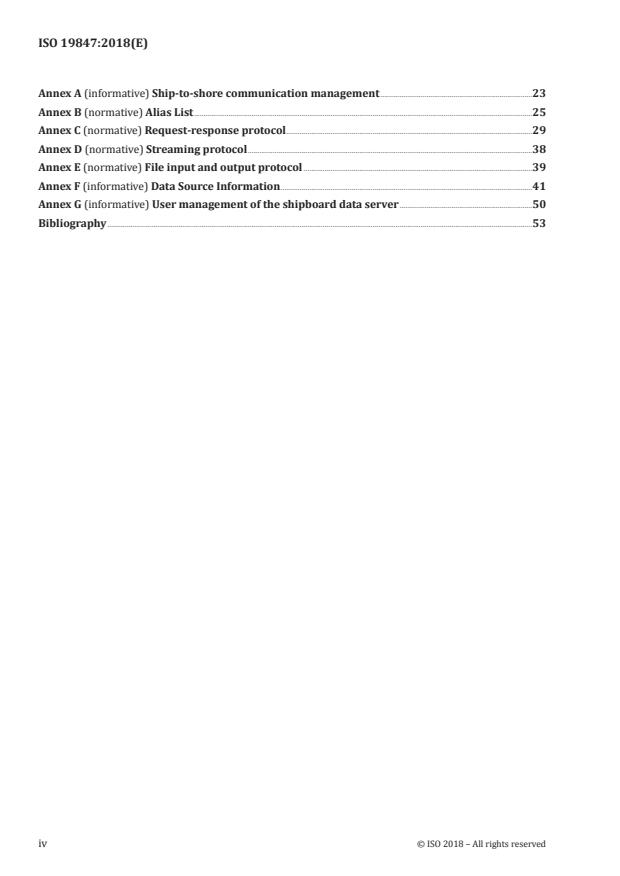
Annex A (informative) Ship-to-shore communication management .23
Annex B (normative) Alias List .25
Annex C (normative) Request-response protocol .29
Annex D (normative) Streaming protocol .38
Annex E (normative) File input and output protocol .39
Annex F (informative) Data Source Information .41
Annex G (informative) User management of the shipboard data server .50
Bibliography .53
iv © ISO 2018 – All rights reserved
Foreword
ISO (the International Organization for Standardization) is a worldwide federation of national standards
bodies (ISO member bodies). The work of preparing International Standards is normally carried out
through ISO technical committees. Each member body interested in a subject for which a technical
committee has been established has the right to be represented on that committee. International
organizations, governmental and non-governmental, in liaison with ISO, also take part in the work.
ISO collaborates closely with the International Electrotechnical Commission (IEC) on all matters of
electrotechnical standardization.
The procedures used to develop this document and those intended for its further maintenance are
described in the ISO/IEC Directives, Part 1. In particular, the different approval criteria needed for the
different types of ISO documents should be noted. This document was drafted in accordance with the
editorial rules of the ISO/IEC Directives, Part 2 (see www .iso .org/directives).
Attention is drawn to the possibility that some of the elements of this document may be the subject of
patent rights. ISO shall not be held responsible for identifying any or all such patent rights. Details of
any patent rights identified during the development of the document will be in the Introduction and/or
on the ISO list of patent declarations received (see www .iso .org/patents).
Any trade name used in this document is information given for the convenience of users and does not
constitute an endorsement.
For an explanation of the voluntary nature of standards, the meaning of ISO specific terms and
expressions related to conformity assessment, as well as information about ISO's adherence to the
World Trade Organization (WTO) principles in the Technical Barriers to Trade (TBT), see www .iso
.org/iso/foreword .html.
This document was prepared by Technical Committee ISO/TC 8, Ships and marine technology,
Subcommittee SC 6, Navigation and ship operations.
Any feedback or questions on this document should be directed to the user’s national standards body. A
complete listing of these bodies can be found at www .iso .org/members .html.
Introduction
Shipboard computer applications for operating ships safely and efficiently are becoming more and more
popular.
These applications need to access data provided by shipboard machinery and equipment.
Navigational instruments may use the IEC 61162 series of standards when exchanging data, but access
to other shipboard machinery and systems to obtain data has not yet been standardised.
For the purpose of sharing field data at sea, including non-standardised machinery data, ISO 19847
specifies requirements for performance, function, service and safety for the shipboard data server that
stores data from shipboard machinery and equipment, and sends stored data off the ship.
The shipboard data server is connected to an information network that is governed by ISO 16425. The
requirements to cyber security of shipboard data server refer to ISO 16425.
vi © ISO 2018 – All rights reserved
INTERNATIONAL STANDARD ISO 19847:2018(E)
Ships and marine technology — Shipboard data servers to
share field data at sea
1 Scope
This document specifies requirements for the shipboard data server that is used to collect data from other
shipboard machinery and systems and to further share the collected data in a safe and efficient manner.
This document specifies communication protocols with reference to the data structure of ISO 19848.
2 Normative References
The following documents are referred to in the text in such a way that some or all of their content
constitutes requirements of this document. For dated references, only the edition cited applies. For
undated references, the latest edition of the referenced document (including any amendments) applies.
ISO 8601, Data elements and interchange formats — Information interchange — Representation of dates
and times
ISO 16425, Ships and marine technology — Guidelines for the installation of ship communication networks
for shipboard equipment and systems
ISO 19848, Ships and marine technology — Standard data for shipboard machinery and equipment
IEC 60092-504:2016, Electrical installations in ships — Part 504: Special features — Control and
instrumentation
IEC 61162-1, Maritime navigation and radiocommunication equipment and systems — Digital interfaces —
Part 1: Single talker and multiple listeners
IEC 61162-450, Maritime navigation and radiocommunication equipment and systems — Digital
interfaces — Part 450: Multiple talkers and multiple listeners — Ethernet interconnection
3 Terms and definitions
For the purposes of this document, the following terms and definitions apply.
ISO and IEC maintain terminological databases for use in standardization at the following addresses:
— IEC Electropedia: available at https: //www .electropedia .org/
— ISO Online browsing platform: available at https: //www .iso .org/obp
3.1
actual recorded data
actual (sensor) data acquired from data providers (3.10) and recorded to the shipboard data server (3.32)
3.2
Alias ID
symbol to refer to one or more Local IDs (3.20) with different names
3.3
Alias List
defined list
3.4
Comma-Separated Value
CSV
method of storing tabular data in plain text in a file where each row of the file forms a data record and
where fields within one data record are separated by a comma character
3.5
Data Channel
virtual channel for data transmission from shipboard machinery and equipment to the shipboard data
server (3.32), defining static properties of data
[SOURCE: ISO 19848:2018, 3.5]
3.6
Data Channel ID
identifier for Data Channel (3.5) that identifies Data Channel universally and on-board a ship
Note 1 to entry: There are three types of Data Channel ID: Universal ID, Local ID (3.20) and Short ID.
[SOURCE: ISO 19848:2018, 3.6]
3.7
Data Channel List
list of definitions for Data Channel (3.5) that define Data Channel ID (3.6) and Data Channel Property
(3.8), and is shared through the shipboard data server (3.32)
[SOURCE: ISO 19848:2018, 3.7]
3.8
Data Channel Property
attributes of Data Channel (3.5), such as units, ranges and others
[SOURCE: ISO 19848:2018, 3.8]
3.9
Data Channel Type
identification of the types of Data Channels (3.5), such as row numeric value, average value, alarms
and status
Note 1 to entry: See ISO 19848:2018, 5.3 a).
3.10
data provider
equipment that provides (sends) data to the shipboard data server (3.32) and has interfaces for
providing data
3.11
Data Source Information
definition of communication protocols and formats in which a data provider (3.10) sends data
3.12
data sample
one measurement datum that has one timestamp
3.13
Extensible Markup Language
XML
text-based data description language used for exchanging data on the Internet
2 © ISO 2018 – All rights reserved
3.14
File Transfer Protocol
FTP
protocol for transferring files between a server and clients
3.15
File Transfer Protocol over SSL/TLS
FTPS
protocol that encrypts data transmitted and received by FTP (3.14) with Secure Sockets Layer (SSL) or
Transport Layer Security (TLS)
3.16
Hypertext Transfer Protocol
HTTP
communication protocol used to exchange HTML(Hyper Text Markup Language) or other contents on
the Internet
Note 1 to entry: See RFC 2616 “Hypertext Transfer Protocol”.
3.17
Hypertext Transfer Protocol over SSL/TLS
HTTPS
protocol in which Web servers and clients encrypt data transmissions
3.18
Java Script Objection Notation
JSON
open and text-based exchange format
Note 1 to entry: Data transmitted in JSON formats make it easy to read and write (for humans), parse and
generate (for computers).
Note 2 to entry: It is similar to XML (3.13).
3.19
Local Data Name
identifier for Data Channels (3.5) that is named in accordance with a Naming Rule (3.23)
Note 1 to entry: The syntax of the identification string shall be disclosed and precisely defined using ABNF.
Note 2 to entry: See ISO 19848:2018, 5.2.2 b).
3.20
Local ID
identification of an on-board Data Channels (3.5) locally, consists of a Naming Rule (3.23) and a Local
Data Name (3.19)
Note 1 to entry: See ISO 19848:2018, 5.2.2.
3.21
management data
catalogues that allow access to and interpretation of recorded data
EXAMPLE Timestamped Data Source Information (3.11), Data Channel List (3.7) and Alias List (3.3).
3.22
MQTT Protocol
machine-to-machine (M2M)/"Internet of Things" connectivity protocol designed as an extremely
lightweight publish/subscribe messaging transport
Note 1 to entry: It is standardised by the Advancing Open Standards for the Information Society (OASIS).
3.23
Naming Rule
sets of requirements that define a naming scheme (or an identification scheme) for components and
systems on-board the ship
Note 1 to entry: See ISO 19848:2018, 5.2.2 a).
3.24
Network File System
NFS
distributed file system and a protocol for distributed file systems defined by RFC 1094, RFC 1813,
RFC 3530 and other protocol specifications
3.25
owner
restrict editors and users by a specifying owner
3.26
Removable External Data Source
REDS
user removable non-network data source
1)
EXAMPLE Compact Disc (CD), USB memory stick, Bluetooth® devices.
[SOURCE: IEC 61162-460:2018, 3.32]
3.27
REST API
program invocation convention for using Web systems from outside, developed in accordance with the
architectural style called REST
Note 1 to entry: Resource operations are designated by HTTP (3.16) sources. Results are sent back in XML (3.13),
JSON (3.18) and other formats.
3.28
Secure File Transfer Protocol
SFTP
protocol that uses the SSH (3.29) protocol to securely transfer files between computers
3.29
Secure Shell
SSH
cryptographic protocol that allows secure communications over an unsecured network
3.30
session
stateful or stateless dialogue established to exchange data between a shipboard data server (3.32) and
shipboard equipment or systems
3.31
Server Message Block
SMB
protocol for sharing files and printers among several Windows computers in networks
3.32
shipboard data server
ship's "information hub" that stores data from shipboard machinery and equipment, shares data at sea
including machine data, and sends stored data outboard
1) Bluetooth® is the trademark of products supplied by Bluetooth Special Interest Group. This information is given
for the convenience of users of this document and does not constitute an endorsement by ISO of these products.
4 © ISO 2018 – All rights reserved
3.33
Syslog
standard for message logging
4 Abbreviated terms
AMS Alarm Monitoring System
CSV Comma-Separated Value
ECDIS Electronic Chart Display and Information System
FTP File Transfer Protocol
FTPS File Transfer Protocol over SSL/TLS
GNSS Global Navigation Satellite System
HTML Hyper Text Markup Language
HTTP Hypertext Transfer Protocol
HTTPS Hypertext Transfer Protocol over SSL/TLS
JSON Java Script Objection Notation
MQTT Message Queuing Telemetry Transport
NFS Network File System
REDS Removable External Data Source
RFC Request for Comments
SFTP Secure File Transfer Protocol
SMB Server Message Block
SSH Secure Shell
SSL Secure Sockets Layer
TLS Transport Layer Security
URI Uniform Resource Identifier
UTC Coordinated Universal Time
VDR Voyage Data Recorder
XML Extensible Markup Language
5 General requirements for the shipboard data server
5.1 Function and performance of the shipboard data server
5.1.1 Processing performance
Manufacturers supplying the shipboard data server shall specify how much data their products can
process. If the product exceeds the amount of data that can be processed, it is necessary to notify the
requesting party by returning the status code, etc.
5.1.1.1 Input data processing performance
The shipboard data server using the request-response transport service shall have a processing
performance to input data for 30 data sample sets at less than one-second from at least five simultaneous
sessions (e.g. VDR, GNSS, alarm and monitoring systems, ballast systems and cargo systems). See
Figure 1.
Figure 1 — Input data processing performance requirement
6 © ISO 2018 – All rights reserved
5.1.1.2 Output data processing performance
The shipboard data server using the request-response transport service shall have a processing
performance to respond within five seconds against read requests for 30 data sample sets from a
database having a maximum size as declared by the manufacturer and simultaneously from at least
five sessions (for example main engine condition monitoring, weather-routing, optimum trim, remote
maintenance and performance analysis). See Figure 2.
The shipboard data server using the File transport service shall have a processing performance to
respond within five seconds against read requests for 30 data sample sets from database having a
maximum size as declared by the manufacturer on at least one session. See Figure 2.
Figure 2 — Output data processing performance requirement
5.1.1.3 Streaming transport processing performance
The shipboard data server using the streaming transport service shall have a processing performance
to input of 150 data sample sets at less than one-second to at least one session.
The shipboard data server using the streaming transport service shall have a processing performance
to output of 150 data sample sets at less than one-second to at least two sessions by 150 input data
sample sets (e.g. condition monitoring and performance analysis system). See Figure 3.
Figure 3 — Streaming transport processing performance requirement
5.1.2 Storage function
The shipboard data server shall be able to store input data, which are defined in 6.3.1, for at least
30 days.
The manufacturer shall give guidance in a user or installation manual on how much storage space is
required per one record. Information about total storage capacity within the ship data sever shall also
be provided.
8 © ISO 2018 – All rights reserved
The shipboard data server shall provide means to assist the user in estimating if the total storage
capacity of the shipboard data server is sufficient for the required time period.
NOTE The shipboard data server can have a redundant function to protect management data and actual
recorded data (e.g., RAID 1, 3 and 5 systems).
5.1.3 Interface function
The shipboard data server shall be able to provide data input and output functions (see 6.3).
The shipboard data server shall have one or more ethernet interfaces where data are transmitted at
100 Mbps or greater.
NOTE The shipboard data server can also have other interfaces capable of serial communications or other
means for input of data.
5.1.4 Condition monitoring function
The shipboard data server shall be able to monitor the status of the following conditions:
a) system failure of shipboard data server processor;
b) failure to access storage device;
c) failure of recording interface;
d) loss of UTC synchronization;
e) storage device full or having insufficient capacity for storing configured records up to 30 days.
The shipboard data server shall be able to report the above statuses to other systems on-board (see
5.1.8) and may provide local indication for the above statuses.
5.1.5 Data backup and restoration functions
The shipboard data server shall have backup and restoration functions for
— management data, and
— actual recorded data.
5.1.6 Function to protect against unauthorised access
The shipboard data server shall have protected settings, management data, actual recorded data and
other items from accidental and/or unauthorised access.
5.1.7 REDS security
5.1.7.1 Physical protection
Unused connection points such as USB ports shall be physically blocked from easy access by a user
without a tool or key.
5.1.7.2 Operational protection
USB connection points intended for keyboards, printers, etc. shall be blocked from easy access to avoid
connection and use of a different device than intended, e.g. by means of a tool or key or by password-
protection (disable/enable) in the device set-up.
Connection points used for access to data storage shall be configured to permit connection only to data
sources identified as USB device class 08h (USB mass storage).
For other operations with other USB device classes and non-USB REDS, the manufacturer shall provide
information about the technology used and how the connection point fulfils the requirement to limit
connection to only data [storage devices] [sources].
5.1.7.3 Executable program file verification
The shipboard data server shall have prohibited all automatic execution from REDS, including auto-run
from USB and CD/DVD. Manual execution of any type of files from REDS shall only be possible after
passing authentication for accessing the executable content of the REDS. Manual execution shall be
possible only for the files which are verified before execution, using digital signature or special keys.
NOTE 1 A digital signature method is based on a private/public key pair. Typically, a hash-function is used, for
example the SHA-2 family. (Use of MD5 and SHA-1 are now discouraged, see ISO/IEC 10118-3.)
NOTE 2 Special keys can be values calculated from the delivered data using a specified function and compared
against a known and expected value, both the function and the value being specified by the trusted source or sender.
5.1.7.4 Non-executable data verification
All unfeasible data in REDS shall be verified using digital signature or a special key before used on the
equipment.
5.1.8 Status reporting
The shipboard data server shall be provided with a status reporting interface. The interface shall as
a minimum consist of one relay contact output capable of signalling normal/abnormal status of the
shipboard data server. The relay contact output may be replaced by other means, as specified by the
manufacturer, which allow ship’s personnel to identify a related failure of the shipboard data server.
NOTE An alternate method to the relay contact output can be based for example on provision of specific
status display at ship data server or on generating priority caution alerts in the shipboard data sever and
reporting the alerts to other systems on-board by employing IEC 61162-1 sentences ACN, ALF, ALC, ARC and HBT.
5.2 Environmental performance of shipboard data server
5.2.1 Power-supply performance
The shipboard data server shall have satisfied the test requirements of the power supply performance
of IEC 60092-504.
Refer to No.4 a), Electric of power supply variations, and No.4 b), Power supply failure, of Table 1 in
IEC 60092-504:2016.
The shipboard data server, management data and actual recorded data shall be protected from damage,
even during temporary loss of electricity.
5.2.2 Vibration-resistant feature
The shipboard data server shall have satisfied the test requirements of the vibration test of
IEC 60092-504.
Refer to No.10, Vibration, of Table 1 in IEC 60092-504:2016.
5.2.3 Requirement for electromagnetic immunity and emission
The shipboard data server shall have satisfied the test requirements of the electromagnetic immunity
tests of IEC 60092-504, refer to IEC 60092-504:2016, Table 1, Tests No. 13,14,15,16 and 17.
10 © ISO 2018 – All rights reserved
The shipboard data server shall have satisfied the test requirements of the electromagnetic emission
tests of IEC 60092-504, refer to IEC 60092-504:2016, Table 1, Tests No. 19 and 20.
5.2.4 Temperature and humidity resistant requirements
The shipboard data server shall have satisfied the following requirements in Table 1 in IEC 60092-
504:2016:
— No.6, Cold with graduate change of temperature;
— No.7, Dry Heat with graduate change of temperature;
— No.8, Damp Heat cyclic.
Where electrical equipment is installed within environmentally controlled spaces, the ambient
temperature for which the equipment is to be suitable may be reduced from 0 °C to 45 °C.
Also according to the temperature conditions, the installation place shall be drawn in the
installation manual.
For the definition of the control space, refer to the following:
— the equipment is not for use for emergency services;
— temperature control is achieved by at least two cooling units arranged, so that in the event of loss
of one cooling unit, for any reason, the remaining unit(s) is capable of satisfactorily maintaining the
design temperature;
— the equipment is able to be initially set to work safely within a 45 °C ambient temperature until such
a time that the lesser ambient temperature may be achieved; the cooling equipment is to be rated for
a 45 °C ambient temperature;
— audible and visual alerts are provided, at a continually manned control station, to indicate any
malfunction of the cooling units.
5.3 Installation requirements for shipboard data server
5.3.1 Environment requirements
The manufacturer shall define the surrounding environment requirements for installing the shipboard
data server in installation manuals.
5.3.2 Requirements for maintenance areas
The manufacturer shall define the work areas that are needed for maintenance, and provide details in
installation manuals.
5.3.3 Requirement for networks and network security
The shipboard data server shall be installed within networks that comply with network security
related requirements given in ISO 16425.
NOTE ISO 16425 sets network security related requirements on
— network system design,
— network interface for shipboard equipment and systems,
— protection from malware, and
— protection from illicit access and Equipment protection.
6 Data input/output and data management on shipboard data server
6.1 General
The shipboard data server shall have the following functions for data input/output and data
management:
a) data management function;
b) data input and output functions;
c) alias function;
d) data calculation function;
e) log management function.
6.2 Data management function
Data management function comprises time stamping of Data Channel List, Data Source Information,
and Alias List based on system clock and administration of management data.
The shipboard data server shall accept change requests in management data only when the requests
are received from authorised sources. See 6.3.
6.2.1 Management of system clock
The system clock of the shipboard data server shall be managed as specified below to add precise
timestamp to the data.
a) The system clock of the shipboard data server shall be synchronised with UTC.
b) Drift in system clock of the shipboard data server shall be no more than one second per hour.
c) To ensure that relative timings are determined within a resolution of 1 s, all data items shall be
recorded with a time index derived from the shipboard data server system clocks with a resolution
of 0,5 s or less.
d) The shipboard data server shall indicate state of loss of UTC synchronization. (See 5.1.4).
NOTE Network time protocol can be used for UTC synchronization of the shipboard data server.
6.2.2 Management of Data Channel List
The shipboard data server shall have a management function of Data Channel List that meets the
following requirements.
a) Data Channel List shall be able to be registered, revised, deleted and referred by data input and
output functions.
b) When Data Channel List is added, updated or deleted, the shipboard data server shall record the
changed information with date and time.
c) The shipboard data server shall be able to clearly indicate the Data Channel List which is currently
used for recording and output of recorded data. This may be done by offering a function for
showing the current Data Channel List to the user or by describing the information in the user or
installation manual.
d) The shipboard data server shall require proper authentication before allowing management or
alteration of the Data Channel List.
12 © ISO 2018 – All rights reserved
6.2.3 Management of Data Source Information
The shipboard data server shall have a management function of Data Source Information that meets the
following requirements.
Refer to Annex F for Data Source Information.
a) Data Source Information shall be able to be added, updated and deleted by data input functions.
b) When Data Source Information is added, updated or deleted, the shipboard data server shall record
the changed information with date and time.
c) The shipboard data server may be able to indicate what Data Sources are currently configured for
the recording of data. This may be done by offering a function for showing the current Data Source
configuration list to the user or by describing the information in the user or installation manual.
6.2.4 Management of Alias List
The shipboard data server shall have a management function of Alias List that meets the following
requirements.
Refer to 6.4 for Alias function and to Annex B for Alias List.
a) Alias List shall be able to be registered, revised, deleted and referred by data input and output
functions.
b) When Alias List is added, updated or deleted, the shipboard data server shall record the changed
information with date and time.
c) The shipboard data server shall be able to clearly indicate the Alias List which is currently used
for recording and output of recorded data. This may be done by offering a function for showing the
current Alias List to the user or by describing the information in the user or installation manual.
d) The shipboard data server shall require proper authentication before allowing management or
alteration of the Alias List.
6.3 Data input and output functions
The shipboard data server shall have interface functions that meet the following requirements. For
data input and output function concepts refer to Figure 4.
The shipboard data server shall provide an access control method to prevent unauthorised access to
actual recorded data and management data. Annex G provides examples of access control methods.
a) The shipboard data server shall use the ethernet interface when inputting and outputting data.
b) The shipboard data server shall offer the following data transport services having data input and
output functions:
— request-response data transport services;
— streaming data transport services.
c) The shipboard data server shall be provided with file transport services having data input and
output functions.
d) The data interface functions of the shipboard data server shall be defined in Data Source
Information.
Examples of Data Source Information for data interfaces are shown in Annex F.
Figure 4 — Data input and output concept model
6.3.1 Input function
The shipboard data server shall have an input function that meets the following requirements.
a) The shipboard data server shall be able to receive data that comply with ISO 19848 data format
and the sentence specified in general IEC 61162-1 sentence transmission of IEC 61162-450 and the
file defined by ISO 19848, all of which are defined in the Data source information of the shipboard
data server.
b) When input data do not have UTC timestamps, the shipboard data server shall timestamp all
recorded data based on the system clock of the shipboard data server. The shipboard data server
may additionally record external timestamps and their related UTC synchronization status
information, if provided by data providers.
c) The shipboard data server shall receive data defined in 6.3.1 a) by the protocol defined in Annex C
and Annex D.
d) The shipboard data server may receive the file defined in 6.3.1 a) by 6.3.5.
6.3.2 Output function
The shipboard data server shall conform to the output function of XML specified in A.2 of ISO 19848:2018.
In addition, the shipboard data server may have the output function of JSON and CSV specified in A.3
and A.4 of ISO 19848:2018.
Also, the shipboard data server shall have an output function that meets the following requirements.
a) The shipboard data server shall be able to send data that comply with A.2 of ISO 19848:2018 and
the IEC 61162-1 sentence data format and the file defined by ISO 19848.
b) The shipboard data server shall send data defined in 6.3.1 a) by 6.3.3 and 6.3.4.
c) The shipboard data server shall send the file defined in 6.3.1 a) by 6.3.5.
6.3.3 Request-response data transport service
The request-response data transport services offer a function of processing data which are arrayed in
chronological order at a time.
14 © ISO 2018 – All rights reserved
The shipboard data server shall have a request-response data transport service that meets the following
requirements.
a) The request-response data transport services shall receive and update one or more data at a time
which are arrayed in chronological order.
b) The request-response data transport services shall send data that contain data items and periods
requested from shipboard machinery and equipment with this protocol.
c) The request-response data transport services shall receive data from shipboard machinery and
equipment with this protocol.
d) The request-response data transport service shall generate a normative XML file defined by A.2 of
ISO 19848:2018 from data records stored in the shipboard data server and shall then transport the
generated file to a location as indicated in the URI-parameter given by the requesting shipboard
machinery and equipment in the request.
NOTE The applicable file transport mechanisms are described in 6.3.5.
Protocols for providing request-response data transport services are described in Annex C.
6.3.4 Streaming data transport service
The streaming data transport services offer a function of sending the latest data at that moment to one
or more shipboard machinery and equipment.
The shipboard data server shall have a streaming data transport service that meets the following
requirements.
a) The streaming data transport services shall offer a function of putting a timestamp to input data
received from shipboard machinery and equipment, and of sending data at that moment to one or
more shipboard machinery and equipment.
b) The streaming data transport services shall be able to record data that are specified in Data Source
Information and received continuously from shipboard machinery and equipment.
c) The streaming data transport service shall be able to start sending required data when they receive
begin commands from shipboard machinery and equipment.
Protocols for providing streaming data transport service are described in Annex D.
6.3.5 File transport service
The file transport services provide a function of data exchange of file formats.
The shipboard data server shall have file transfer function to output the normative XML file that is
defined by A.2 of ISO 19848:2018. Other file formats may also be supported.
For compatibility with already installed systems, file transport services may save received data files in
designated storage location areas defined in the configuration of shipboard data server.
The manufacturer shall describe in the manufacturer’s documentation the maximum capacity that can
be input and output in a single session.
The shipboard data server shall support FTP and HTTP file transport protocols as described in Annex E.
Other protocols such as FTPS, SFTP, HTTPS for transport and SMB or NFS for file sharing may also be
supported.
6.4 Alias function
6.4.1 General
The alias function provides the ability to simultaneously access one or more Local IDs or Short IDs with
one simple name from the actual recorded data. See Figure 5.
The shipboard data server shall be provided with an Alias Function. The alias function is executed by
the GET method of reques
...
Questions, Comments and Discussion
Ask us and Technical Secretary will try to provide an answer. You can facilitate discussion about the standard in here.
Loading comments...