


ISO/FDIS 18491
(Main)Welding and allied processes — Measurement of arc energies
Welding and allied processes — Measurement of arc energies
This document specifies the measuring of parameters needed to calculate arc energies for arc welding processes.
Soudage et techniques connexes — Mesure des énergies de l'arc
General Information
- Status
- Not Published
- Technical Committee
- ISO/TC 44/SC 10 - Quality management in the field of welding
- Drafting Committee
- ISO/TC 44/SC 10/WG 12 - Welding energies
- Current Stage
- 5020 - FDIS ballot initiated: 2 months. Proof sent to secretariat
- Start Date
- 20-Mar-2026
- Completion Date
- 20-Mar-2026
Relations
- Consolidates
FprEN ISO 18491 - Welding and allied processes - Measurement of arc energies (ISO/FDIS 18491:2026) - Effective Date
- 12-Feb-2026
- Effective Date
- 08-Feb-2025
- Revises
ISO/TR 18491:2015 - Welding and allied processes — Guidelines for measurement of welding energies - Effective Date
- 13-Apr-2024
Overview
ISO/FDIS 18491: Welding and Allied Processes - Measurement of Arc Energies is an international standard developed by ISO/TC 44/SC 10. The standard specifies requirements and guidance for measuring parameters necessary to calculate arc energies during arc welding processes. Consistent and accurate arc energy measurement is fundamental for controlling weld quality, verifying compliance with Welding Procedure Specifications (WPS), and ensuring the safety and reliability of welded components.
With advancements in welding equipment, especially waveform-controlled power sources, traditional measurement approaches may lead to significant inaccuracies. ISO/FDIS 18491 addresses these challenges and provides harmonized methods for both conventional and advanced welding technologies.
Key Topics
Arc Energy Measurement: Defines arc energy as the energy supplied by the welding arc per unit run length. The document covers three primary methods for determining arc energy:
- Using welding current, arc voltage, and welding speed
- Using total instantaneous energy and run length
- Using average instantaneous power and welding speed
Measurement Parameters: Specifies essential parameters for measurement, including arc voltage, welding current, instantaneous energy or power, welding speed, and length of weld run.
Instrumentation: Outlines the appropriate tools and devices-such as voltmeters, ammeters, wattmeters, and data-logging meters-that ensure accurate measurement, calibration, and validation processes. Addresses considerations for accurate voltage and current readings, especially when dealing with waveform-controlled and multi-arc welding.
Application of Methods: Provides criteria for selecting appropriate measurement methods depending on the welding process. For waveform-controlled welding (such as pulsed welding and microprocessor-controlled systems), the standard recommends advanced methods to minimize errors.
Calibration and Validation: Recommends that all measuring instruments be calibrated or validated in accordance with ISO 17662 to ensure measurement traceability and reliability.
Conversion Factors: Includes guidance and conversion tables to allow arc energy results to be expressed in units such as J/mm, J/cm, J/inch, kJ/mm, kJ/cm, or kJ/inch, supporting global and regional practices.
Applications
Implementing ISO/FDIS 18491 is essential in several contexts within the welding industry:
Welding Procedure Qualification: Ensures that the methods used to measure arc energy during qualification are consistent, traceable, and repeatable across different welding shops and inspectors.
Production Welding: Helps maintain consistent welding parameters throughout manufacturing, supporting process control and product quality.
Inspection and Compliance: Enables inspectors to verify that arc energy levels adhere to the WPS and applicable construction codes, reducing the risk of quality escapes and structural failures.
Modern Welding Technologies: Provides standardized methods tailored for advanced welding equipment, such as synergic and waveform-controlled power sources, ensuring accuracy despite complex electrical waveforms.
Quality Assurance: Facilitates accurate documentation and reporting, which are critical for quality assurance, traceability, and audits in regulated industries.
Related Standards
For comprehensive arc energy measurement and welding process control, ISO/FDIS 18491 should be used alongside the following standards:
- ISO 4063: Welding, brazing, soldering, and cutting - Nomenclature of processes and reference numbers
- ISO 17662: Welding - Calibration, verification and validation of equipment used for welding, including ancillary activities
- ISO/TR 17671: Recommendations for welding of metallic materials
- ISO/TR 25901 (All Parts): Welding and allied processes - Vocabulary
- IEC 60974-14: Arc welding equipment – Calibration, validation and consistency testing
Adopting ISO/FDIS 18491 improves the consistency, traceability, and reliability of arc energy measurement across all arc welding processes, supporting global best practices in welding and fabrication.
Buy Documents
ISO/FDIS 18491 - Welding and allied processes — Measurement of arc energies/12/2025
ISO/FDIS 18491 - Welding and allied processes — Measurement of arc energies
REDLINE ISO/FDIS 18491 - Welding and allied processes — Measurement of arc energies
ISO/FDIS 18491 - Soudage et techniques connexes — Mesure des énergies de l'arc/22/2025
ISO/FDIS 18491 - Soudage et techniques connexes — Mesure des énergies de l'arc
Get Certified
Connect with accredited certification bodies for this standard

National Aerospace and Defense Contractors Accreditation Program (NADCAP)
Global cooperative program for special process quality in aerospace.
CARES (UK Certification Authority for Reinforcing Steels)
UK certification for reinforcing steels and construction.
DVS-ZERT GmbH
German welding certification society.
Sponsored listings
Frequently Asked Questions
ISO/FDIS 18491 is a draft published by the International Organization for Standardization (ISO). Its full title is "Welding and allied processes — Measurement of arc energies". This standard covers: This document specifies the measuring of parameters needed to calculate arc energies for arc welding processes.
This document specifies the measuring of parameters needed to calculate arc energies for arc welding processes.
ISO/FDIS 18491 is classified under the following ICS (International Classification for Standards) categories: 25.160.01 - Welding, brazing and soldering in general. The ICS classification helps identify the subject area and facilitates finding related standards.
ISO/FDIS 18491 has the following relationships with other standards: It is inter standard links to FprEN ISO 18491, ISO/TS 16843-6:2022, ISO/TR 18491:2015. Understanding these relationships helps ensure you are using the most current and applicable version of the standard.
ISO/FDIS 18491 is available in PDF format for immediate download after purchase. The document can be added to your cart and obtained through the secure checkout process. Digital delivery ensures instant access to the complete standard document.
Standards Content (Sample)
DRAFT
International
Standard
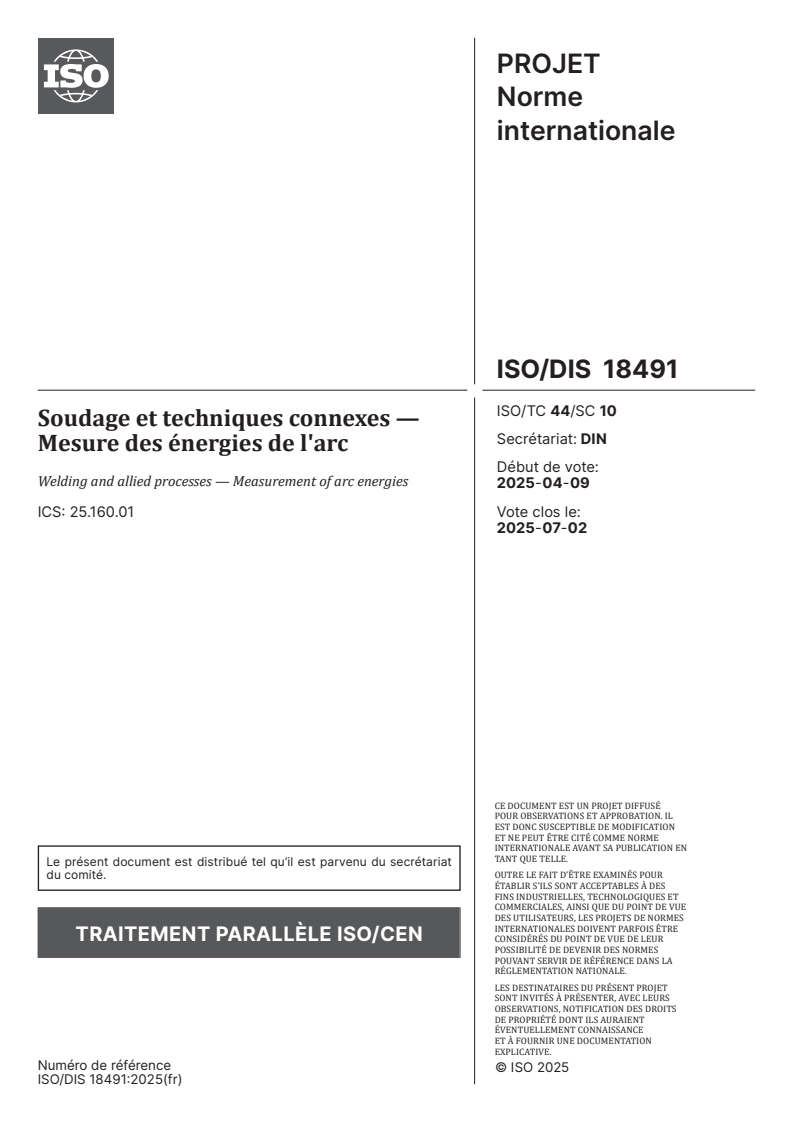
ISO/DIS 18491
ISO/TC 44/SC 10
Welding and allied processes —
Secretariat: DIN
Measurement of arc energies
Voting begins on:
Soudage et techniques connexes — Mesure des énergies de l'arc
2025-04-09
Voting terminates on:
ICS: 25.160.01
2025-07-02
THIS DOCUMENT IS A DRAFT CIRCULATED
FOR COMMENTS AND APPROVAL. IT
IS THEREFORE SUBJECT TO CHANGE
AND MAY NOT BE REFERRED TO AS AN
INTERNATIONAL STANDARD UNTIL
PUBLISHED AS SUCH.
This document is circulated as received from the committee secretariat.
IN ADDITION TO THEIR EVALUATION AS
BEING ACCEPTABLE FOR INDUSTRIAL,
TECHNOLOGICAL, COMMERCIAL AND
USER PURPOSES, DRAFT INTERNATIONAL
STANDARDS MAY ON OCCASION HAVE TO
ISO/CEN PARALLEL PROCESSING
BE CONSIDERED IN THE LIGHT OF THEIR
POTENTIAL TO BECOME STANDARDS TO
WHICH REFERENCE MAY BE MADE IN
NATIONAL REGULATIONS.
RECIPIENTS OF THIS DRAFT ARE INVITED
TO SUBMIT, WITH THEIR COMMENTS,
NOTIFICATION OF ANY RELEVANT PATENT
RIGHTS OF WHICH THEY ARE AWARE AND TO
PROVIDE SUPPORTING DOCUMENTATION.
Reference number
ISO/DIS 18491:2025(en)
DRAFT
ISO/DIS 18491:2025(en)
International
Standard
ISO/DIS 18491
ISO/TC 44/SC 10
Welding and allied processes —
Secretariat: DIN
Measurement of arc energies
Voting begins on:
Soudage et techniques connexes — Mesure des énergies de l'arc
ICS: 25.160.01 Voting terminates on:
THIS DOCUMENT IS A DRAFT CIRCULATED
FOR COMMENTS AND APPROVAL. IT
IS THEREFORE SUBJECT TO CHANGE
AND MAY NOT BE REFERRED TO AS AN
INTERNATIONAL STANDARD UNTIL
PUBLISHED AS SUCH.
This document is circulated as received from the committee secretariat.
IN ADDITION TO THEIR EVALUATION AS
BEING ACCEPTABLE FOR INDUSTRIAL,
© ISO 2025
TECHNOLOGICAL, COMMERCIAL AND
USER PURPOSES, DRAFT INTERNATIONAL
All rights reserved. Unless otherwise specified, or required in the context of its implementation, no part of this publication may
STANDARDS MAY ON OCCASION HAVE TO
ISO/CEN PARALLEL PROCESSING
be reproduced or utilized otherwise in any form or by any means, electronic or mechanical, including photocopying, or posting on
BE CONSIDERED IN THE LIGHT OF THEIR
the internet or an intranet, without prior written permission. Permission can be requested from either ISO at the address below
POTENTIAL TO BECOME STANDARDS TO
WHICH REFERENCE MAY BE MADE IN
or ISO’s member body in the country of the requester.
NATIONAL REGULATIONS.
ISO copyright office
RECIPIENTS OF THIS DRAFT ARE INVITED
CP 401 • Ch. de Blandonnet 8
TO SUBMIT, WITH THEIR COMMENTS,
CH-1214 Vernier, Geneva
NOTIFICATION OF ANY RELEVANT PATENT
Phone: +41 22 749 01 11
RIGHTS OF WHICH THEY ARE AWARE AND TO
PROVIDE SUPPORTING DOCUMENTATION.
Email: copyright@iso.org
Website: www.iso.org
Published in Switzerland Reference number
ISO/DIS 18491:2025(en)
ii
ISO/DIS 18491:2025(en)
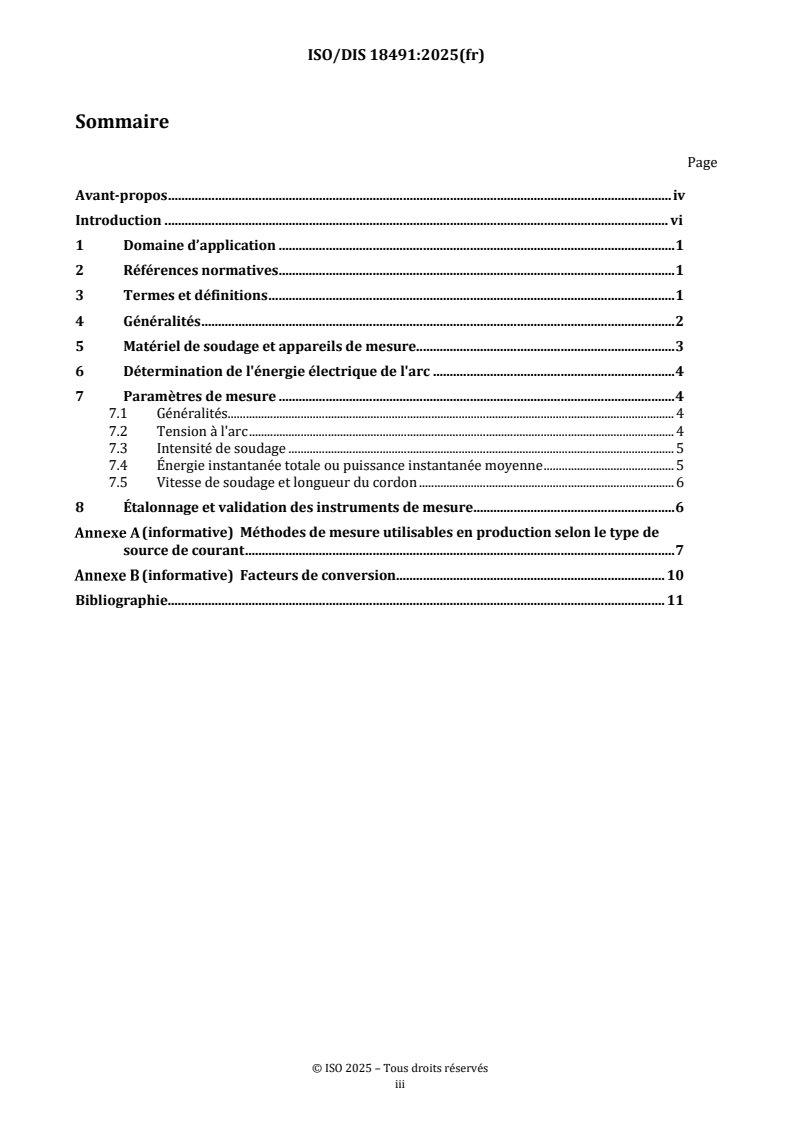
Contents Page
Foreword .iv
Introduction .v
1 Scope . 1
2 Normative references . 1
3 Terms and definitions . 1
4 General . 2
5 Welding equipment and measuring devices . 3
6 Determination of arc energy . 3
7 Measurement parameters . 4
7.1 General .4
7.2 Arc voltage . .4
7.3 Welding current .4
7.4 Total instantaneous energy or average instantaneous power .4
7.5 Welding speed and length of the run .5
8 Calibration and validation of measuring instruments . 5
Annex A (informative) Range of power source types and measurement methods . 6
Annex B (informative) Conversion factors . 8
Bibliography . 9
iii
ISO/DIS 18491:2025(en)
Foreword
ISO (the International Organization for Standardization) is a worldwide federation of national standards
bodies (ISO member bodies). The work of preparing International Standards is normally carried out through
ISO technical committees. Each member body interested in a subject for which a technical committee
has been established has the right to be represented on that committee. International organizations,
governmental and non-governmental, in liaison with ISO, also take part in the work. ISO collaborates closely
with the International Electrotechnical Commission (IEC) on all matters of electrotechnical standardization.
The procedures used to develop this document and those intended for its further maintenance are described
in the ISO/IEC Directives, Part 1. In particular, the different approval criteria needed for the different types
of ISO documents should be noted. This document was drafted in accordance with the editorial rules of the
ISO/IEC Directives, Part 2 (see www.iso.org/directives).
ISO draws attention to the possibility that the implementation of this document may involve the use of (a)
patent(s). ISO takes no position concerning the evidence, validity or applicability of any claimed patent
rights in respect thereof. As of the date of publication of this document, ISO [had/had not] received notice of
(a) patent(s) which may be required to implement this document. However, implementers are cautioned that
this may not represent the latest information, which may be obtained from the patent database available at
www.iso.org/patents. ISO shall not be held responsible for identifying any or all such patent rights.
Any trade name used in this document is information given for the convenience of users and does not
constitute an endorsement.
For an explanation of the voluntary nature of standards, the meaning of ISO specific terms and expressions
related to conformity assessment, as well as information about ISO's adherence to the World Trade
Organization (WTO) principles in the Technical Barriers to Trade (TBT), see www.iso.org/iso/foreword.html.
This document was prepared by Technical Committee ISO/TC 44, Welding and allied processes, Subcommittee
SC 10, Quality management in the field of welding.
This second edition cancels and replaces the first edition (ISO/TR 18491:2015), which has been technically
revised.
The main changes are as follows:
— update of normative references in Clause 2;
— update of vocabulary throughout this document in Clause 3 "Terms and defintions", Clause 4 "General",
Clause 5 "Welding equipment and measuring devices", Clause 6 "Determination of arc energy", Clause 7
"Measurement parameters", Clause 8 " Calibration and validation of measuring instruments" and in
Annex A "Range of power source types and measurement methods";
— addition of a new Annex B "Conversion factors";
— update of the Bibliography.
Any feedback or questions on this document should be directed to the user’s
national standards body. A complete listing of these bodies can be found at
www.iso.org/members.html. Official interpretations of ISO/TC 44 documents, where they exist, are
available from this page: https://committee.iso.org/sites/tc44/home/interpretation.html.
iv
ISO/DIS 18491:2025(en)
Introduction
Welding “arc energy” or “heat input” are fundamental values used to manage the consistency of weld
metal and heat-affected zone properties. ISO 15614 requires the measurement of the welding energies
implemented during a welding procedure qualification, but it does not give details about the methods to be
used. Likewise, during the construction of a welded assembly, inspectors should make sure that the welding
energies comply with the Welding Procedure Specification (WPS). But again, the details of the methods
to be used are not specified. As a consequence, there may be a lack of consistency between the methods
used to measure the welding energies during welding of the test piece and the methods used during the
manufacturing process. This is a potential source of error which could have implications on the safety or
quality of a welded component or structure.
Moreover, the latest technological breakthroughs in microprocessors and electrical power manipulation
have yielded welding power sources and control systems that are capable of generating complex waveforms.
However, these control systems and waveforms increase the difficulties related to voltage and current
intensity measurements, as their values are manipulated at frequencies which can reach thousands of Hertz.
The measuring instruments generally used by inspectors, such as TRMS clamp meters, can no longer be
relied on to correctly measure the welding energy since differences exceeding 30 % with respect to the true
energy can sometimes be found.
This document provides guidance on how to accurately measure welding energy and calculate heat input,
both in the case of traditional welding systems and those that employ complex waveforms.
v
DRAFT International Standard ISO/DIS 18491:2025(en)
Welding and allied processes — Measurement of arc energies
1 Scope
This document specifies the measuring of parameters needed to calculate arc energies for arc welding
processes.
2 Normative references
The following documents are referred to in the text in such a way that some or all of their content constitutes
requirements of this document. For dated references, only the edition cited applies. For undated references,
the latest edition of the referenced document (including any amendments) applies.
ISO 4063, Welding, brazing, soldering and cutting — Nomenclature of processes and reference numbers
ISO 17662, Welding — Calibration, verification and validation of equipment used for welding, including ancillary
activities
ISO/TR 17671 (all parts), Welding — Recommendations for welding of metallic materials
ISO/TR 25901-1, Welding and allied processes — Vocabulary — Part 1: General terms
ISO/TR 25901-3, Welding and allied processes — Vocabulary — Part 3: Welding processes
ISO/TR 25901-4, Welding and allied processes — Vocabulary — Part 4: Arc welding
IEC 60974-14, Arc welding equipment – Part 14: Calibration, validation and consistency testing
3 Terms and definitions
For the purposes of this document, the terms and definitions given in ISO/TR 25901-1, ISO/TR 25901-3,
ISO/TR 25901-4 and ISO/TR 17671 (all parts) and the following apply.
ISO and IEC maintain terminology databases for use in standardization at the following addresses:
— ISO Online browsing platform: available at https:// www .iso .org/ obp
— IEC Electropedia: available at https:// www .electropedia .org/
3.1
power
product of arc voltage and welding current
3.2
energy
product of arc voltage and welding current and arc time
3.3
arc energy
E
product of arc voltage and welding current divided by welding speed
or
energy (3.2) divided by l
...
FINAL DRAFT
International
Standard
ISO/TC 44/SC 10
Welding and allied processes —
Secretariat: DIN
Measurement of arc energies
Voting begins on:
Soudage et techniques connexes — Mesure des énergies de l'arc 2026-03-20
Voting terminates on:
2026-05-15
RECIPIENTS OF THIS DRAFT ARE INVITED TO SUBMIT,
WITH THEIR COMMENTS, NOTIFICATION OF ANY
RELEVANT PATENT RIGHTS OF WHICH THEY ARE AWARE
AND TO PROVIDE SUPPOR TING DOCUMENTATION.
IN ADDITION TO THEIR EVALUATION AS
BEING ACCEPTABLE FOR INDUSTRIAL, TECHNO
ISO/CEN PARALLEL PROCESSING LOGICAL, COMMERCIAL AND USER PURPOSES, DRAFT
INTERNATIONAL STANDARDS MAY ON OCCASION HAVE
TO BE CONSIDERED IN THE LIGHT OF THEIR POTENTIAL
TO BECOME STAN DARDS TO WHICH REFERENCE MAY BE
MADE IN NATIONAL REGULATIONS.
Reference number
FINAL DRAFT
International
Standard
ISO/TC 44/SC 10
Welding and allied processes —
Secretariat: DIN
Measurement of arc energies
Voting begins on:
Soudage et techniques connexes — Mesure des énergies de l'arc
Voting terminates on:
RECIPIENTS OF THIS DRAFT ARE INVITED TO SUBMIT,
WITH THEIR COMMENTS, NOTIFICATION OF ANY
RELEVANT PATENT RIGHTS OF WHICH THEY ARE AWARE
AND TO PROVIDE SUPPOR TING DOCUMENTATION.
© ISO 2026
IN ADDITION TO THEIR EVALUATION AS
All rights reserved. Unless otherwise specified, or required in the context of its implementation, no part of this publication may
BEING ACCEPTABLE FOR INDUSTRIAL, TECHNO
ISO/CEN PARALLEL PROCESSING
LOGICAL, COMMERCIAL AND USER PURPOSES, DRAFT
be reproduced or utilized otherwise in any form or by any means, electronic or mechanical, including photocopying, or posting on
INTERNATIONAL STANDARDS MAY ON OCCASION HAVE
the internet or an intranet, without prior written permission. Permission can be requested from either ISO at the address below
TO BE CONSIDERED IN THE LIGHT OF THEIR POTENTIAL
or ISO’s member body in the country of the requester.
TO BECOME STAN DARDS TO WHICH REFERENCE MAY BE
MADE IN NATIONAL REGULATIONS.
ISO copyright office
CP 401 • Ch. de Blandonnet 8
CH-1214 Vernier, Geneva
Phone: +41 22 749 01 11
Email: copyright@iso.org
Website: www.iso.org
Published in Switzerland Reference number
ii
Contents Page
Foreword .iv
Introduction .v
1 Scope . 1
2 Normative references . 1
3 Terms and definitions . 1
4 General . 2
5 Welding equipment and measuring devices . 3
6 Determination of arc energy . 3
7 Measurement parameters . 3
7.1 General .3
7.2 Arc voltage . .4
7.3 Welding current .4
7.4 Total instantaneous energy or average instantaneous power .4
7.5 Welding speed and length of the run .5
8 Calibration and validation of measuring instruments . 5
Annex A (informative) Range of power source types and measurement methods . 6
Annex B (informative) Conversion factors . 8
Bibliography . 9
iii
Foreword
ISO (the International Organization for Standardization) is a worldwide federation of national standards
bodies (ISO member bodies). The work of preparing International Standards is normally carried out through
ISO technical committees. Each member body interested in a subject for which a technical committee
has been established has the right to be represented on that committee. International organizations,
governmental and non-governmental, in liaison with ISO, also take part in the work. ISO collaborates closely
with the International Electrotechnical Commission (IEC) on all matters of electrotechnical standardization.
The procedures used to develop this document and those intended for its further maintenance are described
in the ISO/IEC Directives, Part 1. In particular, the different approval criteria needed for the different types
of ISO documents should be noted. This document was drafted in accordance with the editorial rules of the
ISO/IEC Directives, Part 2 (see www.iso.org/directives).
ISO draws attention to the possibility that the implementation of this document may involve the use of (a)
patent(s). ISO takes no position concerning the evidence, validity or applicability of any claimed patent
rights in respect thereof. As of the date of publication of this document, ISO had not received notice of (a)
patent(s) which may be required to implement this document. However, implementers are cautioned that
this may not represent the latest information, which may be obtained from the patent database available at
www.iso.org/patents. ISO shall not be held responsible for identifying any or all such patent rights.
Any trade name used in this document is information given for the convenience of users and does not
constitute an endorsement.
For an explanation of the voluntary nature of standards, the meaning of ISO specific terms and expressions
related to conformity assessment, as well as information about ISO's adherence to the World Trade
Organization (WTO) principles in the Technical Barriers to Trade (TBT), see www.iso.org/iso/foreword.html.
This document was prepared by Technical Committee ISO/TC 44, Welding and allied processes, Subcommittee
SC 10, Quality management in the field of welding, in collaboration with the European Committee for
Standardization (CEN) Technical Committee CEN/TC 121, Welding and allied processes, in accordance with
the Agreement on technical cooperation between ISO and CEN (Vienna Agreement).
This second edition cancels and replaces the first edition (ISO/TR 18491:2015), which has been technically
revised.
The main changes are as follows:
— update of normative references in Clause 2;
— update of terms used throughout this document;
— addition of precisions regarding the guidelines for voltage measurement in 7.2;
— addition of a new Annex B "Conversion factors";
— update of the Bibliography.
Any feedback or questions on this document should be directed to the user’s
national standards body. A complete listing of these bodies can be found at
www.iso.org/members.html. Official interpretations of ISO/TC 44 documents, where they exist, are
available from this page: https://committee.iso.org/sites/tc44/home/interpretation.html.
iv
Introduction
Welding “arc energy” or “heat input” are fundamental values used to manage the consistency of weld metal
and heat-affected zone properties. The ISO 15614 series requires the measurement of the welding energies
implemented during a welding procedure qualification, but it does not give details about the methods to be
used. Likewise, during the construction of a welded assembly, inspectors should make sure that the welding
energies conform with the Welding Procedure Specification (WPS); however, the details of the methods
to be used are again not specified. Therefore, there can be a lack of consistency between the methods
used to measure the welding energies during welding of the test piece and the methods used during the
manufacturing process. This is a potential source of error which could have implications on the safety or
quality of a welded component or structure.
Moreover, modern technology in microprocessors and electrical power manipulation have yielded
welding power sources and control systems that are capable of generating complex waveforms. However,
these control systems and waveforms increase the difficulties related to voltage and current intensity
measurements, as their values are manipulated at frequencies which can reach thousands of Hertz. The
measuring instruments generally used by inspectors, such as TRMS clamp meters, can no longer be relied on
to correctly measure the welding energy since differences exceeding 30 % with respect to the true energy
can sometimes be found.
This document provides guidance on how to accurately measure welding energy, both in the case of
traditional welding systems and those that employ complex waveforms.
v
FINAL DRAFT International Standard ISO/FDIS 18491:2026(en)
Welding and allied processes — Measurement of arc energies
1 Scope
This document specifies methods for measuring the parameters needed to calculate arc energies for arc
welding processes.
2 Normative references
The following documents are referred to in the text in such a way that some or all of their content constitutes
requirements of this document. For dated references, only the edition cited applies. For undated references,
the latest edition of the referenced document (including any amendments) applies.
ISO 17662, Welding — Calibration, verification and validation of equipment used for welding, including ancillary
activities
ISO/TR 17671 (all parts), Welding — Recommendations for welding of metallic materials
ISO/TR 25901-1, Welding and allied processes — Vocabulary — Part 1: General terms
ISO/TR 25901-3, Welding and allied processes — Vocabulary — Part 3: Welding processes
ISO/TR 25901-4, Welding and allied processes — Vocabulary — Part 4: Arc welding
IEC 60974-14, Arc welding equipment – Part 14: Calibration, validation and consistency testing
3 Terms and definitions
For the purposes of this document, the terms and definitions given in ISO/TR 25901-1, ISO/TR 25901-3, ISO/
TR 25901-4 and the ISO/TR 17671 series and the following apply.
ISO and IEC maintain terminology databases for use in standardization at the following addresses:
— ISO Online browsing platform: available at https://www.iso.org/obp
— IEC Electropedia: available at https://www.electropedia.org/
3.1
power
product of arc voltage and welding current
3.2
energy
product of arc voltage and welding current and arc time
3.3
arc energy
E
product of:
a) arc voltage and welding current divided by welding speed; or
b) energy (3.2) divided by length of the run; or
c) power (3.1) divided by welding speed
Note 1 to entry: Arc energy is also referred to as the arc energy per unit length.
Note 2 to entry: Arc energy is a measure of the amount of energy generated by the welding arc per unit length of the
run. Not all the energy created by the arc is absorbed by the weld; some is lost to radiation, some to convection and
some to the slag. The percentage loss is welding process dependent. For measurement purposes, this loss is ignored.
When it is necessary to use arc energy to quantify its effect on a material, the arc energy is multiplied by a thermal
eff
...
ISO /TC 44/SC 10
Date: 2025-12-17
Secretariat: DIN
Date: 2026-03-06
Welding and allied processes — Measurement of arc energies
Soudage et techniques connexes — Mesure des énergies de l'arc
FDIS stage
TThhiis s drdraafftt i is s susubbmmiitttteed d ttoo aa ppaarraallellel l vvoottee i inn IISSOO,, CCEEN.N.
All rights reserved. Unless otherwise specified, or required in the context of its implementation, no part of this publication
may be reproduced or utilized otherwise in any form or by any means, electronic or mechanical, including photocopying,
or posting on the internet or an intranet, without prior written permission. Permission can be requested from either ISO
at the address below or ISO’s member body in the country of the requester.
ISO copyright office
CP 401 • Ch. de Blandonnet 8
CH-1214 Vernier, Geneva
Phone: + 41 22 749 01 11
EmailE-mail: copyright@iso.org
Website: www.iso.orgwww.iso.org
Published in Switzerland
ii
Contents
Foreword . iv
Introduction . v
1 Scope . 1
2 Normative references . 1
3 Terms and definitions . 1
4 General . 2
5 Welding equipment and measuring devices . 3
6 Determination of arc energy . 3
7 Measurement parameters . 4
8 Calibration and validation of measuring instruments . 6
Annex A (informative) Range of power source types and measurement methods . 7
Annex B (informative) Conversion factors . 11
Bibliography . 12
Foreword . 4
Introduction . 5
1 Scope . 1
2 Normative references . 1
3 Terms and definitions . 1
4 General . 2
5 Welding equipment and measuring devices . 3
6 Determination of arc energy . 3
7 Measurement parameters . 4
7.1 General . 4
7.2 Arc voltage . 4
7.3 Welding current . 4
7.4 Total instantaneous energy or average instantaneous power . 4
7.5 Welding speed and length of the run . 5
8 Calibration and validation of measuring instruments . 5
Annex A (informative) Range of power source types and measurement methods . 6
Annex B (informative) Conversion factors . 8
Bibliography . 9
iii
Foreword
ISO (the International Organization for Standardization) is a worldwide federation of national standards
bodies (ISO member bodies). The work of preparing International Standards is normally carried out through
ISO technical committees. Each member body interested in a subject for which a technical committee has been
established has the right to be represented on that committee. International organizations, governmental and
non-governmental, in liaison with ISO, also take part in the work. ISO collaborates closely with the
International Electrotechnical Commission (IEC) on all matters of electrotechnical standardization.
The procedures used to develop this document and those intended for its further maintenance are described
in the ISO/IEC Directives, Part 1. In particular, the different approval criteria needed for the different types of
ISO documents should be noted. This document was drafted in accordance with the editorial rules of the
ISO/IEC Directives, Part 2 (see www.iso.org/directives).
ISO draws attention to the possibility that the implementation of this document may involve the use of (a)
patent(s). ISO takes no position concerning the evidence, validity or applicability of any claimed patent rights
in respect thereof. As of the date of publication of this document, ISO had not received notice of (a) patent(s)
which may be required to implement this document. However, implementers are cautioned that this may not
represent the latest information, which may be obtained from the patent database available at
www.iso.org/patents.www.iso.org/patents. ISO shall not be held responsible for identifying any or all such
patent rights.
Any trade name used in this document is information given for the convenience of users and does not
constitute an endorsement.
For an explanation of the voluntary nature of standards, the meaning of ISO specific terms and expressions
related to conformity assessment, as well as information about ISO's adherence to the World Trade
Organization (WTO) principles in the Technical Barriers to Trade (TBT), see www.iso.org/iso/foreword.html.
This document was prepared by Technical Committee ISO/TC 44, Welding and allied processes, Subcommittee
SC 10, Quality management in the field of welding, in collaboration with the European Committee for
Standardization (CEN) Technical Committee CEN/TC 121, Welding and allied processes, in accordance with the
Agreement on technical cooperation between ISO and CEN (Vienna Agreement).
This second edition cancels and replaces the first edition (ISO/TR 18491:2015), which has been technically
revised.
The main changes are as follows:
— — update of normative references in Clause 2;Clause 2;
— — update of terms used throughout this document;
— — addition of precisions regarding the guidelines for voltage measurement in Subclause 7.2;7.2;
— — addition of a new Annex BAnnex B "Conversion factors";
— — update of the Bibliography.
Any feedback or questions on this document should be directed to the user’s national standards body. A
complete listing of these bodies can be found at www.iso.org/members.html.www.iso.org/members.html.
Official interpretations of ISO/TC 44 documents, where they exist, are available from this page:
https://committee.iso.org/sites/tc44/home/interpretation.htmlhttps://committee.iso.org/sites/tc44/hom
e/interpretation.html.
iv
Introduction
Welding “arc energy” or “heat input” are fundamental values used to manage the consistency of weld metal
and heat-affected zone properties. The ISO 15614 series requires the measurement of the welding energies
implemented during a welding procedure qualification, but it does not give details about the methods to be
used. Likewise, during the construction of a welded assembly, inspectors should make sure that the welding
energies complyconform with the Welding Procedure Specification (WPS). But again); however, the details of
the methods to be used are again not specified. As a consequenceTherefore, there can be a lack of consistency
between the methods used to measure the welding energies during welding of the test piece and the methods
used during the manufacturing process. This is a potential source of error which could have implications on
the safety or quality of a welded component or structure.
Moreover, modern technology in microprocessors and electrical power manipulation have yielded welding
power sources and control systems that are capable of generating complex waveforms. However, these control
systems and waveforms increase the difficulties related to voltage and current intensity measurements, as
their values are manipulated at frequencies which can reach thousands of Hertz. The measuring instruments
generally used by inspectors, such as TRMS clamp meters, can no longer be relied on to correctly measure the
welding energy since differences exceeding 30 % with respect to the true energy can sometimes be found.
This document provides guidance on how to accurately measure welding energy, both in the case of traditional
welding systems and those that employ complex waveforms.
v
FINAL DRAFT International Standard
Welding and allied processes — Measurement of arc energies
1 Scope
This document specifies methods for measuring the parameters needed to calculate arc energies for arc
welding processes.
2 Normative references
The following documents are referred to in the text in such a way that some or all of their content constitutes
requirements of this document. For dated references, only the edition cited applies. For undated references,
the latest edition of the referenced document (including any amendments) applies.
ISO 4063, Welding, brazing, soldering and cutting — Nomenclature of processes and reference numbers
ISO 17662, Welding — Calibration, verification and validation of equipment used for welding, including ancillary
activities
ISO/TR 17671 (all parts), Welding — Recommendations for welding of metallic materials
ISO/TR 25901--1, Welding and allied processes — Vocabulary — Part 1: General terms
ISO/TR 25901--3, Welding and allied processes — Vocabulary — Part 3: Welding processes
ISO/TR 25901--4, Welding and allied processes — Vocabulary — Part 4: Arc welding
IEC 60974--14, Arc welding equipment – Part 14: Calibration, validation and consistency testing
3 Terms and definitions
For the purposes of this document, the terms and definitions given in ISO/TR 25901-1, ISO/TR 25901-3,
ISO/TR 25901-4 and the ISO/TR 17671 series and the following apply.
ISO and IEC maintain terminology databases for use in standardization at the following addresses:
— — ISO Online browsing platform: available at https://www.iso.org/obphttps://www.iso.org/obp
— — IEC Electropedia: available at https://www.electropedia.org/https://www.electropedia.org/
3.1 3.1
power
product of arc voltage and welding current
3.2 3.2
energy
product of arc voltage and welding current and arc time
3.3 3.3
arc energy
E
product of:
a) a) arc voltage and welding current divided by welding speed; or
b) b) energy (3.2)(3.2) divided by length of the run; or
c) c) power (3.1)(3.1) divided by welding speed.
Note 1 to entry: Arc energy is also referred to as the arc energy per unit length.
Note 2 to entry: Arc energy is a measure of the amount of energy generated by the welding arc per unit
length of the run. Not all the energy created by the arc is absorbed by the weld; some is lost to radiation, some to
convection and some to the slag. The percentage loss is welding process dependent. For measurement purposes, this loss
is ignored. When it is necessary to use arc energy to quantify its effect on a material, the arc energy is multiplied by a
thermal efficiency factor k (see the ISO/TR 17671 series).) . The term "heat input" is then sometimes used instead of arc
energy.
3.4 3.4
waveform controlled welding
welding process modification of the voltage and/or current wave shape to control characteristics such as
droplet shape, penetration, wetting, bead shape, or transfer mode(s)
3.5 3.5
total instantaneous energy
E
TIE
welding energy determined by summing the product of current and voltage
...
PROJET
Norme
internationale
ISO/DIS 18491
ISO/TC 44/SC 10
Soudage et techniques connexes —
Secrétariat: DIN
Mesure des énergies de l'arc
Début de vote:
Welding and allied processes — Measurement of arc energies
2025-04-09
Vote clos le:
ICS: 25.160.01
2025-07-02
CE DOCUMENT EST UN PROJET DIFFUSÉ
POUR OBSERVATIONS ET APPROBATION. IL
EST DONC SUSCEPTIBLE DE MODIFICATION
ET NE PEUT ÊTRE CITÉ COMME NORME
INTERNATIONALE AVANT SA PUBLICATION EN
TANT QUE TELLE.
Le présent document est distribué tel qu’il est parvenu du secrétariat
du comité. OUTRE LE FAIT D’ÊTRE EXAMINÉS POUR
ÉTABLIR S’ILS SONT ACCEPTABLES À DES
FINS INDUSTRIELLES, TECHNOLOGIQUES ET
COMMERCIALES, AINSI QUE DU POINT DE VUE
DES UTILISATEURS, LES PROJETS DE NORMES
INTERNATIONALES DOIVENT PARFOIS ÊTRE
TRAITEMENT PARALLÈLE ISO/CEN
CONSIDÉRÉS DU POINT DE VUE DE LEUR
POSSIBILITÉ DE DEVENIR DES NORMES
POUVANT SERVIR DE RÉFÉRENCE DANS LA
RÉGLEMENTATION NATIONALE.
LES DESTINATAIRES DU PRÉSENT PROJET
SONT INVITÉS À PRÉSENTER, AVEC LEURS
OBSERVATIONS, NOTIFICATION DES DROITS
DE PROPRIÉTÉ DONT ILS AURAIENT
ÉVENTUELLEMENT CONNAISSANCE
ET À FOURNIR UNE DOCUMENTATION
EXPLICATIVE.
Numéro de référence
ISO/DIS 18491:2025(fr)
ISO/DIS 18491:2025(fr)
ISO TC 44/SC 10
ISO/DIS 18491:2025(fr)
Date : 2025-02-11
Soudage et techniques connexes — Mesure des énergies de l'arc
Étape DIS
Avertissement pour les WD et les CD
Ce document n'est pas une Norme internationale de l'ISO. Il est distribué pour examen et observations. Il est susceptible
de modification sans préavis et ne peut être cité comme Norme internationale.
Les destinataires du présent projet sont invités à présenter, avec leurs observations, notification des droits de propriété
dont ils auraient éventuellement connaissance et à fournir une documentation explicative.
DOCUMENT PROTÉGÉ PAR COPYRIGHT
© ISO 2025
Tous droits réservés. Sauf prescription différente ou nécessité dans le contexte de sa mise en œuvre, aucune partie de cette
publication ne peut être reproduite ni utilisée sous quelque forme que ce soit et par aucun procédé, électronique ou mécanique,
y compris la photocopie, ou la diffusion sur l’internet ou sur un intranet, sans autorisation écrite préalable. Une autorisation peut
être demandée à l’ISO à l’adresse ci-après ou au comité membre de l’ISO dans le pays du demandeur.
ISO copyright office
Case postale 401 • Ch. de Blandonnet 8
CH-1214 Vernier, Genève
Tél.: +41 22 749 01 11
E-mail: copyright@iso.org
Web: www.iso.org
Publié en Suisse
ii
ISO/DIS 18491:2025(fr)
Sommaire
Page
Avant-propos . iv
Introduction . vi
1 Domaine d’application . 1
2 Références normatives . 1
3 Termes et définitions . 1
4 Généralités . 2
5 Matériel de soudage et appareils de mesure . 3
6 Détermination de l'énergie électrique de l'arc . 4
7 Paramètres de mesure . 4
7.1 Généralités. 4
7.2 Tension à l'arc . 4
7.3 Intensité de soudage . 5
7.4 Énergie instantanée totale ou puissance instantanée moyenne . 5
7.5 Vitesse de soudage et longueur du cordon . 6
8 Étalonnage et validation des instruments de mesure. 6
(informative) Méthodes de mesure utilisables en production selon le type de
source de courant . 7
(informative) Facteurs de conversion. 10
Bibliographie. 11
iii
ISO/DIS 18491:2025(fr)
Avant-propos
L'ISO (Organisation internationale de normalisation) est une fédération mondiale d'organismes
nationaux de normalisation (comités membres de l'ISO). L'élaboration des Normes internationales est
en général confiée aux comités techniques de l'ISO. Chaque comité membre intéressé par une étude a le
droit de faire partie du comité technique créé à cet effet. Les organisations internationales,
gouvernementales et non gouvernementales, en liaison avec l'ISO participent également aux travaux.
L'ISO collabore étroitement avec la Commission électrotechnique internationale (IEC) en ce qui
concerne la normalisation électrotechnique.
Les procédures utilisées pour élaborer le présent document et celles destinées à sa mise à jour sont
décrites dans les Directives ISO/IEC, Partie 1. Il convient, en particulier, de prendre note des différents
critères d'approbation requis pour les différents types de documents ISO. Le présent document a été
rédigé conformément aux règles de rédaction données dans les Directives ISO/IEC, Partie 2 (voir
www.iso.org/directives).
L’ISO attire l’attention sur le fait que la mise en application du présent document peut entraîner
l’utilisation d’un ou de plusieurs brevets. L’ISO ne prend pas position quant à la preuve, à la validité et à
l’applicabilité de tout droit de propriété revendiqué à cet égard. À la date de publication du présent
document, l’ISO [avait/n'avait pas] reçu notification qu’un ou plusieurs brevets pouvaient être
nécessaires à sa mise en application. Toutefois, il y a lieu d’avertir les responsables de la mise en
application du présent document que des informations plus récentes sont susceptibles de figurer dans
la base de données de brevets, disponible à l'adresse www.iso.org/brevets. L’ISO ne saurait être tenue
pour responsable de ne pas avoir identifié tout ou partie de tels droits de propriété.
Les appellations commerciales éventuellement mentionnées dans le présent document sont données
pour information, par souci de commodité, à l’intention des utilisateurs et ne sauraient constituer un
engagement.
Pour une explication de la nature volontaire des normes, la signification des termes et expressions
spécifiques de l'ISO liés à l'évaluation de la conformité, ou pour toute information au sujet de l'adhésion
de l'ISO aux principes de l’Organisation mondiale du commerce (OMC) concernant les obstacles
techniques au commerce (OTC), voir www.iso.org/avant-propos.
Le présent document a été élaboré par le comité technique ISO/TC 44, Soudage et techniques connexes,
sous-comité SC 10, Gestion de la qualité dans le domaine du soudage.
Cette deuxième édition annule et remplace la première édition (ISO/TR 18491:2015) qui a fait l’objet
d’une révision technique.
Les modifications sont les suivantes:
— mise à jour des références normatives à l'Article 2;
— mise à jour du vocabulaire dans l'ensemble du présent document dans l'Article 3 « Termes et
définitions », l'Article 4 « Généralités », l'Article 5 « Matériel de soudage et appareils de mesure »,
l'Article 6 « Détermination de l'énergie électrique de l'arc », l'Article 7 « Paramètres de mesure »,
l'Article 8 « Étalonnage et validation des instruments de mesure » et l'Annexe A « Méthodes de mesure
utilisables en production selon le type de source de courant » ;
— ajout d'une nouvelle Annexe B « Facteurs de conversion »;
— mise à jour de la Bibliographie.
iv
ISO/DIS 18491:2025(fr)
Il convient que l’utilisateur adresse tout retour d’information ou toute question concernant le présent
document à l’organisme national de normalisation de son pays. Une liste exhaustive desdits organismes
se trouve à l’adresse www.iso.org/fr/members.html.
v
ISO/DIS 18491:2025(fr)
Introduction
En soudage, « l'énergie de l'arc » ou « l'apport de chaleur » sont des paramètres essentiels utilisés pour
contrôler la cohérence des propriétés du métal fondu et de la zone affectée thermiquement. L'ISO 15614
exige un relevé des énergies de soudage mises en œuvre lors de la réalisation d’une qualification de
mode opératoire de soudage (QMOS), mais ne précise pas le détail des méthodes à utiliser. De la même
manière que pendant la réalisation d'une construction soudée, il convient que les inspecteurs s'assurent
que les énergies de soudage sont conformes au descriptif de mode opératoire de soudage (DMOS). Mais,
une fois de plus, le détail des méthodes à utiliser n’est pas spécifié. Par conséquent, il peut y avoir un
manque de cohérence entre les méthodes utilisées lors de la mesure des énergies de soudage pendant
le soudage de l’assemblage de qualification, et celles utilisées pendant le processus de fabrication. Ceci
est potentiellement source d'erreur qui pourrait avoir des conséquences sur la sécurité ou la qualité
d'un composant ou d'une structure soudée.
Par ailleurs, les dernières évolutions technologiques dans le domaine des microprocesseurs et les
systèmes de gestion de l'énergie électrique ont permis de développer des sources de courant de soudage
et des systèmes de commande capables de générer des formes d'onde complexes. Cependant, ces
systèmes de commande et ces formes d'onde augmentent les difficultés liées aux mesures de tension et
d'intensité de courant, étant donné que leurs valeurs sont manipulées à des fréquences pouvant
atteindre des centaines d’Hertz. Les instruments de mesure généralement utilisés par les inspecteurs,
tels que les pinces ampèremétriques TRMS, ne peuvent plus être tenus pour fiables pour mesurer
correctement l'énergie de soudage puisque des écarts de plus de 30 % par rapport à l'énergie réelle
peuvent parfois être constatés.
Le présent document fournit des indications sur la manière de mesurer l'énergie de soudage et de
calculer l'apport de chaleur avec exactitude, aussi bien pour les systèmes de soudage traditionnels que
pour ceux utilisant des formes d'onde complexes.
vi
ISO/DIS 18491:2025(fr)
Soudage et techniques connexes — Mesure des énergies de
l'arc
1 Domaine d’application
Le présent document spécifie la mesure des paramètres nécessaires au calcul des énergies de soudage
pour les procédés de soudage à l'arc.
2 Références normatives
Les documents suivants sont cités dans le texte de sorte qu’ils constituent, pour tout ou partie de leur
contenu, des exigences du présent document. Pour les références datées, seule l’édition citée s’applique.
Pour les références non datées, la dernière édition du document de référence s'applique (y compris les
éventuels amendements).
ISO 4063, Soudage, brasage et coupage — Nomenclature et numérotation des procédés
ISO 17662, Soudage — Étalonnage, vérification et validation du matériel utilisé pour le soudage, y compris
pour les procédés connexes
ISO/TR 17671 (toutes les parties), Soudage — Recommandations pour le soudage des matériaux
métalliques
ISO/TR 25901-1, Soudage et techniques connexes — Vocabulaire — Partie 1 : termes généraux
ISO/TR 25901-3, Soudage et techniques connexes — Vocabulaire — Partie 3 : procédés de soudage
ISO/TR 25901-4, Soudage et techniques connexes — Vocabulaire — Partie 4 : soudage à l'arc
IEC 60974-14, Matériel de soudage à l'arc — Partie 14 : étalonnage, validation et essais de consistance
3 Termes et définitions
Pour les besoins du présent document, les termes et les définitions de l'ISO/TR 25901-1, de
l'ISO/TR 25901-3, de l'ISO/TR 25901-4 et de l'ISO/TR 17671 (toutes les parties) ainsi que les suivants
s'appliquent.
L'ISO et l'IEC tiennent à jour des bases de données terminologiques destinées à être utilisées en
normalisation, consultables aux adresses suivantes :
— ISO Online browsing platform : disponible à l'adresse https://www.iso.org/obp
— IEC Electropedia : disponible à l'adresse http://www.electropedia.org/
3.1
puissance
produit de la tension à l'arc et de l'intensité de soudage
3.2
énergie
produit de la tension à l'arc et de l'intensité de soudage et du temps d'arc
ISO/DIS 18491:2025(fr)
3.3
énergie de l’arc
E
produit de la tension à l'arc et de l'intensité de soudage divisé par la vitesse de soudage
ou
énergie (3.2) divisée par la longueur du cordon
ou
puissance (3.1) divisée par la vitesse de soudage
Note 1 à l'article : L'énergie de l'arc est une abréviation du terme énergie de l'arc par unité de longueur.
Note 2 à l'article : L'énergie de l'arc est une mesure de la quantité d'énergie générée par l'arc de soudage pour
chaque unité de longueur du cordon. Toute l'énergie créée par l'arc n'est pas absorbée par la soudure ; une partie
se perd en rayonnement, une autre en convection et une autre dans le laitier. Le pourcentage de perte dépend du
procédé de soudage. À des fins de mesurage, cette perte est ignorée. Lorsqu'il est nécessaire d'utiliser l'énergie de
l'arc pour quantifier son effet sur un matériau, l'énergie de l'arc est multipliée par un facteur d'efficacité thermique
k (voir ISO/TR 17671 (toutes les parties). Le terme « apport de chaleur » est alors généralement utilisé à la place
d'« énergie de l'arc ».
3.4
soudage avec forme d'onde contrôlée
soudage au moyen d'un générateur permettant de modifier la tension et/ou la forme d'onde du courant
électrique employé afin de contrôler des caractéristiques telles que la forme des gouttes de produit
d'apport, la pénétration, le mouillage, la forme du cordon de soudure, ou le (les) mode(s) de transfert
3.5
énergie instantanée totale
TIE
énergie de soudage, déterminée en mesurant à intervalles très courts la tension et l'intensité employées
et en additionnant le produit de ces valeurs, tenant ainsi compte des brefs changements de la forme
d’onde du courant de soudage
3.6
puissance instantanée moyenne
AIP
puissance de soudage, déterminée mesurant à intervalles très courts la tension et l'intensité employées
et en faisant la moyenne du produit de ces valeurs sur une période donnée, tenant ainsi compte des brefs
changements de la forme d’onde du courant de soudage
3.7
longueur effective de cordon
longueur du cordon obtenu après avoir fondu une électrode enrobée
[SOURCE: ISO/TR 17671-2:2002, 3.2]
4 Généralités
L'énergie de l'arc est dét
...
PROJET FINAL
Norme
internationale
ISO/TC 44/SC 10
Soudage et techniques connexes —
Secrétariat: DIN
Mesure des énergies de l'arc
Début de vote:
Welding and allied processes — Measurement of arc energies 2026-03-20
Vote clos le:
2026-05-15
LES DESTINATAIRES DU PRÉSENT PROJET SONT
INVITÉS À PRÉSENTER, AVEC LEURS OBSERVATIONS,
NOTIFICATION DES DROITS DE PROPRIÉTÉ DONT ILS
AURAIENT ÉVENTUELLEMENT CONNAISSANCE ET À
FOURNIR UNE DOCUMENTATION EXPLICATIVE.
OUTRE LE FAIT D’ÊTRE EXAMINÉS POUR
ÉTABLIR S’ILS SONT ACCEPTABLES À DES FINS
INDUSTRIELLES, TECHNOLOGIQUES ET COM-MERCIALES,
AINSI QUE DU POINT DE VUE DES UTILISATEURS, LES
PROJETS DE NORMES
TRAITEMENT PARALLÈLE ISO/CEN
INTERNATIONALES DOIVENT PARFOIS ÊTRE CONSIDÉRÉS
DU POINT DE VUE DE LEUR POSSI BILITÉ DE DEVENIR DES
NORMES POUVANT
SERVIR DE RÉFÉRENCE DANS LA RÉGLEMENTATION
NATIONALE.
Numéro de référence
PROJET FINAL
Norme
internationale
ISO/TC 44/SC 10
Soudage et techniques connexes —
Secrétariat: DIN
Mesure des énergies de l'arc
Début de vote:
Welding and allied processes — Measurement of arc energies
2026-03-20
Vote clos le:
2026-05-15
LES DESTINATAIRES DU PRÉSENT PROJET SONT
INVITÉS À PRÉSENTER, AVEC LEURS OBSERVATIONS,
NOTIFICATION DES DROITS DE PROPRIÉTÉ DONT ILS
AURAIENT ÉVENTUELLEMENT CONNAISSANCE ET À
FOURNIR UNE DOCUMENTATION EXPLICATIVE.
DOCUMENT PROTÉGÉ PAR COPYRIGHT
OUTRE LE FAIT D’ÊTRE EXAMINÉS POUR
ÉTABLIR S’ILS SONT ACCEPTABLES À DES FINS
© ISO 2026 INDUSTRIELLES, TECHNOLOGIQUES ET COM-MERCIALES,
AINSI QUE DU POINT DE VUE DES UTILISATEURS, LES
Tous droits réservés. Sauf prescription différente ou nécessité dans le contexte de sa mise en œuvre, aucune partie de cette
PROJETS DE NORMES
TRAITEMENT PARALLÈLE ISO/CEN
INTERNATIONALES DOIVENT PARFOIS ÊTRE CONSIDÉRÉS
publication ne peut être reproduite ni utilisée sous quelque forme que ce soit et par aucun procédé, électronique ou mécanique,
DU POINT DE VUE DE LEUR POSSI BILITÉ DE DEVENIR DES
y compris la photocopie, ou la diffusion sur l’internet ou sur un intranet, sans autorisation écrite préalable. Une autorisation peut
NORMES POUVANT
être demandée à l’ISO à l’adresse ci-après ou au comité membre de l’ISO dans le pays du demandeur.
SERVIR DE RÉFÉRENCE DANS LA RÉGLEMENTATION
NATIONALE.
ISO copyright office
Case postale 401 • Ch. de Blandonnet 8
CH-1214 Vernier, Genève
Tél.: +41 22 749 01 11
E-mail: copyright@iso.org
Web: www.iso.org
Publié en Suisse Numéro de référence
ii
Sommaire Page
Avant-propos .iv
Introduction .v
1 Domaine d’application . 1
2 Références normatives . 1
3 Termes et définitions . 1
4 Généralités . 2
5 Matériel de soudage et appareils de mesure . 3
6 Détermination de l'énergie électrique de l'arc . 3
7 Paramètres de mesure . 4
7.1 Généralités .4
7.2 Tension à l'arc .4
7.3 Intensité de soudage .4
7.4 Énergie instantanée totale ou puissance instantanée moyenne .5
7.5 Vitesse de soudage et longueur du cordon .5
8 Étalonnage et validation des instruments de mesure . 5
Annexe A (informative) Méthodes de mesure utilisables en production selon le type de source
de courant . 6
Annexe B (informative) Facteurs de conversion .10
Bibliographie .11
iii
Avant-propos
L'ISO (Organisation internationale de normalisation) est une fédération mondiale d'organismes nationaux
de normalisation (comités membres de l'ISO). L'élaboration des Normes internationales est en général
confiée aux comités techniques de l'ISO. Chaque comité membre intéressé par une étude a le droit de faire
partie du comité technique créé à cet effet. Les organisations internationales, gouvernementales et non
gouvernementales, en liaison avec l'ISO participent également aux travaux. L'ISO collabore étroitement avec
la Commission électrotechnique internationale (IEC) en ce qui concerne la normalisation électrotechnique.
Les procédures utilisées pour élaborer le présent document et celles destinées à sa mise à jour sont
décrites dans les Directives ISO/IEC, Partie 1. Il convient, en particulier, de prendre note des différents
critères d'approbation requis pour les différents types de documents ISO. Le présent document a
été rédigé conformément aux règles de rédaction données dans les Directives ISO/IEC, Partie 2 (voir
www.iso.org/directives).
L’ISO attire l’attention sur le fait que la mise en application du présent document peut entraîner l’utilisation
d’un ou de plusieurs brevets. L’ISO ne prend pas position quant à la preuve, à la validité et à l’applicabilité de
tout droit de propriété revendiqué à cet égard. À la date de publication du présent document, l’ISO n'avait pas
reçu notification qu’un ou plusieurs brevets pouvaient être nécessaires à sa mise en application. Toutefois,
il y a lieu d’avertir les responsables de la mise en application du présent document que des informations
plus récentes sont susceptibles de figurer dans la base de données de brevets, disponible à l'adresse
www.iso.org/brevets. L’ISO ne saurait être tenue pour responsable de ne pas avoir identifié tout ou partie de
tels droits de propriété.
Les appellations commerciales éventuellement mentionnées dans le présent document sont données pour
information, par souci de commodité, à l’intention des utilisateurs et ne sauraient constituer un engagement.
Pour une explication de la nature volontaire des normes, la signification des termes et expressions
spécifiques de l'ISO liés à l'évaluation de la conformité, ou pour toute information au sujet de l'adhésion de
l'ISO aux principes de l’Organisation mondiale du commerce (OMC) concernant les obstacles techniques au
commerce (OTC), voir www.iso.org/avant-propos.
Le présent document a été élaboré par le comité technique ISO/TC 44, Soudage et techniques connexes, sous-
comité SC 10, Gestion de la qualité dans le domaine du soudage, en collaboration avec le comité technique
CEN/TC 121 Soudage et techniques connexes, du Comité européen de normalisation (CEN) conformément à
l’Accord de coopération technique entre l’ISO et le CEN (Accord de Vienne).
Cette deuxième édition annule et remplace la première édition (ISO/TR 18491:2015) qui a fait l’objet d’une
révision technique.
Les modifications sont les suivantes:
— mise à jour des références normatives à l'Article 2;
— mise à jour des termes utilisés dans l'ensemble du présent document;
— ajout de précisions quant aux lignes directrices pour la mesure de la tension en 7.2;
— ajout d'une nouvelle Annexe B «Facteurs de conversion»;
— mise à jour de la Bibliographie.
Il convient que l’utilisateur adresse tout retour d’information ou toute question concernant le
présent document à l’organisme national de normalisation de son pays. Une liste exhaustive
desdits organismes se trouve à l’adresse www.iso.org/fr/members.html. Les interprétations
officielles des documents de l'ISO/TC 44, lorsqu'elles existent sont disponibles depuis la page:
https://committee.iso.org/sites/tc44/home/interpretation.html.
iv
Introduction
En soudage, «l'énergie de l'arc» ou «l'apport de chaleur» sont des paramètres essentiels utilisés pour
contrôler la cohérence des propriétés du métal fondu et de la zone affectée thermiquement. La série de
normes ISO 15614 exige un relevé des énergies de soudage mises en œuvre lors de la réalisation d’une
qualification de mode opératoire de soudage (QMOS), mais ne précise pas le détail des méthodes à utiliser.
De la même manière, pendant la réalisation d'une construction soudée, il convient que les inspecteurs
s'assurent que les énergies de soudage sont conformes au descriptif de mode opératoire de soudage (DMOS);
néanmoins, les détails des méthodes à utiliser ne sont là encore pas spécifié. Ainsi, il peut y avoir un manque
de cohérence entre les méthodes utilisées lors de la mesure des énergies de soudage pendant le soudage de
l’assemblage de qualification, et celles utilisées pendant le processus de fabrication. Cela est potentiellement
source d'erreur qui pourrait avoir des conséquences sur la sécurité ou la qualité d'un composant ou d'une
structure soudée.
Par ailleurs, les technologies modernes dans le domaine des microprocesseurs et les systèmes de gestion
de l'énergie électrique ont permis de développer des sources de courant de soudage et des systèmes de
commande capables de générer des formes d'onde complexes. Cependant, ces systèmes de commande et ces
formes d'onde augmentent les difficultés liées aux mesures de tension et d'intensité de courant, étant donné
que leurs valeurs sont manipulées à des fréquences pouvant atteindre des centaines d’Hertz. Les instruments
de mesure généralement utilisés par les inspecteurs, tels que les pinces ampèremétriques TRMS, ne peuvent
plus être tenus pour fiables pour mesurer correctement l'énergie de soudage puisque des écarts de plus de
30 % par rapport à l'énergie réelle peuvent parfois être constatés.
Le présent document fournit des indications sur la manière de mesurer l'énergie de soudage avec exactitude,
aussi bien pour les systèmes de soudage traditionnels que pour ceux utilisant des formes d'onde complexes.
v
PROJET FINAL Norme internationale ISO/FDIS 18491:2026(fr)
Soudage et techniques connexes — Mesure des énergies de
l'arc
1 Domaine d’application
Le présent document spécifie les méthodes de mesure des paramètres nécessaires au calcul des énergies de
soudage pour les procédés de soudage à l'arc.
2 Références normatives
Les documents suivants sont cités dans le texte de sorte qu’ils constituent, pour tout ou partie de leur
contenu, des exigences du présent document. Pour les références datées, seule l’édition citée s’applique. Pour
les références non datées, la dernière édition du document de référence s'applique (y compris les éventuels
amendements).
ISO 17662, Soudage — Étalonnage, vérification et validation du matériel utilisé pour le soudage, y compris pour
les procédés connexes
ISO/TR 17671 (toutes les parties), Soudage — Recommandations pour le soudage des matériaux métalliques
ISO/TR 25901-1, Soudage et techniques connexes — Vocabulaire — Partie 1: Termes généraux
ISO/TR 25901-3, Soudage et techniques connexes — Vocabulaire — Partie 3: Procédés de soudage
ISO/TR 25901-4, Soudage et techniques connexes — Vocabulaire — Partie 4: Soudage à l'arc
IEC 60974-14, Matériel de soudage à l’arc — Partie 14: Étalonnage, validation et essais de consistance
3 Termes et définitions
Pour les besoins du présent document, les termes et les définitions de l'ISO/TR 25901-1, de l'ISO/TR 25901-3,
de l'ISO/TR 25901-4 et de la série ISO/TR 17671 ainsi que les suivants s'appliquent.
L'ISO et l'IEC tiennent à jour des bases de données terminologiques destinées à être utilisées en normalisation,
consultables aux adresses suivantes:
— ISO Online browsing platform: disponible à l'adresse https:// www .iso .org/ obp
— IEC Electropedia: disponible à l'adresse https:// www .electropedia .org/
3.1
puissance
produit de la tension à l'arc et de l'intensité de soudage
3.2
énergie
produit de la tension à l'arc et de l'intensité de soudage et du temps d'arc
3.3
énergie de l’arc
E
produit de:
a) la tension à l'arc et de l'intensité de soudage divisé par la vitesse de soudage; ou
b) l'énergie (3.2) divisée par la longueur du cordon; ou
c) la puissance (3.1) divisée par la vitesse de soudage
Note 1 à l'article: L'énergie de l'arc est également nommée énergie de l'arc par unité de longueur.
Note 2 à l'article: L'énergie de l'arc est une mesure de la quantité d'énergie générée par l'arc de soudage pour chaque
unité de longueur du cordon. Toute l'énergie créée par l'arc n'est pas absorbée par la soudure; une partie se perd en
rayonnement, une autre en convection et une autre dans le laitier. Le pourcentage de perte dépend du procédé de
soudage. À des fins de mesurage, cette perte est ignorée. Lorsqu'il est nécessaire d'utiliser l'énergie de l'arc pour
quantifier son effet sur un matériau, l'énergie de l'arc est multipliée par un facteur d'efficacité thermique k (voir la
série ISO/TR 17671). Le terme «apport de chaleur» est alors parfois utilisé à la place d'«énergie de l'arc».
3.4
soudage avec forme d'onde contrôlée
soudage au moyen d'un générateur permettant de modifier la tension et/ou la forme d'onde du courant
électrique employé afin de contrôler des caractéristiques telles que la forme des gouttes de produit d'apport,
la pénétration, le mouillage, la forme du cordon de soudure, ou le (les) mode(s) de transfert
3.5
énergie instantanée totale
E
TIE
énergie de soudage, déterminée en mesurant à intervalles très courts pendant une durée donnée la tension et
l'intensité employées et en additionnant le produit de ces valeurs, tenant ainsi compte des brefs changements
de la forme d’onde du courant de soudage
3.6
puissance instantanée moyenne
P
AIP
puissance de soudage, déterminée mesurant à intervalles très courts la tension et l'intensité employées
et en faisant la moyenne du produit de ces valeurs sur u
...
Questions, Comments and Discussion
Ask us and Technical Secretary will try to provide an answer. You can facilitate discussion about the standard in here.
Loading comments...