

ISO/IEC TR 25219:2024
(Main)Personal identification — ISO-compliant driving licence — Considerations for early adopters of ISO/IEC 18013-7
General Information
- Abstract
This document specifies considerations that can be of use to implementers and developers that elect to participate in work around updates to ISO/IEC TS 18013-7. These considerations are intended to support the improvements, to maximize backward compatibility and to, at minimum, maintain the security and privacy properties already embodied in ISO/IEC TS 18013-7.
- Status
- Withdrawn
- Publication Date
- 16-Oct-2024
- Technical Committee
- ISO/IEC JTC 1/SC 17 - Cards and security devices for personal identification
- Current Stage
- 9599 - Withdrawal of International Standard
- Start Date
- 19-Dec-2025
- Completion Date
- 29-Aug-2026
Overview
ISO/IEC TR 25219:2024 provides practical considerations for early adopters of ISO/IEC TS 18013-7 when implementing ISO-compliant driving licence (mDL) functionality. The Technical Report targets implementers and developers who participate in updates to TS 18013-7 and focuses on preserving the security, privacy and backward compatibility properties already established by the mDL family of standards.
This guidance explicitly supports convergence with emerging web-based digital credentials initiatives such as the W3C Web Platform Incubator Community Group (WIGC) digital credentials API while advising on interoperability with existing mDL mechanisms.
Key Topics
Wallet and app interoperability
- Ensure the issuing authority can work with the wallet/app of choice where reasonable (for example, mainstream implementations such as those from the OpenWallet Foundation). Discretion is advised to avoid forcing support for niche wallets.
Presentation binding and replay protection
- Protect against attackers forwarding engagement or request information by binding presentment to the originating request channel (see Clause 6.5 of ISO/IEC TS 18013-7).
Minimized reader requirements
- Reduce the amount of information an mDL reader must provide to the digital credentials API to retrieve mdoc data, minimizing exposure of verifier-side data and lowering privacy risk.
Independent functional building blocks
- Allow the mdoc reader to convey verifier identity and attestation information to the mdoc in a way functionally similar to the mdoc reader authentication certificate in ISO/IEC 18013-5.
- For the digital credentials API, enable wallet selection and deliver payloads that allow continued use of existing ISO/IEC TS 18013-7 and ISO/IEC 18013-5 mechanisms with minimal changes.
- Deliver and accept messages equivalent in function to the DeviceRequest and DeviceResponse constructs from ISO/IEC 18013-5, preserving doctype, namespace and field identifier concepts.
- Implement application-layer encryption for mdoc responses using an asymmetric key algorithm to derive an ephemeral symmetric key; include the session transcript (per ISO/IEC TS 18013-7 and ISO/IEC 18013-5) in key derivation.
Applications
- Governments and issuing authorities planning early mDL deployments
- Wallet and operating system developers integrating digital credentials APIs
- Verifier implementers seeking to maintain privacy certifications and authorization assertions
Practical value: TR 25219:2024 helps ensure that early deployments remain compatible with future updates, preserve existing trust and privacy guarantees, and interoperate with mainstream wallet ecosystems.
Related Standards
- ISO/IEC TS 18013-7 - Mobile driving licence (mDL) add-on functions
- ISO/IEC 18013-5 - mDL application and mdoc reader authentication concepts
Implementers should consult the referenced documents and the ISO/IEC Directives for normative guidance and updates. For terminology and definitions, refer to the ISO Online Browsing Platform and the IEC Electropedia.
Relations
- Effective Date
- 25-Jan-2025
Get Certified
Connect with accredited certification bodies for this standard

BSI Group
BSI (British Standards Institution) is the business standards company that helps organizations make excellence a habit.

NYCE
Mexican standards and certification body.
Sponsored listings
Frequently Asked Questions
ISO/IEC TR 25219:2024 is a technical report published by the International Organization for Standardization (ISO). Its full title is "Personal identification — ISO-compliant driving licence — Considerations for early adopters of ISO/IEC 18013-7". This standard covers: This document specifies considerations that can be of use to implementers and developers that elect to participate in work around updates to ISO/IEC TS 18013-7. These considerations are intended to support the improvements, to maximize backward compatibility and to, at minimum, maintain the security and privacy properties already embodied in ISO/IEC TS 18013-7.
This document specifies considerations that can be of use to implementers and developers that elect to participate in work around updates to ISO/IEC TS 18013-7. These considerations are intended to support the improvements, to maximize backward compatibility and to, at minimum, maintain the security and privacy properties already embodied in ISO/IEC TS 18013-7.
ISO/IEC TR 25219:2024 is classified under the following ICS (International Classification for Standards) categories: 35.240.15 - Identification cards. Chip cards. Biometrics. The ICS classification helps identify the subject area and facilitates finding related standards.
ISO/IEC TR 25219:2024 has the following relationships with other standards: It is inter standard links to ISO/IEC TR 25219:2025. Understanding these relationships helps ensure you are using the most current and applicable version of the standard.
ISO/IEC TR 25219:2024 is available in PDF format for immediate download after purchase. The document can be added to your cart and obtained through the secure checkout process. Digital delivery ensures instant access to the complete standard document.
Standards Content (Sample)
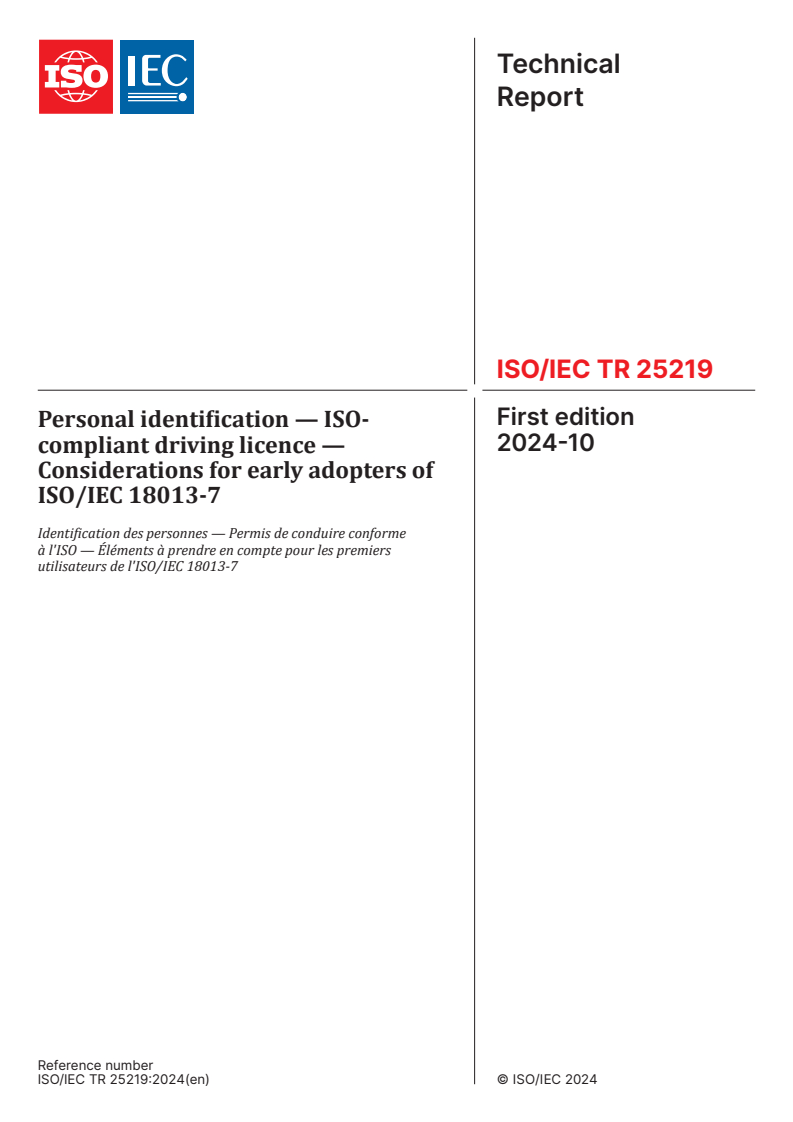
Technical
Report
ISO/IEC TR 25219
First edition
Personal identification — ISO-
2024-10
compliant driving licence —
Considerations for early adopters of
ISO/IEC 18013-7
Identification des personnes — Permis de conduire conforme
à l'ISO — Éléments à prendre en compte pour les premiers
utilisateurs de l'ISO/IEC 18013-7
Reference number
© ISO/IEC 2024
All rights reserved. Unless otherwise specified, or required in the context of its implementation, no part of this publication may
be reproduced or utilized otherwise in any form or by any means, electronic or mechanical, including photocopying, or posting on
the internet or an intranet, without prior written permission. Permission can be requested from either ISO at the address below
or ISO’s member body in the country of the requester.
ISO copyright office
CP 401 • Ch. de Blandonnet 8
CH-1214 Vernier, Geneva
Phone: +41 22 749 01 11
Email: copyright@iso.org
Website: www.iso.org
Published in Switzerland
© ISO/IEC 2024 – All rights reserved
ii
Contents Page
Foreword .iv
Introduction .v
1 Scope . 1
2 Normative references . 1
3 Terms and definitions . 1
4 Considerations . 1
Bibliography . 3
© ISO/IEC 2024 – All rights reserved
iii
Foreword
ISO (the International Organization for Standardization) and IEC (the International Electrotechnical
Commission) form the specialized system for worldwide standardization. National bodies that are
members of ISO or IEC participate in the development of International Standards through technical
committees established by the respective organization to deal with particular fields of technical activity.
ISO and IEC technical committees collaborate in fields of mutual interest. Other international organizations,
governmental and non-governmental, in liaison with ISO and IEC, also take part in the work.
The procedures used to develop this document and those intended for its further maintenance are described
in the ISO/IEC Directives, Part 1. In particular, the different approval criteria needed for the different types
of document should be noted. This document was drafted in accordance with the editorial rules of the ISO/
IEC Directives, Part 2 (see www.iso.org/directives or www.iec.ch/members_experts/refdocs).
ISO and IEC draw attention to the possibility that the implementation of this document may involve the
use of (a) patent(s). ISO and IEC take no position concerning the evidence, validity or applicability of any
claimed patent rights in respect thereof. As of the date of publication of this document, ISO and IEC had not
received notice of (a) patent(s) which may be required to implement this document. However, implementers
are cautioned that this may not represent the latest information, which may be obtained from the patent
database available at www.iso.org/patents and https://patents.iec.ch. ISO and IEC shall not be held
responsible for identifying any or all such patent rights.
Any trade name used in this document is information given for the convenience of users and does not
constitute an endorsement.
For an explanation of the voluntary nature of standards, the meaning of ISO specific terms and expressions
related to conformity assessment, as well as information about ISO's adherence to the World Trade
Organization (WTO) principles in the Technical Barriers to Trade (TBT) see www.iso.org/iso/foreword.html.
In the IEC, see www.iec.ch/understanding-standards.
This document was prepared by Joint Technical Committee ISO/IEC JTC 1, Information technology,
Subcommittee SC 17, Cards and security devices for personal identification.
Any feedback or questions on this document should be directed to the user’s national standards
body. A complete listing of these bodies can be found at www.iso.org/members.html and
www.iec.ch/national-committees.
© ISO/IEC 2024 – All rights reserved
i
...