

ISO 10236:1995
(Main)Carbonaceous materials for the production of aluminium — Green coke and calcined coke for electrodes — Determination of bulk density (tapped)
General Information
- Abstract
Provides a method for the determination of the tapped bulk density of granular carbon and graphite materials. The carbonaceous materials are used in the manufacture of carbon electrodes for the production of aluminium.
- Status
- Published
- Publication Date
- 15-Nov-1995
- Technical Committee
- ISO/TC 226 - Materials for the production of primary aluminium
- Drafting Committee
- ISO/TC 226/WG 2 - Cathodes and ramming paste
- Current Stage
- 9093 - International Standard confirmed
- Start Date
- 25-Sep-2024
- Completion Date
- 29-Aug-2026
Buy Documents
ISO 10236:1995 - Carbonaceous materials for the production of aluminium — Green coke and calcined coke for electrodes — Determination of bulk density (tapped) Released:11/16/1995
ISO 10236:1995 - Produits carbonés utilisés pour la production de l'aluminium — Coke cru et coke calciné pour électrodes — Détermination de la masse volumique apparente (apres tassement) Released:11/16/1995
ISO 10236:1995 - Produits carbonés utilisés pour la production de l'aluminium — Coke cru et coke calciné pour électrodes — Détermination de la masse volumique apparente (apres tassement) Released:11/16/1995
Overview
ISO 10236:1995 defines a standardized laboratory method for determining the tapped bulk density of granular carbonaceous materials (green coke and calcined coke) used in the manufacture of carbon electrodes for aluminium production. The tapped bulk density is measured by determining the volume of a known mass of material after controlled tapping; this value is important for assessing porosity, handling, and electrode performance.
Key Topics
- Principle: The bulk density (tapped) is calculated by dividing a known mass of test portion by the tapped volume: pt = m / V (g/ml).
- Sample preparation:
- Sample in accordance with ISO 6375 for sampling.
- Dry sample in an oven at 120 °C ± 5 °C until consecutive weighings differ by ≤ 0.1% of the original mass; cool in a desiccator.
- Apparatus (summary of required equipment described in the standard):
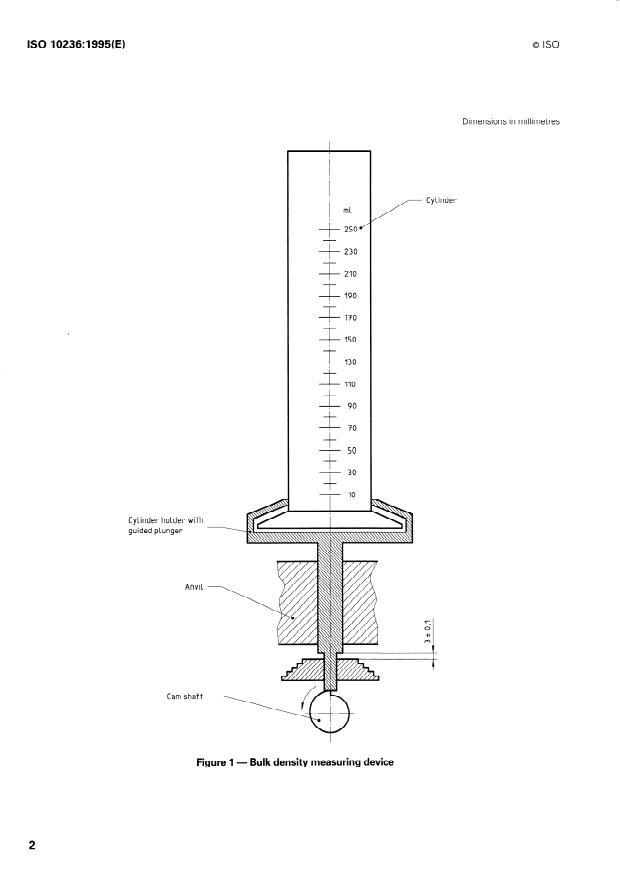
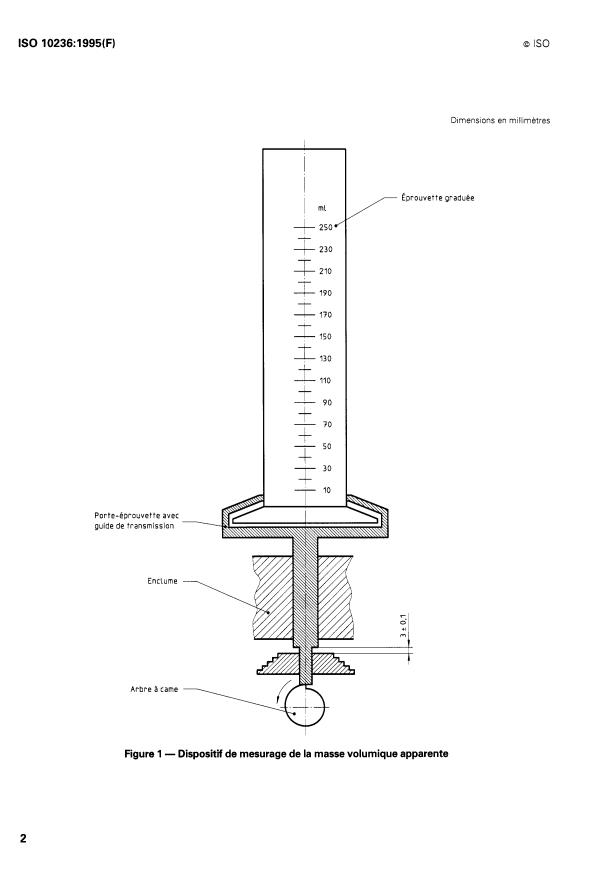
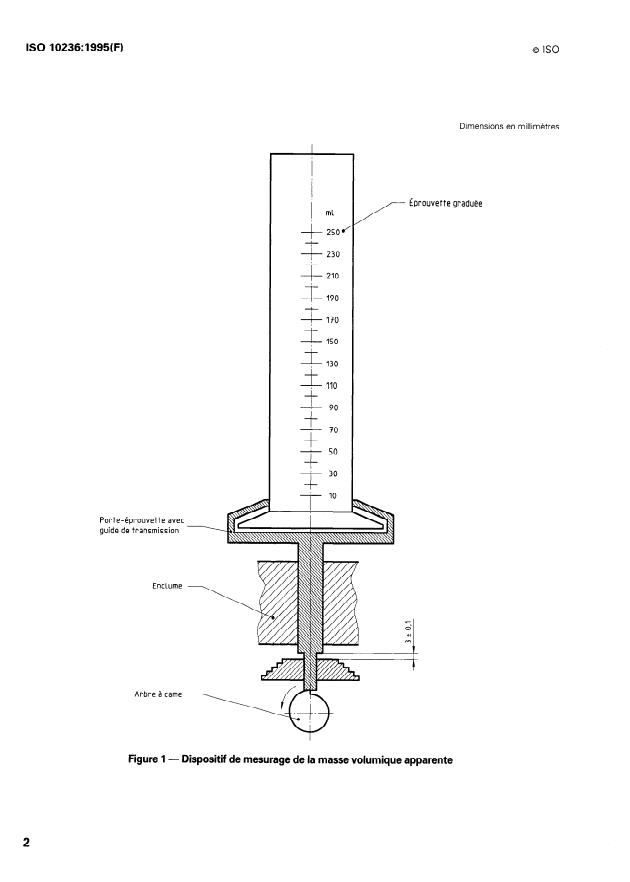
- Bulk density measuring device with measuring cylinder (0–250 ml scale, readable to 1.0 ml) and cylinder holder with guided plunger.
- Plunger mass: 450 g ± 5 g.
- Tapping device capable of 250 ± 15 taps/min with a 3.0 mm ± 0.1 mm drop and counter; total tapping normally 1 500 taps.
- Feeder for controlled filling, test sieves (ISO 3310-1) and oven (120 °C ± 5 °C).
- Test portion: 100 g ± 5 g, weighed to 0.1 g.
- Size fractions: Typical screening fractions include 4.0–8.0 mm, 2.0–4.0 mm, 1.0–2.0 mm, 0.5–1.0 mm and 0.25–0.5 mm. The fraction tested should be recorded.
- Number of determinations: Two independent determinations; report the arithmetic mean to 0.01 g/ml.
- Precision: Repeatability r = 0.01 g/ml; reproducibility R = 0.02 g/ml (as reported in the standard).
Applications
- Quality control of green and calcined coke in electrode manufacture for the aluminium industry.
- Porosity assessment: comparison of tapped bulk density with real (true) density helps estimate granule porosity, which influences electrode performance.
- Material specification and acceptance: allows consistent comparison between batches and suppliers when the tested fraction is specified in the test report.
Related Standards
- ISO 6375 - Carbonaceous materials for the production of aluminium: sampling of coke for electrodes (referenced for sampling procedure).
- ISO 3310-1 - Test sieves: technical requirements for metal wire cloth (referenced for sieving).
- ISO 5725 - Precision of test methods (used to derive repeatability and reproducibility data in the standard).
Test report requirements (excerpt): include sample identification, reference to ISO 10236:1995, grain size distribution or fraction tested, oil-treatment history (if any), ambient temperature, test results (mean of two determinations), and any unusual observations or deviations from the method.
This concise, repeatable method ensures consistent measurement of tapped bulk density for use in production control and materials evaluation in the aluminium electrode supply chain.
Buy Documents
ISO 10236:1995 - Carbonaceous materials for the production of aluminium — Green coke and calcined coke for electrodes — Determination of bulk density (tapped) Released:11/16/1995
ISO 10236:1995 - Produits carbonés utilisés pour la production de l'aluminium — Coke cru et coke calciné pour électrodes — Détermination de la masse volumique apparente (apres tassement) Released:11/16/1995
ISO 10236:1995 - Produits carbonés utilisés pour la production de l'aluminium — Coke cru et coke calciné pour électrodes — Détermination de la masse volumique apparente (apres tassement) Released:11/16/1995
Get Certified
Connect with accredited certification bodies for this standard

ECOCERT
Organic and sustainability certification.

Eurofins Food Testing Global
Global leader in food, environment, and pharmaceutical product testing.

Intertek Bangladesh
Intertek certification and testing services in Bangladesh.
Sponsored listings
Frequently Asked Questions
ISO 10236:1995 is a standard published by the International Organization for Standardization (ISO). Its full title is "Carbonaceous materials for the production of aluminium — Green coke and calcined coke for electrodes — Determination of bulk density (tapped)". This standard covers: Provides a method for the determination of the tapped bulk density of granular carbon and graphite materials. The carbonaceous materials are used in the manufacture of carbon electrodes for the production of aluminium.
Provides a method for the determination of the tapped bulk density of granular carbon and graphite materials. The carbonaceous materials are used in the manufacture of carbon electrodes for the production of aluminium.
ISO 10236:1995 is classified under the following ICS (International Classification for Standards) categories: 71.100.10 - Materials for aluminium production. The ICS classification helps identify the subject area and facilitates finding related standards.
ISO 10236:1995 is available in PDF format for immediate download after purchase. The document can be added to your cart and obtained through the secure checkout process. Digital delivery ensures instant access to the complete standard document.
Standards Content (Sample)
INTERNATIONAL
STANDARD
First edition
1995-11-15
Carbonaceous materials for the production
of aluminium
- Green coke and calcined
coke for electrodes - Determination of bulk
density (tapped)
Produits carbonh utilis& pour Ia production de I’aluminium - Coke cru et
coke calcin6 pour electrodes - Determination de Ia masse volumique
apparen te (apr& tassemen t)
Reference number
Foreword
ISO (the International Organization for Standardization) is a worldwide fed-
eration of national Standards bodies (ISO member bodies). The work of
preparing International Standards is normally carried out through ISO tech-
nical committees. Esch member body interested in a subject for which a
technical committee has been established has the right to be represented
on that committee. International organizations, governmental and non-
governmental, in liaison with ISO, also take part in the work. ISO collabo-
rates closely with the International Electrotechnical Commission (1 EC) on
all matters of electrotechnical standardization.
Draft International Standards adopted by the technical committees are
circulated to the member bodies for voting. Publication as an International
Standard requires approval by at least 75 % of the member bodies casting
a vote.
International Standard ISO 10236 was prepared by Technical Committee
lSO/rC 47, Chemistry, Subcommittee SC 7, Aluminium Oxide, cryolite,
aluminium fluoride, sodium fluoride, carbonaceous products for the alu-
minium indus try.
0 ISO 1995
All rights reserved. Unless otherwise specified, no part of this publication may be reproduced
or utilized in any form or by any means, electronie or mechanical, including photocopying and
microfilm, without Permission in writing from the publisher.
International Organization for Standardization
1G eneve 20 l Switzerland
Case postale 56 l CH-121
Printed in Switzerland
ii
INTERNATIONAL STANDARD o ISO
Carbonaceous materials for the production of aluminium -
Green coke and calcined coke for electrodes -
Determination of bulk density (tapped)
3 Principle
1 Scope
This International Standard specifies a method for the The volume of a known mass of material is deter-
measurement of the bulk density of granular carbon mined after tapping. The bulk density (tapped) is calcu-
and graphite materials used in the manufacture of lated by division of the known mass by the measured
volume.
carbon electrodes for the production of aluminium.
Bulk density depends on the size, shape and porosity
of the granules. For samples with similar grain size
4 Apparatus
and shape, comparison of the real density with the
bulk density (tapped) allows the porosity to be as-
Ordinary laboratory apparatus, plus the following:
sessed. Coke porosity is an important quality par-
ameter which tan affect the quality and Performance
4.1 Bulk density measuring device, as shown in
of the carbon electrodes.
figure 1, comprising the elements specified in 4.1 .l to
4.1.3.
4.1.1 Measuring cylinder, having a mass of
2 Normative references
190 g + 15 g, with a scale reading from 0 to 250 ml,
capable of measuring to L- 1,0 ml.
The following Standards contain provisions which,
through reference in this text, constitute provisions of
4.1.2 Cylinder holder, having a guided plunger with
this International Standard. At the time of publication,
a mass of 450 g ZL 5 g.
the editions indicated were valid. All Standards are
subject to revision, and Parties to agreements based
4.1.3 Tapping device, capable of raising and drop-
on this International Standard are encouraged to in-
ping the plunger (see 4.12) 250 + 15 times per minute
vestigate the possibility of applying the most recent
from a height of 3 mm & 0,l mm, fitted with a counter
editions of the Standards indicated below. Members
to record the number of taps.
of IEC and ISO maintain registers of currently valid
International Standards.
4.2 Test sieves, complying with the requirements of
ISO 331 O-l.
ISO 331 O-l : 1990, Test sieves - Technical require-
men ts and testing - Part 1: Test sieves of me tal wire
4.3 Oven, capable of being maintained at
cloth.
120°c~50c.
ISO 6375:1980, Carbonac
...
NORME
IS0
I NTERNATI ON ALE
Premiere bdition
1995-1 1-1 5
Produits carbonés utilisés pour la production
de l'aluminium - Coke cru et coke calciné
pour électrodes - Détermination de la
masse volumique apparente (après
tassement)
Carbonaceous materials for the production of aluminium - Green coke
and calcined coke for electrodes - Determination of bulk density (tapped)
Numbro de référence
IS0 10236:1995(F)
IS0 10236:1995(F)
Avant-propos
L'ISO (Organisation internationale de normalisation) est une fédération
mondiale d'organismes nationaux de normalisation (comités membres de
I'ISO). L'élaboration des Normes internationales est en général confiée aux
comités techniques de I'ISO. Chaque comité membre intéressé par une
étude a le droit de faire partie du comité technique créé B cet effet. Les
organisations internationales, gouvernementales et non gouverne-
mentales, en liaison avec I'ISO participent également aux travaux. L'ISO
collabore étroitement avec la Commission électrotechnique internationale
(CEI) en ce qui concerne la normalisation électrotechnique.
Les projets de Normes internationales adoptés par les comités techniques
sont soumis aux comités membres pour vote. Leur publication comme
Normes internationales requiert l'approbation de 75 % au moins des
comités membres votants.
IS0 10236 a été élaborée par le comité technique
La Norme internationale
ISO/TC 47, Chimie, sous-comité SC 7, Oxyde d'aluminium, cryolithe,
fluorure d'aluminium, fluorure de sodium, produits carbones pour I'indus-
trie de l'aluminium.
O IS0 1995
Droits de reproduction réservés. Sauf prescription diffbrente, aucune partie de cette publi-
cation ne peut &re reproduite ni utilisée sous quelque forme que ce soit et par aucun
procédé, Blectronique ou mécanique, y compris la photocopie et les microfilms, sans
l'accord écrit de l'éditeur.
Organisation internationale de normalisation
Case postale 56 CH-1 21 1 Gentwe 20 Suisse
Imprimé en Suisse
II
NORME INTERNATIONALE O IS0 IS0 10236:1995(F)
Produits carbonés utilisés pour la production de
l'aluminium - Coke cru et coke calciné pour électrodes -
Détermination de la masse volumique apparente (après
tassement)
3 Principe
1 Domaine d'application
Le volume après tassement d'une masse connue de
La présente Norme internationale prescrit une
méthode pour la détermination de la masse volu- matériau est déterminé aprks tassement. La masse
volumique apparente (après tassement) est calculée
mique apparente des produits en grains (carbone et
en divisant la masse connue par le volume mesuré.
graphite) utilisés dans la fabrication des électrodes en
carbone pour la production de l'aluminium.
La masse volumique apparente dépend de la taille, de
4 Appareillage
'
la forme, de la porosité des grains. Pour des échan-
tillons ayant une taille et une forme de grains
Matériel courant de laboratoire, et
similaires, la comparaison des valeurs de la masse
volumique vraie et de la masse volumique apparente
(après tassement) permet I'évaluation de la porosité.
4.1 Dispositif de mesurage de la masse
La porosité du coke est un important paramètre de
volumique apparente, tel que représenté à la
qualité qui peut affecter les performances et la qualité
figure 1, comprenant les éléments décrits en 4.1 .I à
des électrodes en carbone.
4.1.3.
4.1.1 Éprouvette graduée, de 250 ml, pesant
190 g f 15 g, graduée de O à 250 ml, à même de
2 Références normatives
mesurer à 1 ,O ml près.
Les normes suivantes contiennent des dispositions
qui, par suite de la référence qui en est faite, consti-
4.1.2 Porte-éprouvette, avec guide de transmission,
tuent des dispositions valables pour la présente
pesant 450 g f 5 g.
Norme internationale. Au moment de la publication,
les éditions indiquées étaient en vigueur. Toute norme
4.1.3 Dispositif de tassement, à même de déplacer
est sujette à révision et les parties prenantes des
le guide de transmission (voir 4.1.2) de haut en bas,
accords fondés sur la présente Norme internationale
250f 15 fois par minute sur une hauteur de
sont invitées à rechercher la possibilité d'appliquer les
3 mm f 0,l mm, et équipé d'un compteur enre-
éditions les plus récentes des normes indiquées ci-
gistrant le nombre de secousses.
après. Les membres de la CE1 et de I'ISO possèdent
le registre des Normes internationales en vigueur à un
moment donné.
4.2 Tamis de contrôle, conformes aux prescriptions
de I'ISO 3310-1.
IS0 331 0-1 : 1990, Tamis de contrôle - Exigences
techniques et vdrifications - Partie 1: Tamis de
4.3 Étuve, réglable à 120 OC f 5 OC.
contrôle en tissus métalliaues.
IS0 6375: 1980, Produits carbonés utilisés pour la
4.4 Instrument verseur,
...
NORME
ISO
INTERNATIONALE
Première édition
1995-11-15
Produits carbonés utilisés pour la production
de l’aluminium - Coke cru et coke calciné
pour électrodes - Détermination de la
masse volumique apparente (après
tassement)
Carbonaceous materials for the production of aluminium - Green coke
and calcined coke for electrodes
- Determination of bulk density (tapped)
Numéro de réfbrence
Avant-propos
L’ISO (Organisation internationale de normalisation) est une fédération
mondiale d’organismes nationaux de normalisation (comités membres de
I’ISO). L’élaboration des Normes internationales est en général confiée aux
comités techniques de I’ISO. Chaque comité membre intéressé par une
étude a le droit de faire partie du comité technique créé a cet effet. Les
organisations internationales, gouvernementales et non gouverne-
mentales, en liaison avec I’ISO participent également aux travaux. L’ISO
collabore étroitement avec la Commission électrotechnique internationale
(CEI) en ce qui concerne la normalisation électrotechnique.
Les projets de Normes internationales adoptés par les comités techniques
sont soumis aux comités membres pour vote. Leur publication comme
Normes internationales requiert l’approbation de 75 % au moins des
comités membres votants.
La Norme internationale ISO 10236 a été élaborée par le comité technique
ISOfK 47, Chimie, sous-comité SC 7, Oxyde d’aluminium, cryolithe,
fluorure d’aluminium, fluorure de sodium, produits carbonés pour I’indus-
trie de l’aluminium.
0 ISO 1995
Droits de reproduction réservés. Sauf prescription différente, aucune partie de cette publi-
cation ne peut être reproduite ni utilisée sous quelque forme que ce soit et par aucun
procédé, électronique ou mécanique, y compris la photocopie et les microfilms, sans
l’accord écrit de l’éditeur.
Organisation internationale de normalisation
Case postale 56 l CH-l 211 Genéve 20 l Suisse
Imprimé en Suisse
NORME INTERNATIONALE o ISO
Produits carbonés utilisés pour la production de
- Coke cru et coke calciné pour électrodes -
l’aluminium
Détermination de la masse volumique apparente (après
tassement)
3 ’ Pkcipe
1 Domaine d’application
La présente Norme internationale prescrit une Le volume après tassement d’une masse connue de
matériau est déterminé après tassement. La masse
méthode pour la détermination de la masse volu-
volumique apparente (après tassement) est calculée
mique apparente des produits en grains (carbone et
en :divisant la masse connue par le volume mesuré.
graphite) utilisés dans la fabrication des électrodes en
carbone pour la production de l’aluminium.
La masse volumique apparente dépend de la taille, de
4 Appareillage
t
la forme, de la porosité des grains. Pour des échan-
tillons ayant une taille et une forme de grains
Vlàtériel courant de laboratoire, et
similaires, la comparaison des valeurs de la masse
volumique vraie et de la masse volumique apparente
(après tassement) permet l’évaluation de la porosité.
4.1 Dispositif de mesurage de la masse
La porosité du coke est un important paramètre de
volumique apparente, tel que représenté à la
qualité qui peut affecter les performances et la qualité
figure 1, comprenant les éléments décrits en 4.1 .l à
des électrodes en carbone.
4.1.3.
4.1.1 Éprouvette graduée, de 250 ml, pesant
2 Références normatives 190 g It 15 g, graduée de 0 à 250 ml, a même de
mesurer à 1,O ml près.
Les normes suivantes contiennent des dispositions
qui, par suite de la référence qui en est faite, consti-
4.1.2 Porte-éprouvette, avec guide de transmission,
tuent des dispositions valables pour la présente
pesant 450 g rf: 5 g.
Norme internationale. Au moment de la publication,
les éditions indiquées étaient en vigueur. Toute norme
4.1.3 Dispositif de tassement, à même de déplacer
est sujette à révision et les parties prenantes des
le guide de transmission (voir 4.1.2) de haut en bas,
accords fondés sur la présente Norme internationale
250 + 15 fois par minute sur une hauteur de
sont invitées a rechercher la possibilité d’appliquer les
3 mm + 0,l mm, et équipé d’un compteur enre-
éditions les plus récentes des normes indiquées ci-
gistrant le nombre de secousses.
après. Les membres de la CEI et de I’ISO possèdent
le registre des Normes internationales en vigueur à un
moment donné.
4.2 Tamis de contrôle, conformes aux prescriptions
de I’ISO 3370-l.
ISO 331 O-l : 1990, Tamis de contrôle - Exigences
techniques et vérifications - Partie 1: Tamis de
4.3 Étuve, réglable à 120 “C + 5 OC.
contrôle en tissus métalliques.
ISO 6375: 1980, Produits carbonés utilisés pour la
4.4 Instrument verseur, a même de remplir
production de l
...