

ISO 4939:2016
(Main)Steel — Determination of nickel — Dimethylglyoxime spectrophotometric method
General Information
- Abstract
ISO 4939:2016 specifies a spectrophotometric method for the determination of nickel in steel using dimethylglyoxime. The method is applicable to the determination of nickel mass fractions in the range of 0,10 % and 2,0 %. Cobalt, copper and manganese can cause interferences (see 7.3.2).
- Status
- Published
- Publication Date
- 27-Jan-2016
- Technical Committee
- ISO/TC 17/SC 1 - Methods of determination of chemical composition
- Drafting Committee
- ISO/TC 17/SC 1 - Methods of determination of chemical composition
- Current Stage
- 9020 - International Standard under periodical review
- Start Date
- 15-Jul-2026
- Completion Date
- 15-Jul-2026
Buy Documents

ISO 4939:2016 - Steel -- Determination of nickel -- Dimethylglyoxime spectrophotometric method
ISO 4939:2016 - Steel — Determination of nickel — Dimethylglyoxime spectrophotometric method/28/2016
Overview
ISO 4939:2016 specifies a dimethylglyoxime spectrophotometric method for the determination of nickel in steel. The method covers nickel mass fractions from 0.10 % to 2.0 % and defines sample preparation, colour development, spectrophotometric measurement and result expression. It is intended for analytical and quality-control laboratories performing nickel determination in steel using a spectrophotometer.
Key topics and technical requirements
- Principle: dissolution of a test portion in hydrochloric, nitric and perchloric acids followed by formation of a coloured nickel complex (nickel(III)) with dimethylglyoxime (DMG) in an ammoniacal medium containing iodine/potassium iodide; measurement at about 535 nm.
- Sample and reagents: typical test portion ~0.5 g; acid mixture (HCl/HNO3/water), perchloric acid, ammonium citrate, iodine/iodide solution, dimethylglyoxime solution and ammonia. Use grade‑2 water and analytical‑grade reagents.
- Procedure highlights:
- Dissolution and controlled evaporation to perchloric fumes, oxidation of chromium if present.
- Take aliquots (25 ml) of the prepared solution for colour development and for a compensating solution.
- Add ammonium citrate, iodine solution, then dimethylglyoxime to develop colour; use an ammonia-treated compensating solution to zero the spectrophotometer.
- Measure net absorbance at ~535 nm in an appropriate optical path cell (1 cm or 4 cm, or as specified for concentration range).
- Establish a calibration curve by plotting net absorbance vs. nickel concentration (µg/ml) using prepared nickel standard solutions.
- Interferences: cobalt, copper and manganese can interfere; the standard gives limits for aliquot selection to minimize their effect.
- Precision: repeatability (r) and reproducibility (R) limits are provided (e.g., r ranges from 0.010 % at 0.1 % Ni to 0.034 % at 2.0 % Ni; R ranges from 0.013 % to 0.053 %).
Applications and users
- Intended for metallurgical and chemical analysis laboratories, steel manufacturers, third‑party QC and inspection labs, and standards laboratories that need validated nickel quantification in steel.
- Useful in production quality control, material certification, alloy verification, failure analysis and compliance testing.
Related standards
- Normative references cited in ISO 4939: ISO 648, ISO 1042, ISO 3696, ISO 14284 (laboratory glassware, water for analysis, sampling).
- Use in conjunction with general precision guidance such as ISO 5725 for repeatability/reproducibility interpretation.
Keywords: ISO 4939, nickel determination in steel, dimethylglyoxime spectrophotometric method, spectrophotometric measurement 535 nm, calibration curve, interferences cobalt copper manganese, precision r R, analytical method for steel.
Relations
- Effective Date
- 15-Dec-2012
Buy Documents
ISO 4939:2016 - Steel -- Determination of nickel -- Dimethylglyoxime spectrophotometric method
ISO 4939:2016 - Steel — Determination of nickel — Dimethylglyoxime spectrophotometric method/28/2016
Get Certified
Connect with accredited certification bodies for this standard

Element Materials Technology
Materials testing and product certification.

Inštitut za kovinske materiale in tehnologije
Institute of Metals and Technology. Materials testing, metallurgical analysis, NDT.
Sponsored listings
Frequently Asked Questions
ISO 4939:2016 is a standard published by the International Organization for Standardization (ISO). Its full title is "Steel — Determination of nickel — Dimethylglyoxime spectrophotometric method". This standard covers: ISO 4939:2016 specifies a spectrophotometric method for the determination of nickel in steel using dimethylglyoxime. The method is applicable to the determination of nickel mass fractions in the range of 0,10 % and 2,0 %. Cobalt, copper and manganese can cause interferences (see 7.3.2).
ISO 4939:2016 specifies a spectrophotometric method for the determination of nickel in steel using dimethylglyoxime. The method is applicable to the determination of nickel mass fractions in the range of 0,10 % and 2,0 %. Cobalt, copper and manganese can cause interferences (see 7.3.2).
ISO 4939:2016 is classified under the following ICS (International Classification for Standards) categories: 77.080.01 - Ferrous metals in general. The ICS classification helps identify the subject area and facilitates finding related standards.
ISO 4939:2016 has the following relationships with other standards: It is inter standard links to ISO 4939:1984. Understanding these relationships helps ensure you are using the most current and applicable version of the standard.
ISO 4939:2016 is available in PDF format for immediate download after purchase. The document can be added to your cart and obtained through the secure checkout process. Digital delivery ensures instant access to the complete standard document.
Standards Content (Sample)
INTERNATIONAL ISO
STANDARD 4939
Second edition
2016-02-01
Steel — Determination of
nickel — Dimethylglyoxime
spectrophotometric method
Aciers — Détermination du nickel — Méthode spectrophotométrique
à la diméthylglyoxime
Reference number
©
ISO 2016
© ISO 2016, Published in Switzerland
All rights reserved. Unless otherwise specified, no part of this publication may be reproduced or utilized otherwise in any form
or by any means, electronic or mechanical, including photocopying, or posting on the internet or an intranet, without prior
written permission. Permission can be requested from either ISO at the address below or ISO’s member body in the country of
the requester.
ISO copyright office
Ch. de Blandonnet 8 • CP 401
CH-1214 Vernier, Geneva, Switzerland
Tel. +41 22 749 01 11
Fax +41 22 749 09 47
copyright@iso.org
www.iso.org
ii © ISO 2016 – All rights reserved
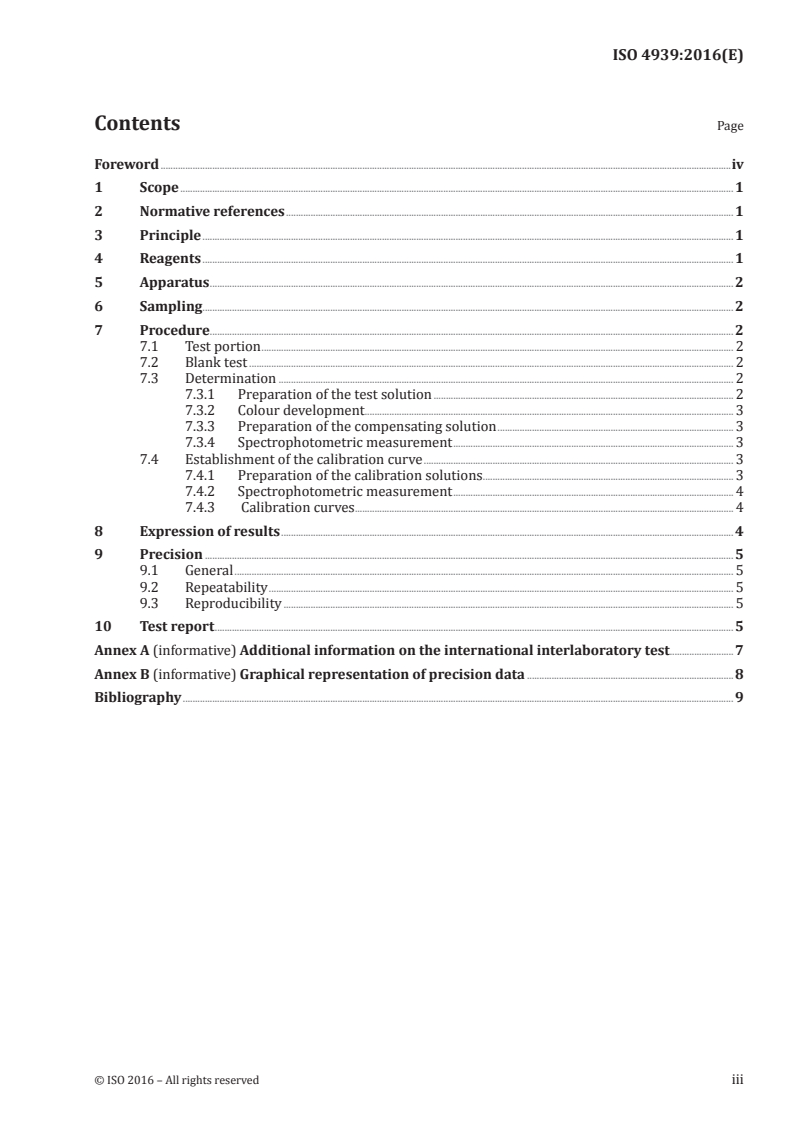
Contents Page
Foreword .iv
1 Scope . 1
2 Normative references . 1
3 Principle . 1
4 Reagents . 1
5 Apparatus . 2
6 Sampling . 2
7 Procedure. 2
7.1 Test portion . 2
7.2 Blank test . 2
7.3 Determination . 2
7.3.1 Preparation of the test solution . 2
7.3.2 Colour development . . 3
7.3.3 Preparation of the compensating solution . 3
7.3.4 Spectrophotometric measurement . 3
7.4 Establishment of the calibration curve . 3
7.4.1 Preparation of the calibration solutions . 3
7.4.2 Spectrophotometric measurement . 4
7.4.3 Calibration curves . 4
8 Expression of results . 4
9 Precision . 5
9.1 General . 5
9.2 Repeatability . 5
9.3 Reproducibility . 5
10 Test report . 5
Annex A (informative) Additional information on the international interlaboratory test.7
Annex B (informative) Graphical representation of precision data . 8
Bibliography . 9
Foreword
ISO (the International Organization for Standardization) is a worldwide federation of national standards
bodies (ISO member bodies). The work of preparing International Standards is normally carried out
through ISO technical committees. Each member body interested in a subject for which a technical
committee has been established has the right to be represented on that committee. International
organizations, governmental and non-governmental, in liaison with ISO, also take part in the work.
ISO collaborates closely with the International Electrotechnical Commission (IEC) on all matters of
electrotechnical standardization.
The procedures used to develop this document and those intended for its further maintenance are
described in the ISO/IEC Directives, Part 1. In particular the different approval criteria needed for the
different types of ISO documents should be noted. This document was drafted in accordance with the
editorial rules of the ISO/IEC Directives, Part 2 (see www.iso.org/directives).
Attention is drawn to the possibility that some of the elements of this document may be the subject of
patent rights. ISO shall not be held responsible for identifying any or all such patent rights. Details of
any patent rights identified during the development of the document will be in the Introduction and/or
on the ISO list of patent declarations received (see www.iso.org/patents).
Any trade name used in this document is information given for the convenience of users and does not
constitute an endorsement.
For an explanation on the meaning of ISO specific terms and expressions related to conformity
assessment, as well as information about ISO’s adherence to the WTO principles in the Technical
Barriers to Trade (TBT) see the following URL: Foreword - Supplementary information.
The committee responsible for this document is ISO/TC 17, Steel, Subcommittee SC 1, Methods of
determination of chemical compound.
This second edition cancels and replaces the first edition (ISO 4939:1984), which has been
technically revised. In particular, the specification of plotting of the calibration graphs shown in
7.4.3 has been corrected.
iv © ISO 2016 – All rights reserved
INTERNATIONAL STANDARD ISO 4939:2016(E)
Steel — Determination of nickel — Dimethylglyoxime
spectrophotometric method
1 Scope
This International Standard specifies a spectrophotometric method for the determination of nickel in
steel using dimethylglyoxime.
The method is applicable to the determination of nickel mass fractions in the range of 0,10 % and 2,0 %.
Cobalt, copper and manganese can cause interferences (see 7.3.2).
2 Normative references
The following documents, in whole or in part, are normatively referenced in this document and are
indispensable for its application. For dated references, only the edition cited applies. For undated
references, the latest edition of the referenced document (including any amendments) applies.
ISO 648, Laboratory glassware — Single-volume pipettes
ISO 1042, Laboratory glassware — One-mark volumetric flasks
ISO 3696, Water for analytical laboratory use — Specification and test methods
ISO 14284, Steel and iron — Sampling and preparation of samples for the determination of chemical
composition
3 Principle
Dissolution of a test portion in hydrochloric, nitric and perchloric acids.
Formation of a coloured complex of nickel(lll) with dimethylglyoxime in ammoniacal solution containing
iodine and potassium iodide.
Spectrophotometric measurement at a wavelength of about 535 nm.
4 Reagents
During the analysis, unless otherwise stated, use only reagents of recognized analytical grade and only
grade 2 water as specified in ISO 3696.
4.1 Acid mixture.
Mix two volumes of hydrochloric acid, ρ approximately 1,19 g/ml, one volume of nitric acid, ρ
approximately 1,40 g/ml and two volumes of water.
4.2 Perchloric acid, ρ approximately 1,54 g/ml.
WARNING — Perchloric acid vapour might cause explosions in the presence of ammonia, nitrous
fumes or organic material in general.
Perchloric acid, ρ approximately 1,67 g/ml, may also be used. 100 ml of perchloric acid, ρ approximately
1,54 g/ml is equivalent to 79 ml of perchloric acid, ρ approximately 1,67 g/ml.
-----------
...
INTERNATIONAL ISO
STANDARD 4939
Second edition
2016-02-01
Steel — Determination of
nickel — Dimethylglyoxime
spectrophotometric method
Aciers — Détermination du nickel — Méthode spectrophotométrique
à la diméthylglyoxime
Reference number
©
ISO 2016
© ISO 2016, Published in Switzerland
All rights reserved. Unless otherwise specified, no part of this publication may be reproduced or utilized otherwise in any form
or by any means, electronic or mechanical, including photocopying, or posting on the internet or an intranet, without prior
written permission. Permission can be requested from either ISO at the address below or ISO’s member body in the country of
the requester.
ISO copyright office
Ch. de Blandonnet 8 • CP 401
CH-1214 Vernier, Geneva, Switzerland
Tel. +41 22 749 01 11
Fax +41 22 749 09 47
copyright@iso.org
www.iso.org
ii © ISO 2016 – All rights reserved
Contents Page
Foreword .iv
1 Scope . 1
2 Normative references . 1
3 Principle . 1
4 Reagents . 1
5 Apparatus . 2
6 Sampling . 2
7 Procedure. 2
7.1 Test portion . 2
7.2 Blank test . 2
7.3 Determination . 2
7.3.1 Preparation of the test solution . 2
7.3.2 Colour development . . 3
7.3.3 Preparation of the compensating solution . 3
7.3.4 Spectrophotometric measurement . 3
7.4 Establishment of the calibration curve . 3
7.4.1 Preparation of the calibration solutions . 3
7.4.2 Spectrophotometric measurement . 4
7.4.3 Calibration curves . 4
8 Expression of results . 4
9 Precision . 5
9.1 General . 5
9.2 Repeatability . 5
9.3 Reproducibility . 5
10 Test report . 5
Annex A (informative) Additional information on the international interlaboratory test.7
Annex B (informative) Graphical representation of precision data . 8
Bibliography . 9
Foreword
ISO (the International Organization for Standardization) is a worldwide federation of national standards
bodies (ISO member bodies). The work of preparing International Standards is normally carried out
through ISO technical committees. Each member body interested in a subject for which a technical
committee has been established has the right to be represented on that committee. International
organizations, governmental and non-governmental, in liaison with ISO, also take part in the work.
ISO collaborates closely with the International Electrotechnical Commission (IEC) on all matters of
electrotechnical standardization.
The procedures used to develop this document and those intended for its further maintenance are
described in the ISO/IEC Directives, Part 1. In particular the different approval criteria needed for the
different types of ISO documents should be noted. This document was drafted in accordance with the
editorial rules of the ISO/IEC Directives, Part 2 (see www.iso.org/directives).
Attention is drawn to the possibility that some of the elements of this document may be the subject of
patent rights. ISO shall not be held responsible for identifying any or all such patent rights. Details of
any patent rights identified during the development of the document will be in the Introduction and/or
on the ISO list of patent declarations received (see www.iso.org/patents).
Any trade name used in this document is information given for the convenience of users and does not
constitute an endorsement.
For an explanation on the meaning of ISO specific terms and expressions related to conformity
assessment, as well as information about ISO’s adherence to the WTO principles in the Technical
Barriers to Trade (TBT) see the following URL: Foreword - Supplementary information.
The committee responsible for this document is ISO/TC 17, Steel, Subcommittee SC 1, Methods of
determination of chemical compound.
This second edition cancels and replaces the first edition (ISO 4939:1984), which has been
technically revised. In particular, the specification of plotting of the calibration graphs shown in
7.4.3 has been corrected.
iv © ISO 2016 – All rights reserved
INTERNATIONAL STANDARD ISO 4939:2016(E)
Steel — Determination of nickel — Dimethylglyoxime
spectrophotometric method
1 Scope
This International Standard specifies a spectrophotometric method for the determination of nickel in
steel using dimethylglyoxime.
The method is applicable to the determination of nickel mass fractions in the range of 0,10 % and 2,0 %.
Cobalt, copper and manganese can cause interferences (see 7.3.2).
2 Normative references
The following documents, in whole or in part, are normatively referenced in this document and are
indispensable for its application. For dated references, only the edition cited applies. For undated
references, the latest edition of the referenced document (including any amendments) applies.
ISO 648, Laboratory glassware — Single-volume pipettes
ISO 1042, Laboratory glassware — One-mark volumetric flasks
ISO 3696, Water for analytical laboratory use — Specification and test methods
ISO 14284, Steel and iron — Sampling and preparation of samples for the determination of chemical
composition
3 Principle
Dissolution of a test portion in hydrochloric, nitric and perchloric acids.
Formation of a coloured complex of nickel(lll) with dimethylglyoxime in ammoniacal solution containing
iodine and potassium iodide.
Spectrophotometric measurement at a wavelength of about 535 nm.
4 Reagents
During the analysis, unless otherwise stated, use only reagents of recognized analytical grade and only
grade 2 water as specified in ISO 3696.
4.1 Acid mixture.
Mix two volumes of hydrochloric acid, ρ approximately 1,19 g/ml, one volume of nitric acid, ρ
approximately 1,40 g/ml and two volumes of water.
4.2 Perchloric acid, ρ approximately 1,54 g/ml.
WARNING — Perchloric acid vapour might cause explosions in the presence of ammonia, nitrous
fumes or organic material in general.
Perchloric acid, ρ approximately 1,67 g/ml, may also be used. 100 ml of perchloric acid, ρ approximately
1,54 g/ml is equivalent to 79 ml of perchloric acid, ρ approximately 1,67 g/ml.
-----------
...