

ISO 20793:2024
(Main)Photography — Lenticular print for changing images — Measurements of image quality
General Information
- Abstract
This document specifies the measurement methods and specification of image quality of lenticular prints that are used for changing images. This document does not cover lenticular prints that are used for 3D images. NOTE Lenticular prints for 3D images can be measured with the same types of procedures. However, it needs more information, such as the dependence of the measurement distance, to evaluate the 3D performance. This document specifically describes measurement methods for crosstalk, viewing angle range, angular misalignment from the designed viewing angle and the uniformity of the image within the printing area of the lenticular print images. These are critical for the image quality of lenticular prints for changing images. This document is applicable to lenticular prints produced by printing technologies that include impact and non-impact printing. Examples of the former are off-set, gravure and flexography, while the examples of the latter are silver halide, inkjet, dye diffusion thermal transfer and electrophotography. The multiple laser images (MLI) and changeable laser images (CLI) process of using a laser to write through a lenticular screen at different angles to create two monochrome images is also used.
- Status
- Published
- Publication Date
- 02-May-2024
- Technical Committee
- ISO/TC 42 - Photography
- Drafting Committee
- ISO/TC 42 - Photography
- Current Stage
- 6060 - International Standard published
- Start Date
- 03-May-2024
- Due Date
- 09-Mar-2026
- Completion Date
- 03-May-2024

Overview
ISO 20793:2024 - Photography - Lenticular print for changing images - Measurements of image quality provides standardized measurement methods and specification requirements for the image quality of lenticular prints used to display changing images (not the 3D-use case). The standard sets out how to measure critical performance attributes such as crosstalk, viewing angle range, angular misalignment, and uniformity across the printing area. It applies to lenticular prints produced by a wide range of printing processes (impact and non‑impact) and to laser imaging processes (MLI, CLI).
Key topics and technical requirements
- Scope and exclusions
- Focuses on lenticular prints for changing/morphing images; 3D lenticular prints are excluded (though similar procedures may be used with additional distance‑dependent evaluation).
- Standard environmental conditions
- Measurements use controlled conditions (temperature and humidity specified in the standard) to ensure repeatability.
- Illumination and measurement geometry
- Hemispherical diffuse illumination (typically using an integrating sphere) is the primary method. Directional illumination is also accommodated for application‑specific simulations.
- For angular dependence, the sample is rotated about an axis parallel to the lenticular lens array.
- Measurement instruments
- Reflected light measurements are done with a spectroradiometer or radiometer with photopic response (V‑filter).
- Measurement metrics
- Procedures and formulas for calculating crosstalk, viewing angle range, angular misalignment from the designed viewing angle, and uniformity across the printed area.
- Sample preparation and test patterns
- Guidance on test patterns, printing, and sample construction for valid measurements.
- Classification
- The standard includes classification criteria for the measured metrics to support specification and acceptance.
Practical applications
- Quality control and acceptance testing in lenticular printing production lines
- Comparative evaluation of lenticular materials and lens sheets
- R&D and process optimization for printers using offset, gravure, flexography, silver halide, inkjet, dye diffusion thermal transfer, electrophotography, and laser imaging (MLI/CLI)
- Conformance testing for product specifications (posters, packaging, signage, secure documents, promotional materials)
Who should use ISO 20793:2024
- Lenticular print manufacturers and converters
- Print quality and QA laboratories
- Material suppliers (lens sheets and substrates)
- Brand owners specifying lenticular image performance
- Test‑instrument manufacturers and metrology labs
- Standards and compliance teams in printing and security document sectors
Related standards
- Normative references in ISO 20793 include ISO 5‑3 and ISO 5‑4 (density and geometric conditions for reflection density). Annexes A–D provide informative material: lens explanation, printing procedures, evaluation of lenticular material prior to laser imaging, and selection/inspection guidance.
Keywords: ISO 20793, lenticular print, image quality measurement, crosstalk, viewing angle, angular misalignment, uniformity, integrating sphere, spectroradiometer, lenticular printing.
Relations
- Effective Date
- 11-Mar-2023
Frequently Asked Questions
ISO 20793:2024 is a standard published by the International Organization for Standardization (ISO). Its full title is "Photography — Lenticular print for changing images — Measurements of image quality". This standard covers: This document specifies the measurement methods and specification of image quality of lenticular prints that are used for changing images. This document does not cover lenticular prints that are used for 3D images. NOTE Lenticular prints for 3D images can be measured with the same types of procedures. However, it needs more information, such as the dependence of the measurement distance, to evaluate the 3D performance. This document specifically describes measurement methods for crosstalk, viewing angle range, angular misalignment from the designed viewing angle and the uniformity of the image within the printing area of the lenticular print images. These are critical for the image quality of lenticular prints for changing images. This document is applicable to lenticular prints produced by printing technologies that include impact and non-impact printing. Examples of the former are off-set, gravure and flexography, while the examples of the latter are silver halide, inkjet, dye diffusion thermal transfer and electrophotography. The multiple laser images (MLI) and changeable laser images (CLI) process of using a laser to write through a lenticular screen at different angles to create two monochrome images is also used.
This document specifies the measurement methods and specification of image quality of lenticular prints that are used for changing images. This document does not cover lenticular prints that are used for 3D images. NOTE Lenticular prints for 3D images can be measured with the same types of procedures. However, it needs more information, such as the dependence of the measurement distance, to evaluate the 3D performance. This document specifically describes measurement methods for crosstalk, viewing angle range, angular misalignment from the designed viewing angle and the uniformity of the image within the printing area of the lenticular print images. These are critical for the image quality of lenticular prints for changing images. This document is applicable to lenticular prints produced by printing technologies that include impact and non-impact printing. Examples of the former are off-set, gravure and flexography, while the examples of the latter are silver halide, inkjet, dye diffusion thermal transfer and electrophotography. The multiple laser images (MLI) and changeable laser images (CLI) process of using a laser to write through a lenticular screen at different angles to create two monochrome images is also used.
ISO 20793:2024 is classified under the following ICS (International Classification for Standards) categories: 37.040.01 - Photography in general. The ICS classification helps identify the subject area and facilitates finding related standards.
ISO 20793:2024 has the following relationships with other standards: It is inter standard links to ISO/TS 20793:2019. Understanding these relationships helps ensure you are using the most current and applicable version of the standard.
ISO 20793:2024 is available in PDF format for immediate download after purchase. The document can be added to your cart and obtained through the secure checkout process. Digital delivery ensures instant access to the complete standard document.
Standards Content (Sample)
International
Standard
ISO 20793
First edition
Photography — Lenticular print for
2024-05
changing images — Measurements
of image quality
Photographie — Impression lenticulaire pour images
changeantes — Mesurages de la qualité des images
Reference number
© ISO 2024
All rights reserved. Unless otherwise specified, or required in the context of its implementation, no part of this publication may
be reproduced or utilized otherwise in any form or by any means, electronic or mechanical, including photocopying, or posting on
the internet or an intranet, without prior written permission. Permission can be requested from either ISO at the address below
or ISO’s member body in the country of the requester.
ISO copyright office
CP 401 • Ch. de Blandonnet 8
CH-1214 Vernier, Geneva
Phone: +41 22 749 01 11
Email: copyright@iso.org
Website: www.iso.org
Published in Switzerland
ii
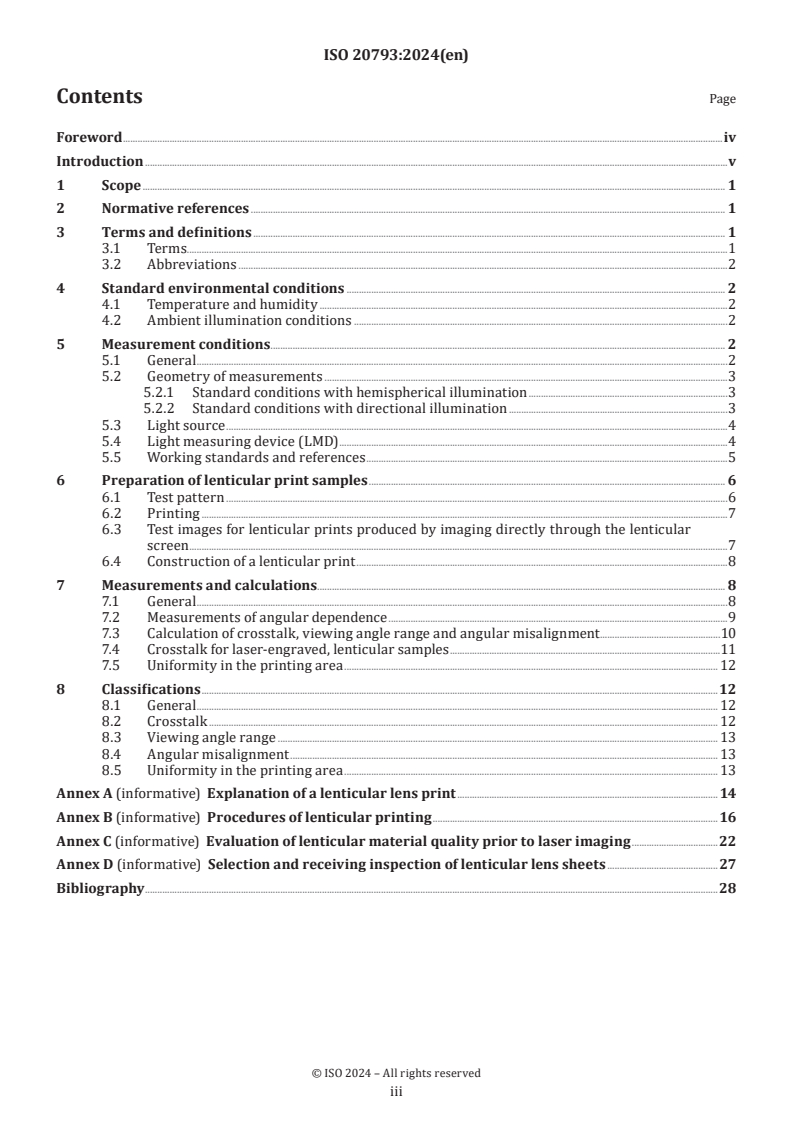
Contents Page
Foreword .iv
Introduction .v
1 Scope . 1
2 Normative references . 1
3 Terms and definitions . 1
3.1 Terms.1
3.2 Abbreviations .2
4 Standard environmental conditions . 2
4.1 Temperature and humidity .2
4.2 Ambient illumination conditions .2
5 Measurement conditions . 2
5.1 General .2
5.2 Geometry of measurements .3
5.2.1 Standard conditions with hemispherical illumination .3
5.2.2 Standard conditions with directional illumination .3
5.3 Light source .4
5.4 Light measuring device (LMD) .4
5.5 Working standards and references .5
6 Preparation of lenticular print samples . 6
6.1 Test pattern .6
6.2 Printing .7
6.3 Test images for lenticular prints produced by imaging directly through the lenticular
screen .7
6.4 Construction of a lenticular print .8
7 Measurements and calculations. 8
7.1 General .8
7.2 Measurements of angular dependence .9
7.3 Calculation of crosstalk, viewing angle range and angular misalignment .10
7.4 Crosstalk for laser-engraved, lenticular samples .11
7.5 Uniformity in the printing area . 12
8 Classifications .12
8.1 General . 12
8.2 Crosstalk . 12
8.3 Viewing angle range . 13
8.4 Angular misalignment . 13
8.5 Uniformity in the printing area . 13
Annex A (informative) Explanation of a lenticular lens print . 14
Annex B (informative) Procedures of lenticular printing .16
Annex C (informative) Evaluation of lenticular material quality prior to laser imaging .22
Annex D (informative) Selection and receiving inspection of lenticular lens sheets .27
Bibliography .28
iii
Foreword
ISO (the International Organization for Standardization) is a worldwide federation of national standards
bodies (ISO member bodies). The work of preparing International Standards is normally carried out through
ISO technical committees. Each member body interested in a subject for which a technical committee
has been established has the right to be represented on that committee. International organizations,
governmental and non-governmental, in liaison with ISO, also take part in the work. ISO collaborates closely
with the International Electrotechnical Commission (IEC) on all matters of electrotechnical standardization.
The procedures used to develop this document and those intended for its further maintenance are described
in the ISO/IEC Directives, Part 1. In particular, the different approval criteria needed for the different types
of ISO document should be noted. This document was drafted in accordance with the editorial rules of the
ISO/IEC Directives, Part 2 (see www.iso.org/directives).
ISO draws attention to the possibility that the implementation of this document may involve the use of (a)
patent(s). ISO takes no position concerning the evidence, validity or applicability of any claimed patent
rights in respect thereof. As of the date of publication of this document, ISO had not received notice of (a)
patent(s) which may be required to implement this document. However, implementers are cautioned that
this may not represent the latest information, which may be obtained from the patent database available at
www.iso.org/patents. ISO shall not be held responsible for identifying any or all such patent rights.
Any trade name used in this document is information given for the convenience of users and does not
constitute an endorsement.
For an explanation of the voluntary nature of standards, the meaning of ISO specific terms and expressions
related to conformity assessment, as well as information about ISO's adherence to the World Trade
Organization (WTO) principles in the Technical Barriers to Trade (TBT), see www.iso.org/iso/foreword.html.
This document was prepared by Technical Committee ISO/TC 42, Photography.
This first edition of ISO 20793 cancels and replaces the first edition of ISO/TS 20793:2019, which has been
technically revised.
Any feedback or questions on this document should be directed to the user’s national standards body. A
complete listing of these bodies can be found at www.iso.org/members.html.
iv
Introduction
Lenticular printing is a technology wherein lenticular lenses are used to produce printed images with an
illusion of depth, i.e. three-dimensional (3D) effect, or the ability to change or move as the image is viewed
from different angles. Lenticular prints for displaying changing images are built up with a lenticular lens
sheet and a printed sheet that contains at least two images, interleaved with the same spatial frequency as
the lenticular lens sheet.
In this context, lenticular lenses generally take the form of arrays of cylindrical lenses, each acting as a
magnifying lens. Widespread applications of lenticular printing are signage, display posters, business cards,
multilingual message boards, packages with changing images or 3D effects, and secure documents.
It has been reported that the market size of lenticular prints is over 100 million m and that the market is
growing. Furthermore, the potential image qualities of lenticular printing have dramatically improved, and
further improvements are expected in the future. While production of lenticular sheets with a lens frequency
of 100 lpi (lines per inch) is routine, products with a 200 lpi frequency are also currently available.
Although the potential image quality of lenticular prints is high as described above, the quality of images is
not always good in the market due to various causes, e.g., due to the misalignment of the lenticular lens and
lenticular printed images. This is a critical problem for lenticular printing.
To improve the image quality of lenticular prints, image quality measurements are essential. This document
provides standard measurement methods and the specifications for the image quality of lenticular prints.
v
International Standard ISO 20793:2024(en)
Photography — Lenticular print for changing images —
Measurements of image quality
1 Scope
This document specifies the measurement methods and specification of image quality of lenticular prints
that are used for changing images. This document does not cover lenticular prints that are used for 3D images.
NOTE Lenticular prints for 3D images can be measured with the same types of procedures. However, it needs
more information, such as the dependence of the measurement distance, to evaluate the 3D performance.
This document specifically describes measurement methods for crosstalk, viewing angle range, angular
misalignment from the designed viewing angle and the uniformity of the image within the printing area of
the lenticular print images. These are critical for the image quality of lenticular prints for changing images.
This document is applicable to lenticular prints produced by printing technologies that include impact and
non-impact printing. Examples of the former are off-set, gravure and flexography, while the examples of the
latter are silver halide, inkjet, dye diffusion thermal transfer and electrophotography. The multiple laser
images (MLI) and changeable laser images (CLI) process of using a laser to write through a lenticular screen
at different angles to create two monochrome images is also used.
2 Normative references
The following documents are referred to in the text in such a way that some or all of their content constitutes
requirements of this document. For dated references, only the edition cited applies. For undated references,
the latest edition of the referenced document (including any amendments) applies.
ISO 5-3, Photography and graphic technology — Density measurements — Part 3: Spectral conditions
ISO 5-4, Photography and graphic technology — Density measurements — Part 4: Geometric conditions for
reflection density
3 Terms and definitions
For the purposes of this document, the following terms and definitions apply.
ISO and IEC maintain terminology databases for use in standardization at the following addresses:
— ISO Online browsing platform: available at https:// www .iso .org/ obp
— IEC Electropedia: available at https:// www .electropedia .org/
3.1 Terms
3.1.1
lenticular lens
array of magnifying semi-cylindrical lenses, designed to produce a desired perception, such as 3D, motion or
morphing, to the underlying interlaced image
EXAMPLE This technique is widely used in lenticular printing, wherein the lenticular lens is used to provide an
illusion of depth, change or motion to an underlying interlaced image when viewed from different angles.
[SOURCE: ISO/TS 20328:2016, 3.1, modified — Note 1 to entry has been removed.]
3.1.2
lenticular print
print combined with lenticular lenses which produces printed images with an illusion of depth, i.e. three-
dimensional (3D) effect, or the ability to change or move as the image is viewed from different angles
Note 1 to entry: The detailed explanation of lenticular print is provided in Annex A.
Note 2 to entry: Lenticular prints to display changing images are built up with a lenticular lens sheet and a printed
sheet that contains at least two images, interleaved with the same spatial frequency as the lenticular lens sheet.
3.2 Abbreviations
CIE commission internationale de l'éclairage (International Commission on Illumination)
CLI changeable laser image
CTP computer to plate
LMD light measuring device
MLI multiple laser image
RGB red, green, blue
4 Standard environmental conditions
4.1 Temperature and humidity
The standard environmental conditions shall be applied for the measurements of lenticular prints.
The standard environmental conditions shall be a temperature of 23 °C ± 3 °C and a humidity of
50 % RH ± 15 % RH.
4.2 Ambient illumination conditions
For standard dark room conditions, the ambient illuminance at any position on the lenticular print is
below 0,3 lx in all directions or the illuminance shall at least be less than a level that does not influence the
measurement results.
When directional illumination is used, standard dark room conditions shall be applied unless the
instrumentation used is effective in suppressing background illumination.
When the sample is set in an integrated sphere, a dark room may not be required.
5 Measurement conditions
5.1 General
For the measurements, the lenticular print samples shall be illuminated with hemispherical diffuse lighting.
Directional illumination can also be used when it is appropriate for simulating the use application.
The reflected light from the print sample shall be measured using a spectroradiometer or a radiometer with
photopic response (V - filter).
λ
5.2 Geometry of measurements
5.2.1 Standard conditions with hemispherical illumination
Uniform hemispherical diffuse illumination is generally realized by using an integrating sphere. The
lenticular print sample shall be placed in the centre of an integrating sphere as shown in Figure 1. For the
calibration, the reflection standard, i.e. a standard white board, shall be placed at the same position of
the lenticular print sample. Best practices for integral sphere design and measurements are described in
References [2] and [3].
When the viewing direction dependence is measured, the print sample shall be rotated around the axis
parallel to the direction of the array of lenticular lens.
Key
1 lenticular print 4 baffle
2 integration sphere 5 light measurement device
a
3 light source Reflected light from sample.
Figure 1 — Geometry of measurement with hemispherical illumination
NOTE A colorimetric conoscopic measurement device with diffuse illumination through the optical system gives
similar information but not equivalent results.
5.2.2 Standard conditions with directional illumination
For samples that are not laser engraved, the directional light shall be illuminated at an angle of 45° from the
normal, and the reflected light shall be detected from the direction normal to the print as shown in Figure 2.
The light source and the detector shall be placed in the same plane. The lenticular print shall first be set
normal to the detector, and it shall be rotated from the normal direction in order to measure the viewing
angle dependence.
Key
b
1 lenticular print Reflected light.
c
2 light source — directional Angle of the incident light = 45°.
d
3 detector Angle of the detection = 90°.
a e
Incident light. Angle of rotation of the print.
Figure 2 — Geometry of measurement with directional illumination
NOTE A colorimetric conoscopic measurement device with directed illumination through the optical system
gives similar information but not equivalent results.
Laser-engraved, lenticular prints with small sample sizes, such as those used in security printing are
illuminated most effectively with 0°/45° directional illumination, with the illumination perpendicular to the
lenticular screen.
5.3 Light source
For the standard conditions, hemispherical illumination shall be applied. The illumination spectra shall be a
stable and spectrally continuous broadband visible light source, for example, an incandescent lamp defined
as CIE Standard Illuminant A.
5.4 Light measuring device (LMD)
The light reflected from the lenticular print shall be measured. Illuminant D50 shall be applied. The following
requirements are given for measurement instrument:
a) The spectroradiometer shall be capable of measuring spectral radiance over at least the 380 nm to
780 nm wavelength range, with a maximum bandwidth of 10 nm for smooth broadband spectra.
Care shall be taken to ensure that the LMD has enough sensitivity and dynamic range to perform the
required task. The measured LMD signal shall be at least ten times greater than the dark level (noise
floor) of the LMD, and no greater than 85 % of the saturation level.
b) The LMD shall be focused on the image plane of the print and aligned perpendicular to its surface, unless
stated otherwise.
c) The relative uncertainty and repeatability of all the measuring devices shall be maintained by following
the instrument supplier’s recommended calibration schedule.
d) The recommended measuring distance is between 30 cm to 60 cm. The measuring distance shall be
noted in the report.
e) The angular aperture shall be less than or equal to 5°, and the measurement field angle shall be less than
or equal to 2° (see Figure 3).
f) The measurement field of the LMD shall be centred and enclosed within the illuminated measuring spot
on the print.
Key
c
1 lenticular print Measurement area (measurement field).
d
2 LMD Angular aperture.
a e
Measuring distance. Aperture area.
b
Measurement area angle (measurement field angle).
Figure 3 — Layout diagram of measurement setup
5.5 Working standards and references
The LMD shall be calibrated with a diffuse white reflectance standard sample with a diffuse reflectance of
98 % or more. The reflectance shall be calculated based on the reflectance of the perfect white panel and the
black panel.
Diffuse white reflectance standard samples can be obtained with a diffuse reflectance of 98 % or more.
They are also available in different shades of grey. A luminance L measurement from such reflectance
std
standards can be used to determine the illuminance E on the standard for a defined detection geometry and
illumination spectra and configuration, as given by Formula (1):
πL
std
E= (1)
R
std
where R is the calibrated luminous reflectance factor for that measurement configuration. When the
std
illumination configuration is a uniform hemispherical illumination, then R is equivalent to luminous
std
reflectance ρ . The luminous reflectance value associated with the standard is only valid for the
std
hemispherical illumination in which it was calibrated. If it is used with a directed source at any angle, there
is no reason to expect that the luminous reflectance value will be the correct luminous reflectance factor
value for that illumination configuration or spectra.
The terms luminous reflectance and luminous reflectance factor shall be abbreviated to reflectance and
reflectance factor, respectively.
Black glass (e.g. BG-1 000), or a very high neutral density absorption filter (density of 4 or larger), can be
used to determine the luminance of a source, L , from the measured luminance, L , of the virtual source
s std
image as reflected by the black glass, and the luminous specular reflectance, ζ , of the black glass for the
std
measurement configuration used, as given by Formula (2):
L
std
L = (2)
s
ζ
std
When making specular measurements, the detector is focused on the virtual image of the source. Black glass
can be considered as a front surface mirror that has a low specular reflectance of between 4 % and 5 %. A
black glass standard can be helpful when the measurement geometry does not allow measuring the source
luminance directly, but only by using a mirror. The low specular reflectance of black glass allows measuring
the source luminance at about the same order of magnitude as the reflection measurement.
The specular reflectance of black glass is affected by the specular angle, the illumination spectrum, and the
cleanliness of its surface. The calibration shall be repeated when the measurement geometry is changed.
6 Preparation of lenticular print samples
6.1 Test pattern
The lenticular images are divided by several picture elements for one lenticular lens width, as shown in
Figure 4. For the measurements of this document, striped test patterns shall be used, where each strip
element shall be white or black, or other primary colours.
Key
b
A lenticular lens Picture elements of lenticular print.
a
Number of picture element.
Figure 4 — Schematic illustration of the picture elements of a lenticular print
The test pattern shown in Table 1 shall be applied for the measurement. Table 1 is for 12 picture elements
in one lenticular lens width. For other cases, an analogous test pattern shall be applied. Table 1 is illustrated
with black and white. For the evaluation of colour images, black shall be replaced with a primary colour of
yellow, magenta, or cyan, or a secondary colour of red, green, or blue.
Table 1 — Example of test patterns for 12 views
Picture element 1 2 3 4 5 6 7 8 9 10 11 12
All white
All black
2-way split 1/2
2/2
3-way split 1/3
2/3
3/3
4-way split 1/4
2/4
3/4
4/4
NOTE The black box indicates a black strip and the white box
...