


ISO/IEC 23009-1:2014
(Main)Information technology — Dynamic adaptive streaming over HTTP (DASH) — Part 1: Media presentation description and segment formats
Information technology — Dynamic adaptive streaming over HTTP (DASH) — Part 1: Media presentation description and segment formats
ISO/IEC 23009-1:2014 primarily specifies formats for the Media Presentation Description and Segments for dynamic adaptive streaming delivery of MPEG media over HTTP. It is applicable to streaming services over the Internet.
Technologies de l'information — Diffusion en flux adaptatif dynamique sur HTTP (DASH) — Partie 1: Description de la présentation et formats de remise des médias
General Information
- Status
- Withdrawn
- Publication Date
- 11-May-2014
- Withdrawal Date
- 11-May-2014
- Current Stage
- 9599 - Withdrawal of International Standard
- Start Date
- 13-Aug-2019
- Completion Date
- 12-Feb-2026
Relations
- Effective Date
- 06-Jun-2022
- Effective Date
- 11-Dec-2021
- Effective Date
- 14-Aug-2021
- Effective Date
- 09-May-2020
- Effective Date
- 24-Feb-2018
- Effective Date
- 16-Nov-2013

ISO/IEC 23009-1:2014 - Information technology -- Dynamic adaptive streaming over HTTP (DASH)


ISO/IEC 23009-1:2014 - Information technology -- Dynamic adaptive streaming over HTTP (DASH)
Get Certified
Connect with accredited certification bodies for this standard

BSI Group
BSI (British Standards Institution) is the business standards company that helps organizations make excellence a habit.

NYCE
Mexican standards and certification body.
Sponsored listings
Frequently Asked Questions
ISO/IEC 23009-1:2014 is a standard published by the International Organization for Standardization (ISO). Its full title is "Information technology — Dynamic adaptive streaming over HTTP (DASH) — Part 1: Media presentation description and segment formats". This standard covers: ISO/IEC 23009-1:2014 primarily specifies formats for the Media Presentation Description and Segments for dynamic adaptive streaming delivery of MPEG media over HTTP. It is applicable to streaming services over the Internet.
ISO/IEC 23009-1:2014 primarily specifies formats for the Media Presentation Description and Segments for dynamic adaptive streaming delivery of MPEG media over HTTP. It is applicable to streaming services over the Internet.
ISO/IEC 23009-1:2014 is classified under the following ICS (International Classification for Standards) categories: 35.040 - Information coding; 35.040.40 - Coding of audio, video, multimedia and hypermedia information. The ICS classification helps identify the subject area and facilitates finding related standards.
ISO/IEC 23009-1:2014 has the following relationships with other standards: It is inter standard links to ISO 80369-3:2016/Amd 1:2019, ISO/IEC 23009-1:2014/Amd 1:2015, ISO/IEC 23009-1:2014/Amd 2:2015, ISO/IEC 23009-1:2014/Amd 3:2016, ISO/IEC 23009-1:2019, ISO/IEC 23009-1:2012. Understanding these relationships helps ensure you are using the most current and applicable version of the standard.
ISO/IEC 23009-1:2014 is available in PDF format for immediate download after purchase. The document can be added to your cart and obtained through the secure checkout process. Digital delivery ensures instant access to the complete standard document.
Standards Content (Sample)
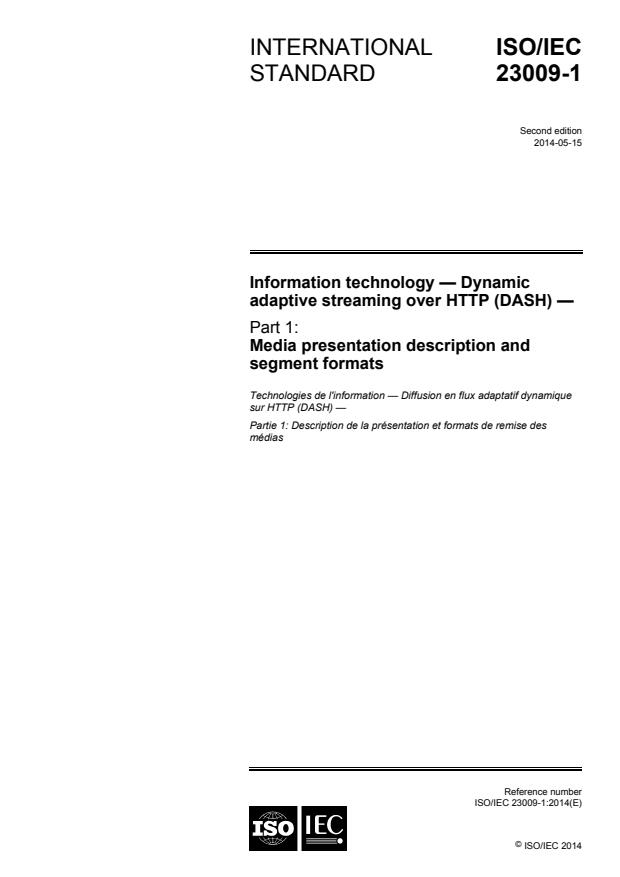
INTERNATIONAL ISO/IEC
STANDARD 23009-1
Second edition
2014-05-15
Information technology — Dynamic
adaptive streaming over HTTP (DASH) —
Part 1:
Media presentation description and
segment formats
Technologies de l'information — Diffusion en flux adaptatif dynamique
sur HTTP (DASH) —
Partie 1: Description de la présentation et formats de remise des
médias
Reference number
©
ISO/IEC 2014
© ISO/IEC 2014
All rights reserved. Unless otherwise specified, no part of this publication may be reproduced or utilized otherwise in any form or by any
means, electronic or mechanical, including photocopying, or posting on the internet or an intranet, without prior written permission.
Permission can be requested from either ISO at the address below or ISO’s member body in the country of the requester.
ISO copyright office
Case postale 56 CH-1211 Geneva 20
Tel. + 41 22 749 01 11
Fax + 41 22 749 09 47
E-mail copyright@iso.org
Web www.iso.org
Published in Switzerland
ii © ISO/IEC 2014 – All rights reserved
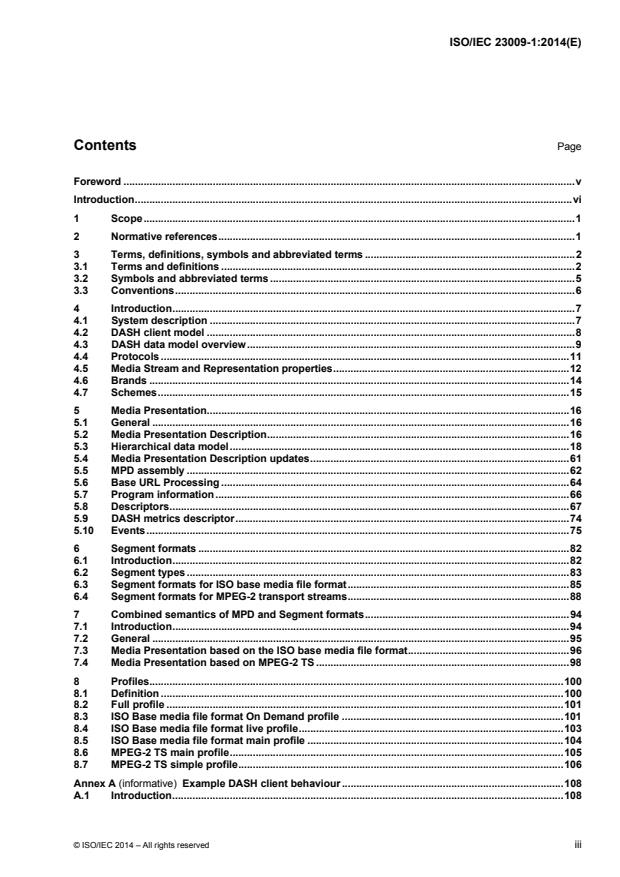
Contents Page
Foreword . v
Introduction . vi
1 Scope . 1
2 Normative references . 1
3 Terms, definitions, symbols and abbreviated terms . 2
3.1 Terms and definitions . 2
3.2 Symbols and abbreviated terms . 5
3.3 Conventions . 6
4 Introduction . 7
4.1 System description . 7
4.2 DASH client model . 8
4.3 DASH data model overview . 9
4.4 Protocols . 11
4.5 Media Stream and Representation properties . 12
4.6 Brands . 14
4.7 Schemes . 15
5 Media Presentation . 16
5.1 General . 16
5.2 Media Presentation Description . 16
5.3 Hierarchical data model . 18
5.4 Media Presentation Description updates . 61
5.5 MPD assembly . 62
5.6 Base URL Processing . 64
5.7 Program information . 66
5.8 Descriptors . 67
5.9 DASH metrics descriptor . 74
5.10 Events . 75
6 Segment formats . 82
6.1 Introduction . 82
6.2 Segment types . 83
6.3 Segment formats for ISO base media file format . 85
6.4 Segment formats for MPEG-2 transport streams . 88
7 Combined semantics of MPD and Segment formats . 94
7.1 Introduction . 94
7.2 General . 95
7.3 Media Presentation based on the ISO base media file format . 96
7.4 Media Presentation based on MPEG-2 TS . 98
8 Profiles. 100
8.1 Definition . 100
8.2 Full profile . 101
8.3 ISO Base media file format On Demand profile . 101
8.4 ISO Base media file format live profile . 103
8.5 ISO Base media file format main profile . 104
8.6 MPEG-2 TS main profile . 105
8.7 MPEG-2 TS simple profile . 106
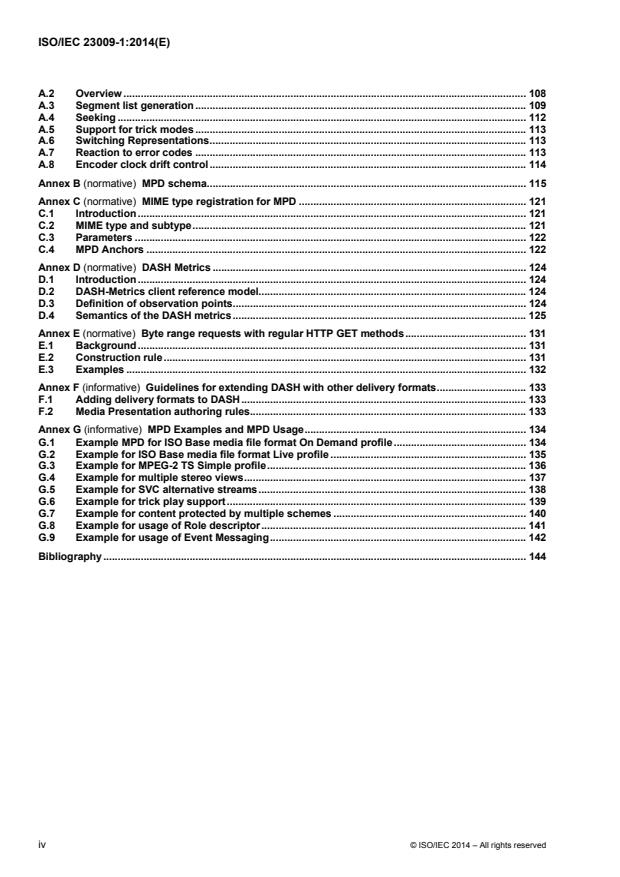
Annex A (informative) Example DASH client behaviour . 108
A.1 Introduction . 108
© ISO/IEC 2014 – All rights reserved iii
A.2 Overview . 108
A.3 Segment list generation . 109
A.4 Seeking . 112
A.5 Support for trick modes . 113
A.6 Switching Representations . 113
A.7 Reaction to error codes . 113
A.8 Encoder clock drift control . 114
Annex B (normative) MPD schema . 115
Annex C (normative) MIME type registration for MPD . 121
C.1 Introduction . 121
C.2 MIME type and subtype . 121
C.3 Parameters . 122
C.4 MPD Anchors . 122
Annex D (normative) DASH Metrics . 124
D.1 Introduction . 124
D.2 DASH-Metrics client reference model. 124
D.3 Definition of observation points . 124
D.4 Semantics of the DASH metrics . 125
Annex E (normative) Byte range requests with regular HTTP GET methods . 131
E.1 Background . 131
E.2 Construction rule . 131
E.3 Examples . 132
Annex F (informative) Guidelines for extending DASH with other delivery formats . 133
F.1 Adding delivery formats to DASH . 133
F.2 Media Presentation authoring rules. 133
Annex G (informative) MPD Examples and MPD Usage . 134
G.1 Example MPD for ISO Base media file format On Demand profile . 134
G.2 Example for ISO Base media file format Live profile . 135
G.3 Example for MPEG-2 TS Simple profile . 136
G.4 Example for multiple stereo views . 137
G.5 Example for SVC alternative streams . 138
G.6 Example for trick play support . 139
G.7 Example for content protected by multiple schemes . 140
G.8 Example for usage of Role descriptor . 141
G.9 Example for usage of Event Messaging . 142
Bibliography . 144
iv © ISO/IEC 2014 – All rights reserved
Foreword
ISO (the International Organization for Standardization) and IEC (the International Electrotechnical
Commission) form the specialized system for worldwide standardization. National bodies that are members of
ISO or IEC participate in the development of International Standards through technical committees
established by the respective organization to deal with particular fields of technical activity. ISO and IEC
technical committees collaborate in fields of mutual interest. Other international organizations, governmental
and non-governmental, in liaison with ISO and IEC, also take part in the work. In the field of information
technology, ISO and IEC have established a joint technical committee, ISO/IEC JTC 1.
International Standards are drafted in accordance with the rules given in the ISO/IEC Directives, Part 2.
The main task of the joint technical committee is to prepare International Standards. Draft International
Standards adopted by the joint technical committee are circulated to national bodies for voting. Publication as
an International Standard requires approval by at least 75 % of the national bodies casting a vote.
Attention is drawn to the possibility that some of the elements of this document may be the subject of patent
rights. ISO and IEC shall not be held responsible for identifying any or all such patent rights.
ISO/IEC 23009-1 was prepared by Joint Technical Committee ISO/IEC JTC 1, Information technology,
Subcommittee SC 29, Coding of audio, picture, multimedia and hypermedia information.
This second edition cancels and replaces the first edition (ISO/IEC 23009-1:2012), which has been technically
revised. It also incorporates the Technical Corrigendum ISO/IEC 23009-1:2012/Cor.1:2013.
ISO/IEC 23009 consists of the following parts, under the general title Information technology — Dynamic
adaptive streaming over HTTP (DASH):
Part 1: Media presentation description and segment formats
Part 2: Conformance and reference software
Part 3: Implementation guidelines [Technical Report]
Part 4: Segment encryption and authentication
© ISO/IEC 2014 – All rights reserved v
Introduction
Dynamic Adaptive Streaming over HTTP (DASH) is intended to support a media-streaming model for delivery
of media content in which control lies exclusively with the client. Clients may request data using the HTTP
protocol from standard web servers that have no DASH-specific capabilities. Consequently, this part of
ISO/IEC 23009 focuses not on client or server procedures but on the data formats used to provide a DASH
Media Presentation.
This part of ISO/IEC 23009 primarily specifies formats for the Media Presentation Description and Segments.
It is applicable to streaming services over the Internet.
vi © ISO/IEC 2014 – All rights reserved
INTERNATIONAL STANDARD ISO/IEC 23009-1:2014(E)
Information technology — Dynamic adaptive streaming over
HTTP (DASH) —
Part 1:
Media presentation description and segment formats
1 Scope
This part of ISO/IEC 23009 primarily specifies formats for the Media Presentation Description and Segments
for dynamic adaptive streaming delivery of MPEG media over HTTP. It is applicable to streaming services
over the Internet.
2 Normative references
The following documents, in whole or in part, are normatively referenced in this document and are
indispensable for its application. For dated references, only the edition cited applies. For undated references,
the latest edition of the referenced document (including any amendments) applies.
ITU-T Rec. H.222.0 | ISO/IEC 13818-1, Information technology — Generic coding of moving pictures and
associated audio information: Systems
ISO/IEC 14496-10, Information technology — Coding of audio-visual objects — Part 10: Advanced Video
Coding
ISO/IEC 14496-12, Information technology — Coding of audio-visual objects — Part 12: ISO base media file
format (technically identical to ISO/IEC 15444-12)
ISO/IEC 23001-8, Information technology — MPEG systems technologies — Part 8: Coding-independent
code points
IETF RFC 2141, URN Syntax, May 1997
IETF RFC 2616, Hypertext Transfer Protocol – HTTP/1.1, June 1999
IETF RFC 3023, XML Media Types, January 2001
IETF RFC 3406, Uniform Resource Names (URN) Namespace Definition Mechanisms, October 2002
IETF RFC 3629, UTF-8, a transformation format of ISO 10646, November 2003
IETF RFC 3986, Uniform Resource Identifier (URI): Generic Syntax, January 2005
IETF RFC 4122, A Universally Unique IDentifier (UUID) URN Namespace, July 2005
IETF RFC 4288, Media Type Specifications and Registration Procedures, December 2005
IETF RFC 4337, MIME Type Registration for MPEG-4, March 2006
© ISO/IEC 2014 – All rights reserved 1
IETF RFC 4648, The Base16, Base32, and Base64 Data Encodings, October 2006
IETF RFC 5261, An Extensible Markup Language (XML) Patch Operations Framework Utilizing XML Path
Language (XPath) Selectors, September 2008
IETF RFC 5646, Tags for Identifying Languages, September 2009
IETF RFC 6265, HTTP State Management Mechanism, April 2011
IETF RFC 6381, The 'Codecs' and 'Profiles' Parameters for "Bucket" Media Types, August 2011
W3C XLINK XML Linking Language (XLink) Version 1.1, W3C Recommendation 06, May 2010
W3C Media Fragments URI 1.0 (basic), W3C Recommendation, 25 September 2012
3 Terms, definitions, symbols and abbreviated terms
3.1 Terms and definitions
For the purposes of this document, the following terms and definitions apply.
3.1.1
access unit
unit of a media stream with an assigned Media Presentation time
3.1.2
accessibility
degree to which a media content or certain media content components are available to as many people as
possible
3.1.3
Adaptation Set
set of interchangeable encoded versions of one or several media content components
3.1.4
asset
content including media and metadata together with the rights to use the content by the content provider
3.1.5
available Segment
Segment that is accessible at its assigned HTTP-URL and a possibly assigned byte range that is the request
with an HTTP GET results in a reply of the Segment and 2xx status code
3.1.6
Bitstream Switching Segment
Segment that if present contains essential data to switch to the Representation it is assigned to
3.1.7
complementary Representation
Representation which complements at least one dependent Representation
3.1.8
continuous media
media with an inherent notion of time, for example, speech, audio, video, timed text or timed metadata
2 © ISO/IEC 2014 – All rights reserved
3.1.9
DASH metric
metric identified by a key and defined in this part of ISO/IEC 23009
3.1.10
dependent Representation
Representation for which Segments from its complementary Representations are necessary for presentation
and/or decoding of the contained media content components
3.1.11
earliest presentation time
smallest presentation time of any access unit of a Media Segment or Subsegment for a media stream
3.1.12
event
aperiodic sparse media-time related auxiliary information to the DASH client or to an application
3.1.13
event stream
sequence of related events
3.1.14
group
collection of Adaptation Sets that are not expected to be presented simultaneously
3.1.15
HTTP-URL
URL with a fixed scheme of “http” or “https”
3.1.16
Index Segment
Segment that primarily contains indexing information for Media Segments
3.1.17
Initialization Segment
Segment containing metadata that is necessary to present the media streams encapsulated in Media
Segments
3.1.18
media content
one media content period or a contiguous sequence of media content periods
3.1.19
media content component
one continuous component of the media content with an assigned media component type that can be
encoded individually into a media stream
3.1.20
media content component type
single type of media content such as audio, video, or text
3.1.21
media content period
set of media content components that have a common timeline as well as relationships on how they can be
presented
3.1.22
Media Presentation
collection of data that establishes a bounded or unbounded presentation of media content
© ISO/IEC 2014 – All rights reserved 3
3.1.23
Media Presentation Description
MPD
formalized description for a Media Presentation for the purpose of providing a streaming service
3.1.24
Media Presentation timeline
concatenation of the timeline of all Periods which itself is common to all Representations in the Period
3.1.25
Media Segment
Segment that complies with media format in use and enables playback when combined with zero or more
preceding segments, and an Initialization Segment (if any)
3.1.26
media stream
encoded version of a media content component
3.1.27
Media Subsegment
Subsegment that only contains media data but no Segment Index
3.1.28
message
part of an event containing information that is exclusively handled by the event handler
3.1.29
MPD start time
approximate presentation start time of a Media Segment signalled in MPD
3.1.30
MPD duration
approximate presentation duration of a Media Segment signalled in MPD
3.1.31
Period
interval of the Media Presentation, where a contiguous sequence of all Periods constitutes the Media
Presentation
3.1.32
presentation time
time associated to an access unit that maps it to the Media Presentation timeline
3.1.33
remote element entity
entity that contains one or more elements and is referenced in the MPD with an HTTP-URL contained in an
@xlink:href attribute
3.1.34
Representation
collection and encapsulation of one or more media streams in a delivery format and associated with
descriptive metadata
3.1.35
Segment
unit of data associated with an HTTP-URL and optionally a byte range that are specified by an MPD
4 © ISO/IEC 2014 – All rights reserved
3.1.36
Segment availability start time
latest time instant in wall-clock time at which a Segment becomes an available Segment
3.1.37
adjusted Segment availability start time
time instant in wall-clock time at which a Segment becomes an available Segment
3.1.38
Segment availability end time
time instant in wall-clock time at which a Segment ceases to be an available Segment
3.1.39
Segment Index
compact index of the time range to byte range mapping within a Media Segment separately from the MPD
3.1.40
stream access point
SAP
position in a Representation enabling playback of a media stream to be started using only the information
contained in Representation data starting from that position onwards (preceded by initializing data in the
Initialization Segment, if any)
3.1.41
Sub-Representation
part of a Representation described in the MPD that is present in the entire Period
3.1.42
Subsegment
unit within Media Segments that is indexed by a Segment Index
3.1.43
valid Segment URL
HTTP-URL that is promised to reference a Segment during its Segment availability period
3.1.44
wall-clock time
time as stated by UTC
3.2 Symbols and abbreviated terms
For the purposes of this document, the following symbols and abbreviated terms apply.
AVC advanced video coding
CAT conditional access table
DASH dynamic adaptive streaming over HTTP
DM DASH Metrics
DRM digital rights management
ECM entitlement control message
HTTP hypertext transfer protocol
IDR instantaneous decoding refresh
© ISO/IEC 2014 – All rights reserved 5
ISOBMFF ISO base media file format
MPD Media Presentation Description
MVC multi-view video coding
PAT program association table
PCR program clock reference
PES packetized elementary stream
PID packet identifier
PMT program map table
PSI program specific information
PTS presentation time stamp
SAP stream access point
SEI supplementary enhancement information
SVC scalable video coding
TCP transmission control protocol
TLS transport layer security
TS transport stream
URI uniform resource identifier
URL uniform resource locator
URN uniform resource name
UTC coordinated universal time
UUID universally unique identifier
XML extensible mark-up language
3.3 Conventions
The following naming conventions apply in this document.
Elements in an XML document are identified by an upper-case first letter and in bold face as
Element. To express that an element Element1 is contained in another element Element2, we
may write Element2.Element1. If an element's name consists of two or more combined words,
camel-casing is typically used, e.g. ImportantElement. Elements may be present either exactly
once, or the minimum and maximum occurrence is defined by . .
Attributes in an XML document are identified by a lower-case first letter as well as they are preceded
by a ‘@’-sign, e.g. @attribute. To point to a specific attribute @attribute contained in an element
Element, one may write Element@attribute. If an attribute's name consists of two or more
combined words, camel-casing is typically used after the first word, e.g.
6 © ISO/IEC 2014 – All rights reserved
@veryImportantAttribute. Attributes may have assigned a status in the XML as mandatory (M),
optional (O), optional with default value (OD) and conditionally mandatory (CM).
Namespace qualification of elements and attributes is used as per XML standards, in the form of
namespace:Element or @namespace:attribute The fully qualified namespace will be provided
in the schema fragment associated with the declaration. External specifications extending the
namespace of DASH are expected to document the element name in the semantic table with an
extension namespace prefix.
Variables defined in the context of this document are specifically highlighted with italics, e.g.
InternalVariable.
Structures that are defined as part of the hierarchical data model are identified by an upper-case first
letter, e.g. Period, Adaptation Set, Representation, Segment, etc.
The term "this clause" refers to the entire clause included within the same first heading number. The
term "this subclause" refers to all text contained in the subclause with the lowest hierarchy heading.
4 Introduction
4.1 System description
Dynamic Adaptive Streaming over HTTP (DASH) specifies XML and binary formats that enable delivery of
media content from standard HTTP servers to HTTP clients and enable caching of content by standard HTTP
caches.
This part of ISO/IEC 23009 primarily defines two formats:
The Media Presentation Description (MPD) describes a Media Presentation, i.e. a bounded or
unbounded presentation of media content. In particular, it defines formats to announce resource
identifiers for Segments and to provide the context for these identified resources within a Media
Presentation. These resource identifiers are HTTP-URLs possibly combined with a byte range.
The Segment formats specify the formats of the entity body of the HTTP response to an HTTP GET
request or a partial HTTP GET with the indicated byte range using HTTP/1.1 as defined in RFC 2616
to a resource identified in the MPD. Segments typically contain efficiently coded media data and
metadata conforming to or at least closely aligned with common media formats.
The MPD provides sufficient information for a client to provide a streaming service to the user by accessing
the Segments through the protocol specified in the scheme of the defined resources. In the context of this part
of ISO/IEC 23009 the assumed protocol is HTTP/1.1. Such a client is referred to as a DASH Client in the
remainder of 23009-1. However, this part of ISO/IEC 23009 does not provide a normative specification for
such a client.
Figure 1 shows a possible deployment architecture in which the formats defined in this part of ISO/IEC 23009
may be used. Boxes with solid lines indicate devices that are mentioned in this specification as they host or
process the formats defined in this specification whereas dashed boxes are conceptual or transparent. This
part of ISO/IEC 23009 deals with the definition of formats that are accessible on the interface to the DASH
Client, indicated by the solid lines. Any other formats or interfaces are not in scope of this Part of
ISO/IEC 23009. In the considered deployment scenario, it is assumed that the DASH Client has access to an
MPD. The MPD provides sufficient information for the DASH Client to provide a streaming service to the user
by requesting Segments from an HTTP server and demultiplexing, decoding and rendering the included media
streams.
© ISO/IEC 2014 – All rights reserved 7
Figure 1 — Example system for DASH formats
Note that despite the formats are initially designed to be used in the above deployment scenario their
application is obviously not restricted to this scenario. The particular aspect on "HTTP" in DASH is the usage
of HTTP-URLs in the MPD for the purpose to refer to Segments. The usage of HTTP-URLs enables unique
location information and it provides well-defined methods to access the resources, in particular HTTP GET
and HTTP partial GET.
4.2 DASH client model
The design of the formats defined in this part of ISO/IEC 23009 is based on the informative client model as
shown in Figure 2. The figure illustrates the logical components of a conceptual DASH client model. In this
figure the DASH access engine receives the Media Presentation Description (MPD), constructs and issues
requests and receives Segments or parts of Segments. In the context of this part of ISO/IEC 23009, the output
of the DASH access engine consists of media in MPEG container formats (ISO/IEC 14496-12 ISO Base
Media File Format or ISO/IEC 13818-1 MPEG-2 Transport Stream), or parts thereof, together with timing
information that maps the internal timing of the media to the timeline of the Media Presentation. In Annex F of
this part of ISO/IEC 23009, guidance on enabling the use of this part of ISO/IEC 23009 with other container
formats is provided. In addition, the DASH access client may also receive and extract Events that are related
to the media time. The events may be processed in the DASH client or may be forwarded to an application in
the execution environment of the DASH client.
Figure 2 — DASH Client Model
8 © ISO/IEC 2014 – All rights reserved
4.3 DASH data model overview
DASH is intended to support a media-streaming model for delivery of media content in which control lies
primarily with the client. Clients may request data using the HTTP protocol from standard web servers that
have no DASH-specific capabilities. Consequently, this standard focuses not on client or server procedures
but on the data formats used to provide a DASH Media Presentation.
The collection of encoded and deliverable versions of media content and the appropriate description of these
form a Media Presentation. Media content is composed of a single or multiple contiguous media content
periods in time. Content in different media content periods may be completely independent or certain periods
of a Media Presentation may belong to the same Asset, for example a Media Presentation is a collection of
main program composed of multiple periods, each assigned to the same Asset, and interleaved with inserted
advertisement periods. Each media content period is composed of one or multiple media content
components, for example audio components in various languages, different video components providing
different views of the same program, subtitles in different language, etc. Each media content component has
an assigned media content component type, for example audio or video.
Each media content component may have several encoded versions, referred to as media streams. Each
media stream inherits the properties of the media content, the media content period, the media content
component from which it was encoded and in addition it gets assigned the properties of the encoding process
such as sub-sampling, codec parameters, encoding bitrate, etc. This describing metadata is relevant for static
and dynamic selection of media content components and media streams.
Figure 3 — DASH High-Level Data Model
© ISO/IEC 2014 – All rights reserved 9
DASH is based on a hierarchical data model aligned with the presentation in Figure 3. A DASH Media
Presentation is described by a Media Presentation Description document. This describes the sequence of
Periods (see 5.3.2) in time that make up the Media Presentation. A Period typically represents a media
content period during which a consistent set of encoded versions of the media content is available i.e. the set
of available bitrates, languages, captions, subtitles etc. does not change during a Period.
Within a Period, material is arranged into Adaptation Sets (see 5.3.3). An Adaptation Set represents a set of
interchangeable encoded versions of one or several media content components (see 5.3.4). For example
there may be one Adaptation Set for the main video component and a separate one for the main audio
component. If there is other material available, for example captions or audio descriptions, then these may
each have a separate Adaptation Set. Material may also be provided in multiplexed form, in which case
interchangeable versions of the multiplex may be described as a single Adaptation Set, for example an
Adaptation Set containing both the main audio and main video for a Period. Each of the multiplexed
components may be described individually by a media content component description.
An Adaptation Set contains a set of Representations (see 5.3.5). A Representation describes a deliverable
encoded version of one or several media content components. A Representation includes one or more media
streams (one for each media content component in the multiplex). Any single Representation within an
Adaptation Set is sufficient to render the contained media content components. By collecting different
Representations in one Adaptation Set, the Media Presentation author expresses that the Representations
represent perceptually equivalent content. Typically this means, that clients may switch dynamically from
Representation to Representation within an Adaptation Set in order to adapt to network conditions or other
factors. Switching refers to the presentation of decoded data up to a certain time t, and presentation of
decoded data of another Representation from time t onwards. If Representations are included in one
Adaptation Set, and the client switches properly, the Media Presentation is expected to be perceived
seamless across the switch. Clients may ignore Representations that rely on codecs or other rendering
technologies they do not support or that are otherwise unsuitable.
Within a Representation, the content may be divided in time into Segments (see 5.3.9 and 6) for proper
accessibility and delivery. In order to access a Segment, a URL is provided for each Segment. Consequently,
a Segment is the largest unit of data that can be retrieved with a single HTTP request.
NOTE This is not strictly true, since the MPD may also include a byte range with the URL, meaning that the
Segment is contained in the provided byte range of some larger resource. An intelligent client could in principle
construct a single request for multiple Segments, but this would not be the typical case.
DASH defines different timelines. One of the key features in DASH is that encoded versions of different media
content components share a common timeline. The presentation time of each access unit within the media
content is mapped to the global common presentation timeline for synchronization of different media
components and to enable seamless switching of different coded versions of the same media components.
This timeline is referred as Media Presentation timeline. The Media Segments themselves contain accurate
Media Presentation timing information enabling synchronization of components and seamless switching.
A second timeline is used to signal to clients the availability time of Segments at the specified HTTP-URLs.
These times are referred to as Segment availability times and are provided in wall-clock time. Clients
typically compare the wall-clock time to Segment availability times before accessing the Segments at the
specified HTTP-URLs in order to avoid erroneous HTTP request responses. For static Media Presentations,
the availability times of all Segments are identical. For dynamic Media Presentations, the availability times of
segments depend on the position of the Segment in the Media Presentation timeline, i.e. the Segments get
available over time. Whereas static Media Presentations are suitable to offer On-Demand content, dynamic
Media Presentations are mostly suitable to offer live services.
Segments are assigned a duration, which is the duration of the media contained in the Segment when
presented at normal speed. Typically all Segments in a Representation have the same or roughly similar
duration. However Segment duration may differ from Representation to Representation. A DASH presentation
can be constructed with relative short segments (for example a few seconds), or longer Segments including a
single Segment for the whole Representation.
Short Segments are usually required in the case of live content, where there are restrictions on end-to-end
latency. The duration of a Segment is typically a lower bound on the end-to-end latency. DASH does not
10 © ISO/IEC 2014 – All rights reserved
support the possibility for Segments to be extended over time: a Segment is treated as an object as a
complete and discrete unit that must be made available in its entirety. However, this does not prevent to apply
advanced HTTP transfer modes such as chunked transfer to optimize deployments and reduce end-to-end
latency.
Segments may be further subdivided into Subsegments each of which contains a whole number of complete
access units. There may also be media-format-specific restrictions on Subsegment boundaries, for example in
the ISO Base Media File Format a Subsegment must contain a whole number of complete movie fragments. If
a Segment is divided into Subsegments they are described by a compact Segment index, which provides the
presentation time range in the Representation and corresponding byte range in the Segment occupied by
each Subsegment. Clients may download this index in advance and then issue requests for individual
Subsegments.
Clients may switch from Representation to Representation within an Adaptation Set at any point in the media.
However, switching at arbitrary positions may be complex because of coding dependencies within
Representations and other factors, potentially requiring parallel download and decoding in the DASH client. It
is also desirable to avoid download of 'overlapping' data i.e. media for the same time period from multiple
Representations. Usually, switching is simplest at a Stream Access Point (SAP) in the new stream. In order to
formalize requirements related to switching DASH defines a codec-independent concept of Stream Access
Points and identifies various types of Stream Access Points.
Segmentation and Subsegmentation may be performed in ways that make switching simpler. For example, in
the very simplest cases each Segment or Subsegment begins with a SAP and the boundaries of Segments or
Subsegments are aligned across the Representations of one Adaptation Set. In this case, switching
Representation involves playing to the end of a (Sub)Segment of one Representation and then playing from
the beginning of the next (Sub)Segment of the new Representation. The Media Presentation Description and
Segment Index provide various indications, which describe properties of the Representations that may make
switching simpler. Profiles of this specification may then require these indicators to be set in certain ways,
making implementation of clients for those profiles simpler at the cost of requiring the media data to obey the
indicated constraints.
For On-Demand services, the Media Presentation Description is typically a static document describing the
various aspects of the Media Presentation. All Segments of the Media Presentation are available on the
server once any Segment is available. For live services, however, Segments become available with time as
the content is produced and therefore, dynamic Media Presentations are suitable. The Media Presentation
Description may be updated regularly to reflect changes in the presentation over time, for example Segment
URLs for new segments may be added to the MPD and those for old, no longer available Segments may be
removed. However, if Segment URLs are described using a template, this updating may not be necessary
except for some redundancy/failover cases.
Events may be provided in the MPD or within a Representation in order to signal aperiodic information to the
DASH client or to an application. Events are timed, i.e. each event starts at a specific media presentation time
and typically has duration. Events include DASH specific signalling or application-specific events. Examples
for events are indication of MPD updates on the server, possibly providing the detailed update as part of the
messages. The event mechanisms may also be used to deliver media time related application events, for
example information about ad insertion opportunities, etc.
4.4 Protocols
This Part of ISO/IEC 23009 may be deployed in a system according to Figure 1 for which
The DASH Client includes a client as specified in RFC 2616 and,
The HTTP Server hosting the DASH Segments complies with a server as specified in RFC 2616.
DASH Clients typically use the HTTP GET method or the HTTP partial GET method, as specified in RFC 2616,
Clause 9.3, to access Segments or parts thereof.
© ISO/IEC 2014 – All rights reserved 11
The use of HTTP as a transport protocol inherently provides many advanced features such as caching,
redirection or authentication. As another example, transport security in HTTP-based delivery may be ach
...
INTERNATIONAL ISO/IEC
STANDARD 23009-1
Second edition
2014-05-15
Information technology — Dynamic
adaptive streaming over HTTP (DASH) —
Part 1:
Media presentation description and
segment formats
Technologies de l'information — Diffusion en flux adaptatif dynamique
sur HTTP (DASH) —
Partie 1: Description de la présentation et formats de remise des
médias
Reference number
©
ISO/IEC 2014
This CD-ROM contains:
1) the publication ISO/IEC 23009-1:2014 in portable document format (PDF), which can be viewed
using Adobe® Acrobat® Reader;
2) electronic attachments to ISO/IEC 23009-1:2014.
Adobe and Acrobat are trademarks of Adobe Systems Incorporated.
This second edition cancels and replaces the first edition (ISO/IEC 23009-1:2012), which has been technically
revised. It also incorporates the Technical Corrigendum ISO/IEC 23009-1:2012/Cor.1:2013.
© ISO/IEC 2014
All rights reserved. Unless otherwise specified, no part of this publication may be reproduced or utilized otherwise in any form or by any
means, electronic or mechanical, including photocopying, or posting on the internet or an intranet, without prior written permission.
Permission can be requested from either ISO at the address below or ISO’s member body in the country of the requester.
ISO copyright office
Case postale 56 CH-1211 Geneva 20
Tel. + 41 22 749 01 11
Fax + 41 22 749 09 47
E-mail copyright@iso.org
Web www.iso.org
Published in Switzerland
ii © ISO/IEC 2014 – All rights reserved
...
Questions, Comments and Discussion
Ask us and Technical Secretary will try to provide an answer. You can facilitate discussion about the standard in here.
Loading comments...