


ISO/FDIS 8144-2
(Main)Thermal insulation — Mineral wool mats for ventilated spaces — Part 2: Specification for horizontal applications with unrestricted ventilation
Thermal insulation — Mineral wool mats for ventilated spaces — Part 2: Specification for horizontal applications with unrestricted ventilation
Specifies the properties and acceptance tolerances for bonded mineral wool thermal insulating mats. The mats specified are only intended to be used for horizontal applications with unrestricted ventilation and are not designed to support any applied load.
Isolation thermique — Feutres en laine minérale pour espaces ventilés — Partie 2: Spécifications pour application horizontale avec ventilation libre
General Information
Relations
Standards Content (Sample)
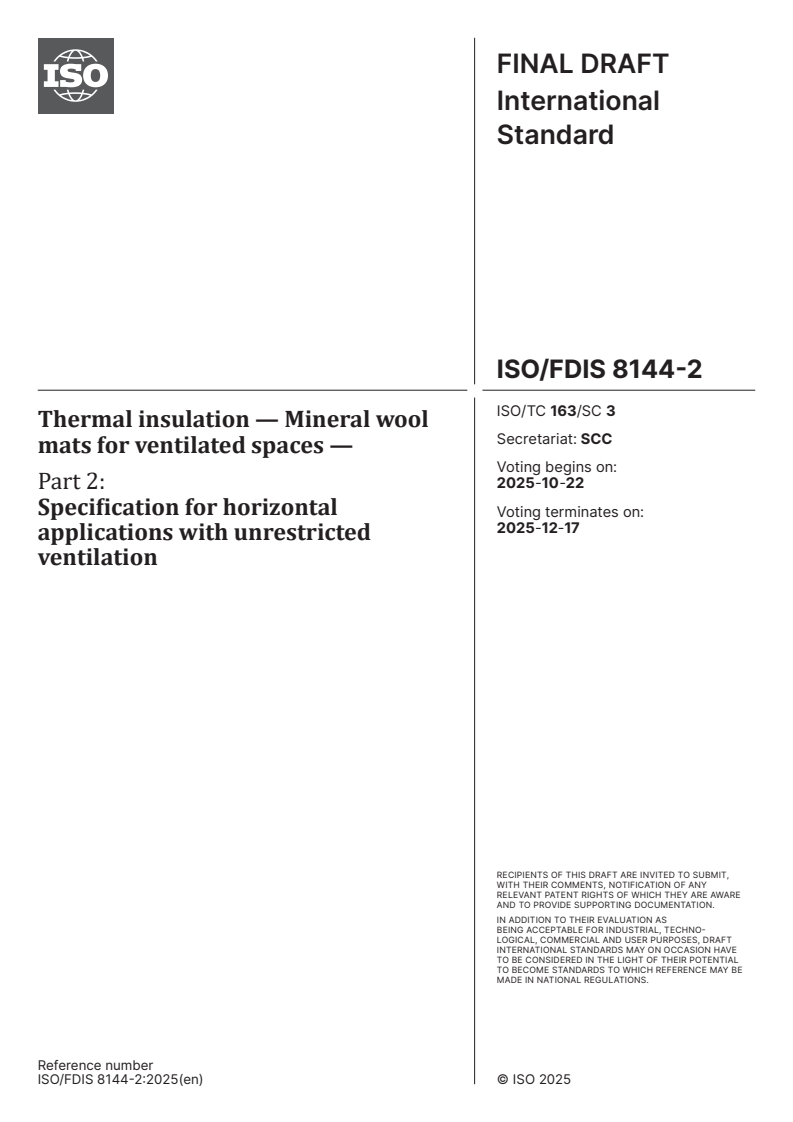
FINAL DRAFT
International
Standard
ISO/TC 163/SC 3
Thermal insulation — Mineral wool
Secretariat: SCC
mats for ventilated spaces —
Voting begins on:
2025-10-22
Part 2:
Specification for horizontal
Voting terminates on:
2025-12-17
applications with unrestricted
ventilation
RECIPIENTS OF THIS DRAFT ARE INVITED TO SUBMIT,
WITH THEIR COMMENTS, NOTIFICATION OF ANY
RELEVANT PATENT RIGHTS OF WHICH THEY ARE AWARE
AND TO PROVIDE SUPPOR TING DOCUMENTATION.
IN ADDITION TO THEIR EVALUATION AS
BEING ACCEPTABLE FOR INDUSTRIAL, TECHNO-
LOGICAL, COMMERCIAL AND USER PURPOSES, DRAFT
INTERNATIONAL STANDARDS MAY ON OCCASION HAVE
TO BE CONSIDERED IN THE LIGHT OF THEIR POTENTIAL
TO BECOME STAN DARDS TO WHICH REFERENCE MAY BE
MADE IN NATIONAL REGULATIONS.
Reference number
FINAL DRAFT
International
Standard
ISO/TC 163/SC 3
Thermal insulation — Mineral wool
Secretariat: SCC
mats for ventilated spaces —
Voting begins on:
Part 2:
Specification for horizontal
Voting terminates on:
applications with unrestricted
ventilation
RECIPIENTS OF THIS DRAFT ARE INVITED TO SUBMIT,
WITH THEIR COMMENTS, NOTIFICATION OF ANY
RELEVANT PATENT RIGHTS OF WHICH THEY ARE AWARE
AND TO PROVIDE SUPPOR TING DOCUMENTATION.
© ISO 2025
IN ADDITION TO THEIR EVALUATION AS
All rights reserved. Unless otherwise specified, or required in the context of its implementation, no part of this publication may
BEING ACCEPTABLE FOR INDUSTRIAL, TECHNO-
LOGICAL, COMMERCIAL AND USER PURPOSES, DRAFT
be reproduced or utilized otherwise in any form or by any means, electronic or mechanical, including photocopying, or posting on
INTERNATIONAL STANDARDS MAY ON OCCASION HAVE
the internet or an intranet, without prior written permission. Permission can be requested from either ISO at the address below
TO BE CONSIDERED IN THE LIGHT OF THEIR POTENTIAL
or ISO’s member body in the country of the requester.
TO BECOME STAN DARDS TO WHICH REFERENCE MAY BE
MADE IN NATIONAL REGULATIONS.
ISO copyright office
CP 401 • Ch. de Blandonnet 8
CH-1214 Vernier, Geneva
Phone: +41 22 749 01 11
Email: copyright@iso.org
Website: www.iso.org
Published in Switzerland Reference number
ii
Contents Page
Foreword .iv
1 Scope . 1
2 Normative references . 1
3 Terms and definitions . 2
4 Sampling and conformity control . 2
5 Required properties. 2
5.1 Dimensions .2
5.2 Fire behaviour .2
5.3 Thermal resistance .3
5.4 Handling properties .4
5.5 General properties .4
6 Marking . . 4
7 Test report . 5
Annex A (normative) Determination of handling properties of mats (batts or rolls). 6
Annex B (normative) Determination of the declared values of thermal resistance and thermal
conductivity . 9
Bibliography .12
iii
Foreword
ISO (the International Organization for Standardization) is a worldwide federation of national standards
bodies (ISO member bodies). The work of preparing International Standards is normally carried out through
ISO technical committees. Each member body interested in a subject for which a technical committee
has been established has the right to be represented on that committee. International organizations,
governmental and non-governmental, in liaison with ISO, also take part in the work. ISO collaborates closely
with the International Electrotechnical Commission (IEC) on all matters of electrotechnical standardization.
The procedures used to develop this document and those intended for its further maintenance are described
in the ISO/IEC Directives, Part 1. In particular, the different approval criteria needed for the different types
of ISO document should be noted. This document was drafted in accordance with the editorial rules of the
ISO/IEC Directives, Part 2 (see www.iso.org/directives).
ISO draws attention to the possibility that the implementation of this document may involve the use of (a)
patent(s). ISO takes no position concerning the evidence, validity or applicability of any claimed patent
rights in respect thereof. As of the date of publication of this document, ISO had not received notice of (a)
patent(s) which may be required to implement this document. However, implementers are cautioned that
this may not represent the latest information, which may be obtained from the patent database available at
www.iso.org/patents. ISO shall not be held responsible for identifying any or all such patent rights.
Any trade name used in this document is information given for the convenience of users and does not
constitute an endorsement.
For an explanation of the voluntary nature of standards, the meaning of ISO specific terms and expressions
related to conformity assessment, as well as information about ISO's adherence to the World Trade
Organization (WTO) principles in the Technical Barriers to Trade (TBT), see www.iso.org/iso/foreword.html.
This document was prepared by Technical Committee ISO/TC 163, Thermal performance and energy use in
the built environment, Subcommittee SC 3, Thermal insulation products, components and systems.
This second edition cancels and replaces the first edition (ISO 8144-2:1995), which has been technically
revised.
The main changes are as follows:
— added references to dimensional testing;
— revised testing procedure for thermal conductivity and thermal resistance.
A list of all parts in the ISO 8144 series can be found on the ISO website.
Any feedback or questions on this document should be directed to the user’s national standards body. A
complete listing of these bodies can be found at www.iso.org/members.html.
iv
FINAL DRAFT International Standard ISO/FDIS 8144-2:2025(en)
Thermal insulation — Mineral wool mats for ventilated
spaces —
Part 2:
Specification for horizontal applications with unrestricted
ventilation
1 Scope
This document specifies the properties and acceptance tolerances for bonded man-made mineral wool
thermal insulating mats (batts and rolls). The mats specified in this document are only intended to be
used for horizontal applications with unrestricted ventilation, where any excess of thickness recovery of
the insulation mat will not restrict the essential ventilation space. See ISO 9774:2004, Figure 1 for typical
locations.
The mineral wool mats which are specified in ISO 8144-1 are primarily intended for use in applications
where any excess of thickness must be limited.
This document provides limiting values for most of the properties. These limiting values are for specification
purposes only; design values can be derived from these by considering the environmental factors affecting
the thermal performance of the product, the influence of the product properties on installation, and the
effect of workmanship on the thermal performance. For converting declared R-values to design values, see
ISO 10456.
Mats can be supplied with a factory-applied facing, but facings are not covered by this document.
In general, mats are not designed to support any applied load. For this reason, only the mechanical properties
required for adequate handling during application are specified.
2 Normative references
The following documents are referred to in the text in such a way that some or all of their content constitutes
requirements of this document. For dated references, only the edition cited applies. For undated references,
the latest edition of the referenced document (including any amendments) applies.
ISO 7345, Thermal performance of buildings and building components — Physical quantities and definitions
ISO 8301, Thermal insulation — Determination of steady-state thermal resistance and related properties —
Heat flow meter apparatus
ISO 8302, Thermal insulation — Determination of steady-state thermal resistance and related properties —
Guarded hot plate apparatus
ISO 9229, Thermal insulation — Vocabulary
ISO 12491, Statistical methods for quality control of building materials and components
ISO 12576-1, Thermal insulation — Insulating materials and products for buildings — Conformity control
systems — Part 1: Factory-made products
ISO 29465, Thermal insulating products for building applications — Determination of length and width
ISO 29466, Thermal insulating products for building applications — Determination of thickness
ISO 29467, Thermal insulating products for building applications — Determination of squareness
3 Terms and definitions
For the purposes of this document, the terms and definitions given in ISO 9229 and the following apply.
ISO and IEC maintain terminology databases for use in standardization at the following addresses:
— ISO Online browsing platform: available at https:// www .iso .org/ obp
— IEC Electropedia: available at https:// www .electropedia .org/
3.1
mineral wool
fibrous thermal insulation material manufactured from molten rock, slag, or glass
3.2
mat
flexible fibrous insulation supplied in the form of rolls or batts, which can be faced but not enclosed
3.3
batt
portion of an insulation mat in the form of a rectangular piece, between 1 m and 3 m in length and supplied
flat or folded
3.4
roll
insulation product supplied in the form of a wound cylinder
4 Sampling and conformity control
Conformity control shall be in accordance with ISO 12576-1. Manufacturer shall declare which option they
have chosen.
5 Required properties
5.1 Dimensions
The manufacturer shall declare the nominal length, width, and thickness of the mats.
These dimensions shall be measured in accordance with ISO 29465 (length and width), ISO 29466 (thickness)
and ISO 29467 (squareness) and shall be subject to the tolerances detailed in Table 1.
5.2 Fire behaviour
The fire behaviour of the insulation materials, including any facings, shall be declared in compliance to the
fire regulations and codes that apply in the locality in which they are applied.
Table 1 — Dimensional tolerances
Dimension Permissible deviations of Test method
measured values from nomi-
nal dimensions
Length, l - 2 %, + excess permitted on ISO 29465
average of measured values for
each single
...
ISO/TC 163/SC 03/WG 19 3
Secretariat: SCC
Date: 2025-08-26
Thermal insulation – — Mineral wool mats for ventilated spaces – —
Part 2:
Specification for horizontal applications with unrestricted
ventilation
Isolation thermique – Feutres en laine minérale pour espaces ventilés – Partie 2: Spécifications pour application
horizontale avec ventilation non-restreinte
FDIS stage
All rights reserved. Unless otherwise specified, or required in the context of its implementation, no part of this publication
may be reproduced or utilized otherwise in any form or by any means, electronic or mechanical, including photocopying,
or posting on the internet or an intranet, without prior written permission. Permission can be requested from either ISO
at the address below or ISO’s member body in the country of the requester.
ISO copyright office
CP 401 • Ch. de Blandonnet 8
CH-1214 Vernier, Geneva
Phone: + 41 22 749 01 11
EmailE-mail: copyright@iso.org
Website: www.iso.org
Published in Switzerland
ii
Contents
Foreword . iv
1 Scope . 1
2 Normative references . 1
3 Terms and definitions . 2
4 Sampling and conformity control . 2
5 Required properties . 2
5.1 Dimensions . 2
5.2 Fire behaviour . 2
5.3 Thermal resistance . 3
5.4 Handling properties . 4
5.5 General properties . 4
6 Marking . 4
7 Test report . 5
Annex A (normative) Determination of handling properties of mats (batts or rolls) . 6
Annex B (normative) Determination of the declared values of thermal resistance and thermal
conductivity . 10
Bibliography . 13
iii
Foreword
ISO (the International Organization for Standardization) is a worldwide federation of national standards
bodies (ISO member bodies). The work of preparing International Standards is normally carried out through
ISO technical committees. Each member body interested in a subject for which a technical committee has been
established has the right to be represented on that committee. International organizations, governmental and
non-governmental, in liaison with ISO, also take part in the work. ISO collaborates closely with the
International Electrotechnical Commission (IEC) on all matters of electrotechnical standardization.
The procedures used to develop this document and those intended for its further maintenance are described
in the ISO/IEC Directives, Part 1. In particular, the different approval criteria needed for the different types of
ISO document should be noted. This document was drafted in accordance with the editorial rules of the
ISO/IEC Directives, Part 2 (see www.iso.org/directives).
ISO draws attention to the possibility that the implementation of this document may involve the use of (a)
patent(s). ISO takes no position concerning the evidence, validity or applicability of any claimed patent rights
in respect thereof. As of the date of publication of this document, ISO had not received notice of (a) patent(s)
which may be required to implement this document. However, implementers are cautioned that this may not
represent the latest information, which may be obtained from the patent database available at
www.iso.org/patents. ISO shall not be held responsible for identifying any or all such patent rights.
Any trade name used in this document is information given for the convenience of users and does not
constitute an endorsement.
For an explanation of the voluntary nature of standards, the meaning of ISO specific terms and expressions
related to conformity assessment, as well as information about ISO's adherence to the World Trade
Organization (WTO) principles in the Technical Barriers to Trade (TBT), see www.iso.org/iso/foreword.html.
This document was prepared by Technical Committee [or Project Committee] ISO/TC [or ISO/PC] ###, [name
of committee],163, Thermal performance and energy use in the built environment, Subcommittee SC ##, [name
of subcommittee], in collaboration with the European Committee for Standardization (CEN) Technical
Committee CEN/TC ###, [name of committee], in accordance with the Agreement on technical cooperation
between ISO and CEN (Vienna Agreement).3, Thermal insulation products, components and systems.
This second edition cancels and replaces the first edition (ISO 8144-2:1995), which has been technically
revised.
The main changes are as follows:
— — added references to dimensional testing;
— — revised testing procedure for thermal conductivity and thermal resistance.
A list of all parts in the ISO 8144 series can be found on the ISO website.
Any feedback or questions on this document should be directed to the user’s national standards body. A
complete listing of these bodies can be found at www.iso.org/members.html.
iv
Thermal insulation – — Mineral wool mats for ventilated spaces – —
Part 2:
Specification for horizontal applications with unrestricted ventilation
1 Scope
This document specifies the properties and acceptance tolerances for bonded man-made mineral wool
thermal insulating mats (batts and rolls). The mats specified in this document are only intended to be used for
horizontal applications with unrestricted ventilation, where any excess of thickness recovery of the insulation
mat will not restrict the essential ventilation space. See ISO 9774-:2004, Figure 1 for typical locations.
The mineral wool mats which are specified in ISO 8144-1 are primarily intended for use in applications where
any excess of thickness must be limited.
This document provides limiting values for most of the properties. These limiting values are for specification
purposes only; design values can be derived from these by considering the environmental factors affecting the
thermal performance of the product, the influence of the product properties on installation, and the effect of
workmanship on the thermal performance. For converting declared R-values to design values, see ISO 10456.
Mats can be supplied with a factory-applied facing, but facings are not covered by this document.
In general, mats are not designed to support any applied load. For this reason, only the mechanical properties
required for adequate handling during application are specified.
2 Normative references
The following documents are referred to in the text in such a way that some or all of their content constitutes
requirements of this document. For dated references, only the edition cited applies. For undated references,
the latest edition of the referenced document (including any amendments) applies.
ISO 7345, Thermal performance of buildings and building components — Physical quantities and definitions
ISO 8301, Thermal insulation — Determination of steady-state thermal resistance and related properties — Heat
flow meter apparatus
ISO 8302, Thermal insulation — Determination of steady-state thermal resistance and related properties —
Guarded hot plate apparatus
ISO 9229, Thermal insulation — Vocabulary
ISO 12491, Statistical methods for quality control of building materials and components
ISO 12576--1, Thermal insulation — Insulating materials and products for buildings — Conformity control
systems — Part 1: Factory-made products
ISO 29465, Thermal insulating products for building applications — Determination of length and width
ISO 29466, Thermal insulating products for building applications — Determination of thickness
ISO 29467, Thermal insulating products for building applications — Determination of squareness
3 Terms and definitions
For the purposes of this document, the terms and definitions given in ISO 9229 and the following apply.
ISO and IEC maintain terminologicalterminology databases for use in standardization at the following
addresses:
— — ISO Online browsing platform: available at https://www.iso.org/obp
— — IEC Electropedia: available at https://www.electropedia.org/
3.1 3.1
mineral wool
fibrous thermal insulation material manufactured from molten rock, slag, or glass
3.2 3.2
mat
flexible fibrous insulation supplied in the form of rolls or batts, which maycan be faced but not enclosed
3.3 3.3
batt
portion of an insulation mat in the form of a rectangular piece, between 1 m and 3 m in length and supplied
flat or folded
3.4 3.
roll
insulation product supplied in the form of a wound cylinder
4 Sampling and conformity control
Conformity control shall be in accordance with ISO 12576-1. Manufacturer shall declare which option they
have chosen.
5 Required properties
5.1 Dimensions
The manufacturer shall declare the nominal length, width, and thickness of the mats.
These dimensions shall be measured in accordance with ISO 29465 (length and width), ISO 29466 (thickness)
and ISO 29467 (squareness) and shall be subject to the tolerances detailed in Table 1Table 1.
5.2 Fire behaviour
The fire behaviour of the insulation materials, including any facings, shall be declared in compliance to the fire
regulations and codes that apply in the locality in which they are applied.
Table 1 — Dimensional tolerances
Dimension Permissible deviations of Test method
measured values from
nominal dimensions
Length, l - 2 %, + excess permitted on ISO 29465
average of measured values
for each single specimen
Dimension Permissible deviations of Test method
measured values from
nominal dimensions
Width, b ±1,5 % or ±10 mm, whichever ISO 29465
is less, on average of
measured values for each
single specimen
Thickness, d - 5 % or – 5 mm, whichever is ISO 29466
less, on average of measured
values for each single
specimen.
+ excess permitted on
average of measured values
for each single specimen
For any single specimen, the
measured thickness at each
individual measuring point
shall not deviate by more
than 15 mm from the mean of
measurements on that
specimen
Squareness of For each 1 m along the ISO 29467
batts (rolls shortest face dimension, the
need not be maximum deviation shall be
tested) more than 5 mm
5.3 Thermal resistance
The thermal transmission properties of a product shall be declared by the manufacturer as either thermal
resistance, R , or thermal conductivity, λ , in accordance with ISO 7345. The mean test temperature shall also
D D
be declared.
Thermal resistance and thermal conductivity shall be based upon measurements carried out and shall be
determined in accordance with Annex BAnnex B,, ISO 8301 and ISO 8302 and declared by the manufacturer
according to the following:
— — The reference mean
...
Questions, Comments and Discussion
Ask us and Technical Secretary will try to provide an answer. You can facilitate discussion about the standard in here.
Loading comments...