

ISO 17738-1:2021
(Main)Thermal insulation products — Exterior insulation finish systems — Part 1: Materials
General Information
- Abstract
This document outlines requirements for exterior insulation and finish systems (EIFS), used in combination with a drained air space as an exterior wall cladding system. The document includes requirements for a water resistive barrier assembly that are used as part of EIFS. This document outlines testing procedures with pass/fail criteria for an exterior insulation and finish system. The procedures cover the liquid applied water resistive barrier, which forms a second line of defense against water penetration, individual material components and the complete system to demonstrate durability. The use of mechanical fasteners is outside the scope of this document. In EIFS, the thermal insulation boards support the base coat with integral glass fibre reinforcing mesh. Systems where the reinforcement is the supporting element of the rendering, e.g. conventional stucco, are not covered by this document.
- Status
- Published
- Publication Date
- 19-Dec-2021
- Technical Committee
- ISO/TC 163/SC 3 - Thermal insulation products, components and systems
- Drafting Committee
- ISO/TC 163/SC 3/WG 9 - Exterior insulation and finish systems
- Current Stage
- 6060 - International Standard published
- Start Date
- 20-Dec-2021
- Due Date
- 28-Sep-2021
- Completion Date
- 20-Dec-2021
Buy Documents
ISO 17738-1:2021 - Thermal insulation products -- Exterior insulation finish systems
ISO 17738-1:2021 - Thermal insulation products — Exterior insulation finish systems — Part 1: Materials/20/2021
Overview - ISO 17738-1:2021 (EIFS Materials)
ISO 17738-1:2021 defines material performance requirements and test methods for Exterior Insulation and Finish Systems (EIFS) used with a drained air space as an exterior wall cladding system. The standard covers constituent materials - including thermal insulation boards, base coats with embedded glass-fibre reinforcing mesh, finish coats and liquid-applied water resistive barriers (LA‑WRB) - and specifies procedures with pass/fail criteria to demonstrate system durability. The document excludes systems where the reinforcement is the primary structural rendering (e.g., conventional stucco) and does not address the use of mechanical fasteners.
Key technical topics and requirements
ISO 17738-1 concentrates on material properties, sampling, specimen preparation and standardized test methods. Major topics include:
- EIFS constituent product requirements - material identification and performance expectations for insulation, base coat, reinforcing mesh and finish.
- Liquid-applied water resistive barrier (LA‑WRB) - definition, testing and performance as a second line of defence against water penetration.
- Testing procedures with pass/fail criteria, including:
- Ash content and infrared analysis for material identification
- Bond strength and pull‑off tests (Annexes on bond testing and adhesion testers)
- Water vapour permeance and water absorption tests
- Accelerated weathering and ultraviolet resistance
- Reinforcing mesh strength and alkalinity resistance
- Durability under cyclic environmental conditions, drainage capacity and wind load testing (normative Annex G)
- LA‑WRB specific tests: joint durability, nail popping resistance, air flow rate
- Marking, packaging and labelling requirements for product traceability and communication.
Practical applications and typical users
ISO 17738-1 is practical for stakeholders involved in the design, production, testing and specification of EIFS:
- Manufacturers of thermal insulation boards, base coats, reinforcing meshes and LA‑WRBs - to demonstrate compliance and perform QA testing.
- Independent test laboratories - to apply standardized test methods and report results.
- Architects and façade engineers - for product selection and to verify material durability and water-resistive performance.
- Specifiers, building inspectors and regulators - to reference objective pass/fail criteria for performance claims.
- Installers and system designers - in conjunction with ISO 17738-2 (installation) and ISO 17738-3 (design and detailing) for a complete EIFS specification.
Related standards
- ISO 17738-2 - Exterior insulation and finish systems: Installation (guidance)
- ISO 17738-3 - Exterior insulation and finish systems: Design and detailing (guidance)
- Referenced test standards (e.g., ISO 846, ISO 1663, ISO 12572, ISO 16474‑3) for specific material test methods.
Keywords: ISO 17738-1, EIFS, exterior insulation and finish systems, water resistive barrier, LA‑WRB, testing procedures, thermal insulation boards, reinforcing mesh, wind load testing, durability.
Relations
- Effective Date
- 23-Apr-2020
Buy Documents
ISO 17738-1:2021 - Thermal insulation products -- Exterior insulation finish systems
ISO 17738-1:2021 - Thermal insulation products — Exterior insulation finish systems — Part 1: Materials/20/2021
Get Certified
Connect with accredited certification bodies for this standard

DIBt (Deutsches Institut für Bautechnik)
German Institute for Building Technology.
DIN CERTCO
DIN Group product certification.

Aboma Certification B.V.
Specialized in construction, metal, and transport sectors.
Sponsored listings
Frequently Asked Questions
ISO 17738-1:2021 is a standard published by the International Organization for Standardization (ISO). Its full title is "Thermal insulation products — Exterior insulation finish systems — Part 1: Materials". This standard covers: This document outlines requirements for exterior insulation and finish systems (EIFS), used in combination with a drained air space as an exterior wall cladding system. The document includes requirements for a water resistive barrier assembly that are used as part of EIFS. This document outlines testing procedures with pass/fail criteria for an exterior insulation and finish system. The procedures cover the liquid applied water resistive barrier, which forms a second line of defense against water penetration, individual material components and the complete system to demonstrate durability. The use of mechanical fasteners is outside the scope of this document. In EIFS, the thermal insulation boards support the base coat with integral glass fibre reinforcing mesh. Systems where the reinforcement is the supporting element of the rendering, e.g. conventional stucco, are not covered by this document.
This document outlines requirements for exterior insulation and finish systems (EIFS), used in combination with a drained air space as an exterior wall cladding system. The document includes requirements for a water resistive barrier assembly that are used as part of EIFS. This document outlines testing procedures with pass/fail criteria for an exterior insulation and finish system. The procedures cover the liquid applied water resistive barrier, which forms a second line of defense against water penetration, individual material components and the complete system to demonstrate durability. The use of mechanical fasteners is outside the scope of this document. In EIFS, the thermal insulation boards support the base coat with integral glass fibre reinforcing mesh. Systems where the reinforcement is the supporting element of the rendering, e.g. conventional stucco, are not covered by this document.
ISO 17738-1:2021 is classified under the following ICS (International Classification for Standards) categories: 91.100.60 - Thermal and sound insulating materials. The ICS classification helps identify the subject area and facilitates finding related standards.
ISO 17738-1:2021 has the following relationships with other standards: It is inter standard links to ISO 17738-1:2017. Understanding these relationships helps ensure you are using the most current and applicable version of the standard.
ISO 17738-1:2021 is available in PDF format for immediate download after purchase. The document can be added to your cart and obtained through the secure checkout process. Digital delivery ensures instant access to the complete standard document.
Standards Content (Sample)
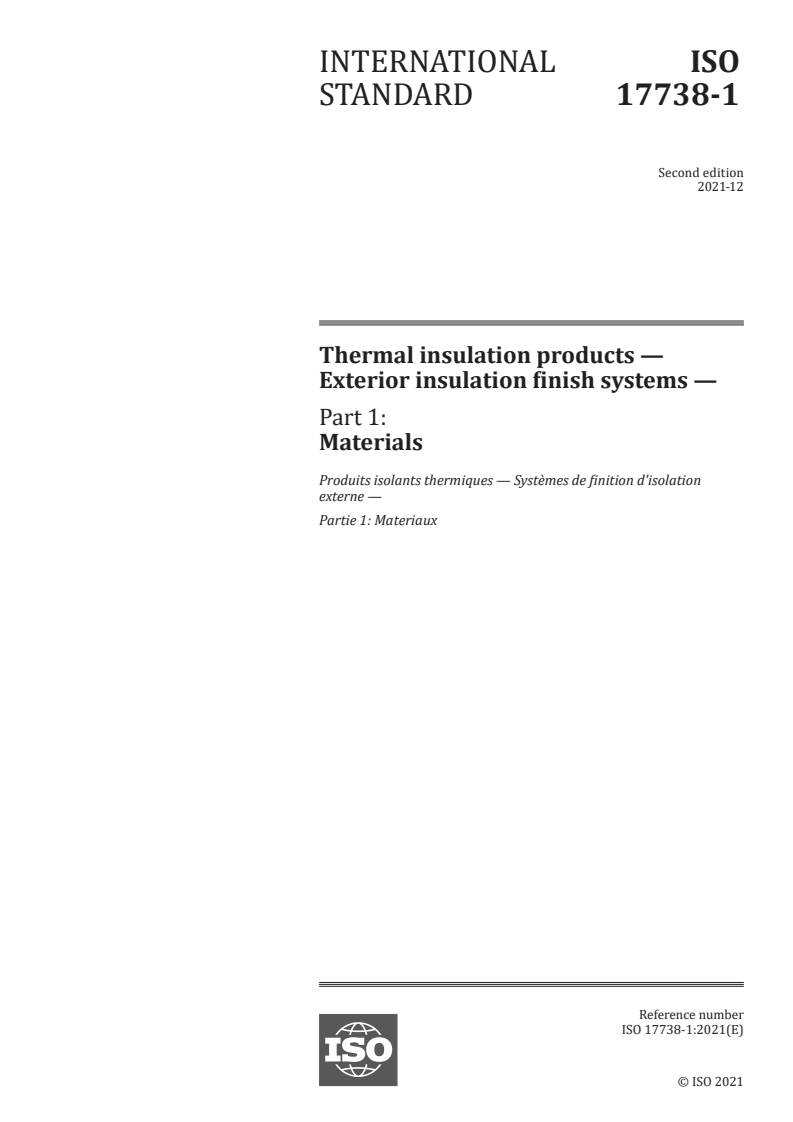
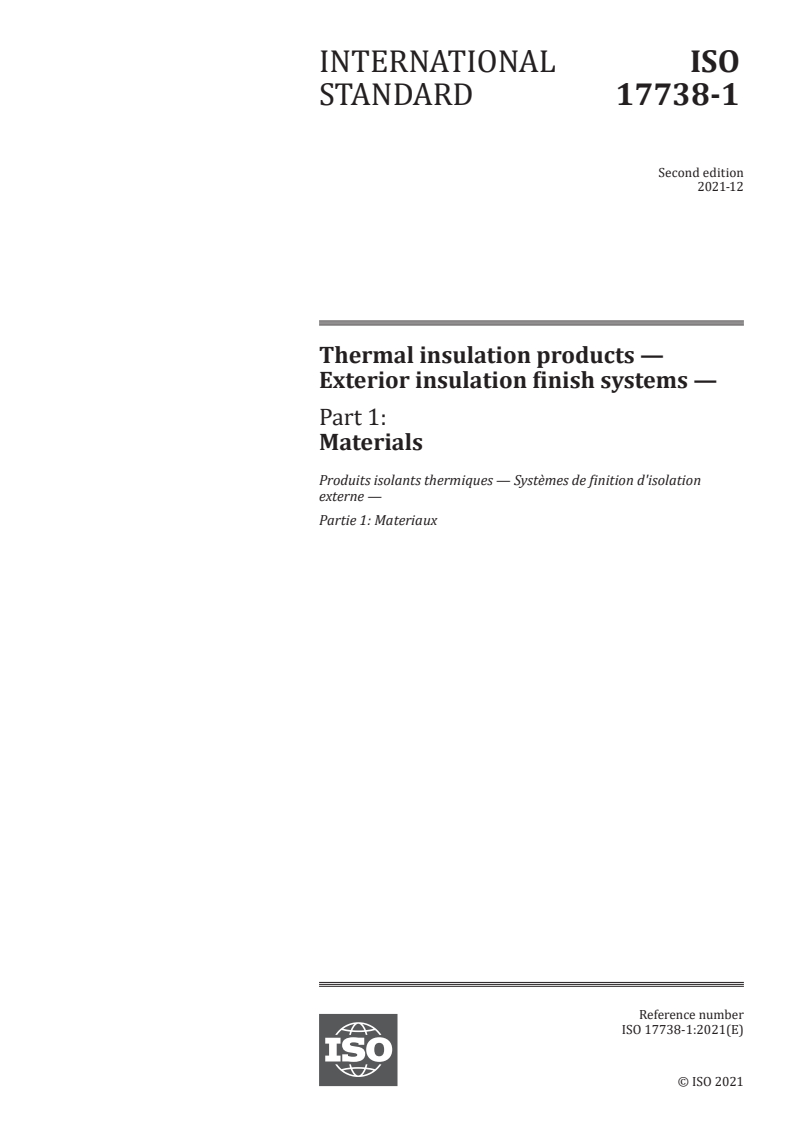
INTERNATIONAL ISO
STANDARD 17738-1
Second edition
2021-12
Thermal insulation products —
Exterior insulation finish systems —
Part 1:
Materials
Produits isolants thermiques — Systèmes de finition d'isolation
externe —
Partie 1: Materiaux
Reference number
© ISO 2021
All rights reserved. Unless otherwise specified, or required in the context of its implementation, no part of this publication may
be reproduced or utilized otherwise in any form or by any means, electronic or mechanical, including photocopying, or posting on
the internet or an intranet, without prior written permission. Permission can be requested from either ISO at the address below
or ISO’s member body in the country of the requester.
ISO copyright office
CP 401 • Ch. de Blandonnet 8
CH-1214 Vernier, Geneva
Phone: +41 22 749 01 11
Email: copyright@iso.org
Website: www.iso.org
Published in Switzerland
ii
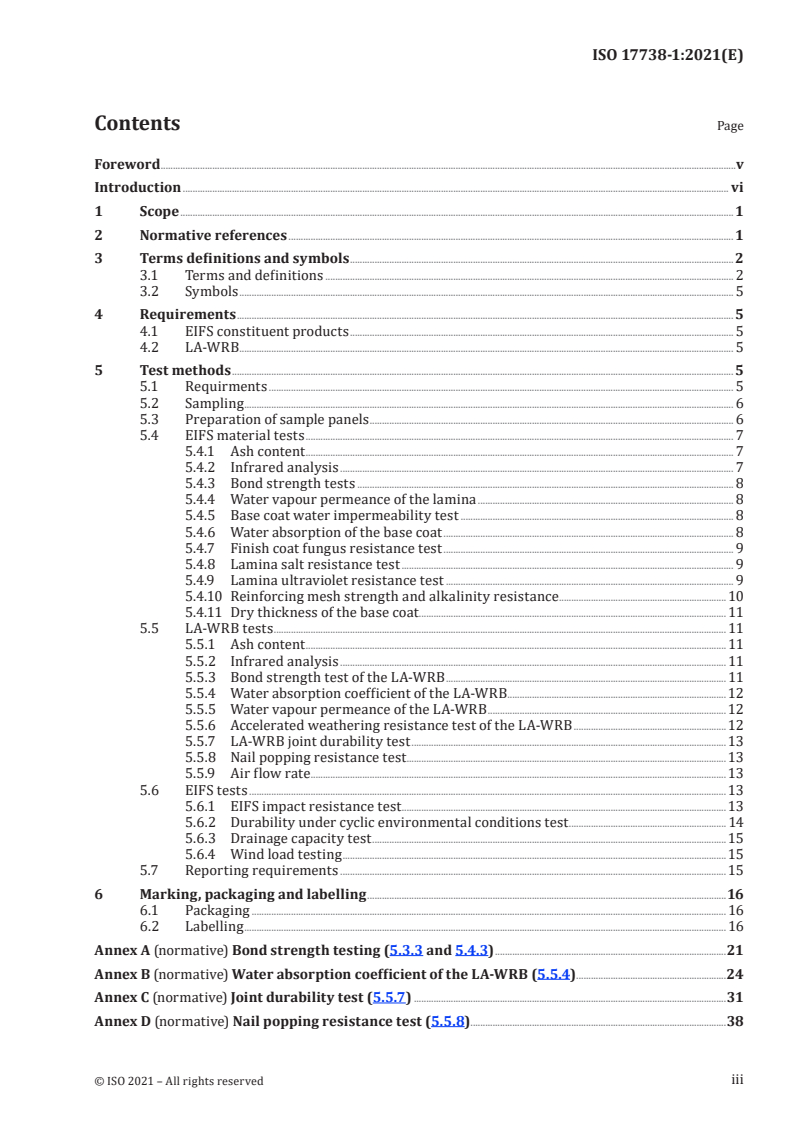
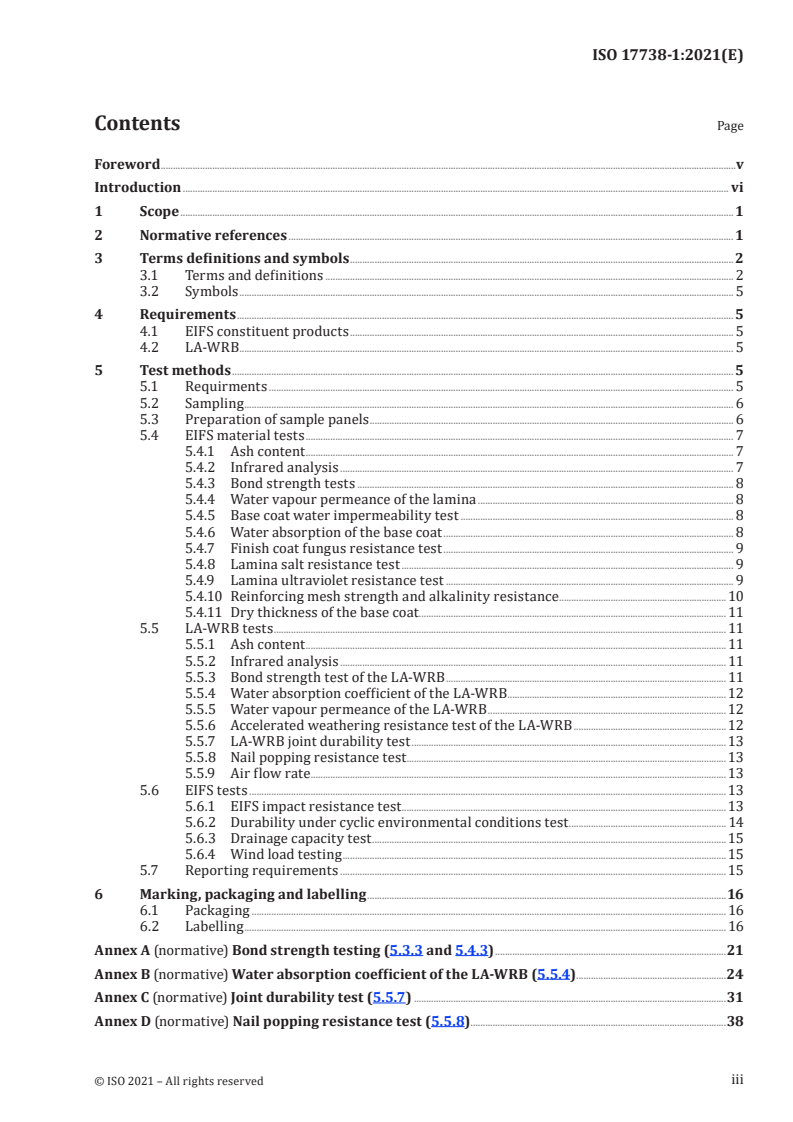
Contents Page
Foreword .v
Introduction . vi
1 Scope . 1
2 Normative references . 1
3 Terms definitions and symbols .2
3.1 Terms and definitions . 2
3.2 Symbols . 5
4 Requirements . 5
4.1 EIFS constituent products . 5
4.2 LA-WRB . 5
5 Test methods . 5
5.1 Requirments . 5
5.2 Sampling . 6
5.3 Preparation of sample panels . 6
5.4 EIFS material tests . 7
5.4.1 Ash content . 7
5.4.2 Infrared analysis . 7
5.4.3 Bond strength tests . 8
5.4.4 Water vapour permeance of the lamina . 8
5.4.5 Base coat water impermeability test . 8
5.4.6 Water absorption of the base coat . 8
5.4.7 Finish coat fungus resistance test . 9
5.4.8 Lamina salt resistance test . 9
5.4.9 Lamina ultraviolet resistance test . 9
5.4.10 Reinforcing mesh strength and alkalinity resistance . 10
5.4.11 Dry thickness of the base coat . 11
5.5 LA-WRB tests . 11
5.5.1 Ash content . 11
5.5.2 Infrared analysis . 11
5.5.3 Bond strength test of the LA-WRB . 11
5.5.4 Water absorption coefficient of the LA-WRB .12
5.5.5 Water vapour permeance of the LA-WRB .12
5.5.6 Accelerated weathering resistance test of the LA-WRB .12
5.5.7 LA-WRB joint durability test . 13
5.5.8 Nail popping resistance test . 13
5.5.9 Air flow rate . 13
5.6 EIFS tests . 13
5.6.1 EIFS impact resistance test . 13
5.6.2 Durability under cyclic environmental conditions test . 14
5.6.3 Drainage capacity test .15
5.6.4 Wind load testing .15
5.7 Reporting requirements . 15
6 Marking, packaging and labelling .16
6.1 Packaging . 16
6.2 Labelling . 16
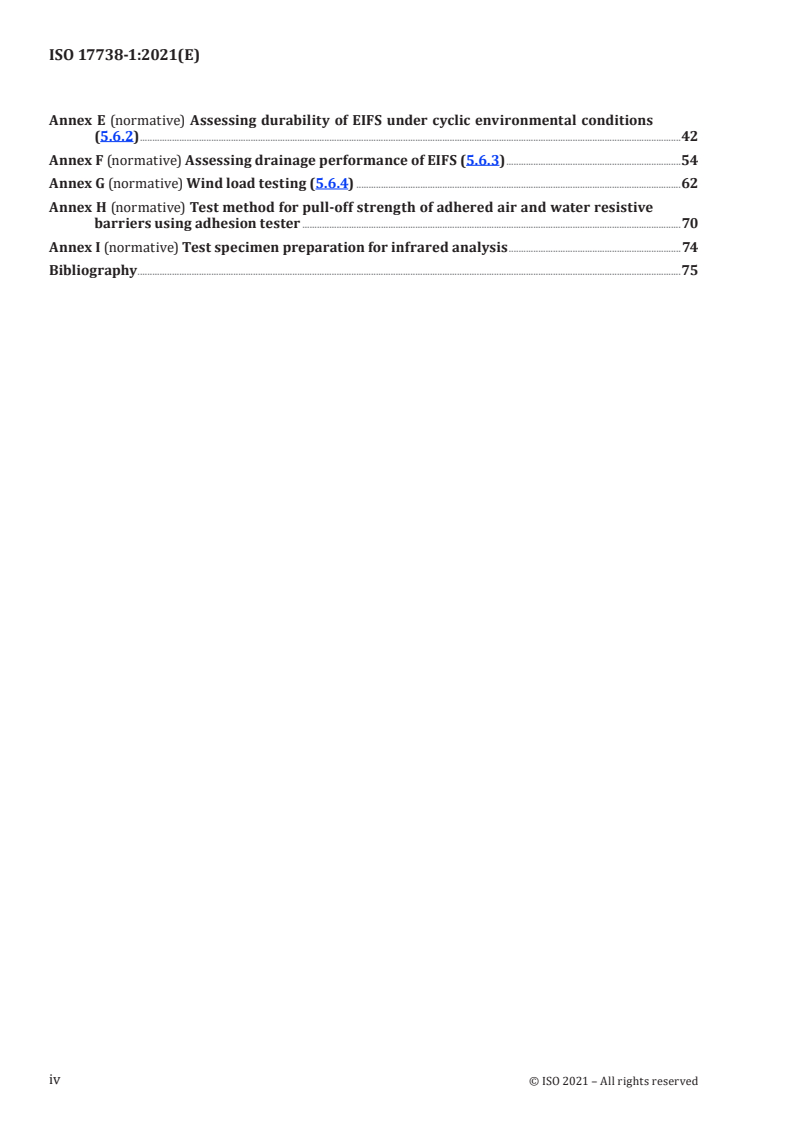
Annex A (normative) Bond strength testing (5.3.3 and 5.4.3) .21
Annex B (normative) Water absorption coefficient of the LA-WRB (5.5.4) .24
Annex C (normative) Joint durability test (5.5.7) .31
Annex D (normative) Nail popping resistance test (5.5.8) .38
iii
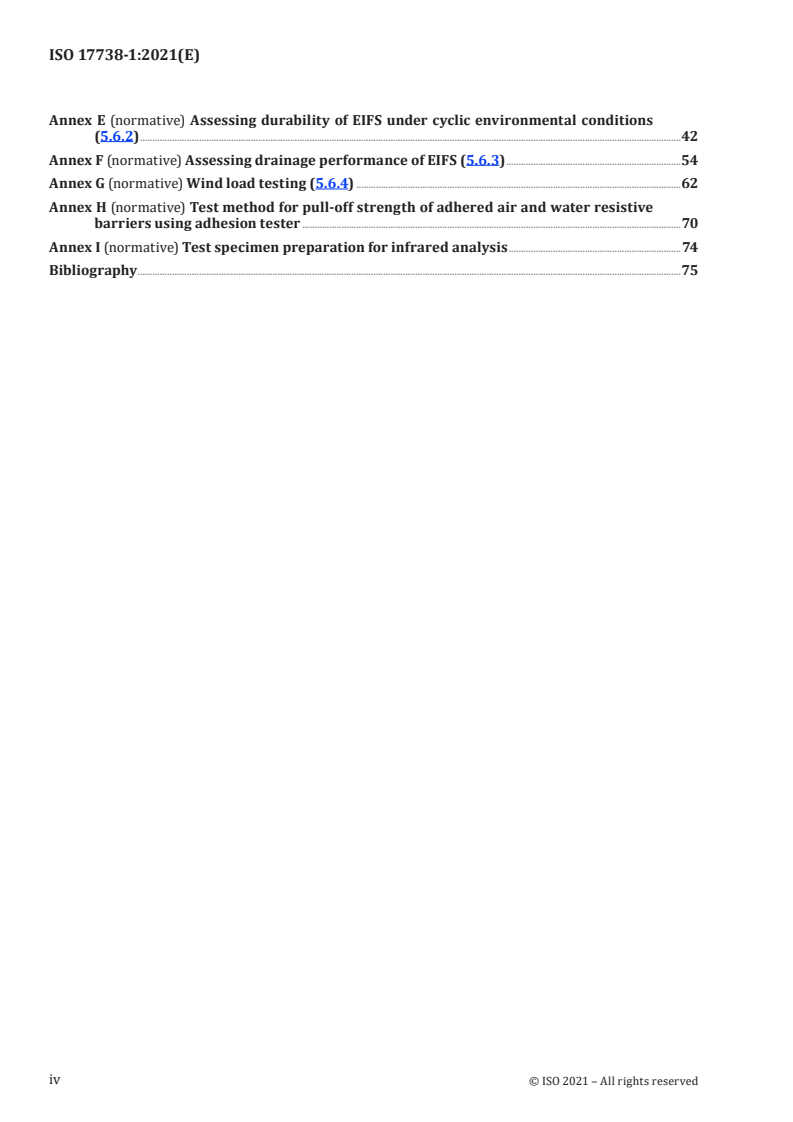
Annex E (normative) Assessing durability of EIFS under cyclic environmental conditions
(5.6.2) .42
Annex F (normative) Assessing drainage performance of EIFS (5.6.3) .54
Annex G (normative) Wind load testing (5.6.4) .62
Annex H (normative) Test method for pull-off strength of adhered air and water resistive
barriers using adhesion tester .70
Annex I (normative) Test specimen preparation for infrared analysis .74
Bibliography .75
iv
Foreword
ISO (the International Organization for Standardization) is a worldwide federation of national standards
bodies (ISO member bodies). The work of preparing International Standards is normally carried out
through ISO technical committees. Each member body interested in a subject for which a technical
committee has been established has the right to be represented on that committee. International
organizations, governmental and non-governmental, in liaison with ISO, also take part in the work.
ISO collaborates closely with the International Electrotechnical Commission (IEC) on all matters of
electrotechnical standardization.
The procedures used to develop this document and those intended for its further maintenance are
described in the ISO/IEC Directives, Part 1. In particular, the different approval criteria needed for the
different types of ISO documents should be noted. This document was drafted in accordance with the
editorial rules of the ISO/IEC Directives, Part 2 (see www.iso.org/directives).
Attention is drawn to the possibility that some of the elements of this document may be the subject of
patent rights. ISO shall not be held responsible for identifying any or all such patent rights. Details of
any patent rights identified during the development of the document will be in the Introduction and/or
on the ISO list of patent declarations received (see www.iso.org/patents).
Any trade name used in this document is information given for the convenience of users and does not
constitute an endorsement.
For an explanation of the voluntary nature of standards, the meaning of ISO specific terms and
expressions related to conformity assessment, as well as information about ISO's adherence to
the World Trade Organization (WTO) principles in the Technical Barriers to Trade (TBT), see
www.iso.org/iso/foreword.html.
This document was prepared by Technical Committee ISO/TC 163, Thermal performance and energy use
in the built environment, Subcommittee SC 3, Thermal insulation products, components and systems.
This second edition cancels and replaces the first edition (ISO 17338-1:2017), which has been technically
revised.
The main changes are as follows:
— The Introduction has been modified to include the three parts of the ISO 17738 series of standards,
including ISO 17738-2 and ISO 17738-3.
— The definition of exterior insulation and finish systems (EIFS) has been clarified to include the
function of the materials that comprise the system.
— The water resistive barrier definitions have been expanded to include the components that connect
the EIFS water resistive barrier with adjacent componets that offer the same function but are part
of a different cladding assembly.
— Testing to determine the air flow rate of the water resistive barrier has been added.
— Testing to demonstrate the ability of EIFS to withstand wind loading (Annex G) has been expanded
and changed from informative to normative.
— A new Annex H (normative) test method for pull-off strength of adhered air and water resistive
barriers using adhesion tester has been added.
A list of all parts in the ISO 17738 series can be found on the ISO website.
Any feedback or questions on this document should be directed to the user’s national standards body. A
complete listing of these bodies can be found at www.iso.org/members.html.
v
Introduction
Exterior insulation and finish systems (EIFS) is a wall cladding assembly consisting of six components:
— A water resistive barrier to protect the substrate; the substrate has a means for drainage to the
exterior;
— a means of attaching the system to the substrate;
— a thermal insulation layer;
— a base coat material;
— a reinforcing mesh embedded into the base coat;
— a finish material to provide the aesthetic appearance of the cladding assembly.
The ISO 17738 series comprises three parts: ISO 17738-1 (this document) deals with the material
performance of exterior insulation and finish systems (EIFS), ISO 17738-2 provides guidance on
installation and ISO 17738-3 gives guidance on the design and detailing of a durable and resiliant EIFS
system.
vi
INTERNATIONAL STANDARD ISO 17738-1:2021(E)
Thermal insulation products — Exterior insulation finish
systems —
Part 1:
Materials
WARNING — This document does not purport to address all the health and safety aspects
associated with its use. Anyone using this document has the responsibility to establish health
and safety practices for its use.
1 Scope
This document outlines requirements for exterior insulation and finish systems (EIFS), used in
combination with a drained air space as an exterior wall cladding system. The document includes
requirements for a water resistive barrier assembly that are used as part of EIFS.
This document outlines testing procedures with pass/fail criteria for an exterior insulation and finish
system. The procedures cover the liquid applied water resistive barrier, which forms a second line
of defense against water penetration, individual material components and the complete system to
demonstrate durability.
The use of mechanical fasteners is outside the scope of this document.
In EIFS, the thermal insulation boards support the base coat with integral glass fibre reinforcing mesh.
Systems where the reinforcement is the supporting element of the rendering, e.g. conventional stucco,
are not covered by this document.
2 Normative references
The following documents are referred to in the text in such a way that some or all of their content
constitutes requirements of this document. For dated references, only the edition cited applies. For
undated references, the latest edition of the referenced document (including any amendments) applies.
ISO 846, Plastics — Evaluation of the action of microorganisms
ISO 1463, Metallic and oxide coatings — Measurement of coating thickness — Microscopical method
ISO 1663, Rigid cellular plastics — Determination of water vapour transmission properties
ISO 1926, Rigid cellular plastics — Determination of tensile properties
ISO 3451-1, Plastics — Determination of ash — Part 1: General methods
ISO 4606, Textile glass — Woven fabric — Determination of tensile breaking force and elongation at break
by the strip method
ISO 4611, Plastics — Determination of the effects of exposure to damp heat, water spray and salt mist
ISO 4650, Rubber — Identification — Infrared spectrometric methods
ISO 4898, Rigid cellular plastics — Thermal insulation products for buildings — Specifications
ISO 6612, Windows and door height windows — Wind resistance tests
ISO 7345, Thermal performance of buildings and building components — Physical quantities and definitions
ISO 8145, Thermal insulation — Mineral wool board for overdeck insulation of roofs — Specification
ISO 9229, Thermal insulation — Vocabulary
ISO 12572, Hygrothermal performance of building materials and products — Determination of water
vapour transmission properties — Cup method
ISO 14857:2014, Thermal performance in the built environment — Determination of air permeance of
building materials
ISO 15821, Doorsets and windows — Water-tightness test under dynamic pressure — Cyclonic aspects
ISO 16474-3, Paints and varnishes — Methods of exposure to laboratory light sources — Part 3: Fluorescent
UV lamps
ISO 16894, Wood-based panels — Oriented strand board (OSB) — Definitions, classification and
specifications
ISO 17738-2, Thermal insulation products — Exterior insulation and finish systems (EIFS) — Part 2:
Installation
ISO 29465, Thermal insulating products for building applications — Determination of length and width
ISO 29466, Thermal insulating products for building applications — Determination of thickness
ISO 29470, Thermal insulating products for building applications — Determination of the apparent density
3 Terms definitions and symbols
For the purposes of this document, the terms and definitions given in ISO 7345, ISO 9229 and the
following apply.
ISO and IEC maintain terminology databases for use in standardization at the following addresses:
— ISO Online browsing platform: available at https:// www .iso .org/ obp
— IEC Electropedia: available at https:// www .electropedia .org/
3.1 Terms and definitions
3.1.1
adhesive
product for adhering the thermal insulation board (3.1.22) to the substrate (3.1.19) or water resistive
barrier assembly (3.1.24)
3.1.2
attachment method
means by which the thermal insulation board (3.1.22) or thermal insulation board/base coat (3.1.3) and
reinforcing mesh (3.1.18) composite is secured to the substrate which provides the wind load resistance
of the wall assembly
3.1.3
base coat
polymer-based coating, either factory-blended (3.1.11) or field-mixed (3.1.12), applied directly to the
thermal insulation board (3.1.22), fully embedding (3.1.9) the reinforcing mesh (3.1.18) providing the
primary barrier to water penetration
3.1.4
cure
develop the ultimate properties of an initial wet state material by a chemical process
3.1.5
drainage cavity
space between the water resistive barrier material (WRB) (3.1.26) and thermal insulation board (3.1.22)
that allows for the free drainage of water that penetrates the exterior insulation and finish system
(EIFS) (3.1.10)
3.1.6
dry
develop the ultimate properties of an initial wet state material solely by evaporation of volatile
ingredients
3.1.7
durability
ability of a building or any of its components to perform its required functions in its service environment
over a period of time without unforeseen cost for maintenance or repair
3.1.8
EIFS manufacturer
exterior insulation and finish system (EIFS) manufacturer
producer of the materials and components forming a proprietary EIFS (3.1.10)
3.1.9
embed
press into and encapsulate the reinforcing mesh (3.1.18) in the wet base coat (3.1.3)
3.1.10
EIFS
exterior insulation and finish system
exterior wall system with capacity to provide heat, air and moisture control functions, inclusive of a
water resistive barrier assembly (3.1.24), thermal insulation board (3.1.22) and attachment method (3.1.2)
for securing the system to the substrate (3.1.19), and protected by a base coat (3.1.3) material and glass
fibre reinforcing mesh (3.1.18) installed over the face and termination surfaces of the thermal insulation
board and completed with a finish material (3.1.13)
3.1.11
factory-blended
material that arrives from the manufacturer requiring no additions apart from water to produce the
wet state material
3.1.12
field-mixed
materials that are mixed in the field by combining two or more materials, other than, or in addition to,
water
3.1.13
finish material
outermost layer installed over the base coat (3.1.3) and forming part of the system, providing the
exterior insulation and finish system (EIFS) (3.1.10) with its aesthetic while contributing to the system’s
exposure resistance
3.1.14
GDDC
geometrically defined drainage cavity
path created between the water resistive barrier material (WRB) (3.1.26) and thermal insulation board
(3.1.22) using thermal insulation board that has a pattern cut into its back surface
3.1.15
lamina
composite of base coat (3.1.3), reinforcing mesh (3.1.18) and finish material (3.1.13)
3.1.16
LA-WRB
liquid-applied water resistive barrier
fluid applied material, that dries to a membrane possessing low water absorption properties becoming
a component of the water resistive barrier assembly (3.1.24)
3.1.17
manufacturer’s installation instruction
written installation instructions provided by the exterior insulation and finish system (EIFS)
manufacturer (3.1.8) that include information that will assist in the correct use and installation of the
materials and components that comprise their system
3.1.18
reinforcing mesh
woven or non-woven glass fibre fabric component of the exterior insulation and finish system (EIFS)
(3.1.10) encapsulated in the base coat (3.1.3) to strengthen the system
3.1.19
substrate
structural component supporting the exterior insulation and finish system (EIFS) (3.1.10), which is
resistant to deterioration caused by water or is protected by a water resistive barrier assembly (3.1.24)
3.1.20
test sample
prepared materials or systems from which test specimens (3.1.21) are taken
3.1.21
test specimen
portion of a test sample (3.1.20) taken for measurement of a material property or characteristic
3.1.22
thermal insulation board
material that reduces heat flow through itself and provides the surface for applying the base coat (3.1.3)
3.1.23
water resistive barrier accesssory
product designated to maintain water resistive barrier assembly (3.1.24) continuity between water
resistive barrier material(s) (3.1.26) and other wall assembly components, or at joints and openings not
bridged by the water resistive barrier material
3.1.24
WRBA
water resistive barrier assembly
combination of water resistive barrier material(s) (3.1.26) and water resistive barrier accessories (3.1.23)
designed to create a continuous secondary barrier against water penetration to direct and/or deflect
water to the exterior
3.1.25
water absorption coefficient
mass of water absorbed by a test specimen (3.1.21) under specified time and pressure, per unit area
3.1.26
WRB
water resistive barrier material
material designed to provide the secondary plane of protection against water penetration and forming
part of the water resistive barrier assembly (3.1.24)
3.1.27
water retention ratio
weight of water retained in the test specimen (3.1.21) following the drainage capacity test divided by
the area of wetted wall
3.1.28
wrap
extend the base coat and glass fibre reinforcing mesh (3.1.18) over the edge and back of the thermal
insulation board (3.1.22) to protect the exposed edges of board
3.2 Symbols
Symbol Description Unit
A face area m
2 0,5
A water absorption coefficient kg/(m ·s )
w
water absorption coefficient related to a specific time, t, in
2 0,5
A kg/(m ·s )
wt
seconds
∆m mass gain per face area after time t kg/m
t
m initial mass of specimen kg
i
m mass of specimen after time t kg
t
t time s or h
2 0,5
W water absorption coefficient kg/(m ·h )
w
water absorption coefficient related to a specific time, t, in
2 0,5
W kg/(m ·h )
wt
hours
NOTE Water absorption coefficient is defined in terms of seconds in ISO 9346. The alternative definition in
terms of hours is widely used.
4 Requirements
4.1 EIFS constituent products
4.1.1 The material that comprise EIFS shall meet the requirements listed in Table 1.
4.1.2 Rigid cellular plastic thermal insulation board shall meet the requirements of ISO 4898.
4.1.3 Semi-rigid mineral fibre thermal insulation board shall meet the requirements of ISO 8145.
4.2 LA-WRB
4.2.1 Type 1 - The LA-WRB shall meet the technical requirements listed in Table 2.
4.2.2 Type 2 - The LA-WRB shall meet the technical requirements listed in Table 2 except for:
a) joint durability test;
b) nail popping resistance test.
5 Test methods
5.1 Requirments
The EIFS shall be tested as an assembly as required in 5.5 and meet the requirements in Table 3.
5.2 Sampling
Random sampling of the materials required for testing, shall be carried out to determine comformance
with this document. The materials selected shall be identified at the production or main storage facility
and sent directly to where the testing takes place. The number of samples shall be determined by the
party in charge of the testing.
5.3 Preparation of sample panels
5.3.1 Sample panels or test specimens shall be prepared following manufacturer’s installation
instructions.
5.3.1.1 One nominal 610 mm × 610 mm panel or individual specimens consisting of 25 mm thick
thermal insulation board and base coat, including reinforcing mesh shall be prepared. The base coat
and reinforcing mesh shall be applied at the thickness stipulated by the EIFS manufacturer, determined
for the purpose of confirmation as a mass per unit area, as per 5.3.5. This test sample panel/specimens
shall be used for the following tests:
a) bond strength test of the base coat;
b) base coat water impermeability test;
c) water absorption of the base coat test.
5.3.1.2 Five nominal 610 mm × 610 mm panels or individual specimens consisting of 25 mm thick
thermal insulation board and base coat, including reinforcing mesh, and finish coat. The edges of four
of the panels/specimens shall be wrapped with base coat, reinforcing mesh and finish coat. The base
coat shall be allowed to cure for a minimum of 24 h prior to application of the finish coat. The base
coat and reinforcing mesh and finish coat shall be applied at the thicknesses stipulated by the EIFS
manufacturer, determined for the purpose of confirmation as a mass per unit area, as per 5.3.5. This
test sample panel/specimens shall be used for preparation of the test specimens for the following tests:
a) bond strength of the finish coat;
b) water vapour permeance of the lamina;
c) lamina salt spray resistance;
d) lamina ultraviolet resistance;
e) EIFS impact resistance (wrapped panels).
5.3.1.3 One nominal 610 mm × 1 220 mm vertical wood frame to which is attached 19 mm thick
oriented strand board (OSB) sheathing meeting the requirements of ISO 16894. The OSB sheathing shall
include a joint with a width of 3,2 mm, as shown in Figure 1. The OSB shall be free of any dirt, dust or
other deleterious substances that may affect the adhesion of the LA-WRB. The LA-WRB shall be applied
to the OSB in strict accordance with the manufacturer’s installation instructions and at the minimum
thickness recommended by the manufacturer, determined for the purpose of confirmation as a weight
per unit area, as per 5.3.5. This test sample panel shall be used for preparation of the test specimens for
the following tests:
a) bond strength test of the LA-WRB;
b) water absorption coefficient of the LA-WRB test;
c) joint durability test;
d) accelerated weathering resistance test of the LA-WRB.
5.3.1.4 One nominal 610 mm × 610 mm panel consisting of LA-WRB applied to nominally 13 mm
thick glass mat gypsum sheathing. The LA-WRB shall be applied in accordance with the manufacturer’s
installation instructions and at the thickness stipulated by the EIFS manufacturer, determined for the
purpose of confirmation as a mass per unit area, as per 5.3.5. This test sample panel shall be used for
preparation of the test specimens to test the water vapour permeance of the LA-WRB.
5.3.2 The test sample panels shall be prepared in either a vertical or horizontal orientation.
5.3.3 For producing the sample panels/specimens follow the installation requirements of EIFS and
LA-WRB, in ISO 17738-2.
5.3.4 The test sample panels/specimens shall be conditioned at (23 ± 2) °C and (50 ± 5) % relative
humidity (RH) for a minimum of 14 d.
5.3.5 The applied material thickness shall be verified as a mass per unit area, as follows.
5.3.5.1 Determine the area of the test sample panel/specimen, by measuring its linear dimensions to
an accuracy of ±1 mm.
5.3.5.2 Determine the required mass of material required for the test sample panel/specimen using
the thickness and density stipulated by the EIFS manufacture. Mass (g) = density (kg/m ) × area of test
2 -6
sample panel (mm ) × thickness (mm) × 10 .
5.3.5.4 Measure the initial mass of the material including its storage container to an accuracy of
1/1 000.
5.3.5.5 Remove material from the storage container and apply it uniformly to the test sample panel/
specimen surface until the mass of material removed is equal to the mass required which is the
difference between the initial mass of material and container and the mass of the remaining material,
including its storage container, measured to an accuracy of 1/1 000.
5.2.5.6 Remove material from the storage container and apply the material to the sample panel/
specimen carefully so that no material is lost (i.e. dropped before it reaches the test sample panel). If
material is lost, its mass shall be determined and deducted from the amount of material applied when
determining the amount of material applied to the sample panel/specimen.
5.3.6 Unless otherwise specified in the test methods, the test specimens shall be obtained from
the conditioned test sample panels described in 5.3.1.1 to 5.3.1.4. Care and caution shall be exercised
when cutting the test specimens from the test sample panels so that the bond between materials is not
affected. The speed of the saw blade, the tooth pitch measured per 25 mm and other cutting variables
shall be considered in test specimen preparation in order to avoid excess vibrations or heat build-up.
5.4 EIFS material tests
5.4.1 Ash content
5.4.1.1 The ash content of the base coat and finish coat shall be determined in accordance with
ISO 3451-1 with specimens prepared in accordance with ISO 3451-1. The results shall be expressed as a
percentage of the initial weight of the dry test specimen.
5.4.2 Infrared analysis
5.4.2.1 The absorption spectrum of the organic fraction of the binder used in the formulation of the
base coat and finish coat shall be determined in accordance with ISO 4650 with specimens prepared
in accordance with Annex I. The results shall be recorded on a plot of percent transmittance vs.
wavelength.
5.4.3 Bond strength tests
5.4.3.1 The bond strength of the adhesive, base coat and finish coat shall be determined in according
to Annex A with specimens prepared in accordance with Annex A.
5.4.3.2 The results shall be averaged and reported in Pa for each state tested (initial, wet and dry).
5.4.4 Water vapour permeance of the lamina
5.4.4.1 The water vapour permeance of the lamina shall be determined according to ISO 1663 with
the face coat of the lamina exposed to the test chamber.
5.4.4.2 Three test specimens of a size suitable for the test equipment to be used shall be cut from the
test sample panel specified in 5.3.1.2 and the lamina carefully removed from the thermal insulation
board. The dry thickness of the lamina shall be measured in at least five locations on each test specimen
and the average thickness reported.
5.4.4.3 The results shall be averaged and reported in ng/(Pa·s·m ).
5.4.5 Base coat water impermeability test
5.4.5.1 The base coat water impermeability shall be determined using three test specimens
measuring 200 mm × 200 mm cut from the test sample panel described in 5.3.1.1. The edges of each test
specimen shall be sealed with wax or other suitable vapour impermeable material.
NOTE A wax meeting the requirements of ISO 1663:2007, 5.8, “sealant wax”, is a suitable material to use for
sealing the edges of the test specimens.
5.4.5.2 Over a surface area of 100 mm × 100 mm in the centre of the test specimens, the thermal
insulation board shall be removed, by scraping, down to the back of the base coat. Methyl violet 2B
powder shall be brushed onto the back of the base coat. Specimens shall be examined for visible damage
stemming from specimen preparation and if apparent, new specimens shall be produced.
5.4.5.3 The test specimens, with the coatings facing downward, shall be placed in a tank of water
with a depth of (5 ± 0,25) mm for 2 h.
5.4.5.4 After two hours, the area of dampness on the test specimen as determined by a colour change
in the methyl violet 2B powder shall be recorded as a percentage of the total exposed base coat area.
Any observation of liquid water shall be recorded.
5.4.5.5 If ponding water occurs, it shall be recorded.
5.4.6 Water absorption of the base coat
5.4.6.1 The water absorption of the base coat shall be determined using two test specimens,
measuring 100 mm × 100 mm, cut from the test sample panel described in 5.3.1.1. The thermal
insulation board shall be carefully removed from the specimens by first slicing the base coat from the
insulation using long, sharp knife. Any remaining insulation shall be carefully scraped from the base
coat, avoiding any chipping or flexing of base coat material.
5.4.6.2 The test specimens shall be dried in a well-ventilated oven for 24 h at a temperature of
(105 ± 2) °C. The specimens shall be cooled for 15 min at room temperature, then the specimens shall
be weighed to the nearest 0,01 g and the results recorded.
5.4.6.3 Each test specimen shall be immersed flat, to a depth of 50 mm below the surface of distilled
(20 ± 5) °C water for a period of 48 h.
5.4.6.4 After 48 h immersion, the weight of each test specimen shall be measured to the nearest
0,01 g. The water absorption shall be determined by the increase in mass in relation to the dry weight of
the specimen expressed as a percentage of the dry weight of the test specimen. The average percentage
water absorption of the two test specimens shall be reported.
5.4.7 Finish coat fungus resistance test
5.4.7.1 The fungus resistance of the finish coat shall be determined in accordance with ISO 846
using one test specimen. The test specimen shall be prepared by applying finish coat according to
manufacturer’s installation instructions onto a 50 mm × 50 mm (minimum) clean glass slide.
5.4.7.2 The test specimen shall be incubated for a minimum of 28 d.
5.4.7.3 At the end of the test period, the test specimen shall be examined for fungal growth on the
finish coat material and the observations recorded according to the requirements of ISO 846.
5.4.8 Lamina salt resistance test
5.4.8.1 The salt resistance of the lamina shall be determined in accordance with ISO 4611 for 300 h
using three test specimens measuring 100 mm × 300 mm cut from the test sample panel described in
5.3.1.2. The edges of each test specimen shall be sealed with wax.
5.4.8.2 The test specimens shall be visually examined without magnification.
5.4.8.3 Any deleterious effects, such as cracking or flaking, shall be recorded.
5.4.9 Lamina ultraviolet resistance test
5.4.9.1 The ultraviolet resistance of the lamina shall be determined in accordance with ISO 16474-3
using three test specimens measuring 100 mm × 300 mm cut from the test sample panel described in
5.3.1.2. The edges of each test specimen shall be sealed with wax.
5.4.9.2 The xenon arc device shall be used with a borosilicate inner filter and a borosilicate outer
filter. The parameters of testing shall be as follows:
a) 102 min of light exposure with no water spray [black panel temperature of (63 ± 2) °C and
(50 % ± 5 %) RH];
b) 18 min of light exposure with water spray [water temperature at (16 ± 3) °C];
c) the above cycle [a) and b)] is repeated for 18 h;
d) 6 h of darkness, no water spray [black panel temperature of (24 ± 2) °C and (95 % ± 5%) RH];
e) the above cycle [a) throughd)] represents 24 h or 1 d exposure. The cycle is repeated for a total of at
least 1 998 h of light exposure (2 664 h or 111 d total).
5.4.9.3 At the end of the testing, the test specimens shall be visually examined without magnification.
5.4.9.4 Any deleterious effects, such as cracking or flaking, shall be recorded.
5.4.10 Reinforcing mesh strength and alkalinity resistance
5.4.10.1 The strength and alkalinity resistance of the reinforcing mesh shall be determined in
accordance with ISO 4606 using test specimens measuring 50 mm wide and 300 mm long, prepared
from the lowest density of reinforcing mesh used with the proprietary system.
5.4.10.2 Test specimens shall be taken at least 150 mm from the edges of the roll and in such a manner
that different test specimens do not have the same weft and/or warp threads. Half the test specimens
cut shall have the long dimension in direction of the warp and half in the direction of the weft.
5.4.10.3 The density (kg/m ) of the mesh shall be determined in accordance with ISO 29470.
5.4.10.4 The dimensions of the mesh shall be measured in accordance with ISO 29465 and ISO 29466.
5.4.10.5 The test specimens shall be conditioned with an alkali solution.
5.4.10.5.1 A minimum of 20 test specimens shall be prepared according to 5.4.10.1. More than the
minimum number of test specimens shall be prepared to ensure that the minimum acceptable test
results are obtained for each state.
5.4.10.5.2 Submerge a minimum of 10 test specimens in a tri-alkali solution composed of:
a) 1 g of reagent grade sodium hydroxide (NaOH), minimum purity of 97 %;
b) 4 g of reagent grade potassium hydroxide (KOH), minimum purity of 85 %;
c) 0,5 g of reagent grade calcium hydroxide (Ca(OH) ), minimum purity of 96 %;
added to 1 L of distilled water (a minimum of 4 L shall be required).
5.4.10.5.3 Maintain the tri-alkali solution at a temperature not exceeding 23 °C for a conditioning
period of 28 days.
5.4.10.5.4 The test specimens shall be removed from the tri-alkali solution and undergo the following
conditioning:
a) The test specimens shall be immersed in a neutralizing acid solution consisting of 5 ml of 35 %
hydrochloric acid diluted in 4 L of water.
b) The test specimens shall be allowed to dry at 23 °C and 50 % ± 5% RH for 2 d prior to tensile
strength testing.
5.4.10.5.5 Following conditioning in 5.4.10.5.4, the strength of the reinforcing mesh shall be tested
according to ISO 4606 and the results determined in N/mm for the following:
a) five test specimens in their initial state in the weft;
b) five test specimens in their initial state in the warp;
c) five test specimens after tri-alkali exposure in the weft;
d) five test specimens after tri-alkali exposure in the warp.
5.4.10.6 The clamps of the testing machine shall be covered with a suitable rubber surface and be
sufficiently rigid to resist deformation during the test. The clamps shall hold the whole width of the test
specimens.
5.4.10.7 Discard results of test specimens that:
a) slip in the jaws of the testing apparatus,
b) break at the edge of or in the jaws of the testing apparatus, or
c) tear in a cascading effect.
5.4.10.8 The strength of each test specimen and the average strength of the test specimens in their
initial state shall be reported in N/mm for both the weft and warp.
5.4.10.9 The strength of each test specimen and the average strength of the test specimens after
exposure to the alkaline solution shall be reported in N/mm for both the weft and warp.
5.4.11 Dry thickness of the base coat
5.4.11.1 The dry thickness of the base coat shall be determined in accordance with ISO 1463 in three
places on each test specimen to an accuracy of 0,1 mm.
5.4.11.2 Following the completion of each test described in 5.4.3, 5.4.5 and 5.4.6, a set of six test
specimens measuring at least 50 mm × 50 mm shall be taken from random spots from the remaining
pieces of the test sample panel described in 5.3.1.1.
5.4.11.3 Following the completion of the testing described in 5.4.3, 5.4.4, 5.4.8 and 5.4.9, a set of six test
specimens measuring at least 50 mm × 50 mm shall be taken from random spots from the remaining
pieces of the unwrapped test sample panel described in 5.3.1.2.
5.4.11.4 The dry thickness of the base coat shall be measured in three places on each test specimen to
an accuracy of 0,1 mm. The maximum, minimum and average of the 18 measurements shall be reported
for panels described in 5.3.1.1 and for pabels described in 5.3.1.2.
5.5 LA-WRB tests
5.5.1 Ash content
The ash content of the base coat and finish coat shall be determined in accordance with ISO 3451-1 with
specimens prepared in accordance with ISO 3451-1. The results shall be expressed as a percentage of
the initial weight of the dry test specimen.
5.5.2 Infrared analysis
The absorption spectrum of the organic fraction of the binder used in the formulation of the base coat
and finish coat shall be determined in accordance with ISO 4650 with specimens prepared in accordance
with Annex I. The results shall be recorded on a plot of percent transmittance vs. wavelength.
5.5.3 Bond strength test of the LA-WRB
5.5.3.1 The bond strength of the LA-WRB shall be determined in accordance with Annex A.
5.5.3.2 The average of the results of the bond strength tests shall be reported in Pa for each state
tested (initial, we
...
INTERNATIONAL ISO
STANDARD 17738-1
Second edition
2021-12
Thermal insulation products —
Exterior insulation finish systems —
Part 1:
Materials
Produits isolants thermiques — Systèmes de finition d'isolation
externe —
Partie 1: Materiaux
Reference number
© ISO 2021
All rights reserved. Unless otherwise specified, or required in the context of its implementation, no part of this publication may
be reproduced or utilized otherwise in any form or by any means, electronic or mechanical, including photocopying, or posting on
the internet or an intranet, without prior written permission. Permission can be requested from either ISO at the address below
or ISO’s member body in the country of the requester.
ISO copyright office
CP 401 • Ch. de Blandonnet 8
CH-1214 Vernier, Geneva
Phone: +41 22 749 01 11
Email: copyright@iso.org
Website: www.iso.org
Published in Switzerland
ii
Contents Page
Foreword .v
Introduction . vi
1 Scope . 1
2 Normative references . 1
3 Terms definitions and symbols .2
3.1 Terms and definitions . 2
3.2 Symbols . 5
4 Requirements . 5
4.1 EIFS constituent products . 5
4.2 LA-WRB . 5
5 Test methods . 5
5.1 Requirments . 5
5.2 Sampling . 6
5.3 Preparation of sample panels . 6
5.4 EIFS material tests . 7
5.4.1 Ash content . 7
5.4.2 Infrared analysis . 7
5.4.3 Bond strength tests . 8
5.4.4 Water vapour permeance of the lamina . 8
5.4.5 Base coat water impermeability test . 8
5.4.6 Water absorption of the base coat . 8
5.4.7 Finish coat fungus resistance test . 9
5.4.8 Lamina salt resistance test . 9
5.4.9 Lamina ultraviolet resistance test . 9
5.4.10 Reinforcing mesh strength and alkalinity resistance . 10
5.4.11 Dry thickness of the base coat . 11
5.5 LA-WRB tests . 11
5.5.1 Ash content . 11
5.5.2 Infrared analysis . 11
5.5.3 Bond strength test of the LA-WRB . 11
5.5.4 Water absorption coefficient of the LA-WRB .12
5.5.5 Water vapour permeance of the LA-WRB .12
5.5.6 Accelerated weathering resistance test of the LA-WRB .12
5.5.7 LA-WRB joint durability test . 13
5.5.8 Nail popping resistance test . 13
5.5.9 Air flow rate . 13
5.6 EIFS tests . 13
5.6.1 EIFS impact resistance test . 13
5.6.2 Durability under cyclic environmental conditions test . 14
5.6.3 Drainage capacity test .15
5.6.4 Wind load testing .15
5.7 Reporting requirements . 15
6 Marking, packaging and labelling .16
6.1 Packaging . 16
6.2 Labelling . 16
Annex A (normative) Bond strength testing (5.3.3 and 5.4.3) .21
Annex B (normative) Water absorption coefficient of the LA-WRB (5.5.4) .24
Annex C (normative) Joint durability test (5.5.7) .31
Annex D (normative) Nail popping resistance test (5.5.8) .38
iii
Annex E (normative) Assessing durability of EIFS under cyclic environmental conditions
(5.6.2) .42
Annex F (normative) Assessing drainage performance of EIFS (5.6.3) .54
Annex G (normative) Wind load testing (5.6.4) .62
Annex H (normative) Test method for pull-off strength of adhered air and water resistive
barriers using adhesion tester .70
Annex I (normative) Test specimen preparation for infrared analysis .74
Bibliography .75
iv
Foreword
ISO (the International Organization for Standardization) is a worldwide federation of national standards
bodies (ISO member bodies). The work of preparing International Standards is normally carried out
through ISO technical committees. Each member body interested in a subject for which a technical
committee has been established has the right to be represented on that committee. International
organizations, governmental and non-governmental, in liaison with ISO, also take part in the work.
ISO collaborates closely with the International Electrotechnical Commission (IEC) on all matters of
electrotechnical standardization.
The procedures used to develop this document and those intended for its further maintenance are
described in the ISO/IEC Directives, Part 1. In particular, the different approval criteria needed for the
different types of ISO documents should be noted. This document was drafted in accordance with the
editorial rules of the ISO/IEC Directives, Part 2 (see www.iso.org/directives).
Attention is drawn to the possibility that some of the elements of this document may be the subject of
patent rights. ISO shall not be held responsible for identifying any or all such patent rights. Details of
any patent rights identified during the development of the document will be in the Introduction and/or
on the ISO list of patent declarations received (see www.iso.org/patents).
Any trade name used in this document is information given for the convenience of users and does not
constitute an endorsement.
For an explanation of the voluntary nature of standards, the meaning of ISO specific terms and
expressions related to conformity assessment, as well as information about ISO's adherence to
the World Trade Organization (WTO) principles in the Technical Barriers to Trade (TBT), see
www.iso.org/iso/foreword.html.
This document was prepared by Technical Committee ISO/TC 163, Thermal performance and energy use
in the built environment, Subcommittee SC 3, Thermal insulation products, components and systems.
This second edition cancels and replaces the first edition (ISO 17338-1:2017), which has been technically
revised.
The main changes are as follows:
— The Introduction has been modified to include the three parts of the ISO 17738 series of standards,
including ISO 17738-2 and ISO 17738-3.
— The definition of exterior insulation and finish systems (EIFS) has been clarified to include the
function of the materials that comprise the system.
— The water resistive barrier definitions have been expanded to include the components that connect
the EIFS water resistive barrier with adjacent componets that offer the same function but are part
of a different cladding assembly.
— Testing to determine the air flow rate of the water resistive barrier has been added.
— Testing to demonstrate the ability of EIFS to withstand wind loading (Annex G) has been expanded
and changed from informative to normative.
— A new Annex H (normative) test method for pull-off strength of adhered air and water resistive
barriers using adhesion tester has been added.
A list of all parts in the ISO 17738 series can be found on the ISO website.
Any feedback or questions on this document should be directed to the user’s national standards body. A
complete listing of these bodies can be found at www.iso.org/members.html.
v
Introduction
Exterior insulation and finish systems (EIFS) is a wall cladding assembly consisting of six components:
— A water resistive barrier to protect the substrate; the substrate has a means for drainage to the
exterior;
— a means of attaching the system to the substrate;
— a thermal insulation layer;
— a base coat material;
— a reinforcing mesh embedded into the base coat;
— a finish material to provide the aesthetic appearance of the cladding assembly.
The ISO 17738 series comprises three parts: ISO 17738-1 (this document) deals with the material
performance of exterior insulation and finish systems (EIFS), ISO 17738-2 provides guidance on
installation and ISO 17738-3 gives guidance on the design and detailing of a durable and resiliant EIFS
system.
vi
INTERNATIONAL STANDARD ISO 17738-1:2021(E)
Thermal insulation products — Exterior insulation finish
systems —
Part 1:
Materials
WARNING — This document does not purport to address all the health and safety aspects
associated with its use. Anyone using this document has the responsibility to establish health
and safety practices for its use.
1 Scope
This document outlines requirements for exterior insulation and finish systems (EIFS), used in
combination with a drained air space as an exterior wall cladding system. The document includes
requirements for a water resistive barrier assembly that are used as part of EIFS.
This document outlines testing procedures with pass/fail criteria for an exterior insulation and finish
system. The procedures cover the liquid applied water resistive barrier, which forms a second line
of defense against water penetration, individual material components and the complete system to
demonstrate durability.
The use of mechanical fasteners is outside the scope of this document.
In EIFS, the thermal insulation boards support the base coat with integral glass fibre reinforcing mesh.
Systems where the reinforcement is the supporting element of the rendering, e.g. conventional stucco,
are not covered by this document.
2 Normative references
The following documents are referred to in the text in such a way that some or all of their content
constitutes requirements of this document. For dated references, only the edition cited applies. For
undated references, the latest edition of the referenced document (including any amendments) applies.
ISO 846, Plastics — Evaluation of the action of microorganisms
ISO 1463, Metallic and oxide coatings — Measurement of coating thickness — Microscopical method
ISO 1663, Rigid cellular plastics — Determination of water vapour transmission properties
ISO 1926, Rigid cellular plastics — Determination of tensile properties
ISO 3451-1, Plastics — Determination of ash — Part 1: General methods
ISO 4606, Textile glass — Woven fabric — Determination of tensile breaking force and elongation at break
by the strip method
ISO 4611, Plastics — Determination of the effects of exposure to damp heat, water spray and salt mist
ISO 4650, Rubber — Identification — Infrared spectrometric methods
ISO 4898, Rigid cellular plastics — Thermal insulation products for buildings — Specifications
ISO 6612, Windows and door height windows — Wind resistance tests
ISO 7345, Thermal performance of buildings and building components — Physical quantities and definitions
ISO 8145, Thermal insulation — Mineral wool board for overdeck insulation of roofs — Specification
ISO 9229, Thermal insulation — Vocabulary
ISO 12572, Hygrothermal performance of building materials and products — Determination of water
vapour transmission properties — Cup method
ISO 14857:2014, Thermal performance in the built environment — Determination of air permeance of
building materials
ISO 15821, Doorsets and windows — Water-tightness test under dynamic pressure — Cyclonic aspects
ISO 16474-3, Paints and varnishes — Methods of exposure to laboratory light sources — Part 3: Fluorescent
UV lamps
ISO 16894, Wood-based panels — Oriented strand board (OSB) — Definitions, classification and
specifications
ISO 17738-2, Thermal insulation products — Exterior insulation and finish systems (EIFS) — Part 2:
Installation
ISO 29465, Thermal insulating products for building applications — Determination of length and width
ISO 29466, Thermal insulating products for building applications — Determination of thickness
ISO 29470, Thermal insulating products for building applications — Determination of the apparent density
3 Terms definitions and symbols
For the purposes of this document, the terms and definitions given in ISO 7345, ISO 9229 and the
following apply.
ISO and IEC maintain terminology databases for use in standardization at the following addresses:
— ISO Online browsing platform: available at https:// www .iso .org/ obp
— IEC Electropedia: available at https:// www .electropedia .org/
3.1 Terms and definitions
3.1.1
adhesive
product for adhering the thermal insulation board (3.1.22) to the substrate (3.1.19) or water resistive
barrier assembly (3.1.24)
3.1.2
attachment method
means by which the thermal insulation board (3.1.22) or thermal insulation board/base coat (3.1.3) and
reinforcing mesh (3.1.18) composite is secured to the substrate which provides the wind load resistance
of the wall assembly
3.1.3
base coat
polymer-based coating, either factory-blended (3.1.11) or field-mixed (3.1.12), applied directly to the
thermal insulation board (3.1.22), fully embedding (3.1.9) the reinforcing mesh (3.1.18) providing the
primary barrier to water penetration
3.1.4
cure
develop the ultimate properties of an initial wet state material by a chemical process
3.1.5
drainage cavity
space between the water resistive barrier material (WRB) (3.1.26) and thermal insulation board (3.1.22)
that allows for the free drainage of water that penetrates the exterior insulation and finish system
(EIFS) (3.1.10)
3.1.6
dry
develop the ultimate properties of an initial wet state material solely by evaporation of volatile
ingredients
3.1.7
durability
ability of a building or any of its components to perform its required functions in its service environment
over a period of time without unforeseen cost for maintenance or repair
3.1.8
EIFS manufacturer
exterior insulation and finish system (EIFS) manufacturer
producer of the materials and components forming a proprietary EIFS (3.1.10)
3.1.9
embed
press into and encapsulate the reinforcing mesh (3.1.18) in the wet base coat (3.1.3)
3.1.10
EIFS
exterior insulation and finish system
exterior wall system with capacity to provide heat, air and moisture control functions, inclusive of a
water resistive barrier assembly (3.1.24), thermal insulation board (3.1.22) and attachment method (3.1.2)
for securing the system to the substrate (3.1.19), and protected by a base coat (3.1.3) material and glass
fibre reinforcing mesh (3.1.18) installed over the face and termination surfaces of the thermal insulation
board and completed with a finish material (3.1.13)
3.1.11
factory-blended
material that arrives from the manufacturer requiring no additions apart from water to produce the
wet state material
3.1.12
field-mixed
materials that are mixed in the field by combining two or more materials, other than, or in addition to,
water
3.1.13
finish material
outermost layer installed over the base coat (3.1.3) and forming part of the system, providing the
exterior insulation and finish system (EIFS) (3.1.10) with its aesthetic while contributing to the system’s
exposure resistance
3.1.14
GDDC
geometrically defined drainage cavity
path created between the water resistive barrier material (WRB) (3.1.26) and thermal insulation board
(3.1.22) using thermal insulation board that has a pattern cut into its back surface
3.1.15
lamina
composite of base coat (3.1.3), reinforcing mesh (3.1.18) and finish material (3.1.13)
3.1.16
LA-WRB
liquid-applied water resistive barrier
fluid applied material, that dries to a membrane possessing low water absorption properties becoming
a component of the water resistive barrier assembly (3.1.24)
3.1.17
manufacturer’s installation instruction
written installation instructions provided by the exterior insulation and finish system (EIFS)
manufacturer (3.1.8) that include information that will assist in the correct use and installation of the
materials and components that comprise their system
3.1.18
reinforcing mesh
woven or non-woven glass fibre fabric component of the exterior insulation and finish system (EIFS)
(3.1.10) encapsulated in the base coat (3.1.3) to strengthen the system
3.1.19
substrate
structural component supporting the exterior insulation and finish system (EIFS) (3.1.10), which is
resistant to deterioration caused by water or is protected by a water resistive barrier assembly (3.1.24)
3.1.20
test sample
prepared materials or systems from which test specimens (3.1.21) are taken
3.1.21
test specimen
portion of a test sample (3.1.20) taken for measurement of a material property or characteristic
3.1.22
thermal insulation board
material that reduces heat flow through itself and provides the surface for applying the base coat (3.1.3)
3.1.23
water resistive barrier accesssory
product designated to maintain water resistive barrier assembly (3.1.24) continuity between water
resistive barrier material(s) (3.1.26) and other wall assembly components, or at joints and openings not
bridged by the water resistive barrier material
3.1.24
WRBA
water resistive barrier assembly
combination of water resistive barrier material(s) (3.1.26) and water resistive barrier accessories (3.1.23)
designed to create a continuous secondary barrier against water penetration to direct and/or deflect
water to the exterior
3.1.25
water absorption coefficient
mass of water absorbed by a test specimen (3.1.21) under specified time and pressure, per unit area
3.1.26
WRB
water resistive barrier material
material designed to provide the secondary plane of protection against water penetration and forming
part of the water resistive barrier assembly (3.1.24)
3.1.27
water retention ratio
weight of water retained in the test specimen (3.1.21) following the drainage capacity test divided by
the area of wetted wall
3.1.28
wrap
extend the base coat and glass fibre reinforcing mesh (3.1.18) over the edge and back of the thermal
insulation board (3.1.22) to protect the exposed edges of board
3.2 Symbols
Symbol Description Unit
A face area m
2 0,5
A water absorption coefficient kg/(m ·s )
w
water absorption coefficient related to a specific time, t, in
2 0,5
A kg/(m ·s )
wt
seconds
∆m mass gain per face area after time t kg/m
t
m initial mass of specimen kg
i
m mass of specimen after time t kg
t
t time s or h
2 0,5
W water absorption coefficient kg/(m ·h )
w
water absorption coefficient related to a specific time, t, in
2 0,5
W kg/(m ·h )
wt
hours
NOTE Water absorption coefficient is defined in terms of seconds in ISO 9346. The alternative definition in
terms of hours is widely used.
4 Requirements
4.1 EIFS constituent products
4.1.1 The material that comprise EIFS shall meet the requirements listed in Table 1.
4.1.2 Rigid cellular plastic thermal insulation board shall meet the requirements of ISO 4898.
4.1.3 Semi-rigid mineral fibre thermal insulation board shall meet the requirements of ISO 8145.
4.2 LA-WRB
4.2.1 Type 1 - The LA-WRB shall meet the technical requirements listed in Table 2.
4.2.2 Type 2 - The LA-WRB shall meet the technical requirements listed in Table 2 except for:
a) joint durability test;
b) nail popping resistance test.
5 Test methods
5.1 Requirments
The EIFS shall be tested as an assembly as required in 5.5 and meet the requirements in Table 3.
5.2 Sampling
Random sampling of the materials required for testing, shall be carried out to determine comformance
with this document. The materials selected shall be identified at the production or main storage facility
and sent directly to where the testing takes place. The number of samples shall be determined by the
party in charge of the testing.
5.3 Preparation of sample panels
5.3.1 Sample panels or test specimens shall be prepared following manufacturer’s installation
instructions.
5.3.1.1 One nominal 610 mm × 610 mm panel or individual specimens consisting of 25 mm thick
thermal insulation board and base coat, including reinforcing mesh shall be prepared. The base coat
and reinforcing mesh shall be applied at the thickness stipulated by the EIFS manufacturer, determined
for the purpose of confirmation as a mass per unit area, as per 5.3.5. This test sample panel/specimens
shall be used for the following tests:
a) bond strength test of the base coat;
b) base coat water impermeability test;
c) water absorption of the base coat test.
5.3.1.2 Five nominal 610 mm × 610 mm panels or individual specimens consisting of 25 mm thick
thermal insulation board and base coat, including reinforcing mesh, and finish coat. The edges of four
of the panels/specimens shall be wrapped with base coat, reinforcing mesh and finish coat. The base
coat shall be allowed to cure for a minimum of 24 h prior to application of the finish coat. The base
coat and reinforcing mesh and finish coat shall be applied at the thicknesses stipulated by the EIFS
manufacturer, determined for the purpose of confirmation as a mass per unit area, as per 5.3.5. This
test sample panel/specimens shall be used for preparation of the test specimens for the following tests:
a) bond strength of the finish coat;
b) water vapour permeance of the lamina;
c) lamina salt spray resistance;
d) lamina ultraviolet resistance;
e) EIFS impact resistance (wrapped panels).
5.3.1.3 One nominal 610 mm × 1 220 mm vertical wood frame to which is attached 19 mm thick
oriented strand board (OSB) sheathing meeting the requirements of ISO 16894. The OSB sheathing shall
include a joint with a width of 3,2 mm, as shown in Figure 1. The OSB shall be free of any dirt, dust or
other deleterious substances that may affect the adhesion of the LA-WRB. The LA-WRB shall be applied
to the OSB in strict accordance with the manufacturer’s installation instructions and at the minimum
thickness recommended by the manufacturer, determined for the purpose of confirmation as a weight
per unit area, as per 5.3.5. This test sample panel shall be used for preparation of the test specimens for
the following tests:
a) bond strength test of the LA-WRB;
b) water absorption coefficient of the LA-WRB test;
c) joint durability test;
d) accelerated weathering resistance test of the LA-WRB.
5.3.1.4 One nominal 610 mm × 610 mm panel consisting of LA-WRB applied to nominally 13 mm
thick glass mat gypsum sheathing. The LA-WRB shall be applied in accordance with the manufacturer’s
installation instructions and at the thickness stipulated by the EIFS manufacturer, determined for the
purpose of confirmation as a mass per unit area, as per 5.3.5. This test sample panel shall be used for
preparation of the test specimens to test the water vapour permeance of the LA-WRB.
5.3.2 The test sample panels shall be prepared in either a vertical or horizontal orientation.
5.3.3 For producing the sample panels/specimens follow the installation requirements of EIFS and
LA-WRB, in ISO 17738-2.
5.3.4 The test sample panels/specimens shall be conditioned at (23 ± 2) °C and (50 ± 5) % relative
humidity (RH) for a minimum of 14 d.
5.3.5 The applied material thickness shall be verified as a mass per unit area, as follows.
5.3.5.1 Determine the area of the test sample panel/specimen, by measuring its linear dimensions to
an accuracy of ±1 mm.
5.3.5.2 Determine the required mass of material required for the test sample panel/specimen using
the thickness and density stipulated by the EIFS manufacture. Mass (g) = density (kg/m ) × area of test
2 -6
sample panel (mm ) × thickness (mm) × 10 .
5.3.5.4 Measure the initial mass of the material including its storage container to an accuracy of
1/1 000.
5.3.5.5 Remove material from the storage container and apply it uniformly to the test sample panel/
specimen surface until the mass of material removed is equal to the mass required which is the
difference between the initial mass of material and container and the mass of the remaining material,
including its storage container, measured to an accuracy of 1/1 000.
5.2.5.6 Remove material from the storage container and apply the material to the sample panel/
specimen carefully so that no material is lost (i.e. dropped before it reaches the test sample panel). If
material is lost, its mass shall be determined and deducted from the amount of material applied when
determining the amount of material applied to the sample panel/specimen.
5.3.6 Unless otherwise specified in the test methods, the test specimens shall be obtained from
the conditioned test sample panels described in 5.3.1.1 to 5.3.1.4. Care and caution shall be exercised
when cutting the test specimens from the test sample panels so that the bond between materials is not
affected. The speed of the saw blade, the tooth pitch measured per 25 mm and other cutting variables
shall be considered in test specimen preparation in order to avoid excess vibrations or heat build-up.
5.4 EIFS material tests
5.4.1 Ash content
5.4.1.1 The ash content of the base coat and finish coat shall be determined in accordance with
ISO 3451-1 with specimens prepared in accordance with ISO 3451-1. The results shall be expressed as a
percentage of the initial weight of the dry test specimen.
5.4.2 Infrared analysis
5.4.2.1 The absorption spectrum of the organic fraction of the binder used in the formulation of the
base coat and finish coat shall be determined in accordance with ISO 4650 with specimens prepared
in accordance with Annex I. The results shall be recorded on a plot of percent transmittance vs.
wavelength.
5.4.3 Bond strength tests
5.4.3.1 The bond strength of the adhesive, base coat and finish coat shall be determined in according
to Annex A with specimens prepared in accordance with Annex A.
5.4.3.2 The results shall be averaged and reported in Pa for each state tested (initial, wet and dry).
5.4.4 Water vapour permeance of the lamina
5.4.4.1 The water vapour permeance of the lamina shall be determined according to ISO 1663 with
the face coat of the lamina exposed to the test chamber.
5.4.4.2 Three test specimens of a size suitable for the test equipment to be used shall be cut from the
test sample panel specified in 5.3.1.2 and the lamina carefully removed from the thermal insulation
board. The dry thickness of the lamina shall be measured in at least five locations on each test specimen
and the average thickness reported.
5.4.4.3 The results shall be averaged and reported in ng/(Pa·s·m ).
5.4.5 Base coat water impermeability test
5.4.5.1 The base coat water impermeability shall be determined using three test specimens
measuring 200 mm × 200 mm cut from the test sample panel described in 5.3.1.1. The edges of each test
specimen shall be sealed with wax or other suitable vapour impermeable material.
NOTE A wax meeting the requirements of ISO 1663:2007, 5.8, “sealant wax”, is a suitable material to use for
sealing the edges of the test specimens.
5.4.5.2 Over a surface area of 100 mm × 100 mm in the centre of the test specimens, the thermal
insulation board shall be removed, by scraping, down to the back of the base coat. Methyl violet 2B
powder shall be brushed onto the back of the base coat. Specimens shall be examined for visible damage
stemming from specimen preparation and if apparent, new specimens shall be produced.
5.4.5.3 The test specimens, with the coatings facing downward, shall be placed in a tank of water
with a depth of (5 ± 0,25) mm for 2 h.
5.4.5.4 After two hours, the area of dampness on the test specimen as determined by a colour change
in the methyl violet 2B powder shall be recorded as a percentage of the total exposed base coat area.
Any observation of liquid water shall be recorded.
5.4.5.5 If ponding water occurs, it shall be recorded.
5.4.6 Water absorption of the base coat
5.4.6.1 The water absorption of the base coat shall be determined using two test specimens,
measuring 100 mm × 100 mm, cut from the test sample panel described in 5.3.1.1. The thermal
insulation board shall be carefully removed from the specimens by first slicing the base coat from the
insulation using long, sharp knife. Any remaining insulation shall be carefully scraped from the base
coat, avoiding any chipping or flexing of base coat material.
5.4.6.2 The test specimens shall be dried in a well-ventilated oven for 24 h at a temperature of
(105 ± 2) °C. The specimens shall be cooled for 15 min at room temperature, then the specimens shall
be weighed to the nearest 0,01 g and the results recorded.
5.4.6.3 Each test specimen shall be immersed flat, to a depth of 50 mm below the surface of distilled
(20 ± 5) °C water for a period of 48 h.
5.4.6.4 After 48 h immersion, the weight of each test specimen shall be measured to the nearest
0,01 g. The water absorption shall be determined by the increase in mass in relation to the dry weight of
the specimen expressed as a percentage of the dry weight of the test specimen. The average percentage
water absorption of the two test specimens shall be reported.
5.4.7 Finish coat fungus resistance test
5.4.7.1 The fungus resistance of the finish coat shall be determined in accordance with ISO 846
using one test specimen. The test specimen shall be prepared by applying finish coat according to
manufacturer’s installation instructions onto a 50 mm × 50 mm (minimum) clean glass slide.
5.4.7.2 The test specimen shall be incubated for a minimum of 28 d.
5.4.7.3 At the end of the test period, the test specimen shall be examined for fungal growth on the
finish coat material and the observations recorded according to the requirements of ISO 846.
5.4.8 Lamina salt resistance test
5.4.8.1 The salt resistance of the lamina shall be determined in accordance with ISO 4611 for 300 h
using three test specimens measuring 100 mm × 300 mm cut from the test sample panel described in
5.3.1.2. The edges of each test specimen shall be sealed with wax.
5.4.8.2 The test specimens shall be visually examined without magnification.
5.4.8.3 Any deleterious effects, such as cracking or flaking, shall be recorded.
5.4.9 Lamina ultraviolet resistance test
5.4.9.1 The ultraviolet resistance of the lamina shall be determined in accordance with ISO 16474-3
using three test specimens measuring 100 mm × 300 mm cut from the test sample panel described in
5.3.1.2. The edges of each test specimen shall be sealed with wax.
5.4.9.2 The xenon arc device shall be used with a borosilicate inner filter and a borosilicate outer
filter. The parameters of testing shall be as follows:
a) 102 min of light exposure with no water spray [black panel temperature of (63 ± 2) °C and
(50 % ± 5 %) RH];
b) 18 min of light exposure with water spray [water temperature at (16 ± 3) °C];
c) the above cycle [a) and b)] is repeated for 18 h;
d) 6 h of darkness, no water spray [black panel temperature of (24 ± 2) °C and (95 % ± 5%) RH];
e) the above cycle [a) throughd)] represents 24 h or 1 d exposure. The cycle is repeated for a total of at
least 1 998 h of light exposure (2 664 h or 111 d total).
5.4.9.3 At the end of the testing, the test specimens shall be visually examined without magnification.
5.4.9.4 Any deleterious effects, such as cracking or flaking, shall be recorded.
5.4.10 Reinforcing mesh strength and alkalinity resistance
5.4.10.1 The strength and alkalinity resistance of the reinforcing mesh shall be determined in
accordance with ISO 4606 using test specimens measuring 50 mm wide and 300 mm long, prepared
from the lowest density of reinforcing mesh used with the proprietary system.
5.4.10.2 Test specimens shall be taken at least 150 mm from the edges of the roll and in such a manner
that different test specimens do not have the same weft and/or warp threads. Half the test specimens
cut shall have the long dimension in direction of the warp and half in the direction of the weft.
5.4.10.3 The density (kg/m ) of the mesh shall be determined in accordance with ISO 29470.
5.4.10.4 The dimensions of the mesh shall be measured in accordance with ISO 29465 and ISO 29466.
5.4.10.5 The test specimens shall be conditioned with an alkali solution.
5.4.10.5.1 A minimum of 20 test specimens shall be prepared according to 5.4.10.1. More than the
minimum number of test specimens shall be prepared to ensure that the minimum acceptable test
results are obtained for each state.
5.4.10.5.2 Submerge a minimum of 10 test specimens in a tri-alkali solution composed of:
a) 1 g of reagent grade sodium hydroxide (NaOH), minimum purity of 97 %;
b) 4 g of reagent grade potassium hydroxide (KOH), minimum purity of 85 %;
c) 0,5 g of reagent grade calcium hydroxide (Ca(OH) ), minimum purity of 96 %;
added to 1 L of distilled water (a minimum of 4 L shall be required).
5.4.10.5.3 Maintain the tri-alkali solution at a temperature not exceeding 23 °C for a conditioning
period of 28 days.
5.4.10.5.4 The test specimens shall be removed from the tri-alkali solution and undergo the following
conditioning:
a) The test specimens shall be immersed in a neutralizing acid solution consisting of 5 ml of 35 %
hydrochloric acid diluted in 4 L of water.
b) The test specimens shall be allowed to dry at 23 °C and 50 % ± 5% RH for 2 d prior to tensile
strength testing.
5.4.10.5.5 Following conditioning in 5.4.10.5.4, the strength of the reinforcing mesh shall be tested
according to ISO 4606 and the results determined in N/mm for the following:
a) five test specimens in their initial state in the weft;
b) five test specimens in their initial state in the warp;
c) five test specimens after tri-alkali exposure in the weft;
d) five test specimens after tri-alkali exposure in the warp.
5.4.10.6 The clamps of the testing machine shall be covered with a suitable rubber surface and be
sufficiently rigid to resist deformation during the test. The clamps shall hold the whole width of the test
specimens.
5.4.10.7 Discard results of test specimens that:
a) slip in the jaws of the testing apparatus,
b) break at the edge of or in the jaws of the testing apparatus, or
c) tear in a cascading effect.
5.4.10.8 The strength of each test specimen and the average strength of the test specimens in their
initial state shall be reported in N/mm for both the weft and warp.
5.4.10.9 The strength of each test specimen and the average strength of the test specimens after
exposure to the alkaline solution shall be reported in N/mm for both the weft and warp.
5.4.11 Dry thickness of the base coat
5.4.11.1 The dry thickness of the base coat shall be determined in accordance with ISO 1463 in three
places on each test specimen to an accuracy of 0,1 mm.
5.4.11.2 Following the completion of each test described in 5.4.3, 5.4.5 and 5.4.6, a set of six test
specimens measuring at least 50 mm × 50 mm shall be taken from random spots from the remaining
pieces of the test sample panel described in 5.3.1.1.
5.4.11.3 Following the completion of the testing described in 5.4.3, 5.4.4, 5.4.8 and 5.4.9, a set of six test
specimens measuring at least 50 mm × 50 mm shall be taken from random spots from the remaining
pieces of the unwrapped test sample panel described in 5.3.1.2.
5.4.11.4 The dry thickness of the base coat shall be measured in three places on each test specimen to
an accuracy of 0,1 mm. The maximum, minimum and average of the 18 measurements shall be reported
for panels described in 5.3.1.1 and for pabels described in 5.3.1.2.
5.5 LA-WRB tests
5.5.1 Ash content
The ash content of the base coat and finish coat shall be determined in accordance with ISO 3451-1 with
specimens prepared in accordance with ISO 3451-1. The results shall be expressed as a percentage of
the initial weight of the dry test specimen.
5.5.2 Infrared analysis
The absorption spectrum of the organic fraction of the binder used in the formulation of the base coat
and finish coat shall be determined in accordance with ISO 4650 with specimens prepared in accordance
with Annex I. The results shall be recorded on a plot of percent transmittance vs. wavelength.
5.5.3 Bond strength test of the LA-WRB
5.5.3.1 The bond strength of the LA-WRB shall be determined in accordance with Annex A.
5.5.3.2 The average of the results of the bond strength tests shall be reported in Pa for each state
tested (initial, we
...