

ISO 17738-4:2026
(Main)Thermal insulation products — Exterior insulation and finish systems (EIFS) — Part 4: Site verification
General Information
- Abstract
This document provides the requirements for site verification that an installed system of EIFS, (exterior insulation and finish system), conforms with the requirements of ISO 17738-1, is installed in conformance with ISO 17738-2 and designed in conformance with ISO 17738-3. The document further covers EIFS installed on prefabricated panels being produced offsite and then installed on site. This document does not purport to address all the safety concerns, if any, associated with its use.
- Status
- Published
- Publication Date
- 03-Feb-2026
- Technical Committee
- ISO/TC 163/SC 3 - Thermal insulation products, components and systems
- Drafting Committee
- ISO/TC 163/SC 3 - Thermal insulation products, components and systems
- Current Stage
- 6060 - International Standard published
- Start Date
- 04-Feb-2026
- Due Date
- 04-May-2026
- Completion Date
- 04-Feb-2026


Overview
ISO 17738-4:2026 establishes site verification requirements for exterior insulation and finish systems (EIFS) as part of the ISO 17738 series, supporting quality assurance in thermal insulation products for buildings. The standard specifies procedures for verifying that installed EIFS systems comply with material, installation, and design criteria outlined in ISO 17738-1, ISO 17738-2, and ISO 17738-3, respectively.
Site verification applies to both traditional EIFS applications and prefabricated panels completed offsite and installed on location. By detailing inspection procedures, reporting, and levels of verification, ISO 17738-4 helps ensure project specifications are met, contributing to the durability and performance of building envelopes.
Key Topics
Levels of Site Verification
- Level 1 – Basic: Minimum required site visits at each project phase.
- Level 2 – Intermediate: Ongoing verification with multiple weekly site visits during construction.
- Level 3 – Comprehensive: Continuous site presence during all EIFS activities.
Roles and Responsibilities
- Site verification personnel must be independent third parties or representatives of the building owner, ensuring impartiality.
- Coordination with various construction trades is required to facilitate effective verification.
Inspection and Documentation
- Review of project documentation, materials, and installation methods.
- Inspection of critical steps such as substrate preparation, mixing, application of barriers, insulation, base coats, and finish materials.
- Visual documentation and photography of discrepancies and processes.
Testing and Reporting
- Conducting standard tests (e.g., thickness measurement, pull-off adhesion) at defined intervals.
- Completion of site verification forms and comprehensive reporting of findings.
Management of Nonconformance
- Reporting any issues found during site inspections that do not meet specified standards or project requirements.
Applications
ISO 17738-4 is essential for:
- Construction quality assurance and compliance in EIFS projects, including both new construction and retrofits.
- Owners, architects, contractors, and independent evaluators seeking to confirm that EIFS installations meet internationally recognized standards.
- Projects using offsite fabricated panels with EIFS, providing a unified approach to site verification regardless of installation method.
The standard supports:
- Improved building envelope performance through verified installation practices.
- Integration into building commissioning processes as outlined in ISO 21105-1.
- Risk mitigation by documenting and addressing installation deficiencies early in the construction process.
Related Standards
ISO 17738-4:2026 is part of the broader ISO 17738 series on EIFS:
- ISO 17738-1 - Materials: Defines material requirements for EIFS.
- ISO 17738-2 - Installation: Specifies EIFS installation procedures.
- ISO 17738-3 - Design requirements: Outlines design criteria for EIFS use.
- ISO 21105-1 - Building enclosure thermal performance verification and commissioning.
- ISO 3611 / ISO 13385-1 / ISO 16809 / ISO 8503-2 - Various equipment and test method standards referenced for material and site testing.
Practical Value
Adhering to ISO 17738-4 ensures consistent, impartial, and thorough site verification for EIFS projects, supporting:
- Enhanced thermal insulation and water management performance.
- Greater confidence in construction quality for stakeholders.
- Compliance with international best practices in building envelope construction.
- The documentation and traceability of EIFS installation quality, essential for future maintenance and durability.
By applying ISO 17738-4:2026, project teams and quality control professionals can systematically demonstrate that EIFS installations meet rigorous material, design, and installation standards-delivering long-term performance and peace of mind.
Get Certified
Connect with accredited certification bodies for this standard

DIBt (Deutsches Institut für Bautechnik)
German Institute for Building Technology.
DIN CERTCO
DIN Group product certification.

Aboma Certification B.V.
Specialized in construction, metal, and transport sectors.
Sponsored listings
Frequently Asked Questions
ISO 17738-4:2026 is a standard published by the International Organization for Standardization (ISO). Its full title is "Thermal insulation products — Exterior insulation and finish systems (EIFS) — Part 4: Site verification". This standard covers: This document provides the requirements for site verification that an installed system of EIFS, (exterior insulation and finish system), conforms with the requirements of ISO 17738-1, is installed in conformance with ISO 17738-2 and designed in conformance with ISO 17738-3. The document further covers EIFS installed on prefabricated panels being produced offsite and then installed on site. This document does not purport to address all the safety concerns, if any, associated with its use.
This document provides the requirements for site verification that an installed system of EIFS, (exterior insulation and finish system), conforms with the requirements of ISO 17738-1, is installed in conformance with ISO 17738-2 and designed in conformance with ISO 17738-3. The document further covers EIFS installed on prefabricated panels being produced offsite and then installed on site. This document does not purport to address all the safety concerns, if any, associated with its use.
ISO 17738-4:2026 is classified under the following ICS (International Classification for Standards) categories: 91.100.60 - Thermal and sound insulating materials. The ICS classification helps identify the subject area and facilitates finding related standards.
ISO 17738-4:2026 is available in PDF format for immediate download after purchase. The document can be added to your cart and obtained through the secure checkout process. Digital delivery ensures instant access to the complete standard document.
Standards Content (Sample)
International
Standard
ISO 17738-4
First edition
Thermal insulation products —
2026-02
Exterior insulation and finish
systems (EIFS) —
Part 4:
Site verification
Reference number
© ISO 2026
All rights reserved. Unless otherwise specified, or required in the context of its implementation, no part of this publication may
be reproduced or utilized otherwise in any form or by any means, electronic or mechanical, including photocopying, or posting on
the internet or an intranet, without prior written permission. Permission can be requested from either ISO at the address below
or ISO’s member body in the country of the requester.
ISO copyright office
CP 401 • Ch. de Blandonnet 8
CH-1214 Vernier, Geneva
Phone: +41 22 749 01 11
Email: copyright@iso.org
Website: www.iso.org
Published in Switzerland
ii
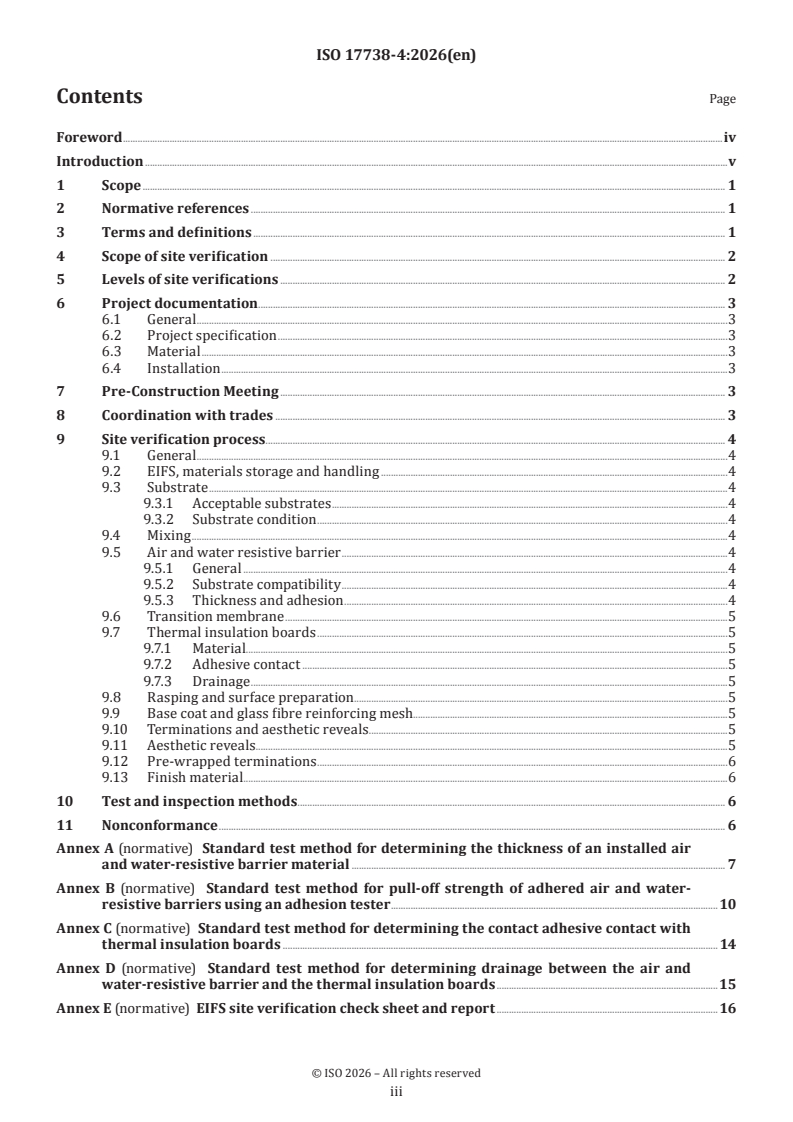
Contents Page
Foreword .iv
Introduction .v
1 Scope . 1
2 Normative references . 1
3 Terms and definitions . 1
4 Scope of site verification . 2
5 Levels of site verifications . 2
6 Project documentation . . 3
6.1 General .3
6.2 Project specification .3
6.3 Material .3
6.4 Installation .3
7 Pre-Construction Meeting . 3
8 Coordination with trades . 3
9 Site verification process. 4
9.1 General .4
9.2 EIFS, materials storage and handling .4
9.3 Substrate .4
9.3.1 Acceptable substrates .4
9.3.2 Substrate condition .4
9.4 Mixing .4
9.5 Air and water resistive barrier .4
9.5.1 General .4
9.5.2 Substrate compatibility .4
9.5.3 Thickness and adhesion .4
9.6 Transition membrane .5
9.7 Thermal insulation boards .5
9.7.1 Material.5
9.7.2 Adhesive contact .5
9.7.3 Drainage .5
9.8 Rasping and surface preparation . . .5
9.9 Base coat and glass fibre reinforcing mesh.5
9.10 Terminations and aesthetic reveals .5
9.11 Aesthetic reveals.5
9.12 Pre-wrapped terminations .6
9.13 Finish material . .6
10 Test and inspection methods . 6
11 Nonconformance . 6
Annex A (normative) Standard test method for determining the thickness of an installed air
and water-resistive barrier material . 7
Annex B (normative) Standard test method for pull-off strength of adhered air and water-
resistive barriers using an adhesion tester . 10
Annex C (normative) Standard test method for determining the contact adhesive contact with
thermal insulation boards . 14
Annex D (normative) Standard test method for determining drainage between the air and
water-resistive barrier and the thermal insulation boards .15
Annex E (normative) EIFS site verification check sheet and report .16
iii
Foreword
ISO (the International Organization for Standardization) is a worldwide federation of national standards
bodies (ISO member bodies). The work of preparing International Standards is normally carried out through
ISO technical committees. Each member body interested in a subject for which a technical committee
has been established has the right to be represented on that committee. International organizations,
governmental and non-governmental, in liaison with ISO, also take part in the work. ISO collaborates closely
with the International Electrotechnical Commission (IEC) on all matters of electrotechnical standardization.
The procedures used to develop this document and those intended for its further maintenance are described
in the ISO/IEC Directives, Part 1. In particular, the different approval criteria needed for the different types
of ISO document should be noted. This document was drafted in accordance with the editorial rules of the
ISO/IEC Directives, Part 2 (see www.iso.org/directives).
ISO draws attention to the possibility that the implementation of this document may involve the use of (a)
patent(s). ISO takes no position concerning the evidence, validity or applicability of any claimed patent
rights in respect thereof. As of the date of publication of this document, ISO had not received notice of (a)
patent(s) which may be required to implement this document. However, implementers are cautioned that
this may not represent the latest information, which may be obtained from the patent database available at
www.iso.org/patents. ISO shall not be held responsible for identifying any or all such patent rights.
Any trade name used in this document is information given for the convenience of users and does not
constitute an endorsement.
For an explanation of the voluntary nature of standards, the meaning of ISO specific terms and expressions
related to conformity assessment, as well as information about ISO's adherence to the World Trade
Organization (WTO) principles in the Technical Barriers to Trade (TBT), see www.iso.org/iso/foreword.html.
This document was prepared by Technical Committee ISO/TC 163, Thermal performance and energy use in
the built environment, Subcommittee SC 3, Thermal insulation products, components and systems.
A list of all parts in the ISO 17738 series can be found on the ISO website.
Any feedback or questions on this document should be directed to the user’s national standards body. A
complete listing of these bodies can be found at www.iso.org/members.html.
iv
Introduction
EIFS are wall cladding assemblies designed to provide integrated air, thermal, vapour, and moisture control
functions in addition to providing a range of aesthetic finishes.
As integrated assemblies, EIFS are installed as tested by the system manufacturer, detailed by the building
design professional, and installed according to manufacturer and standard requirements. Also, if specified,
they can be subject to a standardized process for conducting verification of these project phases.
Verification personnel verify and document that the EIFS installation comprises materials and products
in conformance with ISO 17738-1, is being installed as per ISO 17738-2, with details that conform with
ISO 17738-3, and all are in accordance with manufacturer’s printed installation instructions.
v
International Standard ISO 17738-4:2026(en)
Thermal insulation products — Exterior insulation and finish
systems (EIFS) —
Part 4:
Site verification
1 Scope
This document provides the requirements for site verification that an installed system of EIFS, (exterior
insulation and finish system), conforms with the requirements of ISO 17738-1, is installed in conformance
with ISO 17738-2 and designed in conformance with ISO 17738-3.
The document further covers EIFS installed on prefabricated panels being produced offsite and then
installed on site.
This document does not purport to address all the safety concerns, if any, associated with its use.
2 Normative references
The following documents are referred to in the text in such a way that some or all of their content constitutes
requirements of this document. For dated references, only the edition cited applies. For undated references,
the latest edition of the referenced document (including any amendments) applies.
ISO 3611, Geometrical product specifications (GPS) — Dimensional measuring equipment — Design and
metrological characteristics of micrometers for external measurements
ISO 8503-2, Preparation of steel substrates before application of paints and related products — Surface
roughness characteristics of blast-cleaned steel substrates — Part 2: Method for the grading of surface profile of
abrasive blast-cleaned steel — Comparator procedure
ISO 13385-1, Geometrical product specifications (GPS) — Dimensional measuring equipment — Part 1: Design
and metrological characteristics of callipers
ISO 16809, Non-destructive testing — Ultrasonic thickness determination
ISO 17738-1, Thermal insulation products — Exterior insulation finish systems — Part 1: Materials
ISO 17738-2, Thermal insulation products — Exterior insulation and finish systems (EIFS) — Part 2: Installation
ISO 17738-3, Thermal insulation products — Exterior insulation and finish systems (EIFS) — Part 3: Design
requirements
ISO 21105-1, Performance of buildings — Building enclosure thermal performance verification and
commissioning — Part 1: General requirements
3 Terms and definitions
For the purposes of this document, the following terms and definitions apply.
ISO and IEC maintain terminology databases for use in standardization at the following addresses:
— ISO Online browsing platform: available at https:// www .iso .org/ obp
— IEC Electropedia: available at https:// www .electropedia .org/
3.1
installation
work performed on site to install materials and products
3.2
project
building or structure over which the evaluated system is installed
3.3
verification
examination to confirm that an activity, a product or a service is in accordance with specified project
requirements
3.4
prefabricated panels
wall assemblies that have been constructed off site with the exterior insulation finish system installed
3.5
third party
person or entity independent from the manufacturer or the installer
3.6
exterior insulation finish system verification personnel
EIFS verification personnel
third party person, persons or entity who reviews the evaluated system, installation records, project
specifications, manufacturer’s installation instructions and details to confirm conformance with the
documents
3.7
evaluation agency
third party organization to evaluate conformance to the material standard and publishes a report which
shows conformance or nonconformance
4 Scope of site verification
The EIFS verification personnel shall record what is visible on site at the time of the site verification and the
results of any site testing conducted during the site visit. The EIFS verification personnel shall document by
recording and photographing any discrepancies between the project documentation and what is visible on
site.
EIFS verification personnel shall be representatives of the building owner, a qualified third-party person or
entity, or a qualified third-party evaluation agency, all independent of the EIFS manufacturer or installer.
5 Levels of site verifications
This document covers three levels of site verifications corresponding to ISO 21105-1.
Level 1: Basic, minimum — includes at least one site visit to verify EIFS work at each stage of the application,
on a sampling basis:
— substrate surface preparation and air and water resistive barrier application;
— adhesive and attachment of the thermal insulation boards;
— preparation of the insulation to receive the reinforced base coat;
— application of the reinforced base coat; and
— application of finish coat.
Level 2: Intermediate, medium — includes the scope of review from Level 1 on an ongoing basis, sampling
each review area on the order of 2-3 visits/reports per week when EIFS construction is ongoing – omitting
time either not worked due to resources or weather conditions – or both, etc.
Level 3: Comprehensive, maximum — includes ongoing site verification at all times when EIFS installation
work is occurring.
6 Project documentation
6.1 General
The site verification documentation may be used as part of a building envelope commissioning process in
connection with ISO 21105-1. The level of review determined for each project shall form the basis for the
site verification personnel’s schedule for site visits and reporting. Factors affecting the level of site review
include:
a) The owner’s budget for compensating the entity that employs the site verification personnel;
b) The complexity of the scope of work;
c) The associated risk tolerance which the design professional(s), general contractor, and owner are
comfortable with;
d) The EIFS verification personnel are responsible for reviewing all technical documentation in accordance
with the level of site verification to be conducted.
NOTE It is common to increase the frequency of site verification when higher incidences of deficiencies are
encountered. This is decided by the owner as part of contract administration.
6.2 Project specification
The project specification and other pertinent documents shall be reviewed by the EIFS verification personnel
to confirm conformance with ISO 17738-3.
6.3 Material
The EIFS verification personnel shall confirm that the material and products are documented as conforming
to ISO 17738-1 and that they have come from a single source, or sources approved by the EIFS manufacturer.
6.4 Installation
The EIFS verification personnel shall confirm that the installation, at the time of the site visit and documented
in EIFS installer’s written records, is in conformance with ISO 17738-2, the project specifications and the
EIFS supplier’s instructions. Any conflicts in the documentation or in the installation shall be noted on the
site verification form and documented by photographs with indication where on the project the photographs
were taken.
7 Pre-Construction Meeting
The EIFS verification personnel shall attend a pre-construction meeting when required in accordance with
the ISO 21105-1 level of site verification determined, or when specified in the project documentation to
attend.
8 Coordination with trades
The EIFS verification personnel shall determine the trades involved in the installation of the EIFS and any
other trade that will be needed to be communicated with during the site verification process. The EIFS
verification personnel shall communicate the requirements for EIFS installation site verification, and any
on-site requirements needed to be able to conduct the site verification with the construction manager on
site.
9 Site verification process
9.1 General
The EIFS verification personnel shall review all contract documents that are specifically for EIFS
requirements. The site verification process shall follow the installation steps outlined in ISO 17738-2, based
on the level of the site verification determined. The results of the site verification shall be recorded in a
report containing information that is stipulated in Annex D.
9.2 EIFS, materials storage and handling
The EIFS verification personnel shall confirm whether all EIFS materials and products are as per contract
documents and from a single-source supplier, or other suppliers approved by a single source.
The EIFS verification personnel shall document how the EIFS’s materials and products are being handled
and stored.
9.3 Substrate
9.3.1 Acceptable substrates
The EIFS verification personnel shall confirm that the substrate is approved for the EIFS in conformance
with ISO 17738-1.
9.3.2 Substrate condition
The EIFS verification personnel shall document the condition of the substrate that is visible and prepared
for the installation of the air and water-resistive barrier in conformance with manufacturer’s installation
instructions and ISO 17738-2.
9.4 Mixing
The EIFS verification personnel shall document what equipment is being used to mix the materials and
where possible, document material mixing is in conformance with manufacturer’s written instructions and
ISO 17738-2.
9.5 Air and water resistive barrier
9.5.1 General
The EIFS verification personnel document shall document the air and water resistive barrier material being
installed on the substrate.
9.5.2 Substrate compatibility
The EIFS verification personnel shall confirm that the air and water resistive barrier has been tested with
the substrate.
9.5.3 Thickness and adhesion
The EIFS verification personnel shall test for the thickness of the installed material in accordance with
Annex A and conduct a pull test to determine the pull adhesion value of the installed and cured material in
accordance with Annex B.
9.6 Transition membrane
The EIFS verification personnel shall document the materials used as transition membranes and record
the results of a visual inspection of the installed material. The EIFS verification personnel shall conduct a
pull test on the transition membrane to determine the pull adhesion value in accordance with Annex B, at
sampled locations where the transition membrane:
— forms continuity of the air and water resistive barrier; and
— at transitions of EIFS to adjacent building enclosure assemblies, such as fenestration, roof systems, etc.
9.7 Thermal insulation boards
9.7.1 Material
The EIFS verification personnel shall document the thermal insulation board material being installed and
confirm it is in conformance with the system tested per ISO 17738-1.
9.7.2 Adhesive contact
The EIFS verification personnel shall visually inspect samples of insulation, to confirm the boards are in full
contact with the adhesive by conducting the test outlined in Annex C.
9.7.3 Drainage
The EIFS verification personnel shall confirm drainage between the air and water-resistive barrier and the
thermal insulation boards in accordance with Annex D.
9.8 Rasping and surface preparation
The EIFS verification personnel shall document insulation surface rasping and preparation of installed
thermal insulation boards, visible at the time of the site verification, are in conformance with manufacturer’s
installation instructions and ISO 17738-2.
9.9 Base coat and glass fibre reinforcing mesh
The EIFS verification personnel shall document a visual inspection of the base coat and embedded glass-
fibre reinforcing mesh that are visible during the time of the site verification. Conformance with ISO 17738-2
shall be reported. Thickness measurements shall be conducted in accordance with Annex A.
In accordance with ISO 17738-2, at least two layers of base coat shall be required, unless otherwise specified
by the EIFS manufacturer. This construction requires a continuous layer of wet base coat is applied over the
reinforced base coat to ensure overall thickness is achieved and for a smooth consistent surface to receive
the finish coat.
9.10 Terminations and aesthetic reveals
The EIFS verification personnel shall document that the EIFS terminations meet the design professional’s
details, are
...