

ISO 14624-3:2023
(Main)Space systems — Safety and compatibility of materials — Part 3: Determination of off-gassed compounds from materials and assembled articles
General Information
- Abstract
This document specifies a method for determining the identity and quantity of volatile off-gassed compounds from materials and assembled articles utilized in manned, pressurized spacecraft.
- Status
- Published
- Publication Date
- 09-Oct-2023
- Technical Committee
- ISO/TC 20/SC 14 - Space systems and operations
- Drafting Committee
- ISO/TC 20/SC 14 - Space systems and operations
- Current Stage
- 6060 - International Standard published
- Start Date
- 10-Oct-2023
- Due Date
- 20-May-2023
- Completion Date
- 10-Oct-2023
Overview
ISO 14624-3:2023 - Space systems: Determination of off-gassed compounds specifies a laboratory method to identify and quantify volatile compounds that evolve (off-gas) from materials and assembled articles intended for use in manned, pressurized spacecraft. The standard supports toxicological assessment by providing procedures to measure emissions, calculate a toxic hazard index (T), and derive safe usage limits such as maximum limit mass (MLM) or maximum limit article (MLA).
Key technical topics and requirements
- Scope: Method for volatile off-gassed compounds from materials and assemblies in habitable spacecraft volumes.
- Test atmosphere and pressure: Oxygen volume fraction ~ (20.9 ± 2) % with nitrogen/argon balance; test pressure within ±15 kPa of facility ambient. Specified impurity limits for compressed gases (e.g., CO 1 µl/l, CO2 3.0 µl/l, total hydrocarbons as methane 0.1 µl/l, halogenated compounds 0.5 µl/l, water 7.0 µl/l).
- Thermal conditioning: Standard exposure of (72 ± 1) h at (50 ± 3) °C. High‑temperature‑sensitive materials have a normative alternative at 40 °C (Annex B).
- Apparatus: Sample container, thermal chamber (±3 °C control, continuous recording), and analytical instrumentation.
- Analytical methods: Recommended instruments include gas chromatography with flame ionization detector (GC‑FID), gas chromatography/mass spectrometry (GC‑MS), and infrared spectroscopy. Formaldehyde detection capability required at 0.1 µl/l (or current SMAC).
- Sampling convention: Standard sample-mass-to-chamber-volume ratio is (5.0 ± 0.25) g/l; increase sample mass proportionally if detection limits exceed SMAC values (example provided for benzene).
- Toxicity metrics: Calculate T (toxic hazard index) by summing ratios of projected compound concentrations to their spacecraft maximum allowable concentrations (SMAC). T must be < 0.5 for evaluated materials (assumes 45 kg of material for concentration calculations unless otherwise used).
- Quality and safety: Good laboratory practice (GLP), operator health/safety precautions, and detailed test/reporting procedures are mandated.
Practical applications and who uses this standard
- Purpose: Ensure material safety and compatibility in closed, manned spacecraft atmospheres by quantifying volatile emissions and deriving allowable usage limits.
- Primary users: Aerospace materials engineers, spacecraft integrators, environmental control and life support system (ECLSS) teams, flight hardware suppliers, test laboratories, and mission toxicologists.
- Use cases: Pre‑flight material screening, comparative off‑gassing performance, support for SMAC-based risk assessments, and derivation of MLM/MLA for payload/ cabin design.
Related standards and references
- Part of the ISO 14624 series on space systems - safety and compatibility of materials. Definitions and GLP references align with ISO 14624‑1:2023. SMAC guidance examples reference publicly maintained NASA SMAC listings.
Keywords: ISO 14624-3:2023, off-gassed compounds, off-gassing testing, spacecraft materials, volatile organic compounds, toxic hazard index, SMAC, gas chromatography, thermal chamber, MLM, MLA.
Relations
- Effective Date
- 06-Jun-2022
Get Certified
Connect with accredited certification bodies for this standard

BUREAU VERITAS Certification Germany
Bureau Veritas certification in Germany.

Element Materials Technology
Materials testing and product certification.

AQMS Ltd.
AQMS provides ISO certification to SMEs across the UK.
Sponsored listings
Frequently Asked Questions
ISO 14624-3:2023 is a standard published by the International Organization for Standardization (ISO). Its full title is "Space systems — Safety and compatibility of materials — Part 3: Determination of off-gassed compounds from materials and assembled articles". This standard covers: This document specifies a method for determining the identity and quantity of volatile off-gassed compounds from materials and assembled articles utilized in manned, pressurized spacecraft.
This document specifies a method for determining the identity and quantity of volatile off-gassed compounds from materials and assembled articles utilized in manned, pressurized spacecraft.
ISO 14624-3:2023 is classified under the following ICS (International Classification for Standards) categories: 49.025.01 - Materials for aerospace construction in general; 49.140 - Space systems and operations. The ICS classification helps identify the subject area and facilitates finding related standards.
ISO 14624-3:2023 has the following relationships with other standards: It is inter standard links to ISO 14624-3:2005. Understanding these relationships helps ensure you are using the most current and applicable version of the standard.
ISO 14624-3:2023 is available in PDF format for immediate download after purchase. The document can be added to your cart and obtained through the secure checkout process. Digital delivery ensures instant access to the complete standard document.
Standards Content (Sample)
INTERNATIONAL ISO
STANDARD 14624-3
Second edition
2023-10
Space systems — Safety and
compatibility of materials —
Part 3:
Determination of off-gassed
compounds from materials and
assembled articles
Systèmes spatiaux — Sécurité et compatibilité des matériaux —
Partie 3: Détermination des composés issus du dégazage sous
atmosphère des matériaux et des articles assemblés
Reference number
© ISO 2023
All rights reserved. Unless otherwise specified, or required in the context of its implementation, no part of this publication may
be reproduced or utilized otherwise in any form or by any means, electronic or mechanical, including photocopying, or posting on
the internet or an intranet, without prior written permission. Permission can be requested from either ISO at the address below
or ISO’s member body in the country of the requester.
ISO copyright office
CP 401 • Ch. de Blandonnet 8
CH-1214 Vernier, Geneva
Phone: +41 22 749 01 11
Email: copyright@iso.org
Website: www.iso.org
Published in Switzerland
ii
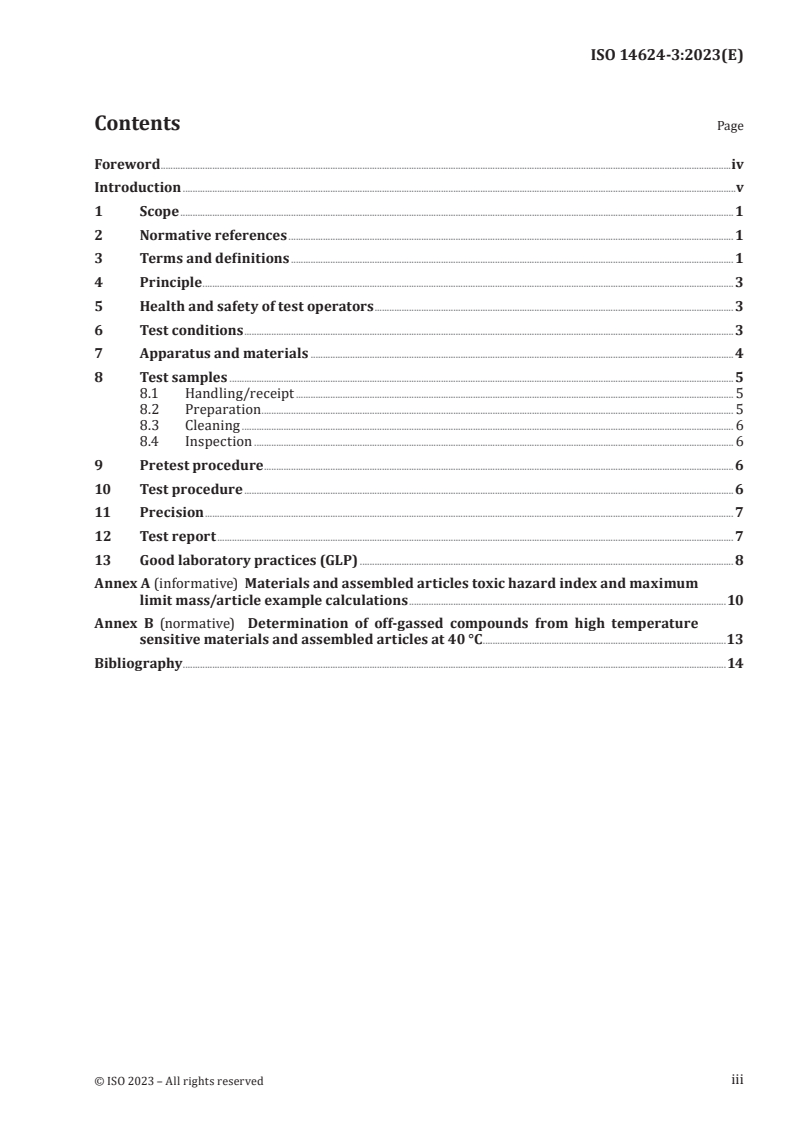
Contents Page
Foreword .iv
Introduction .v
1 Scope . 1
2 Normative references . 1
3 Terms and definitions . 1
4 Principle . 3
5 Health and safety of test operators . 3
6 Test conditions .3
7 Apparatus and materials .4
8 Test samples .5
8.1 Handling/receipt . 5
8.2 Preparation . 5
8.3 Cleaning . 6
8.4 Inspection . 6
9 Pretest procedure .6
10 Test procedure .6
11 Precision . 7
12 Test report . 7
13 Good laboratory practices (GLP) . 8
Annex A (informative) Materials and assembled articles toxic hazard index and maximum
limit mass/article example calculations .10
Annex B (normative) Determination of off-gassed compounds from high temperature
sensitive materials and assembled articles at 40 °C .13
Bibliography .14
iii
Foreword
ISO (the International Organization for Standardization) is a worldwide federation of national standards
bodies (ISO member bodies). The work of preparing International Standards is normally carried out
through ISO technical committees. Each member body interested in a subject for which a technical
committee has been established has the right to be represented on that committee. International
organizations, governmental and non-governmental, in liaison with ISO, also take part in the work.
ISO collaborates closely with the International Electrotechnical Commission (IEC) on all matters of
electrotechnical standardization.
The procedures used to develop this document and those intended for its further maintenance are
described in the ISO/IEC Directives, Part 1. In particular, the different approval criteria needed for the
different types of ISO document should be noted. This document was drafted in accordance with the
editorial rules of the ISO/IEC Directives, Part 2 (see www.iso.org/directives).
ISO draws attention to the possibility that the implementation of this document may involve the use
of (a) patent(s). ISO takes no position concerning the evidence, validity or applicability of any claimed
patent rights in respect thereof. As of the date of publication of this document, ISO had not received
notice of (a) patent(s) which may be required to implement this document. However, implementers are
cautioned that this may not represent the latest information, which may be obtained from the patent
database available at www.iso.org/patents. ISO shall not be held responsible for identifying any or all
such patent rights.
Any trade name used in this document is information given for the convenience of users and does not
constitute an endorsement.
For an explanation of the voluntary nature of standards, the meaning of ISO specific terms and
expressions related to conformity assessment, as well as information about ISO's adherence to
the World Trade Organization (WTO) principles in the Technical Barriers to Trade (TBT), see
www.iso.org/iso/foreword.html.
This document was prepared by Technical Committee ISO/TC 20, Aircraft and space vehicles,
Subcommittee SC 14, Space systems and operations.
This second edition cancels and replaces the first edition (ISO 14624-3:2005), which has been
technically revised.
The main changes are as follows:
— updated the definitions;
— updated Clauses 10 and 12 as well as Table 2.
A list of all parts in the ISO 14624 series can be found on the ISO website.
Any feedback or questions on this document should be directed to the user’s national standards body. A
complete listing of these bodies can be found at www.iso.org/members.html.
iv
Introduction
In this document, the following verbal forms are used:
— “shall” indicates a requirement;
— “should” indicates a recommendation;
— “may” indicates a permission;
— “can” indicates a possibility or a capability.
Recommended criteria are, while not mandatory, considered to be of primary importance in providing
serviceable economical and practical designs. Deviations from the recommended criteria may be made
only after careful consideration, extensive testing and thorough service evaluation have shown an
alternative method to be satisfactory.
v
INTERNATIONAL STANDARD ISO 14624-3:2023(E)
Space systems — Safety and compatibility of materials —
Part 3:
Determination of off-gassed compounds from materials
and assembled articles
1 Scope
This document specifies a method for determining the identity and quantity of volatile off-gassed
compounds from materials and assembled articles utilized in manned, pressurized spacecraft.
2 Normative references
There are no normative references in this document.
3 Terms and definitions
For the purposes of this document, the following terms and definitions apply.
ISO and IEC maintain terminology databases for use in standardization at the following addresses:
— ISO Online browsing platform: available at https:// www .iso .org/ obp
— IEC Electropedia: available at https:// www .electropedia .org/
3.1
assembled article
combination of materials and/or subcomponents resulting in a complete assembly
3.2
average percent relative standard deviation
quotient of the standard deviations for each off-gassed constituent of y replicate samples of a standard
material and the total number of off-gassed constituents
Note 1 to entry: For actual samples, the expected test results and average relative standard deviations for the
quantities of off-gassed compounds (3.6) can be near 50 %. The calculations for standard deviation and average
percent relative standard deviation are as follows:
The standard deviation, s, is given by:
n
xx−
()
∑ i
i=1
s =
n−1
where x is the mean for an individual off-gassed constituent.
Therefore, the calculation for the average percent relative standard deviation A , is given by:
s
s
∑
A = × 100 %
s
y
where
is the summation of the standard deviations for each off-gassed constituent;
s
∑
y is the total number of off-gassed constituents, for a standard material.
3.3
equilibrium plateau
point at which the quantified total hydrocarbon content (normalized to a certified laboratory gas
standard such as propane or methane) shows <10 % change
3.4
good laboratory practice
GLP
practice which involves the testing of standard reference materials to verify data accuracy and
repeatability
[SOURCE: ISO 14624-1:2023, 3.5, modified — Note 1 to entry has been removed.]
3.5
maximum limit
value indicative of the maximum mass of material or the maximum number of assembled articles (3.1)
that can be safely utilized inside the habitable volume of the spacecraft without exceeding a total toxic
hazard index (T) (3.14) of 0,5
Note 1 to entry: Maximum limit can be maximum limit mass (MLM) or maximum limit article (MLA).
Note 2 to entry: See Annex A for detailed calculations.
3.6
off-gassed compound
organic or inorganic compound evolved as a gas from a material or assembled article (3.1)
3.7
off-gassing
evolution of gaseous products from a liquid or solid material into an atmosphere
3.8
primary gas standard
gas mixtures that have gravimetric or analytical traceability and to which all measurements are
ultimately compared
3.9
reportable quantities
quantities determined by each analytical laboratory and based on analysed concentrations of the
specific compound
Note 1 to entry: Compounds that have been identified, but for which the specific compound is unavailable as a
standard, may have reportable quantities based on analysed concentrations of a representative compound.
3.10
ambient temperature
temperature equal to (23 ± 5) °C
3.11
sample container
vessel which contains the test sample
3.12
spacecraft maximum allowable concentration
SMAC
maximum concentration of an off-gassed compound (3.6) allowed in the habitable area of the spacecraft
for a specified flight duration
Note 1 to entry: SMAC values for manned spacecraft are determined by the cognizant procuring authority/user
toxicologist. SMAC values vary with exposure duration; SMAC values for a seven-day flight duration are normally
used to evaluate toxicity of off-gassed compounds. A current listing of NASA SMAC values is maintained on the
Internet at https:// maptis .ndc .nasa .gov/ matsel/ GasPage .aspx with registration via https:// maptis .nasa .gov/ .
3.13
thermal chamber
apparatus into which the sample container (3.11) is placed during thermal conditioning
3.14
toxic hazard index
T
dimensionless ratio of the projected concentration of each off-gassed compound (3.6) in the habitable
volume of the spacecraft under consideration to its spacecraft maximum allowable concentration (SMAC)
(3.12) value and summing the ratios for all off-gassed compounds without separation into toxicological
categories
Note 1 to entry: See Annex A for detailed calculations of the T value for materials or assembled articles (3.1).
Note 2 to entry: T value calculations for materials assume the use of 45 kg of material in habitable volume of the
spacecraft for concentration calculations. T value calculations for assembled articles assumes a single assembled
article used in the in habitable volume of the spacecraft for concentration calculations.
3.15
trace
off-gassed compound (3.6) present in less than the threshold limit defined by an individual laboratory
Note 1 to entry: This category includes compounds that are labelled as unidentified components, because the
concentration is too low for the spectral information to allow for identification. It does not include compounds
that have adequate spectral information but are labelled as unidentified components because suitable standard
spectra for identification are not available.
4 Principle
When this method is utilized for a toxicological assessment for a component or a material (assuming
45 kg of material use) and/or assembled article, the total toxic hazard index (T) values for all volatile
off-gassed compounds shall be less than 0,5 (see Annex B). In addition, the toxic hazard index can be
used to calculate the maximum limit mass (MLM) for use in the habitable volume of the spacecraft. See
Annex B.
5 Health and safety of test operators
Testing outlined in this document may generate toxic substances in either the gas or condensed phase.
Care shall be taken to protect test operators, other personnel and, if necessary, the environment from
such substances.
6 Test conditions
6.1 The test atmosphere should be at least a volume fraction of (20,9 ± 2) % for oxygen with the
balance nitrogen or argon, and the test pressure should be ±15 kPa of the ambient pressure of the test
1)
facility. The maximum volume fraction limits (expressed as a volume fraction in µl/l ) for impurities in
the compressed gases are:
a) carbon monoxide 1;
b) carbon dioxide 3,0;
c) total hydrocarbons, as methane 0,1;
d) halogenated compounds 0,5;
e) water 7,0.
6.2 Batteries or assembled articles containing batteries should be tested in an inert atmosphere
to reduce the risk of generating an explosive gas mixture. Batteries or assembled articles containing
batteries tested in an inert atmosphere do not need to be tested again in an oxygen atmosphere.
6.3 The sample shall be subject to a thermal exposure for (72 ± 1) h at (50 ± 3) °C. Samples do not have
to be tested in spacecraft anticipated oxygen concentration. Off-gassed compounds from materials and
assembled articles which are sensitive to high temperatures shall be determined in accordance with
Annex B.
7 Apparatus and materials
The test system shall comprise the following major components: sample container, thermal chamber
with controlled temperature, and analytical instrumentation.
7.1 Sample container, being easy to clean and construct so that gas samples can be collected easily.
The sample container, including any soft goods, shall not affect the concentration of products off-gassed
from the samples.
7.2 Thermal chamber, having the capability to maintain the test temperature to within ±3 °C for the
duration of the test. The thermal chamber instrumentation shall have the capability to continuously
record the temperature.
7.3 Analytical instrumentation, capable of the separation, identification, and quantification of
selected off-gassed compounds (indicated in Table 1 and Table 2), with reportable quantities at, or
below, their SMAC concentrations.
If the instrumentation cannot achieve this sensitivity, the minimum reportable concentration for those
off-gassed compounds (except formaldehyde) should be reported.
For formaldehyde, the analytical technique shall be capable of detecting a concentration of 0,1 µl/l or
current SMAC.
The recommended analytical instruments include a gas chromatograph using primarily a flame
ionization detector, gas chromatograph/mass spectrometer, and infrared spectrophotometer. Some
analytical compounds can be more difficult to determine, therefore, special methods may be required
to identify and quantify these compounds.
In some cases, where there is a specific target compound of concern that has a reporting limit greater
than the SMAC, it is necessary to test more than the standard test material. The quantity of test
material should be increased proportionally from the standard sample-mass-to-container-volume ratio
(5,0 ± 0,25) g/l to a quantity that allows the analysis to meet the SMAC requirement.
EXAMPLE
1) 1 µl/l = 1 part per million (ppm). The use of “ppm” is deprecated.
Benzene SMAC = 100 parts per billion
Reporting limit = 500 parts per billion
Standard material mass per chamber volume = 5 g/l
Necessary material mass per chamber volume = 25 g/l
8 Test samples
8.1 Handling/receipt
Handling of test articles shall be in a manner that preserves the integrity of the sample surface without
adding contaminants. Materials and assembled articles can be significantly compromised by sources
of contamination, such as exposure to solvents, cleaning agents, abnormal temperatures, variations
in humidity, environmental pollutants, particulate, and handling. It is important that exposure of the
material(s) and assembled articles to these and other contamination sources be sufficiently controlled
to minimize variation in test results.
Test samples shall be prepared from either materials or assembled articles. Preparation of samples for
testing involves the following tasks:
a) receiving and inspecting the material or assembled article;
b) preparing samples to the proper dimensions, if required;
c) cleaning the samples, if specified by the requester;
d) inspecting the samples.
8.2 Preparation
8.2.1 When received, the test material shall be accompanied by proper identification. Appropriate
safety data sheets should also be provided. Note flaws and any residual contamination. All materials
shall meet the requirement of sample-mass-to-container-volume ratio of (5,0 ± 0,25) g/l, and record
the approximate total sample geometric surface area (see 7.3 for special target compounds of concern).
If the specimen mass cannot be met, the maximum practical quantity of specimen, (750 ± 50) cm /l of
thermal chamber volume shall be tested, with the actual specimen mass and geometric surface area
reported. Sample preparation for test materials based on mass shall be as specifi
...