

IEC 62990-1:2019
(Main)Workplace Atmospheres — Part 1: Gas detectors — Performance requirements of detectors for toxic gases
General Information
- Abstract
This part of ISO/IEC 62990 specifies general requirements for design, function and performance, and describes the test methods that apply to portable, transportable, and fixed equipment for the detection and concentration measurement of toxic gases and vapours in workplace atmospheres and other industrial and commercial applications. This document is applicable to continuously sensing equipment whose primary purpose is to provide an indication, alarm and/or other output function the purpose of which is to indicate the presence of a toxic gas or vapour in the atmosphere and in some cases to initiate automatic or manual protective action(s). It is applicable to equipment in which the sensor generates an electrical signal when gas is present. This document applies to two types of equipment: · Type HM (Health Monitoring) ‘occupational exposure’ equipment: For occupational exposure measurement, the performance requirements are focused on uncertainty of measurement of gas concentrations in the region of Occupational Exposure Limit Values (OELV). The upper limit of measurement will be defined by the manufacturer in accordance with 4.2.1. · Type SM (Safety Monitoring) ‘general gas detection’ equipment: For general gas detection applications (e.g. safety warning, leak detection), the performance requirements are focused on alarm signalling. The upper limit of measurement will be defined by the manufacturer according to the intended use of the equipment. In general, the requirements for accuracy will be higher for Type HM equipment than for Type SM equipment. The same equipment may meet the requirements of both Type HM and Type SM. For equipment used for sensing the presence of multiple gases this document applies only to the detection of toxic gas or vapour. This document is not applicable to equipment: – with samplers and concentrators such as sorbents or paper tape having an irreversible indication; – used for the measurement of gases and vapours related to the risk of explosion; – used for the measurement of oxygen; – used only in laboratories for analysis or measurement; – used only for process measurement purposes; – used in the domestic environment; – used in environmental air pollution monitoring; – used for open-path (line of sight) area gas measurement; – used for ventilation control in car parks or tunnels.
- Status
- Published
- Publication Date
- 04-Dec-2019
- Technical Committee
- ISO/TC 146/SC 2 - Workplace atmospheres
- Drafting Committee
- ISO/TC 146/SC 2/WG 3 - Gases
- Current Stage
- 9092 - International Standard to be revised
- Start Date
- 04-Nov-2025
- Completion Date
- 03-Oct-2026
Overview
IEC 62990-1:2019 is an international standard published by the International Electrotechnical Commission (IEC) in collaboration with the International Organization for Standardization (ISO). Titled "Workplace Atmospheres - Part 1: Gas Detectors - Performance Requirements of Detectors for Toxic Gases," this standard sets forth critical performance requirements for gas detection equipment used to monitor toxic gases in workplace atmospheres. Ensuring accurate and reliable detection of toxic substances, IEC 62990-1 helps promote safety and health in occupational environments.
The document establishes general and specific requirements for design, testing, accuracy, alarm signaling, and fault indications of toxic gas detectors. It supports harmonization on a global scale, facilitating manufacturers, employers, and safety professionals in implementing effective monitoring solutions that comply with international best practices.
Key Topics
General and Design Requirements: The standard covers essential design elements of toxic gas detectors, including indicating devices, alarm signals, fault signal handling, and adjustments. It also addresses battery-powered units, systems integrating transmitters and control units, and software-controlled equipment.
Testing Procedures: IEC 62990-1 defines rigorous test methods such as mechanical, environmental, electrical, and performance testing to verify detector reliability under normal and extreme conditions. It includes tests for measurement deviations, stability, fault detection, and exposure to water or adverse environments.
Measurement Uncertainty and Limits: Detailed guidance on calculating the uncertainty of measurement and lower detection limits ensures detectors deliver precise and dependable toxic gas readings. Acceptance criteria are defined to confirm measurement accuracy that aligns with user safety requirements.
Labelling and Instructions: Requirements for clear labelling and comprehensive instruction manuals are specified to aid users in proper detector operation, maintenance, and calibration compliance.
Gas-Specific Requirements: Annexes provide tailored performance criteria for individual toxic gases, ensuring detectors are optimized for specific occupational hazards.
Applications
IEC 62990-1:2019 applies primarily to workplaces where the presence of toxic gases poses a health risk to employees and visitors. Key sectors benefiting from compliance include:
Industrial Plants: Chemical manufacturing, refineries, and processing facilities where toxic gases may be released.
Mining Operations: Detection of harmful gas leaks in underground and surface mining environments.
Laboratories: Protection against exposure to hazardous gaseous compounds used in research and development.
Construction Sites: Monitoring air quality where confined spaces or materials introduce toxic gases.
Environmental Safety: Integration into building ventilation systems and emergency response equipment to ensure safe habitat conditions.
By adhering to IEC 62990-1, organizations can improve workplace safety, meet regulatory requirements, reduce incident risks, and enhance occupational health management programs.
Related Standards
For a comprehensive approach to workplace atmosphere safety and gas detection, organizations may also consider the following related international standards:
IEC 60079 Series: Standards addressing equipment and systems in explosive atmospheres, complementing toxic gas detection for hazardous environments.
ISO 45001: Occupational health and safety management systems providing a framework for risk identification and control.
ISO 7547: Methods for measuring uncertainties in gas concentration measurements, supporting quality assurance in gas detection.
IEC 61508: Functional safety of electrical/electronic systems including gas detection instrument reliability requirements.
Conclusion
IEC 62990-1:2019 provides vital performance requirements and testing methodologies for toxic gas detectors in workplace atmospheres. Its adoption supports enhanced safety, precise monitoring, and international standardization in managing toxic gas hazards. Employers, product manufacturers, and safety professionals rely on this standard to ensure detector effectiveness and protect human health against toxic gas exposure risks.
Get Certified
Connect with accredited certification bodies for this standard

CIS Institut d.o.o.
Personal Protective Equipment (PPE) certification body. Notified Body NB-2890 for EU Regulation 2016/425 PPE.

Kiwa BDA Testing
Building and construction product certification.
Kmetijski inštitut Slovenije
Agricultural Institute of Slovenia. Soil testing, plant health, agricultural product analysis.
Sponsored listings
Frequently Asked Questions
IEC 62990-1:2019 is a standard published by the International Organization for Standardization (ISO). Its full title is "Workplace Atmospheres — Part 1: Gas detectors — Performance requirements of detectors for toxic gases". This standard covers: This part of ISO/IEC 62990 specifies general requirements for design, function and performance, and describes the test methods that apply to portable, transportable, and fixed equipment for the detection and concentration measurement of toxic gases and vapours in workplace atmospheres and other industrial and commercial applications. This document is applicable to continuously sensing equipment whose primary purpose is to provide an indication, alarm and/or other output function the purpose of which is to indicate the presence of a toxic gas or vapour in the atmosphere and in some cases to initiate automatic or manual protective action(s). It is applicable to equipment in which the sensor generates an electrical signal when gas is present. This document applies to two types of equipment: · Type HM (Health Monitoring) ‘occupational exposure’ equipment: For occupational exposure measurement, the performance requirements are focused on uncertainty of measurement of gas concentrations in the region of Occupational Exposure Limit Values (OELV). The upper limit of measurement will be defined by the manufacturer in accordance with 4.2.1. · Type SM (Safety Monitoring) ‘general gas detection’ equipment: For general gas detection applications (e.g. safety warning, leak detection), the performance requirements are focused on alarm signalling. The upper limit of measurement will be defined by the manufacturer according to the intended use of the equipment. In general, the requirements for accuracy will be higher for Type HM equipment than for Type SM equipment. The same equipment may meet the requirements of both Type HM and Type SM. For equipment used for sensing the presence of multiple gases this document applies only to the detection of toxic gas or vapour. This document is not applicable to equipment: – with samplers and concentrators such as sorbents or paper tape having an irreversible indication; – used for the measurement of gases and vapours related to the risk of explosion; – used for the measurement of oxygen; – used only in laboratories for analysis or measurement; – used only for process measurement purposes; – used in the domestic environment; – used in environmental air pollution monitoring; – used for open-path (line of sight) area gas measurement; – used for ventilation control in car parks or tunnels.
This part of ISO/IEC 62990 specifies general requirements for design, function and performance, and describes the test methods that apply to portable, transportable, and fixed equipment for the detection and concentration measurement of toxic gases and vapours in workplace atmospheres and other industrial and commercial applications. This document is applicable to continuously sensing equipment whose primary purpose is to provide an indication, alarm and/or other output function the purpose of which is to indicate the presence of a toxic gas or vapour in the atmosphere and in some cases to initiate automatic or manual protective action(s). It is applicable to equipment in which the sensor generates an electrical signal when gas is present. This document applies to two types of equipment: · Type HM (Health Monitoring) ‘occupational exposure’ equipment: For occupational exposure measurement, the performance requirements are focused on uncertainty of measurement of gas concentrations in the region of Occupational Exposure Limit Values (OELV). The upper limit of measurement will be defined by the manufacturer in accordance with 4.2.1. · Type SM (Safety Monitoring) ‘general gas detection’ equipment: For general gas detection applications (e.g. safety warning, leak detection), the performance requirements are focused on alarm signalling. The upper limit of measurement will be defined by the manufacturer according to the intended use of the equipment. In general, the requirements for accuracy will be higher for Type HM equipment than for Type SM equipment. The same equipment may meet the requirements of both Type HM and Type SM. For equipment used for sensing the presence of multiple gases this document applies only to the detection of toxic gas or vapour. This document is not applicable to equipment: – with samplers and concentrators such as sorbents or paper tape having an irreversible indication; – used for the measurement of gases and vapours related to the risk of explosion; – used for the measurement of oxygen; – used only in laboratories for analysis or measurement; – used only for process measurement purposes; – used in the domestic environment; – used in environmental air pollution monitoring; – used for open-path (line of sight) area gas measurement; – used for ventilation control in car parks or tunnels.
IEC 62990-1:2019 is classified under the following ICS (International Classification for Standards) categories: 13.040.30 - Workplace atmospheres. The ICS classification helps identify the subject area and facilitates finding related standards.
IEC 62990-1:2019 is available in PDF format for immediate download after purchase. The document can be added to your cart and obtained through the secure checkout process. Digital delivery ensures instant access to the complete standard document.
Standards Content (Sample)
IEC 62990-1
Edition 1.0 2019-06
INTERNATIONAL
STANDARD
NORME
INTERNATIONALE
colour
inside
Workplace atmospheres –
Part 1: Gas detectors – Performance requirements of detectors for toxic gases
Atmosphères des lieux de travail –
Partie 1: Détecteurs de gaz – Exigences d'aptitude à la fonction des détecteurs
de gaz toxiques
All rights reserved. Unless otherwise specified, no part of this publication may be reproduced or utilized in any form
or by any means, electronic or mechanical, including photocopying and microfilm, without permission in writing from
either IEC or IEC's member National Committee in the country of the requester. If you have any questions about IEC
copyright or have an enquiry about obtaining additional rights to this publication, please contact the address below or
your local IEC member National Committee for further information.
Droits de reproduction réservés. Sauf indication contraire, aucune partie de cette publication ne peut être reproduite
ni utilisée sous quelque forme que ce soit et par aucun procédé, électronique ou mécanique, y compris la photocopie
et les microfilms, sans l'accord écrit de l'IEC ou du Comité national de l'IEC du pays du demandeur. Si vous avez des
questions sur le copyright de l'IEC ou si vous désirez obtenir des droits supplémentaires sur cette publication, utilisez
les coordonnées ci-après ou contactez le Comité national de l'IEC de votre pays de résidence.
IEC Central Office Tel.: +41 22 919 02 11
3, rue de Varembé info@iec.ch
CH-1211 Geneva 20 www.iec.ch
Switzerland
About the IEC
The International Electrotechnical Commission (IEC) is the leading global organization that prepares and publishes
International Standards for all electrical, electronic and related technologies.
About IEC publications
The technical content of IEC publications is kept under constant review by the IEC. Please make sure that you have the
latest edition, a corrigendum or an amendment might have been published.
IEC publications search - webstore.iec.ch/advsearchform Electropedia - www.electropedia.org
The advanced search enables to find IEC publications by a The world's leading online dictionary on electrotechnology,
variety of criteria (reference number, text, technical containing more than 22 000 terminological entries in English
committee,…). It also gives information on projects, replaced and French, with equivalent terms in 16 additional languages.
and withdrawn publications. Also known as the International Electrotechnical Vocabulary
(IEV) online.
IEC Just Published - webstore.iec.ch/justpublished
Stay up to date on all new IEC publications. Just Published IEC Glossary - std.iec.ch/glossary
details all new publications released. Available online and 67 000 electrotechnical terminology entries in English and
once a month by email. French extracted from the Terms and Definitions clause of
IEC publications issued since 2002. Some entries have been
IEC Customer Service Centre - webstore.iec.ch/csc collected from earlier publications of IEC TC 37, 77, 86 and
If you wish to give us your feedback on this publication or CISPR.
need further assistance, please contact the Customer Service
Centre: sales@iec.ch.
A propos de l'IEC
La Commission Electrotechnique Internationale (IEC) est la première organisation mondiale qui élabore et publie des
Normes internationales pour tout ce qui a trait à l'électricité, à l'électronique et aux technologies apparentées.
A propos des publications IEC
Le contenu technique des publications IEC est constamment revu. Veuillez vous assurer que vous possédez l’édition la
plus récente, un corrigendum ou amendement peut avoir été publié.
Recherche de publications IEC - Electropedia - www.electropedia.org
webstore.iec.ch/advsearchform Le premier dictionnaire d'électrotechnologie en ligne au
La recherche avancée permet de trouver des publications IEC monde, avec plus de 22 000 articles terminologiques en
en utilisant différents critères (numéro de référence, texte, anglais et en français, ainsi que les termes équivalents dans
comité d’études,…). Elle donne aussi des informations sur les 16 langues additionnelles. Egalement appelé Vocabulaire
projets et les publications remplacées ou retirées. Electrotechnique International (IEV) en ligne.
IEC Just Published - webstore.iec.ch/justpublished Glossaire IEC - std.iec.ch/glossary
Restez informé sur les nouvelles publications IEC. Just 67 000 entrées terminologiques électrotechniques, en anglais
Published détaille les nouvelles publications parues. et en français, extraites des articles Termes et Définitions des
Disponible en ligne et une fois par mois par email. publications IEC parues depuis 2002. Plus certaines entrées
antérieures extraites des publications des CE 37, 77, 86 et
Service Clients - webstore.iec.ch/csc CISPR de l'IEC.
Si vous désirez nous donner des commentaires sur cette
publication ou si vous avez des questions contactez-nous:
sales@iec.ch.
IEC 62990-1
Edition 1.0 2019-06
INTERNATIONAL
STANDARD
NORME
INTERNATIONALE
colour
inside
Workplace atmospheres –
Part 1: Gas detectors – Performance requirements of detectors for toxic gases
Atmosphères des lieux de travail –
Partie 1: Détecteurs de gaz – Exigences d'aptitude à la fonction des détecteurs
de gaz toxiques
INTERNATIONAL
ELECTROTECHNICAL
COMMISSION
COMMISSION
ELECTROTECHNIQUE
INTERNATIONALE
ICS 29.260.20 ISBN 978-2-8322-7080-6
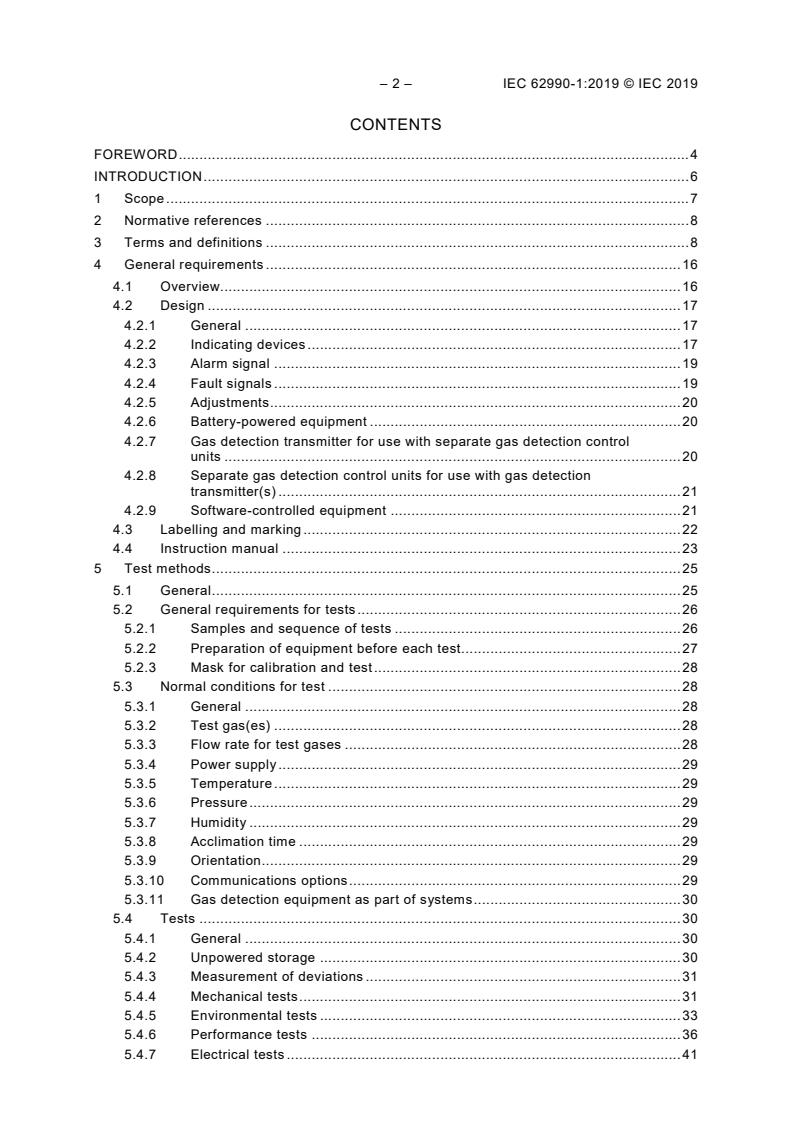
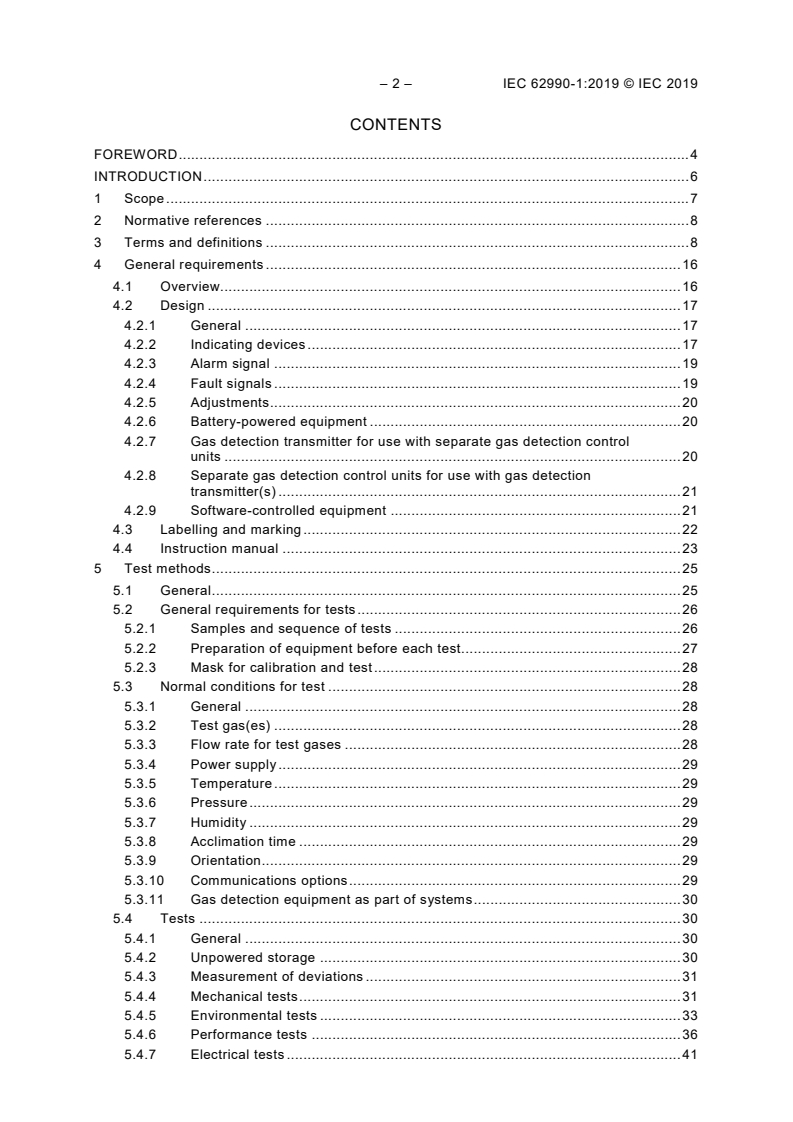
– 2 – IEC 62990-1:2019 © IEC 2019
CONTENTS
FOREWORD . 4
INTRODUCTION . 6
1 Scope . 7
2 Normative references . 8
3 Terms and definitions . 8
4 General requirements . 16
4.1 Overview. 16
4.2 Design . 17
4.2.1 General . 17
4.2.2 Indicating devices . 17
4.2.3 Alarm signal . 19
4.2.4 Fault signals . 19
4.2.5 Adjustments . 20
4.2.6 Battery-powered equipment . 20
4.2.7 Gas detection transmitter for use with separate gas detection control
units . 20
4.2.8 Separate gas detection control units for use with gas detection
transmitter(s) . 21
4.2.9 Software-controlled equipment . 21
4.3 Labelling and marking . 22
4.4 Instruction manual . 23
5 Test methods . 25
5.1 General . 25
5.2 General requirements for tests . 26
5.2.1 Samples and sequence of tests . 26
5.2.2 Preparation of equipment before each test. 27
5.2.3 Mask for calibration and test . 28
5.3 Normal conditions for test . 28
5.3.1 General . 28
5.3.2 Test gas(es) . 28
5.3.3 Flow rate for test gases . 28
5.3.4 Power supply . 29
5.3.5 Temperature . 29
5.3.6 Pressure . 29
5.3.7 Humidity . 29
5.3.8 Acclimation time . 29
5.3.9 Orientation . 29
5.3.10 Communications options . 29
5.3.11 Gas detection equipment as part of systems . 30
5.4 Tests . 30
5.4.1 General . 30
5.4.2 Unpowered storage . 30
5.4.3 Measurement of deviations . 31
5.4.4 Mechanical tests . 31
5.4.5 Environmental tests . 33
5.4.6 Performance tests . 36
5.4.7 Electrical tests . 41
5.4.8 Stability . 44
5.4.9 Fault signal tests . 45
5.4.10 Software controlled equipment . 46
5.4.11 Protection against water . 46
6 Uncertainty of measurement and lower limit of measurement for type HM
equipment . 47
6.1 General . 47
6.2 Method of calculation of uncertainty of measurement . 47
6.2.1 Basic concept . 47
6.2.2 Sources of uncertainty . 48
6.2.3 Calculation of relative expanded uncertainty . 53
6.3 Method of calculation of lower limit of measurement . 54
6.4 Acceptance criteria . 55
6.4.1 Uncertainty of measurement . 55
6.4.2 Lower limit of measurement . 55
6.5 Relation between uncertainty and accuracy . 55
Annex A (normative) Gas specific performance requirements . 56
Annex B (informative) Determination of time of response and time of recovery . 57
B.1 Aspirated equipment . 57
B.1.1 Test rig . 57
B.1.2 Equipment without internal pump . 57
B.1.3 Equipment with internal pump . 57
B.2 Equipment that samples by diffusion . 58
B.2.1 Calibration mask method . 58
B.2.2 Diffusion or flow methods . 58
Bibliography . 60
Figure 1 – Relationship between indication range and measuring range . 14
Figure 2 – Warm-up time in clean air (typical) . 15
Figure 3 – Warm-up time in standard test gas (typical) . 15
Figure 4 – Example of zero uncertainty . 16
Figure B.1 – Schematic example of test rig for use with aspirated equipment . 58
Figure B.2 – Schematic example of test chamber for diffusion method . 59
Figure B.3 – Schematic example of test chamber for flow method . 59
Table 1 – Factors to be considered in the expanded uncertainty estimate . 48
Table A.1 – Gas specific performance requirements . 56
– 4 – IEC 62990-1:2019 © IEC 2019
INTERNATIONAL ELECTROTECHNICAL COMMISSION
____________
WORKPLACE ATMOSPHERES –
Part 1: Gas detectors –
Performance requirements of detectors for toxic gases
FOREWORD
1) The International Electrotechnical Commission (IEC) is a worldwide organization for standardization comprising
all national electrotechnical committees (IEC National Committees). The object of IEC is to promote
international co-operation on all questions concerning standardization in the electrical and electronic fields. To
this end and in addition to other activities, IEC publishes International Standards, Technical Specifications,
Technical Reports, Publicly Available Specifications (PAS) and Guides (hereafter referred to as “IEC
Publication(s)”). Their preparation is entrusted to technical committees; any IEC National Committee interested
in the subject dealt with may participate in this preparatory work. International, governmental and non-
governmental organizations liaising with the IEC also participate in this preparation. IEC collaborates closely
with the International Organization for Standardization (ISO) in accordance with conditions determined by
agreement between the two organizations.
2) The formal decisions or agreements of IEC on technical matters express, as nearly as possible, an international
consensus of opinion on the relevant subjects since each technical committee has representation from all
interested IEC National Committees.
3) IEC Publications have the form of recommendations for international use and are accepted by IEC National
Committees in that sense. While all reasonable efforts are made to ensure that the technical content of IEC
Publications is accurate, IEC cannot be held responsible for the way in which they are used or for any
misinterpretation by any end user.
4) In order to promote international uniformity, IEC National Committees undertake to apply IEC Publications
transparently to the maximum extent possible in their national and regional publications. Any divergence
between any IEC Publication and the corresponding national or regional publication shall be clearly indicated in
the latter.
5) IEC itself does not provide any attestation of conformity. Independent certification bodies provide conformity
assessment services and, in some areas, access to IEC marks of conformity. IEC is not responsible for any
services carried out by independent certification bodies.
6) All users should ensure that they have the latest edition of this publication.
7) No liability shall attach to IEC or its directors, employees, servants or agents including individual experts and
members of its technical committees and IEC National Committees for any personal injury, property damage or
other damage of any nature whatsoever, whether direct or indirect, or for costs (including legal fees) and
expenses arising out of the publication, use of, or reliance upon, this IEC Publication or any other IEC
Publications.
8) Attention is drawn to the Normative references cited in this publication. Use of the referenced publications is
indispensable for the correct application of this publication.
9) Attention is drawn to the possibility that some of the elements of this IEC Publication may be the subject of
patent rights. IEC shall not be held responsible for identifying any or all such patent rights.
International Standard IEC 62990-1 has been prepared by Joint Working Group (JWG) 45 of
IEC technical committee 31: Equipment for explosive atmospheres in cooperation with
ISO technical committee 146: Air quality, sub-committee 2: Workplace atmospheres.
It is published as a dual logo standard.
The text of this International Standard is based on the following documents:
FDIS Report on voting
31/1463/FDIS 31/1480/RVD
Full information on the voting for the approval of this International Standard can be found in
the report on voting indicated in the above table.
This document has been drafted in accordance with the ISO/IEC Directives, Part 2.
A list of all parts in the IEC 62990 series, published under the general title Workplace
atmospheres, can be found on the IEC website.
The committee has decided that the contents of this document will remain unchanged until the
stability date indicated on the IEC website under "http://webstore.iec.ch" in the data related to
the specific document. At this date, the document will be
• reconfirmed,
• withdrawn,
• replaced by a revised edition, or
• amended.
The contents of the corrigendum of December 2019 have been included in this copy.
IMPORTANT – The 'colour inside' logo on the cover page of this publication indicates
that it contains colours which are considered to be useful for the correct
understanding of its contents. Users should therefore print this document using a
colour printer.
– 6 – IEC 62990-1:2019 © IEC 2019
INTRODUCTION
This part of IEC 62990 specifies general requirements for construction, testing and
performance of equipment intended to measure the concentration of toxic gas and vapour in
workplace atmospheres and other industrial and commercial applications. The performance
requirements are intended to apply under environmental conditions present at the site of
operation. However, because a wide range of environmental conditions are encountered in
practise, this document specifies requirements that have to be fulfilled by equipment when
tested under prescribed laboratory conditions.
This document applies to the following types of equipment: Health Monitoring (HM) and Safety
Monitoring (SM). For a given measurement task of Type HM equipment the range over which
the requirements must be met depends on the occupational exposure limit value. However, for
most toxic gases and vapours the occupational exposure limit values have not been
harmonized at the international level. Therefore, it was decided to use a reference value
instead of the occupational exposure limit value for the performance tests. The list of
reference values is given in Annex A. The reference values chosen are equal to or close to
the occupational exposure limit values used in different countries but are intended to be used
only for type testing equipment without any legal implications.
Electrical equipment used for the direct detection and direct concentration measurement of
toxic gases and vapours generate readings in clean air (nominally zero), which vary with
environmental conditions and time. This document therefore includes test methods and
requirements for acceptable variations in measured values at application of zero gas and of
defined test gases.
For gas detection equipment including additional function for detecting flammable gas and/or
oxygen, consideration should be given to the relevant standards.
General requirements for construction, testing and performance of gas detectors for
flammable gases and vapours are set out in IEC 60079-29-1, Explosive atmospheres –
Part 29-1: Gas detectors – Performance requirements of detectors for flammable gases.
General requirements for construction, testing and performance of open path detectors for
flammable gases are set out in IEC 60079-29-4, Explosive atmospheres – Part 29-4: Gas
detectors – Performance requirements of open path detectors for flammable gases.
Guidance for the selection, installation, use and maintenance of gas detecting equipment is
set out in IEC 60079-29-2: Explosive atmospheres – Part 29-2, Gas detectors – Selection,
installation, use and maintenance of detectors for flammable gases and oxygen.
Guidance for functional safety of fixed gas detection systems is set out in IEC 60079-29-3:
Explosive atmospheres – Part 29-3, Gas detectors – Guidance on functional safety of fixed
gas detection systems.
WORKPLACE ATMOSPHERES –
Part 1: Gas detectors –
Performance requirements of detectors for toxic gases
1 Scope
This part of IEC 62990 specifies general requirements for design, function and performance,
and describes the test methods that apply to portable, transportable, and fixed equipment for
the detection and concentration measurement of toxic gases and vapours in workplace
atmospheres and other industrial and commercial applications.
This document is applicable to continuously sensing equipment whose primary purpose is to
provide an indication, alarm and/or other output function the purpose of which is to indicate
the presence of a toxic gas or vapour in the atmosphere and in some cases to initiate
automatic or manual protective action(s). It is applicable to equipment in which the sensor
generates an electrical signal when gas is present.
This document applies to two types of equipment:
• Type HM (Health Monitoring) ‘occupational exposure’ equipment:
For occupational exposure measurement, the performance requirements are focused on
uncertainty of measurement of gas concentrations in the region of Occupational Exposure
Limit Values (OELV). The upper limit of measurement will be defined by the manufacturer
in accordance with 4.2.1.
• Type SM (Safety Monitoring) ‘general gas detection’ equipment:
For general gas detection applications (e.g. safety warning, leak detection), the
performance requirements are focused on alarm signalling. The upper limit of
measurement will be defined by the manufacturer according to the intended use of the
equipment.
In general, the requirements for accuracy will be higher for Type HM equipment than for Type
SM equipment. The same equipment may meet the requirements of both Type HM and Type
SM.
For equipment used for sensing the presence of multiple gases this document applies only to
the detection of toxic gas or vapour.
This document is not applicable to equipment:
– with samplers and concentrators such as sorbents or paper tape having an irreversible
indication;
– used for the measurement of gases and vapours related to the risk of explosion;
– used for the measurement of oxygen;
– used only in laboratories for analysis or measurement;
– used only for process measurement purposes;
– used in the domestic environment;
– used in environmental air pollution monitoring;
– used for open-path (line of sight) area gas measurement;
– used for ventilation control in car parks or tunnels.
– 8 – IEC 62990-1:2019 © IEC 2019
2 Normative references
The following documents are referred to in the text in such a way that some or all of their
content constitutes requirements of this document. For dated references, only the edition
cited applies. For undated references, the latest edition of the referenced document (including
any amendments) applies.
IEC 60068-2-6, Environmental testing – Part 2-6: Tests – Test Fc: Vibration (sinusoidal)
IEC 60079-0, Explosive atmospheres – Part 0: Equipment – General requirements
IEC 60529, Degrees of protection provided by enclosures (IP Code)
IEC 61000-4-29, Electromagnetic compatibility (EMC) – Part 4-29: Testing and measurement
techniques – Voltage dips, short interruptions and voltage variations on d.c. input power port
immunity tests
IEC 61000-6-3, Electromagnetic compatibility (EMC) – Part 6-3: Generic standards –
Emission standard for residential, commercial and light-industrial environments
IEC 61000-6-4, Electromagnetic compatibility (EMC) – Part 6-4: Generic standards –
Emission standard for industrial environments
IEC 61326-1, Electrical equipment for measurement, control and laboratory use – EMC
requirements – Part 1: General requirements
3 Terms and definitions
For the purposes of this document, the following terms and definitions apply.
ISO and IEC maintain terminological databases for use in standardization at the following
addresses:
• IEC Electropedia: available at http://www.electropedia.org/
• ISO Online browsing platform: available at http://www.iso.org/obp
3.1
gas properties
3.1.1
ambient air
normal atmosphere surrounding the equipment
3.1.2
clean air
air that is free of gases or vapours which the sensor is sensitive to or which influence the
performance of the sensor
3.1.3
occupational exposure limit value
OELV
limit of the time-weighted average of the concentration of a chemical agent in the air within
the breathing zone of a worker in relation to a specified reference period
Note 1 to entry: The term “limit value” is often used as a synonym for “occupational exposure limit value”, but the
term “occupational exposure limit value” is preferred because there is more than one limit value (e.g., biological
limit value and occupational exposure limit value).
Note 2 to entry: Occupational exposure limit values (OELVs) are often set for reference periods of 8 h, but can
also be set for shorter periods or concentration excursions.
[SOURCE: ISO 18158:2016, 2.1.5.4, modified (Note 2 to entry is shortened)]
3.1.4
reference value
value used as the basis to specify requirements such as measuring
range, resolution and alarm set point
Note 1 to entry: The term reference value is used in this document because for most toxic gases and vapours the
occupational exposure limit values have not been harmonized at the International level.
3.1.5
poisons
substances that lead to temporary or permanent change of
performance, particularly loss of sensitivity of the sensing element
3.1.6
toxic gas
gas or vapour that can be harmful to human health and/or the performance of persons due to
its physical or physico-chemical properties
Note 1 to entry: For the purpose of this document, the term “toxic gas” includes “toxic vapours”.
3.1.7
volume fraction
quotient of the volume of a specified component and the sum of the volumes of all
components of a gas mixture before mixing, all volumes referring to the pressure and the
temperature of the gas mixture
Note 1 to entry: The volume fraction and volume concentration take the same value if, at the same state
conditions, the sum of the component volumes before mixing and the volume of the mixture are equal. However,
because the mixing of two or more gases at the same state conditions is usually accompanied by a slight
contraction or, less frequently, a slight expansion, this is not generally the case.
3.1.8
zero gas
gas recommended by the manufacturer, which is free of toxic gases and interfering and
contaminating substances, the purpose of which is calibration or adjustment of the equipment
zero
3.1.9
standard test gas
test gas with a composition specified for each item of equipment and gas and/or vapour to be
used for all tests unless otherwise stated
3.1.10
time-weighted average concentration
TWA concentration
concentration of gas in air averaged over a reference period
3.1.11
reference period
specified period of time for which the occupational exposure limit value of a chemical agent
applies
Note 1 to entry: The reference period is usually 8 h for long-term measurements and 15 min for short-term
measurements.
[SOURCE: ISO 18158:2016, 2.1.5.7, modified (term “biological agent” deleted as not
relevant to the current document)]
– 10 – IEC 62990-1:2019 © IEC 2019
3.2
types of equipment
3.2.1
alarm-only equipment
equipment with an alarm but not having an indication of measured value
3.2.2
aspirated equipment
equipment that samples the gas by drawing it to the gas sensor
Note 1 to entry: A hand operated or electric pump is often used to draw gas to the sensor.
3.2.3
automatically aspirated equipment
aspirated equipment with an integral pump or separate pump, which is connected directly to
the equipment
3.2.4
continuous duty equipment
equipment that is powered for long periods of time, but may have either continuous or
intermittent sensing
Note 1 to entry: Within this document, all equipment is regarded as continuous duty.
3.2.5
diffusion equipment
equipment in which the transfer of gas from the atmosphere to the sensor takes place without
aspirated flow
3.2.6
fixed equipment
equipment fastened to a support, or otherwise secured in a specific location when energized
3.2.7
portable equipment
equipment intended to be carried by a person during its operation
Note 1 to entry: Portable equipment is battery powered and includes, but is not limited to
a) hand-held equipment, typically less than 1 kg, which requires use of only one hand to operate,
b) personal monitors, similar in size and mass to the hand-held equipment, that are continuously operating while
they are attached to the user, and
c) larger equipment that can be operated by the user while it is carried either by hand, by a shoulder strap or
carrying harness and which may or may not have a hand directed probe.
3.2.8
transportable equipment
equipment not intended to be carried by a person during operation, nor intended for fixed
installation
3.2.9
gas detection transmitter
fixed gas detection equipment that provide a conditioned electronic signal or output indication
to a generally accepted industry standard (such as 4-20 mA), intended to be utilized with
separate gas detection control units or signal processing data acquisition, central monitoring
and similar systems, which typically process information from various locations and sources
including, but not limited to gas detection equipment
3.2.10
gas detection control unit
equipment intended to provide display indication, alarm functions, output contacts or alarm
signal outputs or any combination when operated with remote sensor(s)
3.2.11
separate gas detection control unit
equipment intended to provide display indication, alarm functions, output contacts or alarm
signal outputs or any combination when operated with gas detection transmitter(s)
3.2.12
equipment with integral sensor(s)
equipment that provides display indication, alarm functions, output contacts and/or alarm
signal outputs using a sensor which is within or directly assembled to the equipment housing
3.2.13
accessory
component which can be fitted to the equipment for special purpose
EXAMPLE: External gas pump, sampling probe, hoses, collecting cone, weather protection device.
3.3
sensors
3.3.1
sensing element
part of the sensor which is sensitive to the gas/vapour to be measured
3.3.2
sensor
assembly in which the sensing element is housed and that may also contain associated circuit
components
3.3.3
integral sensor
sensor which is within or directly assembled to the equipment housing
3.3.4
remote sensor
sensor which is installed separately, but is connected to a gas detection control unit, gas
detection transmitter, or to transportable or portable equipment
3.4
supply of gas to equipment
3.4.1
sample line
means by which the gas being sampled is conveyed to the sensor
Note 1 to entry: Accessories such as filter or water trap are often included in the sample line.
3.4.2
sampling probe
separate accessory sample line which is optionally attached to the equipment
Note 1 to entry: It is usually short (e.g. of the order of 1 m) and rigid, although it can be telescopic. In some
cases, it is connected by a flexible tube to the equipment.
– 12 – IEC 62990-1:2019 © IEC 2019
3.4.3
adjustment
procedure carried out to minimize the deviation of the measured value from the test gas
concentration
Note 1 to entry: When the equipment is adjusted to give an indication of zero in clean air, the procedure is
called ’zero adjustment’.
3.4.4
calibration
procedure which establishes the relationship between a measured value and the
concentration of a test gas
Note 1 to entry: If the deviation at calibration is too high, usually an adjustment will be carried out subsequently.
3.4.5
field calibration kit
means of presenting test gas to the equipment for the purpose of calibrating, adjusting or
verifying the operation of the equipment
Note 1 to entry: The field calibration kit can be used for verifying the operation of the alarms if the concentration
of the test gas is above the alarm set-point.
Note 2 to entry: A mask for calibration and test is an example of a field calibration kit.
3.4.6
mask for calibration and test
device that can be attached to the equipment to present a test gas to the sensor in a
reproducible manner
3.5
signals and alarms
3.5.1
alarm set point
setting of the equipment at which the measured concentration will cause the equipment to
initiate an indication, alarm or other output function
3.5.2
TWA alarm set point
setting of the equipment at which the measured time weighted average concentration will
cause the equipment to initiate an indication, alarm or other output function
3.5.3
indication
representation of the measured value on an output or display
Note 1 to entry: The indication may be affected by suppression of indication, filtering or averaging.
3.5.4
fault signal
audible, visible or other type of output, different from the alarm signal, permitting, directly or
indirectly, a warning or indication that the equipment is not working satisfactorily
3.5.5
latching alarm
alarm that, once activated, requires deliberate action to be deactivated
3.5.6
measured value
calculated concentration of gas and/or vapour that results from processing sensor signal
Note 1 to entry: The measured value may be further processed before indication on output or display
(e.g. time-weighted average, suppression of indication, etc.).
3.5.7
measuring principle
type of physical or physico-chemical detection principle and the measurement procedure to
determine the measured value
3.5.8
special state
any state of the equipment other than those in which monitoring of gas concentration and/or
alarming is the intent
Note 1 to entry: Special state includes warm-up, calibration mode or fault condition.
3.5.9
indication range
range of measured values of gas concentration over which the equipment is capable of
indicating (see Figure 1.
3.5.10
lower limit of indication
smallest measured value within the indication range
SEE Figure 1)
3.5.11
upper limit of indication
largest measured value within the indication range
SEE Figure 1.
3.5.12
measuring range
range of measured values of gas concentration over which the accuracy of the equipment lies
within specified limits
SEE Figure 1.
3.5.13
lower limit of measurement
smallest measured value within the measuring range
SEE Figure 1.
Note 1 to entry: The lower limit of measurement is always zero for type SM equipment.
3.5.14
upper limit of measurement
largest measured value within the measuring range
SEE Figure 1.
Note 1 to entry: Indications below the lower limit of measurement or above the upper limit of measurement will not
necessarily meet the requirements of this document.
– 14 – IEC 62990-1:2019 © IEC 2019
Lower limit of indication
Upper limit of indication
Zero
Indication range
Measuring range
Lower limit of measurement Upper limit of measurement
IEC
Figure 1 – Relationship between indication range and measuring range
3.6
times
3.6.1
drift
variation in the equipment indication over time at any fixed gas volume fraction (including
clean air) under constant ambient conditions
3.6.2
final indication
indication given by the equipment after stabilization
3.6.3
stabilization
state when three successive indications of an equipment at a constant gas volume fraction,
taken at 2 minute intervals or twice the respective t(90), whichever is less, indicates no
changes greater than ± the lower limit of measurement for type HM equipment or ±1 % of the
upper limit of measurement for type SM equipment
3.6.4
time of response
t(x)
time interval, with the equipment in a warmed-up condition, between the time when an
instantaneous change between clean air and the standard test gas is produced at the
equipment inlet, and the time when the indication reaches a stated percentage (x) of the final
indication
Note 1 to entry: For alarm-only equipment the stated indication can be represented by the activation of the alarm
set at a stated value.
3.6.5
time of recovery
t(x)
time interval, with the equipment in a warmed-up condition, between the time when an
instantaneous change from standard test gas to clean air is produced at the equipment inlet
and the time when the indication reaches a stated percentage (x) of the initial indication
Note 1 to entry: For alarm-only equipment the stated indication can be represented by the de-activation of the
alarm set at a stated value.
3.6.6
warm-up time
time interval, with the equipment in a stated atmosphere, between the time when the
equipment is switched on and the time when the indication reaches and remains within the
stated tolerances
Note 1 to entry: See equipment warm-up time in Figures 2 and 3.
Power off in Power on in
clean air clean air
Specified
Equipment
0 tolerance band
}
zero
on zero indication
Time
0 Warm-up time
(see 3.6.6) IEC
Figure 2 – Warm-up time in clean air (typical)
Power off Power on
in standard in standard
test gas test gas
Specified
Volume fraction
tolerances of
of standard
}
the indication
test gas
Zero in
clean air
Time
Warm-up time
(see 3.6.6)
IEC
Figure 3 – Warm-up time in standard test gas (typical)
3.7
uncertainty
3.7.1
expanded uncertainty
U
quantity defining an interval about a result of a measurement, expected to encompass a large
fraction of the distribution of values that could reasonably be attributed to the measurand
[SOURCE: ISO 18158:2016, 2.4.2.5]
3.7.2
measurand
particular quantity subject to measurement
[SOURCE: ISO 18158:2016, 2.3.8]
Indication
Indication
– 16 – IEC 62990-1:2019 © IEC 2019
3.7.3
coverage factor
k
numerical factor used as a multiplier of the combined standard uncertainty in order to obtain
an expanded uncertainty
3.7.4
non-random uncertainty
uncertainty associated with non-random errors
3.7.5
random uncertainty
uncertainty associated with random errors
3.7.6
zero uncertainty
quantity defining an interval about zero expected to encompass a large fraction of the
distribution of values that could reasonably be attributed to the measurement in clean air
Note 1 to entry: In Figure 4, the mean value of the measured values in clean air is not equal to zero to illustrate
that there can be an offset due to drift. The mean value can be above or below zero.
Distribution of measured
values in clean air
Zero Lower limit of Indication
measurement
IEC
Figure 4 – Example of zero uncertainty
3.8
miscellaneous
3.8.1
special tool
tool required to gain access to, or to adjust the equipment controls
Note 1 to entry: The design of the tool is intended to discourage unauthorised interference with the equipment.
4 General requirements
4.1 Overview
In addition to the requirements of this document, parts of the gas detection equipment
intended for use in explosive atmospheres shall comply with the relevant construction and
explosion protection requirements as specified in the IEC 60079 series of standards. The
ambient temperature and pressure ranges of such equipment conforming to this document
shall not exceed the ambient temperature and pressure ranges of the Type(s) of Protection.
Probability
4.2 Design
4.2.1 General
For Type HM equipment the upper limit of measurement shall be equal to or greater than
2 times the reference value. (See Table A.1.) The requirement for the lower limit of
measurement is in 6.4.2.
The equipment shall be constructed in such a manner that regular functional checks can be
easily undertaken by the user and that it can be equipped with suitable devices for application
of test gas (field calibration kit).
Toxic gas detection equipment or parts thereof (e.g. remote sensors) shall be constructed of
materials known to be resistant to degradation by the environment in which they are intended
to be used
...
IEC 62990-1
Edition 1.0 2019-06
INTERNATIONAL
STANDARD
NORME
INTERNATIONALE
colour
inside
Workplace atmospheres –
Part 1: Gas detectors – Performance requirements of detectors for toxic gases
Atmosphères des lieux de travail –
Partie 1: Détecteurs de gaz – Exigences d'aptitude à la fonction des détecteurs
de gaz toxiques
All rights reserved. Unless otherwise specified, no part of this publication may be reproduced or utilized in any form
or by any means, electronic or mechanical, including photocopying and microfilm, without permission in writing from
either IEC or IEC's member National Committee in the country of the requester. If you have any questions about IEC
copyright or have an enquiry about obtaining additional rights to this publication, please contact the address below or
your local IEC member National Committee for further information.
Droits de reproduction réservés. Sauf indication contraire, aucune partie de cette publication ne peut être reproduite
ni utilisée sous quelque forme que ce soit et par aucun procédé, électronique ou mécanique, y compris la photocopie
et les microfilms, sans l'accord écrit de l'IEC ou du Comité national de l'IEC du pays du demandeur. Si vous avez des
questions sur le copyright de l'IEC ou si vous désirez obtenir des droits supplémentaires sur cette publication, utilisez
les coordonnées ci-après ou contactez le Comité national de l'IEC de votre pays de résidence.
IEC Central Office Tel.: +41 22 919 02 11
3, rue de Varembé info@iec.ch
CH-1211 Geneva 20 www.iec.ch
Switzerland
About the IEC
The International Electrotechnical Commission (IEC) is the leading global organization that prepares and publishes
International Standards for all electrical, electronic and related technologies.
About IEC publications
The technical content of IEC publications is kept under constant review by the IEC. Please make sure that you have the
latest edition, a corrigendum or an amendment might have been published.
IEC publications search - webstore.iec.ch/advsearchform Electropedia - www.electropedia.org
The advanced search enables to find IEC publications by a The world's leading online dictionary on electrotechnology,
variety of criteria (reference number, text, technical containing more than 22 000 terminological entries in English
committee,…). It also gives information on projects, replaced and French, with equivalent terms in 16 additional languages.
and withdrawn publications. Also known as the International Electrotechnical Vocabulary
(IEV) online.
IEC Just Published - webstore.iec.ch/justpublished
Stay up to date on all new IEC publications. Just Published IEC Glossary - std.iec.ch/glossary
details all new publications released. Available online and 67 000 electrotechnical terminology entries in English and
once a month by email. French extracted from the Terms and Definitions clause of
IEC publications issued since 2002. Some entries have been
IEC Customer Service Centre - webstore.iec.ch/csc collected from earlier publications of IEC TC 37, 77, 86 and
If you wish to give us your feedback on this publication or CISPR.
need further assistance, please contact the Customer Service
Centre: sales@iec.ch.
A propos de l'IEC
La Commission Electrotechnique Internationale (IEC) est la première organisation mondiale qui élabore et publie des
Normes internationales pour tout ce qui a trait à l'électricité, à l'électronique et aux technologies apparentées.
A propos des publications IEC
Le contenu technique des publications IEC est constamment revu. Veuillez vous assurer que vous possédez l’édition la
plus récente, un corrigendum ou amendement peut avoir été publié.
Recherche de publications IEC - Electropedia - www.electropedia.org
webstore.iec.ch/advsearchform Le premier dictionnaire d'électrotechnologie en ligne au
La recherche avancée permet de trouver des publications IEC monde, avec plus de 22 000 articles terminologiques en
en utilisant différents critères (numéro de référence, texte, anglais et en français, ainsi que les termes équivalents dans
comité d’études,…). Elle donne aussi des informations sur les 16 langues additionnelles. Egalement appelé Vocabulaire
projets et les publications remplacées ou retirées. Electrotechnique International (IEV) en ligne.
IEC Just Published - webstore.iec.ch/justpublished Glossaire IEC - std.iec.ch/glossary
Restez informé sur les nouvelles publications IEC. Just 67 000 entrées terminologiques électrotechniques, en anglais
Published détaille les nouvelles publications parues. et en français, extraites des articles Termes et Définitions des
Disponible en ligne et une fois par mois par email. publications IEC parues depuis 2002. Plus certaines entrées
antérieures extraites des publications des CE 37, 77, 86 et
Service Clients - webstore.iec.ch/csc CISPR de l'IEC.
Si vous désirez nous donner des commentaires sur cette
publication ou si vous avez des questions contactez-nous:
sales@iec.ch.
IEC 62990-1
Edition 1.0 2019-06
INTERNATIONAL
STANDARD
NORME
INTERNATIONALE
colour
inside
Workplace atmospheres –
Part 1: Gas detectors – Performance requirements of detectors for toxic gases
Atmosphères des lieux de travail –
Partie 1: Détecteurs de gaz – Exigences d'aptitude à la fonction des détecteurs
de gaz toxiques
INTERNATIONAL
ELECTROTECHNICAL
COMMISSION
COMMISSION
ELECTROTECHNIQUE
INTERNATIONALE
ICS 29.260.20 ISBN 978-2-8322-7080-6
– 2 – IEC 62990-1:2019 © IEC 2019
CONTENTS
FOREWORD . 4
INTRODUCTION . 6
1 Scope . 7
2 Normative references . 8
3 Terms and definitions . 8
4 General requirements . 16
4.1 Overview. 16
4.2 Design . 17
4.2.1 General . 17
4.2.2 Indicating devices . 17
4.2.3 Alarm signal . 19
4.2.4 Fault signals . 19
4.2.5 Adjustments . 20
4.2.6 Battery-powered equipment . 20
4.2.7 Gas detection transmitter for use with separate gas detection control
units . 20
4.2.8 Separate gas detection control units for use with gas detection
transmitter(s) . 21
4.2.9 Software-controlled equipment . 21
4.3 Labelling and marking . 22
4.4 Instruction manual . 23
5 Test methods . 25
5.1 General . 25
5.2 General requirements for tests . 26
5.2.1 Samples and sequence of tests . 26
5.2.2 Preparation of equipment before each test. 27
5.2.3 Mask for calibration and test . 28
5.3 Normal conditions for test . 28
5.3.1 General . 28
5.3.2 Test gas(es) . 28
5.3.3 Flow rate for test gases . 28
5.3.4 Power supply . 29
5.3.5 Temperature . 29
5.3.6 Pressure . 29
5.3.7 Humidity . 29
5.3.8 Acclimation time . 29
5.3.9 Orientation . 29
5.3.10 Communications options . 29
5.3.11 Gas detection equipment as part of systems . 30
5.4 Tests . 30
5.4.1 General . 30
5.4.2 Unpowered storage . 30
5.4.3 Measurement of deviations . 31
5.4.4 Mechanical tests . 31
5.4.5 Environmental tests . 33
5.4.6 Performance tests . 36
5.4.7 Electrical tests . 41
5.4.8 Stability . 44
5.4.9 Fault signal tests . 45
5.4.10 Software controlled equipment . 46
5.4.11 Protection against water . 46
6 Uncertainty of measurement and lower limit of measurement for type HM
equipment . 47
6.1 General . 47
6.2 Method of calculation of uncertainty of measurement . 47
6.2.1 Basic concept . 47
6.2.2 Sources of uncertainty . 48
6.2.3 Calculation of relative expanded uncertainty . 53
6.3 Method of calculation of lower limit of measurement . 54
6.4 Acceptance criteria . 55
6.4.1 Uncertainty of measurement . 55
6.4.2 Lower limit of measurement . 55
6.5 Relation between uncertainty and accuracy . 55
Annex A (normative) Gas specific performance requirements . 56
Annex B (informative) Determination of time of response and time of recovery . 57
B.1 Aspirated equipment . 57
B.1.1 Test rig . 57
B.1.2 Equipment without internal pump . 57
B.1.3 Equipment with internal pump . 57
B.2 Equipment that samples by diffusion . 58
B.2.1 Calibration mask method . 58
B.2.2 Diffusion or flow methods . 58
Bibliography . 60
Figure 1 – Relationship between indication range and measuring range . 14
Figure 2 – Warm-up time in clean air (typical) . 15
Figure 3 – Warm-up time in standard test gas (typical) . 15
Figure 4 – Example of zero uncertainty . 16
Figure B.1 – Schematic example of test rig for use with aspirated equipment . 58
Figure B.2 – Schematic example of test chamber for diffusion method . 59
Figure B.3 – Schematic example of test chamber for flow method . 59
Table 1 – Factors to be considered in the expanded uncertainty estimate . 48
Table A.1 – Gas specific performance requirements . 56
– 4 – IEC 62990-1:2019 © IEC 2019
INTERNATIONAL ELECTROTECHNICAL COMMISSION
____________
WORKPLACE ATMOSPHERES –
Part 1: Gas detectors –
Performance requirements of detectors for toxic gases
FOREWORD
1) The International Electrotechnical Commission (IEC) is a worldwide organization for standardization comprising
all national electrotechnical committees (IEC National Committees). The object of IEC is to promote
international co-operation on all questions concerning standardization in the electrical and electronic fields. To
this end and in addition to other activities, IEC publishes International Standards, Technical Specifications,
Technical Reports, Publicly Available Specifications (PAS) and Guides (hereafter referred to as “IEC
Publication(s)”). Their preparation is entrusted to technical committees; any IEC National Committee interested
in the subject dealt with may participate in this preparatory work. International, governmental and non-
governmental organizations liaising with the IEC also participate in this preparation. IEC collaborates closely
with the International Organization for Standardization (ISO) in accordance with conditions determined by
agreement between the two organizations.
2) The formal decisions or agreements of IEC on technical matters express, as nearly as possible, an international
consensus of opinion on the relevant subjects since each technical committee has representation from all
interested IEC National Committees.
3) IEC Publications have the form of recommendations for international use and are accepted by IEC National
Committees in that sense. While all reasonable efforts are made to ensure that the technical content of IEC
Publications is accurate, IEC cannot be held responsible for the way in which they are used or for any
misinterpretation by any end user.
4) In order to promote international uniformity, IEC National Committees undertake to apply IEC Publications
transparently to the maximum extent possible in their national and regional publications. Any divergence
between any IEC Publication and the corresponding national or regional publication shall be clearly indicated in
the latter.
5) IEC itself does not provide any attestation of conformity. Independent certification bodies provide conformity
assessment services and, in some areas, access to IEC marks of conformity. IEC is not responsible for any
services carried out by independent certification bodies.
6) All users should ensure that they have the latest edition of this publication.
7) No liability shall attach to IEC or its directors, employees, servants or agents including individual experts and
members of its technical committees and IEC National Committees for any personal injury, property damage or
other damage of any nature whatsoever, whether direct or indirect, or for costs (including legal fees) and
expenses arising out of the publication, use of, or reliance upon, this IEC Publication or any other IEC
Publications.
8) Attention is drawn to the Normative references cited in this publication. Use of the referenced publications is
indispensable for the correct application of this publication.
9) Attention is drawn to the possibility that some of the elements of this IEC Publication may be the subject of
patent rights. IEC shall not be held responsible for identifying any or all such patent rights.
International Standard IEC 62990-1 has been prepared by Joint Working Group (JWG) 45 of
IEC technical committee 31: Equipment for explosive atmospheres in cooperation with
ISO technical committee 146: Air quality, sub-committee 2: Workplace atmospheres.
It is published as a dual logo standard.
The text of this International Standard is based on the following documents:
FDIS Report on voting
31/1463/FDIS 31/1480/RVD
Full information on the voting for the approval of this International Standard can be found in
the report on voting indicated in the above table.
This document has been drafted in accordance with the ISO/IEC Directives, Part 2.
A list of all parts in the IEC 62990 series, published under the general title Workplace
atmospheres, can be found on the IEC website.
The committee has decided that the contents of this document will remain unchanged until the
stability date indicated on the IEC website under "http://webstore.iec.ch" in the data related to
the specific document. At this date, the document will be
• reconfirmed,
• withdrawn,
• replaced by a revised edition, or
• amended.
The contents of the corrigendum of December 2019 have been included in this copy.
IMPORTANT – The 'colour inside' logo on the cover page of this publication indicates
that it contains colours which are considered to be useful for the correct
understanding of its contents. Users should therefore print this document using a
colour printer.
– 6 – IEC 62990-1:2019 © IEC 2019
INTRODUCTION
This part of IEC 62990 specifies general requirements for construction, testing and
performance of equipment intended to measure the concentration of toxic gas and vapour in
workplace atmospheres and other industrial and commercial applications. The performance
requirements are intended to apply under environmental conditions present at the site of
operation. However, because a wide range of environmental conditions are encountered in
practise, this document specifies requirements that have to be fulfilled by equipment when
tested under prescribed laboratory conditions.
This document applies to the following types of equipment: Health Monitoring (HM) and Safety
Monitoring (SM). For a given measurement task of Type HM equipment the range over which
the requirements must be met depends on the occupational exposure limit value. However, for
most toxic gases and vapours the occupational exposure limit values have not been
harmonized at the international level. Therefore, it was decided to use a reference value
instead of the occupational exposure limit value for the performance tests. The list of
reference values is given in Annex A. The reference values chosen are equal to or close to
the occupational exposure limit values used in different countries but are intended to be used
only for type testing equipment without any legal implications.
Electrical equipment used for the direct detection and direct concentration measurement of
toxic gases and vapours generate readings in clean air (nominally zero), which vary with
environmental conditions and time. This document therefore includes test methods and
requirements for acceptable variations in measured values at application of zero gas and of
defined test gases.
For gas detection equipment including additional function for detecting flammable gas and/or
oxygen, consideration should be given to the relevant standards.
General requirements for construction, testing and performance of gas detectors for
flammable gases and vapours are set out in IEC 60079-29-1, Explosive atmospheres –
Part 29-1: Gas detectors – Performance requirements of detectors for flammable gases.
General requirements for construction, testing and performance of open path detectors for
flammable gases are set out in IEC 60079-29-4, Explosive atmospheres – Part 29-4: Gas
detectors – Performance requirements of open path detectors for flammable gases.
Guidance for the selection, installation, use and maintenance of gas detecting equipment is
set out in IEC 60079-29-2: Explosive atmospheres – Part 29-2, Gas detectors – Selection,
installation, use and maintenance of detectors for flammable gases and oxygen.
Guidance for functional safety of fixed gas detection systems is set out in IEC 60079-29-3:
Explosive atmospheres – Part 29-3, Gas detectors – Guidance on functional safety of fixed
gas detection systems.
WORKPLACE ATMOSPHERES –
Part 1: Gas detectors –
Performance requirements of detectors for toxic gases
1 Scope
This part of IEC 62990 specifies general requirements for design, function and performance,
and describes the test methods that apply to portable, transportable, and fixed equipment for
the detection and concentration measurement of toxic gases and vapours in workplace
atmospheres and other industrial and commercial applications.
This document is applicable to continuously sensing equipment whose primary purpose is to
provide an indication, alarm and/or other output function the purpose of which is to indicate
the presence of a toxic gas or vapour in the atmosphere and in some cases to initiate
automatic or manual protective action(s). It is applicable to equipment in which the sensor
generates an electrical signal when gas is present.
This document applies to two types of equipment:
• Type HM (Health Monitoring) ‘occupational exposure’ equipment:
For occupational exposure measurement, the performance requirements are focused on
uncertainty of measurement of gas concentrations in the region of Occupational Exposure
Limit Values (OELV). The upper limit of measurement will be defined by the manufacturer
in accordance with 4.2.1.
• Type SM (Safety Monitoring) ‘general gas detection’ equipment:
For general gas detection applications (e.g. safety warning, leak detection), the
performance requirements are focused on alarm signalling. The upper limit of
measurement will be defined by the manufacturer according to the intended use of the
equipment.
In general, the requirements for accuracy will be higher for Type HM equipment than for Type
SM equipment. The same equipment may meet the requirements of both Type HM and Type
SM.
For equipment used for sensing the presence of multiple gases this document applies only to
the detection of toxic gas or vapour.
This document is not applicable to equipment:
– with samplers and concentrators such as sorbents or paper tape having an irreversible
indication;
– used for the measurement of gases and vapours related to the risk of explosion;
– used for the measurement of oxygen;
– used only in laboratories for analysis or measurement;
– used only for process measurement purposes;
– used in the domestic environment;
– used in environmental air pollution monitoring;
– used for open-path (line of sight) area gas measurement;
– used for ventilation control in car parks or tunnels.
– 8 – IEC 62990-1:2019 © IEC 2019
2 Normative references
The following documents are referred to in the text in such a way that some or all of their
content constitutes requirements of this document. For dated references, only the edition
cited applies. For undated references, the latest edition of the referenced document (including
any amendments) applies.
IEC 60068-2-6, Environmental testing – Part 2-6: Tests – Test Fc: Vibration (sinusoidal)
IEC 60079-0, Explosive atmospheres – Part 0: Equipment – General requirements
IEC 60529, Degrees of protection provided by enclosures (IP Code)
IEC 61000-4-29, Electromagnetic compatibility (EMC) – Part 4-29: Testing and measurement
techniques – Voltage dips, short interruptions and voltage variations on d.c. input power port
immunity tests
IEC 61000-6-3, Electromagnetic compatibility (EMC) – Part 6-3: Generic standards –
Emission standard for residential, commercial and light-industrial environments
IEC 61000-6-4, Electromagnetic compatibility (EMC) – Part 6-4: Generic standards –
Emission standard for industrial environments
IEC 61326-1, Electrical equipment for measurement, control and laboratory use – EMC
requirements – Part 1: General requirements
3 Terms and definitions
For the purposes of this document, the following terms and definitions apply.
ISO and IEC maintain terminological databases for use in standardization at the following
addresses:
• IEC Electropedia: available at http://www.electropedia.org/
• ISO Online browsing platform: available at http://www.iso.org/obp
3.1
gas properties
3.1.1
ambient air
normal atmosphere surrounding the equipment
3.1.2
clean air
air that is free of gases or vapours which the sensor is sensitive to or which influence the
performance of the sensor
3.1.3
occupational exposure limit value
OELV
limit of the time-weighted average of the concentration of a chemical agent in the air within
the breathing zone of a worker in relation to a specified reference period
Note 1 to entry: The term “limit value” is often used as a synonym for “occupational exposure limit value”, but the
term “occupational exposure limit value” is preferred because there is more than one limit value (e.g., biological
limit value and occupational exposure limit value).
Note 2 to entry: Occupational exposure limit values (OELVs) are often set for reference periods of 8 h, but can
also be set for shorter periods or concentration excursions.
[SOURCE: ISO 18158:2016, 2.1.5.4, modified (Note 2 to entry is shortened)]
3.1.4
reference value
value used as the basis to specify requirements such as measuring
range, resolution and alarm set point
Note 1 to entry: The term reference value is used in this document because for most toxic gases and vapours the
occupational exposure limit values have not been harmonized at the International level.
3.1.5
poisons
substances that lead to temporary or permanent change of
performance, particularly loss of sensitivity of the sensing element
3.1.6
toxic gas
gas or vapour that can be harmful to human health and/or the performance of persons due to
its physical or physico-chemical properties
Note 1 to entry: For the purpose of this document, the term “toxic gas” includes “toxic vapours”.
3.1.7
volume fraction
quotient of the volume of a specified component and the sum of the volumes of all
components of a gas mixture before mixing, all volumes referring to the pressure and the
temperature of the gas mixture
Note 1 to entry: The volume fraction and volume concentration take the same value if, at the same state
conditions, the sum of the component volumes before mixing and the volume of the mixture are equal. However,
because the mixing of two or more gases at the same state conditions is usually accompanied by a slight
contraction or, less frequently, a slight expansion, this is not generally the case.
3.1.8
zero gas
gas recommended by the manufacturer, which is free of toxic gases and interfering and
contaminating substances, the purpose of which is calibration or adjustment of the equipment
zero
3.1.9
standard test gas
test gas with a composition specified for each item of equipment and gas and/or vapour to be
used for all tests unless otherwise stated
3.1.10
time-weighted average concentration
TWA concentration
concentration of gas in air averaged over a reference period
3.1.11
reference period
specified period of time for which the occupational exposure limit value of a chemical agent
applies
Note 1 to entry: The reference period is usually 8 h for long-term measurements and 15 min for short-term
measurements.
[SOURCE: ISO 18158:2016, 2.1.5.7, modified (term “biological agent” deleted as not
relevant to the current document)]
– 10 – IEC 62990-1:2019 © IEC 2019
3.2
types of equipment
3.2.1
alarm-only equipment
equipment with an alarm but not having an indication of measured value
3.2.2
aspirated equipment
equipment that samples the gas by drawing it to the gas sensor
Note 1 to entry: A hand operated or electric pump is often used to draw gas to the sensor.
3.2.3
automatically aspirated equipment
aspirated equipment with an integral pump or separate pump, which is connected directly to
the equipment
3.2.4
continuous duty equipment
equipment that is powered for long periods of time, but may have either continuous or
intermittent sensing
Note 1 to entry: Within this document, all equipment is regarded as continuous duty.
3.2.5
diffusion equipment
equipment in which the transfer of gas from the atmosphere to the sensor takes place without
aspirated flow
3.2.6
fixed equipment
equipment fastened to a support, or otherwise secured in a specific location when energized
3.2.7
portable equipment
equipment intended to be carried by a person during its operation
Note 1 to entry: Portable equipment is battery powered and includes, but is not limited to
a) hand-held equipment, typically less than 1 kg, which requires use of only one hand to operate,
b) personal monitors, similar in size and mass to the hand-held equipment, that are continuously operating while
they are attached to the user, and
c) larger equipment that can be operated by the user while it is carried either by hand, by a shoulder strap or
carrying harness and which may or may not have a hand directed probe.
3.2.8
transportable equipment
equipment not intended to be carried by a person during operation, nor intended for fixed
installation
3.2.9
gas detection transmitter
fixed gas detection equipment that provide a conditioned electronic signal or output indication
to a generally accepted industry standard (such as 4-20 mA), intended to be utilized with
separate gas detection control units or signal processing data acquisition, central monitoring
and similar systems, which typically process information from various locations and sources
including, but not limited to gas detection equipment
3.2.10
gas detection control unit
equipment intended to provide display indication, alarm functions, output contacts or alarm
signal outputs or any combination when operated with remote sensor(s)
3.2.11
separate gas detection control unit
equipment intended to provide display indication, alarm functions, output contacts or alarm
signal outputs or any combination when operated with gas detection transmitter(s)
3.2.12
equipment with integral sensor(s)
equipment that provides display indication, alarm functions, output contacts and/or alarm
signal outputs using a sensor which is within or directly assembled to the equipment housing
3.2.13
accessory
component which can be fitted to the equipment for special purpose
EXAMPLE: External gas pump, sampling probe, hoses, collecting cone, weather protection device.
3.3
sensors
3.3.1
sensing element
part of the sensor which is sensitive to the gas/vapour to be measured
3.3.2
sensor
assembly in which the sensing element is housed and that may also contain associated circuit
components
3.3.3
integral sensor
sensor which is within or directly assembled to the equipment housing
3.3.4
remote sensor
sensor which is installed separately, but is connected to a gas detection control unit, gas
detection transmitter, or to transportable or portable equipment
3.4
supply of gas to equipment
3.4.1
sample line
means by which the gas being sampled is conveyed to the sensor
Note 1 to entry: Accessories such as filter or water trap are often included in the sample line.
3.4.2
sampling probe
separate accessory sample line which is optionally attached to the equipment
Note 1 to entry: It is usually short (e.g. of the order of 1 m) and rigid, although it can be telescopic. In some
cases, it is connected by a flexible tube to the equipment.
– 12 – IEC 62990-1:2019 © IEC 2019
3.4.3
adjustment
procedure carried out to minimize the deviation of the measured value from the test gas
concentration
Note 1 to entry: When the equipment is adjusted to give an indication of zero in clean air, the procedure is
called ’zero adjustment’.
3.4.4
calibration
procedure which establishes the relationship between a measured value and the
concentration of a test gas
Note 1 to entry: If the deviation at calibration is too high, usually an adjustment will be carried out subsequently.
3.4.5
field calibration kit
means of presenting test gas to the equipment for the purpose of calibrating, adjusting or
verifying the operation of the equipment
Note 1 to entry: The field calibration kit can be used for verifying the operation of the alarms if the concentration
of the test gas is above the alarm set-point.
Note 2 to entry: A mask for calibration and test is an example of a field calibration kit.
3.4.6
mask for calibration and test
device that can be attached to the equipment to present a test gas to the sensor in a
reproducible manner
3.5
signals and alarms
3.5.1
alarm set point
setting of the equipment at which the measured concentration will cause the equipment to
initiate an indication, alarm or other output function
3.5.2
TWA alarm set point
setting of the equipment at which the measured time weighted average concentration will
cause the equipment to initiate an indication, alarm or other output function
3.5.3
indication
representation of the measured value on an output or display
Note 1 to entry: The indication may be affected by suppression of indication, filtering or averaging.
3.5.4
fault signal
audible, visible or other type of output, different from the alarm signal, permitting, directly or
indirectly, a warning or indication that the equipment is not working satisfactorily
3.5.5
latching alarm
alarm that, once activated, requires deliberate action to be deactivated
3.5.6
measured value
calculated concentration of gas and/or vapour that results from processing sensor signal
Note 1 to entry: The measured value may be further processed before indication on output or display
(e.g. time-weighted average, suppression of indication, etc.).
3.5.7
measuring principle
type of physical or physico-chemical detection principle and the measurement procedure to
determine the measured value
3.5.8
special state
any state of the equipment other than those in which monitoring of gas concentration and/or
alarming is the intent
Note 1 to entry: Special state includes warm-up, calibration mode or fault condition.
3.5.9
indication range
range of measured values of gas concentration over which the equipment is capable of
indicating (see Figure 1.
3.5.10
lower limit of indication
smallest measured value within the indication range
SEE Figure 1)
3.5.11
upper limit of indication
largest measured value within the indication range
SEE Figure 1.
3.5.12
measuring range
range of measured values of gas concentration over which the accuracy of the equipment lies
within specified limits
SEE Figure 1.
3.5.13
lower limit of measurement
smallest measured value within the measuring range
SEE Figure 1.
Note 1 to entry: The lower limit of measurement is always zero for type SM equipment.
3.5.14
upper limit of measurement
largest measured value within the measuring range
SEE Figure 1.
Note 1 to entry: Indications below the lower limit of measurement or above the upper limit of measurement will not
necessarily meet the requirements of this document.
– 14 – IEC 62990-1:2019 © IEC 2019
Lower limit of indication
Upper limit of indication
Zero
Indication range
Measuring range
Lower limit of measurement Upper limit of measurement
IEC
Figure 1 – Relationship between indication range and measuring range
3.6
times
3.6.1
drift
variation in the equipment indication over time at any fixed gas volume fraction (including
clean air) under constant ambient conditions
3.6.2
final indication
indication given by the equipment after stabilization
3.6.3
stabilization
state when three successive indications of an equipment at a constant gas volume fraction,
taken at 2 minute intervals or twice the respective t(90), whichever is less, indicates no
changes greater than ± the lower limit of measurement for type HM equipment or ±1 % of the
upper limit of measurement for type SM equipment
3.6.4
time of response
t(x)
time interval, with the equipment in a warmed-up condition, between the time when an
instantaneous change between clean air and the standard test gas is produced at the
equipment inlet, and the time when the indication reaches a stated percentage (x) of the final
indication
Note 1 to entry: For alarm-only equipment the stated indication can be represented by the activation of the alarm
set at a stated value.
3.6.5
time of recovery
t(x)
time interval, with the equipment in a warmed-up condition, between the time when an
instantaneous change from standard test gas to clean air is produced at the equipment inlet
and the time when the indication reaches a stated percentage (x) of the initial indication
Note 1 to entry: For alarm-only equipment the stated indication can be represented by the de-activation of the
alarm set at a stated value.
3.6.6
warm-up time
time interval, with the equipment in a stated atmosphere, between the time when the
equipment is switched on and the time when the indication reaches and remains within the
stated tolerances
Note 1 to entry: See equipment warm-up time in Figures 2 and 3.
Power off in Power on in
clean air clean air
Specified
Equipment
0 tolerance band
}
zero
on zero indication
Time
0 Warm-up time
(see 3.6.6) IEC
Figure 2 – Warm-up time in clean air (typical)
Power off Power on
in standard in standard
test gas test gas
Specified
Volume fraction
tolerances of
of standard
}
the indication
test gas
Zero in
clean air
Time
Warm-up time
(see 3.6.6)
IEC
Figure 3 – Warm-up time in standard test gas (typical)
3.7
uncertainty
3.7.1
expanded uncertainty
U
quantity defining an interval about a result of a measurement, expected to encompass a large
fraction of the distribution of values that could reasonably be attributed to the measurand
[SOURCE: ISO 18158:2016, 2.4.2.5]
3.7.2
measurand
particular quantity subject to measurement
[SOURCE: ISO 18158:2016, 2.3.8]
Indication
Indication
– 16 – IEC 62990-1:2019 © IEC 2019
3.7.3
coverage factor
k
numerical factor used as a multiplier of the combined standard uncertainty in order to obtain
an expanded uncertainty
3.7.4
non-random uncertainty
uncertainty associated with non-random errors
3.7.5
random uncertainty
uncertainty associated with random errors
3.7.6
zero uncertainty
quantity defining an interval about zero expected to encompass a large fraction of the
distribution of values that could reasonably be attributed to the measurement in clean air
Note 1 to entry: In Figure 4, the mean value of the measured values in clean air is not equal to zero to illustrate
that there can be an offset due to drift. The mean value can be above or below zero.
Distribution of measured
values in clean air
Zero Lower limit of Indication
measurement
IEC
Figure 4 – Example of zero uncertainty
3.8
miscellaneous
3.8.1
special tool
tool required to gain access to, or to adjust the equipment controls
Note 1 to entry: The design of the tool is intended to discourage unauthorised interference with the equipment.
4 General requirements
4.1 Overview
In addition to the requirements of this document, parts of the gas detection equipment
intended for use in explosive atmospheres shall comply with the relevant construction and
explosion protection requirements as specified in the IEC 60079 series of standards. The
ambient temperature and pressure ranges of such equipment conforming to this document
shall not exceed the ambient temperature and pressure ranges of the Type(s) of Protection.
Probability
4.2 Design
4.2.1 General
For Type HM equipment the upper limit of measurement shall be equal to or greater than
2 times the reference value. (See Table A.1.) The requirement for the lower limit of
measurement is in 6.4.2.
The equipment shall be constructed in such a manner that regular functional checks can be
easily undertaken by the user and that it can be equipped with suitable devices for application
of test gas (field calibration kit).
Toxic gas detection equipment or parts thereof (e.g. remote sensors) shall be constructed of
materials known to be resistant to degradation by the environment in which they are intended
to be used
...