

ISO/IEC TS 42119-2:2025
(Main)Artificial intelligence — Testing of AI — Part 2: Overview of testing AI systems
General Information
- Abstract
This document provides requirements and guidance on the application of the ISO/IEC/IEEE 29119 series to the testing of AI systems. This document follows a risk-based approach and uses risks associated with AI systems, and their development and maintenance, to identify suitable test practices, approaches and techniques applicable to AI systems and their components. When the test practices, approaches and techniques are already specified in the ISO/IEC/IEEE 29119 series, this document provides additional detail and describes their application in the context of AI systems.
- Status
- Published
- Publication Date
- 02-Nov-2025
- Technical Committee
- ISO/IEC JTC 1/SC 42 - Artificial intelligence
- Drafting Committee
- ISO/IEC JTC 1/SC 42 - Artificial intelligence
- Current Stage
- 6060 - International Standard published
- Start Date
- 03-Nov-2025
- Due Date
- 21-Nov-2025
- Completion Date
- 03-Nov-2025


Overview
ISO/IEC TS 42119-2:2025 is a Technical Specification developed by ISO and IEC to provide requirements and guidance for testing Artificial Intelligence (AI) systems. Building upon the established ISO/IEC/IEEE 29119 software testing standards, this document offers tailored approaches to address the unique complexities and risks of AI systems throughout their lifecycle. By incorporating a risk-based testing framework, ISO/IEC TS 42119-2:2025 helps organizations systematically identify, assess, and mitigate potential risks associated with AI, ensuring robust test practices that are aligned to stakeholder needs, industry quality benchmarks, and evolving regulatory expectations.
Key Topics
Risk-based Testing for AI
This standard emphasizes a risk-based approach, treating risk identification and prioritization as fundamental to shaping test strategies for AI systems. By integrating ISO/IEC/IEEE 29119 processes, organizations can determine the most suitable test techniques, levels, and documentation requirements tailored to AI-related risks.Integration with the ISO/IEC/IEEE 29119 Series
The document details how to apply the software test processes, documentation templates, and test design techniques from ISO/IEC/IEEE 29119-2, -3, and -4 to AI systems and their components. This is essential for aligning AI system testing with international software engineering standards.AI-specific Testing Considerations
ISO/IEC TS 42119-2:2025 covers specialized AI system aspects, including coverage of AI model validation, testing of data quality, and static analysis of knowledge engineering systems. It guides the application of both manual and automated test approaches within the context of AI technologies.AI System Lifecycle and Testing Processes
The document outlines the relationship between the AI system lifecycle-spanning design, development, deployment, and retirement-and corresponding testing processes. Test practices should adapt to each lifecycle stage, ensuring continuous oversight and adaptation as AI systems evolve.
Applications
Organizations implementing AI systems in domains such as finance, healthcare, autonomous vehicles, and industrial automation benefit from adopting ISO/IEC TS 42119-2:2025 by:
Improving AI Model Reliability
Utilizing risk-based testing and comprehensive documentation to identify and reduce errors, biases, and vulnerabilities in AI models.Enhancing Transparency and Accountability
Ensuring all stakeholders are identified and engaged during the testing process, which helps meet compliance, ethical, and quality demands.Facilitating Regulatory Compliance
Supporting adherence to national and international regulations by providing a standardized approach to AI testing, bolstering trust from users and authorities.Streamlining AI Project Management
By following clearly defined processes for test management, documentation, and coverage, organizations can efficiently plan, execute, and report on AI system testing activities.Mitigating AI-Related Risks
Applying structured risk assessment methods to address unique threats like bias, data quality issues, and concept drift found in AI-based solutions.
Related Standards
Organizations applying ISO/IEC TS 42119-2:2025 should also consider the following standards:
ISO/IEC/IEEE 29119 series
International standards for software testing, including test processes, test documentation, and test design techniques, which form the foundation for AI system testing in this specification.ISO/IEC 22989
Definitions and concepts for AI systems, which help inform the functional, architectural, and risk-based perspectives in testing.ISO/IEC 23894
Guidelines for risk management within AI, supporting structured risk identification and assessment.ISO/IEC 20246
Provides guidance on reviews, inspections, and technical documentation validation, applicable to AI system development and testing activities.ISO/IEC TS 42119-3
Focuses on verification and validation analysis of AI systems.ISO/IEC TS 42119-7 and -8
Offer specific guidance for red teaming assessments and prompt-based generative AI systems.
By adhering to ISO/IEC TS 42119-2:2025, organizations can ensure that the testing of their AI systems is systematic, risk-focused, and grounded in recognized international best practices.
Relations
- Effective Date
- 06-Jun-2022
Get Certified
Connect with accredited certification bodies for this standard

BSI Group
BSI (British Standards Institution) is the business standards company that helps organizations make excellence a habit.

NYCE
Mexican standards and certification body.
Sponsored listings
Frequently Asked Questions
ISO/IEC TS 42119-2:2025 is a technical specification published by the International Organization for Standardization (ISO). Its full title is "Artificial intelligence — Testing of AI — Part 2: Overview of testing AI systems". This standard covers: This document provides requirements and guidance on the application of the ISO/IEC/IEEE 29119 series to the testing of AI systems. This document follows a risk-based approach and uses risks associated with AI systems, and their development and maintenance, to identify suitable test practices, approaches and techniques applicable to AI systems and their components. When the test practices, approaches and techniques are already specified in the ISO/IEC/IEEE 29119 series, this document provides additional detail and describes their application in the context of AI systems.
This document provides requirements and guidance on the application of the ISO/IEC/IEEE 29119 series to the testing of AI systems. This document follows a risk-based approach and uses risks associated with AI systems, and their development and maintenance, to identify suitable test practices, approaches and techniques applicable to AI systems and their components. When the test practices, approaches and techniques are already specified in the ISO/IEC/IEEE 29119 series, this document provides additional detail and describes their application in the context of AI systems.
ISO/IEC TS 42119-2:2025 is classified under the following ICS (International Classification for Standards) categories: 35.020 - Information technology (IT) in general. The ICS classification helps identify the subject area and facilitates finding related standards.
ISO/IEC TS 42119-2:2025 has the following relationships with other standards: It is inter standard links to ISO/IEC TR 29119-11:2020. Understanding these relationships helps ensure you are using the most current and applicable version of the standard.
ISO/IEC TS 42119-2:2025 is available in PDF format for immediate download after purchase. The document can be added to your cart and obtained through the secure checkout process. Digital delivery ensures instant access to the complete standard document.
Standards Content (Sample)
Technical
Specification
ISO/IEC TS 42119-2
First edition
Artificial intelligence — Testing of
2025-11
AI —
Part 2:
Overview of testing AI systems
Intelligence artificielle — Test des IA —
Partie 2: Vue d'ensemble du test de systèmes d'IA
Reference number
© ISO/IEC 2025
All rights reserved. Unless otherwise specified, or required in the context of its implementation, no part of this publication may
be reproduced or utilized otherwise in any form or by any means, electronic or mechanical, including photocopying, or posting on
the internet or an intranet, without prior written permission. Permission can be requested from either ISO at the address below
or ISO’s member body in the country of the requester.
ISO copyright office
CP 401 • Ch. de Blandonnet 8
CH-1214 Vernier, Geneva
Phone: +41 22 749 01 11
Email: copyright@iso.org
Website: www.iso.org
Published in Switzerland
© ISO/IEC 2025 – All rights reserved
ii
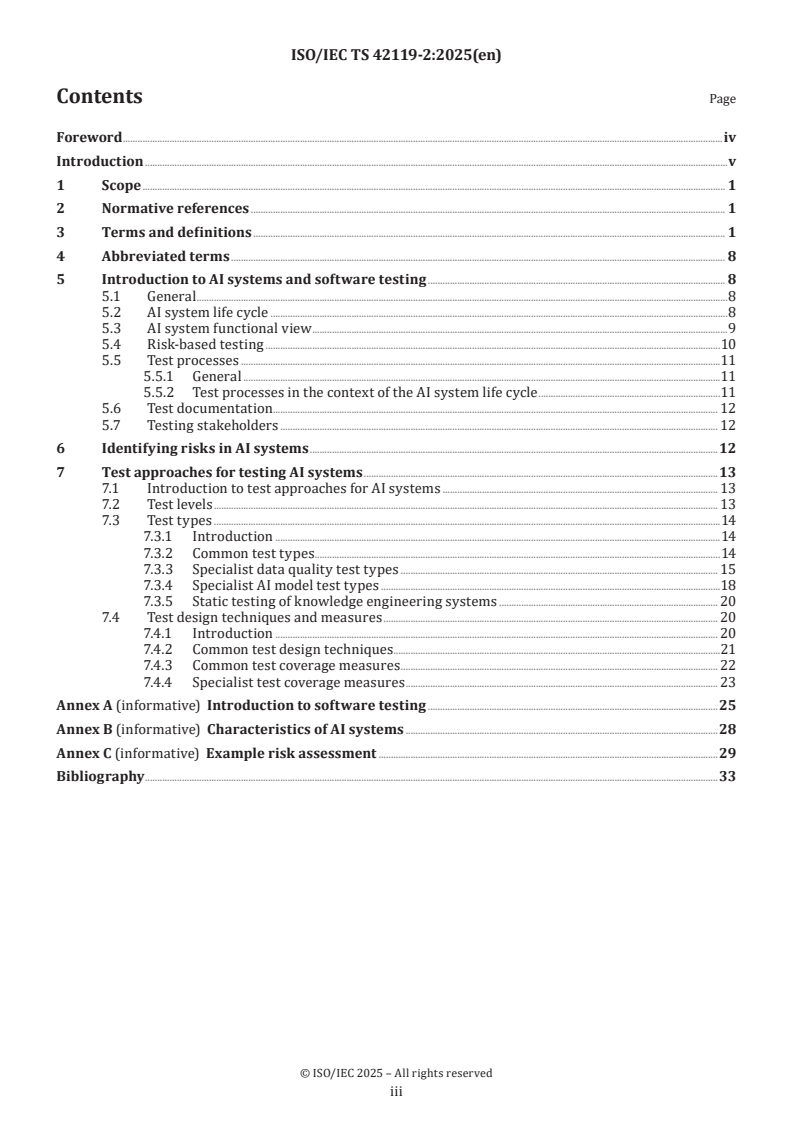
Contents Page
Foreword .iv
Introduction .v
1 Scope . 1
2 Normative references . 1
3 Terms and definitions . 1
4 Abbreviated terms .8
5 Introduction to AI systems and software testing .8
5.1 General .8
5.2 AI system life cycle .8
5.3 AI system functional view .9
5.4 Risk-based testing .10
5.5 Test processes .11
5.5.1 General .11
5.5.2 Test processes in the context of the AI system life cycle .11
5.6 Test documentation . 12
5.7 Testing stakeholders . 12
6 Identifying risks in AI systems .12
7 Test approaches for testing AI systems .13
7.1 Introduction to test approaches for AI systems . 13
7.2 Test levels . 13
7.3 Test types .14
7.3.1 Introduction .14
7.3.2 Common test types . .14
7.3.3 Specialist data quality test types . 15
7.3.4 Specialist AI model test types .18
7.3.5 Static testing of knowledge engineering systems . 20
7.4 Test design techniques and measures . 20
7.4.1 Introduction . 20
7.4.2 Common test design techniques .21
7.4.3 Common test coverage measures . 22
7.4.4 Specialist test coverage measures . 23
Annex A (informative) Introduction to software testing .25
Annex B (informative) Characteristics of AI systems .28
Annex C (informative) Example risk assessment .29
Bibliography .33
© ISO/IEC 2025 – All rights reserved
iii
Foreword
ISO (the International Organization for Standardization) and IEC (the International Electrotechnical
Commission) form the specialized system for worldwide standardization. National bodies that are
members of ISO or IEC participate in the development of International Standards through technical
committees established by the respective organization to deal with particular fields of technical activity.
ISO and IEC technical committees collaborate in fields of mutual interest. Other international organizations,
governmental and non-governmental, in liaison with ISO and IEC, also take part in the work.
The procedures used to develop this document and those intended for its further maintenance are described
in the ISO/IEC Directives, Part 1. In particular, the different approval criteria needed for the different types
of document should be noted. This document was drafted in accordance with the editorial rules of the ISO/
IEC Directives, Part 2 (see www.iso.org/directives or www.iec.ch/members_experts/refdocs).
ISO and IEC draw attention to the possibility that the implementation of this document may involve the
use of (a) patent(s). ISO and IEC take no position concerning the evidence, validity or applicability of any
claimed patent rights in respect thereof. As of the date of publication of this document, ISO and IEC had not
received notice of (a) patent(s) which may be required to implement this document. However, implementers
are cautioned that this may not represent the latest information, which may be obtained from the patent
database available at www.iso.org/patents and https://patents.iec.ch. ISO and IEC shall not be held
responsible for identifying any or all such patent rights.
Any trade name used in this document is information given for the convenience of users and does not
constitute an endorsement.
For an explanation of the voluntary nature of standards, the meaning of ISO specific terms and expressions
related to conformity assessment, as well as information about ISO's adherence to the World Trade
Organization (WTO) principles in the Technical Barriers to Trade (TBT) see www.iso.org/iso/foreword.html.
In the IEC, see www.iec.ch/understanding-standards.
This document was prepared jointly by Joint Technical Committee ISO/IEC JTC 1, Information technology,
Subcommittees SC 7 Software and systems engineering and SC 42, Artificial intelligence.
A list of all parts in the ISO/IEC 42119 series can be found on the ISO and IEC websites.
Any feedback or questions on this document should be directed to the user’s national standards body. A
complete listing of these bodies can be found at www.iso.org/members.html.
© ISO/IEC 2025 – All rights reserved
iv
Introduction
This document facilitates understanding of how ISO/IEC/IEEE 29119-1, ISO/IEC/IEEE 29119-2,
ISO/IEC/IEEE 29119-3, ISO/IEC/IEEE 29119-4 and ISO/IEC 20246 apply to the testing of AI systems.
The purpose of ISO/IEC/IEEE 29119 (all parts) is to define an internationally agreed set of standards for
software testing that can be used by any organization when performing any form of software testing.
ISO/IEC/IEEE 29119-1 introduces software testing concepts, which can be applied to any AI system.
ISO/IEC/IEEE 29119-2 comprises test process descriptions that define the software test processes at the
organizational level, test management level and dynamic test levels. It supports dynamic testing, functional
and non-functional testing, manual and automated testing and scripted and unscripted testing, and can be
utilized for the testing of any software-based system, including AI systems.
ISO/IEC/IEEE 29119-3 defines software test documentation. The requirements specified for templates and
examples of test documentation defined in ISO/IEC/IEEE 29119-3 can be met in the test documentation for
any AI system.
ISO/IEC/IEEE 29119-4 defines test design techniques, which can be utilized for the testing of AI systems and
their components.
ISO/IEC 20246 defines processes and templates for work product reviews, including inspections,
walkthroughs and technical reviews.
This document explains how ISO/IEC/IEEE 29119-2 can be adopted for the testing of AI systems and their
components and how the test documentation templates defined in ISO/IEC/IEEE 29119-3 can be implemented
when testing AI systems and their components. This document also explains how ISO/IEC 20246 can be
adopted for the review of AI systems and related documentation. This document is structured as follows:
— Clauses 1 to 4 define the scope, normative references, terms and definitions and abbreviated terms;
— Clause 5 defines concepts of AI system architectures, the AI system life cycle and testing processes and
documentation;
— Clause 6 explains how risk is identified for AI systems;
— Clause 7 defines test approaches suitable for testing AI systems and components;
— Annexes A to C provide supporting details and examples.
The aim of the ISO/IEC 42119 series is to provide requirements and guidance on the testing of AI components
and systems.
Other parts of the ISO/IEC 42119 series include:
— ISO/IEC TS 42119-3 describes approaches and provides guidance on processes for the verification and
validation analysis of AI systems;
— ISO/IEC TS 42119-7 provides technology-agnostic guidance for conducting red teaming assessments on
AI systems;
— ISO/IEC TS 42119-8 provides definitions, concepts, requirements and guidance related to assessing
prompt-based text-to-text AI systems that utilize generative AI.
© ISO/IEC 2025 – All rights reserved
v
Technical Specification ISO/IEC TS 42119-2:2025(en)
Artificial intelligence — Testing of AI —
Part 2:
Overview of testing AI systems
1 Scope
This document provides requirements and guidance on the application of the ISO/IEC/IEEE 29119 series
to the testing of AI systems. This document follows a risk-based approach and uses risks associated
with AI systems, and their development and maintenance, to identify suitable test practices, approaches
and techniques applicable to AI systems and their components. When the test practices, approaches and
techniques are already specified in the ISO/IEC/IEEE 29119 series, this document provides additional detail
and describes their application in the context of AI systems.
2 Normative references
The following documents are referred to in the text in such a way that some or all of their content constitutes
requirements of this document. For dated references, only the edition cited applies. For undated references,
the latest edition of the referenced document (including any amendments) applies.
ISO/IEC/IEEE 29119-2, Software and systems engineering — Software testing — Part 2: Test processes
ISO/IEC/IEEE 29119-3, Software and systems engineering — Software testing — Part 3: Test documentation
3 Terms and definitions
For the purposes of this document, the following terms and definitions apply.
ISO and IEC maintain terminology databases for use in standardization at the following addresses:
— ISO Online browsing platform: available at https:// www .iso .org/ obp
— IEC Electropedia: available at https:// www .electropedia .org/
3.1
artificial intelligence
AI
research and development of mechanisms and applications of AI systems (3.3)
Note 1 to entry: Research and development can take place across any number of fields such as computer science, data
science, humanities, mathematics and natural sciences.
[SOURCE: ISO/IEC 22989:2022, 3.1.3]
3.2
AI model
machine-readable representation of knowledge (3.15)
Note 1 to entry: An ML model (3.19) and the knowledge captured from experts as rules in an expert system are both
forms of AI model.
© ISO/IEC 2025 – All rights reserved
3.3
AI system
artificial intelligence system
engineered system that generates outputs such as content, forecasts, recommendations or decisions for a
given set of human-defined objectives
Note 1 to entry: The engineered system can use various techniques and approaches related to artificial intelligence
(3.1) to develop a model to represent data, knowledge (3.15), processes, etc. which can be used to conduct tasks.
Note 2 to entry: AI systems are designed to operate with varying levels of automation.
[SOURCE: ISO/IEC 22989:2022, 3.1.4]
3.4
bias
systematic difference in treatment of certain objects, people or groups in comparison
to others
Note 1 to entry: Treatment is any kind of action, including perception, observation, representation, prediction (3.24) or
decision.
[SOURCE: ISO/IEC TR 24027:2021, 3.3.2, modified –Oxford comma removed in definition and note to entry.]
3.5
classification model
machine learning model (3.19) whose expected output for a given input is one or more classes
[SOURCE: ISO/IEC 23053:2022, 3.1.1]
3.6
concept drift
phenomenon where the statistical properties of input data (3.14) change over time, leading to decreased
model (3.20) performance
3.7
data quality
characteristic of data that the data meet the organization's data requirements for a specified context
[SOURCE: ISO/IEC 5259-1:2024, 3.5]
3.8
data quality characteristic
category of data quality attributes that has a bearing on data quality (3.7)
[SOURCE: ISO/IEC 25012:2008, 4.4, modified —"bears" replaced by "has a bearing".]
3.9
dataset
collection of data with a shared format
EXAMPLE 1 Micro-blogging posts from June 2020 associated with hashtags #rugby and #football.
EXAMPLE 2 Macro photographs of flowers in 256x256 pixels.
Note 1 to entry: Datasets can be used for validating or testing (3.39) an AI model (3.2). In a machine learning (3.18)
context, datasets can also be used to train a machine learning algorithm.
[SOURCE: ISO/IEC 22989:2022, 3.2.5]
© ISO/IEC 2025 – All rights reserved
3.10
expert system
AI system (3.3) that accumulates, combines and encapsulates knowledge (3.15) provided by a human expert
or experts in a specific domain to infer solutions to problems
[SOURCE: ISO/IEC 22989:2022, 3.1.13]
3.11
explainability
property of an AI system (3.3) to express important factors influencing the AI system
results in a way that humans can understand
Note 1 to entry: It is intended to answer the question “Why?” without actually attempting to argue that the course of
action that was taken was necessarily optimal.
[SOURCE: ISO/IEC 22989:2022, 3.5.7]
3.12
feature
measurable property of an object or event with respect to a set of characteristics
Note 1 to entry: Features play a role in training and prediction (3.24).
Note 2 to entry: Features provide a machine-readable way to describe the relevant objects. As the algorithm will not
go back to the objects or events themselves, feature representations are designed to contain all useful information.
[SOURCE: ISO/IEC 23053:2022, 3.3.3]
3.13
ground truth
value of the target variable for a particular item of labelled input data (3.14)
Note 1 to entry: The term ground truth does not imply that the labelled input data consistently corresponds to the
real-world value of the target variables.
[SOURCE: ISO/IEC 22989:2022, 3.2.7]
3.14
input data
data for which an AI system (3.3) calculates a predicted output or inference
[SOURCE: ISO/IEC 22989:2022, 3.2.9]
3.15
knowledge
abstracted information about objects, events, concepts or rules, their relationships
and properties, organized for goal-oriented systematic use
Note 1 to entry: Knowledge in the AI (3.1) domain does not imply a cognitive capability, contrary to usage of the term
in some other domains. In particular, knowledge does not imply the cognitive act of understanding.
Note 2 to entry: Information can exist in numeric or symbolic form.
Note 3 to entry: Information is data that has been contextualized, so that it is interpretable. Data is created through
abstraction or measurement from the world.
[SOURCE: ISO/IEC 22989:2022, 3.1.21]
3.16
label
target variable assigned to a sample
[SOURCE: ISO/IEC 22989:2022, 3.2.10]
© ISO/IEC 2025 – All rights reserved
3.17
life cycle
evolution of a system, product, service, project or other human-made entity, from conception through
retirement
[SOURCE: ISO/IEC/IEEE 15288:2015, 4.1.23]
3.18
machine learning
ML
process of optimizing model (3.20) parameters through computational techniques, such that the model's
behaviour reflects the data or experience
[SOURCE: ISO/IEC 22989:2022, 3.3.5]
3.19
machine learning model
ML model
mathematical construct that generates an inference or prediction (3.24) based on input data (3.14) or
information
EXAMPLE If a univariate linear function (y = θ + θ x) has been trained using linear regression, the resulting
0 1
model can be y = 3 + 7x.
Note 1 to entry: A machine learning model results from training based on a machine learning algorithm.
[SOURCE: ISO/IEC 22989:2022, 3.3.7, modified –"ML model" added as a preferred term.]
3.20
model
physical, mathematical or otherwise logical representation of a system, entity, phenomenon, process or data
[SOURCE: ISO/IEC 22989:2022, 3.1.23]
3.21
neural network
NN
neural net
artificial neural network
network of one or more layers of neurons (3.22) connected by weighted links with
adjustable weights, which takes input data (3.14) and produces an output
Note 1 to entry: Neural networks are a prominent example of the connectionist approach.
Note 2 to entry: Although the design of neural networks was initially inspired by the functioning of biological neurons,
most works on neural networks do not follow that inspiration anymore.
[SOURCE: ISO/IEC 22989:2022, 3.4.8]
3.22
neuron
primitive processing element which takes one or more input values and produces an
output value by combining the input values and applying an activation function on the result
Note 1 to entry: Examples of nonlinear activation functions are a threshold function, a sigmoid function and a
polynomial function.
[SOURCE: ISO/IEC 22989:2022, 3.4.9]
© ISO/IEC 2025 – All rights reserved
3.23
parameter
model parameter
internal variable of a model (3.20) that affects how it computes its outputs
Note 1 to entry: Examples of parameters include the weights in a neural network (3.21) and the transition probabilities
in a Markov model.
[SOURCE: ISO/IEC 22989:2022, 3.3.8]
3.24
prediction
primary output of an AI system (3.3) when provided with input data (3.14) or
information
Note 1 to entry: Predictions (3.24) can be followed by additional outputs, such as recommendations, decisions and
actions.
Note 2 to entry: Prediction does not necessarily refer to predicting something in the future.
Note 3 to entry: Predictions can refer to various kinds of data analysis or production applied to new data or historical
data (including translating text, creating synthetic images or diagnosing a previous power failure).
[SOURCE: ISO/IEC 22989:2022, 3.1.27]
3.25
production data
data acquired during the operation phase of an AI system (3.3), for which a deployed AI system calculates a
predicted output or inference
[SOURCE: ISO/IEC 22989:2022, 3.2.12]
3.26
retraining
updating a trained model (3.40) by training (3.41) with different training data (3.42)
[SOURCE: ISO/IEC 22989:2022, 3.3.10]
3.27
risk
combination of the probability of occurrence of a negative event and the severity of that event
[SOURCE: ISO/IEC Guide 51:2014, 3.9, modified — Definition revised.]
3.28
sample
atomic data element processed in quantities by a machine learning (3.18) algorithm or an AI system (3.3)
[SOURCE: ISO/IEC 22989:2022, 3.2.13]
3.29
stakeholder
any individual, group, or organization that can affect, be affected by or perceive itself to be affected by a
decision or activity
[SOURCE: ISO/IEC 38500:2015, 2.24, modified —Comma removed after “be affected by” in the definition.]
3.30
static testing
testing (3.39) in which a test item is examined against a set of quality or other criteria without the test item
being executed
EXAMPLE Reviews, static analysis.
© ISO/IEC 2025 – All rights reserved
[SOURCE: ISO/IEC/IEEE 29119-1:2022, 3.78]
3.31
supervised machine learning
machine learning (3.18) that makes only use of labelled data during training (3.41)
[SOURCE: ISO/IEC 22989:2022, 3.3.12]
3.32
task
action required to achieve a specific goal
Note 1 to entry: Actions can be physical or cognitive. For instance, computing or creation of predictions (3.24),
translations, synthetic data or artefacts or navigating through a physical space.
EXAMPLE Classification, regression, ranking, clustering and dimensionality reduction.
[SOURCE: ISO/IEC 22989:2022, 3.1.35]
3.33
test approach
high-level test implementation choice, typically made as part of the test strategy design activity
EXAMPLE 1 The use of model-based testing (3.39) for the functional system testing.
EXAMPLE 2 Typical choices made as test approaches are test level (3.36), test type (3.38), test design technique
(3.35), test practice (3.37) and the form of static testing (3.30) to be used.
[SOURCE: ISO/IEC/IEEE 29119-1:2022, 3.83]
3.34
test data
data used to assess the performance of a final model (3.20)
Note 1 to entry: Test data is disjoint from training data (3.42) and validation data (3.44).
[SOURCE: ISO/IEC 22989:2022, 3.2.14]
3.35
test design technique
test technique
procedure used to create or select a test model, identify test coverage items, and derive corresponding test cases
EXAMPLE Equivalence partitioning, boundary value analysis, decision table testing, branch testing.
Note 1 to entry: The test design technique is typically used to achieve a required level of test coverage.
Note 2 to entry: Some test practices (3.37), such as exploratory testing or model-based testing are sometimes referred
to as “test techniques”. Following the definition in the ISO/IEC/IEEE 29119 series, they are not test design techniques
as they are not themselves providing a way to create test cases, but instead use test design techniques to achieve that.
[SOURCE: ISO/IEC/IEEE 29119-1:2022, 3.94]
3.36
test level
one of a sequence of test stages, each of which is typically associated with the achievement of particular
objectives and used to treat particular risks (3.27)
EXAMPLE The following are common test levels, listed sequentially: unit/component testing, integration testing,
system testing, system integration testing, acceptance testing.
Note 1 to entry: It is not always necessary for a test item to be tested at all test levels, but the sequence of test levels
generally stays the same.
© ISO/IEC 2025 – All rights reserved
Note 2 to entry: Typical test level objectives can include consideration of basic functionality for unit/component
testing, interaction between integrated components for integration testing, acceptability to end users for acceptance
testing.
[SOURCE: ISO/IEC/IEEE 29119-1:2022, 3.108]
3.37
test practice
conceptual framework that can be applied to the organizational test process, the test management process,
and/or the dynamic test process to facilitate testing (3.39)
[SOURCE: ISO/IEC/IEEE 29119-1:2022, 3.119]
3.38
test type
testing (3.39) that is focused on specific quality characteristics
EXAMPLE Security testing, functional testing, usability testing, and performance testing.
Note 1 to entry: A test type can be performed at a single test level (3.36) or across several test levels (e.g. performance
testing performed at a unit test level and at a system test level).
[SOURCE: ISO/IEC/IEEE 29119-1:2022, 3.130]
3.39
testing
set of activities conducted to facilitate discovery or evaluation of properties of one or more test items
[SOURCE: ISO/IEC/IEEE 29119-1:2022, 3.131)
3.40
trained model
result of model (3.20)training (3.41)
[SOURCE: ISO/IEC 22989:2022, 3.3.14]
3.41
training
model training
process to determine or to improve the parameters (3.23) of a machine learning model
(3.19), based on a machine learning (3.18) algorithm, by using training data (3.42)
[SOURCE: ISO/IEC 22989:2022, 3.3.15]
3.42
training data
data used to train a machine learning model (3.19)
[SOURCE: ISO/IEC 22989:2022, 3.3.16]
3.43
validation
confirmation, through the provision of objective evidence, that the requirements for a specific intended use
or application have been fulfilled
[SOURCE: ISO/IEC 25000:2014, 4.41]
© ISO/IEC 2025 – All rights reserved
3.44
validation data
development data
data used to compare the performance of different candidate ML models (3.19)
Note 1 to entry: Validation data is disjoint from test data (3.34) and generally also from training data (3.42). However,
in cases where there is insufficient data for a three-way training, validation and test set split, the data is divided into
only two sets – a test set and a training or validation set. Cross-validation or bootstrapping are common methods for
then generating separate training and validation sets from the training or validation set.
Note 2 to entry: Validation data can be used to tune hyperparameters (3.46) or to validate some algorithmic choices, up
to the effect of including a given rule in an expert system.
[SOURCE: ISO/IEC 22989:2022, 3.2.15, modified —"ML" added before “models” in the definition]
3.45
verification
confirmation, through the provision of objective evidence, that specified requirements have been fulfilled
[SOURCE: ISO/IEC 25000:2014, 4.43]
3.46
hyperparameter
characteristic of a machine learning (3.18) algorithm (3.3.6) that affects its learning process
Note 1 to entry: Hyperparameters are selected prior to training and can be used in processes to help estimate model
parameters.
Note 2 to entry: Examples of hyperparameters include the number of network layers, width of each layer, type of
activation function, optimization method, learning rate for neural networks; the choice of kernel function in a support
vector machine; number of leaves or depth of a tree; the K for K-means clustering; the maximum number of iterations
of the expectation maximization algorithm; the number of Gaussians in a Gaussian mixture.
[SOURCE: ISO/IEC 22989:2022, 3.3.4]
4 Abbreviated terms
AI artificial intelligence
API application programming interface
MCDC modified condition/decision coverage
ML machine learning
RBT risk-based testing
5 Introduction to AI systems and software testing
5.1 General
This clause provides a high-level introduction to AI systems and software testing.
The testing of AI systems and their components shall be performed in accordance with ISO/IEC/IEEE 29119-2.
Annex A provides an introduction to software testing.
5.2 AI system life cycle
Figure 1 shows an example of the AI systems life cycle from ISO/IEC 22989 and its relationship with software
testing.
© ISO/IEC 2025 – All rights reserved
Figure 1 — Example AI systems life cycle model stages and software testing
5.3 AI system functional view
Figure 2 depicts a functional view of a generic AI system from ISO/IEC 22989.
NOTE The parts drawn with dashed lines are for AI systems based on machine learning (ML).
Figure 2 — ISO/IEC 22989 AI system functional view
The “Model” depicted in the centre of Figure 2 is a machine-readable representation of knowledge. This
knowledge can come from various sources, and different forms of AI system can be categorised depending
on the source (or sources) of this knowledge.
Example AI systems include:
— heuristic AI systems, such as a classical expert system or a reasoning system equipped with a fixed
knowledge base;
— ML-based AI systems, where the training dataset is processed to capture patterns, and build a ML model;
— a continuous learning system, where incremental training of the AI model takes place on an ongoing basis;
— a knowledge engineering system, where the knowledge base comprises interacting knowledge of
contents and knowledge of methods.
© ISO/IEC 2025 – All rights reserved
Large AI systems can use several different technologies, each of which presents potential risks that can be
treated through testing and reviews. Figure 3 depicts the AI ecosystem in terms of functional layers, as
described in ISO/IEC 22989.
Figure 3 — ISO/IEC 22989 AI ecosystem
5.4 Risk-based testing
Risk-based testing (RBT) is a core concept in the ISO/IEC/IEEE 29119 series, which expects risks to be
used as the prime driver for determining the test approaches included in the test strategy and therefore the
consequent software testing.
© ISO/IEC 2025 – All rights reserved
Risk-based testing is similar to most other risk management processes. Initially potential risks are identified.
Next, the identified risks are analysed to determine the potential consequence, and its severity, they can
have on a delivered product or the project, if they occur. The likelihood of each risk is determined, which
can be based on factors such as requirement quality, staff capabilities, system complexity and historical
information. A risk exposure level is then established, based on combining the consequences and likelihood
of each risk. Risks can then be prioritized accordingly, followed by deciding on the appropriate or possible
treatments. A treatment for one risk can be the cause, or increased exposure, of another risk. Not all identified
risks can be treated through RBT. For instance, a lack of trained program designers is not directly addressed
by RBT. Risk treatments by testing can include the test approaches defined in ISO/IEC/IEEE 29119-1 and
ISO/IEC/IEEE 29119-4, and the review techniques defined in ISO/IEC 20246.
Not meeting stakeholder requirements is a major risk for most projects, and as such, is a key consideration
in the selection of test approaches. Contrary to common belief, this is not a choice between focusing on risk
or focusing on requirements. Instead, both are vital considerations in a risk-based test strategy.
The test approach for treating a specific risk can take one or more forms, such as:
— adopting an organizational test practice (e.g. continuous testing as a risk treatment for AI systems that
can change behaviour in production);
— deciding that a particular test level is used (e.g. model testing, if the performance of the AI model is
perceived to be a risk);
— selecting a test type, such as functional testing or data representativeness testing;
— deciding on a form of static testing (i.e. reviews and static analysis);
— selecting a test design technique (e.g. equivalence partitioning) and corresponding coverage measures
(e.g. equivalence partition coverage).
Guidance on risk management for AI systems can be found in ISO/IEC 23894.
5.5 Test processes
5.5.1 General
Processes describe a set of interrelated or interacting activities that transform inputs into outputs. It is
often useful to consider the testing activities separately from the development (and other) activities, and
these testing activities are described by test processes. In ISO/IEC/IEEE 29119-2, test processes are defined
at three levels: the organizational level, management level and dynamic testing level.
Organizations and projects can supplement these generic test processes with additional activities,
procedures, and practices, as necessary.
5.5.2 Test processes in the context of the AI system life cycle
Figure 4 shows the example AI system life cycle model from ISO/IEC 22989 with the test-specific processes
from ISO/IEC/IEEE 29119-2 and the review process defined in ISO/IEC 20246.
© ISO/IEC 2025 – All rights reserved
Figure 4 — Example AI system life cycle model with test-specific processes
5.6 Test documentation
Test documentation is produced as a result of performing the test processes and is defined in detail in
ISO/IEC/IEEE 29119-3. The destination of the test documentation is either a stakeholder (e.g. test status
reports to a project manager) or another process (e.g. a test plan to direct the performance of dynamic
testing). As the test documentation comes from the processes, it can be categorized in terms of outputs at
the three test process levels defined in ISO/IEC/IEEE 29119-2.
The documentation of the testing of AI systems and their components shall be produced in accordance with
ISO/IEC/IEEE 29119-3.
See A.7 for more detail on test documentation.
5.7 Testing stakeholders
When using this document and the ISO/IEC/IEEE 29119 series in the context of AI systems, relevant
stakeholders should be identified and documented. This defined group of stakeholders should be used
consistently in all test processes.
6 Identifying risks in AI systems
The focus of this document is on the elements of the AI ecosystem within the dotted lines of Figure 3.
© ISO/IEC 2025 – All rights reserved
Risks in AI systems are identified using several approaches. For instance, they can be identified from the
AI system functions, the elements of the AI ecosystem, and checklists, among others. The checklists for AI
systems can be based on quality characteristics, such as those defined in ISO/IEC 25010 and ISO/IEC 25059
(see Annex B). The identification of risks can be conducted based on a risk identification process according
to ISO/IEC 23894.
The system functional view shown in Figure 2 provides a generic view of the ML, engineering and other
technologies layer shown in Figure 3. These high-level functional layers serve as a guide in the process of
allocating risks to the relevant functional areas. They also identify the appropriate test level and test type,
for risks where testing is an appropriate treatment. In practice, the relevant architecture and development
techniques for the specific system under test should be used for this process.
For the purpose of the risk analysis, the functional areas of an AI system previously introduced in 5.3 can be
grouped and represented as follows:
— development or operational processes (design choices, engineering processes, specific development
processes such as ML, oversight of decisions supported by AI system outputs);
— AI functions (decisions, reasoning);
— model (a machine-readable representation of knowledge, regardless of the method used to produce it);
— data (training data, validation data, test data);
— inputs (information, production data);
— outputs (which connect to a wider system).
Identifying potential risks, prioritising them according to consequences and likelihood, and identifying the
relevant test approaches that are appropriate risk treatments fulfils the test planning processes TP3 and
TP4 (see ISO/IEC 29119-2:2021, 7.2.4.4 to 7.2.4.5 for more detail).
Annex C contains an example of risk identification and the allocation of appropriate test approaches as risk
treatments.
7 Test approaches for testing AI systems
7.1 Introduction to test approaches for AI systems
For risks that can be partially or fully addressed through software testing, appropriate means of treating
identified risks shall be determined (based on the level of risk exposure and categorization). Risk treatment
activities that rely on testing can be planned using the design test strategy activity (TP5) within the test
planning process (see ISO/IEC/IEEE 29119-2:2021, 7.2.4.6).
From a testing perspective, treatment of these risks involves the implementation of various test approaches,
which comprise a range of test types. These include static testing (e.g. reviews of datasets) and dynamic
testing (e.g. test execution of data pipelines in order to observe output from an AI model). They are carried
out as part of one or more test levels and can also make use of a specific test practice. In some cases the
most effective and efficient treatment of the risk does not include testing (e.g. risk treatment can take place
through risk acceptance, risk transfer or a contingency plan).
7.2 Test levels
The testing for AI systems and their components is performed at various distinct stages of the life cycle,
typically referred to as test levels. Each test level is associated with a type of test item (e.g. component,
system), has specific objectives and is used to treat specific risks. For instance, integration testing has the
objective of determining whether software components work together correctly as specified. It is also used
to treat risks associated with interactions and interfaces between test items and attempts to ensure that
they communicate correctly.
© ISO/IEC 2025 – All rights reserved
Test levels can be associated with static and dynamic testing and are closely related to development
activities. For dynamic testing, each test level is typically implemented in a specific test environment.
Common test levels, presented in the order they are typically performed and in order of the size of the test
items from individual units or modules to complete systems are:
— unit testing;
— integration testing;
— system testing;
— acceptance testing.
Unit testing in the context of AI systems typically includes a focus on code structures, such as modules,
beneath the level of the AI model. It can make use of structure-based test design techniques (such as those
described in ISO/IEC/IEEE 29119-4:2021, 5.3), which address these code-level elements of the model, rather
than the model as a whole.
There are additional test levels that apply to AI systems. These are associated with a specific test item type,
have specific objectives and treat specific risks:
— Data quality testing, which focuses specifically on the data being used to produce the model, and typically
uses a range of data quality test types (see 7.3.3) to reduce the risk of a poor-quality model being derived
from the data.
— Model testing, which focuses specifically on the AI model as the test item, and typically uses one or more
specialist AI model test types (see 7.3.4) to check that the model performs acceptably within the intended
context of use. This test level typically treats risks such as those related to the functional correctness of
the model and bias, as shown in the example risk treatments in Annex C.
Model testing and data quality testing typically occur after unit testing and before integration testing. When
an AI system includes more than one model, then data quality testing and model testing are applied for each
model in the system. Ongoing monitoring of model behaviour through periodic repetition of initial model
tests is essential to ensure consistent performance in production. Data quality testing typically occurs prior
to model testing but both levels can be performed iteratively.
7.3 Test types
7.3.1 Introduction
Test types are typically focused on the testing associated with a particular quality characteristic. Test types
can often be applied across several test levels and can employ numerous different test design techniques
and static testing.
Test types are covered in detail in ISO/IEC/IEEE 29119-4.
7.3.2 Common test types
There are several common test types that can be applicable to the testing of an AI system as a general piece
of software, including:
— functional testing;
— accessibility testing;
— compatibility testing;
— conversion testing;
— disaster/recovery testing;
— installability testing;
© ISO/IEC 2025 – All rights reserved
---------------------- Page
...