


ISO/IEC 23000-19:2018
(Main)Information technology — Multimedia application format (MPEG-A) — Part 19: Common media application format (CMAF) for segmented media
Information technology — Multimedia application format (MPEG-A) — Part 19: Common media application format (CMAF) for segmented media
ISO/IEC 23000-19:2018 specifies the CMAF multimedia format, which contains segmented media objects optimized for streaming delivery and decoding on end user devices in adaptive multimedia presentations. CMAF specifies a track format derived from the ISO Base Media File Format, then derives addressable media objects from CMAF tracks that can be used for storage and delivery. CMAF specifies sets of tracks that share encoding and packaging constraints that enable the selection of multiple tracks to form a multimedia presentation and allow seamless switching of alternative encodings of the same content at different bit rates, frame rates, resolution, etc. CMAF specifies a hypothetical application model that determines how tracks in a CMAF presentation are intended to be combined and synchronized to form a multimedia presentation. The model abstracts delivery to allow any delivery method. The hypothetical application model assumes a manifest and player, but CMAF does not specify a manifest, player, or delivery protocol, with the intent that any that support the hypothetical application model can be used. CMAF specifies media profiles and brands that constrain media encoding and packaging of CMAF tracks to enable seamless adaptive switching of tracks and allow devices to identify compatible content by its brand. CMAF specifies presentation profiles that conditionally require sets of CMAF tracks conforming to specified media profiles and allow content creators and devices to identify compatible multimedia presentations. CMAF enables extensibility by specifying how new media profiles and presentation profiles can be specified and identified and includes guidelines for those specifications.
Technologies de l'information — Format pour application multimédia (MPEG-A) — Partie 19: Format CMAF (Common Media Application Format) pour médias segmentés
General Information
- Status
- Withdrawn
- Publication Date
- 16-Jan-2018
- Withdrawal Date
- 16-Jan-2018
- Current Stage
- 9599 - Withdrawal of International Standard
- Start Date
- 19-Mar-2020
- Completion Date
- 12-Feb-2026
Relations
- Effective Date
- 01-Jan-2022
- Effective Date
- 12-Oct-2020
- Effective Date
- 23-Apr-2020


Get Certified
Connect with accredited certification bodies for this standard

BSI Group
BSI (British Standards Institution) is the business standards company that helps organizations make excellence a habit.

NYCE
Mexican standards and certification body.
Sponsored listings
Frequently Asked Questions
ISO/IEC 23000-19:2018 is a standard published by the International Organization for Standardization (ISO). Its full title is "Information technology — Multimedia application format (MPEG-A) — Part 19: Common media application format (CMAF) for segmented media". This standard covers: ISO/IEC 23000-19:2018 specifies the CMAF multimedia format, which contains segmented media objects optimized for streaming delivery and decoding on end user devices in adaptive multimedia presentations. CMAF specifies a track format derived from the ISO Base Media File Format, then derives addressable media objects from CMAF tracks that can be used for storage and delivery. CMAF specifies sets of tracks that share encoding and packaging constraints that enable the selection of multiple tracks to form a multimedia presentation and allow seamless switching of alternative encodings of the same content at different bit rates, frame rates, resolution, etc. CMAF specifies a hypothetical application model that determines how tracks in a CMAF presentation are intended to be combined and synchronized to form a multimedia presentation. The model abstracts delivery to allow any delivery method. The hypothetical application model assumes a manifest and player, but CMAF does not specify a manifest, player, or delivery protocol, with the intent that any that support the hypothetical application model can be used. CMAF specifies media profiles and brands that constrain media encoding and packaging of CMAF tracks to enable seamless adaptive switching of tracks and allow devices to identify compatible content by its brand. CMAF specifies presentation profiles that conditionally require sets of CMAF tracks conforming to specified media profiles and allow content creators and devices to identify compatible multimedia presentations. CMAF enables extensibility by specifying how new media profiles and presentation profiles can be specified and identified and includes guidelines for those specifications.
ISO/IEC 23000-19:2018 specifies the CMAF multimedia format, which contains segmented media objects optimized for streaming delivery and decoding on end user devices in adaptive multimedia presentations. CMAF specifies a track format derived from the ISO Base Media File Format, then derives addressable media objects from CMAF tracks that can be used for storage and delivery. CMAF specifies sets of tracks that share encoding and packaging constraints that enable the selection of multiple tracks to form a multimedia presentation and allow seamless switching of alternative encodings of the same content at different bit rates, frame rates, resolution, etc. CMAF specifies a hypothetical application model that determines how tracks in a CMAF presentation are intended to be combined and synchronized to form a multimedia presentation. The model abstracts delivery to allow any delivery method. The hypothetical application model assumes a manifest and player, but CMAF does not specify a manifest, player, or delivery protocol, with the intent that any that support the hypothetical application model can be used. CMAF specifies media profiles and brands that constrain media encoding and packaging of CMAF tracks to enable seamless adaptive switching of tracks and allow devices to identify compatible content by its brand. CMAF specifies presentation profiles that conditionally require sets of CMAF tracks conforming to specified media profiles and allow content creators and devices to identify compatible multimedia presentations. CMAF enables extensibility by specifying how new media profiles and presentation profiles can be specified and identified and includes guidelines for those specifications.
ISO/IEC 23000-19:2018 is classified under the following ICS (International Classification for Standards) categories: 35.040 - Information coding; 35.040.40 - Coding of audio, video, multimedia and hypermedia information. The ICS classification helps identify the subject area and facilitates finding related standards.
ISO/IEC 23000-19:2018 has the following relationships with other standards: It is inter standard links to ISO/IEC 23000-19:2018/Amd 2:2019, ISO/IEC 23000-19:2018/Amd 1:2018, ISO/IEC 23000-19:2020. Understanding these relationships helps ensure you are using the most current and applicable version of the standard.
ISO/IEC 23000-19:2018 is available in PDF format for immediate download after purchase. The document can be added to your cart and obtained through the secure checkout process. Digital delivery ensures instant access to the complete standard document.
Standards Content (Sample)
INTERNATIONAL ISO/IEC
STANDARD 23000-19
First edition
2018-01
Information technology — Multimedia
application format (MPEG-A) —
Part 19:
Common media application format
(CMAF) for segmented media
Technologies de l'information — Format pour application multimédia
(MPEG-A) —
Partie 19: Format CMAF (Common Media Application Format) pour
médias segmentés
Reference number
©
ISO/IEC 2018
© ISO/IEC 2018
All rights reserved. Unless otherwise specified, or required in the context of its implementation, no part of this publication may
be reproduced or utilized otherwise in any form or by any means, electronic or mechanical, including photocopying, or posting
on the internet or an intranet, without prior written permission. Permission can be requested from either ISO at the address
below or ISO’s member body in the country of the requester.
ISO copyright office
CP 401 • Ch. de Blandonnet 8
CH-1214 Vernier, Geneva, Switzerland
Tel. +41 22 749 01 11
Fax +41 22 749 09 47
copyright@iso.org
www.iso.org
Published in Switzerland
ii © ISO/IEC 2018 – All rights reserved
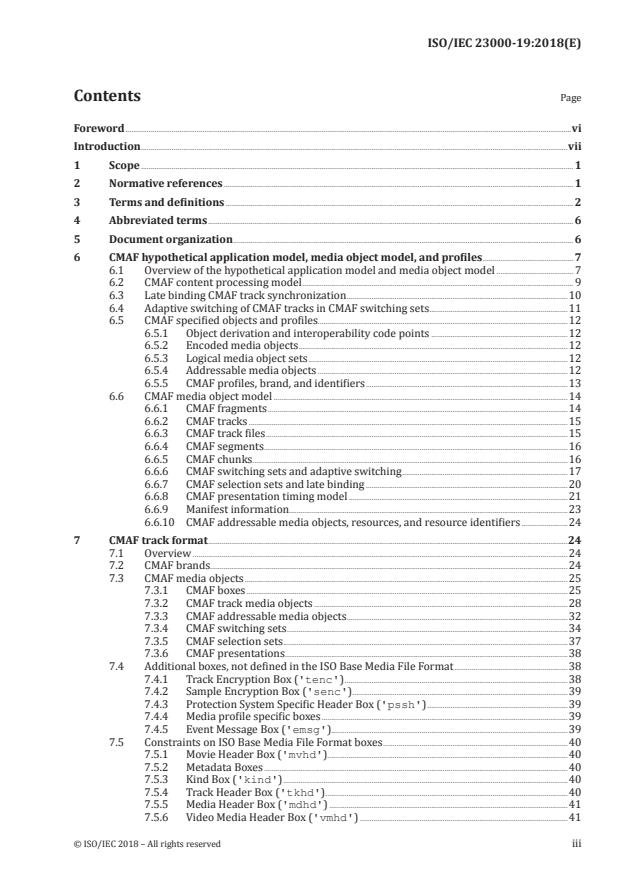
Contents Page
Foreword .vi
Introduction .vii
1 Scope . 1
2 Normative references . 1
3 Terms and definitions . 2
4 Abbreviated terms . 6
5 Document organization . 6
6 CMAF hypothetical application model, media object model, and profiles .7
6.1 Overview of the hypothetical application model and media object model . 7
6.2 CMAF content processing model . 9
6.3 Late binding CMAF track synchronization .10
6.4 Adaptive switching of CMAF tracks in CMAF switching sets .11
6.5 CMAF specified objects and profiles.12
6.5.1 Object derivation and interoperability code points .12
6.5.2 Encoded media objects . .12
6.5.3 Logical media object sets .12
6.5.4 Addressable media objects .12
6.5.5 CMAF profiles, brand, and identifiers .13
6.6 CMAF media object model .14
6.6.1 CMAF fragments .14
6.6.2 CMAF tracks .15
6.6.3 CMAF track files .15
6.6.4 CMAF segments . .16
6.6.5 CMAF chunks . .16
6.6.6 CMAF switching sets and adaptive switching .17
6.6.7 CMAF selection sets and late binding .20
6.6.8 CMAF presentation timing model .21
6.6.9 Manifest information.23
6.6.10 CMAF addressable media objects, resources, and resource identifiers .24
7 CMAF track format .24
7.1 Overview .24
7.2 CMAF brands.24
7.3 CMAF media objects .25
7.3.1 CMAF boxes .25
7.3.2 CMAF track media objects .28
7.3.3 CMAF addressable media objects .32
7.3.4 CMAF switching sets .34
7.3.5 CMAF selection sets . .37
7.3.6 CMAF presentations .38
7.4 Additional boxes, not defined in the ISO Base Media File Format .38
7.4.1 Track Encryption Box ('tenc') .38
7.4.2 Sample Encryption Box ('senc') .39
7.4.3 Protection System Specific Header Box ('pssh') .39
7.4.4 Media profile specific boxes .39
7.4.5 Event Message Box ('emsg').39
7.5 Constraints on ISO Base Media File Format boxes .40
7.5.1 Movie Header Box ('mvhd') . .40
7.5.2 Metadata Boxes .40
7.5.3 Kind Box ('kind') .40
7.5.4 Track Header Box ('tkhd') .40
7.5.5 Media Header Box ('mdhd') .41
7.5.6 Video Media Header Box ('vmhd') .41
© ISO/IEC 2018 – All rights reserved iii
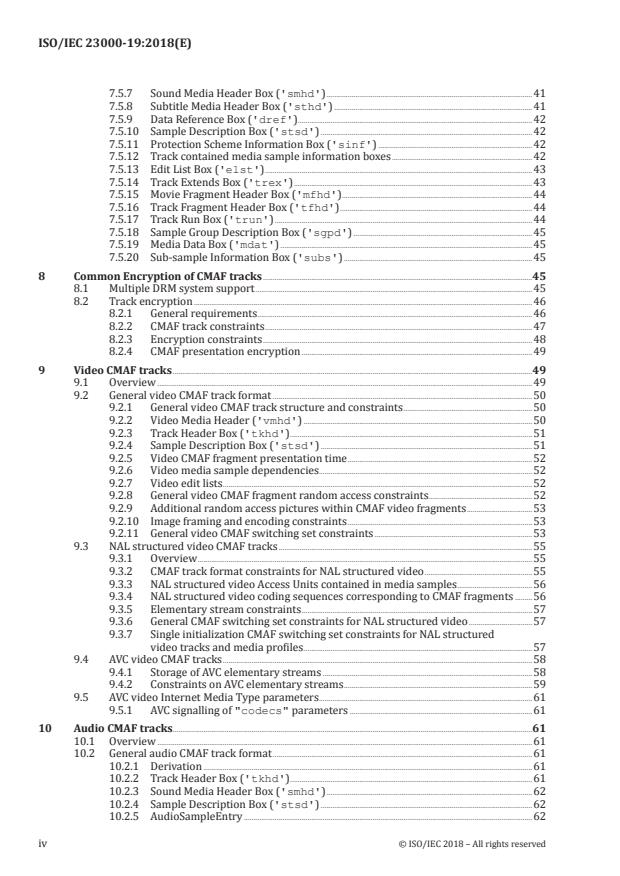
7.5.7 Sound Media Header Box ('smhd') .41
7.5.8 Subtitle Media Header Box ('sthd') .41
7.5.9 Data Reference Box ('dref') .42
7.5.10 Sample Description Box ('stsd') .42
7.5.11 Protection Scheme Information Box ('sinf') .42
7.5.12 Track contained media sample information boxes .42
7.5.13 Edit List Box ('elst') .43
7.5.14 Track Extends Box ('trex') .43
7.5.15 Movie Fragment Header Box ('mfhd') .44
7.5.16 Track Fragment Header Box ('tfhd') .44
7.5.17 Track Run Box ('trun') .44
7.5.18 Sample Group Description Box ('sgpd') .45
7.5.19 Media Data Box ('mdat') .45
7.5.20 Sub-sample Information Box ('subs') .45
8 Common Encryption of CMAF tracks .45
8.1 Multiple DRM system support .45
8.2 Track encryption .46
8.2.1 General requirements .46
8.2.2 CMAF track constraints .47
8.2.3 Encryption constraints .48
8.2.4 CMAF presentation encryption .49
9 Video CMAF tracks .49
9.1 Overview .49
9.2 General video CMAF track format .50
9.2.1 General video CMAF track structure and constraints .50
9.2.2 Video Media Header ('vmhd') .50
9.2.3 Track Header Box ('tkhd') .51
9.2.4 Sample Description Box ('stsd') .51
9.2.5 Video CMAF fragment presentation time .52
9.2.6 Video media sample dependencies .52
9.2.7 Video edit lists .52
9.2.8 General video CMAF fragment random access constraints.52
9.2.9 Additional random access pictures within CMAF video fragments .53
9.2.10 Image framing and encoding constraints .53
9.2.11 General video CMAF switching set constraints .53
9.3 NAL structured video CMAF tracks .55
9.3.1 Overview .55
9.3.2 CMAF track format constraints for NAL structured video .55
9.3.3 NAL structured video Access Units contained in media samples .56
9.3.4 NAL structured video coding sequences corresponding to CMAF fragments .56
9.3.5 Elementary stream constraints .57
9.3.6 General CMAF switching set constraints for NAL structured video .57
9.3.7 Single initialization CMAF switching set constraints for NAL structured
video tracks and media profiles .57
9.4 AVC video CMAF tracks .58
9.4.1 Storage of AVC elementary streams .58
9.4.2 Constraints on AVC elementary streams .59
9.5 AVC video Internet Media Type parameters .61
9.5.1 AVC signalling of "codecs" parameters .61
10 Audio CMAF tracks .61
10.1 Overview .61
10.2 General audio CMAF track format .61
10.2.1 Derivation .61
10.2.2 Track Header Box ('tkhd') .61
10.2.3 Sound Media Header Box ('smhd') .62
10.2.4 Sample Description Box ('stsd') .62
10.2.5 AudioSampleEntry .62
iv © ISO/IEC 2018 – All rights reserved
10.2.6 Audio offset edit list .62
10.3 AAC audio CMAF tracks .62
10.3.1 Overview .62
10.3.2 "codecs" parameter signalling .62
10.3.3 Considerations for AAC audio encoding .63
10.3.4 AAC track constraints .64
10.3.5 AAC elementary stream constraints .65
10.4 AAC core audio CMAF media profile .66
10.5 AAC adaptive switching audio CMAF media profile .67
10.5.1 General constraints .67
10.5.2 CMAF fragment encoding constraints .67
10.5.3 General considerations and requirements .67
10.5.4 Constraints for AAC-LC .68
10.5.5 Constraints for HE-AAC .68
10.5.6 Constraints for HE-AACv2 .69
11 Subtitles and captions .70
11.1 Overview .70
11.2 WebVTT .70
11.3 IMSC text and image tracks .71
11.3.1 General.71
11.3.2 Common constraints .71
11.3.3 IMSC1 text track constraints .71
11.3.4 IMSC1 image track constraints .72
11.4 CTA-608 and CTA-708 .72
11.5 Metadata for subtitles .72
12 CMAF media profiles and CMAF presentation profiles .73
12.1 CMAF media profiles .73
12.1.1 General guidelines for specifying CMAF media profiles .73
12.1.2 Guidelines for audio CMAF media profiles .74
12.1.3 Guidelines for video CMAF media profiles .74
12.2 CMAF presentation profiles .75
12.2.1 General.75
12.2.2 CMAF profile conformance .75
Annex A (normative) CMAF presentation profiles and media profiles.78
Annex B (normative) HEVC video CMAF track format and CMAF media profiles .82
Annex C (informative) Subsampling of NAL structured video tracks in CMAF switching sets .88
Annex D (informative) Hypothetical player model .98
Annex E (informative) Event messages .101
Annex F (informative) Error handling for missing media .102
Annex G (informative) Recommendations for AAC CMAF switching set encoding .103
Bibliography .106
© ISO/IEC 2018 – All rights reserved v
Foreword
ISO (the International Organization for Standardization) and IEC (the International Electrotechnical
Commission) form the specialized system for worldwide standardization. National bodies that are
members of ISO or IEC participate in the development of International Standards through technical
committees established by the respective organization to deal with particular fields of technical
activity. ISO and IEC technical committees collaborate in fields of mutual interest. Other international
organizations, governmental and non-governmental, in liaison with ISO and IEC, also take part in the
work. In the field of information technology, ISO and IEC have established a joint technical committee,
ISO/IEC JTC 1.
The procedures used to develop this document and those intended for its further maintenance are
described in the ISO/IEC Directives, Part 1. In particular the different approval criteria needed for the
different types of ISO documents should be noted. This document was drafted in accordance with the
editorial rules of the ISO/IEC Directives, Part 2 (see www.iso.org/directives).
Attention is drawn to the possibility that some of the elements of this document may be the subject of
patent rights. ISO shall not be held responsible for identifying any or all such patent rights. Details of
any patent rights identified during the development of the document will be in the Introduction and/or
on the ISO list of patent declarations received (see www.iso.org/patents).
Any trade name used in this document is information given for the convenience of users and does not
constitute an endorsement.
For an explanation on the voluntary nature of standards, the meaning of ISO specific terms and
expressions related to conformity assessment, as well as information about ISO's adherence to the
World Trade Organization (WTO) principles in the Technical Barriers to Trade (TBT) see the following
URL: www.iso.org/iso/foreword.html.
This document was prepared by Technical Committee ISO/IEC JTC 1, Information technology, SC 29,
Coding of audio, picture, multimedia and hypermedia information.
A list of all parts in the ISO/IEC 23000 series can be found on the ISO website.
vi © ISO/IEC 2018 – All rights reserved
Introduction
Common Media Application Format (CMAF) combines and constrains several MPEG specifications to
define a multimedia format that is optimized for delivery of a single adaptive multimedia presentation to
a variety of devices, using a variety of adaptive streaming, broadcast, download, and storage methods.
Several MPEG specifications have been adopted for much of the video delivered over the Internet and
other IP networks (cellular, cable, broadcast, etc.). Various organizations have taken MPEG’s core coding,
file format and system standards and combined them into their own specifications for their specific
application. While these specifications are similar, their differences result in unnecessary duplication
of engineering effort and duplication of identical content in slightly different formats, which results in
increased storage and delivery costs.
CMAF provides a common media specification that application specifications, such as MPEG Dynamic
Adaptive Streaming over HTTP (DASH), can reference and a common media format that allows a single
encoded multimedia presentation to be used by many applications.
© ISO/IEC 2018 – All rights reserved vii
INTERNATIONAL STANDARD ISO/IEC 23000-19:2018(E)
Information technology — Multimedia application format
(MPEG-A) —
Part 19:
Common media application format (CMAF) for
segmented media
1 Scope
This document specifies the CMAF multimedia format, which contains segmented media objects
optimized for streaming delivery and decoding on end user devices in adaptive multimedia
presentations.
CMAF specifies a track format derived from the ISO Base Media File Format, then derives addressable
media objects from CMAF tracks that can be used for storage and delivery.
CMAF specifies sets of tracks that share encoding and packaging constraints that enable the selection
of multiple tracks to form a multimedia presentation and allow seamless switching of alternative
encodings of the same content at different bit rates, frame rates, resolution, etc.
CMAF specifies a hypothetical application model that determines how tracks in a CMAF presentation
are intended to be combined and synchronized to form a multimedia presentation. The model abstracts
delivery to allow any delivery method. The hypothetical application model assumes a manifest and
player, but CMAF does not specify a manifest, player, or delivery protocol, with the intent that any that
support the hypothetical application model can be used.
CMAF specifies media profiles and brands that constrain media encoding and packaging of CMAF
tracks to enable seamless adaptive switching of tracks and allow devices to identify compatible content
by its brand.
CMAF specifies presentation profiles that conditionally require sets of CMAF tracks conforming to
specified media profiles and allow content creators and devices to identify compatible multimedia
presentations.
CMAF enables extensibility by specifying how new media profiles and presentation profiles can be
specified and identified and includes guidelines for those specifications.
2 Normative references
The following documents are referred to in the text in such a way that some or all of their content
constitutes requirements of this document. For dated references, only the edition cited applies. For
undated references, the latest edition of the referenced document (including any amendments) applies.
ISO/IEC 14496-1, Information technology — Coding of audio-visual objects — Part 1: Systems
ISO/IEC 14496-3, Information technology — Coding of audio-visual objects — Part 3: Audio
ISO/IEC 14496-10, Information technology — Coding of audio-visual objects — Part 10: Advanced
Video Coding
ISO/IEC 14496-12, Information technology — Coding of audio-visual objects — Part 12: ISO base media
file format
ISO/IEC 14496-14, Information technology — Coding of audio-visual objects — Part 14: MP4 file format
© ISO/IEC 2018 – All rights reserved 1
ISO/IEC 14496-15, Information technology — Coding of audio-visual objects — Part 15: Carriage of
network abstraction layer (NAL) unit structured video in the ISO base media file format
ISO/IEC 14496-30, Information technology — Coding of audio-visual objects — Part 30: Timed text and
other visual overlays in ISO base media file format
ISO/IEC 23001-7, Information technology — MPEG systems technologies — Part 7: Common encryption in
ISO base media file format files
ISO/IEC 23008-2, Information technology — High efficiency coding and media delivery in heterogeneous
environments — Part 2: High efficiency video coding
ISO/IEC 23009-1, Information technology — Dynamic adaptive streaming over HTTP (DASH) — Part 1:
Media presentation description and segment formats
1)
IETF RFC 5234 , Augmented BNF for Syntax Specifications: ABNF
IETF RFC 6381, The 'Codecs' and 'Profiles' Parameters for "Bucket" Media Types
ITU-R Recommendation BT.709, Parameter values for the HDTV standards for production and international
programme exchange
ITU-R Recommendation BT.1886, Reference electro-optical transfer function for flat panel displays used in
HDTV studio production
2)
ITU-R Recommendation BT.2020 , Parameter values for ultra-high definition television systems for
production and international programme exchange
ITU-R Recommendation BT.2035, A reference viewing environment for evaluation of HDTV program
material or completed programmes
3)
ITU-R Recommendation BT.2100-0:2016 , Image parameter values for high dynamic range television for
use in production and international programme exchange
4)
ITU-T Recommendation X.667:2014 , Information technology — Open Systems Interconnection —
Procedures for the operation of OSI Registration Authorities: Generation and registration of Universally
Unique Identifiers (UUIDs) and their use as ASN.1 object identifier components
5)
ANSI/CTA-608-E R-2014 , Line 21 Data Services
6)
ANSII/CTA-708-E , Digital Television (DTV) Closed Captioning
7)
W3C , TTML Profiles for Internet Media Subtitles and Captions 1.0 (W3C IMSC1)
8)
W3C , TTML Media Type Definition and Profile Registry, W3C Working Group Note (W3C TTML Registry)
3 Terms and definitions
For the purposes of this document, the following terms and definitions apply.
1) Available at https://tools.ietf.org/html/rfc5234
2) Available at http://www.itu.int/rec/R-REC-BT.2020/en
3) Available at https://www.itu.int/dms_pubrec/itu-r/rec/bt/R-REC-BT.2100-0-201607-I!!PDF-E.pdf
4) Available at https://www.itu.int/rec/T-REC-X.667
5) Available at http://www.techstreet.com/standards/cta-608-e-r2014?product_id=1815447
6) Available at http://www.techstreet.com/standards/cta-708-e?product_id=1860354
7) Available at http://www.w3.org/TR/ttml-imsc1
8) Available at https://www.w3.org/TR/ttml-profile-registry
2 © ISO/IEC 2018 – All rights reserved
ISO and IEC maintain terminological databases for use in standardization at the following addresses:
— IEC Electropedia: available at http://www.electropedia.org/
— ISO Online browsing platform: available at http://www.iso.org/obp
3.1 Media objects
3.1.1
CMAF fragment
encoded ISOBMFF media segment conforming to CMAF constraints
3.1.2
CMAF header
sequence of CMAF constrained ISOBMFF boxes that do not reference any media samples (3.3.15), but are
associated with a CMAF track (3.2.1) and necessary for the decoding of its CMAF fragments (3.1.1)
3.1.3
CMAF addressable media object
CMAF media object packaged for storage or delivery
Note 1 to entry: Examples include a CMAF track file (3.1.6) containing a CMAF header (3.1.2) and CMAF fragments
(3.1.1), or a CMAF segment (3.1.5) containing one or more CMAF fragments, or a CMAF chunk (3.1.4) containing a
partial sequence of the media samples (3.3.15) of a CMAF fragment.
3.1.4
CMAF chunk
CMAF media object that contains a consecutive subset of the media samples (3.3.15) of a CMAF fragment
(3.1.1), where only the first CMAF chunk of a CMAF fragment is constrained to be an adaptive switching
(3.3.9) point
3.1.5
CMAF segment
CMAF addressable media object (3.1.3) consisting of one or more consecutive CMAF fragments (3.1.1)
from the same CMAF track (3.2.1)
Note 1 to entry: A “CMAF segment” is conformant to an “ISOBMFF segment” and a “DASH segment”.
3.1.6
CMAF track file
one CMAF track (3.2.1) stored consecutively in a single ISOBMFF file with the earliest CMAF fragment
(3.1.1) constrained to start at decode time zero
3.2 Logical structure
3.2.1
CMAF track
sequence of CMAF fragments (3.1.1) that are consecutive in presentation time, contain one media
stream, conform to the 'cmfc' brand, including an associated CMAF header (3.1.2) that can initialize
playback
3.2.2
CMAF switching set
set of one or more CMAF tracks (3.2.1), where each track is an alternative encoding of the same source
content, and are constrained to enable seamless track switching (3.3.9)
3.2.3
aligned CMAF switching set
set of CMAF switching sets (3.2.2), the CMAF tracks (3.2.1) of which all contain alternative encodings of
the same source content in time-aligned CMAF fragments (3.1.1), but all CMAF tracks do not conform to
a single CMAF switching set
© ISO/IEC 2018 – All rights reserved 3
3.2.4
CMAF selection set
set of one or more CMAF switching sets (3.2.2), where each CMAF switching set encodes an alternative
aspect of the same presentation over the same time period, only one of which is intended to be played at
a time, e.g. an alternative language or codec
3.2.5
CMAF presentation
set of one or more CMAF selection sets (3.2.4) that can be simultaneously decoded to produce a
multimedia user experience, potentially including synchronized audio, video, and subtitles
3.2.6
CMAF media profile
encoding constraint on a CMAF track (3.2.1) and its contained media samples (3.3.15) associated with a
CMAF compatibility brand
3.2.7
CMAF presentation profile
requirement on the CMAF media profiles (3.2.6) contained in a CMAF presentation (3.2.5)
3.2.8
required media profile
CMAF media profile (3.2.6) conditionally required by a CMAF presentation profile (3.2.7)
3.2.9
manifest
document describing one or more CMAF presentations (3.2.5)
Note 1 to entry: Manifest formats are not specified in this document.
3.3 Application model
3.3.1
CMAF hypothetical application model
CMAF presentation (3.2.5) application model based on late binding (3.3.3) and synchronization of CMAF
tracks (3.2.1) that partly determines the CMAF track encoding constraints necessary for an intended
CMAF presentation
3.3.2
player
component of the CMAF hypothetical application model (3.3.1) responsible for interpreting a manifest
(3.2.9), requesting resources, and rendering a CMAF presentation (3.2.5)
3.3.3
late binding
selection (3.3.8) and synchronization of separately stored CMAF tracks (3.2.1) by a player (3.3.2)
resulting in a synchronized multimedia presentation
3.3.4
CMAF presentation timeline
timeline shared by all CMAF tracks (3.2.1) in a CMAF presentation (3.2.5), starting at CMAF presentation
time zero, which is coincident with the earliest media samples (3.3.15) intended for presentation
3.3.5
presentation time offset
earliest presentation time of each CMAF track (3.2.1) at the start of a CMAF presentation (3.2.5)
Note 1 to entry: Presentation time offset is an encoded property of tracks in a presentation, but it can also refer
to that value stored in a manifest (3.2.9).
4 © ISO/IEC 2018 – All rights reserved
3.3.6
CMAF fragment duration
sum of the media sample (3.3.15) durations documented in the TrackFragmentRunBox of all
MovieFragmentHeaderBoxes in the CMAF fragment (3.1.1)
3.3.7
CMAF presentation duration
sum of the CMAF fragment durations (3.3.6) of the longest CMAF track (3.2.1) in a CMAF presentation
(3.2.5), starting from its earliest presentation time on the CMAF presentation timeline (3.3.4)
3.3.8
selection
choice of a CMAF track (3.2.1) from alternatives in a selection set (e.g. selecting an audio track by
language), possibly by user action or stored user preference
3.3.9
switching
changing to a different CMAF track (3.2.1) during presentation, including adaptively switching between
CMAF fragments (3.1.1) in a CMAF switching set (3.2.2)
3.3.10
seamless switching
switching (3.3.9) between CMAF tracks (3.2.1) without interrupting presentation of the media content,
i.e. decoding media samples (3.3.15), at the same time and quality as though their containing CMAF
track was decoded without switching
3.3.11
CMAF switching set constraints
CMAF media profile (3.2.6) constraints that enable seamless switching (3.3.9) between CMAF tracks
(3.2.1) in a CMAF switching set (3.2.2) conforming to that media profile
3.3.12
single initialization CMAF switching set constraints
additional CMAF switching set constraints (3.3.11) so CMAF fragments (3.1.1) do not depend on a different
CMAF header (3.1.2) when switching (3.3.9)
3.3.13
resource identifier
externally specified identifier that identifies a CMAF addressable media object (3.1.3)
Note 1 to entry: An example is a URI or other object identifier specified by a delivery protocol and manifest (3.2.9).
3.3.14
stream access point
media sample (3.3.15) random access property, numbered as in ISO/IEC 14496-12:2015, Annex I
3.3.15
media sample
media data in a CMAF fragment (3.1.1) associated with a single decode start time and duration
Note 1 to entry: The term “sample” is often used in the context of video to refer to the spatial samples of an
image and in the context of audio to refer to PCM waveform samples. In this document, each type of sample
is identified by a defined term. A media sample defined by ISOBMFF is always identified by the term “media
sample”. The word “sample” is frequently used in ISOBMFF to refer to objects and parameters such as a “sample
entry”, “sample size”, etc., and those terms are used without modification in this document.
3.3.16
audio PCM sample
digital sample quantizing the amplitude of an audio waveform at regular and frequent intervals,
e.g. 48 kHz
© ISO/IEC 2018 – All rights reserved 5
3.3.17
video spatial sample
quantized values representing the colour and brightness of an area of an image corresponding to a two-
dimensional spatial tessellation of the image
3.3.18
subsampling
video encoding using a smaller number of video spatial samples (3.3.17) than the source video, that
number being an integer submultiple that can be scaled to the source video size based on video stream
parameters without position shift or picture aspect ratio distortion
4 Abbreviated terms
The following abbreviated terms are used in this document.
AU Access Unit
CDN Content Delivery Network
CMAF Common Media Application Format
CVS Coded Video Sequence [A sequence of media samples (coded video frames), starting
with a SAP type 1 or 2, and including all media samples prior to the next SAP type 1 or
2 in decoding order.]
DASH Dynamic Adaptive Streaming over HTTP
ISOBMFF ISO Base Media File Format, defined in ISO/IEC 14496-12
KID Key Identifier as defined in ISO/IEC 23001-7
NAL Network Adaptation Layer
PCM Pulse Code Modulation
PPS Picture Parameter Set
SAP Stream Access Point as defined in ISO/IEC 14496-12
SEI Supplemental Enhancement Information
SPS Sequence Parameter Set
VCL Video Coding Layer
VPS Video Parameter Set
VUI Video Usability Information
5 Document organization
First-time readers of this document are advised to start with Clause 6 for a description of the objects
and terminology specified, the CMAF object model, and the hypothetical application model, which
defines how these objects can be combined to form adaptive multimedia presentations.
The normative specifications in Clause 7 through Clause 12 are terse to facilitate
...
Questions, Comments and Discussion
Ask us and Technical Secretary will try to provide an answer. You can facilitate discussion about the standard in here.
Loading comments...