

ISO/IEC 12247:1993
(Main)Information technology — 3,81 mm wide magnetic tape cartridge for information interchange — Helical scan recording — DDS format using 60 m and 90 m length tapes
General Information
- Abstract
Specifies the physical and magnetic characteristics. Also specifies the quality of the recorded signals, the recorded format and the recording method, thereby allowing data interchange between drives by means of such magnetic tape cartridges. Specifies two types of cartridges referred to as type A (magnetic tape of nominal thickness of 13 µm and a nominal length of up to 60,5 m) and type B (magnetic tape of a nominal thickness of 9 µm and a nominal length of up to 92,0 m).
- Status
- Published
- Publication Date
- 22-Dec-1993
- Current Stage
- 9093 - International Standard confirmed
- Start Date
- 21-Aug-2020
- Completion Date
- 29-Aug-2026
Overview
ISO/IEC 12247:1993 specifies a standardized 3.81 mm wide magnetic tape cartridge format for information interchange using helical-scan recording - the Digital Data Storage (DDS) format for 60 m and 90 m tapes. The standard defines the physical and magnetic characteristics of the cartridge and tape, the required quality of recorded signals, the recorded format and the recording method so that cartridges can be interchanged reliably between different drives and systems.
Key topics and technical requirements
- Cartridge types: Defines two cartridge types - Type A (magnetic tape nominal thickness 13 µm, intended for the shorter tape length) and Type B (nominal thickness 9 µm, for longer tape lengths).
- Physical and mechanical specs: Detailed requirements for the cartridge case, lid, hubs, detection holes, support/datum areas and dimensional tolerances to ensure mechanical interoperability with drives.
- Unrecorded tape properties: Material, tape width, total thickness, coating and layer adhesion, curvature, tensile strength and residual elongation requirements.
- Magnetic recording characteristics: Specifies optimum recording field, signal amplitude, overwrite behavior, physical recording densities and signal-to-noise expectations to guarantee read/write compatibility.
- Format and layout: Defines the on-tape format (Basic Groups, Sub‑Groups, Main Data Blocks, housekeeping frames), track geometry (azimuths, track pitch, track width), device/system/data areas, partitioning and End‑Of‑Data/Early‑Warning points.
- Conformance rules: Criteria for cartridge, generating-system and receiving-system conformance, including optional features (Media Recognition System - MRS, Read‑After‑Write, multiple representations, ECC3 frames). Conformance claims must state supported cartridge types and optional features.
- Measurement and test methods: Annexes provide standardized test procedures (light transmittance, S/N measurement, bit shift, track edge linearity, read‑after‑write, transport recommendations, etc.).
Applications and who uses it
- Tape drive manufacturers: ensure mechanical, magnetic and format compatibility across drives.
- Media manufacturers: produce cartridges and tapes meeting physical and magnetic requirements for interchangeability.
- Data centers & archival storage: implement reliable long-term tape backup and migration strategies using standardized DDS cartridges.
- System integrators and test labs: validate conformance, perform signal and mechanical testing, and certify media/drive interoperability.
- Forensics and data exchange: enable trusted transfer of archived data between organizations and vendors.
Related standards
- ISO/IEC 10777 (DDS helical-scan formats)
- ISO/IEC 11557 (DDS-DC compression variant)
- ISO/IEC 11319, 11321, 12246, 12248 (related tape cartridge and helical-scan standards)
Keywords: ISO/IEC 12247, DDS format, 3.81 mm magnetic tape, helical scan recording, tape cartridge standard, Type A, Type B, data interchange, tape drive interoperability.
Relations
- Effective Date
- 15-Apr-2008
Get Certified
Connect with accredited certification bodies for this standard

BSI Group
BSI (British Standards Institution) is the business standards company that helps organizations make excellence a habit.

NYCE
Mexican standards and certification body.
Sponsored listings
Frequently Asked Questions
ISO/IEC 12247:1993 is a standard published by the International Organization for Standardization (ISO). Its full title is "Information technology — 3,81 mm wide magnetic tape cartridge for information interchange — Helical scan recording — DDS format using 60 m and 90 m length tapes". This standard covers: Specifies the physical and magnetic characteristics. Also specifies the quality of the recorded signals, the recorded format and the recording method, thereby allowing data interchange between drives by means of such magnetic tape cartridges. Specifies two types of cartridges referred to as type A (magnetic tape of nominal thickness of 13 µm and a nominal length of up to 60,5 m) and type B (magnetic tape of a nominal thickness of 9 µm and a nominal length of up to 92,0 m).
Specifies the physical and magnetic characteristics. Also specifies the quality of the recorded signals, the recorded format and the recording method, thereby allowing data interchange between drives by means of such magnetic tape cartridges. Specifies two types of cartridges referred to as type A (magnetic tape of nominal thickness of 13 µm and a nominal length of up to 60,5 m) and type B (magnetic tape of a nominal thickness of 9 µm and a nominal length of up to 92,0 m).
ISO/IEC 12247:1993 is classified under the following ICS (International Classification for Standards) categories: 35.220.23 - Cassettes and cartridges for magnetic tapes. The ICS classification helps identify the subject area and facilitates finding related standards.
ISO/IEC 12247:1993 has the following relationships with other standards: It is inter standard links to ISO/IEC 10777:1991. Understanding these relationships helps ensure you are using the most current and applicable version of the standard.
ISO/IEC 12247:1993 is available in PDF format for immediate download after purchase. The document can be added to your cart and obtained through the secure checkout process. Digital delivery ensures instant access to the complete standard document.
Standards Content (Sample)
INTERNATIONAL ISO/IEC
STANDARD 12247
First edition
1993-12-15
Information technology - 3,81 mm wide
magnetic tape cartridge for information
interchange - Helical scan recording -
DDS format using 60 m and 90 m length
tapes
Technologies de l’information - Cartouche de bande magne’tique de
3,81 mm de large pour Mchange d’information - Enregistrement par
balayage en spirale - Format DDS utilisant des bandes de 60 m et
90 m de long
Reference number
ISO/IEC 12247: 1993(E)
ISO/IEC 12247: 1993 (E)
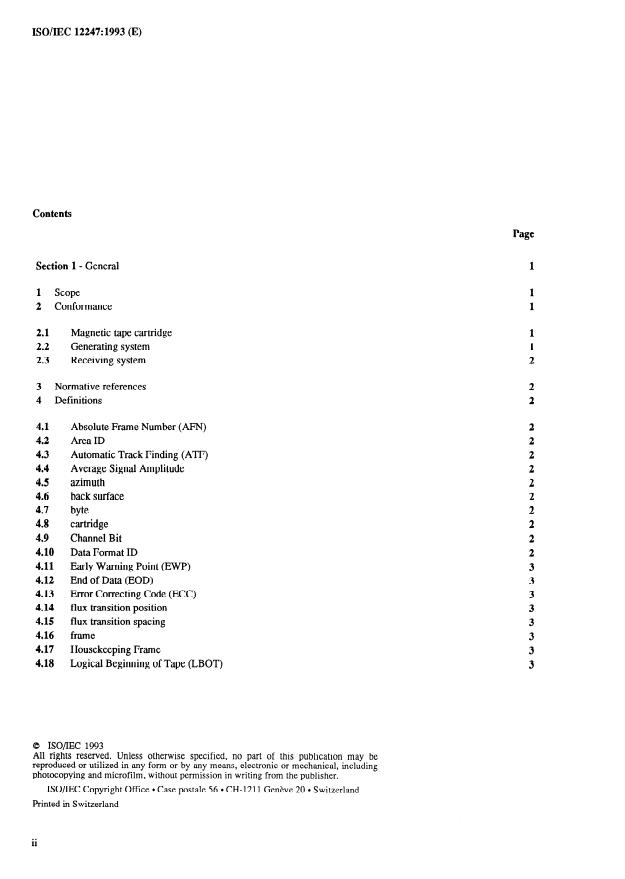
contents
Page
Section 1 - General
1 Scope
2 Conformance
Magnetic tape cartridge
21 .
22 . Generating system
23 . Receiving system
3 Normative references
4 Definitions
41 . Absolute Frame Number (AFN)
Area ID
42 .
Automatic Track Finding (ATF)
43 .
44 . Average Signal Amplitude
. azimuth
46 . back surface
47 . byte
. cartridge
49 Channel Bit
4’10 Data Format ID
4’11 Early Warning Point (EWP)
4’12 End of Data (EOD)
4’13
Error Correcting Code @CC)
4’14 flux transition position
4’15 flux transition spacing
4’16 frame
4’17 Housekeeping Frame
4’18 . Logical Beginning of Tape (LBOT)
0 ISO/IEC 1993
All rights reserved. Unless otherwise specified, no part of this publication may be
reproduced or utilized in any form or by any means, electronic or mechanical, including
photocopying and microfilm, without permission in writing from the publisher.
ISO/IEC Copyright Office l Case postale 56 l CH-1211 Geneve 20 l Switzerland
Printed in Switzerland
ii
ISO/IEC 12247: 1993 (E)
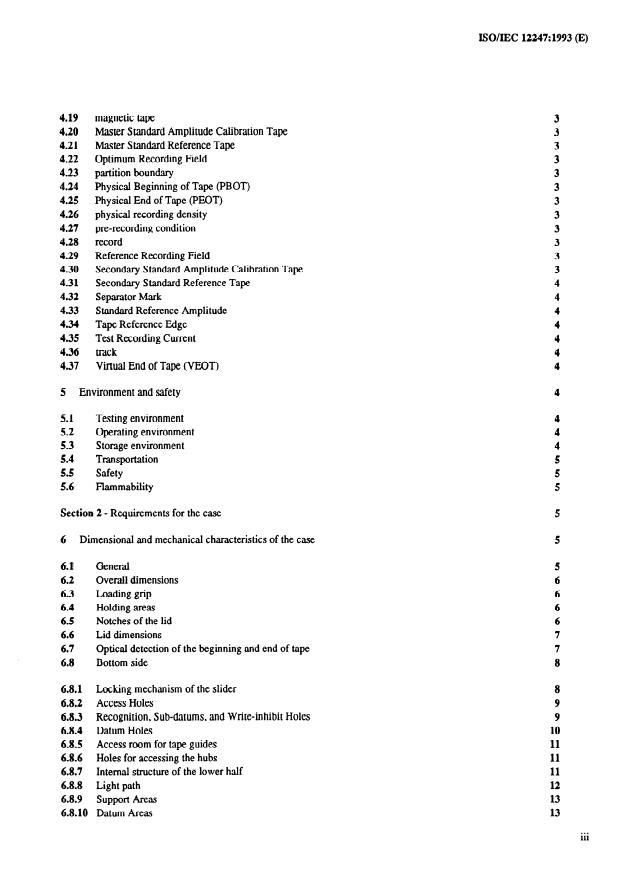
4.19 magnetic tape
4.20 Master Standard Amplitude Calibration Tape
Master Standard Reference Tape 3
4.21
4.22 Optimum Recording Field
4.23 partition boundary
4.24 Physical Beginning of Tape (PBOT)
Physical End of Tape (PEOT)
4.25
4.26 physical recording density
4.27 pre-recording condition
4.28 record
Reference Recording Field
4.29
4.30 Secondary Standard Amplitude Calibration Tape
4.31 Secondary Standard Reference Tape
4.32 Separator Mark
4.33 Standard Reference Amplitude
4.34 Tape Reference Edge
4.35 Test Recording Current
4.36 track
437 Virtual End of Tape (VEOT)
5 Environment and safety
51 . Testing environment
52 . Operating environment
53 . Storage environment
54 l Transportation
55 . Safety
56 . Flammability
Section 2 - Requirements for the case
6 Dimensional and mechanical characteristics of the case
‘1 1’
61 . General
62 . Overall dimensions
63 . Loading grip
64 Holding areas
Notches of the lid
65 l
Lid dimensions
66 .
67 l Optical detection of the beginning and end of tape
68 . Bottom side
6.8.1 Locking mechanism of the slider
6.8.2 Access Holes
6.8.3 Recognition, Subdatums, and Write-inhibit Holes
6.8.4 Datum Holes
6.8.5 Access room for tape guides
6.8.6 Holes for accessing the hubs
6.8.7 Internal structure of the lower half
6.8.8 Light path
6.8.9 Support Areas
6.8.10 Datum Areas
. . .
ISOIIEC 12247:1993 (E)
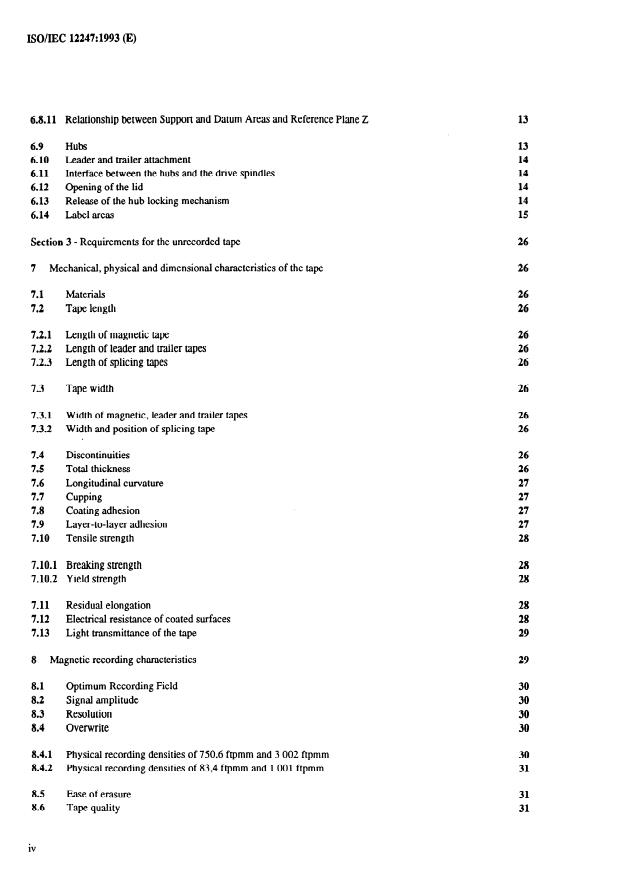
6.8.11 Relationship between Support and Datum Areas and Reference Plane Z
69 Hubs
Leader and trailer attachment
6.11 Interface between the hubs and the drive spindles
6.12 Opening of the lid
6.13 Release of the hub locking mechanism
6.14 Label areas
Section 3 - Requirements for the unrecorded tape
7 Mechanical, physical and dimensional characteristics of the tape
71 Materials
7:2 Tape length
7.2.1 Length of magnetic tape
Length of leader and trailer tapes
7.2.2
7.2.3 Length of splicing tapes
73 . Tape width
7.3.1 Width of magnetic, leader and trailer tapes
Width and position of splicing tape
7.3.2
.
Discontinuities
74 .
75 . Total thickness
76 . Longitudinal curvature
77 . Cupping
78 . Coating adhesion
79 Layer-to-layer adhesion
Tensile strength
7’10 .
7.10.1 Breaking strength
7.10.2 Yield strength
7.11 Residual elongation
7.12 Electrical resistance of coated surfaces
7.13 Light transmittance of the tape
8 Magnetic recording characteristics
81 . Optimum Recording Field
82 . Signal amplitude
Resolution
83 .
84 . Overwrite
3 002 ftpmm 30
of 750,6 ftpmm and
8.4.1 Physical recording densities
of 83,4 ftpmm and 1 001 ftpmm
8.4.2 Physical recording densities
85 . Ease of erasure
86 . Tape quality
iv
lSO/IEC 12247: 1993 (E)
8.6.1 Missing pulses
8.6.2 Missing pulse zone
87 . Signal-to-noise ratio (S/N) characteristic
Section 4 - Requirements for an interchanged tape
9 Format
91 . General
92 . Basic Groups
9.2.1 Group Information Table
9.2.2 Block Access Table 34
93 . Sub-Groups
9.3.1 G 1 Sub-Group
9.3.2 G2 Sub-Group - randomizing
9.3.3 G3 Sub-Group
9.3.4 G4 Sub-Group 40
9.3.5 Main Data Block 44
94 . Sub Data Area
9.4.1 Pack Item No. 1
9.4.2 Pack Item No. 2
9.4.3 Pack Item No. 3 48
9.4.4 Pack Item No. 4 49
9.4.5 Pack Item No. 5 50
9.4.6 Pack Item No. 6 51
9.4.7 Pack Item No. 7 52
9.4.8 Pack Item No. 8 53
9.4.9 Sub Data Block 53
10 Method of recording
10.1 Physical recording density 57
10.2 Long-term average bit cell length 57
10.3 Short-term average bit cell length 57
10.4 Rate of change
10.5 Bit shift
10.6 Read signal amplitude 57
10.7 Maximum recorded levels
11 Track geometry
11.1 Track configuration
11.2 Average track pitch 58
11.3 Variations of the track pitch 58
11.4 Track width 58
lSO/IEC 12247: 1993 (E)
11.5 Track angle
11.6 Track edge linearity
11.7 Track length
11.8 Ideal tape centreline
11.9 Azimuth angles
Recording of blocks on the tape
12.1 Recorded Main Data Block
12,2 Recorded Sub Data Block
12.3 Margin Blocks, Preamble Blocks and Postamble Blocks
12.4 Spacer Blocks
13 Format of a track
13.1 Track capacity
13.2 Positioning accuracy
13.3 Tracking scheme
14 Layout of a Single Data Space tape
14.1 Device Area
14.2 Reference Area
14.3 Position Tolerance Band No. 1
System Area
14.4
14.4.1 System Preamble
14.4.2 System Log
System Postamble
14.43
Position Tolerance Band No. 2
14.4.4
14.4.5 Vendor Group Preamble
14.5 Data Area
14.5.1 Vendor Group
14.5.2 Recorded Data Group
14.53 ECC3
14.5.4 Multiple recorded instances
Repeated frames
14.5.5
14.5.6 Appending and overwriting
14.6 EOD Area
14.7 Post-EOD Area
14.8 Early Warning Point - EWP
14.9 Initialization
15 Layout of a partitioned tape
Overall magnetic tape layout
15.1
15.1.1 Device Area
15.1.2 Partition 1
vi
IsOlIEC 12247:1993 (E)
151.3 Partition 0 71
15.2 Area ID 71
15.3 System Area Pack Items No. 3 and No. 4 71
15.4 Empty partitions 71
Initialization of partitioned tapes 72
15.5
16 Housekeeping Frames 72
16.1 Amble Frames 72
16.2 System Log Frames 72
16.3 Tape Management Frames 72
Annexes
A - Measurement of the light transmittance of the prisms 74
B - Recognition Holes 76
C - Means to open the lid 77
D - Measurement of light transmittance of tape and leaders
E - Measurement of Signal-to-Noise Ratio 81
F - Method for determining the nominal and the maximum allowable recorded levels 82
G - Representation of $-bit bytes by lo-bit patterns 83
M - Measurement of bit shift 89
J - Recommendations for transportation 92
K - Method of measuring track edge linearity
L - Read-After-Write 94
M - Example of the content of a Basic Group No. 0 95
N - Media Recognition System (MRS) 96
Vii
ISO/IEC 12247: 1993 (E)
Foreword
IS0 (the International Organization for Standardization) and IEC (the Inter-
national Electrotechnical Commission) form the specialized system for worldwide
standardization. National bodies that are members of IS0 or IEC participate in
the development of International Standards through technical committees estab-
lished by the respective organization to deal with particular fields of technical
activity. IS0 and IEC technical committees collaborate in fields of mutual inter-
est. Other international organizations, governmental and non-governmental, in
liaison with IS0 and IEC, also take part in the work.
In the field of information technology, IS0 and IEC have established a joint
technical committee, ISO/IEC JTC 1. Draft International Standards adopted by
the joint technical committee are circulated to national bodies for voting. Publi-
cation as an International Standard requires approval by at least 75 % of the na-
tional bodies casting a vote.
International Standard ISO/IEC 12247 was prepared by the European Computer
Manufacturers Association (ECMA) (as Standard ECMA-170) and was adopted,
under a special “fast-track procedure”, by Joint Technical Committee ISO/IEC
JTC 1, Information technology, in parallel with its approval by national bodies
of IS0 and IEC.
Annexes A, D, E, F, G, H and K form an integral part of this International
Standard. Annexes B, C, J, I,, M and N are for information only.
. . .
Vlll
Introduction
ISO/IEC have produced a series of International Standards for cassettes and cartridges
containing magnetic tapes of different
width and characteristics. Of these, the following relate to helical scan recording.
ISO/IEC 10777: 199 1, Information technology - 3,81 mm wide magnetic tape cartridge for information interchange - Helical
scan recording - DDS format.
ISO/IEC 11319: 1993, Information technology - 8 mm wide magnetic tape cartridge for information interchange - Helical
scan recording.
ISO/IEC 11321:1992, Information technology - 3,81 wide magnetic tape cartridge for information interchange - Helical
scan recording - DATAIDATformut.
ISO/IEC 11557:1992, Information technology - 3,81 wide magnetic tape cartridge for information interchange - Helical
scan recording - DDS-DC format using 60 m and 90 m length tapes.
ISO/IEC 12246:1993, Information technology - 8 mm wide magnetic tape cartridge dual azimuth format for information
interchange - Helical scan recording.
ISO/IEC 12248:1993, Information technology - 3,81 wide magnetic tape cartridge for information interchange - Helical
scan recording - DATA/DAT-DC format using 60 m and 90 length tapes.
This International Standard is a further International Standard for the same recorded format as given in ISO/IEC 10777, but
which supports two types of cartridges. For Type A, the magnetic tape has a nominal thickness of 13 pm. For Type B, the
magnetic tape has a nominal thickness of 9 pm. This International Standard also includes the specifications of the Media
Recognition System, namely a striped splicing tape.
A companion International Standard ISO/IEC 11557 defines another data interchange specification for the same cartridges,
but with a recorded format, namely DDS-DC, which enables data to be compressed by the drive before being recorded.
ix
This page intentionally left blank
INTERNATIONAL STANDARD ISO/IEC 1224731993 (E)
Information technology - 3,Sl mm wide magnetic tape cartridge for information
interchange - Helical scan resordi g - DDS format using 60 m and 90 m length tapes
Section 1 - General
1 Scope
This International Standard specifies the physical and magnetic characteristics of a 3,81 mm wide magnetic tape cartridge to
enable interchangeability of such cartridges. It also specifies the quality of the recorded signals, the recorded format and the
recording method, thereby allowing data interchange between drives by means of such magnetic tape cartridges. The format
used is known as Digital Data Storage (DDS).
This International Standard specifies two types of cartridge which, for the purpose of this International Standard, are referred
toasTypeAandTypeB.
For Type A, the magnetic tape has a nominal thickness of 13 pm and a nominal length of up to 605 m.
For Type B, the magnetic tape has a nominal thickness of 9 urn and a nominal length of up to 92,0 m.
Information interchange between systems by means of this International Standard also requires the use, at a minimum, of a
labelling and fde structure and an interchange code which are agreed upon by the interchange parties. It is not within the
scope of this International Standard to specify the labelling and file structure, or the interchange code.
2 Confosmance
21 Magnetic tape cartridge
.
A tape cartridge shaIl be in conformance with this International Standard if it meets all mandatory requirements specified
herein for either Type A or Type B. The tape requirements shall be satisfied throughout the extent of the tape. A recorded
tape shall be either a Single Data Space Tape or a partitioned tape.
A claim of conformance shall state whether the optional feature for the Media Recognition System (MRS) is incorporated
(see annex N).
22 . Generating system
A system generating a magnetic tape cartridge for interchange shall be entitled to claim conformance with this International
Standard if all recordings on the tape meet the mandatory requirements of this International Standard, and if either or both
methods of appending and overwriting are implemented.
A claim of conformance shall state whether cartridges of Type A or Type B or both are supported. In addition a cl& of
conformance shall also state which of the following optional features are implemented and which are not:
- the performing of a Read-After-Write check and the recording of any necessary repeated frames,
- the recording of multiple representations of the same Basic Group,
- the generation of ECC3 Frames.
A claim of conformance shall also state the differences in its operation, if any, which depend upon the presence, or absence,
of the MRS feature in the cartridge.
ISO/IEC 12247: 1993 (E)
Receiving system
2.3
A system receiving a magnetic tape cartridge for interchange shall be entitled to claim conformance with this International
Standard if it is able to handle any recording made on the tape according to this International Standard. In particular it shall
be able:
-
to recognize repeated frames and to make available to the user data and Separator Marks from only one of these frames,
-
Basic
to recognize multiple representations of the same Group and to make available to the user data and Separator
Marks from only one of these representations,
-
to update the System Log(s) if the Write-inhibit Hole state so permits,
-
to recognize an ECC3 frame, and ignore it if the system is not capable of using ECC3 check bytes in a process of error
correction.
A claim of conformance shall state whether or not the system is capable of using ECC3 cheek bytes in a process of error
correction.
In addition a claim of conformance shall also state whether cartridges of Type A or Type B or both are supported.
A claim of conformance shall also state the differences in its operation, if any, which depend upon the presence, or absence,
of the MRS feature in the cartridge.
3 Normative references
The following standards contain provisions which, through reference in this text, constitute provisions of this International
Standard. At the time of publication, the editions indicated were valid. All standards are subject to revision, and parties to
agreements based on this International Standard are encouraged to investigate the possibility of applying the most recent
editions of the standards listed below. Members of XIX and IS0 maintain registers of currently valid International Standards.
ISO/R 527: 1966, Plastics - Determination of tensile properties.
IS0 1302:1992, Technical Drawings - Method of indicating surface texture.
EC 950: 1991, Safety of information technology equipment, including electrical business equipment.
4 Definitions
For the purposes of this International Standard, the following definitions apply.
4.1 Absolute Frame Number (AFN): A sequence number, encoded in the frame.
4.2 Area ID: An identifier defming the area of the tape and specifying the types of frame written.
4.3 Automatic Track Finding (ATF): The method by which tracking is achieved.
4.4 Average Signal Amplitude: The average peak-to-peak value of the output signal from the read head at the
fundamental frequency of the specified physical recording density over a minimum of 7,8 mm of track, exclusive ofm&ing
pulses.
azimuth: The angular deviation, in degrees, minutes and seconds of arc, made by the mean flux transition line with the
4.5
line normal to the centreline of the recorded track.
4.6 back surface: The surface of the tape opposite to the magnetic coating which is used to record data
4.7 byte: Ah ordered set of bits acted upon as a unit.
4.8 cartridge: A case containing magnetic tape stored on twin hubs.
4.9 Channel Bit: A bit after 8-10 transformation.
4.10 Data Format ID: An identifier specifying which data format is being used on the tape.
4.11 Early Warning Point (EWP): A point along the length of the tape at which warning is given of the approach, in the
forward direction of tape motion, of the partition boundary or of the Physical End of Tape.
4.12 End of Data (EOD): The point on the tape at the end of the group which contains the last user data.
4.13 Error Correcting Code (ECC): A mathematical algorithm yielding check bytes used for the detection and correction
of errors.
4.14 flux transition position: That point which exhibits maximum free-space flux density normal to the tape surface.
4.15 flux transition spacing: The distance along a track between successive flux transitions.
4.16 frame: A pair of adjacent tracks with azimuths of opposite polarity, in which the track with the positive azimuth
precedes that with the negative azimuth.
4.17 Housekeeping Frame: A frame which contains no user data and which is identified as such by the values in the data
fields therein.
4.18 Logical Beginning of Tape (LBOT): The point along the length of the tape where a recording of data for interchange
commences.
4.19 magnetic tape: A tape which will accept and the magnetic signals in tended for input, output storage
purposes on computers and associated equipment.
4.20 Master Standard Amplitude Calibration Tape: A pre-recorded tape on which the standard signal amplitudes have
been recorded in the tracks of positive azimuth, 23,0 urn wide, at nominal track pitch, on an a.c.-erased tape.
NOTE 1 - The tape includes recordings made at 83,4 !Qnnm, 333,6 ftpmm, 500,4 ftpnm, 1081 ftpm and 1 SO1 ftpmm.
NOTE 2 - The Master Standad Amplitude CaWration Tape has been established by Sony Corporation.
4.21 Master Standard Reference Tape: A tape selected as the standard for Reference Recording Field, Signal Amplitude,
Resolution, Overwrite and Signal-to-Noise Ratio.
NOTE - The Master Standard Reference Tape has been established by Sony Corporation.
4.22 Optimum Recording Field: In the plot of Average Signal Amplitude against the recording field at the physical
recording density of 3 002 ftpmm, the field that causes the maximum Average Signal Amplitude.
along the length of a magnetic tape at which partition 1 ends and partition 0
4.23 partition bounda ry: The point
commences.
4.24 Physical Beginning of Tape (PBOT): The point where the leader tape is joined to the magnetic tape.
4.25 Physical End of Tape (PEOT): The point where the trailer tape is joined to the magnetic tape.
4.26 physical recording density: The number of recorded flux transitions per unit length of track, expressed in flux
transitions per millimetre (ftpmm).
4.27 pre-recording condition: The recording levels above which a tape intended for interchange shall not previously have
been recorded.
4.28 record: Related data treated as a unit of information.
Reference Recording Field: The Optimum Recording Field of the Master Standard Reference Tape.
4.29
430 Secondary Standard Amplitude Calibration Tape: A tape prerecorded as defined for the Master Standard
Amplitude Calibration Tape; the outputs are known and stated in relation to those of the Master Standard Amplitude
Calibration Tape.
NOTE - Secondary Standard Amplitude Calibration Tapes can be ordered from Sony Corporation, Audio Device Business Department, Component Marketing
Group, 4-10-18, Takanawa, Minato-ku, Tokyo 108, Japan, under Part Number TY-7000G until the year 2ooO. It is intended that these be used for calibrating
tertiary refenxxx taps for use in routine calibration.
4.31 Secondary Standard Reference Tape: A tape the performance of which is known and stated in relation to that of the
Master Standard Reference Tape.
NOTE - Secondaxy Standard Reference Tapes can be or&md from Sony bpomtion, Ma&r Customer Division, Magnetic Products Group, 6-7-35, Kitashinagawa,
Shinagawa-ku, Tokyo 141, Japan, under Part Number RSD 1079 until the yw 2OOC). It is intended that these be used for calibrating tertiary refemce tapes for use
in routine calibration.
4.32 Separator Mark: A Record containing no user data, which is used to separate data.
4.33 Standard Reference Amplitude: The Average Signal Amplitude from the tracks of positive azimuth of the Master
Standard Amplitude Calibration Tape at a specified physical recording density.
4.34 Tape Reference Edge: The bottom edge of the tape when viewing the recording side of the tape, with the PEOT to
the observer’s right.
4.35 Test Recording Current: The current that produces the Reference Recording Field.
4.36 track: A diagonally positioned area on the tape along which a series of magnetic signals may be recorded.
437 Virtual End of Tape (VEOT): The point along the length of the magnetic tape within partition 1 which defines the
end of the part of partition 1 which is usable for recording dab for interchange.
5 Environment ancl safety
Unless otherwise stated, the conditions specified below sefer to the ambient conditions of the air immediately surrounding the
cartridge.
5.1 Testing environment
Unless otherwise stated tests and measurements made on the tape cartridge to check the requirements of this International
Standard shall be carried out under the following conditions:
: 23 “C k 2 T
temperature
: 40 % to 60 %
relative kmidity
: 24 h
conditioning period before testing
52 . Operating environment
Cartridges used for data interchange shall be capable of operating under the following conditions:
:5”Cto45”C
temperature
relative humidity : 20 % to 80 %
: 26 OC max.
wet bulb temperature
There shall be no deposit of moisture on or in the cartridge.
Conditioning before operating:
If a cartridge has been exposed during storage and/or transportation to a condition outside the above values, before use the
cartridge shall be conditioned in the operating environment for a time at least equal to the period during which it has been
out of the operating environment, up to a maximum of 24 h.
NOTE - Rapid variations of temperature should be avoided.
53 . Storage environment
For long-term or archival storage of cartridges the following conditions shall be observed:
temperature : 5 T to 32 T
relative humidity
: 20 % to 60 %
ISOIIEC 12247: 1993 (E)
: 26 T max.
wet bulb temperature
The stray magnetic field at any point on the tape shall not exceed 4 000 A/m. There shall be no deposit of moisture on or in
the cartridge.
. Transportation
Recommended limits for the environment to which a cartridge may be subjected during transportation, and the precautions to
be taken to minimize the possibility of damage, are provided in annex J.
55 . Safety
The cartridge and its components shall satisfy the requirements of IEC 950.
Flammability
56 .
The cartridge and its components shall be made from materials, which if ignited from a match flame, do not continue to burn
in a still carbon dioxide atmosphere.
Section 2 - Requirements for the case
6 Dimensional and mechanical characteristics of the case
61 . General
The case of the cartridge shall comprise:
an upper half,
- a lower half,
- a slider movably mounted on the lower half,
- a lid pivotally mounted on the upper half.
In the drawings, using third angle projection, an embodiment of the cartridge is shown as an example.
Figure 1 is a perspective view of the cartridge seen from top,
Figure 2 is a perspective view of the cartridge seen from bottom.
is a partial view of the rear side.
Figure 3
Figure 4 is a schematic view showing the Reference Planes X, Y and Z.
Figure 5 shows the front side.
shows the top side with the lid in closed position.
Figure 6
Figure 7 shows the left side.
Figure 8 shows the top side with the lid in open position.
shows the left side with the lid in open position.
Figure 9
Figure 10 shows the bottom side with the lid and the slider in closed position.
Figure 11 shows the bottom side with the lid and the slider in open position.
Figure 12 is a view from the top of the inside of the lower half with the upper half removed.
is a view of the bottom half with the lid and the slider in open position.
Figure 13
is a view of the left side with the lid and the slider in open position.
Figure 14
Figure 15 is a top view of a hub.
Figure 16 is a side view of a hub with partial cross-section.
Figure 17 is a partial cross-section through a hub and both halves of the case showing the interface with the drive
spindle.
Figure 18 shows at a larger scale the lid in the open position.
Figure 19,20 show at a larger scale the functional relationship between the lid and the locking mechanism of the
hubs.
Figure 21,22 show the label areas on the top and the rear side.
The dimensions are referred to three orthogonal Reference Planes X, Y and Z (figure 4).
lSO/IEC 12247: 1993 (E)
Overall dimensions
62 .
See figures 6 and 7.
The overall dimensions of the case with the lid in the closed position shall be:
L, = 73,0 mm * 0,3 mm
mm
4 = 54,0 mm * 0,3
4 = lo,5 mm * 0,2 mm
The edges formed by the rear side and the left and right sides shall be rounded off with a radius
R, = 1,5 mm max.
The two edges of the lid shall be rounded off with a radius
R, = 0,5 mm max.
Loading grip
63 .
See figure 6.
The top side shall have a loading grip for loading and positioning the cartridge into the drive. The position and dimensions of
the loading grip shall be
La = 25,5 mm i 0,3 mm
L, = 10 mm min.
Ls = 5,0 mm * 0,2 mm
4 = 2,0 mm min.
The depth of the loading grip below the surface of the top side shall be
0,5 mm +02~
- 0,o
64 . Holding areas
See figure 6.
The two areas shown shaded in figure 6 shall be the areas along which the cartridge shall be held down when inserted in the
drive. Their positions and dimensions shall be
L, = 6,0 mm k 0,l mm
4 = 5,0 mm * 0,l mm
65 . Notches of the lid
See figures 5 and 8.
The lid shall have two pairs of notches.
The first pair of notches, the slider lock release notches, allows elements of the drive to release the locking mechanism of the
slider. The positions and dimensions of these notches shall be
L,, = 0,4 mm max.
L,, = 3,0 mm min.
L 12=1~mmf0,1mm
L 13 = 49,8 mm & 0,2 mm
ISO/IEC 12247: 1993 (E)
The second pair of notches, the slider movement notches, allows elements of the drive to move the slider from the closed to
the open position (see also 6.8.1). The positions and dimensions of these notches shall be
L,, = 3,0 mm min.
L 14 = 0,9 mm min.
L15 = 73 mm * 0,l mm
L 16 = 36,OO mm k O,I5 mm
66 . Lid dimensions
See figures 6 to 8.
The lid is shown in the closed position in figure 6 and 7. Its dimensions shall be
L,, = 12 mm * 0,l mm
L,, = 6,8 mm * 0,4 mm
L,, = I,1 mm * 0,l mm
ho = 2,0 mm * 0,l mm
b1 = 6,4 mm f: 0,2 mm
~2=l~mmf0,1mm
R, = 6,8 mm * 0,4 mm
The lid shall have a chamfer of 45’ by
There shall be a dimensional relationship between the height b4 shown in figure 7, which includes the slider and the upper
half, and the height hs of the lid. When a vertical force of 1 N is exerted on the upper half the following condition shall be
met.
b4 = 10,5 mm * 0,2 mm
When no force is exerted
h4 = 10,9 mm max.
In figure 8 the lid is shown in the open position. The distance from the front edge of the lid to the rear side shall be
& = 55,s mm f: 0,3 mm.
67 l Optical detection of the beginning and end of tape
See figures 9 and 12.
Means for the optical detection of the beginning and end of tape shaI1 be provided. These shall consist of a pair of windows
on the left and right sides of the case (see also figure 18). The design of these windows allows this detection for two different
drive designs:
-
either a light source and a detector are provided in the drive on each side of the cartridge, in which case the light enters
the case through the upper windows, falls on a prism (see section A-A) mounted inside the case, which reflects this light
so that it goes through the tape and falls on the detector through the lower window; the light transmittance of the prism
shall be greater than 50 % of that of a reference prism when measured as specified in annex A,
-
or, the light of a light source within the drive passes through the tape from inside the cartridge and falls through the
lower windows onto the detectors placed on each side of the case.
ISO/IEC 12247: 1993 (E)
The positions and dimensions of these windows allow the cartridge to be used with drives implementing either system, they
shall be
h7 = 6,20 mm k 0,lO mm
b8 = 7,65 mm k 0,lO mm
b9 = 1,50 mm’::=
ho = 3,9 mm i 0,l mm
b1 = 1,8 mm i 0,l mm
b2 = 7,0 mm * 0,2 mm
b3 = 2,5 mm min.
Dimension & specifies the position of the rear edge of the windows relative to Reference Plane X. Dimension b3 shall be
measured relative to this rear edge.
68 . Bottom side
See figures 10 and 11.
The bottom side is shown in figure 10 with the lid and the slider in the closed position and in figure 11 with both in the open
position.
The dimension k4 of the bottom half, & of the slider and 56 of the lid shall satisfy the following conditions
b4 = 73,0 mm i 0,3 mm
5s%4
46’44
6.8.1 Locking mechanism of the slider
The cartridge shall have a locking mechanism for the slider which locks it in the closed and open positions. The design of
this mechanism is not specified by this International Standard, except for the different forces acting on the slider, and for its
detent.
The slider shall be spring-loaded by a spring holding it in the closed position when it is unlocked. The force required
operate the slider shall not exceed 2 N.
The slider shall have two grooves with an opening at each end. The detent of the locking mechanism shall protrude through
these openings so as to hold the slider in both open and closed positions. The detent shown in cross-section C-C is only an
example of implementation.
The grooves are pamllel to Reference Plane Z and aligned with the slider lock release notches of the lid. The positions and
dimensions of the grooves and of the openings for the detent of the locking mechanism when the slider is in the closed
position shall be
&=12mmfO,lmm
b8 = 49,8 mm k 0,2 mm
h9 = 10,O mm * 0,l mm
+W
L40= 2,0 mm
- o,o-
L41 = 3,0 mm min.
L,, = 1,5 mm min.
lSO/IEC 12247:1993 (E)
L43 = 0,8 mm i OJ mm
+W
L,, = 0,8 mm
-0,1-
h = 45O min.
L,, = 0,65 mm & 0,05 mm
The position and dimensions of the openings for the detent when the slider is held in the open position are determi.ned by &,
L407 L43 and L44*
In the closed position of the slider, the maximum force to be exerted on the detent in a direction perpendicular to Reference
Plane Z and over a stroke of 0,65 mm shall be 0,5 N max.
In the open position of the slider the holding force shall be 0,3 N min.
6.8.2 Access Holes
The slider shall have two circular Access Holes (see section B-B) which, in the open position of the slider, allow penetration
of the drive spindles into the hubs. The diameters of these Access Holes shall be
d, = 10,O mm f: 0,2 mm
d2 = 12,0 mm max.
6.8.3 Recognition, Sub-datums, and Write-inhibit Holes
The bottom half shall have a number of holes on an edge at its rear. This edge shall be defined by
L46 = 45,2 mm * 0,2 mm
.
L 47 = 49,2 mm * 0,2 mm
The centres of these holes lie on a line perpendicular to Reference Plane Y at a distance from Reference Plane X of
Ls8 = 47,2 mm i 0,2 mm
6.8,3.P Recognition Holes
There shall be four Recognition Holes numbered from 1 to 4 as shown in figure 10. Their positions and dimensions shall be
d3 = 2,5 mm * 0,l mm
L49 = 1,0 mm k 0,l mm
Lso = 56,0 mm Jt 0,3 mm
Lsl = 4,0 mm * 0,l mm
L,, = 1,O mm * 0,l mm
Ls3 = 3,0 mm min.
All Recognition Holes shall have the cross-section shown in cross-section F-F in figure 11 for Recognition Hole No. 1.
Recognition Hole closed by means
One of the two cross-sections F-F shows a of a plug, the other shows it with the plug
applied force of 0,5 N max. without
punched out. These plugs shall withstand an being punched out.
This International Standard prescribes the following states of these holes:
Recognition Holes No. 1 and No. 3 shall be closed
Recognition Hole No. 2 shall be closed for Type A cartridges
Recognition Hole No. 2 shall be open for Type B cartridges
Recognition Hole No. 4 may be open or closed
ISO/IEC 12247: 1993 (E)
Other combinations of the states of the Recognition Holes No. 1, No. 2 and No. 3 are reserved for future applications (see
annex B).
6.8.3.2 Write-inhibit Hole
The position and dimensions of the Write-inhibit Hole shall be
d4 = 2,5 mm * 0,l mm
Lso = 56,0 mm k 0,3 mm
When the Write-inhibit Hole is open, recording on the tape is inhibited, when it is closed recording is enabled.
The Write-inhibit Hole shall have the cross-section shown in cross-section F-F in figure 11 for Recognition Hole No. 1. One
of the two cross-sections F-F shows the hole closed by means of a plug, the other shows it with the hole punched out. These
plugs shall withstand an applied force of 0,5 N max without being punched out.
The case may have a movable element allowing the Write-inhibit Hole to be opened and closed. If present, this element shall
be such that the state of Write-inhibit Hole is visible (see figure 3 as an example). Such an element shall neither be broken
nor moved by a force smaller than 05 N.
Regardless of whether a plug or a movable element is used to select the open and closed states of the Write-inhibit Hole,
following dimensions from cross-section F-F shall define the closed and open states, respectively.
L5* = 1,O mm * 0,l mm
Ls3 = 3,0 mm min.
6.8.3.3 Sub-datum Holes
These holes are used to position the cartridge in the drive. Their position and dimensions shall be as follows.
- The hole seen below the Write-inhibit Hole in figure 11 shall have an elongated form and the same cross-section E-E as
shown for the other hole.
Ls4 = 45,5 mm * 0,2 mm
+O,l
L,, = 3,5 mm
- 0.0 -
+ 0,05
4, = 2,50 mm
-0,oo -
- The position and dimensions of the other Sub-datum Hole shall be
+ 0,05
d, = 2,50 mm
-0.00 -
= 1,0 mm min.
d6
L57=5J mm * 0,
Lss = 2,0 mm min
L,, = 1,2 mm min .
The edge of both Sub-datum Holes shall have a chamfer of
0,2 mm * 0,l mm.
6.8.4 Datum Hoies
The lower half has two Datum Holes also used to position the cartridge within the drive. One of them has an elongated form,
the other is circular. Cross-section D-D shown for the latter also applies to the former. Their positions and dimensions shall
be
ISOhEC 12247:1993 (E)
L,=51,0mm*0,1 mm
+ 0,05
&jl = 2,80 mm
-0*OO-
+ 0,l
Le2 = 33 mm
- 0,o -
Le3 = $0 mm min.
+ 0,05
d7 = 2,80 mm
-0$O-
The upper edge of both Datum Holes shall have a chamfer of 02 mm i 0,l mm.
6.8.5 Access room for tape guides
When the cartridge is inserted into the drive, tape guides in the drive pull out the tape toward the heads of the drive. The
shape and dimensions of the access room provided by the cartridge for these tape guides shall be (see also 6.8.7.5):
La4 = $1 mm max.
Les = 5,6 mm min.
L66 = 11,O mm max.
+ 0,7
L67 = 7,0 mm
- 0,o -
Las = 6,7 mm min.
a = 45O * lo
Leg = 47,9 mm min.
+ 0,oo
40 = 3930 mmwo 15 -
6.8.6 Holes for accessing the hubs
The lower half has two holes through which the spindles of the drive can access the hubs when the slider is in the open
position. The positions and dimensions of these holes shall be
d, = 9,0 mm i 0,l mm
bl = 29,00 mm * 0,15 mm
b2 = 10,5 mm * 0,l mm
h3 = 30,O mm * 0,l mm
6.8.7 Internal structure of the lower half
See figure 12.
In figure 12 the different elements of the inside of the lower half are shown. There shall be a locking mechanism for the hubs
to prevent them from rotating when the lid is in the closed position. The design of this locking mechanism is not specified by
this International Standard, thus it is not shown in figure 12. Locking and unlocking of the hubs shall depend upon the
position of the lid as specified in 6.13.
6.8.7.1 Diameter of the wound tape
The diameter of the tape wound on a hub shall be
ds = 36,5 mm max.
ISO/IEC 12247: 1993 (E)
6.8.7.2 Tape wind
The magnetic surface of the tape shall face outwards.
6.8.73 Tape motion
The forward direction of tape motion is from the left side of the cartridge to its right side (see figure 1 and 2).
6.8.7.4 Guide posts
The tape shall pass around two guide posts in the cartridge, the axes of which are perpendicular to Reference Plane Z and
pass through the centres of the Datum Holes. The positions and dimensions of these guide posts shall be
-
their positions are determined by those of the centres of the Datum Holes,
their cross-section shall be circular with a radius
R, = 3,0 mm * 0,l mm
over an angle of 180’ in clockwise sense starting at angle
p=45”* lo
- their cross-section over the other half of 180° is not specified by this International Standard
6.8.7.5 Position of the tape in the case (view A)
When the tape runs from one guide post to the other it shall remain between two planes parallel to Reference Plane Z. The
distance of these planes to Reference Plane Z shall be
b4 = 1,4 mm min.
b5 = 6,4 mm? max.
The design centre for the position of the tape centreline is
b6 = 3,9 mm
The height of the access room specified in 6.8.5 for the tape guides shall be
+ 0,6
L77=Wmm-OO=
6.8.7.6 Tape path zone
When the cartridge is inserted into the drive, the tape is pulled outside the case by tape guides as mentioned above. It is then
no longer in contact with the guide posts. The tape path zone of the case is the zone in which the tape must be able to move
freely. This zone is defmed by
& = 56,5 mm f: 0,3 mm
L,, = 8,0 mm & 0,2 mm
6.8.8 Light path
See figure 12.
As specified in 6.7 there is a lower window in the right and left sides of the case through which light having passed through
the tape can pass and fall onto a detector of the drive. In order to ensure that the corresponding light path is not obstructed by
inner elements of the case, its configuration in this zone shall be as follows.
The position and dimensions of the lower window are specified by b. and b1 (see figure 9). The dimensions
L,, = 1,5 mm max.
L,, = 5,0 mm min.
I!SO/IEC 12247:1993 (E)
ensure that no elements of the case obstruct the light path.
6.8.9 Support Areas
See figure 13.
When the cartridge is inserted into the drive and held in position by forces perpendicular to Reference Plane Z acting on the
Holding Areas (see 6.4), it shall be supported by three Supporting Areas A’, B’, C’ on its bottom side, shown shaded in figure
13. The position and dimensions of these areas shall be as follows.
- Areas A’ and B’ are not specified by this International Standard because they depend on parts of the lower half for which
this International Standard does not specify requirements.
- Area C’ shall be defined by
La, = 1,O mm * 0,l mm
L,, = 49,0 mm k 0,3 mm
6.8.10 Datum Areas
See figure 13.
There shall be two annular Datum Surfaces A and B and one circular such surface C. AI1 three Datum Areas shall lie in
Reference Plane Z. Their position and dimensions shall be:
- Datum Area A shall be centred on the intersection of Reference Planes X, Y and Z, iti inner &meter shall h d7 (m
6.8.4 and figure 1 l), its outer diameter shall be
d 1o = 5,0 mm * 0,l mm
- Datum Area B shall be centred on the intersection of Reference Planes X and 2 at a distance Lao (see 6.8.4 and figure
11) from the centre of Datum Area A. Its inner dimensions shall be Lal and &, its outer diameter shall be d,,.
- Datum Area C shall be centred on a point defined by
L,, = 42,0 mm i 0,3 mm
L 86 = 25,5 mm k 0,3 mm
Its diameter shall be d 1o.
6.8.11 Relationship between Support and Datum Areas and Reference Plane Z
See figure 14.
Support Area A’ shall be coplanar with Datum Area A within 0,l mm.
Support Area B’ shall be coplanar with Datum Area B within 0,l mm.
Support Area C’ shall be parallel to Reference Plane Z within 0,l mm. It shall be at a distance
La7 = l,lo mm k 0,05 mm
from Reference Plane Z.
69 . Hubs
See figures 15,16.
The dimensions of the hubs shall be
+ 0.08
d 11 =6,6Omm
-0*OO-
d 12 = 8,8 mm + O’O 1111)
- 0,l
ISO/IEC 12247: 1993 (E)
d,, = 15,OO mm f: 0,05 mm
/?=60”& lo
y = 45O * lo
L,, = 2,5 mm::; II~T~
La9 = 2,60 mLoa -
- 0,m
The two cylindrical surfaces with diameters d,, and d,, shall be co-axial within 0,05 mm.
The torque necessary to rotate the hub with a partially or fully wound tape shall be 0,0002 N-m max.
6.10 Leader and trailer attachment
The material of the leader and trailer and their attachment to the hubs and to the tape shall be such that when subjected to a
force of 5 N max. they will neither break nor be detached from the hubs or the tape.
6.11 Interface between the hubs and the drive spindles
See figure 17.
The interface the hubs and the in figure 17 in cross-section, is specified in terms of the following
relationships:
12 mm max.
45 -d14= 10mm~
.
Lgl-Lgo’l,immmax.
NOTE - It is expected that the top of the drive spindle will not penetrate within the hub beyond a distance Ld = 7,65 mm max. above Refemce Plane 2.
6.12 Opening of the lid
See figure 18.
When the lid is opened its lower front edge moves along an arc of a circle with radius
R, = 9,6 mm & 0,2 mm
The centre of rotation is defined by L,, and bl. The end position of the lid, i.e. when it is fully open, is defmed by
b2 = 10,9 mm * 0,2 mm
b3 = 0,3 mm * 0,l mm
b4 = 6,3 mm & 0,2 mm
The force F required to open the lid shall not exceed 1,2 N. It shall be applied at a distance
b5 = 5,0 mm f: 0,l mm
measured parallel to Reference Plane Z from the centre of rotation of radius R, (see also annex C).
6.13 Release of the hub locking mechanism
See figures 19,20.
As mentioned in 6.8.7 the design of the locking mechanism for the hubs is not specified by this International Standard,
except that it shall be connected to the lid so that the hubs are locked or unlocked as a function of the angular position of the
lid.
When the lid rotates from the closed to the open position (clockwise as seen in figure 19, 20) the hubs shall
locked
long as the lid has not reached the position defined by
I!SO/IEC 12247: 1993 (E)
h6 = 7,0 mm
Lg7=75mmf0,2mm
as shown in figure 19.
The hubs shall be completely released as soon as the lid has reached the position defined by:
ha = 10,3 mm
b = 6,6 mm * 0,2 mm
as shown in
...