


ISO 11296-7:2011
(Main)Plastics piping systems for renovation of underground non-pressure drainage and sewerage networks — Part 7: Lining with spirally-wound pipes
Plastics piping systems for renovation of underground non-pressure drainage and sewerage networks — Part 7: Lining with spirally-wound pipes
Systèmes de canalisations en plastique pour la rénovation des réseaux de branchements et de collecteurs d'assainissement enterrés sans pression — Partie 7: Tubage par enroulement hélicoïdal avec espace annulaire
General Information
- Status
- Withdrawn
- Publication Date
- 25-Oct-2011
- Withdrawal Date
- 25-Oct-2011
- Technical Committee
- ISO/TC 138/SC 8 - Rehabilitation of pipeline systems
- Drafting Committee
- ISO/TC 138/SC 8 - Rehabilitation of pipeline systems
- Current Stage
- 9599 - Withdrawal of International Standard
- Start Date
- 11-Jan-2019
- Completion Date
- 12-Feb-2026
Relations
- Effective Date
- 14-Nov-2015

ISO 11296-7:2011 - Plastics piping systems for renovation of underground non-pressure drainage and sewerage networks

ISO 11296-7:2011 - Systemes de canalisations en plastique pour la rénovation des réseaux de branchements et de collecteurs d'assainissement enterrés sans pression
Get Certified
Connect with accredited certification bodies for this standard

ICC Evaluation Service
Building products evaluation and certification.

QAI Laboratories
Building and construction product testing and certification.

Zavod za gradbeništvo Slovenije (ZAG) - Inšpekcija
ZAG inspection body for construction products, structures, and materials.
Sponsored listings
Frequently Asked Questions
ISO 11296-7:2011 is a standard published by the International Organization for Standardization (ISO). Its full title is "Plastics piping systems for renovation of underground non-pressure drainage and sewerage networks — Part 7: Lining with spirally-wound pipes". This standard covers: Plastics piping systems for renovation of underground non-pressure drainage and sewerage networks — Part 7: Lining with spirally-wound pipes
Plastics piping systems for renovation of underground non-pressure drainage and sewerage networks — Part 7: Lining with spirally-wound pipes
ISO 11296-7:2011 is classified under the following ICS (International Classification for Standards) categories: 23.040.20 - Plastics pipes; 23.040.45 - Plastics fittings; 91.140.80 - Drainage systems; 93.030 - External sewage systems. The ICS classification helps identify the subject area and facilitates finding related standards.
ISO 11296-7:2011 has the following relationships with other standards: It is inter standard links to ISO 11296-7:2019. Understanding these relationships helps ensure you are using the most current and applicable version of the standard.
ISO 11296-7:2011 is available in PDF format for immediate download after purchase. The document can be added to your cart and obtained through the secure checkout process. Digital delivery ensures instant access to the complete standard document.
Standards Content (Sample)
INTERNATIONAL ISO
STANDARD 11296‑7
First edition
2011-11-01
Plastics piping systems for renovation of
underground non‑pressure drainage and
sewerage networks —
Part 7:
Lining with spirally‑wound pipes
Systèmes de canalisations en plastique pour la rénovation des réseaux
de branchements et de collecteurs d’assainissement enterrés sans
pression —
Partie 7: Tubage par enroulement hélicoïdal avec espace annulaire
Reference number
ISO 11296-7:2011(E)
©
ISO 2011
ISO 11296‑7:2011(E)
© ISO 2011
All rights reserved. Unless otherwise specified, no part of this publication may be reproduced or utilized in any form or by any means,
electronic or mechanical, including photocopying and microfilm, without permission in writing from either ISO at the address below or ISO’s
member body in the country of the requester.
ISO copyright office
Case postale 56 • CH-1211 Geneva 20
Tel. + 41 22 749 01 11
Fax + 41 22 749 09 47
E-mail copyright@iso.org
Web www.iso.org
Published in Switzerland
ii © ISO 2011 – All rights reserved
ISO 11296‑7:2011(E)
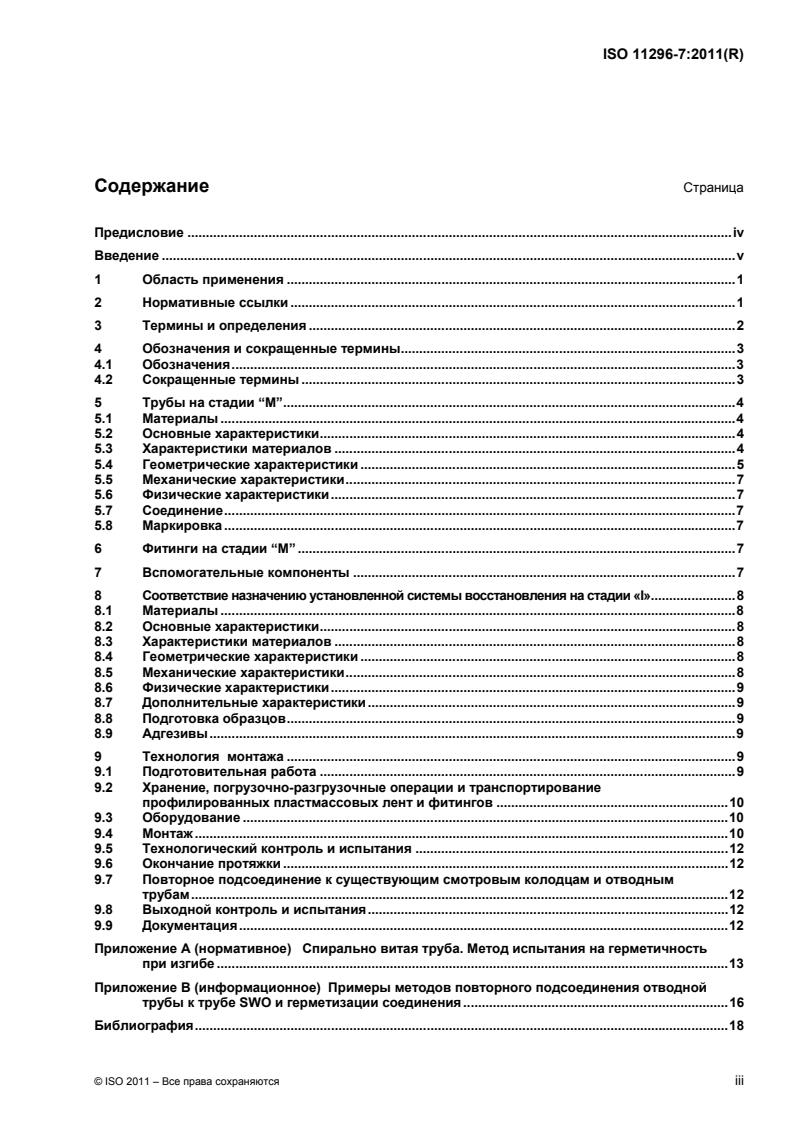
Contents Page
Foreword .iv
Introduction . v
1 Scope . 1
2 Normative references . 1
3 Terms and definitions . 2
4 Symbols and abbreviated terms . 3
4.1 Symbols . 3
4.2 Abbreviated terms . 3
5 Pipes at the “M” stage . 3
5.1 Materials . 3
5.2 General characteristics . 4
5.3 Material characteristics . 4
5.4 Geometric characteristics . 5
5.5 Mechanical characteristics . 6
5.6 Physical characteristics . 6
5.7 Jointing . 6
5.8 Marking . 6
6 Fittings at the “M” stage . 7
7 Ancillary components . 7
8 Fitness for purpose of the installed lining system at the “I” stage . 7
8.1 Materials . 7
8.2 General characteristics . 7
8.3 Material characteristics . 7
8.4 Geometric characteristics . 7
8.5 Mechanical characteristics . 7
8.6 Physical characteristics . 8
8.7 Additional characteristics . 8
8.8 Preparation of samples . 8
8.9 Adhesives . 8
9 Installation practice . 8
9.1 Preparatory work . 8
9.2 Storage, handling and transportation of profiled plastics strips and fittings . 8
9.3 Equipment . 8
9.4 Installation . 9
9.5 Process‑related inspection and testing .10
9.6 Lining termination .10
9.7 Reconnecting to existing manholes and laterals .10
9.8 Final inspection and testing .10
9.9 Documentation .10
Annex A (normative) Spirally‑wound pipe — Test method for watertightness in a deflected condition . 11
Annex B (informative) Examples of methods for reconnecting and sealing laterals to SWO pipe .14
Bibliography .16
© ISO 2011 – All rights reserved iii
ISO 11296‑7:2011(E)
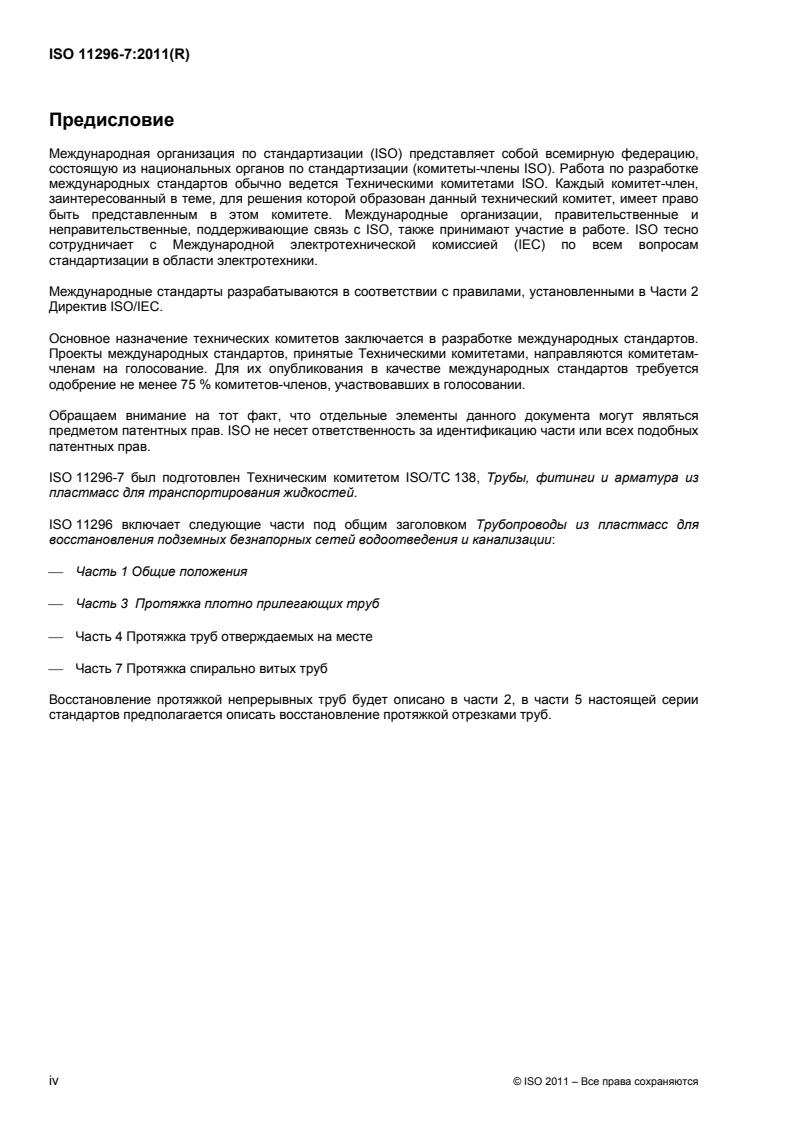
Foreword
ISO (the International Organization for Standardization) is a worldwide federation of national standards bodies
(ISO member bodies). The work of preparing International Standards is normally carried out through ISO
technical committees. Each member body interested in a subject for which a technical committee has been
established has the right to be represented on that committee. International organizations, governmental and
non-governmental, in liaison with ISO, also take part in the work. ISO collaborates closely with the International
Electrotechnical Commission (IEC) on all matters of electrotechnical standardization.
International Standards are drafted in accordance with the rules given in the ISO/IEC Directives, Part 2.
The main task of technical committees is to prepare International Standards. Draft International Standards
adopted by the technical committees are circulated to the member bodies for voting. Publication as an
International Standard requires approval by at least 75 % of the member bodies casting a vote.
Attention is drawn to the possibility that some of the elements of this document may be the subject of patent
rights. ISO shall not be held responsible for identifying any or all such patent rights.
ISO 11296-7 was prepared by Technical Committee ISO/TC 138, Plastics pipes, fittings and valves for the
transport of fluids.
ISO 11296 consists of the following parts, under the general title Plastics piping systems for renovation of
underground non-pressure drainage and sewerage networks:
— Part 1: General
— Part 3: Lining with close-fit pipes
— Part 4: Lining with cured-in-place pipes
— Part 7: Lining with spirally-wound pipes
Lining with continuous pipes is to form the subject of a Part 2 and lining with discrete pipes is to form the subject
of a Part 5.
iv © ISO 2011 – All rights reserved
ISO 11296‑7:2011(E)
Introduction
The System Standard, of which this is Part 7, specifies the requirements for plastics piping systems of various
materials used for renovation of existing pipelines in a specified application area. System Standards for
renovation specify procedures for the following applications:
— plastics piping systems for renovation of underground non-pressure drainage and sewerage networks (this
application);
— plastics piping systems for renovation of underground drainage and sewerage networks under pressure;
— plastics piping systems for renovation of underground water supply networks;
— plastics piping systems for renovation of underground gas supply networks.
These System Standards are distinguished from those for conventionally installed plastics piping systems
because they set requirements for certain characteristics in the as-installed condition, after site processing.
This is in addition to specifying requirements for plastics piping system components, as manufactured.
Each of the System Standards comprises a Part 1 (general) and all applicable renovation technique family-
related parts from the following:
— Part 2: Lining with continuous pipes;
— Part 3: Lining with close-fit pipes;
— Part 4: Lining with cured-in-place pipes;
— Part 5: Lining with discrete pipes;
— Part 7: Lining with spirally-wound pipes.
The requirements for any given renovation technique family are given in Part 1, applied in conjunction with
the relevant other part. For example, Parts 1 and 2 specify the requirements relating to lining with continuous
pipes. For complementary information, see ISO 11295. Not all technique families are applicable to every area
of application and this is reflected in the part numbers included in each System Standard.
A consistent structure of clause headings has been adopted for all parts to facilitate direct comparisons across
renovation technique families.
Figure 1 shows the common structure and the relationship between ISO 11296 and the System Standards for
other application areas.
© ISO 2011 – All rights reserved v
ISO 11296‑7:2011(E)
Figure 1 — Format of the renovation System Standards
vi © ISO 2011 – All rights reserved
INTERNATIONAL STANDARD ISO 11296‑7:2011(E)
Plastics piping systems for renovation of underground
non‑pressure drainage and sewerage networks —
Part 7:
Lining with spirally‑wound pipes
1 Scope
This part of ISO 11296, in conjunction with Part 1, specifies requirements and test methods for pipes which are
formed on site by spirally winding and jointing a pre-manufactured profiled plastics strip, or a profiled plastics
strip and integral locking joiner strip, and used for the renovation of underground non-pressure drainage and
sewerage networks.
It applies to spirally-wound pipes of fixed or variable diameter installed by one of two methods.
The first method employs a dedicated winding machine in front of the open end of an existing pipeline, e.g. in
a manhole. The pipes thus formed are simultaneously inserted into the existing pipeline by the winding forces,
and by certain techniques can also be expanded in diameter after or during insertion.
The second method employs a dedicated winding machine which forms the pipe as it traverses the existing
pipeline from one manhole to the next.
It covers spirally-wound pipes of fixed or variable diameter made of profiled plastics strips, with or without
steel stiffening elements, of unplasticized poly(vinyl chloride) (PVC-U) with integral locking mechanism or high
density polyethylene (HDPE) with integrally welded joints.
2 Normative references
The following referenced documents are indispensable for the application of this document. For dated
references only the edition cited applies. For undated references, the latest edition of the referenced document
(including any amendments) applies.
ISO 37, Rubber, vulcanized or thermoplastic — Determination of tensile stress-strain properties
ISO 179-1, Plastics — Determination of Charpy impact properties — Part 1: Non-instrumented impact test
ISO 306, Plastics — Thermoplastics materials — Determination of Vicat softening temperature (VST)
ISO 527-1, Plastics — Determination of tensile properties — Part 1: General principles
ISO 527-2, Plastics — Determination of tensile properties — Part 2: Test conditions for moulding and extrusion
plastics
ISO 4427 (all parts), Plastics piping systems — Polyethylene (PE) pipes and fittings for water supply
ISO 4435, Plastics piping systems for non-pressure underground drainage and sewerage — Unplasticized
poly(vinyl chloride) (PVC-U)
ISO 4948-2, Steels — Classification — Part 2: Classification of unalloyed and alloy steels according to main
quality classes and main property or application characteristics
ISO 6259-1, Thermoplastics pipes — Determination of tensile properties — Part 1: General test method
© ISO 2011 – All rights reserved 1
ISO 11296‑7:2011(E)
ISO 7619-1, Rubber, vulcanized or thermoplastic — Determination of indentation hardness — Part 1: Durometer
method (Shore hardness)
ISO 9967, Thermoplastics pipes — Determination of creep ratio
ISO 9969, Thermoplastics pipes — Determination of ring stiffness
ISO 11296-1, Plastics piping systems for renovation of underground non-pressure drainage and sewerage
networks — Part 1: General
ISO 11296-4:2009, Plastics piping systems for renovation of underground non-pressure drainage and sewerage
networks — Part 4: Lining with cured-in-place pipes
EN 1979, Plastics piping and ducting systems — Thermoplastics spirally-formed structured-wall pipes —
Determination of the tensile strength of a seam
EN 14364:2006, Plastics piping systems for drainage and sewerage with or without pressure — Glass-
reinforced thermosetting (GRP) plastics based on unsaturated polyester resin (UP) — Specifications for pipes,
fittings and joints
3 Terms and definitions
For the purposes of this document, the terms and definitions given in ISO 11296-1 and the following apply.
3.1
spirally‑wound pipe
pipe formed by continuously winding and joining a profiled plastics strip, or a profiled plastics strip and integral
locking joiner strip
3.2
seam
joint between adjacent profiled plastics strips formed by an integral locking mechanism and/or seam sealant
3.3
integral locking mechanism
mechanical interlock achieved by suitable design of the edges of the extruded profile
3.4
seam sealant
thermoplastic or adhesive material added to the integral locking mechanism or profiled plastics strip surface to
make the seam leaktight
3.5
close fit
location of the outside of the installed liner relative to the inside of the existing pipeline, which may either be an
interference fit or include a small annular gap resulting from shrinkage and tolerances only
NOTE Tolerances in the above definition refers to offsets and deformities in the existing pipeline. Spirally-wound
liners are not subject to shrinkage.
3.6
close‑fit spirally‑wound pipe
continuous lining pipe wound from a profiled plastics strip, with or without steel reinforcement, expanded or
wound in place to achieve a close fit to the existing pipeline
2 © ISO 2011 – All rights reserved
ISO 11296‑7:2011(E)
4 Symbols and abbreviated terms
For the purposes of this document, the symbols and abbreviated terms given in ISO 11296-1 and the following
apply.
4.1 Symbols
A cross-sectional area of the profiled plastics strip mm/mm
w
d outside diameter mm
e
e height of neutral axis of the strip above its base mm
a
e overall profile height mm
o
e minimal waterway wall thickness mm
w,min
e waterway wall thickness at any point mm
w
e encapsulation thickness at any point mm
e encapsulation thickness at any point mm
I second moment of area of the strip mm/mm
w
l length of the specimen for short-term tensile force resistance test of the locked seam mm
s
S ring stiffness of the pipe kN/m
w effective width of the strip mm
w width of the specimen for short-term tensile force resistance test of the locked seam mm
s
4.2 Abbreviated terms
EPDM ethylene-propylene-diene monomer
GRP glass-reinforced thermosetting plastic
HDPE high density polyethylene
PE polyethylene
PVC-U unplasticized poly(vinyl chloride)
SWO spirally-wound
5 Pipes at the “M” stage
This clause specifies requirements for profiled plastics strips, and the material classification of any steel
stiffening elements incorporated, prior to winding into a pipe. For requirements for the wound pipe, see Clause
8.
5.1 Materials
The material of the profiled plastics strip shall be unplasticized poly(vinyl chloride) (PVC-U) or high density
polyethylene (HDPE), to which are added those additives needed to facilitate the manufacture and/or installation
of pipes conforming to this part of ISO 11296.
© ISO 2011 – All rights reserved 3
ISO 11296‑7:2011(E)
Depending on the design of the profiled plastics strip, the seam sealant shall comprise one or more of the
following materials:
— thermoplastics elastomers (e.g. HDPE, EPDM, silicone);
— adhesives (e.g. amorphous poly-alpha-olefin).
Only virgin and own reprocessable materials, as defined in ISO 11296-1, are permitted for the profiled plastics
strips and seam sealant. The material(s) used for the seam sealant shall be declared by the manufacturer of
the profiled plastics strips.
Any steel stiffening elements, including material grade classified in accordance with ISO 4948-2 or other
equivalent international or national standard, shall be declared by the supplier. The material of any stiffening
element, whether or not encapsulated, shall in all cases be approved by the client for the environment of its
specific application.
NOTE 1 Detailed specification of non-plastics materials is outside the scope of this part of ISO 11296.
NOTE 2 Some sewage effluents and groundwater contaminants pote
...
NORME ISO
INTERNATIONALE 11296-7
Première édition
2011-11-01
Systèmes de canalisations en plastique
pour la rénovation des réseaux de
branchements et de collecteurs
d’assainissement enterrés sans
pression —
Partie 7:
Tubage par enroulement hélicoïdal avec
espace annulaire
Plastics piping systems for renovation of underground non-pressure
drainage and sewerage networks —
Part 7: Lining with spirally-wound pipes
Numéro de référence
ISO 11296-7:2011(F)
©
ISO 2011
DOCUMENT PROTÉGÉ PAR COPYRIGHT
© ISO 2011
Droits de reproduction réservés. Sauf prescription différente, aucune partie de cette publication ne peut être reproduite ni utilisée sous
quelque forme que ce soit et par aucun procédé, électronique ou mécanique, y compris la photocopie et les microfilms, sans l’accord écrit
de l’ISO à l’adresse ci-après ou du comité membre de l’ISO dans le pays du demandeur.
ISO copyright office
Case postale 56 • CH-1211 Geneva 20
Tel. + 41 22 749 01 11
Fax + 41 22 749 09 47
E-mail copyright@iso.org
Web www.iso.org
Publié en Suisse
ii © ISO 2011 – Tous droits réservés
Sommaire Page
Avant-propos .iv
Introduction . v
1 Domaine d’application . 1
2 Références normatives . 1
3 Termes et définitions . 2
4 Symboles et abréviations . 3
4.1 Symboles . 3
4.2 Abréviations . 3
5 Tuyaux au stade «M» . 3
5.1 Matières . 4
5.2 Caractéristiques générales . 4
5.3 Caractéristiques des matières . 4
5.4 Caractéristiques géométriques . 5
5.5 Caractéristiques mécaniques . 7
5.6 Caractéristiques physiques . 7
5.7 Assemblage . 7
5.8 Marquage . 7
6 Raccords au stade «M» . 7
7 Accessoires . 7
8 Aptitude à l’emploi du système de rénovation installé au stade «I» . 7
8.1 Matières . 7
8.2 Caractéristiques générales . 8
8.3 Caractéristiques des matières . 8
8.4 Caractéristiques géométriques . 8
8.5 Caractéristiques mécaniques . 8
8.6 Caractéristiques physiques . 8
8.7 Caractéristiques supplémentaires . 9
8.8 Préparation des échantillons . 9
8.9 Adhésifs . 9
9 Pratique d’installation . 9
9.1 Travaux préparatoires . 9
9.2 Stockage, manutention et transport des bandes profilées en plastique et des raccords . 9
9.3 Équipement . 9
9.4 Installation . 9
9.5 Contrôle et essais relatifs au processus d’installation . 11
9.6 Achèvement du tubage ou chemisage . 11
9.7 Raccordement aux regards de visite et branchements existants . 11
9.8 Inspection finale et essais . 11
9.9 Documentation . 11
Annexe A (normative) Tubage par enroulement hélicoïdal — Méthode d’essai d’étanchéité à l’eau des
tubages soumis à déflexion .12
Annexe B (informative) Exemples de méthodes de raccordement et de scellement des branchements
avec le tubage SWO .15
Bibliographie .17
© ISO 2011 – Tous droits réservés iii
Avant-propos
L’ISO (Organisation internationale de normalisation) est une fédération mondiale d’organismes nationaux de
normalisation (comités membres de l’ISO). L’élaboration des Normes internationales est en général confiée aux
comités techniques de l’ISO. Chaque comité membre intéressé par une étude a le droit de faire partie du comité
technique créé à cet effet. Les organisations internationales, gouvernementales et non gouvernementales,
en liaison avec l’ISO participent également aux travaux. L’ISO collabore étroitement avec la Commission
électrotechnique internationale (CEI) en ce qui concerne la normalisation électrotechnique.
Les Normes internationales sont rédigées conformément aux règles données dans les Directives ISO/CEI,
Partie 2.
La tâche principale des comités techniques est d’élaborer les Normes internationales. Les projets de Normes
internationales adoptés par les comités techniques sont soumis aux comités membres pour vote. Leur
publication comme Normes internationales requiert l’approbation de 75 % au moins des comités membres
votants.
L’attention est appelée sur le fait que certains des éléments du présent document peuvent faire l’objet de droits
de propriété intellectuelle ou de droits analogues. L’ISO ne saurait être tenue pour responsable de ne pas avoir
identifié de tels droits de propriété et averti de leur existence.
L’ISO 11296-7 a été élaborée par le comité technique ISO/TC 138, Tubes, raccords et robinetterie en matières
plastiques pour le transport des fluides.
L’ISO 11296 comprend les parties suivantes, présentées sous le titre général Systèmes de canalisations en
plastique pour la rénovation des réseaux de branchements et de collecteurs d’assainissement enterrés sans
pression:
— Partie 1: Généralités
— Partie 3: Tubage par tuyau continu sans espace annulaire
— Partie 4: Tubage continu par tubes polymérisés sur place
— Partie 7: Tubage par enroulement hélicoïdal avec espace annulaire
Un tubage par tuyau continu avec espace annulaire fera l’objet d’une future Partie 2 et un tubage par tuyaux
courts avec espace annulaire fera l’objet d’une future Partie 5.
iv © ISO 2011 – Tous droits réservés
Introduction
La Norme de Système, dont le présent document est la Partie 1, spécifie les exigences pour des systèmes de
canalisations en plastique à base de matériaux variés utilisés pour la rénovation de canalisations existantes
dans un domaine d’application spécifié. Les Normes de Systèmes relatives à la rénovation spécifient les
modes opératoires pour les applications suivantes:
— systèmes de canalisations en plastique pour la rénovation des réseaux d’assainissement enterrés sans
pression;
— systèmes de canalisations en plastique pour la rénovation des réseaux d’assainissement enterrés sous
pression;
— systèmes de canalisations en plastique pour la rénovation de réseaux enterrés d’alimentation en eau;
— systèmes de canalisations en plastique pour la rénovation des réseaux de gaz enterrés.
Ces Normes de Systèmes se distinguent des normes relatives aux systèmes de canalisations en plastique
installés traditionnellement du fait qu’elles établissent des exigences concernant certaines caractéristiques
liées aux conditions d’installation, après mise en œuvre sur le site. Cela s’ajoute aux exigences spécifiques
pour les composants du système tels que fabriqués.
Chacune des Normes de Systèmes comprend une Partie 1 (généralités) et toutes les parties applicables aux
familles de techniques de rénovation contenues dans la liste suivante:
— Partie 2: Tubage par tuyau continu avec espace annulaire;
— Partie 3: Tubage par tuyau continu sans espace annulaire;
— Partie 4: Tubage continu par tubes polymérisés sur place;
— Partie 5: Tubage par tuyaux courts avec espace annulaire;
— Partie 7: Tubage par enroulement hélicoïdal avec espace annulaire.
Les exigences applicables à toute famille de techniques de rénovation donnée sont indiquées dans la Partie 1,
appliquée conjointement à toute autre partie associée. Par exemple, les Parties 1 et 2 spécifient les exigences
se rapportant au tubage par tuyau continu avec espace annulaire. Pour toute information complémentaire, voir
l’ISO 11295. Toutes les familles de techniques ne sont pas applicables à chaque domaine d’application et cela
se reflète dans les numéros de parties compris dans chaque Norme de Système.
Une structure cohérente des titres des articles a été adoptée pour toutes les parties afin de faciliter des
comparaisons directes entre les différentes familles de techniques de rénovation.
La Figure 1 illustre la structure commune et la relation entre l’ISO 11296 et les Normes de Systèmes concernant
d’autres domaines d’application.
© ISO 2011 – Tous droits réservés v
Figure 1 — Présentation des Normes de Systèmes de rénovation
vi © ISO 2011 – Tous droits réservés
NORME INTERNATIONALE ISO 11296-7:2011(F)
Systèmes de canalisations en plastique pour la rénovation
des réseaux de branchements et de collecteurs
d’assainissement enterrés sans pression —
Partie 7:
Tubage par enroulement hélicoïdal avec espace annulaire
1 Domaine d’application
La présente partie de l’ISO 11296, conjointement avec la Partie 1, spécifie les exigences et les méthodes
d’essai applicables aux tubes formés sur place par enroulement hélicoïdal et assemblage d’une bande profilée
préfabriquée en plastique, ou d’une bande profilée en plastique et d’une bande d’assemblage à verrouillage
intégral, et utilisés pour la rénovation de réseaux de branchements et de collecteurs d’assainissement enterrés
sans pression.Elle s’applique aux tubages par enroulement hélicoïdal, de diamètre fixe ou variable, installés en
utilisant l’une des deux méthodes suivantes:
— la première méthode fait intervenir une machine à enrouler spécifique devant l’extrémité ouverte d’une
canalisation existante (par exemple dans un regard). Les tubages ainsi formés sont insérés simultanément
dans la canalisation existante par les forces d’enroulement et certaines techniques permettent d’en élargir
le diamètre pendant ou après l’insertion;
— la seconde méthode fait intervenir une machine à enrouler spécifique pour former le tubage à mesure de
sa progression à travers la canalisation existante d’un regard au regard suivant.
Elle traite également des tubages par enroulement hélicoïdal de diamètre fixe ou variable, fabriqués à partir de
bandes profilées en plastique PVC-U (polychlorure de vinyle non plastifié), avec ou sans éléments raidisseurs
en acier, munies d’un mécanisme de verrouillage intégral, ou en polyéthylène haute densité (HDPE) avec joints
intégralement soudés.
2 Références normatives
Les documents de référence suivants sont indispensables à l’application du présent document. Pour les
références datées, seule l’édition citée s’applique. Pour les références non datées, la dernière édition du
document de référence s’applique (y compris les éventuels amendements) s’applique.
ISO 37, Caoutchouc vulcanisé ou thermoplastique — Détermination des caractéristiques de contrainte-
déformation en traction
ISO 179-1, Plastiques — Détermination des caractéristiques au choc Charpy — Partie 1: Essai de choc non
instrumenté
ISO 306, Plastiques — Matières thermoplastiques — Détermination de la température de ramollissement Vicat
(VST)
ISO 527-1, Plastiques — Détermination des propriétés en traction — Partie 1: Principes généraux
ISO 527-2, Plastiques — Détermination des propriétés en traction — Partie 2: Conditions d’essai des plastiques
pour moulage et extrusion
ISO 4427 (toutes les parties), Systèmes de canalisations en plastique — Tubes et raccords en polyéthylène
(PE) destinés à l’alimentation en eau
© ISO 2011 – Tous droits réservés 1
ISO 4435, Systèmes de canalisations en plastique pour les branchements et les collecteurs d’assainissement
enterrés sans pression — Poly(chlorure de vinyle) non plastifié (PVC-U)
ISO 4948-2, Aciers — Classification — Partie 2: Classification des aciers alliés et aciers non alliés en fonction
des principales classes de qualité et des caractéristiques principales de propriétés ou d’application
ISO 6259-1, Tubes en matières thermoplastiques — Détermination des caractéristiques en traction — Partie 1:
Méthode générale d’essai
ISO 7619-1, Caoutchouc vulcanisé ou thermoplastique — Détermination de la dureté par pénétration —
Partie 1: Méthode au duromètre (dureté Shore)
ISO 9967, Tubes en matières thermoplastiques — Détermination du taux de fluage
ISO 9969, Tubes en matières thermoplastiques — Détermination de la rigidité annulaire
ISO 11296-1:2009, Systèmes de canalisations en plastique pour la rénovation des réseaux de branchements
et de collecteurs d’assainissement enterrés sans pression — Partie 1: Généralités
ISO 11296-4:2009, Systèmes de canalisations en plastique pour la rénovation des réseaux de branchements
et de collecteurs d’assainissement enterrés sans pression — Partie 4: Tubage continu par tubes polymérisés
sur place
EN 1979, Systèmes de canalisations et de gaines en matières plastiques — Tubes thermoplastiques à paroi
structurée enroulés en hélice — Détermination de la résistance en traction de la ligne de soudure
EN 14364:2006, Systèmes de canalisations en plastiques pour l’évacuation et l’assainissement avec ou sans
pression — Plastiques thermodurcissables renforcés de verre (PRV) à base de résine de polyester non saturé
(UP) — Spécifications pour tubes, raccords et assemblages
3 Termes et définitions
Pour les besoins du présent document, les termes et définitions donnés dans l’ISO 11296-1 ainsi que les
suivants s’appliquent.
3.1
tubage par enroulement hélicoïdal
tube formé par enroulement continu et assemblage d’une bande profilée en plastique ou d’une bande profilée
en plastique et d’une bande d’assemblage à verrouillage intégral
3.2
ligne de soudure
joint entre des bandes profilées en plastique adjacentes, formé par un mécanisme de verrouillage intégral
et/ou un produit d’étanchéité pour assemblage
3.3
mécanisme de verrouillage intégral
verrouillage mécanique obtenu par une conception appropriée des bords du profilé extrudé
3.4
produit d’étanchéité pour assemblage
matière thermoplastique ou adhésif ajouté au mécanisme de verrouillage intégral ou sur la surface des bandes
profilées en plastique pour rendre l’assemblage étanche
3.5
sans espace annulaire
position de l’extérieur du tubage installé par rapport à l’intérieur de la canalisation existante, qui peut soit être
un contact avec interférence, soit inclure un petit espace annulaire dû uniquement au retrait et aux tolérances
NOTE Les tolérances évoquées dans la définition ci-dessus se réfèrent aux décalages et aux déformations de la
canalisation existante. Les tubages par enroulement hélicoïdal ne sont pas sujets au décalage.
2 © ISO 2011 – Tous droits réservés
3.6
tubage par enroulement hélicoïdal sans espace annulaire
tubage continu obtenu par l’enroulement d’une bande profilée en plastique, avec ou sans renfort en acier, dilaté
ou enroulé sur place de façon à ne laisser subsister aucun espace annulaire avec la canalisation existante
4 Symboles et abréviations
Pour les besoins du présent document, les symboles et abréviations donnés dans l’ISO 11296-1 ainsi que les
suivants s’appliquent.
4.1 Symboles
A aire de section transversale de la bande profilée en plastique mm/mm
w
d diamètre extérieur mm
e
e hauteur de l’axe neutre de la bande au-dessus de sa base mm
a
e hauteur hors-tout du profilé mm
o
e épaisseur minimale de la surface de la paroi d’avalement mm
w,min
e épaisseur de paroi en un point quelconque de la surface d’avalement mm
w
e épaisseur en un point quelconque de l’encapsulage mm
e épaisseur en un point quelconque de l’encapsulage mm
I moment d’inertie de la bande mm/mm
w
l longueur de l’éprouvette pour l’essai de résistance à la force de traction à court terme mm
s
de l’assemblage verrouillé
S rigidité annulaire du tube kN/m
w
largeur efficace de la bande mm
w largeur de l’éprouvette pour l’essai de résistance à la force de traction à court terme mm
s
de l’assemblage verrouillé
4.2 Abréviations
EPDM monomère d’éthylène-propylène-diène
HDPE polyéthylène haute densité
PE polyéthylène
PVC-U poly(chlorure de vinyle) non plastifié
PVR plastiques thermodurcissables renforcés de verre
SWO enroulement hélicoïdal
5 Tuyaux au stade «M»
Le présent article décrit les exigences relatives aux bandes profilées en plastique et la classification des
matériaux des éléments raidisseurs en acier incorporés, avant de les enrouler dans un tuyau. Pour les
exigences de tuyaux enroulés, voir l’Article 8.
© ISO 2011 – Tous droits réservés 3
5.1 Matières
La matière constitutive de la bande profilée en plastique doit être soit du poly(chlorure de vinyle) non plastifié
(PVC-U), soit du polyéthylène haute densité (HDPE), auquel sont ajoutés les additifs nécessaires pour faciliter
la fabrication et/ou l’installation des tuyaux conformément à la présente partie de l’ISO 11296.
En fonction de la conception de la bande profilée en plastique, le produit d’étanchéité pour assemblage doit
être constitué d’une ou de plusieurs matières, parmi les suivantes:
— élastomères thermoplastiques (par exemple HDPE, EPDM, silicone);
— adhésifs (par exemple poly-α-oléfine amorphe).
Seules les matières vierges et retraitables internes, définies dans l’ISO 11296-1, sont autorisées pour les
bandes profilées en plastique et pour le produit d’étanchéité pour assemblage. La (les) matière(s) utilisée(s)
pour le produit d’étanchéité pour assemblage doit (doivent) être déclarée(s) par le fabricant des bandes profilées
en plastique.
Le fournisseur doit déclarer les éléments raidisseurs en acier, le cas échéant, y compris de qualité répondant
à la classification de l’ISO 4948-2 ou d’une autre Norme internationale ou nationale équivalente. La matière
constitutive des éléments raidisseurs, qu’ils fassent ou non l’objet d’un encapsulage, doit dans tous les cas être
approuvée par le client pour l’environnement de son application spécifique.
NOTE 1 La spécification détaillée des matières non plastiques n’entre pas dans le domaine d’application de la présente
partie de l’ISO 11296.
NOTE 2 Certains effluents d’égout et contaminants de la nappe phréatique potentiellement corrosifs pour l’acier
peuvent pénétrer une couche de protection en PVC-U ou en HDPE si elle est mince. En fonction de la conception des
profilés et de la technique d’installation, ces couches de protection peuvent être exposées elles aussi à des risques
d’endommagement.
5.2 Caractéristiques générales
Lors d’une observation sans grossissement, les surfaces des bandes profilées en plastique doivent être
lisses, propres et exemptes de rayures, de cavités, ainsi que de tout autre défaut, susceptibles d’entraver leur
conformité à la présente partie de l’ISO 11296.
5.3 Caractéristiques des matières
La matière de la bande profilée en plastique une fois extrudée en une p
...
МЕЖДУНАРОДНЫЙ ISO
СТАНДАРТ 11296-7
Первое издание
2011-11-01
Трубопроводы из пластмасс для
восстановления подземных
безнапорных сетей водоотведения и
канализации.
Часть 7.
Протяжка спирально витых труб
Plastics piping systems for renovation of underground non-pressure
drainage and sewefage networks —
Part 7: Lining with spirally-wound pipes
Ответственность за подготовку русской версии несёт GOST R
(Российская Федерация) в соответствии со статьёй 18.1 Устава ISO
Ссылочный номер
©
ISO 2011
Отказ от ответственности при работе в PDF
Настоящий файл PDF может содержать интегрированные шрифты. В соответствии с условиями лицензирования, принятыми
фирмой Adobe, этот файл можно распечатать или смотреть на экране, но его нельзя изменить, пока не будет получена
лицензия на установку интегрированных шрифтов в компьютере, на котором ведется редактирование. В случае загрузки
настоящего файла заинтересованные стороны принимают на себя ответственность за соблюдение лицензионных условий
фирмы Adobe. Центральный секретариат ISO не несет никакой ответственности в этом отношении.
Adobe - торговый знак фирмы Adobe Systems Incorporated.
Подробности, относящиеся к программным продуктам, использованным для создания настоящего файла PDF, можно найти в
рубрике General Info файла; параметры создания PDF были оптимизированы для печати. Были приняты во внимание все
меры предосторожности с тем, чтобы обеспечить пригодность настоящего файла для использования комитетами-членами
ISO. В редких случаях возникновения проблемы, связанной со сказанным выше, просьба проинформировать Центральный
секретариат по адресу, приведенному ниже.
ДОКУМЕНТ ЗАЩИЩЕН АВТОРСКИМ ПРАВОМ
© ISO 2011
Все права сохраняются. Если не указано иное, никакую часть настоящей публикации нельзя копировать или использовать в
какой-либо форме или каким-либо электронным или механическим способом, включая фотокопии и микрофильмы, без
предварительного письменного согласия ISO, которое должно быть получено после запроса о разрешении, направленного по
адресу, приведенному ниже, или в комитет-член ISO в стране запрашивающей стороны.
ISO copyright office
Case postale 56 • CH-1211 Geneva 20
Tel. + 41 22 749 01 11
Fax + 41 22 749 09 47
E-mail copyright@iso.org
Web www.iso.org
Опубликовано в Швейцарии
ii © ISO 2011 – Все права сохраняются
Содержание Страница
Предисловие .iv
Введение .v
1 Область применения .1
2 Нормативные ссылки .1
3 Термины и определения .2
4 Обозначения и сокращенные термины.3
4.1 Обозначения.3
4.2 Сокращенные термины .3
5 Трубы на стадии “M”.4
5.1 Материалы .4
5.2 Основные характеристики.4
5.3 Характеристики материалов .4
5.4 Геометрические характеристики .5
5.5 Механические характеристики.7
5.6 Физические характеристики.7
5.7 Соединение.7
5.8 Маркировка .7
6 Фитинги на стадии “M” .7
7 Вспомогательные компоненты .7
8 Соответствие назначению установленной системы восстановления на стадии «I».8
8.1 Материалы .8
8.2 Основные характеристики.8
8.3 Характеристики материалов .8
8.4 Геометрические характеристики .8
8.5 Механические характеристики.8
8.6 Физические характеристики.9
8.7 Дополнительные характеристики.9
8.8 Подготовка образцов.9
8.9 Адгезивы .9
9 Технология монтажа .9
9.1 Подготовительная работа .9
9.2 Хранение, погрузочно-разгрузочные операции и транспортирование
профилированных пластмассовых лент и фитингов .10
9.3 Оборудование .10
9.4 Монтаж .10
9.5 Технологический контроль и испытания .12
9.6 Окончание протяжки .12
9.7 Повторное подсоединение к существующим смотровым колодцам и отводным
трубам.12
9.8 Выходной контроль и испытания.12
9.9 Документация.12
Приложение А (нормативное) Спирально витая труба. Метод испытания на герметичность
при изгибе .13
Приложение В (информационное) Примеры методов повторного подсоединения отводной
трубы к трубе SWO и герметизации соединения .16
Библиография.18
Предисловие
Международная организация по стандартизации (ISO) представляет собой всемирную федерацию,
состоящую из национальных органов по стандартизации (комитеты-члены ISO). Работа по разработке
международных стандартов обычно ведется Техническими комитетами ISO. Каждый комитет-член,
заинтересованный в теме, для решения которой образован данный технический комитет, имеет право
быть представленным в этом комитете. Международные организации, правительственные и
неправительственные, поддерживающие связь с ISO, также принимают участие в работе. ISO тесно
сотрудничает с Международной электротехнической комиссией (IEC) по всем вопросам
стандартизации в области электротехники.
Международные стандарты разрабатываются в соответствии с правилами, установленными в Части 2
Директив ISO/IEC.
Основное назначение технических комитетов заключается в разработке международных стандартов.
Проекты международных стандартов, принятые Техническими комитетами, направляются комитетам-
членам на голосование. Для их опубликования в качестве международных стандартов требуется
одобрение не менее 75 % комитетов-членов, участвовавших в голосовании.
Обращаем внимание на тот факт, что отдельные элементы данного документа могут являться
предметом патентных прав. ISO не несет ответственность за идентификацию части или всех подобных
патентных прав.
ISO 11296-7 был подготовлен Техническим комитетом ISO/TC 138, Трубы, фитинги и арматура из
пластмасс для транспортирования жидкостей.
ISO 11296 включает следующие части под общим заголовком Трубопроводы из пластмасс для
восстановления подземных безнапорных сетей водоотведения и канализации:
⎯ Часть 1 Общие положения
⎯ Часть 3 Протяжка плотно прилегающих труб
⎯ Часть 4 Протяжка труб отверждаемых на месте
⎯ Часть 7 Протяжка спирально витых труб
Восстановление протяжкой непрерывных труб будет описано в части 2, в части 5 настоящей серии
стандартов предполагается описать восстановление протяжкой отрезками труб.
iv © ISO 2011 – Все права сохраняются
Введение
Настоящий документ является 7 частью серии стандартов и устанавливает требования к
трубопроводным системам из различных пластмасс, применяемым для восстановления существующих
трубопроводов в заданной сфере применения. Серии стандартов устанавливают технологии
восстановления существующих трубопроводов в следующих областях применения:
⎯ трубопроводы из пластмасс для восстановления подземных безнапорных сетей водоотведения и
канализации;
⎯ трубопроводы из пластмасс для восстановления подземных напорных сетей водоотведения и
канализации;
⎯ трубопроводы из пластмасс для восстановления подземных сетей водоснабжения;
⎯ трубопроводы из пластмасс для восстановления подземных газораспределительных сетей.
Эти серии стандартов отличаются от аналогичных стандартов на трубопроводы, предназначенные для
традиционной прокладки, так как содержат требования к характеристикам уже эксплуатируемых
трубопроводов. Это влечет установление дополнительных требований к производимым компонентам
системы.
Каждая серия стандартов включает часть 1 (общие положения) и далее части, относящиеся ко всем
применяемым техникам восстановления, а именно:
⎯ Часть 2. Протяжка непрерывных труб
⎯ Часть 3. Протяжка плотно прилегающих труб;
⎯ Часть 4. Протяжка труб отверждаемых на месте;
⎯ Часть 5. Протяжка отрезков труб;
⎯ Часть 7. Протяжка спирально витых труб.
Требования к любой технологии восстановления приводятся в Части 1, применяемой совместно с
другой, соответствующей частью. Например, Части 1 и 2 устанавливают требования, касающиеся
технологии восстановления непрерывными трубами. Для дополнительной информации см. ISO 11295.
Не все технологии применимы для каждой области применения, что отражается в количестве частей, в
каждой серии стандартов.
С целью облегчения прямого сопоставления различных способов восстановления для всех частей
принята последовательная структура заголовков разделов.
На Рисунке 1 показана обычная структура и взаимосвязь между ISO 11296 и сериями стандартов, для
других областей применения.
vi © ISO 2011 – Все права сохраняются
МЕЖДУНАРОДНЫЙ СТАНДАРТ ISO 11296-7:2011(R)
Трубопроводы из пластмасс для восстановления подземных
безнапорных сетей водоотведения и канализации.
Часть 7.
Протяжка спирально витых труб
1 Область применения
Настоящая часть ISO 11296, совместно с Частью 1, устанавливает требования и методы испытаний
для труб, которые формируются непосредственно на строительной площадке спиральной навивкой и
соединением заранее изготовленной профилированной пластмассовой ленты, или спиральной
навивкой профилированной пластмассовой ленты с интегральным фиксирующим в замок соединением,
и предназначены для восстановления подземных безнапорных сетей водоотведения и канализации.
Настоящий стандарт применим к спирально витым трубам постоянного или переменного диаметра,
прокладываемых одним из двух методов.
В первом методе применяется специализированная намоточная машина, расположенная перед открытым
концом восстанавливаемого трубопровода, например в смотровом колодце. Трубы, формируемые таким
образом, одновременно вдвигаются в существующий трубопровод навивочным механизмом и
определенными способами могут быть также увеличены в диаметре после или во время вдвигания.
Во втором методе применяется специализированная намоточная машина, которая формирует трубу по мере
ее прохождения восстанавливаемого трубопровода от одного смотрового колодца к следующему.
Стандарт касается спирально витых труб постоянного или переменного диаметра, изготовленных из
профилированных пластмассовых лент со стальными элементами жесткости или без них из
непластифицированного поливинилхлорида (PVC-U) с интегральным фиксирующим в замок
устройством или из полиэтилена высокой плотности (HDPE) с цельносварными соединениями.
2 Нормативные ссылки
Следующие документы являются обязательными для применения настоящего документа. Для
датированных ссылок действительно только указанное издание. В случае недатированных ссылок
используется последняя редакция документа, на который дается ссылка (включая все изменения).
ISO 37, Резина и термопласты . Определение упруго-прочностных свойств при растяжении
ISO 179-1, Пластмассы. Определение ударной вязкости по Шарпи. Часть 1. Неинструментальный
метод испытания на удар
ISO 306, Пластмассы. Термопласты. Определение температуры размягчения по Вика (VST)
ISO 527-1, Пластмассы. Определение механических свойств при растяжении. Часть 1. Общие
требования
ISO 527-2, Пластмассы. Определение механических свойств при растяжении. Часть 2. Условия
испытаний для литьевых и экструзионных пластмасс
ISO 4427 (все части), Трубы и фитинги из полиэтилена для водоснабжения
ISO 4435, Сети трубопроводные пластмассовые для безнапорной подземных канализации и
водоотведения. Непластифицированный поливинилхлорид (НПВХ)
ISO 4948-2, Стали. Классификация. Часть 2. Классификация нелегированных и легированных
сталей по основным классам качества и основному свойству или области применения
ISO 6259-1, Трубы из термопластов. Определение механических свойств при растяжении. Часть 1.
Общий метод испытания
ISO 7619-1, Каучук вулканизованный или термопластичный. Определение твердости при
вдавливании. Часть 1. Метод с применением твердомера (твердость по Шору)
ISO 9967, Трубы из термопластов. Определение коэффициента ползучести
ISO 9969, Трубы из термопластов. Определение кольцевой жесткости
ISO 11296-1, Трубопроводы их пластмасс для восстановления подземных безнапорных сетей
водоотведения и канализации. Часть 1. Общие положения
ISO 11296-4:2009, Трубопроводы из пластмасс для восстановления подземных безнапорных сетей
канализации и водоотведения. Часть 4. Протяжка труб, отверждаемых на месте
EN 1979, Пластмассовые трубопроводы и воздуховоды. Трубы из термопластов со спирально
витой структурированной стенкой. Определение прочности шва при растяжении
EN 14364:2006, Трубопроводы из пластмасс для безнапорной и напорной канализации и
водоотведения. Термореактивные пластмассы, армированные стекловолокном (GRP) на основе
ненасыщенных полиэфирных (UP) смол. Технические условия на трубы, фитинги и соединения
3 Термины и определения
В настоящем стандарте применяются термины и определения, приведенные в ISO 11296-1 , а также
следующие.
3.1
спирально витая труба
spirally-wound pipe
труба, образованная непрерывной навивкой соединяемой профилированной пластмассовой ленты или
образованная непрерывной навивкой профилированной пластмассовой ленты, соединяемой при
помощи интегрального фиксирующего в замок устройства.
3.2
шов
seam
соединение между соседними профилированными пластмассовыми лентами, образованное
интегральным фиксирующим в замок устройством и/или герметиком для швов
3.3
интегральное фиксирующее в замок устройство
integral locking mechanism
механическое замковое соединение, образующееся за счет специальной конструкции кромок
экструдируемого профиля
3.4
герметик для швов
seam sealant
термопласт или адгезив, закладываемый в интегральное фиксирующее устройство, или наносимый на
поверхность профилированной пластмассовой ленты, чтобы герметизировать соединительный шов
2 © ISO 2011 – Все права сохраняются
3.5
плотное прилегание
close fit
расположение наружной поверхности установленной трубы относительно внутренней поверхности
восстанавливаемого трубопровода, при котором обе поверхности плотно соприкасаются или имеют
место только небольшие кольцевые зазоры, образующиеся только в результате усадки и допусков.
ПРИМЕЧАНИЕ Под допусками в вышеприведенном определении подразумеваются неровности и
деформированность в восстанавливаемом трубопроводе. Спирально витые трубы усадке не подвергаются.
3.6
плотно прилегающая спирально витая труба
close-fit spirally-wound pipe
длинномерная труба, навитая из профилированной пластмассовой ленты с или без усиления
стальными элементами, развальцованная или навитая на строительной площадке для обеспечения
плотного прилегания к внутренней поверхности восстанавливаемого трубопровода
4 Обозначения и сокращенные термины
В настоящем документе применяются обозначения и сокращенные термины, приведенные в
ISO 11296-1, а также следующие.
4.1 Обозначения
A площадь поперечного сечения профилированной пластмассовой ленты мм /мм
w
d наружный диаметр мм
e
e высота нейтральной оси ленты от ее основания мм
a
e полная высота профиля мм
o
e минимальная толщина стенки водовода мм
w,min
e толщина стенки водовода в любой точке мм
w
e толщина заделки встроенного элемента в любой точке мм
e толщина заделки встроенного элемента в любой точке мм
I момент инерции площади профиля мм /мм
w
l длина образца для испытания на стойкость замкового шва к кратковременной мм
s
растягивающей нагрузке
S
кольцевая жесткость трубы кН/мм
w эффективная ширина ленты мм
w ширина образца для испытания на стойкость шва соединения в замок к мм
s
кратковременной растягивающей нагрузке
4.2 Сокращенные термины
EPDM этилен-пропилендиеновый мономер (ЭПДМ)
GRP стеклонаполненная термоотверждаемая пластмасса
HDPE полиэтилен высокой плотности (ПЭВП)
PE Полиэтилен (ПЭ)
PVC-U непластифицированный поливинилхлорид (НПВХ)
SWO Спиральная навивка
5 Трубы на стадии “M”
Этот раздел устанавливает требования только к профилированным пластмассовым лентам и
классификации материалов встроенных элементов жесткости из стали до навивки в трубу. В
отношении требований к витой трубе см. Раздел 8.
5.1 Материалы
В качестве материала для профилированной пластмассовой ленты применяют
непластифицированный поливинилхлорид (PVC-U) или полиэтилен высокой плотности (HDPE) с
добавками, необходимыми для обеспечения изготовления и/или монтажа труб в соответствии с
настоящей частью ISO 11296.
В зависимости от конструкции профилированной пластмассовой ленты, герметик для соединительных
швов должен содержать один или несколько следующих материалов:
⎯ термопластические эластомеры (например, HDPE, EPDM, силикон);
⎯ адгезивы (например, аморфный поли-альфа-олефин).
Только первичное полимерное сырье и возвратные материалы собственного производства, как указано
в ISO 11296-1, применяются для изготовления профилированных пластмассовых лент и герметика
соединительных швов. Материал(ы), используемый(е) в качестве герметика(ов) соединительных швов,
должен(ны) декларироваться изготовителем профилированных пластмассовых лент.
Все стальные элементы жесткости, включая марку материала по классификации ISO 4948-2 или
другого равноценного международного или национального стандарта, должны декларироваться
поставщиком. Материал любого элемента жесткости, встроенного или нет, должен в любом случае
быть одобрен клиентом как безопасный для окружающей среды в условиях его конкретного
применения.
ПРИМЕЧАНИЕ 1 Детальная спецификация непластмассовых материалов выходит за рамки настоящей части
ISO 11296.
ПРИМЕЧАНИЕ 2 Некоторые сточные и грунтовые воды могут содержать вещества потенциально коррозионно-
агрессивные для стали, которые могут проникать сквозь тонкий защитный слой PVC-U или HDPE. В зависимости
от конструкции профиля и техники монтажа, такие защитные слои также подвергаются риску повреждения.
5.2 Основные характеристики
При визуальном осмотре без применения увеличительных прибо
...
Questions, Comments and Discussion
Ask us and Technical Secretary will try to provide an answer. You can facilitate discussion about the standard in here.
Loading comments...