

ISO/IEC 7811-8:2014
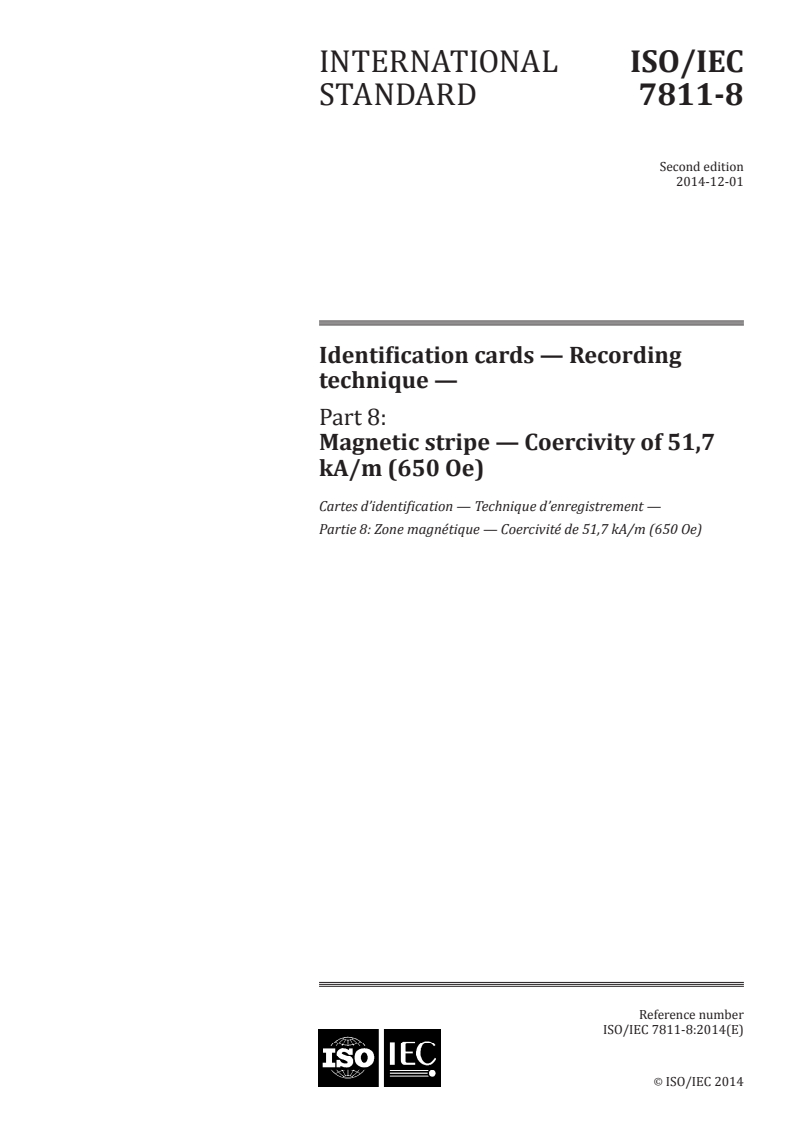
(Main)Identification cards — Recording technique — Part 8: Magnetic stripe — Coercivity of 51,7 kA/m (650 Oe)
General Information
- Abstract
ISO/IEC 7811-8:2014 defines the characteristics for identification cards as defined in Clause 4 of this part of ISO/IEC 7811, and the use of such cards for international interchange. ISO/IEC 7811-8:2014 specifies requirements for a 51,7 kA/m (650 Oe) magnetic stripe (including any protective overlay) on an identification card. The encoding technique and coded character sets are not defined, however, the specifications of ISO/IEC 7811‑2 may be used. It takes into consideration both human and machine aspects and states minimum requirements. Coercivity influences many of the quantities specified in this part of ISO/IEC 7811. It has a nominal value of 51,7 kA/m (650 Oe), but is not itself specified. Exposure of the card to a magnetic field is likely to destroy the recorded data. ISO/IEC 7811-8:2014 provides criteria to which cards are to perform. No consideration is given within this International Standard to the amount of use, if any, experienced by the card prior to test. Failure to conform to specified criteria is negotiated between the involved parties. ISO/IEC 10373‑2 specifies the test procedures used to check cards against the parameters specified in this part of ISO/IEC 7811. Numeric values in the SI and/or Imperial measurement system in this part of ISO/IEC 7811 may have been rounded off and therefore are consistent with, but not exactly equal to, each other. Either system may be used, but the two are not to be intermixed or reconverted. The original design was made using the Imperial measurement system.
- Status
- Published
- Publication Date
- 23-Nov-2014
- Technical Committee
- ISO/IEC JTC 1/SC 17 - Cards and security devices for personal identification
- Current Stage
- 9093 - International Standard confirmed
- Start Date
- 07-Oct-2025
- Completion Date
- 29-Aug-2026
Buy Documents
ISO/IEC 7811-8:2014 - Identification cards -- Recording technique
ISO/IEC 7811-8:2014 - Identification cards — Recording technique — Part 8: Magnetic stripe — Coercivity of 51,7 kA/m (650 Oe)/24/2014
Overview
ISO/IEC 7811-8:2014 - "Identification cards - Recording technique - Part 8: Magnetic stripe - Coercivity of 51,7 kA/m (650 Oe)" defines physical and performance criteria for identification cards that use a 51,7 kA/m (650 Oe) magnetic stripe. The standard specifies minimum requirements for the magnetic stripe area (including overlays), signal performance, environmental/test considerations and mechanical characteristics to support reliable international interchange. Encoding formats and character sets are not defined in this part (ISO/IEC 7811‑2 specifications may be used).
Keywords: ISO/IEC 7811-8:2014, magnetic stripe, coercivity 51.7 kA/m, identification cards, magnetic media, hotel key cards.
Key Topics and Requirements
- Coercivity: Media nominal coercivity is 51,7 kA/m (650 Oe). Higher energy is required to record compared with low-coercivity media; exposure to magnetic fields can destroy recorded data.
- Physical card requirements: Cards must conform to ISO/IEC 7810 for basic card dimensions and stiffness.
- Magnetic stripe location & dimensions: Defines stripe placement and recommended stripe widths and clear distortion-free areas to ensure proper head contact.
- Surface profile and height tolerance: Limits on transverse surface deviation, slope and vertical deviation of the stripe area (e.g., vertical deviation h between −0.005 mm and 0.038 mm) to avoid read/write errors.
- Magnetic material performance: Signal amplitude, reference currents, flux transition definitions and minimum readback criteria are specified to ensure interoperability with readers/writers designed for 650 Oe media.
- Environmental and test considerations: Takes into account both human and machine aspects; test procedures referenced in ISO/IEC 10373‑2 (cards with magnetic stripes).
- Interchange and conformance: Cards must meet mandatory requirements; failure to conform is resolved between involved parties. Numeric values are provided in SI and Imperial units (do not mix).
Applications and Who Uses It
- Primary application: hotel guest room entry systems and similar access-control cards where 650 Oe coercivity is common.
- Organizations that design, manufacture or test magnetic stripe cards and readers:
- Card manufacturers and laminators
- Access control and hospitality system integrators
- Test labs and quality assurance teams
- Card issuers and service providers concerned with international interchange
- Useful for procurement specs, product validation, and interoperability testing of magnetic stripe media and encoders/readers.
Related Standards
- ISO/IEC 7810 - Identification cards: physical characteristics
- ISO/IEC 7811‑2 - Magnetic stripe - Low coercivity (encoding details)
- ISO/IEC 7811‑6, ‑7 - Magnetic stripe - High coercivity variants
- ISO/IEC 10373‑2 - Test methods: cards with magnetic stripes
- ISO 4287 - Surface texture (profile method)
This concise summary helps implementers and procurement teams apply ISO/IEC 7811-8:2014 requirements when specifying, producing, testing or integrating 650 Oe magnetic stripe identification cards.
Relations
- Effective Date
- 10-May-2012
Buy Documents
ISO/IEC 7811-8:2014 - Identification cards -- Recording technique
ISO/IEC 7811-8:2014 - Identification cards — Recording technique — Part 8: Magnetic stripe — Coercivity of 51,7 kA/m (650 Oe)/24/2014
Get Certified
Connect with accredited certification bodies for this standard

BSI Group
BSI (British Standards Institution) is the business standards company that helps organizations make excellence a habit.

NYCE
Mexican standards and certification body.
Sponsored listings
Frequently Asked Questions
ISO/IEC 7811-8:2014 is a standard published by the International Organization for Standardization (ISO). Its full title is "Identification cards — Recording technique — Part 8: Magnetic stripe — Coercivity of 51,7 kA/m (650 Oe)". This standard covers: ISO/IEC 7811-8:2014 defines the characteristics for identification cards as defined in Clause 4 of this part of ISO/IEC 7811, and the use of such cards for international interchange. ISO/IEC 7811-8:2014 specifies requirements for a 51,7 kA/m (650 Oe) magnetic stripe (including any protective overlay) on an identification card. The encoding technique and coded character sets are not defined, however, the specifications of ISO/IEC 7811‑2 may be used. It takes into consideration both human and machine aspects and states minimum requirements. Coercivity influences many of the quantities specified in this part of ISO/IEC 7811. It has a nominal value of 51,7 kA/m (650 Oe), but is not itself specified. Exposure of the card to a magnetic field is likely to destroy the recorded data. ISO/IEC 7811-8:2014 provides criteria to which cards are to perform. No consideration is given within this International Standard to the amount of use, if any, experienced by the card prior to test. Failure to conform to specified criteria is negotiated between the involved parties. ISO/IEC 10373‑2 specifies the test procedures used to check cards against the parameters specified in this part of ISO/IEC 7811. Numeric values in the SI and/or Imperial measurement system in this part of ISO/IEC 7811 may have been rounded off and therefore are consistent with, but not exactly equal to, each other. Either system may be used, but the two are not to be intermixed or reconverted. The original design was made using the Imperial measurement system.
ISO/IEC 7811-8:2014 defines the characteristics for identification cards as defined in Clause 4 of this part of ISO/IEC 7811, and the use of such cards for international interchange. ISO/IEC 7811-8:2014 specifies requirements for a 51,7 kA/m (650 Oe) magnetic stripe (including any protective overlay) on an identification card. The encoding technique and coded character sets are not defined, however, the specifications of ISO/IEC 7811‑2 may be used. It takes into consideration both human and machine aspects and states minimum requirements. Coercivity influences many of the quantities specified in this part of ISO/IEC 7811. It has a nominal value of 51,7 kA/m (650 Oe), but is not itself specified. Exposure of the card to a magnetic field is likely to destroy the recorded data. ISO/IEC 7811-8:2014 provides criteria to which cards are to perform. No consideration is given within this International Standard to the amount of use, if any, experienced by the card prior to test. Failure to conform to specified criteria is negotiated between the involved parties. ISO/IEC 10373‑2 specifies the test procedures used to check cards against the parameters specified in this part of ISO/IEC 7811. Numeric values in the SI and/or Imperial measurement system in this part of ISO/IEC 7811 may have been rounded off and therefore are consistent with, but not exactly equal to, each other. Either system may be used, but the two are not to be intermixed or reconverted. The original design was made using the Imperial measurement system.
ISO/IEC 7811-8:2014 is classified under the following ICS (International Classification for Standards) categories: 35.240.15 - Identification cards. Chip cards. Biometrics. The ICS classification helps identify the subject area and facilitates finding related standards.
ISO/IEC 7811-8:2014 has the following relationships with other standards: It is inter standard links to ISO/IEC 7811-8:2008. Understanding these relationships helps ensure you are using the most current and applicable version of the standard.
ISO/IEC 7811-8:2014 is available in PDF format for immediate download after purchase. The document can be added to your cart and obtained through the secure checkout process. Digital delivery ensures instant access to the complete standard document.
Standards Content (Sample)
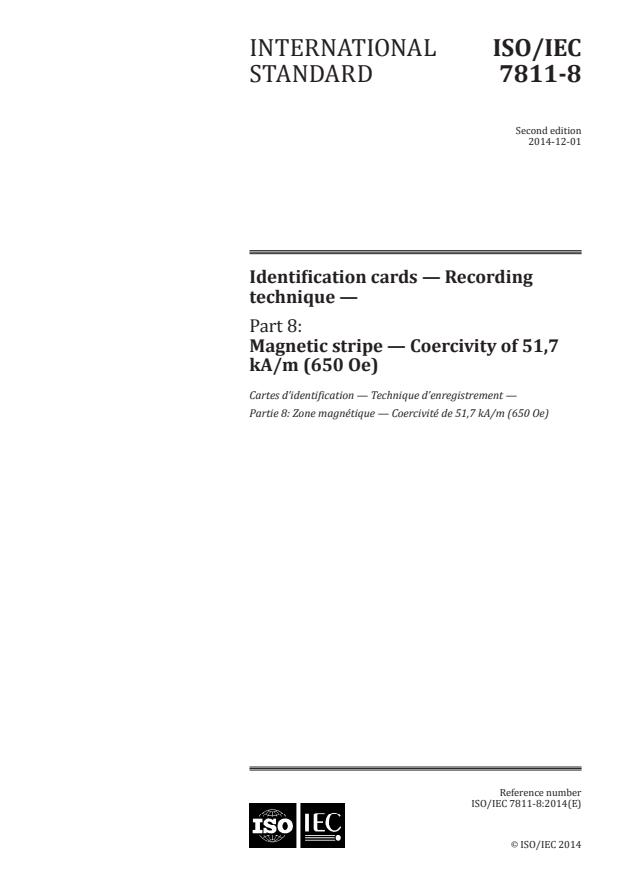
INTERNATIONAL ISO/IEC
STANDARD 7811-8
Second edition
2014-12-01
Identification cards — Recording
technique —
Part 8:
Magnetic stripe — Coercivity of 51,7
kA/m (650 Oe)
Cartes d’identification — Technique d’enregistrement —
Partie 8: Zone magnétique — Coercivité de 51,7 kA/m (650 Oe)
Reference number
©
ISO/IEC 2014
© ISO/IEC 2014
All rights reserved. Unless otherwise specified, no part of this publication may be reproduced or utilized otherwise in any form
or by any means, electronic or mechanical, including photocopying, or posting on the internet or an intranet, without prior
written permission. Permission can be requested from either ISO at the address below or ISO’s member body in the country of
the requester.
ISO copyright office
Case postale 56 • CH-1211 Geneva 20
Tel. + 41 22 749 01 11
Fax + 41 22 749 09 47
E-mail copyright@iso.org
Web www.iso.org
Published in Switzerland
ii © ISO/IEC 2014 – All rights reserved
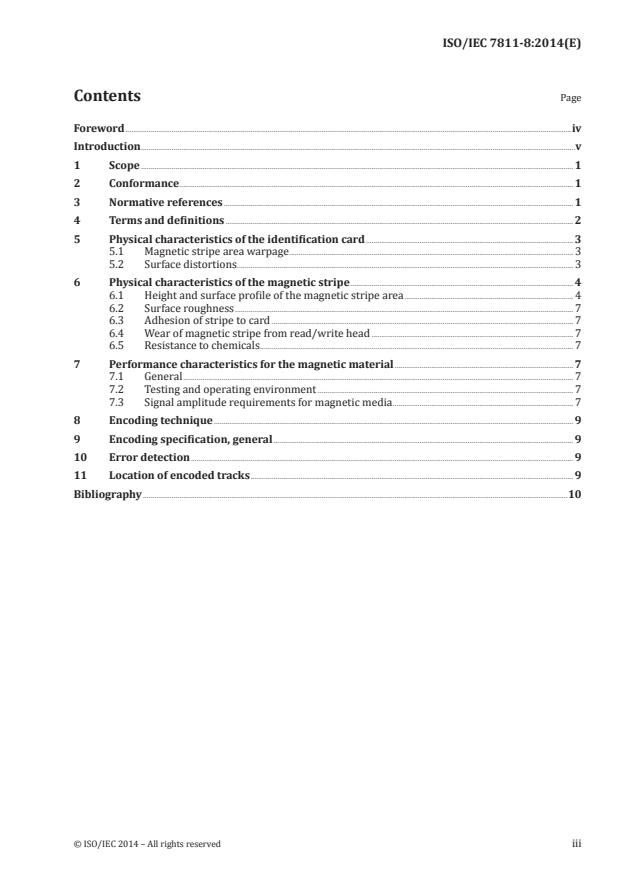
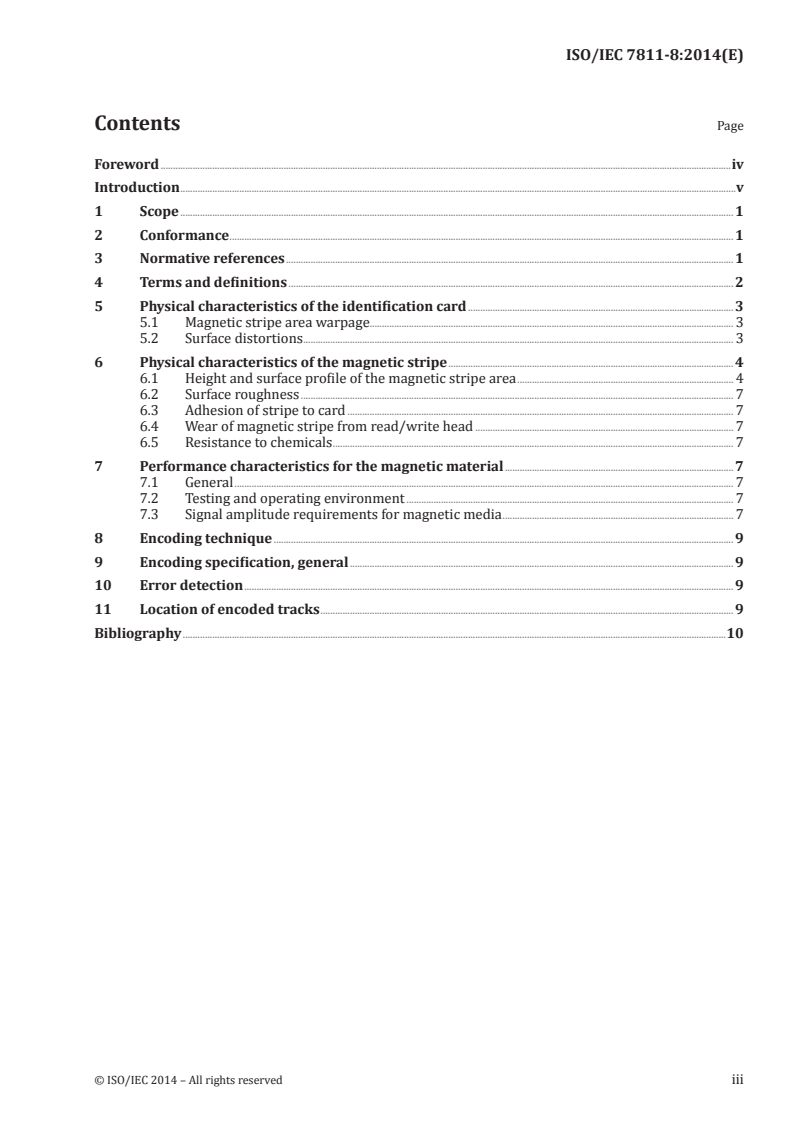
Contents Page
Foreword .iv
Introduction .v
1 Scope . 1
2 Conformance . 1
3 Normative references . 1
4 Terms and definitions . 2
5 Physical characteristics of the identification card .3
5.1 Magnetic stripe area warpage. 3
5.2 Surface distortions . 3
6 Physical characteristics of the magnetic stripe . 4
6.1 Height and surface profile of the magnetic stripe area . 4
6.2 Surface roughness . 7
6.3 Adhesion of stripe to card . 7
6.4 Wear of magnetic stripe from read/write head . 7
6.5 Resistance to chemicals . 7
7 Performance characteristics for the magnetic material . 7
7.1 General . 7
7.2 Testing and operating environment . 7
7.3 Signal amplitude requirements for magnetic media . 7
8 Encoding technique .9
9 Encoding specification, general .9
10 Error detection .9
11 Location of encoded tracks .9
Bibliography .10
© ISO/IEC 2014 – All rights reserved iii
Foreword
ISO (the International Organization for Standardization) and IEC (the International Electrotechnical
Commission) form the specialized system for worldwide standardization. National bodies that are
members of ISO or IEC participate in the development of International Standards through technical
committees established by the respective organization to deal with particular fields of technical
activity. ISO and IEC technical committees collaborate in fields of mutual interest. Other international
organizations, governmental and non-governmental, in liaison with ISO and IEC, also take part in the
work. In the field of information technology, ISO and IEC have established a joint technical committee,
ISO/IEC JTC 1.
International Standards are drafted in accordance with the rules given in the ISO/IEC Directives, Part 2.
The main task of the joint technical committee is to prepare International Standards. Draft International
Standards adopted by the joint technical committee are circulated to national bodies for voting.
Publication as an International Standard requires approval by at least 75 % of the national bodies
casting a vote.
Attention is drawn to the possibility that some of the elements of this document may be the subject of
patent rights. ISO and IEC shall not be held responsible for identifying any or all such patent rights.
ISO/IEC 7811 was prepared by Joint Technical Committee ISO/IEC JTC 1, Information technology, SC 17,
Cards and personal identification.
This second edition cancels and replaces the first edition (ISO/IEC 7811-8:2008), which has been
technically revised. Major changes from the first edition are as follows:
— The primary standard cards held by Q-Card are used to calibrate the manufacture of secondary
reference cards. Other primary standard cards held by PTB and Card testing International (CTI) are
used as backup to replace cards held by Q-Card as they wear out.
— The supplier of secondary reference cards has changed from PTB to Q-Card.
ISO/IEC 7811 consists of the following parts, under general title Identification cards — Recording technique:
— Part 1: Embossing
— Part 2: Magnetic stripe — Low coercivity
— Part 6: Magnetic stripe — High coercivity
— Part 7: Magnetic stripe — High coercivity, high density
— Part 8: Magnetic stripe — Coercivity of 51,7 kA/m (650 Oe)
— Part 9: Tactile identifier mark
iv © ISO/IEC 2014 – All rights reserved
Introduction
This part of ISO/IEC 7811 is similar to ISO/IEC 7811-2, except that its higher coercivity requires higher
energy to encode the data. The user of ISO/IEC 7811-8 is encouraged to review the entire standard for
revisions and updates. The major differences from ISO/IEC 7811-2 are listed below.
— In terms of coercivity, this part of ISO/IEC 7811 media (51,7 kA/m, 650 Oe) is between ISO/IEC 7811-
2 (23,9 kA/m, 300 Oe) and ISO/IEC 7811-6 (minimum 199 kA/m, 2 500 Oe).
— The primary application for 51,7 kA/m (650 Oe) is for hotel guest room entry systems worldwide.
— For Table 1 values, this part of ISO/IEC 7811 specifies different values for I (6,5 FR) and I (8 FR).
min max
— Encoding techniques, specification, and error detection are not specified in this part of ISO/IEC 7811.
— Wherever possible, the same definitions, criteria, and test methods are used in ISO/IEC 7811-2,
ISO/IEC 7811-6, and this part of ISO/IEC 7811.
Notes in this part of ISO/IEC 7811 are only used for giving additional information intended to assist
understanding or use, and do not contain provisions or requirements to which it is necessary to conform
in order to be able to claim compliance with this part of ISO/IEC 7811.
© ISO/IEC 2014 – All rights reserved v
INTERNATIONAL STANDARD ISO/IEC 7811-8:2014(E)
Identification cards — Recording technique —
Part 8:
Magnetic stripe — Coercivity of 51,7 kA/m (650 Oe)
1 Scope
This International Standard defines the characteristics for identification cards as defined in Clause 4 of
this part of ISO/IEC 7811, and the use of such cards for international interchange.
This part of ISO/IEC 7811 specifies requirements for a 51,7 kA/m (650 Oe) magnetic stripe (including
any protective overlay) on an identification card. The encoding technique and coded character sets are
not defined, however, the specifications of ISO/IEC 7811-2 may be used. It takes into consideration both
human and machine aspects and states minimum requirements.
Coercivity influences many of the quantities specified in this part of ISO/IEC 7811. It has a nominal
value of 51,7 kA/m (650 Oe), but is not itself specified. Exposure of the card to a magnetic field is likely
to destroy the recorded data.
This International Standard provides criteria to which cards are to perform. No consideration is given
within this International Standard to the amount of use, if any, experienced by the card prior to test.
Failure to conform to specified criteria is negotiated between the involved parties.
ISO/IEC 10373-2 specifies the test procedures used to check cards against the parameters specified in
this part of ISO/IEC 7811.
Numeric values in the SI and/or Imperial measurement system in this part of ISO/IEC 7811 may have
been rounded off and therefore are consistent with, but not exactly equal to, each other. Either system
may be used, but the two are not to be intermixed or reconverted. The original design was made using
the Imperial measurement system.
2 Conformance
A prerequisite for conformance with this part of ISO/IEC 7811 is conformance with ISO/IEC 7810.
An identification card is in conformance with this part of ISO/IEC 7811 if it meets all mandatory
requirements specified herein. Default values apply if no others are specified.
3 Normative references
The following documents, in whole or in part, are normatively referenced in this document and are
indispensable for its application. For dated references, only the edition cited applies. For undated
references, the latest edition of the referenced document (including any amendments) applies.
ISO 4287, Geometrical Product Specifications (GPS) — Surface texture: Profile method — Terms, definitions
and surface texture parameters
ISO/IEC 7810, Identification cards — Physical characteristics
ISO/IEC 10373-1, Identification cards — Test methods — Part 1: General characteristics
ISO/IEC 10373-2, Identification cards — Test methods — Part 2: Cards with magnetic stripes
© ISO/IEC 2014 – All rights reserved 1
4 Terms and definitions
For the purposes of this document, the terms and definitions given in ISO/IEC 7810 and the following apply.
4.1
primary st
...
INTERNATIONAL ISO/IEC
STANDARD 7811-8
Second edition
2014-12-01
Identification cards — Recording
technique —
Part 8:
Magnetic stripe — Coercivity of 51,7
kA/m (650 Oe)
Cartes d’identification — Technique d’enregistrement —
Partie 8: Zone magnétique — Coercivité de 51,7 kA/m (650 Oe)
Reference number
©
ISO/IEC 2014
© ISO/IEC 2014
All rights reserved. Unless otherwise specified, no part of this publication may be reproduced or utilized otherwise in any form
or by any means, electronic or mechanical, including photocopying, or posting on the internet or an intranet, without prior
written permission. Permission can be requested from either ISO at the address below or ISO’s member body in the country of
the requester.
ISO copyright office
Case postale 56 • CH-1211 Geneva 20
Tel. + 41 22 749 01 11
Fax + 41 22 749 09 47
E-mail copyright@iso.org
Web www.iso.org
Published in Switzerland
ii © ISO/IEC 2014 – All rights reserved
Contents Page
Foreword .iv
Introduction .v
1 Scope . 1
2 Conformance . 1
3 Normative references . 1
4 Terms and definitions . 2
5 Physical characteristics of the identification card .3
5.1 Magnetic stripe area warpage. 3
5.2 Surface distortions . 3
6 Physical characteristics of the magnetic stripe . 4
6.1 Height and surface profile of the magnetic stripe area . 4
6.2 Surface roughness . 7
6.3 Adhesion of stripe to card . 7
6.4 Wear of magnetic stripe from read/write head . 7
6.5 Resistance to chemicals . 7
7 Performance characteristics for the magnetic material . 7
7.1 General . 7
7.2 Testing and operating environment . 7
7.3 Signal amplitude requirements for magnetic media . 7
8 Encoding technique .9
9 Encoding specification, general .9
10 Error detection .9
11 Location of encoded tracks .9
Bibliography .10
© ISO/IEC 2014 – All rights reserved iii
Foreword
ISO (the International Organization for Standardization) and IEC (the International Electrotechnical
Commission) form the specialized system for worldwide standardization. National bodies that are
members of ISO or IEC participate in the development of International Standards through technical
committees established by the respective organization to deal with particular fields of technical
activity. ISO and IEC technical committees collaborate in fields of mutual interest. Other international
organizations, governmental and non-governmental, in liaison with ISO and IEC, also take part in the
work. In the field of information technology, ISO and IEC have established a joint technical committee,
ISO/IEC JTC 1.
International Standards are drafted in accordance with the rules given in the ISO/IEC Directives, Part 2.
The main task of the joint technical committee is to prepare International Standards. Draft International
Standards adopted by the joint technical committee are circulated to national bodies for voting.
Publication as an International Standard requires approval by at least 75 % of the national bodies
casting a vote.
Attention is drawn to the possibility that some of the elements of this document may be the subject of
patent rights. ISO and IEC shall not be held responsible for identifying any or all such patent rights.
ISO/IEC 7811 was prepared by Joint Technical Committee ISO/IEC JTC 1, Information technology, SC 17,
Cards and personal identification.
This second edition cancels and replaces the first edition (ISO/IEC 7811-8:2008), which has been
technically revised. Major changes from the first edition are as follows:
— The primary standard cards held by Q-Card are used to calibrate the manufacture of secondary
reference cards. Other primary standard cards held by PTB and Card testing International (CTI) are
used as backup to replace cards held by Q-Card as they wear out.
— The supplier of secondary reference cards has changed from PTB to Q-Card.
ISO/IEC 7811 consists of the following parts, under general title Identification cards — Recording technique:
— Part 1: Embossing
— Part 2: Magnetic stripe — Low coercivity
— Part 6: Magnetic stripe — High coercivity
— Part 7: Magnetic stripe — High coercivity, high density
— Part 8: Magnetic stripe — Coercivity of 51,7 kA/m (650 Oe)
— Part 9: Tactile identifier mark
iv © ISO/IEC 2014 – All rights reserved
Introduction
This part of ISO/IEC 7811 is similar to ISO/IEC 7811-2, except that its higher coercivity requires higher
energy to encode the data. The user of ISO/IEC 7811-8 is encouraged to review the entire standard for
revisions and updates. The major differences from ISO/IEC 7811-2 are listed below.
— In terms of coercivity, this part of ISO/IEC 7811 media (51,7 kA/m, 650 Oe) is between ISO/IEC 7811-
2 (23,9 kA/m, 300 Oe) and ISO/IEC 7811-6 (minimum 199 kA/m, 2 500 Oe).
— The primary application for 51,7 kA/m (650 Oe) is for hotel guest room entry systems worldwide.
— For Table 1 values, this part of ISO/IEC 7811 specifies different values for I (6,5 FR) and I (8 FR).
min max
— Encoding techniques, specification, and error detection are not specified in this part of ISO/IEC 7811.
— Wherever possible, the same definitions, criteria, and test methods are used in ISO/IEC 7811-2,
ISO/IEC 7811-6, and this part of ISO/IEC 7811.
Notes in this part of ISO/IEC 7811 are only used for giving additional information intended to assist
understanding or use, and do not contain provisions or requirements to which it is necessary to conform
in order to be able to claim compliance with this part of ISO/IEC 7811.
© ISO/IEC 2014 – All rights reserved v
INTERNATIONAL STANDARD ISO/IEC 7811-8:2014(E)
Identification cards — Recording technique —
Part 8:
Magnetic stripe — Coercivity of 51,7 kA/m (650 Oe)
1 Scope
This International Standard defines the characteristics for identification cards as defined in Clause 4 of
this part of ISO/IEC 7811, and the use of such cards for international interchange.
This part of ISO/IEC 7811 specifies requirements for a 51,7 kA/m (650 Oe) magnetic stripe (including
any protective overlay) on an identification card. The encoding technique and coded character sets are
not defined, however, the specifications of ISO/IEC 7811-2 may be used. It takes into consideration both
human and machine aspects and states minimum requirements.
Coercivity influences many of the quantities specified in this part of ISO/IEC 7811. It has a nominal
value of 51,7 kA/m (650 Oe), but is not itself specified. Exposure of the card to a magnetic field is likely
to destroy the recorded data.
This International Standard provides criteria to which cards are to perform. No consideration is given
within this International Standard to the amount of use, if any, experienced by the card prior to test.
Failure to conform to specified criteria is negotiated between the involved parties.
ISO/IEC 10373-2 specifies the test procedures used to check cards against the parameters specified in
this part of ISO/IEC 7811.
Numeric values in the SI and/or Imperial measurement system in this part of ISO/IEC 7811 may have
been rounded off and therefore are consistent with, but not exactly equal to, each other. Either system
may be used, but the two are not to be intermixed or reconverted. The original design was made using
the Imperial measurement system.
2 Conformance
A prerequisite for conformance with this part of ISO/IEC 7811 is conformance with ISO/IEC 7810.
An identification card is in conformance with this part of ISO/IEC 7811 if it meets all mandatory
requirements specified herein. Default values apply if no others are specified.
3 Normative references
The following documents, in whole or in part, are normatively referenced in this document and are
indispensable for its application. For dated references, only the edition cited applies. For undated
references, the latest edition of the referenced document (including any amendments) applies.
ISO 4287, Geometrical Product Specifications (GPS) — Surface texture: Profile method — Terms, definitions
and surface texture parameters
ISO/IEC 7810, Identification cards — Physical characteristics
ISO/IEC 10373-1, Identification cards — Test methods — Part 1: General characteristics
ISO/IEC 10373-2, Identification cards — Test methods — Part 2: Cards with magnetic stripes
© ISO/IEC 2014 – All rights reserved 1
4 Terms and definitions
For the purposes of this document, the terms and definitions given in ISO/IEC 7810 and the following apply.
4.1
primary st
...