

ISO/FDIS 25652
(Main)Soil, sludge, waste, sediment — Analysis of perfluoroalkyl and polyfluoroalkyl substances (PFAS) by high performance liquid chromatography (HPLC) and mass spectrometry
- Abstract
This document specifies a method for quantitative determination of various perfluorinated hydrocarbons by means of High-Performance Liquid Chromatography (HPLC) and mass spectrometry in soil, sludge, sediment and waste (see Table 1). For many substances to which this document applies a limit of quantification (LOQ) of 0.1 to 10 μg/kgdm can be achieved. The method can be applied to the analysis of additional PFAS not specified in the scope, if validity is proven by proper in-house validation protocols. For each target compound both, eventually occurring branched, isomers and the respective non-branched isomer are quantified together. In this method the amount of linear and branched PFAS is quantified using the response factor of the linear PFAS in the calibration standard and the total area of the linear and branched PFAS (Annex 1 gives more explanation)
- Status
- Not Published
- Technical Committee
- ISO/TC 190/SC 3 - Chemical and physical characterization
- Drafting Committee
- ISO/TC 190/SC 3/WG 1 - Inorganic analysis
- Current Stage
- 5000 - FDIS registered for formal approval
- Start Date
- 06-Aug-2026
- Completion Date
- 11-May-2026
Buy Documents
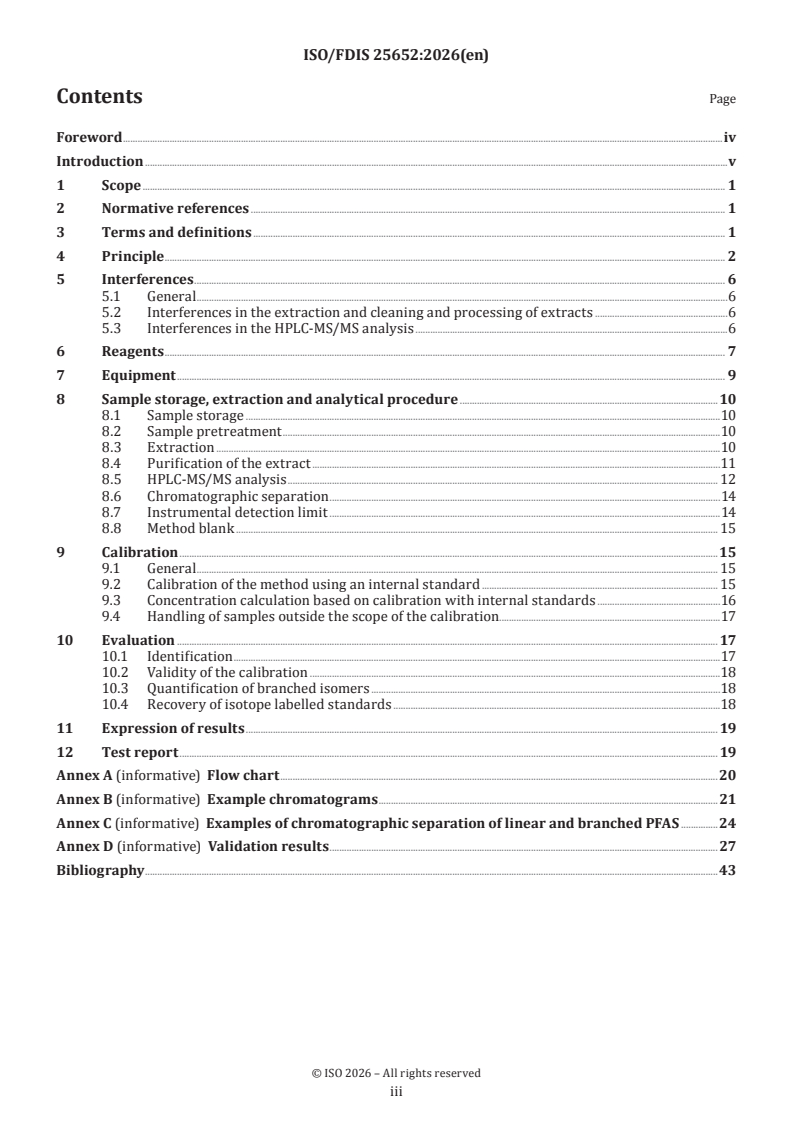
ISO/FDIS 25652 - Soil, sludge, waste, sediment — Analysis of perfluoroalkyl and polyfluoroalkyl substances (PFAS) by high performance liquid chromatography (HPLC) and mass spectrometry
REDLINE ISO/FDIS 25652 - Soil, sludge, waste, sediment — Analysis of perfluoroalkyl and polyfluoroalkyl substances (PFAS) by high performance liquid chromatography (HPLC) and mass spectrometry
ISO/FDIS 25652 is an ISO draft document for the quantitative determination of PFAS in soil, sludge, sediment and waste by high performance liquid chromatography (HPLC) and mass spectrometry. It sets out how to prepare the sample, extract and clean up the analytes, calibrate the measurement, and report results for laboratories working with contaminated solid and semi-solid environmental matrices. The method also explains how linear and branched isomers are handled for target PFAS.
What does ISO/FDIS 25652 specify?
ISO/FDIS 25652 specifies a method for measuring selected PFAS in soil, sludge, sediment and waste. It also allows additional PFAS to be analysed if the laboratory proves suitability through in-house validation.
The document is organized into clauses on scope, principle, interferences, reagents, equipment, storage and extraction, calibration, evaluation, expression of results and test reporting. It also includes four informative annexes that support routine laboratory use.
| Annex | What it covers |
|---|---|
| Annex A | Flow chart of sample processing |
| Annex B | Example chromatograms |
| Annex C | Examples of chromatographic separation of linear and branched PFAS |
| Annex D | Validation results |
What are the key requirements of ISO/FDIS 25652?
ISO/FDIS 25652 is built around contamination control, isotope-dilution style calibration, and mass-spectrometric identification criteria. In practice, the user needs to control blanks, match calibration to the target matrix, and show that the chosen workflow works for the sample type being tested.
Sample handling, extraction and cleanup
- Clause 8.1 requires analysis within 28 days, with separate storage guidance for sludge and soil. This matters because PFAS levels can change if samples are kept too long or under the wrong conditions.
- Clause 8.2 requires drying of the sample, with drying temperatures limited to 40 °C and freeze-drying preferred for sewage sludge. This helps reduce losses of volatile PFAS.
- Clause 8.3 describes extraction with methanol, acetonitrile, or a mixture of the two under basic conditions, with isotopically labelled PFAS added before extraction. In practice, the labelled compounds track losses during preparation.
- Clause 8.4 allows an optional cleanup step, for example with activated carbon, followed by concentration under a gentle nitrogen stream. The document warns against drying to complete dryness because that can lose volatile compounds.
Instrument setup, blanks and calibration
- Clause 8.5 requires HPLC-MS/MS measurement, normally in MRM mode with negative ionization, and gives advised transitions in Table 2. This is the core detection step, so the instrument must be tuned for the target PFAS.
- Clause 8.7 requires a check of the instrumental detection limit in each measurement series. The practical meaning is that the lab must confirm the instrument is still sensitive enough before reporting results.
- Clause 8.8 requires at least one method blank for each extraction series, and it sets action levels for blank contamination. This is important because PFAS contamination from lab materials can easily bias low-level results.
- Clause 9 requires calibration with linear isomers using internal standards, and at least five calibration levels. The same section allows quadratic calibration if it gives a better fit, but the laboratory must still verify the curve with independent standards.
Evaluation, isomers and reporting
- Clause 10.1 identifies compounds by retention time and transition ratios. That means the result is not based on one signal alone, but on chromatographic and mass-spectrometric agreement.
- Clause 10.3 quantifies branched isomers together with the linear isomer using the response of the linear compound. This matters because environmental samples often contain mixed isomer patterns.
- Clause 10.4 checks recovery of isotope-labelled standards, with acceptable recovery between 30 % and 200 %. In practice, this is the control that shows whether the method stayed within a usable performance window.
- Clause 11 requires results to be reported as anion concentration in µg/kg DM. This gives one common reporting basis for soil, sludge, sediment and waste results.
- Clause 12 requires the report to include the document reference, sample identification, report date, PFAS contents, observed peculiarities and any non-standard actions that may have influenced the result.
What terms does ISO/FDIS 25652 define?
- PFAS - perfluoroalkyl and polyfluoroalkyl substances, meaning organic compounds in which most or all hydrogen atoms in the aliphatic chain are replaced by fluorine.
- HPLC - high-performance liquid chromatography, the separation step used before mass spectrometric detection.
- MS/MS - tandem mass spectrometry, used here to identify and quantify PFAS by selected transitions.
- MRM - multiple reaction monitoring, the MS/MS acquisition mode used for target compounds in this method.
- Internal standard - an isotope-labelled compound added to correct for losses during preparation, injection and matrix effects.
- Branched isomer - a non-linear isomer of a PFAS target compound, which this method normally quantifies together with the linear form.
- DM - dry matter, the basis used for reporting concentrations as µg/kg DM.
- LOQ - limit of quantification, the lowest concentration level that the procedure can measure with usable confidence.
Who uses ISO/FDIS 25652?
ISO/FDIS 25652 is used by laboratories that analyse PFAS in soil, sludge, sediment and waste. It is also relevant to quality managers and method developers who need to validate extraction, cleanup, calibration and blank control for these matrices.
The introduction links the method to decisions about soil trading and the use of soil and dredged material in projects. In practice, that means it supports analytical work used by environmental consultants, project teams and buyers who need measured PFAS data before reuse, disposal or release decisions are made.
Which standards are used with ISO/FDIS 25652?
The document cites related standards for sampling, storage, sample preparation, dry matter calculation, calibration and result evaluation.
| Related standard | Contribution in practice |
|---|---|
| ISO 5667-15 | Preservation and handling of sludge and sediment samples |
| ISO 18512 | Long and short term storage of soil samples |
| ISO 18400 | Soil sampling guidance |
| EN 15002 | Preparation of test portions from laboratory waste samples |
| EN 16179 | Sample pretreatment for sludge, treated biowaste and soil |
| EN 15934 | Calculation of dry matter fraction |
| ISO 21253-1:2019 | Identification criteria and transition-ratio tolerances |
| ISO 5725-2 | Repeatability and reproducibility statistics |
| ISO 8466-1 | Linear calibration function |
| ISO 8466-2 | Non-linear calibration strategy |
| ISO 21675:2019 | Related PFAS method for water |
| ISO 25101 | Related PFOS and PFOA method for water |
What does the ISO/FDIS 25652 document contain?
ISO/FDIS 25652 contains a full laboratory workflow, from sample storage through extraction, cleanup, HPLC-MS/MS analysis, calibration and reporting. Clause 4 explains the principle, Clause 5 discusses contamination and matrix interferences, and Clauses 6 and 7 list reagents and equipment.
The document also includes the analytical detail needed for routine work: Tables 1 to 4, advised MRM transitions, internal standards, and calculation formulas for calibration and concentration. Annex B shows example chromatograms, Annex C shows how linear and branched PFAS can be separated and quantified, and Annex D summarizes validation data for several matrices.
Relations
- Effective Date
- 12-Feb-2026
- Consolidates
ISO 24201:2025 - Oil and gas industries including lower carbon energy — Tertiary outfitting structures - Effective Date
- 07-Jan-2025
Buy Documents
ISO/FDIS 25652 - Soil, sludge, waste, sediment — Analysis of perfluoroalkyl and polyfluoroalkyl substances (PFAS) by high performance liquid chromatography (HPLC) and mass spectrometry
REDLINE ISO/FDIS 25652 - Soil, sludge, waste, sediment — Analysis of perfluoroalkyl and polyfluoroalkyl substances (PFAS) by high performance liquid chromatography (HPLC) and mass spectrometry
Get Certified
Connect with accredited certification bodies for this standard

CIS Institut d.o.o.
Personal Protective Equipment (PPE) certification body. Notified Body NB-2890 for EU Regulation 2016/425 PPE.

Kiwa BDA Testing
Building and construction product certification.
Kmetijski inštitut Slovenije
Agricultural Institute of Slovenia. Soil testing, plant health, agricultural product analysis.
Sponsored listings
Frequently Asked Questions
ISO/FDIS 25652 is a draft published by the International Organization for Standardization (ISO). Its full title is "Soil, sludge, waste, sediment — Analysis of perfluoroalkyl and polyfluoroalkyl substances (PFAS) by high performance liquid chromatography (HPLC) and mass spectrometry". This standard covers: This document specifies a method for quantitative determination of various perfluorinated hydrocarbons by means of High-Performance Liquid Chromatography (HPLC) and mass spectrometry in soil, sludge, sediment and waste (see Table 1). For many substances to which this document applies a limit of quantification (LOQ) of 0.1 to 10 μg/kgdm can be achieved. The method can be applied to the analysis of additional PFAS not specified in the scope, if validity is proven by proper in-house validation protocols. For each target compound both, eventually occurring branched, isomers and the respective non-branched isomer are quantified together. In this method the amount of linear and branched PFAS is quantified using the response factor of the linear PFAS in the calibration standard and the total area of the linear and branched PFAS (Annex 1 gives more explanation)
This document specifies a method for quantitative determination of various perfluorinated hydrocarbons by means of High-Performance Liquid Chromatography (HPLC) and mass spectrometry in soil, sludge, sediment and waste (see Table 1). For many substances to which this document applies a limit of quantification (LOQ) of 0.1 to 10 μg/kgdm can be achieved. The method can be applied to the analysis of additional PFAS not specified in the scope, if validity is proven by proper in-house validation protocols. For each target compound both, eventually occurring branched, isomers and the respective non-branched isomer are quantified together. In this method the amount of linear and branched PFAS is quantified using the response factor of the linear PFAS in the calibration standard and the total area of the linear and branched PFAS (Annex 1 gives more explanation)
ISO/FDIS 25652 is classified under the following ICS (International Classification for Standards) categories: 13.080.10 - Chemical characteristics of soils. The ICS classification helps identify the subject area and facilitates finding related standards.
ISO/FDIS 25652 has the following relationships with other standards: It is inter standard links to prEN ISO 25652, ISO 24201:2025. Understanding these relationships helps ensure you are using the most current and applicable version of the standard.
ISO/FDIS 25652 is available in PDF format for immediate download after purchase. The document can be added to your cart and obtained through the secure checkout process. Digital delivery ensures instant access to the complete standard document.
Standards Content (Sample)
FINAL DRAFT
International
Standard
ISO/TC 190/SC 3
Soil, sludge, waste, sediment —
Secretariat: DIN
Analysis of perfluoroalkyl and
Voting begins on:
polyfluoroalkyl substances (PFAS)
2026-10-12
by high performance liquid
Voting terminates on:
chromatography (HPLC) and mass
2026-12-07
spectrometry
Sédiments, sol, boues et déchets — Analyse des substances
perfluoroalkylées et polyfluoroalkylées (PFAS) par
chromatographie liquide à haute performance (CLHP) et
spectrométrie de masse
RECIPIENTS OF THIS DRAFT ARE INVITED TO SUBMIT,
WITH THEIR COMMENTS, NOTIFICATION OF ANY
RELEVANT PATENT RIGHTS OF WHICH THEY ARE AWARE
AND TO PROVIDE SUPPOR TING DOCUMENTATION.
IN ADDITION TO THEIR EVALUATION AS
BEING ACCEPTABLE FOR INDUSTRIAL, TECHNO
ISO/CEN PARALLEL PROCESSING LOGICAL, COMMERCIAL AND USER PURPOSES, DRAFT
INTERNATIONAL STANDARDS MAY ON OCCASION HAVE
TO BE CONSIDERED IN THE LIGHT OF THEIR POTENTIAL
TO BECOME STAN DARDS TO WHICH REFERENCE MAY BE
MADE IN NATIONAL REGULATIONS.
Reference number
FINAL DRAFT
International
Standard
ISO/TC 190/SC 3
Soil, sludge, waste, sediment —
Secretariat: DIN
Analysis of perfluoroalkyl and
Voting begins on:
polyfluoroalkyl substances (PFAS)
by high performance liquid
Voting terminates on:
chromatography (HPLC) and mass
spectrometry
Sédiments, sol, boues et déchets — Analyse des substances
perfluoroalkylées et polyfluoroalkylées (PFAS) par
chromatographie liquide à haute performance (CLHP) et
spectrométrie de masse
© ISO 2026
All rights reserved.
RECIPIENTS OF THIS DRAFT ARE INVITED TO SUBMIT,
WITH THEIR COMMENTS, NOTIFICATION OF ANY
This ISO publication is protected by copyright and is owned by ISO and/or its licensors.
RELEVANT PATENT RIGHTS OF WHICH THEY ARE AWARE
The content of this ISO publication is provided under licence, not sold. Use is subject to the applicable licence terms issued by ISO,
AND TO PROVIDE SUPPOR TING DOCUMENTATION.
an ISO member body, or an authorized third-party distributor.
IN ADDITION TO THEIR EVALUATION AS
BEING ACCEPTABLE FOR INDUSTRIAL, TECHNO
Except as required for implementation or expressly permitted by a separate licence, no part of this ISO publication may be
ISO/CEN PARALLEL PROCESSING
LOGICAL, COMMERCIAL AND USER PURPOSES, DRAFT
reproduced, distributed, modified, used, or made available in any form or by any means – electronic or mechanical, including
INTERNATIONAL STANDARDS MAY ON OCCASION HAVE
photocopying, scanning, recording, or posting on internal or external digital platforms. TO BE CONSIDERED IN THE LIGHT OF THEIR POTENTIAL
TO BECOME STAN DARDS TO WHICH REFERENCE MAY BE
Any use beyond the scope of the granted rights is prohibited and may result in legal action.
MADE IN NATIONAL REGULATIONS.
ISO copyright office
CP 401 • CH-1214 Vernier, Geneva
Phone: +41 22 749 01 11
Email: copyright@iso.org
Website: www.iso.org
Published in Switzerland
Reference number
ii
Contents Page
Foreword .iv
Introduction .v
1 Scope . 1
2 Normative references . 1
3 Terms and definitions . 1
4 Principle . 2
5 Interferences . 6
5.1 General .6
5.2 Interferences in the extraction and cleaning and processing of extracts .6
5.3 Interferences in the HPLC-MS/MS analysis .6
6 Reagents . 7
7 Equipment . 9
8 Sample storage, extraction and analytical procedure .10
8.1 Sample storage .10
8.2 Sample pretreatment .10
8.3 Extraction .10
8.4 Purification of the extract .11
8.5 HPLC-MS/MS analysis . 12
8.6 Chromatographic separation .14
8.7 Instrumental detection limit .14
8.8 Method blank . 15
9 Calibration .15
9.1 General . 15
9.2 Calibration of the method using an internal standard . 15
9.3 Concentration calculation based on calibration with internal standards .16
9.4 Handling of samples outside the scope of the calibration.17
10 Evaluation . 17
10.1 Identification .17
10.2 Validity of the calibration .18
10.3 Quantification of branched isomers .18
10.4 Recovery of isotope labelled standards .18
11 Expression of results . 19
12 Test report . 19
Annex A (informative) Flow chart .20
Annex B (informative) Example chromatograms .21
Annex C (informative) Examples of chromatographic separation of linear and branched PFAS .24
Annex D (informative) Validation results .27
Bibliography .43
iii
Foreword
ISO (the International Organization for Standardization) is a worldwide federation of national standards
bodies (ISO member bodies). The work of preparing International Standards is normally carried out through
ISO technical committees. Each member body interested in a subject for which a technical committee
has been established has the right to be represented on that committee. International organizations,
governmental and non-governmental, in liaison with ISO, also take part in the work. ISO collaborates closely
with the International Electrotechnical Commission (IEC) on all matters of electrotechnical standardization.
The procedures used to develop this document and those intended for its further maintenance are described
in the ISO/IEC Directives, Part 1. In particular, the different approval criteria needed for the different types
of ISO documents should be noted. This document was drafted in accordance with the editorial rules of the
ISO/IEC Directives, Part 2 (see www.iso.org/directives).
ISO draws attention to the possibility that the implementation of this document may involve the use of (a)
patent(s). ISO takes no position concerning the evidence, validity or applicability of any claimed patent
rights in respect thereof. As of the date of publication of this document, ISO had not received notice of (a)
patent(s) which may be required to implement this document. However, implementers are cautioned that
this may not represent the latest information, which may be obtained from the patent database available at
www.iso.org/patents. ISO shall not be held responsible for identifying any or all such patent rights.
Any trade name used in this document is information given for the convenience of users and does not
constitute an endorsement.
For an explanation of the voluntary nature of standards, the meaning of ISO specific terms and expressions
related to conformity assessment, as well as information about ISO’s adherence to the World Trade
Organization (WTO) principles in the Technical Barriers to Trade (TBT), see www.iso.org/iso/foreword.html.
This document was prepared by Technical Committee ISO/TC 190, Soil quality, Subcommittee SC 3, Chemical
and physical characterization, in collaboration with the European Committee for Standardization (CEN)
Technical Committee CEN/TC 444, Environmental characterization of solid matrices, in accordance with the
Agreement on technical cooperation between ISO and CEN (Vienna Agreement).
Any feedback or questions on this document should be directed to the user’s national standards body. A
complete listing of these bodies can be found at www.iso.org/members.html.
iv
Introduction
Perfluoroalkyl and polyfluoroalkyl substances (PFAS) are a large group of industrially produced fluorinated
hydrocarbons (alkyl substances). PFAS contain a fully (per-) or partially (poly-) fluorinated carbon chain.
The length normally ranges from 2 to 18 carbon atoms. The best known PFAS are PFOS (perfluorooctane
1)
sulfonic acid) and PFOA (perfluorooctanoic acid) .
Since 2018, explicit attention has been requested for PFAS residues in soil trading. Due to the potential
risks of the substance group or the lack of information about it, the target values for soil trading in some
countries are relatively low at the level of a few µg/kg. For this reason, in many cases the chemical analyses
are decisive in decision-making for soil trading and determining the possibilities for use of soil and dredged
material released in projects. Precisely because of the diffuse occurrence of PFAS and the relatively strict
target values, there is a generic need for a validated analysis method with a substantiated reporting limit
and uniformity in the analysis methods and the associated pre-treatment.
The need for validation and uniformity does not only affect chemical analysis. The sampling strategy and
method of performing the fieldwork also determine the final result. To this end, various guidelines have
been and will be provided in other contexts and assessment guidelines and protocols have been drawn up.
1) Both substances, PFOS and PFOA, consist of eight and seven fully fluorinated carbon atoms, respectively, with PFOS
additionally having a sulfonate as a “functional group” on the last carbon atom and PFOA a carboxyl group.
v
FINAL DRAFT International Standard ISO/FDIS 25652:2026(en)
Soil, sludge, waste, sediment — Analysis of perfluoroalkyl and
polyfluoroalkyl substances (PFAS) by high performance liquid
chromatography (HPLC) and mass spectrometry
WARNING — Persons using this document should be familiar with normal laboratory practice. This
document does not purport to address all of the safety problems, if any, associated with its use. It is
the responsibility of the user to establish appropriate safety and health practices.
IMPORTANT — Tests conducted in accordance with this document shall be carried out by suitably
trained staff.
1 Scope
This document specifies a method for quantitative determination of various perfluorinated and
polyfluorinated hydrocarbons by means of high-performance liquid chromatography (HPLC) and mass
spectrometry in soil, sludge, sediment and waste (see Table 1).
Annex D provides more information on the limits of quantification (LOQs) reachable with this procedure.
The method can be applied to the analysis of additional perfluoroalkyl and polyfluoroalkyl substances
(PFAS) not specified in the scope, if validity is proven by proper in-house validation protocols, particularly
for volatile compounds that can be lost during preparation.
For each target compound, all branched and non-branched are quantified together. In this method the
amount of linear and branched PFAS is quantified using the response factor of the linear PFAS in the
calibration standard and the total area of the linear and branched PFAS (Annex C gives more explanation).
Alternatively, the linear isomer and sum of branched isomers can be quantified separately and the sum of
both can be calculated provided a complete separation of the linear isomer from the branched isomers is
obtained.
2 Normative references
There are no normative references in this document.
3 Terms and definitions
For the purposes of this document, the following terms and definitions apply.
ISO and IEC maintain terminology databases for use in standardization at the following addresses:
— ISO Online browsing platform: available at https:// www .iso .org/ obp
— IEC Electropedia: available at https:// www .electropedia .org/
3.1
perfluoroalkyl and polyfluoroalkyl substances
PFAS
organic compounds with replacement of most or all hydrogen atoms by fluorine in the aliphatic chain
structure
Note 1 to entry: The term is used in the broader sense for perfluoroalkyl and polyfluoroalkyl substances (PFAS), and
perfluorinated and polyfluorinated compounds (PFC) as well.
[SOURCE: ISO 21675:2019, 3.1]
4 Principle
The compounds listed in Table 1 are extracted from the prepared, homogenized sample material with
methanol, acetonitrile or a mixture of the two under basic conditions after addition of isotopically
labelled PFAS compounds. The extracts are purified if necessary, for example with activated carbon. The
identification and quantification are performed by high performance liquid chromatography coupled with a
mass selective detector (HPLC-MS/MS). The content of each PFAS compound is calculated with the internal
standard method.
For many substances to which this document is applicable a limit of quantification (LOQ) of 0,01 to 0,1 µg/
kgDM can be achieved. See also Annex D.
All compounds of Table 1 were tested during an international inter laboratory trial in Europe in the period
December 2023 to April 2024. Table 1 specifies for which the criteria of an inter laboratory coefficient of
variation of reproducibility (C ) of 50 % was not reached. See Annex D for more details.
V,R
The validity of the procedure has been proven for soil, sediment and sludge samples and for a selection of
waste samples. For other waste types than mentioned in Annex D the laboratory shall validate the suitability
of the procedure of this standard.
NOTE For many compounds in the river clay, sediment and marine sediment sample Table 1 gives “Cons <” as
conclusion, where Annex D might show positive results. Annex D in that case shows the results of the few labs with a
positive result, where Table 1, based on all raw data, clarifies that most of the labs reported a “< ‒ value”.
Table 1 — Summary of the conclusions of the validation per compound and per matrix
a b
Abbr. Analyte Formula IUPAC name CAS-RN RivClay Sed MarSed Waste Soil Sludge
Perfluorobutanoic 2,2,3,3,4,4,4-
PFBA C4HF7O2 375–22–4 Yes (7) Yes Yes Yes
acid Heptafluorobutanoic acid
Perfluoropentanoic 2,2,3,3,4,4,5,5,5- 2706–
PFPeA C5HF9O2 - Cons < No Yes Yes Yes
acid Nonafluoropentanoic acid 90–3
Perfluorohexanoic 2,2,3,3,4,4,5,5,6,6,6-
PFHxA C6HF11O2 307–24–4 Yes Cons < Yes Yes Yes Yes
acid Undecafluorohexanoic acid
Perfluoroheptanoic 2,2,3,3,4,4,5,5,6,6,7,7,7-
PFHpA C7HF13O2 375–85–9 Yes Cons < Yes Yes Yes Yes
acid Tridecafluoroheptanoic acid
2,2,3,3,4,4,5,5,6,6,7,7,8,
Perfluorooctanoic
PFOA C8HF15O2 8,8- 335–67–1 Yes Yes Yes Yes Yes Yes
acid
Pentadecafluorooctanoic acid
Perfluorooctanoic
PFOA branched C8HF15O2
acid branched
2,2,3,3,4,4,5,5,6,6,7,7,8,
Perfluorononanoic
PFNA C9HF17O2 8,9,9,9- 375–95–1 Yes Cons < Yes Yes Yes Yes
acid
Heptadecafluoro-nonanoic acid
Perfluorononanoic
PFNA branched C9HF17O2
acid branched
2,2,3,3,4,4,5,5,6,6,7,7,8,
Perfluorodecanoic
PFDA C10HF19O2 8,9,9,10,10,10- 335–76–2 Yes Cons < Yes Yes Yes Yes
acid
Nonadecafluorodecanoic acid
a
IUPAC International Union of Pure and Applied Chemistry
b
CAS-RN Chemical Abstract Services Registry Number
The branched isomers mentioned in this table are examples, other branched isomers do exist.
RivClay river clay
Sed sediment
MarSed marine sediment
Yes criterion of CVR < 50 % was met with 8 or more laboratories
Yes(n) criterion of CVR < 50 % was met with n laboratories
No criterion was not met with 8 or more laboratories
Cons < most of the results consistently < ‒ value
TTaabblle 1 e 1 ((ccoonnttiinnueuedd))
a b
Abbr. Analyte Formula IUPAC name CAS-RN RivClay Sed MarSed Waste Soil Sludge
2,2,3,3,4,4,5,5,6,6,7,7,8,
Perfluoroundeca- 2058–
PFUnDA C11HF21O2 8,9,9,10,10,11,11,11- Yes Cons < Yes Yes Yes Yes
noic acid 94–8
Henicosafluoroundecanoic acid
2,2,3,3,4,4,5,5,6,6,7,7,8,8,9,9,10,10,
Perfluorododeca-
PFDoDA C12HF23O2 11,11,12,12,12- 307–55–1 Yes Cons < Yes Yes Yes Yes
noic acid
Tricosafluorododecanoic acid
2,2,3,3,4,4,5,5,6,6,7,7,8,
Perfluorotrideca- 8,9,9,10,10,11,11,12,12 72629–
PFTrDA C13HF25O2 Yes Cons < Yes Yes Yes No
noic acid ,13,13,13- 94–8
Pentacosafluorotridecanoic acid
2,2,3,3,4,4,5,5,6,6,7,7,8,
8,9,9,10,10,11,11,12,12
Perfluorotetra-de-
PFTeDA C14HF27O2 ,13,13,14,14,14 - 376–06–7 Cons < Cons < Yes Yes Yes Yes
canoic acid
Heptacosafluorotetra -decanoic
acid
2,2,3,3,4,4,5,5,6,6,7,7,8,
8,9,9,10,10,11,11,12,12
Perfluorohexa-de- ,13,13,14,14,15,15,16,1 67905–
PFHxDA C16HF31O2 Cons < Cons < Cons < Yes Yes Yes
canoic acid 6,16 - 19–5
Hentriacontafluorohexa -decanoic
acid
2,2,3,3,4,4,5,5,6,6,7,7,8,
8,9,9,10,10,11,11,12,12
Perfluorocta-deca- ,13,13,14,14,15,15,16,1 16517– Yes
PFODA C18HF35O2 Cons < Cons < Cons < Yes (6) Yes
noic acid 6,17,17,18,18,18 - 11–6 (7)
Pentatriacontafluoro -octadeca-
noic acid
1,1,2,2,3,3,4,4,4-
Perfluorobu-
PFBS C4HF9O3S Nonafluorobutane-1- 375–73–5 Cons < Cons < Yes Yes Yes Yes
tane-sulfonic acid
sulfonic acid
1,1,2,2,3,3,4,4,5,5,5-
Perfluoropen-
PFPeS C5HF11O3S Undecafluoropentane-1-sulfonic 2706–91–4 Cons < Cons < Cons < Yes Yes Yes
tane-sulfonic acid
acid
1,1,2,2,3,3,4,4,5,5,6,6,6-
Perfluorohex-
PFHxS C6HF13O3S Tridecafluorohexane-1-sulfonic 355–46–4 Yes Cons < Yes (6) Yes Yes Yes
ane-sulfonic acid
acid
Perfluorohex-
PFHxS branched ane-sulfonic C6HF13O3S
acid branched
1,1,2,2,3,3,4,4,5,5,6,6,7,7,
Perfluorohep- 7-
PFHpS C7HF15O3S 375–92–8 Yes Cons < Cons < Yes Yes Yes
tane-sulfonic acid Pentadecafluoroheptane-1-sul-
fonic acid
1,1,2,2,3,3,4,4,5,5,6,6,7,7,
Perfluorooc- 8,8,8-
PFOS C8HF17O3S 1763–23–1 Yes Yes Yes Yes Yes Yes
tane-sulfonic acid Heptadecafluorooctane-1-sulfonic
acid
Perfluorooc-
PFOS branched tane-sulfonic C8HF17O3S
acid branched
1,1,2,2,3,3,4,4,5,5,6,6,7,
Perfluoronon- 7,8,8,9,9,9- 68259–
PFNS C9HF19O3S Cons < Cons < Cons < Yes Yes Yes
ane-sulfonic acid Nonadecafluoro-nonane-1-sulfonic 12–1
acid
1,1,2,2,3,3,4,4,5,5,6,6,7,
Perfluorode- 7,8,8,9,9,10,10,10-
PFDS C10HF21O3S 335–77–3 Cons < Cons < Cons < Yes Yes Yes
cane-sulfonic acid Henicosafluorodecane-1-sulfonic
acid
a
IUPAC International Union of Pure and Applied Chemistry
b
CAS-RN Chemical Abstract Services Registry Number
The branched isomers mentioned in this table are examples, other branched isomers do exist.
RivClay river clay
Sed sediment
MarSed marine sediment
Yes criterion of CVR < 50 % was met with 8 or more laboratories
Yes(n) criterion of CVR < 50 % was met with n laboratories
No criterion was not met with 8 or more laboratories
Cons < most of the results consistently < ‒ value
TTaabblle 1 e 1 ((ccoonnttiinnueuedd))
a b
Abbr. Analyte Formula IUPAC name CAS-RN RivClay Sed MarSed Waste Soil Sludge
1,1,2,2,3,3,4,4,5,5,6,6,7,7,
Perfluorounde- 8,8,9,9,10,10,11,11,11- 749786–
PFUnDS C11HF23O3S Cons < Cons < Cons < Yes No Yes
cane-sulfonic acid Tricosafluoroundecane-1-sulfonic 16–1
acid
1,1,2,2,3,3,4,4,5,5,6,6,7,
Perfluorodode- C12HF2 7,8,8,9,9,10,10,11,11,12,12,12- 79780–
PFDoDS Cons < Cons < Cons < Yes No Yes
cane-sulfonic acid 5O3S Pentacosafluorodo-decane-1-sul- 39–5
fonic acid
1,1,2,2,3,3,4,4,5,5,6,6,7,
7,8,8,9,9,10,10,11,11,12,12,13,1
Perfluorotride- 791563–
PFTrDS C13HF27O3S 3,13 - Cons < Cons < Cons < No No No
cane-sulfonic acid 89–8
Heptacosafluorodo-decane -1-sul-
fonic acid
4:2 Fluorotelomer 3,3,4,4,5,5,6,6,6- 757124–
4:2 FTS C6H5F9O3S Cons < Cons < Cons < Yes Yes Yes
sulfonic acid Nonafluorohexane-1-sulfonic acid 72–4
6:2 Fluorotelomer C8H5F1 3,3,4,4,5,5,6,6,7,7,8,8,8-Tride- 27619–
6:2 FTS Cons < Cons < Yes No Yes Yes
sulfonic acid 3O3S cafluorooctane-1-sulfonic acid 97–2
bis(3,3,4,4,5,5,6,6,7,7,8,
6:2 fluorotelomer C16H9F 57677–
6:2 diPAP 8,8-tridecafluorooctyl) hydrogen Yes (4)
phosphate diester 26O4P 95–9
phosphate
3,3,4,4,5,5,6,6,7,7,8,8,9,
6:2 8:2 fluorotel- 9,10,10,10-
C18H9F 943913–
6:2 8:2 diPAP omer phosphate heptadecafluorodecyl Cons < Cons < Yes (4)
30O4P 15–3
diester 3,3,4,4,5,5,6,6,7,7,8,8,8-tride-
cafluorooctyl hydrogen phosphate
3,3,4,4,5,5,6,6,7,7,8,8,9,
8:2 Fluorotelomer C10H5F 9,10,10,10- 39108–
8:2 FTS Cons < Cons < Yes Yes Yes Yes
sulfonic acid 17O3S Heptadecafluorodecane-1-sulfonic 34–4
acid
3,3,4,4,5,5,6,6,7,7,8,8,9,
10:2 Fluorotel- C12H5F 9,10,10,11,11,12,12,12- 120226–
10:2 FTS Cons < Cons < Yes Yes Yes No
omer-sulfonic acid 21O3S Henicosafluorododecane-1-sul- 60–0
fonic acid
8:2 Fluorotelomer
C10H2F 3,4,4,5,5,6,6,7,7,8,8,9,9,10,10,10- 70887–
8:2 FTUCA unsaturated car- Cons < Cons < Cons < Yes (6) Yes Yes
16O2 Hexadecafluorodec-2-enoic acid 84–2
boxylic acid
Bis(3,3,4,4,5,5,6,6,7,7,8,
8:2 Perfluoroalkyl C20H9F 8,9,9,10,10,10-
8:2 diPAP 678–41–1 Cons < Cons < Yes Yes No Yes
phosphate diester 34O4P heptadecafluorodecyl) hydrogen
phosphate
1,1,2,2,3,3,4,4,5,5,6,6,7,
Perfluorooc- C8H2F- 7,8,8,8-
PFOSA 754–91–6 Yes Yes Yes Yes Yes Yes
tane-sulfonamide 17NO2S Heptadecafluoro-1-octanesulfo-
namide
Perfluorooc-
C8H2F-
PFOSA branched tane-sulfonamide
17NO2S
branched
1,1,2,2,3,3,4,4,5,5,6,6,7,
N-methylper-
C9H4F- 7,8,8,8-Heptadecafluoro-N-me- 31506– Yes
MePFOSA fluoro-octanesulfo- Cons < Yes (4) Cons < Yes (7) Yes
17NO2S thyl-1- 32–8 (7)
namide
octanesulfonamide
N-methylper-
C9H4F-
MePFOSA branched fluoro-octanesulfo-
17NO2S
namide branched
N-methylper- 2-[1,1,2,2,3,3,4,4,5,5,6,6,7,7,8,8,8-
C11H6F-
MePFOSAA fluoro-octanesulfo- Heptadecafluorooctyl-sulfon- 2355–31–9 Cons < Yes Yes Yes Yes Yes
17NO4S
namidoacetic acid yl(methyl)amino]acetic acid
a
IUPAC International Union of Pure and Applied Chemistry
b
CAS-RN Chemical Abstract Services Registry Number
The branched isomers mentioned in this table are examples, other branched isomers do exist.
RivClay river clay
Sed sediment
MarSed marine sediment
Yes criterion of CVR < 50 % was met with 8 or more laboratories
Yes(n) criterion of CVR < 50 % was met with n laboratories
No criterion was not met with 8 or more laboratories
Cons < most of the results consistently < ‒ value
TTaabblle 1 e 1 ((ccoonnttiinnueuedd))
a b
Abbr. Analyte Formula IUPAC name CAS-RN RivClay Sed MarSed Waste Soil Sludge
N-methylper-
fluoro-octanesulfo- C11H6F-
MePFOSAA branched
namidoacetic acid 17NO4S
branched
N-Eth
N-ethylper-
C10H6F- yl-1,1,2,2,3,3,4,4,5,5,6,6,7,7,8,8,8- Yes Yes
EtPFOSA fluoro-octanesulfo- 4151–50–2 Cons < Yes (7) Cons < Yes (6)
17NO2S heptadecafluorooctane-1-sulfo- (7) (7)
namide
namide
N-ethylper-
C10H6F-
EtPFOSA branched fluoro-octanesulfo-
17NO2S
namide branched
2-[Ethyl(1,1,2,2,3,3,4,4,5,5,6,6,7,
N-ethylperfluo-
C12H8F- 7,8,8,8- 2991–
EtPFOSAA rooctane-sulfona- Yes Yes Yes Yes Yes Yes
17NO4S heptadecafluoro-octylsulfonyl) 50–6
midoacetic acid
amino]acetic acid
N-ethylperfluo-
rooctane-sulfon- C12H8F-
EtPFOSAA branched
amidoacetic acid 17NO4S
branched
N-methylper-
C5H4F- N-Methyl-1,1,2,2,3,3,4,4,4- 68298–
MePFBSA fluoro-butanesulfo- Cons < Cons < Cons < Yes (5) Yes (6) Yes (6)
9NO2S nonafluorobutane-1-sulfonamide 12–4
namide
N-methylper- 2-[Methyl(1,1,2,2,3,3,4,4,4-
C7H6F- 159381–
MePFBSAA fluoro-butanesulfo- nonafluorobutylsulfonyl)amino] Cons < Cons < Cons < No Yes (6) Yes
9NO4S 10–9
namidoacetic acid acetic acid
2,2-difluoro-2-[1,1,2,2-
Nonafluoro-3,6-di- tetrafluoro-2- 151772–
NFDHpA C5HF9O4
oxaheptanoic acid (trifluoromethoxy)ethoxy]acetic 58–6
acid
1,1,2,2,3,3,4,4,5,5,6,6,6-Non-
Perfluorobu- C4H2F- 30334–
PFBSA afluoro-1- Cons < Cons < Cons < No Yes Yes
tane-sufonamide 9NO2S 69–1
butanesulfonamide
Perfluoro-3-meth- 2,2,3,3-tetrafluoro-3-(trifluo-
PFMPA C4HF7O3 377–73–1 Yes (3) Yes (3)
oxypropanoic acid romethoxy)propanoic acid
2,2,3-Trifluoro-3-[1,1,2,2,3,3-hex-
4,8-Dioxa-3H-per- afluoro-3- 919005–
DONA C7H2F12O4 Cons < Cons < Cons < Yes Yes Yes
fluorononanoic acid (trifluoromethoxy)propoxy] 14–4
propanoic acid
7H-Perfluorohepta- 2,2,3,3,4,4,5,5,6,6,7,7- 1546– Yes
HPFHpA C7H2F12O2 Cons < Cons < Cons < Yes Yes
noic acid Dodecafluoroheptanoic acid 95–8 (7)
Perfluoro-3–7-di- 2,2,3,4,4,5,5,6,6,7,8,8,8-Tride-
172155– Yes
P37DMOA methyloctanoic C10HF19O2 cafluoro-3,7- Cons < Cons < Cons < Yes (7) Yes
07–6 (7)
acid bis(trifluoromethyl)octanoic acid
1,1,2,2,3,3,4,4,5,5,6,6,6-
Perfluorohex- C6H2F- 41997–
PFHxSA tridecafluorohexane-1-sulfona- Cons < Cons < Cons < Yes (7) Yes (6) Yes (5)
ane-sulfon-amide 13NO2S 13–1
mide
Perfluoro-4-meth- 2,2,3,3,4,4-hexafluoro-4- 863090–
PFMBA C5HF9O3
oxybutanoic acid (trifluoromethoxy)butanoic acid 89–5
9-Chlorohexade- 2-(6-Chloro-1,1,2,2,3,3,4,4,5,5,6,6-
C8HCl- 756426-
9Cl-PF3ONS cafluoro-3-oxanon- dodecafluorohexoxy)-1,1,2,2- Cons < Cons < Cons < Yes Yes Yes
F16O4S 58-1
ane-1-sulfonic acid tetrafluoroethanesulfonic acid
2H,2H,3H,3H-per- 4,4,5,5,6,6,7,7,8,8,9,9,10,10,11,1
34598–
4H-PFUnDA fluoro undecanoic C11H5F17O2 1,11- Cons < Cons < Yes Yes (6) No Yes
33–9
acid Heptadecafluoroundecanoic acid
a
IUPAC International Union of Pure and Applied Chemistry
b
CAS-RN Chemical Abstract Services Registry Number
The branched isomers mentioned in this table are examples, other branched isomers do exist.
RivClay river clay
Sed sediment
MarSed marine sediment
Yes criterion of CVR < 50 % was met with 8 or more laboratories
Yes(n) criterion of CVR < 50 % was met with n laboratories
No criterion was not met with 8 or more laboratories
Cons < most of the results consistently < ‒ value
TTaabblle 1 e 1 ((ccoonnttiinnueuedd))
a b
Abbr. Analyte Formula IUPAC name CAS-RN RivClay Sed MarSed Waste Soil Sludge
1,2,2,3,3,4,5,5,6,6-de-
perfluoro-4-ethyl-
cafluoro-4-(1,1,2,2,2- Yes
4-PFECHS cyclohexane C8HF15O3S 646–83–3 Cons < Cons < Cons < Yes (6)
pentafluoroethyl)cyclohex- (7)
sulfonic acid
ane-1-sulfonic acid
2,3,3,3-Tetrafluo
Perfluoro-2–
ro-2-(1,1,2,2,3,3,3- 13252–
HFPO-DA propoxypropanoic C6HF11O3 Cons < Cons < Cons < Yes Yes Yes
heptafluoropropoxy)-propanoic 13–6
acid
acid
a
IUPAC International Union of Pure and Applied Chemistry
b
CAS-RN Chemical Abstract Services Registry Number
The branched isomers mentioned in this table are examples, other branched isomers do exist.
RivClay river clay
Sed sediment
MarSed marine sediment
Yes criterion of CVR < 50 % was met with 8 or more laboratories
Yes(n) criterion of CVR < 50 % was met with n laboratories
No criterion was not met with 8 or more laboratories
Cons < most of the results consistently < ‒ value
5 Interferences
5.1 General
In particular, process interferences can be caused by contact of the sample with polytetrafluoroethylene
(PTFE) materials. To avoid raised blank values, materials of glass, steel, polyether ether ketone (PEEK),
polypropylene (PP) or high density polyethylene (HDPE) should preferably be used for sampling, extraction
and analysis.
5.2 Interferences in the extraction and cleaning and processing of extracts
Efforts should be taken to minimize background levels in method blank materials such that the method
blank is maximum half of the reporting limit (8.8). Low molecular residuals in fluoropolymer-containing
materials such as Viton (fluorocarbon rubber), PVDF (polyvinylideenfluoride), etc., which are often used in
LC equipment, can cause blank values, e.g. in the case of PFOA. Sampling vessels (7.1) and sample vials (7.4)
shall be checked for possible background contamination before use.
5.3 Interferences in the HPLC-MS/MS analysis
Either peak tailing, peak fronting or broadened peaks or a combination of one of these are indicative of
interferences in chromatography. Sample matrix components can affect the ionization of the target
substances. This can result in suppression or enhancement of the ionization. Such matrix interferences
can be detected and corrected by using authentic isotopically labelled internal standards. Substances with
similar retention times that can produce ions with similar mass to charge ratios (m/z) to those produced
by the target analytes can interfere with the determination. These interferences can lead to incompletely
resolved signals and/or additional signals in the mass chromatograms of target substances. Depending on
their levels in the sample, such substances can affect the accuracy and precision of the results. As long as the
peak of interest can be separately integrated from interferences, it may be used.
Typical contamination sources in the LC system include vacuum degassers, frits and tubes as well as pump
head seals. In the case of such interferences, degassing of the eluents, for example, can be carried out using
helium instead of vacuum degassers. Fluoropolymer frits and tubes shall be replaced by frits and tubes
made of stainless steel or PEEK. If available, pump head seals made of PE shall be used.
A delay column supports avoiding background contamination from within the instrument (7.13).
6 Reagents
Always use certified or analytical grade reagents whenever possible. Store the reagents in glass or
polypropylene bottles (7.10) fitted with a metal or polypropylene lid. Avoid using lids containing
fluoropolymers and verify reagents are free from contaminants by taking regular blank measurements, see
the method blank procedure (8.8).
6.1 Ultrapure water, H O, deionized.
6.2 Acetonitrile, CH CN.
6.3 Methanol, CH OH.
6.4 Sodium hydroxide, NaOH, alternatively ammonium hydroxide, NH OH, can be used.
6.5 Acetic acid, CH COOH, > 96 % (mass fraction).
6.6 Ammonium formate, NH HCO , alternatively ammonium acetate NH CO CH or ammonium
4 2 4 2 3
carbonate (NH ) CO can be used.
4 2 3
6.7 Extraction solvent, acetonitrile: methanol (1:1) with 0,05 mol/l sodium hydroxide.
Weigh e.g. 2 g sodium hydroxide (6.4) into a mixture of 500 ml acetonitrile (6.2) and 500 ml methanol (6.3).
Other solvents with similar chemical properties and other concentrations of sodium hydroxide than those
described here may be used, provided that comparability with the operating procedure of the present
standard is demonstrated.
6.8 Conditioning fluid, ac e t on it r i le: me t h a nol: w at er (1:1:1) .
Mix e.g. 250 ml of water (6.1) with 250 ml of acetonitrile (6.2) and 250 ml of methanol (6.3).
6.9 Elution liquid, acetonitrile: methanol (1:1) with 0,05 mol/l acetic acid.
Add e.g. 0,3 ml acetic acid (6.5) to a mixture of 50 ml acetonitrile (6.2) and 50 ml methanol (6.3).
6.10 Mobile phase, ammonium formate eluate solution with 5 % methanol.
Weigh e.g. 1,2 g of ammonium formate (6.6) into a mixture of 3 800 ml of water (6.1) and 200 ml of methanol
(6.3).
6.11 Reference standards.
Only use reference standards that consist of at least 95 % (mass fraction) of the linear isomer, for the
quantitative determination of the analytes (see Table 1).
NOTE Ampoules of individual compounds or mixtures thereof are commercially available.
6.12 Isotope labelled standards.
Isotope labelled standards are used for internal standard calibration. This allows correction for loss during
the analytical process or other changes in analytical conditions that can lead to bias.
NOTE Ampoules of individual isotope labelled standards or mixtures thereof are commercially available.
6.13 Stock, intermediate and calibration solutions.
Calculate the concentration of all reference and calibration solutions on the basis of the dissolved anion
amount (neutral compound). All solutions are stored in the dark at 5 ± 3 °C. The solutions have a shelf life of
at least one year. The solutions are brought to room temperature before use. For some compounds sonication
or vortex, or both, is required.
6.13.1 Stock solutions of reference standards.
Prepare stock solutions of the reference standards (6.11) in acetonitrile (6.2) or methanol (6.3).
6.13.2 Stock solutions from isotope labelled standards.
Prepare stock solutions of the isotope-labelled standards solutions (6.12) in acetonitrile (6.2) or methanol
(6.3).
NOTE 13C HFPO-DA is not stable in acetonitrile.
6.13.3 Stock solutions of reference standards for QC for verification of the calibration curve.
Prepare stock solutions of independent reference standards (6.11) in acetonitrile (6.2) or methanol (6.3).
Independent reference standards are preferably obtained from different suppliers. A minimum of one third
of the analytes in the stock solutions of reference standards (6.13.1) should be present in the calibration
verification solution. Each calibration verification solution should, if relevant for the compounds to be
analysed, contain representative compounds for at least the following groups:
— perfluorated carboxylic acids: PFBA, PFHxA, PFOA, PFDA, PFTeDA, PFODA;
— perfluorated sulfonic acids: PFBS, PFHxS, PFOS, PFDS, PFDoDS;
— fluorotelomers: 4:2 FTS, 10:2 FTS;
— perfluoro-sulfonamides: PFBSA;
— perfluoro-sulfonamide acetic acids: EtPFOSAA, MePFOSAA;
— various: DONA, 4-PFECHS, HFPO-DA, 8:2 diPAP.
Preferably use standards from a different supplier for the calibration verification solution or at least different
mixtures from the same supplier (if available).
NOTE HFPO-DA is not stable in acetonitrile.
6.13.4 Intermediate solution of reference standards.
Prepare an intermediate solution of the stock solutions of reference standards (6.13.1) in methanol (6.3) or
acetonitrile (6.2) (the same as used for the stock solution) at a concentration of e.g. 0,2 µg/ml.
6.13.5 Intermediate solution of isotope-labelled standards.
Prepare an intermediate solution of the stock solutions of isotope-labelled standards (6.13.2) in methanol
(6.3) or acetonitrile (6.2) (the same as used for the stock solution) with a concentration of e.g. 0,2 µg/ml.
6.13.6 Intermediate solution of reference standards for QC verification of the calibration curve.
Prepare an intermediate solution of the stock solutions of independent reference standards for QC
verification of the calibration curve (6.13.3) in methanol (6.3) or acetonitrile (6.2) (the same as used for the
stock solution) with a concentration of e.g. 0,2 µg / ml.
6.13.7 Calibration solutions from reference standards.
This is a series of multi-component calibration solutions (at least five different solutions) in increasing
concentration prepared in methanol (6.3) or acetonitrile (6.2) (the same as used for the stock solution)
from the intermediate solution of reference standards (6.13.4) with a concentration range of, as an example,
0,02 ng/ml to 20 ng/ml. A fixed amount of the isotope-labelled standards (6.13.5) intermediate solutions are
added to each calibration solution.
NOTE Instead of adding the isotope labelled standards to the calibration solutions, injection can also be performed
by the instrument.
6.13.8 Spike solution isotope-labelled standards.
Prepare a spike solution of the intermediate isotope-labelled standards (6.13.5) in methanol (6.3) or
acetonitrile (6.2) (the same as used for the stock solution) with a concentration of e.g. 0,02 µg/ml. The
concentration level should be at least three times the corresponding level of the limit of quantification.
6.13.9 Solutions of independent standards for verification of the calibration curve.
Prepare two solutions in methanol (6.3) or acetonitrile (6.2) (the same as used for the stock solution) from
the intermediate solution of independent standards for verification of the calibration curve (6.13.6) with a
concentration preferably in the beginning and end of the calibration range.
6.14 Purification columns; disposable adsorption material.
2)
— SPE (solid phase extraction) adsorption material: activated carbon, such as ENVI-Carb .
— Other adsorption materials may be used provided equivalent results are obtained. Good results are
obtained using 250 mg/ 6 ml tubes.
6.15 Nitrogen gas, N .
6.16 Silver sand.
6.17 Neutralization solution.
Weigh e.g. 3,8 g ammonium acetate (6.6) in 100 ml water (6.1).
7 Equipment
All equipment and utensils that come into contact with the sample or extract shall be free from PFAS
contaminants analysed. If a background signal of PFAS is observed, the equipment and utensils used should
be cleaned with water (6.1) and methanol (6.3). All equipment shall be calibrated or checked according to
official standards or proprietary internal procedures.
7.1 Sample containers with screw cap, free from background signal.
Sample containers made of glass, polypropylene, PET or high-density polyethylene (HDPE) or stainless steel.
7.2 Balance, with a resolution of at least 1 % of the weighed amount.
7.3 Syringes.
7.4 Test tubes, sampling vials of appropriate volume, e.g. made of polypropylene.
2) ENVI-Carb is an example of a suitable product available commercially. This information is given for the convenience
of users of this document and does not constitute an endorsement by ISO of this product.
7.5 Pasteur pipettes.
7.6 Pipettes of appropriate volume.
7.7 Evaporation block.
7.8 Shaking device, with horizontal movement (200 to 300 strokes per min).
7.9 Centrifuge.
7.10 Polypropylene containers.
7.11 Liquid chromatograph with gradient set-up with mass spectrometer.
Mass spectrometric detector (MS/MS), preferably tandem mass spectrometer with electrospray ionization
(ESI).
NOTE For the procedure described in this standard, other MS techniques can be used as well, e.g. time-of-flight
mass spectrometry (TOF/MS), provided the identification of the analytes has been verified and documented for the
respective applications.
7.12 “Reversed phase” HPLC column, C18 or equivalent.
7.13 Delay column.
Background contamination from the instrument can be controlled by using a delay column. A delay colum
...
ISO/DISFDIS 25652
ISO/TC 190/SC 3
Secretariat: DIN
Date: 2026-01-0509-28
Soil, sludge, waste, sediment — Analysis of perfluoroalkyl and
polyfluoroalkyl substances (PFAS) by high performance liquid
chromatography (HPLC) and mass spectrometry
Les sédiments, leSédiments, sol, les boues et les déchets — Analyse des substances perfluoroalkylées et
polyfluoroalkylées (PFAS) par HPLCchromatographie liquide à haute performance (CLHP) et spectrométrie de
masse
FDIS stage
Warning for WD’s and CD’s
All rights reserved.
This document is ISO publication is protected by copyright and is owned by ISO and/or its licensors.
The content of this ISO publication is provided under licence, not an ISO International Standard. It is distributed for
review and comment. Itsold. Use is subject to change without notice and may not be referred tothe applicable licence
terms issued by ISO, an ISO member body, or an authorized third-party distributor.
Except as an International Standard.
Recipients of this draft are invited to submit, with their comments, notification of any relevant patent rights of which
they are aware and to provide supporting documentation.
ISO/DISFDIS 25652:20252026(en)
All rights reserved. Unless otherwise specified, or required in the context of its for implementation or expressly permitted
by a separate licence, no part of this ISO publication may be reproduced or utilized otherwise, distributed, modified, used,
or made available in any form or by any means, – electronic or mechanical, including photocopying, scanning, recording,
or posting on the internet or an intranet, without prior written permission. Permission can be requested from either ISO
at the address below or ISO’s member body in the country of the requesterinternal or external digital platforms.
Any use beyond the scope of the granted rights is prohibited and may result in legal action.
ISO copyright office
CP 401 • Ch. de Blandonnet 8
CH-1214 Vernier, Geneva
Phone: + 41 22 749 01 11
E-mailEmail: copyright@iso.org
Website: www.iso.org
Published in Switzerland
iii
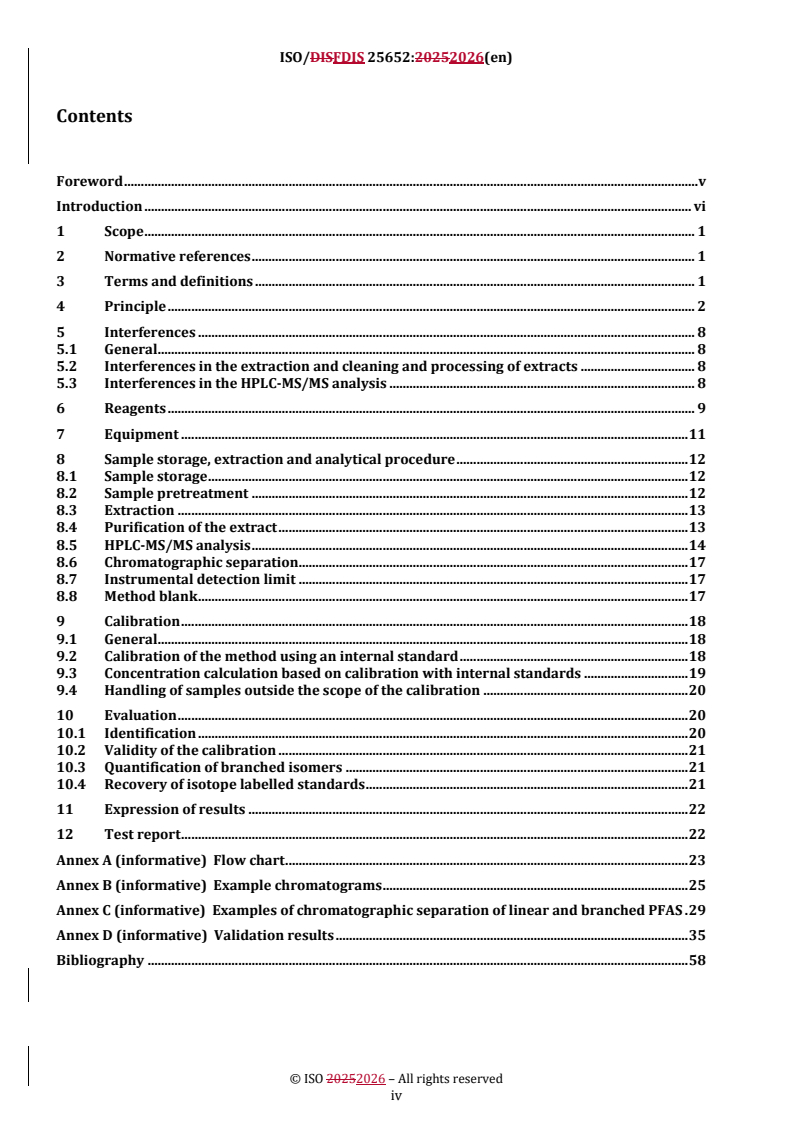
ISO/DISFDIS 25652:20252026(en)
Contents
Foreword . v
Introduction . vi
1 Scope . 1
2 Normative references . 1
3 Terms and definitions . 1
4 Principle . 2
5 Interferences . 8
5.1 General . 8
5.2 Interferences in the extraction and cleaning and processing of extracts . 8
5.3 Interferences in the HPLC-MS/MS analysis . 8
6 Reagents . 9
7 Equipment . 11
8 Sample storage, extraction and analytical procedure . 12
8.1 Sample storage . 12
8.2 Sample pretreatment . 12
8.3 Extraction . 13
8.4 Purification of the extract . 13
8.5 HPLC-MS/MS analysis . 14
8.6 Chromatographic separation. 17
8.7 Instrumental detection limit . 17
8.8 Method blank . 17
9 Calibration . 18
9.1 General . 18
9.2 Calibration of the method using an internal standard . 18
9.3 Concentration calculation based on calibration with internal standards . 19
9.4 Handling of samples outside the scope of the calibration . 20
10 Evaluation . 20
10.1 Identification . 20
10.2 Validity of the calibration . 21
10.3 Quantification of branched isomers . 21
10.4 Recovery of isotope labelled standards . 21
11 Expression of results . 22
12 Test report . 22
Annex A (informative) Flow chart . 23
Annex B (informative) Example chromatograms . 25
Annex C (informative) Examples of chromatographic separation of linear and branched PFAS . 29
Annex D (informative) Validation results . 35
Bibliography . 58
iv
ISO/DISFDIS 25652:20252026(en)
Foreword
ISO (the International Organization for Standardization) is a worldwide federation of national standards
bodies (ISO member bodies). The work of preparing International Standards is normally carried out through
ISO technical committees. Each member body interested in a subject for which a technical committee has been
established has the right to be represented on that committee. International organizations, governmental and
non-governmental, in liaison with ISO, also take part in the work. ISO collaborates closely with the
International Electrotechnical Commission (IEC) on all matters of electrotechnical standardization.
The procedures used to develop this document and those intended for its further maintenance are described
in the ISO/IEC Directives, Part 1. In particular, the different approval criteria needed for the different types of
ISO documentdocuments should be noted. This document was drafted in accordance with the editorial rules
of the ISO/IEC Directives, Part 2 (see www.iso.org/directives).
ISO draws attention to the possibility that the implementation of this document may involve the use of (a)
patent(s). ISO takes no position concerning the evidence, validity or applicability of any claimed patent rights
in respect thereof. As of the date of publication of this document, ISO [had/had not] received notice of (a)
patent(s) which may be required to implement this document. However, implementers are cautioned that this
may not represent the latest information, which may be obtained from the patent database available at
www.iso.org/patents. ISO shall not be held responsible for identifying any or all such patent rights.
Any trade name used in this document is information given for the convenience of users and does not
constitute an endorsement.
For an explanation of the voluntary nature of standards, the meaning of ISO specific terms and expressions
related to conformity assessment, as well as information about ISO'sISO’s adherence to the World Trade
Organization (WTO) principles in the Technical Barriers to Trade (TBT), see www.iso.org/iso/foreword.html.
This document was prepared by Technical Committee ISO/TC 190, Soil quality, Subcommittee SC 3, Chemical
and physical characterization, in collaboration with the European Committee for Standardization (CEN)
Technical Committee CEN/TC 444, Environmental characterization of solid matrices in collaboration with
Technical Committee ISO/TC 190, Soil quality, Subcommittee SC 3, Chemical and physical characterization, in ,
in accordance with the Agreement on technical cooperation between ISO and CEN (Vienna Agreement).
Any feedback or questions on this document should be directed to the user’s national standards body. A
complete listing of these bodies can be found at www.iso.org/members.html.
v
ISO/DISFDIS 25652:20252026(en)
Introduction
Per-Perfluoroalkyl and polyfluoroalkyl substances (PFAS) isare a large group of industrially produced
fluorinated hydrocarbons (alkyl substances). PFAS contain a fully (per-) or partially (poly-) fluorinated carbon
chain. The length normally ranges from 2 to 18 carbon atoms. The best known PFAS are PFOS (perfluorooctane
1)
sulfonic acid) and PFOA (perfluorooctanoic acid) .
Since 2018, explicit attention has been requested for PFAS residues in soil trading. Due to the potential risks
of the substance group or the lack of information about it, the target values for soil trading in some countries
are relatively low at the level of a few µg / /kg. For this reason, in many cases the chemical analyses are decisive
in decision-making for soil trading and determining the possibilities for use of soil and dredged material
released in projects. Precisely because of the diffuse occurrence of PFAS and the relatively strict target values,
there is a generic need for a validated analysis method with a substantiated reporting limit and uniformity in
the analysis methods and the associated pre-treatment.
The need for validation and uniformity does not only affect chemical analysis. The sampling strategy and
method of performing the fieldwork also determine the final result. To this end, various guidelines have been
and will be provided in other contexts and assessment guidelines and protocols have been drawn up.
1)
Both substances, PFOS and PFOA, consist of eight and seven fully fluorinated carbon atoms, respectively, with PFOS
additionally having a sulfonate as a "“functional group"” on the last carbon atom and PFOA a carboxyl group.
vi
ISO/DISFDIS 25652:20252026(en)
Soil, sludge, waste, sediment — Analysis of perfluoroalkyl and
polyfluoroalkyl substances (PFAS) by high perfomanceperformance
liquid chromatography (HPLC) and mass spectrometry
WARNING — Persons using this document should be familiar with normal laboratory practice. This
document does not purport to address all of the safety problems, if any, associated with its use. It is
the responsibility of the user to establish appropriate safety and health practices.
IMPORTANT — Tests conducted in accordance with this document shall be carried out by suitably
qualifiedtrained staff.
1 Scope
This document specifies a method for quantitative determination of various per-perfluorinated and
polyfluorinated hydrocarbons by means of high-performance liquid chromatography (HPLC) and mass
spectrometry in soil, sludge, sediment and waste (see Table 1).
Annex D provides more information on the LOQ’slimits of quantification (LOQs) reachable with this
procedure.
The method can be applied to the analysis of additional perfluoroalkyl and polyfluoroalkyl substances (PFAS)
not specified in the scope, if validity is proven by proper in-house validation protocols, particularly for volatile
compounds that can be lost during preparation.
For each target compound, all branched and non-branched are quantified together. In this method the amount
of linear and branched PFAS is quantified using the response factor of the linear PFAS in the calibration
standard and the total area of the linear and branched PFAS ((Annex C gives more explanation).
Alternatively, the linear isomer and sum of branched isomers can be quantified separately and the sum of both
can be calculated provided a complete separation of the linear isomer from the branched isomers is obtained.
2 Normative references
There are no normative references in this document.
3 Terms and definitions
For the purposes of this document, the following terms and definitions apply.
ISO and IEC maintain terminology databases for use in standardization at the following addresses:
— ISO Online browsing platform: available at https://www.iso.org/obp
— IEC Electropedia: available at https://www.electropedia.org/
3.1
perfluoroalkyl and polyfluoroalkyl substances
PFAS
organic compounds with replacement of most or all hydrogen atoms by fluorine in the aliphatic chain
structure
Note 1 to entry: The term is used in the broader sense for per-perfluoroalkyl and polyfluoroalkyl substances (PFAS), and
perperfluorinated and polyfluorinated compounds (PFC) as well.
ISO/DISFDIS 25652:20252026(en)
[SOURCE: ISO 21675:2019, 3.1]
4 Principle
The compounds listed in Table 1 are extracted from the prepared, homogenized sample material with
methanol, acetonitrile or a mixture of the two under basic conditions after addition of isotopically labelled
PFAS compounds. The extracts are purified if necessary, for example with activated carbon. The identification
and quantification are performed by high performance liquid chromatography coupled with a mass selective
detector (HPLC-MS / /MS). The content of each PFAS compound is calculated with the internal standard
method.
For many substances to which this document is applicable a limit of quantification (LOQ) of 0,01 to 0,1
µg/kgDM can be achieved. See also Annex DAnnex D.
All compounds of Table 1 were tested during an international inter laboratory trial in Europe in the period
December 2023 to April 2024. Table 1The table specifies for which the criteria of an inter laboratory
coefficient of variation of reproducibility (C C ) of 50 % was not reached. See Annex D for more details.
VR V,R
The validity of the procedure has been proven for soil, sediment and sludge samples and for a selection of
waste samples. For other waste types than mentioned in Annex D the laboratory shall validate the suitability
of the procedure of this standard.
Note NOTE For many compounds in the river clay, sediment and marine sediment sample Table 1Table 1 gives
“Cons <” as conclusion, where Annex DAnnex D might show positive results. Annex DAnnex D in that case shows the
results of the few labs with a positive result, where Table 1Table 1,, based on all raw data, clarifies that most of the labs
reported a “<-“< ‒ value”.
Table 1 — Summary of the conclusions of the validation per compound and per matrix
a
Abbr. Analyte Formu IUPAC name CAS- RivC Sed Mar Wa Soi Slu
b
la RN lay Sed ste l dg
e
2,2,3,3,4,4,4-
Perfluorobut C4HF7 375– Yes Ye
PFBA Heptafluorobutanoic Yes Yes
anoic acid O2 22–4 (7) s
acid
2,2,3,3,4,4,5,5,5-
Perfluorope C5HF9 2706– Con Ye
PFPeA Nonafluoropentanoic - No Yes Yes
ntanoic acid O2 90–3 s < s
acid
2,2,3,3,4,4,5,5,6,6,6-
Perfluorohe C6HF1 307– Con Ye
PFHxA Undecafluorohexanoic Yes Yes Yes Yes
xanoic acid 1O2 24–4 s < s
acid
2,2,3,3,4,4,5,5,6,6,7,7,7-
Perfluorohe C7HF1 375– Con Ye
PFHpA Tridecafluoroheptanoic Yes Yes Yes Yes
ptanoic acid 3O2 85–9 s < s
acid
2,2,3,3,4,4,5,5,6,6,7,7,8,
Perfluorooct C8HF1 8,8- 335– Ye
PFOA Yes Yes Yes Yes Yes
anoic acid 5O2 Pentadecafluorooctanoi 67–1 s
c acid
Perfluorooct
PFOA C8HF1
anoic acid
branched 5O2
branched
Perfluorono C9HF1 375– Con Ye
2,2,3,3,4,4,5,5,6,6,7,7,8,
PFNA Yes Yes Yes Yes
nanoic acid 7O2 95–1 s < s
8,9,9,9-
ISO/DISFDIS 25652:20252026(en)
a
Abbr. Analyte Formu IUPAC name CAS- RivC Sed Mar Wa Soi Slu
b
la RN lay Sed ste l dg
e
Heptadecafluoro-
nonanoic acid
Perfluorono
PFNA C9HF1
nanoic acid
branched 7O2
branched
2,2,3,3,4,4,5,5,6,6,7,7,8,
Perfluorodec C10HF 8,9,9,10,10,10- 335– Con Ye
PFDA Yes Yes Yes Yes
anoic acid 19O2 Nonadecafluorodecanoi 76–2 s < s
c acid
2,2,3,3,4,4,5,5,6,6,7,7,8,
Perfluoroun
C11HF 8,9,9,10,10,11,11,11- 2058– Con Ye
PFUnDA decanoic Yes Yes Yes Yes
21O2 Henicosafluoroundecan 94–8 s < s
acid
oic acid
2,2,3,3,4,4,5,5,6,6,7,7,8,
Perfluorodo 8,9,9,10,10,11,11,12,12,
C12HF 307– Con Ye
PFDoDA decanoic 12- Yes Yes Yes Yes
23O2 55–1 s < s
acid Tricosafluorododecanoi
c acid
2,2,3,3,4,4,5,5,6,6,7,7,8,
Perfluorotri 8,9,9,10,10,11,11,12,12
C13HF 72629 Con Ye
PFTrDA decanoic ,13,13,13- Yes Yes Yes No
25O2 –94–8 s < s
acid Pentacosafluorotrideca
noic acid
2,2,3,3,4,4,5,5,6,6,7,7,8,
Perfluorotet 8,9,9,10,10,11,11,12,12
C14HF 376– Cons Con Ye
PFTeDA ra-decanoic ,13,13,14,14,14 - Yes Yes Yes
27O2 06–7 < s < s
acid Heptacosafluorotetra -
decanoic acid
2,2,3,3,4,4,5,5,6,6,7,7,8,
8,9,9,10,10,11,11,12,12
Perfluorohe
C16HF ,13,13,14,14,15,15,16,1 67905 Cons Con Con Ye
PFHxDA xa-decanoic Yes Yes
31O2 6,16,16 - - –19–5 < s < s < s
acid
Hentriacontafluorohex
a -decanoic acid
2,2,3,3,4,4,5,5,6,6,7,7,8,
8,9,9,10,10,11,11,12,12
Perfluorocta ,13,13,14,14,15,15,16,1
C18HF 16517 Cons Con Con Yes Ye Yes
PFODA -decanoic 61
35O2 –11–6 < s < s < (6) s (7)
acid 6,17,17,18,18,18 -
Pentatriacontafluoro -
octadecanoic acid
Perfluorobut 1,1,2,2,3,3,4,4,4-
C4HF9 375– Cons Con Ye
PFBS ane-sulfonic Nonafluorobutane-1- Yes Yes Yes
O3S 73–5 < s < s
acid sulfonic acid
Perfluorope 1,1,2,2,3,3,4,4,5,5,5-
C5HF1 2706– Cons Con Con Ye
PFPeS ntane- Undecafluoropentane- Yes Yes
1O3S 91–4 < s < s < s
sulfonic acid 1-sulfonic acid
ISO/DISFDIS 25652:20252026(en)
a
Abbr. Analyte Formu IUPAC name CAS- RivC Sed Mar Wa Soi Slu
b
la RN lay Sed ste l dg
e
Perfluorohe 1,1,2,2,3,3,4,4,5,5,6,6,6-
C6HF1 355– Con Yes Ye
PFHxS xane- Tridecafluorohexane-1- Yes Yes Yes
3O3S 46–4 s < (6) s
sulfonic acid sulfonic acid
Perfluorohe
xane-
PFHxS C6HF1
sulfonic
branched 3O3S
acid branche
d
1,1,2,2,3,3,4,4,5,5,6,6,7,
Perfluorohe 7,
C7HF1 375– Con Con Ye
PFHpS ptane- 7- Yes Yes Yes
5O3S 92–8 s < s < s
sulfonic acid Pentadecafluoroheptan
e-1-sulfonic acid
1,1,2,2,3,3,4,4,5,5,6,6,7,
Perfluorooct 7,
C8HF1 1763– Ye
PFOS ane-sulfonic 8,8,8- Yes Yes Yes Yes Yes
7O3S 23–1 s
acid Heptadecafluorooctane
-1-sulfonic acid
Perfluorooct
PFOS ane-sulfonic C8HF1
branched acid branche 7O3S
d
1,1,2,2,3,3,4,4,5,5,6,6,7,
Perfluorono
C9HF1 7,8,8,9,9,9- 68259 Cons Con Con Ye
PFNS nane- Yes Yes
9O3S Nonadecafluoro- –12–1 < s < s < s
sulfonic acid
nonane-1-sulfonic acid
1,1,2,2,3,3,4,4,5,5,6,6,7,
Perfluorodec
C10HF 7,8,8,9,9,10,10,10- 335– Cons Con Con Ye
PFDS ane-sulfonic Yes Yes
21O3S Henicosafluorodecane- 77–3 < s < s < s
acid
1-sulfonic acid
1,1,2,2,3,3,4,4,5,5,6,6,7,
Perfluoroun 7, 74978
C11HF Cons Con Con
PFUnDS decane- 8,8,9,9,10,10,11,11,11- 6–16– Yes No Yes
23O3S < s < s <
sulfonic acid Tricosafluoroundecane 1
-1-sulfonic acid
C12HF 1,1,2,2,3,3,4,4,5,5,6,6,7,
Perfluorodo 25O3S 7,8,8,9,9,10,10,11,11,12
79780 Cons Con Con
PFDoDS decane- C12HF ,12,12- Yes No Yes
–39–5 < s < s <
sulfonic acid 2 Pentacosafluorodo-
5O3S decane-1-sulfonic acid
1,1,2,2,3,3,4,4,5,5,6,6,7,
Perfluorotri 7,8,8,9,9,10,10,11,11,12 79156
C13HF Cons Con Con
PFTrDS decane- ,12,13,13,13 - 3–89– No No No
27O3S < s < s <
sulfonic acid Heptacosafluorodo- 8
decane -1-sulfonic acid
4:2
3,3,4,4,5,5,6,6,6- 75712
Fluorotelom C6H5F Cons Con Con Ye
4:2 FTS Nonafluorohexane-1- 4–72– Yes Yes
er sulfonic 9O3S < s < s < s
sulfonic acid 4
acid
ISO/DISFDIS 25652:20252026(en)
a
Abbr. Analyte Formu IUPAC name CAS- RivC Sed Mar Wa Soi Slu
b
la RN lay Sed ste l dg
e
C8H5F
6:2
13O3S 3,3,4,4,5,5,6,6,7,7,8,8,8-
Fluorotelom 27619 Cons Con Ye
6:2 FTS C8H5F Tridecafluorooctane-1- Yes No Yes
er sulfonic –97–2 < s < s
1 sulfonic acid
acid
3O3S
C16H9
6:2
F26O4 bis(3,3,4,4,5,5,6,6,7,7,8,
fluorotelome 57677 Yes
6:2 diPAP PC16H 8,8-tridecafluorooctyl)
r phosphate –95–9 (4)
9F hydrogen phosphate
diester
26O4P
3,3,4,4,5,5,6,6,7,7,8,8,9,
C18H9
6:2 8:2 9,10,10,10-
F30O4 94391
fluorotelome heptadecafluorodecyl Cons Con Yes
6:2 8:2 diPAP PC18H 3–15–
r phosphate 3,3,4,4,5,5,6,6,7,7,8,8,8- < s < (4)
9F 3
diester tridecafluorooctyl
30O4P
hydrogen phosphate
C10H5
8:2 3,3,4,4,5,5,6,6,7,7,8,8,9,
F17O3
Fluorotelom 9,10,10,10- 39108 Cons Con Ye
8:2 FTS SC10H Yes Yes Yes
er sulfonic Heptadecafluorodecane –34–4 < s < s
5F
acid -1-sulfonic acid
17O3S
C12H5
10:2 3,3,4,4,5,5,6,6,7,7,8,8,9,
F21O3 12022
Fluorotelom 9,10,10,11,11,12,12,12- Cons Con Ye
10:2 FTS SC12H 6–60– Yes Yes No
er-sulfonic Henicosafluorododecan < s < s
5F 0
acid e-1-sulfonic acid
21O3S
8:2
C10H2
Fluorotelom 3,4,4,5,5,6,6,7,7,8,8,9,9,
F16O2
er 10,10,10- 70887 Cons Con Con Yes Ye
8:2 FTUCA C10H2 Yes
unsaturated Hexadecafluorodec-2- –84–2 < s < s < (6) s
F
carboxylic enoic acid
16O2
acid
C20H9
8:2 Bis(3,3,4,4,5,5,6,6,7,7,8,
F34O4
Perfluoroalk 8,9,9,10,10,10- 678– Cons Con
8:2 diPAP PC20H Yes Yes No Yes
yl phosphate heptadecafluorodecyl) 41–1 < s <
9F
diester hydrogen phosphate
34O4P
1,1,2,2,3,3,4,4,5,5,6,6,7,
Perfluorooct C8H2F
7,8,8,8- 754– Ye
PFOSA ane- 17NO2 Yes Yes Yes Yes Yes
Heptadecafluoro-1- 91–6 s
sulfonamide S
octanesulfonamide
Perfluorooct
C8H2F
PFOSA ane-
17NO2
branched sulfonamide
S
branched
N- 1,1,2,2,3,3,4,4,5,5,6,6,7,
methylperfl C9H4F 7,8,8,8- Ye
31506 Cons Yes Con Yes
MePFOSA uoro- 17NO2 Heptadecafluoro-N- s Yes
–32–8 < (4) s < (7)
octanesulfon S methyl-1- (7)
amide octanesulfonamide
ISO/DISFDIS 25652:20252026(en)
a
Abbr. Analyte Formu IUPAC name CAS- RivC Sed Mar Wa Soi Slu
b
la RN lay Sed ste l dg
e
N-
methylperfl
C9H4F
MePFOSA uoro-
17NO2
branched octanesulfon
S
amide
branched
N- 2-
methylperfl [1,1,2,2,3,3,4,4,5,5,6,6,7
C11H6
uoro- ,7,8,8,8- 2355– Cons Ye
MePFOSAA F17NO Yes Yes Yes Yes
octanesulfon Heptadecafluorooctyl- 31–9 < s
4S
amidoacetic sulfonyl(methyl)amino
acid ]acetic acid
N-
methylperfl
uoro- C11H6
MePFOSAA
octanesulfon F17NO
branched
amidoacetic 4S
acid
branched
N- N-Ethyl-
ethylperfluo C10H6 1,1,2,2,3,3,4,4,5,5,6,6,7, Ye
4151– Cons Yes Con Yes Yes
EtPFOSA ro- F17NO 7,8,8,8- s
50–2 < (7) s < (6) (7)
octanesulfon 2S heptadecafluorooctane- (7)
amide 1-sulfonamide
N-
ethylperfluo
C10H6
EtPFOSA ro-
F17NO
branched octanesulfon
2S
amide
branched
2-
N-
[Ethyl(1,1,2,2,3,3,4,4,5,
ethylperfluo C12H8
5,6,6,7,7,8,8,8- 2991– Ye
EtPFOSAA rooctane- F17NO Yes Yes Yes Yes Yes
heptadecafluoro- 50–6 s
sulfonamido 4S
octylsulfonyl)amino]ac
acetic acid
etic acid
N-
ethylperfluo
C12H8
EtPFOSAA rooctane-
F17NO
branched sulfonamido
4S
acetic acid
branched
N-
N-Methyl-
methylperfl Ye
C5H4F 1,1,2,2,3,3,4,4,4- 68298 Cons Con Con Yes Yes
MePFBSA uoro- s
9NO2S nonafluorobutane-1- –12–4 < s < s < (5) (6)
butanesulfo (6)
sulfonamide
namide
N-
15938 Ye
2-
C7H6F Cons Con Con
methylperfl
MePFBSAA 1–10– No s Yes
[Methyl(1,1,2,2,3,3,4,4,
9NO4S < s < s <
uoro-
9 (6)
4-
butanesulfo
ISO/DISFDIS 25652:20252026(en)
a
Abbr. Analyte Formu IUPAC name CAS- RivC Sed Mar Wa Soi Slu
b
la RN lay Sed ste l dg
e
namidoaceti nonafluorobutylsulfony
c acid l)amino]acetic acid
Nonafluoro- 2,2-difluoro-2-[1,1,2,2-
3,6- C5HF9 tetrafluoro-2-(-
NFDHpA 2–58–
dioxaheptan O4 (trifluoromethoxy)etho
oic acid xy]acetic acid
Perfluorobut 1,1,2,2,3,3,4,4,5,5,6,6,6-
C4H2F 30334 Cons Con Con Ye
PFBSA ane- Nonafluoro-1- No Yes
9NO2S –69–1 < s < s < s
sufonamide butanesulfonamide
Perfluoro-3- 2,2,3,3-tetrafluoro-3- Ye
C4HF7 377– Yes
PFMPA methoxypro (trifluoromethoxy)prop s
O3 73–1 (3)
panoic acid anoic acid (3)
2,2,3-Trifluoro-3-
4,8-Dioxa-
[1,1,2,2,3,3-hexafluoro- 91900
3H- C7H2F Cons Con Con Ye
DONA 3-(- 5–14– Yes Yes
perfluorono 12O4 < s < s < s
(trifluoromethoxy)prop 4
nanoic acid
oxy]propanoic acid
7H- 2,2,3,3,4,4,5,5,6,6,7,7- Ye
C7H2F 1546– Cons Con Con
HPFHpA Perfluorohe Dodecafluoroheptanoic Yes s Yes
12O2 95–8 < s < s <
ptanoic acid acid (7)
Perfluoro-3– 2,2,3,4,4,5,5,6,6,7,8,8,8-
17215 Ye
7- C10HF Tridecafluoro-3,7- Cons Con Con Yes
P37DMOA 5–07– s Yes
dimethyloct 19O2 bis(trifluoromethyl)oct < s < s < (7)
6 (7)
anoic acid anoic acid
Perfluorohe C6H2F 1,1,2,2,3,3,4,4,5,5,6,6,6- Ye
41997 Cons Con Con Yes Yes
PFHxSA xane-sulfon- 13NO2 tridecafluorohexane-1- s
–13–1 < s < s < (7) (5)
amide S sulfonamide (6)
2,2,3,3,4,4-hexafluoro-
Perfluoro-4- 86309
C5HF9 4-(-
PFMBA methoxybut 0–89–
O3 (trifluoromethoxy)buta
anoic acid 5
noic acid
9- 2-(6-Chloro-
Chlorohexad 1,1,2,2,3,3,4,4,5,5,6,6-
C8HCl 75642
ecafluoro-3- dodecafluorohexoxy)- Cons Con Con Ye
9Cl-PF3ONS F16O4 6-58- Yes Yes
oxanonane- 1,1,2,2- < s < s < s
S 1
1-sulfonic tetrafluoroethanesulfo
acid nic acid
2H,2H,3H,3 4,4,5,5,6,6,7,7,8,8,9,9,1
H-perfluoro C11H5 0,10,11,11,11- 34598 Cons Con Yes
4H-PFUnDA Yes No Yes
undecanoic F17O2 Heptadecafluoroundec –33–9 < s < (6)
acid anoic acid
perfluoro-4- 1,2,2,3,3,4,5,5,6,6-
Ye
ethylcyclohe C8HF1 decafluoro-4-(1,1,2,2,2- 646– Cons Con Con Yes
4-PFECHS s
xane 5O3S pentafluoroethyl)cyclo 83–3 < s < s < (6)
(7)
sulfonic acid hexane-1-sulfonic acid
2,3,3,3-Tetrafluoro-2-
Perfluoro-2–
C6HF1 (1,1,2,2,3,3,3- 13252 Cons Con Con Ye
HFPO-DA propoxypro Yes Yes
1O3 heptafluoropropoxy)- –13–6 < s < s < s
panoic acid
propanoic acid
ISO/DISFDIS 25652:20252026(en)
a
Abbr. Analyte Formu IUPAC name CAS- RivC Sed Mar Wa Soi Slu
b
la RN lay Sed ste l dg
e
a IUPAC : International Union of Pure and Applied Chemistry
b CAS-RN : Chemical Abstract Services Registry Number
1 The branched isomers mentioned in this table are examples, other branched isomers do exist.
Further explanation:
RivClay: River Clay
river clay
Sed: Sediment
sediment
MarSed: Marine Sediment
marine sediment
Yes : criterion of CVR < 50 % was met with 8 or more laboratories
Yes(n): ) criterion of CVR < 50 % was met with n laboratories
No : criterion was not met with 8 or more laboratories
Cons < : most of the results consistently < - ‒ value
5 Interferences
5.1 General
In particular, process interferences can be caused by contact of the sample with polytetrafluoroethylene
(PTFE) materials. To avoid raised blank values, materials of glass, steel, polyether ether ketone (PEEK),
polypropylene (PP) or high density polyethylene (HDPE) should preferably be used for sampling, extraction
and analysis.
5.2 Interferences in the extraction and cleaning and processing of extracts
Efforts should be taken to minimize background levels in method blank materials such that the method blank
is maximum half of the reporting limit (8.8().). Low molecular residuals in fluoropolymer-containing materials
such as Viton (Fluorocarbonfluorocarbon rubber), PVDF (Polyvinylideenfluoridepolyvinylideenfluoride), etc.,
which are often used in LC equipment, can cause blank values, e.g. in the case of PFOA. Sampling vessels (7.1())
and sample vials (7.4()) shall be checked for possible background contamination before use.
5.3 Interferences in the HPLC-MS / /MS analysis
Either peak tailing, peak fronting or broadened peaks or a combination of one of these are indicative of
interferences in chromatography. Sample matrix components can affect the ionization of the target
substances. This can result in suppression or enhancement of the ionization. Such matrix interferences can be
detected and corrected by using authentic isotopically labelled internal standards. Substances with similar
retention times that can produce ions with similar mass to charge ratios (m/z) to those produced by the target
analytes can interfere with the determination. These interferences can lead to incompletely resolved signals
and/or additional signals in the mass chromatograms of target substances. Depending on their levels in the
sample, such substances can affect the accuracy and precision of the results. As long as the peak of interest can
be separately integrated from interferences, it may be used.
Typical contamination sources in the LC system include vacuum degassers, frits and tubes as well as pump
head seals. In the case of such interferences, degassing of the eluents, for example, can be carried out using
helium instead of vacuum degassers. Fluoropolymer frits and tubes shall be replaced by frits and tubes made
of stainless steel or PEEK. If available, pump head seals made of PE shall be used.
ISO/DISFDIS 25652:20252026(en)
A delay column supports avoiding background contamination from within the instrument (7.13().).
6 Reagents
Always use certified or analytical grade reagents whenever possible. Store the reagents in glass or
polypropylene bottles (7.10) fitted with a metal or polypropylene lid. Avoid using lids containing
fluoropolymers and verify reagents are free from contaminants by taking regular blank measurements, see
the method blank procedure (8.8.).
6.1 Ultrapure water, H O, deionized.
6.2 Acetonitrile, CH CN.
6.3 Methanol, CH OH.
OH, can be used.
6.4 Sodium hydroxide, NaOH, alternatively ammonium hydroxide, NH
6.5 Acetic acid, CH COOH, > 96 % (mass fraction).
6.6 Ammonium formate, NH HCO , alternatively ammonium acetate NH CO CH or ammonium carbonate
4 2 4 2 3
(NH ) CO can be used.
4 2 3
6.7 Extraction solvent, acetonitrile:methanol (1:1) with 0,05 mol/l sodium hydroxide.
Weigh e.g. 2 g sodium hydroxide (6.4()) into a mixture of 500 ml acetonitrile (6.2()) and 500 ml methanol
(6.3().).
Other solvents with similar chemical properties and other concentrations of sodium hydroxide than those
described here may be used, provided that comparability with the operating procedure of the present
standard is demonstrated.
6.8 Conditioning fluid, acetonitrile:methanol:water (1:1:1).
Mix e.g. 250 ml of water (6.1()) with 250 ml of acetonitrile (6.2()) and 250 ml of methanol (6.3().).
6.9 Elution liquid, acetonitrile:methanol (1:1) with 0.,05 mol/l acetic acid.
Add e.g. 0,3 ml acetic acid (6.5()) to a mixture of 50 ml acetonitrile (6.2()) and 50 ml methanol (6.3().).
6.10 Mobile phase, ammonium formate eluate solution with 5 % methanol.
Weigh e.g. 1,2 g of ammonium formate (6.6()) into a mixture of 38003 800 ml of water (6.1()) and 200 ml of
methanol (6.3().).
6.11 Reference standards.
Only use reference standards that consist of at least 95 % (mass fraction) of the linear isomer, for the
quantitative determination of the analytes (see Table 1).
NOTE Ampoules of individual compounds or mixtures thereof are commercially available.
6.12 Isotope labelled standards.
Isotope labelled standards are used for internal standard calibration. This allows correction for loss during
the analytical process or other changes in analytical conditions that can lead to bias.
ISO/DISFDIS 25652:20252026(en)
NOTE Ampoules of individual isotope labelled standards or mixtures thereof are commercially available.
6.13 Preparation of stockStock, intermediate and calibration solutions.
Calculate the concentration of all reference and calibration solutions on the basis of the dissolved anion
amount (neutral compound). All solutions are stored in the dark at 5 ± ± 3 °C. The solutions have a shelf life
of at least one year. The solutions are brought to room temperature before use. For some compounds
sonication or vortex, or both, is required.
6.13.1 Stock solutions of reference standards.
Prepare stock solutions of the reference standards (6.11()) in acetonitrile (6.2()) or methanol (6.3().).
6.13.2 Stock solutions from isotope labelled standards.
Prepare stock solutions of the isotope-labelled standards solutions (6.12()) in acetonitrile (6.2()) or methanol
(6.3().).
NOTE 13C HFPO-DA is not stable in acetonitrile.
6.13.3 Stock solutions of reference standards for QC for verification of the calibration curve.
Prepare stock solutions of independent reference standards (6.11()) in acetonitrile (6.2()) or methanol
(6.3().). Independent reference standards are preferably obtained from different suppliers. A minimum of one
third of the analytes in the stock solutions of reference standards (6.13.1()) should be present in the
calibration verification solution. Each calibration verification solution should, if relevant for the compounds
to be analysed, contain representative compounds for at least the following groups:
— Perfluoratedperfluorated carboxylic acids: PFBA, PFHxA, PFOA, PFDA, PFTeDA, PFODA;
— Perfluoratedperfluorated sulfonic acids: PFBS, PFHxS, PFOS, PFDS, PFDoDS;
— Fluorotelomersfluorotelomers: 4:2 FTS, 10:2 FTS;
— Perfluoroperfluoro-sulfonamides: PFBSA;
— Perfluoroperfluoro-sulfonamide acetic acids: EtPFOSAA, MePFOSAA;
— Variousvarious: DONA, 4-PFECHS, HFPO-DA, 8:2 diPAP.
Preferably use standards from a different supplier for the calibration verification solution or at least different
mixtures from the same supplier (if available).
NOTE HFPO-DA is not stable in acetonitrile.
6.13.4 Intermediate solution of reference standards.
Prepare an intermediate solution of the stock solutions of reference standards (6.13.1()) in methanol (6.3())
or acetonitrile (6.2) (the same as used for the stock solution) at a concentration of e.g. 0,2 µg / /ml.
6.13.5 Intermediate solution of isotope-labelled standards.
Prepare an intermediate solution of the stock solutions of isotope-labelled standards (6.13.2()) in methanol
(6.3()) or acetonitrile (6.2) (the same as used for the stock solution) with a concentration of e.g. 0,2 µg / /ml.
6.13.6 Intermediate solution of reference standards for QC verification of the calibration curve.
ISO/DISFDIS 25652:20252026(en)
Prepare an intermediate solution of the stock solutions of independent reference standards for QC verification
of the calibration curve (6.13.3()) in methanol (6.3()) or acetonitrile (6.2) (the same as used for the stock
solution) with a concentration of e.g. 0,2 µg / ml.
6.13.7 Calibration solutions from reference standards.
This is a series of multi-component calibration solutions (at least five different solutions) in increasing
concentration prepared in methanol (6.3()) or acetonitrile (6.2) (the same as used for the stock solution) from
the intermediate solution of reference standards (6.13.4()) with a concentration range of, as an example,
0.,02 ng / /ml to 20 ng / /ml. A fixed amount of the isotope-labelled standards (6.13.5()) intermediate
solutions are added to each calibration solution.
NOTE Instead of adding the isotope labelled standards to the calibration solutions, injection can also be performed
by the instrument.
6.13.8 Spike solution isotope-labelled standards.
()) or
Prepare a spike solution of the intermediate isotope-labelled standards (6.13.5()) in methanol (6.3
acetonitrile (6.2) (the same as used for the stock solution) with a concentration of e.g. 0,02 µg/ml. The
concentration level should be at least three times the corresponding level of the limit of quantification.
6.13.9 Solutions of independent standards for verification of the calibration curve.
Prepare two solutions in methanol (6.3()) or acetonitrile (6.2) (the same as used for the stock solution) from
the intermediate solution of independent standards for verification of the calibration curve (6.13.6()) with a
concentration preferably in the beginning and end of the calibration range.
6.14 Purification columns; disposable adsorption material.
— SPE (Solid Phase Extractionsolid phase extraction) adsorption material: Activatedactivated carbon, such
2)
as ENVI-Carb .
— Other adsorption materials may be used provided equivalent results are obtained. Good results are
obtained using 250 mg/ 6 ml tubes.
6.15 Nitrogen gas, N .
6.16 Silver sand.
6.17 Neutralization solution.
Weigh e.g. 3,8 g ammonium acetate (6.6()) in 100 ml water (6.1().).
7 Equipment
All equipment and utensils that come into contact with the sample or extract shall be free from PFAS
contaminants analysed. If a background signal of PFAS is observed, the equipment and utensils used should
be cleaned with water (6.1()) and methanol (6.3().). All equipment shall be calibrated or checked according to
official standards or proprietary internal procedures.
7.1 Sample containers with screw cap, free from background signal.
2)
ENVI-Carb is an example of a suitable product available commercially. This information is given for the convenience of
users of this document and does not constitute an endorsement by ISO of these products.this product.
ISO/DISFDIS 25652:20252026(en)
Sample containers made of glass, polypropylene, PET or high-density polyethylene (HDPE) or stainless steel.
7.2 Balance, with a resolution of at least 1 % of the weighed amount.
7.3 Syringes.
7.4 Test tubes, sampling vials of appropriate volume, e.g. made of Polypropylenepolypropylene.
7.5 Pasteur pipettes.
7.6 Pipettes of appropriate volume.
7.7 Evaporation block.
7.8 Shaking device, with horizontal movement (200 to 300 strokes per min).
7.9 Centrifuge.
7.10 Polypropylene containers.
7.11 Liquid chromatograph with gradient set-up with mass spectrometer.
Mass spectrometric detector (MS/MS), preferably tandem mass spectrometer with electrospray ionization
(ESI).
NOTE For the procedure described in this standard, other MS techniques can be used as well, e.g. time-of-flight mass
spectrometry (TOF/MS), provided the identification of the analytes has been verified and documented for the respective
applications.
7.12 “Reversed phase” HPLC column, C18 or equivalent.
7.13 Delay column.
Background contamination from the instrument can be controlled by using a delay column. A delay column is
attached between the solvent mixer and the injection valve to chromatographically separate these background
contaminants, originating from the instrument or mobile phases, or both, from the target analytes.
7.14 HPLC vial, e.g. a 2 ml Polypropylenepolypropylene vial, with a fluorine screw cap.
8 Sample storage, extraction and analytical procedure
8.1 Sample storage
Samples shall be analysed within 28 days. If necessary, sludge samples should be stored according to
ISO 5667-15. Dried samples can be stored at room temperature up to one month. Soil samples should be stored
according to ISO 18512.
8.2 Sample pretreatment
The sample shall be dried. Drying can be performed e.g. by freeze drying (preferred for sewage sludge) or
drying at a maximum of 40 °C. Chemical drying (with sodium sulfate) is also a possibility. It is recommended
that a field moist soil sample or a sludge sample be pre-treated following standards such as EN 16179, and
that waste samples be treated according to standards like EN 15002 or any other suitable standard.
Drying of the (partial) sample is permitted up to a maximum of 40 °C to minimize loss of volatile PFAS
compounds.
ISO/DISFDIS 25652:20252026(en)
8.3 Extraction
The different steps for the procedure described here are an example and are summarized in Annex A,
Figure A.1Figure A.1.
Remove the spike solution of the isotope internal standard solution (6.13.8()) from the refrigerator and allow
it to reach room temperature.
At least one method blank is prepared for each series.
Depending on the grinding fineness, 1 g to 10 g of dried sample is weighed into a polypropylene container
(7.10()) or a suitable glass container. To all samples e.g. 100 µl isotopically labelled spike solution (6.13.8) is
() added. All samples are shaken briefly by hand to mix the added solution with the sample.
An amount of acetonitrile (6.2()) or methanol (6.3()) or a mixture (6.7()) of acetonitrile:methanol (1:1) is used
as extraction solvent. Add 0,05 mol/l sodium hydroxide or ammonium hydroxide (6.4() are added) to all
samples in order to getobtain a liquid-solid ratio from at least 2 to 4 (e.g. 20 ml to 5 g).
NOTE The use of only acetonitrile is not possible if HFPO-DA has to be analysed, as this compound is not stable in
acetonitrile.
Other solvents with similar chemical properties and other concentrations of sodium hydroxide than those
described here may be used, provided that comparability with the operating procedure of the present
standard is demonstrated.
The samples are placed on the shaker (7.8()) and shaken for a minimum of 60 minutes. Instead of shaking,
ultrasonication (at a maximum temperature of 55 ˚C °C) may be applied. After extraction, the samples are
placed in the centrifuge (7.9()) to remove particles. Alternatively, the sample can be left in the refrigerator for
sedimentation for at least 3 hours.
If no purification step (see 8.4)) is applied, add 100 µl ammonium acetate solution (6.17()) to 900 µl extract.
8.4 Purification of the ex
...