


ISO/TS 22220:2009
(Main)Health Informatics — Identification of subjects of health care
Health Informatics — Identification of subjects of health care
ISO/TS 22220:2009 indicates the data elements and structure suited to accurate and procedurally appropriate and sensitive identification of individuals in health care in a face-to-face setting supported by computer technology, or through interactions between computer systems. It provides guidelines for improving the positive identification of subjects of care within and between health care organizations. ISO/TS 22220:2009 defines demographic and other identifying data elements suited to capture, and the wide variety of manual and computer-enhanced procedures used for subject of care identification in health care settings. It also provides guidance on their application in the manual and the computer environment and makes recommendations about the nature and form of health care identifiers, the management organization to oversee subject of care identification, and computer support to be provided for the identification process. The objective of ISO/TS 22220:2009 is to promote uniform good practice in: identifying individuals in a face-to-face or paper-based environment, as well as in and between automated systems; recording and reporting of subject of care identifying data; ensuring that data being associated with any given subject of care, and upon which clinical communication and data aggregation are based, are appropriately associated with that individual or organization and no other. ISO/TS 22220:2009 is primarily concerned with the use of subject of care identification data to support patient care. It should be used by health and health related establishments that create, use or maintain records on subjects of care. Health care organizations should use this Technical Specification where appropriate, for collecting data when registering subjects of care or potential subjects of care and when reporting patient information to other systems, both clinical and administrative.
Informatique de santé — Identification des sujets de soins sanitaires
General Information
- Status
- Withdrawn
- Publication Date
- 10-Mar-2009
- Withdrawal Date
- 10-Mar-2009
- Technical Committee
- ISO/TC 215 - Health informatics
- Drafting Committee
- ISO/TC 215/WG 1 - Architecture, Frameworks and Models
- Current Stage
- 9599 - Withdrawal of International Standard
- Start Date
- 13-Dec-2011
- Completion Date
- 12-Feb-2026
Relations
- Effective Date
- 14-May-2011

Get Certified
Connect with accredited certification bodies for this standard

BSI Group
BSI (British Standards Institution) is the business standards company that helps organizations make excellence a habit.

NYCE
Mexican standards and certification body.
Sponsored listings
Frequently Asked Questions
ISO/TS 22220:2009 is a technical specification published by the International Organization for Standardization (ISO). Its full title is "Health Informatics — Identification of subjects of health care". This standard covers: ISO/TS 22220:2009 indicates the data elements and structure suited to accurate and procedurally appropriate and sensitive identification of individuals in health care in a face-to-face setting supported by computer technology, or through interactions between computer systems. It provides guidelines for improving the positive identification of subjects of care within and between health care organizations. ISO/TS 22220:2009 defines demographic and other identifying data elements suited to capture, and the wide variety of manual and computer-enhanced procedures used for subject of care identification in health care settings. It also provides guidance on their application in the manual and the computer environment and makes recommendations about the nature and form of health care identifiers, the management organization to oversee subject of care identification, and computer support to be provided for the identification process. The objective of ISO/TS 22220:2009 is to promote uniform good practice in: identifying individuals in a face-to-face or paper-based environment, as well as in and between automated systems; recording and reporting of subject of care identifying data; ensuring that data being associated with any given subject of care, and upon which clinical communication and data aggregation are based, are appropriately associated with that individual or organization and no other. ISO/TS 22220:2009 is primarily concerned with the use of subject of care identification data to support patient care. It should be used by health and health related establishments that create, use or maintain records on subjects of care. Health care organizations should use this Technical Specification where appropriate, for collecting data when registering subjects of care or potential subjects of care and when reporting patient information to other systems, both clinical and administrative.
ISO/TS 22220:2009 indicates the data elements and structure suited to accurate and procedurally appropriate and sensitive identification of individuals in health care in a face-to-face setting supported by computer technology, or through interactions between computer systems. It provides guidelines for improving the positive identification of subjects of care within and between health care organizations. ISO/TS 22220:2009 defines demographic and other identifying data elements suited to capture, and the wide variety of manual and computer-enhanced procedures used for subject of care identification in health care settings. It also provides guidance on their application in the manual and the computer environment and makes recommendations about the nature and form of health care identifiers, the management organization to oversee subject of care identification, and computer support to be provided for the identification process. The objective of ISO/TS 22220:2009 is to promote uniform good practice in: identifying individuals in a face-to-face or paper-based environment, as well as in and between automated systems; recording and reporting of subject of care identifying data; ensuring that data being associated with any given subject of care, and upon which clinical communication and data aggregation are based, are appropriately associated with that individual or organization and no other. ISO/TS 22220:2009 is primarily concerned with the use of subject of care identification data to support patient care. It should be used by health and health related establishments that create, use or maintain records on subjects of care. Health care organizations should use this Technical Specification where appropriate, for collecting data when registering subjects of care or potential subjects of care and when reporting patient information to other systems, both clinical and administrative.
ISO/TS 22220:2009 is classified under the following ICS (International Classification for Standards) categories: 35.240.80 - IT applications in health care technology. The ICS classification helps identify the subject area and facilitates finding related standards.
ISO/TS 22220:2009 has the following relationships with other standards: It is inter standard links to ISO/TS 22220:2011. Understanding these relationships helps ensure you are using the most current and applicable version of the standard.
ISO/TS 22220:2009 is available in PDF format for immediate download after purchase. The document can be added to your cart and obtained through the secure checkout process. Digital delivery ensures instant access to the complete standard document.
Standards Content (Sample)
TECHNICAL ISO/TS
SPECIFICATION 22220
First edition
2009-03-15
Health Informatics — Identification of
subjects of health care
Informatique de la santé — Identification des sujets de soins sanitaires
Reference number
©
ISO 2009
PDF disclaimer
This PDF file may contain embedded typefaces. In accordance with Adobe's licensing policy, this file may be printed or viewed but
shall not be edited unless the typefaces which are embedded are licensed to and installed on the computer performing the editing. In
downloading this file, parties accept therein the responsibility of not infringing Adobe's licensing policy. The ISO Central Secretariat
accepts no liability in this area.
Adobe is a trademark of Adobe Systems Incorporated.
Details of the software products used to create this PDF file can be found in the General Info relative to the file; the PDF-creation
parameters were optimized for printing. Every care has been taken to ensure that the file is suitable for use by ISO member bodies. In
the unlikely event that a problem relating to it is found, please inform the Central Secretariat at the address given below.
© ISO 2009
All rights reserved. Unless otherwise specified, no part of this publication may be reproduced or utilized in any form or by any means,
electronic or mechanical, including photocopying and microfilm, without permission in writing from either ISO at the address below or
ISO's member body in the country of the requester.
ISO copyright office
Case postale 56 • CH-1211 Geneva 20
Tel. + 41 22 749 01 11
Fax + 41 22 749 09 47
E-mail copyright@iso.org
Web www.iso.org
Published in Switzerland
ii © ISO 2009 – All rights reserved
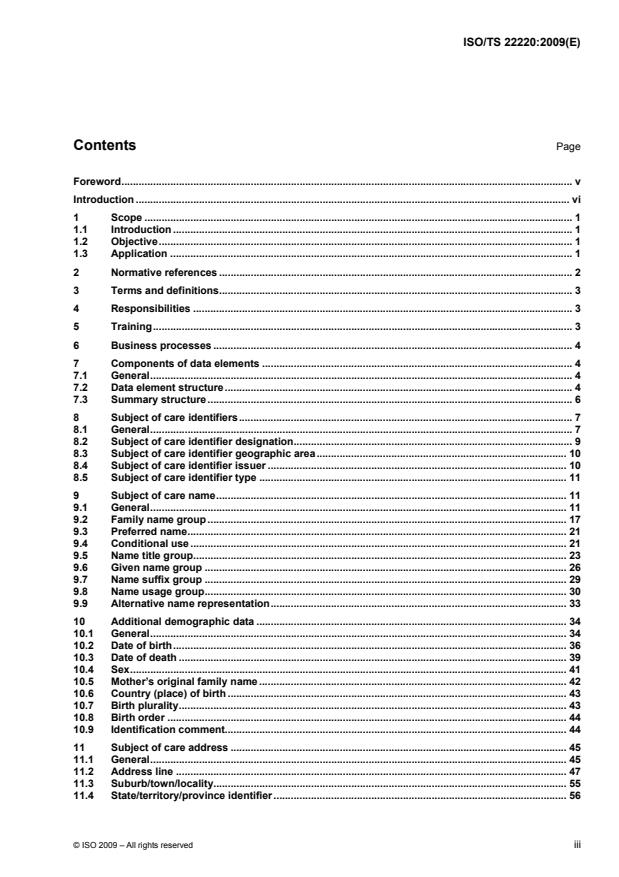
Contents Page
Foreword. v
Introduction . vi
1 Scope . 1
1.1 Introduction . 1
1.2 Objective. 1
1.3 Application . 1
2 Normative references . 2
3 Terms and definitions. 3
4 Responsibilities . 3
5 Training. 3
6 Business processes . 4
7 Components of data elements . 4
7.1 General. 4
7.2 Data element structure. 4
7.3 Summary structure. 6
8 Subject of care identifiers. 7
8.1 General. 7
8.2 Subject of care identifier designation. 9
8.3 Subject of care identifier geographic area. 10
8.4 Subject of care identifier issuer . 10
8.5 Subject of care identifier type . 11
9 Subject of care name. 11
9.1 General. 11
9.2 Family name group. 17
9.3 Preferred name. 21
9.4 Conditional use . 21
9.5 Name title group. 23
9.6 Given name group . 26
9.7 Name suffix group . 29
9.8 Name usage group. 30
9.9 Alternative name representation. 33
10 Additional demographic data . 34
10.1 General. 34
10.2 Date of birth. 36
10.3 Date of death . 39
10.4 Sex. 41
10.5 Mother’s original family name . 42
10.6 Country (place) of birth . 43
10.7 Birth plurality. 43
10.8 Birth order . 44
10.9 Identification comment. 44
11 Subject of care address . 45
11.1 General. 45
11.2 Address line . 47
11.3 Suburb/town/locality. 55
11.4 State/territory/province identifier . 56
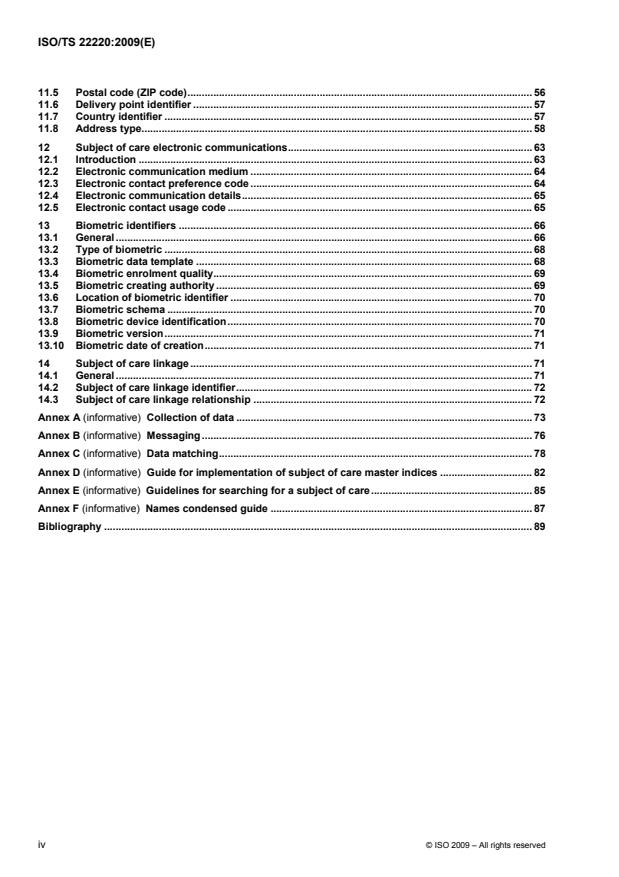
11.5 Postal code (ZIP code). 56
11.6 Delivery point identifier . 57
11.7 Country identifier . 57
11.8 Address type. 58
12 Subject of care electronic communications. 63
12.1 Introduction . 63
12.2 Electronic communication medium . 64
12.3 Electronic contact preference code . 64
12.4 Electronic communication details. 65
12.5 Electronic contact usage code . 65
13 Biometric identifiers . 66
13.1 General . 66
13.2 Type of biometric . 68
13.3 Biometric data template . 68
13.4 Biometric enrolment quality. 69
13.5 Biometric creating authority . 69
13.6 Location of biometric identifier . 70
13.7 Biometric schema . 70
13.8 Biometric device identification. 70
13.9 Biometric version. 71
13.10 Biometric date of creation. 71
14 Subject of care linkage . 71
14.1 General . 71
14.2 Subject of care linkage identifier. 72
14.3 Subject of care linkage relationship . 72
Annex A (informative) Collection of data . 73
Annex B (informative) Messaging. 76
Annex C (informative) Data matching. 78
Annex D (informative) Guide for implementation of subject of care master indices . 82
Annex E (informative) Guidelines for searching for a subject of care. 85
Annex F (informative) Names condensed guide . 87
Bibliography . 89
iv © ISO 2009 – All rights reserved
Foreword
ISO (the International Organization for Standardization) is a worldwide federation of national standards bodies
(ISO member bodies). The work of preparing International Standards is normally carried out through ISO
technical committees. Each member body interested in a subject for which a technical committee has been
established has the right to be represented on that committee. International organizations, governmental and
non-governmental, in liaison with ISO, also take part in the work. ISO collaborates closely with the
International Electrotechnical Commission (IEC) on all matters of electrotechnical standardization.
International Standards are drafted in accordance with the rules given in the ISO/IEC Directives, Part 2.
The main task of technical committees is to prepare International Standards. Draft International Standards
adopted by the technical committees are circulated to the member bodies for voting. Publication as an
International Standard requires approval by at least 75 % of the member bodies casting a vote.
In other circumstances, particularly when there is an urgent market requirement for such documents, a
technical committee may decide to publish other types of document:
— an ISO Publicly Available Specification (ISO/PAS) represents an agreement between technical experts in
an ISO working group and is accepted for publication if it is approved by more than 50 % of the members
of the parent committee casting a vote;
— an ISO Technical Specification (ISO/TS) represents an agreement between the members of a technical
committee and is accepted for publication if it is approved by 2/3 of the members of the committee casting
a vote.
An ISO/PAS or ISO/TS is reviewed after three years in order to decide whether it will be confirmed for a
further three years, revised to become an International Standard, or withdrawn. If the ISO/PAS or ISO/TS is
confirmed, it is reviewed again after a further three years, at which time it must either be transformed into an
International Standard or be withdrawn.
Attention is drawn to the possibility that some of the elements of this document may be the subject of patent
rights. ISO shall not be held responsible for identifying any or all such patent rights.
ISO/TS 22220 was prepared by Technical Committee ISO/TC 215, Health Informatics.
Introduction
The health care system relies heavily on the ability to uniquely and accurately identify a person when they
attend for care. The introduction of computerization into this process requires the clear specification of all
elements of information used to support the procedural as well as the computerized identification of a subject
of care so that the current person is associated with previous health information and to support
communication between health care professionals. Developments in the health care system and the
emergence of health networks have amplified the importance of collecting, sharing and exchanging data
concerning individual subjects of care between different health care providers and between different
information systems.
More effective communication between health care professionals is key to securing closer co-operation,
improving the handling of subjects of care in terms of quality and continuity of care, and prevention and
promoting health system efficiency.
Reliable identification of the individual has always been a critical part of the health care process. The ability of
computerized systems to support and enhance the manual process of identification is vital in addition to the
ability of these systems to identify individuals when communicating patient information electronically. High
quality identification is necessary to ensure that health care professionals have access to patient information,
facilitating closer co-ordination and continuity of care and improving service in terms of prevention and follow-
up. Modern service delivery networks result in greater flows of subjects of care and services across national,
functional, jurisdictional and professional boundaries. However, high quality identification can be very complex
in a more integrated health care environment.
Within health care service delivery environments, the process of positively identifying subjects of care entails
matching data supplied manually and/or electronically, or through hard documentation by those subjects of
care against data the service provider holds about those subjects. This process occurs both manually,
increasingly with computer support, and electronically where systems have to communicate information about
individuals securely and accurately. Impediments to high quality identification include variable data quality,
inadequately considered manual identification processes, differing data capture requirements and
mechanisms, and varying data matching methods.
This Technical Specification identifies the data elements and relevant structure and content of the data used
to manually identify individuals in a health care setting and provides support to the identification of individuals
in a consistent manner between systems that will support the natural changes in usage and application of the
various names used by people over time.
This Technical Specification addresses the business requirements of identification as well as the data needed
to improve the confidence of health service providers in subjects of care identification. It defines the data used
to identify subjects of care, and the business processes associated with this activity, whether computerized or
manual. This Technical Specification is intended to be used both to support the processes of the identification
of subjects of care by individuals and computerized identification in automated matching systems.
Usage
Within a health care service delivery context, the process of positively identifying individuals entails matching
data supplied by those individuals against data the service provider holds about them.
The ability to positively identify individuals and to locate their relevant details is critical to the provision of
speedy, safe, high quality, comprehensive and efficient health care. The benefits of positive identification
include the following:
⎯ less time wasted and inconvenience generated in hunting for and/or re-gathering information about the
individual, which translates to more efficient health care;
vi © ISO 2009 – All rights reserved
⎯ more complete and accurate information on which to base potentially life-critical clinical decisions;
⎯ fewer duplicate entries for an individual leading to less duplication of testing and prescribing;
⎯ safer treatment from having clinical details for the right individual.
The delivery of health care is undergoing a paradigm change, brought about by changing consumer
expectations, technological advances, economic pressures, socio-demographic change and changes in the
patterns of health and ill health in communities.
These changes include the following:
⎯ a shift from institution-centred care to subject-centred care, together with greater empowerment of the
subjects of care;
⎯ greater emphasis on continuity of services supporting quality and safety, health promotion and
maintenance;
⎯ more integrated health care, in which organizational and administrative barriers are invisible to subjects of
care.
These new service directions will necessitate a much greater flow of information on subjects of care and
services across functional, jurisdictional, administrative and professional boundaries. In a more integrated
health care environment, positive identification is no less critical, but is much more complex. Population
mobility and multiple points of access to the health care system lead to the accumulation of subject-related
data in a variety of fragmented, unrelated repositories. Positive subject of care identification is recognized
around the world as a critical success factor for health care reform.
There are many barriers to successfully identifying individuals in health care settings, including the following.
⎯ Variable data quality and changes in key identifying information over time.
⎯ The patient’s capacity to provide information. In a health care environment the identification system must
be able to cope with the fact that people’s memories and capacity to communicate vary according to their
mental and physical capacity and to their willingness to seek and receive care. Information is often
provided by third parties (family and friends) who might know the person by a preferred name rather than
by the person’s formal name.
⎯ Differing data capture requirements and mechanisms, and varying data matching methods. This
Technical Specification provides a framework for improving the confidence of health service providers
and subjects of care alike, that the data being associated with any given individual, and upon which
clinical decisions are made, is appropriately associated and suited to the flexibility of the health care
setting.
⎯ The need to respect the wishes of the subject of care. If an individual prefers that others not know their
full name, or that they be known by a preferred or nickname, then this should be able to be respected by
the system, allowing the system to communicate the formal name, when required, to other systems, but
also to ensure that the preferred name is used so as not to unnecessarily stress the subject of care or
confuse family and/or friends.
Where permitted by law, data matching may be undertaken in a variety of contexts and settings, including for
administrative purposes. However, the specific focus of this Technical Specification is the positive
identification of subjects of care for health care service delivery purposes. It is recognized that
implementations in different systems and national settings may need to establish the elements of this
document best suited to these local needs.
It is recognized that this document may support national client registry projects in health care, but does not
represent a registry content or structural specification.
TECHNICAL SPECIFICATION ISO/TS 22220:2009(E)
Health Informatics — Identification of subjects of health care
1 Scope
1.1 Introduction
This Technical Specification indicates the data elements and structure suited to accurate and procedurally
appropriate and sensitive identification of individuals in health care in a face-to-face setting supported by
computer technology, or through interactions between computer systems. It provides guidelines for improving
the positive identification of subjects of care within and between health care organizations.
It defines demographic and other identifying data elements suited to capture, and the wide variety of manual
and computer-enhanced procedures used for subject of care identification in health care settings. It also
provides guidance on their application in the manual and the computer environment and makes
recommendations about the nature and form of health care identifiers, the management organization to
oversee subject of care identification, and computer support to be provided for the identification process.
There are additional factors to be considered in providing access to distributed subject of care data, including
privacy, security and data transfer mechanisms. These are outside the scope of this Technical Specification.
Application of this Technical Specification will increase the capacity for data access. Authorization of such
access is determined by the application of legislation, organizational policies and guidelines and professional
ethics.
It is recognized that specific applications may require additional data to fulfil their purpose. This Technical
Specification provides a generic set of identifying information, which is application-independent.
Implementations in different health care environments and national settings may require the establishment of
data sub-sets or priorities.
1.2 Objective
The objective of this Technical Specification is to promote uniform good practice in:
a) identifying individuals in a face-to-face or paper-based environment, as well as in and between automated
systems;
b) recording and reporting of subject of care identifying data;
c) ensuring that data being associated with any given subject of care, and upon which clinical
communication and data aggregation are based, are appropriately associated with that individual or
organization and no other.
1.3 Application
This Technical Specification is primarily concerned with the use of subject of care identification data to support
patient care. It should be used by health and health-related establishments that create, use or maintain
records on subjects of care. Health care organizations should use this Technical Specification where
appropriate, for collecting data when registering subjects of care or potential subjects of care and when
reporting patient information to other systems, both clinical and administrative.
Informative guides are provided in the following annexes.
a) Annex A (Collection of data) provides guidance on basic business principles for management of
identification information collection.
b) Annex B (Messaging) is provided to assist in the implementation of this Technical Specification in a
messaging environment.
c) Annex C (Data matching) provides guidance on manual searching for a subject of care within a master
index. The use of appropriate and thorough searching techniques is important in ensuring that any
existing client data will be linked to the relevant health care client.
d) Annex D (Guide for implementation of subject of care master indices) provides guidance on master
indices that form the key client directory within health care establishments. They are central to health care
client identification.
e) Annex E (Guidelines for searching for a subject of care).
f) Annex F (Names — Condensed guide).
2 Normative references
The following referenced documents are indispensable for the application of this document. For dated
references, only the edition cited applies. For undated references, the latest edition of the referenced
document (including any amendments) applies.
ISO/IEC 2022, Information technology — Character code structure and extension techniques
ISO 3166-1, Codes for the representation of names of countries and their subdivisions — Part 1: Country
codes
ISO/IEC 11179-3, Information technology — Metadata registries (MDR) — Part 3: Registry metamodel and
basic attributes
ISO/IEC 19785-1, Information technology — Common Biometric Exchange Formats Framework — Part 1:
Data element specification
ISO/IEC 19785-2, Information technology — Common Biometric Exchange Formats Framework — Part 2:
Procedures for the operation of the Biometric Registration Authority
AS 4846-2006, Health Care Provider Identification
AS 4590-2006, Interchange of client information
ASTM E1714-00, Standard Guide for Properties of a Universal Health Care Identifier (UHID)
HL7 V2.4, Health Level Seven Version 2.4
HL7 V3, Health Level Seven Version 3
Australian Institute of Health and Welfare, National Health Data Dictionary (NHDD). Available at:
http://www.aihw.gov.au
HealthNet/BC Provider ID Standard, British Columbia Health Information Standards Council, B.C. Ministry of
Health and Ministry Responsible for Seniors, June 1999
HNBC 98-10, HealthNet/BC Provider Data Standard Version 1.0
2 © ISO 2009 – All rights reserved
3 Terms and definitions
For the purposes of this document, the following terms and definitions apply.
3.1
capture
deliberate action that results in the registration of a record in a record-keeping system
3.2
subject of (health) care
SOC
any person who uses or is a potential user of a health care service
NOTE Subjects of care can also be referred to as patients, health care consumers or subject of cares.
3.3
subject of care identifier
SCI
unique number or code issued for the purpose of identifying a subject of (health) care
3.4
information system
organized collection of hardware, software, supplies, policies, procedures and people which stores, processes
and provides access to information
3.5
records
recorded information, in any form, including data in computer systems, created or received and maintained by
an organization or person in the transaction of business or the conduct of affairs and kept as evidence of such
activity
3.6
registration
act of giving a record a unique identity in a record-keeping system
3.7
storage
function of storing records for future retrieval and use
4 Responsibilities
The positive and unique identification of subjects of care within and between health care organizations is a
critical event in health service delivery, with direct implications for the safety and quality of health care.
Responsibilities for the quality, capture, storage and use of identifying data for subjects of care, including
implementation of this Technical Specification, should be clearly and unambiguously assigned within the
organization, and documented in relevant policies, procedures and work instructions.
Users of this Technical Specification should refer to relevant privacy legislation, codes of fair information
practice and other guidelines, so as not to breach personal privacy in their collection, use, storage and
disclosure of subject of care information.
5 Training
Relevant staff should receive training that highlights the nature, importance and health benefits of high quality
procedures for the capture, storage and use of health identifying data, and the safety implications of errors
and duplications of subject of care information.
6 Business processes
Business processes associated with the capture, storage and use of subject-identifying data should be
designed and continuously improved to ensure that accurate, consistent and complete data collection,
communication and storage practices are used.
7 Components of data elements
7.1 General
This Technical Specification includes recommendations concerning the data elements most likely to affect the
quality of identification of subjects of care. Data elements are expressed in terms of the interrelated
components listed under 7.2. Individual organizations should identify the elements of most relevance for
identification in their cultural and health setting environment.
Data concepts described in this Technical Specification are listed in Figure 1. This figure does not show the
interrelationships between the sections, all the data elements that comprise these concepts or data structures.
Figure 1 — Data elements and interrelated components
7.2 Data element structure
7.2.1 General
Each data element has been defined according to a set of metadata components that are based on
ISO 11179-3. Most components (viz definition, data type, representational class, data domain, etc.) describe
essential features of the structure of a data element. Some components such as collection method and
comments describe additional, non-essential features and may be left blank where appropriate.
4 © ISO 2009 – All rights reserved
7.2.2 Synonyms
Alternative names for the data element.
7.2.3 Definition
A statement that expresses the essential nature of the data element and its differentiation from all other data
elements
7.2.4 Source standards
Details of established data definitions or guidelines for data elements that have been cited in this Technical
Specification. See Clause 2 and the Bibliography.
7.2.5 Data type
It is recognised that different representations of the values shown in this Technical Specification may be
required. Where possible, the data types are described in a manner consistent with HL7 data types. The list
below provides examples of data types used in this document:
⎯ Boolean-literal (true/false);
⎯ number (e.g. ISO 11404) (only used in this Technical Specification where arithmetic operations are
performed);
⎯ character string;
⎯ text or unconstrained text;
⎯ coded text (from an agreed vocabulary or value domain);
⎯ constrained text (where the text is associated with a formal terminology); the difference between the
coded and constrained text is the relationship to a formal, structured terminology, as opposed to a code
set, or list of values;
⎯ unique identifier;
⎯ dates/times.
Though there are other data types, they are not required within this Technical Specification and thus have not
been included.
7.2.6 Data domain
The values or codes acceptable for representation of the data element.
The data elements contained in this Technical Specification are either free text or coded. For each data
element that is coded, a code value is provided as well as a descriptor of the code value and in some cases
an alternative code (generally an alphabetic code). The code should be used for communication of this data
value, the descriptor is the title of the code value, and the alternative code is provided for collection of the data,
where the use of alphabetic code values is preferred at the point of data collection or for screen viewing. For
example, the data domain for the data element “sex” is shown in Table 1.
Table 1 — Example of data domain representation
Code Descriptor Alternative code
1 Male M
2 Female F
3 Indeterminate I
9 Not stated/inadequately described N
7.2.7 Guide for use
Additional guidance to inform the use of the data element.
7.2.8 Verification rules
Quality control mechanisms that restrict the collection, storage or transferral of non-valid data.
7.2.9 Collection method
Comments and advice concerning the actual capture of data for the particular data elements to achieve
uniformly high quality data.
7.2.10 Comments (optional)
Any further information relevant to data element collection or storage.
7.3 Summary structure
Table 2 provides a summary guide to the structure of the data elements defined in this Technical
Specification. This table indicates that for a given individual there may be multiple identifiers, names,
addresses, electronic communications and biometric identifiers, but one set of core demographic data. Each
of these data elements are established from a sub-set of data elements.
Table 2 — Summary of data element structure
Repeat data
a
Clause Data elements Opt. Data type
b
element
8 Subject of care identifier R Text Y
9 Subject of care name R Text Y
10 Additional demographic data O Text N
11 Subject of care address O Text Y
12 Subject of care electronic communications O Text Y
13 Subject of care biometric identifier O Text Y
14 Subject of care linkage O Text Y
a
Whether the data element is optional (O) or required (R).
b
Whether yes (Y) or no (N).
6 © ISO 2009 – All rights reserved
8 Subject of care identifiers
8.1 General
This clause includes data elements that jointly comprise a unique identifier for subjects of care. This clause
outlines subject identifiers. See Figure 2.
The combination of the subject identifier and the health care organization, the type of identifier and the name
given to the identifier in the organization is one way to indicate unique identification of the subject of care.
Subject of care identifier may also be known as:
⎯ patient ID (HL7);
⎯ person identifier;
⎯ unit record number (URN);
⎯ medical record number (MRN);
⎯ local subject identifier;
⎯ subject identification number;
⎯ enterprise identifier;
⎯ area identifier;
⎯ province/state/territory identifier;
⎯ unique identifier (UID);
⎯ unique health identifier (UHID).
Figure 2 — Data elements for subject of care identifier
Table 3 indicates the data elements used to describe a subject of care identifier. There may be multiple
identifiers collected for any one individual. Most subjects of care will have more than one identifier. Each
health care organization or health care activity may designate a specific identifier as the one for use in their
environment. This identification process would require the specification of the identifier type, identifier issuer
and identifier name to be used within that organization/purpose.
Table 3 — Subject of care identifier data elements
(Sub) Repeat data
a
Data element name Opt. Data type Example
b
clause element
8 Subject of care identifier R Unique identifier Y
Subject of care identifier
8.2 R Unique identifier Y 12345678
designation
Subject of care identifier
8.3 R Coded text Y N (National)
geographic area
8.4 Subject of care identifier issuer R Unique identifier Y
8.5 Subject of care identifier type R Coded text Y
a
Whether the data element is optional (O) or required (R).
b
Whether yes (Y) or no (N).
Table 4 provides examples of the identifiers used at a number of organizations for Joe Smith.
Table 4 — Example of subject of care identifiers
SOC identifier SOC identifier
SOC identifier issuer SOC identifier type
designation geographic area
99876543 1 (local) AB1345 (The Hill Regional Hospital) 01 (unique identifier for issuer)
NCB 913452 1 (local) AB1345 (The Hill Regional Hospital) 02 (specialty number — pathology)
XYZ123 2 (area) ABC4 (Northern Area Health Service) 01 (unique identifier for issuer)
998AAB990 4 (national) SSA (Social Security Agency) 01 (unique identifier for issuer)
99812341 3 (state/province) ABC (ABC State Department of 01 (unique identifier for issuer)
Health)
3344 2256 2235 3 4 (national) DOHAU (National Department of 01 (unique identifier for issuer)
Health Australia)
The combination of any of the items along one row of Table 4 represents a subject of care identifier. For
example, at The Hill Regional Hospital the medical record number may be identified as the number to be used
within that organization as the main identifier.
Some identifiers assigned by government agencies or other regulatory bodies to subjects of care may be for
special purposes (billing or claiming benefits). Therefore such identifiers should not generally be used for
purposes other than these special purposes. The individual requirements of legislation in individual countries
should be applied.
8 © ISO 2009 – All rights reserved
8.2 Subject of care identifier designation
Synonym Patient identifier number
Health care client identifier number
UR number
Definition A number or code assigned to a person by an organization, establishment, agency or
domain in order to uniquely identify that person as a subject of health care within that
health care organization, establishment, agency or domain.
Source standards
ASTM E1714-00
HL7 V2.4 (PID-3 Patient identifier list)
Data type
Unique identifier
Data domain Identifier code according to issuer rules for identifier generation.
Guide for use Individual agencies, establishments or collection authorities may use their own
alphabetic, numeric or string coding systems.
The combination of the subject of care identifier designation, subject of care identifier
type, subject of care identifier issuer and subject of care identifier name uniquely
identify the person.
ASTM E1714-00 should be used as a guide to the properties of subject of care
identifiers.
Validation rules Field may not be blank.
Collection method
The following criteria and characteristics of the subject of care identifier (SCI) are
(informative) adapted from ASTM E1714-00.
Atomic – the SCI should be a single data item. It should not contain sub-elements
that have a meaning outside the context of the entire SCI. Nor should the SCI consist
of multiple items that are taken together to constitute an identifier.
Content free – the SCI should not depend on possibly changing or possibly unknown
information pertaining to the subject of care. Including content in the SCI will make it
impossible to assign the “correct” identifier if that information is not known. It also
leads to invalid situations if the information changes: for example, what happens to
an identifier based on sex if the subject has a sex change procedure?
Longevity – The SCI system should be designed to function for the foreseeable
future. It should not contain known limitations that will force the system to be
restructured or revised radically.
Permanent – once assigned, an SCI should remain with the subject of care. It should
never be re-assigned to another subject, even after the subject's death.
Unambiguous – whether represented in automated or handwritten form, an SCI
should minimize the risk of misinterpretation. Where using string identifiers, it is
important to be aware of possible confusion of the number “0” with the letter “O” and
the number “1” with the letter “I”.
Unique – a valid subject of care identifier designation should identify one and only
one subject of care.
8.3 Subject of care identifier geographic area
Definition A code representing the geographic area within which this identifier is used.
Source standards Not applicable.
Data type Coded text.
Data domain Code Description Alternative code
1 Local subject identifier L
2 Area, region or district identifier A
3 State/province/territory identifier S
4 National identifier N
Guide for use Codes 1 to 4 are recommended for storage, and the alternative codes are suggested
for collection of data where the full descriptor cannot be displayed.
The fields can be a multiple-occurrence field, one occurrence per group of subject of
care identifier fields. This is one of the essential elements required for inclusion in a
subject of care identifier.
The combination of the subject of care identifier: designation, subject of care
identifier geogra
...
Questions, Comments and Discussion
Ask us and Technical Secretary will try to provide an answer. You can facilitate discussion about the standard in here.
Loading comments...