


ISO/TR 17400:2003
(Main)Space systems — Space launch complexes, integration sites and other facilities — General testing guidelines
Space systems — Space launch complexes, integration sites and other facilities — General testing guidelines
ISO/TR 17400:2003 is applicable to new projects and programs and to redesigned and upgraded launch pad and integration sites. ISO/TR 17400:2003 establishes the testing phases, goals, and general aspects for launch space complexes and complexes for assembly and tests of a vehicle and spacecraft and the associated equipment that, after successful testing, will be ready for launch vehicle processing and launch. ISO/TR 17400:2003 may be applicable to the creation of international launch pad and integration sites. At creation of new launching space complexes and complexes for assembly and tests of a vehicle and spacecraft (or at their modernization) within the framework of one country, the rules established by that country may be applied.
Systèmes spatiaux — Complexes de lancement spatial, sites d'intégration et autres installations — Lignes directrices pour les essais
General Information
- Status
- Withdrawn
- Publication Date
- 09-Feb-2003
- Withdrawal Date
- 09-Feb-2003
- Technical Committee
- ISO/TC 20/SC 14 - Space systems and operations
- Drafting Committee
- ISO/TC 20/SC 14/WG 3 - Operations and support systems
- Current Stage
- 9599 - Withdrawal of International Standard
- Start Date
- 12-Aug-2021
- Completion Date
- 12-Feb-2026
Relations
- Effective Date
- 15-Jul-2017
Get Certified
Connect with accredited certification bodies for this standard

DEKRA North America
DEKRA certification services in North America.

Eagle Registrations Inc.
American certification body for aerospace and defense.

Element Materials Technology
Materials testing and product certification.
Sponsored listings
Frequently Asked Questions
ISO/TR 17400:2003 is a technical report published by the International Organization for Standardization (ISO). Its full title is "Space systems — Space launch complexes, integration sites and other facilities — General testing guidelines". This standard covers: ISO/TR 17400:2003 is applicable to new projects and programs and to redesigned and upgraded launch pad and integration sites. ISO/TR 17400:2003 establishes the testing phases, goals, and general aspects for launch space complexes and complexes for assembly and tests of a vehicle and spacecraft and the associated equipment that, after successful testing, will be ready for launch vehicle processing and launch. ISO/TR 17400:2003 may be applicable to the creation of international launch pad and integration sites. At creation of new launching space complexes and complexes for assembly and tests of a vehicle and spacecraft (or at their modernization) within the framework of one country, the rules established by that country may be applied.
ISO/TR 17400:2003 is applicable to new projects and programs and to redesigned and upgraded launch pad and integration sites. ISO/TR 17400:2003 establishes the testing phases, goals, and general aspects for launch space complexes and complexes for assembly and tests of a vehicle and spacecraft and the associated equipment that, after successful testing, will be ready for launch vehicle processing and launch. ISO/TR 17400:2003 may be applicable to the creation of international launch pad and integration sites. At creation of new launching space complexes and complexes for assembly and tests of a vehicle and spacecraft (or at their modernization) within the framework of one country, the rules established by that country may be applied.
ISO/TR 17400:2003 is classified under the following ICS (International Classification for Standards) categories: 49.140 - Space systems and operations. The ICS classification helps identify the subject area and facilitates finding related standards.
ISO/TR 17400:2003 has the following relationships with other standards: It is inter standard links to ISO/TR 17400:2021. Understanding these relationships helps ensure you are using the most current and applicable version of the standard.
ISO/TR 17400:2003 is available in PDF format for immediate download after purchase. The document can be added to your cart and obtained through the secure checkout process. Digital delivery ensures instant access to the complete standard document.
Standards Content (Sample)
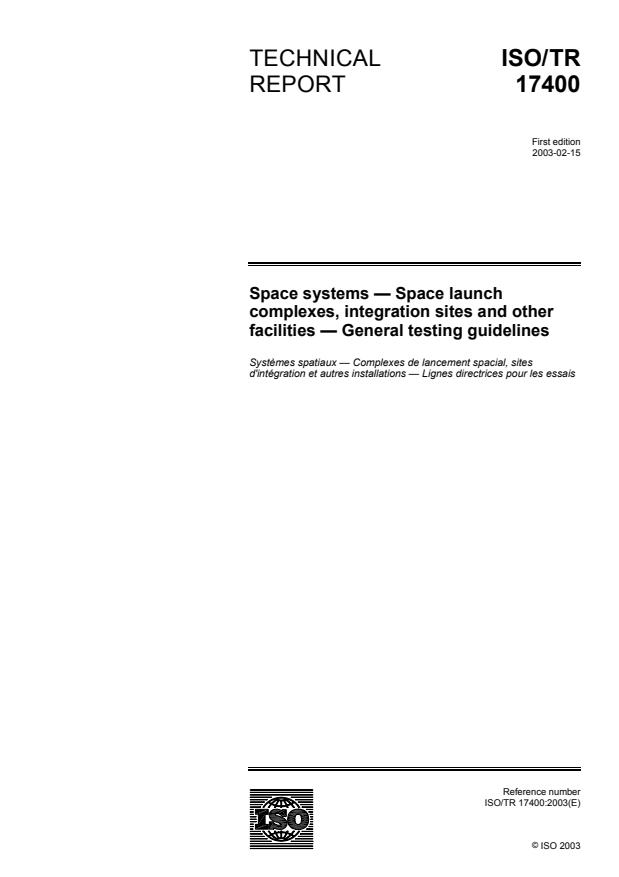
TECHNICAL ISO/TR
REPORT 17400
First edition
2003-02-15
Space systems — Space launch
complexes, integration sites and other
facilities — General testing guidelines
Systèmes spatiaux — Complexes de lancement spacial, sites
d'intégration et autres installations — Lignes directrices pour les essais
Reference number
©
ISO 2003
PDF disclaimer
This PDF file may contain embedded typefaces. In accordance with Adobe's licensing policy, this file may be printed or viewed but
shall not be edited unless the typefaces which are embedded are licensed to and installed on the computer performing the editing. In
downloading this file, parties accept therein the responsibility of not infringing Adobe's licensing policy. The ISO Central Secretariat
accepts no liability in this area.
Adobe is a trademark of Adobe Systems Incorporated.
Details of the software products used to create this PDF file can be found in the General Info relative to the file; the PDF-creation
parameters were optimized for printing. Every care has been taken to ensure that the file is suitable for use by ISO member bodies. In
the unlikely event that a problem relating to it is found, please inform the Central Secretariat at the address given below.
© ISO 2003
All rights reserved. Unless otherwise specified, no part of this publication may be reproduced or utilized in any form or by any means,
electronic or mechanical, including photocopying and microfilm, without permission in writing from either ISO at the address below or
ISO's member body in the country of the requester.
ISO copyright office
Case postale 56 • CH-1211 Geneva 20
Tel. + 41 22 749 01 11
Fax + 41 22 749 09 47
E-mail copyright@iso.org
Web www.iso.org
Published in Switzerland
ii © ISO 2003 — All rights reserved
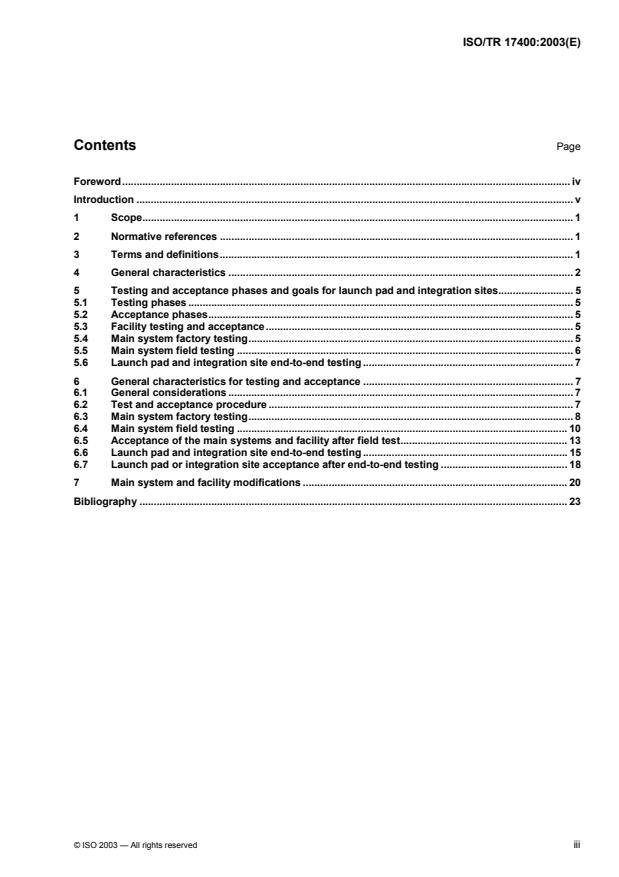
Contents Page
Foreword. iv
Introduction . v
1 Scope. 1
2 Normative references. 1
3 Terms and definitions. 1
4 General characteristics. 2
5 Testing and acceptance phases and goals for launch pad and integration sites. 5
5.1 Testing phases. 5
5.2 Acceptance phases. 5
5.3 Facility testing and acceptance. 5
5.4 Main system factory testing. 5
5.5 Main system field testing . 6
5.6 Launch pad and integration site end-to-end testing . 7
6 General characteristics for testing and acceptance . 7
6.1 General considerations. 7
6.2 Test and acceptance procedure . 7
6.3 Main system factory testing. 8
6.4 Main system field testing . 10
6.5 Acceptance of the main systems and facility after field test. 13
6.6 Launch pad and integration site end-to-end testing . 15
6.7 Launch pad or integration site acceptance after end-to-end testing . 18
7 Main system and facility modifications . 20
Bibliography . 23
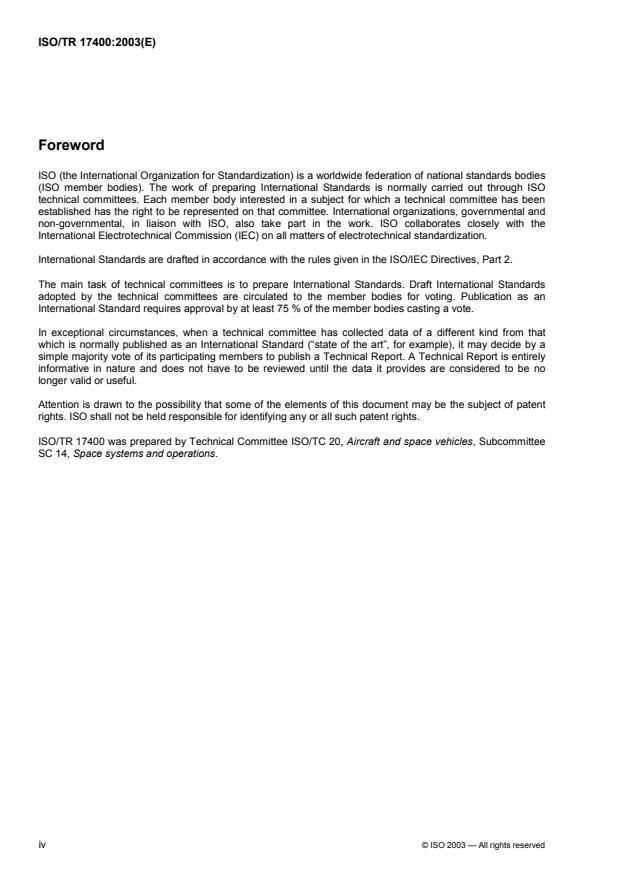
Foreword
ISO (the International Organization for Standardization) is a worldwide federation of national standards bodies
(ISO member bodies). The work of preparing International Standards is normally carried out through ISO
technical committees. Each member body interested in a subject for which a technical committee has been
established has the right to be represented on that committee. International organizations, governmental and
non-governmental, in liaison with ISO, also take part in the work. ISO collaborates closely with the
International Electrotechnical Commission (IEC) on all matters of electrotechnical standardization.
International Standards are drafted in accordance with the rules given in the ISO/IEC Directives, Part 2.
The main task of technical committees is to prepare International Standards. Draft International Standards
adopted by the technical committees are circulated to the member bodies for voting. Publication as an
International Standard requires approval by at least 75 % of the member bodies casting a vote.
In exceptional circumstances, when a technical committee has collected data of a different kind from that
which is normally published as an International Standard (“state of the art”, for example), it may decide by a
simple majority vote of its participating members to publish a Technical Report. A Technical Report is entirely
informative in nature and does not have to be reviewed until the data it provides are considered to be no
longer valid or useful.
Attention is drawn to the possibility that some of the elements of this document may be the subject of patent
rights. ISO shall not be held responsible for identifying any or all such patent rights.
ISO/TR 17400 was prepared by Technical Committee ISO/TC 20, Aircraft and space vehicles, Subcommittee
SC 14, Space systems and operations.
iv © ISO 2003 — All rights reserved
Introduction
This Technical Report establishes the general characteristics related to testing at launch pad and integration
sites for launch vehicle and spacecraft.
The purpose of this Technical Report is to establish the uniform practices for organizing the tests and
promoting verification of all parameters and characteristics of various launch complexes. It is necessary to
define the functions and to coordinate the activities of all the test participants, namely, the developers of
complexes and systems, the manufacturers of systems and equipment, the organizers of tests, the customer,
and others.
This Technical Report establishes recommended test activities and lists who will be responsible for the testing
at launch pad and integration sites for launch vehicle and spacecraft.
TECHNICAL REPORT ISO/TR 17400:2003(E)
Space systems — Space launch complexes, integration sites
and other facilities — General testing guidelines
1 Scope
This Technical Report is applicable to new projects and programs and to redesigned and upgraded launch
pad and integration sites. This Technical Report establishes the testing phases, goals, and general aspects
for launch space complexes and complexes for assembly and tests of a vehicle and spacecraft and the
associated equipment that, after successful testing, will be ready for launch vehicle processing and launch.
This Technical Report may be applicable to the creation of international launch pad and integration sites. At
creation of new launching space complexes and complexes for assembly and tests of a vehicle and
spacecraft (or at their modernization) within the framework of one country, the rules established by that
country may be applied.
2 Normative references
The following referenced documents are indispensable for the application of this document. For dated
references, only the edition cited applies. For undated references, the latest edition of the referenced
document (including any amendments) applies.
ISO 9000:2000, Quality management systems — Fundamentals and vocabulary
3 Terms and definitions
For the purposes of this document, the terms and definitions given in ISO 9000:2000 and the following apply.
3.1
integration site
equipment and facility designed for launch vehicle storage, assembly, testing, preparation, maintenance,
servicing and preparation for transportation to the launch pad
3.2
international launch site
land, ground/airborne/marine facilities, equipment, utilities, and infrastructure, created with the cooperation of
several countries or the entities that belong to more than one country, necessary for the launch operations of
launch vehicle and payload and for in-flight operations during the launch phase
3.3
launch pad
equipment and facility designed to provide for the pre-launch and launch operations of spacecraft
3.4
launch pad site end-to-end testing
integration site end-to-end testing
launch pad or integration site development phase including the testing and evaluation of its overall readiness
to support a launch vehicle and a spacecraft
3.5
launch pad site support system
integration site support system
component launch pad or integration site, which enables the main system to operate
3.6
main system
launch pad or integration site or components primarily responsible for providing preparation and launch of a
launch vehicle or spacecraft
3.7
main system factory testing
launch pad or integration site development phase that includes the testing of a completely assembled and
checked out main system to determine its operational readiness to be shipped to the operational launch pad
or integration site for further testing or operation
3.8
main system field testing
launch pad or integration site development phase including the testing of an assembled, fully equipped, and
checked out (or factory tested) main system; the testing is conducted at the operational launch pad or
integration site to determine the system readiness for further testing or operation
3.9
test supervision
acceptance team
group of experts formed by the customer (organization, company, etc.) with the goal of coordinating work
during specific testing or acceptance phases
4 General characteristics
4.1 Testing of launch pad and integration sites and the main systems should be conducted in accordance
with the regulatory and design documentation specifications.
4.2 The test supervision team should coordinate use of the launch pad and integration site and the system
testing process and work management.
4.3 The launch pad and integration site developer should be the technical manager during the launch pad
and integration site and system testing.
4.4 Appointments to test supervision and acceptance team should be determined according to company or
agency recommendations before the beginning of a related testing phase.
Customer representatives should participate in team activities and sign respective documents in the event the
representatives are employees of the company or agency.
4.5 Customer representatives participating in the testing may work in a Joint Control and Acceptance Group
(JCAG). JCAG functions should be determined in agreements developed by the customer.
4.6 The system testing and acceptance team should have the authority to convene representatives of
design and unit manufacturing organizations. These representatives should be involved in:
factory testing (the system manufacturing organization);
field testing (the test organization);
end-to-end testing (the team chairman).
2 © ISO 2003 — All rights reserved
4.7 Depending on the results of the analysis of malfunctions or failures found in the course of testing, the
team should have the authority to:
continue testing without repeating the operations completed earlier;
repeat the testing starting with a specific phase;
repeat the testing from the beginning.
4.8 If failures occurred in the testing or the system was subjected to changes, the test supervision team
should have the authority to increase the scope of testing as necessary.
4.9 The test supervision team should have the authority to suspend or terminate testing in the event of the
following situations:
occurrence of an emergency posing a hazard to personnel safety;
failures;
systems revealed to be out of conformance with the design specifications or documentation.
In these cases, the team should report to the body that appointed the team indicating the reasons for such a
termination (suspension) and provide the necessary documentation.
4.10 Testing suspended in accordance with 4.9 should be restarted only upon permission from the body that
appointed the team.
4.11 Personnel permitted to perform testing should have the skills required to operate the main systems
within the range of their operational duties and should have passed tests on the knowledge of the equipment,
its operating instructions, safety regulations, and test programs and procedures.
4.12 Personnel working in hazardous conditions or with harmful substances should undergo a medical
examination prior to commencement of duties and annually thereafter.
4.13 Launch pad and integration site safety precautions should be taken before the beginning of testing or
experimental and research tasks.
4.14 The organization should ensure safety requirements are observed and appropriate safety documents
are maintained.
4.15 During system testing and acceptance, interested organizations may conduct experimental and
research projects under special programs.
4.16 In the event experimental and research activities require the use of mock-ups of launch vehicles,
spacecraft, or testing equipment, the special programs and reports should be cleared with the space complex
development organization.
4.17 Those main system items that fail during the tests should be replaced upon the team decision.
4.18 When any test fails, the cause of the failure should be established and eliminated.
4.19 Verify that the cause of the failure has been eliminated and continue testing:
In case of a first-time (including independent elimination) failure (test team chairman), the tests continue
from the moment of the termination.
In case of recurrence of the same failure (test team chairman), the amount of retest is determined by the
test team chairman depending on character of failure.
In case of occurrence of the same failure in a third time (enterprise-developer of the main system together
with the enterprise-manufacturer and representative customer), the tests are completely repeated. The
differences among the developer of the main system, manufacturer, and representative customer are
resolved by the developer of the launch pad (integration site) and customer.
4.20 Malfunctions and failures identified in the course of testing should be eliminated by the organizations
responsible for the cause of these malfunctions and failures.
4.21 During test preparation, performance, and finalization and during the acceptance of the launch pad and
integration sites, main systems, and facilities, the organization in charge of the related work should process
reports under the procedure established in accordance with its respective national aerospace industry
practices.
4.22 The final decision on the results of the main system test and acceptance for operation should be made
by the launch pad and integration site developers.
4.23 During the testing of main systems, a test log should be maintained. The following should be entered
into the log:
list of completed operations;
test progress report;
defects, malfunctions, failures, deviations or functioning irregularities of the main system found during
testing;
methods for correcting the defects, malfunctions and failures;
information on fine tuning or adjustments that may have been made;
information about replaced components;
main system nonconformity’s with the design documentation specifications;
main system operating times on a daily or per-operation basis;
decisions regarding test programs and/or procedure updates;
suggestions for main system design and schemes improvement.
4.24 Implementation of the main system and the changes required for the elimination of failures should be
implemented on the basis of the design documents authorizing the changes. If necessary, change the design
documentation.
4.25 The procedure and timing for the submission of claims for faulty or incomplete main systems or for poor
quality should be in accordance with the regulations accepted in the respective national space industry.
4.26 Companies should finalize (approve and adopt) test programs and procedures within 30 calendar days
of receipt (or agreed specified date between related organizations).
4.27 In performing the facility and assembly work, the test organization and the chief engineering system and
facilities development organization should, on a regular basis, ensure job quality control, building code
compliance control, technical specification conformance control, and design document requirement
conformance control. Experts from the operations or test organizations and the customer should be involved
in the control.
4 © ISO 2003 — All rights reserved
5 Testing and acceptance phases and goals for launch pad and integration sites
5.1 Testing phases
The following main system and launch pad and integration site testing phases should be adopted:
main system factory testing;
main system field testing;
launch pad and integration site end-to-end testing.
If necessary or on demand of the customer, other extra phases of tests are possible also.
5.2 Acceptance phases
The following main system and launch pad and integration site acceptance phases should be adopted:
main system acceptance after factory testing;
main system and facility acceptance after field testing;
launch pad and integration site acceptance after end-to-end testing.
5.3 Facility testing and acceptance
Facility testing and acceptance should be accomplished in conformance with the established respective
national aviation and space industry practice and the facility specifications.
5.4 Main system factory testing
Main system factory testing should be conducted to verify the main system conformance to the design
specifications and documentation, the operational readiness requirements, the main system acceptance by
the customer’s representatives, and system readiness for shipping to the assembly launch pad or integration
site for further testing. The goals of the main system factory testing are:
verification of main system completeness;
verification of main system operational readiness and functioning interfaces and conformance to the
design specifications and documentation;
verification of the correct interaction and functioning of the item;
verification of system compatibility and operation with the components of the launch vehicles, spacecraft,
and main systems of the launch pad, as necessary;
verification of the accuracy of the adopted design approaches;
verification of the feasibility of the assembly process;
verification of the serviceability of the protective devices and electrical interlocks in emergency modes;
verification of the main system operational readiness and strength at the extreme parameter values
indicated in the design specifications;
verification of the adequacy and completeness of operations documentation;
verification of the adequacy and applicability of the tools, devices, and instruments required for the main
system operation;
verification of the adequacy of the operational safety provisions;
verification of maintenance and repair accessibility;
verification of the quality of manufacturing, assembly, and checkout;
dating the scope of the main system field testing;
verification of transportability;
evaluation of the main system’s reliability;
verification of the availability of component reliability documents (for experimental items only);
verification of test metrological support.
5.5 Main system field testing
The main system field testing should be conducted for the purpose of verifying main system operational
readiness and determining system readiness for end-to-end testing (in the event the main systems are
designated to undergo the end-to-end testing) or other subsequent tests (if necessary). The main system field
testing goals are:
verification of main system completeness;
verification of main system assembly and checkout quality;
verification of main system operational readiness and functioning interfaces and conformance to the
design specifications and documentation;
verification of the main system compatibility and operation with the launch pad and integration site’s other
main systems and facilities, as necessary;
verification of the adequacy of the main system operation safety instructions indicated in the operations
documentation;
verification of maintenance and repair accessibility;
verification of the human habitability conditions (lighting, ventilation, heating, harmful gas content, etc.);
verification of the adequacy of the operations personnel;
verification of the efficiency of modifications made based on the factory test results;
verification of the sufficiency and serviceability of the tools, devices, and instruments required for main
system operation;
evaluation of the main system’s reliability;
verification of test metrological support.
6 © ISO 2003 — All rights reserved
5.6 Launch pad and integration site end-to-end testing
The end-to-end testing should be conducted for the purpose of verifying the launch pad and integration site
operational readiness and determining the launch pad and integration site readiness for launch or other
subsequent tests (if necessary). The end-to-end launch pad and integration site testing goals are:
verification of the launch pad and integration site operational readiness and its conformance to the design
specifications and documentation during standard operations involving launch vehicles and spacecraft
under conditions closely approximating those conditions of actual operations but in which testing does not
require the actual launching of a launch vehicle;
verification that the launch pad and integration site is complete;
verification and update of the operational sequences of the main items during launch vehicle preparation,
launch, aborted launch, and preparation for a post-abort launch;
verification and update of the time requirements for the main system operational procedures;
verification of the accuracy of the adopted design approaches;
verification of the compatibility of the main systems in the process sequences as well as with launch
vehicles and spacecraft;
verification and update of the requirements and skill level of the operations personnel;
verification and update of the completeness and adequacy of the operations documentation;
verification of the adequacy of the safety maintenance of the launch pad and integration site and main
systems, including emergency situations;
evaluation of the supply of spare parts and tools;
update the procedure for launch pad and integration site maintenance and post-launch refurbishment;
verification of the adequacy of the measures taken to eliminate failures and malfunctions based on the
results of previous and end-to-end testing;
evaluation of launch pad and integration site reliability;
verification of metrological support.
6 General characteristics for testing and acceptance
6.1 General considerations
Nature of the testing toward acceptance of the launch pad and integration launch pad and integration site and
the duties of each participating organizations are described generally in this section. Exact definition of the
acceptance condition, testing, and the duties of the participating organizations should be identified in the
individual contract document.
6.2 Test and acceptance procedure
The following procedure should be adopted for test and acceptance:
a) facility and support system test and acceptance should be conducted in accordance with the national
aviation and space industry practice;
b) factory main system test;
c) main system acceptance after factory test;
d) main system field testing;
e) main system and facility acceptance after field test;
f) end-to-end testing;
g) launch pad and integration site acceptance for operation as part of the space complex.
6.3 Main system factory testing
6.3.1 The factory test team should be formed by the manufacturing organization at least 30 calendar days
prior to the beginning of testing (or agreed specified date between related organizations).
6.3.2 During the factory testing involving individual items of the launch vehicle, spacecraft, and other main
systems, the factory test team should include representatives of the organizations in charge of the launch
vehicle, spacecraft, and other main system development and grant the representatives the status of team
members.
6.3.3 Ten working days before the test (or agreed specified date between the related organizations), the
manufacturing organization should submit the following documentation to the team:
a) design specifications;
b) complete set of the design documentation updated as of the date the testing begins, including:
1) test program and procedures;
2) measurement procedures, as necessary.
c) documents for the test equipment (benches, devices, instruments, etc.) that verify readiness for testing;
d) test schedule;
e) list of deviations from the design documentation that occurred during the manufacturing of the main
system at the manufacturing organization;
f) records and technical reports on the test results of specific items;
g) report on the electric equipment insulation resistance included in the main system or connected thereto
and the electric equipment of the cable network connected thereto;
h) acceptance records for the assembly of grounding and static electricity protection devices;
i) list of design identified modifications during the testing process as well as the set of documents
authorizing these modifications;
j) reports on the testing or work completed before the beginning of the factory testing;
k) submission note;
l) test log.
6.3.4 During the factory testing, supervision team, and also the organizations participating in tests (the
launch pad (integration site) developer, main system and unit developer and manufacturer, and customer)
should execute the following activities:
submission of the documentation required for main system 2 months prior to the beginning of the testing
(or specified date agreed between related organizations);
8 © ISO 2003 — All rights reserved
test organization;
assurance and control of the completeness and quality of the test in accordance with the test program
and procedures;
technical supervision of the testing and involvement of the organization representatives in the testing;
elimination of faults and failures identified in the course of testing and adaptation of aggregates under the
documentation authorizing this adaptation;
development and approval of the documentation authorizing the changes resulting from the test;
correction of design documentation as necessary;
analysis and evaluation of test results;
main system maintenance in accordance with the operations documentation;
provisioning of required benches, devices, instruments, control means, measuring devices, etc;
replenishment of used parts and consumed materials;
submission of the main unit for acceptance by the customer representative at the main system
manufacturing organization;
main system acceptance;
shipment of the main system accepted by the customer representative according to contracts and
schedules;
issuance of a system acceptance certificate to the main system manufacturing organization and approval
of the certificate and data sheet;
notification for the recipient of the shipment of the accepted main system in accordance with the contract
and schedule.
6.3.5 A completely equipped and checked-out main system accepted by the technical supervision body of
the main system manufacturing organization should be allowed to undergo factory testing.
6.3.6 The main system manufacturer/developer should develop a test schedule that should be approved by
the main system developer, launch pad developer, and the customer representatives.
6.3.7 Logistics support of the main system testing should be supplied by the main system manufacturing
organization.
6.3.8 If the testing is conducted with the use of a launch vehicle, spacecraft, or other main system devices
and items, the respective manufacturing organizations should provide the devices and items in accordance
with the main system manufacturing organization requirements.
6.3.9 After the test program is completed, the following should be performed:
the manufacturing organization and the customer representative should execute required entries in the
main system data log;
the test team should supply the test certificate, the factory test report, the list of malfunctions and failures
identified during testing, and suggestions for main system improvements (as an enclosure to the
certificate) and send copies of these documents and documents listed in 6.3.4 to the manufacturer
organization.
6.3.10 The main system should be accepted if:
the testing was successful;
the system is complete with documentation, spare parts, and accessories;
the system is approved by the customer representative at the main system manufacturing organization;
the customer representative has executed an entry about the approval of the main system for the field
testing into the main system data log.
6.3.11 The main system manufacturing organization should forward the test data package within 20 calendar
days and the test report within 30 calendar days after the completion of the test (or agreed specified date
between the related organizations) to the following parties:
main system and launch pad (integration site) developer and the customer representatives;
customer representative at the main system manufacturing organization;
test organization.
6.3.12 Within 10 working days after issuance of the test data package (or agreed specified date between the
related organizations), the main system manufacturing organization should send pertinent extracts from the
package to interested organizations for making decisions and suggestions for correcting malfunctions and
failures that occurred during testing.
6.3.13 Shipment of approved equipment and components should be arranged by the manufacturer and
customer in accordance with international and/or national regulations.
6.3.14 If the main system developer makes a recommendation and it is approved by the launch pad and
integration site developer, the customer, the general supplier, and the main system manufacturing
organization, the full scope of the main system factory testing may not be performed in the following cases:
a) if the complete main system assembly is not possible because the required industrial space and/or
equipment and auxiliaries are not available;
b) if it is not feasible to develop expensive testing equipment and auxiliaries;
c) if it is not possible to disassemble the main system without degrading its quality.
In these situations, the main system should be tested at the main system manufacturing organization (or
organizations) and the interaction among all the parties during the main system assembly and checkout
should be defined in the decision.
6.3.15 Upon completion of the main system testing, the customer representative should provide an
assessment of the main unit for approval of the assembly and field testing, including a comment on the main
system data log.
6.3.16 Upon completion of the main system assembly and checkout as indicated in 6.3.14, the factory testing
should be included in the field testing.
6.4 Main system field testing
6.4.1 The test team should be appointed by the test organization 20 calendar days prior to the start of
testing (or agreed specified date between the related organizations).
6.4.2 If testing involves the team of the launch vehicle, spacecraft, or other main systems, the
representatives of the launch vehicle, spacecraft, and other main system developers should be involved in test
team activities.
10 © ISO 2003 — All rights reserved
6.4.3 Ten calendar days prior to the beginning of testing (or agreed specified date between the related
organizations), the general supplier (if the main system is assembled at the operational launch pad or
integration site) or the main system manufacturing organization (if the main system is not assembled at the
operational launch pad or integration site) should submit to the team the following documentation:
a) technical specifications;
b) full set of the design documentation, corrected for the start of field test, including:
1) test program and procedures;
2) measurement procedures;
c) test equipment documentation (for benches, auxiliary instruments, etc.) verifying equipment applicability
for the testing;
d) field test schedule;
e) list of deviations from the design documentation that occurred during the main system assembly;
f) records of the insulation resistance testing to higher voltage, if necessary;
g) records of electrical equipment insulation resistance testing included in the main system or switched to it
as well as the cable network;
h) acceptance records of the protective grounding unit assemblies and the main system static electricity
protection units;
i) list of documents authorizing the modifications and alterations to the design documentation, in
accordance with an established list, and the documents relating to their implementation;
j) submission note;
k) data package and test report for factory testing and acceptance;
l) data package for main unit checkout (if the main system is assembled at the operational launch pad or
integration site);
m) records showing the correction of the testing malfunctions and failures as well as for the implementation
of recommended improvements that require implementation before the beginning of field testing;
n) testing log;
o) assembly documentation in accordance with design specifications (if the main system is assembled at the
operational launch pad or integration site);
p) results of the metrology expert’s evaluation at the factory testing phase;
q) records showing the implementation of the metrology expert’s recommendation conducted during the
factory testing phase.
6.4.4 The representatives of the launch pad and integration site and main system developer and the
customer should participate in the field testing.
6.4.5 One of the following conditions should be met before field testing the main system:
the main system should be assembled at the operational launch pad or integration site, equipped and
checked out, and should be accepted by the project management department of the assembly
organization and by the customer representative and should include in its data log the approval of the
assembly organization and the customer representatives for field testing; or
the main system should be fully equipped and factory tested, should be accepted by the project
management body of the main system manufacturing organization and by the customer representative,
and should include in the data log the approval of the main system manufacturing unit and the customer
representatives for field testing.
6.4.6 Before field testing, the main system:
should be prepared for testing in accordance with the operation’s manual. If the main system was
subjected to factory testing, the manual should have been updated to reflect factory test results;
should pass the tests indicated in the operations documentation;
should not include any equipment with expired technical certification.
6.4.7 The facility and support systems should be accepted for testing in the course of testing the respective
main systems.
6.4.8 The measurement system of the main system should pass its own field testing before performance of
the main system field testing to provide required measurements.
6.4.9 During the field testing, the supervision team and the organizations participating in tests that may
include the launch pad or integration site developer, the main system and unit developer and manufacturer,
the customer, the general supplier, and the organization executing assembly, checkout, and tests should
execute the following activities:
submission of the documentation required for main system 2 months prior to the beginning of the testing
(or specified date agreed between related organizations);
timely preparation of the main system for testing;
test organization;
assurance and control of the completeness and quality of the test in accordance with the test program
and procedures;
technical supervision of the testing and involvement of the organization representatives in the testing;
elimination of faults and failures identified in the course of testing and adaptation of aggregates under the
documentation authorizing this adaptation;
development and approval of the documentation authorizing the changes resulting from the test;
correction of design documentation as necessary;
analysis and evaluation of test results;
main system maintenance in accordance with the operations documentation;
provisioning of required benches, devices, instruments, control means, measuring devices, etc;
replenishment of used parts and consumed materials;
submission of the main unit for acceptance by the customer;
12 © ISO 2003 — All rights reserved
main system storage and the completion of maintenance operations documentation specifications from
the time of receipt of the main assembly from the main assembly manufacturing organization (if the main
assembly is not assembled at the operational launch pad or integration site) and from the time of
submission of the main system for field testing by the general supplier (if the main system is assembled at
the operational launch pad or integration site) and during testing.
6.4.10 The main system developer should develop a test schedule that should be approved by the main
system manufacturer, the launch pad developer, and the customer representatives.
6.4.11 The main system manufacturer should provide test logistics support. If, by mutual agreement between
the main system developer and the customer, both the test organization and the general supplier need to be
involved in the test logistics support, the test procedure and schedule should be agreed to by the test
organization and by the general supplier.
6.4.12 The space complex developer should provide the testing and funding for the propulsion system
propellants, gases, etc., in accordance with the direction of the launch pad or integration launch pad and
integration site developer.
6.4.13 Respective manufacturers should supply the standard test items and devices of the launch vehicle,
spacecraft, and other main systems required for testing in accordance with the instructions agreed to
previously and submitted by the main system developers.
6.4.14 The main system manufacturer should deliver special items, auxiliary instruments and tools together
with the main system before the testing starts.
6.4.15 The team that conducted the testing should provide the following documents upon the completion of
the test program and transmit these documents to the testing organization:
test completion data package;
test report;
list of malfunctions and failures and recommendations for final improvements (include as an enclosure to
the certificate).
6.4.16 After approval of the data package testing, the general supplier or the main system manufacturer
should submit the main system to the acceptance team of the operations organization.
6.4.17 Upon completion of the testing, the following should be accomplished:
if the main systems are not assembled at the operations launch pad or integration site, the operations
organization representative should approve the data log at the main system manufacturing organization
authorizing main system operation;
in addition, if the main systems are assembled at the operations launch pad and integration site, the main
system manufacturing organization should complete the acceptance certificate and warranty obligations.
6.4.18 The test organization should send the test data package within 10 calendar days and the test report
within 30 calendar days (or agreed specified date between the related organizations) to the interested parties.
6.5 Acceptance of the main systems and facility after field test
6.5.1 The operations organization should appoint the main system and facility acceptance team within
5 working days (or agreed specified date between the related organizations) after the written notifications
about the completion of the field testing and the main system and facility readiness for acceptance. The
notifications should be sent to the inspection team by the following organizations:
general supplier, if the main system was assembled at the operational launch pad or integration site;
field test team, if the main system was not assembled at the operational launch pad or integration site.
6.5.2 The acceptance team should have the following duties:
verification of the conformance of the facility and assembly to specifications in accordance with design
and cost estimate documentation, standards, facility standards, and regulations;
verification of the completeness of the main system testing based on field test certificates;
quality evaluation of t
...
Questions, Comments and Discussion
Ask us and Technical Secretary will try to provide an answer. You can facilitate discussion about the standard in here.
Loading comments...