

ISO 17325-1:2014
(Main)Ships and marine technology — Marine environment protection — Oil booms — Part 1: Design requirements
General Information
- Abstract
ISO 17325-1:2014 specifies the basic design requirements, general function, designations and marking of oil booms. It further specifies minimum information regarding design, dimensions and materials of oil booms to be provided by the manufacturer. The intent of ISO 17325-1:2014 is to assist manufacturers and facilitate user selection of booms by technical criteria. It does not purport to address all aspects of booms or safety concerns associated with boom use, nor does it define boom operational procedures. It is the responsibility of the user of this International Standard to establish the appropriate safety and health practices, and determine applicability of regulatory limitations.
- Status
- Published
- Publication Date
- 12-Jun-2014
- Technical Committee
- ISO/TC 8/SC 2 - Marine environment protection
- Drafting Committee
- ISO/TC 8/SC 2 - Marine environment protection
- Current Stage
- 9060 - Close of review
- Completion Date
- 02-Dec-2030
Buy Documents
ISO 17325-1:2014 - Ships and marine technology — Marine environment protection — Oil booms — Part 1: Design requirements Released:6/13/2014
ISO 17325-1:2014 - Ships and marine technology — Marine environment protection — Oil booms — Part 1: Design requirements Released:7/1/2016
Overview
ISO 17325-1:2014 - Ships and marine technology - Marine environment protection - Oil booms - Part 1: Design requirements defines the basic design, designation and marking expectations for oil booms. The standard helps manufacturers and buyers by specifying minimum information on boom design, dimensions and materials, classifications by environmental conditions, and essential technical topics such as forces acting on boom assemblies. It does not prescribe operational procedures or full safety practices - users remain responsible for health, safety and regulatory compliance.
Key topics and technical requirements
- Scope and intent: Assist manufacturers and facilitate user selection via technical criteria; exclude operational procedures and exhaustive safety guidance.
- Parts of a boom: boom wall, buoyancy chamber, skirt, tension member, ballast, end connectors and anchor points.
- Types of booms:
- Curtain booms (flexible skirt, high buoyancy-to-weight, offshore use)
- Fence booms (stiffened, solid floats, sheltered waters)
- Fire-resistant booms (for in-situ burning or repeated use with cooling systems)
- Shore sealing booms (inter-tidal sealing with dual water chambers and top air chamber)
- Functions & configurations: containment, deflection, protection; typical layouts include U-, V-, J-configurations and simple deflection deployments.
- Forces on boom assemblies: design must account for combined forces from towing, currents and wind - Annex A provides calculation guidance.
- Classification by environment: body-size classes linked to freeboard, draught and wave height (examples: Class A for calm water, Class B for sheltered, Class C for open water).
- Manufacturer data requirements: operational height, freeboard, draught, weight, section length, number/length of buoyancy chambers, bursting pressure (inflatable types), ballast type/material, boom wall and flotation materials, breaking strength of entire assembly, gross buoyancy-to-weight ratio, etc.
- Marking and designation: rules for labeling and providing manufacturer specifications and test certificates (see Part 1 for marking basics).
Applications and users
ISO 17325-1:2014 is essential for:
- Boom manufacturers and component suppliers (design specification, material selection, labelling)
- Procurement officers and equipment specifiers (selecting suitable booms by environment and function)
- Oil spill response teams, port & harbor authorities, environmental agencies, naval architects, and marine consultants (understanding technical limits and intended use)
- Regulators and standards bodies (harmonizing product information and compliance checks)
Related standards
- ISO 17325-2 (Strength and performance requirements - under preparation)
- ISO 16165 (Terminology for oil spill response)
- ASTM F1093, ASTM F1523 (boom connector testing/selection guidance)
- JIS F 9900 (Japanese boom design/manufacture guidance)
- IMO Manual on Oil Pollution (combating oil spills)
Keywords: ISO 17325-1:2014, oil booms, marine environment protection, design requirements, containment boom, curtain boom, fence boom, boom classification, manufacturer data.
Buy Documents
ISO 17325-1:2014 - Ships and marine technology — Marine environment protection — Oil booms — Part 1: Design requirements Released:6/13/2014
ISO 17325-1:2014 - Ships and marine technology — Marine environment protection — Oil booms — Part 1: Design requirements Released:7/1/2016
Get Certified
Connect with accredited certification bodies for this standard

DNV
DNV is an independent assurance and risk management provider.

BSI Group
BSI (British Standards Institution) is the business standards company that helps organizations make excellence a habit.

Bureau Veritas
Bureau Veritas is a world leader in laboratory testing, inspection and certification services.
Sponsored listings
Frequently Asked Questions
ISO 17325-1:2014 is a standard published by the International Organization for Standardization (ISO). Its full title is "Ships and marine technology — Marine environment protection — Oil booms — Part 1: Design requirements". This standard covers: ISO 17325-1:2014 specifies the basic design requirements, general function, designations and marking of oil booms. It further specifies minimum information regarding design, dimensions and materials of oil booms to be provided by the manufacturer. The intent of ISO 17325-1:2014 is to assist manufacturers and facilitate user selection of booms by technical criteria. It does not purport to address all aspects of booms or safety concerns associated with boom use, nor does it define boom operational procedures. It is the responsibility of the user of this International Standard to establish the appropriate safety and health practices, and determine applicability of regulatory limitations.
ISO 17325-1:2014 specifies the basic design requirements, general function, designations and marking of oil booms. It further specifies minimum information regarding design, dimensions and materials of oil booms to be provided by the manufacturer. The intent of ISO 17325-1:2014 is to assist manufacturers and facilitate user selection of booms by technical criteria. It does not purport to address all aspects of booms or safety concerns associated with boom use, nor does it define boom operational procedures. It is the responsibility of the user of this International Standard to establish the appropriate safety and health practices, and determine applicability of regulatory limitations.
ISO 17325-1:2014 is classified under the following ICS (International Classification for Standards) categories: 13.020.99 - Other standards related to environmental protection; 47.020.99 - Other standards related to shipbuilding and marine structures. The ICS classification helps identify the subject area and facilitates finding related standards.
ISO 17325-1:2014 is available in PDF format for immediate download after purchase. The document can be added to your cart and obtained through the secure checkout process. Digital delivery ensures instant access to the complete standard document.
Standards Content (Sample)
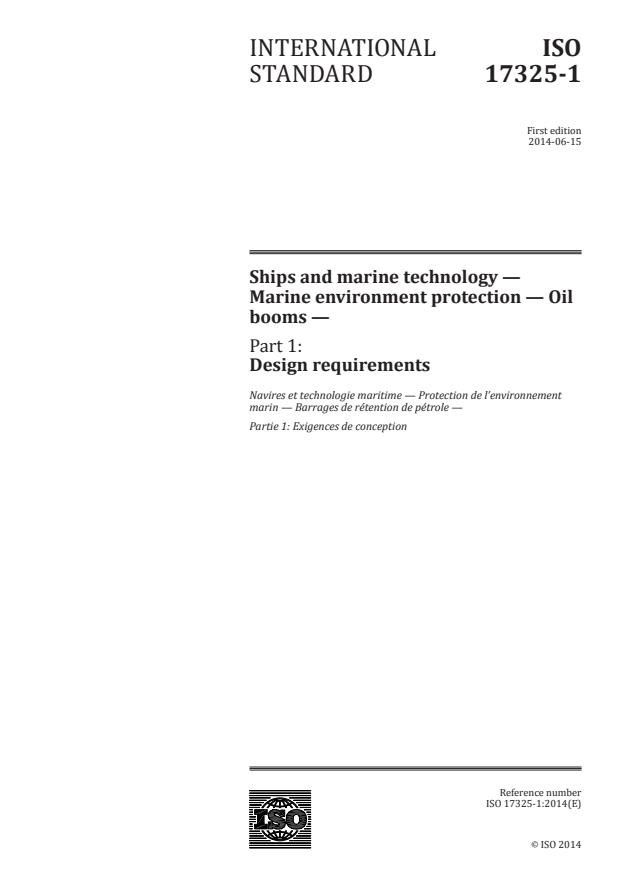
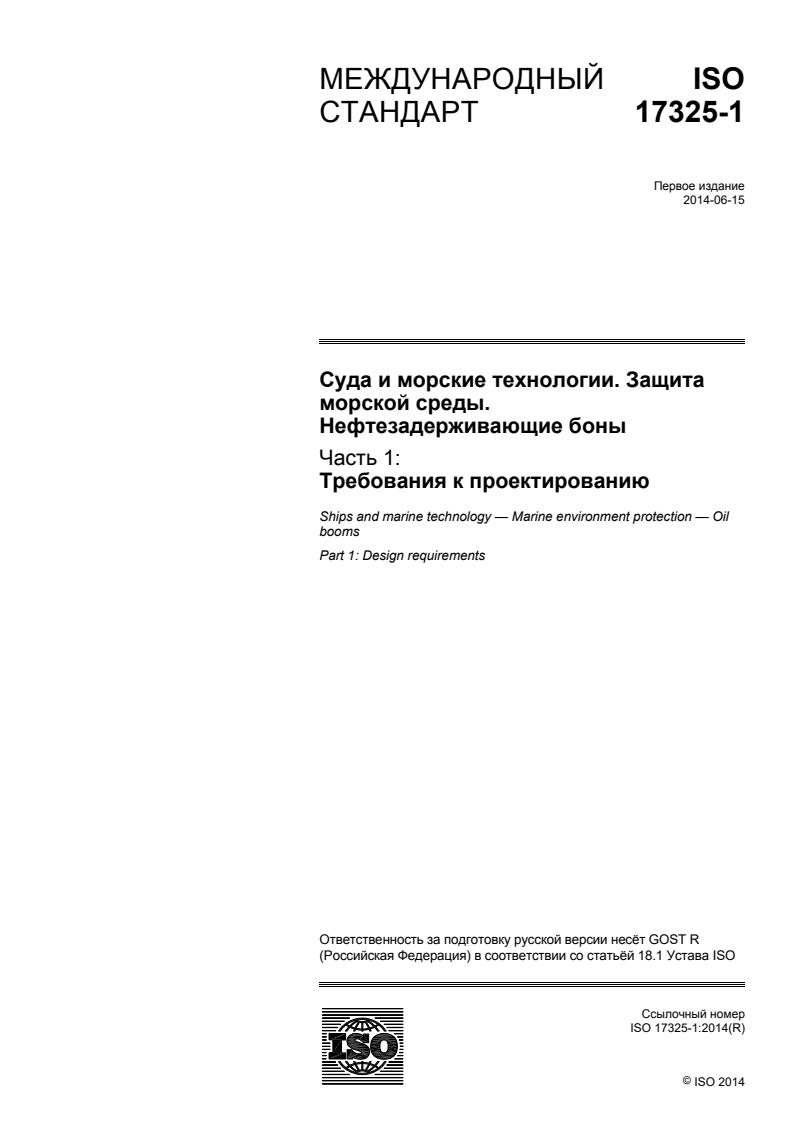
INTERNATIONAL ISO
STANDARD 17325-1
First edition
2014-06-15
Ships and marine technology —
Marine environment protection — Oil
booms —
Part 1:
Design requirements
Navires et technologie maritime — Protection de l’environnement
marin — Barrages de rétention de pétrole —
Partie 1: Exigences de conception
Reference number
©
ISO 2014
© ISO 2014
All rights reserved. Unless otherwise specified, no part of this publication may be reproduced or utilized otherwise in any form
or by any means, electronic or mechanical, including photocopying, or posting on the internet or an intranet, without prior
written permission. Permission can be requested from either ISO at the address below or ISO’s member body in the country of
the requester.
ISO copyright office
Case postale 56 • CH-1211 Geneva 20
Tel. + 41 22 749 01 11
Fax + 41 22 749 09 47
E-mail copyright@iso.org
Web www.iso.org
Published in Switzerland
ii © ISO 2014 – All rights reserved
Contents Page
Foreword .iv
Introduction .v
1 Scope . 1
2 Normative references . 1
3 Terms and definitions . 1
4 Boom design . 2
4.1 Application . 2
4.2 Environmental considerations . 2
4.3 Parts of booms . 2
4.4 Types of booms . 2
5 Boom functions and configurations . 3
5.1 General . 3
5.2 Containment . 3
5.3 Deflection . 3
5.4 Protection . 3
5.5 Configurations . 3
6 Forces on boom assemblies . 7
7 Classification of booms by environmental conditions . 7
8 Data requirements for manufacturers . 8
9 Designation and marking .10
9.1 General .10
9.2 Marking .10
Annex A (informative) Forces on boom assemblies — Calculations .11
Bibliography .13
Foreword
ISO (the International Organization for Standardization) is a worldwide federation of national standards
bodies (ISO member bodies). The work of preparing International Standards is normally carried out
through ISO technical committees. Each member body interested in a subject for which a technical
committee has been established has the right to be represented on that committee. International
organizations, governmental and non-governmental, in liaison with ISO, also take part in the work.
ISO collaborates closely with the International Electrotechnical Commission (IEC) on all matters of
electrotechnical standardization.
The procedures used to develop this document and those intended for its further maintenance are
described in the ISO/IEC Directives, Part 1. In particular the different approval criteria needed for the
different types of ISO documents should be noted. This document was drafted in accordance with the
editorial rules of the ISO/IEC Directives, Part 2. www.iso.org/directives
Attention is drawn to the possibility that some of the elements of this document may be the subject of
patent rights. ISO shall not be held responsible for identifying any or all such patent rights. Details of any
patent rights identified during the development of the document will be in the Introduction and/or on
the ISO list of patent declarations received. www.iso.org/patents
Any trade name used in this document is information given for the convenience of users and does not
constitute an endorsement.
For an explanation on the meaning of ISO specific terms and expressions related to conformity
assessment, as well as information about ISO’s adherence to the WTO principles in the Technical Barriers
to Trade (TBT), see the following URL: Foreword - Supplementary information
The committee responsible for this document is ISO/TC 8, Ships and marine technology, Subcommittee
SC 2, Marine environment protection.
ISO 17325 consists of the following parts, under the general title Ships and marine technology — Marine
environment protection — Oil booms:
— Part 1: Design requirements
The following parts are under preparation:
— Part 2: Strength and performance requirements
— Part 3: End connectors
— Part 4: Auxiliary equipment
iv © ISO 2014 – All rights reserved
Introduction
Oil booms can be classified in two major types:
— fence booms typically provide a stiffened barrier designed to float vertically in the water; and
— curtain booms are provided with flexible material for the underwater portion of the membrane
(called the skirt).
There are other types of booms, such as special purpose booms and sorbent booms, which are not the
subject of this part of the International Standard.
All parts of ISO 17325 will give some general guidelines for manufacturers as well as users with regard
to subjects associated with producing, purchasing, and using such types of equipment. It will not define
any specific type and size of boom for a particular application, as many variables have to be taken into
consideration.
This part of ISO 17325 specifies the basic design requirements, general function, designations and
marking of oil booms. It further specifies minimum information regarding design, dimensions and
materials of oil booms to be provided by the manufacturer.
This International Standard has been developed after considering the below standards and national
legislative requirements.
The American Society for Testing and Materials (ASTM) Committee F-20 has prepared two standards
relating to boom connectors. ASTM F1093 specifies static laboratory tests of the strength of an oil spill
response boom under tensile loading. ASTM F1523 provides a guide on the selection of a containment
boom that may be used to control spills of oil and other substances that float on the water.
The Japanese Industrial Standard JIS F 9900 (Parts 1 and 2) provides the necessary conditions and
specifications for the design, manufacture, etc. of oil booms.
INTERNATIONAL STANDARD ISO 17325-1:2014(E)
Ships and marine technology — Marine environment
protection — Oil booms —
Part 1:
Design requirements
1 Scope
This part of ISO 17325 specifies the basic design requirements, general function, designations and
marking of oil booms. It further specifies minimum information regarding design, dimensions and
materials of oil booms to be provided by the manufacturer.
The intent of this International Standard is to assist manufacturers and facilitate user selection of booms
by technical criteria. It does not purport to address all aspects of booms or safety concerns associated
with boom use, nor does it define boom operational procedures. It is the responsibility of the user of
this International Standard to establish the appropriate safety and health practices, and determine
applicability of regulatory limitations.
2 Normative references
The following documents, in whole or in part, are normatively referenced in this document and are
indispensable for its application. For dated references, only the edition cited applies. For undated
references, the latest edition of the referenced document (including any amendments) applies.
International Maritime Organization, Manual on Oil Pollution, Section IV, Combating Oil Spills, IMO
596E, London, 2004
ISO 34-1:2010, Rubber, vulcanized or thermoplastic — Determination of tear strength — Part 1: Trouser,
angle and crescent test pieces
ISO 505:1999, Conveyor belts — Method for the determination of the tear propagation resistance of textile
conveyor belts
ISO 1817:2011, Rubber, vulcanized or thermoplastic — Determination of the effect of liquids
ISO 16165:2013, Ships and marine technology — Marine environment protection — Terminology relating
to oil spill response
ISO 17325-2, Ships and marine technology — Marine environment protection — Oil booms — Part 2:
Strength and performance requirements
3 Terms and definitions
For the purposes of this document, the terms and definitions given in ISO 16165, ASTM F1093, and the
following apply.
3.1
end connector
device attached to the boom used for joining boom sections to one another or to other accessory devices
3.2
gross buoyancy
weight of fresh water displaced by an entire boom section when totally submerged
3.3
oil containment boom
floating barrier used to control the movement of substances that float
3.4
operational draught
minimum vertical depth of the boom below the waterline in the working condition
3.5
operational freeboard
minimum vertical height of the boom above the waterline in the working condition
3.6
tensile strength
force required to stretch boom material to the point where it fails and tears apart
4 Boom design
4.1 Application
A boom is dedicated for use in water. As its main purpose is to control the movement and/or stop
spreading of an oil slick and other substances o
...
МЕЖДУНАРОДНЫЙ ISO
СТАНДАРТ 17325-1
Первое издание
2014-06-15
Суда и морские технологии. Защита
морской среды.
Нефтезадерживающие боны
Часть 1:
Требования к проектированию
Ships and marine technology — Marine environment protection — Oil
booms
Part 1: Design requirements
Ответственность за подготовку русской версии несёт GOST R
(Российская Федерация) в соответствии со статьёй 18.1 Устава ISO
Ссылочный номер
©
ISO 2014
ДОКУМЕНТ ЗАЩИЩЕН АВТОРСКИМ ПРАВОМ
© ISO 2014
Все права сохраняются. Если не указано иное, никакую часть настоящей публикации нельзя копировать или использовать в
какой-либо форме или каким-либо электронным или механическим способом, включая фотокопии и микрофильмы, без
предварительного письменного согласия ISO по соответствующему адресу, указанному ниже, или комитета-члена ISO в стране
заявителя.
ISO copyright office
Case postale 56 CH-1211 Geneva 20
Tel. + 41 22 749 01 11
Fax + 41 22 749 09 47
E-mail copyright@iso.org
Web www.iso.org
Опубликовано в Швейцарии
ii © ISO 2014 – Все права сохраняются
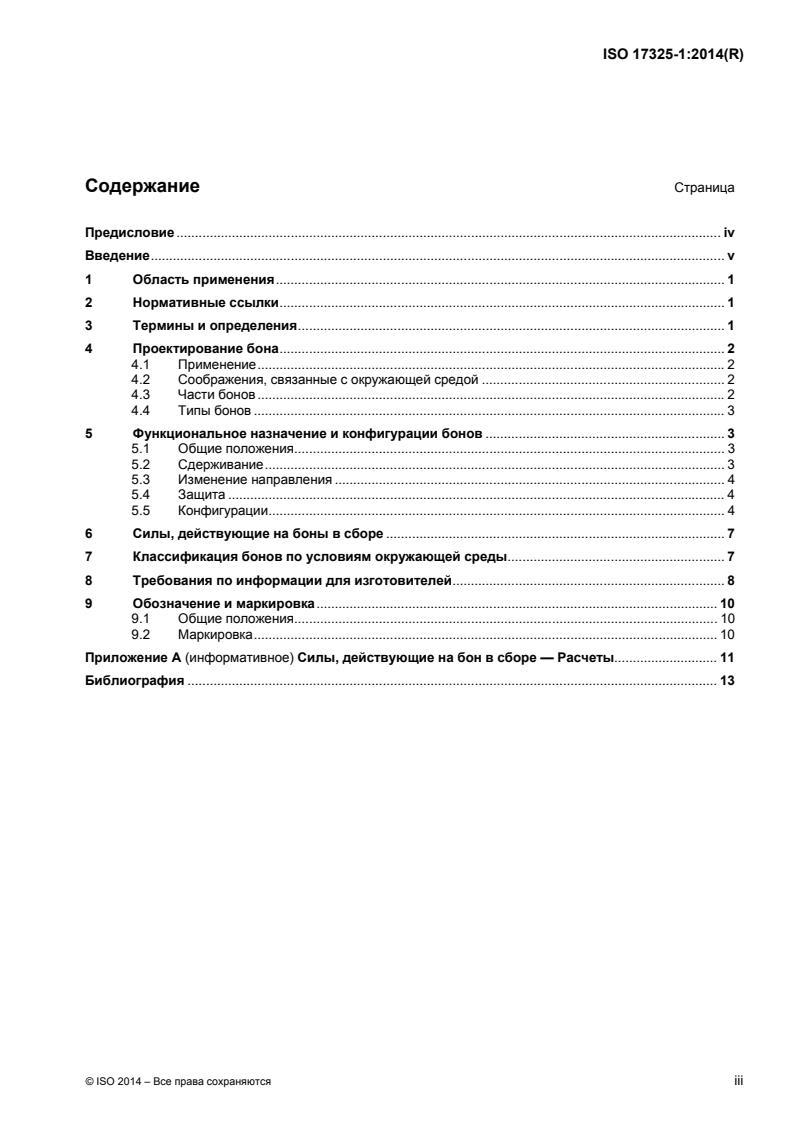
Содержание Страница
Предисловие . iv
Введение . v
1 Область применения . 1
2 Нормативные ссылки . 1
3 Термины и определения . 1
4 Проектирование бона . 2
4.1 Применение . 2
4.2 Соображения, связанные с окружающей средой . 2
4.3 Части бонов . 2
4.4 Типы бонов . 3
5 Функциональное назначение и конфигурации бонов . 3
5.1 Общие положения . 3
5.2 Сдерживание . 3
5.3 Изменение направления . 4
5.4 Защита . 4
5.5 Конфигурации . 4
6 Силы, действующие на боны в сборе . 7
7 Классификация бонов по условиям окружающей среды . 7
8 Требования по информации для изготовителей . 8
9 Обозначение и маркировка . 10
9.1 Общие положения . 10
9.2 Маркировка . 10
Приложение A (информативное) Силы, действующие на бон в сборе — Расчеты. 11
Библиография . 13
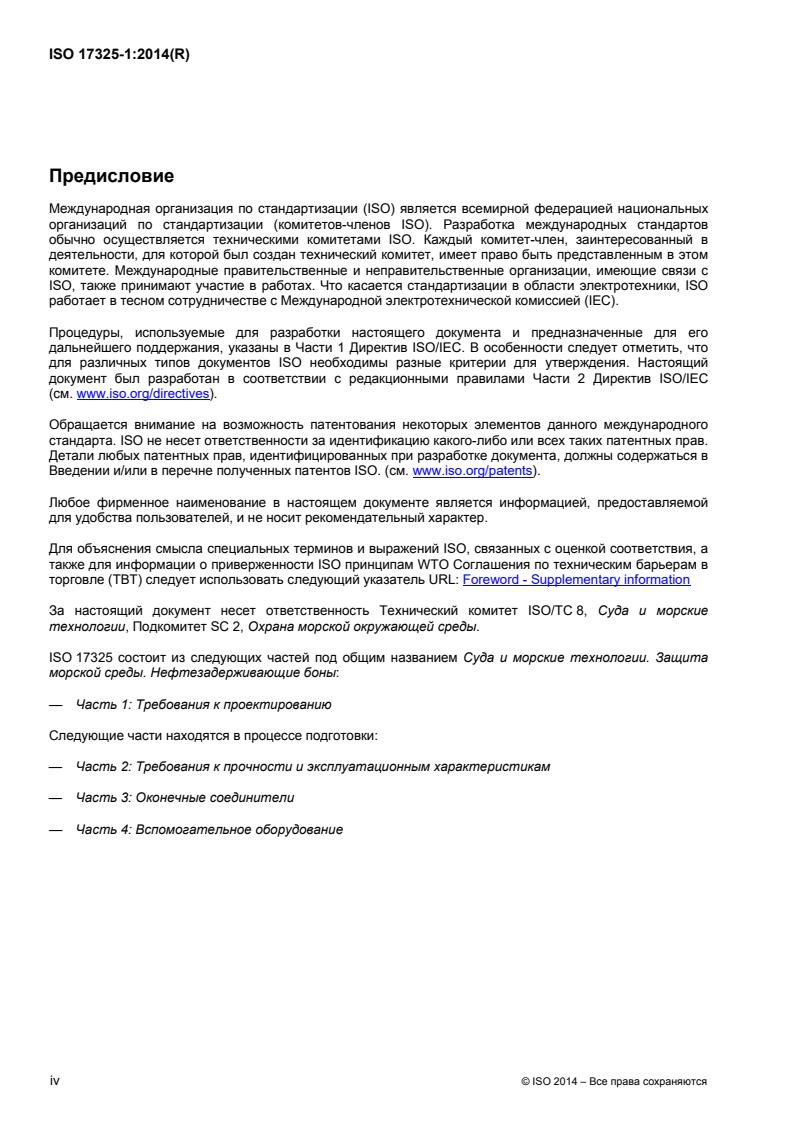
Предисловие
Международная организация по стандартизации (ISO) является всемирной федерацией национальных
организаций по стандартизации (комитетов-членов ISO). Разработка международных стандартов
обычно осуществляется техническими комитетами ISO. Каждый комитет-член, заинтересованный в
деятельности, для которой был создан технический комитет, имеет право быть представленным в этом
комитете. Международные правительственные и неправительственные организации, имеющие связи с
ISO, также принимают участие в работах. Что касается стандартизации в области электротехники, ISO
работает в тесном сотрудничестве с Международной электротехнической комиссией (IEC).
Процедуры, используемые для разработки настоящего документа и предназначенные для его
дальнейшего поддержания, указаны в Части 1 Директив ISO/IEC. В особенности следует отметить, что
для различных типов документов ISO необходимы разные критерии для утверждения. Настоящий
документ был разработан в соответствии с редакционными правилами Части 2 Директив ISO/IEC
(см. www.iso.org/directives).
Обращается внимание на возможность патентования некоторых элементов данного международного
стандарта. ISO не несет ответственности за идентификацию какого-либо или всех таких патентных прав.
Детали любых патентных прав, идентифицированных при разработке документа, должны содержаться в
Введении и/или в перечне полученных патентов ISO. (см. www.iso.org/patents).
Любое фирменное наименование в настоящем документе является информацией, предоставляемой
для удобства пользователей, и не носит рекомендательный характер.
Для объяснения смысла специальных терминов и выражений ISO, связанных с оценкой соответствия, а
также для информации о приверженности ISO принципам WTO Соглашения по техническим барьерам в
торговле (TBT) следует использовать следующий указатель URL: Foreword - Supplementary information
За настоящий документ несет ответственность Технический комитет ISO/TC 8, Суда и морские
технологии, Подкомитет SC 2, Охрана морской окружающей среды.
ISO 17325 состоит из следующих частей под общим названием Суда и морские технологии. Защита
морской среды. Нефтезадерживающие боны:
— Часть 1: Требования к проектированию
Следующие части находятся в процессе подготовки:
— Часть 2: Требования к прочности и эксплуатационным характеристикам
— Часть 3: Оконечные соединители
— Часть 4: Вспомогательное оборудование
iv © ISO 2014 – Все права сохраняются
Введение
Нефтезадерживающие боны могут быть классифицированы на два основных типа:
— боны-ограждения, обычно имеющие вертикально плавающий в воде усиленный барьер; и
— боны-занавесы, имеющие подводную часть мембраны, выполненную из гибкого материала
(называемую юбкой).
Существуют другие типы бонов такие, как боны специального назначения и сорбирующие боны, которые
не являются предметом рассмотрения данной части настоящего международного стандарта.
Все части ISO 17325 будут предоставлять некоторое общее руководство для производителей, а также
для пользователей, касающееся вопросов, связанных с изготовлением, приобретением и
использованием определенных типов оборудования. Стандарт не будет определять некоторые
специфические типы и размеры бонов для специального применения, поскольку должно быть принято
во внимание много переменных показателей.
Настоящая часть ISO 17325 определяет основные требования к проектированию, общее
функциональное назначение, обозначение и маркировку нефтезадерживающих бонов. Далее стандарт
устанавливает минимальную информацию производителя по проектированию, размерам и материалам
нефтезадерживающих бонов, которую надлежит предоставить.
Настоящий международный стандарт был разработан после рассмотрения указанных ниже стандартов
и требований национального законодательства.
Комитет F-20 Американского общества по испытанию материалов (ASTM) подготовило два стандарта,
относящихся к боновым соединителям. ASTM F1093 определяет статические лабораторные испытания
прочности нефтезадерживающего бона под растягивающей нагрузкой. ASTM F1523 предоставляет
руководство по выбору бонового заграждения, которое может быть использовано при контроле разливов
нефти и других субстанций, плавающих в воде.
Японский промышленный стандарт JIS F 9900 (Части 1 и 2) предусматривает необходимые условия и
технические требования для проектирования, изготовления и т.д. нефтезадерживающих бонов.
МЕЖДУНАРОДНЫЙ СТАНДАРТ ISO 17325-1:2014(R)
Суда и морские технологии. Защита морской среды.
Нефтезадерживающие боны
Часть 1.
Требования к проектированию
1 Область применения
Настоящая часть ISO 17325 определяет базовые требования к проектированию, общее назначение,
обозначения и маркировку нефтезадерживающих бонов. Кроме того определяется минимальная
информация по проектированию, размерам и материалам нефтезадерживающего бона, которая
должна быть предоставлена изготовителем.
Целью настоящего стандарта является содействие изготовителям и облегчение пользователям
выбора бонов по техническим критериям Он не подразумевает рассмотрение всех аспектов, связанных
с бонами, или вопросов безопасности их использования, а также определение рабочих процедур для
бонов. Установление надлежащих инструкций по безопасности и охране здоровья и определение
применимости регулирующих ограничений находится в сфере ответственности пользователей
настоящего международного стандарта.
2 Нормативные ссылки
Следующие документы, полностью или частично являются ссылочными в данном документе и
обязательными при его применении. При датированных ссылочных документах применяется только
приведенное издание документа. При недатированных ссылках необходимо использовать самое
последнее издание нормативного ссылочного документа (включая любые изменения).
Международная морская организация, Руководство по разливам нефти, Секция IV. Борьба с
разливами нефти, ИМО, Лондон, 2004
ISO 34-1:2010, Резина вулканизированная или термопластичная. Определение сопротивления
раздиру. Часть 1. Раздвоенные, угловые и серповидные образцы
ISO 505:1999, Ленты конвейерные. Метод для определения сопротивления распространению
разрыва текстильных конвейерных лент
ISO 1817:2011, Резина вулканизированная или термопластичная. Определение воздействия
жидкостей
ISO 16165:2013, Суда и морские технологии. Защита морской среды. Терминология, относящаяся к
ликвидации последствий аварийного разлива нефти
ISO 17325-2, Суда и морские технологии. Защита морской среды. Нефтезадерживающие боны.
Часть . Требования к прочности и эксплуатационным характеристикам
3 Термины и определения
В настоящем документе используются термины и их определения, данные в ISO 16165 и ASTM F1093,
а также следующие термины и их определения.
3.1
оконечный соединитель
end connector
устройство, прикрепленное к бону для соединений секций бона между собой или с другими
дополнительными устройствами
3.2
общая плавучесть
gross buoyancy
масса пресной воды, вытесненной боном при полном погружении
3.3
нефтезадерживающий бон
oil containment boom
плавучий барьер, используемый для контроля перемещения плавающих субстанций
3.4
рабочая осадка
operational draught
минимальная глубина погружения бона ниже ватерлинии в рабочем состоянии
3.5
рабочая высота надводного борта
operational freeboard
минимальная высота бона над ватерлинией в рабочем состоянии
3.6
предел прочности на растяжение
tensile strength
сила, требуемая для растяжения материала бона до значения, при котором он разрывается
4 Проектирование бона
4.1 Применение
Бон предназначается для использования в воде. Поскольку его основной целью является контроль
перемещения и/или сдерживание распространения нефтяной пленки или других субстанций на
поверхности воды, он должен располагаться и над и под поверхностью воды.
4.2 Соображения, связанные с окружающей средой
Проектирование и изготовление бонов должно быть организовано наиболее безвредным для
окружающей среды способом. Бон и его компоненты не должны содержать никаких веществ,
потенциально опасных для здоровья и/или окружающей среды, например, свинец и трибутилолово
(TBT), или другие вещества, регламентированные международным/национальным законодательством.
4.3 Части бонов
В общем, бон состоит из следующих частей, не ограничиваясь этим:
— стенка бона;
— камера плавучести;
— юбка;
— элемент натяжения;
2 © ISO 2014 – Все права сохраняются
— балластный элемент;
— оконечный соединитель;
— якорные крепления.
4.4 Типы бонов
4.4.1 Общие положения
По прямому назначению боны, как правило, могут быть классифицированы следующим образом.
4.4.2 Бон-занавес
Бон, который поддерживается элементом плавучести, симметричным в вертикальном сечении
...