


ISO 14085-3:2015
(Main)Aerospace series — Hydraulic filter elements — Test methods — Part 3: Filtration efficiency and retention capacity
Aerospace series — Hydraulic filter elements — Test methods — Part 3: Filtration efficiency and retention capacity
ISO 14085-3:2015 describes two methods to measure in repeatable conditions the filtration efficiency of filter elements used in aviation and aerospace hydraulic fluid systems. It can be applied when evaluating the overall characteristics of a filter element per ISO 14085‑1, or separately. Since the filtration efficiency of a filter element can change during its service life as it is clogging, this test method specifies its continuous measurement by using on-line particle counters with continuous injection of test contaminant and recirculation of particles not retained by the test filter element until the differential pressure across the element reaches a given final or "terminal" value. ISO 14085-3:2015 allows the efficiency to be measured under both steady or cyclic flow conditions. It also is applied to measure the stabilized contamination levels that are produced by the filter element while testing with cyclic flow. ISO 14085-3:2015 is not intended to qualify a filter element under replicate conditions of service; this can only be done by a specific test protocol developed for the purpose, including actual conditions of use, for example the operating fluid or contamination. The tests data resulting from application of this part of ISO 14085 can be used to compare the performance of aerospace hydraulic filter elements.
Série aérospatiale — Eléments filtrants hydrauliques — Méthode d'essais — Partie 3: Efficacité de filtration et capacité de rétention
General Information
- Status
- Withdrawn
- Publication Date
- 25-Feb-2015
- Technical Committee
- ISO/TC 20/SC 10 - Aerospace fluid systems and components
- Drafting Committee
- ISO/TC 20/SC 10/WG 8 - Hydraulic fluids and fluid contamination control
- Current Stage
- 9599 - Withdrawal of International Standard
- Start Date
- 01-May-2024
- Completion Date
- 12-Feb-2026
Relations
- Effective Date
- 06-Jun-2022
Get Certified
Connect with accredited certification bodies for this standard

DEKRA North America
DEKRA certification services in North America.

Eagle Registrations Inc.
American certification body for aerospace and defense.

Element Materials Technology
Materials testing and product certification.
Sponsored listings
Frequently Asked Questions
ISO 14085-3:2015 is a standard published by the International Organization for Standardization (ISO). Its full title is "Aerospace series — Hydraulic filter elements — Test methods — Part 3: Filtration efficiency and retention capacity". This standard covers: ISO 14085-3:2015 describes two methods to measure in repeatable conditions the filtration efficiency of filter elements used in aviation and aerospace hydraulic fluid systems. It can be applied when evaluating the overall characteristics of a filter element per ISO 14085‑1, or separately. Since the filtration efficiency of a filter element can change during its service life as it is clogging, this test method specifies its continuous measurement by using on-line particle counters with continuous injection of test contaminant and recirculation of particles not retained by the test filter element until the differential pressure across the element reaches a given final or "terminal" value. ISO 14085-3:2015 allows the efficiency to be measured under both steady or cyclic flow conditions. It also is applied to measure the stabilized contamination levels that are produced by the filter element while testing with cyclic flow. ISO 14085-3:2015 is not intended to qualify a filter element under replicate conditions of service; this can only be done by a specific test protocol developed for the purpose, including actual conditions of use, for example the operating fluid or contamination. The tests data resulting from application of this part of ISO 14085 can be used to compare the performance of aerospace hydraulic filter elements.
ISO 14085-3:2015 describes two methods to measure in repeatable conditions the filtration efficiency of filter elements used in aviation and aerospace hydraulic fluid systems. It can be applied when evaluating the overall characteristics of a filter element per ISO 14085‑1, or separately. Since the filtration efficiency of a filter element can change during its service life as it is clogging, this test method specifies its continuous measurement by using on-line particle counters with continuous injection of test contaminant and recirculation of particles not retained by the test filter element until the differential pressure across the element reaches a given final or "terminal" value. ISO 14085-3:2015 allows the efficiency to be measured under both steady or cyclic flow conditions. It also is applied to measure the stabilized contamination levels that are produced by the filter element while testing with cyclic flow. ISO 14085-3:2015 is not intended to qualify a filter element under replicate conditions of service; this can only be done by a specific test protocol developed for the purpose, including actual conditions of use, for example the operating fluid or contamination. The tests data resulting from application of this part of ISO 14085 can be used to compare the performance of aerospace hydraulic filter elements.
ISO 14085-3:2015 is classified under the following ICS (International Classification for Standards) categories: 49.080 - Aerospace fluid systems and components. The ICS classification helps identify the subject area and facilitates finding related standards.
ISO 14085-3:2015 has the following relationships with other standards: It is inter standard links to ISO 14085-3:2024. Understanding these relationships helps ensure you are using the most current and applicable version of the standard.
ISO 14085-3:2015 is available in PDF format for immediate download after purchase. The document can be added to your cart and obtained through the secure checkout process. Digital delivery ensures instant access to the complete standard document.
Standards Content (Sample)
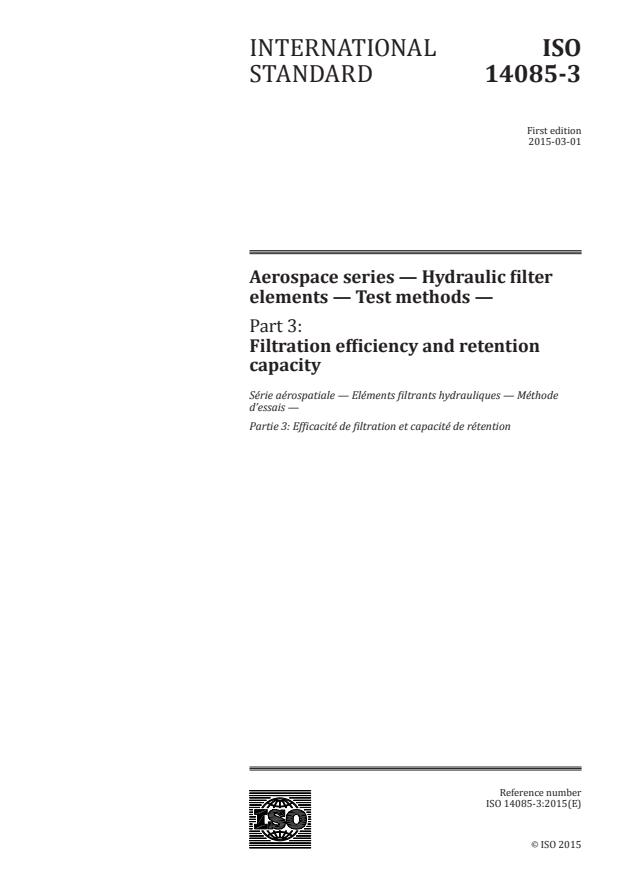
INTERNATIONAL ISO
STANDARD 14085-3
First edition
2015-03-01
Aerospace series — Hydraulic filter
elements — Test methods —
Part 3:
Filtration efficiency and retention
capacity
Série aérospatiale — Eléments filtrants hydrauliques — Méthode
d’essais —
Partie 3: Efficacité de filtration et capacité de rétention
Reference number
©
ISO 2015
© ISO 2015
All rights reserved. Unless otherwise specified, no part of this publication may be reproduced or utilized otherwise in any form
or by any means, electronic or mechanical, including photocopying, or posting on the internet or an intranet, without prior
written permission. Permission can be requested from either ISO at the address below or ISO’s member body in the country of
the requester.
ISO copyright office
Case postale 56 • CH-1211 Geneva 20
Tel. + 41 22 749 01 11
Fax + 41 22 749 09 47
E-mail copyright@iso.org
Web www.iso.org
Published in Switzerland
ii © ISO 2015 – All rights reserved
Contents Page
Foreword .iv
Introduction .v
1 Scope . 1
2 Normative references . 1
3 Terms and definitions . 2
4 Symbols and abbreviated terms . 4
5 Test procedure overview . 6
6 Test equipment and supplies. 6
7 Instrument accuracy and allowable test condition variation .10
8 Test equipment validation .10
9 Summary of information required prior to testing .14
10 Preliminary test preparation .14
10.1 Test filter assembly .14
10.2 Contaminant injection system .14
10.3 Steady flow filter test system .15
10.4 Cyclic flow filter test system .17
11 Filter element efficiency test .17
11.1 Steady flow test.17
11.2 Cyclic flow test .18
12 Calculation and data reporting .20
12.1 Filtration ratio and retention capacity .20
12.2 Calculation of stabilized particle counts for cyclic flow test .24
13 Identification statement (reference to this part of ISO 14085) .25
Annex A (normative) Properties of test fluid to evaluate performance of hydraulic fluid
systems filter elements .30
Annex B (informative) Test system design guide .32
Bibliography .37
Foreword
ISO (the International Organization for Standardization) is a worldwide federation of national standards
bodies (ISO member bodies). The work of preparing International Standards is normally carried out
through ISO technical committees. Each member body interested in a subject for which a technical
committee has been established has the right to be represented on that committee. International
organizations, governmental and non-governmental, in liaison with ISO, also take part in the work.
ISO collaborates closely with the International Electrotechnical Commission (IEC) on all matters of
electrotechnical standardization.
The procedures used to develop this document and those intended for its further maintenance are
described in the ISO/IEC Directives, Part 1. In particular the different approval criteria needed for the
different types of ISO documents should be noted. This document was drafted in accordance with the
editorial rules of the ISO/IEC Directives, Part 2 (see www.iso.org/directives).
Attention is drawn to the possibility that some of the elements of this document may be the subject of
patent rights. ISO shall not be held responsible for identifying any or all such patent rights. Details of
any patent rights identified during the development of the document will be in the Introduction and/or
on the ISO list of patent declarations received (see www.iso.org/patents).
Any trade name used in this document is information given for the convenience of users and does not
constitute an endorsement.
For an explanation on the meaning of ISO specific terms and expressions related to conformity
assessment, as well as information about ISO’s adherence to the WTO principles in the Technical Barriers
to Trade (TBT) see the following URL: Foreword - Supplementary information
The committee responsible for this document is ISO/TC 20, Aircraft and space vehicles, Subcommittee
SC 10, Aerospace fluid systems and components.
ISO 14085 consists of the following parts, under the general title Aerospace series — Hydraulic filter
elements — Test methods:
— Part 1: Test sequence
— Part 2: Conditioning
— Part 3: Filtration efficiency and retention capacity
— Part 4: Verification of collapse/burst pressure rating
— Part 5: Resistance to flow fatigue
— Part 6: Initial cleanliness level
iv © ISO 2015 – All rights reserved
Introduction
In aerospace hydraulic fluid power systems, power is transmitted and controlled through a liquid
under pressure. The liquid is both a lubricant and power-transmitting medium. The presence of solid
contaminant particles in the liquid interferes with the ability of the hydraulic fluid to lubricate, and
causes wear and malfunction of the components. The extent of contamination in the fluid has a direct
bearing on the performance, reliability, and safety of the system, and needs to be controlled to levels
that are considered appropriate for the system concerned.
Different principles are used to control the contamination level of the fluid by removing solid contaminant
particles; one of them uses a filter element enclosed in a filter housing. The filter element is the porous
device that performs the actual process of filtration. The complete assembly is designated as a filter.
The performance characteristics of a filter are a function of the element (its medium and geometry) and
the housing (its general configuration and seal design). For a given filter, the actual performance is a
function of the characteristics of the liquid (viscosity, temperature, conductivity, etc.), the particles in
suspension (size, shape, hardness, etc.), and the flow conditions.
A standard multi-pass method for evaluating the performance of hydraulic fluid filter elements under
steady state conditions has been developed and used for several years, and is referred to in several
aircraft hydraulic systems specifications.
Most aircraft hydraulic systems are subjected to unsteady flow with flow cycles caused by such conditions
as actuator movement. Such flow variations can have a significant impact on filter performance. To
enable the relative performance of hydraulic filters to be reliably compared so that the most appropriate
filter can be selected, it is necessary to perform testing with the same standard operating conditions.
This part of ISO 14085 describes two test methods and the equipment required to measure hydraulic
filter element performance with multi-pass flow in both steady and cyclic conditions.
The influence of other stressful operating conditions, such as heat, cold, and vibration, are not measured
with this procedure alone. The influence of such conditions is determined with pre-conditioning being
performed on the test filter element prior to efficiency testing (refer to ISO 14085-1 for descriptions of
such tests and when they are applied).
The stabilized contamination level measured while testing with cyclic flow gives an indication of the
average contamination level maintained by the filter in a dynamic operating system. The average system
contamination level is important in establishing wear rates and reliability levels.
The measurements are made with precise control over the operating conditions in particular the test fluid
and test contaminant, to ensure repeatability and reproducibility. However, because the test parameters
and test contaminant do not exactly replicate actual operating conditions which significantly differ
from one system to another, the measurements cannot be expected to duplicate actual performance in
an operating system.
INTERNATIONAL STANDARD ISO 14085-3:2015(E)
Aerospace series — Hydraulic filter elements — Test
methods —
Part 3:
Filtration efficiency and retention capacity
1 Scope
This part of ISO 14085 describes two methods to measure in repeatable conditions the filtration
efficiency of filter elements used in aviation and aerospace hydraulic fluid systems. It can be applied
when evaluating the overall characteristics of a filter element per ISO 14085-1, or separately.
Since the filtration efficiency of a filter element can change during its service life as it is clogging, this
test method specifies its continuous measurement by using on-line particle counters with continuous
injection of test contaminant and recirculation of particles not retained by the test filter element until
the differential pressure across the element reaches a given final or “terminal” value.
This part of ISO 14085 allows the efficiency to be measured under both steady or cyclic flow conditions.
It also is applied to measure the stabilized contamination levels that are produced by the filter element
while testing with cyclic flow.
This part of ISO 14085 is not intended to qualify a filter element under replicate conditions of service;
this can only be done by a specific test protocol developed for the purpose, including actual conditions
of use, for example the operating fluid or contamination.
The tests data resulting from application of this part of ISO 14085 can be used to compare the performance
of aerospace hydraulic filter elements.
2 Normative references
The following documents, in whole or in part, are normatively referenced in this document and are
indispensable for its application. For dated references, only the edition cited applies. For undated
references, the latest edition of the referenced document (including any amendments) applies.
ISO 1219-1, Fluid power systems and components — Graphical symbols and circuit diagrams — Part 1:
Graphical symbols for conventional use and data-processing applications
ISO 2942, Hydraulic fluid power — Filter elements — Verification of fabrication integrity and determination
of the first bubble point
ISO 3968, Hydraulic fluid power — Filters — Evaluation of differential pressure versus flow characteristics
ISO 4021, Hydraulic fluid power — Particulate contamination analysis — Extraction of fluid samples from
lines of an operating system
ISO 4405, Hydraulic fluid power — Fluid contamination — Determination of particulate contamination by
the gravimetric method
ISO 5598, Fluid power systems and components — Vocabulary
ISO 11171, Hydraulic fluid power — Calibration of automatic particle counters for liquids
ISO 11943, Hydraulic fluid power — On-line automatic particle-counting systems for liquids — Methods of
calibration and validation
ISO 12103-1:1997, Road vehicles — Test dust for filter evaluation — Part 1: Arizona test dust
3 Terms and definitions
For the purposes of this document, the terms and definitions given in ISO 5598 and the following apply.
3.1
contaminant mass injected
mass of specific particulate contaminant injected into the test circuit to obtain the terminal
differential pressure
3.2
cyclic flow
change of flow from the specified rated flow rate to 25 % of rated flow rate at a specified frequency and
waveform
3.3
differential pressure
Δp
difference between the inlet and outlet pressures of the component under test, as measured under
specified conditions
Note 1 to entry: See Figure 1 and Figure 2 for graphical depiction of differential pressure (3.3) terms.
3.3.1
clean assembly differential pressure
difference between the tested component inlet and outlet pressure as measured with a clean filter
housing containing a clean filter element
3.3.2
clean element differential pressure
differential pressure (3.3) of the clean element calculated as the difference between the clean assembly
differential pressure (3.3.1) and the housing differential pressure (3.3.4)
3.3.3
final assembly differential pressure
assembly differential pressure at end of test equal to sum of housing plus terminal element differential
pressures (3.3.5)
3.3.4
housing differential pressure
differential pressure of the filter housing without an element
3.3.5
terminal element differential pressure
maximum differential pressure across the filter element as designated by the manufacturer or
specification to limit useful performance
3.4
filtration ratio
ratio of the number of particles larger than a specified size per unit volume in the influent fluid to the
number of particles larger than the same size per unit volume in the effluent fluid
Note 1 to entry: For steady flow testing, the filtration ratios (3.4) are designated with the Greek letter beta, ß.
Note 2 to entry: For cyclic flow (3.2) testing, the filtration ratios (3.4) are designated with the Greek letter sigma, σ.
3.5
free-flow dummy element
duplicate test filter element with its media layers removed to replicate the flow pattern in the housing
generated by the test filter element
2 © ISO 2015 – All rights reserved
3.6
rest conductivity
electrical conductivity at the initial instant of current measurement after a dc voltage is impressed
between electrodes
Note 1 to entry: It is the reciprocal of the resistance of uncharged fluid in the absence of ionic depletion or
polarization.
3.7
retention capacity
mass of specific particulate contaminant effectively retained by the filter element when terminal
element differential pressure is reached
Key
x test time or mass injected 3 clean element differential pressure
y differential pressure 4 housing differential pressure
1 final assembly (end of test) differential pressure 5 clean assembly differential pressure
2 terminal element differential pressure
Figure 1 — Differential pressure conventions for multi-pass test with steady flow
Key
3 clean element differential pressure at test flow rate
x test time or mass injected
(q )
f
Y differential pressure 4 housing differential pressure at test flow rate (q )
f
1 final assembly (end of test) differential pressure 5 clean assembly differential pressure at test flow rate
(q )
f
2 terminal element differential pressure at test flow
rate (q )
f
Figure 2 — Differential pressure conventions for multi-pass test with cyclic flow
4 Symbols and abbreviated terms
4.1 Graphic symbols used are in accordance with ISO 1219-1.
4.2 The letter symbols used in this part of ISO 14085 are shown in Table 1.
Table 1 — Letter symbols
Symbol Unit Description or explanation
particles/ml Overall average upstream count greater than size, x
A
u,x
particles/ml Overall average downstream count greater than size, x
A
d,x
mg/l Average base upstream gravimetric level
c
b
c ʹ mg/l Desired base upstream gravimetric level
b
mg/l Average injection gravimetric level
c
i
c ʹ mg/l Desired injection gravimetric level
i
c mg/l Test reservoir gravimetric level at 80 % assembly Δp
m G Mass of contaminant needed for injection
m G Estimated filter element capacity (mass injected)
e
m G Contaminant mass injected
i
m G Contaminant mass injected at element differential pressure
p
4 © ISO 2015 – All rights reserved
Table 1 (continued)
Symbol Unit Description or explanation
m G Retained capacity
R
n None Number of counts in specific time period
N particles/ml Number of upstream particles greater than size, x, at count, j
u,x,j
N particles/ml Number of downstream particles greater than size, x, at count, j
d,x,j
particles/ml Average upstream count greater than size, x, at time interval, t
N
u,x,t
particles/ml Average downstream count greater than size, x, at time interval, t
N
d,x,t
Δp Pa or kPa (bar) Differential pressure
Δp Pa or kPa (bar) Final assembly differential pressure
f
Δp Pa or kPa (bar) Net assembly differential pressure
n
Δp Pa or kPa (bar) Assembly differential pressure after increase of 2,5 % net Δp
2,5 %
Δp Pa or kPa (bar) Assembly differential pressure after increase of 80 % net Δp
80 %
l/min Average filter test flow rate
q
f
q l/min Discarded downstream sample flow rate
d
q l/min Filter rated flow (maximum flow for cyclic conditions)
f
q ʹ l/min Desired injection flow rate
i
l/min Average injection flow rate
q
i
q l/min Discarded upstream sample flow rate
u
t min Test time
tʹ min Predicted test time
t min Final test time
f
t min Test time at element differential pressure
p
t min Test time at beginning of 2,5 % stabilization period
2,5 %
t min Test time at beginning of 80 % stabilization period
80 %
V l Final measured injection system volume
if
V l Initial measured injection system volume
ii
V l Minimum required operating injection system volume
min
V l Final measured filter test system volume
tf
V l Minimum validated injection system volume
v
x, x1, x2 μm(c) Particle sizes
None Filtration ratio at particle size, x (steady flow)
β
x
None Filtration ratio at particle size, x, and time interval, t (steady flow)
β
x,t
None Average filtration ratio at particle size x, (steady flow)
β
x
σ None Filtration ratio at particle size, x, (cyclic flow)
x
σ None Filtration ratio at particle size, x, and time interval, t (cyclic flow)
x,t
None Average filtration ratio at particle size x, (cyclic flow)
σ
x
5 Test procedure overview
5.1 Set up and maintain apparatus in accordance with Clause 6 and Clause 7.
5.2 Validate equipment in accordance with Clause 8.
5.3 Run all tests in accordance with Clauses 9, 10, and 11.
5.4 Analyse and present data from Clause 11 in accordance with Clause 12.
6 Test equipment and supplies
6.1 Suitable timer
6.2 Sample bottles, use applicable sample bottles containing less than 100 particles greater than 6 μm(c)
per millilitre of bottle volume, as qualified per ISO 3722, to collect samples for gravimetric analyses.
6.3 Membrane filters and associated equipment, suitable for conducting gravimetric contamination
analysis in accordance with ISO 4405.
6.4 Test contaminant, use ISO Fine Test Dust (ISO FTD), grade A2 in accordance with ISO 12103-1,
dried at 110 °C to 150 °C for not less than 1 h for quantities less than 200 g.
Ensure that the ISO FTD used conforms to all the requirements of ISO 12103-1 grade A2, especially the
volume particle size distribution shown in ISO 12103-1:1997, Table 2
NOTE 1 This dust is commercially available. For availability of ISO Fine Test Dust, contact the ISO Central
Secretariat or member bodies of ISO.
NOTE 2 If the total quantity of ISO Fine Test Dust needed is greater than 200 g, batches not exceeding 200 g can
be prepared to make up the amount required.
NOTE 3 For use in the test system, it is recommended to mix the test dust into the test fluid, mechanically
2 2
agitate, then disperse ultrasonically in an ultrasonic bath that has a power density of 3 000 W/m to 10 000 W/m
provided it has been demonstrated that ultrasonic energy used does not affect the fluid viscosity.
6.5 Test fluid, petroleum base test fluid with properties as detailed in Annex A.
Another standard test fluid shall be used provided there is agreement between parties. Only filter test
results obtained with the same fluid shall be compared.
The temperature of the test fluid, during the test, shall be controlled at a value to result in a test fluid
2 2
kinematic viscosity of 15 mm /s ± 1 mm /s.
NOTE 1 The use of this hydraulic fluid ensures greater reproducibility of results and is based upon current
practices, other accepted filter standards, and its world-wide availability.
NOTE 2 The addition of an anti-static agent to this test fluid can affect the test results.
6.6 Particle counting systems
6.6.1 An online automatic particle counting system, per ISO 11943, shall be used to determine the
number and size distribution of the contaminant particles in the fluid. An online dilution system might
6 © ISO 2015 – All rights reserved
be required to ensure that the particulate concentration in the fluid sampled by the automatic particle
counters does not exceed the saturation limits specified by the automatic particle counter manufacturer.
The automatic particle counters, including the on-line dilution system, if applicable, should be validated
for on-line counting in accordance with ISO 11943.
6.6.2 A turbulent sampling means, in accordance with ISO 4021, shall be located upstream and
downstream of the test filter element in order to provide fluid sample flow to the automatic particle
counters. The design of the sampling system shall be such as to minimize lag time in fluid flow to the
automatic particle counters. The portion of the sampling flow not passing through the automatic particle
counters can be returned to the filter element test circuit reservoir via a by-pass line. Flow through the
automatic particle counters can also be returned to the filter element test circuit reservoir provided it has
not been diluted, or it can be discarded. Do not interrupt sample flow during the test.
6.6.3 Automatic particle counters shall be calibrated in accordance with ISO 11171 for the appropriate
particle sizes. Use the recommended particle sizes given in Table 3 unless otherwise agreed.
6.7 Test housing and free flow dummy element
6.7.1 The service filter housing shall be used whenever possible, and it shall be installed in a normal
service attitude. If this housing contains a by-pass valve, it shall be blocked and tested for zero leakage at
twice the normal cracking pressure.
6.7.2 If a service filter housing is not available, the test housing shall duplicate the inside configuration,
including size, direction, and location of the inlet and outlet flow ports used in the service filter housing.
The volume beyond the ends of the filter element can vary up to ±10 % of the corresponding volumes of
the actual housing.
6.7.3 Install a free flow dummy element in the filter housing when determining the differential pressure
of the empty filter assembly (i.e. without the filter element installed) to reduce the impact of any changes
in flow patterns on the measured filter element differential pressure. The free flow dummy element shall
be the same as the test element without the filter media. If the test filter element is not constructed with a
rigid core, the dummy element shall be provided with a core having a minimum open area equal to twice
the filter element outlet area (the internal cross-sectional area of the filter assembly outlet tube) and a
diameter approximating the inside diameter of the media pack.
6.8 Filter performance test circuits
The filter performance test requires two separate circuits: a filter element test circuit, and a contaminant
injection circuit. Schematic diagrams of typical filter performance test set-ups used to measure filtration
efficiency in steady and cyclic flow conditions are shown in Annex B.
6.8.1 Filter element test circuit, consisting of the following.
6.8.1.1 A reservoir with a smooth conical bottom that has an included angle of not more than 90°, pump,
fluid conditioning apparatus, and instrumentation that are capable of accommodating the range of flow
rates, pressures, temperatures, and volumes required by the procedure, and is capable of meeting the
validation requirements of Clause 8.
6.8.1.2 A clean-up filter capable of providing an initial system contamination level as specified in Table 3.
6.8.1.3 A configuration that is insensitive to the intended operative contaminant level.
6.8.1.4 A configuration that does not alter the test contaminant distribution over the anticipated test duration.
6.8.1.5 Pressure taps in accordance with ISO 3968.
6.8.1.6 Fluid sampling sections upstream and downstream of the test filter in accordance with ISO 4021.
6.8.1.7 Fluids entering the reservoir shall be diffused. Diffusion should take place below the reservoir
fluid surface in order to eliminate the formation of air bubbles.
6.8.1.8 For cyclic flow testing, a cyclic flow by-pass line equipped with an automatically controlled
shut-off valve (e.g. an electrically-actuated ball valve or poppet type valve, which has been shown to be
satisfactory for this application) or other method capable of producing the required flow rate cycle at the
test frequency shall be used.
The flow cycling set-up shall be capable of cycling at 0,1 Hz. Each 10 s cycle shall consist of two equal
parts, the first including a flow rise period (25 % to 100 % of the test flow rate, q ) and a constant 100 %
f
flow period, followed by the second part including a flow decay back to 25 % q and a constant 25 % flow
f
period. This is accomplished via the solenoid operated shut-off valve and the flow control valve in the
by-pass circuit shown in Figure B.2 or using an alternate acceptable method. The set-up should be such
that the flow cycle falls within the limits set forth in Figure 3.
key
x time after start of flow cycle 2 25 % of filter rated flow, 0,25 q
f
y differential pressure 3 rise time = 0,1 s to 0,2 s
1 filter rated flow, q 4 fall time = 0,1 s to 0,2 s
f
Figure 3 — Flow cycle waveform
Alternatively, any other specified frequency or cycle waveform (minimum or maximum flow, and rise and
fall times) can be used for the test provided there is agreement between parties. However, a validation
shall be successfully performed at these alternate conditions per 8.2, and the cyclic conditions shall be
clearly delineated in the test report.
Alternative cyclic conditions will likely affect the test results, both in efficiency and stabilized cleanliness;
therefore, when making comparisons between filters, only one condition should be used.
NOTE The solenoid operated shut-off valve and the flow control valve in the by-pass circuit are the primary
differences in the cyclic flow test circuit and that of steady flow multi-pass test equipment.
6.8.2 Contaminant Injection test circuit, consisting of the following.
6.8.2.1 A reservoir with a smooth conical bottom that has an included angle of no more than 90°,
pump, fluid conditioning apparatus, and instrumentation that are capable of accommodating the range of
flow rates, pressures, temperatures, and volumes required by the procedure and capable of meeting the
validation requirements of Clause 8.
6.8.2.2 A configuration that is relatively insensitive to the intended contaminant level.
8 © ISO 2015 – All rights reserved
6.8.2.3 A configuration that does not alter the test contaminant particle size distribution over the
anticipated test duration.
6.8.2.4 A fluid sampling section in accordance with the requirements of ISO 4021.
6.8.2.5 A clean-up filter capable of providing an initial injection system contamination level as
specified in Table 3.
6.8.2.6 A turbulent means for transferring fluid from the contaminant injection system to the filter
element test system reservoir to yield an injection flow rate up to 0,25 l/min.
6.8.2.7 Fluids entering the reservoir shall be diffused. Diffusion should take place below the reservoir
fluid surface in order to eliminate the formation of air bubbles.
NOTE 1 The injection flow should be set as low as possible to minimize any influence of contaminant removed
by the downstream fluid discarded. The injection system is to be validated at the minimum flow rate (see 8.3).
NOTE 2 Turbulence is not always possible or guaranteed by calculation. Long straight lines should not be used.
A validation ensures that the system is satisfactory.
NOTE 3 The injection fluid volume can be increased, which will require an increase in the amount of test dust
proportionately.
7 Instrument accuracy and allowable test condition variation
7.1 Utilize and maintain instrument accuracy and test condition variations within the limits in Table 2.
7.2 Maintain specific test parameters within the limits in Table 3 depending on the test condition
being conducted.
Table 2 — Instruments accuracy and test conditions variations
Instrument
Allowed test condition
Test parameter SI Unit accuracy (±) of
variation (±)
reading
Electrical conductivity pS/m 10 % —
Differential pressure Pa, kPa or bar 5 % —
Base upstream gravimetric mg/l — 10 %
Flow:
Injection flow ml/min 2 % 5 %
Test flow l/min 2 % 5 %
a
APC sensor and dilution flow rates l/min 1,5 % 3 %
2 b 2
Kinematic viscosity mm /s 2 % 1 mm /s
Mass g 0,1 mg —
c
Temperature °C 1 °C 2 °C
Time s 1 s —
Injection system volume l 2 % —
Filter test system volume l 2 % 5 %
a
Sensor flow variation to be included in the overall 10 % allowed between sensors.
b 2
1 mm /s = 1 cSt (centistoke).
c
Or as required to comply with the viscosity tolerance.
Table 3 — Test conditions values
Initial contamination level for filter test systems: Less than 1 % of the minimum number specified in Table 4
measured at the minimum particle size to be counted.
Initial contamination level for injection system: Less than 1 % of injection gravimetric level.
a
Base upstream gravimetric level, mg/l: 3 ± 0,3 or 10 ± 1,0
b
Recommended particle counting sizes: Minimum of five sizes selected to cover the presumed filter
performance range from β or σ = 2 to β or σ = 1 000. Typical
sizes are: (4, 5, 6, 7, 8, 10, 12, 14, 20, 25) μm (c).
a
When comparing test results between two filters, the base upstream gravimetric level should be the same.
b
Particle sizes where filtration ratios are low (β or σ = 2, 10.) can be unobtainable for fine filters and particle sizes where
betas are high (β or σ = ., 200, 1 000) can be unobtainable for coarser filters.
8 Test equipment validation
8.1 Steady flow filter test system validation
8.1.1 Validate the filter test system at the minimum flow rate at which it is to be operated. Install a pipe
in place of filter housing during validation.
10 © ISO 2015 – All rights reserved
8.1.2 Adjust the total fluid volume of the filter test system (exclusive of the clean-up filter circuit) such
that it is numerically within the range of 25 % to 50 % of the minimum volume flow rate (l/min) value,
with a minimum volume of 5 l.
NOTE 1 This is the ratio of volume to flow rate required by the filter test.
NOTE 2 It is recommended that the fluid volume be numerically equal to 50 % of the maximum flow rate for
flow rates less than or equal to 60 l/min with a minimum volume of 5 l. For flow rates greater than 60 l/min, it is
recommended that the fluid volume be numerically equal to 25 % of the flow rate greater than 60 l/min.
8.1.3 Clean-up the contents of the reservoir until the cleanliness complies with the level stated in Table 3.
8.1.4 Contaminate the system fluid to the lowest base upstream gravimetric level to be used in testing
as shown in Table 3 using ISO FTD test dust and circulate for 15 min.
8.1.5 Verify that the flow rate through each particle counting sensor is equal to the value used for the
particle counter calibration within the limits of Table 2.
8.1.6 Circulate the fluid in the test system for an additional 60 min, conducting continuous online
automatic particle counts from the upstream sampling section for the 60 min period. Sample flow from
this section shall not be interrupted for the duration of the validation.
8.1.7 Record cumulative online particle counts at equal time intervals not to exceed 1 min for the
duration of the 60 min test at the particle sizes selected from those given in Table 3, including the 25 μm
(c) particle size.
8.1.8 Accept the validation test only if:
a) the particle count obtained for a given size at each sample interval does not deviate more than 15 %
from the average particle count from all sample intervals for that size,
b) the average of all cumulative particle counts per millilitre is within the range of acceptable counts
shown in Table 4, and
c) there is less than a 10 % difference between the cumulative particle count obtained from the
upstream automatic particle counter at each counting interval in each particle size range and the
cumulative particle count obtained from the downstream automatic particle counter for the same
particle size during the corresponding count interval.
NOTE Validation is required only at particle sizes to be used in the filter performance test.
Table 4 — Validation Counts for ISO FTD
a
Particle Acceptable cumulative particle counts per millilitre
size
Base upstream gravimetric Base upstream gravimetric
3 mg/l 10 mg/l
μm(c) minimum maximum minimum maximum
4 9 000 11 000 30 000 36 700
5 5 000 6 100 16 600 20 400
7 1 370 1 780 4 730 5 790
10 330 450 1 160 1 440
15 90 125 300 420
20 38 54 125 180
a
The minimum and maximum values are based on particle counts determined by a round robin conducted with automatic
particle counters calibrated in accordance with ISO 11171, with a calculated variation based on the Poisson distribution.
Table 4 (continued)
a
Particle Acceptable cumulative particle counts per millilitre
size
Base upstream gravimetric Base upstream gravimetric
3 mg/l 10 mg/l
25 15 25 53 79
a
The minimum and maximum values are based on particle counts determined by a round robin conducted with automatic
particle counters calibrated in accordance with ISO 11171, with a calculated variation based on the Poisson distribution.
8.1.9 Validate the online particle counting system, and dilution systems if used, in accordance with
ISO 11943.
NOTE Validation is required only at particle sizes to be used in the filter performance test.
8.2 Cyclic flow filter test system validation
8.2.1 Validate the ability of the cyclic flow system to achieve the required flow waveform shown in
Figure 3 at the minimum and maximum filter rated flows for which the test stand is intended for use.
8.2.2 Validate the cyclic flow filter test system at the minimum flow rate at which it is to be operated.
8.2.3 Validation shall be performed while cycling at the minimum filter flow rate, q , at which the filter
f
test system is to be operated.
8.2.4 Validate the cyclic flow at 0,1 Hz (6 cycles/min), using the waveform shown in Figure 3.
8.2.5 Install a pipe and valve in place of the filter housing during validation. The pipe and valve shall
be selected so that they produce the maximum differential pressure expected during testing at the
maximum flow rate.
8.2.6 Adjust the total fluid volume of the filter test system (exclusive of the clean-up filter circuit) such
that it is numerically within the range of 25 % to 50 % of the maximum volume flow rate, with a minimum
volume of 5 l.
NOTE 1 It is recommended that the system be validated with a fluid volume numerically equal to 50 % of the
maximum test volume flow rate for flow rates less than or equal to 60 l/min, or 25 % of the maximum test volume
flow rate for flow rates greater than 60 l/min.
NOTE 2 This is the ratio of volume to flow rate required by the filter test procedure (see 10.3.4).
8.2.7 Validate the online particle counting system and dilution systems, if used, in accordance with
ISO 11943 while the filter test system is under cyclic flow conditions.
8.2.8 Establish a background fluid contamination level that is less than that specified in Table 3.
8.2.9 Contaminate the system fluid at the minimum base upstream gravimetric level to be used as
shown in Table 3, using ISO FTD test dust, and circulate for 15 min.
8.2.10 Verify that the flow rate through each particle counting sensor is equal to the value used for the
particle counter calibration and is within the limits of Table 2.
8.2.11 Circulate the fluid in the test system for an additional 60 min, conducting continuous online
automatic particle counts from the upstream sampling section for the 60-min period. Sample flow from
this section shall not be interrupted for the duration of the validation. If dilution is used, the fluid that has
passed through the sensor shall not be returned to the reservoir.
12 © ISO 2015 – All rights reserved
8.2.12 Record cumulative online particle counts at equal time intervals not to exceed 1 min for the
duration of the 60-min test at the particle sizes shown in Table 3.
8.2.13 Accept the validation only if
a) the on-line particle counting system and dilution system were successfully validated in accordance
with ISO 11943,
b) the particle count obtained for a given size at each sample interval does not deviate more than 15 %
from the average particle count from all sample intervals for that size,
c) the average of all cumulative particle counts per millilitre are within the range of acceptable counts
shown in Table 4, and
d) there is less than a 10 % difference between the cumulative particle count obtained from the
upstream automatic particle counter at each counting interval in each particle size range and the
cumulative particle count obtained from the downstream automatic particle counter for the same
particle size during the corresponding count interval.
8.3 Contaminant injection system validation
8.3.1 Validate at the maximum initial injection system volume (V ) to be used per 10.2.3, the maximum
ii
contaminant injection system gravimetric level (c ʹ) specified per 10.2.4, the minimum contaminant
i
injection flow rate (q ʹ), and for a length of time required to deplete the complete usable volume (V V )
i ii min
of the contaminant injection reservoir.
8.3.2 Pre-clean the contaminant injection fluid system to achieve the fluid cleanliness given in Table 3,
then by-pass the clean-up filter system.
8.3.3 Calculate the required amount of contaminant (m) to be added to the contaminant injection
system from the volume (V ) and gravimetric level (c ʹ) per 8.3.1, according to the Formula (1):
ii i
′
Vc×
()
ii i
m= (1)
8.3.4 Add the required quantity of contaminant (m) to the contaminant injection system reservoir fluid
and circulate for a minimum of 30 min.
8.3.5 Start the timer and initiate injection flow from the contaminant injection system, once the
temperature has stabilized, collecting this flow externally from the system. Maintain the injection flow
rate at the stabilized temperature to within ±5 % of the desired injection flow rate (q ʹ) for the duration of
i
the validation. Obtain an initial sample at this point and measure the injection flow rate by collecting the
fluid in a calibrated measuring cylinder for a measured duration of time not less than 30 s.
8.3.6 Obtain samples of the injection flow and measure the injection flow rate at 30 min, 60 min, 90
min, and 120 min or at four equal intervals, depending upon the depletion rate of the system.
8.3.7 Analyse each sample from 8.3.6 gravimetrically in accordance with ISO 4405.
8.3.8 Measure the volume of the injection system at the end of the validation test. This is the minimum
validated volume, V .
v
8.3.9 Validation requirements: The contaminant injection system shall be considered validated only if
the criteria listed below are met.
a) The gravimetric level of each sample, analyzed in 8.3.7, shall be within ±5 % of the average of the
samples, and within ± 10% of the desired gravimetric level (c ʹ) per 8.3.1.
i
b) The injection flow rates, measured in 8.3.6, shall be within ±5 % of the average of the injection flow
rates, and within ±5 % of the desired injection flow rate (q ʹ).
i
c) The volume remaining in the injection system (V ) plus the volume of fluid expelled during the
v
validation, calculated as: (average injection flow rate) × (total injection time), is equal, within ±10%,
to the initial injection system volume (V ).
ii
9 Summary of information required prior to testing
The following information is needed prior to applying this standard to a particular filter element:
a) fabrication integrity test
...
Questions, Comments and Discussion
Ask us and Technical Secretary will try to provide an answer. You can facilitate discussion about the standard in here.
Loading comments...