

ISO 9328-7:2018
(Main)Steel flat products for pressure purposes — Technical delivery conditions — Part 7: Stainless steels
General Information
- Abstract
ISO 9328-7:2018 specifies requirements for flat products for pressure purposes made of stainless steels, including austenitic creep-resisting steels, in thicknesses as specified in Tables 7 to 10. The requirements and definitions of ISO 9328‑1 also apply to this document.
- Status
- Published
- Publication Date
- 31-Jan-2018
- Technical Committee
- ISO/TC 17/SC 10 - Steel for pressure purposes
- Drafting Committee
- ISO/TC 17/SC 10 - Steel for pressure purposes
- Current Stage
- 9092 - International Standard to be revised
- Start Date
- 17-Jul-2024
- Completion Date
- 29-Aug-2026
Buy Documents


ISO 9328-7:2018 - Steel flat products for pressure purposes -- Technical delivery conditions
ISO 9328-7:2018 - Steel flat products for pressure purposes — Technical delivery conditions — Part 7: Stainless steels/1/2018
Overview
ISO 9328-7:2018 - Steel flat products for pressure purposes - Part 7: Stainless steels specifies technical delivery conditions for stainless steel flat products intended for pressure applications. It applies to a range of stainless steels (including austenitic and austenitic-ferritic (duplex) creep‑resisting grades) in the nominal thicknesses listed in Tables 7–10 of the standard. The general requirements and definitions of ISO 9328‑1 are directly applicable.
This third edition (2018) updates grade designations, refines technical data tables and aligns certain requirements with EN standards. The document also notes potential patent claims on some grades and references ISO 3651‑2 for intergranular corrosion testing.
Key topics and technical requirements
- Scope and classification: Defines steel grade designations and classification rules for stainless steel flat products used under pressure.
- Chemical composition: Cast-analysis limits and permissible deviations for product analysis are given in Tables 1–5; corrosion‑related requirements reference ISO 3651‑2 for intergranular corrosion testing.
- Mechanical properties: Tensile and impact requirements at room and low temperatures; elevated-temperature proof and tensile strength values are provided (see Tables 11–15), with creep data and preliminary guidance in informative annexes.
- Delivery conditions and process routes: Specifies process routes and heat treatment options (Tables 6–10) and includes guidance for post‑weld heat treatment (Annex C) and further fabrication treatments (Annex B).
- Surface condition, dimensions and tolerances: Referenced to ISO 9328‑1 and ISO 18286 for dimensional tolerances and flatness options.
- Inspection, testing and sampling: Types of inspection documents, required tests (Table 16), sampling frequency, test methods and re‑test rules follow ISO 9328‑1 provisions.
- Informative annexes: Provide comparable national designations (Annex A), physical property data (Annex G), reference strength and creep data (Annexes D–F), and numbering in accordance with ISO 15510.
Practical applications and users
ISO 9328‑7 is intended for manufacturers, specifiers and users of stainless steel plates and sheets for pressure equipment, such as:
- Boiler and pressure vessel manufacturers
- Heat exchanger fabricators
- Oil & gas and chemical process equipment engineers
- Procurement and quality assurance teams specifying technical delivery conditions and inspection certificates
Using ISO 9328‑7 helps ensure material consistency, traceability, and conformity to mechanical, chemical and corrosion-resistance requirements for pressure‑retaining components.
Related standards
- ISO 9328‑1 - General requirements for steel flat products for pressure purposes (normative for Part 7)
- ISO 3651‑2 - Corrosion testing for stainless steels (intergranular corrosion)
- ISO 18286, ISO 10474, ISO 15510 - Referenced for tolerances, inspection certificates and grade numbering
Keywords: ISO 9328-7:2018, stainless steels, steel flat products for pressure purposes, technical delivery conditions, austenitic, duplex stainless steel, tensile properties, chemical composition, post-weld heat treatment.
Relations
- Effective Date
- 30-Jul-2016
Buy Documents
ISO 9328-7:2018 - Steel flat products for pressure purposes -- Technical delivery conditions
ISO 9328-7:2018 - Steel flat products for pressure purposes — Technical delivery conditions — Part 7: Stainless steels/1/2018
Get Certified
Connect with accredited certification bodies for this standard

Element Materials Technology
Materials testing and product certification.

Inštitut za kovinske materiale in tehnologije
Institute of Metals and Technology. Materials testing, metallurgical analysis, NDT.
Sponsored listings
Frequently Asked Questions
ISO 9328-7:2018 is a standard published by the International Organization for Standardization (ISO). Its full title is "Steel flat products for pressure purposes — Technical delivery conditions — Part 7: Stainless steels". This standard covers: ISO 9328-7:2018 specifies requirements for flat products for pressure purposes made of stainless steels, including austenitic creep-resisting steels, in thicknesses as specified in Tables 7 to 10. The requirements and definitions of ISO 9328‑1 also apply to this document.
ISO 9328-7:2018 specifies requirements for flat products for pressure purposes made of stainless steels, including austenitic creep-resisting steels, in thicknesses as specified in Tables 7 to 10. The requirements and definitions of ISO 9328‑1 also apply to this document.
ISO 9328-7:2018 is classified under the following ICS (International Classification for Standards) categories: 77.140.30 - Steels for pressure purposes; 77.140.50 - Flat steel products and semi-products. The ICS classification helps identify the subject area and facilitates finding related standards.
ISO 9328-7:2018 has the following relationships with other standards: It is inter standard links to ISO 9328-7:2011. Understanding these relationships helps ensure you are using the most current and applicable version of the standard.
ISO 9328-7:2018 is available in PDF format for immediate download after purchase. The document can be added to your cart and obtained through the secure checkout process. Digital delivery ensures instant access to the complete standard document.
Standards Content (Sample)
INTERNATIONAL ISO
STANDARD 9328-7
Third edition
2018-02
Steel flat products for pressure
purposes — Technical delivery
conditions —
Part 7:
Stainless steels
Produits plats en acier pour service sous pression — Conditions
techniques de livraison —
Partie 7: Aciers inoxydables
Reference number
©
ISO 2018
© ISO 2018
All rights reserved. Unless otherwise specified, or required in the context of its implementation, no part of this publication may
be reproduced or utilized otherwise in any form or by any means, electronic or mechanical, including photocopying, or posting
on the internet or an intranet, without prior written permission. Permission can be requested from either ISO at the address
below or ISO’s member body in the country of the requester.
ISO copyright office
CP 401 • Ch. de Blandonnet 8
CH-1214 Vernier, Geneva, Switzerland
Tel. +41 22 749 01 11
Fax +41 22 749 09 47
copyright@iso.org
www.iso.org
Published in Switzerland
ii © ISO 2018 – All rights reserved
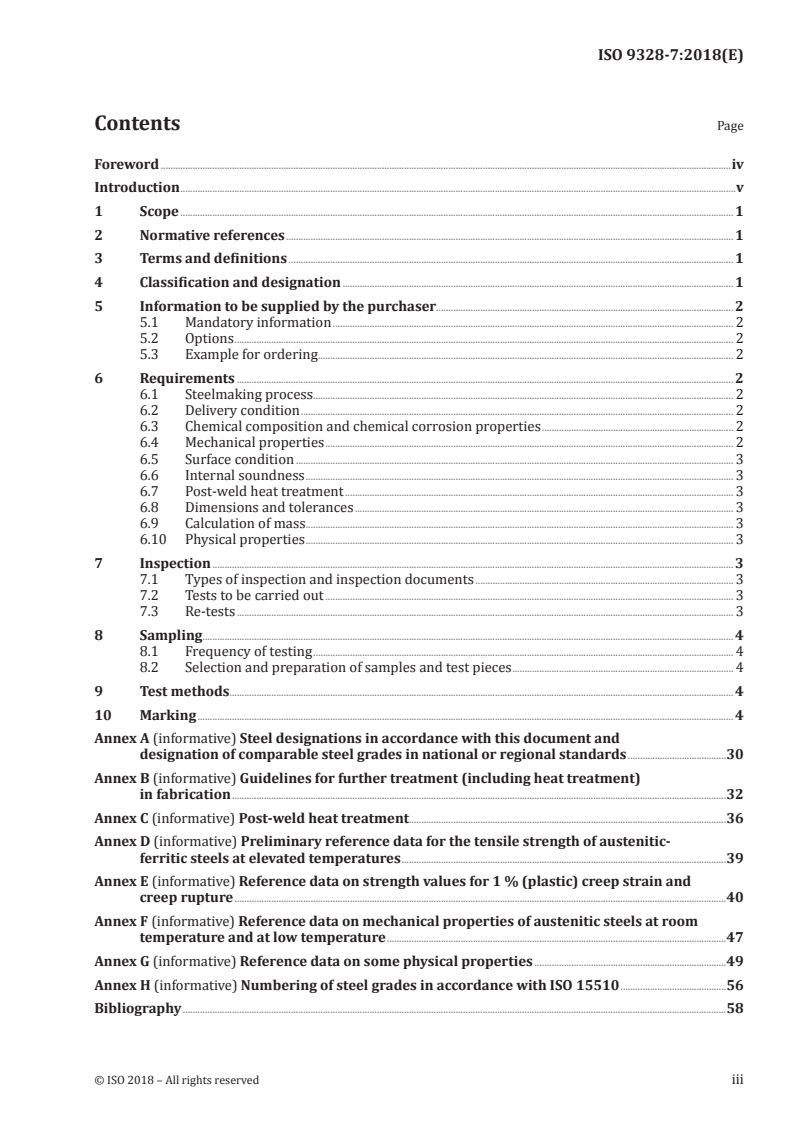
Contents Page
Foreword .iv
Introduction .v
1 Scope . 1
2 Normative references . 1
3 Terms and definitions . 1
4 Classification and designation . 1
5 Information to be supplied by the purchaser. 2
5.1 Mandatory information . 2
5.2 Options . 2
5.3 Example for ordering . 2
6 Requirements . 2
6.1 Steelmaking process . 2
6.2 Delivery condition . 2
6.3 Chemical composition and chemical corrosion properties . 2
6.4 Mechanical properties . 2
6.5 Surface condition . 3
6.6 Internal soundness . 3
6.7 Post-weld heat treatment . 3
6.8 Dimensions and tolerances . 3
6.9 Calculation of mass . 3
6.10 Physical properties . 3
7 Inspection . 3
7.1 Types of inspection and inspection documents . 3
7.2 Tests to be carried out . 3
7.3 Re-tests . 3
8 Sampling . 4
8.1 Frequency of testing . 4
8.2 Selection and preparation of samples and test pieces . 4
9 Test methods . 4
10 Marking . 4
Annex A (informative) Steel designations in accordance with this document and
designation of comparable steel grades in national or regional standards .30
Annex B (informative) Guidelines for further treatment (including heat treatment)
in fabrication .32
Annex C (informative) Post-weld heat treatment.36
Annex D (informative) Preliminary reference data for the tensile strength of austenitic-
ferritic steels at elevated temperatures .39
Annex E (informative) Reference data on strength values for 1 % (plastic) creep strain and
creep rupture .40
Annex F (informative) Reference data on mechanical properties of austenitic steels at room
temperature and at low temperature .47
Annex G (informative) Reference data on some physical properties .49
Annex H (informative) Numbering of steel grades in accordance with ISO 15510 .56
Bibliography .58
Foreword
ISO (the International Organization for Standardization) is a worldwide federation of national standards
bodies (ISO member bodies). The work of preparing International Standards is normally carried out
through ISO technical committees. Each member body interested in a subject for which a technical
committee has been established has the right to be represented on that committee. International
organizations, governmental and non-governmental, in liaison with ISO, also take part in the work.
ISO collaborates closely with the International Electrotechnical Commission (IEC) on all matters of
electrotechnical standardization.
The procedures used to develop this document and those intended for its further maintenance are
described in the ISO/IEC Directives, Part 1. In particular the different approval criteria needed for the
different types of ISO documents should be noted. This document was drafted in accordance with the
editorial rules of the ISO/IEC Directives, Part 2 (see www .iso .org/ directives).
Attention is drawn to the possibility that some of the elements of this document may be the subject of
patent rights. ISO shall not be held responsible for identifying any or all such patent rights. Details of
any patent rights identified during the development of the document will be in the Introduction and/or
on the ISO list of patent declarations received (see www .iso .org/ patents).
Any trade name used in this document is information given for the convenience of users and does not
constitute an endorsement.
For an explanation on the voluntary nature of standards, the meaning of ISO specific terms and
expressions related to conformity assessment, as well as information about ISO's adherence to the
World Trade Organization (WTO) principles in the Technical Barriers to Trade (TBT) see the following
URL: www .iso .org/ iso/ foreword .html.
This document was prepared by Technical Committee ISO/TC 17, Steel, Subcommittee SC 10, Steel for
pressure purposes.
This third edition cancels and replaces the second edition (ISO 9328-7:2011), which has been technically
revised. The following changes have been made:
— the term “product thickness” has been replaced with “nominal thickness”;
— new steel grades X1CrNiSI18-5-4, X2CrCuNbTiV22-1, X2CrNiMoN21-9-1, X2CrMnNiN21-5-1 and
X2CrNiMnMoCuN24-4-3-2 and all their technical data have been added;
— the technical data in Table 5 have been revised;
— the technical data in Table 9 have been aligned with EN 10028-7.
A list of all the parts in the ISO 9328 series can be found on the ISO website.
iv © ISO 2018 – All rights reserved
Introduction
The International Organization for Standardization (ISO) draws attention to the fact that it is claimed
that compliance with this document may involve the use of patents concerning eight steel grades.
ISO takes no position concerning the evidence, validity and scope of this patent right. The holder of
this patent right has assured ISO that he/she is willing to negotiate licences under reasonable and
non-discriminatory terms and conditions with applicants throughout the world. In this respect, the
statement of the holder of this patent right is registered with ISO. Information may be obtained from
the following sources.
c
For steel grades 1.4162 (but also consider footnote in Table 4) and 1.4662 from:
Outokumpu Stainless AB
SE-77480 AVESTA, Sweden
For steel grades 1.4420 and 1.4622 from:
Outokumpu Oyj
FI-02200 Espoo, Finland
Attention is drawn to the possibility that some of the elements of this document may be the subject of
patent rights other than those identified above. ISO shall not be held responsible for identifying any or
all such patent rights.
INTERNATIONAL STANDARD ISO 9328-7:2018(E)
Steel flat products for pressure purposes — Technical
delivery conditions —
Part 7:
Stainless steels
1 Scope
This document specifies requirements for flat products for pressure purposes made of stainless steels,
including austenitic creep-resisting steels, in thicknesses as specified in Tables 7 to 10.
The requirements and definitions of ISO 9328-1 also apply to this document.
2 Normative references
The following documents are referred to in the text in such a way that some or all of their content
constitutes requirements of this document. For dated references, only the edition cited applies. For
undated references, the latest edition of the referenced document (including any amendments) applies.
ISO 3651-2, Determination of resistance to intergranular corrosion of stainless steels — Part 2:
Ferritic,austenitic and ferritic-austenitic (duplex) stainless steels — Corrosion test in media containing
sulfuric acid
ISO 9328-1:2018,Steel flat products for pressure purposes — Technical delivery conditions — Part 1:
General requirements
3 Terms and definitions
For the purposes of this document, the terms and definitions given in ISO 9328-1 and the following apply.
ISO and IEC maintain terminological databases for use in standardization at the following addresses:
— IEC Electropedia: available at http:// www .electropedia .org/
— ISO Online browsing platform: available at https:// www .iso .org/ obp
3.1
cryogenic temperature
temperature lower than −75 °C used in the liquefaction of gases
4 Classification and designation
Shall be in accordance with ISO 9328-1.
NOTE 1 Information on the designation of comparable steel grades in national or regional standards is given
in Annex A.
NOTE 2 Information on numbering of steel grades is in accordance with ISO 15510.
5 Information to be supplied by the purchaser
5.1 Mandatory information
Shall be in accordance with ISO 9328-1.
5.2 Options
The relevant options of ISO 9328-1 apply.
5.3 Example for ordering
An order of 10 plates made of a steel grade with the name X5CrNi18-10 as specified in this document
with nominal dimensions thickness = 8 mm, width = 2 000 mm, length = 5 000 mm and tolerances
on dimensions, shape and mass as specified in ISO 18286, with “normal” flatness tolerance in process
route 1D (see Table 6), and with inspection certificate 3.1 as specified in ISO 10474 is designated as
follows:
10 plates ISO 18286 – 8 × 2 000 × 5 000 N – Steel ISO 9328-7 – X5 CrNi18-10 + 1D – Inspection
certificate 3.1
6 Requirements
6.1 Steelmaking process
Shall be in accordance with ISO 9328-1.
6.2 Delivery condition
The products shall be supplied in the delivery condition specified in the order by reference to the process
route given in Table 6 and, where alternatives exist, to the treatment conditions given in Tables 7 to 10.
Guidelines for further treatment, including heat treatment, are given in Annex B.
6.3 Chemical composition and chemical corrosion properties
6.3.1 The chemical composition requirements given in Tables 1 to 4 apply in respect of the chemical
composition according to the cast analysis.
6.3.2 The product analysis may deviate from the limiting values for the cast analysis given in Tables 1
to 4 by the values listed in Table 5.
6.3.3 Referring to resistance to intergranular corrosion as defined in ISO 3651-2, for ferritic, austenitic
and austenitic-ferritic steels, the specifications in Tables 7, 9 and 10 apply.
NOTE 1 ISO 3651-2 is not applicable for testing martensitic steels.
NOTE 2 The corrosion resistance of stainless steels is very dependent on the type of environment and can
therefore not always be clearly ascertained through laboratory tests. It is therefore advisable to draw on the
available experience of the use of the steels.
6.4 Mechanical properties
6.4.1 The tensile properties at room temperature and the impact energy at room temperature and at
low temperature, as specified in Tables 7 to 10, apply for the relevant specified heat treatment condition.
2 © ISO 2018 – All rights reserved
NOTE Austenitic steels are insensitive to brittle fracture in the solution annealed condition. Because they
do not have a pronounced transition temperature, which is characteristic of other steels, they are also useful for
application at cryogenic temperatures.
6.4.2 The values in Tables 11 to 14 apply for the 0,2 % and 1,0 % proof strength at elevated
temperatures. Additionally, the values in Table 15 apply for the tensile strength at elevated temperatures
of austenitic steels.
Tensile strength values at elevated temperatures for austenitic-ferritic steels are given for guidance in
Annex D.
6.4.3 Annex E provides for the purchaser mean values as preliminary data on the strength for 1 %
(plastic) creep strain and creep rupture. These data apply for the solution annealed condition only.
6.4.4 In Annex F, preliminary data on mechanical properties at low temperatures of austenitic steels
are listed.
6.5 Surface condition
Shall be in accordance with ISO 9328-1 and Table 6.
6.6 Internal soundness
Shall be in accordance with ISO 9328-1.
6.7 Post-weld heat treatment
Guidelines for the purchaser on post-weld heat treatment are given in Annex C.
6.8 Dimensions and tolerances
Shall be in accordance with ISO 9328-1.
6.9 Calculation of mass
For density of steels, see Annex G.
6.10 Physical properties
Reference data on some physical properties are given in Annex G.
7 Inspection
7.1 Types of inspection and inspection documents
Shall be in accordance with ISO 9328-1.
7.2 Tests to be carried out
Shall be in accordance with Table 16 and ISO 9328-1.
7.3 Re-tests
Shall be in accordance with ISO 9328-1.
8 Sampling
8.1 Frequency of testing
Shall be in accordance with Table 16 and ISO 9328-1.
8.2 Selection and preparation of samples and test pieces
Shall be in accordance with ISO 9328-1.
9 Test methods
Shall be in accordance with ISO 9328-1.
10 Marking
Shall be in accordance with ISO 9328-1.
4 © ISO 2018 – All rights reserved
a
Table 1 — Chemical composition (cast analysis) of ferritic steels
mass fraction, %
b
Steel grade C Si Mn P S N Cr Mo Nb Ni Ti
max. max. max. max. max. max.
0,30 to
X2CrNi12 0,030 1,00 1,50 0,040 0,015 0,030 10,5 to 12,5 — — —
1,10
0,50 to
X6CrNiTi12 0,08 1,00 1,00 0,040 0,015 — 10,5 to 12,5 — — 0,05 to 0,35
1,50
X2CrTi17 0,025 0,50 0,50 0,040 0,015 0,015 16,0 to 18,0 — — — 0,30 to 0,60
[4 × (C + N) + 0,15] to
X3CrTi17 0,05 1,00 1,00 0,040 0,015 — 16,0 to 18,0 — — —
c
0,80
0,80 to
X2CrMoTi17-1 0,025 1,00 1,00 0,040 0,015 0,030 16,0 to 18,0 — — 0,30 to 0,60
1,40
1,80 to [4 × (C + N) + 0,15] to
X2CrMoTi18-2 0,025 1,00 1,00 0,040 0,015 0,030 17,0 to 20,0 — —
c
2,50 0,80
0,80 to [7 × (C + N) + 0,10] to
X6CrMoNb17-1 0,08 1,00 1,00 0,040 0,015 0,040 16,0 to 18,0 — —
1,40 1,00
X2CrTiNb18 0,030 1,00 1,00 0,040 0,015 — 17,5 to 18,5 — [3 × C + 0,30] to 1,00 — 0,10 to 0,60
X 2Cr Cu N bT iV 22-1
0,030 1,00 0,80 0,040 0,015 0,030 20,0 to 24,0 — 0,10 to 0,70 — 0,10 to 0,70
d,e
a
Elements not listed in this table may not be intentionally added to the steel without agreement of the purchaser, except for finishing of the cast. All appropriate precautions are
to be taken to avoid the addition of such elements from scrap and other materials used in production, which would impair mechanical properties and the suitability of the steel.
b
Information concerning ISO steel numbers and designations according to other regional or national standards is given in Annex A.
c
The stabilization may be made by use of titanium and/or niobium and/or zirconium. According to the atomic number of these elements and the content of carbon and nitrogen,
the equivalence shall, if additional stabilizing with niobium or zirconium is used, be the following:
Nb==Zr Ti .
d
Patented steel.
e
Other elements: V: 0,03 to 0,50 %; Cu: 0,30 to 0,80 %; Ti + Nb: 8x(C+N) to 0,80 %.
6 © ISO 2018 – All rights reserved
a
Table 2 — Chemical composition (cast analysis) of martensitic steels
mass fraction, %
b
Steel grade C Si Mn P S N Cr Mo Ni
max. max. max. max. max. min.
X3CrNiMo13-4 0,05 0,70 0,50 to 1,00 0,040 0,015 0,020 12,0 to 14,0 0,30 to 1,00 3,5 to 4,5
X4CrNiMo16-5-1 0,06 0,70 1,50 0,040 0,015 0,020 15,0 to 17,0 0,80 to 1,50 4,0 to 6,0
a
Elements not listed in this table may not be intentionally added to the steel without the agreement of the purchaser, except for finishing of the cast. All appropriate precautions
are to be taken to avoid the addition of such elements from scrap and other materials used in production, which would impair mechanical properties and the suitability of the steel.
b
Information concerning ISO steel numbers and designations according to other regional or national standards is given in Annex A.
a
Table 3 — Chemical composition (cast analysis) of austenitic steels
mass fraction, %
b
Steel grade C Si Mn P S N Cr Cu Mo Nb Ni Ti Others
max. max. max.
Austenitic corrosion-resisting grades
0,10 to 16,5 to 6,0 to
X2CrNiN18-7 ≤ 0,030 ≤ 1,00 2,00 0,045 0,015 — — — — —
0,20 18,5 8,0
17,5 to 8,0 to
X2CrNi18-9 ≤ 0,030 ≤ 1,00 2,00 0,045 0,015 ≤ 0,10 — — — — —
19,5 10,5
18,0 to 10,0 to
X2CrNi19-11 ≤ 0,030 ≤ 1,00 2,00 0,045 0,015 ≤ 0,10 — — — — —
20,0 12,0
0,12 to 18,0 to 8,0 to
X5CrNiN19-9 ≤ 0,06 ≤ 1,00 2,00 0,045 0,015 — — — — —
0,22 20,0 11,0
0,12 to 17,5 to 8,0 to
X2CrNiN18-10 ≤ 0,030 ≤ 1,00 2,00 0,045 0,015 — — — — —
0,22 19,5 11,5
17,5 to 8,0 to
X5CrNi18-10 ≤ 0,07 ≤ 1,00 2,00 0,045 0,015 ≤ 0,10 — — — — —
19,5 10,5
17,0 to 9,0 to
X6CrNiTi18-10 ≤ 0,08 ≤ 1,00 2,00 0,045 0,015 — — — — 5 × C to 0,70 —
19,0 12,0
17,0 to 10 × C to 9,0 to
X6CrNiNb18-10 ≤ 0,08 ≤ 1,00 2,00 0,045 0,015 — — — — —
19,0 1,00 12,0
24,0 to 20,0 to
X1CrNi25-21 ≤ 0,020 ≤ 0,25 2,00 0,025 0,010 ≤ 0,10 — ≤ 0,20 — — —
26,0 22,0
16,5 to 2,00 to 10,0 to
X2CrNiMo17-12-2 ≤ 0,030 ≤ 1,00 2,00 0,045 0,015 ≤ 0,10 — — — —
18,5 2,50 13,0
0,12 to 16,5 to 2,00 to 10,0 to
X2CrNiMoN17-11-2 ≤ 0,030 ≤ 1,00 2,00 0,045 0,015 — — — —
0,22 18,5 2,50 12,5
16,5 to 2,00 to 10,0 to
X5CrNiMo17-12-2 ≤ 0,07 ≤ 1,00 2,00 0,045 0,015 ≤ 0,10 — — — —
18,5 2,50 13,0
0,10 to 24,0 to 2,00 to 21,0 to
X1CrNiMoN25-22-2 ≤ 0,020 ≤ 0,70 2,00 0,025 0,010 — — — —
0,16 26,0 2,50 23,0
16,5 to 2,00 to 10,5 to
X6CrNiMoTi17-12-2 ≤ 0,08 ≤ 1,00 2,00 0,045 0,015 — — — 5 × C to 0,70 —
18,5 2,50 13,5
a
Elements not listed in this table may not be intentionally added to the steel without the agreement of the purchaser, except for finishing of the cast. All appropriate precautions are to be taken to
avoid the addition of such elements from scrap and other materials used in production, which would impair mechanical properties and the suitability of the steel.
b
Information concerning ISO steel numbers and designations according to other regional or national standards is given in Annex A.
c
Patented steel.
8 © ISO 2018 – All rights reserved
Table 3 (continued)
mass fraction, %
b
Steel grade C Si Mn P S N Cr Cu Mo Nb Ni Ti Others
max. max. max.
16,5 to 2,00 to 10 × C to 10,5 to
X6CrNiMoNb17-12-2 ≤ 0,08 ≤ 1,00 2,00 0,045 0,015 — — —
18,5 2,50 1,00 13,5
16,5 to 2,50 to 10,5 to
X2CrNiMo17-12-3 ≤ 0,030 ≤ 1,00 2,00 0,045 0,015 ≤ 0,10 — — — —
18,5 3,00 13,0
0,12 to 16,5 to 2,50 to 11,0 to
X2CrNiMoN17-13-3 ≤ 0,030 ≤ 1,00 2,00 0,045 0,015 — — — —
0,22 18,5 3,00 14,0
16,5 to 2,50 to 10,5 to
X3CrNiMo17-12-3 ≤ 0,05 ≤ 1,00 2,00 0,045 0,015 ≤ 0,10 — — — —
18,5 3,00 13,0
17,0 to 2,50 to 12,5 to
X2CrNiMo18-14-3 ≤ 0,030 ≤ 1,00 2,00 0,045 0,015 ≤ 0,10 — — — —
19,0 3,00 15,0
0,10 to 16,5 to 3,0 to 10,5 to
X2CrNiMoN18-12-4 ≤ 0,030 ≤ 1,00 2,00 0,045 0,015 — — — —
0,20 19,5 4,0 14,0
17,5 to 3,0 13,0 to
X2CrNiMo18-15-4 ≤ 0,030 ≤ 1,00 2,00 0,045 0,015 ≤ 0,10 — — — —
19,5 to 4,0 16,0
0,12 to 16,5 to 4,0 12,5 to
X2CrNiMoN17-13-5 ≤ 0,030 ≤ 1,00 2,00 0,045 0,015 — — — —
0,22 18,5 to 5,0 14,5
26,0 to 0,70 to 3,0 to 30,0 to
X1NiCrMoCu31-27-4 ≤ 0,020 ≤ 0,70 2,00 0,030 0,010 ≤ 0,10 — — —
28,0 1,50 4,0 32,0
19,0 to 1,20 to 4,0 to 24,0 to
X1NiCrMoCu25-20-5 ≤ 0,020 ≤ 0,70 2,00 0,030 0,010 ≤ 0,15 — — —
21,0 2,00 5,0 26,0
3,7 to 16,5 to 14,0 to
X1CrNiSi18-15-4 ≤ 0,015 ≤ 2,00 0,025 0,010 ≤ 0,10 — ≤ 0,20 — — —
4,5 18,5 16,0
0,14 to 19,5 to 0,50 to 8,0 to
c
X2CrNiMoN21-9-1 ≤ 0,03 ≤ 1,00 ≤ 2,00 0,045 0,015 ≤ 1,00 — — —
0,25 21,5 1,50 9,5
Austenitic corrosion-resisting grades
0,17 to 24,0 to 1,00 to 4,7 to 24,0 to
X1CrNiMoCuN25-25-5 ≤ 0,020 ≤ 0,70 2,00 0,030 0,010 — — —
0,25 26,0 2,00 5,7 27,0
0,18 to 19,5 to 0,50 to 6,0 to 17,5 to
X1CrNiMoCuN20-18-7 ≤ 0,020 ≤ 0,70 1,00 0,030 0,010 — — —
0,25 20,5 1,00 7,0 18,5
a
Elements not listed in this table may not be intentionally added to the steel without the agreement of the purchaser, except for finishing of the cast. All appropriate precautions are to be taken to
avoid the addition of such elements from scrap and other materials used in production, which would impair mechanical properties and the suitability of the steel.
b
Information concerning ISO steel numbers and designations according to other regional or national standards is given in Annex A.
c
Patented steel.
Table 3 (continued)
mass fraction, %
b
Steel grade C Si Mn P S N Cr Cu Mo Nb Ni Ti Others
max. max. max.
0,15 to 19,0 to 0,50 to 6,0 to 24,0 to
X1NiCrMoCuN25-20-7 ≤ 0,020 ≤ 0,50 2,00 0,030 0,010 — — —
0,25 21,0 1,50 7,0 26,0
0,15 to 16,0 to 3,5 to
X2CrMnNiN17-7-5 < 0,030 ≤ 1,00 6,0 to 8,0 0,045 0,015 — — — — —
0,20 17,0 5,5
16,5 to 1,00 to 4,5 to
X9CrMnNiCu17-8-5-2 ≤ 0,10 ≤ 1,00 5,5 to 9,5 0,070 0,010 ≤ 0,15 — — — —
18,5 2, 50 5,5
Austenitic creep-resisting grades
0,10 to 16,0 to 2,00 to 12,0 to 0,001 5 to
X3CrNiMoBN17-13-3 ≤ 0,04 ≤ 0,75 2,00 0,035 0,015 — — —
0,18 18,0 3,00 14,0 0,005 0 B
0,04 to 17,0 to 9,0 to 5 × C 0,001 5 to
X6CrNiTiB18-10 ≤ 1,00 2,00 0,035 0,015 — — — —
0,08 19,0 12,0 to 0,70 0,005 0 B
0,04 to 17,0 to 8,0 to
X6CrNi18-10 ≤ 1,00 2,00 0,035 0,015 ≤ 0,10 — — — — —
0,08 19,0 11,0
0,04 to 22,0 to 12,0 to
X6CrNi23-13 ≤ 0,70 2,00 0,035 0,015 ≤ 0,10 — — — — —
0,08 24,0 15,0
0,04 to 24,0 to 19,0 to
X6CrNi25-20 ≤ 0,70 2,00 0,035 0,015 ≤ 0,10 — — — — —
0,08 26,0 22,0
a
Elements not listed in this table may not be intentionally added to the steel without the agreement of the purchaser, except for finishing of the cast. All appropriate precautions are to be taken to
avoid the addition of such elements from scrap and other materials used in production, which would impair mechanical properties and the suitability of the steel.
b
Information concerning ISO steel numbers and designations according to other regional or national standards is given in Annex A.
c
Patented steel.
10 © ISO 2018 – All rights reserved
Table 3 (continued)
mass fraction, %
b
Steel grade C Si Mn P S N Cr Cu Mo Nb Ni Ti Others
max. max. max.
0,20 to
0,50 Al
Al + Ti:
0,03 to 19,0 to 30,0 to ≤ 0,70
X5NiCrAlTi31-20 (+RA) ≤ 0,70 1,50 0,015 0,010 ≤ 0,03 ≤ 0,50 — ≤ 0,10 0,20 to 0,50
0,08 22,0 32,5 ≤ 0,50 Co
Ni + Co:
30,0
to 32,5
0,25 to
0,65 Al
0,05 to 19,0 to 30,0 to ≤ 0,50 Co
X8NiCrAlTi32-21 ≤ 0,70 1,50 0,015 0,010 ≤ 0,03 ≤ 0,50 — — 0,25 to 0,65
0,10 22,0 34,0 Ni + Co:
30,0 to
34,0
0,04 to 0,30 to 15,0 to 10 × C to 12,0 to
X8CrNiNb16-13 1,50 0,035 0,015 — — — — —
0,10 0,60 17,0 1,20 14,0
a
Elements not listed in this table may not be intentionally added to the steel without the agreement of the purchaser, except for finishing of the cast. All appropriate precautions are to be taken to
avoid the addition of such elements from scrap and other materials used in production, which would impair mechanical properties and the suitability of the steel.
b
Information concerning ISO steel numbers and designations according to other regional or national standards is given in Annex A.
c
Patented steel.
a
Table 4 — Chemical composition (cast analysis) of austenitic-ferritic steels
mass fraction,%
b
Steel grade C Si Mn P S N Cr Cu Mo Ni W
max. max. max. max. max.
0,05 to 22,0 to 0,10 to 0,10 to 3,5 to
X2CrNiN23-4 0,030 1,00 2,00 0,035 0,015 —
0,20 24,0 0,60 0,60 5,5
0,16 to 21,0 to 1,5 to
c
X2CrNiN22-2 0,030 1,00 2,00 0,040 0,010 — ≤ 0,45 —
0,28 23,8 2,9
0,10 to 21,0 to 2,50 to 4,5 to
X2CrNiMoN22-5-3 0,030 1,00 2,00 0,035 0,015 — —
0,22 23,0 3,5 6,5
0,20 to 24,0 to 1,00 to 3,0 to 6,0 to
X2CrNiMoCuN25-6-3 0,030 0,70 2,00 0,035 0,015 —
0,30 26,0 2,50 4,0 8,0
0,040 1,00 4,0 to 0,035 0,005 0,20 to 21,0 to 0,10 to 0,10 to 1,35 to
c
X2CrMnNiN21-5-1
d
6,0 0,25 22,0 0,80 0,80 1,90
0,24 to 24,0 to 3,0 to 6,0 to
X2CrNiMoN25-7-4 0,030 1,00 2,00 0,035 0,015 — —
0,35 26,0 4,5 8,0
0,20 to 24,0 to 0,50 to 3,0 to 6,0 to 0,50 to
X2CrNiMoCuWN25-7-4 0,030 1,00 1,00 0,035 0,015
0,30 26,0 1,00 4,0 8,0 1,00
4,0 to 0,20 to 21,0 to 0,10 to 0,10 to 1,35 to
c
X2CrMnNiN21-5-1 0,040 1,00 0,035 0,005 —
e
6,0 0,25 22,0 0,80 0,80 1,90
2,50 to 0,20 to 23,0 to 0,10 to 1,00 to 3,0 to
c
X2CrNiMnMoCuN24-4-3-2 0,030 0,70 0,035 0,005 —
4,0 0,30 25,0 0,80 2,00 4,5
a
Elements not listed in this table may not be intentionally added to the steel without the agreement of the purchaser, except for finishing of the cast. All appropriate precautions
are to be taken to avoid the addition of such elements from scrap and other materials used in production, which would impair mechanical properties and the suitability of the steel.
b
Information concerning ISO steel numbers and designations according to other regional or national standards is given in Annex A.
c
Patented steel.
d
Steel grade 1.4162 is patented steel up to a max. limit of Ni of 1,70 %.
e
This steel grade is patented steel up to a max. limit of Ni of 1,70 %.
Table 5 — Permissible product analysis tolerances on the limiting values given in Tables 1 to 4
for the cast analysis
a
Specified value in the cast analysis Permissible deviation
in Tables 1 to 4 of the product analysis
Element
% by mass % by mass
≤ 0,030 +0,005
C
> 0,030 to ≤ 0,10 ±0,01
≤ 1,00 +0,05
Si > 1,00 to ≤ 3,00 ±0,10
> 3,00 to ≤ 4,50 ±0,15
≤ 1,00 +0,03
Mn
> 1,00 to ≤ 2,50 +0,04
≤ 0,045 +0,005
P
> 0,045 to ≤ 0,070 +0,010
S ≤ 0,015 +0,003
N ≤ 0,35 ±0,01
Al ≤ 0,65 ±0,10
≥ 10,5 to < 15,0 ±0,15
Cr ≥ 15,0 to ≤ 20,0 ±0,20
> 20,0 to ≤ 28,0 ±0,25
≤ 1,00 ±0,07
Cu
> 1,00 to ≤ 2,50 ±0,10
≤ 0,60 ±0,03
Mo > 0,60 to ≤ 1,75 ±0,05
≥ 1,75 to < 7,0 ±0,10
Nb ≤ 1,00 ±0,05
≤ 1,00 ±0,03
> 1,00 to ≤ 5,0 ±0,07
Ni > 5,0 to ≤ 10,0 ±0,10
> 10,0 to ≤ 20,0 ±0,15
> 20,0 to ≤ 34,0 ±0,20
B ≥ 0,001 5 to ≤ 0,005 0 ±0,000 3
Co ≤ 0,50 ±0,05
Ti ≤ 0,08 ±0,05
W ≤ 1,00 ±0,05
a
If several product analyses are carried out on one cast, and the contents of an individual element
determined lie outside the permissible range of the chemical composition specified for the cast analysis,
then it is only allowed to exceed the permissible maximum value or to fall short of the permissible minimum
value, but not both for one cast.
12 © ISO 2018 – All rights reserved
a
Table 6 — Type of process route of sheet, plate and strip
b
Abbreviation Type of treatment Surface finish Notes
Suitable for parts which will be
Hot rolled, heat treat- Covered with the descaled or machined in subse-
1C
ed, not descaled rolling scale quent production or for certain
heat-resisting applications.
The type of mechanical descaling,
e.g. coarse grinding or shot blast-
Hot rolled, heat
ing, depends on the steel grade
Hot rolled 1E treated, mechanically Free of scale
and the product, and is left to the
descaled
manufacturer's discretion, unless
otherwise agreed.
Usually standard for most steel
types to ensure good corrosion
Hot rolled, heat treat- resistance; also common finish for
1D Free of scale
ed, pickled further processing. It is permissi-
ble for grinding marks to be pres-
ent. Not as smooth as 2D or 2B.
Suitable for parts which will be
Smooth with scale
Cold rolled, heat descaled or machined in subse-
2C from heat treat-
treated, not descaled quent production or for certain
ment
heat-resisting applications.
Usually applied to steels with a
Cold rolled, heat
scale which is very resistant to
2E treated, mechanically Rough and dull
pickling solutions. May be followed
descaled
by pickling.
Cold rolled, heat Finish for good ductility, but not as
Cold rolled 2D Smooth
treated, pickled smooth as 2B or 2R.
Most common finish for most steel
types to ensure good corrosion re-
Cold rolled, heat
sistance, smoothness and flatness.
2B treated, pickled, skin Smoother than 2D
Also a common finish for further
passed
processing. Skin passing may be
by tension levelling.
Smoother and brighter than 2B.
Cold rolled, bright Smooth, bright,
2R Also a common finish for further
c
annealed reflective
processing.
Grade of grit or surface roughness
Special 1G
d e
Ground See footnote . can be specified. Unidirectional
finishes or 2G
texture, not very reflective.
Smoother than Grade of brush or surface rough-
d
Brushed or dull
1J or 2J ground. See foot- ness can be specified. Unidirec-
d
polished
e
note . tional texture, not very reflective.
a
Not all process routes and surface finishes are available for all steels.
b
First digit: 1 = hot rolled, 2 = cold rolled.
c
May be skin passed.
d
One surface only, unless otherwise agreed at the time of enquiry and order.
e
Within each finish description, the surface characteristics can vary, and more specific requirements may need to be
agreed between the manufacturer and purchaser (e.g. grade of grit or surface roughness).
Table 6 (continued)
b
Abbreviation Type of treatment Surface finish Notes
Additional specific requirements
to a “J” type finish, in order to
achieve adequate corrosion re-
Special
d e
1K or 2K Satin polished See footnote . sistance for marine and external
finishes
architectural applications. Trans-
verse R < 0,5 µm with clean cut
a
surface finish.
Mechanical polishing. Process
or surface roughness can be
d e
1P or 2P Bright polished See footnote . specified. Non-directional finish,
reflective with high degree of
image clarity.
Cold rolled, heat Uniform non-re-
Heat treatment by bright anneal-
2F treated, skin passed flective matt
ing or by annealing and pickling.
on roughened rolls surface
a
Not all process routes and surface finishes are available for all steels.
b
First digit: 1 = hot rolled, 2 = cold rolled.
c
May be skin passed.
d
One surface only, unless otherwise agreed at the time of enquiry and order.
e
Within each finish description, the surface characteristics can vary, and more specific requirements may need to be
agreed between the manufacturer and purchaser (e.g. grade of grit or surface roughness).
14 © ISO 2018 – All rights reserved
Table 7 — Mechanical properties at room temperature for ferritic steels in the annealed condition (see Table B.1)
and resistance to intergranular corrosion
0,2 % proof Tensile
Elongation after fracture
Resistance to intergranular Impact
strength strength
Thickness
d
corrosion energy (ISO-V)
b c
R R A A
p0,2 m 80
Product
Steel grade < 3 mm thick ≥ 3 mm thick KV
a
form mm MPa MPa MPa
% % J
in the delivery in the welded
max. min. min. min. min. condition condition min.
(long.) (tr.) (long. + tr.) (long. + tr.) (tr.)
C 8
280 320 20
X2CrNi12 H 13,5 450 to 650 no no no
P 25 250 280 18
C 8
280 320 23
X6CrNiTi12 H 13,5 450 to 650 no no 50
P 25 250 280 20
e
X2CrTi17 C 4 180 200 380 to 530 24 yes yes —
e
X3CrTi17 C 4 230 240 420 to 600 23 yes yes —
e
X2CrMoTi17-1 C 4 200 220 400 to 550 23 yes yes —
e
X2CrMoTi18-2 C 4 300 320 420 to 640 20 yes — —
e
X6CrMoNb17-1 C 4 280 300 480 to 560 25 yes yes —
e
X2CrTiNb18 C 4 230 250 430 to 630 18 yes yes —
X2CrCuNbTiV22-1 C 4 280 300 430 to 630 22 yes yes 27
a
C = cold-rolled strip; H = hot-rolled strip; P = hot-rolled plate.
b
The values are related to test pieces with a gauge length of 80 mm and a width of 20 mm. Test pieces with a gauge length of 50 mm and a width of 12,5 mm may also be used.
c
The values are related to test pieces with a gauge length of 56, 5 S .
d
When tested in accordance with ISO 3651-2.
e
Because of the small maximum nominal thickness, t [the requirement to prepare impact test pieces applies for t ≥ 6 mm, see ISO 9328-1:2018, 8.2.2.3 c)], no verifiable values
can be specified.
Table 8 — Tensile properties at room temperature and impact energy at 20 °C and at −20 °C for
martensitic steels in the quenched and tempered condition (see Table B.2)
0,2 %
Tensile Elongation Impact energy
proof
Product
strength after fracture (ISO-V)
Thickness
a strength
form
b
R R A KV
p0,2 m 2
Steel grade
≥ 3 mm thick J
mm MPa
MPa % min.
max. min.
min.
at 20 °C at −20 °C
(long. + tr.)
(long. + tr.) (tr.)
X3CrNiMo13-4 P 75 650 780 to 980 14 70 40
X4CrNiMo16-5-1 P 75 680 840 to 980 14 55 40
a
P = hot-rolled plate.
b
The values apply for test pieces with a gauge length of 56, 5 S .
16 © ISO 2018 – All rights reserved
Table 9 — Tensile properties at room temperature and impact energy at 20 °C and at −20 °C of austenitic steels in the solution annealed
a
condition (see Table B.3) and resistance to intergranular corrosion
Resistance to
0,2 % proof 1,0 % proof Tensile Elongation
Impact energy (ISO-V) intergranular
strength strength strength after fracture
f
corrosion
KV
d e
A A
Steel Product > 10 mm thick in the in the
Thickness R R R < 3 mm ≥ 3 mm
p0,2 p1,0 m
b
grade form J delivery sensitized
thick thick
min. condition condition
MPa % % at 20 °C at −20 °C
mm
min. MPa min. min.
max.
(long.) (tr.) (tr.)
c c c
(tr.) (tr.) (tr.)
Austenitic corrosion-resisting grades
C 8 350 380
X2CrNiN18-7 H 13,5 330 370 650 to 850 35 40 90 60 60 yes yes
P 75 330 370
C 8 220 250 520 to 700
X2CrNi18-9 H 13,5 200 240 45 45 100 60 60 yes yes
P 75 200 240 500 to 700
C 8 220 250 520 to 700
X2CrNi19-11 H 13,5 200 240 45 45 100 60 60 yes yes
P 75 200 240 500 to 700
C 8 290 320
h i
X5CrNiN19-9 H 13,5 270 310 550 to 750 40 40 100 60 60 (yes) no
P 75 270 310
C 8 290 320
X2CrNiN18-10 H 13,5 270 310 550 to 750 40 40 100 60 60 yes yes
P 75 270 310
f f
C 8 230 260 540 to 750 45 45
h i
X5CrNi18-10 H 13,5 210 250 520 to 720 100 60 60 (yes) no
P 75 210 250 45 45
C 8 220 250 520 to 720
X6CrNiTi18-10 H 13,5 200 240 40 40 100 60 60 yes yes
P 75 200 240 500 to 700
18 © ISO 2018 – All rights reserved
Table 9 (continued)
Resistance to
0,2 % proof 1,0 % proof Tensile Elongation
Impact energy (ISO-V) intergranular
strength strength strength after fracture
f
corrosion
KV
d e
A A
Steel Product > 10 mm thick in the in the
Thickness R R R < 3 mm ≥ 3 mm
p0,2 p1,0 m
b
grade form J delivery sensitized
thick thick
min. condition condition
MPa % % at 20 °C at −20 °C
mm
min. MPa min. min.
max.
(long.) (tr.) (tr.)
c c c
(tr.) (tr.) (tr.)
H 13,5 200 240 520 to 720 40 40 100 60 40 yes yes
X6CrNiNb18-10
P 75 200 240 500 to 700
X1CrNi25-21 P 75 200 240 470 to 670 40 40 100 60 60 yes yes
C 8 240 270 530 to 680 40 40
X2CrNiMo17-12-2 H 13,5 220 260 100 60 60 yes yes
P 75 220 260 520 to 670 45 45
C 8 300 330 580 to 780
X2CrNiMoN17-11-2 H 13,5 280 320 40 40 100 60 60 yes yes
P 75 280 320 510 to 710
X1CrNiMoN25-22-2 P 75 250 290 540 to 740 40 40 100 60 60 yes yes
C 8 240 270 530 to 680 40 40
i i
X5CrNiMo17-12-2 H 13,5 220 260 100 60 60 (yes) no
P 75 220 260 520 to 670 45 45
C 8 240 270 540 to 690 40 40
X6CrNiMoTi17-12-2 H 13,5 220 260 100 60 60 yes yes
P 75 220 260 520 to 670
C 8 240 270 550 to 700 40 40
X2CrNiMo17-12-3 H 13,5 220 260 100 60 60 yes yes
P 75 220 260 520 to 670 45 45
C 8 300 330 35 35
X2CrNiMoN17-13-3 H 13,5 280 320 580 to 780 100 60 60 yes yes
P 75 280 320 40 40
C 8 240 270 550 to 700 40 40
h i
X3CrNiMo17-13-3 H 13,5 220 260 100 60 60 (yes) no
Table 9 (continued)
Resistance to
0,2 % proof 1,0 % proof Tensile Elongation
Impact energy (ISO-V) intergranular
strength strength strength after fracture
f
corrosion
KV
d e
A A
Steel Product > 10 mm thick in the in the
Thickness R R R < 3 mm ≥ 3 mm
p0,2 p1,0 m
b
grade form J delivery sensitized
thick thick
min. condition condition
MPa % % at 20 °C at −20 °C
mm
min. MPa min. min.
max.
(long.) (tr.) (tr.)
c c c
(tr.) (tr.) (tr.)
P 75 220 260 530 to 730 40 40
C 8 240 270 550 to 700 40 40
X2CrNiMo18-14-3 H 13,5 220 260 100 60 60 yes yes
P 75 220 260 520 to 670 45 45
C 8 290 320 570 to 770 35 35
X2CrNiMoN18-12-4 H 13,5 270 310 100 60 60 yes yes
P 75 270 310 540 to 740 40 40
C 8 240 270 550 to 700 35 35 100 60 60 yes yes
X2CrNiMo18-15-4 H 13,5 220 260
P 75 220 260 520 to 720 40 40
C 8 290 320 35 35
X2CrNiMoN17-13-5 H 13,5 270 310 580 to 780 100 60 60 yes yes
P 75 270 310 40 40
X1NiCrMoCu31-27-4 P 75 220 260 500 to 700 40 40 100 60 60 yes yes
C 8 240 270 530 to 730 35 35
X1NiCrMoCu25-20-5 H 13,5 220 260 100 60 60 yes yes
P 75 220 260 520 to 720 40 40
X1CrNiMoCuN25-25-5 P 75 290 330 600 to 800 40 40 100 60 60 yes yes
C 8 320 350 35 35
X1CrNiMoCuN20-18-7 H 13,5 300 340 650 to 850 100 60 60 yes yes
P 75 300 340 40 40
C 7 300 340 600 to 800 40 40 120 100 —
X1NiCrMoCuN25-20-7 H 13 300 340 600 to 800 40 40 120 100 — yes yes
P 75 300 340 650 to 850 40 40 100 60 —
20 © ISO 2018 – All rights reserved
Table 9 (continued)
Resistance to
0,2 % proof 1,0 % proof Tensile Elongation
Impact energy (ISO-V) intergranular
strength strength strength after fracture
f
corrosion
KV
d e
A A
Steel Product > 10 mm thick in the in the
Thickness R R R < 3 mm ≥ 3 mm
p0,2 p1,0 m
b
grade form J delivery sensitized
thick thick
min. condition condition
MPa % % at 20 °C at −20 °C
mm
min. MPa min. min.
max.
(long.) (tr.) (tr.)
c c c
(tr.) (tr.) (tr.)
C 8,0 330 380
X2CrMnNiN17-7-5 H 13,5 300 370 650 to 850 40 45 1 60 60 yes yes
P 75,0 300 370
C 8,0 230 250 540 to 850
X9CrMnNiCu17-8-5-2 H 13,5 230 250 520 to 830 45 45 100 60 60 yes no
P 75,0 210 240 520 to 830
X1CrNiSi18-15-4 P 75 220 260 530 to 730 40 40 100 60 — yes yes
C 8 350 380 650 to 850 35 35 100 60 60 yes yes
X2CrNiMoN21-9-1 H 13,5 350 380
P 75 320 350 630 to 830 40 40 100 60
...
INTERNATIONAL ISO
STANDARD 9328-7
Third edition
2018-02
Steel flat products for pressure
purposes — Technical delivery
conditions —
Part 7:
Stainless steels
Produits plats en acier pour service sous pression — Conditions
techniques de livraison —
Partie 7: Aciers inoxydables
Reference number
©
ISO 2018
© ISO 2018
All rights reserved. Unless otherwise specified, or required in the context of its implementation, no part of this publication may
be reproduced or utilized otherwise in any form or by any means, electronic or mechanical, including photocopying, or posting
on the internet or an intranet, without prior written permission. Permission can be requested from either ISO at the address
below or ISO’s member body in the country of the requester.
ISO copyright office
CP 401 • Ch. de Blandonnet 8
CH-1214 Vernier, Geneva, Switzerland
Tel. +41 22 749 01 11
Fax +41 22 749 09 47
copyright@iso.org
www.iso.org
Published in Switzerland
ii © ISO 2018 – All rights reserved
Contents Page
Foreword .iv
Introduction .v
1 Scope . 1
2 Normative references . 1
3 Terms and definitions . 1
4 Classification and designation . 1
5 Information to be supplied by the purchaser. 2
5.1 Mandatory information . 2
5.2 Options . 2
5.3 Example for ordering . 2
6 Requirements . 2
6.1 Steelmaking process . 2
6.2 Delivery condition . 2
6.3 Chemical composition and chemical corrosion properties . 2
6.4 Mechanical properties . 2
6.5 Surface condition . 3
6.6 Internal soundness . 3
6.7 Post-weld heat treatment . 3
6.8 Dimensions and tolerances . 3
6.9 Calculation of mass . 3
6.10 Physical properties . 3
7 Inspection . 3
7.1 Types of inspection and inspection documents . 3
7.2 Tests to be carried out . 3
7.3 Re-tests . 3
8 Sampling . 4
8.1 Frequency of testing . 4
8.2 Selection and preparation of samples and test pieces . 4
9 Test methods . 4
10 Marking . 4
Annex A (informative) Steel designations in accordance with this document and
designation of comparable steel grades in national or regional standards .30
Annex B (informative) Guidelines for further treatment (including heat treatment)
in fabrication .32
Annex C (informative) Post-weld heat treatment.36
Annex D (informative) Preliminary reference data for the tensile strength of austenitic-
ferritic steels at elevated temperatures .39
Annex E (informative) Reference data on strength values for 1 % (plastic) creep strain and
creep rupture .40
Annex F (informative) Reference data on mechanical properties of austenitic steels at room
temperature and at low temperature .47
Annex G (informative) Reference data on some physical properties .49
Annex H (informative) Numbering of steel grades in accordance with ISO 15510 .56
Bibliography .58
Foreword
ISO (the International Organization for Standardization) is a worldwide federation of national standards
bodies (ISO member bodies). The work of preparing International Standards is normally carried out
through ISO technical committees. Each member body interested in a subject for which a technical
committee has been established has the right to be represented on that committee. International
organizations, governmental and non-governmental, in liaison with ISO, also take part in the work.
ISO collaborates closely with the International Electrotechnical Commission (IEC) on all matters of
electrotechnical standardization.
The procedures used to develop this document and those intended for its further maintenance are
described in the ISO/IEC Directives, Part 1. In particular the different approval criteria needed for the
different types of ISO documents should be noted. This document was drafted in accordance with the
editorial rules of the ISO/IEC Directives, Part 2 (see www .iso .org/ directives).
Attention is drawn to the possibility that some of the elements of this document may be the subject of
patent rights. ISO shall not be held responsible for identifying any or all such patent rights. Details of
any patent rights identified during the development of the document will be in the Introduction and/or
on the ISO list of patent declarations received (see www .iso .org/ patents).
Any trade name used in this document is information given for the convenience of users and does not
constitute an endorsement.
For an explanation on the voluntary nature of standards, the meaning of ISO specific terms and
expressions related to conformity assessment, as well as information about ISO's adherence to the
World Trade Organization (WTO) principles in the Technical Barriers to Trade (TBT) see the following
URL: www .iso .org/ iso/ foreword .html.
This document was prepared by Technical Committee ISO/TC 17, Steel, Subcommittee SC 10, Steel for
pressure purposes.
This third edition cancels and replaces the second edition (ISO 9328-7:2011), which has been technically
revised. The following changes have been made:
— the term “product thickness” has been replaced with “nominal thickness”;
— new steel grades X1CrNiSI18-5-4, X2CrCuNbTiV22-1, X2CrNiMoN21-9-1, X2CrMnNiN21-5-1 and
X2CrNiMnMoCuN24-4-3-2 and all their technical data have been added;
— the technical data in Table 5 have been revised;
— the technical data in Table 9 have been aligned with EN 10028-7.
A list of all the parts in the ISO 9328 series can be found on the ISO website.
iv © ISO 2018 – All rights reserved
Introduction
The International Organization for Standardization (ISO) draws attention to the fact that it is claimed
that compliance with this document may involve the use of patents concerning eight steel grades.
ISO takes no position concerning the evidence, validity and scope of this patent right. The holder of
this patent right has assured ISO that he/she is willing to negotiate licences under reasonable and
non-discriminatory terms and conditions with applicants throughout the world. In this respect, the
statement of the holder of this patent right is registered with ISO. Information may be obtained from
the following sources.
c
For steel grades 1.4162 (but also consider footnote in Table 4) and 1.4662 from:
Outokumpu Stainless AB
SE-77480 AVESTA, Sweden
For steel grades 1.4420 and 1.4622 from:
Outokumpu Oyj
FI-02200 Espoo, Finland
Attention is drawn to the possibility that some of the elements of this document may be the subject of
patent rights other than those identified above. ISO shall not be held responsible for identifying any or
all such patent rights.
INTERNATIONAL STANDARD ISO 9328-7:2018(E)
Steel flat products for pressure purposes — Technical
delivery conditions —
Part 7:
Stainless steels
1 Scope
This document specifies requirements for flat products for pressure purposes made of stainless steels,
including austenitic creep-resisting steels, in thicknesses as specified in Tables 7 to 10.
The requirements and definitions of ISO 9328-1 also apply to this document.
2 Normative references
The following documents are referred to in the text in such a way that some or all of their content
constitutes requirements of this document. For dated references, only the edition cited applies. For
undated references, the latest edition of the referenced document (including any amendments) applies.
ISO 3651-2, Determination of resistance to intergranular corrosion of stainless steels — Part 2:
Ferritic,austenitic and ferritic-austenitic (duplex) stainless steels — Corrosion test in media containing
sulfuric acid
ISO 9328-1:2018,Steel flat products for pressure purposes — Technical delivery conditions — Part 1:
General requirements
3 Terms and definitions
For the purposes of this document, the terms and definitions given in ISO 9328-1 and the following apply.
ISO and IEC maintain terminological databases for use in standardization at the following addresses:
— IEC Electropedia: available at http:// www .electropedia .org/
— ISO Online browsing platform: available at https:// www .iso .org/ obp
3.1
cryogenic temperature
temperature lower than −75 °C used in the liquefaction of gases
4 Classification and designation
Shall be in accordance with ISO 9328-1.
NOTE 1 Information on the designation of comparable steel grades in national or regional standards is given
in Annex A.
NOTE 2 Information on numbering of steel grades is in accordance with ISO 15510.
5 Information to be supplied by the purchaser
5.1 Mandatory information
Shall be in accordance with ISO 9328-1.
5.2 Options
The relevant options of ISO 9328-1 apply.
5.3 Example for ordering
An order of 10 plates made of a steel grade with the name X5CrNi18-10 as specified in this document
with nominal dimensions thickness = 8 mm, width = 2 000 mm, length = 5 000 mm and tolerances
on dimensions, shape and mass as specified in ISO 18286, with “normal” flatness tolerance in process
route 1D (see Table 6), and with inspection certificate 3.1 as specified in ISO 10474 is designated as
follows:
10 plates ISO 18286 – 8 × 2 000 × 5 000 N – Steel ISO 9328-7 – X5 CrNi18-10 + 1D – Inspection
certificate 3.1
6 Requirements
6.1 Steelmaking process
Shall be in accordance with ISO 9328-1.
6.2 Delivery condition
The products shall be supplied in the delivery condition specified in the order by reference to the process
route given in Table 6 and, where alternatives exist, to the treatment conditions given in Tables 7 to 10.
Guidelines for further treatment, including heat treatment, are given in Annex B.
6.3 Chemical composition and chemical corrosion properties
6.3.1 The chemical composition requirements given in Tables 1 to 4 apply in respect of the chemical
composition according to the cast analysis.
6.3.2 The product analysis may deviate from the limiting values for the cast analysis given in Tables 1
to 4 by the values listed in Table 5.
6.3.3 Referring to resistance to intergranular corrosion as defined in ISO 3651-2, for ferritic, austenitic
and austenitic-ferritic steels, the specifications in Tables 7, 9 and 10 apply.
NOTE 1 ISO 3651-2 is not applicable for testing martensitic steels.
NOTE 2 The corrosion resistance of stainless steels is very dependent on the type of environment and can
therefore not always be clearly ascertained through laboratory tests. It is therefore advisable to draw on the
available experience of the use of the steels.
6.4 Mechanical properties
6.4.1 The tensile properties at room temperature and the impact energy at room temperature and at
low temperature, as specified in Tables 7 to 10, apply for the relevant specified heat treatment condition.
2 © ISO 2018 – All rights reserved
NOTE Austenitic steels are insensitive to brittle fracture in the solution annealed condition. Because they
do not have a pronounced transition temperature, which is characteristic of other steels, they are also useful for
application at cryogenic temperatures.
6.4.2 The values in Tables 11 to 14 apply for the 0,2 % and 1,0 % proof strength at elevated
temperatures. Additionally, the values in Table 15 apply for the tensile strength at elevated temperatures
of austenitic steels.
Tensile strength values at elevated temperatures for austenitic-ferritic steels are given for guidance in
Annex D.
6.4.3 Annex E provides for the purchaser mean values as preliminary data on the strength for 1 %
(plastic) creep strain and creep rupture. These data apply for the solution annealed condition only.
6.4.4 In Annex F, preliminary data on mechanical properties at low temperatures of austenitic steels
are listed.
6.5 Surface condition
Shall be in accordance with ISO 9328-1 and Table 6.
6.6 Internal soundness
Shall be in accordance with ISO 9328-1.
6.7 Post-weld heat treatment
Guidelines for the purchaser on post-weld heat treatment are given in Annex C.
6.8 Dimensions and tolerances
Shall be in accordance with ISO 9328-1.
6.9 Calculation of mass
For density of steels, see Annex G.
6.10 Physical properties
Reference data on some physical properties are given in Annex G.
7 Inspection
7.1 Types of inspection and inspection documents
Shall be in accordance with ISO 9328-1.
7.2 Tests to be carried out
Shall be in accordance with Table 16 and ISO 9328-1.
7.3 Re-tests
Shall be in accordance with ISO 9328-1.
8 Sampling
8.1 Frequency of testing
Shall be in accordance with Table 16 and ISO 9328-1.
8.2 Selection and preparation of samples and test pieces
Shall be in accordance with ISO 9328-1.
9 Test methods
Shall be in accordance with ISO 9328-1.
10 Marking
Shall be in accordance with ISO 9328-1.
4 © ISO 2018 – All rights reserved
a
Table 1 — Chemical composition (cast analysis) of ferritic steels
mass fraction, %
b
Steel grade C Si Mn P S N Cr Mo Nb Ni Ti
max. max. max. max. max. max.
0,30 to
X2CrNi12 0,030 1,00 1,50 0,040 0,015 0,030 10,5 to 12,5 — — —
1,10
0,50 to
X6CrNiTi12 0,08 1,00 1,00 0,040 0,015 — 10,5 to 12,5 — — 0,05 to 0,35
1,50
X2CrTi17 0,025 0,50 0,50 0,040 0,015 0,015 16,0 to 18,0 — — — 0,30 to 0,60
[4 × (C + N) + 0,15] to
X3CrTi17 0,05 1,00 1,00 0,040 0,015 — 16,0 to 18,0 — — —
c
0,80
0,80 to
X2CrMoTi17-1 0,025 1,00 1,00 0,040 0,015 0,030 16,0 to 18,0 — — 0,30 to 0,60
1,40
1,80 to [4 × (C + N) + 0,15] to
X2CrMoTi18-2 0,025 1,00 1,00 0,040 0,015 0,030 17,0 to 20,0 — —
c
2,50 0,80
0,80 to [7 × (C + N) + 0,10] to
X6CrMoNb17-1 0,08 1,00 1,00 0,040 0,015 0,040 16,0 to 18,0 — —
1,40 1,00
X2CrTiNb18 0,030 1,00 1,00 0,040 0,015 — 17,5 to 18,5 — [3 × C + 0,30] to 1,00 — 0,10 to 0,60
X 2Cr Cu N bT iV 22-1
0,030 1,00 0,80 0,040 0,015 0,030 20,0 to 24,0 — 0,10 to 0,70 — 0,10 to 0,70
d,e
a
Elements not listed in this table may not be intentionally added to the steel without agreement of the purchaser, except for finishing of the cast. All appropriate precautions are
to be taken to avoid the addition of such elements from scrap and other materials used in production, which would impair mechanical properties and the suitability of the steel.
b
Information concerning ISO steel numbers and designations according to other regional or national standards is given in Annex A.
c
The stabilization may be made by use of titanium and/or niobium and/or zirconium. According to the atomic number of these elements and the content of carbon and nitrogen,
the equivalence shall, if additional stabilizing with niobium or zirconium is used, be the following:
Nb==Zr Ti .
d
Patented steel.
e
Other elements: V: 0,03 to 0,50 %; Cu: 0,30 to 0,80 %; Ti + Nb: 8x(C+N) to 0,80 %.
6 © ISO 2018 – All rights reserved
a
Table 2 — Chemical composition (cast analysis) of martensitic steels
mass fraction, %
b
Steel grade C Si Mn P S N Cr Mo Ni
max. max. max. max. max. min.
X3CrNiMo13-4 0,05 0,70 0,50 to 1,00 0,040 0,015 0,020 12,0 to 14,0 0,30 to 1,00 3,5 to 4,5
X4CrNiMo16-5-1 0,06 0,70 1,50 0,040 0,015 0,020 15,0 to 17,0 0,80 to 1,50 4,0 to 6,0
a
Elements not listed in this table may not be intentionally added to the steel without the agreement of the purchaser, except for finishing of the cast. All appropriate precautions
are to be taken to avoid the addition of such elements from scrap and other materials used in production, which would impair mechanical properties and the suitability of the steel.
b
Information concerning ISO steel numbers and designations according to other regional or national standards is given in Annex A.
a
Table 3 — Chemical composition (cast analysis) of austenitic steels
mass fraction, %
b
Steel grade C Si Mn P S N Cr Cu Mo Nb Ni Ti Others
max. max. max.
Austenitic corrosion-resisting grades
0,10 to 16,5 to 6,0 to
X2CrNiN18-7 ≤ 0,030 ≤ 1,00 2,00 0,045 0,015 — — — — —
0,20 18,5 8,0
17,5 to 8,0 to
X2CrNi18-9 ≤ 0,030 ≤ 1,00 2,00 0,045 0,015 ≤ 0,10 — — — — —
19,5 10,5
18,0 to 10,0 to
X2CrNi19-11 ≤ 0,030 ≤ 1,00 2,00 0,045 0,015 ≤ 0,10 — — — — —
20,0 12,0
0,12 to 18,0 to 8,0 to
X5CrNiN19-9 ≤ 0,06 ≤ 1,00 2,00 0,045 0,015 — — — — —
0,22 20,0 11,0
0,12 to 17,5 to 8,0 to
X2CrNiN18-10 ≤ 0,030 ≤ 1,00 2,00 0,045 0,015 — — — — —
0,22 19,5 11,5
17,5 to 8,0 to
X5CrNi18-10 ≤ 0,07 ≤ 1,00 2,00 0,045 0,015 ≤ 0,10 — — — — —
19,5 10,5
17,0 to 9,0 to
X6CrNiTi18-10 ≤ 0,08 ≤ 1,00 2,00 0,045 0,015 — — — — 5 × C to 0,70 —
19,0 12,0
17,0 to 10 × C to 9,0 to
X6CrNiNb18-10 ≤ 0,08 ≤ 1,00 2,00 0,045 0,015 — — — — —
19,0 1,00 12,0
24,0 to 20,0 to
X1CrNi25-21 ≤ 0,020 ≤ 0,25 2,00 0,025 0,010 ≤ 0,10 — ≤ 0,20 — — —
26,0 22,0
16,5 to 2,00 to 10,0 to
X2CrNiMo17-12-2 ≤ 0,030 ≤ 1,00 2,00 0,045 0,015 ≤ 0,10 — — — —
18,5 2,50 13,0
0,12 to 16,5 to 2,00 to 10,0 to
X2CrNiMoN17-11-2 ≤ 0,030 ≤ 1,00 2,00 0,045 0,015 — — — —
0,22 18,5 2,50 12,5
16,5 to 2,00 to 10,0 to
X5CrNiMo17-12-2 ≤ 0,07 ≤ 1,00 2,00 0,045 0,015 ≤ 0,10 — — — —
18,5 2,50 13,0
0,10 to 24,0 to 2,00 to 21,0 to
X1CrNiMoN25-22-2 ≤ 0,020 ≤ 0,70 2,00 0,025 0,010 — — — —
0,16 26,0 2,50 23,0
16,5 to 2,00 to 10,5 to
X6CrNiMoTi17-12-2 ≤ 0,08 ≤ 1,00 2,00 0,045 0,015 — — — 5 × C to 0,70 —
18,5 2,50 13,5
a
Elements not listed in this table may not be intentionally added to the steel without the agreement of the purchaser, except for finishing of the cast. All appropriate precautions are to be taken to
avoid the addition of such elements from scrap and other materials used in production, which would impair mechanical properties and the suitability of the steel.
b
Information concerning ISO steel numbers and designations according to other regional or national standards is given in Annex A.
c
Patented steel.
8 © ISO 2018 – All rights reserved
Table 3 (continued)
mass fraction, %
b
Steel grade C Si Mn P S N Cr Cu Mo Nb Ni Ti Others
max. max. max.
16,5 to 2,00 to 10 × C to 10,5 to
X6CrNiMoNb17-12-2 ≤ 0,08 ≤ 1,00 2,00 0,045 0,015 — — —
18,5 2,50 1,00 13,5
16,5 to 2,50 to 10,5 to
X2CrNiMo17-12-3 ≤ 0,030 ≤ 1,00 2,00 0,045 0,015 ≤ 0,10 — — — —
18,5 3,00 13,0
0,12 to 16,5 to 2,50 to 11,0 to
X2CrNiMoN17-13-3 ≤ 0,030 ≤ 1,00 2,00 0,045 0,015 — — — —
0,22 18,5 3,00 14,0
16,5 to 2,50 to 10,5 to
X3CrNiMo17-12-3 ≤ 0,05 ≤ 1,00 2,00 0,045 0,015 ≤ 0,10 — — — —
18,5 3,00 13,0
17,0 to 2,50 to 12,5 to
X2CrNiMo18-14-3 ≤ 0,030 ≤ 1,00 2,00 0,045 0,015 ≤ 0,10 — — — —
19,0 3,00 15,0
0,10 to 16,5 to 3,0 to 10,5 to
X2CrNiMoN18-12-4 ≤ 0,030 ≤ 1,00 2,00 0,045 0,015 — — — —
0,20 19,5 4,0 14,0
17,5 to 3,0 13,0 to
X2CrNiMo18-15-4 ≤ 0,030 ≤ 1,00 2,00 0,045 0,015 ≤ 0,10 — — — —
19,5 to 4,0 16,0
0,12 to 16,5 to 4,0 12,5 to
X2CrNiMoN17-13-5 ≤ 0,030 ≤ 1,00 2,00 0,045 0,015 — — — —
0,22 18,5 to 5,0 14,5
26,0 to 0,70 to 3,0 to 30,0 to
X1NiCrMoCu31-27-4 ≤ 0,020 ≤ 0,70 2,00 0,030 0,010 ≤ 0,10 — — —
28,0 1,50 4,0 32,0
19,0 to 1,20 to 4,0 to 24,0 to
X1NiCrMoCu25-20-5 ≤ 0,020 ≤ 0,70 2,00 0,030 0,010 ≤ 0,15 — — —
21,0 2,00 5,0 26,0
3,7 to 16,5 to 14,0 to
X1CrNiSi18-15-4 ≤ 0,015 ≤ 2,00 0,025 0,010 ≤ 0,10 — ≤ 0,20 — — —
4,5 18,5 16,0
0,14 to 19,5 to 0,50 to 8,0 to
c
X2CrNiMoN21-9-1 ≤ 0,03 ≤ 1,00 ≤ 2,00 0,045 0,015 ≤ 1,00 — — —
0,25 21,5 1,50 9,5
Austenitic corrosion-resisting grades
0,17 to 24,0 to 1,00 to 4,7 to 24,0 to
X1CrNiMoCuN25-25-5 ≤ 0,020 ≤ 0,70 2,00 0,030 0,010 — — —
0,25 26,0 2,00 5,7 27,0
0,18 to 19,5 to 0,50 to 6,0 to 17,5 to
X1CrNiMoCuN20-18-7 ≤ 0,020 ≤ 0,70 1,00 0,030 0,010 — — —
0,25 20,5 1,00 7,0 18,5
a
Elements not listed in this table may not be intentionally added to the steel without the agreement of the purchaser, except for finishing of the cast. All appropriate precautions are to be taken to
avoid the addition of such elements from scrap and other materials used in production, which would impair mechanical properties and the suitability of the steel.
b
Information concerning ISO steel numbers and designations according to other regional or national standards is given in Annex A.
c
Patented steel.
Table 3 (continued)
mass fraction, %
b
Steel grade C Si Mn P S N Cr Cu Mo Nb Ni Ti Others
max. max. max.
0,15 to 19,0 to 0,50 to 6,0 to 24,0 to
X1NiCrMoCuN25-20-7 ≤ 0,020 ≤ 0,50 2,00 0,030 0,010 — — —
0,25 21,0 1,50 7,0 26,0
0,15 to 16,0 to 3,5 to
X2CrMnNiN17-7-5 < 0,030 ≤ 1,00 6,0 to 8,0 0,045 0,015 — — — — —
0,20 17,0 5,5
16,5 to 1,00 to 4,5 to
X9CrMnNiCu17-8-5-2 ≤ 0,10 ≤ 1,00 5,5 to 9,5 0,070 0,010 ≤ 0,15 — — — —
18,5 2, 50 5,5
Austenitic creep-resisting grades
0,10 to 16,0 to 2,00 to 12,0 to 0,001 5 to
X3CrNiMoBN17-13-3 ≤ 0,04 ≤ 0,75 2,00 0,035 0,015 — — —
0,18 18,0 3,00 14,0 0,005 0 B
0,04 to 17,0 to 9,0 to 5 × C 0,001 5 to
X6CrNiTiB18-10 ≤ 1,00 2,00 0,035 0,015 — — — —
0,08 19,0 12,0 to 0,70 0,005 0 B
0,04 to 17,0 to 8,0 to
X6CrNi18-10 ≤ 1,00 2,00 0,035 0,015 ≤ 0,10 — — — — —
0,08 19,0 11,0
0,04 to 22,0 to 12,0 to
X6CrNi23-13 ≤ 0,70 2,00 0,035 0,015 ≤ 0,10 — — — — —
0,08 24,0 15,0
0,04 to 24,0 to 19,0 to
X6CrNi25-20 ≤ 0,70 2,00 0,035 0,015 ≤ 0,10 — — — — —
0,08 26,0 22,0
a
Elements not listed in this table may not be intentionally added to the steel without the agreement of the purchaser, except for finishing of the cast. All appropriate precautions are to be taken to
avoid the addition of such elements from scrap and other materials used in production, which would impair mechanical properties and the suitability of the steel.
b
Information concerning ISO steel numbers and designations according to other regional or national standards is given in Annex A.
c
Patented steel.
10 © ISO 2018 – All rights reserved
Table 3 (continued)
mass fraction, %
b
Steel grade C Si Mn P S N Cr Cu Mo Nb Ni Ti Others
max. max. max.
0,20 to
0,50 Al
Al + Ti:
0,03 to 19,0 to 30,0 to ≤ 0,70
X5NiCrAlTi31-20 (+RA) ≤ 0,70 1,50 0,015 0,010 ≤ 0,03 ≤ 0,50 — ≤ 0,10 0,20 to 0,50
0,08 22,0 32,5 ≤ 0,50 Co
Ni + Co:
30,0
to 32,5
0,25 to
0,65 Al
0,05 to 19,0 to 30,0 to ≤ 0,50 Co
X8NiCrAlTi32-21 ≤ 0,70 1,50 0,015 0,010 ≤ 0,03 ≤ 0,50 — — 0,25 to 0,65
0,10 22,0 34,0 Ni + Co:
30,0 to
34,0
0,04 to 0,30 to 15,0 to 10 × C to 12,0 to
X8CrNiNb16-13 1,50 0,035 0,015 — — — — —
0,10 0,60 17,0 1,20 14,0
a
Elements not listed in this table may not be intentionally added to the steel without the agreement of the purchaser, except for finishing of the cast. All appropriate precautions are to be taken to
avoid the addition of such elements from scrap and other materials used in production, which would impair mechanical properties and the suitability of the steel.
b
Information concerning ISO steel numbers and designations according to other regional or national standards is given in Annex A.
c
Patented steel.
a
Table 4 — Chemical composition (cast analysis) of austenitic-ferritic steels
mass fraction,%
b
Steel grade C Si Mn P S N Cr Cu Mo Ni W
max. max. max. max. max.
0,05 to 22,0 to 0,10 to 0,10 to 3,5 to
X2CrNiN23-4 0,030 1,00 2,00 0,035 0,015 —
0,20 24,0 0,60 0,60 5,5
0,16 to 21,0 to 1,5 to
c
X2CrNiN22-2 0,030 1,00 2,00 0,040 0,010 — ≤ 0,45 —
0,28 23,8 2,9
0,10 to 21,0 to 2,50 to 4,5 to
X2CrNiMoN22-5-3 0,030 1,00 2,00 0,035 0,015 — —
0,22 23,0 3,5 6,5
0,20 to 24,0 to 1,00 to 3,0 to 6,0 to
X2CrNiMoCuN25-6-3 0,030 0,70 2,00 0,035 0,015 —
0,30 26,0 2,50 4,0 8,0
0,040 1,00 4,0 to 0,035 0,005 0,20 to 21,0 to 0,10 to 0,10 to 1,35 to
c
X2CrMnNiN21-5-1
d
6,0 0,25 22,0 0,80 0,80 1,90
0,24 to 24,0 to 3,0 to 6,0 to
X2CrNiMoN25-7-4 0,030 1,00 2,00 0,035 0,015 — —
0,35 26,0 4,5 8,0
0,20 to 24,0 to 0,50 to 3,0 to 6,0 to 0,50 to
X2CrNiMoCuWN25-7-4 0,030 1,00 1,00 0,035 0,015
0,30 26,0 1,00 4,0 8,0 1,00
4,0 to 0,20 to 21,0 to 0,10 to 0,10 to 1,35 to
c
X2CrMnNiN21-5-1 0,040 1,00 0,035 0,005 —
e
6,0 0,25 22,0 0,80 0,80 1,90
2,50 to 0,20 to 23,0 to 0,10 to 1,00 to 3,0 to
c
X2CrNiMnMoCuN24-4-3-2 0,030 0,70 0,035 0,005 —
4,0 0,30 25,0 0,80 2,00 4,5
a
Elements not listed in this table may not be intentionally added to the steel without the agreement of the purchaser, except for finishing of the cast. All appropriate precautions
are to be taken to avoid the addition of such elements from scrap and other materials used in production, which would impair mechanical properties and the suitability of the steel.
b
Information concerning ISO steel numbers and designations according to other regional or national standards is given in Annex A.
c
Patented steel.
d
Steel grade 1.4162 is patented steel up to a max. limit of Ni of 1,70 %.
e
This steel grade is patented steel up to a max. limit of Ni of 1,70 %.
Table 5 — Permissible product analysis tolerances on the limiting values given in Tables 1 to 4
for the cast analysis
a
Specified value in the cast analysis Permissible deviation
in Tables 1 to 4 of the product analysis
Element
% by mass % by mass
≤ 0,030 +0,005
C
> 0,030 to ≤ 0,10 ±0,01
≤ 1,00 +0,05
Si > 1,00 to ≤ 3,00 ±0,10
> 3,00 to ≤ 4,50 ±0,15
≤ 1,00 +0,03
Mn
> 1,00 to ≤ 2,50 +0,04
≤ 0,045 +0,005
P
> 0,045 to ≤ 0,070 +0,010
S ≤ 0,015 +0,003
N ≤ 0,35 ±0,01
Al ≤ 0,65 ±0,10
≥ 10,5 to < 15,0 ±0,15
Cr ≥ 15,0 to ≤ 20,0 ±0,20
> 20,0 to ≤ 28,0 ±0,25
≤ 1,00 ±0,07
Cu
> 1,00 to ≤ 2,50 ±0,10
≤ 0,60 ±0,03
Mo > 0,60 to ≤ 1,75 ±0,05
≥ 1,75 to < 7,0 ±0,10
Nb ≤ 1,00 ±0,05
≤ 1,00 ±0,03
> 1,00 to ≤ 5,0 ±0,07
Ni > 5,0 to ≤ 10,0 ±0,10
> 10,0 to ≤ 20,0 ±0,15
> 20,0 to ≤ 34,0 ±0,20
B ≥ 0,001 5 to ≤ 0,005 0 ±0,000 3
Co ≤ 0,50 ±0,05
Ti ≤ 0,08 ±0,05
W ≤ 1,00 ±0,05
a
If several product analyses are carried out on one cast, and the contents of an individual element
determined lie outside the permissible range of the chemical composition specified for the cast analysis,
then it is only allowed to exceed the permissible maximum value or to fall short of the permissible minimum
value, but not both for one cast.
12 © ISO 2018 – All rights reserved
a
Table 6 — Type of process route of sheet, plate and strip
b
Abbreviation Type of treatment Surface finish Notes
Suitable for parts which will be
Hot rolled, heat treat- Covered with the descaled or machined in subse-
1C
ed, not descaled rolling scale quent production or for certain
heat-resisting applications.
The type of mechanical descaling,
e.g. coarse grinding or shot blast-
Hot rolled, heat
ing, depends on the steel grade
Hot rolled 1E treated, mechanically Free of scale
and the product, and is left to the
descaled
manufacturer's discretion, unless
otherwise agreed.
Usually standard for most steel
types to ensure good corrosion
Hot rolled, heat treat- resistance; also common finish for
1D Free of scale
ed, pickled further processing. It is permissi-
ble for grinding marks to be pres-
ent. Not as smooth as 2D or 2B.
Suitable for parts which will be
Smooth with scale
Cold rolled, heat descaled or machined in subse-
2C from heat treat-
treated, not descaled quent production or for certain
ment
heat-resisting applications.
Usually applied to steels with a
Cold rolled, heat
scale which is very resistant to
2E treated, mechanically Rough and dull
pickling solutions. May be followed
descaled
by pickling.
Cold rolled, heat Finish for good ductility, but not as
Cold rolled 2D Smooth
treated, pickled smooth as 2B or 2R.
Most common finish for most steel
types to ensure good corrosion re-
Cold rolled, heat
sistance, smoothness and flatness.
2B treated, pickled, skin Smoother than 2D
Also a common finish for further
passed
processing. Skin passing may be
by tension levelling.
Smoother and brighter than 2B.
Cold rolled, bright Smooth, bright,
2R Also a common finish for further
c
annealed reflective
processing.
Grade of grit or surface roughness
Special 1G
d e
Ground See footnote . can be specified. Unidirectional
finishes or 2G
texture, not very reflective.
Smoother than Grade of brush or surface rough-
d
Brushed or dull
1J or 2J ground. See foot- ness can be specified. Unidirec-
d
polished
e
note . tional texture, not very reflective.
a
Not all process routes and surface finishes are available for all steels.
b
First digit: 1 = hot rolled, 2 = cold rolled.
c
May be skin passed.
d
One surface only, unless otherwise agreed at the time of enquiry and order.
e
Within each finish description, the surface characteristics can vary, and more specific requirements may need to be
agreed between the manufacturer and purchaser (e.g. grade of grit or surface roughness).
Table 6 (continued)
b
Abbreviation Type of treatment Surface finish Notes
Additional specific requirements
to a “J” type finish, in order to
achieve adequate corrosion re-
Special
d e
1K or 2K Satin polished See footnote . sistance for marine and external
finishes
architectural applications. Trans-
verse R < 0,5 µm with clean cut
a
surface finish.
Mechanical polishing. Process
or surface roughness can be
d e
1P or 2P Bright polished See footnote . specified. Non-directional finish,
reflective with high degree of
image clarity.
Cold rolled, heat Uniform non-re-
Heat treatment by bright anneal-
2F treated, skin passed flective matt
ing or by annealing and pickling.
on roughened rolls surface
a
Not all process routes and surface finishes are available for all steels.
b
First digit: 1 = hot rolled, 2 = cold rolled.
c
May be skin passed.
d
One surface only, unless otherwise agreed at the time of enquiry and order.
e
Within each finish description, the surface characteristics can vary, and more specific requirements may need to be
agreed between the manufacturer and purchaser (e.g. grade of grit or surface roughness).
14 © ISO 2018 – All rights reserved
Table 7 — Mechanical properties at room temperature for ferritic steels in the annealed condition (see Table B.1)
and resistance to intergranular corrosion
0,2 % proof Tensile
Elongation after fracture
Resistance to intergranular Impact
strength strength
Thickness
d
corrosion energy (ISO-V)
b c
R R A A
p0,2 m 80
Product
Steel grade < 3 mm thick ≥ 3 mm thick KV
a
form mm MPa MPa MPa
% % J
in the delivery in the welded
max. min. min. min. min. condition condition min.
(long.) (tr.) (long. + tr.) (long. + tr.) (tr.)
C 8
280 320 20
X2CrNi12 H 13,5 450 to 650 no no no
P 25 250 280 18
C 8
280 320 23
X6CrNiTi12 H 13,5 450 to 650 no no 50
P 25 250 280 20
e
X2CrTi17 C 4 180 200 380 to 530 24 yes yes —
e
X3CrTi17 C 4 230 240 420 to 600 23 yes yes —
e
X2CrMoTi17-1 C 4 200 220 400 to 550 23 yes yes —
e
X2CrMoTi18-2 C 4 300 320 420 to 640 20 yes — —
e
X6CrMoNb17-1 C 4 280 300 480 to 560 25 yes yes —
e
X2CrTiNb18 C 4 230 250 430 to 630 18 yes yes —
X2CrCuNbTiV22-1 C 4 280 300 430 to 630 22 yes yes 27
a
C = cold-rolled strip; H = hot-rolled strip; P = hot-rolled plate.
b
The values are related to test pieces with a gauge length of 80 mm and a width of 20 mm. Test pieces with a gauge length of 50 mm and a width of 12,5 mm may also be used.
c
The values are related to test pieces with a gauge length of 56, 5 S .
d
When tested in accordance with ISO 3651-2.
e
Because of the small maximum nominal thickness, t [the requirement to prepare impact test pieces applies for t ≥ 6 mm, see ISO 9328-1:2018, 8.2.2.3 c)], no verifiable values
can be specified.
Table 8 — Tensile properties at room temperature and impact energy at 20 °C and at −20 °C for
martensitic steels in the quenched and tempered condition (see Table B.2)
0,2 %
Tensile Elongation Impact energy
proof
Product
strength after fracture (ISO-V)
Thickness
a strength
form
b
R R A KV
p0,2 m 2
Steel grade
≥ 3 mm thick J
mm MPa
MPa % min.
max. min.
min.
at 20 °C at −20 °C
(long. + tr.)
(long. + tr.) (tr.)
X3CrNiMo13-4 P 75 650 780 to 980 14 70 40
X4CrNiMo16-5-1 P 75 680 840 to 980 14 55 40
a
P = hot-rolled plate.
b
The values apply for test pieces with a gauge length of 56, 5 S .
16 © ISO 2018 – All rights reserved
Table 9 — Tensile properties at room temperature and impact energy at 20 °C and at −20 °C of austenitic steels in the solution annealed
a
condition (see Table B.3) and resistance to intergranular corrosion
Resistance to
0,2 % proof 1,0 % proof Tensile Elongation
Impact energy (ISO-V) intergranular
strength strength strength after fracture
f
corrosion
KV
d e
A A
Steel Product > 10 mm thick in the in the
Thickness R R R < 3 mm ≥ 3 mm
p0,2 p1,0 m
b
grade form J delivery sensitized
thick thick
min. condition condition
MPa % % at 20 °C at −20 °C
mm
min. MPa min. min.
max.
(long.) (tr.) (tr.)
c c c
(tr.) (tr.) (tr.)
Austenitic corrosion-resisting grades
C 8 350 380
X2CrNiN18-7 H 13,5 330 370 650 to 850 35 40 90 60 60 yes yes
P 75 330 370
C 8 220 250 520 to 700
X2CrNi18-9 H 13,5 200 240 45 45 100 60 60 yes yes
P 75 200 240 500 to 700
C 8 220 250 520 to 700
X2CrNi19-11 H 13,5 200 240 45 45 100 60 60 yes yes
P 75 200 240 500 to 700
C 8 290 320
h i
X5CrNiN19-9 H 13,5 270 310 550 to 750 40 40 100 60 60 (yes) no
P 75 270 310
C 8 290 320
X2CrNiN18-10 H 13,5 270 310 550 to 750 40 40 100 60 60 yes yes
P 75 270 310
f f
C 8 230 260 540 to 750 45 45
h i
X5CrNi18-10 H 13,5 210 250 520 to 720 100 60 60 (yes) no
P 75 210 250 45 45
C 8 220 250 520 to 720
X6CrNiTi18-10 H 13,5 200 240 40 40 100 60 60 yes yes
P 75 200 240 500 to 700
18 © ISO 2018 – All rights reserved
Table 9 (continued)
Resistance to
0,2 % proof 1,0 % proof Tensile Elongation
Impact energy (ISO-V) intergranular
strength strength strength after fracture
f
corrosion
KV
d e
A A
Steel Product > 10 mm thick in the in the
Thickness R R R < 3 mm ≥ 3 mm
p0,2 p1,0 m
b
grade form J delivery sensitized
thick thick
min. condition condition
MPa % % at 20 °C at −20 °C
mm
min. MPa min. min.
max.
(long.) (tr.) (tr.)
c c c
(tr.) (tr.) (tr.)
H 13,5 200 240 520 to 720 40 40 100 60 40 yes yes
X6CrNiNb18-10
P 75 200 240 500 to 700
X1CrNi25-21 P 75 200 240 470 to 670 40 40 100 60 60 yes yes
C 8 240 270 530 to 680 40 40
X2CrNiMo17-12-2 H 13,5 220 260 100 60 60 yes yes
P 75 220 260 520 to 670 45 45
C 8 300 330 580 to 780
X2CrNiMoN17-11-2 H 13,5 280 320 40 40 100 60 60 yes yes
P 75 280 320 510 to 710
X1CrNiMoN25-22-2 P 75 250 290 540 to 740 40 40 100 60 60 yes yes
C 8 240 270 530 to 680 40 40
i i
X5CrNiMo17-12-2 H 13,5 220 260 100 60 60 (yes) no
P 75 220 260 520 to 670 45 45
C 8 240 270 540 to 690 40 40
X6CrNiMoTi17-12-2 H 13,5 220 260 100 60 60 yes yes
P 75 220 260 520 to 670
C 8 240 270 550 to 700 40 40
X2CrNiMo17-12-3 H 13,5 220 260 100 60 60 yes yes
P 75 220 260 520 to 670 45 45
C 8 300 330 35 35
X2CrNiMoN17-13-3 H 13,5 280 320 580 to 780 100 60 60 yes yes
P 75 280 320 40 40
C 8 240 270 550 to 700 40 40
h i
X3CrNiMo17-13-3 H 13,5 220 260 100 60 60 (yes) no
Table 9 (continued)
Resistance to
0,2 % proof 1,0 % proof Tensile Elongation
Impact energy (ISO-V) intergranular
strength strength strength after fracture
f
corrosion
KV
d e
A A
Steel Product > 10 mm thick in the in the
Thickness R R R < 3 mm ≥ 3 mm
p0,2 p1,0 m
b
grade form J delivery sensitized
thick thick
min. condition condition
MPa % % at 20 °C at −20 °C
mm
min. MPa min. min.
max.
(long.) (tr.) (tr.)
c c c
(tr.) (tr.) (tr.)
P 75 220 260 530 to 730 40 40
C 8 240 270 550 to 700 40 40
X2CrNiMo18-14-3 H 13,5 220 260 100 60 60 yes yes
P 75 220 260 520 to 670 45 45
C 8 290 320 570 to 770 35 35
X2CrNiMoN18-12-4 H 13,5 270 310 100 60 60 yes yes
P 75 270 310 540 to 740 40 40
C 8 240 270 550 to 700 35 35 100 60 60 yes yes
X2CrNiMo18-15-4 H 13,5 220 260
P 75 220 260 520 to 720 40 40
C 8 290 320 35 35
X2CrNiMoN17-13-5 H 13,5 270 310 580 to 780 100 60 60 yes yes
P 75 270 310 40 40
X1NiCrMoCu31-27-4 P 75 220 260 500 to 700 40 40 100 60 60 yes yes
C 8 240 270 530 to 730 35 35
X1NiCrMoCu25-20-5 H 13,5 220 260 100 60 60 yes yes
P 75 220 260 520 to 720 40 40
X1CrNiMoCuN25-25-5 P 75 290 330 600 to 800 40 40 100 60 60 yes yes
C 8 320 350 35 35
X1CrNiMoCuN20-18-7 H 13,5 300 340 650 to 850 100 60 60 yes yes
P 75 300 340 40 40
C 7 300 340 600 to 800 40 40 120 100 —
X1NiCrMoCuN25-20-7 H 13 300 340 600 to 800 40 40 120 100 — yes yes
P 75 300 340 650 to 850 40 40 100 60 —
20 © ISO 2018 – All rights reserved
Table 9 (continued)
Resistance to
0,2 % proof 1,0 % proof Tensile Elongation
Impact energy (ISO-V) intergranular
strength strength strength after fracture
f
corrosion
KV
d e
A A
Steel Product > 10 mm thick in the in the
Thickness R R R < 3 mm ≥ 3 mm
p0,2 p1,0 m
b
grade form J delivery sensitized
thick thick
min. condition condition
MPa % % at 20 °C at −20 °C
mm
min. MPa min. min.
max.
(long.) (tr.) (tr.)
c c c
(tr.) (tr.) (tr.)
C 8,0 330 380
X2CrMnNiN17-7-5 H 13,5 300 370 650 to 850 40 45 1 60 60 yes yes
P 75,0 300 370
C 8,0 230 250 540 to 850
X9CrMnNiCu17-8-5-2 H 13,5 230 250 520 to 830 45 45 100 60 60 yes no
P 75,0 210 240 520 to 830
X1CrNiSi18-15-4 P 75 220 260 530 to 730 40 40 100 60 — yes yes
C 8 350 380 650 to 850 35 35 100 60 60 yes yes
X2CrNiMoN21-9-1 H 13,5 350 380
P 75 320 350 630 to 830 40 40 100 60
...