

ISO/IEEE 11073-10425:2024
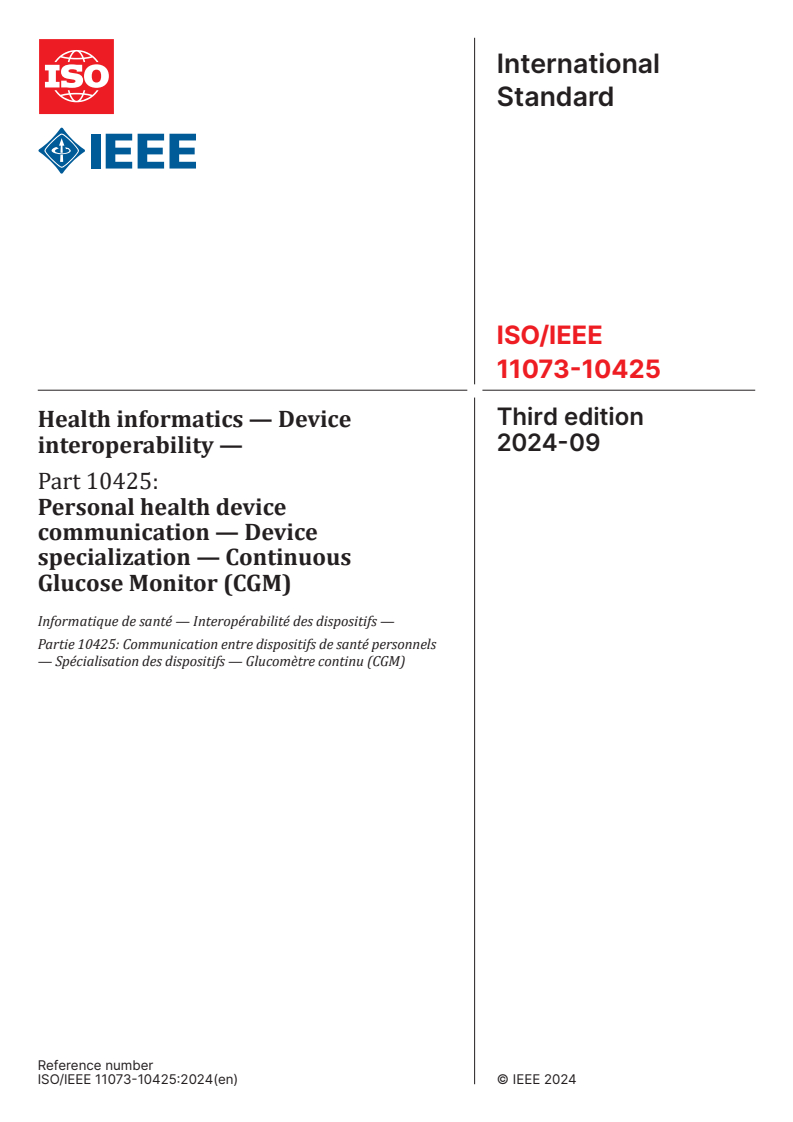
(Main)Health informatics — Device interoperability — Part 10425: Personal health device communication — Device specialization — Continuous Glucose Monitor (CGM)
General Information
- Abstract
This DOCVARIABLE "txtGorRPorSTD" \* MERGEFORMAT \*Lowerstandard establishes a normative definition of communication between personal health continuous glucose monitor (CGM) devices (agents) and managers (e.g., cell phones, personal computers, personal health appliances, set top boxes) in a manner that enables plug-and-play interoperability. It leverages work done in other ISO/IEEE 11073 standards including existing terminology, information profiles, application profile standards, and transport standards. It specifies the use of specific term codes, formats, and behaviors in telehealth environments, restricting optionality in base frameworks in favor of interoperability. This DOCVARIABLE "txtGorRPorSTD" \* MERGEFORMAT \*Lowerstandard defines a common core of communication functionality of CGM devices. In this context, CGM refers to the measurement of the level of glucose in the body on a regular (typically 5 minute) basis through a sensor continuously attached to the person.
- Status
- Published
- Publication Date
- 15-Sep-2024
- Technical Committee
- ISO/TC 215 - Health informatics
- Drafting Committee
- ISO/TC 215/WG 2 - Systems and Device Interoperability
- Current Stage
- 6060 - International Standard published
- Start Date
- 16-Sep-2024
- Due Date
- 27-Apr-2025
- Completion Date
- 16-Sep-2024
Buy Documents
ISO/IEEE 11073-10425:2024 - Health informatics — Device interoperability — Part 10425: Personal health device communication — Device specialization — Continuous Glucose Monitor (CGM) Released:16. 09. 2024
ISO/IEEE 11073-10425:2024 - Informatique de santé — Interopérabilité des dispositifs — Partie 10425: Communication entre dispositifs de santé personnels — Spécialisation des dispositifs — Glucometre continu (CGM) Released:16. 09. 2024
Overview
ISO/IEEE 11073-10425:2024 defines a normative, plug-and-play communication model for Continuous Glucose Monitors (CGM) and managers (for example smartphones, PCs, personal health appliances, set‑top boxes). As part of the ISO/IEEE 11073 family, this device specialization standard specifies the term codes, data formats and expected behaviors that enable interoperable medical device communication in telehealth environments. It reduces optionality in base frameworks to promote consistent implementation and defines a common core of CGM communication functionality. In this standard, CGM refers to sensors that measure glucose levels at regular intervals (typically every five minutes) while continuously attached to the person.
Key topics and requirements
- Plug‑and‑play interoperability: normative definitions for agent (CGM) and manager interaction to facilitate seamless discovery and data exchange.
- Terminology and information models: leverages ISO/IEEE 11073 nomenclature and information profiles to standardize meaning and structure of CGM data.
- Defined term codes, formats and behaviors: prescribes which codes and formats to use and constrains optional features to ensure compatibility across implementations.
- Core communication functionality: common data elements for glucose measurement, timestamps, device state and alarms/alerts.
- Telehealth readiness: tailored for remote monitoring scenarios and integration with personal health devices and manager platforms.
- Conformance and extensibility rules: guidance to maintain interoperability while allowing controlled device information model (DIM) extensions.
- Normative references: aligned with other ISO/IEEE 11073 base standards (for example IEEE 11073-20601 and 11073-10101) to ensure protocol and nomenclature consistency.
Applications
- Enabling CGM connection to mobile apps and personal health gateways for real‑time glucose monitoring.
- Feeding standardized CGM data into electronic health records (EHRs), telehealth platforms and clinical dashboards.
- Supporting remote diabetes management, alerts and automated insulin dosing integrations.
- Facilitating device certification, interoperability testing and multi‑vendor systems in clinical and home settings.
- Use in clinical trials and population health analytics where consistent, time‑series glucose data is required.
Who uses this standard
- Medical device manufacturers (CGM hardware and firmware teams)
- Software/app developers and device integrators for personal health and telehealth solutions
- Interoperability engineers, test labs and certification bodies
- Healthcare providers, diabetes care platforms and regulators seeking standardized data exchange
Related standards
- ISO/IEEE 11073 family (device communication frameworks)
- IEEE 11073-20601 (agent/manager communication architecture)
- ISO/IEEE 11073-10101 (nomenclature)
Keywords: ISO/IEEE 11073-10425:2024, continuous glucose monitor, CGM, medical device communication, personal health devices, device interoperability, telehealth, plug-and-play.
Relations
- Effective Date
- 12-Feb-2026
- Effective Date
- 28-Oct-2023
Buy Documents
ISO/IEEE 11073-10425:2024 - Health informatics — Device interoperability — Part 10425: Personal health device communication — Device specialization — Continuous Glucose Monitor (CGM) Released:16. 09. 2024
ISO/IEEE 11073-10425:2024 - Informatique de santé — Interopérabilité des dispositifs — Partie 10425: Communication entre dispositifs de santé personnels — Spécialisation des dispositifs — Glucometre continu (CGM) Released:16. 09. 2024
Get Certified
Connect with accredited certification bodies for this standard

BSI Group
BSI (British Standards Institution) is the business standards company that helps organizations make excellence a habit.

NYCE
Mexican standards and certification body.
Sponsored listings
Frequently Asked Questions
ISO/IEEE 11073-10425:2024 is a standard published by the International Organization for Standardization (ISO). Its full title is "Health informatics — Device interoperability — Part 10425: Personal health device communication — Device specialization — Continuous Glucose Monitor (CGM)". This standard covers: This DOCVARIABLE "txtGorRPorSTD" \* MERGEFORMAT \*Lowerstandard establishes a normative definition of communication between personal health continuous glucose monitor (CGM) devices (agents) and managers (e.g., cell phones, personal computers, personal health appliances, set top boxes) in a manner that enables plug-and-play interoperability. It leverages work done in other ISO/IEEE 11073 standards including existing terminology, information profiles, application profile standards, and transport standards. It specifies the use of specific term codes, formats, and behaviors in telehealth environments, restricting optionality in base frameworks in favor of interoperability. This DOCVARIABLE "txtGorRPorSTD" \* MERGEFORMAT \*Lowerstandard defines a common core of communication functionality of CGM devices. In this context, CGM refers to the measurement of the level of glucose in the body on a regular (typically 5 minute) basis through a sensor continuously attached to the person.
This DOCVARIABLE "txtGorRPorSTD" \* MERGEFORMAT \*Lowerstandard establishes a normative definition of communication between personal health continuous glucose monitor (CGM) devices (agents) and managers (e.g., cell phones, personal computers, personal health appliances, set top boxes) in a manner that enables plug-and-play interoperability. It leverages work done in other ISO/IEEE 11073 standards including existing terminology, information profiles, application profile standards, and transport standards. It specifies the use of specific term codes, formats, and behaviors in telehealth environments, restricting optionality in base frameworks in favor of interoperability. This DOCVARIABLE "txtGorRPorSTD" \* MERGEFORMAT \*Lowerstandard defines a common core of communication functionality of CGM devices. In this context, CGM refers to the measurement of the level of glucose in the body on a regular (typically 5 minute) basis through a sensor continuously attached to the person.
ISO/IEEE 11073-10425:2024 is classified under the following ICS (International Classification for Standards) categories: 35.240.80 - IT applications in health care technology. The ICS classification helps identify the subject area and facilitates finding related standards.
ISO/IEEE 11073-10425:2024 has the following relationships with other standards: It is inter standard links to EN ISO/IEEE 11073-10425:2025, ISO/IEEE 11073-10425:2019. Understanding these relationships helps ensure you are using the most current and applicable version of the standard.
ISO/IEEE 11073-10425:2024 is available in PDF format for immediate download after purchase. The document can be added to your cart and obtained through the secure checkout process. Digital delivery ensures instant access to the complete standard document.
Standards Content (Sample)
International
Standard
ISO/IEEE
11073-10425
Third edition
Health informatics — Device
2024-09
interoperability —
Part 10425:
Personal health device
communication — Device
specialization — Continuous
Glucose Monitor (CGM)
Informatique de santé — Interopérabilité des dispositifs —
Partie 10425: Communication entre dispositifs de santé personnels
— Spécialisation des dispositifs — Glucomètre continu (CGM)
Reference number
© IEEE 2024
All rights reserved. Unless otherwise specified, or required in the context of its implementation, no part of this publication may
be reproduced or utilized otherwise in any form or by any means, electronic or mechanical, including photocopying, or posting on
the internet or an intranet, without prior written permission. Permission can be requested from IEEE at the address below.
Institute of Electrical and Electronics Engineers, Inc
3 Park Avenue, New York
NY 10016-5997, USA
Email: stds.ipr@ieee.org
Website: www.ieee.org
Published in Switzerland
© IEEE 2024 – All rights reserved
ii
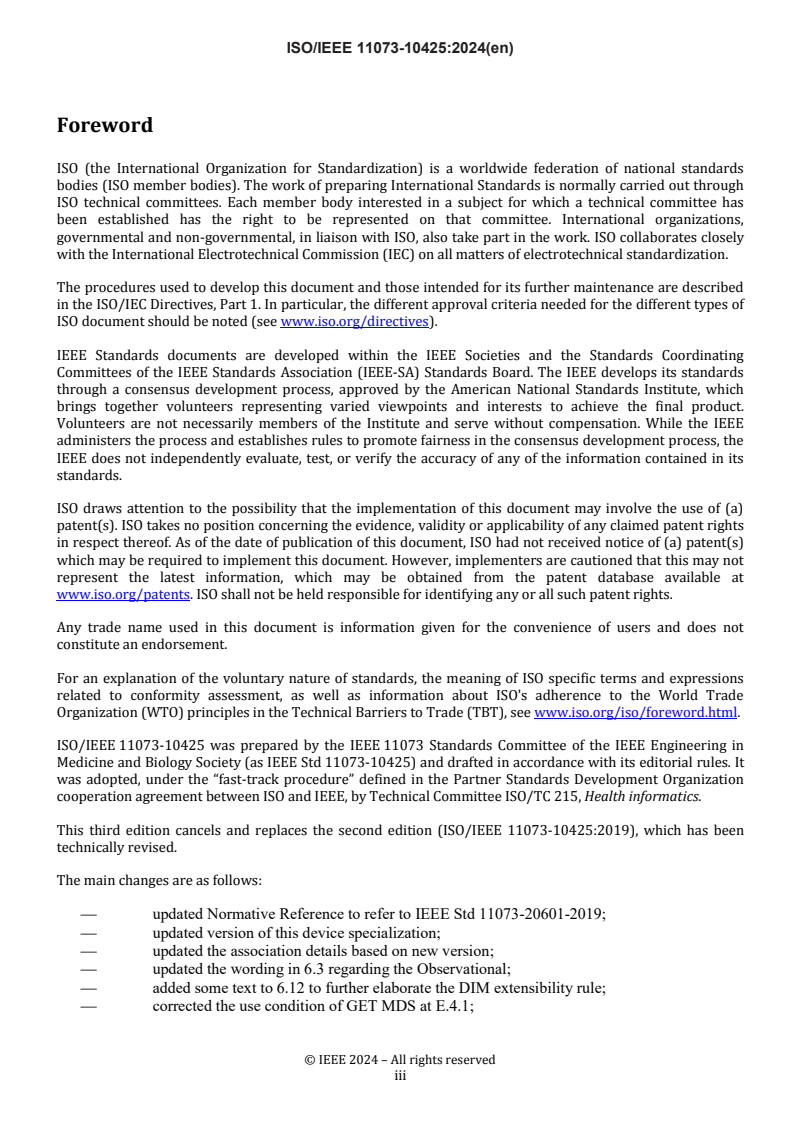
Foreword
ISO (the International Organization for Standardization) is a worldwide federation of national standards
bodies (ISO member bodies). The work of preparing International Standards is normally carried out through
ISO technical committees. Each member body interested in a subject for which a technical committee has
been established has the right to be represented on that committee. International organizations,
governmental and non-governmental, in liaison with ISO, also take part in the work. ISO collaborates closely
with the International Electrotechnical Commission (IEC) on all matters of electrotechnical standardization.
The procedures used to develop this document and those intended for its further maintenance are described
in the ISO/IEC Directives, Part 1. In particular, the different approval criteria needed for the different types of
ISO document should be noted (see www.iso.org/directives).
IEEE Standards documents are developed within the IEEE Societies and the Standards Coordinating
Committees of the IEEE Standards Association (IEEE-SA) Standards Board. The IEEE develops its standards
through a consensus development process, approved by the American National Standards Institute, which
brings together volunteers representing varied viewpoints and interests to achieve the final product.
Volunteers are not necessarily members of the Institute and serve without compensation. While the IEEE
administers the process and establishes rules to promote fairness in the consensus development process, the
IEEE does not independently evaluate, test, or verify the accuracy of any of the information contained in its
standards.
ISO draws attention to the possibility that the implementation of this document may involve the use of (a)
patent(s). ISO takes no position concerning the evidence, validity or applicability of any claimed patent rights
in respect thereof. As of the date of publication of this document, ISO had not received notice of (a) patent(s)
which may be required to implement this document. However, implementers are cautioned that this may not
represent the latest information, which may be obtained from the patent database available at
www.iso.org/patents. ISO shall not be held responsible for identifying any or all such patent rights.
Any trade name used in this document is information given for the convenience of users and does not
constitute an endorsement.
For an explanation of the voluntary nature of standards, the meaning of ISO specific terms and expressions
related to conformity assessment, as well as information about ISO's adherence to the World Trade
Organization (WTO) principles in the Technical Barriers to Trade (TBT), see www.iso.org/iso/foreword.html.
ISO/IEEE 11073-10425 was prepared by the IEEE 11073 Standards Committee of the IEEE Engineering in
Medicine and Biology Society (as IEEE Std 11073-10425) and drafted in accordance with its editorial rules. It
was adopted, under the “fast-track procedure” defined in the Partner Standards Development Organization
cooperation agreement between ISO and IEEE, by Technical Committee ISO/TC 215, Health informatics.
This third edition cancels and replaces the second edition (ISO/IEEE 11073-10425:2019), which has been
technically revised.
The main changes are as follows:
— updated Normative Reference to refer to IEEE Std 11073-20601-2019;
— updated version of this device specialization;
— updated the association details based on new version;
— updated the wording in 6.3 regarding the Observational;
— added some text to 6.12 to further elaborate the DIM extensibility rule;
— corrected the use condition of GET MDS at E.4.1;
© IEEE 2024 – All rights reserved
iii
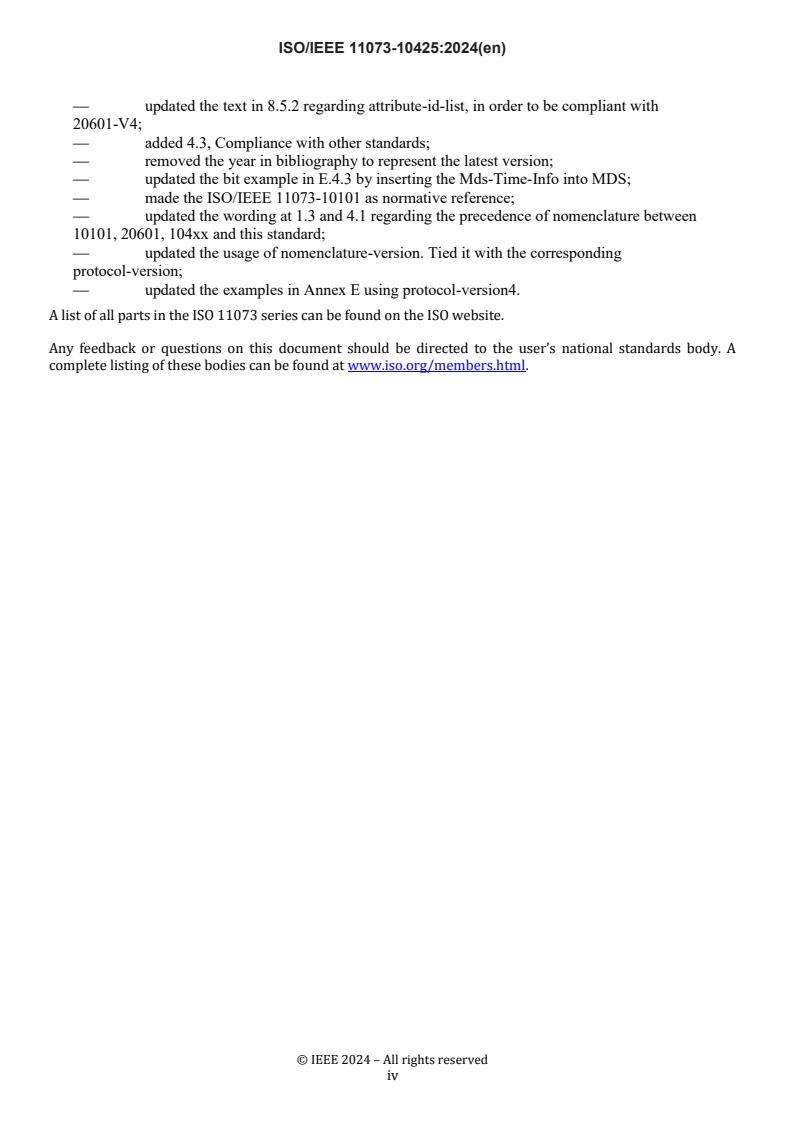
— updated the text in 8.5.2 regarding attribute-id-list, in order to be compliant with
20601-V4;
— added 4.3, Compliance with other standards;
— removed the year in bibliography to represent the latest version;
— updated the bit example in E.4.3 by inserting the Mds-Time-Info into MDS;
— made the ISO/IEEE 11073-10101 as normative reference;
— updated the wording at 1.3 and 4.1 regarding the precedence of nomenclature between
10101, 20601, 104xx and this standard;
— updated the usage of nomenclature-version. Tied it with the corresponding
protocol-version;
— updated the examples in Annex E using protocol-version4.
A list of all parts in the ISO 11073 series can be found on the ISO website.
Any feedback or questions on this document should be directed to the user’s national standards body. A
complete listing of these bodies can be found at www.iso.org/members.html.
© IEEE 2024 – All rights reserved
iv
Abstract: Within the context of the ISO/IEEE 11073 family of standards for device communication, a
normative definition of the communication between continuous glucose monitor (CGM) devices and
managers (e.g., cell phones, personal computers, personal health appliances, set top boxes), in a manner that
enables plug-and-play interoperability, is established in this standard. It leverages appropriate portions of
existing standards including ISO/IEEE 11073 terminology and information models. It specifies the use of
specific term codes, formats, and behaviors in telehealth environments, restricting optionality in base
frameworks in favor of interoperability. This standard defines a common core of communication functionality
of CGM devices. In this context, CGM refers to the measurement of the level of glucose in the body on a regular
(typically 5 minute) basis through a sensor continuously attached to the person.
Keywords: continuous glucose monitor, IEEE 11073-10425™, medical device communication, personal health
devices
The Institute of Electrical and Electronics Engineers, Inc.
3 Park Avenue, New York, NY 10016-5997, USA
All rights reserved. Published 28 July 2023. Printed in the United States of America.
IEEE is a registered trademark in the U.S. Patent & Trademark Office, owned by The Institute of Electrical and Electronics Engineers, Incorporated.
PDF: ISBN 978-1-5044-9836-4 STD26255
Print: ISBN 978-1-5044-9837-1 STDPD26255
IEEE prohibits discrimination, harassment, and bullying.
For more information, visit http://www.ieee.org/web/aboutus/whatis/policies/p9-26.html.
No part of this publication may be reproduced in any form, in an electronic retrieval system or otherwise, without the prior written permission of the publisher.
© IEEE 2024 – All rights reserved
v
Important Notices and Disclaimers Concerning IEEE Standards Documents
IEEE Standards documents are made available for use subject to important notices and legal disclaimers. These notices and
disclaimers, or a reference to this page (https://standards.ieee.org/ipr/disclaimers.html), appear in all standards and may be found
under the heading “Important Notices and Disclaimers Concerning IEEE Standards Documents.”
Notice and Disclaimer of Liability Concerning the Use of IEEE Standards Documents
IEEE Standards documents are developed within the IEEE Societies and the Standards Coordinating Committees of the IEEE
Standards Association (IEEE SA) Standards Board. IEEE develops its standards through an accredited consensus development
process, which brings together volunteers representing varied viewpoints and interests to achieve the final product. IEEE
Standards are documents developed by volunteers with scientific, academic, and industry-based expertise in technical working
groups. Volunteers are not necessarily members of IEEE or IEEE SA, and participate without compensation from IEEE. While
IEEE administers the process and establishes rules to promote fairness in the consensus development process, IEEE does not
independently evaluate, test, or verify the accuracy of any of the information or the soundness of any judgments contained in its
standards.
IEEE makes no warranties or representations concerning its standards, and expressly disclaims all warranties, express or implied,
concerning this standard, including but not limited to the warranties of merchantability, fitness for a particular purpose and non-
infringement. In addition, IEEE does not warrant or represent that the use of the material contained in its standards is free from
patent infringement. IEEE standards documents are supplied “AS IS” and “WITH ALL FAULTS.”
Use of an IEEE standard is wholly voluntary. The existence of an IEEE Standard does not imply that there are no other ways to
produce, test, measure, purchase, market, or provide other goods and services related to the scope of the IEEE standard.
Furthermore, the viewpoint expressed at the time a standard is approved and issued is subject to change brought about through
developments in the state of the art and comments received from users of the standard.
In publishing and making its standards available, IEEE is not suggesting or rendering professional or other services for, or on
behalf of, any person or entity, nor is IEEE undertaking to perform any duty owed by any other person or entity to another. Any
person utilizing any IEEE Standards document, should rely upon his or her own independent judgment in the exercise of
reasonable care in any given circumstances or, as appropriate, seek the advice of a competent professional in determining the
appropriateness of a given IEEE standard.
IN NO EVENT SHALL IEEE BE LIABLE FOR ANY DIRECT, INDIRECT, INCIDENTAL, SPECIAL, EXEMPLARY, OR
CONSEQUENTIAL DAMAGES (INCLUDING, BUT NOT LIMITED TO: THE NEED TO PROCURE SUBSTITUTE
GOODS OR SERVICES; LOSS OF USE, DATA, OR PROFITS; OR BUSINESS INTERRUPTION) HOWEVER CAUSED
AND ON ANY THEORY OF LIABILITY, WHETHER IN CONTRACT, STRICT LIABILITY, OR TORT (INCLUDING
NEGLIGENCE OR OTHERWISE) ARISING IN ANY WAY OUT OF THE PUBLICATION, USE OF, OR RELIANCE
UPON ANY STANDARD, EVEN IF ADVISED OF THE POSSIBILITY OF SUCH DAMAGE AND REGARDLESS OF
WHETHER SUCH DAMAGE WAS FORESEEABLE.
Translations
The IEEE consensus development process involves the review of documents in English only. In the event that an IEEE standard
is translated, only the English version published by IEEE is the approved IEEE standard.
Official statements
A statement, written or oral, that is not processed in accordance with the IEEE SA Standards Board Operations Manual shall not
be considered or inferred to be the official position of IEEE or any of its committees and shall not be considered to be, nor be
relied upon as, a formal position of IEEE. At lectures, symposia, seminars, or educational courses, an individual presenting
information on IEEE standards shall make it clear that the presenter’s views should be considered the personal views of that
individual rather than the formal position of IEEE, IEEE SA, the Standards Committee, or the Working Group.
© IEEE 2024 – All rights reserved
vi
Comments on standards
Comments for revision of IEEE Standards documents are welcome from any interested party, regardless of membership
affiliation with IEEE or IEEE SA. However, IEEE does not provide interpretations, consulting information, or advice
pertaining to IEEE Standards documents.
Suggestions for changes in documents should be in the form of a proposed change of text, together with appropriate supporting
comments. Since IEEE standards represent a consensus of concerned interests, it is important that any responses to comments
and questions also receive the concurrence of a balance of interests. For this reason, IEEE and the members of its Societies and
Standards Coordinating Committees are not able to provide an instant response to comments, or questions except in those cases
where the matter has previously been addressed. For the same reason, IEEE does not respond to interpretation requests. Any
person who would like to participate in evaluating comments or in revisions to an IEEE standard is welcome to join the relevant
IEEE working group. You can indicate interest in a working group using the Interests tab in the Manage Profile & Interests area
of the IEEE SA myProject system. An IEEE Account is needed to access the application.
Comments on standards should be submitted using the Contact Us form.
Laws and regulations
Users of IEEE Standards documents should consult all applicable laws and regulations. Compliance with the provisions of any
IEEE Standards document does not constitute compliance to any applicable regulatory requirements. Implementers of the
standard are responsible for observing or referring to the applicable regulatory requirements. IEEE does not, by the publication
of its standards, intend to urge action that is not in compliance with applicable laws, and these documents may not be construed
as doing so.
Data privacy
Users of IEEE Standards documents should evaluate the standards for considerations of data privacy and data ownership in the
context of assessing and using the standards in compliance with applicable laws and regulations.
Copyrights
IEEE draft and approved standards are copyrighted by IEEE under US and international copyright laws. They are made
available by IEEE and are adopted for a wide variety of both public and private uses. These include both use, by reference, in
laws and regulations, and use in private self-regulation, standardization, and the promotion of engineering practices and methods.
By making these documents available for use and adoption by public authorities and private users, IEEE does not waive any
rights in copyright to the documents.
Photocopies
Subject to payment of the appropriate licensing fees, IEEE will grant users a limited, non-exclusive license to photocopy
portions of any individual standard for company or organizational internal use or individual, non-commercial use only. To
arrange for payment of licensing fees, please contact Copyright Clearance Center, Customer Service, 222 Rosewood Drive,
Danvers, MA 01923 USA; +1 978 750 8400; https://www.copyright.com/. Permission to photocopy portions of any individual
standard for educational classroom use can also be obtained through the Copyright Clearance Center.
Updating of IEEE Standards documents
Users of IEEE Standards documents should be aware that these documents may be superseded at any time by the issuance of
new editions or may be amended from time to time through the issuance of amendments, corrigenda, or errata. An official IEEE
document at any point in time consists of the current edition of the document together with any amendments, corrigenda, or
errata then in effect.
Every IEEE standard is subjected to review at least every 10 years. When a document is more than 10 years old and has not
undergone a revision process, it is reasonable to conclude that its contents, although still of some value, do not wholly reflect the
present state of the art. Users are cautioned to check to determine that they have the latest edition of any IEEE standard.
© IEEE 2024 – All rights reserved
vii
In order to determine whether a given document is the current edition and whether it has been amended through the issuance of
amendments, corrigenda, or errata, visit IEEE Xplore or contact IEEE. For more information about the IEEE SA or IEEE’s
standards development process, visit the IEEE SA Website.
Errata
Errata, if any, for all IEEE standards can be accessed on the IEEE SA Website. Search for standard number and year of approval
to access the web page of the published standard. Errata links are located under the Additional Resources Details section. Errata
are also available in IEEE Xplore. Users are encouraged to periodically check for errata.
Patents
IEEE Standards are developed in compliance with the IEEE SA Patent Policy.
Attention is called to the possibility that implementation of this standard may require use of subject matter covered by patent
rights. By publication of this standard, no position is taken by the IEEE with respect to the existence or validity of any patent
rights in connection therewith. If a patent holder or patent applicant has filed a statement of assurance via an Accepted Letter of
Assurance, then the statement is listed on the IEEE SA Website at https://standards.ieee.org/about/sasb/patcom/patents.html.
Letters of Assurance may indicate whether the Submitter is willing or unwilling to grant licenses under patent rights without
compensation or under reasonable rates, with reasonable terms and conditions that are demonstrably free of any unfair
discrimination to applicants desiring to obtain such licenses.
Essential Patent Claims may exist for which a Letter of Assurance has not been received. The IEEE is not responsible for
identifying Essential Patent Claims for which a license may be required, for conducting inquiries into the legal validity or scope
of Patents Claims, or determining whether any licensing terms or conditions provided in connection with submission of a Letter
of Assurance, if any, or in any licensing agreements are reasonable or non-discriminatory. Users of this standard are expressly
advised that determination of the validity of any patent rights, and the risk of infringement of such rights, is entirely their own
responsibility. Further information may be obtained from the IEEE Standards Association.
IMPORTANT NOTICE
IEEE Standards do not guarantee or ensure safety, security, health, or environmental protection, or ensure against interference
with or from other devices or networks. IEEE Standards development activities consider research and information presented to
the standards development group in developing any safety recommendations. Other information about safety practices, changes
in technology or technology implementation, or impact by peripheral systems also may be pertinent to safety considerations
during implementation of the standard. Implementers and users of IEEE Standards documents are responsible for determining
and complying with all appropriate safety, security, environmental, health, and interference protection practices and all
applicable laws and regulations.
© IEEE 2024 – All rights reserved
viii
Participants
At the time this IEEE standard was submitted to the IEEE SA Standards Board for approval, the Personal Health Devices
Working Group had the following membership:
Daidi Zhong, Chair
Malcolm Clarke, Vice-Chair
Raymond Krasinski, Secretary
Karsten Aalders Chia-Chin Chong Raul Gonzalez Gomez
Charles R. Abbruscato Jinhan Chung Chris Gough
Nabil Abujbara John A. Cogan Channa Gowda
Maher Abuzaid John T. Collins Charles M. Gropper
James Agnew Cory Condek Amit Gupta
Manfred Aigner Todd H. Cooper Jeff Guttmacher
Jorge Alberola Sandra Costanzo Rasmus Haahr
David Aparisi Douglas Coup Christian Habermann
Lawrence Arne Nigel Cox Michael Hagerty
Diego B. Arquillo Hans Crommenacker Jerry Hahn
Serafin Arroyo Tomio Crosley Robert Hall
Muhammad Asim Allen Curtis Shu Han
Kit August Jesús Daniel Trigo Nathaniel Hamming
Doug Baird David Davenport Rickey L. Hampton
David Baker Russell Davis Sten Hanke
Anindya Bakshi Sushil K. Deka Aki Harma
Ananth Balasubramanian Ciro de la Vega Jordan Hartmann
Sunlee Bang Jim Dello Stritto Kai Hassing
M. Jonathan Barkley Kent Dicks Avi Hauser
Gilberto Barrón Hyoungho Do Nathaniel Heintzman
David Bean Fangjie Dong Charles Henderson
John Bell Jonathan Dougherty Jun-Ho Her
Olivia Bellamou-Huet Xiaolian Duan Timothy L. Hirou
Rudy Belliardi Sourav Dutta Allen Hobbs
Daniel Bernstein Jakob Ehrensvard Alex Holland
George A. Bertos Fredrik Einberg Arto Holopainen
Chris Biernacki Javier Escayola Calvo Kris Holtzclaw
Ola Björsne Mark Estes Robert Hoy
Thomas Blackadar Leonardo Estevez Anne Huang
Thomas Bluethner Michael Faughn Guiling Huang
Douglas P. Bogia Bosco T. Fernandes Haofei Huang
Xavier Boniface Christoph Fischer Zhiyong Huang
Shannon Boucousis Morten Flintrup David Hughes
Lyle G. Bullock, Jr. Russell Foster Robert D. Hughes
Bernard Burg Eric Freudenthal Jiyoung Huh
Chris Burns Matthias Frohner Hugh Hunter
Jeremy Byford-Rew Kenneth Fuchs Philip O. Isaacson
Satya Calloji Jing Gao Atsushi Ito
Carole C. Carey Marcus Garbe Michael Jaffe
Craig Carlson John Garguilo Praduman Jain
Santiago Carot-Nemesio Liang Ge Zongbo Jiang
Seungchul Chae Rick Geimer Hu Jin
Yao Chen Igor Gejdos Danny Jochelson
Jing Cheng Ferenc Gerbovics Akiyoshi Kabe
Peggy Chien Alan Godfrey Steve Kahle
David Chiu Nicolae Goga Tomio Kamioka
Jinyong Choi Julian Goldman James J. Kang
© IEEE 2024 – All rights reserved
ix
Kei Kariya Carsten Mueglitz Sid Shaw
Andy Kaschl Soundharya Nagasubramanian Frank Shen
Junzo Kashihara Alex Neefus Min Shih
Ralph Kent Trong-Nghia Nguyen-Dobinsky Mazen Shihabi
Laurie M. Kermes Michael E. Nidd Redmond Shouldice
Sanjay R. Kharche Jim Niswander Sternly K. Simon
Ahmad Kheirandish Hiroaki Niwamoto Marjorie Skubic
Junhyung Kim Thomas Norgall Robert Smith
Minho Kim Yoshiteru Nozoe Ivan Soh
Min-Joon Kim Abraham Ofek Motoki Sone
Taekon Kim Brett Olive Emily Sopensky
Tetsuya Kimura BegonyaOtal Rajagopalan Srinivasan
Michael J. Kirwan Marco Paleari Nicholas Steblay
Alfred Kloos Bud Panjwani Lars Steubesand
Edward Koch Carl Pantiskas John (Ivo) Stivoric
Jeongmee Koh Harry P. Pappas Hermanni Suominen
Jean-Marc Koller Hanna Park Lee Surprenant
John Koon Jong-Tae Park Ravi Swami
Patty Krantz Myungeun Park Ray Sweidan
Alexander Kraus Phillip E. Pash Na Tang
Ramesh Krishna TongBi Pei Haruyuyki Tatsumi
Geoffrey Kruse Soren Petersen Isabel Tejero
Falko Kuester James Petisce Tom Thompson
Rafael Lajara Peter Piction Jonas Tirén
Pierre Landau Michael Pliskin Janet Traub
Jaechul Lee Varshney Prabodh Gary Tschautscher
JongMuk Lee Jeff Price Masato Tsuchid
Kyong Ho Lee Harald Prinzhorn Ken Tubman
Rami Lee Lifei Qian Akib Uddin
Sungkee Lee Harry Qiu Sunil Unadkat
Woojae Lee Tanzilur Rahman Fabio Urbani
Jing Li Lin Ran Philipp Urbauer
Qiong Li Phillip Raymond Laura Vanzago
Xiangchen Li Terrie Reed Alpo Värri
Patrick Lichter Barry Reinhold Andrei Vasilateanu
Jisoon Lim Brian Reinhold Dalimar Velez
Wei-Jung Lo Melvin I. Reynolds Martha Velezis
Charles Lowe John G. Rhoads Rudi Voon
Don Ludolph Jeffrey S. Robbins Isobel Walker
Ling Luo Chris Roberts David Wang
Christian Luszick Moskowitz Robert Jerry P. Wang
Bob MacWilliams Stefan Robert Shiwei Wang
Srikkanth Madhurbootheswaran Scott M. Robertson Yao Wang
Miriam L. Makhlouf Timothy Robertson Yi Wang
M. Sabarimalai Manikandan Sean Rocke Steve Warren
Romain Marmot David Rosales Fujio Watanabe
Sandra Martinez Bill Saltzstein Toru Watsuji
Miguel Martínez de EsproncedaCámara Giovanna Sannino Kathleen Wible
Peter Mayhew Jose A. Santos-Cadenas
Jim McCain Stefan Sauermann Paul Williamson
LászlóMeleg John Sawyer Jia-Rong Wu
Alexander Mense Alois Schloegl Will Wykeham
Behnaz Minaei Paul S. Schluter Ariton Xhafa
Jinsei Miyazaki Mark G. Schnell Ricky Yang
Madhu Mohan Richard A. Schrenker Melanie S. Yeung
Erik Moll Antonio Scorpiniti Qiang Yin
Darr Moore KwangSeok Seo Done-Sik Yoo
Chris Morel Riccardo Serafin Zhi Yu
© IEEE 2024 – All rights reserved
x
Jianchao Zeng Liang Zheng Miha Zoubek
Jason Zhang Daidi Zhong Szymon Zyskoter
Zerui Zhang Yuanhong Zhong
Shiwei Zhao Qing Zhou
The following members of the individual balloting committee voted on this standard. Balloters may have voted for approval,
disapproval, or abstention.
Robert Aiello Charles M. Gropper Bansi Patel
Cheryl Alexander Wang Werner Hoelzl Scott M. Robertson
Bjoern Andersen Piotr Karocki Stefan Schlichting
Pradeep Balachandran Stuart Kerry Walter Struppler
Malcolm Clarke Raymond Krasinski John Vergis
Javier Espina H. Moll Yu Yuan
Michael Faughn Rajesh Murthy Oren Yuen
Kenneth Fuchs Daidi Zhong
When the IEEE SA Standards Board approved this standard on 30 March 2023, it had the following membership:
David J. Law, Chair
Ted Burse, Vice Chair
Gary Hoffman, Past Chair
Konstantinos Karachalios, Secretary
Sara R. Biyabani Joseph S. Levy Paul Nikolich
Doug Edwards Howard Li Annette D. Reilly
Ramy Ahmed Fathy Johnny Daozhuang Lin Robby Robson
Guido R. Hiertz Gui Lin Lei Wang
Yousef Kimiagar Xiaohui Liu F. Keith Waters
Joseph L. Koepfinger* Kevin W. Lu Karl Weber
Thomas Koshy Daleep C. Mohla Philip B. Winston
John D. Kulick Andrew Myles Don Wright
*Member Emeritus
© IEEE 2024 – All rights reserved
xi
Introduction
This introduction is not part of IEEE Std 11073-10425-2023, Health Informatics—Device Interoperability—Part 10425: Personal Health
Device Communication—Device Specialization—Continuous Glucose Monitor (CGM).
ISO/IEEE 11073 standards enable communication between medical devices and external computer systems. This document uses
the optimized framework created in ISO/IEEE 11073-20601 and describes a specific, interoperable communication approach for
continuous glucose monitors (CGMs). These standards align with, and draw on, the existing clinically focused standards to
provide support for communication of data from clinical or personal health devices (PHDs).
Information on references can be found in Clause 2.
© IEEE 2024 – All rights reserved
xii
Contents
1. Overview . 1
1.1 Scope . 1
1.2 Purpose . 1
1.3 Word usage . 1
1.4 Context . 1
2. Normative references . 2
3. Definitions, acronyms, and abbreviations . 2
3.1 Definitions . 2
3.2 Acronyms and abbreviations . 3
4. Introduction to ISO/IEEE 11073 personal health devices (PHDs) . 4
4.1 General . 4
4.2 Introduction to ISO/IEEE 11073-20601 modeling constructs . 4
4.3 Compliance with other standards . 5
5. Glucose monitoring concepts and modalities . 5
5.1 General . 5
5.2 Device types . 6
5.3 CGM agent-to-manager communication . 7
5.4 Collected data . 7
5.5 Stored data . 9
6. Continuous glucose monitor (CGM) domain information model (DIM) . 9
6.1 Overview . 9
6.2 Class extensions . 9
6.3 Object instance diagram . 9
6.4 Types of configuration . 11
6.5 Profiles . 11
6.6 MDS object. 11
6.7 Numeric objects . 14
6.8 Real-time sample array objects. 24
6.9 Enumeration objects . 24
6.10 PM-store objects . 27
6.11 Scanner objects . 31
6.12 Class extension objects . 31
6.13 CGM information model extensibility rules . 31
7. CGM service model . 32
7.1 General . 32
7.2 Object access services . 32
7.3 Object access event report services . 34
8. CGM communication model . 34
8.1 Overview . 34
8.2 Communication characteristics . 34
8.3 Association procedure . 35
8.4 Configuring procedure . 36
8.5 Operating procedure . 38
8.6 Time synchronization . 39
© IEEE 2024 – All rights reserved
xiii
9. Test associations . 39
9.1 Behavior with standard configuration . 39
9.2 Behavior with extended configurations . 39
10. Conformance . 39
10.1 Applicability . 39
10.2 Conformance specification . 39
10.3 Levels of conformance. 40
Annex A (informative) Bibliography . 46
Annex B (normative) Any additional ASN.1 definitions . 47
Annex C (normative) Allocation of identifiers . 51
Annex D (informative) Message sequence examples . 56
Annex E (informative) Protocol data unit examples. 58
Annex F (informative) Revision history . 67
© IEEE 2024 – All rights reserved
xiv
Health Informatics—Device Interoperability
Part 10425:
Personal Health Device Communication—Device
Specialization—Continuous Glucose Monitor (CGM)
1. Overview
1.1 Scope
This standard establishes a normative definition of communication between personal health continuous glucose monitor (CGM)
devices (agents) and managers (e.g., cell phones, personal computers, personal health appliances, set top boxes) in a manner that
enables plug-and-play interoperability. It leverages work done in other ISO/IEEE 11073 standards including existing
terminology, information profiles, application profile standards, and transport standards. It specifies the use of specific term
codes, formats, and behaviors in telehealth environments, restricting optionality in base frameworks in favor of interoperability.
This standard defines a common core of communication functionality of CGM devices. In this context, CGM refers to the
measurement of the level of glucose in the body on a regular (typically 5 minute) basis through a sensor continuously attached to
the person.
1.2 Purpose
This standard addresses a need for an openly defined, independent standard for controlling information exchange to and from
personal health devices (PHDs) and compute engines (e.g., cell phones, personal computers, personal health appliances, set top
boxes). Interoperability is the key to growing the potential market for these devices and to enabling people to be better informed
participants in the management of their health.
1.3 Word usage
The word shall indicates mandatory requirements strictly to be followed in order to conform to the standard and from which no
2, 3
deviation is permitted (shall equals is required to).
The word should indicates that among several possibilities one is recommended as particularly suitable, without mentioning or
excluding others; or that a certain course of action is preferred but not necessarily required (should equals is recommended that).
The word may is used to indicate a course of action permissible within the limits of the standard (may equals is permitted to).
The word can is used for statements of possibility and capability, whether material, physical, or causal (can equals is able to).
1.4 Context
See ISO/IEEE 11073-20601 for an overview of the environment within which this standard is written.
This standard defines the device specialization for the CGM, being a specific agent type, and it provides a description of the
device concepts, its capabilities, and its implementation according to this standard.
The use of the word must is deprecated and cannot be used when stating mandatory requirements; must is used only to describe unavoidable situations.
The use of will is deprecated and cannot be used when stating mandatory requirements; will is only used in statements of fact.
© IEEE 2024 – All rights reserved
This standard is based on ISO/IEEE 11073-20601, which in turn draws information from both
ISO/IEEE 11073-10201 [B6] and ISO/IEEE 11073-20101 [B7]. The medical device encoding rules (MDER) used within this
standard are fully described in ISO/IEEE 11073-20601.
The object classes and attributes in this standard are identified by nomenclature codes. Each code consists of a reference
identifier (RefID) string and an integer code value. By using a consistent nomenclature, interoperability is enhanced as all
implementations maintain the same semantic meaning for the numeric codes. This standard leverages the existing nomenclature
codes in ISO/IEEE 11073-10101. Between this standard, ISO/IEEE 11073-10101, ISO/IEEE 11073-20601, and other IEEE Std
11073-104zz, all required nomenclature codes for implementation are documented. New codes may be defined in newer
versions/ revisions of each of these documents. In the case of a conflict, when one term code has been assigned to two separate
semantic concepts with different RefIDs, in general, the oldest definition in actual use should take precedence. The same policy
applies when one RefID has two different code values assigned in different specifications. The resolution of such conflicts will
be determined through joint action by the responsible working groups and other stakeholders, and any corrective action will be
published as corrigenda.
NOTE—In this standard, IEEE Std 11073-104zz is used to refer to the collection of device specialization standards that utilize ISO/IEEE
11073-20601, where zz can be any number from 01 to 99, inclusive.
2. Normative references
The following referenced documents are indispensable for the application of this document (i.e., they must be understood and
used; therefore, each referenced document is cited in text and its relationship to this document is explained). For dated
references, only the edition cited applies. For undated references, the latest edition of the referenced document (including any
amendments or corrigenda) applies.
ISO/IEEE 11073-10101, Health informatics—Point-of-care medical device communication—Part 10101: Nomenclature.
ISO/IEEE 11073-20601, Health informatics—Personal health device communication—Part 20601: Application Profile—
Optimized Exchange Protocol.
See Annex A for all informative material referenced by this standard.
3. Definitions, acronyms, and abbreviations
3.1 Definitions
For the purposes of this document, the following terms and definitions apply. The IEEE Standards Dictionary Online should be
consulted for terms not defined in this clause.
agent: A node that collects and transmits personal health data to an associated manager.
blood glucose: Glucose concentration in the blood.
class: In object-oriented modeling, a term collectively describing the attributes, methods, and events utilized by objects
instantiated from the class.
compute engine: See: manager.
continuous glucose monitor (CGM): A medical device to provide a series of estimates of blood glucose concentration;
typically from body fluid.
The numbers in brackets correspond to those of the bibliography in Annex A.
Notes in text, tables, and figures of a standard are given for information only and do not contain requirements needed to implement this standard.
ISO/IEEE publications are available from the ISO Central Secretariat (http://www.iso.ch/). ISO/IEEE publications are also available in the United States from
The Institute of Electrical and Electronics Engineers (http://standards.ieee.org/).
IEEE Standards Dictionary Online is available at: http://dictionary.ieee.org. An IEEE Account is required for access to the dictionary, and one can be created
at no charge on the dictionary sign-in page.
© IEEE 2024 – All rights reserved
device: A physical apparatus implementing either an agent or a manager role.
glucose: The major source of energy used by the body cells. Glucose is commonly referred to as sugar.
handle: An unsigned 16-bit number that is locally unique and identifies one of the object instances within an agent.
interstitial fluid (ISF): The thin layer of fluid that surrounds the body’s cells.
manager: A node receiving data from one or more agent systems. Some examples of managers include a cellular phone, health
appliance, set top box, or a computer system.
object: In object-oriented modeling, a particular instantiation of a class. The instantiation realizes attributes, methods, and
events from the class.
obj-handle: See: handle.
personal health device (PHD): A device used in personal health applications.
personal telehealth device: See: personal health device (PHD).
3.2 Acronyms and abbreviations
APDU application protocol data unit
ASN.1 Abstract Syntax Notation One
AST alternative site testing
BGM blood glucose meter
CGM continuous glucose monitor
DIM domain information model
DM disease management
EUI-64 extended unique identifier (64 bits)
HCP health care professional
ICS implementation conformance statement
ID identifier
ISF interstitial fluid
MDC medical device communication
MDER medical device encoding rules
MDS medical device system
MOC managed object class
OID object identifier
PHD personal health device
VMO virtual medical object
VMS virtual medical system
© IEEE 2024 – All rights reserved
----------------------
...
Norme
internationale
ISO/IEEE
11073-10425
Troisième édition
Informatique de santé —
2024-09
Interopérabilité des dispositifs —
Partie 10425:
Communication entre dispositifs de
santé personnels — Spécialisation
des dispositifs — Glucomètre
continu (CGM)
Health informatics — Device interoperability —
Part 10425: Personal health device communication — Device
specialization — Continuous Glucose Monitor (CGM)
Numéro de référence
DOCUMENT PROTÉGÉ PAR COPYRIGHT
© IEEE 2024
Tous droits réservés. Sauf prescription différente ou nécessité dans le contexte de sa mise en œuvre, aucune partie de cette
publication ne peut être reproduite ni utilisée sous quelque forme que ce soit et par aucun procédé, électronique ou mécanique, y
compris la photocopie, ou la diffusion sur l’internet ou un intranet, sans autorisation écrite préalable. Une autorisation peut être
demandée à l’IEEE à l’adresse ci-après.
Institute of Electrical and Electronics Engineers, Inc
3 Park Avenue, New York
NY 10016-5997, USA
E-mail: stds.ipr@ieee.org
Website: www.ieee.org
Publié en Suisse
© IEEE 2024 – Tous droits réservés
ii
Avant-propos
L’ISO (Organisation internationale de normalisation) est une fédération mondiale d’organismes nationaux de
normalisation (comités membres de l’ISO). L’élaboration des Normes internationales est en général confiée
aux comités techniques de l’ISO. Chaque comité membre intéressé par une étude a le droit de faire partie du
comité technique créé à cet effet. Les organisations internationales, gouvernementales et non
gouvernementales, en liaison avec l’ISO participent également aux travaux. L’ISO collabore étroitement avec
la Commission électrotechnique internationale (IEC) en ce qui concerne la normalisation électrotechnique.
Les procédures utilisées pour élaborer le présent document et celles destinées à sa mise à jour sont décrites
dans les Directives ISO/IEC, Partie 1. Il convient, en particulier, de prendre note des différents critères
d’approbation requis pour les différents types de documents ISO (voir www.iso.org/directives).
Les documents normatifs de l’IEEE sont élaborés au sein des sociétés de l’IEEE et des Comités de Coordination
des Normes du Conseil des Normes de l’Association des normes IEEE (IEEE-SA). L’IEEE élabore ses normes
par le biais d’un processus de développement de consensus approuvé par l’American National Standards
Institute, qui rassemble des volontaires représentant divers points de vue et divers intérêts pour parvenir au
produit final. Les volontaires ne sont pas nécessairement des membres de l’Institut et aucune compensation
ne leur est attribuée. Bien que l’IEEE administre le processus et établisse des règles pour favoriser l’équité au
cours du processus de développement du consensus, l’IEEE n’évalue pas, ne soumet pas à essai ou ne vérifie
pas de manière indépendante l’exactitude des informations contenues dans ses normes.
L’ISO attire l’attention sur le fait que la mise en application du présent document peut entraîner l’utilisation
d’un ou de plusieurs brevets. L’ISO ne prend pas position quant à la preuve, à la validité et à l’applicabilité de
tout droit de propriété revendiqué à cet égard. À la date de publication du présent document, l’ISO n’avait pas
reçu notification qu’un ou plusieurs brevets pouvaient être nécessaires à sa mise en application. Toutefois, il
y a lieu d’avertir les responsables de la mise en application du présent document que des informations plus
récentes sont susceptibles de figurer dans la base de données de brevets, disponible à l’adresse
www.iso.org/brevets. L’ISO ne saurait être tenue pour responsable de ne pas avoir identifié de tels droits de
brevet.
Les appellations commerciales éventuellement mentionnées dans le présent document sont données pour
information, par souci de commodité, à l’intention des utilisateurs et ne sauraient constituer un engagement.
Pour une explication de la nature volontaire des normes, la signification des termes et expressions spécifiques
de l’ISO liés à l’évaluation de la conformité, ou pour toute information au sujet de l’adhésion de l’ISO aux
principes de l’Organisation mondiale du commerce (OMC) concernant les obstacles techniques au commerce
(OTC), voir www.iso.org/avant-propos.
L’ISO/IEEE 11073-10425 a été élaborée par le Comité des normes IEEE 11073 de la Société d’Ingénierie en
Médecine et Biologie de l’IEEE (en tant que norme IEEE 11073-10425) et rédigée conformément à ses règles
de rédaction. Elle a été adoptée par le comité technique ISO/TC 215, Informatique de santé, dans le cadre de la
« procédure rapide » définie par l’accord de coopération entre les Organisations Partenaires de
Développement de Normes que sont l’ISO et l’IEEE.
Cette troisième édition annule et remplace la deuxième édition (ISO/IEEE 11073-10425:2019), qui a fait
l’objet d’une révision technique.
Les principales modifications sont les suivantes :
— mise à jour des références normatives pour se référer à la norme IEEE 11073-20601-2019 ;
— version mise à jour de cette spécialisation de dispositif ;
— mise à jour des détails de l’association en fonction de la nouvelle version ;
— mise à jour de la formulation en 6.3 concernant l’observation ;
© IEEE 2024 – Tous droits réservés
iii
— ajout de texte en 6.12 pour approfondir la règle d’extension du DIM ;
— correction de la condition d’utilisation du MDS de GET en E.4.1 ;
— mise à jour du texte en 8.5.2 concernant attribute-id-list, afin d’être conforme à
20601-V4 ;
— ajout de 4.3 concernant la conformité à d’autres normes ;
— suppression de l’année dans la bibliographie pour représenter la dernière version ;
— mise à jour de l’exemple de bit en E.4.3 en insérant Mds-Time-Info dans le MDS ;
— transformation de l’ISO/IEEE 11073-10101 en tant que référence normative ;
— mise à jour des formulations en 1.3 et 4.1 concernant la priorité donnée à la nomenclature
entre 10101, 20601, 104xx et la présente norme ;
— mise à jour de l’utilisation de nomenclature-version. Rattaché avec le protocol-version
correspondant ;
— mise à jour des exemples de l’Annexe E à l’aide de protocol-version4.
Une liste de toutes les parties de la série ISO 11073 se trouve sur le site Web de l’ISO.
Il convient que l’utilisateur adresse tout retour d’information ou toute question concernant le présent
document à l’organisme national de normalisation de son pays. Une liste exhaustive desdits organismes se
trouve à l’adresse www.iso.org/fr/members.html.
© IEEE 2024 – Tous droits réservés
iv
Résumé : Dans le contexte de la famille de normes ISO/IEEE 11073 relatives à la communication entre des
dispositifs, la présente norme établit une définition normative de la communication entre des dispositifs
glucomètres continus (CGM) et des gestionnaires (par exemple des téléphones cellulaires, des ordinateurs
personnels, des équipements personnels de santé, des boîtiers décodeurs) d’une manière qui permet une
interopérabilité du type prêt à l’emploi. Elle s’appuie sur les parties appropriées de normes existantes,
y compris la terminologie et des modèles d’informations de l’ISO/IEEE 11073. Elle spécifie l’utilisation de
codes, de formats et de comportements en termes spécifiques dans les environnements de télésanté,
en limitant les choix à des cadres de travail de base en faveur de l’interopérabilité. La présente norme définit
un noyau commun de fonctionnalités de communication des dispositifs CGM. Dans ce contexte, CGM désigne
la mesure du niveau de glucose dans l’organisme relevé régulièrement (généralement toutes les 5 minutes)
par le biais d’un capteur relié en permanence à la personne.
Mots-clés : glucomètre continu, IEEE 11073-10425™, communication entre dispositifs médicaux, dispositifs
personnels de santé
The Institute of Electrical and Electronics Engineers, Inc.
3 Park Avenue, New York, NY 10016-5997, États-Unis
Tous droits réservés. Publiée le 28 juillet 2023. Imprimé aux États-Unis.
IEEE est une marque commerciale déposée à l’Office des brevets et des marques des États-Unis, détenue par l’Institute of Electrical and Electronics Engineers,
Incorporated.
PDF : ISBN 978-1-5044-9836-4 STD26255
Copie papier : ISBN 978-1-5044-9837-1 STDPD26255
L’IEEE interdit toute discrimination, tout harcèlement et toute intimidation.
Pour plus d’informations, consulter le site Internet http://www.ieee.org/web/aboutus/whatis/policies/p9-26.html.
Toute reproduction, même partielle, de cette publication, sous quelque forme et par quelque procédé que ce soit, y compris par système de localisation électronique,
est interdite sans l’autorisation écrite préalable de l’éditeur.
© IEEE 2024 – Tous droits réservés
i
Notes importantes et rejets de responsabilité concernant les documents normatifs de l’IEEE
Les documents normatifs de l’IEEE sont disponibles sous réserve de l’utilisation des avis importants et avertissements juridiques.
Ces notes et rejets de responsabilité, ou une référence à cette page (https://standards.ieee.org/ipr/disclaimers.html), apparaissent
dans toutes les normes et peuvent être trouvés sous l’en-tête « Notes importantes et rejets de responsabilité concernant les
documents normatifs de l’IEEE ».
Note et rejet de responsabilité concernant l’utilisation des documents normatifs de l’IEEE
Les documents normatifs de l’IEEE sont élaborés au sein des sociétés de l’IEEE et des Comités de Coordination des Normes du
Conseil des Normes de l’Association des Normes de l’IEEE (IEEE-SA). L’IEEE élabore ses normes par le biais d’un processus
agréé de développement du consensus, qui rassemble des volontaires représentant des points de vue et des centres d’intérêt variés
pour parvenir au produit final. Les normes de l’IEEE sont des documents élaborés par des groupes de travail composés de
volontaires experts dans les domaines scientifique, universitaire et industriel. Les volontaires ne sont pas nécessairement des
membres de l’IEEE ou de l’IEEE SA, et aucune compensation ne leur est attribuée pour leur participation. Bien que l’IEEE
administre le processus et établisse des règles pour favoriser l’équité au cours du processus de développement du consensus,
l’IEEE n’évalue pas, ne soumet pas à essai ou ne vérifie pas de manière indépendante l’exactitude des informations ni le bien-fondé
de tous les jugements contenus dans ses normes.
L’IEEE ne garantit ni ne représente l’exactitude ou le contenu des informations contenues dans ses normes, et décline
expressément toute garantie, explicite ou implicite, concernant la présente norme, notamment, les garanties d’aptitude à la
commercialisation, d’adéquation à un usage particulier et de non-contrefaçon. En outre, l’IEEE ne garantit ni ne déclare que
l’utilisation du contenu de ses normes ne comporte aucun risque de violation de brevet. Les documents normatifs de l’IEEE sont
fournis « EN L’ÉTAT » et « AVEC TOUS LES DÉFAUTS ».
L’utilisation d’une norme IEEE est totalement volontaire. L’existence d’une norme IEEE n’implique pas qu’il n’y ait pas d’autres
manières de produire, de soumettre à essai, de mesurer, d’acheter, de commercialiser ou de fournir d’autres biens et services qui
se rapportent au domaine d’application de la norme IEEE. En outre, le point de vue exprimé à l’instant où une norme est approuvée
et publiée est soumis aux changements provoqués par les développements dans l’état de la technique et les commentaires reçus
des utilisateurs de la norme.
En publiant ses normes et en les rendant disponibles, l’IEEE ne suggère pas ou ne rend pas de services professionnels ou autres
pour une personne ou une entité quelconque, et n’entreprend pas non plus l’exécution d’une responsabilité quelconque de toute
autre personne ou entité envers une autre. Il est recommandé à toute personne utilisant un document normatif de l’IEEE de
s’appuyer sur son jugement indépendant en exerçant une diligence raisonnable dans des circonstances données quelconques ou,
selon le cas, de demander l’avis d’un professionnel compétent pour déterminer la pertinence d’une norme IEEE donnée.
EN AUCUN CAS L’IEEE NE SAURAIT ÊTRE TENUE POUR RESPONSABLE DE QUELCONQUES DOMMAGES
DIRECTS, INDIRECTS, INCIDENTS, SPÉCIAUX, EXEMPLAIRES OU CONSÉCUTIFS (Y COMPRIS, SANS TOUTEFOIS
S’Y LIMITER : BESOIN D’ACHATS DE MARCHANDISES OU DE SERVICES DE REMPLACEMENT ; PERTE
D’UTILISATION, DE DONNÉES OU DE BÉNÉFICES ; OU INTERRUPTION D’ACTIVITÉ) CAUSÉS DE QUELQUE
MANIÈRE QUE CE SOIT ET SELON TOUTE THÉORIE DE RESPONSABILITÉ, QUE CE SOIT DANS LE CONTRAT,
RESPONSABILITÉ STRICTE OU DÉLICTUELLE (Y COMPRIS LA NÉGLIGENCE OU AUTRE), RÉSULTANT DE LA
PUBLICATION, DE L’UTILISATION OU DE LA CONFIANCE DE/EN TOUTE NORME, MÊME EN CAS
D’INFORMATION DE LA POSSIBILITÉ DE TELS DOMMAGES, ET INDÉPENDAMMENT DU FAIT QUE CES
DOMMAGES ÉTAIENT PRÉVISIBLES OU NON.
Traductions
Le processus de développement du consensus IEEE implique l’étude des documents en anglais uniquement. Si une norme de
l’IEEE est traduite, il convient que seule la version anglaise publiée par l’IEEE soit la norme IEEE approuvée.
© IEEE 2024 – Tous droits réservés
ii
Déclarations officielles
Il ne doit pas être considéré ou déduit qu’une déclaration, écrite ou orale, qui n’est pas traitée conformément au manuel des
opérations du Conseil des normes de l’IEEE SA reflète la position officielle de l’IEEE ou de l’un de ses comités et une telle
déclaration ne doit pas être considérée comme une position officielle de l’IEEE ou à laquelle se fier. Lors de conférences, de
symposiums, de séminaires ou de cours de formation, une personne présentant des informations sur les normes de l’IEEE doit
indiquer clairement qu’il convient que les points de vue du présentateur soient considérés comme les points de vue personnels de
cette personne plutôt que comme étant la position officielle de l’IEEE, l’IEEE SA, le comité des normes ou le groupe de travail.
Commentaires sur les normes
Les commentaires visant à des révisions des documents normatifs de l’IEEE provenant de toute partie intéressée sont les bienvenus,
indépendamment de l’affiliation en tant que membre de l’IEEE ou l’IEEE SA. Cependant, l’IEEE ne fournit pas
d’interprétations, d’informations à titre de consultation ni de conseils concernant les documents normatifs de l’IEEE.
Il convient que des suggestions pour des modifications aux documents se présentent sous la forme d’une modification de texte
proposée accompagnée des commentaires d’appui appropriés. Comme les normes de l’IEEE représentent un consensus des intérêts
concernés, il est important que toute réponse à des commentaires ou questions reçoive également l’attention d’intérêts équilibrés.
Pour cette raison, l’IEEE et les membres de ses sociétés et de ses Comités de Coordination des Normes ne peuvent pas fournir
une réponse instantanée aux commentaires ou questions, excepté dans les cas où le sujet a précédemment été traité. Pour la même
raison, l’IEEE ne répond pas aux demandes d’interprétation. Toute personne qui aimerait participer à l’évaluation des
commentaires ou aux révisions d’une norme IEEE est invitée à se joindre au groupe de travail pertinent de l’IEEE. Il est possible
d’indiquer l’intérêt pour un groupe de travail à l’aide de l’onglet « Interests » dans la zone « Manage Profile & Interests » sur le
site IEEE SA myProject system. Un compte IEEE est nécessaire pour accéder à la demande.
Il convient d’envoyer des commentaires sur les normes en utilisant le formulaire Contact Us.
Lois et règlements
Il est recommandé aux utilisateurs des documents normatifs de l’IEEE de consulter toutes les lois et réglementations applicables.
La conformité aux dispositions de tout document normatif de l’IEEE n’induit pas la conformité à toutes les exigences
réglementaires applicables. Il incombe aux personnes ou organismes mettant en œuvre la norme d’observer les exigences
réglementaires applicables ou d’y faire référence. L’IEEE n’a pas l’intention, du fait de la publication de ses normes, de provoquer
des actions qui ne sont pas conformes aux lois applicables et ces documents ne peuvent pas être interprétés comme le faisant.
Protection des données
Il convient que les utilisateurs des documents des normes IEEE évaluent les normes au regard des considérations relatives à la
confidentialité des données et à la propriété des données dans le contexte de l’évaluation et de l’utilisation des normes en
conformité avec les lois et réglementations applicables.
Copyrights
Les projets de normes et les normes approuvées de l’IEEE sont soumis aux droits d’auteur de l’IEEE en vertu des lois américaines
et internationales sur les droits d’auteur. Ils sont rendus disponibles par l’IEEE et sont adoptés pour une grande diversité
d’utilisations à la fois publiques et privées. Celles-ci incluent une utilisation, par référence, dans les lois et réglementations et une
utilisation dans l’auto-réglementation, la normalisation et la promotion de pratiques et de méthodes d’ingénierie. En rendant ces
documents disponibles en vue de leur utilisation et de leur adoption par les autorités publiques et les utilisateurs privés, l’IEEE ne
renonce à aucun droit de copyright sur ce document.
© IEEE 2024 – Tous droits réservés
iii
Photocopies
Sous réserve du paiement des droits de licence correspondants, l’IEEE accordera aux utilisateurs une licence limitée et non
exclusive pour photocopier des parties de toute norme individuelle en vue d’une utilisation interne par l’entreprise ou
l’organisation ou une utilisation exclusivement individuelle et non commerciale. Pour procéder au paiement des droits de licence,
contacter le Copyright Clearance Center, Customer Service, 222 Rosewood Drive, Danvers, MA 01923 États-Unis d’Amérique ;
+1 978 750 8400 ; https://www.copyright.com/. L’autorisation de photocopier des parties d’une norme individuelle à des fins
d’enseignement en classe peut également être obtenue auprès du Copyright Clearance Center.
Mise à jour de documents normatifs de l’IEEE
Il convient que les utilisateurs des documents normatifs de l’IEEE soient informés du fait que ces documents peuvent être
remplacés à tout moment par la publication de nouvelles éditions ou peuvent être amendés de temps à autre par le biais de la
publication d’amendements, de correctifs ou d’errata. Un document IEEE officiel, à un instant quelconque, est constitué de
l’édition actuelle du document accompagnée de tous les amendements, correctifs ou errata alors en vigueur.
Chaque norme IEEE est soumise à un examen au moins tous les 10 ans. Lorsqu’un document a plus de 10 ans et n’a pas fait l’objet
d’un processus de révision, il est raisonnable de conclure que son contenu, bien qu’il ait encore une certaine valeur, ne reflète pas
totalement l’état actuel de la technique. Les utilisateurs sont invités à s’assurer qu’ils ont la dernière édition des normes IEEE.
Pour déterminer si un document donné est l’édition actuelle et s’il a été amendé par le biais de l’émission d’amendements, de
correctifs ou d’errata, consulter IEEE Xplore ou contacter l’IEEE. Pour plus d’informations sur l’IEEE SA ou le processus
d’élaboration des normes IEEE, consulter le site Web de l’IEEE SA.
Errata
Le cas échéant, les errata de toutes les normes IEEE peuvent être consultés sur le site Web de l’IEEE SA. Rechercher le numéro
de norme et l’année d’approbation pour accéder à la page Web de la norme publiée. Les liens des errata se trouvent dans la section
« Additional Resources Details ». Les errata sont également disponibles sur le site IEEE Xplore. Les utilisateurs sont encouragés
à vérifier périodiquement les errata.
Brevets
Les normes IEEE sont élaborées conformément à la Politique de brevet de l’IEEE SA.
L’attention est attirée sur la possibilité que la mise en œuvre de la présente norme puisse requérir l’utilisation d’un objet couvert
par des droits de propriété intellectuelle. Du fait de la publication de la présente norme, aucune position n’est prise par l’IEEE en
ce qui concerne l’existence ou la validité de tout droit de propriété intellectuelle en rapport avec celle-ci. Si un détenteur ou
demandeur de brevet a déposé une déclaration d’assurance par l’intermédiaire d’une lettre d’assurance acceptée, la déclaration est
alors répertoriée sur le site Web de l’IEEE SA à l’adresse : https://standards.ieee.org/about/sasb/patcom/patents.html. Les lettres
d’assurance peuvent indiquer si le demandeur est disposé ou non à accorder des licences dans le cadre de droits de brevet sans
compensation ou à des tarifs raisonnables, avec des conditions raisonnables dont il peut être démontré qu’elles sont exemptes de
discrimination déloyale pour les demandeurs qui souhaitent obtenir de telles licences.
D’autres revendications essentielles en matière de brevets peuvent exister, pour lesquelles une lettre d’assurance n’a pas été reçue.
Il n’incombe pas à l’IEEE d’identifier les Essential Patent Claims (Revendications Essentielles de Brevets) pour lesquelles une
licence peut être requise, d’exécuter des enquêtes portant sur la validité légale ou la portée des revendications de brevet ou de
déterminer si des termes ou conditions d’attribution de licence fournis en rapport avec la soumission d’une lettre d’assurance, le
cas échéant, ou dans des accords d’attribution de licence quelconques sont raisonnables ou non discriminatoires. Les utilisateurs
de la présente norme sont expressément avisés que la détermination de la validité de tout droit de brevet et le risque de violation
de ces droits leur incombent entièrement. Des informations supplémentaires peuvent être obtenues auprès de l’Association des
normes IEEE.
© IEEE 2024 – Tous droits réservés
iv
NOTES IMPORTANTES
Les normes de l’IEEE ne fournissent ni garantie, ni assurance quant à la sûreté, la sécurité, la santé ou la protection
environnementale, et n’assurent pas de protection contre les interférences avec d’autres dispositifs ou réseaux ou provenant de
ceux-ci. Les activités d’élaboration des normes de l’IEEE tiennent compte de la recherche et des informations présentées au groupe
de développement de normes lors de la définition de toutes les recommandations de sécurité. D’autres informations sur les
pratiques de sécurité, les modifications de la technologie ou de la mise en œuvre de la technologie, ou sur l’impact des systèmes
périphériques peuvent également être pertinentes pour des questions de sécurité pendant la mise en œuvre de la norme. Les
personnes qui mettent en œuvre et celles qui utilisent les documents normatifs de l’IEEE sont responsables de la détermination
appropriée de la sûreté, de la sécurité, des pratiques environnementales, sanitaires et de protection contre les interférences et de
toutes les lois et réglementations applicables ainsi que de la conformité à celles-ci.
© IEEE 2024 – Tous droits réservés
v
Intervenant
Au moment où la présente IEEE était soumise au Conseil des Normes IEEE-SA pour approbation, le Groupe de travail comprenait
les membres suivants :
Daidi Zhong, Président
Malcolm Clarke, Vice-président
Raymond Krasinski, Secrétaire
Karsten Aalders Chia-Chin Chong Raul Gonzalez Gomez
Charles R. Abbruscato Jinhan Chung Chris Gough
Nabil Abujbara John A. Cogan Channa Gowda
Maher Abuzaid John T. Collins Charles M. Gropper
James Agnew Cory Condek Amit Gupta
Manfred Aigner Todd H. Cooper Jeff Guttmacher
Jorge Alberola Sandra Costanzo Rasmus Haahr
David Aparisi Douglas Coup Christian Habermann
Lawrence Arne Nigel Cox Michael Hagerty
Diego B. Arquillo Hans Crommenacker Jerry Hahn
Serafin Arroyo Tomio Crosley Robert Hall
Muhammad Asim Allen Curtis Shu Han
Kit August Jesús Daniel Trigo Nathaniel Hamming
Doug Baird David Davenport Rickey L. Hampton
David Baker Russell Davis Sten Hanke
Anindya Bakshi Sushil K. Deka Aki Harma
Ananth Balasubramanian Ciro de la Vega Jordan Hartmann
Sunlee Bang Jim Dello Stritto Kai Hassing
M. Jonathan Barkley Kent Dicks Avi Hauser
Gilberto Barrón Hyoungho Do Nathaniel Heintzman
David Bean Fangjie Dong Charles Henderson
John Bell Jonathan Dougherty Jun-Ho Her
Olivia Bellamou-Huet Xiaolian Duan Timothy L. Hirou
Rudy Belliardi Sourav Dutta Allen Hobbs
Daniel Bernstein Jakob Ehrensvard Alex Holland
George A. Bertos Fredrik Einberg Arto Holopainen
Chris Biernacki Javier Escayola Calvo Kris Holtzclaw
Ola Björsne Mark Estes Robert Hoy
Thomas Blackadar Leonardo Estevez Anne Huang
Thomas Bluethner Michael Faughn Guiling Huang
Douglas P. Bogia Bosco T. Fernandes Haofei Huang
Xavier Boniface Christoph Fischer Zhiyong Huang
Shannon Boucousis Morten Flintrup David Hughes
Lyle G. Bullock, Jr. Russell Foster Robert D. Hughes
Bernard Burg Eric Freudenthal Jiyoung Huh
Chris Burns Matthias Frohner Hugh Hunter
Jeremy Byford-Rew Kenneth Fuchs Philip O. Isaacson
Satya Calloji Jing Gao Atsushi Ito
Carole C. Carey Marcus Garbe Michael Jaffe
Craig Carlson John Garguilo Praduman Jain
Santiago Carot-Nemesio Liang Ge Zongbo Jiang
Seungchul Chae Rick Geimer Hu Jin
Yao Chen Igor Gejdos Danny Jochelson
Jing Cheng Ferenc Gerbovics Akiyoshi Kabe
Peggy Chien Alan Godfrey Steve Kahle
David Chiu Nicolae Goga Tomio Kamioka
Jinyong Choi Julian Goldman James J. Kang
© IEEE 2024 – Tous droits réservés
vi
Kei Kariya Carsten Mueglitz Sid Shaw
Andy Kaschl Soundharya Nagasubramanian Frank Shen
Junzo Kashihara Alex Neefus Min Shih
Ralph Kent Trong-Nghia Nguyen-Dobinsky Mazen Shihabi
Laurie M. Kermes Michael E. Nidd Redmond Shouldice
Sanjay R. Kharche Jim Niswander Sternly K. Simon
Ahmad Kheirandish Hiroaki Niwamoto Marjorie Skubic
Junhyung Kim Thomas Norgall Robert Smith
Minho Kim Yoshiteru Nozoe Ivan Soh
Min-Joon Kim Abraham Ofek Motoki Sone
Taekon Kim Brett Olive Emily Sopensky
Tetsuya Kimura BegonyaOtal Rajagopalan Srinivasan
Michael J. Kirwan Marco Paleari Nicholas Steblay
Alfred Kloos Bud Panjwani Lars Steubesand
Edward Koch Carl Pantiskas John (Ivo) Stivoric
Jeongmee Koh Harry P. Pappas Hermanni Suominen
Jean-Marc Koller Hanna Park Lee Surprenant
John Koon Jong-Tae Park Ravi Swami
Patty Krantz Myungeun Park Ray Sweidan
Alexander Kraus Phillip E. Pash Na Tang
Ramesh Krishna TongBi Pei Haruyuyki Tatsumi
Geoffrey Kruse Soren Petersen Isabel Tejero
Falko Kuester James Petisce Tom Thompson
Rafael Lajara Peter Piction Jonas Tirén
Pierre Landau Michael Pliskin Janet Traub
Jaechul Lee Varshney Prabodh Gary Tschautscher
JongMuk Lee Jeff Price Masato Tsuchid
Kyong Ho Lee Harald Prinzhorn Ken Tubman
Rami Lee Lifei Qian Akib Uddin
Sungkee Lee Harry Qiu Sunil Unadkat
Woojae Lee Tanzilur Rahman Fabio Urbani
Jing Li Lin Ran Philipp Urbauer
Qiong Li Phillip Raymond Laura Vanzago
Xiangchen Li Terrie Reed Alpo Värri
Patrick Lichter Barry Reinhold Andrei Vasilateanu
Jisoon Lim Brian Reinhold Dalimar Velez
Wei-Jung Lo Melvin I. Reynolds Martha Velezis
Charles Lowe John G. Rhoads Rudi Voon
Don Ludolph Jeffrey S. Robbins Isobel Walker
Ling Luo Chris Roberts David Wang
Christian Luszick Moskowitz Robert Jerry P. Wang
Bob MacWilliams Stefan Robert Shiwei Wang
Srikkanth Madhurbootheswaran Scott M. Robertson Yao Wang
Miriam L. Makhlouf Timothy Robertson Yi Wang
M. Sabarimalai Manikandan Sean Rocke Steve Warren
Romain Marmot David Rosales Fujio Watanabe
Sandra Martinez Bill Saltzstein Toru Watsuji
Miguel Martínez de EsproncedaCámara Giovanna Sannino Kathleen Wible
Peter Mayhew Jose A. Santos-Cadenas
Jim McCain Stefan Sauermann Paul Williamson
LászlóMeleg John Sawyer Jia-Rong Wu
Alexander Mense Alois Schloegl Will Wykeham
Behnaz Minaei Paul S. Schluter Ariton Xhafa
Jinsei Miyazaki Mark G. Schnell Ricky Yang
Madhu Mohan Richard A. Schrenker Melanie S. Yeung
Erik Moll Antonio Scorpiniti Qiang Yin
Darr Moore KwangSeok Seo Done-Sik Yoo
Chris Morel Riccardo Serafin Zhi Yu
© IEEE 2024 – Tous droits réservés
vii
Jianchao Zeng Liang Zheng Miha Zoubek
Jason Zhang Daidi Zhong Szymon Zyskoter
Zerui Zhang Yuanhong Zhong
Shiwei Zhao Qing Zhou
La présente norme a été votée par les membres suivants du comité de vote individuel. Les votants peuvent avoir voté son
approbation, sa désapprobation ou s’être abstenus.
Robert Aiello Charles M. Gropper Bansi Patel
Cheryl Alexander Wang Werner Hoelzl Scott M. Robertson
Bjoern Andersen Piotr Karocki Stefan Schlichting
Pradeep Balachandran Stuart Kerry Walter Struppler
Malcolm Clarke Raymond Krasinski John Vergis
Javier Espina H. Moll Yu Yuan
Michael Faughn Rajesh Murthy Oren Yuen
Kenneth Fuchs Daidi Zhong
Lorsque le Conseil des Normes IEEE-SA a approuvé la présente norme le 30 mars 2023, il comprenait les membres suivants :
David J. Law, Président
Ted Burse, Vice-président
Gary Hoffman, Président sortant
Konstantinos Karachalios, Secrétaire
Sara R. Biyabani Joseph S. Levy Paul Nikolich
Doug Edwards Howard Li Annette D. Reilly
Ramy Ahmed Fathy Johnny Daozhuang Lin Robby Robson
Guido R. Hiertz Gui Lin Lei Wang
Yousef Kimiagar Xiaohui Liu F. Keith Waters
Joseph L. Koepfinger* Kevin W. Lu Karl Weber
Thomas Koshy Daleep C. Mohla Philip B. Winston
John D. Kulick Andrew Myles Don Wright
*Membre émérite
© IEEE 2024 – Tous droits réservés
viii
Introduction
Cette introduction ne fait pas partie de la norme IEEE 11073-10425-2023 Health Informatics—Device Interoperability—Part 10425: Personal
Health Device Communication—Device Specialization—Continuous Glucose Monitor (CGM).
Les normes ISO/IEEE 11073 permettent la communication entre des dispositifs médicaux et des systèmes informatiques
externes. Le présent document utilise le cadre optimisé créé dans l’ISO/IEEE 11073-20601 et décrit une approche de
communication interopérable spécifique pour les glucomètres (CGM). Ces normes s’alignent sur et s’inspirent des normes
existantes focalisées sur les sujets cliniques pour fournir un support de communication de données depuis les dispositifs de santé
cliniques ou personnels (PHD).
Pour des informations sur les références, voir l’Article 2.
© IEEE 2024 – Tous droits réservés
ix
Sommaire
1. Vue d’ensemble . 1
1.1 Domaine d’application . 1
1.2 Objet . 1
1.3 Usage des mots . 1
1.4 Contexte . 2
2. Références normatives . 2
3. Définitions, acronymes et abréviations . 3
3.1 Définitions . 3
3.2 Acronymes et abréviations . 3
4. Introduction à l’ISO/IEEE 11073 portant sur les dispositifs de santé personnels (PHD) . 4
4.1 Généralités . 4
4.2 Introduction aux constructions de modélisation de l’ISO/IEEE 11073-20601 . 4
4.3 Conformité à d’autres normes . 5
5. Concepts et modalités relatifs à la surveillance du glucose . 6
5.1 Généralités . 6
5.2 Types de dispositifs . 7
5.3 Communication entre l’agent et le gestionnaire du CGM . 8
5.4 Données collectées . 9
5.5 Données stockées . 10
6. Modèle d’information du domaine (DIM) du glucomètre continu (CGM) . 10
6.1 Vue d’ensemble . 10
6.2 Extensions de classe . 10
6.3 Diagramme d’instances d’objets . 11
6.4 Types de configurations . 12
6.5 Profilés . 13
6.6 Objet MDS . 13
6.7 Objets numériques . 16
6.8 Objets groupement d’échantillons en temps réel . 26
6.9 Objets énumération . 26
6.10 Objets PM-store . 30
6.11 Objets analyseur . 34
6.12 Objets extension de classe . 34
6.13 Règles d’extensibilité du modèle d’information du CGM . 34
7. Modèle de service du CGM . 35
7.1 Généralités . 35
7.2 Services d’accès à l’objet . 35
7.3 Services de rapport d’événement d’accès à l’objet . 37
8. Modèle de communication CGM . 37
8.1 Vue d’ensemble . 37
8.2 Caractéristiques de communication . 37
8.3 Procédure d’association . 38
8.4 Procédure de l’état Configuring . 39
8.5 Mode opératoire . 41
8.6 Synchronisation de l’heure . 41
9. Associations pour test . 42
9.1 Comportement avec une configuration normalisée . 42
9.2 Comportement avec des configurations étendues . 42
10. Conformité . 42
© IEEE 2024 – Tous droits réservés
x
10.1 Applicabilité . 42
10.2 Spécifications de la conformité . 42
10.3 Niveaux de conformité . 43
10.4 Déclarations de conformité de mise en œuvre (ICS) . 43
Annexe A (informative) Bibliographie . 49
Annexe B (normative) Définitions supplémentaires de l’ASN.1 . 50
Annexe C (normative) Allocation d’identificateurs . 54
Annexe D (informative) Exemples de séquences de messages . 59
Annexe E (informative) Exemples d’unités de données de protocole . 61
Annexe F (informative) Historique des révisions . 70
© IEEE 2024 – Tous droits réservés
xi
Informatique de santé — Interopérabilité des dispositifs
Partie 10425 :
Communication entre dispositifs de santé personnels —
Spécialisation des dispositifs — Glucomètre continu (CGM)
1. Vue d’ensemble
1.1 Domaine d’application
La présente norme établit une définition normative de la communication entre des dispositifs (agents) et des gestionnaires de
glucomètres continus (CGM) personnels de santé (par exemple des téléphones cellulaires, des ordinateurs personnels,
des équipements personnels de santé, des boîtiers décodeurs) d’une manière qui permet une interopérabilité du type prêt à l’emploi.
Elle s’appuie sur le travail réalisé dans d’autres normes ISO/IEEE 11073, y compris la terminologie, des modèles d’informations,
des normes de profils d’applications et des normes de transport. Elle spécifie l’utilisation de codes, de formats et de comportements
en termes spécifiques dans les environnements de télésanté, en limitant les choix à des cadres de travail de base en faveur de
l’interopérabilité. La présente norme définit un noyau commun de fonctionnalités de communication des dispositifs CGM. Dans
ce contexte, CGM désigne la mesure du niveau de glucose dans l’organisme relevé régulièrement (généralement toutes les 5
minutes) par le biais d’un capteur relié en permanence à la personne.
1.2 Objet
La présente norme répond au besoin d’une norme indépendante définie de manière ouverte portant sur la commande de l’échange
d’informations entre des dispositifs de santé personnels (PHD) et des moteurs informatiques (par exemple des téléphones
cellulaires, des ordinateurs personnels, des équipements personnels de santé, des boîtiers décodeurs). L’interopérabilité est la clé
de la croissance du marché potentiel de ces dispositifs et pour permettre aux personnes d’être des acteurs mieux informés dans la
prise en charge de leur santé.
1.3 Usage des mots
Le mot doit indique des exigences obligatoires qui doivent être strictement respectées pour se conformer à la norme et auxquelles
2,3
il n’est pas permis de déroger (doit est synonyme de est tenu de).
L’expression il convient de indique que, parmi plusieurs possibilités, l’une d’entre elles est particulièrement recommandée,
sans mentionner ni exclure les autres, ou qu’un mode d’action spécifique est préféré, mais pas nécessairement requis (il convient
de est synonyme de il est recommandé que).
Le mot peut au sens de permission est utilisé pour indiquer un plan d’action admissible dans les limites de la norme (peut dans ce
sens est synonyme de il est permis/admis de).
Le mot peut au sens de possibilité/capacité est utilisé pour introduire des notions de possibilité et de capacité, qu’elles soient
matérielles, physiques ou causales (peut dans
...