

ISO 16653-2:2021
(Main)Mobile elevating work platforms — Design, calculations, safety requirements and test methods relative to special features — Part 2: MEWPs with non-conductive (insulating) components
General Information
- Abstract
This document specifies the design, calculations, safety requirements and test methods for mobile elevating work platforms (MEWPs) with non-conductive (insulating) components. It is intended to be used in conjunction with ISO 16368. It is applicable to all types and sizes of MEWPs with non-conductive (insulating) components, including dielectric components designed and tested to meet the specific electrical properties consistent with the manufacturer's identification plate. This equipment is intended to move persons, tools and equipment to working positions where they can carry out work from a work platform located above a non-conductive (insulating) boom section. This document covers structural design calculations and the application of stability criteria, construction, safety examinations and tests done before MEWPs with non-conductive (insulating) components are first put into service. Annex A identifies the hazards arising from the use of MEWPs with non-conductive (insulating) components and describes methods for the elimination or reduction of these hazards. MEWPs covered in this document are not intended to have any of their components make contact with live parts of electrical installations. The electrical properties of a MEWP's non-conducting (insulating) components can provide electrical protection in case of inadvertent contact above the non-conductive boom component at the platform end. If a MEWP is equipped with a chassis insulating system, it can provide electrical protection for ground personnel in case of inadvertent contact above that system. This document is not applicable to MEWPs designed for or capable of operating in live working conditions (see IEC 61057). The electrical insulation level is limited to voltages experienced in electrical distribution systems 46 kV and below.
- Status
- Published
- Publication Date
- 10-Oct-2021
- Technical Committee
- ISO/TC 214 - Elevating work platforms
- Drafting Committee
- ISO/TC 214/WG 1 - Mobile elevating work platforms
- Current Stage
- 6060 - International Standard published
- Start Date
- 11-Oct-2021
- Due Date
- 27-Feb-2022
- Completion Date
- 11-Oct-2021
Buy Documents
ISO 16653-2:2021 - Mobile elevating work platforms -- Design, calculations, safety requirements and test methods relative to special features
ISO 16653-2:2021 - Mobile elevating work platforms — Design, calculations, safety requirements and test methods relative to special features — Part 2: MEWPs with non-conductive (insulating) components/11/2021
Overview
ISO 16653-2:2021 - Mobile elevating work platforms (MEWPs) with non-conductive (insulating) components - specifies design, calculations, safety requirements and test methods for MEWPs that include dielectric/insulating parts. Intended to be used in conjunction with ISO 16368, this part addresses MEWPs that provide electrical protection through non-conductive boom or chassis insulating systems for voltages encountered in distribution systems up to 46 kV. It covers requirements from structural design and stability through pre‑service examinations, dielectric and electrical testing, marking, and maintenance.
Key topics and requirements
- Design & calculations: Structural design checks and application of stability criteria for MEWPs with insulating components.
- Material and construction: Requirements for non‑conductive platform materials, insulating liners and dielectric components consistent with the manufacturer's identification plate.
- Electrical requirements: Definition of electrical insulation level, use of lower test electrode systems, and chassis insulating system considerations to limit phase‑to‑earth exposure.
- Testing & verification: Dielectric and electrical tests, manufacturing and design checks, initial inspection before first use, and periodic electrical confirmation tests.
- Safety procedures: Pre‑start inspections, annual mechanical and electrical inspections, test equipment guidance, and procedures for modifications or alterations.
- Hazard assessment: Annex A lists significant hazards specific to MEWPs with insulating components and methods to eliminate or reduce risk.
- Scope limits: Not applicable to equipment intended for live working (see IEC 61057); insulation capability limited to distribution system voltages up to 46 kV.
Keywords: ISO 16653-2, MEWPs, non-conductive components, insulating boom, dielectric testing, chassis insulating system, electrical insulation level.
Practical applications
- Ensures safe design and certification of MEWPs used near electrical distribution equipment (up to 46 kV) where inadvertent contact above an insulating boom may occur.
- Guides manufacturers on dielectric component specification, testing protocols and marking requirements.
- Helps fleet owners, safety managers and maintenance teams implement inspection, test intervals and recordkeeping for insulating MEWPs.
- Assists certifying bodies and procurement teams in verifying compliance for machines used in utility, construction or maintenance operations near energized systems.
Who uses this standard
- MEWP manufacturers and design engineers
- Test laboratories and conformity assessment bodies
- Maintenance personnel, safety managers, and operators
- Purchasers, asset managers and regulators in utilities and construction
Related standards
- ISO 16368 - General MEWP design, calculations and safety requirements
- ISO 18893 - MEWP safety principles, inspection, maintenance and operation
- IEC 61057 - Live working - insulating aerial devices
- ISO 12100 - General machinery safety and risk assessment
This summary helps engineers, safety officers and procurement specialists quickly understand the scope, technical focus and practical uses of ISO 16653-2:2021 when specifying or managing MEWPs with insulating components.
Relations
- Effective Date
- 23-Apr-2020
Buy Documents
ISO 16653-2:2021 - Mobile elevating work platforms -- Design, calculations, safety requirements and test methods relative to special features
ISO 16653-2:2021 - Mobile elevating work platforms — Design, calculations, safety requirements and test methods relative to special features — Part 2: MEWPs with non-conductive (insulating) components/11/2021
Frequently Asked Questions
ISO 16653-2:2021 is a standard published by the International Organization for Standardization (ISO). Its full title is "Mobile elevating work platforms — Design, calculations, safety requirements and test methods relative to special features — Part 2: MEWPs with non-conductive (insulating) components". This standard covers: This document specifies the design, calculations, safety requirements and test methods for mobile elevating work platforms (MEWPs) with non-conductive (insulating) components. It is intended to be used in conjunction with ISO 16368. It is applicable to all types and sizes of MEWPs with non-conductive (insulating) components, including dielectric components designed and tested to meet the specific electrical properties consistent with the manufacturer's identification plate. This equipment is intended to move persons, tools and equipment to working positions where they can carry out work from a work platform located above a non-conductive (insulating) boom section. This document covers structural design calculations and the application of stability criteria, construction, safety examinations and tests done before MEWPs with non-conductive (insulating) components are first put into service. Annex A identifies the hazards arising from the use of MEWPs with non-conductive (insulating) components and describes methods for the elimination or reduction of these hazards. MEWPs covered in this document are not intended to have any of their components make contact with live parts of electrical installations. The electrical properties of a MEWP's non-conducting (insulating) components can provide electrical protection in case of inadvertent contact above the non-conductive boom component at the platform end. If a MEWP is equipped with a chassis insulating system, it can provide electrical protection for ground personnel in case of inadvertent contact above that system. This document is not applicable to MEWPs designed for or capable of operating in live working conditions (see IEC 61057). The electrical insulation level is limited to voltages experienced in electrical distribution systems 46 kV and below.
This document specifies the design, calculations, safety requirements and test methods for mobile elevating work platforms (MEWPs) with non-conductive (insulating) components. It is intended to be used in conjunction with ISO 16368. It is applicable to all types and sizes of MEWPs with non-conductive (insulating) components, including dielectric components designed and tested to meet the specific electrical properties consistent with the manufacturer's identification plate. This equipment is intended to move persons, tools and equipment to working positions where they can carry out work from a work platform located above a non-conductive (insulating) boom section. This document covers structural design calculations and the application of stability criteria, construction, safety examinations and tests done before MEWPs with non-conductive (insulating) components are first put into service. Annex A identifies the hazards arising from the use of MEWPs with non-conductive (insulating) components and describes methods for the elimination or reduction of these hazards. MEWPs covered in this document are not intended to have any of their components make contact with live parts of electrical installations. The electrical properties of a MEWP's non-conducting (insulating) components can provide electrical protection in case of inadvertent contact above the non-conductive boom component at the platform end. If a MEWP is equipped with a chassis insulating system, it can provide electrical protection for ground personnel in case of inadvertent contact above that system. This document is not applicable to MEWPs designed for or capable of operating in live working conditions (see IEC 61057). The electrical insulation level is limited to voltages experienced in electrical distribution systems 46 kV and below.
ISO 16653-2:2021 is classified under the following ICS (International Classification for Standards) categories: 53.020.99 - Other lifting equipment. The ICS classification helps identify the subject area and facilitates finding related standards.
ISO 16653-2:2021 has the following relationships with other standards: It is inter standard links to ISO 16653-2:2009. Understanding these relationships helps ensure you are using the most current and applicable version of the standard.
ISO 16653-2:2021 is available in PDF format for immediate download after purchase. The document can be added to your cart and obtained through the secure checkout process. Digital delivery ensures instant access to the complete standard document.
Standards Content (Sample)
INTERNATIONAL ISO
STANDARD 16653-2
Second edition
2021-10
Mobile elevating work platforms —
Design, calculations, safety
requirements and test methods
relative to special features —
Part 2:
MEWPs with non-conductive
(insulating) components
Plates-formes élévatrices mobiles de personnel — Conception,
calculs, exigences de sécurité et méthodes d'essai concernant les
caractéristiques spéciales —
Partie 2: PEMP avec composants non conducteurs (isolants)
Reference number
© ISO 2021
All rights reserved. Unless otherwise specified, or required in the context of its implementation, no part of this publication may
be reproduced or utilized otherwise in any form or by any means, electronic or mechanical, including photocopying, or posting on
the internet or an intranet, without prior written permission. Permission can be requested from either ISO at the address below
or ISO’s member body in the country of the requester.
ISO copyright office
CP 401 • Ch. de Blandonnet 8
CH-1214 Vernier, Geneva
Phone: +41 22 749 01 11
Email: copyright@iso.org
Website: www.iso.org
Published in Switzerland
ii
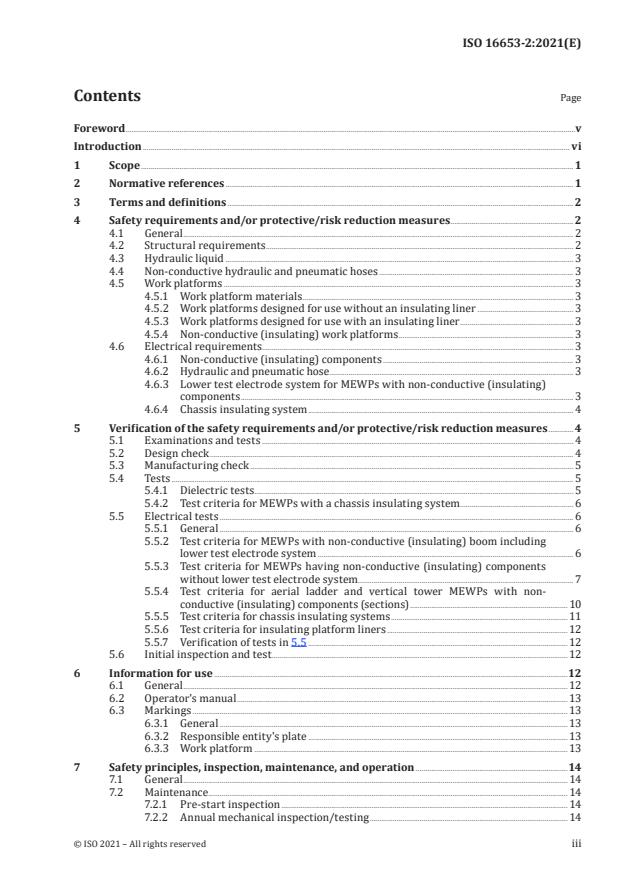
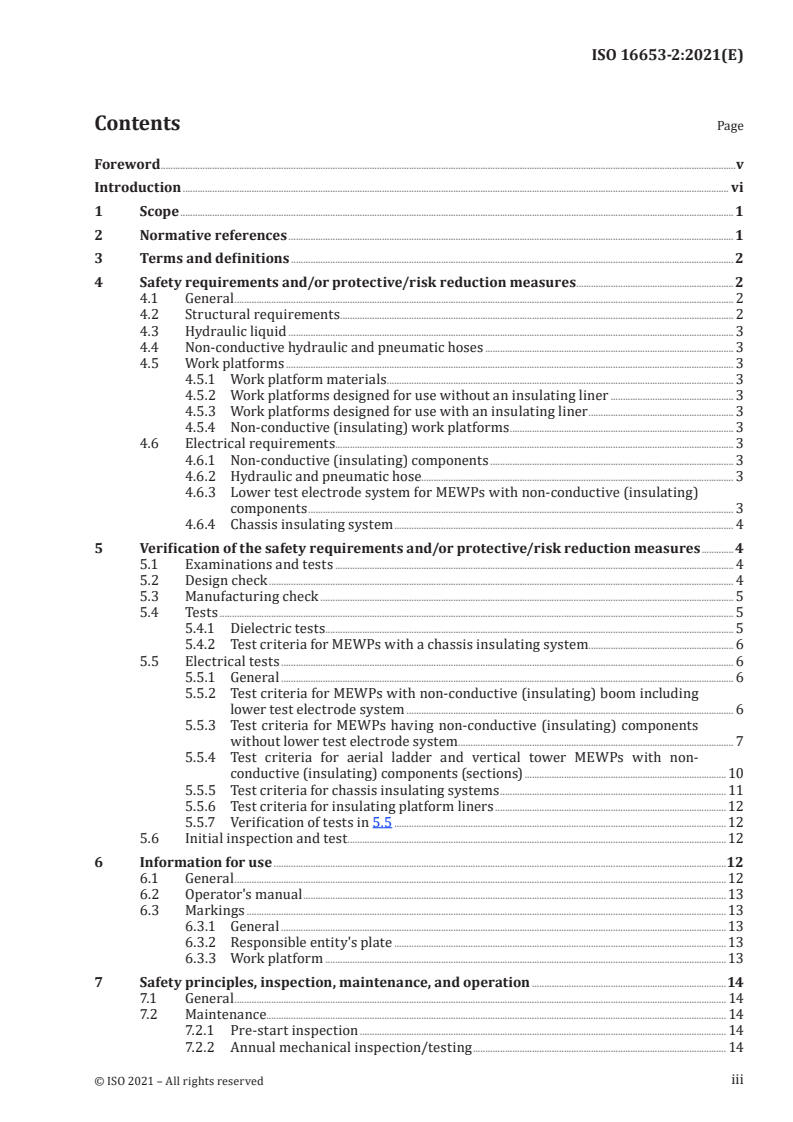
Contents Page
Foreword .v
Introduction . vi
1 Scope . 1
2 Normative references . 1
3 Terms and definitions . 2
4 Safety requirements and/or protective/risk reduction measures .2
4.1 General . 2
4.2 Structural requirements . . 2
4.3 Hydraulic liquid . 3
4.4 Non-conductive hydraulic and pneumatic hoses . 3
4.5 Work platforms . 3
4.5.1 Work platform materials . . 3
4.5.2 Work platforms designed for use without an insulating liner . 3
4.5.3 Work platforms designed for use with an insulating liner . 3
4.5.4 Non-conductive (insulating) work platforms . 3
4.6 Electrical requirements. 3
4.6.1 Non-conductive (insulating) components . 3
4.6.2 Hydraulic and pneumatic hose. 3
4.6.3 Lower test electrode system for MEWPs with non-conductive (insulating)
components . 3
4.6.4 Chassis insulating system . 4
5 Verification of the safety requirements and/or protective/risk reduction measures .4
5.1 Examinations and tests . 4
5.2 Design check . 4
5.3 Manufacturing check . 5
5.4 Tests . 5
5.4.1 Dielectric tests. 5
5.4.2 Test criteria for MEWPs with a chassis insulating system . 6
5.5 Electrical tests . 6
5.5.1 General . 6
5.5.2 Test criteria for MEWPs with non-conductive (insulating) boom including
lower test electrode system . 6
5.5.3 Test criteria for MEWPs having non-conductive (insulating) components
without lower test electrode system . 7
5.5.4 Test criteria for aerial ladder and vertical tower MEWPs with non-
conductive (insulating) components (sections) . 10
5.5.5 Test criteria for chassis insulating systems . 11
5.5.6 Test criteria for insulating platform liners .12
5.5.7 Verification of tests in 5.5 .12
5.6 Initial inspection and test . .12
6 Information for use .12
6.1 General .12
6.2 Operator's manual . 13
6.3 Markings . 13
6.3.1 General .13
6.3.2 Responsible entity's plate . 13
6.3.3 Work platform .13
7 Safety principles, inspection, maintenance, and operation .14
7.1 General . 14
7.2 Maintenance . 14
7.2.1 Pre-start inspection . 14
7.2.2 Annual mechanical inspection/testing . 14
iii
7.2.3 Annual confirmation electrical test . 15
7.2.4 Electrical tests .15
7.2.5 Electrical test equipment . 18
7.2.6 Electrical certification . 18
7.3 Modifications or alterations . 18
Annex A (informative) List of significant hazards .19
Bibliography .20
iv
Foreword
ISO (the International Organization for Standardization) is a worldwide federation of national standards
bodies (ISO member bodies). The work of preparing International Standards is normally carried out
through ISO technical committees. Each member body interested in a subject for which a technical
committee has been established has the right to be represented on that committee. International
organizations, governmental and non-governmental, in liaison with ISO, also take part in the work.
ISO collaborates closely with the International Electrotechnical Commission (IEC) on all matters of
electrotechnical standardization.
The procedures used to develop this document and those intended for its further maintenance are
described in the ISO/IEC Directives, Part 1. In particular, the different approval criteria needed for the
different types of ISO documents should be noted. This document was drafted in accordance with the
editorial rules of the ISO/IEC Directives, Part 2 (see www.iso.org/directives).
Attention is drawn to the possibility that some of the elements of this document may be the subject of
patent rights. ISO shall not be held responsible for identifying any or all such patent rights. Details of
any patent rights identified during the development of the document will be in the Introduction and/or
on the ISO list of patent declarations received (see www.iso.org/patents).
Any trade name used in this document is information given for the convenience of users and does not
constitute an endorsement.
For an explanation of the voluntary nature of standards, the meaning of ISO specific terms and
expressions related to conformity assessment, as well as information about ISO's adherence to
the World Trade Organization (WTO) principles in the Technical Barriers to Trade (TBT), see
www.iso.org/iso/foreword.html.
This document was prepared by Technical Committee ISO/TC 214, Elevating work platforms.
This second edition cancels and replaces the first edition (ISO 16653-2:2009), which has been
technically revised.
The main changes compared to the previous edition are as follows:
— the limitation of applicability to 46 kV and below has been clarified in the Scope;
— the normative references have been updated;
— the hazard list has been moved to Annex A;
— in Clause 4, the bursting safety factors have been aligned with ISO 16368;
— in Clause 4, the requirements for vacuum flashover have been removed and the work platform
requirements have been clarified and re-organized;
— in Clause 5, general requirements for examination and test have been added;
— Table 1 and Table 2 have been updated.
A list of all parts in the ISO 16653 series can be found on the ISO website.
Any feedback or questions on this document should be directed to the user’s national standards body. A
complete listing of these bodies can be found at www.iso.org/members.html.
v
Introduction
The object of this document is to define rules for safeguarding persons and objects against the risk of
accident associated with the operation of special-application mobile elevating work platforms (MEWPs).
This document does not repeat all the general technical rules applicable to every electrical, mechanical
or structural component.
The safety requirements of this document have been drawn up on the basis that MEWPs are periodically
maintained according to the manufacturer's instructions, working conditions, frequency of use and
applicable regulations.
It is assumed that MEWPs will be checked for proper function daily before start of work and that the
MEWP will not be put into operation unless all required controls and safety devices are available and in
working order. If a MEWP is seldom used, the checks may be made before start of work.
Where, for clarity, an example of a safety measure is given in the text, the example is intended as a
possible solution. Any other safety measure solution leading to an equivalent level of safety is
permissible.
vi
INTERNATIONAL STANDARD ISO 16653-2:2021(E)
Mobile elevating work platforms — Design, calculations,
safety requirements and test methods relative to special
features —
Part 2:
MEWPs with non-conductive (insulating) components
1 Scope
This document specifies the design, calculations, safety requirements and test methods for mobile
elevating work platforms (MEWPs) with non-conductive (insulating) components. It is intended to be
used in conjunction with ISO 16368.
It is applicable to all types and sizes of MEWPs with non-conductive (insulating) components, including
dielectric components designed and tested to meet the specific electrical properties consistent with the
manufacturer's identification plate. This equipment is intended to move persons, tools and equipment to
working positions where they can carry out work from a work platform located above a non-conductive
(insulating) boom section.
This document covers structural design calculations and the application of stability criteria,
construction, safety examinations and tests done before MEWPs with non-conductive (insulating)
components are first put into service. Annex A identifies the hazards arising from the use of MEWPs
with non-conductive (insulating) components and describes methods for the elimination or reduction
of these hazards.
MEWPs covered in this document are not intended to have any of their components make contact with
live parts of electrical installations. The electrical properties of a MEWP's non-conducting (insulating)
components can provide electrical protection in case of inadvertent contact above the non-conductive
boom component at the platform end. If a MEWP is equipped with a chassis insulating system, it can
provide electrical protection for ground personnel in case of inadvertent contact above that system.
This document is not applicable to MEWPs designed for or capable of operating in live working
conditions (see IEC 61057). The electrical insulation level is limited to voltages experienced in electrical
distribution systems 46 kV and below.
2 Normative references
The following documents are referred to in the text in such a way that some or all of their content
constitutes requirements of this document. For dated references, only the edition cited applies. For
undated references, the latest edition of the referenced document (including any amendments) applies.
ISO 12100, Safety of machinery — General principles for design — Risk assessment and risk reduction
ISO 16368:2010, Mobile elevating work platforms — Design, calculations, safety requirements and test
methods
ISO 18893:2014, Mobile elevating work platforms — Safety principles, inspection, maintenance and
operation
IEC 61057, Live working — Insulating aerial devices for mounting on a chassis
3 Terms and definitions
For the purposes of this document, the terms and definitions given in ISO 16368:2010 and the following
apply.
ISO and IEC maintain terminology databases for use in standardization at the following addresses:
— ISO Online browsing platform: available at https:// www .iso .org/ obp
— IEC Electropedia: available at http:// www .electropedia .org/
3.1
chassis insulating system
system of non-conductive (insulating) components installed between the chassis and the structure
supporting the upper non-conductive (insulating) boom
Note 1 to entry: Such a system, when properly maintained, can provide insulation of the chassis, should the
portion of the MEWP between the upper non-conductive (insulating) boom and this system inadvertently contact
an energized conductor or other apparatus.
3.2
electrical insulation level
level of phase-to-earth (ground) electrical insulation offered by the non-conductive (insulating)
components of the upper boom and expressed by the maximum nominal voltage of an electrical
installation (line or equipment) in case of inadvertent contact with this installation above the non-
conductive (insulating) components at the platform end of the MEWP
Note 1 to entry: The electrical insulation level is established by the MEWP's responsible entity.
Note 2 to entry: The electrical insulation level is limited to voltages experienced in electrical distribution systems
(46 kV and below).
3.3
insulating liner
insert made of non-conductive (insulating) material and designed to fit inside the work platform
3.4
non-destructive examination
examination by various means of devices or their components without alteration of the original
components, so that they can function as before the testing
Note 1 to entry: These include acoustic emissions (AE), magnetic particle (MT), liquid penetrant (PT), ultrasonic
(UT), radiography (RT), dielectric (DT), and visual (VT).
4 Safety requirements and/or protective/risk reduction measures
4.1 General
4.1.1 The machine shall be designed according to the principles of ISO 12100 for relevant but not
significant hazards that are not dealt with by this document.
4.1.2 Except where otherwise specified in this document, the machine shall be in accordance with
ISO 16368:2010.
NOTE National or local requirements can apply, which could be more stringent.
4.2 Structural requirements
Structural requirements shall be in accordance with ISO 16368:2010.
4.3 Hydraulic liquid
Hydraulic liquid (usually oil or similar fluid) shall meet the requirements of the responsible entity and
the insulating requirements of the MEWP.
4.4 Non-conductive hydraulic and pneumatic hoses
Non-conductive hydraulic hoses and pneumatic hoses shall meet the requirements of IEC 61057.
4.5 Work platforms
4.5.1 Work platform materials
The work platform shall be constructed of non-conductive materials that does not sustain a flame after
an ignition source has been removed.
NOTE UL 94 – H-B or IEC 60695-11-10 can be used for guidance.
4.5.2 Work platforms designed for use without an insulating liner
A work platform designed for use without an insulating liner shall meet the requirements of
ISO 16368:2010, 4.6.16.
4.5.3 Work platforms designed for use with an insulating liner
A work platform designed for use with an insulating liner shall be identified as non-insulating. The
insulating liner shall be constructed from non-conductive materials and tested in accordance with
IEC 61057. The insulating liner shall be supported by the inside bottom surface of the work platform. A
work platform designed for use with an insulating liner shall not have drain holes or access openings.
4.5.4 Non-conductive (insulating) work platforms
A non-conductive (insulating) platform shall have no drain holes or access openings and shall be tested
in accordance with the dielectric tests for insulating liners as defined in IEC 61057.
4.6 Electrical requirements
4.6.1 Non-conductive (insulating) components
All components crossing non-conductive (insulating) portions of the applicable MEWP shall have
appropriate electrical insulating properties so that it conforms to the test requirements of this
document. All non-conductive (insulating) systems shall maintain the electrical insulating values in all
working boom positions, as defined by the responsible entity.
4.6.2 Hydraulic and pneumatic hose
All hydraulic and pneumatic hoses crossing the non-conductive (insulating) portion of the upper boom
shall be tested in accordance with IEC 61057.
4.6.3 Lower test electrode system for MEWPs with non-conductive (insulating) components
MEWPs with non-conductive (insulating) components equipped with a lower test electrode system
shall meet the lower test electrode system requirements of IEC 61057.
4.6.4 Chassis insulating system
MEWPs with a chassis insulating system shall have a means provided to bypass the chassis insulating
system during dielectric tests. See Figure 1.
Key
1 insulating system
2 temporary shunt (to be removed after test)
3 stainless steel stud with 25 mm thread exposed
Figure 1 — Example of shunting arrangement for chassis insulating systems
5 Verification of the safety requirements and/or protective/risk reduction
measures
5.1 Examinations and tests
5.1.1 The MEWP shall conform to the safety requirements and/or protective measures of ISO 16368
and this document.
5.1.2 Examinations and tests shall consist of
a) design checks (see 5.2),
b) manufacturing checks (see 5.3), and
c) tests (see 5.4).
5.1.3 The results of examinations and tests shall be recorded.
5.2 Design check
The design check shall verify that the MEWP is designed in accordance with this document. It shall
include verification of the following:
a) drawings containing the main dimensions of the MEWP;
b) description of the MEWP, with necessary information about its capabilities;
c) information about the materials used;
d) diagrams of the electrical, hydraulic and pneumatic circuits;
e) the operator's manual;
f) calculations.
5.3 Manufacturing check
The manufacturing check shall verify that
a) the MEWP is manufactured in accordance with the design check documents,
b) the components are in accordance with the drawings,
c) test certificates are available for each type of r
...
INTERNATIONAL ISO
STANDARD 16653-2
Second edition
2021-10
Mobile elevating work platforms —
Design, calculations, safety
requirements and test methods
relative to special features —
Part 2:
MEWPs with non-conductive
(insulating) components
Plates-formes élévatrices mobiles de personnel — Conception,
calculs, exigences de sécurité et méthodes d'essai concernant les
caractéristiques spéciales —
Partie 2: PEMP avec composants non conducteurs (isolants)
Reference number
© ISO 2021
All rights reserved. Unless otherwise specified, or required in the context of its implementation, no part of this publication may
be reproduced or utilized otherwise in any form or by any means, electronic or mechanical, including photocopying, or posting on
the internet or an intranet, without prior written permission. Permission can be requested from either ISO at the address below
or ISO’s member body in the country of the requester.
ISO copyright office
CP 401 • Ch. de Blandonnet 8
CH-1214 Vernier, Geneva
Phone: +41 22 749 01 11
Email: copyright@iso.org
Website: www.iso.org
Published in Switzerland
ii
Contents Page
Foreword .v
Introduction . vi
1 Scope . 1
2 Normative references . 1
3 Terms and definitions . 2
4 Safety requirements and/or protective/risk reduction measures .2
4.1 General . 2
4.2 Structural requirements . . 2
4.3 Hydraulic liquid . 3
4.4 Non-conductive hydraulic and pneumatic hoses . 3
4.5 Work platforms . 3
4.5.1 Work platform materials . . 3
4.5.2 Work platforms designed for use without an insulating liner . 3
4.5.3 Work platforms designed for use with an insulating liner . 3
4.5.4 Non-conductive (insulating) work platforms . 3
4.6 Electrical requirements. 3
4.6.1 Non-conductive (insulating) components . 3
4.6.2 Hydraulic and pneumatic hose. 3
4.6.3 Lower test electrode system for MEWPs with non-conductive (insulating)
components . 3
4.6.4 Chassis insulating system . 4
5 Verification of the safety requirements and/or protective/risk reduction measures .4
5.1 Examinations and tests . 4
5.2 Design check . 4
5.3 Manufacturing check . 5
5.4 Tests . 5
5.4.1 Dielectric tests. 5
5.4.2 Test criteria for MEWPs with a chassis insulating system . 6
5.5 Electrical tests . 6
5.5.1 General . 6
5.5.2 Test criteria for MEWPs with non-conductive (insulating) boom including
lower test electrode system . 6
5.5.3 Test criteria for MEWPs having non-conductive (insulating) components
without lower test electrode system . 7
5.5.4 Test criteria for aerial ladder and vertical tower MEWPs with non-
conductive (insulating) components (sections) . 10
5.5.5 Test criteria for chassis insulating systems . 11
5.5.6 Test criteria for insulating platform liners .12
5.5.7 Verification of tests in 5.5 .12
5.6 Initial inspection and test . .12
6 Information for use .12
6.1 General .12
6.2 Operator's manual . 13
6.3 Markings . 13
6.3.1 General .13
6.3.2 Responsible entity's plate . 13
6.3.3 Work platform .13
7 Safety principles, inspection, maintenance, and operation .14
7.1 General . 14
7.2 Maintenance . 14
7.2.1 Pre-start inspection . 14
7.2.2 Annual mechanical inspection/testing . 14
iii
7.2.3 Annual confirmation electrical test . 15
7.2.4 Electrical tests .15
7.2.5 Electrical test equipment . 18
7.2.6 Electrical certification . 18
7.3 Modifications or alterations . 18
Annex A (informative) List of significant hazards .19
Bibliography .20
iv
Foreword
ISO (the International Organization for Standardization) is a worldwide federation of national standards
bodies (ISO member bodies). The work of preparing International Standards is normally carried out
through ISO technical committees. Each member body interested in a subject for which a technical
committee has been established has the right to be represented on that committee. International
organizations, governmental and non-governmental, in liaison with ISO, also take part in the work.
ISO collaborates closely with the International Electrotechnical Commission (IEC) on all matters of
electrotechnical standardization.
The procedures used to develop this document and those intended for its further maintenance are
described in the ISO/IEC Directives, Part 1. In particular, the different approval criteria needed for the
different types of ISO documents should be noted. This document was drafted in accordance with the
editorial rules of the ISO/IEC Directives, Part 2 (see www.iso.org/directives).
Attention is drawn to the possibility that some of the elements of this document may be the subject of
patent rights. ISO shall not be held responsible for identifying any or all such patent rights. Details of
any patent rights identified during the development of the document will be in the Introduction and/or
on the ISO list of patent declarations received (see www.iso.org/patents).
Any trade name used in this document is information given for the convenience of users and does not
constitute an endorsement.
For an explanation of the voluntary nature of standards, the meaning of ISO specific terms and
expressions related to conformity assessment, as well as information about ISO's adherence to
the World Trade Organization (WTO) principles in the Technical Barriers to Trade (TBT), see
www.iso.org/iso/foreword.html.
This document was prepared by Technical Committee ISO/TC 214, Elevating work platforms.
This second edition cancels and replaces the first edition (ISO 16653-2:2009), which has been
technically revised.
The main changes compared to the previous edition are as follows:
— the limitation of applicability to 46 kV and below has been clarified in the Scope;
— the normative references have been updated;
— the hazard list has been moved to Annex A;
— in Clause 4, the bursting safety factors have been aligned with ISO 16368;
— in Clause 4, the requirements for vacuum flashover have been removed and the work platform
requirements have been clarified and re-organized;
— in Clause 5, general requirements for examination and test have been added;
— Table 1 and Table 2 have been updated.
A list of all parts in the ISO 16653 series can be found on the ISO website.
Any feedback or questions on this document should be directed to the user’s national standards body. A
complete listing of these bodies can be found at www.iso.org/members.html.
v
Introduction
The object of this document is to define rules for safeguarding persons and objects against the risk of
accident associated with the operation of special-application mobile elevating work platforms (MEWPs).
This document does not repeat all the general technical rules applicable to every electrical, mechanical
or structural component.
The safety requirements of this document have been drawn up on the basis that MEWPs are periodically
maintained according to the manufacturer's instructions, working conditions, frequency of use and
applicable regulations.
It is assumed that MEWPs will be checked for proper function daily before start of work and that the
MEWP will not be put into operation unless all required controls and safety devices are available and in
working order. If a MEWP is seldom used, the checks may be made before start of work.
Where, for clarity, an example of a safety measure is given in the text, the example is intended as a
possible solution. Any other safety measure solution leading to an equivalent level of safety is
permissible.
vi
INTERNATIONAL STANDARD ISO 16653-2:2021(E)
Mobile elevating work platforms — Design, calculations,
safety requirements and test methods relative to special
features —
Part 2:
MEWPs with non-conductive (insulating) components
1 Scope
This document specifies the design, calculations, safety requirements and test methods for mobile
elevating work platforms (MEWPs) with non-conductive (insulating) components. It is intended to be
used in conjunction with ISO 16368.
It is applicable to all types and sizes of MEWPs with non-conductive (insulating) components, including
dielectric components designed and tested to meet the specific electrical properties consistent with the
manufacturer's identification plate. This equipment is intended to move persons, tools and equipment to
working positions where they can carry out work from a work platform located above a non-conductive
(insulating) boom section.
This document covers structural design calculations and the application of stability criteria,
construction, safety examinations and tests done before MEWPs with non-conductive (insulating)
components are first put into service. Annex A identifies the hazards arising from the use of MEWPs
with non-conductive (insulating) components and describes methods for the elimination or reduction
of these hazards.
MEWPs covered in this document are not intended to have any of their components make contact with
live parts of electrical installations. The electrical properties of a MEWP's non-conducting (insulating)
components can provide electrical protection in case of inadvertent contact above the non-conductive
boom component at the platform end. If a MEWP is equipped with a chassis insulating system, it can
provide electrical protection for ground personnel in case of inadvertent contact above that system.
This document is not applicable to MEWPs designed for or capable of operating in live working
conditions (see IEC 61057). The electrical insulation level is limited to voltages experienced in electrical
distribution systems 46 kV and below.
2 Normative references
The following documents are referred to in the text in such a way that some or all of their content
constitutes requirements of this document. For dated references, only the edition cited applies. For
undated references, the latest edition of the referenced document (including any amendments) applies.
ISO 12100, Safety of machinery — General principles for design — Risk assessment and risk reduction
ISO 16368:2010, Mobile elevating work platforms — Design, calculations, safety requirements and test
methods
ISO 18893:2014, Mobile elevating work platforms — Safety principles, inspection, maintenance and
operation
IEC 61057, Live working — Insulating aerial devices for mounting on a chassis
3 Terms and definitions
For the purposes of this document, the terms and definitions given in ISO 16368:2010 and the following
apply.
ISO and IEC maintain terminology databases for use in standardization at the following addresses:
— ISO Online browsing platform: available at https:// www .iso .org/ obp
— IEC Electropedia: available at http:// www .electropedia .org/
3.1
chassis insulating system
system of non-conductive (insulating) components installed between the chassis and the structure
supporting the upper non-conductive (insulating) boom
Note 1 to entry: Such a system, when properly maintained, can provide insulation of the chassis, should the
portion of the MEWP between the upper non-conductive (insulating) boom and this system inadvertently contact
an energized conductor or other apparatus.
3.2
electrical insulation level
level of phase-to-earth (ground) electrical insulation offered by the non-conductive (insulating)
components of the upper boom and expressed by the maximum nominal voltage of an electrical
installation (line or equipment) in case of inadvertent contact with this installation above the non-
conductive (insulating) components at the platform end of the MEWP
Note 1 to entry: The electrical insulation level is established by the MEWP's responsible entity.
Note 2 to entry: The electrical insulation level is limited to voltages experienced in electrical distribution systems
(46 kV and below).
3.3
insulating liner
insert made of non-conductive (insulating) material and designed to fit inside the work platform
3.4
non-destructive examination
examination by various means of devices or their components without alteration of the original
components, so that they can function as before the testing
Note 1 to entry: These include acoustic emissions (AE), magnetic particle (MT), liquid penetrant (PT), ultrasonic
(UT), radiography (RT), dielectric (DT), and visual (VT).
4 Safety requirements and/or protective/risk reduction measures
4.1 General
4.1.1 The machine shall be designed according to the principles of ISO 12100 for relevant but not
significant hazards that are not dealt with by this document.
4.1.2 Except where otherwise specified in this document, the machine shall be in accordance with
ISO 16368:2010.
NOTE National or local requirements can apply, which could be more stringent.
4.2 Structural requirements
Structural requirements shall be in accordance with ISO 16368:2010.
4.3 Hydraulic liquid
Hydraulic liquid (usually oil or similar fluid) shall meet the requirements of the responsible entity and
the insulating requirements of the MEWP.
4.4 Non-conductive hydraulic and pneumatic hoses
Non-conductive hydraulic hoses and pneumatic hoses shall meet the requirements of IEC 61057.
4.5 Work platforms
4.5.1 Work platform materials
The work platform shall be constructed of non-conductive materials that does not sustain a flame after
an ignition source has been removed.
NOTE UL 94 – H-B or IEC 60695-11-10 can be used for guidance.
4.5.2 Work platforms designed for use without an insulating liner
A work platform designed for use without an insulating liner shall meet the requirements of
ISO 16368:2010, 4.6.16.
4.5.3 Work platforms designed for use with an insulating liner
A work platform designed for use with an insulating liner shall be identified as non-insulating. The
insulating liner shall be constructed from non-conductive materials and tested in accordance with
IEC 61057. The insulating liner shall be supported by the inside bottom surface of the work platform. A
work platform designed for use with an insulating liner shall not have drain holes or access openings.
4.5.4 Non-conductive (insulating) work platforms
A non-conductive (insulating) platform shall have no drain holes or access openings and shall be tested
in accordance with the dielectric tests for insulating liners as defined in IEC 61057.
4.6 Electrical requirements
4.6.1 Non-conductive (insulating) components
All components crossing non-conductive (insulating) portions of the applicable MEWP shall have
appropriate electrical insulating properties so that it conforms to the test requirements of this
document. All non-conductive (insulating) systems shall maintain the electrical insulating values in all
working boom positions, as defined by the responsible entity.
4.6.2 Hydraulic and pneumatic hose
All hydraulic and pneumatic hoses crossing the non-conductive (insulating) portion of the upper boom
shall be tested in accordance with IEC 61057.
4.6.3 Lower test electrode system for MEWPs with non-conductive (insulating) components
MEWPs with non-conductive (insulating) components equipped with a lower test electrode system
shall meet the lower test electrode system requirements of IEC 61057.
4.6.4 Chassis insulating system
MEWPs with a chassis insulating system shall have a means provided to bypass the chassis insulating
system during dielectric tests. See Figure 1.
Key
1 insulating system
2 temporary shunt (to be removed after test)
3 stainless steel stud with 25 mm thread exposed
Figure 1 — Example of shunting arrangement for chassis insulating systems
5 Verification of the safety requirements and/or protective/risk reduction
measures
5.1 Examinations and tests
5.1.1 The MEWP shall conform to the safety requirements and/or protective measures of ISO 16368
and this document.
5.1.2 Examinations and tests shall consist of
a) design checks (see 5.2),
b) manufacturing checks (see 5.3), and
c) tests (see 5.4).
5.1.3 The results of examinations and tests shall be recorded.
5.2 Design check
The design check shall verify that the MEWP is designed in accordance with this document. It shall
include verification of the following:
a) drawings containing the main dimensions of the MEWP;
b) description of the MEWP, with necessary information about its capabilities;
c) information about the materials used;
d) diagrams of the electrical, hydraulic and pneumatic circuits;
e) the operator's manual;
f) calculations.
5.3 Manufacturing check
The manufacturing check shall verify that
a) the MEWP is manufactured in accordance with the design check documents,
b) the components are in accordance with the drawings,
c) test certificates are available for each type of r
...