

ISO/IEC 24789-2:2024
(Main)Identification cards — Card service life — Part 2: Methods of evaluation
General Information
- Abstract
This document provides methods of evaluation for ID-1 identification card service life for the applications provided in ISO/IEC 24789-1. The listed evaluation methods represent available tests, not mandatory tests. The selection of mandatory tests is listed in ISO/IEC 24789-1.
- Status
- Published
- Publication Date
- 07-Jan-2024
- Technical Committee
- ISO/IEC JTC 1/SC 17 - Cards and security devices for personal identification
- Current Stage
- 6060 - International Standard published
- Start Date
- 08-Jan-2024
- Due Date
- 16-Oct-2023
- Completion Date
- 08-Jan-2024

Overview
ISO/IEC 24789-2:2024 - "Identification cards - Card service life - Part 2: Methods of evaluation" specifies standardized methods of evaluation for ID-1 identification card service life. It complements ISO/IEC 24789-1, which defines application profiles and the selection of mandatory tests. Part 2 lists available, non-mandatory test methods that enable objective comparison and ranking of card durability factors for issuers, manufacturers and suppliers.
Key technical topics and requirements
- Scope and relationship to Part 1: Provides test methods for the ID-1 card form factor; Part 1 defines which tests are mandatory for specific applications.
- Default test items: Defines baseline conditions such as test environment, pre-conditioning, default tolerances, and total measurement uncertainty to ensure repeatability and comparability.
- Comprehensive test methods (summarized from the table of contents):
- Surface abrasion and magnetic stripe abrasion
- ICM (integrated circuit module) adhesion: wrapping, push and pull tests
- Plasticised vinyl storage
- Temperature and humidity aging and temperature & exposure with humidity variation
- ID-1 card flexure (static bending stress)
- Cross-cut tape test and other mechanical strength tests
- Test reporting: Each method includes procedural steps and minimum reporting items to document results consistently.
- Informative Annex A: Additional tests (e.g., dye migration, contactless card mechanical life-cycle sequences) are provided for extended evaluations.
- Notable updates in the 2024 edition: methods revised to current practice, plasticizer change from DOP to DOTP, replacement of temperature-humidity cycling with a humidity-variation exposure method, addition of static bending stress, and other methodological refinements.
Practical applications
- Develop and validate card durability specifications for national IDs, payment cards, access cards and other ID-1 applications.
- Compare materials, laminates, printing methods, magnetic stripes and chip mounting options for life-cycle performance.
- Establish quality assurance and acceptance tests for production and procurement.
- Support R&D and failure analysis by reproducing environmental and mechanical stressors in a standardized manner.
- Provide objective input for procurement contracts, compliance checks and vendor benchmarking.
Who should use this standard
- Card issuers (government and private)
- Card manufacturers and laminators
- Card component suppliers (chips, magnetic stripes, adhesives)
- Independent test laboratories and QA teams
- Procurement specialists writing technical specifications
Related standards
- ISO/IEC 24789-1 (application profiles and selection of mandatory tests)
- The full ISO/IEC 24789 series for card service life guidance
Keywords: ISO/IEC 24789-2:2024, identification cards, card service life, ID-1, card durability testing, evaluation methods, ICM adhesion, temperature and humidity testing, flexure testing, magnetic stripe abrasion.
Relations
- Revises
ISO/IEC 24789-2:2011 - Identification cards — Card service life — Part 2: Methods of evaluation - Effective Date
- 06-Jun-2022
Get Certified
Connect with accredited certification bodies for this standard

BSI Group
BSI (British Standards Institution) is the business standards company that helps organizations make excellence a habit.

NYCE
Mexican standards and certification body.
Sponsored listings
Frequently Asked Questions
ISO/IEC 24789-2:2024 is a standard published by the International Organization for Standardization (ISO). Its full title is "Identification cards — Card service life — Part 2: Methods of evaluation". This standard covers: This document provides methods of evaluation for ID-1 identification card service life for the applications provided in ISO/IEC 24789-1. The listed evaluation methods represent available tests, not mandatory tests. The selection of mandatory tests is listed in ISO/IEC 24789-1.
This document provides methods of evaluation for ID-1 identification card service life for the applications provided in ISO/IEC 24789-1. The listed evaluation methods represent available tests, not mandatory tests. The selection of mandatory tests is listed in ISO/IEC 24789-1.
ISO/IEC 24789-2:2024 is classified under the following ICS (International Classification for Standards) categories: 35.240.15 - Identification cards. Chip cards. Biometrics. The ICS classification helps identify the subject area and facilitates finding related standards.
ISO/IEC 24789-2:2024 has the following relationships with other standards: It is inter standard links to ISO/IEC 24789-2:2011. Understanding these relationships helps ensure you are using the most current and applicable version of the standard.
ISO/IEC 24789-2:2024 is available in PDF format for immediate download after purchase. The document can be added to your cart and obtained through the secure checkout process. Digital delivery ensures instant access to the complete standard document.
Standards Content (Sample)
International
Standard
ISO/IEC 24789-2
Second edition
Identification cards — Card service
2024-01
life —
Part 2:
Methods of evaluation
Cartes d'identification — Durée de vie des cartes —
Partie 2: Méthodes d'évaluation
Reference number
© ISO/IEC 2024
All rights reserved. Unless otherwise specified, or required in the context of its implementation, no part of this publication may
be reproduced or utilized otherwise in any form or by any means, electronic or mechanical, including photocopying, or posting on
the internet or an intranet, without prior written permission. Permission can be requested from either ISO at the address below
or ISO’s member body in the country of the requester.
ISO copyright office
CP 401 • Ch. de Blandonnet 8
CH-1214 Vernier, Geneva
Phone: +41 22 749 01 11
Email: copyright@iso.org
Website: www.iso.org
Published in Switzerland
© ISO/IEC 2024 – All rights reserved
ii
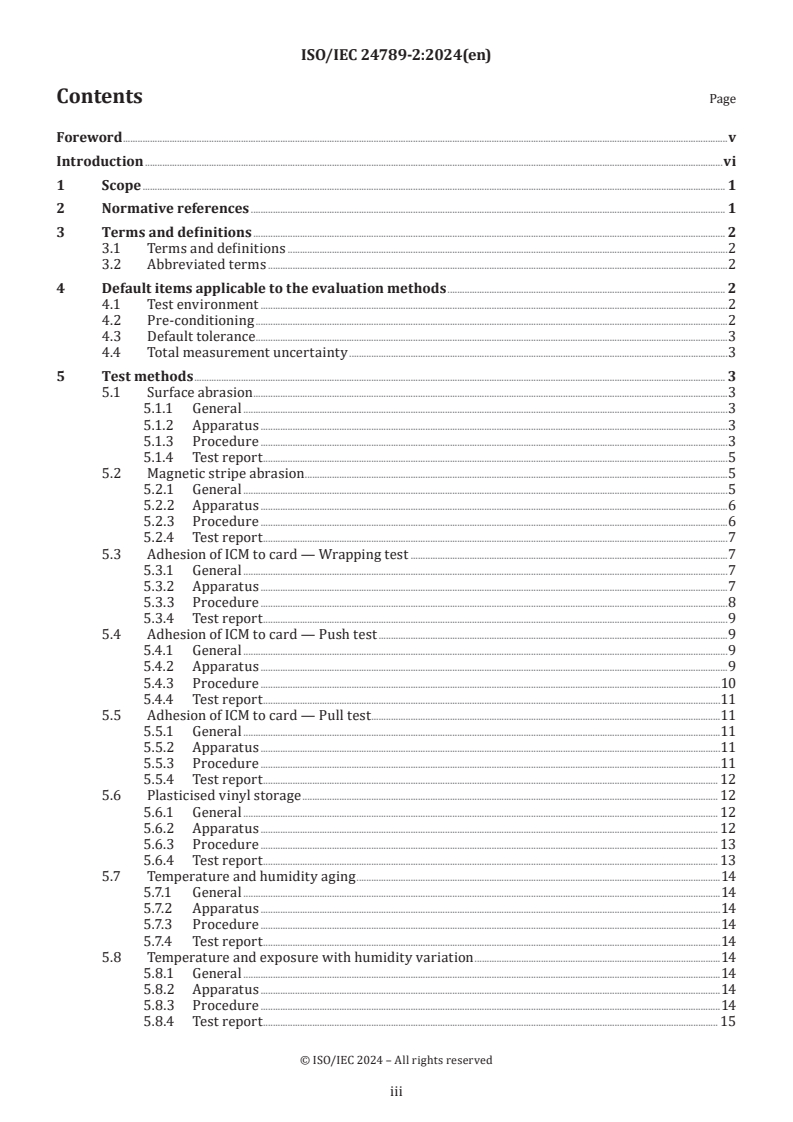
Contents Page
Foreword .v
Introduction .vi
1 Scope .1
2 Normative references .1
3 Terms and definitions . 2
3.1 Terms and definitions .2
3.2 Abbreviated terms .2
4 Default items applicable to the evaluation methods . 2
4.1 Test environment .2
4.2 Pre-conditioning .2
4.3 Default tolerance .3
4.4 Total measurement uncertainty .3
5 Test methods .3
5.1 Surface abrasion .3
5.1.1 General .3
5.1.2 Apparatus .3
5.1.3 Procedure .3
5.1.4 Test report .5
5.2 Magnetic stripe abrasion .5
5.2.1 General .5
5.2.2 Apparatus .6
5.2.3 Procedure .6
5.2.4 Test report .7
5.3 Adhesion of ICM to card — Wrapping test .7
5.3.1 General .7
5.3.2 Apparatus .7
5.3.3 Procedure .8
5.3.4 Test report .9
5.4 Adhesion of ICM to card — Push test .9
5.4.1 General .9
5.4.2 Apparatus .9
5.4.3 Procedure .10
5.4.4 Test report .11
5.5 Adhesion of ICM to card — Pull test .11
5.5.1 General .11
5.5.2 Apparatus .11
5.5.3 Procedure .11
5.5.4 Test report . 12
5.6 Plasticised vinyl storage . 12
5.6.1 General . 12
5.6.2 Apparatus . 12
5.6.3 Procedure . 13
5.6.4 Test report . 13
5.7 Temperature and humidity aging .14
5.7.1 General .14
5.7.2 Apparatus .14
5.7.3 Procedure .14
5.7.4 Test report .14
5.8 Temperature and exposure with humidity variation .14
5.8.1 General .14
5.8.2 Apparatus .14
5.8.3 Procedure .14
5.8.4 Test report . 15
© ISO/IEC 2024 – All rights reserved
iii
5.9 ID-1 card flexure . 15
5.9.1 General . 15
5.9.2 Apparatus . 15
5.9.3 Procedure . 15
5.9.4 Test report . 15
5.10 Cross cut tape test .16
5.10.1 General .16
5.10.2 Apparatus .16
5.10.3 Procedure .16
5.10.4 Test report .18
5.11 Additional test methods regarding mechanical strength .18
Annex A (informative) Additional tests . 19
Bibliography .36
© ISO/IEC 2024 – All rights reserved
iv
Foreword
ISO (the International Organization for Standardization) and IEC (the International Electrotechnical
Commission) form the specialized system for worldwide standardization. National bodies that are
members of ISO or IEC participate in the development of International Standards through technical
committees established by the respective organization to deal with particular fields of technical activity.
ISO and IEC technical committees collaborate in fields of mutual interest. Other international organizations,
governmental and non-governmental, in liaison with ISO and IEC, also take part in the work.
The procedures used to develop this document and those intended for its further maintenance are described
in the ISO/IEC Directives, Part 1. In particular, the different approval criteria needed for the different types
of document should be noted. This document was drafted in accordance with the editorial rules of the ISO/
IEC Directives, Part 2 (see www.iso.org/directives or www.iec.ch/members_experts/refdocs).
ISO and IEC draw attention to the possibility that the implementation of this document may involve the
use of (a) patent(s). ISO and IEC take no position concerning the evidence, validity or applicability of any
claimed patent rights in respect thereof. As of the date of publication of this document, ISO and IEC had not
received notice of (a) patent(s) which may be required to implement this document. However, implementers
are cautioned that this may not represent the latest information, which may be obtained from the patent
database available at www.iso.org/patents and https://patents.iec.ch. ISO and IEC shall not be held
responsible for identifying any or all such patent rights.
Any trade name used in this document is information given for the convenience of users and does not
constitute an endorsement.
For an explanation of the voluntary nature of standards, the meaning of ISO specific terms and expressions
related to conformity assessment, as well as information about ISO's adherence to the World Trade
Organization (WTO) principles in the Technical Barriers to Trade (TBT) see www.iso.org/iso/foreword.html.
In the IEC, see www.iec.ch/understanding-standards.
This document was prepared by Joint Technical Committee ISO/IEC JTC 1, Information technology,
Subcommittee SC 17, Cards and security devices for personal identification.
This second edition cancels and replaces the first edition (ISO/IEC 24789-2:2011), which has been technically
revised.
The main changes are as follows:
— all methods have been revised to bring them to the latest technical status;
— additional details are defined in the method ICM adhesion;
— plasticizer changed from DOP to DOTP;
— temperature humidity cycling method is replaced by temperature and exposure with humidity variation;
— temperature and humidity aging followed by peel strength is deleted;
— ID-card static bending stress method is added;
— temperature and humidity induced dye migration method is added to the informative Annex A;
— mechanical life cycle sequence for contactless cards is added to the informative Annex A.
A list of all parts in the ISO/IEC 24789 series can be found on the ISO and IEC websites.
Any feedback or questions on this document should be directed to the user’s national standards
body. A complete listing of these bodies can be found at www.iso.org/members.html and
www.iec.ch/national-committees.
© ISO/IEC 2024 – All rights reserved
v
Introduction
This document provides methods of evaluation of identification (ID) card service life. These methods of
evaluation complement the application profiles and requirements defined in ISO/IEC 24789-1 which are
intended to be used by card issuers, card manufacturers and card component suppliers to represent the
comparative rigour of various ID card service life applications. They provide a means for ranking and
comparing the main factors affecting ID card service life in a manner that is amenable to evaluation using
the methods defined or referenced in this document.
NOTE For the convenience of certain users, non-SI equivalents are given for some quantity values where these are
in common use in the ID card industry. These equivalents appear in parenthesis and are for information only.
© ISO/IEC 2024 – All rights reserved
vi
International Standard ISO/IEC 24789-2:2024(en)
Identification cards — Card service life —
Part 2:
Methods of evaluation
1 Scope
This document provides methods of evaluation for ID-1 identification card service life for the applications
provided in ISO/IEC 24789-1.
The listed evaluation methods represent available tests, not mandatory tests. The selection of mandatory
tests is listed in ISO/IEC 24789-1.
2 Normative references
The following documents are referred to in the text in such a way that some or all of their content constitutes
requirements of this document. For dated references, only the edition cited applies. For undated references,
the latest edition of the referenced document (including any amendments) applies.
ISO 3310-1, Test sieves — Technical requirements and testing — Part 1: Test sieves of metal wire cloth
ISO 3664, Graphic technology and photography — Viewing conditions
ISO 4892-1, Plastics — Methods of exposure to laboratory light sources — Part 1: General guidance
ISO 4892-2:2013, Plastics — Methods of exposure to laboratory light sources — Part 2: Xenon-arc lamps
ISO/IEC 7811-2, Identification cards — Recording technique — Part 2: Magnetic stripe: Low coercivity
ISO/IEC 7811-6, Identification cards — Recording technique — Part 6: Magnetic stripe: High coercivity
ISO/IEC 7811-8, Identification cards — Recording technique — Part 8: Magnetic stripe — Coercivity of
51,7 kA/m (650 Oe)
ISO 9370, Plastics — Instrumental determination of radiant exposure in weathering tests — General guidance
and basic test method
ISO/IEC 10373-1, Cards and security devices for personal identification — Test methods — Part 1: General
characteristics
ISO/IEC 10373-2, Identification cards — Test methods — Part 2: Cards with magnetic stripes
ISO 13655, Graphic technology — Spectral measurement and colorimetric computation for graphic arts images
ISO/IEC 14443-1, Cards and security devices for personal identification — Contactless proximity objects — Part
1: Physical characteristics
1)
ISO/IEC 24789-1 , Identification cards — Card service life — Part 1: Application profiles and requirements
IEC 60068-2-78, Environmental testing — Part 2-78: Tests — Test Cab: Damp heat, steady state
IEC 60454-2, Pressure-sensitive adhesive tapes for electrical purposes — Part 2: Methods of test
1) Under preparation. Stage at the time of publication: ISO/IEC FDIS 24789-1.
© ISO/IEC 2024 – All rights reserved
3 Terms and definitions
For the purposes of this document, the terms and definitions in ISO/IEC 24789-1 and the following apply.
ISO and IEC maintain terminology databases for use in standardization at the following addresses:
— ISO Online browsing platform: available at https:// www .iso .org/ obp
— IEC Electropedia: available at https:// www .electropedia .org/
3.1 Terms and definitions
3.1.1
card fracture
crack or break in a card whose depth is at least one third of the card thickness
3.1.2
contactless integrated circuit card
card into which integrated circuit and coupling means have been placed, such that the communication to
such integrated circuit is done in a contactless manner
3.2 Abbreviated terms
ATQA Answer To reQuest, Type A
ATQB Answer To reQuest, Type B
ATR answer to reset
DICC dual interface integrated circuit card, as defined in ISO/IEC 10373-1
DOTP dioctyl terephthalate CAS 6422-86-2
IC integrated circuit, as defined in ISO/IEC 7816-1
ICC integrated circuit card, as defined in ISO/IEC 7810
ICM integrated circuit model
PICC proximity integrated circuit(s) card or object, as defined in the ISO/IEC 14443 series
PVC polyvinyl chloride
RH relative humidity
VICC vicinity integrated circuit(s) card or object, as defined in the ISO/IEC 15693 series
4 Default items applicable to the evaluation methods
4.1 Test environment
Unless otherwise specified, testing shall take place in an environment having a temperature of 23 °C ± 3 °C
(73 °F ± 5 °F) and a relative humidity (RH) of 40 % to 60 %.
4.2 Pre-conditioning
Pre-conditioning is mandatory for all test methods. The identification card shall be conditioned in the test
environment for 16 h before testing.
© ISO/IEC 2024 – All rights reserved
4.3 Default tolerance
Unless otherwise specified, a default tolerance of ±5 % shall be applied to the quantity values given to specify
the characteristics of the test equipment (for example linear dimensions) and the test method procedures
(for example test equipment adjustments).
4.4 Total measurement uncertainty
Total measurement uncertainty shall be reported with the results and is considered when judging
conformity. The total measurement uncertainty should be less than 20 % of the permitted tolerance range.
JCGM 100 provides guidance for determining and expressing the total measurement uncertainty.
5 Test methods
5.1 Surface abrasion
5.1.1 General
The test simulates mechanical abrasion of the card surface.
5.1.2 Apparatus
5.1.2.1 Abraser, with vacuum pick up or equivalent:
2)
— abrasive wheels pair (TABER® CS-10F);
— resurfacing disks (TABER® S-11);
— dry soft cloth, or soft brush, or both;
— hole punch or equivalent;
— 500 g total load per wheel (250 g additional – no counter weight wheels);
— clamping ring (outer retaining ring).
5.1.3 Procedure
Prepare test cards that possess all desired information and features.
Use the notch location as per Figure 1 if the area of interest falls in the wheel path. If the area of interest does
not fall inside the wheel path in Figure 1 then:
— the card may be moved to a different location on the turntable, so the area of interest is in the wheel path;
— if only one card is tested, a place holder card shall be used to position the test card on the turntable so
the area of interest is abraded with minimal wheel bouncing;
— notches / holes for mounting the cards on the turntable shall be made in one or both cards;
— location of wear pattern tested shall be noted on the test report.
2) TABER® Industries is a trade name of products supplied by TABER® Industries. This information is given for the
convenience of users of this document and does not constitute an endorsement by ISO or IEC of the product named.
Equivalent products may be used if they can be shown to lead to same result.
© ISO/IEC 2024 – All rights reserved
Dimensions in millimetres
Key
1 abrasive wheel path
Figure 1 — Test card notch location
Resurface the abrasive wheels for 50 cycles before testing begins. Remove all debris from the cards and
turntable by cleaning with either a dry soft cloth or soft brush, or both. Avoid direct finger contact with
the test cards and abrasion wheels. Replace the S-11 resurfacing disk after a maximum of 10 uses. Use the
clamping ring when re-surfacing to avoid damage to vacuum nozzle from contact with the resurfacing disk.
Mount the cards on the turntable using the clamp plate and nut without a rubber pad. Place the abrasive
wheels on the cards and lower the vacuum nozzle to 3 mm (0.12 in) above them.
Start the abraser and vacuum.
— The test shall be paused every 50 cycles. The cards shall be cleaned and examined for wear-through.
— Wear-through within 6 mm (0.25 in) of the card edge shall be excluded from the examination.
— The cards and turntable shall be cleaned with a vacuum and either a dry soft cloth or soft brush, or both.
Avoid direct finger contact with the test cards and abrasion wheels.
— The abrasive wheels shall be resurfaced at the beginning of each test and again after every 250 cycles.
— The resurfacing is independent of specified cycles or stopping point.
— Stop the test after wear-through of the card feature is observed.
— Figure 2 illustrates 50 cycles before and at the stopping point for a heat transfer film, varnish or similar
coating. This will also be the stopping point for dye printing underneath the heat transfer film.
— Figure 3 illustrates 50 cycles before and at the stopping point for resin-based text. Wear-through is
defined as the point where any character is no longer legible.
— Figure 4 illustrates the stopping point for a resin based graphical element (e.g. logo, seal). Wear-through
is defined as the point where the element is no longer completely intact or functional.
— The test may be stopped after reaching the limit value of the base standard.
© ISO/IEC 2024 – All rights reserved
Key
1 wear-through
Figure 2 — 50 cycles before (left) and at (right) stopping point for heat transfer film, varnish or
similar coating
Figure 3 — 50 cycles before (left) and at (right) stopping point for resin-based text
Figure 4 — 50 cycles before (left) and at (right) stopping point for resin based graphical element
(e.g. logo, seal)
Test results are affected by alignment of the card and wheels. It is important that the wheels make uniform
contact with the card’s surface over the width of each wheel.
Test results are affected by roughness of the abrasive wheels.
5.1.4 Test report
Record the number of cycles to stopping point, along with location of wheel path.
Sample images at stopping point should be included in the test report unless security dictates their exclusion.
The test report inclusion of a card image at stopping point fulfils the wheel path documentation requirement.
5.2 Magnetic stripe abrasion
5.2.1 General
The test simulates mechanical abrasion of the card surface.
© ISO/IEC 2024 – All rights reserved
5.2.2 Apparatus
5.2.2.1 Abraser, with vacuum pick up or equivalent
— filler card (card of the same thickness as the card to be abraded);
— resurfacing disks (TABER® S-11);
— 500 g total load per wheel (250 g additional – no counter weight wheels);
— dry soft cleaning cloth or soft brush;
— hole punch or equivalent;
— magnetic stripe read test equipment with the following characteristics:
— ISO/IEC 10373-2 conformant;
— capable of reporting average signal amplitude (U ) on middle third of Track 2 according to
A
ISO/IEC 7811-2, ISO/IEC 7811-6 or ISO/IEC 7811-8.
5.2.3 Procedure
Prepare the card by encoding on Track 2 with a recording density of 8 ftpmm (200 ftpi), with a relative
tolerance of ±10 %, at a recording current of I . Use ISO/IEC 7811-2, ISO/IEC 7811-6 or ISO/IEC 7811-8 for
min
the definition and permitted range of I and ISO/IEC 10373-2 for the method to measure I .
min min
Create a hole in the card as shown in Figure 5.
Measure the average signal amplitude U in the read area shown in Figure 5.
A initial
Resurface the abrasive wheels for 50 cycles before testing begins and after every 100 cycles. Clean the cards
and turntable using a dry soft cloth or soft brush after the abrasive wheels are resurfaced. Avoid direct
finger contact with the cards and abrasion wheels. Complete the procedure for each card to the stopping
point before recommencing it with another card.
Mount the card on the turntable without any compliant pad. Add a filler card of the same thickness as the
card on the specimen plate so that the abrasive wheels do not bounce when the procedure is in progress.
Place the abrasive wheels (with the additional loads) on the card and the vacuum nozzle 6,4 mm (0.25 in)
above the cards.
Preset counter to 50 and start the abraser and vacuum. Ensure that the abrasive wheels do not bounce
during the test.
Remove the card and clean the magnetic stripe thoroughly, using a clean soft cloth, to remove debris.
NOTE A completely debris-free stripe prevents damage to the magnetic head used to measure the signal
amplitude.
Re-measure average signal amplitude (U ) in the read area shown in Figure 5.
A
Repeat the sequence. Wheel resurfacing is required every 100 cycles, while U measurements are made
A
every 50 cycles. The test may be stopped when the following occur:
— the average signal amplitude (U ) in the read area is equal to or less than 0,70 U ;
A A initial
— after 5 000 cycles if U remains above 0,70 U and the base standard does not specify otherwise.
A A initial
Record the number of cycles to stopping point for each card tested.
© ISO/IEC 2024 – All rights reserved
Dimensions in millimetres
Key
1 read area
2 hole
3 abrasive wheel path
Figure 5 — Magnetic stripe read area and hole location
5.2.4 Test report
Report the number of abrasion cycles for each card tested.
NOTE Graphical results (average signal amplitude vs. abraser cycles) have been shown to be useful in showing
abrasion characteristics.
5.3 Adhesion of ICM to card — Wrapping test
5.3.1 General
The purpose of this method is to establish that sufficient bond strength exists between the card and the ICM
of an IC card with contacts.
This test is destructive and tested cards are not suitable for further use.
With certain ICC designs, this test can cause localized detachment of the adhesive near the connection
points of the antenna. If the ICM remains firmly attached in all four corners, then this should not be seen as a
failure. The visual check shall be done at bending stage.
5.3.2 Apparatus
The test shall be carried out by wrapping the card module side up around a cylinder, with a diameter D of
50 mm. See Figure 6.
© ISO/IEC 2024 – All rights reserved
Dimensions in millimetres
Key
1 card front side 3 jaw
2 card back side 4 location of ICM
NOTE The rounded part of the apparatus is half a cylinder, not half a sphere
Figure 6 — Wrapping test apparatus with IC card inserted
5.3.3 Procedure
Insert the card in the jaws, contact side up, the ICM being as close as possible to the jaw, but definitely on the
radius of the testing device, when wrapped.
Wrap the card 10 times as shown in Figure 7. The time for deforming the card from a fully relaxed to a fully
wrapped position shall be between 0,5 s and 2 s. The time for relaxing the card from a fully wrapped to a
fully relaxed position shall be between 0,5 s and 2 s.
© ISO/IEC 2024 – All rights reserved
Key
1 location of ICM
2 card front side
3 force
Figure 7 — Wrapping test apparatus with card being wrapped
5.3.4 Test report
Report if there is detachment of the ICM from the card body.
5.4 Adhesion of ICM to card — Push test
5.4.1 General
The area of the ICM shall be the full visible area of the ICM, not just the metallized area, nor just the adhesive
area.
The adhesive between the ICM and the card is a key factor of the ICC's durability and is designed to bond
plastic and other materials (card and ICM substrate). Many variables ranging from physical properties of the
related substrates, process parameters to end use environment can affect the adhesion.
This test is a destructive test with concentrated pressure on the exposed reverse side of the ICM, opposite to
the contacts. The test attempts to push the ICM out of the card.
The force is applied directly to the centre of the reverse side of the ICM through an opening in the card. The
opening in the card is created specifically for this test.
5.4.2 Apparatus
5.4.2.1 Card holder, to hold the card in a fixed position. The card holder has an opening that is slightly
larger than the visible surface of the ICM, to allow pushing the ICM from the card when applying a force from
behind.
5.4.2.2 Stamp, connected to a force measurement device. The stamp can move perpendicular to the card’s
surface and should be able to travel at least 5 mm deeper than the location of the card in the card holder.
The apparatus is shown in Figure 8
© ISO/IEC 2024 – All rights reserved
Key
1 force applied to the centre of ICM 4 card
2 ICM adhesive 5 ICM
3 stamp with a diameter of 5 mm 6 opening with at least the size of the ICM
7 milled hole; minimum for hole diameter of the
stamp +1 mm
Figure 8 — ICM push test
Certain recent ICM constructions have a very small IC and a very small encapsulation around the IC. When
embedding such an ICM into the card, the resulting cavity to hold the IC is probably also very small and a
stamp diameter of 5 mm is perhaps too large, as it would not fit into the part of the cavity holding the IC. In
such case, stamps with a smaller diameter are permitted.
5.4.3 Procedure
a) Remove the card material covering the backside of the ICM that is not adhered to the ICM. Ensure that
the encapsulation of the IC and wire bonds (for wire bonded IC) or the backside of the IC itself (for flip-
chip bonded IC) remain undamaged. Use milling or cutting equipment as suitable for the specific card
and ICM construction while taking care not to damage the adhesive between the ICM and the card.
b) Determine the centre of the ICM (reverse side).
c) Lower the stamp until it is close above the rear centre of the ICM without touching the ICM or the card
with the stamp.
d) Start the force measurement and continue lowering the stamp onto the rear of the ICM with a speed of
30 mm/min.
e) Continue the downward movement of the stamp until one of the following occurs:
— the ICM detaches at least partially from the card; or
— the ICM ruptures.
f) Record the maximum force measured.
g) Remove the card and ICM from the test apparatus and observe the ICM and card for the failure mode of
the adhesive and record the observation.
Failure modes recommended to distinguish are:
— ICM ruptured;
— ICM detached from the adhesive;
© ISO/IEC 2024 – All rights reserved
— adhesive detached from the card;
— adhesive split (adhesive can be found on both the detached ICM and the card).
NOTE The test is expected to irreversibly damage the ICM, even if the test is stopped at the minimum required
force. No verification of electrical functionality is required as part of this test and damage of the IC and ICM is likely to
occur.
5.4.4 Test report
The test report shall report the maximum force measured and the failure mode.
5.5 Adhesion of ICM to card — Pull test
5.5.1 General
The purpose of this test is to provide a means to determine the bond strength between the card and ICM.
ICM-to-card adhesion is a function of the card material, ICM, adhesive employed and the assembly process.
5.5.2 Apparatus
5.5.2.1 Force measuring device, which displays maximum force achieved and equipped with grip to affix
the test block.
5.5.2.2 Test block, a metal block with one end sized to fit onto the ICM contact surface without overlap
and as flat and smooth as the ICM. The block length is sufficient to facilitate the force measuring grip.
5.5.2.3 Card restraint fixture (see Figure 9).
5.5.2.4 Suitable adhesive, for example cyanoacrylate or 2-component epoxy adhesive.
NOTE Carbon steel test blocks and Loctite 380 adhesive have shown to produce sufficient bonding to the ICM.
5.5.3 Procedure
Place a drop of adhesive on the surface of the ICM. Press the contact surface of the test block on the ICM
surface and apply approximately 2 N (0.4 lbf) force on the test block during the curing time of the adhesive.
A clean ICM and test block surface is needed to achieve the optimal bond between the ICM and test block.
Allow adhesive to cure before performing the force measurement. Care shall be taken not to influence the
test results by adhesive flowing into the gaps between the ICM and the card.
Mount the IC card with the test block attached in the card restraint fixture and affix the force measuring
device to the test block. Pull the test block at a rate of 300 mm/min, until separation occurs (after the peak
force is achieved).
© ISO/IEC 2024 – All rights reserved
Key
1 applied force 5 ICM
2 test block affixed to ICM 6 ICM adhesive
3 adhesive for pull test 7 card
4 restraint fixture 8 opening in restraint fixture
Figure 9 — ICM pull test fixture
5.5.4 Test report
Record the peak (maximum) force achieved during the pull. Record whether the ICM was removed in whole
or in part or if the test block released from the ICM.
5.6 Plasticised vinyl storage
5.6.1 General
The purpose of this method is to evaluate the card’s resistance to the potentially damaging effects of
plasticisers. Plasticisers can migrate into the card from adjacent materials and can change the card's
physical properties.
5.6.2 Apparatus
5.6.2.1 Two rigid inert sheets, having dimensions that exceed the maximum length and width of the
cards to be evaluated. Glass or chrome plated steel are acceptable materials.
5.6.2.2 Soft PVC foils, containing 20 % to 30 % DOTP plasticiser cut, at least, to cover the entire card
3)
surface.
5.6.2.3 Weight, placed on top of one of the rigid inert sheets listed above, applying together with the top
rigid inert sheet a uniform pressure of 2,5 kPa ± 0,13 kPa (0.36 PSI ± 0.02 PSI) to the surface of a card placed
completely beneath the top rigid inert sheet.
3) DOTP sheets with a DOTP content between 26 % and 30 % can be obtained from Q-Card Company, 301 Reagan Street,
Sunbury, PA 17801 Phone 570 286-7447, Fax 570 286 2649, www .q -card .com, in small quantities. This information is
given for the convenience of users of this document and does not constitute an endorsement by ISO or IEC for this product.
© ISO/IEC 2024 – All rights reserved
NOTE 1 Test results vary depending upon DOTP content used. Higher DOTP content will degrade susceptible
materials faster.
NOTE 2 This pressure would correlate to a combined mass for the weight and top rigid inert sheet of 1 169 +/- 65 g
when testing an ID-1 card.
5.6.2.4 Environmental chamber.
5.6.3 Procedure
The procedure requires a batch of five cards for evaluation. Add placeholder cards in case less than five
samples are available for the test.
Starting from the rigid inert sheet, alternately place DOTP sheets and cards to form a stack. All card sides
shall be in contact with the surface of a DOTP sheet. DOTP sheets of about 450 µm should be used, or a stack
of DOTP sheets giving the same thickness.
Use DOTP sheets only once.
Cover the stack with weight and place all elements as shown in Figure 10 in an environmental chamber set
to temperature of 50 °C ± 3 °C for 48 h unless otherwise specified.
Key
1 weight 4 inert rigid sheet
2 card 5 stack of five cards and six plasticised DOTP foils
3 DOTP foil
Figure 10 — Cards stacked for loading into the environmental chamber
Remove the stack from the chamber and place in the test environment (4.1) and immediately remove the
weight from the stack. Allow the stack to cool for 2 h. Separate the plasticised vinyl sheets from the cards.
WARNING — Results obtained with DOTP sheets may not be directly comparable to results obtained
with DOP sheets, which were used in the first edition of this document.
5.6.4 Test report
Report visible changes to the card and transfer to DOTP sheets. Report the DOTP percentage by weight.
© ISO/IEC 2024 – All rights reserved
5.7 Temperature and humidity aging
5.7.1 General
The purpose of this test is to accelerate the aging process of the cards. The rate of humidity penetration
increases with higher temperatures. The aging effect can then be evaluated with complementary tests, such
as mechanical or thermo-mechanical tests.
This method exposes the card to elevated temperature and humidity. It can be used in conjunction with
other methods to evaluate the effect of aging on specified properties of the card.
5.7.2 Apparatus
5.7.2.1 Environmental chamber, as specified in IEC 60068-2-78.
5.7.2.2 Test card holder, constructed in such a way that permits exposure of the humid air to both
surfaces of the card and is sufficient to support cards without restricting their movement.
NOTE Stainless steel welded wire cloth has shown to provide proper card support. Other similar materials can be
also suitable.
5.7.3 Procedure
Place the sample card on the test card holder in the environmental chamber at RH and a time period
according to the defined sequence of the test plan.
Following the exposure, return the sample card to the test environment for 24 h ± 4 h before evaluating the
card.
5.7.4 Test report
Report any visual changes after exposure.
5.8 Temperature and exposure with humidity variation
5.8.1 General
The purpose of the test is to saturate the card material at a fixed temperature with water and dry the
material in the following step. This procedure first swells and in the second step shrinks the material which
induces a significant higher stress compared to a standard RH test (5.7). The defined test parameters (50 °C
±3°C/ 95 % RH ±5% RH followed by 50 °C ±3°C/ 25 % RH ±5% RH) ensure card materials are saturated with
water and dried afterwards.
5.8.2 Apparatus
5.8.2.1 Environmental
...