


ISO/FDIS 19718
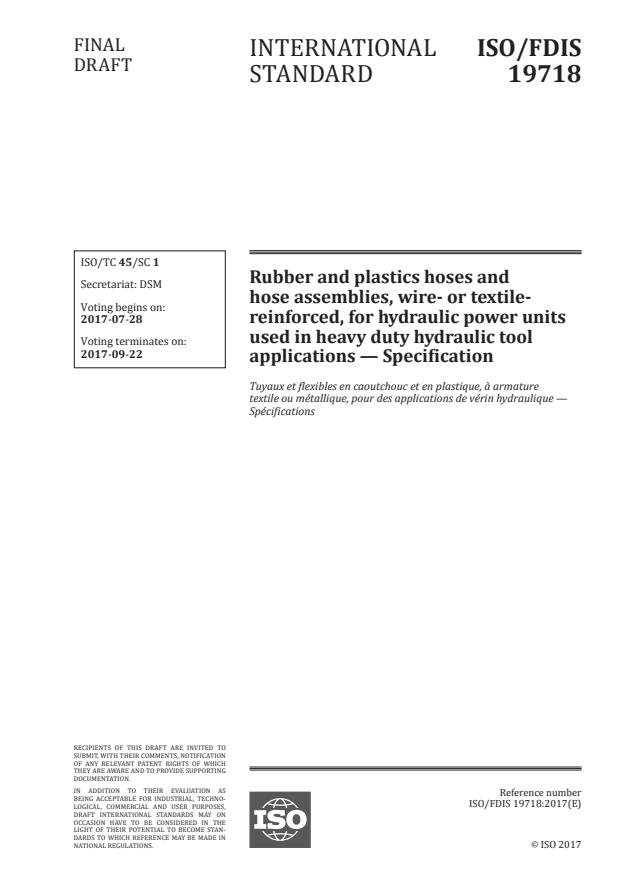
(Main)Rubber and plastics hoses and hose assemblies, wire- or textile- reinforced, for hydraulic power units used in heavy duty hydraulic tool applications — Specification
Rubber and plastics hoses and hose assemblies, wire- or textile- reinforced, for hydraulic power units used in heavy duty hydraulic tool applications — Specification
Tuyaux et flexibles en caoutchouc et en plastique, à armature textile ou métallique, pour des applications de vérin hydraulique — Spécifications
General Information
- Status
- Withdrawn
- Technical Committee
- ISO/TC 45/SC 1 - Rubber and plastics hoses and hose assemblies
- Drafting Committee
- ISO/TC 45/SC 1 - Rubber and plastics hoses and hose assemblies
- Current Stage
- 5098 - Project deleted
- Start Date
- 27-Oct-2017
- Completion Date
- 14-Feb-2026
Relations
- Effective Date
- 23-Jun-2018
- Effective Date
- 06-Jun-2022


Get Certified
Connect with accredited certification bodies for this standard

Institut za varilstvo d.o.o. (Welding Institute)
Slovenia's leading welding institute since 1952. ISO 3834, EN 1090, pressure equipment certification, NDT personnel, welder qualification. Only IIW Au
Sponsored listings
Frequently Asked Questions
ISO/FDIS 19718 is a draft published by the International Organization for Standardization (ISO). Its full title is "Rubber and plastics hoses and hose assemblies, wire- or textile- reinforced, for hydraulic power units used in heavy duty hydraulic tool applications — Specification". This standard covers: Rubber and plastics hoses and hose assemblies, wire- or textile- reinforced, for hydraulic power units used in heavy duty hydraulic tool applications — Specification
Rubber and plastics hoses and hose assemblies, wire- or textile- reinforced, for hydraulic power units used in heavy duty hydraulic tool applications — Specification
ISO/FDIS 19718 is classified under the following ICS (International Classification for Standards) categories: 23.040.70 - Hoses and hose assemblies. The ICS classification helps identify the subject area and facilitates finding related standards.
ISO/FDIS 19718 has the following relationships with other standards: It is inter standard links to ISO 23384:2021, ISO 1833-14:2019. Understanding these relationships helps ensure you are using the most current and applicable version of the standard.
ISO/FDIS 19718 is available in PDF format for immediate download after purchase. The document can be added to your cart and obtained through the secure checkout process. Digital delivery ensures instant access to the complete standard document.
Standards Content (Sample)
FINAL
INTERNATIONAL ISO/FDIS
DRAFT
STANDARD 19718
ISO/TC 45/SC 1
Rubber and plastics hoses and
Secretariat: DSM
hose assemblies, wire- or textile-
Voting begins on:
20170728 reinforced, for hydraulic power units
used in heavy duty hydraulic tool
Voting terminates on:
20170922
applications — Specification
Tuyaux et flexibles en caoutchouc et en plastique, à armature
textile ou métallique, pour des applications de vérin hydraulique —
Spécifications
RECIPIENTS OF THIS DRAFT ARE INVITED TO
SUBMIT, WITH THEIR COMMENTS, NOTIFICATION
OF ANY RELEVANT PATENT RIGHTS OF WHICH
THEY ARE AWARE AND TO PROVIDE SUPPOR TING
DOCUMENTATION.
IN ADDITION TO THEIR EVALUATION AS
Reference number
BEING ACCEPTABLE FOR INDUSTRIAL, TECHNO
LOGICAL, COMMERCIAL AND USER PURPOSES,
DRAFT INTERNATIONAL STANDARDS MAY ON
OCCASION HAVE TO BE CONSIDERED IN THE
LIGHT OF THEIR POTENTIAL TO BECOME STAN
DARDS TO WHICH REFERENCE MAY BE MADE IN
©
NATIONAL REGULATIONS. ISO 2017
© ISO 2017, Published in Switzerland
All rights reserved. Unless otherwise specified, no part of this publication may be reproduced or utilized otherwise in any form
or by any means, electronic or mechanical, including photocopying, or posting on the internet or an intranet, without prior
written permission. Permission can be requested from either ISO at the address below or ISO’s member body in the country of
the requester.
ISO copyright office
Ch. de Blandonnet 8 • CP 401
CH1214 Vernier, Geneva, Switzerland
Tel. +41 22 749 01 11
Fax +41 22 749 09 47
copyright@iso.org
www.iso.org
ii © ISO 2017 – All rights reserved
Contents Page
Foreword .iv
1 Scope . 1
2 Normative references . 1
3 Terms and definitions . 2
4 Classification . 2
5 List of significant hazards . 2
5.1 General . 2
5.2 Hazards due to bursting or leaking of hoses . 2
5.3 Hazards due to failure of connectors . 2
5.4 Hazards due to errors by the operator . 3
5.5 Hazards due to change in length of hose assembly . 4
6 Safety requirements and/or protective measures . 5
6.1 General . 5
6.2 Requirements for compatibility of components . 5
7 Materials and construction . 5
7.1 Hoses . 5
7.2 Hose assemblies . 5
8 Dimensions and tolerances . 5
8.1 Diameters . 5
8.2 Cover thickness . 6
8.3 Concentricity. 6
9 Physical properties . 6
9.1 Fluid resistance . 6
9.1.1 Test pieces . 6
9.1.2 Oil resistance . 6
9.2 Performance requirements . 6
9.2.1 Hydrostatic requirements . 6
9.2.2 Change in length . 7
9.2.3 Minimum bend radius . 7
9.2.4 Resistance to impulse . 8
9.2.5 Leakage of hose assemblies . 8
9.2.6 Cold flexibility . 8
9.2.7 Ozone resistance . 8
9.2.8 Electrical conductivity . 9
9.3 Frequency of testing . 9
10 Type tests . 9
11 Marking . 9
11.1 Hoses . 9
11.2 Hose assemblies .10
12 Test report .10
13 Recommendations for packaging and storage .10
Annex A (normative) Test frequency.11
Annex B (informative) Production tests .12
Annex C (informative) Recommendations for lengths of supplied hoses and hose assemblies .13
Annex D (normative) Test method for electrical conductivity .14
Bibliography .15
Foreword
ISO (the International Organization for Standardization) is a worldwide federation of national standards
bodies (ISO member bodies). The work of preparing International Standards is normally carried out
through ISO technical committees. Each member body interested in a subject for which a technical
committee has been established has the right to be represented on that committee. International
organizations, governmental and nongovernmental, in liaison with ISO, also take part in the work.
ISO collaborates closely with the International Electrotechnical Commission (IEC) on all matters of
electrotechnical standardization.
The procedures used to develop this document and those intended for its further maintenance are
described in the ISO/IEC Directives, Part 1. In particular the different approval criteria needed for the
different types of ISO documents should be noted. This document was drafted in accordance with the
editorial rules of the ISO/IEC Directives, Part 2 (see www .iso .org/ directives).
Attention is drawn to the possibility that some of the elements of this document may be the subject of
patent rights. ISO shall not be held responsible for identifying any or all such patent rights. Details of
any patent rights identified during the development of the document will be in the Introduction and/or
on the ISO list of patent declarations received (see www .iso .org/ patents).
Any trade name used in this document is information given for the convenience of users and does not
constitute an endorsement.
For an explanation on the voluntary nature of standards, the meaning of ISO specific terms and
expressions related to conformity assessment, as well as information about ISO’s adherence to the
World Trade Organization (WTO) principles in the Technical Barriers to Trade (TBT) see the following
URL: w w w . i s o .org/ iso/ foreword .html.
This document was prepared by Technical Committee ISO/TC 45, Rubber and rubber products,
Subcommittee SC 1, Rubber and plastics hoses and hose assemblies.
iv © ISO 2017 – All rights reserved
FINAL DRAFT INTERNATIONAL STANDARD ISO/FDIS 19718:2017(E)
Rubber and plastics hoses and hose assemblies, wire- or
textile- reinforced, for hydraulic power units used in heavy
duty hydraulic tool applications — Specification
1 Scope
This document specifies the requirements for wire- or textile-reinforced hydraulic hose and hose
assemblies used in heavy duty hydraulic tool applications of sizes ranging from 5 to 10. They are suitable
for use with hydraulic fluids HH, HL, HM, HR and HV in accordance with ISO 6743-4 at temperature
ranging from −20 and +55 °C.
This document does not include requirements for the connection ends. It is limited to the performance
of hoses and hose assemblies. The hose assembly maximum working pressure is regulated by the lowest
maximum working pressure of the components.
Typical usage of this product includes, but is not limited to, applications where the hose is in close
proximity to the operator, such as rescue tools and electrical utilities service tools, using hydraulic
power units (electrical, pneumatic, etc.).
NOTE It is the responsibility of the user, in consultation with the hose manufacturer, to establish the
compatibility of the hose with the fluid to be used.
2 Normative references
The following documents, in whole or in part, are normatively referenced in this document and are
indispensable for its application. For dated references, only the edition cited applies. For undated
references, the latest edition of the referenced document (including any amendments) applies.
ISO 1402, Rubber and plastics hoses and hose assemblies — Hydrostatic testing
ISO 1817, Rubber, vulcanized or thermoplastic — Determination of the effect of liquids
ISO 4671, Rubber and plastics hoses and hose assemblies — Methods of measurement of the dimensions of
hoses and the lengths of hose assemblies
ISO 67434, Lubricants, industrial oils and related products (class L) — Classification — Part 4: Family H
(Hydraulic systems)
ISO 6803, Rubber or plastics hoses and hose assemblies — Hydraulic-pressure impulse test without flexing
ISO 7326:2016, Rubber and plastics hoses — Assessment of ozone resistance under static conditions
ISO 8330, Rubber and plastics hoses and hose assemblies — Vocabulary
ISO 8331, Rubber and plastics hoses and hose assemblies — Guidelines for selection, storage, use and
maintenance
ISO 106191, Rubber and plastics hoses and tubing — Measurement of flexibility and stiffness — Part 1:
Bending tests at ambient temperature
ISO 106192:2011, Rubber and plastics hoses and tubing — Measurement of flexibility and stiffness —
Part 2: Bending tests at sub-ambient temperatures
ISO 12100, Safety of machinery — General principles for design — Risk assessment and risk reduction
3 Terms and definitions
For the purposes of this document, the terms and definitions given in ISO 8330 apply.
ISO and IEC maintain terminological databases for use in standardization at the following addresses:
— ISO Online browsing platform: available at http:// www .iso .org/ obp
— IEC Electropedia: available at http:// www .electropedia .org/
4 Classification
All hoses are classified on their electrical properties using grades:
a) Grade 1, no electrical requirements.
b) Grade
...
Questions, Comments and Discussion
Ask us and Technical Secretary will try to provide an answer. You can facilitate discussion about the standard in here.
Loading comments...